059.pdf
Unknown Volume 710 pages 616 redactions 0.1% redacted
Help categorize this page (click to add/remove your vote)
1 redactions
4 redactions
1 redactions
4 redactions
1 redactions
1 redactions
1 redactions
1 redactions
1 redactions
7 redactions
1 redactions
2 redactions
2 redactions
11 redactions
1 redactions
7 redactions
1 redactions
2 redactions
1 redactions
2 redactions
4 redactions
8 redactions
7 redactions
7 redactions
4 redactions
18 redactions
10 redactions
4 redactions
21 redactions
8 redactions
14 redactions
3 redactions
26 redactions
8 redactions
22 redactions
8 redactions
8 redactions
7 redactions
13 redactions
12 redactions
7 redactions
6 redactions
14 redactions
5 redactions
8 redactions
14 redactions
18 redactions
14 redactions
18 redactions
27 redactions
14 redactions
13 redactions
17 redactions
24 redactions
14 redactions
22 redactions
17 redactions
35 redactions
11 redactions
21 redactions
19 redactions
10 redactions
1 redactions
1 redactions
1 redactions
1 redactions
NOT A CERTIFIED COPY
Filing# 125411406 E-Filed 04/22/2021 11 :42:00 AM
CA FLORIDA HOLDINGS, LLC,
Publisher of THE PALM BEACH POST,
Plaintiff,
V.
DA VE ARONBERG, as State Attorney of
Palm Beach County, Florida; SHARON R.
BOCK, as Clerk and Comptroller of Palm
Beach County, Florida,
Defendants.
IN THE CIRCUIT COURT OF THE
FIFTEENTH WDICIAL CIRCUIT IN AND
FOR PALM BEACH COUNTY, FLORIDA
CASE NO.: 50-2019-CA-014681-XXXX-MB
DIVISION: AG
APPENDIX TO MOTION OF PLAINTIFF CA FLORIDA HOLDINGS, LLC
FOR SUMMARY JUDGMENT AND INCORPORATED MEMORANDUM OF LAW
1.
Excerpts from the March 19, 2010 deposition of Detective Joseph Recarey (Volume I and
11)
2.
Excerpts from the April 27, 2010 deposition of Detective Joseph Recarey (Volume III and
IV)
3.
November 2020 Department of Justice Office of Professional Responsibility Report
4.
Excerpts from the November 23, 2009 video-taped deposition of Michael Reiter (Volume
I and 11)
5.
May 1, 2006 Michael S. Reiter, Chief of Police, letter to Barry E. Krischer, State Attorney
6.
Indictment
7.
Non-Prosecution Agreement and Addendum to the Non-Prosecution Agreement
8.
Plea Deal
9.
July 8, 2019 Geoffrey S. Berman, United States Attorney, letter to The Honorable Henry
Pitman re: United States v. Jeffrey Epstein; Case No. 19 CR 490 (RMB)
GreenbergTraurig, P.A. ■ 401 East Las Olas Boulevard, Suite 2000 ■ Ft. Lauderdale, Florida 33301 ■ Tel 954.765.0500 ■ Fax 954.765.1477 ■ www.gtlaw.com
FILED: PALM BEACH COUNTY, FL, JOSEPH ABRUZZO, CLERK, 04/22/2021 11 :42:00 AM
NOT A CERTIFIED COPY
10.
July 8, 2019 Department of Justice U.S. Attorney's Office for the Southern District ofNew
York Press Release "Jeffrey Epstein Charged in Manhattan Federal Court With Sex
Trafficking Of Minors"
11.
August 27, 2019 Hearing Transcript from United States District Court of the Southern
District of New York, United Sates of America v. Jeffrey Epstein; Case No. 19 CR 490
(RMB)
12.
Palm Beach Post articles
13.
June 3, 2020 Hearing Transcript on the Motion to Dismiss in Circuit Court of Palm Beach
County, CA Florida Holdings LLC Publisher of the Palm Beach Post v. Dave Aronberg,
Sharon R. Bock; Case No. 50-2019-A-014681
Dated: April 22, 2021
Respectfully submitted,
GREENBERG TRAURIG, P.A.
Attorneys for CA Florida Holdings, LLC,
Publisher of The Palm Beach Post
Stephen A. Mendelsohn, Esq.
401 East Las Olas Blvd., Ste. 2000
Fort Lauderdale, Florida 33301
Telephone: (954) 768-8225
Facsimile: (561) 338-7099
By: Isl Stephen A. Mendelsohn
STEPHEN A. MENDELSOHN
Florida Bar No. 849324
mendelsohns@gtlaw.com
smithl@gtlaw.com
FLService@gtlaw.com
By: Isl Michael J Grygiel
MICHAEL J. GRYGIEL
(Admitted Pro Hae Vice)
54 State St., 6th Floor
Albany, New York 12207
Telephone: (518) 689-1400
Facsimile: (518) 689-1499
grygielm@gtlaw.com
GreenbergTraurig, P.A. ■ 401 East Las Olas Boulevard, Suite 2000 ■ Ft. Lauderdale, Florida 33301 ■ Tel 954.765.0500 ■ Fax 954.765.1477 ■ www.gtlaw.com
2
NOT A CERTIFIED COPY
By: /s/ Nina D. Boyaiian
NINA D. BOY AJIAN
(Admitted Pro Hae Vice)
1840 Century Park East, Ste. 1900
Los Angeles, California 90067
Telephone: (310) 586-7700
Facsimile: (310) 586-7800
boyajiann@gtlaw.com
CERTIFICATE OF SERVICE
I HEREBY CERTIFY that on this 22nd day of April, 2021, a true and correct copy of the
foregoing has been filed with the Clerk of the Court using the State of Florida e-filing system,
which will send a notice of electronic service for all parties of record herein
Isl Stephen A. Mendelsohn
STEPHEN A. MENDELSOHN
GreenbergTraurig, P.A. ■ 401 East Las Olas Boulevard, Suite 2000 ■ Ft. Lauderdale, Florida 33301 ■ Tel 954.765.0500 ■ Fax 954.765.1477 ■ www.gtlaw.com
3
NOT A CERTIFIED COPY
Appendix 1
NOT A CERTIFIED COPY
UNITED STATES DISTRICT COURT
SOUTHERN DISTRICT OF FLORIDA
CASE NO. 08-CIV-80119-MARRA/JOHNSON
JANE DOE NO. 2,
Plaintiff,
-vs-
VOLUME I OF II
JEFFREY EPSTEIN,
Defendant.
----------------------
Related cases:
08-80232, 08-08380, 08-80381, 08-80994
08-80993, 08-80811, 08-80893, 09-80469
09-80591, 09-80656, 09-80802, 09-81092
----------------------
DEPOSITION OF
DETECTIVE JOSEPH RECAREY
Friday, March 19, 2010
9:37 -
5:12 p.m.
250 Australian Avenue South
Suite 1500
I
I
West Palm Beach, Florida 33401
Reported By:
Cynthia Hopkins, RPR, FPR
Notary Public, State of Florida
Prose Court Reporting
Job No.:
1509
(561) 832-7500
PROSE COURT REPORTING AGENCY, INC.
Page 1
(561) 832-7506
NOT A CERTIFIED COPY
1
2
3
4
5
6
IN THE CIRCUIT COURT OF THE FIFTEENTH JUDICIAL
CIRCUIT IN AND FOR PALM BEACH COUNTY, FLORIDA
CASE No.502008CA037319XXXXMB AB
B.B.
Plaintiff,
-vs-
VOLUME I OF II
7
JEFFREY EPSTEIN
AND SARAH KELLEN,
8
9
10
11
12
13
14
15
16
Defendants.
----------------------
DEPOSITION OF
DETECTIVE JOSEPH RECAREY
Friday, March 19, 2010
9:37 -
5:12 p.m.
250 Australian Avenue South
Suite 1500
I
17
18
19
20
21
West Palm Beach, Florida 33401
22
Reported By:
Cynthia Hopkins, RPR, FPR
23
Notary Public, State of Florida
Prose Court Reporting
24
Job No.:
1509
25
Page 2
(561) 832-7500
PROSE COURT REPORTING AGENCY, INC.
(561) 832-7506
NOT A CERTIFIED COPY
1
2
3
4
5
6
7
8
9
Q.
I understand.
Now, it's obviously not
public at that point.
You're keeping the
investigation private?
A.
Q.
Correct.
But nonetheless all those documents that
you would have reviewed from Ms. Pagan would have
been business records of the police department at
the time?
A.
Correct.
Page 31
10
Q.
I understand.
Now, when you reviewed this
11
information from Detective Pagan, could you walk us
12
through exactly what -
had explained occurred to
13
her?
14
MR. PIKE:
Form.
(15)
(THE WITNESS:) (She was taken to)
[§)
(Mr. Epstein's house for the purpose of making)
[2)
(money_,_providing a massag.ij
@)
(MR. KUVIN : ) (Q_§y__J
[:[)
(THE WITNESS:) (Once she got there, she was)
(20)
(taken upstairs to the bedroom area.) (At that)
(21)
(time what my understanding was is they were)
(22)
(taken to the bedroom area through the stairwell)
(23)
(where Mr. Epstein was awaiting to do a massag.ij
(2 4)
(MR. KUVIN:) (Q_§y__J
(25)
(THE WITNESS:) (The massage begiii.J (At some)
(561) 832-7500
PROSE COURT REPORTING AGENCY, INC.
(561) 832-7506
NOT A CERTIFIED COPY
(D
®
@)
@)
@)
@
(JJ
®
®
~
(ill
(9
~
[])
~
[§)
[2)
(ill
~
~
@
~
@
~
@
Page 32
(point during the massage Mr. Epstein -- this is)
(all off recollection by the way?)
(MR. KUVIN:) (f[__you want to use the)
(incident report, what we're referring to would)
(be on Pages 11 through roughly 15 of the)
(incident report --)
( MR . PI KE : ) (Just - - )
(MR. KUVIN:) (-- if you need it to helpJ
(refresh your recollection.)
(MR. PIKE:) (Just so the record is clear,)
(we' re still on the one question.) (There is a)
(form objection on the same answer.)
(THE WITNESS:) (It was -- I haven't found)
(exactly where she goes into the story, however)
(I know --)
(MR. KUVIN:) (I think it's at Page 14.)
(THE WITNESS:) (-- where there was some)
(touching involved, and Mr. Epstein then, I)
(believe, introduced a massagii]
(BY MR. KUVIN:)
(gJ
(KJ
(gJ
(A vibrator?)
(Correct.)
@_§y?J (was she asked to take her clothes)
(off according to what she told the police)
~partment ?)
(561) 832-7500
PROSE COURT REPORTING AGENCY, INC.
(561) 832-7506
NOT A CERTIFIED COPY
Page 33
(D
(MR . PI KE : ) (Form . )
®
(THE WITNESS:) (Yes.)
@)
(BY MR. KUVIN:)
@)
(QJ
(And how old was she at the time?)
@)
(MR. PIKE:) (Form.)
@
(THE WITNESS:) (Fourteen.)
(JJ
(BY MR. KUVIN:)
@)
(QJ
(Was there an investigation as to how)-
(])
(actually was taken to the home?) (In other words did)
[Q)
(you determine who took her there?)
[D
@]
(Correct.)
(12)
(QJ
(Who was that?)
(13)
@]
(Haley Robson.)
[!)
(MR . PI KE : ) (Form . )
(15)
(BY MR. KUVIN:)
[§)
(QJ
(Did Ms. Pagan interview Ms. Robson?)
[2)
@]
(No, she did not.)
[ID
(QJ
(Not at this point?)
~
@J
(No.)
(20)
(QJ
(Did you ultimately interview Ms. Robson?)
@J
(Yes, I did.)
(QJ
(with respect to what) -
~plained, I)
(23)
(would like to walk through this if I could for a)
(2 4)
(minute.)
(25)
(MR. PIKE:) (What page are you on?)
(561) 832-7500
PROSE COURT REPORTING AGENCY, INC.
(561) 832-7506
NOT A CERTIFIED COPY
Page 34
(D
(MR. KUVIN:) (Fourteen.)
@
(BY MR. KUVIN :)
@)
(gJ
(Was there another woman that she described)
@)
(in the home at Epstein's house?)
@)
(MR. PIKE:) (Form.)
@
(THE WITNESS:) (Yes.) (She described a tall)
(JJ
(blonde female which I believe was Nadia)
@)
(Marcinkova.)
(])
(BY MR. KUVIN:)
[Q)
(gJ
~y__J (And what did Marcinkova do --)
[D
(MR. PIKE:) (Form.)
(12)
(BY MR. KUVIN:)
(13)
(gJ
(--
as far as what she described to yi2.i-ij
[!)
(MR. PIKE:) (Same objection.)
(15)
(THE WITNESS:) (If I can just --
I
am going)
~
(to --)
[2)
(MR. KUVIN:) (Yeah, take a look.)
[[)
(THE WITNESS:) (Nadia was the one who took)
~
(her upstairs, I believe.)
(2 o)
(MR. PIKE:) (Form.)
(21)
(BY MR. KUVIN:)
(22)
(gJ
@pstairs in Mr. Epstein's house?)
(2 3)
(MR. PIKE:) (Same objection.)
(2 4)
(THE WITNESS:) (Yes.)
25
(561) 832-7500
PROSE COURT REPORTING AGENCY, INC.
(561) 832-7506
NOT A CERTIFIED COPY
Page 35
(D
(BY MR. KUVIN:)
@
(gJ
(The same home that we described before on)
@)
(El Brillo Wayj)
@)
(MR. PIKE:) (Form.)
@)
(THE WITNESS:) (Yes.)
@
(BY MR. KUVIN:)
(JJ
~-~(Q.)
(All righi.J (Let's walk through some of)
@)
(this.) (when she gets upstairs, the woman leaves the)
(])
(room?)
@
(MR. PIKE:) (Form.)
[D
(THE WITNESS:) (Correct.)
(12)
(BY MR. KUVIN:)
(13)
(gJ
~y_J (At that point does she tell y:s@
[!)
(that Mr. Epstein comes in?)
(15)
(MR. PIKE:) (Form.)
[§)
(THE WITNESS:) (This is what she's informing)
[2)
(Officer Pagiii.J
[[)
(BY MR. KUVIN:)
[:[)
(gJ
~gan, y~
(20)
([J
(Yes.)
(21)
(MR. PIKE:) (Same objection.)
(22)
(BY MR. KUVIN:)
(23)
(gJ
(All righi.J (And what does Mr. Epstein do)
(24)
(at that point according to what)-explained?)
( 2 5)
( MR . PI KE : ) (Form . )
(561) 832-7500
PROSE COURT REPORTING AGENCY, INC.
(561) 832-7506
NOT A CERTIFIED COPY
Page 36
(D
(THE WITNESS:) (He told her to remove, take)
@
(off her clothes.)
@)
(BY MR. KUVIN:)
@)
(QJ
(Q_§y__J (And she's 14 at this point?)
@)
(MR. PIKE:) (Form.)
@
(THE WITNESS:) (correct.)
(JJ
(BY MR. KUVIN:)
@)
(QJ
(what did)- ~plain was his demeanor,)
(])
(Mr. Epstein's demeanor with respect to asking her to)
[2)
(take off her clothes?)
[D
(MR. PIKE:) (Form.)
(12)
(THE WITNESS:) (I believe he was stern when)
(13)
(he instructed her to remove her clothing]
[!)
(BY MR. KUVIN:)
(15)
(QJ
(What was he dressed in?)
[§)
(MR. PIKE:) (Form.)
[2)
(THE WITNESS:) (In a towel.)
[[)
(BY MR. KUVIN:)
[:m
(QJ
(Could you explain to us exactly what)
(20)
(Mr. Epstein surposedly instructed her to do--)
(21)
(MR. PIKE:) (Form.)
(22)
(BY MR. KUVIN:)
(23)
(QJ
(--
and then what he did?)
(2 4)
(MR. PIKE:) (Same objection.)
(25)
(THE WITNESS:) (He instructed her to provide)
(561) 832-7500
PROSE COURT REPORTING AGENCY, INC.
(561) 832-7506
NOT A CERTIFIED COPY
Page 37
(D
(a massag~pointing to the specific lotion for)
@
(her to use.) (He laid on the table face down.)
@)
(As she was providing the massage, he asked her)
@)
Eget onto his back.) (She straddled herself)
@)
(along his back and advised that her exposed)
@
(buttocks was touching his bare buttocks.)
(JJ
(MR. PIKE:) (Form, move to strike.)
@)
(BY MR. KUVIN :)
(])
(QJ
(What happened next?)
@
(MR. PIKE:) (Form.)
[D
(THE WITNESS:) (He turned over onto his back)
(12)
(and was masturbating__J
13
BY MR. KUVIN:
14
Q.
Okay.
Did he masturbate to conclusion
15
according to her?
16
17
MR. PIKE:
Form.
THE WITNESS:
It doesn't state in the
18
report.
19
BY MR. KUVIN:
20
Q.
Okay.
Did -describe what her reaction
21
was to what was occurring at this point?
22
23
24
25
(561) 832-7500
MR. KUVIN:
Form.
THE WITNESS:
She was disgusted by his
actions but didn't say anything.
PROSE COURT REPORTING AGENCY, INC.
(561) 832-7506
NOT A CERTIFIED COPY
1
2
3
4
5
6
7
8
9
10
11
12
13
14
15
16
17
18
~
~
@
~
@
~
25
Page 106
BY MR. KUVIN:
Q.
Okay.
And what does she describe occurs
between her, Ms. Marcinkova, Mr. Epstein, if
anything?
MR. PIKE:
Form.
THE WITNESS:
It was oral sex performed on
her.
There was strap-on penises utilized.
There was other sexual toys being used, a
vibrator.
BY MR. KUVIN:
Q.
Does she describe whether or not
Mr. Epstein actually puts his fingers inside of her
vagina or not?
A.
Yes.
MR. PIKE:
Form.
BY MR. KUVIN:
Q.
What does she state about that?
MR. PIKE:
Form.
(THE WITNESS:) (That Mr. Epstein inserted)
(his fingers in her vagina in an attempt to make)
ilier climax as she was masturbating him.)
(BY MR. KUVIN:)
(gJ
~
Q.
~11 of this while she was how old?)
(Sixteen.)
All right.
At some point you have to stop
(561) 832-7500
PROSE COURT REPORTING AGENCY, INC.
(561) 832-7506
NOT A CERTIFIED COPY
1
2
3
4
5
6
7
8
9
10
11
Page 112
BY MR. KUVIN:
Q.
-- any lawful reason why you could think
of why a 16-year-old girl could describe
Mr. Epstein's penis?
MR. PIKE:
Form.
THE WITNESS:
No.
BY MR. KUVIN:
Q.
Did Ms. Jane Doe No. 103 describe whether
or not she had an ongoing sexual relationship with
Mr. Epstein and Ms. Marcinkova at all?
A.
Yes, she did.
She stated that
12
MR. PIKE:
Form.
(13)
(THE WITNESS:) (She stated that when she)
[!)
(would come over, there was, she would have)
(15)
(either relations with Nadia or -- and at one)
[§)
(point she even stated there were some)
[2)
(photographs taken of her in the tub with Nadia.)
18
MR. PIKE:
Form.
19
BY MR. KUVIN:
20
21
22
23
24
25
(561) 832-7500
Q.
A.
Did you ever recover those photographs?
No.
MR. PIKE:
Form, move to strike the
previous response.
MS. EZELL:
Mr. Kuvin, excuse me.
I was
trying to object to the form of the previous
PROSE COURT REPORTING AGENCY, INC.
(561) 832-7506
NOT A CERTIFIED COPY
1
2
3
4
5
6
7
8
9
10
11
12
13
14
15
16
17
18
Page 114
second paragraph from the bottom.
A.
I know, but do you want to me to use her name
or use the redacted portions of it?
Q.
Yes.
We're discussing Ms. Jane Doe No.
103 at this point.
A.
"Jane Doe No. 103 advised one day, Jane Doe
No. 103 was unable to state the exact date this incident
occurred."
Q.
I'm sorry.
Read it to yourself and I will
just ask you questions.
A.
Q.
Okay.
Sorry about that.
Okay.
Did Ms. Jane Doe
No. 103 describe to you an incident that occurred in
the massage room at Mr. Epstein's home?
A.
Yes.
MR. PIKE:
Form.
BY MR. KUVIN:
Q.
And what did she describe to you with
19
respect to Epstein and her and any contact that he
20
may have had with her?
21
MR. PIKE:
Form.
(22)
(THE WITNESS:) (She stated that she had g~
(23)
@.p to the bedroom and that both Marcinkova and)
(24)
@pstein were in the bedroom.) ~y were already)
(2 5)
(naked.) (She had removed her clothing] (There)
(561) 832-7500
PROSE COURT REPORTING AGENCY, INC.
(561) 832-7506
NOT A CERTIFIED COPY
Page 115
(D
(was an appointed time when her and Nadia begiri)
@
(kissing, touching on the massage table.) (She)
@)
(stated that she had achieved climax.)
@)
(All the while this was occurring)
@)
(Mr. Epstein was masturbating] (At one)
@
(point Mr. Epstein put her onto the massag~
(JJ
(table and inserted his penis into her)
@)
G@_gina.)
9
BY MR. KUVIN:
10
11
12
13
14
15
16
17
18
19
20
21
22
23
24
25
Q.
Did she say whether or not this was
consensual or not?
MR. PIKE:
Form.
THE WITNESS:
This was not consensual.
BY MR. KUVIN:
Q.
And what did she say occurred happened at
that point?
MR. PIKE:
Form.
THE WITNESS:
She said this occurred for
very quick.
He removed himself from her
vagina.
BY MR. KUVIN:
Q.
Did she say whether or not she told him
no?
A.
Yes.
MR. PIKE:
Form, move to strike.
(561) 832-7500
PROSE COURT REPORTING AGENCY, INC.
(561) 832-7506
NOT A CERTIFIED COPY
1
2
3
4
5
6
7
8
9
10
11
12
13
14
15
16
17
18
19
A.
Q.
A.
Q.
Page 119
Yes.
All right.
And you were present?
Yes.
Tell us, if you would, how you found the
state of the home when you arrived on that date for
the inspection?
MR. PIKE:
Form.
MR. KUVIN:
Or for the execution of the
warrant, excuse me.
THE WITNESS:
It was determined, obviously
when we were in the house, that the house was
somewhat sanitized.
MR. PIKE:
Form.
MR. KUVIN:
Describe what you mean.
I think we just got disconnected.
Ms. Ezell.
(A brief recess was held.)
MR. KUVIN:
We lost you, Kathy.
MS. EZELL:
Sorry.
Lost you for a minute.
20
BY MR. KUVIN:
21
(gJ
(All righi.J (You mentioned before we took a)
(22)
(quick break there that you felt that the house was,)
(23)
~you determined that the house was somewhat)
(24)
(sanitized.) (Can you describe what you mean by that?)
(25)
(MR. PIKE:) (Form.)
(561) 832-7500
PROSE COURT REPORTING AGENCY, INC.
(561) 832-7506
NOT A CERTIFIED COPY
Page 120
1
(THE WITNESS:) (The CPU's were removed.) (The)
@
(CPU's being the computers.) (The towers were)
@)
(removed.) (The wires were just left.) ~
@)
(cabinet in which they claimed all the oils were)
@)
(being~pt were, was empty except for one)
@
(bottle that was way in the back.) (The drawer in)
(JJ
(the bedroom where they claimed all the toyi)
@)
(were was emp_!y__J (That's what I meant by3
(])
(MR. KUVIN:) (sanitized?)
[Q)
(THE WITNESS:) ((Witness nods head.))
11
BY MR. KUVIN:
12
13
14
15
16
17
18
19
20
21
22
23
24
25
Q.
Okay.
During the inspection that you did
or the warrant, execution of the warrant, did you
determine whether or not there were any internal
security cameras in the home?
A.
Yes, there were.
MR. PIKE:
Form.
BY MR. KUVIN:
Q.
And do you recall whether there were any
located based on your inspection in the upstairs
area of the home?
MR. PIKE:
Form.
THE WITNESS:
Not in the upstairs area.
There was a covert clock in the downstairs
office area and there was another covert clock
(561) 832-7500
PROSE COURT REPORTING AGENCY, INC.
(561) 832-7506
NOT A CERTIFIED COPY
UNITED STATES DISTRICT COURT
SOUTHERN DISTRICT OF FLORIDA
CASE NO. 08-CIV-8-0119-MARRA/ JOHNSON
JANE DOE NO. 2,
Page 130
-vs-
VOLUME II OF II
JEFFREY EPSTEIN,
Defendant.
----------------------
Related cases:
08-80232, 08-08380, 08-80381, 08-80994
08-80993, 08-80811, 08-B-0893, 09-80469
09-80591, 09-80656, 09"-8-0802, 09:-8"1092
----------------------
DEPOS-ITION OF
DETECTIVE JOSEPH RECAREY
Friday, Ma-rch 19, 2010
9:37 -
5:12 p.m.
250 Australian Avenue South
Suite 1500
I
I
West Palm Beach, Florida 33401
Reported By:
Cynthia Hopkins, RPR, FPR
Notary Public, State of Florida
Prose Court Reporting
Job No. :
1509
(561) 832-7500
PROSE COURT REPORTING AGENCY, INC.
ctronically signed by cynthia hopkins (601-051-976-2934)
dronir:::.llv ,::innF>rl hv r:vnthi::. honkin,:: (601-051-976-29~'1\
(561) 832-7506
NOT A CERTIFIED COPY
1
2
3
4
5
6
7
8
9
10
11
12
13
14
15
16
17
18
19
20
21
22
23
24
25
IN THE CIRCUIT COURT OF THE FIFTEENTH JUDICIAL
CIRCUIT IN AND FOR PALM BEACH COUNTY, FLORIDA
CASE-No.502008CA037319XXXXMB AB
B.B.
Plaintiff,
-vs-
VOLUME II OF II
JEFFREY EPSTEIN
AND SARAH KELLEN,
Defendants.
-----------------------
DEPOSITION OF
DETECTIVE JOSEPH RECAREY
Friday, March 19, 2010
9:37 -
5:12 p.m.
250 Australian Avenue South
Suite 1500
I
West Palm Beach, Florida 33401
Reported By:
Cynthia Hopkins, RPR, FPR
Notary Public, State of Florida
Prose Court Reporting
Job No. :
1509
Page 131
(561) 832-7500
PROSE COURT REPORTING AGENCY, INC.
(561) 832-7506
ctronically signed by cynthia hopkins (601-051-976-2934)
dronir.,.llv ,:,inn<>ri hv r.vnthi" hnnkin,:, /n01-0/;1.976-2934\
NOT A CERTIFIED COPY
1
2
UNITED STATES DISTRIC'I' COURT
SOUTHERN DISTRICT OF FLORIDA
CASE NO. 10-&0309
JANE DOE NO. 103,
Plaintiff,
Page 132
3
4
5
6
7
8
9
-vs-
VOLUME-II OF II
10
11
12
13
14
15
16
JEFFREY EPSTEIN,
Defendant.
-----------------------
DEPOSITION OF--
DETECTIVE JOSEPH RECAREY
Friday, March ·19-, 2010
9:3-7 - 5:12 p.m.
250 Australian Avenue South
Suite 1500
I
17
18
19
20
21
22
West Palm Beach, Florida 33401
23
24
25
Reported By:
Cynthia Hopkins, RPR, FPR
Notary Public, State of Florida
Prose Court Reporting
Job No.:
1509
(561) 832-7500
PROSE COURT REPORTING AGENCY, INC.
ctronically signed by cynthia hopkins (601-051-976-2934)
rotrnnir.::,llv ,:,inn<>rl hv r.vnthi::, hnnkin,:, /601-051-976-29'..A.\
-
(561) 832-7506
NOT A CERTIFIED COPY
1
2
3
4
5
6
7
8
9
MR. PIKE:
Form.
THE WITNESS:
I was told it was Roy
Black's office tha-t had them.
BY MR. KUVIN:
Q.
Gotcha_
All right.
Let's keep going
here.
Item 58 was another massage table that was
taken as ev~dence?
A.
Correct.
MR. PIKE:
Form.
BY MR. KUVIN-:
Q.
You saw that massage table?
Yes, sir.
Page 150
10
11
12
13
~yJ (Let's) (look at the next p2tge,) (six of)
14
(six J (rt says al (9":!::een RhotograRh with al (naked girl J
15
(Do you recall where that was taken from?;
16
IAJ
tthat was taken out of theJ ~ (believeJ fuastezj
1 7
(bedroom.)
18
(MR J (PIKE:)
(Form J
19
(BY MR J IKUVIN :I
20
~ould you tell by looking at th~
21
(RhotograRh whether it was an underag~girl ?)
22
IMR J (PIKE:)
(Form J
2 3
IBY MR J IKUVIN :)
24
(J, (mean,) (was! (it al (young_girl ,) (a mature)
25
(girl,) (old?)
(561) 83Z-7500
PROSE COURT REPORTING AGENCY, INC.
ctronically signed by cynthia hopkins (601-051-976-2934)
r:trnnir:,.llv 5-inn<>rl hv r:vnthi-;i hnnkin5- rnn1.nF.1-97S-29'.l4\
( 5 61 )-
8 3 2 - 7 5 0 6
NOT A CERTIFIED COPY
1
2
3
4
5
6
7
8
9
10
11
12
13
14
15
16
17
18
19
20
21
22
23
24
25
IA]
(No,) (it was al (y__Q_Q_Q_g_g~)
IIARJ !PIKE:)
(same objection J
(THE WITNESS:) (Very_young_girl J
(BY MR J IKUVIN :)
ITT
©ould you tell the age from the Rhoto~
IBR) (PIKE:)
(Form J
(THE WITNESS:)
(Younger than ten J
BY MR. KUVIN:
Q.
Could you find any photographs of girls
Page 151
that were victims during the investigation?
Did you
find any photographs of girls that were victims
during the investigation?
MR. PIKE:
Form.
THE WITNESS:
There were photographs taken
during the search warrant, topless females that
were taken.
But, no, I did not locate one of
the victims in the photos.
MR. KUVIN:
Okay.
If we look at what
we'll mark as Exhibit 5, appears to be a
supplement of the chain of custody log, two
pages.
Make sure I have got it. It's three
pages actually.
(Plaintiff's Exhibit No. 5 was marked for
identification.)
(561) 832-7500
PROSE COURT REPORTING AGENCY, INC.
{561) 832-7506
ctronically signed by cynthia hopkins (601-051-976-2934)
dronir.;,llv s,innF>ri hv r.vrithi;, honkins, '601-051-976-2934\
NOT A CERTIFIED COPY
l
2
3
4
5
6
7
8
9
10
11
12
13
14
15
16
17
18
19
20
21
22
23
24
Page 157
THE WITNESS:
No.
BY MR. KUVIN:
Q.
Narrative 18, it looks like you made
telephone contact with another white, looks like WF,
I assume it means white female, on November 8.
Do
you recall which girl that may have been?
MR. PIKE:
Form.
BY MR. KUVIN:
Q.
Let me ask it this way:
Was this a
recounting o_f the incident with Ms. Jane Doe No.
103?
BY
A.
No.
Q.
This is a different girl 7-
A.
This is a different girl.
MR. PIKE:
Form to both questions.
TH-E WITNEs-s:
This was- a different
and I am trying to remember who it was.
MR. KUVIN:
Q.
A.
Q.
Do you recall the name-?
Yes.
Is that who this was?
MR. PIKE:
Form.
THE WITNESS:
Yes, it was.
BY MR. KUVIN:
girl
~yJ (And a:r:marently she had re2ortedl
(561) 832-7500
PROSE COURT REFORTING AGENCY, INC.
(561) 832-750-6
ctronically signed by cynthia hopkins (601-051-976-2934)
drnnir.::,llv ,.Jan.,cl nv c-..\Lllthi::, honlcin"' rnn1.n!i1-97n-?934\
NOT A CERTIFIED COPY
(Page 158)
1
~exual intercourse with Mr.I ~Rstein~
2
3
(Aj
(That is correct.)
(MR J (PIKE:)
(Form,) (leadingJ
4
IBY MR J (KUVIN :)
5
7
8
9
10
11
12
IAJ
!Did she reRort any_ sexual contact with)
~
(she didJ
(What t ypi_j
(MR .I (PIKE:)
(Form J
(THE WITNESS:)
(She was Raid to have vaginal)
(intercourse J
IMR J (PIKE:)
(Form,) (move to strike J
1_3
(BY MR J (KUVIN :)
14
!Did y_ou determine how old she was when she)
15
~eRorted having this vaginal intercourse with!
17
18
19
20
21
22
23
24
25
(561) 832-7500
(MR.I (PIKE:)
(Form.I
\THE WITNESS :1
(sixteen y_ears of age J
MR. PIKE:
Spencer, can you hold on?
MR. KUVIN:
Yes, sir.
MR. PIKE:
Let's go off the record for a
second.
(A discussion was held off the record.)
MS. EZELL:
If I could interject, I
was
fumbling on mute and I wanted to move to strike
PROSE COURT REPORTING AGENCY, INC.
(561) 832-7506
ctronically signed by cynthia hopkins (601-051-976~2934)
r.tronir::,illv .::innF>rl hv r:vnthi:,i honkin.:: /601-051-976-2934.\
NOT A CERTIFIED COPY
1
2
5
6
7
8
10
11
12
13
14
15
16
17
18
19
20
21
22
.25
;
Page iBO i !
prepared dinner _fQJ:' them.
·At :the conclusion of
!
!
It
din_p.er, they went upstairs 'to do the massage.
i
(Mr. Epstein left the deposition room.)
(THE WITNESS:) {And that \Was the time that (J·.
fbelieve -
lea~ned of (this massaqe..J
(BY MR.) {KUVIN :)
((Ll
{And hqw clid -
[nffially :r-eac_t [g 1,that?J
(MR.! (PIKE:·-) (EprmJ
(were going to do the .massage instead of the!
(mode 1 ing .)
----· ----
---
(BY MR J (KUVIN :i
(QJ
(she get tiridr~ssed according to her~
~
(BY MR_.) (KUVINj)
(BY MR J lKUVIN :i
(touched· her?)
•
'(561) 832-7500
PROSE COURT :RE.PORTING AGENCY~ :INC.
(561) :1532..:7506
ctronically signed by cynthia hopkins (601~51~976-2934)
r.trnnlr.;ilht ~innP.ci h~ r.vnthl:' h~nkiM ll.01-M1~!:i71>-?Ald\
NOT A CERTIFIED COPY
Page 181
1
lTHE WITNESS:)
(Yes,) lhe did J
2
(BY MR.) IKUVIN :)
(1ivhere?)
(I, !believe he stroked her vagina.)
3
4
5
(Do you recall whether she discussed if he)
6
(touched her breasts) /as)(weil?)
7
8
9
~
(PIKE:)
IFormJ
(THE WITNESS:)
!He may have J
(I'm trying td
~ecallJ
~ (believe soJ
10
(BY MR J IKUVIN :)
11
~yJ lWhat did_ she tell you Mr.) (~:r::2steid
12
(was doing during this massagi.1)
IMR J IP I KE :)
IFo rm J
(THE WITNESS:) IMasturbatedJ
BY MR. KUVIN:
Q.
Did he, did she tell you whether he
ejaculated eventually?
MR. PIKE:
Form.
THE WITNESS:
I believe he did.
MR. PIKE:
And leading.
BY MR. KUVIN:
13
14
15
16
17
18
19
20
21
22
23
24
25
Q.
Did -
discuss anything with you about
threats made by Mr. Epstein to her?
MR. PIKE:
Form.
That would be double
hearsay.
(561) 832-7500
PROSE COURT REPORTING AGENCY, INC.
ctronically signed by cynthia hopkins (601-051-976-2934)
r:trnnir.:allv ,::;inn,:,rl hv r.vnthi:a hnnkin,::;-lfin1-IT1'1-97fi-?9~4 \
(561) 832-7506
NOT A CERTIFIED COPY
1
2
3
4
5
6
7
8
9
10
11
12
13
14
15
16
17
18
19
20
21
22
23
24
25
THE WITNESS:
Page
She stated that if &he spoke
of this to anyone, bad things could happen.
BY MR. KUVIN:
ITT
(Did Ms. -
(tell you that) (she was afraid?)
(MR] (PIKE:)
IFormJ
(THE WITNESS:)
(Yes.)
IBY MR.) (KUVIN :I
ITT
(Did she explain why she was a~fraid ?)
(MR J !PIKE:)
(Form.)
lTHE WITNESS:)
lYes ,) (she did J (She explained)
~hat because he was very wealthyJ &ou knowJ
(that he could f)ay someone to hurt heT or her)
(family_}
BY MR. KUVIN:
Q.
Did Ms. -
explain whether or not she
received any additional contact from Mr. Epstein or
one of his agents?
MR. PIKE:
Form.
THE WITNESS:
I believe she went another
time to the house.
BY MR. KUVIN:
Q.
All right.
If you would take a look at
Page 20 of 22.
It says here:
-
stated that
several days later she received a telephone call
from Sarah Kellen who coordinated for -
to return
(561) 832-7500
PROSE COURT REPORTING AGENCY, INC.
(561) 832-7506
ctronically signed by cynthia hopkins (601-051-976-2934)
drnnir.;,llv «innArl hv r.vnthi;, hnnkin« /fin1-051-97fi-?9~4\
NOT A CERTIFIED COPY
l
2
3
4
5,
6
7
8
9
10
11
12
13
14·
15
1:6
17
18
19
20
21
22
23
I
Page 187 J
j
BY MR. KlJVIN:
l
j
.. Q.
And. what occurred during this second time
j
ij
she was at. the_ home.
I
I
MR. PIKE:
Form.
-ll ;;
BY MR .. KUVIN:
Q.
. -- according to her?
A.
She.returned.to the home with -
and another
Irias sage was conducted.·
(6J
(All_ rigptJ ~And_ did t.hi.s mai:;~~_ge involye)
(Mr·"' E2stein ag~getting· naked?)
(jfJ
(¢.of:rg.gt_J
(MRJ (PIKE:) fForinJ
IB,Y~MB.) (KUVIN ~
(Q)
(Qi_c:L-_·U!.t_$_:__l!lc3..~_$._~g~) (accordirig_to hei)
(iny.9J:v~ a11y 1:quc:ti:in,_g~y r-1:i:-J \EQst.ein o·f h~r.:?)
(B[J (PIKE:)
(.r_9irii_J
('tHE~w'I.Tl.'lEss:.~1
(Y.esJ
(BY MR. KUVIN :)
(Q]
1~here :did she tell (you i::h~t Mr.I (£pstein1
(tQ}iched • h~r?)
(MB] (PIKE:)
(F9:i:-m .)
(THE WITNESS :1
l$h~~:i.ItfSt:t;'!Il_?d me th~!i (b§ ... .0
(y_ag ina-.:..w.a s.~t_o,uch e.d __ JJ.i_g i_tai1y_wh'.i i.e _he ~was)
24
~asturbatingJ
I •
I I
25
1
l•~li'""•~•"'"•·'"''''''"'"-•<••:,,.,.,~,,at,;c~-;;•""-~\+""'°'.:'"'.·''°""'';,,,'~*-'--=->'-="'"'~'r~S<.t<,,i,,_,,,,~,,,c.';'.;·"•''-"'"•";'"~·••'''°'""'.,,,,,_,,..,,,:",-''""-""'-""~'=""'""=-c"-';'.';~>;"'".·•·•""=•=·",':'.:'''-'''.'"''n;••~<••"_,,"''w'>•~•.,,-'.'".'•";'·••••cl"'•Jl
(561f 832~7500
- . ' .
.
. .
-
.
. . ..
.
PROS-E toURT REPORTING AGENCY, INC.
ctronlcaily signed by cynthla hopklns (601.051-976~2934)
r.trnnii-,:illv i:tinntlti hv ,::vnthi~ honkinA lf:01-ll!i1~A7'.1.-2934\
(5_61) .832-750 6
.
.
.
.
.
NOT A CERTIFIED COPY
Page 188
BY MR. KUVIN:
1
2
3
4
5
6
7
8
9
Q.
Okay.
Did she describe during the second
10
11
12
13
14
15
16
17
time whether or not Mr. Epstein climaxed?
MR. PIKE:
Form.
THE WITNESS:
Yes, she did.
BY MR. KUVIN:
(And did she recount! (for~ (you whether or not)
I~ l~2stein made another threat to her at the!
(conclusion of this massag.i:?)
IMR J (PIKE:)
IFormJ
\Who are we talking)
(about?) ~~n
I~ IKUVIN:; -)
\THE WITNESS:
YesJ
\_______/
IBY MR J IKUVIN :)
\What did she tell you?)
IMRJ (PIKE:)
IFormJ
\THE WITNESS:)
(She said that she was not toi
18
~2eak of this to anyone~ (bad things could)
19
lhapp~)
2 0
IBY MR J IKUVIN :)
21
\When you talked to her,) (was) (she afraid,)
22
(bless Y..Q..!d,) (was she afraid that Mr J (~2stein would dol
23
(something to her or her familyj
2-4
25
IAJ
\Yes J
(She was afraid that someone would hurt)
(either her or her family_}
(561) 832-7500
PROSE COURT REPORTING AGENCY, INC.
ctronically signed by cynthia hepkins (601-051-976-2934)
dr.nni":.llv ,,.inn"rl hv "vnthi:. hnnkin,,. CR01-01>1-971'-?9::!4\
(561) 832-7506
NOT A CERTIFIED COPY
1
2
3
4
5
6
7
8
9
10
11
12
13
14
15
16
17
18
19
20
21
22
23
24
25
Page 299
stuck around just to assist the victims.
BY MR. EDWARDS:
Q.
And when you talk about the statement that
you provided, did you present testimony related to
all of the minor females that you discovered to have
come in contact with Jeffrey Epstein or only the
four or five names that ultimately were at the end
of your probable cause affidavit?
MR. PIKE:
Form and compound.
THE WITNESS:
As far as my testimony at
the grand jury, I only answered the questions
that were asked of me by the state.
At that
point it was Lanna Belohlavek.
I'm sorry about the last name.
I don't
know how to spell her last name.
BY MR. EDWARDS:
(And in talking with the State Attorney__50
©ffice during the investigationJ @id you indicate tJ
(them the number of underage females', (that you were!
(aware had come in contact sexually with Mr J (~2stein ?)
IMR.1 (PIKE :1
(Form and assumes! (facts not1 (in1
(evidence J
(THE WITNESS :I
(Yes ,1 (tfuiy were aware. of the!
~robable cause affidavit which indicated alD
(the facts .1
( 5 61_ ) 8 3 2 - 7 5 0 0
PROSE COURT REPORTING AGENCY, INC.
(561) 832-7506
ctronically signed oy cynthia hopkins {601-051-976-2934)
drnnic:~llv sinn<>rl hv c:-vnthi~ hnnkins {601-051-976-29'.'!4\
NOT A CERTIFIED COPY
1
2
3
4
5
6
7
8
9
10
11
1 ,,
.LL.
13
14
15
16
17
18
19
20
21
22
23
24
25
between the Palm Beach Police Department and the
State Attorney's Office?
A.
Q.
Yes, there was.
And --
Page 301
IA]
tthis case was originally brought to thei~
~ttention very early on in the investigation to whichl
~y were,) (you know,) (iiiiy_gung-=--h.Q,) Gi_iiy let's gg_,) (let's)
(do this,) fup until,) fup until,) fu:R until the meeting with)
(Alan Dershowitz and the State AttorneyJ (And then it,) (it)
full took a turn]
@ere you at that meetingj
~ futtended one meeting where~ !believe i8
IDershowi tz ,) IKrischer ,) (and Belohlavek.)
IJ\IBJ !PIKE:)
(Qbj ect to form.!
(BY MR.) !EDWARDS:)
ITT
lWhat was said during that meetingj
~
!PIKE:) (All righ!_J (With regard to this)
[ine of guestioningJ ~ Gust want to be clea~
~hat~ (have form objections to this line ofj
~uestioningJ (And the fact that under variou~
@ederal RulesJ ~!believe it's 408J @10 as welD
~s various rules under Florida Evidence CodeJ
~ome of these discussions are J:)rotected a~
(potential f)lea negotiations.) (so,) !having said)
(that ... )
(561) 832-7500
PROSE -CDURT REPORTING AGENCY, INC.
(561) 832-7506
ctronically signed by cynthia hopkins (601-051-976-2934)
r.tronir.;allv <>inn<>rl hv r.vnthi;a honkin<: '601-051-976-2934\
NOT A CERTIFIED COPY
Page 302
1
IBY MR J !EDWARDS:)
2
~hat was said during these) ~his meetin~
3
~hat you attended~
4
(AJ
(Several of the girls' MySpaces were discussed.I
5
l!'Q;y_§pace being the social network J
CT.h.§_y all had)
6
l!'Q;y_§paces J (And the girls,) (the girls were actually who!
7
(had the MySpaces had inputted,) (you know ,I (various!
8
@ifferent things regarding alcohol use or marijuana us~
9
(or that) (kind of thingJ
10
(And what was brought up at that meeting a~
11
~o the relevance of whether or not these female~
12
(that had been to Jeffrey____];pstein' s house -while)
13
(underage used alcohol or drugg (What was the point)
14
0f that~
15
I~ (PIKE:)
IForrnJ
16
(THE WITNESS:)
(To show that the character)
1 7
(of the girls were not,) (was not to be believed J
18
(BY MR J (EDWARDS:)
19
~yJ (rt was! (~pecifically to attack their)
20
(credibilityj)
(MRJ (PIKE:)
(Form,) (move to strike J
(THE WITNESS:)
(Correct J
BY MR. EDWARDS:
21
22
23
24
25
Q.
So, at that point in time who was making
those arguments on behalf of Jeffrey Epstein?
(561) 832-7500
PROSE COURT REPORTING AGENCY, INC.
ctronically signed by cynthia hopkins (601-051-976-2934)
r:tronir.;:illv sinn<>ci hv r.vnthi;:i honkins (1;01-051-976-2934\
(561) 832-7506
NOT A CERTIFIED COPY
Appendix 2
NOT A CERTIFIED COPY
UNITED STATES D7STRICT COURT
SOUTHERN DISTRICT OF FLORIDA
CASE NO. -OB-CIV-80119-MARRA/JOHNSON
Page 319
JANE DOE NO. -2,
Plaintiff,
-vs-
VOLUME III OF IV
JEF-FREY EPSTEIN,
Defendant.
_____________________ /
Related cases:.
0-0-00232, 00-08380, o.8-80381, oa-00994
08---80.993-, 08-80-S'll, 08-80893, 09-80469
09-80591, -09-:_8065_6_, 09-80802, 09-ff1092
---------------------
DEPOSITION OF
DETECTIVE JOSEPH RECAREY
Tuesday, April 219-, 2010
10:03 - 5:12 p.m.
505 South Flagler Drive
Suite 1100
I
West Palm Beach, Florida 33401
Reported By:
Jeana Ricciuti, RPR, "FPR, CLR
Notary Public~ State of Florida
Prose Court Reporting
Job No.:
1509
(561) 832-7500
PROSE COURT REPORTING AGENCY, INC.
(561) 832-75-06
Electronically signed by Jeana Ricciuti {601-280-428-9381)
Electronically signed by Jeana Riccit1tl (601-280-428-9381)
c5062637-abe1-452c-a836-bc614e314d7a
NOT A CERTIFIED COPY
Page 401
1
or --
2
BY MR. WEINBERG:
3
(QJ
(Well,) (let's start with that time,.) (~when)
4
1B:i) (§Rstein was the customer.) (Were an~ of the women)
5
(going to his house engaging---1.!!__:i;:,rosti tution,) (in yiiiii)
6
7
8
9
(g:i;:,inion ?)
IMS.) (ARBOUR:)
lTHE WITNESS:)
(In my_Q:i;:,inion ?)
IBY MR. WEINBERG:)
(Q]
lYes.)
(A]
(No J
10
11
12
13
14
15
16
(Q]
1/\nd that included thoBe who were going to hii
!house who were above 18 as well as below)(rs-,) (correct?)
I~ (ARBOUR:)
(FormJ
lTHE WITNESS:)
(Like I 1 (was told,) (p~ple that I 1
(interviewed that were above 18 ,) (what hapgenedl
1 7
!between them were between two consenting ..adults.)
18
(BY MR J lWEINBERG :)
19
(And so to your mind,) (it's not the. gi ving___Qf,)
2 0
(money) (it's the negotiated agreement that constitutes)
21
&he essential element that distinguishes prostitutio~
2 2
(from simRl y a consensual act as long as) ~2eople whoi
2 3
(§rig aged in it were both over 18 ?)
24
IMS. ARBOUR:)
(Form.I
25
(561) 832-7500
PROSE COURT REPORTING AGENCY, INC.
(561) 832-7506
Electronically signed by Jeana Ricciuti (601-280-428-9381)
Electronically signed by Jeana Ricciuti (601-280-428-9381)
c5062637-abe1 -452c-a836-bc614e314d7 a
NOT A CERTIFIED COPY
Page 402
1
(@(MRJ \WEINBERG:)
2
ITT
(Correct?)
3
'MS J (ARBOUR:)
(same objection J
4
\THE WITNESS:)
(The negotiation Rart,) IK)(for~ (L\
5
(BY) IMR J \WEINBERG:)
6
7
8
9
10
11
12
14
15
16
17
18
19
20
21
22
23
24
25
ITT
(so absent the negotiation,) (there) (is no)
(Rrosti tution ?)
IMS J (ARBOUR:)
\THE WITNESS :)
(No .___j
BY MR. WEINBERG:
Q.
And therefore, in your opinion, the women
go-ing to see Mr. Epstein were not going there pursuant
to a prostitution agreement, correct?
A.
Q.
Correct.
They were going there as consenting adults or
even consenting minors to do something other than
prostitution?
MS. ARBOUR:
Form.
THE WITNESS:
They were going there to provide
the massage but, you're right, it wasn't
prostitution.
BY MR. WEINBERG:
Q.
And in fact, had some of these girls that went
there who were under 18, had they been over 18, then
this_ entire case would have been a consenting massage
{561) 832-7500
PROSE COURT REPORTING AGENCY, INC.
(561) 832-7506
Electronically signed by Jeana Ricciuti (601-280.428-9381}
Electronically signed by Jeana Ricciuti {601-280-428-9381)
c5062637-abe 1-452c-a836-bc614e314d7 a
NOT A CERTIFIED COPY
1
2
3
4
5
6
7
8
9
10
11
12
Page 476
December of 2005, correct?
Uh-huh.
A.
Q.
So it began in March and it continued through
December of 2005, correct?
A.
Q.
Yes.
The first time you formalized a probable cause
affidavit was May 1, 2006, correct?
A.
Uh-huh.
And that probable cause affidavit resulted
several months later when the State Attorney was
presenting a case to the grand jury?
(That was -- that whole_ fia-s-co w±th the State)
13
(Attorney's office where originally -we were g.Qi_gg--to gQ)
14
(to the grand jQ£y_,) (then we P~RDne_d it,) (and then we)
15
(were g21_Qg to go back to the grand Jury_,) (therr we)
16
(p~poned it,) (and then they said no ,1 (we want a 2robable)
17
(cause affidavit.) ~' (submitted it as- a probable cause)
18
~ffidavitJ ~nd they came back and said noJ ~e want tog~
19
!back to the grand j ury=---=:0
20
21
22
23
24
25
Q.
To cut through it, there was some, to put it
mildly, miscommunication between the State Attorney's
office and the Palm Beach Police Department?
MR. GARCIA:
Object to the form.
MS. ARBOUR:
Form.
MR. GARCIA:
Mischaracterizes his testimony.
(561) 832-7500
PROSE COURT REPORTING AGENCY, INC.
(561) 832-7506
Electronically signed by Jeana Ricciuti (601-280-428-9381)
Electronically signed by Jeana Ricciuti (601-280-428-9381)
c5O62637-abe 1-452c-a836-bc614e314d7a
NOT A CERTIFIED COPY
1
2
3
4
5
6
7
8
Page 477
BY MK. WEINBERG:
Q.
Let me go back and start again.
In April,
they told you they were going to conduct a grand jury
and subpoenas went out to certain people-1 okay?
A.
It was prior to April, I believe.
I think we
were in March.
Q.
So in March, the grand jury subpoenas were
served far an April appearance.
Does that chronology
9
make sense?
10
11
12
13
14
16
A.
I think that's when the discussions were back
and forth about grand- jury.
Q.
And Ms~ Jane Doe ro3 was served with a grand
jury subpoena?
A.
~~drove u2 andl @ (served her with a grand jury)
Q.
(And that grand jury was 2ost];)oned or canceled,)
17
~orrect~
18
19
A.
Q.
(And a
1 (second grand jury was thereafter)
20
(convened during the summer of 2006,) (correct,) (months!
21
22
23
24
25
~fter the first one~
(A]
Q.
And taking that timeline 1 between the grand
jury for which you subpoenaed Ms. Jane Doe 103 the first
time and the grand jury that ultimately returned-~ was
(561) 832-7500
PROSE COURT REPORTING AGENCY, INC.
( 5 61) -s 3 2-7 5 0 6
Electronically signed by Jeana Ricciuti (601-280-428-9381)
Electronically signed by Jeana Ricciuti (601-280-428-9381)
c5061637-abe1-452c-a836,bc614e314d7a
NOT A CERTIFIED COPY
1
2
3
4
5
6
7
8
9
10
11
12
13
14
15
16
17
18
19
20
21
22
23
24
25
Page 484
written by Chief Reiter and sent to whom?
A.
They were sent to some of-the parents of the
victims.
Q.
If I represent to you that at least some of
those letters were dated in May of 2006, would that jog
Y-OUr memory as to when this _meeting with Special Agent
Ortiz eccurred?
A.
letters.
Q.
I believe it would have been after those
But before the return of the State grand jury
indictment?
A.
I don't believe it was before the grand jury.
I believe i± was after the grand jury.
Q.-
So your best memory, therefore, woul-d be that
it would be -after both the letters and the grand jury?
A.
Correct-
Q.
You had different conversations with the State
Attorney during this period, with one or more of the
State attorneys?
A.
Q.
Yeah, Assistant State attorneys.
Which Assistant State attorney do you recall
talking to?
A.
Lanna Belohlavek.
IDo you recall any conversation wi th1
(MsJ IBelohlavek wherein you discussed whether or not y~
(561) 832-7500
PROSE COURT REPORTING AGENCY, INC.
_{561) 832-7506
Electronically signed by Jeana Ricciuti {601-280-428-9381)
Electronically signed by Jeana Ricciuti {601-280-428-9381)
c5062637-abe1-452c-a836-bc614e314d7a
NOT A CERTIFIED COPY
1
~itnesses were or were not victims~
2
3
(MS. ARBOUR :I
(Form.)
(THE WrTNESS :)
(I recall her picking and)
Page 485
4
(choosing who she wanted to refer to as a victim]
5
~ost of my conversations with her I know wer~
6
@ocumented in the report]
7
(BY MR. WEINBERG:)
8
(Do you recall words to the effect that you)
9
~ere frustrated with her because one of her opinion~
10
~ere that there was no victims in this case~
11
(Ms. ARBOUR:)
(Form.)
12
(THE WITNESS :I
(I did recall that conversation,)
(BY MR. WEINBERG:)
13
14
15
16
(Q)
(And what .do you recall of that conversation?)
~ recall herJ ~fter viewing some of th~
1 7
(materials that were supplied to her by Dershowi tz ,) ~
18
(started to claim that the victims were not victims based)
19
(on the materials that were supplied by the MySpaces .)
(6)
(The victims were not victims?)
iAJ
(That's what she was claiming)
20
21
22
(9J
(And this is the State Attorney's statements to)
23
(you based on her investigation which included her review)
24
~£ materials provided to her by Defense CounseD
25
~rofessor Alan Dershowitz~
(561) 832-7500
PROSE COURT REPORTING AGENCY, INC.
(561) 832-7506
Electronically signed by Jeana-Ricciuti (601-280-428-9381)
Electronically signed by Jeana Ricciuti (601-280-428-9381➔
c5062637 •abe1-452c•a836-bc614e314d7a
NOT A CERTIFIED COPY
1
2
3
4
5
6
7
8
9
10
11
12
13
14
15
16
17
18
19
20
21
22
23
24
25
Page 486
~
(ARBOUR :I
(Form J
(THE WITNESS :1
(Ji (wouldn't consider what she did!
lher invest_igationJ IJ1 (think she just looked at1
(these girls') 1B°Yl2Race accounts J (Ji (wouldn't consider)
~hat an investigation.)
BY MR. WEINBERG:
Q.
But she had in her possession at this time
your incident report?
MS. ARBOUR:
F6rm.
BY MR. WEINBERG:
Q.
Y-our probable carrse_ affidavit?
MS. ARBOUR:
Form.
THE WITNES-8:
I don't know if it was- drafted
yet.
BY MR. WEINBERG:
Q.
But she had the raw materials of your many
interviews over many months, correct?
MS. ARBOUR:
Form.
THE WITNESS:
Yes.
BY MR. WEINBERG:
not?
Q.
A.
Q.
She had the results of the search, did she
Yes.
She had the message pads available to her, did
(561) 832-7500
PROSE COURT REPORTING AGENCY, INC.
(561) 832-7506
Electronically signed by Jeana Ricciuti (601-280-428-9381)
Electronically signed by Jeana Ricciuti (601-280-428-9381)
c5062637-abe 1-452c-a836-bc614e314d7 a
NOT A CERTIFIED COPY
1
2
3
4
5
6
7
8
9
10
11
12
13
14
15
16
17
Yes.
Was amongst them Ms. __ ?
Yes.
Who else?
Page 491
A.
Q.
A.
Q.
A.
I believe this was it.
I think that was the
initial -- they were going to do it in sections, and
they were going to pick those girls to go first.
Q.
And the criminal offense that she was
investigating at the time was felony solicitation?
MS. ARBOUR:
Form.
THE WITNESS:
I don't know what she was
looking into.
I know what I was seeking.
BY MR. WEINBERG:
Q.
You and her had-. disagreements about witnesses
and charges, correct?
A.
Q.
Yes.
(And you had d.i:sagre-ement.s about whether or not)
18
(the witnesses that you denominated victims and she saidl
19
~eren't victimsJ ~ou had disagreements over theizj
20
(credibility_,) @i.4___you not ?J
21
IAJ
!Not over their credibility.) (It was over,)
22
(like,) (the MyS2ace 2ages J
(i, lhad the feeling that) (she was)
23
(ti_ying=-::t_g) --
24
@ (don't mean to interru2t,) lbut r, (want to stick)
25
(to conversations and evidence and not feelings)(~
(561) 832-7500
PROSE COURT REPORTING AGENCY, INC.
(561) 832-7506
Electronically signed by Jeana Ricciuti (601-280--428-9381)
Electronically signed by J.eana Ricciuti (601-280-428-9381)
c5062637-abe1--452c-a836-bc614e314d7a
NOT A CERTIFIED COPY
1
2
3
4
5
6
7
8
9
10
11
12
1-3
14
15
16
17
18
19
20
21
22
23
24
25
Page 492
~
(GARCIA:)
(Go ahead and finish your answer,)
~
!Don't let him interruRt y-2i-i_J ~ou can finis~
(your answer J
~HE WITNESS~
~ lhad the feeling that she wa~
(tiying to brush this case under the carRetJ
That
was my
BY MR. WEINBERG:
Q.
correct?
A.
Q.
You believed that she was minimizing the case,
(Non-verbal response).
And you believed that one of the reasons she
was minimizing the case was her review of the MySpace
_pag-es of some of your witnesses, correct?
A.
I know that the attitude of the State
Attorney's office was very pro-assisting us from the
very beginning.
Once Mr. Dershowitz became involved in
the investigative stage 1 everything changed.
Q.
So let's talk about these MySpace pages for a
minute.
MySpace pages are an Internet site where the
witnesses herself would put information out there that
was available to whoever accessed the site, correct?
MS. ARBOUR:
Form.
THE WITNESS:
MySpace is a social network that
you can basically create anything that you want to
create on a MySpace page.
(561) 832-7500
PROSE COURT REPORTING AGENCY, INC.
(561) 832-7506
Electronically signed-by Jeana Ricciuti (601-280-428-9381)
Electronically signed by Jeana Ricciuti (601-280-428-938·1)
c5062637-abe 1-452c-a836-bc614e314d7 a
NOT A CERTIFIED COPY
1
2
3
4
5
6
7
8
9
10
11
12
13
14
15
16
17
18
19
20
21
22
.23
24
Page 496
(that the case wasn • t -- it wasn't -- in my___§_yes ,) [Ii
(wasn't any justice served J
BY MR. WEINBERG:
Q.
Your disagreements with the State Attorney's
charge decision led you to go outside the State law
enforcement community and transmit information about
Mr. Epstein to Federal au-thori ti.es?
MS. ARBOUR:
Form, asked and answered.
THE WITNESS:
And also to see if there was any
?ederal nexus pertaining to the case.
BY MR. WEINBERG:
Q.
But you sought .to determine iT there was a
Federal nexus rel..ating to this case as a result of your
disagreements with the char.g_e dee Ls ions that were being
made by your State Attorney, correct?
MS. ARBOUR:
Form.
THE W-ITNESS·:
I belie__ve so.
MR. WEINBERG:
Why don't we take a break and
have lunch.
MR. WEINBERG:
(A luncheon recess was taken.}
(561) 832-7500
PROSE COURT REPORTING AGENCY, INC.
(561) 832-7506
Electronically signed by Jeana Ricciuti (601~280-428-9381)
Electronically signed by Jeana Ricciuti (601-280-428-9381)
c5062637-abe 1-452c-a836-bc614e314d7a
NOT A CERTIFIED COPY
UNITED STATES DISTRICT COURT
SOUTHERN DISTRICT OF FLORIDA
Page 499
CASE NO-. D8-CIV'--80-119-HARRA/JOHNSON
JANE DOE NO. 2r
Plaintiff,
-vs-
VOLUHE IV OF IV
JEFFREY EPSTEIN,
Defendant.
-/
-----------------------
Related cases:
08-80232, 08-08380, 08-80381, 08-80994
08-80993, 08-8.08Tl, 0:8-8Q893, 09-80469
09-8059~, 09-80656, 09-80802, 09-81092
-----------------------
DEPOSITION OF
DETECTIVE JOSEPH RECAREY
Tuesday, April 27, 2010
10:03 -
5:23 p.m.
505 South Flagler Drive
Suite 1100
I
West Palm Beach, Florida 33401
Reported By:
Jeana Ricciuti, RPR, FPR, CLR
Notary Public, State of Florida
Prose Court Reporting
(561) 832-7500
PROSE COURT REPORTING AGENCY, INC.
Electronically signed by Jeana Ricciuti (601-280-428-9381)
Electronically signed by Jeana Ricciuti (601-280-428-9381)
(561) 832-7506
bdcd1876-c72e-432d-8cf0-b19ae656129f
NOT A CERTIFIED COPY
1
2
3
4
5
6
7
8
9
10
11_
12
13
14
15
16
17
18
19
20
21
22
23
24
25
A.
I'm trying to recall what we discussed.
Page 537
I
served her with a subpoena and instructed her to call
the phone number that was on there to make arrangements.
Q.
How long were you with her in Tallahassee on
this occasion?
A.
Q.
I'd say about 40 minutes, 50 minutes.
And did you decide that you were to be the
person to serve the subpoena as contrasted to any of the
different people working under or with you?
A.
Yes, I am the one who served the other search
warrant -- subpoenas.
Q.
A.
ITT
(so you served all of the sub:roenas ?1
lUh-huhJ
(And was that the only reason to go td
\Tallahassee that day_ll
IA]
IJ1 (~:roke to her also regarding some :rhone calls!
~hat she had received which she felt was threatening in)
(nature J
ITT
(And what were the results of those!
(conversations?)
IA]
(she had received a :rhone call from -J
[ndicating to her that those that are with Mr.I ~:rstein)
(will be com:rensated and those that go against himl
!basically would be dealt with.I
Q.
We're talking about March or April of 2006,
(561) 832-7500
PROSE COURT REPORTING AGENCY, INC.
(561) 832-7506
Electronically signed-by:Jeana Ricciuti (601-280-428-9381)
Electronically signed by Jeana Ricciuti (601-280-428°9381)-
bdcd1876-c72e-432d-8cf0-b19ae656129f
NOT A CERTIFIED COPY
Page 541
1
time, did she have a conversation with you regarding the
2
second subpoena's conf lictin.g with her finals schedule?
3
4
5
6
7
8
9
10
11
12
13
14
15
16
17
18
19
20
21
22
23
24
25
A.
Correct-.
ITT
(And she made a phone call to you to complain)
fubout the service~
IA]
ITT
(Correct J
~nd what was the conversation between Jane Do~
ao3 and you on that occasion~
IA]
(It wasl (finals week and she could not leave and)
(not take her final to come down for the grand jQ,IyJ
11,
(recormnended that she contact the State Attorney's office)
(a-nd make recormnendations through the State Attorney' sl
(off ice.)
ITT
(And did you have any followup with her to see)
(if she had been formally excused from the grand jury__l:2y)
(the State Attorney_])
(No,) (Ji (did not J
(QJ
(Did you learn that she didn't show up at the)
(grand j ury_j)
IA]
Q.
Did you learn that she had not been excused by
the State Attorney?
A.
I don't think she officially came out and told
me that she was not excused.
Q.
But you do know that she failed to appear?
(561) 832-7500
PROSE COURT REPORTING AGENCY, INC.
(561) 832-7506
Electronically signed by Jeana Ricciuti (601-280-428-9381)
Electronically signed by Jeana Ricciuti (601-280-428-9381)
bdcd1876-c72e-432d-8cf0-b19ae656129f
NOT A CERTIFIED COPY
1
2
3
4
5
6
7
8
9
10
11
12
13
14
15
16
17
18
19
20
21
22
23
24
25
A.
Q.
A.
Q.
control?
A.
Q.
Page 556
(Non-verbal response).
The time he was on work release, no request?
None.
The time he was on probation, community
No.
So you've never received an FBI request to, in
any way, investigate Mr. Epstein?
A.
No.
Q.
Surveille Mr. Epstein?
A.
No.
Q.
Report to them any of your knowledge of
Mr. Epstein's ongoing conduct?
A.
Q.
No.
Same question for the US Attorney's office:
Have they ever initiated a call to you at any time after
Mr. Epstein went to jail asking you to do anything in
connection to their ongoing investigation of
Mr. Epstein?
A.
Q.
Absolutely not.
And what about Probation?
Has Probation ever
asked you to initiate any surveillance or investigation
of Mr. Epstein?
A.
No.
(Aside) (from that one day: that I 1 (saw him)
~alking on the -- along South Ocean BoulevardJ ~hat wa~
(561) 832-7500
PROSE COURT REPORTING AGENCY, INC.
(561) 832-7506
Electronically-signed by Jeana Ricciuti (601-280-428-9381)
Electronically signed by Jeana Ricciuti (601-280-428-93!r1 )_
bdcd1876-c72e-432d-8cf0-b19ae656129f
NOT A CERTIFIED COPY
1
2
3
4
5
6
7
8
9
10
11
12
13
14
15
16
17
18
19
20
21
22
23
24
25
Page 557
(ID \That was the only -- and I 1 (didn't even contact)
IP rob a tion J
(Ji !believe Ca:Rtain Frick) ((Rhone tic)) [sl (the)
~ne who contacted Probation and something Sloa~
((Rhonetic )_J
Q.
Are you aware of any -- putting yourself aside
and putting this one incident aside, are you aware of
the Palm Beach Police Department having any ongoing~role
in the investigation of Jeffrey Epstein?
A.
Q.
A.
Q.
As far as today?
Yes, as of today.
No.
How about at any time over th-e past yea-r,
starting with the time he was out on work release and
thereafter on community control
A.
Q.
A.
Q.
There did no --
house arrest?
investigation, not that I'm aware of.
Is the one occasion the only time that you or
anyone working with you spoke to Probation about
Mr. Epstein's ongoing activities?
A.
Q.
A.
Q.
That was the only time I think --
That you were involved?
Yes.
And is it the only time that you are aware
that anyone else has had communications to and from the
(561) 832-7500
PROSE COURT REPORTING AGENCY, INC.
(561) 832-7506
Electronically signed by Seana Ricciuti (601-280-428-9381)
Electronically _signed by Jeana Ricciuti (601-280-428-9381)
bdcd1876-c72e-432d-8cf0-b19ae656129f
NOT A CERTIFIED COPY
1
2
3
4
5
6
7
8
9
10
11
12
13
14
15
16
17
18
19
20
21
22
23
24
25
A.
Q.
A.
Q.
Page 627
Yes, there was.
How about Jane Doe 7?
Yes.
How about a girl that we haven't discussed
named Jane Doe 5?
A.
Q.
A.
Q.
A.
Q.
No.
How about a girl named Jane Doe 6?
No.
How about Jane Doe 8?
No.
At any time during your investigation, did you
speak to Jane Doe 5?
A.
No.
Q.
Did you speak to a girl named Jane Doe 6?
A.
No.
Q.
Did you ever speak to a girl named Jane Doe 8?
A.
No.
ITT
(You were asked some questions earlier about a1
(private investigator following_you and pulling_y-2iii)
&rash I believe you said]
IAJ
ITT
~you tell me more about that?)
IMR J IPIKE :)
(Form J
(THE WITNESS:)
(sometime during____ih§I
[nvestigationJ [twas discovered that we ha~
(561) 832-7500
PROSE COURT REPORTING AGENCY, INC.
(561) 832-7506
E~ectronically signed by Jeana Ricciuti (601-280-428-9381)
Electronically signed by Jeana Ricciuti-(601-280-428-93-81)
bdcd1876-c72e-432d-8cf0-b19ae656129f
NOT A CERTIFIED COPY
1
2
3
4
5
6
7
8
9
10
11
12
13
14
15
16
17
18
19
20
21
22
23
Page 628
(Rrivate investigators! (following___Igyself and former~
(Chief Reiter J (When I 1 (would leave work and I'd gg
(visit my children,) IJ1 (would notice a! (car two lengths!
!behind me doing the exact s-ame moves1 IJ1 ~
CT::L]1
(e2ed u-:p_,) lhe s2ed u:p_;) (if I 1 (slowed down,) lhe slowed)
(down.l
IJ1 (p~2osely) -- @ (p~2osely drove way under the!
(,e2ee-d limit just to see if he would g_Q_ around.I
INQI
(cars around us and he! (~yed right behind me J
II1
(made several U-turns ,1 lhe did the same exact thing_}
~o it was clearly evident ~~aB being followed)
@(did manage-to obtain a driver's license!
(2late number and it came back to a 2rivate1
(investigator J
~ ~as actually called by one of the PisJ ~hie@
~Rhone number came back to the Law Office of Ro~
!Black in Miami J
(As1 (far as my trash being_2ulled,) (it became!
0learly evident the day after Thanksgiving wher~
(there is no trash 2icku2 in my neighborhood,1 (~y)
(house ,1 (the day after Thanksgi.Y.i!:!_g ,) (it's a holiday,1
fuiiybody' s cans were1 (full and mine is em2tyJ
IMRJ (PIKE :1
(Form.I
(Move to strike J
2 4
IBY MS J (ARBOUR :1
25
ITT
IDid you ever do any research to determine the!
(561) 832-7500
PROSE COURT REPORTING AGENCY, INC.
Electronically signed by Jeana Ricciuti (601-280-428-9381)
Electronically signed by Jeana Ricciuti (601-280-428-9381)
(561) 832-7506
bdcd1876-c72e-432d-8cf0-b19ae656129f
NOT A CERTIFIED COPY
1
2
3
4
5
6
7
8
9
10
11
12
Page 629
(identity of the Rrivate investigators that you believed)
(were following_you ?)
IA]
(Yes J (J, (did obtain -- based on their license)
(Rlate,) II was able to obtain who they were and which PII
(firm they re:rresent J
(Did you ever SReak to any~
IMRJ !PIKE:)
(same objection J
IBY MS J (ARBOUR:)
(Q)
(Did you ever SReak to any reRresentatives of)
(that PI firm?)
IA]
(Q)
(Do you have any information about who,) (if)
13
Canyone,) (hired them to follow y-2iii)
14
15
16
17
18
19
20
21
22
23
24
25
IA]
(Aside from that one Rhone call that came back)
&o Roy Black's office]
(Q)
(And that was the investigator's calling_you or)
~ou were calling the investigators~
(Q)
IA]
INoJ
(They actually called me by mistake J
~yJ (,§_Q_you didn't actually2
:reak to anyone?)
(No J (They asked me who I was,) (and I 1 (said who!
~Y_QQ_,) (and they hung_QpJ
(I had the number on my)
(caller ID J \J' (cross referenced the Rhone number and it)
(came back to it J
Q.
And to the best of your recollection, all of
this occurred sometime in that September to May 2006 --
(561) 832-7500
PROSE COURT REPORTING AGENCY, INC.
(561) 832-7506
Electronically signed by Jeana Ricciuti (601-280.c-428-9381)
Electronically signed by Jeana Ricciuti (601-280-428-9381)
bdcd1876-c72e-432d-8cf0-b19ae65612Sf
NOT A CERTIFIED COPY
Appendix 3
NOT A CERTIFIED COPY
DEPARTMENT OF JUSTICE
-
-
v-.~-~~.--: -.,.-.,.
~
OFFICE OF
PROFESSIONAL RESPONSIBILITY
REPORT
Investigation into the
U.S. Attorney's Office for the Southern District of Florida's
Resolution of Its 2006-2008 Federal Criminal Investigation of
Jeffrey Epstein and Its Interactions with Victims during the Investigation
November 2020
NOTE: THIS REPORT CONTAINS SENSITIVE, PRIVILEGED, AND PRIVACY
ACT PROTECTED INFORMATION. DO NOT DISTRIBUTE THE REPORT OR
ITS CONTENTS WITHOUT THE PRIOR APPROVAL OF THE OFFICE OF
PROFESSIONAL RESPONSIBILITY.
NOT A CERTIFIED COPY
NOT A CERTIFIED COPY
EXECUTIVE SUMMARY
The Department of Justice (Department) Office of Professional Responsibility (OPR)
investigated allegations that in 2007-2008, prosecutors in the U.S. Attorney's Office for the
Southern District of Florida (USAO) improperly resolved a federal investigation into the criminal
conduct of Jeffrey Epstein by negotiating and executing a federal non-prosecution agreement
(NP A). The NP A was intended to end a federal investigation into allegations that Epstein engaged
in illegal sexual activity with girls. 1 OPR also investigated whether USAO prosecutors committed
professional misconduct by failing to consult with victims of Epstein's crimes before the NPA was
signed or by misleading victims regarding the status of the federal investigation after the signing.
I.
OVERVIEW OF FACTUAL BACKGROUND
The Palm Beach (Florida) Police Department (PBPD) began investigating Jeffrey Epstein
in 2005, after the parents of a 14-year-old girl complained that Epstein had paid her for a massage.
Epstein was a multi-millionaire financier with residences in Palm Beach, New York City, and
other United States and foreign locations. The investigation led to the discovery that Epstein used
personal assistants to recruit girls to provide massages to him, and in many instances, those
massages led to sexual activity. After the PBPD brought the case to the State Attorney's Office, a
Palm Beach County grand jury indicted Epstein, on July 19, 2006, for felony solicitation of
prostitution in violation of Florida Statute§ 796.07. However, because the PBPD Chief and the
lead Detective were dissatisfied with the State Attorney's handling of the case and believed that
the state grand jury's charge did not address the totality of Epstein's conduct, they referred the
matter to the Federal Bureau of Investigation (FBI) in West Palm Beach for a possible federal
investigation.
The FBI brought the matter to an Assistant U.S. Attorney (AUSA), who opened a...
NOT A CERTIFIED COPY
NP A required Epstein to plead guilty in state court to the then-pending state indictment against
him and to an additional criminal information charging him with a state offense that would require
him to register as a sexual offender-specifically, procurement of minors to engage in prostitution,
in violation of Florida Statute § 796.03.
The NPA required Epstein to make a binding
recommendation that the state court sentence him to serve 18 months in the county jail followed
by 12 months of community control (home detention or "house arrest"). The NPA also included
provisions designed to facilitate the victims' recovery of monetary damages from Epstein. In
exchange, the USAO agreed to end its investigation of Epstein and to forgo federal prosecution in
the Southern District of Florida of him, four named co-conspirators, and "any potential
co-conspirators." Victims were not informed of, or consulted about, a potential state resolution or
the NP A prior to its signing.
The signing of the NP A did not immediately lead to Epstein's guilty plea and incarceration,
however. For the next nine months, Epstein deployed his extensive team of prominent attorneys
to try to change the terms that his team had negotiated and he had approved, while simultaneously
seeking to invalidate the entire NP A by persuading senior Department officials that there was no
federal interest at issue and the matter should be left to the discretion of state law enforcement
officials. Through repeated communications with the USAO and senior Department officials,
defense counsel fought the government's interpretation of the NP A's terms. They also sought and
obtained review by the Department's Criminal Division and then the Office of the Deputy Attorney
General, primarily on the issue of federal jurisdiction over what the defense insisted was "a
quintessentially state matter." After reviewing submissions by the defense and the USAO, on
June 23, 2008, the Office...
NOT A CERTIFIED COPY
Soon after he was incarcerated, Epstein applied for the Palm Beach County Sheriffs work
release program, and the Sheriff approved his application. In October 2008, Epstein began
spending 12 hours a day purportedly working at the "Florida Science Foundation," an entity
Epstein had recently incorporated that was co-located at the West Palm Beach office of one of
Epstein's attorneys. Although the NP A specified a term of incarceration of 18 months, Epstein
received "gain time," that is, time off for good behavior, and he actually served less than 13 months
of incarceration. On July 22, 2009, Epstein was released from custody to a one-year term of home
detention as a condition of community control, and he registered as a sexual offender with the
Florida Department of Law Enforcement. After victims and news media filed suit in Florida courts
for release of the copy of the NP A that had been filed under seal in the state court file, a state judge
in September 2009 ordered it to be made public.
By mid-2010, Epstein reportedly settled multiple civil lawsuits brought against him by
victims seeking monetary damages, including the two petitioners in the CVRA litigation. During
the CVRA litigation, the petitioners sought discovery from the USAO, which made substantial
document productions, filed lengthy privilege logs in support of its withholding of documents, and
submitted declarations from the AUSA and the FBI case agents who conducted the federal
investigation. The USAO opposed efforts to unseal various records, as did Epstein, who was
permitted to intervene in the litigation with respect to certain issues. Nevertheless, the court
ultimately ordered that substantial records relating to the USAO's resolution of the Epstein case
be made public. During the course of the litigation, the court made numerous rulings interpreting
the CVRA. After failed efforts to settle the case, the parties' cross motions for summary judgment
remained pen...
NOT A CERTIFIED COPY
abuse of minors. The Miami Herald report led to public outrage and media scrutiny of the
government's actions.4
On February 21, 2019, the district court granted the CVRA case petitioners' Motion for
Partial Summary Judgment, ruling that the government violated the CVRA in failing to advise the
victims about its intention to enter into the NP A. 5 The court also found that letters the government
sent to victims after the NP A was signed, describing the investigation as ongoing, "mislead [sic]
the victims to believe that federal prosecution was still a possibility." The court also highlighted
the inequity of the USAO's failure to communicate with the victims while at the same time
engaging in "lengthy negotiations" with Epstein's counsel and assuring the defense that the NP A
would not be "made public or filed with the court." The court ordered the parties to submit
additional briefs regarding the appropriate remedies. After the court's order, the Department
recused the USAO from the CVRA litigation and assigned the U.S. Attorney's Office for the
Northern District of Georgia to handle the case for the government. Among the remedies sought
by the petitioners, and opposed by the government, was rescission of the NP A and federal
prosecution of Epstein.
On July 2, 2019, the U.S. Attorney's Office for the Southern District ofNew York obtained
a federal grand jury indictment charging Epstein with one count of sex trafficking of minors and
one count of conspiracy to commit sex trafficking of minors. The indictment alleged that from
2002 until 2005, Epstein created a vast network of underage victims in both New York and Florida
whom he sexually abused and exploited. Epstein was arrested on the charges on July 6, 2019. In
arguing for Epstein's pretrial detention, prosecutors asserted that agents searching Epstein's
Manhattan residence found thousands of photos of nude and half-nude females, including at least
one believed to be a min...
NOT A CERTIFIED COPY
Secretary of Labor. In a brief oral statement, Acosta explained that continued media attention on
his handling of the Epstein investigation rather than on the economy was unfair to the Labor
Department.
On August 10, 2019, Epstein was found hanging in his cell and was later pronounced dead.
The New York City Chief Medical Examiner concluded that Epstein had committed suicide.
As a result of Epstein's death, the U.S. Attorney's Office for the Southern District of
New York filed a nolle prosequi to dismiss the pending indictment against Epstein.
On
August 27, 2019, the district court held a hearing at which more than a dozen of Epstein's
victims-including victims of the conduct in Florida that was addressed through the NP A-spoke
about the impact of Epstein's crimes.
The court dismissed the Epstein indictment on
August 29, 2019.
After Epstein's death, the federal district court in Florida overseeing the CVRA litigation
denied the petitioners their requested remedies and closed the case as moot. Among its findings,
the court concluded that although the government had violated the CVRA, the government had
asserted "legitimate and legally supportable positions throughout this litigation," and therefore had
not litigated in bad faith.
The court also noted it expected the government to "honor its
representation that it will provide training to its employees about the CVRA and the proper
treatment of crime victims," as well as honoring its promise to meet with the victims.
On September 30, 2019, CVRA petitioner "Jane Doe l" filed in her true name a petition
for a writ of mandamus in the United States Court of Appeals for the Eleventh Circuit, seeking
review of the district court's order denying all of her requested remedies. In its responsive brief,
the government argued that "as a matter oflaw, the legal obligations under the CVRA do not attach
prior to the government charging a case" and thus, "the CVRA was not triggered in [t...
NOT A CERTIFIED COPY
an investigation into the matter and would review the USAO's decision to resolve the federal
investigation of Epstein through the NPA. 6
After the district court issued its ruling in the CVRA litigation, on February 21, 2019, OPR
included within the scope of its investigation an examination of the government's conduct that
formed the basis for the court's findings that the USAO violated the CVRA in failing to afford
victims a reasonable right to confer with the government about the NP A before the agreement was
signed and that the government affirmatively misled victims about the status of the federal
investigation.
During the course of its investigation, OPR obtained and reviewed hundreds of thousands
of records from the USAO, the FBI, and other Department components, including the Office of
the Deputy Attorney General, the Criminal Division, and the Executive Office for U.S. Attorneys.
The records included emails, letters, memoranda, and investigative materials. OPR also collected
and reviewed materials relating to the state investigation and prosecution of Epstein. OPR also
examined extensive publicly available information, including depositions, pleadings, orders, and
other court records, and reviewed media reports and interviews, articles, podcasts, and books
relating to the Epstein case.
In addition to this extensive documentary review, OPR conducted more than 60 interviews
of witnesses, including the FBI case agents, their supervisors, and FBI administrative personnel;
current and former USAO staff and attorneys; current and former Department attorneys and senior
managers, including a former Deputy Attorney General and a former Assistant Attorney General
for the Criminal Division; and the former State Attorney and former Assistant State Attorney in
charge of the state investigation of Epstein. OPR also interviewed several victims and attorneys
representing victims, and reviewed written submissions from victims, conce...
NOT A CERTIFIED COPY
carefully considered the comments and made changes, or noted comments, as OPR deemed
appropriate; OPR did not, however, alter its findings and conclusions.
Finally, OPR reviewed relevant case law, statutes, regulations, Department policy, and
attorney professional responsibility rules as necessary to resolve the issues presented in this case
and to determine whether the subjects committed professional misconduct.
As part of its investigation, OPR examined the interactions between state officials and the
federal investigators and prosecutors, but because OPR does not have jurisdiction over state
officials, OPR did not investigate, or reach conclusions about, their conduct regarding the state
investigation. 7 Because OPR's mission is to ensure that Department attorneys adhere to the
standards of professional conduct, OPR's investigation focused on the actions of the subject
attorneys rather than on determining the full scope of Epstein's and his assistants' criminal
behavior. Accordingly, OPR considered the evidence and information regarding Epstein's and his
assistants' conduct as it was known to the subjects at the time they performed their duties as
Department attorneys. Additional evidence and information that came to light after June 30, 2008,
when Epstein entered his guilty plea under the NPA, did not affect the subjects' actions prior to
that date, and OPR did not evaluate the subjects' conduct on the basis of that subsequent
information.
OPR's investigation occurred approximately 12 years after most of the significant events
relating to the USAO's investigation of Epstein, the NPA, and Epstein's guilty plea. As a result,
many of the subjects and witnesses were unable to recall the details of events or their own or
others' actions occurring in 2006-2008, such as conversations, meetings, or documents they
reviewed at the time. 8 However, OPR's evaluation of the subjects' conduct was aided significantly
by extensive, con...
NOT A CERTIFIED COPY
investigate, litigate, or provide legal advice. 9 OPR also has jurisdiction to investigate allegations
of misconduct against Department law enforcement agents when they relate to a Department
attorney's alleged professional misconduct.
In its investigations, OPR determines whether a clear and unambiguous standard governs
the challenged conduct and whether a subject attorney violated that standard.
Department
attorneys are subject to various legal obligations and professional standards in the performance of
their duties, including the Constitution, statutes, standards of conduct imposed by attorney
licensing authorities, and Department regulations and policies. OPR finds misconduct when it
concludes by a preponderance of the evidence that a subject attorney violated such a standard
intentionally or recklessly. Pursuant to OPR's analytical framework, when OPR concludes that
(1) no clear and unambiguous standard governs the conduct in question or (2) the subject did not
intentionally or recklessly violate the standard that governs the conduct, then it concludes that the
subject's conduct does not constitute professional misconduct. In some cases, OPR may conclude
that a subject attorney's conduct does not satisfy the elements necessary for a professional
misconduct finding, but that the circumstances warrant another finding. In such cases, OPR may
conclude that a subject attorney exercised poor judgment, made a mistake, or otherwise acted
inappropriately under the circumstances. OPR may also determine that the subject attorney's
conduct was appropriate under the circumstances. 10
IV.
ISSUES CONSIDERED
In this investigation, OPR considered two distinct sets of allegations. The first relates to
the negotiation, execution, and implementation of the NPA. The second relates to the USAO's
interactions with Epstein's victims and adherence to the requirements of the CVRA. The two sets
of issues are described below and are analyzed s...
NOT A CERTIFIED COPY
of immunity, or (6) the deportation of criminal aliens. The potentially applicable standards that
OPR considered as to each of these issues are identified and discussed later in this Report. OPR
also examined whether the evidence establishes that any of the subjects were influenced to enter
into the NP A, or to include in the NP A terms favorable to Epstein, because of an improper motive,
such as a bribe, political consideration, personal interest, or favoritism. OPR also examined and
discusses in this Report significant events that occurred after the NP A was negotiated and signed
that shed additional light on the USA O's handling of the Epstein investigation.
B.
The District Court's Conclusion That the USAO Violated the CVRA
To address the district court's adverse judicial findings, OPR assessed the manner, content,
and timing of the government's interactions with victims both before and after the NPA was
signed, including victim notification letters issued by the USAO and the FBI and interviews
conducted by the USAO. OPR considered whether any of the subject attorneys violated any clear
and unambiguous standard governing victim consultation or notification. OPR examined the
government's lack of consultation with the victims before the NPA was signed, as well as the
circumstances relating to the district court's finding that the USAO affirmatively misled Epstein's
victims about the status of the federal investigation after the NP A was signed.
V.
OPR'S FINDINGS AND CONCLUSIONS
OPR evaluated the conduct of each subject and considered his or her individual role in
various decisions and events. Acosta, however, made the pivotal decision to resolve the federal
investigation of Epstein through a state-based plea and either developed or approved the terms of
the initial offer to the defense that set the beginning point for the subsequent negotiations that led
to the NP A. Although Acosta did not sign the NP A, he participated ...
NOT A CERTIFIED COPY
initiate a federal prosecution of Epstein was within the scope of his authority, and OPR did not
find evidence that his decision was based on corruption or other impermissible considerations,
such as Epstein's wealth, status, or associations. Evidence shows that Acosta resisted defense
efforts to have the matter returned to the state for whatever result state authorities deemed
appropriate, and he refused to eliminate the incarceration and sexual offender registration
requirements. OPR did not find evidence establishing that Acosta's "breakfast meeting" with one
of Epstein's defense counsel in October 2007 led to the NPA, which had been signed weeks earlier,
or to any other significant decision that benefited Epstein. The contemporaneous records show
that USAO managers' concerns about legal issues, witness credibility, and the impact of a trial on
the victims led them to prefer a pre-charge resolution and that Acosta's concerns about the proper
role of the federal government in prosecuting solicitation crimes resulted in his preference for a
state-based resolution. Accordingly, OPR does not find that Acosta engaged in professional
misconduct by resolving the federal investigation of Epstein in the way he did or that the other
subjects committed professional misconduct through their implementation of Acosta's decisions.
Nevertheless, OPR concludes that Acosta's decision to resolve the federal investigation
through the NP A constitutes poor judgment. Although this decision was within the scope of
Acosta's broad discretion and OPR does not find that it resulted from improper factors, the NPA
was a flawed mechanism for satisfying the federal interest that caused the government to open its
investigation of Epstein. In Acosta's view, the federal government's role in prosecuting Epstein
was limited by principles of federalism, under which the independent authority of the state should
be recognized, and the federal responsibility in ...
NOT A CERTIFIED COPY
interactions with victims that ultimately led to public and court condemnation of the government's
treatment of the victims, reflected poorly on the Department as a whole, and is contradictory to the
Department's mission to minimize the frustration and confusion that victims of a crime endure.
OPR determined that none of the subjects was responsible for communications sent to
certain victims after the NP A was signed that described the case as "under investigation" and that
failed to inform them of the NP A. The letters were sent by an FBI administrative employee who
was not directly involved in the investigation, incorporated standard form language used by the
FBI when communicating with victims, and were not drafted or reviewed by the subjects.
Moreover, the statement that the matter was "under investigation" was not false because the
government in fact continued to investigate the case in anticipation that Epstein would not fulfill
the terms of the NP A. However, the letters risked misleading the victims and contributed to victim
frustration and confusion by failing to provide important information about the status of the
investigation. The letters also demonstrated a lack of coordination between the federal agencies
responsible for communicating with Epstein's victims and showed a lack of attention to and
oversight regarding communication with victims.
After the NP A was signed, Acosta elected to defer to the State Attorney the decision
whether to notify victims about the state's plea hearing pursuant to the state's own victim's rights
requirements.
Although Acosta's decision was within his authority and did not constitute
professional misconduct, OPR concludes that Acosta exercised poor judgment when he failed to
make certain that the state intended to and would notify victims identified through the federal
investigation about the state plea hearing. His decision left victims uninformed about an important
proceeding th...
NOT A CERTIFIED COPY
that the victims were not treated with the forthrightness and sensitivity expected by the
Department.
VI.
ORGANIZATION OF THE REPORT
The Report is divided into three chapters. In Chapter One, OPR describes the relevant
federal, state, and local law enforcement entities involved in investigating Epstein's criminal
conduct, as well as the backgrounds of the five subjects and their roles in the events in question.
OPR provides a brief profile of Epstein and identifies the defense attorneys who interacted with
the subjects.
In Chapter Two, OPR sets forth an extensive account of events relating to the federal
investigation of Epstein. The account begins with the initial complaint in March 2005 by a young
victim and her parents to the local police-a complaint that launched an investigation by local law
enforcement authorities-and continues through the mid-2006 opening of the federal
investigation; the September 2007 negotiation and signing of the NPA; Epstein's subsequent
efforts to invalidate the NP A through appeals to senior Department officials; Epstein's June 2008
guilty plea in state court; and, finally, efforts by the AUSA to ensure Epstein's compliance with
the terms of the NP A during his incarceration and until his term of home detention ended in July
2010. After describing the relevant events, OPR analyzes the professional misconduct allegations
relating to the decisions made regarding the development and execution of the NP A.
OPR
describes the relevant standards and sets forth its findings and conclusions regarding the subjects'
conduct.
Chapter Three concerns the government's interactions with victims and the district court's
findings regarding the CVRA. OPR describes the relevant events and analyzes the subjects'
conduct in light of the pertinent standards.
OPR sets forth the extensive factual detail provided in Chapters Two and Three, including
internal USAO and Department communications, because doing so is n...
NOT A CERTIFIED COPY
TABLE OF CONTENTS
EXECUTIVE SUMMARY ............................................................................................................. i
I.
OVERVIEW OF FACTUAL BACKGROUND ................................................................. i
IL
THE INITIATION AND SCOPE OF OPR'S INVESTIGATION ...................................... v
III.
OVERVIEW OF OPR'S ANALYTICAL FRAMEWORK ............................................. vii
IV.
ISSUES CONSIDERED .................................................................................................. viii
A.
The Negotiation, Execution, and Implementation of the NPA ............................ viii
B.
The District Court's Conclusion That the USAO Violated the CVRA ................. ix
V.
OPR'S FINDINGS AND CONCLUSIONS ...................................................................... ix
A.
Findings and Conclusions Relating to the NPA .................................................... ix
B.
Findings and Conclusions Relating to the Government's Interactions
with Victims ............................................................................................................. x
VI.
ORGANIZATION OF THE REPORT ............................................................................. xii
CHAPTER ONE: SIGNIFICANT ENTITIES AND INDIVIDUALS .......................................... 1
I.
THE FEDERAL AND LOCAL LAW ENFORCEMENT AGENCIES ............................. 1
A.
The Department of Justice, the U.S. Attorney's Office for the
Southern District of Florida, and the Federal Bureau of Investigation .................... l
B.
The State and Local Law Enforcement Agencies ................................................... .4
IL
THE SUBJECT ATTORNEYS AND THEIR ROLES IN THE EPSTEIN CASE ............. 4
III.
JEFFREY EPSTEIN AND HIS DEFENSE ATTORNEYS ................................................ 8
A.
Jeffrey Epstein .................................................
NOT A CERTIFIED COPY
III.
THE FBI AND THE USAO INVESTIGATE EPSTEIN, AND THE
DEFENSE TEAM ENGAGES WITH THE USAO .......................................................... 16
A.
May 2006-February 2007: The Federal Investigation Is Initiated,
and the USAO Opens a Case File .......................................................................... 16
1.
The PBPD Presents the Matter to the FBI and the USAO ......................... 17
2.
May 2006: The USAO Accepts the Case and Opens a Case File ............. 18
3.
July 14, 2006: Villafana Informs Acosta and Sloman about the Case ...... 18
4.
Late July 2006: The State Indicts Epstein, and the USAO
Moves Forward with a Federal Investigation ............................................ 20
5.
October 2006- February 2007: Epstein's Defense Counsel
Initiate Contact with Villafana, Lourie, and Sloman, and
Press for a Meeting .................................................................................... 22
6.
February 2007: Defense Counsel Meet with Lourie and
Villafana and Present the Defense Objections to a Federal Case .............. 24
B.
February- May 2007: Villafana and the FBI Continue to Investigate;
Villafana Drafts a Prosecution Memorandum and Proposed Indictment
for USAO Managers to Review ............................................................................. 24
C.
May- June 2007: Miami Managers Consider the Prosecution Memorandum
and Proposed Charges ............................................................................................ 27
D.
Defense Counsel Seek a Meeting with Senior USAO Managers, which
Villafana Opposes .................................................................................................. 30
E.
June 2007: Villafana Supplements the Prosecution Memorandum ...................... 33
F.
The June 26, 2007 Meeting with Defense Counsel ............................................... 33
IV.
ACOSTA DECIDES TO OFFER EPSTEIN A TWO-YEAR STATE P...
NOT A CERTIFIED COPY
2.
The Subjects' Explanations for the Decision to Offer Epstein
a Sentence with a Two-Year Term oflncarceration ................................. .49
E.
Villafana Drafts a "Term Sheet" Listing the Requirements of a Potential
Agreement with the Defense .................................................................................. 51
V.
THE USAO PRESENTS EPSTEIN WITH KEY TERMS OF A DEAL: PLEAD
GUILTY TO STATE CHARGES REQUIRING A TWO-YEAR TERM OF
INCARCERATION AND SEXUAL OFFENDER REGISTRATION, AND AGREE
TO A MEANS FOR THE VICTIMS TO OBTAIN MONETARY DAMAGES ............. 53
A.
July 31, 2007: The USAO Presents Its Proposal to the Defense Team,
which Makes a Counteroffer .................................................................................. 54
B.
In an August 3, 2007 Letter, the USAO States That a Two-Year Term of
Imprisonment Is the Minimum That Will Vindicate the Federal Interest ............. 55
C.
August- September 2007: Epstein Hires Additional Attorneys, Who
Meet with Acosta ................................................................................................... 59
1.
Acosta Agrees to Meet with Epstein's New Attorneys ............................. 59
2.
Leading to the Meeting with Defense Counsel, Investigative
Steps Are Postponed, and the Defense Continues to Oppose
Villafana's Efforts to Obtain the Computer Evidence ............................... 60
3.
September 7, 2007: Acosta, Other USAO Attorneys, and
FBI Supervisors Meet with Epstein Attorneys Starr, Lefkowitz,
and Sanchez ............................................................................................... 62
VI.
SEPTEMBER 2007: THE PLEA NEGOTIATIONS INTENSIFY, AND IN THE
PROCESS, THE REQUIRED TERM OF IMPRISONMENT IS REDUCED ................. 63
A.
The Incarceration Term Is Reduced from 24 Months to 20 Months ..................... 63
B.
September 12, 2007: The USAO and Defense Counsel Meet with
the State Attorney ....
NOT A CERTIFIED COPY
I.
The Defense Rejects the Federal Plea Agreement, Returns to the NP A
"State-Only" Resolution, and Begins Opposing the Sexual Offender
Registration Requirement ...................................................................................... 78
J.
The USAO Agrees Not to Criminally Charge "Potential Co-Conspirators" ......... 79
K.
The USAO Rejects Defense Efforts to Eliminate the Sexual Offender
Registration Requirement ...................................................................................... 81
L.
The Defense Adds a Confidentiality Clause .......................................................... 83
VII.
SEPTEMBER 24, 2007: ACOSTA MAKES FINAL EDITS, AND THE
NPA IS SIGNED ............................................................................................................... 84
VIII. POST-NPA NEGOTIATIONS .......................................................................................... 87
A.
September - October 2007: Sloman' s Concerns about Selection of an
Attorney Representative Lead to a Proposed NP A Addendum ............................. 87
B.
October 12, 2007: Acosta and Defense Attorney Lefkowitz
Meet for Breakfast ................................................................................................. 89
C.
Acosta Agrees to the Defense Request to Postpone Epstein's Guilty Plea;
the Parties Continue to Negotiate Issues concerning the Attorney
Representative and Finally Reach Agreement on the NPA Addendum ................ 91
D.
Epstein Further Delays His Guilty Plea ................................................................. 94
E.
Epstein Seeks Departmental Review of the NPA's § 2255 Provision
Relating to Monetary Damages for the Victims .................................................... 94
F.
Despite Affirming the NPA, Defense Counsel Intensify Their Challenges
to It and Accuse Villafana oflmproper Conduct .....................................................
NOT A CERTIFIED COPY
B.
May-June 23, 2008: Review by the Office of the Deputy
Attorney General .................................................................................................. I 08
X.
JUNE 2008 - JUNE 2009: EPSTEIN ENTERS HIS PLEAS AND
SERVES HIS CUSTODIAL SENTENCE ...................................................................... 110
A.
June 30, 2008: Epstein Enters His Guilty Pleas in State Court .......................... 111
B.
Epstein Is Placed on Work Release ..................................................................... 113
XI.
POST-RELEASE DEVELOPMENTS ............................................................................ 117
PART TWO: APPLICABLE STANDARDS ............................................................................ 119
I.
OPR'SANALYTICALFRAMEWORK ........................................................................ 119
II.
APPLICABLE STANDARDS OF CONDUCT .............................................................. 120
A.
The United States Attorneys' Manual.. ................................................................ 120
1.
USAM Provisions Relating to the Initiation and Declination
of a Federal Prosecution ........................................................................... 120
2.
USAM § 9-2.031: The Petite Policy ....................................................... 122
3.
USAM Provisions Relating to Plea Agreements ..................................... 123
4.
USAM Provisions Relating to Non-Prosecution Agreements ................. 124
5.
USAM Provisions Relating to Grants of Immunity ................................. 125
6.
USAM/C.F.R. Provisions Relating to Financial Conflicts oflnterest.. ... 125
B.
Other Department Policies ................................................................................... 125
1.
Department Policies Relating to the Disposition of Charges ................... 125
2.
Department Policy Relating to Deportation of Crimi...
NOT A CERTIFIED COPY
III.
OPR FOUND THAT NONE OF THE SUBJECTS VIOLATED A CLEAR AND
UNAMBIGUOUS STATUTE, PROFESSIONAL RESPONSIBILITY RULE OR
STANDARD, OR DEPARTMENT REGULATION OR POLICY, IN
NEGOTIATING, APPROVING, OR ENTERING INTO THE NP A ............................ 134
A.
U.S. Attorneys Have Broad Discretion to Resolve Investigations or
Cases as They Deem Appropriate, and Acosta's Decision to Decline
to Prosecute Epstein Federally Does Not Constitute Professional
Misconduct ........................................................................................................... 13 5
B.
No Clear and Unambiguous Standard Precluded Acosta's Use of a
Non-Prosecution Agreement to Resolve the Federal Investigation
of Epstein ............................................................................................................. 136
C.
The NP A's Individual Provisions Did Not Violate Any Clear and
Unambiguous Standards ...................................................................................... 137
1.
Acosta Had Authority to Approve an Agreement That Required
Epstein to Plead to Offenses Resulting in an 18-Month Term of
Incarceration ............................................................................................ 137
2.
The USAO's Agreement Not to Prosecute Unidentified "Potential
Co-Conspirators" Did Not Violate a Clear and Unambiguous
Department Policy ................................................................................... 139
3.
The NP A Did Not Violate Department Policy Relating to
Deportation of Criminal Aliens ............................................................... 140
IV.
THE EVIDENCE DOES NOT ESTABLISH THAT THE SUBJECTS WERE
INFLUENCED BY IMPROPER MOTIVES TO INCLUDE IN THE NPA
TERMS FAVORABLE TO EPSTEIN OR TO OTHERWISE EXTEND
BENEFITS TO EPSTEIN ................................................................................................ 140
A.
OPR Found No Evidence of Criminal ...
NOT A CERTIFIED COPY
D.
OPR Does Not Find That the Subjects' Preexisting Relationships with
Defense Counsel, Decisions to Meet with Defense Counsel, and Other
Factors Established That the Subjects Acted from Improper Influences or
Provided Improper Benefits to Epstein ................................................................ 150
1.
The Evidence Does Not Establish That the Subjects Extended
Any Improper Benefit to Epstein because of Their Preexisting
Relationships with His Attorneys ............................................................ 150
2.
The Subjects Asserted That Their Relationships with Defense
Counsel Did Not Influence Their Actions ............................................... 151
E.
The Evidence Does Not Establish That the Subjects' Meetings with
Defense Counsel Were Improper Benefits to Epstein ......................................... 155
1.
The Evidence Shows That the Subjects' Decisions to Meet with
Epstein's Legal Team Were Warranted by Strategic Considerations ...... 155
2.
The Evidence Does Not Establish That Acosta Negotiated a
Deal Favorable to Epstein over Breakfast with Defense Counsel ........... 160
F.
Villafana's Emails with Defense Attorney Lefkowitz during the NPA
Negotiations Do Not Establish That Villafana, or Other Subjects,
Intended to Give Epstein Preferential Treatment or Were Motivated by
Favoritism or Other Improper Influences ............................................................ 163
G.
The Evidence Does Not Establish That Acosta, Lourie, or Villafana
Agreed to the NPA's Provision Promising Not to Prosecute "Potential
Co-conspirators" in Order to Protect Any of Epstein's Political, Celebrity,
or Other Influential Associates ............................................................................ 166
H.
OPR's Investigation Did Not Reveal Evidence Establishing That Epstein
Cooperated in Other Federal Investigations or Received Special Treatment
on That Basis ....................
NOT A CERTIFIED COPY
CHAPTER THREE: ISSUES RELATING TO THE GOVERNMENT'S INTERACTIONS
AND COMMUNICATIONS WITHVICTIMS ......................................................................... 189
PART ONE: FACTUAL BACKGROUND .............................................................................. 189
I.
OVERVIEW .................................................................................................................... 189
IL
THE CVRA, 18 U.S.C. § 3771 ........................................................................................ 189
A.
History .................................................................................................................. 189
B.
Enumerated Rights ............................................................................................... 191
III.
THE DEPARTMENT'S INTERPRETATION OF THE CVRA'S DEFINITION OF
"CRIME VICTIM" AT THE TIME OF THE EPSTEIN INVESTIGATION ................ 192
A.
April 1, 2005 Office of Legal Counsel "Preliminary Review" ............................ 192
B.
2005 Attorney General Guidelines for Victim and Witness Assistance .............. 193
IV.
USAO AND FBI VICTIM/WITNESS NOTIFICATION PRACTICE AT THE
TIME OF THE EPSTEIN INVESTIGATION ................................................................ 194
A.
USAO Training .................................................................................................... 194
B.
The Automated Victim Notification System ....................................................... 195
C.
FBI Victim Notification Pamphlets ..................................................................... 196
V.
THE INTRODUCTORY USAO AND FBI LETTERS TO VICTIMS ........................... 196
A.
August 2006: The FBI Victim Notification Letters ............................................ 196
B.
August 2006: The USAO's Letters to Victims ................................................... 198
C.
USAO and FBI Letters Are Hand Delive...
NOT A CERTIFIED COPY
A.
September- October 2007: The Case Agents Notify Some Victims about
the NP A, but Stop When the Case Agent Becomes Concerned about
Potential Impeachment ......................................................................................... 207
B.
October 2007: Defense Attorneys Object to Government Victim
Notifications ......................................................................................................... 210
C.
October- November 2007: The FBI and the USAO Continue to
Investigate, and the FBI Sends a Notice Letter to One Victim Stating
That the Case is "Under Investigation" ............................................................... 211
D.
The USAO Informs the Defense That It Intends to Notify Victims by
Letter about Epstein's State Plea Hearing and the Resolution of the Federal
Investigation, but the Defense Strongly Objects to the Notification Plan ........... 212
E.
December 19, 2007: Acosta Advises the Defense That the USAO Will
Defer to the State Attorney the Decision Whether to Notify Victims of the
State Plea Hearing, but the USAO Would Notify Them of the Federal
Resolution, "as Required by Law" ....................................................................... 216
F.
January- June 2008: While the Defense Presses Its Appeal to the
Department in an Effort to Undo the NP A, the FBI and the USAO
Continue Investigating Epstein ............................................................................ 220
1.
Villafana Prepares to Contact Victims in Anticipation That
Epstein Will Breach the NP A .................................................................. 220
2.
The FBI Uses VNS Form Letters to Re-Establish Contact with
Victims ..................................................................................................... 221
3.
Villafana, the FBI, and the CEOS Trial Attorney Interview Victims ...... 224
4.
February- March 2008: Villafana Takes Additional Steps to
P...
NOT A CERTIFIED COPY
B.
July 7, 2008: The CVRA Litigation Is Initiated ................................................. 236
C.
July 2008: Villafana Prepares and Sends a Victim Notification Letter
to Listed Victims .................................................................................................. 23 7
D.
July- August 2008: The FBI Sends the Victim Notification Letter to
Victims Residing Outside of the United States .................................................... 238
E.
August - September 2008: The Federal Court Orders the USAO to
Disclose the NP A to Victims, and the USAO Sends a Revised Victim
Notification Letter ................................................................................................ 239
F.
2010 - 2011: Department and Congressional Actions Regarding
Interpretation of the CVRA ................................................................................. 241
G.
The CVRA Litigation Proceedings and Current Status ....................................... 242
PART TWO: APPLICABLE STANDARDS ............................................................................ 247
I.
STATUTORY PROVISIONS ......................................................................................... 247
A.
The CVRA, 18 U.S.C. § 3771 ............................................................................. 247
B.
The Victims' Rights and Restitution Act of 1990 (VRRA), 34 U.S.C. § 20141,
Services to Victims (formerly cited as 42 USCA § 10607) ................................. 248
IL
DEPARTMENT POLICY: THE 2005 ATTORNEY GENERAL GUIDELINES
FOR VICTIM AND WITNESS ASSISTANCE (2005 GUIDELINES) ......................... 249
III.
FLORIDA RULES OF PROFESSIONAL CONDUCT .................................................. 253
A.
FRPC 4-4.1 - Candor in Dealing with Others ..................................................... 253
B.
FRPC 4-8.4 - Conduct Prejudicial to the Administration of Justice ................... 253...
NOT A CERTIFIED COPY
B.
Because the Federal Investigation Continued after the NPA Was Signed,
the FBI Letters Were Accurate but Risked Misleading Victims regarding
the Status of the Federal Investigation ................................................................. 263
IV.
ACOSTA'S DECISION TO DEFER TO THE STATE ATTORNEY'S
DISCRETION WHETHER TO NOTIFY VICTIMS ABOUT EPSTEIN'S STATE
COURT PLEA HEARING DID NOT VIOLATE A CLEAR OR UNAMBIGUOUS
STANDARD; HOWEVER, ACOSTA EXERCISED POOR JUDGMENT BY
FAILING TO ENSURE THAT VICTIMS IDENTIFIED IN THE FEDERAL
INVESTIGATION WERE ADVISED OF THE STATE PLEA HEARING ................. 265
A.
Acosta's Decision to Defer to the State Attorney's Discretion Whether
to Notify Victims about Epstein's State Court Plea Hearing Did Not
Violate Any Clear or Unambiguous Standard ..................................................... 265
B.
Acosta Exercised Poor Judgment When He Failed to Ensure That
Victims Identified in the Federal Investigation Were Informed of the
State Plea Hearing ................................................................................................ 269
V.
VILLAFANA DID NOT COMMIT PROFESSIONAL MISCONDUCT IN HER
ORAL COMMUNICATIONS TO VICTIMS AND VICTIMS' ATTORNEYS, IN
WHICH SHE DESCRIBED THE CASE AS "UNDER INVESTIGATION"
BUT DID NOT DISCLOSE THE EXISTENCE OF THE NPA TO SOME
VICTIMS ......................................................................................................................... 273
VI.
THE GOVERNMENT FAILED TO TREAT VICTIMS FORTHRIGHTLY AND
WITH SENSITIVITY WHEN IT FAILED TO TIMELY PROVIDE VICTIMS
WITH IMPORTANT INFORMATION ABOUT THE RESOLUTION OF THE
FEDERAL INVESTIGATION ........................................................................................ 280
CONCLUSION ........................................................................................................................... 283
METHODOLOGY ..................................................
NOT A CERTIFIED COPY
[Page Intentionally Left Blank]
XXIV
NOT A CERTIFIED COPY
CHAPTER ONE
SIGNIFICANT ENTITIES AND INDIVIDUALS
I.
THE FEDERAL AND LOCAL LAW ENFORCEMENT AGENCIES
A.
The Department of Justice, the U.S. Attorney's Office for the Southern District
of Florida, and the Federal Bureau of Investigation
The Department of Justice (Department) is a cabinet-level executive branch department
headed by the United States Attorney General. The stated mission of the Department is to enforce
federal law and defend the interests of the United States; ensure public safety; provide federal
leadership in preventing and controlling crime; seek just punishment for those guilty of unlawful
behavior; and ensure the fair and impartial administration of justice. The Department enforces
federal criminal law through investigations and prosecutions of violations of federal criminal
statutes.
It also engages in civil litigation. During the period relevant to this Report, the
Department had approximately 110,000 employees in 40 components.
The Department's
headquarters are in Washington, D.C., and it conducts most of its work through field locations
around the nation and overseas.
The prosecution of federal criminal laws is handled primarily through 94 U.S. Attorney's
Offices, each headed by a presidentially appointed (with advice and consent of the U.S. Senate)
U.S. Attorney who has independent authority over his or her office but is overseen by the Attorney
General through the Deputy Attorney General. 1 The Department's Criminal Division, headed by
an Assistant Attorney General, includes components with specialized areas of expertise that also
prosecute cases, assist in the prosecutions handled by U.S. Attorney's Offices, and provide legal
expertise and policy guidance. Among the Criminal Division components mentioned in this
Report are the Appellate Section, the Office of Enforcement Operations, the Computer Crime and
Intellectual Property Section, and, most prominently, the Child Exploitation and Obscenity S...
NOT A CERTIFIED COPY
or other divisions having responsibility for specific criminal enforcement, such as the Civil Rights
Division. In this Report, OPR applies the USAM provisions in effect at the relevant time.
During the period most relevant to this Report, the Attorney General was Michael
Mukasey, the Deputy Attorney General was Mark Filip, and the Assistant Attorney General for
the Criminal Division was Alice Fisher. The Chief of CEOS was Andrew Oosterbaan.
The U.S. Attorney's Office for the Southern District of Florida (USAO) handles federal
matters in the Southern District of Florida judicial district, which covers the counties of Miami-
Dade, Broward, Momoe, Palm Beach, Martin, St. Lucie, Indian River, Okeechobee, and
Highlands, an area of over 15,000 square miles. During the period relevant to this Report, the
USAO had a staff of approximately 200 Assistant U.S. Attorneys (AUSAs) and 200 support
personnel. The main office is in Miami; staffed branch offices are located in Fort Lauderdale,
West Palm Beach (covering Palm Beach County), and Fort Pierce; and an unstaffed branch office
is located in Key West. The West Palm Beach USAO office is approximately 70 miles from the
Miami office. The USAO is headed by the U.S. Attorney; the second-in-command is the First
Assistant U.S. Attorney (F AUSA), who serves as principal advisor to the U.S. Attorney and
supervises all components of the USAO, including the Criminal, Civil, and Appellate Divisions,
each of which is headed by a Chief. During the period relevant to this Report, the West Palm
Beach office consisted of two criminal sections and was headed by a Managing AUSA.
The Federal Bureau of Investigation (FBI) is the principal federal law enforcement agency
and is part of the Department. It maintains field offices that work with U.S. Attorney's Offices.
The FBI field office in Miami, headed by a Special Agent in Charge, has satellite offices, known
as Resident Agencies, one of which is located ...
NOT A CERTIFIED COPY
_1
ITOR
SOLIC
GEN ERAL
I
OFTHE
OFFICE
SOllaT
GEN
OR
ERAL
CEOF
OFFI
JUSTI
PROG
CE
RAMS
VE
D<ICUTI
OFFICE
UNITED
FOIITHE
STATES
CEOF
OFFI
DISP
RESOL
UTE
UTIOII
ASSOCIATE
ATTORNEY GENERAL
COMMUNITY
ORIENm>
CVILRIGHTS
--
DMSIOII
POUCING
SBMCES
OFFICE OF
ArlTITRUST
--
INFORMATION
DMSIOII
AND PRIVACY
FOREIGNCIAIMS
--
SETTl.fMENT
TAX DIVISION
COMMISSION
OFFICE OF
VIOLENCE
AGAINST
WOMEN
---
CML DIVISION
ErMRONMENT
--
AND NATURAL
RESOURCES
DMSION
COMMutllTY
1--
RELATIONS
SERVICE
U.S. Department of Justice
2006- 2008
Attorney
General
Deputy
Attorney General
OFFICE OF
OFFICE OF
LEGAL POLICY
---
PUBLIC
AFFAIRS
OFFICE OF
OFFICE OF
LEGISLATIVE
---
LEGAL
AFFAIRS
COUNSEL
OFFICE OF INTER-
GOVERNMENTAL
ANDPUBUC
UASON
3
Fl:DERAL
---
CRIMl~IAL
BUREAU OF
INVESTIGATION
DMSIOII
DRUG
BUREAU OF
lNFORCCMCNT --
ADMINISTRATION
PRISOIIS
D<ICUTIVE
UNITED STATES
OFFICE FOR
---
UNITED STATES
MARSHALS
ATTORNEYS
SERVICE
UNITID
U.S.NATIONAL
STATES
i-o i-o
CENTRAL
BUREAU
ATTORNEYS
INTERPOL
BlafAUOF
OFFICE OF THE
AlCDHOL,, --
FEDERAL
TOBACCO.,
FIREARMS.,&
DETENTION
fXPLOSlvtS
TRUSTEE
NATIONAL
SECURITY --
DIVISION
OFFICE OFTHE
lrlSPECTOR --
GENERAL
JUSTICE
r.wlAGEMENT
----
DMSION
EXECUTIVE
OFFICE FOR --
IMMIGRATION
REVIEW
0 FFICEOF
Fl:SSIONAL
RESPONSIBnJTY
PRO
OFFI CEOFTHE
ARDON
TTORNEY
p
A
UN ITEDSTATES
AROlE
MMISSION
p
OD
NAT IONALORUG
NTELUGENCE
CENTER
I
PROFl:SSIONAL
RESPONSIBnJTY
ADVISORY
OFFICE
NOT A CERTIFIED COPY
B.
The State and Local Law Enforcement Agencies
Florida state criminal prosecutions are primarily managed by an Office of State Attorney
in each of the state's 20 judicial circuits, headed by a State Attorney who is elected to a four-year
term. Palm Beach County constitutes the 15th Judicial Circuit. Barry Krischer was the elected
State Attorney for that circuit from 1992 until January 2009. During the period relevant to this
Report, the Palm Beach County State Attorney's Office, based in the City of West Palm Beach,
had more than 100 attorneys and several investigators, and a Crimes Against Children Unit headed
by Assistant State Attorney Lanna Belohlavek.
The incorporated Town of Palm Beach occupies the coastal barrier island off the city of
West Palm Beach. Its law enforcement agency is the Palm Beach Police Department (PBPD).
Michael Reiter, who joined the PBPD in 1981, served as PBPD Chief from 2001 to February 2009.
The Palm Beach County Sheriffs Office (PBSO), based in the City of West Palm Beach, is
the largest law enforcement agency in the county. Through its Department of Corrections, the
PBSO operates the Main Detention Center and, during the period relevant to this Report, housed
minimum-security detainees, including those on work release, at its Stockade facility. The current
Sheriff has served continuously since January 2005.
II.
THE SUBJECT ATTORNEYS AND THEIR ROLES IN THE EPSTEIN CASE
R. Alexander Acosta was appointed Interim U.S. Attorney for the Southern District of
Florida in June 2005, at age 36. In June 2006, President George W. Bush formally nominated
Acosta, and after Senate confirmation, Acosta was sworn in as the U.S. Attorney in October 2006.
After graduating from law school, Acosta served a federal appellate clerkship; an 18-month
term as an associate at the firm of Kirkland & Ellis in Washington, D.C.; approximately four years
as a policy fellow and law school lecturer; and nearly two years as ...
NOT A CERTIFIED COPY
Kirkland & Ellis, which was representing Epstein, because Acosta had begun discussions with the
firm about possible employment.
After leaving the USAO in June 2009, Acosta became the Dean of the Florida International
University College of Law. In April 2017, Acosta became the U.S. Secretary of Labor, but he
resigned from that post effective July 19, 2019, following public criticism of the USAO's handling
of the Epstein case.
Jeffrey H. Sloman joined the USAO in 1990 as a line AUSA. In 2001, he became Deputy
Chief of the USAO's Fort Lauderdale branch office Narcotics and Violent Crimes Section, and in
2003, became the Managing AUSA for that branch office. In early 2004, Sloman was appointed
Chief of the USAO's Criminal Division. In October 2006, Sloman became the FAUSA, and
Sloman's office was located with Acosta's in the Miami office's executive suite.
As F AUSA, Sloman was responsible for supervising the Civil, Criminal, and Appellate
Divisions, and he was part of the supervisory team that oversaw the Epstein investigation.
Although Sloman had relatively little involvement in the decisions and negotiations that led to the
NP A and did not review it before it was signed, he personally negotiated an addendum to the NP A,
which he signed on behalf of the USAO in October 2007. After subordinates Matthew Menchel
and Andrew Lourie left the USAO, Sloman directly engaged with the line AUSA, Marie Villafana,
on Epstein matters, and participated in meetings and other communications with defense counsel.
After Acosta was formally recused from the Epstein matter in December 2008, Sloman became
the senior USAO official supervising the matter. When Acosta left the USAO, Sloman became
the Acting U.S. Attorney for the Southern District of Florida, and in January 2010, the Attorney
General appointed Sloman to be the Interim U.S. Attorney for the district. Sloman left the USAO
to enter private practice in June 2010.
Matthew I. Mencheljoine...
NOT A CERTIFIED COPY
for the Department's Criminal Division, a position in which he served as Chief of Staff to Assistant
Attorney General Alice Fisher. Lourie left the Department in February 2008 to enter private
practice.
Ann Marie C. Villafafiajoined the USAO in September 2001 as a line AUSA. She served
in the Major Crimes Section in Miami until January 2004, when she transferred to the West Palm
Beach branch office. Villafana handled the majority of the child exploitation cases in West Palm
Beach, along with other criminal matters. In 2006, she was designated as the USAO's first
coordinator for Project Safe Childhood, a new Department initiative focusing on child sexual
exploitation and abuse. 2
In 2006, Villafana assumed responsibility for the Epstein investigation. As the line AUSA,
Villafana handled all aspects of the investigation. Villafana determined the lines of inquiry to
pursue, identified the witnesses to be interviewed, conducted legal research to support possible
charges, and sought guidance from others at the USAO and in the Department. Villafana, along
with the FBI case agents and the FBI Victim Specialist, had direct contact with Epstein's victims.
She handled court proceedings related to the investigation.
She drafted a prosecution
memorandum, indictment, and related documents, and revised those documents in response to
comments from those in her supervisory chain of command. Villafana participated in meetings
between members of the USAO and counsel for Epstein, and prepared briefing materials for
management in preparation for those meetings and in response to issues raised during those
meetings. Although Acosta made the decision to utilize a non-prosecution agreement to resolve
the federal investigation and approved the terms of the NP A, Villafana was the primary USAO
representative negotiating with defense counsel and drafting the language of the NP A, under her
supervisors' direction and guidance, and she signed the NPA...
NOT A CERTIFIED COPY
WIIrb
II
USAO Roles and Responsibilities in Epstein Investigation
Mid-2006 through Mid-2009
WlifJ
II
!!!lID
■
Alexander Acosta
WP)
...-------·---------------------------------------------------
L:'!!iti~~tri!)
I
• JfillG:--t~~
l~I
.._ _____ __. .-------------------
~ifR!iEtW;../~l
~1i~•~~1~>'•\i~y
\V{:ruf~~"(~
/;YID!illfl
r.~:filal,~
ilrJ:®a?~;y_c
rmi~~~mtrru
l~~l
~p.Jmi'.;~
~~-' y?µfl1•FJ_.:
-~:t~m.~
7
NOT A CERTIFIED COPY
III.
JEFFREY EPSTEIN AND HIS DEFENSE ATTORNEYS
A.
Jeffrey Epstein
Jeffrey Epstein was born in Brooklyn, New York, in 1953.4 Although he did not graduate
from college, he taught physics and mathematics to teens at an elite private school in Manhattan
from 1974 until 1976. Through connections made at the school, he was hired at the Wall Street
firm of Bear Steams, where he rose from junior assistant to a floor trader to become a limited
partner before leaving in 1981. An enigmatic individual whose source of wealth was never clear,
Epstein reportedly provided wealth management and advisory services to a business entrepreneur
through whom Epstein acquired a mansion in midtown Manhattan, where he resided. In the early
1990s, Epstein acquired a large residence in Palm Beach, Florida. He also owned a private island
in the U.S. Virgin Islands, a ranch in New Mexico, and a residence in Paris, France. He traveled
among his residences in a private Boeing 727 jet.
Epstein reportedly was an investor, founder, or principal in myriad businesses and other
entities, in numerous locations. Although frequently referred to as a billionaire, the sources and
extent of his wealth were never publicly established during his lifetime. 5 He associated with
prominent and wealthy individuals from business, political, academic, and social circles, and
engaged in substantial philanthropy. Epstein maintained a large corps of employees, including
housekeeping staff and pilots, as well as numerous female personal assistants, several of whom
traveled with him.
B.
Epstein's Defense Attorneys
Jeffrey Epstein employed numerous criminal defense attorneys in responding to the
allegations that he had coerced girls into engaging in sexual activity with him at his Palm Beach,
Florida estate.
As different law enforcement entities became involved in investigating the
allegations, he added attorneys having particular relevant knowledge of, or connections with, tho...
NOT A CERTIFIED COPY
whose law firm website cites his "national reputation for the aggressive defense" of "high-profile
defendants in criminal matters."
In late 2006, after the USAO opened its investigation, Epstein hired Miami criminal
defense attorneys who were former AUSAs. One, Guy Lewis, had also served as the U.S.
Attorney for the Southern District of Florida and as Director of the Department's Executive Office
for United States Attorneys, the component charged with providing close liaison between the
Department and the U.S. Attorneys. Another, Lilly Ann Sanchez, had served in the USAO and
as a Deputy Chief in the Major Crimes Section before leaving in 2005.
In August 2007,
immediately after the USAO offered the terms that ultimately led to the NP A, two attorneys from
the firm of Kirkland & Ellis, one of the largest law firms in the country, contacted the USAO on
Epstein's behalf: Kenneth Starr, former federal judge and Solicitor General, who was serving as
Dean of Pepperdine University School of Law while of counsel to the firm; and Jay Lefkowitz, a
litigation partner who had served in high-level positions in the administrations of Presidents
George H.W. Bush and George W. Bush. They were joined by nationally prominent Boston
criminal defense attorney Martin Weinberg. After the NPA was signed, former U.S. Attorney
Joe D. Whitley joined the defense team, as did the former Principal Deputy Chief of CEOS and
another former U.S. Attorney, who was also a retired federal judge.
9
NOT A CERTIFIED COPY
[Page Intentionally Left Blank]
10
NOT A CERTIFIED COPY
CHAPTER TWO
THE NON-PROSECUTION AGREEMENT
PARTONE: FACTUALBACKGROUND
I.
OVERVIEW
In the following sections in this chapter, the Office of Professional Responsibility (OPR)
details the significant events leading to, and during, the federal investigation of Epstein; the
negotiation and signing of the NPA; and the defense's subsequent nine-month effort to stop the
NP A from taking effect. OPR also describes more briefly the events occurring after Epstein pled
guilty in state court, as the USAO sought to hold him to the terms of the agreement. In describing
events, OPR relies heavily on contemporaneous documents, particularly emails.
In many
instances, the emails not only describe meetings and identify the participants, but also set forth the
issues under discussion, the alternatives considered, and the basis for certain decisions. When
helpful to explain the actions taken by the subjects, OPR also includes the subjects' explanations
as provided in their written responses to, or interviews with, OPR, or explanations provided by
witnesses.
A timeline of key events is set forth on the following page.
II.
MARCH 2005 - MAY 2006:
EPSTEIN IS INVESTIGATED BY THE PALM
BEACH POLICE DEPARTMENT AND THE PALM BEACH COUNTY STATE
ATTORNEY'S OFFICE
A.
The Initial Allegations and the PBPD Investigation
In March 2005, the parents of a 14-year-old girl reported to the PBPD that a man had paid
their daughter $300 to give him a massage in his Palm Beach home. 6
The PBPD began
investigating Epstein, identified as the recipient of the massage, and two of his personal assistants,
who were also implicated by the complainant. The investigation soon expanded beyond the initial
claim, to encompass allegations that during 2004 and 2005, Epstein, through his female assistants
6
As previously noted, "girls" refers to females under the age of 18. Epstein's contacts with girls and young
women previously had come to the attention of the PBPD. In Marc...
NOT A CERTIFIED COPY
Timeline of Key Events for Federal Epstein Investigation - May 2006 through October 2008
May 23 - Villafalla opens
federal investigation into
Jeffrey Epstein
July 14 - Villafalla
first briefing to
Acosta and Sloman
2006
Oct 2 - Sloman becomes
First Assistant United
States Attorney; Menchel
becomes Criminal Chief
~~~
\1lill'.'l1't-;?.jtpf ffiJE•~r:m~~S1
ill9.V..,t©ti~@n.U!i'i]1HG!O
•r:,,-~.11 ... ·,-.
,.
12
,!!ilil'!:,~l: l}Iffeli;1~.\I~?
1!t&"Eit'(!lJiE~:If.l:t~EI.!£
i.t£:,\ULW~<'~
r!t;_J,fu!ul~~f,'til'tli'?B?
iJs1If.1J·J]:Dill.,iJeiJ
t~:it~-~,ai:x~.13'.!ltt
~
' ·:Gm!°~
EJEJE]E]E]EJ~ ~ ,!TD E]E]E]EJ
@!(-'.£f,'£)c)I@j
f"1Tttltli liilWf!t-F•l'c,j:'i • Ki
,~r.i-~ . '. - . ,,,
awm
[!N: i r,) -,Jf:t"..illF-
1 ~Jfil. ~-rr!l:.!
.'i:ll:-91:.~:!i-W-.&·
NOT A CERTIFIED COPY
and some of the victims as well, regularly recruited local high-school-age girls to give him
massages in his home that, in some cases, led to sexual activity.
Through their interviews with victims, the police learned more about Epstein's conduct.
Some girls had only one encounter with Epstein, while others had many encounters with him. The
nature of the massages varied. According to victims, some girls remained fully clothed while they
massaged Epstein, some wore only their underwear, and some were fully nude. Victims stated
that during these massages, Epstein masturbated himself. Some victims alleged that he touched
them during the massage, usually fondling their breasts or touching their vaginas directly or
through their clothing. Some victims reported that Epstein used a vibrator to masturbate them, and
some stated that he digitally penetrated them. Some victims who stated that they saw him more
often alleged that Epstein engaged in oral and vaginal sex with them. According to one victim, an
Epstein female assistant participated, on at least one occasion, in sexual activity with the victim at
Epstein's direction. 7
Although the allegations varied in the specific details, for the most part they were consistent
in describing a general pattern of conduct by Epstein and several of his assistants. According to
the information provided to, and evidence gathered by, the PBPD, Epstein's assistants scheduled
up to three massage appointments each day, often contacting the girls to make an appointment
while Epstein was en route to Palm Beach from one of his other residences. Typically, when a girl
arrived at Epstein's home for a massage, she was taken upstairs to the master bedroom and
bathroom area by one of Epstein's assistants, who set up a massage table and massage oils. When
the assistant left the room, Epstein entered, wearing only a robe or a towel. After removing his
clothing, Epstein lay face down and nude on the massage ta...
NOT A CERTIFIED COPY
they found computer monitors and keyboards in the home, as well as disconnected surveillance
cameras, but the computer equipment itself-including video recordings and other electronic
storage media-were gone. Nonetheless, the PBPD retrieved some evidence from Epstein's home,
including notepads on which Epstein's assistants documented messages from many girls over a
two-year span returning phone calls to confirm appointments. The police also found numerous
photographs of naked young females of indeterminate age. Police photographs taken of the interior
of Epstein's home corroborated the victims' descriptions to police of the layout of the home and
master bedroom and bathroom area. The police also found massage tables and oils, one victim's
high school transcript, and items the police believed to be sex toys.
B.
The State Attorney's Office Decides to Present the Case to a State Grand Jury
State Attorney Barry Krischer explained to OPR that the Epstein case was unusual in that
police brought the case to his office without having made an arrest. Krischer was unfamiliar with
Epstein, and the case was assigned to the Crimes Against Children Unit. PBPD Chief Michael
Reiter stated in a 2009 civil deposition that when the PBPD initially brought the case to the State
Attorney's Office in 2005, Krischer was supportive of the investigation and told Reiter, "Let's go
for it," because, given the nature of the allegations, Epstein was "somebody we have to stop."
Krischer told OPR, however, that both the detectives and the prosecutors came to recognize that
"there were witness problems."
Assistant State Attorney and Crimes Against Children Unit Chief Lanna Belohlavek told
OPR that she and an experienced Assistant State Attorney who initially worked with her on the
case "were at a disagreement" with the PBPD "over what the state ... could ethically charge."
According to Belohlavek, she did not believe the evidence the police presented would...
NOT A CERTIFIED COPY
told OPR that Epstein's local counsel brought attorney Alan Dershowitz to see Krischer and the
Assistant State Attorney, but Dershowitz was "overly aggressive" and threatened, "We're going
to destroy your witnesses; don't go to court because we're going to destroy those girls." According
to Krischer, Dershowitz so "tainted the waters" that Epstein also hired local attorney Jack
Goldberger, with whom Krischer had "a working relationship." Because the husband of the
Assistant State Attorney was Goldberger's law partner, Belohlavek recused the Assistant State
Attorney to remove "even the appearance of any kind of conflict" of interest, and Belohlavek took
over the case. Goldberger, together with Gerald Lefcourt, a nationally known New York criminal
defense attorney also representing Epstein, then directed their efforts at Belohlavek and Krischer
to dissuade the office from prosecuting Epstein, largely by attacking the credibility of the victim
witnesses.
Meanwhile, the State Attorney's Office took the unusual step of preparing to present the
case to a grand jury. Krischer told OPR that under state law as it existed until changed in 2016,
his office prosecuted minors as young as 14 for prostitution. 10 The possibility that Epstein's
victims themselves could have been prosecuted caused "great consternation within the office," and
according to Krischer, resulted in the decision to put the case before the grand jury. 11 Belohlavek
told OPR that her office took the allegations against Epstein "seriously, because ... it was an
organized scheme to involve young girls by offering them money. And I wouldn't say that we ...
thought they were prostitutes ... [but] I think there was solicitation." However, she said, although
Epstein's "behavior was reprehensible, ... I'm limited by ... the state statutes as to what I can
charge." Krischer told OPR, "There were so many issues involving the victim-witnesses that to
my mind, in consultation w...
NOT A CERTIFIED COPY
other things, prohibit anyone from being present while grand jurors deliberate and vote, and
proscribe the release of the notes, records, and transcripts of a grand jury. 15
D.
PBPD Chief Reiter Becomes Concerned with the State Attorney's Office's
Handling of the State Investigation and Seeks a Federal Investigation
In 2006, PBPD Chief Reiter perceived that Krischer's attitude had changed and, according
to Reiter's statements in his 2009 deposition, Krischer said that he did not believe the victims were
credible. Reiter was disturbed when Krischer suggested that the PBPD issue a notice for Epstein
to appear in court on misdemeanor charges, leading Reiter to begin questioning Krischer' s
objectivity and the State Attorney's Office's approach to the case. As Reiter explained in his
deposition:
This was a case that I felt absolutely needed the attention of the State
Attorney's Office, that needed to be prosecuted in state court. It's
not generally something that's prosecuted in a federal court. And I
knew that it didn't really matter what the facts were in this case, it
was pretty clear to me that Mr. Krischer did not want to prosecute
this case.
On May 1, 2006, Reiter submitted to Krischer probable cause affidavits and a case filing
package relating to Epstein, one of his personal assistants, and a young local woman whom Epstein
first victimized and then used to recruit other girls. In his transmittal letter, which was later made
public, Reiter criticized Krischer, noting that he found the State Attorney's Office's "treatment of
these cases [to be] highly unusual." 16 Reiter urged Krischer "to examine the unusual course that
your office's handling of this matter has taken" and to consider disqualifying himself from
prosecuting Epstein. 17
III.
THE FBI AND THE USAO INVESTIGATE EPSTEIN, AND THE DEFENSE
TEAM ENGAGES WITH THE USAO
A.
May 2006 - February 2007: The Federal Investigation Is Initiated, and the
USAO Opens a Cas...
NOT A CERTIFIED COPY
charge. Villafana suggested meeting with the PBPD, but the case agent explained that before
formally presenting the case to the FBI, the PBPD wanted to see how the State Attorney's Office
decided to charge Epstein.
1.
The PBPD Presents the Matter to the FBI and the USAO
In May 2006, the lead Detective handling the state's investigation met with Villafana and
the FBI case agent to summarize for them the information learned during the state's
investigation. 18 At the time, neither Villafana nor the case agent had heard of Epstein or had any
knowledge of his background.
According to Villafana, during this meeting, the Detective expressed concern that "pressure
had been brought to bear on ... Krischer by Epstein's attorneys," and he and Chief Reiter were
concerned the state would charge Epstein with only a misdemeanor or not at all. 19 The Detective
explained that the defense had hired private investigators to trail Reiter and the Detective, had
raised claims of various improprieties by the police, and, in the view of the PBPD, had orchestrated
the removal of the Assistant State Attorney initially assigned to handle the matter, who was viewed
as an aggressive prosecutor, by hiring a defense attorney whose relationship with the Assistant
State Attorney created a conflict of interest for the prosecutor. Further, given the missing computer
equipment and surveillance camera videotapes, the Detective believed Epstein may have been
"tipped off' in advance about the search warrant.
During the meeting, Villafana reviewed the U.S. Code to see what federal charges could
be brought against Epstein. She focused on 18 U.S.C. §§ 2422 (enticement of minors into
prostitution or other illegal sexual activity and use of a facility of interstate or foreign commerce
to persuade or induce a minor to engage in prostitution or other illegal sexual activity) and 2423
(travel for purposes of engaging in illegal sexual conduct). As they discussed these...
NOT A CERTIFIED COPY
2.
May 2006: The USAO Accepts the Case and Opens a Case File
On May 23, 2006, Villafana prepared the paperwork to open a USAO case file. Villafana
told OPR that several aspects of the case implicated federal interests and potentially merited a
federal prosecution: (1) the victimization of minors through the use of facilities of interstate
commerce (the telephone and airports); (2) the number of victims involved; (3) the possibility that
Epstein had been producing or possessing child pornography (suggested by the removal of the
computer equipment from his residence); and (4) the possibility that improper political pressure
had affected the State Attorney Office's handling of the case. The investigation was named
"Operation Leap Year" because the state investigation had identified approximately 29 girls as
victims of Epstein's conduct.20
Villafana told OPR that from the outset of the federal investigation, she understood that
the case would require a great deal of time and effort given the number of potential victims and
Epstein's financial resources. Nonetheless, Villafana was willing to put in the effort and believed
that the FBI was similarly committed to the case. Villafana discussed the case with her immediate
supervisor, who also "thought it would be a good case" and approved it to be opened within the
USAO's file management system, and on May 23, 2006, it was formally initiated.
3.
July 14, 2006: Villafana Informs Acosta and Sloman about the Case
Because Villafana was not familiar with Epstein, she researched his background and
learned that he "took a scorched earth approach" to litigation. Villafana was aware that Epstein
had hired multiple lawyers to interact with the State Attorney's Office in an effort to derail the
state case, and she believed he would likely do the same in connection with any federal
investigation.
Therefore, Villafana arranged to meet with U.S. Attorney Alexander Acosta and Jeffrey
Sloman, wh...
NOT A CERTIFIED COPY
Epstein massages that were sexual in nature, and that Epstein had used "various types of pressure"
to avoid prosecution by the state, including hiring attorneys who had personal connections to the
State Attorney. Villafana said that part of her goal in speaking to Acosta and Sloman at the outset
of the federal investigation was to sensitize them to the tactics Epstein's legal team would likely
employ. Villafana explained, "When you have a case that you know people are going to be getting
calls about ... you just want to make sure that they know about it so they don't get ... a call from
out of the blue." According to Villafana, she told Acosta and Sloman that the FBI was willing to
put the necessary resources into the case, and she was willing to put in the time, but she "didn't
want to get to the end and have [the] same situation occur" with a federal prosecution as had
occurred with the state. She told OPR, "I remember specifically saying to them that I expected
the case would be time and resource-intensive and I did not want to invest the time and the FBI's
resources if the Office would just back down to pressure at the end." According to Villafana,
Acosta and Sloman promised that "if the evidence is there, we will prosecute the case." In a later
email to Lourie and her immediate supervisor, Villafana recounted that she spoke with Acosta and
Sloman because she "knew that what has happened to the state prosecution can happen to a federal
prosecution if the U.S. Attorney isn't on board," but Acosta and Sloman had given her "the green
light" to go forward with the Epstein investigation.
Both Acosta and Sloman told OPR that they did not recall the July 2006 meeting with
Villafana. Each told OPR that at the time the federal investigation was initiated, he had not
previously heard of Epstein. 22
Acosta told OPR that he understood from the outset that the case involved a wealthy man
who was "doing sordid things" with girls, and ...
NOT A CERTIFIED COPY
4.
Late July 2006: The State Indicts Epstein, and the USAO Moves
Forward with a Federal Investigation
Several days after Villafana spoke with Acosta and Sloman, on July 19, 2006, Assistant
State Attorney Belohlavek presented the case to the state grand jury. 23 Krischer told OPR that
"the whole thing" was put before the grand jury. According to a statement made at the time by the
State Attorney's Office spokesman, the grand jury was presented with a list of charges from highest
to lowest, without a recommendation by the prosecutor, and deliberated with the prosecutor out of
the room. 24 The state grand jury returned an indictment charging Epstein with one count of felony
solicitation of prostitution, in violation of Florida Statute § 796.07, a felony under state law because
it alleged three or more instances of solicitation. 25 The indictment did not identify the person or
persons solicited and made no mention of the fact that Epstein had solicited minors.26 On July 23,
2006, Epstein self-surrendered to be arrested on the indictment, but was not detained, and the
charges were made public.
Villafana told OPR that she decided to move forward with the federal investigation at that
point because she believed the State Attorney's Office would permit Epstein to enter a plea to a
reduced misdemeanor charge and that once he entered a guilty plea, the Department's Petite policy
might preclude a federal prosecution. 27 Villafana told OPR that at the time, she "definitely
believed that we were going to proceed to [ a federal] indictment, assuming that ... we had
sufficient evidence."
23
Villafana and the FBI obtained and examined records of the state grand jury proceeding, and Lourie reviewed
them. Because the grand jury records have not been ordered released publicly, OPR does not discuss their substance
in this Report.
24
Larry Keller, "Police say lawyer tried to discredit teenage girls," Palm Beach Post, July 29, 2006, citing
s...
NOT A CERTIFIED COPY
On July 24, 2006, Villafana alerted Sloman, who informed Acosta, that the State Attorney's
Office had charged and arrested Epstein. 28 On that same day, the FBI in West Palm Beach formally
opened the case, assigning the case agent and, later, a co-case agent, to investigate it. Villafana
told Sloman that the FBI agents "are getting copies of all of the evidence and we are going to
review everything at [the] FBI on Wednesday," and she noted that her target date for filing federal
charges against Epstein was August 25, 2006. Acosta emailed Sloman, asking whether it was
"appropriate to approach [State Attorney Krischer] and give him a heads up re where we might
go?" Sloman replied, "No for fear that it will be leaked straight to Epstein."29
Although Lourie learned of the case at this point from Sloman, and eventually took a more
active role in supervising the investigation, Villafana continued to update Acosta and Sloman
directly on the progress of the case.30 Villafana's immediate supervisor in West Palm Beach had
little involvement in supervising the Epstein investigation, and at times, Villafana directed her
emails to Sloman, Menchel, and Lourie without copying her immediate supervisor.
In the
immediate supervisor's view, however, "Miami" purposefully assumed all the "authority" for the
case, which the immediate supervisor regarded as "highly unusual."31
By late August 2006, Villafana and the FBI had identified several additional victims and
obtained "some flight manifests, telephone messages, and cell phone records that show the
communication and travel in interstate commerce" by Epstein and his associates. Villafana
reported to her supervisors that the State Attorney's Office would not provide transcripts from the
state grand jury voluntarily, and that she would be meeting with Chief Reiter "to convince him to
relinquish the evidence to the FBI." Villafana also told her supervisors that she expected "a
number of fights" o...
NOT A CERTIFIED COPY
also informed Sloman and Lourie that the FBI was re-interviewing victims who had given taped
statements to the PBPD, to ensure their stories "have not changed," and that "[ a ]ny discrepancies
will be noted and considered." She conceded that "[g]etting them to tell their stories in front of a
jury at trial may be much harder," but expressed confidence that the two key victims "will stay the
course." She acknowledged that the case "needs to be rock solid."
The case agent told OPR that in this initial stage of the investigation, the FBI "partnered
up very well" with the USAO. She recalled that there was little higher-level management oversight
either from the FBI or the USAO, and "we were allowed to do what we needed to do to get our
job done." This included continuing to identify, locate, and interview victims and Epstein
employees, and obtaining records relating to Epstein's travel, communications, and financial
transactions. The case agent viewed the case as "strong."
5.
October 2006 - February 2007: Epstein's Defense Counsel Initiate
Contact with Villafana, Lourie, and Sloman, and Press for a Meeting
Just as Epstein had learned of the PBPD investigation at its early stage, he quickly became
aware of the federal investigation, both because the FBI was interviewing his employees and
because the government was seeking records from his businesses. One of Epstein's New York
attorneys, Gerald Lefcourt, made initial contact with Villafana in August 2006.
As the
investigation progressed, Epstein took steps to persuade the USAO to decline federal
prosecution. 32 As with the state investigation, Epstein employed attorneys who had experience
with the Department and relationships with individual USAO personnel.33 One of Epstein's
Miami lawyers, Guy Lewis, a former career AUSA and U.S. Attorney for the Southern District of
Florida, made an overture on Epstein's behalf in early November 2006.34 Lewis telephoned
Villafana, a call that...
NOT A CERTIFIED COPY
"'anything' she wanted" without the necessity oflegal process. Lewis asked to meet with Villafana
and Sloman to discuss the Epstein investigation, but Villafana declined.
Shortly thereafter, Lilly Ann Sanchez, a former AUSA, contacted Sloman and advised him
that she also represented Epstein. Sanchez was employed by the USAO from 2000 to September
2005 and had been a Deputy Chief of the USAO's Major Crimes section at the time Menchel was
the Chief. According to Sloman's contemporaneous email recounting the conversation, when
Sanchez indicated to him that his participation in Lewis's call with Villafana led the defense team
to believe that the matter had been "elevated" within the USAO, Sloman tried to "disabuse" her of
that notion. Sanchez said that Epstein "wanted to be as transparent and cooperative as possible"
in working with the USAO. Despite the fact that Lewis had already made contact with the USAO
on Epstein's behalf, Sanchez sent a letter to Villafana on November 15, 2006, in which she asserted
that she and Gerald Lefcourt were representing Epstein and asked that the USAO direct all contact
or communications about Epstein to them. In response, Villafana requested that the defense
provide documents and information pertinent to the federal investigation, including the documents
and information that Epstein had previously provided to the State Attorney's Office, and
"computers, hard drives, CPUs [computer processing units], and any other computer media"
removed from Epstein's home before the PBPD executed its search warrant in October 2005. In
January 2007, Sanchez contacted Villafana to schedule a meeting, but Villafana responded that
she wanted to receive and review the documents before scheduling a meeting with Sanchez.
Immediately after receiving Villafana's response, Sanchez bypassed Villafana and phoned
Lourie, with whom she had worked when she was an AUSA, to press for a meeting. Lourie agreed
to meet with Sanche...
NOT A CERTIFIED COPY
disagreed with her position. Villafana and a West Palm Beach AUSA with whom she was
consulting about the investigation, and who served for a time as her co-counsel, both recalled
meeting with Lourie in his office to express their concerns about meeting with defense counsel.
They perceived Lourie to be dismissive of their views. 35 According to Villafana, Lourie believed
that a meeting with the defense attorneys would be the USAO's chance to learn the defense's legal
theories and would position the USAO to arrange a debriefing of Epstein, through which the USAO
might learn information helpful to a prosecution. Villafana told OPR, however, that while this
strategy might make sense in a white-collar crime case, she did not believe it was appropriate or
worthwhile in a child exploitation case, in which the perpetrator would be unlikely to confess to
the conduct. Villafana also told OPR that she did not believe the USAO could extract information
about the defense legal theories without telling the defense the precise crimes the USAO intended
to charge, which Villafana did not want to reveal.
6.
February 2007: Defense Counsel Meet with Lourie and Villafana and
Present the Defense Objections to a Federal Case
At the February 1, 2007 meeting with Lourie and Villafana, Sanchez and Lefcourt set out
arguments that would be repeated throughout the months-long defense campaign to stop the federal
investigation. In support of their arguments, the defense attorneys provided a 25-page letter, along
with documents the defense had obtained from the state's investigative file and potential
impeachment material the defense had developed relating to the victims.
In the letter and at the meeting, defense counsel argued that (1) the allegations did not
provide a basis for the exercise of federal jurisdiction; (2) the evidence did not establish that
Epstein knew girls who provided him with massages were minors; (3) no evidence existed proving
tha...
NOT A CERTIFIED COPY
of the state's victim interviews and partial transcripts provided by defense counsel. 36 Villafana
also pursued other investigative steps, which included working with the FBI to locate an expert
witness to testify about the effect of sexual abuse on victims. She also continued collecting records
relating to Epstein's business entities, in part to help establish the interstate nexus of Epstein's
activity. On several occasions, Villafana sought guidance from CEOS, which had considerable
national expertise in child exploitation cases, about legal issues relating to the case, such as
whether charges she was considering required proof that the defendant knew a minor victim's age.
USAO procedures generally required that a proposed indictment be accompanied by a
prosecution memorandum from the AUSA handling the case. The prosecution memorandum was
expected to explain the factual and legal bases for the proposed charges and address any significant
procedural, factual, and legal issues of which the AUSA was aware; witness-related issues;
expected defenses; and sentencing issues. Routine prosecutions could be approved by lower-level
supervisors, but in high-profile or complex cases, proposed indictments might require review and
approval by the Criminal Division Chief, the FAUSA, or even the U.S. Attorney.
Accordingly, Villafana drafted an 82-page prosecution memorandum directed to Acosta,
Sloman, Menchel (who had replaced Sloman as the USAO's Criminal Division Chief the previous
October, when Sloman became the F AUSA), Lourie, and her immediate supervisor, dated May 1,
2007, supporting a proposed 60-count indictment that charged Epstein with various federal crimes
relating to sexual conduct with and trafficking of minors. The prosecution memorandum set forth
legal issues and potential defenses relating to each proposed charge; explained why certain other
statutes were rejected as proposed charges; described the evidence supporting each...
NOT A CERTIFIED COPY
forward with charges in this case. Lourie forwarded a copy of the prosecution memorandum to
Menchel. Laurie's transmittal message read:
Marie did a 50 [sic] page pros memo in the Epstein case. I am going
to start reading it tonight. ... It's a major case because the target is
one of the richest men in the country and it has been big news. He
has a stable of attorneys, including Dershowitz, [Roy] Black,
Lefcourt, Lewis, and Lily [sic] Sanchez. Jeff Sloman is familiar
with the investigation. The state intentionally torpedoed it in the
grand jury so it was brought to us. I am going to forward the pros
memo to you so you can start reading it at the same time I do. The
FBI is pushing to do it in Mid [sic] May, which I think is not critical,
but we might as well get a jump on it. I have some ideas about the
indictment (needs to be ultra lean with only clean victims), so I am
not sending that yet.
Lourie explained to OPR that by "clean" victims, he meant those for whom the defense did not
have impeachment evidence to use against them.
A few days later, Lourie emailed Menchel, asking if Menchel had read the prosecution
memorandum.
Lourie directed Menchel's attention to particular pages of the prosecution
memorandum, noting that the "keys" were whether the USAO could prove that Epstein traveled
for the purpose of engaging in sexual acts, and the fact that some minor victims told Epstein they
were 18. 37 Lourie asked for Menchel's "very general opinion as to whether this is a case you think
the office should do," and reminded Menchel that the State Attorney's Office "went out of their
way to get a no-bill on this ... and thus only charged adult solicitation, which they would bargain
away to nothing."
During his OPR interview, Menchel said that Laurie's email transmitting the prosecution
memorandum was his "official introduction" to the case and at that point in time, he had never
heard of Epstein and had no information about his...
NOT A CERTIFIED COPY
recalled generally having conversations with Sloman and Menchel about the Epstein case, but he
could not recall with specificity when those conversations took place or the details of the
discussions.
Sloman told OPR that because of his broad responsibilities as F AUSA, he left it to
Menchel, as a highly experienced trial attorney and the Criminal Division Chief, to work directly
with Acosta, and Sloman recalled that it was Menchel and Lourie who conducted a "granular
review" of the charging package. Acosta confirmed to OPR that Sloman and Menchel "were a
team" who became involved in issues as needed, and if Sloman perceived that Menchel was taking
the lead on the Epstein matter, Sloman may have deferred to Menchel.
C.
May - June 2007: Miami Managers Consider the Prosecution Memorandum
and Proposed Charges
When she submitted the prosecution memorandum, Villafana intended to file charges by
May 15, 2007, and the FBI planned to arrest Epstein immediately thereafter. Villafana, however,
had not obtained authorization to indict on that schedule. The managers in Miami wanted time to
analyze the lengthy prosecution memorandum and consider the potential charges and charging
strategy. Just a few days after he received the prosecution memorandum, and after learning that
the FBI was planning a press conference for May 15, Sloman advised Villafana that "[t]his Office
has not approved the indictment. Therefore, please do not commit us to anything at this time."38
On May 10, 2007, with Menchel's concurrence, Lourie sent a copy of Villafana's
prosecution memorandum to CEOS Chief Andrew Oosterbaan, who in tum sent it to his deputy
and another CEOS attorney, asking them to assess the legal issues involved in the case and
describing it as a "highly sensitive" case involving "a high profile, very rich defendant."39 After
CEOS reviewed the materials, Oosterbaan responded to Lourie with an email stating that the
memorandum was "exhaustive" an...
NOT A CERTIFIED COPY
the FBI squad supervisor on May 9, 2007, to explain that charges against Epstein would not be
quickly approved, he reported to Menchel that the FBI was "not happy" about the delay, adding,
"I did not even tell them I think we should bring [Epstein] in, once we decide to charge him, and
offer a pre-indictment deal, figuring a judge might never agree to such a deal post indictment. That
would have sent them thru the roof." Lourie explained to OPR that he thought a judge, after seeing
an indictment charging the full nature and scope of Epstein's conduct, might not agree to a plea
involving substantially less time or to dismiss substantive charges.41
Lourie told OPR that despite Oosterbaan's favorable opinion of the case, "[t]his was ... a
bit of uncharted territory," involving facts that were unlike the case law Oosterbaan had cited.
Although Lourie had some concerns about the legal issues and about the witnesses, he "probably"
did not see any impediment to going forward with the case; in fact, Lourie "was not in favor of
walking away, which is what the defense wanted [the USAO] to do." But while Lourie "thought
we could have won and we could have prevailed through appeal," he "didn't think the odds were
nearly as good as you want in a criminal case, and ... the things that we had to gain [through a
plea agreement] were much more than [in] a normal criminal case," in which the only cost of a
loss would be that the defendant did not go to jail. Lourie told OPR that to the best of his
recollection, he thought a plea agreement would be a good result, and although the government
might have to "give up some jail time," there were other benefits to a plea, such as the ability to
require Epstein to register as a sex offender and the availability of monetary damages for the
victims. Lourie recalled "thinking that this case should settle and we should set it up so we can
settle it" by, for example, charging Epstein by complaint and then ...
NOT A CERTIFIED COPY
Lourie followed up his email to Villafana with one to Menchel, in which Lourie reiterated
the potential benefits of a pre-indictment plea, explaining that he and Villafana believed "the best
thing to do is charge Epstein by complaint, assuming we decide to charge him. . . . The
[ sentencing] guidelines will be in the 20 year range, so we would need to plead him to one or two
conspiracies to cap him and there is no telling if a judge would go for that once we indict. "43
Menchel responded that he and Acosta would read the prosecution memorandum and "[ w ]e can
discuss after that."
Later that afternoon, Villafana sent Lourie an email, which Lourie forwarded to Menchel,
explaining that a "conservative calculation" of Epstein's potential sentencing exposure under the
U.S. Sentencing Guidelines would be 168 to 210 months, and that in her view, the facts warranted
an upward departure from that range. Villafana told OPR that although Lourie proposed some
changes to the draft indictment, at that point no one had told her that the evidence was insufficient
to support the proposed charges or that the office did not want to go forward with the case.
In an email to Acosta and Menchel on May 11, 2007, Lourie recommended charging
Epstein by complaint and seeking a pre-indictment plea:
My current thoughts are that we should charge him. Not sure that I
agree with the charging strategy as it is now, but at this point I think
we only need to get on the same page as to whether the statutes cover
the conduct and whether the conduct is the type we should charge.
I think the answer to both is yes, although there is some risk on some
of the statutes as this is uncharted territory to some degree. We can
decide later what the [ charging document] should look like precisely
and which victims should be charged.
I also think if we choose to go forward, we should start with a
complaint, arrest him, detain him ... and then try to see ifhe wants
a pre...
NOT A CERTIFIED COPY
he is comfortable before proceeding." Menchel told Villafana he had "trouble understanding" why
she was in a "rush" "given how long this case has been pending."44
OPR questioned Lourie, Menchel, Sloman, and Acosta about the timeline for reviewing
the prosecution memorandum and the proposed charges. Acosta and Menchel believed Villafana' s
timeline was umealistic from the start. Acosta told OPR that Villafana was "very hard charging,"
but her timeline for filing charges in the case was "really, really fast." Menchel described Villafana
as "out over her skis a little bit" and "ahead of' Acosta in terms of his analysis of the case. 45
Menchel said it was clear to him that Acosta "was going to be the one making the call" about
whether to go forward with charges, and Acosta needed more time to make a decision. Menchel
told OPR, "This [was] not a case [ we were] going to review in two weeks and make a decision
on." Sloman told OPR that although he did not conduct a "granular review" of the proposed
charges, he believed Menchel and Lourie had done so and "obviously" had concluded that "the
facts and the law didn't suggest that the right thing to do was to automatically indict." Lourie told
OPR that he believed "the case was moving ahead."
Villafana continued to seek direction from her managers. On May 15, 2007, she emailed
Sloman, noting that "[i]t seemed from our discussion yesterday that pestering Alex [Acosta] will
not do any good. Am I right about that?" Sloman responded, "Yes." On May 21, 2007, three
weeks after submitting the prosecution memorandum, Villafana emailed Sloman and Menchel
asking for "a sense of the direction where we are headed-i.e., approval of an indictment something
like the current draft, a complaint to allow for pre-indictment negotiations, an indictment
drastically different from the current draft?" Sloman responded only, "Taken care of."46
D.
Defense Counsel Seek a Meeting with Senior USAO Managers, whic...
NOT A CERTIFIED COPY
we are contemplating so Dershowitz can tell us why they don't apply."47 Lourie told Menchel, "I
don't see the downside," but added, "Marie is against it." Menchel responded that it was
"premature" to provide the information. During his OPR interview, Menchel could not specifically
recall why he believed it was "premature" to provide the defense with the requested information,
but speculated that it was too soon after the prosecution memorandum had been circulated for
Acosta to have made a decision about how he wanted to proceed. This recollection is consistent
with the May 2007 emails reflecting that Acosta wanted time to consider the proposed prosecution.
On May 22, 2007, defense counsel Lefcourt emailed Lourie a letter to "confirm" that
Epstein's attorneys would be given an opportunity to meet with Lourie before the USAO reached
a final decision on charging Epstein. Lourie forwarded the letter to Menchel and Sloman, but
noted that Epstein's defense team was "really ready for the next level," rather than another meeting
with him. Lourie suggested that Menchel meet with defense counsel, adding, "Whether Alex
would be present or grant them another meeting after that is his call." Lourie also emailed
Lefcourt, clarifying that Lourie had not promised to call Epstein's counsel before filing charges,
and suggesting that Epstein's counsel make their next presentation to Menchel.
Although Lourie's emails show that he had no objection to more senior USAO managers
meeting with defense counsel, Villafana opposed such a meeting. Several emails indicate that
Menchel traveled to West Palm Beach to meet with Lourie and Villafana on the afternoon of
May 23, 2007. 48 On that same date, Villafana drafted an email, which she planned to send to
Sloman and Menchel, expressing her disagreement with meeting with defense counsel. Although
the email was written for Sloman and Menchel, Villafana sent it as a draft only to her immediate
supervisor, s...
NOT A CERTIFIED COPY
opposition to these meetings, but we are simply looking at this case
as a violent crime prosecution involving stiff penalties rather than as
a white collar or public corruption case where the parties can
amicably work out a light sentence. 49
With respect to the "policy reasons" that Lefcourt wants to discuss,
those were already raised in his letter (which is part of the indictment
package) and during his meeting with Andy and myself. Those
reasons are: ( 1) he wants the Petit [sic] policy to trump our ability
to prosecute Epstein, (2) this shouldn't be a federal offense, and
(3) the victims were willing participants so the crime shouldn't be
prosecuted at all. Unless the Office thinks that any of those
arguments will be persuasive, a meeting will not be beneficial to the
prosecution, it will only benefit the defense. With respect to
Lefcourt's promised legal analysis, that also has already been
provided. The only way to get additional analysis is to expose to the
defense the other charges that we are considering. In my opinion
this would seriously undermine the prosecution.
The defense is anxious to have a meeting in order to delay the
investigation/prosecution, to find out more about our investigation,
and to use political pressure to stop the investigation.
I have no control over the Office's decisions regarding whether to
meet with the defense or to whom the facts and analysis of the case
will be disclosed. However, if you all do decide to go forward with
these meetings in a way that is detrimental to the investigation, then
I will have to ask to have the case reassigned to an AUSA who is in
agreement with the handling of the case.
After receiving this draft, the immediate supervisor cautioned Villafana, "Let's talk before
this is sent, please."50 Villafana told OPR that the supervisor counseled Villafana not to send the
email to Sloman or Menchel because Villafana could be viewed as insubordinate. She also told
...
NOT A CERTIFIED COPY
for meetings was to cause delay, but "the people in my office either couldn't see that or didn't
want to see that," perhaps because of "their lack of experience with these types of cases" or a
misguided belief "that [Epstein's] attorneys would not engage in this behavior." Villafana told
OPR that she "could not seem to get [her supervisors] to understand the seriousness of Epstein's
behavior and the fact that he was probably continuing to commit the behavior, and that there was
a need to move with necessary speed." Nonetheless, Villafana followed the guidance of her
immediate supervisor and did not send the email.
Like Lourie, Menchel told OPR that he believed meeting with defense counsel was good
practice. Menchel told OPR that he saw "no downside" to hearing the defense point of view.
Defense counsel might make a persuasive point "that's actually going to change our mind," or
alternatively, present arguments the defense would inevitably raise if the case went forward, and
Menchel believed it would be to the USAO's advantage to learn about such arguments in advance.
Menchel also told OPR that he did not recall Villafana ever articulating a concern that Epstein was
continuing to offend, and in Menchel's view, Epstein was "already under a microscope, at least in
Florida," and it would have been "the height of stupidity" for Epstein to continue to offend in those
circumstances.
E.
June 2007: Villafana Supplements the Prosecution Memorandum
While Villafana's supervisors were considering whether to go forward with the proposed
charges, Villafana took additional steps to support them. On June 14, 2007, she supplemented the
prosecution memorandum with an addendum addressing "credibility concerns" relating to one of
the victims. In the email transmitting the addendum to Lourie, Menchel, Sloman, and her
immediate supervisor, Villafana reported, "another Jane Doe has been identified and interviewed,"
and the "different strategies" ...
NOT A CERTIFIED COPY
On that same day, Villafana emailed Lourie, Menchel, Sloman, and her immediate supervisor
complaining that she had received no reply to her query about making changes to the proposed
indictment and asking again for feedback. During his OPR interview, Lourie observed that
Villafana's request for feedback reflected her desire to "charge this case sooner than ... everybody
else," but Acosta was still considering what strategy to pursue. Sloman told OPR that he did not
know whether Villafana received any response to her request, but he believed that at that point in
time, Menchel and Lourie were evaluating the case to make a decision about how to proceed.
The day before the June 26 meeting, defense counsel Lefcourt transmitted to the USAO a
19-page letter intended to provide "an overview of our position and the materials we plan to present
in order to demonstrate that none of the statutes identified by you can rightly be applied to the
conduct at issue here." Reiterating their prior arguments and themes, defense counsel strongly
contested the appropriateness of federal involvement in the matter. Among other issues, Lefcourt's
letter argued:
•
Voluntary sexual activity involving "young adults-16 or 17 years of age"-was
"strictly a state concern."
•
Federal statutes were not meant to apply to circumstances in which the defendant
reasonably believed that the person with whom he engaged in sexual activity was
18 years of age.
•
One of the chief statutes the USAO had focused upon, 18 U.S.C. § 2422(b), was
intended to address use of the internet to prey upon child victims through "internet
trolling," but Epstein did not use the internet to lure victims.
•
The "travel" statute, 18 U.S.C. § 2423(b), prohibits travel "for the purpose of'
engaging in illicit sexual conduct, but Epstein traveled to Florida to visit family,
oversee his Florida-based flight operations, and "engage in the routine activities of
daily living."
Lefcourt ...
NOT A CERTIFIED COPY
Lourie opined that the government could argue "that over time [Epstein] set up a network of illegal
high school massage recruits that would be difficult to duplicate anywhere else," which supported
the conclusion that the massages must have been a motivating purpose of his travel, if not the sole
purpose. However, Lourie expressed concern about "getting to the jury" on this issue and noted
that he had not found a legal case factually on point. Villafana told OPR that she disagreed with
Laurie's analysis of the purpose of travel issue and had discussed the matter with him. 53 Villafana
also recalled that there were aspects of the defense submissions she and her colleagues considered
"particularly weak."
On June 26, 2007, Sloman, Menchel, Lourie, Villafana, the case agent, and the West Palm
Beach squad supervisor met at the Miami USAO with Epstein attorneys Dershowitz, Black,
Lefcourt, and Sanchez. Dershowitz led the defense team's presentation. From the USAO
perspective, the meeting was merely a "listening session."54 Echoing the arguments made in
Lefcourt's letter, Dershowitz argued that the USAO should permit the state to handle the case
because these were "traditionally state offenses." The case agent recalled being uncomfortable
that the defense was asking questions in an attempt to gain information about the federal
investigation, including the number of victims and the types of sexual contact that had been
involved.
Villafana told OPR that when Epstein's attorneys left the meeting, they appeared to be
"under the impression that they had convinced us not to proceed." But Menchel told OPR, "[T]hey
obviously did not persuade" the USAO because "we ... didn't drop the investigation." According
to Villafana, Lourie, and Menchel, during a short post-meeting discussion at which Lourie
expressed concern about the purpose of travel issue and Menchel raised issues related to general
credibility of the victims, the prevailing sens...
NOT A CERTIFIED COPY
damages. 55 During a two-month period, the subject attorneys were involved to varying degrees in
converting the broad outline into specific terms, resulting in the NPA signed by Epstein on
September 24, 2007. The subjects, including Acosta, were generally able to explain to OPR both
the larger goals and the case-related factors they likely considered during the process of
conceptualizing, negotiating, and finalizing this resolution. However, the contemporaneous emails
and other records do not reflect all of the conversations among the decision makers, and their
deliberative and decision-making process is therefore not entirely clear. In particular, Menchel
and Acosta had offices located near each other and likely spoke in person about the case, but
neither had a clear memory of their conversations. Therefore, OPR could not determine all of the
facts surrounding the development of the two-year state plea resolution or the NP A.
In the following account, OPR discusses the initial key decision to resolve the federal
investigation through state, rather than federal, charges, and sets forth many of the numerous
communications that reflect the negotiations between the parties that led to the final NP A. OPR
questioned each of the subjects about how the decision was reached to pursue a state resolution,
and OPR includes below the subjects' explanations.
The subjects' memories of particular
conversations about this topic were unclear, but from their statements to OPR, a general consensus
emerged that there were overlapping concerns about the viability of the legal theories, the
willingness of the victims to testify, the impact of a trial on the victims, the overall strength of the
case that had been developed at that time, and the uncertainty about the USAO's ability to prevail
at trial and through appeal. In addition, Acosta was concerned about usurping the state's authority
to prosecute a case involving an offense that was traditi...
NOT A CERTIFIED COPY
include concurrent time." The email primarily concerned other issues, and Villafana did not
explain what the resolution she had in mind would entail. 57 Villafana requested to be advised,
"[i]f anyone has communicated anything to Epstein's attorneys that is contrary to this." Villafana,
who was aware that Menchel and Lourie had been in direct contact with defense counsel about the
case, explained to OPR that she made this request because "people were communicating with the
defense attorneys," and she suspected that those communications may have included discussions
about a possible plea.
In response to Villafana's email, Menchel notified Villafana that he had told Sanchez "a
state plea [with] jail time and sex offender status may satisfy the [U.S. Attorney]," but Sanchez
had responded that it "was a non-starter for them."58 During his OPR interview, Menchel had no
independent recollection of his conversation with Sanchez and did not remember why the defense
deemed the proposal a "non-starter." However, Menchel explained that he would not have made
the proposal to Sanchez without Acosta's knowledge. He also pointed out that in numerous emails
before the June 26, 2007 meeting, he repeatedly noted that Acosta was still deciding what he
wanted to do with the Epstein case. Acosta agreed, telling OPR that although he did not remember
a specific conversation with Menchel concerning a state-based resolution, Menchel would not have
discussed a potential resolution with Sanchez "without having discussed it with me."
1.
Acosta's Explanation for His Decision to Pursue a State-based
Resolution
Subsequent events showed that the decision to resolve the case through state charges was
pivotal, and OPR extensively questioned Acosta about his reasoning. In his OPR interview, Acosta
explained the various factors that influenced his decision to pursue a state-based resolution. Acosta
said that although he, Sloman, and Menchel "believed the vic...
NOT A CERTIFIED COPY
[The prosecution] was going forward on the part of the state, and so
here is the big bad federal government stepping on a sovereign ...
state, saying you're not doing enough, [when] to my mind ... the
whole idea of the [P]etite policy is to recognize that the []state ...
is an independent entity, and that we should presume that what
they're doing is correct, even if we don't like the outcome, except
in the most unusual of circumstances.
Acosta told OPR that "absent USAO intervention," the state's prosecution of Epstein would have
become final, and accordingly, it was "prudent" to employ Petite policy analysis. As Acosta
explained in a public statement he issued in 2011, "the federal responsibility'' in this unique
situation was merely to serve as a "backstop [to] state authorities to ensure that there [was] no
miscarriage of justice."6° Furthermore, Acosta saw a distinction between a case that originated as
a federal investigation and one that had already been indicted by the state but was brought to the
federal government because of a perception that the state charge was inadequate. In the latter
circumstance, Acosta viewed the USAO's role only as preventing a "manifest injustice."61 Acosta
explained that "no jail time" would have been a manifest injustice. But it was his understanding
that if Epstein had pled guilty to state charges and received a two-year sentence to a registrable
offense, "it would never have come to the office in the first place," and therefore would not be
viewed as a manifest injustice.
Acosta also told OPR he was concerned that a federal prosecution in this case would result
in unfavorable precedent, because the Epstein case straddled the line between "solicitation" or
"prostitution," which Acosta described as a traditional state concern, and "trafficking," which was
an emerging matter of federal interest. Acosta contended that in 2006, "it would have been
extremely unusual for any United States At...
NOT A CERTIFIED COPY
I do think it's important to look back on this, and try to be in the
shoes of the thought process in 2006 and '07 when trafficking
prosecutions were fairly new, when ... more so than today, some
jurors may have looked at this as prostitution, and ... [a] judge's
tolerance for victim shaming may have ... caused more hesitation
on the part of victims .... 63
Finally, Acosta told OPR that a state-based resolution offered more flexibility in fashioning
a sentence, because he believed prosecutors would have difficulty persuading a federal district
court in the Southern District of Florida to approve a federal plea for a stipulated binding sentence
that differed from the otherwise applicable federal sentencing guidelines range. 64
In summarizing his thinking at the time, Acosta told OPR,
The way the matter came to the office was, the state wasn't doing
enough. It didn't provide for prison time. It didn't provide for
registration, and then you had the restitution issue. There were legal
issues .... There were witness issues. And ... we could go to trial
... and we may or may not prevail. Alternatively, we could look at
a pre-indictment resolution, and at various points, the office went
back and forth between a federal pre-indictment resolution, and a
state pre-indictment resolution.
Acosta told OPR that, in the end, "there was a preference for deferring to the state" because, in
part, the facts of the Epstein case at the time appeared to constitute solicitation or prostitution
rather than trafficking, and a federal prosecution would be "uncharted territory." Acosta explained
that he did not view it as problematic to defer resolution of the case to the state, although as the
Epstein case played out, the federal role became "more intrusive" than he had anticipated, because
the defense tried to get the state to "circumvent and undermine" the outcome.
Attorney's Office could have proceeded against Epstein by way of an information, ...
NOT A CERTIFIED COPY
Menchel could not recall who initially suggested a state plea, but noted to OPR that his
own "emails ... make clear that this course of action was ultimately decided by Alex Acosta." He
referenced, among others, his May 14, 2007 email to Villafana informing her that Acosta was
deciding how he wanted to handle the case. Menchel surmised that a state resolution accomplished
two things that Acosta viewed as important: first, it resolved any Petite policy concerns, and
second, it afforded more flexibility in sentencing than a federal plea would have allowed. Menchel
told OPR that the state plea proposal did not reflect any minimization of Epstein's conduct and
that any state plea would have been to an offense that required sexual offender registration. He
told OPR, "I don't think anybody sat around and said, you know, it's not that big a deal. That was
not the reaction that I think anybody had from the federal side of this case." Rather, Menchel said,
"The concern was ifwe charge him [as proposed], there's going to be a trial."
2.
July 2007: Villafana and Menchel Disagree about the Proposed State
Resolution
Villafana told OPR that she was angry when she received Menchel's July email explaining
that he had proposed to Sanchez resolving the federal investigation through a state plea. In
Villafana's view, the proposed state resolution "didn't make any sense" and "did not correspond"
to Department policy requiring that a plea offer reflect "the most serious readily provable
offense."65 In her view, a plea to a state charge "obviously" would not satisfy this policy. Villafana
also told OPR that in her view, the USAM required the USAO to confer with the investigative
agency about plea negotiations, and Villafana did not believe the FBI would be in favor of a state
plea. Villafana also believed the CVRA required attorneys for the government to confer with
victims before making a plea offer, but the victims had not been consulted about...
NOT A CERTIFIED COPY
In light of these concerns, Villafana emailed Menchel, expressing her strong disagreement
with the process:
[I]t is inappropriate for you to enter into plea negotiations without
consulting with me or the investigative agencies, and it is more
inappropriate to make a plea offer that you know is completely
unacceptable to the FBI, ICE [Immigration and Customs
Enforcement], the victims, and me. These plea negotiations violate
the Ashcroft memo, the U.S. Attorney[s'] Manual, and all of the
various iterations of the victims' rights legislation. Strategically,
you have started the plea negotiations as though we are in a position
of weakness, anxious to make the case go away, by telling the
defense that we will demand no federal conviction. We left the
meeting on June 26th in a stronger position than when we entered,
and your statement that a state resolution would satisfy us takes
away that advantage. If you make it seem like the U.S. Attorney
doesn't have faith in our investigation, Epstein has no incentive to
make a deal.
Second, your discussion makes it appear that my investigation is for
"show" only and completely undermines my ability to deal with
Epstein's attorneys directly ....
I would like to make a presentation to the U.S. Attorney, Jeff
[Sloman], Andy [Lourie], and you with our side of the investigation
and a revised indictment. The presentation will address the points
raised by Epstein's counsel and will convince you all of the strength
of the case.
In the meantime, please direct all communications from Epstein's
counsel to me.
Menchel told OPR he realized Villafana was "very anxious" to file charges in the case.
Villafana had put a "tremendous" amount of effort into the investigation, and Menchel "was not
unsympathetic at all to her desires" to pursue a federal case. However, as Menchel told OPR,
Villafana's supervisors, including Acosta, were "trying to be a little bit more dispassionate," and
her urgency w...
NOT A CERTIFIED COPY
Menchel's reply email began with a rebuke:
Both the tone and substance of your email are totally inappropriate
and, in combination with other matters in the past, it seriously calls
your judgment into question.
As you well know, the US Attorney has not even decided whether
to go forward with a prosecution in this matter, thus you should have
respected his position before engaging in plea negotiations.
Along that same line, despite whatever contrary representations you
made to the agents in this matter, it was made clear to you by the US
Attorney and the First Assistant from the time when you were first
authorized to investigate Mr. Epstein that the office had concerns
about taking this case because of petit [sic] policy and a number of
legal issues. Despite being told these things, you prepared a pros
memo and indictment that included a definitive date for indictment.
It has come to my attention that you led the agents to believe that
the indictment of this matter was a foregone conclusion and that our
decision to put off that date and listen to the defense attorneys'
concerns is indicative of the office having second thoughts about
indicting. As you well knew, you were never given authorization
by anyone to seek an indictment in this case. 66
In the email, Menchel went on to explain the circumstances of his conversation with
Sanchez and respond to Villafafia's complaints:
66
Lilly Sanchez called me before, not after, the June 26th meeting. It
was an informal discussion and not in the nature of an official plea
offer but rather a feeling out by both sides as to what it might take
to resolve the matter. As you are also well aware, the only reason
why this office even agreed to look into the Epstein matter in the
first instance was because of concerns that the State had not done an
adequate job in vindicating the victims' rights. As you and the
agents conceded, had Epstein been convicted of a felony that
resulted in ...
NOT A CERTIFIED COPY
on the defense team believes that the federal investigation in this
matter has been for show.
Nor are your arguments that I have violated the Ashcroft memo, the
USAM or any other policy well taken. As Chief of the Criminal
Division, I am the person designated by the US Attorney to exercise
appropriate discretion in deciding whether certain pleas are
appropriate and consistent with the Ashcroft memo and the USAM
-not you.
As for your statement that my concerns about this case hurting
Project Safe Childhood are unfounded, I made it clear to you that
those concerns were voiced by the US Attorney. 67 Whether or not
you are correct, matters of policy are always within his purview and
any decisions in that area ultimately rest with him.
Finally, you may not dictate the dates and people you will meet with
about this or any other case. If the U.S. Attorney or the First
Assistant desire to meet with you, they will let you know. Nor will
I direct Epstein's lawyers to communicate only with you. If you
want to work major cases in the district you must understand and
accept the fact that there is a chain of command - something you
disregard with great regularity.
Villafana acknowledged to OPR that as Criminal Division Chief, Menchel had authority to
deviate from the Ashcroft Memo requiring that guilty pleas be to the most serious readily provable
offense. She disagreed, however, with his representation about her initial meeting with Acosta
and Sloman regarding the Epstein investigation, noting that Menchel had not been at that
meeting. 68 Villafana told OPR that no one had communicated to her the "concerns" Menchel
mentioned, and she had not been given an opportunity to respond to those concerns. 69
A week later, Villafana replied to Menchel's email, reiterating her concerns about the
process and that filing charges against Epstein was not moving forward:
Hi Matt -- My trial is over, so I now have [ ] time to focus back on
this c...
NOT A CERTIFIED COPY
e-mail that I would like to address, and I also would like to address
where we are in the case.
First, I wanted to address the comment about jumping the chain of
command. After that concern was brought to my attention several
months ago, I have tried very hard to be cognizant of the chain of
command. . . . If there is a particular instance of violating the chain
of command that you would like to discuss, I would be happy to
discuss it with you.
The statement that I have not respected Alex's position regarding
the prosecution of the case demonstrates why you hear the
frustration in the tone of my e-mail. For two and a half months I
have been asking about what that position is. I have asked for
direction on whether to revise the indictment, whether there are
other issues that Alex wants addressed prior to deciding, whether
there is additional investigation that needs to be done, etc. None of
that direction has been forthcoming, so I am left with ... victims,
and agents all demanding to know why we aren't presenting an
indictment. Perhaps that lack of direction is through no fault of
yours, but I have been dealing with a black box, so I do not know to
whom I should address my frustration. My recollection of the
original meeting with Alex and Jeff is quite different than your
summary. In that meeting, I summarized the case and the State
Attorney's Office's handling of it. I acknowledged that we needed
to do work to collect the evidence establishing a federal nexus, and
I noted the time and money that would be required for an
investigation. I said that I was willing to invest that time and the
FBI was willing to invest the money, but I didn't want to get to the
end and then have the Office be intimidated by the high-powered
lawyers. I was assured that that would not happen. Now I feel like
there is a glass ceiling that prevents me from moving forward while
evidence suggests that Epstein is continuing to engage in this
c...
NOT A CERTIFIED COPY
proof beyond a reasonable doubt of Epstein's criminal culpability.
Lastly, I was not trying to "dictate" a meeting with the U.S. Attorney
or anyone else. I stated that I "would like" to schedule a meeting,
asking to have the same courtesy that was extended to the defense
attorneys extended to the FBI and an Assistant in the Office. With
respect to your questions regarding my judgment, I will simply say
that disagreements about strategy and raising concerns about the
forgotten voices of the victims in this case should not be classified
as a lapse in judgment. This Office should seek to foster spirited
debate about the law and the use of prosecutorial discretion ....
[M]y first and only concern in this case (and my other child
exploitation cases) is the victims. If our personality differences
threaten their access to justice, then please put someone on the case
whom you trust more, and who will also protect their rights.
In the meantime, I will be meeting with the agents on Monday to
begin preparing a revised indictment package containing your
suggestions on the indictment and responding to the issues raised by
Epstein's attorneys .... Ifthere are any specific issues that you or
the U.S. Attorney would like to see addressed, please let me know. 70
Villafana did not get the meeting with Acosta that she requested. She viewed Menchel' s
message as a rejection of her request to make a presentation to Acosta, and she told OPR that even
though she regarded Sloman as a friend, she did not feel she could reach out even to him to raise
her concerns. 71 Menchel, however, told OPR that he did not "order" Villafana to refrain from
raising her concerns with Acosta, Sloman, or Lourie, and he did not believe his email to Villafana
foreclosed her from meeting with Acosta. Rather, "the context of this exchange is, she is running
roughshod over the U.S. Attorney, and what I am saying to her is, there is a process. You're not
in charge ofit...
NOT A CERTIFIED COPY
Early in the federal investigation, Villafana recognized the potential significance of
obtaining the missing computer equipment. Villafana told OPR that she and the FBI agents went
through every photograph found in Epstein's house, but found none that could be characterized as
child pornography. Nevertheless, Villafana told OPR that investigators had learned that Epstein
used hidden cameras in his New York residence to record his sexual encounters, and she believed
he could have engaged in similar conduct in his Palm Beach home. In addition, the computer
equipment potentially contained surveillance video that might have corroborated victim statements
about visiting Epstein's home. More generally, in Villafana's experience, individuals involved in
child exploitation often possessed child pornography. 72
Villafana' s co-counsel, who had
substantial experience prosecuting child pornography cases, similarly told OPR, "Epstein was a
billionaire. We knew his house was wired with video, it would be unusual [for] someone with his
capabilities not to be video recording" his encounters.
As the investigation continued, Villafana took various steps to acquire the computer
equipment removed from Epstein's Palm Beach residence. As noted previously in this Report, in
her initial request to Epstein's counsel for documents, she asked defense counsel to provide "[t]he
computers, hard drives, CPUs, and any other computer media (including CD-ROMs, DVDs,
floppy disks, flash drives, etc.) removed from" the residence. Although Lourie subsequently
narrowed the government's request for documents, the request for computer equipment remained.
The defense, however, failed to comply with the request.
Villafana learned that the computer equipment was in the possession of a particular
individual. After consulting the Department's Computer Crime and Intellectual Property Section
and Office of Enforcement Operations about the appropriate legal steps to obt...
NOT A CERTIFIED COPY
equipment. 74 After further communications on this issue involving Black, Sanchez, Villafana, and
Lourie, Black took legal action that effectively halted production of the computer equipment to the
USAO until the issue could be decided by the court-which, as explained below, never happened
because the parties entered into the NP A.
C.
July 2007: The Defense Continues Its Efforts to Stop the Federal Investigation
In addition to their efforts to stop the government from obtaining the computer equipment,
defense counsel also sent letters to the USAO, dated July 6, 2007, and July 25, 2007, reiterating
their objections to a federal investigation of Epstein. The July 25, 2007 letter included a lengthy
"case analysis chart" purporting to support the defense argument that Epstein had committed no
federal offense. The July 25 letter also noted that the defense had been consulting with the former
Principal Deputy Chief of CEOS, reporting that she "supports our position without reservation that
this is not a matter upon which the federal statu[t]es should be brought to bear."75
While the defense was reiterating its objections to the federal investigation, CEOS
expressed its endorsement ofVillafafia's legal analysis and proposed charges. On July 18, 2007,
CEOS Chief Oosterbaan emailed Sloman, Menchel, and Lourie, stating that he had read
Villafafia's prosecution memorandum "closely," and noting that "[s]he did a terrific job. As we
opined to Andy [Lourie] back in May, [CEOS] agree[s] with her legal analysis. Her charging
decisions are legally sound." Oosterbaan observed:
I have also reviewed the arguments contained in the letters from
defense counsel. Their legal analysis is detailed and comprehensive,
but I find none of their arguments persuasive. That is not to say that
all the arguments are completely devoid of merit. I expect the judge
to consider some of the arguments closely. Nevertheless, while the
law applicable here is not a...
NOT A CERTIFIED COPY
D.
Acosta Decides on a Resolution That Includes a Two-Year Term of
Incarceration
The next critical step in the development of the NP A was the decision to propose a two-
year term of imprisonment. Although presented to the defense as the "minimum" the USAO would
accept, in actuality the two-year proposal became only the starting point for the negotiations, with
the result that the defense continued to chip away at it as the negotiations continued. The
contemporaneous emails make no mention of any rationale for the decision to propose two years
as the government's beginning negotiating position, and nobody with whom OPR spoke was able
to recall how the decision was made. As discussed below, Acosta did offer OPR an explanation,
but OPR was unable to find contemporaneous evidence supporting it. 76
While the defense was communicating its objections to the federal investigation to
Villafana, Lourie, Menchel, and Sloman, Villafana continued moving toward filing charges. On
July 19, 2007, the day after receiving Oosterbaan's email supporting a potential prosecution,
Villafana emailed Lourie and Menchel seeking approval to take further investigative steps
regarding three of Epstein's assistants. However, Menchel directed Villafana to "hold off ... until
we decide what course of action we are going to take on [E]pstein which should happen next
week." Menchel told OPR that he did not specifically recall why he asked Villafana to wait, but
he assumed it was because Acosta was deciding what course of action to take on the case.
On Monday, July 23, 2007, Menchel submitted a resignation notice to Acosta, stating that
he would be leaving the USAO effective August 6, 2007. 77
1.
The July 26, 2007 Meeting in Miami
Early on the morning of Thursday, July 26, 2007, Villafana informed Menchel that she was
preparing a new draft indictment containing revisions he had suggested, including removal of all
but three of the "travel counts" and "a la...
NOT A CERTIFIED COPY
Villafana, Menchel left the meeting after almost no discussion, leaving Villafana "shocked and
stunned."
Menchel told OPR that he did not recall the July 26, 2007 meeting. Nonetheless, he
strongly disputed Villafana's description of events, asserting that it would have been "directly at
odds with his management style" to convene such a meeting, announce Acosta's decision, and
leave without discussion. Acosta told OPR that he had "decided and endorsed this resolution at
some point," but he did not recall being aware that Menchel was going to announce the decision
at the July 26 meeting; in addition, although Acosta did not recall the circumstances of Menchel's
relaying of that decision, he said it "would have been consistent with" his decision for Menchel to
do so. Neither Sloman nor Lourie recalled the meeting. The FBI case agent recalled attending a
meeting at the USAO in Miami with her co-case agent and supervisors, together with Villafana,
Lourie (by telephone), Menchel, and Sloman, at which they discussed how to proceed with the
Epstein case. According to the case agent, at this meeting the FBI insisted that Epstein be
registered for life as a sexual offender, and the co-case agent advocated for waiting until the court
had ruled on the USAO's ability to obtain Epstein's computer equipment.
Regardless of exactly how Acosta's decision regarding the two-year term was
communicated to Villafana and the FBI agents, and regardless of who initially proposed the
specific term, the record shows that Acosta ultimately made the decision to offer Epstein a
resolution that included a two-year term of imprisonment, as he acknowledged. 78
2.
The Subjects' Explanations for the Decision to Offer Epstein a Sentence
with a Two-Year Term of Incarceration
Villafana asserted that she was not consulted about the specific two-year term before the
decision was made. 79 Villafana told OPR that she had worked hard to develop a strong case, and
n...
NOT A CERTIFIED COPY
Sloman also told OPR that he did not know how the decision to offer a two-year plea offer
was reached, but he believed that Acosta made the decision based on recommendations from
Menchel, Lourie, and Villafana. He opined to OPR that the decision was likely based on an
assessment by Menchel and Lourie of the litigation risks presented by the case. 81 Sloman added
that he did not know how a two-year sentence might have related to specific charges or to either
state or federal sentencing guidelines. Lourie likewise told OPR he did not recall how the two-year
term was decided upon, or by whom, but he speculated that it may have been presented by the
defense as the most Epstein would accept, and that the decision would have been reached by
Acosta following "extended consideration, research, and discussion," among Acosta, Sloman,
Menchel, Lourie, and Villafana. 82
Menchel told OPR that he did not recall discussing a two-year plea deal with Acosta or
who reached the decision that two years was an appropriate sentence. Menchel also told OPR,
however, that he recalled believing that if the USAO had filed the contemplated federal charges,
Epstein would have felt he had "nothing to lose" and "undoubtedly" would have chosen to take
the case to trial. Menchel recalled believing there was a real risk that the USAO might lose at trial,
and in so doing, might cause more trauma to the victims, particularly those who were reluctant to
testify. Menchel told OPR that he did not believe that anyone at the time looked at two years "as
a fair result in terms of the conduct. I think that was not the issue. The issue was whether or not
if we took this case to trial, would we risk losing everything," and "if we ... felt we could have
gotten more time, we would have, without having to press it to the trial."
Acosta told OPR that "I had decided and endorsed" the two-year resolution "at some
point," and that it resulted from "back and forth" discussion ...
NOT A CERTIFIED COPY
understood that the PBPD would not have asked the FBI to investigate Epstein if the state had
pursued the appropriate charges. In other words, in Acosta's view, "[T]his was, rightly or wrongly,
an analysis that distinguished between what is necessary to prevent manifest injustice, versus what
is the appropriate federal outcome to that." Acosta told OPR that he believed he had discussed his
concerns about the case with Lourie, Sloman, or Menchel, although he could not recall any specific
conversation with them.
E.
Villafana Drafts a "Term Sheet" Listing the Requirements of a Potential
Agreement with the Defense
A meeting with defense counsel was scheduled for Tuesday, July 31, 2007. Villafana told
OPR that between July 26 and July 30, 2007, she had "some sort of discussion" with her
supervisors that resulted in her creation of a "term sheet" identifying the proposed terms for
resolving the federal investigation through state charges. Sometime during that period, Villafana
left a voicemail message for Menchel. During their OPR interviews, neither Villafana nor
Menchel could recall what Villafana said in that message. On July 30, 2007, Menchel emailed
Villafana:
I received your voicemail this morning. I don't see any reason to
change our approach. I think telling them that unless the state
resolves this in a way that appropriately vindicates our interests and
the interests of the victims, we will seek [ federal charges] conveys
that we are serious. While Lilly [Sanchez] has represented in the
past that this would likely not happen, I never conveyed it in quite
these terms before. In any event, this is the course of action that the
US Attorney feels comfortable taking at this juncture.
The following day, July 31, 2007, Villafana emailed a one-page "Terms of Epstein
Non-Prosecution Agreement" to Sloman, Menchel, and Lourie. Villafana told OPR she had never
before seen or heard of a non-prosecution agreement and that it was a...
NOT A CERTIFIED COPY
as a "non-prosecution agreement" came from Acosta, although Menchel may have communicated
that terminology to her. According to Villafana, she asked that it include a mechanism for the
victims to be provided monetary compensation through 18 U.S.C. § 2255 in lieu of the restitution
that would have been available if Epstein were pleading guilty to federal charges. 86 Acosta told
OPR that he "developed and approved" the term sheet."
Before the document was presented to defense counsel, two terms were dropped from
Villafafia's draft-one providing that the agreement would apply only to already-identified
victims, and another requiring the deal to be accepted, and Epstein to plead guilty, within the
month. The final term sheet was as follows:
to plea agreements, which involve the formal conviction of a corporation in a
court proceeding.
Memorandum from Acting Deputy Attorney General Craig S. Morford to Heads of Departmental Components and
United States Attorneys at n.2 (Mar. 7, 2008), available at https://www.justice.gov/archives/jm/criminal-resource-
manual-163-selection-and-use-monitors. Villafana did not have significant experience prosecuting corporate entities.
86
A civil remedy for personal injuries suffered by victims of certain crimes is provided for in the federal
criminal code at 18 U.S.C. § 2255.
Subsection (a) of the statute, as in effect from July 27, 2006, to
March 6, 2013, provided as follows:
Any person who, while a minor, was a victim of a violation of section
224l(c), 2242, 2243, 2251, 2251A, 2252, 2252A, 2260, 2421, 2422, or 2423 of
this title and who suffers personal injury as a result of such violation, regardless
of whether the injury occurred while such person was a minor, may sue in any
appropriate United States District Court and shall recover the actual damages such
person sustains and the cost of the suit, including a reasonable attorney's fee. Any
person as described in the preceding sentence shall b...
NOT A CERTIFIED COPY
CONFIDENTIAL PLEA NEGOTIATIONS
TERMS OF EPSTEIN NON.:.PR.OSECUTION AGREEl\iIENT
■
Epstein pleads guilty (not nolo.contendei·e) to an Infonilation filed by the
Palm Beach County State Attorney's Office charging him with:
(a)
lewd and lascivious batte1y on a child, in violation of Fl. Stat.
800.04(4);
(b)
(c)
solicitation of minors to engage in prostin1tion, in violation of Fl.
Stat. 796.03; and
• •
•
engaging in sexual a·ctivity with minors at least sixteen years of age,
it'1. violation of FL Stat.. 794.05.
■
Epstein mid the State Attorney's Offi<::e make a joint, binding
reco~1m1endation that Epstein serve at least two years in plison, without any
opportunity for withhold_ing ~djudic~tio1j or sentencing; -~nd without
probation or conununity control in lieu of imprisonment.
■
Epstein agrees to waive all challenges to the infonnation filed by the State
and the light to appeal.
■
Epstein agrees that, if any of the victims identified in the fede1'al
investigation file suit pursuant to 18 U.S.C. § 2255, Epstein will not contest.
the jurisdiction of the U.S. District Com1 for the Southern District of
Flolida over his person and the subject matter. Epstein will not contest that
!heidentified victims are persons who, while minors, were victims _of'
violations of Title 18, United States Code, Sections(s) 2422 ancVor 2423.
.
.
■
After Epstein enters his state coi.111_ plea mid is sentenced, the FBI and the
U.S. Attorn~y's Office will close their investigatio1~s.
V.
THE USAO PRESENTS EPSTEIN WITH KEY TERMS OF A DEAL: PLEAD
GUILTY TO STATE CHARGES REQUIRING A TWO-YEAR TERM OF
INCARCERATION AND SEXUAL OFFENDER REGISTRATION, AND AGREE
TO A MEANS FOR THE VICTIMS TO OBTAIN MONETARY DAMAGES
Although the USAO term sheet was presented to Epstein's defense team on July 31, 2007,
it took almost another two months to reach a final agreement in the form of the NP A. The
contemporaneous emails show that over the course of thos...
NOT A CERTIFIED COPY
the period of imprisonment, because the USAO failed to hold firm to its proposal of "at least two
years in prison." The USAO did, however, consistently reject defense proposals to change other
terms, particularly the requirement that Epstein register as a sexual offender.
A.
July 31, 2007: The USAO Presents Its Proposal to the Defense Team, which
Makes a Counteroffer
Menchel, Sloman, Lourie, Villafana, and the case agents met with Epstein attorneys
Lefcourt, Sanchez, and Black on July 31, 2007, with Menchel "leading the meeting" for the
USAO. 87
The USAO presented the term sheet, and Villafana distributed a federal sentencing
guidelines calculation showing that if prosecuted federally, Epstein faced a sentencing range of
188 to 235 months' incarceration.
Villafana recalled that during the meeting, Epstein's attorneys opposed the requirement of
sexual offender registration, argued that Epstein would not be safe in prison, suggested that Epstein
serve a sentence of home confinement or "community control"88 in lieu of incarceration, and
emphasized that a state resolution provided greater sentencing flexibility. 89 Villafana told OPR
that when Epstein's attorneys expressed concern during the meeting about Epstein's security in a
state prison and argued for a home confinement sentence, Menchel suggested Epstein plead to a
federal charge so that he could serve his time in a federal facility. A few days after the meeting,
Villafana emailed Menchel, stating that she had "figured out a way to do a federal plea with a 2-1/2
year cap."
Although Acosta had authorized a plea to state charges, emails and other correspondence
show that during the negotiations, the parties also considered structuring a plea around federal
87
88
Villafana was the only witness with whom OPR spoke who had a substantive memory of this meeting.
According to the Florida Department of Corrections fact sheet for defendants subjected to community control,
The ...
NOT A CERTIFIED COPY
charges in addition to state charges. On behalf of the defense team, Sanchez followed up on the
July 31, 2007 meeting with an August 2, 2007 letter to Menchel:
We welcomed your recognition that a state prison sentence is neither
appropriate for, nor acceptable to, Mr. Epstein, as the dangers of the
state prison system pose risks that are clearly untenable.
We
acknowledge that your suggestion of a plea to two federal
misdemeanors was an attempt to resolve this dilemma.
Our
proposal is significantly punitive, and if implemented, would, we
believe, leave little doubt that the federal interest was demonstrably
vindicated. 90
Sanchez added, "We must keep in mind that Jeffrey Epstein is a 54-year-old man who has never
been arrested before. He has lived an otherwise exemplary life."
The "significantly punitive" proposal described in the defense letter involved no period of
mandatory incarceration. Instead, Sanchez suggested two years of home confinement, with regular
reporting to and visits from a community control officer; payment of restitution, damages, court
and probationary costs, and law enforcement costs; random drug testing; community service;
psychological counseling; and a prohibition on unsupervised contact with the victims. The letter
specifically referred to the victim damages-recovery procedure that the government had proposed
under 18 U.S.C. § 2255 and represented that Epstein was "prepared to fully fund the identified
group of victims which are the focus of the [USAO] - that is, the 12 individuals noted at the
meeting on July 31, 2007." Under the defense proposal, the state would incarcerate Epstein only
if he failed to comply with the terms of supervised custody. Sanchez also advised that the defense
team was seeking a meeting with Acosta.
B.
In an August 3, 2007 Letter, the USAO States That a Two-Year Term of
Imprisonment Is the Minimum That Will Vindicate the Federal Interest
Villafana told OPR that she an...
NOT A CERTIFIED COPY
Menchel made several substantive changes to Villafafia's draft letter. He specified that "a
two-year term of state imprisonment" was the minimum sentence that would satisfy the federal
interest in the case. (Emphasis added.) With regard to the option of a federal plea, Menchel wrote
that the USAO "would be willing to explore a federal conviction" and retained the reference to a
Rule 11 ( c) plea. Menchel also removed the reference to the specific state offenses to which Epstein
would be required to plead guilty. Menchel forwarded the redraft to Acosta, suggesting that they
speak about it the next morning, as well as to Sloman, Lourie, and Villafana.
The final letter, as shown on the following pages, was identical to Menchel' s redraft, except
that it omitted all reference to a federal plea under Rule 11 ( c ). 91
91
Menchel told OPR that he did not disfavor Rule ll(c) pleas but knew that the USAO believed the judges
were generally averse to them. He did not recall why the provision was dropped from the letter, but "assumed" it was
a decision by Acosta. In a September 6, 2007 email, Villafana told Sloman that she and Menchel had discussed a
Rule 11 ( c) plea, but she opined that Menchel "must have asked Alex about it and it was nixed." Villafana told OPR
that Lourie, too, had told her Acosta did not want to do a Rule 11 ( c) plea.
56
NOT A CERTIFIED COPY
. .
-. -
R. _.L£X.4h'D£lf ,iaJST.4
LW11r.lJ STA r£S ,i 170/llfa'
Re~
·JeffNY Epstein
Dear Lilly::
-'U.S. Department of Justice
•
Uniied Staies Atton,ey
'Sotithertt DJ.slrfct a/Florida.
•9PN.C..~ Si.rnl •
l,a-i, f1,JJIJ1 .
• (J(JJJ 961•9/00 • T~kplic.u
(J_rJSJ SJO-~m- Fi:aUJ1I~-
-August 3, 20Q7
Thank )'OU foryour'lcticrof August2M rcgnrding yourpiop~al on 110w ttj resolve the
~pst~in niatt~r~
•
As we explained at our meeting on July 3 i, 2007, the Office believes that the f cdcral
int~res~ will n~lt ~e vindicntcd ·in· the nbs~nc.e of n t\yo-ycni term. of state· impriso11m·c11t for
Mr~ Epstein. That off er \If~ not meant as a starting point far negotiations, it _is the minimum,
terin ofimpii~!}rrienl that \Ifill obviate the need 'for federal prosecution. The Office has
never ngrcc:d that a sta'tc prison sentence is not npproprii1te for Mr~ Epstein. Rniher we:
simply stated that if Mr,' Epstein preferred to serve his sentence in a federal pcrictcntiary, we:
,vould bt: .wittins·to explore a federal conviction that may allow, that in lieu of any state·
:resolution~ Further,,as I madc·clear in~our follO\V.-Up telephone conversation after the·
meeting, a pica to two federal misdemeanors was ric,•er exte~dcd' or 111earit ns an '?ff er.
,v~ also would reiterate th~t ihc agreement .to Section 2255 liability applies to all of
the minor girls identified during thefedcrid investigation. not just the 12 .that fonn the basis
~fan· initial plann~d charg_ing instrument.·
•
• -
• • • • • •
As )'OU. know., the ability. to engage_ in flexible plea negotiations is, dramatically
~ha_ngcd. upon the return of an indi~mcri~ · Once 'an indictnienl is returned, the Office docs
· not intend ~o file a Superseding Infonnation containing a less.er.charge or-to dismiss the case·
'in fov<_>r bf state prosec~ti~n_.
• • -
• • • -
• • • • • • • • • •
•
-
57
NOT A CERTIFIED COPY
ULi. Y M'N SANClll!Z, Esq; .
. Auousr ·3, 2007
•
"PAOE2
•
1PJ~c let us km;,w your~licnt's de~ision by no latcrtha~ J\ugust 17. I have conferred
with u.s;.Attomcy Acosta whu·has·askcd me to.communicate thnt the two-year tem1 of
• incarccratio·n is· a non~ncgotiablc minimum fr; vindicate a f cderal interest, ·and, at this time;
,he is not incliricd.to meet w1th counsel for Mr. Epstein. •
•
• -•
cc:
Roy Black•
Gerald B. Lcfcourt
R, AIC?Xan~~r. A~i?sta.
Jeffrey Sloman
-Andrew Lourie·
A." Marie vmarana
:Si~cer'?lY,
IR. Alexander Ac·ost:i
United States A~tomcy
B~~_aQ
• Matthew Mcrichcl
Chief, Criminal Division ,
Menchel told OPR that in his view, the two-year sentence established a "floor" for
negotiations and if Epstein rejected the offer, subsequent offers would require him to accept more
jail time rather than less. Menchel told OPR that the USAO was "leaving our options open" by
retaining the option of a federal plea because he thought the defense was "trying ... to get him
into a federal penitentiary." The letter's deadline of August 17, 2007, for acceptance of the
government's offer was intended to accommodate Villafana's request that the deadline provide
her with enough time to go to New York, pursue investigative steps involving two of Epstein's
assistants, do witness interviews, and take additional legal steps to obtain Epstein's computers if
Epstein rejected the deal. Menchel told OPR he considered August 17 to be a firm deadline: "[I]f
you tell someone they have two weeks, it should be two weeks." Menchel signed and sent the
letter on Friday, August 3, 2007, which was his last day at the USAO before joining a private law
firm. 92
The following Monday, August 6, 2007, Villafana contacted Menchel by email at his new
firm to inquire whether the letter to Epstein's counsel had gone out on Friday. Villafana explained
92
Menchel told QPR that the timing of the letter to Sanchez was a "total coincidence," and ...
NOT A CERTIFIED COPY
to OPR that she "wanted to know whether this letter went out. Because ... if the letter didn't go
out we can make this all go away and restart." Menchel confirmed to her that he had sent the letter
out by email.
Later that day, the West Palm Beach FBI squad supervisor told Sloman that he understood
Epstein had rejected the USAO's proposal, and he asked when Epstein would be charged.
Villafana told OPR that the squad supervisor "yelled at" Sloman about the USAO's decision not
to prosecute Epstein federally.
Sloman similarly told OPR that the squad supervisor "like
[Villafana] ... [a]nd the agents felt very strongly about the case."93
C.
August - September 2007: Epstein Hires Additional Attorneys, Who Meet
with Acosta
1.
Acosta Agrees to Meet with Epstein's New Attorneys
Villafana told OPR that Epstein's team was "incensed" that Acosta would not meet with
them and that the USAO had set such a short deadline to respond to its offer. Around this time,
Epstein added to his team Kenneth Starr and Jay Lefkowitz, two prominent attorneys from the law
firm Kirkland & Ellis, whom Acosta knew from his employment a decade earlier as an associate
at the firm. 94 On the evening of August 6, 2007, Sloman emailed Acosta: "Just saw Menchel. I
didn't know Kirkland made a call into you. You were right. Unbelievable." During their OPR
interviews, neither Acosta nor Sloman remembered the call from Kirkland & Ellis and could
provide no additional information about the contact.95 A reply email from Acosta to Sloman
indicates that the Kirkland & Ellis attorneys were considering elevating to the Department their
objections to the USAO's involvement in the Epstein matter. In that email, Acosta stated, "They
are likely to go to DC. We should strategize a bit. We are not changing positions, and that should
be made clear."
The next day, Acosta wrote to Sloman:
[Epstein's] attorneys want to go to DC on the case, on the grounds
of a process foul, i....
NOT A CERTIFIED COPY
jurisdiction), while making clear that we are not talking about the
details of the case, and (ii) asking [CEOS Chief] Oosterba[an] to
participate by teleconference, thereby intercepting the DC meeting.
Thoughts?
Acosta told OPR that he had no concern about Departmental "scrutiny of the NP A scheme" and
that "[i]f anything," he was concerned whether the Department might direct the USAO to "drop
this case."96
2.
Leading to the Meeting with Defense Counsel, Investigative Steps Are
Postponed, and the Defense Continues to Oppose Villafafia's Efforts to
Obtain the Computer Evidence
On August 8, 2007, Villafana informed Acosta that she had spoken with Oosterbaan, who
was willing to join a meeting with the defense; although he could not do so in person until after
August 21, he was willing to participate by phone in order "to stay firm on our August 17th
deadline." Villafana also reiterated that she wanted to contact Epstein's assistants in New York
and to interview some of Epstein's colleagues and former employees there. Noting that "there was
some concern about [taking the proposed investigative steps] while we are trying to negotiate a
plea," Villafana asked Acosta for guidance. Lourie also emailed Acosta and Sloman, asking that
the USAO "stick to our deadline if possible." Lourie pointed out that CEOS "has no approval
authority" and opined it was "a bit extreme to allow the defense to keep arguing this [case] to
different agencies." Acosta replied, "This will end up [ at the Department] anyhow, if we don't
meet with them. I'd rather keep it here. Brin[g]ing [the Chief of CEOS] in visibly does so. If our
deadline has to slip a bit ... it's worth it."
As a result, the investigative steps were postponed. On August 10, 2007, Villafana emailed
Lourie inquiring whether she could "still go ahead" with the New York trip and whether she could
oppose Black's request to stay the litigation concerning the government's efforts to obtain ...
NOT A CERTIFIED COPY
She believed that access to the computer evidence would strengthen the government's negotiating
position, but that her supervisors "did not seem to recognize that." Villafana said she did not
understand why her supervisors were uninterested in determining what the computers contained.
Instead, they instructed Villafana to "keep calling the judge" to ask for a delay in the litigation
proceedings.
Sloman told OPR that he recalled an issue about the computers, but did not recall "what
the thinking was at the time" about pursuing that evidence or why Villafana was "ordered to stand
down." Acosta, Menchel, and Lourie all told OPR that they did not recall Villafana's effort to
obtain the computer evidence or that there had been litigation relating to it. Lourie, however, told
OPR that the computers might have contained "very powerful evidence" that possibly "could have
changed our advice to [Acosta], or his decision making." In his OPR interview, Menchel was
uncertain whether the computer evidence would have been useful, but also acknowledged to OPR,
"You always want more as a prosecutor."
On August 31, 2007, in preparation for the upcoming September 7, 2007 meeting with
defense counsel that he planned to attend, CEOS Chief Oosterbaan traveled to West Palm Beach
to meet with Villafana and the case agents and to examine the case file. He explained to OPR that
he wanted to see the file before meeting with the defense so that he could best "represent[] the
interests of the prosecution team," and that he was in favor of going forward with the case.
According to Villafana, during his review of the file, Oosterbaan told her that the case was "really
good" and offered to assist Villafana at trial.
On September 6, 2007, the day before the meeting with defense counsel, Sloman sent
Villafana an email asking, "Please refresh my recollection. What is the 'deal' on the table?"
Sloman told OPR that his question reflected the fact that in his c...
NOT A CERTIFIED COPY
Villafana added that the PBPD Chief had alerted the FBI that an upcoming news article would
report that Epstein was "going to plead to a state charge" and the PBPD Chief "wanted to know if
the victims had been consulted about the deal." Sloman forwarded Villafana's email to Acosta
with a note that read simply, "fyi."
Later that evening, Villafana circulated to Sloman, Lourie, and Oosterbaan two alternative
documents: a draft federal plea agreement and a draft NP A. 100 The draft federal plea agreement,
following the USAO's standard format, called for Epstein to plead guilty to a five-year conspiracy
under 18 U.S.C. § 371 to entice minors to engage in prostitution, an offense requiring registration
as a sexual offender, with a Rule ll(c) binding sentence of two years' imprisonment. The draft
NP A contained the terms presented to the defense team on July 31, 2007, and called for Epstein to
enter a state plea by September 28, 2007. Villafana told OPR that because she had never seen a
non-prosecution agreement before, she relied on a template she found either using USAO or the
Department's internal online resources, but she did not do any additional research regarding the
use of non-prosecution agreements. 101
3.
September 7, 2007:
Acosta, Other USAO Attorneys, and FBI
Supervisors Meet with Epstein Attorneys Starr, Lefkowitz, and
Sanchez
On Friday, September 7, 2007, Acosta, Sloman, Villafana, Villafana's co-counsel,
Oosterbaan, and one or two supervisory FBI agents met at the USAO's West Palm Beach office
with defense attorneys Sanchez and, for the first time, Starr and Lefkowitz. 102 This was Acosta's
first meeting with Epstein's defense team. Villafana understood the purpose of this meeting was
to afford Epstein's counsel an opportunity to "make a pitch" as to why the case should not be
prosecuted federally. Villafana recalled that at a "pre-meet" before defense counsel arrived,
Acosta did not express concern about the vi...
NOT A CERTIFIED COPY
forward, that either there is this pre-indictment resolution, or we go forward with an indictment.
The September meeting did not alter or shift our position." 103
Villafana told OPR that after hearing the defense argument, Acosta reiterated that the
federal interest in the case could be vindicated only by a state plea to an offense that required
sexual offender registration, resulted in a two-year term of incarceration, and was subject to the
18 U.S.C. § 2255 process for providing compensation to the victims. When defense counsel
objected to the registration requirement, Acosta held firm, and he also rejected the defense proposal
for a sentence of home confinement. In a subsequent email exchange with Criminal Division
Deputy Assistant Attorney General Sigal Mandelker, who supervised CEOS, Oosterbaan reported
that the meeting was "non-eventful," noting that defense counsel argued "federalism" and might
approach Criminal Division Assistant Attorney General Alice Fisher to present that argument
directly to her.
VI.
SEPTEMBER 2007: THE PLEA NEGOTIATIONS INTENSIFY, AND IN THE
PROCESS, THE REQUIRED TERM OF IMPRISONMENT IS REDUCED
Acosta had dispensed with the August 17, 2007 plea deadline specified in Menchel's
August 3, 2007 letter, in order to allow the defense to meet with him. After that meeting, and
although Villafana continued to plan to file charges on September 25, no new plea deadline was
established, and the negotiations continued through most of September.
The defense used that time to push the USAO to make concessions. Because Acosta was
not willing to compromise on the issue of sexual offender registration or providing a means
through which the victims could seek monetary damages, the negotiations focused on the term of
imprisonment. As the contemporaneous emails show, the USAO did not hold to its position that
a two-year term of imprisonment was "the minimum" that the USAO would accept. To reach an
agreement with ...
NOT A CERTIFIED COPY
noted that the revised charges involved 19 victims, so the defense proposal for a 15-month sentence
amounted to less than one month per victim. Villafana requested that "whatever the U.S. Attorney
decides to do," the agreement with Epstein should "follow . . . a version of my written non-
prosecution agreement" in order to "avoid any state shenanigans and ... keep the defense on a
strict timeline."
Later that day, Villafana circulated to Acosta and Sloman a revised NP A that called for a
20-month jail sentence to be followed by 10 months of home confinement. This redrafted NP A
contained a provision that specified, "With credit for gain time, Epstein shall serve at least
17 months in a state correctional institution."104 Acosta reviewed the revised NPA and amended
it to include a statement clarifying that it was Epstein's obligation "to undertake discussions with
the State of Florida to ensure compliance with these procedures." Villafana sent her version of the
revised NPA to Lefcourt that afternoon and forwarded Acosta's proposed change to him the
following day, after she learned of it.
On September 11, 2007, the court contacted Villafana to inquire whether the USAO would
be prepared to proceed with the litigation concerning the computers the following day. At
Sloman' s direction, Villafana asked the court to delay the hearing, and the court rescheduled it for
the following week. At the same time, anticipating that plea negotiations would fail, Villafana
circulated a revised indictment to her co-counsel and Oosterbaan, seeking their feedback before
sending it "through the chain of command." Villafana also sent Oosterbaan the revised NP A and
told him she was "still shooting for 9/25" to bring charges, assuming the defense declined the
USAO's offer. Oosterbaan responded, "The counter-offering is unfortunate, but I suppose it's
understandable." 105
That afternoon, Lourie asked Villafana, "What is our latest offer?" Villafana ...
NOT A CERTIFIED COPY
Villafana told OPR that during the meeting, the group discussed the draft NP A, but she did
not think they gave a copy to Krischer and Belohlavek. Neither Krischer nor Belohlavek expressed
concern about proceeding as the USAO was proposing. According to Villafana, Belohlavek
explained that a plea to the three state counts identified in the draft NP A would affect the state's
sentencing guidelines, and that it would be better for the guidelines calculation if Epstein pled
guilty to just one of the three counts. Villafana recalled that when Belohlavek confirmed that
Epstein would be required to register as a sexual offender ifhe pled to any one of the three charges,
Lourie, speaking for the USAO, agreed to allow Epstein to enter his plea to just one state charge
in addition to the pending state indictment, and the defense attorneys selected the charge of
procurement of minors to engage in prostitution. 106
Lourie, however, disputed Villafana's
recollection that he made the final decision, stating that it was "illogical" to conclude that he had
the authority to change the terms of agreement unilaterally. 107
During the meeting, defense counsel raised concerns about Epstein serving time in state
prison. Villafana also told OPR that Lourie, the other supervisor, and she made clear during the
meeting that they expected Epstein to be incarcerated 24 hours a day, seven days a week, during
the entirety of his sentence, and they did not "particularly care" whether it was in a state or local
facility. Belohlavek explained to OPR that in order for Epstein to serve his time in a county
facility, rather than state prison, his sentence on each charge could be no more than 12 months, so
that, for example, consecutive terms of 12 months and 6 months-totaling 18 months-could be
served in the county jail. Villafana told OPR:
Our thing was incarceration 24 hours a day. So during this meeting,
I remember [ the defense] talking about ... a one y...
NOT A CERTIFIED COPY
going to become a registered sex offender, and he was going to go actually do time-which he
hadn't done up to this point." Krischer asked, "Why would I tum that down?" Krischer also noted
that at that time, sexual offender registration "was not the norm" in Florida, and he recognized that
"it was clearly something that was important to the U.S. Attorney's Office." 108
Acosta told OPR that he did not recall if he learned what transpired at the September 12
meeting, nor did he recall why the USAO team agreed to permit Epstein to plead guilty to only
one charge. Acosta told OPR, however, that he recognized that Villafana and Lourie needed "some
degree of discretion to negotiate"; that "in the give and take" of negotiations, they might propose
a concession; and he was comfortable with the concession as long as the charge to which Epstein
ultimately pled "captured the conduct" in an "appropriate" way.
Although Epstein's attorneys expressed interest in Epstein serving his time in a county
facility (rather than state prison), one of Epstein's attorneys alternatively expressed interest in
Epstein serving his time in a federal facility, and along with discussions about the possible state
resolution, the USAO and Epstein's counsel also discussed a possible federal plea with a sentence
running concurrently to the sentence Epstein would receive on the already indicted state charge.
Later that day, Villafana sent Lefkowitz an email advising that she and Lourie had talked with
Acosta and Sloman, and they were "all satisfied in principle with the agreement." 109 The next day,
September 13, 2007, Villafana sent an email to Acosta, Sloman, Lourie, and two other supervisors,
identifying potential federal offenses that would yield a two-year sentence. Villafana also emailed
defense counsel, stating that she had been "spending some quality time with Title 18"-referring
to the code of federal criminal statutes-to make sure there would be a "factu...
NOT A CERTIFIED COPY
having directly with Alex Acosta, and Alex Acosta agreed to 18
months.
Villafana further explained to OPR:
Regarding going from 24 months to 20 months, I recall a discussion
that 24 months of federal time was really 20 months after gain time,
so Epstein should be allowed to plead to 20 months' in the state.
Epstein's counsel represented that he wouldn't get gain time like
that in the [ s ]tate, and someone above me agreed. Later, of course,
as shown in the agreements, Epstein's counsel (Jay Lefkowitz) got
Alex to agree that Epstein should be allowed to earn gain time in the
[ s ]tate, so the 20 months in the state became at least 17 months.
Regarding going from 20 months' to 18 months, ... this came from
a negotiation between Epstein's counsel and Andy or Alex where
the federal statutory max could only be 24 or 18, so 18 was agreed
to.
I also recall that, after Epstein's counsel decided that they
wanted to proceed with an NP A and only a state guilty plea, I asked
Alex why we didn't return to 20 months because the reason why we
went to 18 months was because that was the only way to end up with
a federal statutory maximum. 110
However, a subsequent account of the history of negotiations with Epstein's attorneys,
drafted by Villafana for Acosta several weeks after the September 12, 2007 meeting with the State
Attorney's Office, stated that "a significant compromise" reached at the meeting "was a reduction
in the amount of jail time - from [the originally proposed] twenty-four months down to eighteen
months, which would be served at the Palm Beach County Jail rather than a state prison facility."
Acosta also noted to OPR that Villafana was engaged in a "tough negotiation," and he was willing
to allow her the discretion to reduce the amount of incarceration time without him "second-
guessing" her. Acosta acknowledged that he "clearly approved it at some point."
Based on this record, OPR could not definitively determine whe...
NOT A CERTIFIED COPY
D.
The Parties Continue to Negotiate but Primarily Focus on a Potential Plea to
Federal Charges
During the remainder of September, Villafana conducted plea negotiations and drafted the
final NP A, mainly with Epstein attorney Jay Lefkowitz. In a September 13, 2007 email to CEOS
Chief Oosterbaan, Villafana reported that the plea negotiations were "getting fast and furious."
She said that the defense wanted to establish a "victim's fund" through which Epstein could make
payments to the victims, rather than having the victims file individual § 2255 court actions for
damages, which she speculated was "to keep this stuff out of the public [ c]ourt files."
According to the email documentation, by Friday, September 14, 2007, the parties had
moved toward a "hybrid" federal plea agreement, incorporating a plea to state charges, which
would allow Epstein to serve his sentence for all the charges concurrently in a federal prison.
Villafana informed Acosta, Sloman, Lourie, and other colleagues that negotiations with Lefkowitz
had resulted in a tentative agreement for Epstein to plead to two federal charges: harassment to
prevent a witness from reporting a crime (18 U.S.C. § 1512(d)(2), which was then a one-year
misdemeanor), and simple assault on an airplane (18 U.S.C. § 113(a)(5), a six-month
misdemeanor). Villafana reported that Lefkowitz "put in a pitch for only 12 months, I put in a
pitch that [Epstein] plead to 24 with a 20-month recommendation, and we decided that we would
be stuck with the 18 months."
Later that day, Villafana sent to Lefkowitz a draft "hybrid" plea agreement and information
mirroring the agreement in principle she had described to her supervisors, but which she noted had
"not yet been blessed" by them. The agreement provided that Epstein would plead guilty to the
two federal charges for which the parties would jointly recommend that he be sentenced to the
statutory maximum penalty of 18 months' imprisonment fo...
NOT A CERTIFIED COPY
to the assault charge" and suggesting a different factual scenario to support a federal charge. 112 At
this point, Sloman left on vacation, and he informed Acosta and Villafana that in his absence
Lourie had agreed "to help finalize this." Lourie spent the following work week at his new post
at the Department in Washington, D.C., but communicated with his USAO colleagues by phone
and email.
In a Sunday, September 16, 2007 email, Villafana informed Lefkowitz that she had drafted
a factual proffer to accompany a revised "hybrid" federal plea proposal. In that email, Villafana
also noted that she was considering filing charges in the federal district court in Miami, "which
will hopefully cut the press coverage significantly." This email received considerable attention 12
years later when it was made public during the CVRA litigation and was viewed as evidence of
the USAO's efforts to conceal the NPA from the victims. Villafana, however, explained to OPR
that she was concerned that news media coverage would violate the victims' privacy. She told
OPR, "[I]f [the victims] wanted to attend [the plea hearing], I wanted them to be able to go into
the courthouse without their faces being splashed all over the newspaper," and that such publicity
was less likely to happen in Miami, where the press "in general does not care about what happens
in Palm Beach."
Lefkowitz responded to Villafana with a revised version of her latest proposed "hybrid"
plea agreement, in a document entitled "Agreement."
Significantly, this defense proposal
introduced two new provisions. The first related to four female assistants who had allegedly
facilitated Epstein in his criminal scheme. The defense sought a government promise not to
prosecute them, as well as certain other unnamed Epstein employees, and a promise to forego
immigration proceedings against two of the female assistants:
Epstein's fulfilling the terms and conditions of the Agreement also
prec...
NOT A CERTIFIED COPY
evidence of a violation of the agreement. Epstein and his counsel
agree that the computers that are currently under [legal process] will
be safeguarded in their current condition by Epstein's counsel or
their agents until the terms and conditions of the Agreement are
fulfilled.
Later that day, Villafana sent Lefkowitz a lengthy email to convey two options Lourie had
suggested: "the original proposal" for a state plea but with an agreement for an 18-month sentence,
or pleas to state charges and two federal obstruction-of-justice charges. Villafana also told
Lefkowitz she was willing to ask Acosta again to approve a federal plea to a five-year conspiracy
with a Rule 11 ( c) binding recommendation for a 20-month sentence. Villafana explained:
As to timing, it is my understanding that Mr. Epstein needs to be
sentenced in the state after he is sentenced in the federal case, but
not that he needs to plead guilty and be sentenced after serving his
federal time. Andy recommended that some of the timing issues be
addressed only in the state agreement, so that it isn't obvious to the
judge that we are trying to create federal jurisdiction for prison
purposes.
With regard to prosecution of individuals other than Epstein, Villafana suggested standard
federal plea agreement language regarding the resolution of all criminal liability, "and I will
mention 'co-conspirators,' but I would prefer not to highlight for the judge all of the other crimes
and all of the other persons that we could charge." Villafana told OPR that she was willing to
include a non-prosecution provision for Epstein's co-conspirators, who at the time she understood
to be the four women named in the proposed agreement, because the USAO was not interested in
prosecuting those individuals if Epstein entered a plea. Villafana told OPR, "[W]e considered
Epstein to be the top of the food chain, and we wouldn't have been interested in prosecuting anyone
else." She did not...
NOT A CERTIFIED COPY
for them to be deported." 114 As to whether the foreign nationals would be removable by virtue of
having committed crimes, Villafana told OPR she did not consider her role as seeking removal
apart from actual prosecution.
Villafana concluded her email to Lefkowitz by expressing disappointment that they were
not "closer to resolving this than it appears that we are," and offering to meet the next day to work
on the agreement:
Can I suggest that tomorrow we either meet live or via
teleconference, either with your client or having him within a quick
phone call, to hash out these items? I was hoping to work only a
half day tomorrow to save my voice for Tuesday's hearing ... , if
necessary, but maybe we can set a time to meet. If you want to meet
"off campus" somewhere, that is fine. I will make sure that I have
all the necessary decision makers present or "on call," as well. 115
Villafana told OPR that she offered to meet Lefkowitz away from the USAO because conducting
negotiations via email was inefficient, and Villafana wanted "to have a meeting where we sat down
and just finalized things. And what I meant by off campus is, sometimes people feel better if you
go to a neutral location" for a face-to-face meeting.
On the morning of Monday, September 17, 2007, the USAO supervisor who was taking
over Laurie's duties as manager of the West Palm Beach office asked Villafana for an update on
the plea negotiations, and she forwarded to him the email she had sent to Lefkowitz the previous
afternoon. Villafana told the manager, "As you can see ... there are a number of things in their
last draft that were unacceptable. All of the loopholes that I sewed up they tried to open."
Shortly thereafter, Villafana alerted the new manager, Acosta, and Lourie that she had just
spoken with Lefkowitz, who advised that Epstein was leaning towards a plea to state charges under
a non-prosecution agreement, and she would be forwarding to Lefkowitz "o...
NOT A CERTIFIED COPY
we go that route, would you intend to make the deferred [sic] prosecution agreement public?"
Villafana replied that while a federal plea agreement would be part of the court file and publicly
accessible, the NP A "would not be made public or filed with the Court, but it would remain part
of our case file. It probably would be subject to a FOIA [Freedom of Information Act] request,
but it is not something that we would distribute without compulsory process." 116 Villafana told
OPR that she believed Epstein did not want the NP A to be made public because he "did not want
people to believe him to have committed a variety of crimes." As she explained to OPR, Villafana
believed the NP A did not need to be disclosed in its entirety, but she anticipated notifying the
victims about the NP A provisions relating to their ability to recover damages.
E.
The Parties Appear to Reach Agreement on a Plea to Federal Charges
Negotiations continued the next day, Tuesday, September 18, 2007.
Responding to
Villafana's revised draft of the NPA, Lefkowitz suggested that Epstein plead to one federal charge
with a 12-month sentence, followed by one year of supervised release with a requirement for home
detention and two years of state probation, with the first six months of the state sentence to be
served under community control. Villafana replied, "I know that the U.S. Attorney will not go
below 18 months of prison/jail time (and I would strongly oppose the suggestion)." Shortly
thereafter, Villafana emailed Acosta, Lourie, and the incoming West Palm Beach manager:
Hi all - I think that we may be near the end of our negotiations with
Mr. Epstein, and not because we have reached a resolution. As I
mentioned yesterday, I spent about 12 hours over the weekend
drafting Informations, changing plea agreements, and writing
factual proffers. I was supposed to receive a draft agreement from
them yesterday, which never arrived.
At that time, they were
l...
NOT A CERTIFIED COPY
twelve months, with six served m home confinement, to run
consecutively.
I just received an e-mail asking if Mr. Epstein could just do 12
months imprisonment instead.
As you can see, Mr. Epstein is having second thoughts about doing
jail time. I would like to send Jay Lefkowitz an e-mail stating that
if we do not have a signed agreement by tomorrow at 5:00,
negotiations will end. I have selected tomorrow at 5:00 because it
gives them enough time to really negotiate an agreement if they are
serious about it, and if not, it gives me one day before the Jewish
holiday to get [prepared] for Tuesday ... [September 25] , when I
plan to [ file charges], and it gives the office sufficient time to review
the indictment package.
Do you concur?
A few minutes later, the incoming West Palm Beach manager emailed Lourie, suggesting that
Lourie "talk to Epstein and close the deal." 118
Within moments, Lourie replied to the manager, with a copy to Villafana, reporting that he
had just spoken with Lefkowitz and agreed "to two fed[ eral] obstruction[] charges (24 month cap)
with nonbinding recommendation for 18 months. When [Epstein] gets out, he has to plead to state
offenses, including against minor, registrable, and then take one year house arrest/community
confinement." By reply email, Villafana asked Lourie to call her, but there is no record of whether
they spoke.
F.
Defense Counsel Offers New Proposals Substantially Changing the Terms of
the Federal Plea Agreement, which the USAO Rejects
Approximately an hour after Laurie's email reporting the deal he had reached with
Lefkowitz, Lefkowitz sent Villafana a revised draft plea agreement. Despite the agreement Lourie
believed he and Lefkowitz had reached that morning, Lefkowitz' s proposal would have resulted
in a 16-month federal sentence followed by 8 months of supervised release served in the form of
home detention. Lefkowitz also inserted a statement in his proposal explicitly pr...
NOT A CERTIFIED COPY
and had added language waiving the preparation of a presentence investigation (PSI) "so he can
keep all of his information confidential. I have already told Jay that the PSI language ... was
unacceptable to our office." Of even greater significance, in a follow-up email, Villafana noted
that the defense had removed both the requirement that Epstein plead to a registrable offense and
the entire provision relating to monetary damages under 18 U.S.C. § 2255.
In the afternoon, Villafana circulated her own proposed "hybrid" plea agreement, first
internally to the management team with a note stating that it "contains the 18/12 split that Jay and
Andy agreed to," and then to Lefkowitz. Regarding the prosecution of other individuals, she
included the following provision: "This agreement resolves the federal criminal liability of the
defendant and any co-conspirators in the Southern District of Florida growing out of any criminal
conduct by those persons known to the [USAO] as of the date of this plea agreement," including
but not limited to the conspiracy to solicit minors to engage in prostitution.
In her email to Lefkowitz, transmitting the plea agreement, Villafana wrote:
Could you share the attached draft with your colleagues. It is in
keeping with what Andy communicated to me was the operative
"deal." The U.S. Attorney hasn't had a chance to review all of the
language, but he agrees with it in principle.
[The West Palm Beach manager] and I will both be available at 2:00 .
. . . One of my suggestions is going to be ( again) that we all sit down
together in the same room, including Barry [Krischer] and/or Lanna
[Belohlavek], so we can hash out the still existing issues and get a
signed document.
Villafana also emailed Acosta directly, telling him she planned to meet with Epstein's
attorneys to work on the plea agreement, and asking if Acosta would be available to provide final
approval. Acosta replied, "I don't think I should ...
NOT A CERTIFIED COPY
message, "That is fine. [The West Palm Beach manager] and I will nail everything down, we just
want to get a final blessing."
Negotiations continued throughout the day on Wednesday, September 19, 2007, with
Villafana and Lefkowitz exchanging emails regarding the factual proffer for a plea and the
scheduling of a meeting to finalize the plea agreement's terms. During that exchange, Villafana
made clear to Lefkowitz that the time for negotiating was reaching an end:
I hate to have to be firm about this, but we need to wrap this up by
Monday. I will not miss my [September 25 charging] date when this
has dragged on for several weeks already and then, if things fall
apart, be left in a less advantageous position than before the
negotiations.
I have had an 82-page pros memo and 53-page
indictment sitting on the shelf since May to engage in these
negotiations. There has to be an ending date, and that date is
Monday.
Early that afternoon, Lourie-who was participating in the week's negotiations from his
new post at the Department in Washington, D.C.-asked Villafana to furnish him with the last
draft of the plea agreement she had sent to defense counsel, and she provided him with the "18/12
split" draft she had sent to Lefkowitz the prior afternoon. After reviewing that draft, Lourie told
Villafana it was a "[g]ood job" but he questioned certain provisions, including whether the
USAO's agreement to suspend the investigation and hold all legal process in abeyance should be
in the plea agreement. Villafana told Lourie that she had added that paragraph at the "insistence"
of the defense, and opined, "I don't think it hurts us." Villafana explained to OPR that she held
this view because "Alex and people above me had already made the decision that if the case was
resolved we weren't going to get the computer equipment."
At 3:44 p.m. that afternoon, Lefkowitz emailed a "redline" version of the federal plea
agreement showing his new rev...
NOT A CERTIFIED COPY
G.
Villafana and Lourie Recommend Ending Negotiations, but Acosta Urges
That They "Try to Work It Out"
In the late afternoon of Wednesday, September 19, 2007, Villafana expressed her
increasing frustration to her supervisors. She emailed the defense redline version of the plea
agreement to Lourie and the incoming West Palm Beach manager, identifying all of the provisions
she had "specifically discussed with [the defense team] and rejected, that they have re-inserted into
the agreement." (Emphasis in original). Villafana opined, "This is NOT good faith negotiations."
Lourie responded that he would "reach out to Alex to discuss."
Lourie immediately emailed Acosta the following:
I looked at the latest draft from Jay [Lefkowitz] and I must agree
with Marie. Based on my own conversations with him, his draft is
out of left field. He claims to orally agree to our terms and then
sends us a document that is the opposite. I suggest we simply tell
him that his counter offer is rejected and that we intend to move
forward with our case.
Acosta replied:
Why don't we just call him. Tell him
1.
You agree, and then change things.
2.
That's not acceptable, and is in bad faith. Stop it or we'll
indict.
3.
Try to work it out.
It seems that we are close, and it[']s worth trying to overcome what
has to be painfully ... annoying negotiating tactics.
Acosta explained to OPR that he recognized,
[t]his negotiation was a pain, but if it was the right position, the fact
that you've got annoying counsel on the other side doesn't it make
it less of a right position. You tell them stop being annoying, you
try to work it out, and if not, then you indict.
In response to Acosta's instruction, Lourie responded, "Ok will do." He also forwarded to
Acosta the latest version of the USAO draft "hybrid" plea agreement that Villafana had sent to
Lefkowitz the previous day, which Lourie had requested and obtained from Villafana earlier that
afternoon.
...
NOT A CERTIFIED COPY
everything, but I really do not think that Mr. Epstein is going to engage in serious negotiations
until he sees the Indictment and shows up in mag [ federal magistrate judge] court." She suggested
charging Epstein on a federal conspiracy charge, and if he refused to plead to that offense,
superseding with additional charges and going to trial. She complained that after seven weeks of
negotiations, "we are just spinning our wheels." Her proposed email to Lefkowitz detailed all of
the objectionable provisions in his draft, and concluded, "If you or your client insists on these,
there can be no plea agreement."
H.
Acosta Edits the Federal Plea Agreement, and Villafana Sends a Final Version
to the Defense
The next day, Thursday, September 20, 2007, Villafana emailed Assistant State Attorney
Belohlavek and informed her:
Our deadline is Monday evening for a signed agreement and
arraignment in the federal system. At this time, things don't look
promising anyway, but I will keep you posted. In their latest draft,
they changed what they agreed to plead to in the state from
solicitation of minors for prostitution (a registrable offense) to
forcing adults into prostitution ( a non-registrable offense). We will
not budge on this issue, so it is looking unlikely that we will reach a
mutually acceptable agreement. If that changes, I will let you know.
Acosta sent Lourie "[ s Jome thoughts" about the USAO version of the proposed "hybrid"
federal plea agreement he had received from Lourie the evening before, commenting that "it seems
very straightforward" and "we are not changing our standard charging language" for the
defense. 120 Noting that the draft was prepared for his signature, Acosta told Lourie that he did not
typically sign plea agreements and "this should not be the first," adding that the USAO "should
only go forward if the trial team supports and signs this agreement." 121 Lourie forwarded the email
to Villafana with a tra...
NOT A CERTIFIED COPY
I.
The Defense Rejects the Federal Plea Agreement, Returns to the NPA
"State-Only" Resolution, and Begins Opposing the Sexual Off ender
Registration Requirement
After having spent days negotiating the federal charges to be included in a plea agreement,
by the afternoon of September 20, 2007, the defense rejected the federal plea option, and the parties
resumed negotiations over the details of an NP A calling for Epstein to plead to only state charges.
Through multiple emails and attempts (some successful) to speak directly with Acosta and other
supervisors, defense attorneys vigorously fought the USAO's insistence that Epstein plead to a
state charge requiring sexual offender registration.
After receiving the federal plea agreement, Lefkowitz spoke with Villafana. She reported
to Acosta and Lourie that Lefkowitz told her the defense was "back to doing the state-charges-
only agreement" and wanted until the middle of the following week to work out the details, but
that she had told defense counsel that "we need a signed agreement by tomorrow [Friday] or we
are [filing charges] on Tuesday."
Lefkowitz emailed Villafana about the draft NP A that she had sent to him, pointing out
that it called for a 20-month jail sentence followed by 10 months of community control, rather than
18 months in jail and 12 under community control, and to ask if the USAO had "any flexibility"
on the§ 2255 procedure. Villafana responded:
The 18 and 12 has already been agreed to by our office, so that is
not a problem. On the issue about 18 [U.S.C. §] 2255, we seem to
be miles apart. Your most recent version not only had me binding
the girls to a trust fund administered by the state court, but also
promising that they will give up their[§] 2255 rights.
I reviewed the e-mail that I sent you on Sunday with the comments
on some of your other changes. In the context of a non-prosecution
agreement, the office may be more willing to be specific about not ...
NOT A CERTIFIED COPY
I think Jay [Lefkowitz] will try to talk you out of a registrable
offense. Regardless of the merits of his argument, in order to get us
down in time they made us an offer that included pleading to an
offense against a minor ( encouraging a minor into prostitution) and
touted that we should be happy because it was registrable. For that
reason alone, I don't think we should consider allowing them to
come down from their own offer, either on this issue or on time of
incarceration.
Lefkowitz attempted to reach Acosta that night, but Acosta directed Villafana to return the
call, and told Lourie that he did not want to open "a backchannel" with defense counsel. Lourie
instructed Villafana, "U can tell [J]ay that [ A ]lex will not agree to a nomegistration offense."
On the morning of Friday, September 21, 2007, Villafana emailed Acosta informing him
that "it looks like we will be [filing charges against] Mr. Epstein on Tuesday," reporting that the
charging package was being reviewed by the West Palm Beach manager, and asking if anyone in
the Miami office needed to review it. Villafana also alerted Lourie that she had spoken that
morning to Lefkowitz, who "was waffling" about Epstein pleading to a state charge that required
sexual offender registration, and she noted that she would confer with Krischer and Belohlavek
"to make sure the defense doesn't try to do an end run."
That same morning, Epstein attorney Sanchez, who had not been involved in negotiations
for several weeks, emailed Sloman, advising, "[I] want to finalize the plea deal and there is only
one issue outstanding and [I] do not believe that [ A ]lex has read all the defense submissions that
would assist in his determination on this point ... [U]pon resolution, we will be prepared to sign
as soon as today." From his out-of-town vacation, Sloman forwarded the email to Acosta, who
replied, "Enjo[y] vacation. Working with [M]arie on this." Sloman also forwarded Sanchez's...
NOT A CERTIFIED COPY
precluding the government from requesting, initiating, or recommending immigration proceedings
against the two assistants who were foreign nationals.
At this point, Lefkowitz again sought to speak to Acosta, who replied by email: "I am
happy to talk. My caveat is that in the middle of negotiations, u try to avoid[] undermining my
staff by allowing 'interlocutor[]y' appeals so to speak so I'd want [M]arie on the call[.] I'll have
her set something up."
Villafana sent to Lefkowitz her own revised NP A, telling him it was her "attempt at
combining our thoughts," but it had not "been approved by the office yet." She inserted solicitation
of minors to engage in prostitution, a registrable offense, as the charge to which Epstein would
plead guilty; proposed a joint recommendation for a 30-month sentence, divided into 18 months
in the county jail and 12 months of community control; and amended the § 2255 provision. 123
Villafana's revision retained the provision suspending the investigation and holding all legal
process in abeyance, and she incorporated the non-prosecution provision while slightly altering it
to apply to "any potential co-conspirator of Epstein, including" the four named assistants, and
deleting mention of the corporate entity employees.
Finally, Villafana deleted mention of
immigration proceedings, but advised in her transmittal email that "we have not and don't plan to
ask immigration" proceedings to be initiated. 124
Later that day, Villafana alerted Lourie (who had arrived in Florida from Washington, D.C.
early that afternoon) and the new West Palm Beach manager ( copying her first-line supervisor and
co-counsel) that she had included language that defense counsel had requested "regarding
promises not to prosecute other people," and commented, "I don't think it hurts us." There is no
documentation that Lourie, the West Palm Beach manager, or anyone else expressed disagreement
with Villafana's assessment. Rath...
NOT A CERTIFIED COPY
federal court. Sloman similarly said that he had the impression that the non-prosecution provision
was meant to protect named co-conspirators who were also victims, "in a sense," of Epstein's
conduct. Although later press coverage of the Epstein case focused on Epstein's connection to
prominent figures and suggested that the non-prosecution provision protected these individuals,
Sloman told OPR that it never occurred to him that the reference to potential co-conspirators was
directed toward any of the high-profile individuals who were at the time or subsequently linked
with Epstein. 125 Acosta did not recall the provision or any discussions about it. He speculated
that if he read the non-prosecution provision, he likely assumed that Villafana and Lourie had
"thought this through" and "addressed it for a reason." The West Palm Beach manager, who had
only limited involvement at this stage, told OPR that the provision was "highly unusual," and he
had "no clue" why the USAO agreed to it.
Villafana told OPR that, apart from the women named in the NP A, the investigation had
not developed evidence of "any other potential co-conspirators.
So, . . . we wouldn't be
prosecuting anybody else, so why not include it? . . . I just didn't think that there was anybody
that it would cover." She conceded, however, that she "did not catch the fact that it could be read
as broadly as people have since read it."
K.
The USAO Rejects Defense Efforts to Eliminate the Sexual Offender
Registration Requirement
On the afternoon of Friday, September 21, 2007, State Attorney Krischer informed
Villafana that Epstein's counsel had contacted him and Epstein was ready to agree "to all the
terms" of the NP A-except for sexual offender registration. According to Krischer, defense
counsel had proposed that registration be deferred, and that Epstein register only if state or federal
law enforcement felt, at any point during his service of the sentence, that h...
NOT A CERTIFIED COPY
At some point that day, Acosta spoke with Lefkowitz by phone regarding the need for
Epstein to plead to a registrable offense. Throughout the weekend, with Villafafia's Monday
deadline looming, defense counsel pressed hard to eliminate the sexual offender requirement. On
Saturday, September 22, 2007, Sanchez sent a series of emails to Lourie. In the first, she provided
details from a press report about a Florida public official who the previous day had pled guilty to
child sex abuse charges and was sentenced to a term of probation. She noted that she "spoke to
[M]att [Menchel]" and asked Lourie to call her. Two hours later she sent Lourie a second, lengthy
email, strongly objecting to the registration requirement, and outlining "all arguments against
registration [as a sexual offender] in this case." In this email, Sanchez claimed that there had been
a "miscommunication" during the September 12, 2007 meeting, and that "we only agreed to the
solicitation with minors because we believed and [Krischer] and [Belohlavek] confirmed it was
NOT registrable." Sanchez complained that lifetime sexual offender registration was a "life
sentence" that was "uncalled for," "does not make sense," and was "inappropriate" to impose
"simply [because] the FBI wants it, in return for all there [sic] efforts." She listed numerous
reasons why Epstein should not have to register, including his lack of a prior record or history of
sexual offenses; the lack of any danger of recidivism; the ease with which he could be "tracked"
without registering; and that it would be "virtually impossible to comply" with four separate state
registration requirements. A few minutes later, Sanchez sent Lefcourt's phone number to Lourie
"in case you want to speak to him directly."
In another email sent less than two hours later, Sanchez told Lourie she was writing again
because "you are a very fair person. This resolution in the Epstein case is not reasonable. [I]t is a ...
NOT A CERTIFIED COPY
Lefkowitz set forth arguments similar to those Sanchez had presented to Lourie, as to why
registration "based on the facts alleged in this case ... simply does not make sense." In the event
that Acosta did not agree to their proposed charges, Lefkowitz offered as an alternative "to stipulate
that the state offense" would "constitute a prior sexual offense for purposes of enhanced recidivist
sentencing" should Epstein ever again commit a federal sex offense against minors. As Lefkowitz
further argued, "By accepting this option, you would be substituting the certainty of recidivist
sentencing for the humiliation of registration." Emails reflect that, early that afternoon, Acosta,
Lourie, and Villafana discussed the matter in a conference call.
Lefkowitz also sent a revised version of the NP A to Villafana that omitted identification of
the charge to which Epstein would plead guilty. Later that day, Lefkowitz emailed Acosta:
I got a call from [M]arie who said you had rejected our proposal.
Does that mean you are not even prepared to have [Epstein] commit
now to plead to the registerable offense near the end of his 18 month
sentence and then be sentenced to 12 month[s] community control
for that charge? I thought that was exactly what you proposed
[F]riday (although you wanted, but were not able, to do it with some
kind of federal charge).
But that still gives you a registerable sex offense, 30 months total,
and 18 in jail.
How can that not satisfy you-while still ensuring that [E]pstein is
not unduly endangered in jail?
Acosta responded, "I do not mean to be difficult, but our negotiations must take place with the
AUSAs assigned to the case." Acosta added that he had spoken with Lourie and Villafana, and
they had "discretion to proceed as they believe just and appropriate." Acosta copied Villafana,
and she emailed Acosta to thank him "for the support."
L.
The Defense Adds a Confidentiality Clause
Throughout that Sunday ev...
NOT A CERTIFIED COPY
The parties anticipate that this agreement will not be made part of
any public record. If the United States receives a Freedom of
Information Act request or any compulsory process commanding
the disclosure of the agreement, it will provide notice to Epstein
before making that disclosure. 128
VII.
SEPTEMBER 24, 2007: ACOSTA MAKES FINAL EDITS, AND THE NPA IS
SIGNED
The contemporaneous emails show that Villafana continued to update Acosta as the parties
negotiated the final language and that Acosta reviewed and edited the NP A. Shortly after midnight
on Monday, September 24, 2007, Acosta sent Villafana "[ s ]mall edits" to the "final" NP A she had
sent to him. Among his changes was language modifying provisions that appeared to require the
State Attorney's Office or the state court to take specific actions, such as requiring that Epstein
enter his guilty plea by a certain date. Acosta explained in his email, "I'm not comfortable with
requiring the State Attorney to enter into a [joint sentencing] recommendation" or "requiring a
State court to stick with our timeline" for entry of the guilty plea and sentencing. Accordingly,
Acosta substituted language that required Epstein alone to make a binding sentencing
recommendation to the state court, and required Epstein to use his "best efforts" to enter his guilty
plea and be sentenced by the specified dates. Acosta also instructed Villafana to restore a reference
to Epstein's wish "to reach a global resolution of his state and federal criminal liabilities." Lourie,
who had returned to the Department in Washington, D.C., had a phone conversation with
Lefkowitz and sent additional comments on the final draft to Acosta and Villafana. Villafana sent
a new revision, incorporating edits from Acosta and Lourie, to Lefkowitz later that morning.
On the afternoon of September 24, 2007, Villafana circulated the new "final" version of
the NP A to Acosta, Sloman, Lourie, and other supervisors,...
NOT A CERTIFIED COPY
agreement. I know that Andy promised Chief Reiter an update when
a resolution was achieved. . . . [The West Palm Beach manager] is
calling, but [he] knows not to tell Chief Reiter about the money
issue, just about what crimes Mr. Epstein is pleading guilty to and
the amount of time that has been agreed to. [He] also is telling Chief
Reiter not to disclose the outcome to anyone.
OPR questioned Villafana about this email.
She explained that she generally kept
confidential the terms of the resolution of any case. She understood that "the way that the [Epstein]
case was resolved" needed to remain confidential, but the victims could be informed about what
happened because by the NP A's terms, they needed to know what the agreement was about.
Villafana emailed the West Palm Beach manager, asking him to tell PBPD Chief Reiter
"the good news" but "leave out the part about damages," and explained that she wanted to meet
with the victims herself to explain how the damages provision would work. Villafana also told
him that Lourie had asked that Reiter share information about the NP A only with the PBPD
Detective who had led the state investigation of Epstein. 129 Villafana forwarded to Acosta, Lourie,
and the West Palm Beach manager Lefkowitz's email asking that the USAO try to keep the NPA
from becoming public. Acosta responded that the agreement "already binds us not to make public
except as required by law under [the Freedom of Information Act]," and asked, "[W]hat more does
he want?" Villafana replied, "My guess is that if we tell anyone else (like the police chief or FBI
or the girls), that we ask them not to disclose." Soon thereafter, Acosta emailed Lourie, Villafana,
and the West Palm Beach manager to set up a call to discuss "who we tell and how much," adding,
"Nice job with a difficult negotiation."
The final NP A, as signed by Epstein, his attorneys Lefcourt and Sanchez, and Villafana,
contained the following pertinent pr...
NOT A CERTIFIED COPY
Timing:
Immunity:
Other:
Breach:
Disclosure:
it had identified as victims. 131 The USAO, with the good faith approval of
Epstein's counsel, would select an attorney representative for the victims,
whom Epstein would pay.
Epstein would make his best efforts to enter his guilty plea and be sentenced
by October 26, 2007. The USAO had no objection to Epstein self-reporting
to begin serving his sentence by January 4, 2008.
The USAO would not initiate criminal charges against "any potential
co-conspirator of Epstein," including four named personal assistants.
Epstein was obligated to undertake discussions with the State Attorney's
Office to ensure compliance with this agreement.
Epstein waived his right to appeal.
Epstein agreed that he would not be afforded any benefits with respect to
gain time or other rights, opportunities, and benefits not available to any
other inmate.
The federal investigation would be suspended and all pending legal process
held in abeyance unless and until Epstein violated any term of the
agreement. Evidence "requested by or directly related to" the pending legal
process, "including certain computer equipment," would be kept inviolate
until all the NP A terms had been satisfied.
The USAO would be required to notify Epstein of any alleged breach of the
agreement within 90 days of the expiration of the term of home
confinement, and would be required to initiate prosecution within 60 days
thereafter.
The parties "anticipate[ d]" that the agreement would not be made part of
any public record, and if the USAO received a Freedom of Information Act
request or compulsory process commanding disclosure of the agreement, it
would provide notice to Epstein before making any disclosure. 132
That evening, Lefkowitz emailed Lourie to express concern about the notification he
understood would be given to Chief Reiter, stating, "I am very concerned about leaks unduly
prejudicing Jeffrey [Epstein] in the media...
NOT A CERTIFIED COPY
this matter." Lourie responded with an assurance that the Reiter notification was only "so he does
not find out about it in the paper," and he concluded: "I enjoyed it as well. Mr. Epstein was
fortunate to have such excellent representation."
VIII. POST-NP A NEGOTIATIONS
Almost immediately after the NP A was signed, conflicts arose about its terms, and the
difficult negotiation process began anew. The USAO quickly realized that there were numerous
issues concerning the monetary damages provision that were not resolved in the NP A, and the
parties differed in their interpretations of the § 2255 provision, in particular the role and duties of
the attorney representative for the victims. As negotiations regarding the damages provision
continued, the defense was able to delay having Epstein enter his guilty plea in state court.
A.
September -
October 2007:
Sloman's Concerns about Selection of an
Attorney Representative Lead to a Proposed NPA Addendum
The first controversy centered on the appointment of an attorney representative for the
victims. Initially, Villafana reached out to a private attorney who was one of several suggested to
her for that role. Villafana notified Lefkowitz that she was recommending the attorney to serve as
the victims' representative and suggested a phone conference to discuss what information the
USAO could disclose to the attorney about the case. Villafana told Lefkowitz that she had never
met the attorney, but he had been recommended by "a good friend in our appellate section" and by
one of the district judges in Miami. 134 Over the next few days, Villafana exchanged messages with
the attorney about the possibility of his serving as the attorney representative. She also exchanged
emails with Lefkowitz, passing along procedural questions raised by the attorney.
By this time, Lourie had fully transitioned to his detail at the Department's Criminal
Division. Sloman, who had been on vacation during th...
NOT A CERTIFIED COPY
a proposal regarding the special master's responsibilities, along with a draft letter to send to the
special master explaining the procedure for selecting an attorney representative.
Lefkowitz objected to this proposal in a letter to Villafana, pointing out that the NP A did
not provide for the appointment of a special master. More importantly, Lefkowitz used the
discussion of the special master as an opening to press for other alterations to the language of the
NPA or, at least, to its interpretation. Focusing on the attorney representative, Lefkowitz argued
that the attorney's role should be viewed as limited to negotiating settlements and that the attorney
was precluded from filing lawsuits on behalf of victims who could not reach a negotiated
settlement with Epstein. Lefkowitz proposed:
[T]he selected attorney should evaluate the claims of each identified
individual, negotiate a total fund amount with Mr. Epstein, then
distribute the monies based on the strength of each case. For those
identified individuals who elect not to settle with Mr. Epstein, they
may proceed on their own, but by doing so, they would not be suing
under§ 2255 as contemplated by [the NPA] and therefore may not
continue to be represented by the selected attorney.
Lefkowitz also objected to Villafana's draft letter to the special master, asserting that it was
essential for the defense to participate in crafting a "mutually acceptable communication" to the
victims. Going further, Lefkowitz claimed that any contact between the USAO and the victims
about the § 2255 provision would violate the agreement's confidentiality provision. Lefkowitz
admonished the government not to contact the victims "to inform them of the resolution of the
case, including [the] appointment of the selected attorney and the settlement process."
Villafana forwarded Lefkowitz's letter to Sloman, complaining that the defense
interpretation of the § 2255 procedure violated the clea...
NOT A CERTIFIED COPY
that Epstein pay the victims' legal fees incurred from contested litigation would "trigger profound
ethical problems," in that the attorney representative would have an incentive to reject settlement
offers in order to incur more fees. In addition, Lefkowitz rejected Villafana's view that Epstein
had waived the right to challenge § 2255 liability as to victims who did not want to settle their
claims, and contended that any such victims "will have to prove, among other things, that they are
victims under the enumerated statutes." Finally, Lefkowitz again argued that the USAO should
not discuss the settlement process with the victims who were to be identified as eligible for
settlement under§ 2255:
Ms. Villafana proposes that either she or federal agents will speak
with the [victims] regarding the settlement process. We do not think
it is the government's place to be co-counsel to the [victims], nor
should the FBI be their personal investigators. Neither federal
agents nor anyone from your Office should contact the [victims] to
inform them of the resolution of the case, including appointment of
the attorney representative and the settlement process. Not only
would that violate the confidentiality of the Agreement, but
Mr. Epstein also will have no control over what is communicated to
the [victims] at this most critical stage. We believe it is essential
that we participate in crafting a mutually acceptable communication
to the [victims]. We further believe that communications between
your Office or your case agents and the [victims] might well violate
Rule 6(e)(2)(B) of the Federal Rules of Criminal Procedure. The
powers of the federal grand jury should not, even in appearance, be
utilized to advance the interests of a party to a civil lawsuit. 137
Lefkowitz concluded, "I look forward to resolving these open issues with you during our 4:30 call
today." 138
Villafana was at that time on sick leave, and Sloman and Acosta exc...
NOT A CERTIFIED COPY
However, as with Villafafia's publicly released emails to Lefkowitz, this meeting between
Acosta and Lefkowitz drew criticism when the media learned of it during the CVRA litigation. It
was seen either as further evidence of the USA O's willingness to meet with Epstein's attorneys
while simultaneously ignoring the victims, or as a meeting at which Acosta made secret
agreements with the defense.
Two letters written later in 2007 refer to the breakfast meeting. In a December 2007 letter
to Sanchez, Acosta stated that he had "sua sponte proposed the Addendum to Mr. Lefkowitz at an
October meeting in Palm Beach .... in an attempt to avoid what I foresaw would likely be a
litigious selection process." 139 In an October 23, 2007 letter from Lefkowitz to Acosta, less than
two weeks after the breakfast meeting, Lefkowitz represented that during the meeting, Acosta
assured me that [the USAO] would not intervene with the State
Attorney's Office regarding this matter; or contact any of the
identified individuals, potential witnesses, or potential civil
claimants and their respective counsel in this matter; and that neither
[the USAO] nor the [FBI] would intervene regarding the sentence
Mr. Epstein receives pursuant to a plea with the State, so long as the
sentence does not violate state law. 140
However, two days after receiving this letter, Acosta revised a response letter drafted by
Sloman, adding the term "inaccurate" to describe Lefkowitz's claims that Acosta had promised
not to intervene with the State Attorney's Office, contact individual witnesses or claimants, or
intervene regarding Epstein's sentence. 141 The draft response stated, "[S]uch a promise equates to
the imposition of a gag order. Our Office cannot and will not agree to this." 142
Acosta told OPR that he did not remember the breakfast meeting, but he speculated that
the meeting may have been prompted by defense complaints that Villafana had recommended "her
boyfri...
NOT A CERTIFIED COPY
Lefkowitz's description of their breakfast meeting discussion, Acosta told OPR that there were
"several instances" in which Lefkowitz and other defense counsel mischaracterized something he
or an AUSA said, in a way that was misleading.
Emails show that, immediately after the breakfast, Acosta phoned Sloman, who then
emailed to Lefkowitz a revision to the Addendum language they had been negotiating and who
also later reported to Villafana that Lefkowitz's "suggested revision has been rejected." Other
emails show that the parties continued to be at odds about the proposed language for the NP A
addendum for several days after the breakfast meeting.
C.
Acosta Agrees to the Defense Request to Postpone Epstein's Guilty Plea; the
Parties Continue to Negotiate Issues concerning the Attorney Representative
and Finally Reach Agreement on the NP A Addendum
A week after his breakfast meeting with Acosta, Lefkowitz-citing a scheduling conflict-
sent Acosta an email seeking his agreement to postpone Epstein's entry of his guilty plea in state
court from October 26, 2007, the date agreed to in the NPA, to November 20, 2007. In his email,
Lefkowitz reported that the State Attorney's Office had agreed to the postponement, and he noted
that Acosta had said during the breakfast meeting that he "didn't want to dictate a schedule to the
state." 145 Acosta solicited input from Sloman, who later that day emailed Lefkowitz and agreed
to the postponement.
With Lourie having departed from the USAO, Sloman became more involved in
negotiating the NP A addendum than he had been in the negotiations leading to the NP A, and he
quickly came up against the problem Villafana and Lourie had faced: the defense attorneys
continued to negotiate provisions to which they had seemingly already agreed. Between October
12 and 19, 2007, in a series of email exchanges and phone conversations, Acosta, Sloman,
Villafana, and Lefkowitz continued working on language for...
NOT A CERTIFIED COPY
On October 22, 2007, Sloman responded to the issues Lefkowitz had raised, rejecting some
defense proposals but agreeing to modify certain language in the proposed addendum to "satisfy
your concern." 146 Noting that the addendum and a revised letter to the special master were
attached, Sloman ended by stating, "[T]his needs to be concluded. Alex and I believe that this is
as far as we can go. Therefore, please advise me whether we have a deal no later than COB
tomorrow .... "
Nonetheless, the next day, Lefkowitz sent Acosta a three-page letter reiterating the Epstein
team's disagreements with the USAO's interpretation of the NPA. Lefkowitz noted, however, that
Epstein had "every intention of honoring the terms of [the NP A] in good faith," and that the defense
letter was not intended to be "a rescission or withdrawal from the terms of the [NP A]." Lefkowitz
added:
I also want to thank you for the commitment you made to me during
our October 12 meeting in which you promised genuine finality with
regard to this matter, and assured me that your Office would not
intervene with the State Attorney's Office regarding this matter; or
contact any of the identified individuals, potential witnesses, or
potential civil claimants and their respective counsel in this matter;
and that neither your Office nor the [FBI] would intervene regarding
the sentence Mr. Epstein receives pursuant to a plea with the State,
so long as that sentence does not violate state law. Indeed, so long
as Mr. Epstein's sentence does not explicitly violate the terms of the
Agreement, he is entitled to any type of sentence available to him,
including but not limited to gain time and work release.
Sloman forwarded the letter to Villafana, commenting, "Wait [until] you see this one."
Villafana replied:
Welcome to my world. I love the way that they want to interpret
this agreement.
It also looks like they are planning to ask for and receive a sentence
far lower ...
NOT A CERTIFIED COPY
Why don't we agree to mutual recission [sic] and indict him?
Acosta also weighed in, sending both Villafana and Sloman an email with a subject line
that read "This has to stop," in which he stated:
Just read the letter.
1.
We specifically refused to include the provision saying that
we would not communicate. If I recall the conference call, we told
him we could not agree to a gag order using those words.
2.
The purpose of the agreement was not an out of court
settlement. Seems that they can't take no. Let's talk re how to
proceed. I'm not sure we will ever agree on a letter [to the special
master about how to select an attorney representative] at this point.
Notwithstanding Acosta's assessment and prediction, after Sloman sent to Lefkowitz a new
draft addendum and they spoke by phone, the parties reached agreement on the addendum's
terms. 147
On October 25, 2007, Sloman sent a letter to the person whom the USAO had selected to
serve as special master, outlining the special master's duties. A few days later, on October 29,
2007, Epstein and his attorneys Lefcourt and Sanchez signed the NP A addendum. 148 Villafana' s
name was printed as the USAO representative, but at Villafana's request, Sloman signed the
addendum for her on behalf of the USAO.
Villafana later emailed Sloman thanking him for "the advice and the pep talk," which
apparently related to the defense attorneys' allegation of impropriety concerning her initial
selection of the private attorney to assist the victims. Villafana explained to Sloman:
The funny thing is that I had never met (and still haven't met) or
spoken to [the private attorney] before I asked him if he would be
willing to take on this case .... But as soon as you mentioned the
appearance problem, I saw where the problem would arise and
agreed that the Special Master would be a safer route. I just worry
that the defense's attacks on me could harm the victims.
Sloman responded that defense c...
NOT A CERTIFIED COPY
D.
Epstein Further Delays His Guilty Plea
The addendum did not bring the case to conclusion. Instead, the matter entered a new,
protracted phase, which involved the upper echelons of the Department of Justice. Despite the
fact that Epstein and his attorneys had signed the NP A, they pursued a new strategy of appealing
to senior Department managers with the goal of setting aside the NP A entirely. Although
ultimately unsuccessful, the strategy delayed the entry of Epstein's guilty plea by months.
On October 29, 2007, Villafana emailed Sloman, raising several issues that she wanted
Sloman to address with Lefkowitz. Among other things, Villafana pointed out that the NP A
required Epstein to use his "best efforts" to comply with the agreement, but he had failed to comply
with the timeline established by the NPA when he sought and obtained a plea hearing
postponement from October 26 to November 20. Responding to Lefkowitz's attempts to limit the
USAO's communications with various entities and individuals, Villafana noted that the USAO
needed to be able to communicate with the State Attorney's Office and the victims' attorney "to
[ e ]nsure that Epstein is abiding by the terms of the agreement."
That same day, Assistant State Attorney Belohlavek informed Sloman that the state judge
assigned to the case had scheduled Epstein's plea and sentence in early January 2008. Belohlavek
assured Sloman that the "plea and sentence will definitely occur before the January 4th date that
was agreed on by all for the sentencing." 149 Nonetheless, emails over the course of the next month
show that the USAO, the State Attorney's Office, and defense counsel continued to communicate
regarding the date of the guilty plea, with the USAO asserting that a proposed January 7, 2008
date for the entry of Epstein's guilty plea was "unacceptable," while the defense contended that
Epstein had not agreed to any date. Finally, after multiple communications refe...
NOT A CERTIFIED COPY
not recall for OPR the substance of his conversation with Starr, other than that it was likely about
Epstein's wish to have the Department review the case. 152
On November 28, 2007, Starr requested, by letter, a meeting with Fisher. In his letter, Starr
argued that the USAO improperly had compelled Epstein to agree to pay civil damages under
18 U.S.C. § 2255 as part of a state-based resolution of a criminal case. On the same day, Lefkowitz
emailed Sloman, complaining about the USAO's plan to notify victims about the § 2255 provision
and alerting Sloman that Epstein's counsel were seeking a meeting with the Assistant Attorney
General "to address what we believe is the unprecedented nature of the section 2255 component"
of the NP A. After Lourie sent to Sloman a copy of the Starr letter, Sloman forwarded it to
Villafana, asking her to prepare a chronology of the plea negotiations and how the§ 2255 provision
evolved. Villafana responded that she was "going through all of the ways in which they have tried
to breach the agreement to convince you guys to let me indict."
In Washington, D.C., Lourie consulted with CEOS Chief Oosterbaan, asking for his
thoughts on defense counsel's arguments. At the same time, at Laurie's request, Villafana sent
the NP A and its addendum to Lourie and Oosterbaan. Oosterbaan responded to Lourie that he was
"not thrilled" about the NPA; described Epstein's conduct as unusually "egregious," particularly
because of its serial nature; and observed that the NP A was "pretty advantageous for the defendant
and not all that helpful to the victims." He opined, however, that the Assistant Attorney General
would not and should not consider or address the NPA "other than to say that she agrees with it."
During her OPR interview, Fisher did not recall reading Starr's letter or discussing it with
Oosterbaan, but believed the comment about her "agree[ing] with it" referred to a federal
prosecution of Epstein, which ...
NOT A CERTIFIED COPY
[S]ince the signing of the September 24th agreement, more than two
months[] ago, it has become clear that several attorneys on your
legal team are dissatisfied with that result.
[You], Professor Dershowitz, former Solicitor [General] Starr,
former United States Attorney Lewis, Ms. Sanchez and Messrs.
Black, Goldberger and Lefcourt previously had the opportunity to
review and raise objections to the terms of the Agreement. The
defense team, however, after extensive negotiation, chose to adopt
the Agreement. Since then counsel have objected to several steps
taken by the U.S. Attorney's Office to effectuate the terms of the
Agreement, in essence presenting collateral challenges to portions
of the Agreement.
It is not the intention of this Office ever to require a defendant to
enter a plea against his wishes. Your client has the right to proceed
to trial. If your client is dissatisfied with his Agreement, or believes
that it is unlawful or unfair, we stand ready to unwind the
Agreement.
In a separate, seven-page letter to Starr, with Villafafia's and Sloman's input, Acosta
responded to the substance of Starr's November 28 letter to Assistant Attorney General Fisher.
Fisher told OPR that she did not recall why Acosta, rather than her office, responded to the letter,
but she conjectured that "probably I was trying to make sure that somebody responded since [the
Criminal Division wasn't] going to respond." 153
In his seven-page letter, sent to Starr on December 4, 2007, Acosta wrote:
The Non-Prosecution Agreement entered into between this Office
and Mr. Epstein responds to Mr. Epstein's desire to reach a global
resolution of his state and federal criminal liability. Under this
Agreement, this District has agreed to defer prosecution for
enumerated sections of Title 18 in favor of prosecution by the State
of Florida, provided ... Mr. Epstein satisfies three general federal
interests:
(1) that Mr. Epstein plead guilty to a "...
NOT A CERTIFIED COPY
provision, recounted the history of NP A negotiations, and described the post-signing efforts by
Epstein's counsel to challenge portions of the NPA. Acosta's letter concluded:
Although it happens rarely, I do not mind this Office's decision
being appealed to Washington, and have previously directed our
prosecutors to delay filings in this case to provide defense counsel
with the option of appealing our decisions. Indeed, although I am
confident in our prosecutors' evidence and legal analysis, I
nonetheless directed them to consult with the subject matter experts
in [CEOS] to confirm our interpretation of the law before approving
their [charges]. I am thus surprised to read a letter addressed to
Department Headquarters that raises issues that either have not been
raised with this Office previously or that have been raised, and in
fact resolved, in your client's favor.
I am troubled, likewise, by the apparent lack of finality in this
Agreement. The AUSAs who have been negotiating with defense
counsel have for some time complained to me regarding the tactics
used by the defense team.
It appears to them that as soon as
resolution is reached on one issue, defense counsel finds ways to
challenge the resolution collaterally. My response thus far has been
that defense counsel is doing its job to vigorously represent the
client. That said, there must be closure on this matter. Some in our
Office are deeply concerned that defense counsel will continue to
mount collateral challenges to provisions of the Agreement, even
after Mr. Epstein has entered his guilty plea and thus rendered the
agreement difficult, if not impossible, to unwind.
I would reiterate that it is not the intention of this Office ever to force
the hand of a defendant to enter into an agreement against his
wishes. Your client has the right to proceed to trial. Although time
is of the essence . . . I am directing our prosecutors not to issue
victim notification ...
NOT A CERTIFIED COPY
the defense "[ f]irst and foremost" reaffirmed the NP A and that Epstein "has no intention of
unwinding the agreement."
On December 7, 2007-the deadline set by Acosta in his December 4, 2007 letter to Starr-
the defense transmitted to the USAO a one-sentence "Affirmation" of the NP A and its addendum,
signed by Epstein. 154
F.
Despite Affirming the NPA, Defense Counsel Intensify Their Challenges to It
and Accuse Villafana of Improper Conduct
1.
December 7 and 11, 2007: Starr and Lefkowitz Send to Acosta Letters
and "Ethics Opinions" Complaining about the Federal Investigation
and Villafana
On the same day that the defense team sent Epstein's "Affirmation" to the USAO, Starr
and Lefkowitz sent to Acosta two "independent ethics opinions"-one authored by prominent
criminal defense attorney and former U.S. Attorney Joe Whitley, which assessed purported
improprieties in the federal investigation of Epstein, and the other, by a prominent retired federal
judge and former U.S. Attorney, arguing against the NP A's use of the civil damages recovery
provision under 18 U.S.C. § 2255 "as a proxy for traditional criminal restitution."
Days later, on December 11, 2007, Starr sent a letter to Acosta transmitting two lengthy
submissions authored by Lefkowitz presenting substantive challenges to the NP A and to the
"background and conduct of the investigation." These submissions repeated arguments previously
raised by the defense but also asserted new issues. In one submission, 20 pages long, Lefkowitz
addressed the "improper involvement" of federal authorities in the investigation and criticized
Villafana for a number of alleged improprieties, including having engaged in "unprecedented
federal overreaching" by seeking to prosecute Epstein federally, "insist[ing]" that the State
Attorney's Office "charge Mr. Epstein with violations of law and recommend a sentence that are
significantly harsher than what the State deemed appropriate," and ...
NOT A CERTIFIED COPY
Notwithstanding these voluminous submissions, Lefkowitz added that Epstein
"unconditionally re-asserts his intention to fulfill and not seek to withdraw from or unwind" the
NPA.
2.
As a Result of the Starr and Lefkowitz Submissions, the New USAO
Criminal Chief Begins a Full Review of the Evidence, and Acosta
Agrees to Meet Again with Defense Counsel
After reviewing Starr's and Lefkowitz's letters, Sloman notified Villafana that "in light of
the recent Kirkland & Ellis correspondence" he had asked Robert Senior, who had succeeded
Menchel as Chief of the USAO's Criminal Division, to review de nova the evidence underlying
the proposed revised indictment, and Sloman asked Villafana to provide Senior with all the state
and FBI investigative materials.
In the meantime, Acosta agreed to meet with Starr and other Epstein defense attorneys to
discuss the defense complaints raised in Lefkowitz's December 11, 2007 submissions. 156 The
meeting took place in Miami on December 14, 2007.
The defense team included Starr,
Dershowitz, Lefcourt, and Boston attorney Martin Weinberg. The USAO side included Acosta,
Sloman, Villafana, and another senior AUSA, with the Miami FBI Special Agent in Charge and
Assistant Special Agent in Charge also present. In addition to previously raised arguments, during
this meeting, Epstein's attorneys raised a new argument-that the state charge to which Epstein
had agreed to plead guilty did not apply to the facts of the case.
3.
The Defense Notifies Acosta That It May Pursue a Department Review
of the USA O's Actions
Shortly after the December 14, 2007 meeting, Lefkowitz notified Acosta that if the issues
raised at the meeting could not be resolved promptly, the defense team may "have no alternative
but to seek review in Washington." Acosta notified Assistant Attorney General Fisher that the
defense team might make an appeal to her, and he asked her to grant such a request for review and
"to in fact revie...
NOT A CERTIFIED COPY
4.
Acosta Attempts to Revise the NP A § 2255 Language concerning
Monetary Damages, but the Defense Does Not Accept It
Acosta undertook to respond to defense counsel's continuing concern about the § 2255
provision. He sent to Deputy Assistant Attorney General Sigal Mandelker language that he
proposed including in a revision to the NPA's § 2255 implementation section.
Mandelker
forwarded the language to her counterpart in the Civil Division, who responded to Mandelker and
Acosta that he did not have "any insight" to offer. On December 19, 2007, after Acosta and
Sloman had a phone conversation with Starr and Lefkowitz, Acosta sent to Sanchez a letter
proposing to resolve "our disagreements over interpretation[]" by replacing the existing language
of the NP A relating to § 2255 with a provision that would read:
Any person, who while a minor, was a victim of a violation of an
offense enumerated in Title 18, United States Code, Section 2255,
will have the same rights to proceed under Section 2255 as she
would have had, if Mr. Epstein [had] been tried federally and
convicted of an enumerated offense. For purposes of implementing
this paragraph, the United States shall provide Mr. Epstein's
attorneys with a list of individuals whom it was prepared to
name ... as victims of an enumerated offense by Mr. Epstein. Any
judicial authority interpreting this provision, including any authority
determining which evidentiary burdens if any a plaintiff must meet,
shall consider that it is the intent of the parties to place these
identified victims in the same position as they would have been had
Mr. Epstein been convicted at trial. No more; no less.
Acosta also noted that he had resisted his prosecutors' urging to declare the NP A breached by the
defense delays. 157
Lefkowitz responded by letter a few days later, suggesting that Acosta's proposal raised
"several troubling questions" and that "the problem arises from the incongruity that ...
NOT A CERTIFIED COPY
scheduled January 4, 2008 plea hearing. As soon became apparent, Acosta was unable to achieve
an
expedited review
so
that Epstein could plead guilty and be
sentenced by
January 4, 2008, and the plea and sentencing date was rescheduled. On January 2, 2008, Sloman
spoke with Assistant State Attorney Belohlavek, who confirmed that the change of plea hearing
had been postponed. In an email reporting this to Acosta and Villafana, Sloman said that Epstein's
local defense attorney Goldberger had told Belohlavek the postponement was because the facts
"did not fit the proposed state charge," and that Belohlavek told Sloman she agreed with that
assessment. 159 The next day, Villafana sent to Acosta and Sloman a local newspaper article
reporting that Epstein's state plea hearing was reset for March and in exchange for it the federal
authorities would drop their investigation of him. Acosta also sent to Sloman and Villafana an
email memorializing a statement made to him by Lefkowitz in a phone call that day: "'I
[Lefkowitz] may have made a mistake 6 months ago. [Belohlavek] told us solicitation [is] not
registrable. It turns out that the actual offense charged is."' 160
5.
January 7, 2008: Acosta and Sloman Meet with Sanchez, Who Makes
Additional Allegations of USAO Misconduct
On January 7, 2008, Acosta and Sloman met with defense attorney Sanchez at her request.
According to meeting notes made by Sloman, among other things, Sanchez alleged that the
USAO's media spokesperson had improperly disclosed details of the Epstein case to a national
news reporter, and Sanchez "suggested that the USAO could avoid any potential ugliness in DC
by agreeing to a watered-down resolution for Epstein." After Acosta excused himself to attend
another meeting and Sloman refused to speak further with Sanchez "without a witness present,"
she left. Later that day, Acosta and Sloman spoke by phone with Starr, Lefkowitz, and Sanchez,
who expressed concern...
NOT A CERTIFIED COPY
that it was to establish whether, if the plea fell apart, he, as Chief, would agree "that we can go
forward with" the charges. He did recall being concerned, after completing the review, that "we
did not have ... a lot of victims ... lined up and ready to testify" and that some victims might "not
be favorable for us." Nevertheless, he concluded that the proposed charges were sound, and he
told Acosta that he would approve proceeding with a federal case.
6.
Acosta Asks CEOS to Review the Evidence
Notwithstanding Senior's favorable review, Acosta and Sloman told Starr and Lefkowitz
that they "appreciate[ d]" that the defense wanted a "fresh face" to conduct a review, and noted that
the Criminal Chief had not undertaken the "in-depth work associated with the issues raised by the
defense." They told the defense team that Acosta had asked CEOS to "come on board" and that
CEOS Chief Oosterbaan would designate an attorney having "a national perspective" to conduct
a fresh review in light of the defense submissions. Oosterbaan assigned a CEOS Trial Attorney
who Villafana understood was to review the case and prepare for trial in the event Epstein did not
"consummate" the NP A.
The CEOS Trial Attorney traveled to Florida to review the case
materials, and to meet with Villafana to discuss the case and interview some of the victims. After
one such meeting, Villafana wrote to Acosta and Sloman:
We just finished interviewing three of the girls. I wish you could
have been there to see how much this has affected them.
One girl broke down sobbing so that we had to stop the interview
twice within a 20 minute span. She regained her composure enough
to continue a short time, but she said that she was having nightmares
about Epstein coming after her and she started to break down again,
so we stopped the interview.
The second girl . . . told us that she was very upset about the 18
month deal she had read about in the paper. She said that 18...
NOT A CERTIFIED COPY
these victim issues as insurmountable but, based on these alone, the CEOS Trial Attorney
considered a potential prosecution of Epstein to be a "crap shoot." In addition, she told OPR that
there were novel legal issues in the case that also presented difficulties, although she believed these
difficulties could be overcome. Shortly after the CEOS Trial Attorney met with the victims,
however, "things just stopped" when Oosterbaan instructed her to cease her involvement in the
case and CEOS engaged in the Criminal Division review sought by Epstein's defense team.
IX.
FEBRUARY - JUNE 2008: THE DEPARTMENT'S REVIEW
Epstein's defense attorneys sought a broad review from the Department, one that would
encompass the defense complaints about federal jurisdiction, specific terms in the NP A, and the
various allegations of professional misconduct by USAO attorneys and other personnel. The
Department, however, only reviewed the issue of federal jurisdiction and never reviewed the NP A
or any specific provisions. 162
Nonetheless, the process took several months as the defense
appealed first to CEOS and the Department's Criminal Division, and then to the Office of the
Deputy Attorney General. The chart set forth on the following page shows the positions and
relationships among the individuals in those offices involved in communicating with the USAO
or defense beginning in November 2007 or in those offices' reviews, which continued through
June 2008.
162
On February 28, 2008, USAO Criminal Division Chief Senior sent to the Civil Rights Division written
notification of the USAO's "ongoing investigation of a child exploitation matter" involving Epstein and others "that
may result in charges of violations of 18 U.S.C. § 1591." USAM § 8-3.120 required a U.S. Attorney to notify the
Civil Rights Division, irI writing, "[ a ]t the outset of a criminal irivestigation ... that may implicate federal criminal
civil rights statutes, ... and irI no ev...
NOT A CERTIFIED COPY
Criminal Division
{~~~iG'i
{!\3ill.iffi1!~•1
@:Gimjl
0@jl~~:fr,
~}l:.'mtfilm
~,<'"~
~
~mill•
@hcf1i~
Office of the Deputy
Attorney General
~mt~~(:)
1ToimlW;.1H.Wim1/
©Bm:Ell
il!1"m1@mi;
~l!)if~~
l!mI!u:tlir'U!J'iiIS')
(filiEtll
A.
February - May 15, 2008: Review by CEOS and the Criminal Division
On February 21, 2008, soon after the CEOS Trial Attorney met with victims, Oosterbaan
spoke with Lefkowitz about CEOS 's role. In a subsequent email to Villafana, Sloman, and Senior,
Oosterbaan explained:
I told [Lefkowitz] that all I want to do is help the process move
forward, and if they think we best help the process by taking a fresh
and objective look at the case and their arguments [then] that is what
I want to do. I told him that if that's what they want - if that is what
will help the process to move forward - then I don't think it's
advisable for CEOS to partner with the USAO on the case. He wants
to think about that ( and probably talk to his co-counsel about
104
NOT A CERTIFIED COPY
whether it is better to have us partnered in the case or just serve a
review function) and he said he'd get back to me later today.
Oosterbaan told OPR that this email reflects that he likely told Acosta that he intended to
limit CEOS's role to review only, and Acosta asked him to "make sure the defense is okay with
that," to preempt a possible defense complaint about CEOS's involvement in the review.
Oosterbaan explained to OPR that "the defense ke[pt] bringing up new arguments and new
problems and [the USAO was saying] look if we're going to do this, if you've got a problem with
it, tell us now."
By February 25, 2008, Lefkowitz told Oosterbaan, who informed Sloman, that the CEOS
role should be "review only." Lourie had just then left the Department to enter private practice,
and Oosterbaan continued to keep his direct supervisor, Deputy Assistant Attorney General
Mandelker, informed of the defense team contacts. Sloman emailed Lefkowitz that CEOS was
"ready to proceed immediately" with a review of the matter. Sloman advised Lefkowitz that "in
the event CEOS decides that a federal prosecution should not be undertaken against Mr. Epstein,
this Office will close its investigation," but that, "should CEOS disagree with Mr. Epstein's
position, Mr. Epstein shall have one week to abide by [the NPA]." Sloman forwarded this email
to Villafana, who responded, "Why would we possibly let him keep the same deal after all he has
put us through? And after we have discovered 6 new girls .... "
The defense soon signaled that the CEOS review would not end Epstein's requests for the
Department's involvement. On February 29, 2008, Lefkowitz requested a defense meeting with
Oosterbaan on March 12, 2008. 163 Starr spoke to Assistant Attorney General Fisher and "made it
clear that [the defense team would] want an audience with her if [CEOS] decid[ ed] to support the
prosecution." On March 6, 2008, Acosta alerted Sloman and Oosterbaan that Starr...
NOT A CERTIFIED COPY
appeal an adverse determination by him within the DOJ. Ken [Starr]
and I appreciate that you understand this and have no objection to
our seeking appellate review within DOJ.
Starr, Lefkowitz, and Martin Weinberg attended the March 12, 2008 meeting, as well as
the former Principal Deputy Chief of CEOS, who had joined the Epstein defense team.
Oosterbaan, Mandelker, and a current CEOS Deputy Chief represented the Department. The
current CEOS Deputy Chief told OPR that it was primarily a "listening session" with Starr doing
most of the presentation. Oosterbaan told OPR that he recalled "some back and forth" because the
defense team was saying "some outrageous things." Both Oosterbaan and his Deputy Chief were
disturbed that the former CEOS Principal Deputy Chief, who had been an aggressive advocate for
child exploitation prosecutions, was supporting the defense position, although according to the
CEOS Deputy Chief, the former Principal Deputy Chief gave only a "weak pitch" that was not
effective.
After the meeting, Starr and Lefkowitz made multiple written submissions to the Criminal
Division. One submission provided a lengthy list of USAO actions that "have caused us serious
concern," including the following:
"Federal involvement in a state criminal prosecution without any
communication with state authorities"; 164
the issuance of legal process and document requests for items that
"had no connection to the conduct at issue";
the nomination "of an individual closely associated with one of the
Assistant United States Attorneys involved in this case" to serve as
the victims' attorney representative;
the "insistence" on a victim notification letter inviting the victims to
make sworn statements at Epstein's sentencing; and
the purported existence of a "relationship" between Sloman and a
law firm representing several of the alleged victims in civil suits
against Epstein. 165
164
This complaint appeared to be at odds with Vi...
NOT A CERTIFIED COPY
In another letter, Starr renewed the defense accusation that the USAO improperly disclosed
information about the case to the media, and accused Sloman and Villafana of "encouraging civil
litigation" against Epstein.
Finally, in a letter to Assistant Attorney General Fisher on
May 14, 2008, Starr thanked her for having spoken with him the previous day, reiterated the
defense team's various complaints, and asked her to meet with him, Lefkowitz, and Whitley.
Meanwhile, Oosterbaan's Deputy Chief drafted a decision letter to be sent from Oosterbaan
to Lefkowitz, and over the course of several weeks, it was reviewed by and received input from
Deputy Assistant Attorney General Mandelker and Assistant Attorney General Fisher, as well as
the Criminal Division's Appellate Section (regarding certain legal issues) and Office of
Enforcement Operations (regarding the Petite policy). Oosterbaan told OPR that, notwithstanding
the defense submissions on a wide variety of issues and complaints, CEOS's review was limited
to determining whether there was a basis for a federal prosecution of Epstein.
Oosterbaan's letter, sent to Lefkowitz on May 15, 2008, notified the defense team that
CEOS had completed its independent evaluation of whether prosecution of Epstein for federal
criminal violations "would contradict criminal enforcement policy interests." The letter specified
that CEOS 's review addressed the "narrow question" of whether a legitimate basis existed for a
federal prosecution, and that CEOS did not conduct a de nova review of the facts, analyze issues
relating to federal statutes that did not pertain to child exploitation, or review the terms of the NP A
or the prosecutorial misconduct allegations. The letter stated that based on its examination of the
material relevant to its limited review of the matter, CEOS had concluded that "federal prosecution
in this case would not be improper or inappropriate" and that Acosta "could properly ...
NOT A CERTIFIED COPY
federal prosecution is not appropriate in this case." 168 Lefkowitz alluded to the possibility of
seeking further review of the matter by the Deputy Attorney General or Attorney General, should
the defense be unable to "resolve this matter directly with" Acosta.
Acosta declined the request to respond personally and directed Lefkowitz to communicate
with the "trial team." That same day, Sloman sent Lefkowitz a letter asking that all further
communication about the case be made to Villafana or her immediate supervisor, and reiterating
that Acosta would not respond personally to counsel's email or calls. Sloman noted that the USAO
had "bent over backwards to exhaustively consider and re-consider" Epstein's objections, but
"these objections have finally been exhausted." Sloman advised that the USAO would terminate
the NP A unless Epstein complied with all of its terms by the close of business on
June 2, 2008.
B.
May - June 23, 2008: Review by the Office of the Deputy Attorney General
Also on May 19, 2008, Starr and Whitley co-authored a letter to Deputy Attorney General
Mark Filip asking for review "of the federal involvement in a quintessentially state matter." 169 In
the letter, they acknowledged that CEOS had recently completed "a very limited review" of the
Epstein case, but contended that "full review of all the facts is urgently needed at senior levels of
the Justice Department." They argued that federal prosecution of Epstein was "unwarranted," and
that "the irregularity of conduct by prosecutors and the unorthodox terms of the [NP A] are beyond
any reasonable interpretation of the scope of a prosecutor's responsibilities." They followed up
with a second letter on May 27, 2008, in which they asserted "the bedrock need for integrity in the
enforcement of federal criminal laws" and "the profound questions raised by the unprecedented
extension of federal laws ... to a prominent public figure who has close ties to President ...
NOT A CERTIFIED COPY
Division forwarded to Roth the prior defense submissions, describing them as "an enormous
amount of material" regarding the Epstein matter. On June 3, 2008, Sloman sent to Roth a lengthy
letter from Sloman to the Deputy Attorney General, recounting in detail the history of negotiations
with Epstein's counsel culminating in the NPA, and addressing Epstein's claims of professional
misconduct. Among the documents submitted with the letter were the prosecution memorandum,
one of the proposed charging documents, and the NPA with its addendum and Acosta's
December 19, 2007 letter to Sanchez.
As the review was ongoing in the Office of the Deputy Attorney General, State Attorney
Krischer mentioned to the USAO's West Palm Beach manager that Krischer and Epstein's local
defense attorney Jack Goldberger had arrived at a resolution of Epstein's case that would involve
a 90-day jail term, but Krischer provided no further information. Upon learning of this, Villafana
wrote to her immediate supervisor: "Please tell me that you are joking. Maybe we should throw
him [Epstein] a party and tell him we are sorry to have bothered him." Villafana and her immediate
supervisor later had phone and email exchanges with Krischer and with Epstein's local counsel to
insist that the state plea comply with the terms of the NP A, or "we will consider it a breach of the
agreement and proceed accordingly." 171
Deputy Attorney General Filip told OPR he had never heard of Epstein before receiving
Starr's letter. Following the office's standard protocol, Starr's letter was handled by John Roth,
an experienced senior federal prosecutor who had served some years before as an AUSA in the
USAO. Roth also told OPR that he had never before heard of Epstein. Roth explained to OPR
that he did not conduct an independent investigation, interview witnesses, or meet with Epstein's
counsel, and instead limited his review to written materials submitted by Epstein's attorneys...
NOT A CERTIFIED COPY
On Monday, June 23, 2008, Roth sent a brief letter to Starr and Lefkowitz informing them
that the office had "completed a thorough review" of the USA O's handling of the Epstein matter
and did not believe intervention by the Deputy Attorney General was warranted in view of the
"considerable discretion" vested by the Department in U.S. Attorneys. He added, "Even if we
were to substitute our judgment for that of the U.S. Attorney, we believe that federal prosecution
of this case is appropriate."
Immediately after receiving a copy of Roth's letter, Villafana notified defense counsel that
Epstein would have until close of business on Monday, June 30, 2008, to comply with the NP A
by entering his guilty plea, being sentenced, and surrendering to begin serving his sentence. On
June 26, 2008, Roth alerted the Office of the Attorney General that Epstein's counsel might try to
contact the Attorney General to request additional review and urged the Attorney General not to
take defense counsel's calls. Roth told OPR that he was concerned that Epstein's team would try
to take a further appeal in order to delay resolution of the case.
Meanwhile, Starr sent a concluding email to Acosta, acknowledging they had reached "the
end of a long and arduous road" and adding, "While I am obviously very unhappy at what I believe
is the government's treatment of my client, a man whom I have come to deeply admire, I recognize
that we have filed and argued our 'appellate motions' and lost. ... I would like to have ... some
closure with you on this matter so that in the years to come, neither of us will harbor any ill will
over the matter."
X.
JUNE 2008 - JUNE 2009: EPSTEIN ENTERS HIS PLEAS AND SERVES HIS
CUSTODIAL SENTENCE
On Friday, June 27, 2008, Villafana renewed her requests to Epstein's local attorneys
Goldberger and Black for a copy of the state plea agreement reached with the State Attorney's
Office, noting that their failure to provide it was...
NOT A CERTIFIED COPY
The next day, Villafana asked Goldberger to change the plea agreement by inserting the
word "imprisoned" after "6 months," and Goldberger agreed to do so. Villafana, however, did not
ask that the agreement be amended to clarify that the reference to "the Palm Beach County
Detention Facility" meant the jail, rather than the Stockade. The final signed plea agreement form
further clarified the sentence, providing that after serving 12 months in the Palm Beach County
Detention Facility, Epstein would be "sentenced to 6 months in the Palm Beach County Detention
Facility ... to be served consecutive to the 12 month sentence," followed by "12 months
Community Control." The word "imprisoned" was hand written after "6 months" but then crossed
out and replaced by "jail sentence." 173
A.
June 30, 2008: Epstein Enters His Guilty Pleas in State Court
Epstein, with his attorney Jack Goldberger, appeared in Palm Beach County court on
June 30, 2008, and entered guilty pleas to the indictment charging him with one felony count of
solicitation of prostitution and to a criminal information charging him with one felony count of
procurement of a minor to engage in prostitution. 174 At the plea hearing, which Villafana and the
FBI case agent attended as spectators, Assistant State Attorney Belohlavek did not proffer the facts
of the case; instead she only recited the charging language in the indictment and the criminal
information:
[B]etween August 1, 2004 and October 31, 2005, the defendant in
Palm Beach County did solicit or procure someone to commit
[prostitution] on three or more occasions.
And . . . between
August 1, 2004 and October 9, 2005, the defendant did procure a
minor under the age of 18 to commit prostitution in Palm Beach
County also. 175
The court found this to be "a sufficient factual basis to support the pleas," and engaged in
a colloquy with Belohlavek regarding Epstein's victims:
The Court:
Are there more than one victi...
NOT A CERTIFIED COPY
The Court:
Ms. Belohlavek:
The Court:
Ms. Belohlavek:
The Court:
Ms. Belohlavek:
Are all the victims in both these cases m
agreement with the terms of the plea?
I have spoken to several myself and I have
spoken to counsel, through counsel as to the
other victim, and I believe, yes.
And with regard to the victims under age
eighteen, is that victim's parents or guardian
in agreement with the plea?
That victim is not under age 18 any more and
that's why we spoke with her counsel.
And she is in agreement with the plea?
Yes.176
When the court asked if the plea was "in any way tied to any promises or representations
by any civil attorneys or other jurisdictions," Goldberger and Belohlavek, with Epstein present,
spoke with the judge at sidebar and disclosed the existence of the "confidential" non-prosecution
agreement with the USAO, and the court ordered that a copy of it be filed under seal with the court.
After the court accepted Epstein's guilty pleas, and imposed sentence on him pursuant to
the plea agreement, Epstein was taken into custody to begin serving his sentence immediately.
In the aftermath of the plea, numerous individuals familiar with the investigation expressed
positive reactions to the outcome, and Villafana received several congratulatory messages.
Oosterbaan wrote, "Congratulations, Marie-at long last! Your work on this matter was truly
exceptional, and you obtained a very significant result that will serve the victims well." One senior
colleague who was familiar with the case noted, "This case only resolved with the filthy rich bad
guy going to jail because of your dedication and determination." Another wrote, "If it had not
been for you, he would have gotten away with it." The CEOS Trial Attorney who had worked
briefly with Villafana told her, "But for your tenacity, he'd be somewhere ruining another child's
life." One victim's attorney stated, "[G]reatjob of not letting this guy off." But Villafana...
NOT A CERTIFIED COPY
Dershowitz, Lefkowitz and Starr." 177 In that same later public statement, Acosta noted that he
received communications from Dershowitz, Starr, and Lefkowitz, who "all sought to make peace"
with him; Acosta referred to it as "a proud moment."
On July 7, 2008, an Epstein victim filed an emergency petition against the Department, in
federal court in Miami, alleging violation of her rights under the CVRA; a second victim joined
the petition soon thereafter. The history of the litigation and issues relating to it are discussed in
Chapter Three of this Report.
B.
Epstein Is Placed on Work Release
A few days after Epstein's guilty plea, Villafana reported to Sloman that Epstein was
incarcerated at the low-security Stockade, rather than the Main Detention Center where county
prisoners were usually housed. She also told Sloman that according to the Sheriffs Office, Epstein
was eligible for work release. Although the USAO had made clear that it expected Epstein to be
incarcerated 24 hours a day, every day, the subject of work release had not been addressed
explicitly during the NP A negotiations, and the NP A itself was silent on the issue. Epstein's
acceptance into the work release program as a convicted sexual offender was seen by many as
another special benefit given to Epstein. Because the decision to allow Epstein into the work
release program was made by the Palm Beach Sheriffs Office, OPR did not investigate whether
any state, county, or Sheriffs Office rules were violated.
OPR did examine the USAO's
consideration of work release prior to signing the NP A and its subsequent unsuccessful efforts to
ensure that Epstein remained incarcerated 24 hours a day.
The first specific reference to work release was made weeks after the NP A was signed,
when Lefkowitz asserted, in his October 23, 2007 letter to Acosta, that, "so long as Mr. Epstein's
sentence does not explicitly violate the terms of the [NP A] he is entitled to any type ...
NOT A CERTIFIED COPY
until after Epstein completed his sentence, but that Krischer would oppose such a petition "if it is
in the agreement." 179 On November 16, 2007, the case agents met with Belohlavek and asked if
the State Attorney's Office would oppose a request that Epstein be granted work release.
Belohlavek was noncommittal, and when the agents asked that she include language in the state's
plea agreement prohibiting Epstein from participating in work release, she responded that she
would have to discuss the issue with the State Attorney. 180 Krischer later told OPR that work
release was "within the control of the Sheriffs Office, not my office." The state's plea agreement
with Epstein did not address the issue of work release.
The day after Epstein entered his June 30, 2008 plea, Villafana and her immediate
supervisor met with a Palm Beach Sheriffs Office official to discuss work release. According to
Villafana, the official told them, "Epstein would be eligible for work release and will be placed on
work release," a statement that contradicted the information the case agents had been given by a
jail supervisor the previous November, as well as statements made by defense attorney Jack
Goldberger to Villafana just days before the plea was entered, when he "specifically told
[Villafana] that [Epstein] would not get work release." Villafana alerted the Sheriffs Office
official that although Epstein told the court during his plea proceeding that he had worked "every
day" for a "couple of years" at the "Florida Science Foundation," that entity did not even exist
until November 2007. 181 Moreover, the address Epstein provided to the court for the "Florida
Science Foundation" was the office of Epstein's attorney Jack Goldberger. Villafana and her
supervisor asked that the Sheriffs Office notify the USAO if Epstein applied for work release.
Acosta told OPR that he was aware Villafana was trying to ensure that Epstein did not get
work release, an...
NOT A CERTIFIED COPY
for up to 12 hours per day, six days per week, to work at the "Florida Science Foundation" office
in West Palm Beach. 182 In mid-November 2008, Villafana learned that Epstein was on work
release. She notified Acosta, Sloman, and the USAO Criminal Division Chief of this development
in an email, and asked, "Can I indict him now?"
On November 24, 2008, Villafana sent defense attorney Black a letter, notifying him that
the USAO believed Epstein's application to and participation in the work release program
constituted a material breach of the NP A. Villafana reminded Black that she had "more than a
dozen e-mails" expressing the USAO's "insistence" that Epstein be incarcerated for 18 months,
and that her June 27, 2008 letter to counsel made clear that this meant "confinement for twenty-
four hours a day." Villafana noted that Goldberger had not inserted the word "imprisoned" into
the plea agreement, as he had agreed to do, but instead inserted the term "jail sentence." Villafana
told counsel:
The [USAO's] Agreement not to prosecute Mr. Epstein was based
upon its determination that eighteen months' incarceration (i.e.,
confinement twenty-four hours a day) was sufficient to satisfy the
federal interest in Mr. Epstein's crimes. Accordingly, the U.S.
Attorney's Office hereby gives notice that Mr. Epstein has violated
the [NP A] by failing to remain incarcerated twenty-four hours a day
for the eighteen-month term of imprisonment. The United States
will exercise any and all rights it has under the [NP A] unless
Mr. Epstein immediately ceases and desists from his breach of this
agreement.
According to Villafana, the FBI case agent spoke with the Stockade's work release
coordinator and reported back that that the work release coordinator told her he had been led to
believe the government knew Epstein had applied for the program, and that he had been threatened
with legal action ifhe did not allow Epstein to participate in work release...
NOT A CERTIFIED COPY
Florida law treated work release as part of confinement; and the Palm Beach County Sheriffs
Office had discretion to grant work release to any inmate. Black also claimed that Acosta
"recognized that Mr. Epstein might serve a portion of his sentence through the Work Release
Program" and pointed out that the December 6, 2007 draft victim notification letter sent to
Lefkowitz for review specifically referred to the victim's right to be notified "if [Epstein] 1s
allowed to participate in a work release program."
On December 3, 2008, in advance of a scheduled meeting with Black, Villafana sent
Sloman and Criminal Division Chief Senior an email about Epstein's participation in the work
release program:
It appears that, since Day 1, Goldberger and Krisher [sic] ... have
been scheming to get Epstein out on work release. For example, the
indictment incorrectly charges Epstein for an offense that would
have made him ineligible for work release if it had been charged
correctly. (Remember that Krisher [sic] also went along with letting
us believe that Epstein was pleading to a registrable offense when
Epstein's folks and Krisher [sic] believed that ... the offense was
not registrable.) Krisher [sic] and Goldberger also told us that
Epstein would be housed at the Palm [Beach County] Jail, not the
Stockade, but he would not have been eligible for work release if at
the jail. ...
As part of his work release, Epstein has hired off-duty Sheriffs
deputies to provide him with "protection." It appears that he is
paying between $3000 and $4100 per week for this service, despite
the work release rules barring anyone from the Sheriffs Office ( and
the Sheriffs Office itself) from having "any business transactions
with inmates ... while they are in the custody or supervision of the
Sheriff .... "
Villafana added that she and her immediate supervisor believed that the USAO "should not budge
on the 24-hour-a-day incarceration" requirement. Ref...
NOT A CERTIFIED COPY
the Sheriffs Office that Epstein's duties required him to work six days a week for 12 hours per
day.
Finally, Villafana pointed out that Epstein's purported "supervisor"-who as the
Foundation's vice president was subordinate to Epstein, the Foundation's president-had
promised to alert the Sheriffs Office if Epstein failed to comply with his work schedule, but the
"supervisor" lived and worked in the New York metropolitan area and was unable to monitor
Epstein's activities on a day-to-day basis.
The Sheriffs Office neither acknowledged nor
responded to Villafafia's letter.
In March 2009, Sloman met in Miami with Dershowitz for, as Dershowitz characterized it
in a subsequent email, "a relaxed drink and conversation," which included a discussion of the
Epstein case. After that encounter, Dershowitz emailed Sloman, expressing appreciation for
Sloman's "assurance that the feds will not interfere with how the Palm Beach sheriff administers"
Epstein's sentence "as long as he is treated like any similarly situated inmate." Sloman responded:
Regarding Mr. Epstein, the United States Attorney's Office will not
interfere with how the Palm Beach Sheriffs Office administers the
sentence imposed by the Court. That being said, this does not mean
that the USAO condones or encourages the PBSO to mitigate the
terms and conditions of his sentence. Furthermore, it does not mean
that, if contacted for our position concerning alternative custody or
in-home detention, we would not object. To be clear, if contacted
we will object. Naturally, I also expect that no one on behalf of
Mr. Epstein will use my assurance to you to affirmatively represent
to PBSO that the USAO does not object to an alternative custody or
home detention.
A week later, Dershowitz emailed Sloman again, this time expressing appreciation for
Sloman's "willingness to call the sheriff and advise him that your office would take no position
on how he handled Epstein's sentence,...
NOT A CERTIFIED COPY
cooperation. 186 When Villafana spoke with attorneys in the Eastern District of New York,
however, an AUSA there told Villafana that "[t]hey had never heard of' Epstein, and he had not
cooperated with the Bear Steams case. 187 During her OPR interview, Villafana told OPR that to
her knowledge, the rumor of Epstein's cooperation was "completely false."
Villafana and the USAO continued to monitor Epstein's compliance with the terms of the
NPA. In August 2009, Villafana alerted her supervisors that Epstein was in apparent violation of
his home detention-he had been spotted walking on the beach, and when stopped by the police,
he claimed that he was walking "to work" at an office nearly eight miles from his home. Villafana
passed this information along to the Palm Beach County probation office. 188 By letter dated
September 1, 2009, Black wrote to Sloman seeking the USAO's agreement to transfer supervision
of the community control phase of Epstein's sentence to the U.S. Virgin Islands, where Epstein
maintained his "primary residence." In response, Villafana notified Black that the USAO opposed
such a request and would view it as a violation of the NP A. Three months later, Sloman met with
Dershowitz and, among other issues, informed him that the USAO opposed early termination of
Epstein's community control supervision and would object to a request to transfer Epstein's
supervision to the U.S. Virgin Islands.
After serving his year on home detention in Florida, Epstein completed his sentence on
July 21, 2010.
186
See "Out of Prison," New York Post, July 23, 2009.
187
The New York AUSA had emailed Villafana, "We're the prosecutors in [the Bear Steams case] .... We
saw the below article from the New York Post and wanted to ask you about this defendant, Epstein, who we had never
heard of until this morning. We've since learned that he is pretty unsavory." Villafana reported to Sloman and other
supervisors that she "just got off t...
NOT A CERTIFIED COPY
CHAPTER TWO
PART TWO: APPLICABLE STANDARDS
I.
OPR'S ANALYTICAL FRAMEWORK
OPR finds professional misconduct when an attorney intentionally violates or acts in
reckless disregard of a known, unambiguous obligation imposed by law, rule of professional
conduct, or Department regulation or policy. In determining whether an attorney has engaged in
professional misconduct, OPR uses the preponderance of the evidence standard to make factual
findings.
An attorney intentionally violates an obligation or standard when the attorney (1) engages
in conduct with the purpose of obtaining a result that the obligation or standard unambiguously
prohibits; or (2) engages in conduct knowing its natural or probable consequence, and that
consequence is a result that the obligation or standard unambiguously prohibits. An attorney acts
in reckless disregard of an obligation or standard when (1) the attorney knows or should know,
based on his or her experience and the unambiguous nature of the obligation or standard, of an
obligation or standard; (2) the attorney knows or should know, based on his or her experience and
the unambiguous applicability of the obligation or standard, that the attorney's conduct involves a
substantial likelihood that he or she will violate, or cause a violation of, the obligation or standard;
and (3) the attorney nonetheless engages in the conduct, which is objectively umeasonable under
all the circumstances. Thus, an attorney's disregard of an obligation is reckless when it represents
a gross deviation from the standard of conduct that an objectively reasonable attorney would
observe in the same situation.
If OPR determines that an attorney did not engage in professional misconduct, OPR
determines whether the attorney exercised poor judgment, engaged in other inappropriate conduct,
made a mistake, or acted appropriately under all the circumstances. An attorney exercises poor
judgment when, faced with alternative cours...
NOT A CERTIFIED COPY
affirmative steps the attorney reasonably believed were required to comply with an obligation or
standard.
II.
APPLICABLE STANDARDS OF CONDUCT
A.
The United States Attorneys' Manual
Among its many provisions, the United States Attorneys' Manual (USAM) includes
general statements of principles that summarize appropriate considerations to be weighed, and
desirable practices to be followed, by federal prosecutors when discharging their prosecutorial
responsibilities. 189 The goal of the USAM is to promote "the reasoned exercise of prosecutorial
authority and contribute to the fair, evenhanded administration of the Federal criminal laws," and
to promote public confidence that important prosecutorial decisions will be made "rationally and
objectively on the merits of each case." USAM § 9-27.001.
Because the USAM is designed to assist in structuring the decision-making process of
government attorneys, many of its principles are cast in general terms, with a view to providing
guidance rather than mandating results. Id.; see also USAM § 9-27.120, comment ("It is expected
that each Federal prosecutor will be guided by these principles in carrying out his/her criminal law
enforcement responsibilities .... However, it is not intended that reference to these principles will
require a particular prosecutorial decision in any given case."); USAM § 9-27.110, comment
("Under the Federal criminal justice system, the prosecutor has wide latitude in determining when,
whom, how, and even whether to prosecute for apparent violations of Federal criminal law.").
However, USAM § 9-27.130 provides that AUSAs who depart from the principles of federal
prosecution articulated in the USAM may be subject to internal discipline. In particular, USAM
§ 9-27.130 states that each U.S. Attorney should establish internal office procedures to ensure that
prosecutorial decisions are made at an appropriate level of responsibility and are consistent with
the pr...
NOT A CERTIFIED COPY him/her by an agency unless a statute provides otherwise." Whenever a U.S. Attorney closes a case without prosecution, the file should reflect the action taken and the reason for it. USAM § 9-27.220 sets forth the grounds to be considered in making the decision whether to commence or decline federal prosecution. A federal prosecutor should commence or recommend prosecution if he or she believes that admissible evidence will probably be sufficient to obtain and sustain a conviction of a federal offense, unless ( 1) the prosecution would serve no federal interest; (2) the person is subject to effective prosecution in another jurisdiction; or (3) there exists an adequate alternative to prosecution. A comment to this provision indicates that it is the prosecutor's task to determine whether these circumstances exist, and in making that determination, the prosecutor "should" consult USAM §§ 9-27.230, 9-27.240, or 9-27.250, as appropriate. USAM § 9-27.230 sets forth a non-exhaustive list of considerations that a federal prosecutor should weigh in determining whether a substantial federal interest would be served by initiating prosecution against a person: 1. Federal law enforcement priorities; 190 2. The nature and seriousness of the offense; 191 3. The deterrent effect of prosecution; 4. The person's culpability in connection with the offense; 5. The person's history with respect to criminal activity; 6. The person's willingness to cooperate in the investigation or prosecution of others; and 7. The probable sentence or other consequences if the person is convicted. The USAM contemplates that, on occasion, a federal prosecutor will decline to open a case in deference to prosecution by the state in which the crime occurred. USAM § 9-27.240 directs that in evaluating the effectiveness of prosecution in another jurisdiction, the federal prosecutor should weigh "all relevant considerations," including the strength of the oth...
NOT A CERTIFIED COPY Some offenses, even though in violation of Federal law, are of particularly strong interest to the authorities of the state or local jurisdiction in which they occur, either because of the nature of the offense, the identity of the offender or victim, the fact that the investigation was conducted primarily by state or local investigators, or some other circumstance. Whatever the reason, when it appears that the Federal interest in prosecution is less substantial than the interest of state or local authorities, consideration should be given to referring the case to those authorities rather than commencing or recommending a Federal prosecution. Another comment cautions that in assessing whether to defer to state or local authorities, "the Federal prosecutor should be alert to any local conditions, attitudes, relationships or other circumstances that might cast doubt on the likelihood of the state or local authorities conducting a thorough and successful prosecution." USAM § 9-27.260 identifies impermissible considerations relating to the decision whether to initiate or decline a federal prosecution. Specifically, the decision may not be based on consideration of the person's race, religion, sex, national origin, or political association, activities, or beliefs; the prosecutor's "own personal feelings" about the person or the victim; or the possible effect of the decision on the prosecutor's own professional or personal circumstances. When opting to decline federal prosecution, the prosecutor should ensure that the reasons for that decision are communicated to the investigating agency and reflected in the office files. USAM § 9-27.270. 2. USAM § 9-2.031: The Petite Policy Although the Constitution does not prohibit prosecutions of a defendant by both state and federal authorities, even when the conduct charged is identical in both charging jurisdictions, the Department has a long-standing policy, known as the Petite polic...
NOT A CERTIFIED COPY that come within the national investigation and prosecution priorities established by the Department are more likely to satisfy this requirement than other matters. (2) The prior prosecution must have left the substantial federal interest "demonstrably unvindicated." In general, the Department presumes that a prior prosecution has vindicated federal interests, but that presumption may be overcome in certain circumstances. As relevant here, the presumption may be overcome when the choice of charges in the prior prosecution was based on factors such as incompetence, corruption, intimidation, or undue influence. The presumption may be overcome even when the prior prosecution resulted in a conviction, if the prior sentence was "manifestly inadequate in light of the federal interest involved and a substantially enhanced sentence-including forfeiture and restitution as well as imprisonment and fines-is available through the contemplated federal prosecution." (3) The government must believe that the defendant's conduct constitutes a federal offense, and that the admissible evidence probably will be sufficient to obtain and sustain a conviction. However, the satisfaction of the prerequisites does not require a prosecutor to proceed with a federal investigation or charges nor is the Department required to approve the proposed prosecution. The Petite policy cautions that whenever a matter involves overlapping federal and state jurisdiction, federal prosecutors should consult with their state counterparts "to determine the most appropriate single forum in which to proceed to satisfy the substantial federal and state interests involved." If a substantial question arises as to whether the Petite policy applies to a particular prosecution, the prosecutor should submit the matter to the appropriate Assistant Attorney General for resolution. Prior approval from the appropriate Assistant Attorney General must be obtained before bringin...
NOT A CERTIFIED COPY defendant's criminal conduct, has an adequate factual basis, makes likely the imposition of an appropriate sentence and order of restitution, and does not adversely affect the investigation or prosecution of others. USAM § 9-27.420 specifies: In determining whether it would be appropriate to enter into a plea agreement, the attorney for the government should weigh all relevant considerations, including: 1. The defendant's willingness to cooperate m the investigation or prosecution of others; 2. The defendant's history with respect to criminal activity; 3. The nature and seriousness of the offense or offenses charged; 4. The defendant's remorse or contrition and his/her willingness to assume responsibility for his/her conduct; 5. The desirability of prompt and certain disposition of the case; 6. The likelihood of obtaining a conviction at trial; 7. The probable effect on witnesses; 8. The probable sentence or other consequences if the defendant is convicted; 9. The public interest in having the case tried rather than disposed ofby a guilty plea; 10. The expense of trial and appeal; 11. The need to avoid delay in the disposition of other pending cases; and 12. The effect upon the victim's right to restitution. 4. USAM Provisions Relating to Non-Prosecution Agreements USAM § 9-27.600 authorizes government attorneys to enter into a non-prosecution agreement in exchange for a person's cooperation. The provision explains that a non-prosecution agreement is appropriate for this purpose when, in the prosecutor's judgment, the person's timely cooperation "appears to be necessary to the public interest and other means of obtaining the desired cooperation are unavailable or would not be effective." A comment to this provision explains that such "other means" include seeking cooperation after trial and conviction, bargaining for 124
NOT A CERTIFIED COPY cooperation as part of a plea agreement, or compelling cooperation under a "use immunity" order. The comment observes that these alternative means "are clearly preferable to permitting an offender to avoid any liability for his/her conduct" and "should be given serious consideration in the first instance." USAM §§ 9-27.620 and 9-27.630 set forth considerations a prosecutor should take into account when entering into a non-prosecution agreement. Generally, the U.S. Attorney has authority to approve a non-prosecution agreement. USAM § 9-27.600 comment. However, USAM § 9-27.640 directs that a government attorney should not enter into a non-prosecution agreement in exchange for a person's cooperation without first obtaining the approval of the appropriate Assistant Attorney General, or his or her designee, when the person is someone who "is likely to become of major public interest." These USAM provisions do not address the uses of non-prosecution agreements m circumstances other than when needed to obtain cooperation. 5. USAM Provisions Relating to Grants of Immunity Nothing in the USAM directly prohibits the government from using the criminal exposure of third parties in negotiating with a criminal defendant. Instead, the provision that addresses immunity relates only to the exchange of limited immunity for the testimony of a witness who has asserted a Fifth Amendment privilege against self-incrimination. See USAM §§ 9-23.100 et seq. 6. USAM/C.F.R. Provisions Relating to Financial Conflicts of Interest Department employees are expected to be aware of, and to comply with, all ethics-related laws, rules, regulations, and policies. See, generally, USAM § 1-4.000 et seq. Specifically, a government attorney is prohibited by criminal statute from participating personally and substantially in any particular matter in which he has a financial interest or in which such an interest can be imputed to him. See 18 U.S.C. § 208 and 5 C.F...
NOT A CERTIFIED COPY prosecutors adhere to the principles and objectives" of the Sentencing Reform Act of 1984, the Sentencing Guidelines, and the PROTECT Act "in their charging, case disposition, and sentencing practices." 195 The Ashcroft Memo directed that, "in all federal cases, federal prosecutors must charge and pursue the most serious, readily provable offense or offenses that are supported by the facts of the case," except as authorized by an Assistant Attorney General, U.S. Attorney, or designated supervisory authority in certain articulated limited circumstances. The Ashcroft Memo cautioned that a charge is not "readily provable" if the prosecutor harbors a good faith doubt, based on either the law or the evidence, as to the government's ability to prove the charge at trial. The Ashcroft Memo explains that the "basic policy" "requires federal prosecutors to charge and pursue all charges that are determined to be readily provable" and would yield the most substantial sentence under the Sentencing Guidelines. The policy set forth six exceptions, including a catch-all exception that permits a prosecutor to decline to pursue readily provable charges "in other exceptional circumstances" with the written or otherwise documented approval of an Assistant Attorney General, U.S. Attorney, or "designated supervisory attorney." As examples of circumstances in which such declination would be appropriate, the Ashcroft Memo cites to situations in which a U.S. Attorney's Office is "particularly over-burdened," the trial is expected to be of exceptionally long duration, and proceeding to trial would significantly reduce the total number of cases the office could resolve. The Ashcroft Memo specifically notes that "[ c ]harges may be declined ... pursuant to a plea agreement only to the extent consistent" with the policies established by the Memo. On January 28, 2005, Deputy Attorney General James Corney issued a memorandum entitled "Department Policies...
NOT A CERTIFIED COPY flexibility to decline to bring a particular charge based on a "good faith doubt" that the law or evidence supports the charge. 2. Department Policy Relating to Deportation of Criminal Aliens On April 28, 1995, the Attorney General issued a memorandum to all federal prosecutors entitled "Deportation of Criminal Aliens," directing federal prosecutors to actively and directly become involved in the process of removing criminal aliens from the United States. In pertinent part, this memorandum notes that prosecutors can make a major contribution to the expeditious deportation of criminal aliens by effectively using available prosecution tools for dealing with alien defendants. These tools include (1) stipulated administrative deportation orders in connection with plea agreements; (2) deportation as a condition of supervised release under 18 U.S.C. § 3853(d); and (3) judicial deportation orders pursuant to 8 U.S.C. § 1252a(d). The memorandum further directs: All deportable criminal aliens should be deported unless extraordinary circumstances exist. Accordingly, absent such circumstances, Federal prosecutors should seek the deportation of deportable alien defendants in whatever manner is deemed most appropriate in a particular case. Exceptions to this policy must have the written approval of the United States Attorney. See also USAM § 9-73.520. A "criminal alien" is a foreign national who has been convicted of a crime. 196 Stipulated administrative deportation orders can be based "on the conviction for an offense to which the alien will plead guilty," provided that the offense is one of those enumerated in 8 U.S.C. § 1251 as an offense that causes an alien to be deported. Under 8 U.S.C. § 125l(a)(2)(A)(i), any alien who is convicted of a crime of "moral turpitude" within five years after the date of entry ( or 10 years in the case of an alien provided lawful permanent resident status), and is either sentenced to confinemen...
NOT A CERTIFIED COPY the prosecutor indicted him on more serious charges. Hayes was thereafter convicted and sentenced under the new indictment. The state court of appeals rejected Hayes's challenge to his conviction, concluding that the prosecutor's decision to indict on more serious charges was a legitimate use of available leverage in the plea-bargaining process. Hayes filed for review of his conviction and sentence in federal court, and although Hayes lost at the district court level, the U.S. Court of Appeals for the Sixth Circuit concluded that the prosecutor's conduct constituted impermissible vindictive prosecution. The Supreme Court reversed the Sixth Circuit's ruling. The Court opined that "acceptance of the basic legitimacy of plea bargaining necessarily implies rejection of any notion that a guilty plea is involuntary in a constitutional sense simply because it is the end result of the bargaining process." Id. at 363. A long as the prosecutor has probable cause to believe a crime has been committed, "the decision whether or not to prosecute, and what charge to file or bring before a grand jury, rests entirely in his discretion." Id. at 364 ( emphasis added). The Court explained that selectivity in enforcement of the criminal law is not improper unless based upon an unjustifiable standard such as race, religion, or other arbitrary classification. Id. These principles were reiterated in Wayte v. United States, 470 U.S. 598 (1985), a case involving the government's policy of prosecuting only those individuals who reported themselves as having failed to register with the Selective Service system. The petitioner in Wayte claimed that the self-reported non-registrants were "vocal" opponents of the registration program who were being punished for the exercise of their First Amendment rights. The Supreme Court rejected this argument, stating that the government has "broad discretion" in deciding whom to prosecute, and that the limits of tha...
NOT A CERTIFIED COPY
when prosecutors have used third parties as leverage in plea negotiations. Numerous courts have
made clear, however, that a plea is not invalid when entered under an agreement that includes a
promise ofleniency towards a third party or in response to a prosecutor's threat to prosecute a third
party if a plea is not entered. See, e.g., United States v. Marquez, 909 F.2d 738, 741-42 (2d Cir.
1990) (rejecting claim that plea was involuntary because of pressure placed upon a defendant by
the government's insistence that a defendant's wife would not be offered a plea bargain unless he
pled guilty); Martin v. Kemp, 760 F.2d 1244, 1248 (11th Cir. 1985) (in order to satisfy "heavy
burden" of establishing that the government had not acted "in good faith," a defendant challenging
voluntariness of his plea on grounds that the prosecutor had threatened to bring charges against
the defendant's pregnant wife had to establish that government lacked probable cause to believe
the defendant's wife had committed a crime at the time it threatened to charge her); Stinson v.
State, 839 So. 2d 906, 909 (Fla. App. 2003) ("In cases involving ... a promise not to prosecute a
third party, the government must act in good faith ... [ and] must have probable cause to charge
the third party.").
The second context concerns situations in which courts have enforced prosecutors'
promises of leniency to third parties. For example, in State v. Frazier, 697 So. 2d 944 (Fla. App.
1997), as consideration for the defendant's guilty plea, the prosecutor agreed and announced in
open court that the government would dismiss charges against the defendant's niece and nephew,
who had all been charged as a result of the same incident. When the state reneged and attempted
to prosecute the niece and nephew, the trial court dismissed the charges against them, and the state
appealed.
The appellate court affirmed the dismissal, concluding that under contract law
principles, th...
NOT A CERTIFIED COPY is subject to all rules of the court. 199 Attorney Admission Rule 6(b )(2)(A) makes clear that attorneys practicing before the court are subject to the Florida Bar's Rules of Professional Conduct (FRPC). Moreover, the choice-of-law provisions contained within the relevant state's rules of professional conduct make the FRPC applicable to their conduct. 1. FRPC 4-1.1 - Competence FRPC 4-1.1 requires that a lawyer provide competent representation to a client. 200 Competent representation requires the legal knowledge, skill, thoroughness, and preparation reasonably necessary for the representation. A comment to the rule clarifies that the factors relevant to determining a lawyer's competence to handle a particular matter include "the relative complexity and specialized nature of the matter, the lawyer's general experience, the lawyer's training and experience in the field in question, the preparation and study the lawyer is able to give the matter, and whether it is feasible to refer the matter to, or associate or consult with, a lawyer of established competence in the field." The comment further notes that "[i]n many instances the required proficiency is that of a general practitioner." With respect to particular matters, competence requires inquiry into and analysis of the factual and legal elements of the problem. The comment to Rule 4-1.1 explains that "[ t ]he required attention and preparation are determined in part by what is at stake; major litigation and complex transactions ordinarily require more extensive treatment than matters of lesser complexity and consequence." 2. FRPC 4-1.3 - Diligence FRPC 4-1.3 specifies that a lawyer should act with reasonable diligence and promptness in representing a client. A comment to this rule explains, "A lawyer should pursue a matter on behalf of a client despite opposition, obstruction, or personal inconvenience to the lawyer and take whatever lawful and ethical measures are requ...
NOT A CERTIFIED COPY 4. FRPC 4-8.4 - Conduct Prejudicial to the Administration of Justice FRPC 4-8.4( c) states that a lawyer shall not engage in conduct involving dishonesty, fraud, deceit, or misrepresentation. FRPC 4-8.4( d) prohibits a lawyer from engaging in conduct in connection with the practice of law that is prejudicial to the administration of justice. In Florida Bar v. Frederick, 756 So. 2d 79, 87 (Fla. 2000), the court noted that FRPC 4-8.4( d) is not limited to conduct that occurs in a judicial proceeding, but can be applied to "conduct in connection with the practice oflaw." In Florida Bar v. Shankman, 41 So. 3d 166, 172 (Fla. 2010), for example, an attorney's continuous hiring and firing of firms to assist in the client's matter resulted in delayed resolution of the case and constituted a violation of FRPC 4-8.4( d) due to the delay in the administration of justice and the increased costs to the client.201 201 OPR also examined FRPC 4-3.8, Special Responsibilities of a Prosecutor. Nothing in the text of that rule, however, was relevant to the issues addressed in this Report. A comment to FRPC Rule 4-3.8 notes that Florida has adopted the American Bar Association (ABA) Standards of Criminal Justice Relating to the Prosecution Function. These "standards," however, are not binding rules of conduct but rather provide guidance to prosecutors. Indeed, the ABA has expressly stated that these standards "are not intended to serve as the basis for the imposition of professional discipline, to create substantive or procedural rights for accused or convicted persons, to create a standard of care for civil liability, or to serve as a predicate for a motion to suppress evidence or dismiss a charge." OPR does not consider the ABA standards as binding on the conduct of Department prosecutors. 131
NOT A CERTIFIED COPY [Page Intentionally Left Blank] 132
NOT A CERTIFIED COPY I. OVERVIEW CHAPTER TWO PARTTHREE: ANALYSIS Following the Miami Herald report in November 2018, media scrutiny of and public attention to the USAO's handling of its Epstein investigation has continued unabated. At the heart of the public's concern is the perception that Epstein's 18-month sentence, which resulted in a 13- month term of actual incarceration, was too lenient and inadequately punished Epstein's criminal conduct. Although many records have been released as part of civil litigation stemming from Epstein's conduct, the public has received only limited information regarding the decision-making process leading to the signed NP A. As a result, questions have arisen about Acosta and his staffs motivations for entering into the NP A. Publicly released communications between prosecutors and defense counsel, the leniency of the sentence, and an unusual non-prosecution provision in the NP A have led to allegations that Acosta and the USAO gave Epstein a "sweetheart deal" because they were motivated by improper influences, such as their preexisting and personal relationships with his attorneys, or even corrupt influences, such as the receipt of personal benefits from Epstein. Through its investigation, OPRhas sought to answer the following core questions: (1) who was responsible for the decision to resolve the federal investigation through the NP A and for its specific terms; (2) did the NP A or any of its provisions violate Department policies or other rules or regulations; and (3) were any of the subjects motivated to resolve the federal investigation by improper factors, such as corruption or favoritism. To the extent that available records and witness interviews shed light on these questions, OPR shows in detail the process that led to the NP A, from the initial complaint to the USAO through the intense and often confusing negotiation process. After a thorough and detailed examination of thousands of contemporaneous r...
NOT A CERTIFIED COPY different points in time, and regarding different decisions. Menchel, for example, participated in formulating the USAO's initial written offer to the defense, but he had no involvement with actions or decisions made after August 3, 2007. Sloman was absent during part of the most intense negotiations in September 2007 and did not see the final, signed version of the NP A until he returned. Villafana and Lourie participated in the negotiations, and Lourie either made decisions during the September 12, 2007 meeting with the defense and State Attorney's Office, or at least indicated agreement pending Acosta's approval. In any event, whatever the level of Sloman's, Menchel's, Laurie's, and Villafana's involvement, they acted with the knowledge and approval of Acosta. Under OPR's analytical framework, an attorney who makes a good faith attempt to ascertain the obligations and standards imposed on the attorney and to comply with them in a given situation does not commit professional misconduct. Evidence that an attorney made a good faith attempt to ascertain and comply with the obligations and standards imposed can include, but is not limited to, the fact that the attorney consulted with a supervisor. 202 In this regard, OPR's framework is similar to a standard provision of the professional conduct rules of most state bars, which specify that a subordinate lawyer does not engage in misconduct if that lawyer acts in accordance with a supervisory lawyer's reasonable resolution of an arguable question of professional duty. See, e.g., FRPC 4-5.2(b). Therefore, in addition to the fact that OPR did not find a violation of a clear and unambiguous standard as discussed below, OPR concludes that Menchel, Sloman, Lourie, and Villafana did not commit professional misconduct with respect to any aspect of the NPA because they acted under Acosta's direction and with his approval. III. OPR FOUND THAT NONE OF THE SUBJECTS VIOLATED A CLEAR AND ...
NOT A CERTIFIED COPY
unambiguous standard or engaged in professional misconduct in developing, negotiating, or
entering into the NP A, including its addendum.
A.
U.S. Attorneys Have Broad Discretion to Resolve Investigations or Cases as
They Deem Appropriate, and Acosta's Decision to Decline to Prosecute
Epstein Federally Does Not Constitute Professional Misconduct
The U.S. Attorneys exercise broad discretion in enforcing the nation's criminal laws.203
As a general matter, federal prosecutors "are designated by statute as the President's delegates to
help him discharge his constitutional responsibility to 'take Care that the Laws be faithfully
executed."' United States v. Armstrong, 517 U.S. 456, 464 (1996) (quoting U.S. Const. art. II,
§ 3).
Unless based on an impermissible standard such as race, religion, or other arbitrary
classification, a prosecutor's charging decisions-including declinations-are not dictated by law
or statute and are not subject to judicial review. See United States v. LaBonte, 520 U.S. 751, 762
(1997) ("Such discretion is an integral feature of the criminal justice system, and is appropriate,
so long as it is not based upon improper factors.").
Department policy guidance in effect at the time the USAO was handling the Epstein case
helped ensure "the reasoned exercise of prosecutorial authority," but did not require "a particular
prosecutorial decision in any given case." USAM §§ 9-27.001, 9-27.120 (comment). Rather than
mandating specific actions, the USAM identified considerations that should factor into a
prosecutor's charging decisions, including that the defendant was "subject to effective prosecution
in another jurisdiction." USAM § 9-27.220. Importantly, U.S. Attorneys had "plenary authority
with regard to federal criminal matters" and could modify or depart from the principles set forth
in the USAM as deemed necessary in the interest of fair and effective law enforcement within their
individual judicial district...
NOT A CERTIFIED COPY As the U.S. Attorney, and in the absence of evidence establishing that his decision was motivated by improper factors, Acosta had the "plenary authority" under federal law and under the USAM to resolve the case as he deemed necessary and appropriate. As discussed in detail below, OPR did not find evidence establishing that Acosta, or the other subjects, were motivated or influenced by improper considerations. Because no clear and unambiguous standard required Acosta to indict Epstein on federal charges or prohibited his decision to defer prosecution to the state, OPR does not find misconduct based on Acosta's decision to decline to initiate a federal prosecution of Epstein. B. No Clear and Unambiguous Standard Precluded Acosta's Use of a Non-Prosecution Agreement to Resolve the Federal Investigation of Epstein OPR found no statute or Department policy that was violated by Acosta's decision to resolve the federal investigation of Epstein through a non-prosecution agreement. The prosecutor's broad charging discretion includes the option ofresolving a case through a non-prosecution agreement or a related and similar mechanism, a deferred prosecution agreement. United States v. Fokker Servs. B. V., 818 F.3d 733 (D.C. Cir. 2016). These agreements "afford a middle-ground option to the prosecution when, for example, it believes that a criminal conviction may be difficult to obtain or may result in unwanted collateral consequences for a defendant or third parties, but also believes that the defendant should not evade accountability altogether." Id. at 738. As with all prosecutorial charging decisions, the choice to resolve a case through a non-prosecution agreement or a deferred prosecution agreement "resides fundamentally with the Executive" branch. Id. at 741. OPR found no clear and unambiguous standard in the USAM prohibiting the use of a non- prosecution agreement in the circumstances presented in Epstein's case. The USAM speci...
NOT A CERTIFIED COPY agreement that did not require Epstein's cooperation nor did the USAM require Acosta to obtain Departmental approval before doing so. C. The NPA's Individual Provisions Did Not Violate Any Clear and Unambiguous Standards Although Acosta, as U.S. Attorney, had discretion generally to resolve the case through a non-prosecution agreement that deferred prosecution to the state, OPR also considered whether a clear and unambiguous standard governed any of the individual provisions of the NP A. Specifically, OPR examined Acosta's decision to permit Epstein to resolve the federal investigation by pleading guilty to state charges of solicitation of minors to engage in prostitution and solicitation to prostitution, with a joint, binding recommendation for an 18-month sentence of incarceration. Because, as noted above, OPR found no clear guidance applicable to non- prosecution agreements not involving cooperation, OPR examined Departmental policies relating to plea offers to assess the propriety of the NPA's charge and sentence requirements. OPR also examined the provision declining to prosecute Epstein's unidentified "potential co-conspirators," to determine whether that provision violated Departmental policy regarding grants of immunity. Finally, OPR considered whether there was a clear and unambiguous obligation under the Department's policy regarding the deportation of criminal aliens, which would have required further action to be taken against the two Epstein assistants who were foreign nationals. After considering the applicable rules and policies, OPR finds that Acosta's decision to resolve the federal investigation through the NP A did not violate any clear and unambiguous standards and that Acosta had the authority to resolve the federal investigation through a state plea and through the terms that he chose. Accordingly, OPR concludes that Acosta did not commit professional misconduct in developing, negotiating, or approvin...
NOT A CERTIFIED COPY Longstanding Department policy directs prosecutors to require the defendant to plead to the most serious readily provable charge consistent with the nature and extent of the defendant's criminal conduct, that has an adequate factual basis, is likely to result in a sustainable conviction, makes likely the imposition of an appropriate sentence and restitution order, and does not adversely affect the investigation or prosecution of others. See USAM §§ 9-27.430, 9-27-300, 9-27.400 (comment). The genesis of this policy, the Ashcroft Memo, specifically requires federal prosecutors to charge and pursue all readily provable charges that would yield the most substantial sentence under the Sentencing Guidelines. However, the Ashcroft Memo articulates an important exception: a U.S. Attorney or a "designated supervisory attorney" may authorize a plea that does not comport with this policy. 207 Moreover, the Ashcroft Memo explains that a charge is not "readily provable" if the prosecutor harbors "a good faith doubt," based on either the law or the evidence, as to the government's ability to prove the charge at trial. By its plain terms, the NP A arguably does not appear to satisfy the "most serious readily provable charge" requirement. The draft indictment prepared by Villafana proposed charging Epstein with a variety of federal crimes relating to sexual conduct with and trafficking of minors, and Epstein's sentencing exposure under the federal guidelines was in the range of 168 to 210 months' imprisonment. The original "term sheet" presented to the defense proposed a "non- negotiable" requirement that Epstein plead guilty to three state offenses, in addition to the original state indictment, with a joint, binding recommendation for a two-year term of incarceration. Instead, Epstein was permitted to resolve his federal criminal exposure with a plea to the state indictment and only one additional state offense, and an 18-month sentence. ...
NOT A CERTIFIED COPY authority to deviate from the Ashcroft Memo's "most senous readily provable offense" requirement. Although Acosta could not recall specifically how or by whom the decision was made to allow Epstein to plead to only one of the three charges identified on the original term sheet, or how or by whom the decision was made to reduce the sentencing requirement from two years to 18 months, Acosta was aware of these changes. He reviewed and approved the final NP A before it was signed. Department policy gave him the discretion to approve the agreement, notwithstanding any arguable failure to comply with the "most serious readily provable offense" requirement. Furthermore, the Ashcroft Memo does not appear to preclude a U.S. Attorney from deferring to a state prosecution, so it is not clear that the Memo's terms apply to a situation involving state charges. Accordingly, OPR concludes that the negotiation of an agreement that allowed Epstein to resolve the federal investigation in return for the imposition of an 18-month state sentence did not violate a clear and unambiguous standard and therefore does not constitute professional misconduct. 2. The USAO's Agreement Not to Prosecute Unidentified "Potential Co-Conspirators" Did Not Violate a Clear and Unambiguous Department Policy Several witnesses told OPR that they believed the government's agreement not to prosecute unidentified "potential co-conspirators" amounted to "transactional immunity," which the witnesses asserted is prohibited by Department policy. Although "use immunity" protects a witness only against the government's use of his or her immunized testimony in a prosecution of the witness, and is frequently used by prosecutors, transactional immunity protects a witness from prosecution altogether and is relatively rare. OPR found no policy prohibiting a U.S. Attorney from declining to prosecute third parties or providing transactional immunity. One section of the USAM rel...
NOT A CERTIFIED COPY 3. The NPA Did Not Violate Department Policy Relating to Deportation of Criminal Aliens During the negotiations, the USAO rejected a defense-offered provision prohibiting the USAO from "request[ing], initiat[ing], or in any way encourag[ing] immigration authorities to institute immigration proceedings" against two female assistants. However, OPR considered whether the April 28, 1995 memorandum imposed any obligation on the USAO to prosecute Epstein's two female assistants who were known to be foreign nationals-as Villafana urged in her prosecution memorandum-and thus trigger their removal, or conversely, whether it precluded the USAO from agreeing not to prosecute them as part of a negotiated resolution. OPR found nothing in the policy that created a clear and unambiguous standard in either regard. The Attorney General's April 28, 1995 memorandum regarding "Deportation of Criminal Aliens" directed federal prosecutors to become involved actively and directly in the process of removing criminal aliens from the United States, and, along with USAM § 9-73.520, provided that "[a]ll deportable criminal aliens should be deported unless extraordinary circumstances exist." However, Epstein's two assistants were not "deportable" unless and until convicted of a crime that would have triggered their removal. But neither the policy memorandum nor the USAM imposed an obligation on the USAO to prosecute or secure a conviction against a foreign national nor did either provision preclude the USAO from declining to prosecute an alien using the same broad discretion that otherwise applies to charging decisions. The policy guidance also requires "prompt and close coordination" with immigration officials in cases involving alien defendants and specifies that prosecutors must notify immigration authorities before engaging in plea negotiations with alien defendants. OPR learned during its investigation that an ICE agent participated in the Epstei...
NOT A CERTIFIED COPY to prosecute all of Epstein's co-conspirators. These factors are analyzed m the following discussions throughout this Section of the Report. As a threshold matter, OPR's investigation of the subjects' decisions and actions in the Epstein matter uncovered no evidence of corruption such as bribery, gratuity, or illegal political or personal consideration. In addition, OPR examined the extensive contemporaneous documentary record, interviewed witnesses, and questioned the subject attorneys. The evidence shows three sets of issues influenced Acosta's decision to resolve the case through the NP A. The first-of main concern to Acosta-involved considerations of federalism and deference to state authority. The second arose from an assessment by Acosta's senior advisers-Sloman, Menchel, and Lourie-that the case carried substantial litigation risks, including both witness issues and what some viewed as a novel application of certain federal statutes to the facts of the Epstein case.208 The third was Acosta's aim of obtaining a greater measure of justice for victims of Epstein's conduct and for the community than that proposed by the state. Although the NP A and the process for reaching it can be criticized, as OPR does, OPR did not find evidence supporting a conclusion that the subjects were motivated by a desire to benefit Epstein for personal gain or because of other improper considerations, such as Epstein's wealth, status, or associations. That is not to say that Epstein received no benefit from his enormous wealth. He was able to hire nationally known attorneys who had prestige, skill, and extensive experience in federal and state criminal law and in conducting negotiations. He had the resources to finance an aggressive approach to the case that included the preparation of multiple written submissions reflecting extensive research and analysis, as well as multiple in-person meetings involving several of his attorneys and USAO pe...
NOT A CERTIFIED COPY OPR was attentive to any evidence that any of the subjects was motivated by bribes, gratuities, or other illegal political or personal considerations, and found no such indication. 209 Witnesses, including law enforcement officials, were specifically asked whether they had any information indicating such corruption, and all-notwithstanding the harsh criticism by some of those same witnesses of the Epstein matter's outcome-stated that they did not. Specifically, the FBI case agent told OPR that she did not believe there had been any illegal influence, and that if she had perceived any, she "would have gone screaming" to the FBI's public corruption unit. The co-case agent and the FBI supervisors up through the Special Agent in Charge likewise told OPR that they were unaware of any indication that a prosecutor acted in the matter because of illegal factors such as a gratuity or bribe or other corrupt influence, and that any such indication would immediately have been referred for criminal investigation by the FBI. B. Contemporaneous Written Records and Witness and Subject Interviews Did Not Reveal Evidence Establishing That the Subjects Were Improperly Influenced by Epstein's Status, Wealth, or Associations Although Epstein's name is now nationally recognized, in 2006 and 2007, he was not a familiar national figure or even particularly well known in Florida. All five subjects told OPR that when they first learned of the investigation, they had not heard of Epstein. Similarly, the FBI case agent told OPR that when the investigation began, no one in the FBI appeared to have heard of Epstein, and other witnesses also told OPR that they were initially unfamiliar with Epstein. However, news reports about Epstein's July 2006 arrest on the state indictment, which were contemporaneous with the beginning of the federal investigation, identified him as a wealthy Palm Beach resident with influential contacts, including William Clinton, D...
NOT A CERTIFIED COPY narrative of Epstein's philanthropic activities, rather than presented as a suggestion that Epstein's association to the former President warranted leniency and, in any case, the USAO rejected the defense argument that the matter should be left entirely to the state's discretion.212 The defense submission to the Deputy Attorney General contained a direct reference to Epstein's connection to former President Clinton, but that submission was made well after the NP A was negotiated and signed, and in it, counsel contended that the USAO had treated Epstein too harshly because of his association with the former President. 213 2. The Subjects Asserted That They Were Motivated by Reasonable Strategic and Policy Considerations, Not Improper Influences In addition to reviewing the documentary evidence, OPR questioned the five subject attorneys, all of whom denied being personally influenced by Epstein's wealth or status in making decisions regarding the investigation, in the decision to resolve the case through an NP A, or in negotiating the NP A. Villafana, in particular, was concerned from the outset of the federal investigation that Epstein might try to employ against the USAO the same pressure that she understood had been used with the State Attorney's Office, and she proactively took steps to counter Epstein's possible influence by meeting with Acosta and Sloman to sensitize them to Epstein's tactics. Both Acosta and Sloman told OPR that the USAO had handled cases involving wealthy, high-profile defendants before, including the Abramoff case. Acosta told OPR, "[W]e tried to treat [the case] fairly, not looking at ... how wealthy is he, but also not saying we need to do this because he is so wealthy." Menchel expressed a similar view, telling OPR that he did not believe "it's appropriate to go after somebody because of their status one way or the other." Lourie told OPR that Epstein's status may have generated more "front office...
NOT A CERTIFIED COPY considered that the USAO's most pivotal decisions-to resolve the case through an NPA requiring Epstein to serve time in jail, register as a sexual offender, and provide monetary damages to victims-had been made by July 31, 2007, when the USAO presented its "term sheet" to the defense. This was before Acosta had ever met with defense counsel and when he had not indicated any plans to do so. It also was well before Acosta's October 12, 2007 breakfast meeting with defense counsel Lefkowitz, which received strong public and media criticism. OPR also considered significant the fact that although the USAO made numerous concessions in the course of negotiating the final NP A, the USAO did not accede to the defense request that the USAO end federal involvement altogether and return the matter to the state authorities to handle as they saw fit, and the USAO refused to eliminate its requirement that Epstein register as a sexual offender, despite a strong push by the defense that it do so. 3. Subject and Witness Interviews and Contemporaneous Records Identified Case-Specific Considerations Relating to Evidence, Legal Theories, Litigation Risk, and a Trial's Potential Impact on Victims Acosta, Sloman, Menchel, and Lourie told OPR that they did not recall the specific content of discussions about the challenges presented by a potential federal prosecution or reasons for Acosta's decision to resolve the federal investigation through the NPA, but they and Villafana identified for OPR several case-specific factors, unrelated to Epstein's wealth or associations, that either did or likely would have been included in those discussions and that OPR concludes likely influenced Acosta's decision-making. These considerations included assessment of the evidentiary risks and the potential impact of a trial on the victims. For the most part, however, these factors appear more aptly to pertain to the decision to resolve the case through a pre-charg...
NOT A CERTIFIED COPY and guaranteed sexual offender registration by Epstein ... were among the factors [that led to the NPA].215 During her OPR interview, Villafana similarly described the victims' general reluctance to go forward with a trial: [W]hen we would meet with victims, we would ask them how they wanted the case to be resolved. And most of them wanted the case to be resolved via a plea. Some of them wanted him not to be prosecuted at all. Most of them did not want to have to come to court and testify. They were very worried about their privacy rights.216 In his written response to OPR, Lourie stated that although he did not specifically recall the issues Villafana set forth in her declaration, he believed they would have been important to the USAO in 2007. Lourie also told OPR that he generally recalled concerns within the USAO about the charges and a potential trial: [M]y vague recollection is that I and others had concerns that there was a substantial chance we would not prevail at both trial and on appeal after a conviction, resulting in no jail time, no criminal 215 Doe v. United States, No. 9:08-cv-80736 (S.D. Fla.), Declaration of A. Marie Villafana in Support of Government's Response and Opposition to Petitioners' Motion for Partial Summary Judgment and Cross-Motion for Summary Judgment at 8-9 (June 2, 2017). 216 These concerns are also reflected in a 2017 declaration filed by the FBI case agent in the CVRA litigation, in which she stated, "During interviews conducted from 2006 to 2008, no victims expressed a strong opinion that Epstein be prosecuted." She further described the concerns of some of the victims: Throughout the investigation, we interviewed many [of Epstein's] victims .... A majority of the victims expressed concern about the possible disclosure of their identities to the public. A number of the victims raised concerns about having to testify and/or their parents fmding out about their involvement with Mr. E...
NOT A CERTIFIED COPY record, no restitution, no sex offender status, publication at a trial of the names of certain victims that didn't want their names revealed and the general difficulties of a trial for the victims and their families. Although his emails showed that, at the time, he advocated for prosecution of Epstein, Lourie told OPR it was also his general recollection that "everybody at the USAO working on the matter had expressed concerns at various times about the long-term viability of a federal prosecution of Epstein due to certain factual and legal hurdles, as well as issues with the cooperation and desires of the victims." Similarly, Menchel-who had experience prosecuting sexual assault crimes-recalled understanding that many of the victims were unwilling to go forward and would have experienced additional trauma as a result of a trial, and some had made statements exonerating Epstein. Menchel told OPR he believed that if the USAO had filed the proposed charges against Epstein, Epstein would have elected to go to trial. In Menchel's view, the USAO therefore had to weigh the risk of losing at trial, and thereby re-traumatizing the victims, against the benefits gained through a negotiated result, which ensured that Epstein served time in jail, registered as a sexual offender, and made restitution to his victims. Sloman also recalled witness challenges and concerns about the viability of the government's legal theories. He told OPR: [I]t seemed to me you had a tranche of witnesses who were not going to be reliable. You had a tranche [ of] witnesses who were going to be severely impeached. People who loved Jeffrey Epstein who thought he was a Svengali ... who were going to say I told him I was 18 years old. You had witnesses who were scared to death of the public light being shown on them because their parents didn't even know -- had very vulnerable victims. You had all of these concerns. Acosta told OPR that he recalled discussio...
NOT A CERTIFIED COPY d[id]n't want to have to relive what happened to them."217 The co-case agent told OPR that one of the "strategies" for dealing with the victims' fear was "to keep them off the stand," and he generally remembered discussions about resolving the Epstein case in a way that protected the victims' identities. In addition, the CEOS Trial Attorney who briefly worked with Villafana on the case after the NP A was signed told OPR that in her meetings with some of the victims, she formed the impression that they were not interested in the prosecution going forward. The CEOS Trial Attorney told OPR that "[the victims] would have testified," but would have required an extensive amount of "victim management" because they were "deeply embarrassed" about potentially being labeled as prostitutes. The CEOS Trial Attorney also told OPR that "there were obvious weaknesses in the case," from an evidentiary perspective. 218 The contemporaneous records also reflect discussions of, or references to, various legal and factual issues or other concerns about the case. For example, in an early email to Menchel, Lourie noted that two key issues raised by Villafana's proposed charges were whether the USAO could prove that Epstein traveled for the purpose of engaging in sex acts, and the fact that some minor victims had told Epstein they were 18. He later opined to Acosta and Menchel that "there is some risk on some of the statutes [proposed in Villafana's prosecution memorandum] as this is uncharted territory to some degree." In his July 5, 2007 email to Villafana, Menchel cited Acosta's and Sloman's "concerns about taking this case because of [the P]etit policy and a number of legal issues" and Acosta's concerns about "hurting Project Safe Childhood." Defense counsel raised myriad legal and factual challenges in their voluminous letters to the USAO. Defense submissions attacked the legal theories for a federal prosecution and detailed factors that could ...
NOT A CERTIFIED COPY The USAO might have been able to surmount the evidentiary, legal, and policy issues presented by a federal prosecution of Epstein. Villafana, in particular, believed she could have prevailed had she taken the case to trial, and even after the NPA was negotiated, she repeatedly recommended declaring Epstein in breach and proceeding with an indictment, because she continued to have confidence in the case. 220 Oosterbaan and others also believed that the government would succeed at trial. Furthermore, the victims were not a uniform group. Some of them were afraid of testifying or having their identities made public; others wanted Epstein prosecuted, but even among those, it is not clear how many expressed a willingness to testify at a trial; and still others provided information favorable to Epstein. In the end, Acosta assumed responsibility for deciding how to resolve the Epstein investigation and weighing the risks and benefits of a trial versus those of a pre-charge disposition. His determination that a pre-charge disposition was appropriate was not umeasonable under the circumstances. Although evidentiary and witness issues explain the subject supervisors' concerns about winning a potential trial and why the USAO would have sought some sort of pre-charge disposition, they do not fully explain why Acosta decided to pursue a state-based resolution as opposed to a traditional federal plea agreement. OPR did not find in the contemporaneous records a memorandum or other memorialization of the reasoning underlying Acosta's decision to offer a state-based resolution or the terms offered to the defense on July 31, 2007. According to Acosta, "In 2006, it would have been extremely unusual for any United States Attorney's Office to become involved in a state solicitation case, even one involving underage teens," because solicitation was "the province of state prosecutors." Acosta told OPR that he developed "a preference for deferring...
NOT A CERTIFIED COPY been concerned about policy and federalism issues.221 Sloman told OPR that although he did not remember specific conversations, he generally recalled that Acosta had been "sensitive to" Petite policy and federalism concerns, which Sloman described as whether the USAO was "overstepping our bounds by taking what is a traditional state case that was in the State Attorney's Office that was resolved by the State Attorney's Office at some level." During his OPR interview, Menchel remembered that Acosta approached the case from "a broader policy perspective" and was worried about "the impact that taking the case in federally may have on ... other programs," although Menchel did not recall specifically what those programs were. C. Other Significant Factors Are Inconsistent with a Conclusion That the Subjects' Actions Were Motivated by Improper Influences OPR considered additional aspects of the Epstein case that were inconsistent with a suggestion that Acosta's decision to offer the July 31, 2007 terms was driven by corruption, a desire to provide an improper benefit to Epstein, or other improper influences. First, OPR considered highly significant the fact that if Acosta's primary motivation was to benefit Epstein, he had an option even more favorable to Epstein available to him. The NP A required Epstein to serve time in jail and register as a sexual offender, and provided a mechanism for the victims to seek monetary damages-outcomes unlikely if the matter had been abandoned and sent back to the state for whatever result state authorities deemed appropriate. Epstein's attorneys had vehemently argued to the USAO that there was no federal interest in the investigation and that his conduct was exclusively a matter of state concern. If the USAO had declined to intervene in the case, as Epstein's counsel repeatedly and strongly argued it should, the state would have meted out the sole punishment for his behavior. Under the state's ori...
NOT A CERTIFIED COPY reconsider the provision. Acosta could certainly have modified or eliminated the provision entirely if his motivation was to benefit Epstein or Epstein's attorneys. Second, Epstein himself was not satisfied with the NP A. Immediately after signing the agreement, he sought to have the Department nullify it by declaring federal involvement in the investigation inappropriate. In addition to repeatedly attacking the NP A in his submissions to the Department, Epstein added to his evidentiary challenges and federalism claims allegations of misconduct and improper bias on the part of specific USAO personnel. Epstein's dissatisfaction with the NP A, and his personal attacks on individual prosecutors involved in negotiating the agreement, appear inconsistent with a conclusion that the subjects designed the NPA for Epstein's benefit. D. OPR Does Not Find That the Subjects' Preexisting Relationships with Defense Counsel, Decisions to Meet with Defense Counsel, and Other Factors Established That the Subjects Acted from Improper Influences or Provided Improper Benefits to Epstein In evaluating the subjects' conduct, OPR considered various other factors featured in media accounts to show that the subjects provided improper benefits to Epstein or which purportedly suggested that the subjects acted from improper influences. OPR examined these factors but did not find that they supported a finding that the subjects were influenced by favoritism, bias, or other improper motivation. 1. The Evidence Does Not Establish That the Subjects Extended Any Improper Benefit to Epstein because of Their Preexisting Relationships with His Attorneys Epstein's wealth enabled him to hire multiple attorneys who had preexisting personal connections to some of the government attorneys involved in his case, in the State Attorney's Office, in the USAO, and elsewhere in the Department. Based on the attorneys Epstein selected to represent him, a reasonable inf...
NOT A CERTIFIED COPY [O]ne of the issues in the case was the ... defense's ability to describe the case or characterize the case as being legally complex. It was not as legally complex as they made it out to be. But because they were able to convince members of our office that it was somehow extremely novel and legally complex, the issue became who was likely to succeed in arguing these legal issues. And because of that, the legal prowess, if you will, of the attorneys [ ] [became] something to consider. I think that the ability of Alan Dershowitz and Ken Starr and Jay Lefkowitz to convince Alex Acosta that I didn't know what I was talking [about] also, all came into play. So I think there were a number of factors and it all came together. Although Villafana was critical of Acosta's consideration of the defense arguments, she conceded that the defense team's tactics demonstrated effective advocacy. Certainly, throughout the case, Epstein's attorneys prepared lengthy memoranda analyzing the evidence and arguing nuanced legal points concerning federalism, the elements of numerous federal criminal statutes, and the evidence relevant to those statutes, but it is not unusual or umeasonable for prosecutors to carefully consider well-crafted legal arguments from defense counsel. There is little question that Epstein's extensive team of attorneys was able to obtain negotiated benefits for Epstein-although the USAO never wavered from its three core requirements, it did agree to a reduction in prison time from its original offer, and it granted Epstein certain other concessions during the negotiations. Epstein's wealth provided him with skilled, experienced negotiators who continually sought various incremental concessions, and with attorneys who knew how to obtain Department review of a USAO matter, thereby delaying undesired outcomes for as long as possible.223 Despite Epstein's evident intentions, however, OPR did not find evidence warranting a co...
NOT A CERTIFIED COPY friendships or associations with any of Epstein's attorneys. In fact, Menchel told OPR that he and his USAO colleagues viewed Epstein's attempt to exert influence through his choice of counsel as "ham-fisted" and "clumsy." Sloman told OPR that although he became aware that Lourie was friends with Guy Lewis and Lewis's law partner, he was unaware of personal relationships between any of his other colleagues and any of Epstein's attorneys, but that in any event his attitude regarding cases involving former colleagues "was that we would give them process, but we didn't pull any punches with them." In Sloman's view, preexisting relationships with defense counsel did not "change the equation" because as AUSAs, he and his colleagues were motivated by what they perceived to be best for the case. Lourie told OPR that his preexisting associations with Epstein's attorneys "didn't influence anything." Notably, at the outset of the Epstein case, Lourie sought guidance from the USAO's Professional Responsibility Officer about the propriety of his role as a supervisor in the investigation, because of his acquaintance with Lewis and long-time friendship with Lewis's law partner. OPR considered Laurie's caution in seeking and obtaining the Professional Responsibility Officer's advice as an indication that he was alert to his ethical responsibilities regarding relationships with defense counsel, including avoiding the appearance of a conflict of interest. Acosta said during his OPR interview that he "developed" the three criteria reflected on the term sheet-a sentence of incarceration, sexual offender registration, and monetary damages for the victims-before he engaged directly with any of Epstein's attorneys and before Epstein added Starr and Lefkowitz, the Kirkland & Ellis attorneys, to his team. Acosta pointed out that the USAO continued to insist on a resolution that satisfied all three of those criteria even after Kirkland & Ellis beca...
NOT A CERTIFIED COPY In its review of the documentary record, OPR examined an email written by Villafana in 2018, more than a decade after the NP A was negotiated, in which she suggested that the two-year sentence requirement in the initial "term sheet" provided to the defense was developed by Menchel as a favor to defense attorney Sanchez. OPR examined the facts surrounding this allegation and determined that there was no merit to it. Specifically, in December 2018, after the Miami Herald investigative report renewed public attention to the case, Villafana recounted in an email to a supervisory AUSA, a conversation she recalled having had with Sloman about the case. 225 In the email, Villafana stated that she had not been a participant in discussions that led to Acosta's decision to offer a two-year plea deal, but she added the following: "Months ( or possibly years) later, I asked former First Assistant Jeff Sloman where the two-year figure came from. He said that Lily [sic] Ann Sanchez (attorney for Epstein) asked Mr. Menchel to 'do her a solid' and convince Mr. Acosta to offer two years." OPR questioned both Villafana and Sloman about the purported "do her a solid" remark. Villafana told OPR that she had been aware that Menchel and Sanchez were friends. During her OPR interview, Villafana explained: [A] lot later, I asked Jeff. I said, you know, "Jeff, where did this two years come from?" And he said, "Well, I always figured that ... Lilly asked Matt to do her a solid," which I thought was such a strange term, ... "and to get her a good deal so that she would be in Epstein's good graces" and that that's where the two years came from. Although strangely enough, then several years after that, Jeff Sloman asked me where the two years came from, and I had to remind him of that conversation. So Jeff doesn't know where the two years came from. Because the email had been expressed in more definitive terms, OPR asked Villafana whether Sloman had...
NOT A CERTIFIED COPY Menchel told OPR that when he and Sanchez were in the USAO, they had a social relationship, which included, in 2003, "a handful of dates over a period of two to three weeks. We decided that ... this was probably best not to pursue, and we mutually agreed to not do that."226 Apart from that, he stated they were "close" and "hung out," and he asserted that this was known in the office at the time. Menchel said that his relationship with Sanchez "changed dramatically" when she left the office for private practice, and that by the time he became involved in the Epstein investigation, he had dated and married his wife, and his contact with Sanchez would "most likely" have been at office events and when she attended his wedding. 227 Menchel added, "[T]hat was three and a half years [prior] for a very brief period of time, and I don't think I gave it a moment's thought." When asked by OPR about the basis for the decision to make an offer of a two-year term of incarceration, Menchel said that he did not recall discussions about the two-year offer and did not recall how the office arrived at that figure. In response to OPR's question, Menchel stated that his relationship with Sanchez did "[n]ot at all" affect his handling of the Epstein case. Moreover, Menchel asserted that the contemporaneous documentary record supports a conclusion that it was Acosta, not Menchel, who made the decision to resolve the case with the two-year term. OPR carefully considered the documentary record on this point, as well as the statements to OPR from Menchel, Villafana, Sloman, and Acosta, and concludes that there is no evidence supporting the suggestion that the plea was instigated by Menchel as a favor to defense counsel. The USAO's first plea overture to defense counsel, which took place sometime before June 26, 2007, occurred when Menchel spoke with Sanchez about the possibility of resolving the federal case with a state plea that required jail time ...
NOT A CERTIFIED COPY accept the two-year proposal when it was made, but instead continued to press for a sentence of home confinement, suggesting that the defense had not requested the two-year term as a favor and did not view it as such. The defense had previously rejected the state's offer of a sentence of probation, and there is no indication in the contemporaneous records that Epstein viewed any jail sentence favorably and certainly that did not appear to be the view of the defense team in the early stages of the negotiations. As discussed below, after extensive questioning of the subjects about the basis for the two- year offer, and a thorough review of the documentary record, OPR was unable to determine the reasoning underlying the decision to offer two years as the term of incarceration, as opposed to any other term of years. Nonetheless, OPR concludes from the evidence that Acosta was aware of and approved the initial offer to the defense, which included the two-year term of incarceration. The only evidence suggesting that the offer of two years stemmed from an improper motivation of Menchel's was a single second-hand statement in an email drafted many years later. Sloman, the purported declarant, told OPR that he could not recall whether he made the statement, but he firmly disputed that the email accurately reflected either the reason for the two-year proposal or his understanding of that reason. Villafana herself could remember little about the critical conversation with Sloman, including whether she had recorded accurately what Sloman had said. Given the lack of any corroborating evidence, and the evidence showing Epstein's vigorous resistance to the proposal, OPR concludes that there is no evidence to support the statement in Villafana's 2018 email that Menchel had extended a two-year plea deal as a favor to one of Epstein's attorneys. E. The Evidence Does Not Establish That the Subjects' Meetings with Defense Counsel Were Imprope...
NOT A CERTIFIED COPY
including.one called by the USAO·to offer the NPA term sheet resolution-· and·a sixth meeting
t9get~er with th~ St~te Attorney and the le~d state prosecutor to discuss t4e state plea. Acost~
·attended o~y one pre"'."NPA meeting. ·Aft~r the NPA:-was signed-and l?efore Epsteµi entered Ins
state guilty-pl~a_s, the subjectsupervisors anci the defen~e team had·one substapt_ive pieeting,_,one·
1mscheduled meeting on a procedural matter, and a meeting with one defense· attorney in
·preparation for a conference call; .in addition, Acosta had the breakfast meeting with Lefkowitz.229
.
.
.
:nate--
-
- . IUSAO Partkipa:nts' .. ·Defense·
Topic/Purp·ose· -
-
-
..
,. :Partfrinants
-
'
-
•
' -
.
Pre-NPA
Feb. 1,2007
Lourie/ Villafana
Lefcourt / Sanchez
Defense pres·ents investigation
improprieties and federal
iurisdiction issues
Feb. 20. 2007
· Lourie / Villafana
Lefcomi / Sanchez
Defense presents witness issues
Jime 26, 2007
Sloman/ Menchel /
Dershowitz / Black
Defense presents. legal. issues,
Lourie /Villafana
/ Lefcourt / Sanchez investigation improprieties, and.
federal jurisdiction issues·
.July 31, 2007
Sloman / Merichel 1 •
:Black / Lefcourt /
USAO presents NP A term sheet
Lourie / Villafana
Sanchez
Sept. 7, 2007
Ac·osta I Oosterbaan I
Starr/ Lefkowitz/'
Defense presents counteroffer
Sloman / Villafana /
·sanchez
Villafana;s co-counsel
Sept. 12; 2007 .Lourie / Lourie
Lefkowitz/·Lefcomi Joint meeting with Krischer /
successor/ Villafana
/ Goldberger
Belohlavek re s_tate plea
provision of NP A
·'Post::.NPA
Oct. 12, 2007 Acosta
Lefkowitz
Defense discussion of NP A
tenns and likely appealto
Department
Nov. 21, 2007 Sloman (possilJly
Lefkowitz {possibly Defense discussion of victims'
. (unsch~duled)
Acosta) -
•
Dershowitz)
•
attorney representative
procedure
Dec. 14; 2007 • Acosta I Sloman /
Starr / Weinberg /
Defense presents. feder~l • •
Villafana / another
DershoWitz /
j1frisdiction iss...
NOT A CERTIFIED COPY OPR explored the subject supervisors' reasoning for accommodating the defense requests for in-person meetings and whether such accommodation was unusual. OPR questioned each of the four supervisory subject attorneys about his rationale for engaging in multiple meetings with the defense. Lourie could not recall his reasoning for meeting with Epstein's defense counsel, but he told OPR that his general practice was to meet with defense counsel when asked to do so. Lourie recognized that some prosecutors-like Villafana-viewed meeting with the defense as a sign of "weakness," but in Laurie's view, "information is power," and as long as the USAO did not share information with the defense but rather listened to their arguments, meetings were "all power to us." Lourie explained that by meeting with the defense, "[Y]ou're getting the information that they think is important; that they're going to focus on. The witnesses that they think are liars .... And so you can form all of that into your strategy." Lourie also told OPR that giving defense counsel the opportunity to argue the defense position is an important "part of the process" that helped ensure procedural fairness, allowing them to "believe that they are getting heard." When asked whether he afforded the same access to all defendants, Lourie responded, "I don't recall ever getting ... so many requests for meetings ... and so many appeals and so many audiences that [Epstein's attorneys] got. But this was I think the first time that that's really happened." Menchel, too, told OPR that his general view was that "ethically it's appropriate" to give a defense attorney "an audience," and there was no real "downside" to doing so. Menchel added, "[W]hat happens a lot of times is the government will carve around those points that are being raised by the defense, and it's good to know" what the defense will be. During his OPR interview, Acosta rejected the notion that his meeting with d...
NOT A CERTIFIED COPY preparing a "short" charging document "with only 'clean' victims that they have not dirtied up already."230 The fact that Lourie apparently used information gleaned from the defense about the victims' credibility to formulate his charging recommendation supported his statements to OPR that such meetings were, in his experience, a useful source of information that could be factored into the government's charging strategy. The two February 2007 Villafana/Lourie-level meetings focused on witness issues and claims of misconduct by state investigators, but in late May 2007, defense attorneys requested another meeting-this time with higher-level supervisors Menchel and Sloman-to make a presentation concerning legal deficiencies in a potential federal prosecution. The request was granted after Lourie recommended to Menchel and Sloman that "[i]t would probably be helpful to us ... to hear their legal arguments in case we have missed something." The requested meeting took place on June 26, 2007. Before the meeting, at Menchel's direction, Villafana provided to the defense a list of statutes the USAO was considering as the basis for federal charges. Defense counsel used that information to prepare a 19-page letter, submitted to the USAO the day before the June 26 meeting, as "an overview" of the defense position. In an email to his colleagues, Lourie evaluated the defense submission, noting its weaker and stronger arguments. A contemporaneous email indicates that Menchel, Lourie, and Villafana viewed the meeting itself as primarily a "listening session."231 After the meeting, Epstein's team submitted a second lengthy letter to the USAO detailing Epstein's "federalism" arguments that the USAO should let the state handle the matter. Menchel apparently scheduled the next meeting with defense counsel, on July 31, 2007, to facilitate the USAO's presentation to the defense team of the "term sheet" describing the proposed terms of a non-pr...
NOT A CERTIFIED COPY The meeting of USAO representatives and Epstein's defense attorneys, together with the State Attorney and the lead state prosecutor on September 12, 2007, was a necessary part of the NP A negotiation process. Even after the NP A was signed, the defense continued to request meetings and reviews of the case, both within the USAO and by the Department's Criminal Division and the Deputy Attorney General. Although limited reviews were granted, during this period there was only one substantive meeting with Acosta, on December 14, 2007.232 This meeting occurred in lieu of the meeting Starr had requested of Assistant Attorney General Fisher, most likely because the defense submissions to the Department's Criminal Division had raised issues not previously raised with the USAO and the Department determined that Acosta should address those in the first instance. 233 Acosta told OPR that he did not ask for the Department review, but he also did not want to appear as if he "fear[ ed]" that review. Acosta's nuanced position, however, was not clear to the Department attorneys who responded to Epstein's appeals and who perceived Acosta to be in favor of a Department review, rather than merely tolerant of it. Notably, though, none of those meetings or reviews resulted in the USAO abandoning the NP A, and Epstein gained no substantial advantage from his continued entreaties. In sum, in evaluating the subjects' conduct, OPR considered the number of meetings, their purpose, the content of the discussions, and decisions made afterwards. OPR cannot say that the number of meetings, particularly those occurring before the NP A was signed, was so far outside the norm-for a high profile case with skilled defense attorneys-that the quantity of meetings alone shows that the subjects were motivated by improper favoritism. In evaluating the subjects' conduct, OPR considered that the meetings were held with different levels ofUSAO managers and that the ...
NOT A CERTIFIED COPY 2. The Evidence Does Not Establish That Acosta Negotiated a Deal Favorable to Epstein over Breakfast with Defense Counsel OPR separately considered the circumstances of one specific meeting that has been the subject of media attention and public criticism. The Miami Herald's November 2018 reporting on the Epstein investigation opened with an account of the October 12, 2007 breakfast meeting that defense counsel Jay Lefkowitz arranged to have with Acosta at the West Palm Beach Marriott hotel. According to the Miami Herald article, "a deal was struck" at the meeting to allow Epstein to serve "just 13 months" in the county jail in exchange for the shuttering of the federal investigation, and Acosta also agreed to "conceal" the full extent of Epstein's crimes from the victims and the public. 234 Although public criticism of the meeting has focused on the fact that the meeting occurred in a hotel far from Acosta's Miami office, the evidence shows that Acosta traveled to West Palm Beach on October 11 for a press event and stayed overnight at the hotel, near the USAO's West Palm Beach office, because at midday on October 12 he was to speak at the Palm Beach County Bench Bar Conference. After carefully considering the evidence surrounding the breakfast meeting, including contemporaneous email communications and witness accounts, OPR concludes that Acosta did not negotiate the NP A, or make any significant concessions relating to it, during or as a result of the October breakfast meeting. Epstein and his attorneys signed the NP A on September 24, 2007-more than two weeks before the October 12 breakfast meeting. The signed NPA contained all of the key provisions resulting from the preceding weeks of negotiations between the parties, and despite a later addendum and ongoing disputes about interpreting the damages provision of the agreement, those key provisions remained in place thereafter. Acosta told OPR that throughout the negotia...
NOT A CERTIFIED COPY proof that this led to the breakfast meeting, email exchanges between Lefkowitz and Acosta show that it was under discussion at the time they were scheduling the meeting. Shortly after the breakfast meeting, Sloman, in Miami, sent an email to Lefkowitz (copying Acosta and Villafana), noting that he "just got off the phone with Alex" and offering a slightly revised portion of the addendum relating to the mechanism for selection of the attorney representative. Sloman later clarified for Villafana that "Jay's suggested revision has been rejected." A second area of continuing negotiation arose from the defense claim that Epstein's obligation under the NPA to pay the attorney representative's fees did not obligate him to pay the fees and costs of contested litigation filed against him. Although this was at odds with the USAO's interpretation of the provision, the USAO and defense counsel reached agreement and clarified the provision in the NP A addendum that was finalized several weeks after the October breakfast meeting. Although the revised provision was to Epstein's advantage, the revision concerned attorney's fees and did not materially impede the victims' ability to seek damages from Epstein under§ 2255. The fact that the negotiations continued after the breakfast meeting indicates that Acosta did not make promises at the meeting that resolved the issue. OPR found limited contemporaneous evidence concerning the discussion between Acosta and Lefkowitz. In a letter sent to Acosta on October 23, 2007, two weeks after the breakfast meeting, Lefkowitz represented that Acosta made three significant concessions during the meeting. Specifically, Lefkowitz claimed that Acosta had agreed (1) not to intervene with the State Attorney's Office's handling of the case, (2) not to contact any of the victim-witnesses or their counsel, and (3) not to intervene regarding the sentence Epstein received. Acosta told OPR that he did not remember ...
NOT A CERTIFIED COPY promise equates to the imposition of a gag order. Our Office cannot and will not agree to this. It is the intent of this Office to treat this matter like any other case. Acosta told OPR that this was a polite way of chastising Lefkowitz for mischaracterizing what Acosta said during the breakfast meeting. Although OPR could not find evidence that the letter was sent to Lefkowitz, OPR nonetheless considers it persuasive evidence that Acosta, shortly after the breakfast meeting, disagreed with Lefkowitz's description of their discussions and had discussed those disagreements with Sloman. Nevertheless, OPR examined the three specific concessions that Lefkowitz described in the October 23 letter, to determine whether evidence reflected that Acosta had made them during the breakfast meeting. First, Lefkowitz claimed that Acosta agreed during the breakfast meeting that he did not intend to interfere with the state's handling of the case. Contemporaneous documents show that well before the breakfast meeting, Acosta had expressed the view that he did not want to "dictate" actions to the State Attorney or the state court. For example, during the NPA negotiations, Acosta asked Villafana to "soften" certain language that appeared to require the State Attorney's Office or the state court to take specific actions, such as requiring that Epstein enter his guilty plea or report to begin serving his sentence by a certain date. Although Acosta may have made a statement during the breakfast meeting expressing his disinclination to interfere with the state's proceedings, such a statement would have been a reiteration of his prior position on the subject, rather than any new concession. Lefkowitz also claimed in his October 23, 2007 letter that Acosta agreed not to contact any of the victims or potential witnesses or their counsel. For the reasons discussed more fully in Chapter Three, OPR concludes that the decision not to notify the victims ...
NOT A CERTIFIED COPY sentence of incarceration, and the USAO would consider a plea that differed from that requirement a breach of the NPA and would "proceed accordingly." The guilty plea Epstein entered in state court in June 2008 was consistent with the dictates of the NPA, and pursuant to that plea, the court imposed a sentence of 18 months' incarceration. Epstein, however, applied for and was accepted into the work release program, and was able to serve a substantial portion of his sentence outside of the jail. The NP A did not reference work release nor authorize Epstein to receive such benefits during his tenure at the Palm Beach County Stockade. Moreover, Villafana received assurances from defense counsel that Epstein would serve his entire sentence of confinement "in custody." Responsibility for the decision to afford Epstein work release privileges during his incarceration rested with state officials, who had the sole authority for administering the work release program. After considering the substantial record documenting the decisions made after Acosta's October 12, 2007 breakfast meeting with Lefkowitz, OPR found nothing in the record to suggest that the meeting resulted in a material change to the NP A, affected the sentence Epstein served pursuant to the NPA, or contributed to state officials' decision to permit him to participate in work release. F. Villafafia's Emails with Defense Attorney Lefkowitz during the NPA Negotiations Do Not Establish That Villafana, or Other Subjects, Intended to Give Epstein Preferential Treatment or Were Motivated by Favoritism or Other Improper Influences During the CVRA litigation, the petitioners obtained from Epstein's attorney, and filed under seal, a redacted series of email exchanges between Epstein attorney Lefkowitz and Villafana (and others with Acosta and Sloman) during September 2007 when the NPA was being finalized, and thereafter. These emails had been redacted to delete most of Lefk...
NOT A CERTIFIED COPY OPR asked Villafana about these emails and about the tenor of her interactions with Lefkowitz during the NP A negotiations and with other defense attorneys generally. Villafana acknowledged that their tone was collegial and collaborative, and explained that generally, the tone of these emails reflected her personality and her commitment to complete the task her supervisors had assigned to her: [I]f you were to pull all my e-mails on every case, you would find that that is how I communicate with people. I'm a Minnesota girl, and I prefer not to be confrontational until I have to be. And I can be when I need to be. But my instructions from my supervisors were to engage in these negotiations and to complete them. So I felt that given that task, the best way to complete them was to reach the agreement and, keeping in mind the terms that ... our office had agreed to, and do that in a way that is civil. So ... although my language in the kind of introductory or prefatory communications with Mr. Lefkowitz was casual and was friendly, when you look at the terms and when he would come back to me asking for changes, my response was always, "No, I will not make that change." Villafana denied any intention to keep the victims uninformed about the NP A or to provide an improper benefit for Epstein, and she explained the context of the emails in question. The email in which Villafana expressed reluctance to "highlight for the judge all of the other crimes and all of the other persons that we could charge" was written in response to a defense proposal to include in the federal plea agreement the parties were then considering a promise by the government not to prosecute Epstein's assistants and other employees. Lefkowitz had proposed that the plea agreement state, "Epstein's fulfilling the terms and conditions of the Agreement also precludes the initiation of any and all criminal charges which might otherwise in the future be brought aga...
NOT A CERTIFIED COPY With regard to her comment about "avoid[ing] the press," Villafana told OPR that her goal was to protect the anonymity of the victims. She said that the case was far more likely to be covered by the Palm Beach press, which had already written articles about Epstein, than in Miami, and "if [the victims] wanted to attend [the plea hearing], I wanted them to be able to go into the courthouse without their faces being splashed all over the newspaper." In evaluating the emails, OPR reviewed all the email exchanges between Villafana, as well as Sloman and Acosta, and Lefkowitz and other defense counsel, including the portions redacted from the publicly released emails ( except for a few to or from Acosta, copies of which OPR did not locate in the USAO records). OPR also considered the emails in the broader context of Villafana's overall conduct during the federal investigation of Epstein. The documentary record, as well as witness and subject interviews, establishes that Villafana consistently advocated in favor of prosecuting Epstein and worked for months toward that goal. She repeatedly pressed her supervisors for permission to indict Epstein and made numerous efforts to expand the scope of the case. She opposed meetings with the defense team, and nearly withdrew from the case because her supervisors agreed to those meetings. Villafana objected to the decision to resolve the case through a guilty plea in state court, and she engaged in a lengthy and heated email exchange with Menchel about that subject. When she was assigned the task of creating an agreement to effect that resolution, Villafana fought hard during the ensuing negotiations to hold the USAO's position despite defense counsel's aggressive tactics. OPR also considered statements of her supervisors regarding her interactions with defense counsel. Sloman, in particular, told OPR that reports that Villafana "was soft on Epstein ... couldn't have been further from the tr...
NOT A CERTIFIED COPY entitled to significant weight, and OPR credits them. OPR finds, therefore, that the emails in question do not themselves establish that Villafana ( or any other subject) acted to improperly benefit Epstein, was motivated by favoritism or other improper influences, or sought to silence victims. G. The Evidence Does Not Establish That Acosta, Lourie, or Villafana Agreed to the NPA's Provision Promising Not to Prosecute "Potential Co-conspirators" in Order to Protect Any of Epstein's Political, Celebrity, or Other Influential Associates OPR examined the decision by the subjects who negotiated the NP A-Villafana, Lourie, and Acosta-to include in the agreement a provision in which the USAO agreed not to prosecute "any potential co-conspirators of Epstein," in addition to four named individuals, to determine whether that provision resulted from the subjects' improper favoritism towards Epstein or an improper effort to shield from prosecution any of Epstein's known associates. Other than various drafts of the NP A and of a federal plea agreement, OPR found little in the contemporaneous records mentioning the provision and nothing indicating that the subjects discussed or debated it- or even gave it much consideration. Drafts of the NP A and of the federal plea agreement show that the final broad language promising not to prosecute "any potential co-conspirators of Epstein" evolved from a more narrow provision sought by the defense. The provision expanded as Villafana and defense counsel exchanged drafts of, first, a proposed federal plea agreement and, then, of the NP A, with apparently little analysis and no substantive discussion within the USAO about the provision. 237 As the NP A drafting process concluded, Villafana circulated to Lourie and another supervisor a draft that contained the non-prosecution provision, telling Lourie it was "some of [defense counsel's] requested language regarding promises not to prosecute other p...
NOT A CERTIFIED COPY Villafana had raised (defense counsel's attempt to insert an immigration waiver into the agreement), but Lourie did not comment on the provision promising not to prosecute co- conspirators or ask Villafana to explain why she believed the provision did not harm the government's interests. In a subsequent email about the draft NPA, Villafana asked Lourie for "[ a ]ny other thoughts," but there is no indication that he provided further input. OPR found no document that suggested Villafana and Lourie discussed the provision further, or that the other individuals who were copied on Villafana's email referencing the provision-her immediate supervisor, the supervisor designated to succeed Lourie as manager of the West Palm Beach office, and Villafana's co-counsel-commented on or had substantive discussions about it. Villafana told OPR that because none of the three supervisors responded to her observation that the non- prosecution provision "doesn't hurt us," Villafana assumed that they agreed with her assessment. Villafana told OPR that she could not recall a conversation specifically about the provision agreeing not to prosecute "any potential co-conspirators," but she remembered generally that defense counsel told her Epstein wanted "to make sure that he's the only one who takes the blame for what happened." Villafana told OPR that she and her colleagues believed Epstein's conduct was his own "dirty little secret." Villafana said that press coverage at the time of Epstein's 2006 arrest did not allege that any of his famous contacts participated in Epstein's illicit activity and that none of the victims interviewed by the case agents before the NP A was signed told the investigators about sexual activity with any of Epstein's well-known contacts about whom allegations arose many years later.238 Villafana acknowledged that investigators were aware of Epstein's longtime relationship with a close female friend who was a well-known soci...
NOT A CERTIFIED COPY Lourie described the promise not to prosecute "potential co-conspirators" as "unusual," and told OPR that he did not know why it was included in the agreement, but added that it would be "unlike me ifl read that language to just leave it in there unless I thought it was somehow helpful." Lourie posited that victims who recruited other underage girls to provide massages for Epstein "theoretically" could have been charged as co-conspirators. He told OPR that when he saw the provision, he may have understood the reference to unnamed "co-conspirators" as "a message to any victims that had recruited other victims that there was no intent to charge them." Acosta did not recall any discussions about the non-prosecution provision. But he told OPR that Epstein was always "the focus" of the federal investigation, and he would have viewed the federal interests as vindicated as long as Epstein was required to face "meaningful consequences" for his actions. Acosta told OPR that when he reviewed the draft NPA, "[t]o the extent I reviewed this co-conspirator provision, I can speculate that my thinking would have been the focus is on Epstein[ ] ... going to jail. Whether some of his employees go to jail, or other, lesser involved [individuals], is not the focus of this." Acosta also told OPR that he assumed Villafana and Lourie had considered the provision and decided that it was appropriate. Finally, Sloman, who was not involved in negotiating the NP A, told OPR that in retrospect, he understood the non-prosecution provision was designed to protect Epstein's four assistants, and it "never dawned" on him that it was intended to shield anyone else. This broad provision promising not to prosecute "any potential co-conspirators" is troubling and, as discussed more fully later in this Report, OPR did not find evidence showing that the subjects gave careful consideration to the potential scope of the provision or whether it was warranted given t...
NOT A CERTIFIED COPY investigation. 243 Media reports in mid-2009 suggested Epstein was released from his state incarceration "early" because he was assisting in a financial crimes investigation in the Eastern District of New York involving Epstein's former employer, Bear Steams. At the time, Villafana was notified by the AUSAs handling the matter that they "had never heard of' Epstein and he was providing "absolutely no cooperation" to the government. In 2011, Villafana reported to senior colleagues that "this is urban myth. The FBI and I looked into this and do not believe that any of it is true." Villafana told OPR that the rumor that Epstein had cooperated with the case in New York was "completely false." Acosta told OPR that he did not have any information about Epstein cooperating in a financial investigation or relating to media reports that Epstein had been an "intelligence asset. "244 In addition to the contemporaneous record attesting that Epstein was not a cooperating witness in a federal matter, OPR found no evidence suggesting that Epstein was such a cooperating witness or "intelligence asset," or that anyone-including any of the subjects of OPR's investigation-believed that to be the case, or that Epstein was afforded any benefit on such a basis. OPR did not find any reference to Epstein's purported cooperation, or even a suggestion that he had assisted in a different matter, in any of the numerous communications sent by defense counsel to the USAO and the Department. It is highly unlikely that defense counsel would have omitted any reason warranting leniency for Epstein if it had existed. Accordingly, OPR concludes that none of the subjects of OPR's investigation provided Epstein with any benefits on the basis that he was a cooperating witness in an umelated federal investigation, and OPR found no evidence establishing that Epstein had received benefits for cooperation in any matter. V. ACOSTA EXERCISED POOR JUDGMENT BY RESOLVI...
NOT A CERTIFIED COPY successful federal prosecution, Acosta prematurely decided to resolve the case without adequately addressing ways in which a federal case potentially could have been strengthened, such as by obtaining Epstein's missing computer equipment. Finally, a lack of coordination within the USAO compounded Acosta's flawed reasoning and resulted in insufficient oversight over the process of drafting the NP A, a unique document that required more detailed attention and review than it received. These problems were, moreover, entirely avoidable because federal prosecution, and potentially a federal plea agreement, existed as viable alternatives to the NP A resolution. In evaluating Acosta's conduct, OPR has considered and taken into account the fact that some of Epstein's conduct known today was not known in 2007 and that other circumstances have changed in the interim, including some victims' willingness to testify. OPR has also evaluated Acosta's decisions in a framework that recognizes and allows for decisions that are made in good faith, even if the decision in question may not have led to the "best" result that potentially could have been obtained. Nonetheless, after considering all of the available evidence and the totality of the then-existing circumstances, OPR concludes that Acosta exercised poor judgment in that he chose an action or course of action that was in marked contrast to that which the Department would reasonably expect of an attorney exercising good judgment. A. Acosta's Decision to Resolve the Federal Investigation through a State Plea under Terms Incorporated into the NPA Was Based on a Flawed Application of the Petite Policy and Federalism Concerns, and Failed to Consider the Significant Disadvantages of a State-Based Resolution The Department formulated the Petite policy in response to a series of Supreme Court opinions holding that the Constitution does not deny state and federal governments the power to prosec...
NOT A CERTIFIED COPY Notably, in the early 2000s, the Department had begun pursuing specific initiatives to combat child sex trafficking, including Project Safe Childhood, and Congress had then recently passed the PROTECT Act. Acosta himself told OPR that the exploitation of minors was "an important federal interest," which in Epstein's case was compounded by the "sordidness" of the acts involved and the number of victims. It is also clear that because the state case against Epstein was still pending and had not reached a conviction, acquittal, or other decision on the merits, the Petite policy did not apply and certainly did not preclude a federal prosecution of Epstein. He had been charged with one state charge of solicitation to prostitution on three occasions, involving one or more other persons without regard to age-a charge that would have addressed only a scant portion of the conduct under federal investigation. Acosta acknowledged to OPR that the Petite policy "on its face" did not apply. Moreover, the State Attorney did not challenge the federal government's assumption of prosecutorial responsibility, and despite having obtained an indictment, held back on proceeding with the state prosecution in deference to the federal government's involvement. In these circumstances, the USAO was free to proceed with a prosecution sufficient to ensure vindication of the federal interest in prosecuting a man who traveled interstate repeatedly to prey upon minors. The federal government was uniquely positioned to fully investigate the conduct of an individual who engaged in repeated criminal conduct in Florida but who also traveled extensively and had residences outside of Florida. Even if the Petite policy had applied, OPR has little doubt that the USAO could have obtained authorization from the Department to proceed with a prosecution under the circumstances of this case. 245 Despite the undeniable federal interest in prosecuting Epstein, the fact t...
NOT A CERTIFIED COPY [The prosecution] was going forward on the part of the state, and so here is the big bad federal government stepping on a sovereign ... state, saying you're not doing enough, [when] to my mind ... the whole idea of the [P]etite policy is to recognize that the []state ... is an independent entity, and that we should presume that what they're doing is correct, even if we don't like the outcome, except in the most unusual of circumstances. Acosta told OPR that "absent USAO intervention," the state's prosecution of Epstein would have become final, and accordingly, it was "prudent" to employ Petite policy analysis. In Acosta's view, "the federal responsibility" in this unique situation was merely to serve as a "back- stop [to] state authorities to ensure that there [was] no miscarriage ofjustice."247 Acosta told OPR that he understood the PBPD would not have brought Epstein to the FBI's attention if the State Attorney had pursued charges that required Epstein's incarceration. Acosta therefore decided that the USAO could avert a "manifest injustice" by forcing the state to do more and require Epstein to serve time in jail and register as a sexual offender. Acosta's reasoning was flawed and unduly constricted. Acosta's repeated references to a "miscarriage of justice" or "manifest injustice" echoes the "manifestly inadequate" language used in the Petite policy to define the circumstances in which the federal government may proceed with a criminal case after a completed state prosecution. Nothing in the Petite policy, however, requires similar restraint when the federal government pursues a case in the absence of a completed state prosecution, even if the state is already investigating the same offense. The goal of the Petite policy is to prevent multiple prosecutions for the same offense, not to compel the federal government to defer to a parallel state interest in a case, particularly one in which state officials involved in the ...
NOT A CERTIFIED COPY depart from the Ashcroft Memo. He told OPR, however, that he did not recall discussing the Ashcroft Memo with his colleagues and nothing in the contemporaneous documentary record suggests that he made a conscious decision to depart from it when he decided to resolve the federal investigation through the NP A. Instead, it appears that Acosta simply failed to consider the tension between federal charging policy and the strong federal interest in this case, on the one hand, and his broad reading of the Petite policy and his general concerns about "federalism," on the other hand. OPR concludes that Acosta viewed the federal government's role in prosecuting Epstein too narrowly and through the wrong prism. Furthermore, Acosta's federalism concerns about intruding on the state's autonomy resulted in an outcome-the NP A-that intruded far more on the state's autonomy than a decision to pursue a federal prosecution would have. 249 By means of the NP A, the federal government dictated to the state the charges, the sentence, the timing, and certain conditions that the state had to obtain during the state's own prosecution. Acosta acknowledged during his OPR interview that his "attempt to backstop the state here[] rebounded, because in the process, it ... ended up being arguably more intrusive." Acosta's concern about invading the state's authority led to additional negative consequences. Acosta revised the draft NP A in several respects to "soften" its tone, by substituting provisions requiring Epstein to make his "best efforts" for language that appeared to dictate certain actions to the state. In so doing, however, Acosta undermined the enforceability of the agreement, making it difficult later to declare Epstein in breach when he failed to comply. OPR found no indication that when deciding to resolve the federal prosecution through a mechanism that relied completely on state action, Acosta considered the numerous disadvantages of h...
NOT A CERTIFIED COPY The sexual offender registration provision is yet another example of how Acosta's decision to create an unorthodox mechanism that relied on state procedures to resolve the federal investigation led to unanticipated consequences benefitting Epstein. Acosta told OPR that one of the core aspects of the NP A was the requirement that Epstein plead guilty to a state charge requiring registration as a sexual offender. He cited it as a provision that he insisted on from the beginning and from which he never wavered. However, the USAO failed to anticipate certain factors that affected the sexual offender registration requirement in other states where Epstein had a residence. In selecting the conduct for the factual basis for the crime requiring sexual offender registration, the state chose conduct involving a victim who was at least 16 at the time of her interactions with Epstein, even though Epstein also had sexual contact with a 14-year old victim. The victim's age made a difference, as the age of consent in New Mexico, where Epstein had a residence, was 16; therefore, Epstein was not required to register in that state. As a 2006 letter from defense counsel Lefcourt to the State Attorney's Office made clear, the defense team had thoroughly researched the details and ramifications of Florida's sexual offender registration requirement; OPR did not find evidence indicating similar research and consideration by the USAO. Finally, Acosta was well aware that the PBPD brought the case to the FBI's attention because of a concern that the State Attorney's Office had succumbed to "pressure" from defense counsel. Villafana told OPR that she informed both Acosta and Sloman of this when she met with them at the start of the federal investigation. Although Acosta did not remember the meeting with Villafana, he repeatedly told OPR during his interview that he was aware that the PBPD was dissatisfied with the State Attorney's Office's handling of ...
NOT A CERTIFIED COPY Epstein's state guilty plea. 250 As U.S. Attorney, Acosta had the authority to resolve the case in this manner, but OPR concludes that in light of all the surrounding circumstances, his decision to do so reflected poor judgment. Acosta's application of Petite policy principles was too expansive, his view of the federal interest in prosecuting Epstein was too narrow, and his understanding of the state system was too imperfect to justify the decision to use the NP A. 251 B. The Assessment of the Merits of a Potential Federal Prosecution Was Undermined by the Failure to Obtain Evidence or Take Other Investigative Steps That Could Have Changed the Complexion of the Case The leniency resulting from Acosta's decision to resolve the case through the NPA is also troubling because the USAO reached agreement on the terms of the NP A without fully pursuing evidence that could have changed the complexion of the case or afforded the USAO significant leverage in negotiating with Epstein. Acosta told OPR that his decision to resolve the federal investigation through the NP A was, in part, due to concerns about the merits of the case and concerns about whether the government could win at trial. Yet, Acosta made the decision to resolve the case through a state-based resolution and extended that proposal to Epstein's defense attorneys before the investigation was completed. As the investigation progressed, the FBI continued to locate additional victims, and many had not been interviewed by the FBI by the time of the initial offer. In other words, at the time of Acosta's decision, the USAO did not know the full scope of Epstein's conduct; whether, given Epstein's other domestic and foreign residences, his criminal conduct had occurred in other locations; or whether the additional victims might implicate other offenders. In addition, Villafana planned to approach the female assistants to attempt to obtain cooperation, but that step had not bee...
NOT A CERTIFIED COPY search warrant was executed on that property, the computer equipment associated with those cameras had been removed. Villafana knew who had possession of the computer equipment. Surveillance images might have shown the victims' visits, and photographic evidence of their appearance at the time of their encounters with Epstein could have countered the anticipated argument that Epstein was unaware these girls were minors. The surveillance video might have shown additional victims the investigators had not yet identified. Such images could have been powerful visual evidence of the large number of girls Epstein victimized and the frequency of their visits to his home, potentially persuasive proof to a jury that this was not a simple "solicitation" case. Epstein's personal computers possibly contained even more damning evidence. Villafana told OPR that the FBI had information that Epstein used hidden cameras in his New York residence to record his sexual encounters, and one victim told agents that Epstein's assistant photographed her in the nude. Based on this evidence, and experience in other sex cases involving minors, Villafana and several other witnesses opined to OPR that the computers might have contained child pornography. Moreover, Epstein lived a multi-state lifestyle; it was reasonable to assume that he may have transmitted still images or videos taken at his Florida residence over the internet to be accessed while at one of his other homes or while traveling. The interstate transmission of child pornography was a separate, and serious, federal crime that could have changed the entire complexion of the case against Epstein. 253 Villafana told OPR, "[I]f the evidence had been what we suspected it was ... [i]t would have put this case completely to bed. It also would have completely defeated all of these arguments about interstate nexus." Because she recognized the potential significance of this evidence, Villafana attempt...
NOT A CERTIFIED COPY the federal investigation in exchange for a plea in state court to a charge that carried a two-year sentence. The FBI co-case agent told OPR that, in a meeting to discuss the resolution, at which the FBI was present, the co-case agent specifically suggested that the USAO wait to pursue a resolution until after the litigation was resolved, but this suggestion was "pushed under the rug" without comment. Although the co-case agent could not recall who was present, the case agent recalled that Menchel led the meeting, which occurred while the litigation was still pending. Even after the NP A two-year state plea resolution was presented to the defense, Villafana continued to press ahead to have the court resolve the issue concerning the defense production of the computer equipment. On August 10, 2007, she asked Lourie for authorization to oppose Epstein's efforts to stay the litigation until after an anticipated meeting between the USAO and the defense, informing Lourie that a victim interviewed that week claimed she started seeing Epstein at age 14 and had been photographed in the nude. A few days later, Villafana told defense counsel that she had "conferred with the appropriate people, and we are not willing to agree to a stay." Defense counsel then contacted Lourie, who agreed to postpone the hearing until after the upcoming meeting with Acosta. After the meeting, and when the court sought to reschedule the hearing, Villafana emailed Sloman to ask if she should "put it off'; he replied, "Yes," and the hearing was re-set for September 18, 2007. As negotiations towards the NP A progressed, however, the hearing was postponed indefinitely. Ultimately the NP A itself put the issue to rest by specifying that all legal process would be held in abeyance unless and until Epstein breached the agreement. Villafana told OPR that she had learned through law enforcement channels that the defense team had reviewed the contents of Epstein's ...
NOT A CERTIFIED COPY with one of Epstein's defense attorneys about it. Sloman told OPR during his interview that he "vaguely" remembered the computer issue. The documentary evidence confirms that he had at least some contemporaneous knowledge of the issue-when asked by Villafana whether to put off a September 12, 2007 hearing on the litigation, he told her to do so. Finally, as noted previously, the FBI co-case agent proposed at a meeting with USAO personnel that the USAO wait until the litigation was resolved before pursuing plea negotiations. Contemporaneous records show that Acosta was likely aware before the NP A was signed of the USAO's efforts to obtain custody of Epstein's computers and that after the NPA was signed, he was informed about the use of legal process for obtaining the computer equipment. The NP A itself provides that "the federal ... investigation will be suspended, and all pending [legal process] will be held in abeyance," that Epstein will withdraw his "motion to intervene and to quash certain [legal process]," and, further, that the parties would "maintain ... evidence subject to [legal process] that have been issued, and including certain computer equipment, inviolate" until the NPA's terms had been fully satisfied, at which point the legal process would be "deemed withdrawn." (Emphasis added.) Acosta's numerous edits on the NP A's final draft suggest that he gave it a close read, and OPR expects that Acosta would not have approved the agreement without understanding what legal process his office was agreeing to withdraw, or why the only type of evidence specified was "certain computer equipment." In addition, Acosta told OPR that he worked closely with Sloman and Menchel, consulted with them, and relied on their counsel about the case. Among other things, Acosta said he discussed with them concerns about the law and the evidentiary issues presented by a federal criminal trial. Therefore, although it is possible that Slom...
NOT A CERTIFIED COPY To be clear, OPR is not suggesting that prosecutors must obtain all available evidence before reaching plea agreements or that prosecutors cannot reasonably determine that reaching a resolution is more beneficial than continuing to litigate evidentiary issues. Every case is different and must be judged on its own facts. In this case, however, given the unorthodox nature of the state-based resolution, the fact that Acosta's decision to pursue it set the case on a wholly different track than what had been originally contemplated by his experienced staff, the nature and scope of Epstein's criminal conduct, the circumstances surrounding the removal of the computers from Epstein's residence, and the potential for obtaining evidence revealing serious additional criminal conduct, Acosta had a responsibility to ensure that he was fully informed about the consequences of pursing the course of action that he proposed and particularly about the consequences flowing from the express terms of the NP A. In deciding to resolve the case pre-charge, Acosta lost sight of the bigger picture that the investigation was not completed and viable leads remained to be pursued. The decision to forgo the government's efforts to obtain the computer evidence and to pursue significant investigative steps should have been made only after careful consideration of all the costs and benefits of the proposed action. OPR did not find evidence that Acosta fully considered the costs of ending the investigation prematurely. 255 C. OPR Was Unable to Determine the Basis for the Two-Year Term of Incarceration, That It Was Tied to Traditional Sentencing Goals, or That It Satisfied the Federal Interest in the Prosecution The heart of the controversy surrounding the Epstein case is the apparent undue leniency afforded him concerning his sentence. After offering a deal that required a "non-negotiable" 24-month term of incarceration, Acosta agreed to resolve it for an 1...
NOT A CERTIFIED COPY "I'm reconstructing memories of ... 12 years ago. I can speculate that at some point, the matter came up, and I or someone else said ... what would the original charges have likely brought? And someone said this amount." Acosta told OPR that he could not recall who initially proposed this method, but he believed that it likely did not result from a single specific discussion but rather from conversations over a course of time. Acosta could not recall specifically with whom he had these discussions, other than that it would have been Lourie, Menchel, or Sloman. Villafana was not asked for her views on a two-year sentence, and she had no input into the decision before it was made. Villafana told OPR that she examined the state statutes and could not validate that a state charge would have resulted in a 24-month sentence. OPR also examined applicable state statutes and the Florida sentencing guidelines, but could not confirm that Epstein was, in fact, facing a potential two-year sentence under charges contemplated by the PBPD. On the other hand, during his OPR interview, Lourie "guess[ ed]" that "somehow the defense conveyed ... we're going to trial if it's more than two years." Menchel similarly told OPR that he did not know how the two year sentence was derived, but "obviously it was a number that the office felt was palatable enough that [Epstein] would take" it. Sloman told OPR that he had no idea how the two-year sentence proposal was reached. The contemporaneous documentary record, however, provides no indication that Epstein's team proposed a two-year sentence of incarceration or initially suggested, before the USAO made its offer, that Epstein would accept a two-year term of incarceration. As late as July 25, 2007- only days before the USAO provided the term sheet to defense counsel-Epstein's counsel submitted a letter to the USAO arguing that the federal government should not prosecute Epstein at all. Furthermore, after...
NOT A CERTIFIED COPY indictment. Given Epstein's continued insistence that federal charges were not appropriate and defense counsel's efforts to minimize the amount of time Epstein would spend in jail, it is questionable whether Epstein would have accepted such a plea offer, but the USAO did not even extend the offer to determine what his response to it would be. Weighed against possible loss at trial were some clear advantages to a negotiated resolution that ensured a conviction, including sexual offender registration and the opportunity to establish a mechanism for the victims to recover damages. These advantages, added to Acosta's concern about intruding on the state's authority, led him to the conclusion that a two-year state plea would be sufficient to prevent manifest injustice. Menchel told OPR, "I don't believe anybody at the time that this resolution was entered into was looking at the two years as a fair result in terms of the conduct. I think that was not the issue. The issue was whether or not if we took this case to trial, would we risk losing everything?" During the course of negotiations over a potential federal plea, the USAO agreed to accept a plea for an 18-month sentence, a reduction of six months from the original "non-negotiable" two- year term. The subjects did not have a clear memory of why this reduction was made. Villafana attributed it to a conversation between Acosta and Lefkowitz, but Acosta attributed it to a decision made during the negotiating process by Villafana and Lourie, telling OPR that he understood his attorneys needed flexibility to reach a final deal with Epstein. OPR found no contemporaneous documents showing the basis for the two-year term. Despite extensive subject interviews and review of thousands of contemporaneous records, OPR was unable to determine who initially proposed the two-year term of incarceration or why that term, as opposed to other possible and lengthier terms, was settled on for the in...
NOT A CERTIFIED COPY D. Acosta's Decisions Led to Difficulties Enforcing the NPA After the agreement was reached, the collateral attacks and continued appeals raised the specter that the defense had negotiated in bad faith. At various points, individual members of the USAO team became frustrated by defense tactics, and in some instances, consideration was given to whether the USAO should declare a unilateral breach. Indeed, on November 24, 2008, the USAO gave notice that it deemed Epstein's participation in work release to be a breach of the agreement but ultimately took no further action. Acosta told OPR: "I was personally very frustrated with the failure to report on October 20, and had I envisioned that entire collateral attack, I think I would have looked at this very differently." Once the NP A was signed, Acosta could have ignored Epstein's requests for further review by the Department and, if Epstein failed to fulfill his obligations under the NP A to enter his state guilty plea, declared Epstein to be in breach and proceeded to charge him federally. When questioned about this issue, Acosta explained that he believed the Department had the "right" to address Epstein's concerns. He told OPR that because the USAO is part of the Department of Justice, if a defendant asks for Departmental review, it would be "unseemly" to object. During his OPR interview, Sloman described Acosta as very process-oriented, which he attributed to Acosta's prior Department experience. Sloman, however, believed the USAO gave Epstein "[t]oo much process," a result of the USAO's desire to "do the right thing" and to the defense team's ability to keep pressing for more process without triggering a breach of the NPA. Furthermore, Epstein's defense counsel repeatedly and carefully made clear they were not repudiating the agreement. Acosta told OPR that the USAO would have had to declare Epstein in breach of the NP A in order to proceed to file federal charges, and Eps...
NOT A CERTIFIED COPY the defendant faced decades in prison for sexual crimes against minors with such an insignificant term of incarceration, and made numerous other concessions to the defense. As OPR has set forth in substantial detail in this Report, OPR did not find evidence to support allegations that the prosecutors sought to benefit Epstein at the expense of the victims. Instead, the result can more appropriately be tied to Acosta's misplaced concerns about interfering with a traditionally state crime and intruding on state authority. Acosta was also unwilling to abandon the path that he had set, even when Villafana and Lourie advocated to end the negotiations and even though Acosta himself had learned that the state authorities may not have been a reliable partner. Many of the problems that developed might have been avoided had Acosta engaged in greater consultation with his staff before making key decisions. The contemporaneous records revealed problems with communication and coordination among the five key participants. Acosta was involved to a greater extent and made more decisions than he did in a typical case. Lourie told OPR that it was "unusual to have a U.S. Attorney get involved with this level of detail." Menchel told OPR, "I know we would have spoken about this case a lot, okay? And I'm sure with Jeff as well, and there were conversations -- a meeting that I had with Marie and Andy as well." Lourie similarly told OPR: Well, ... he would have been talking to Jeff and Matt, talking to me to the extent that he did, he would have been looking at the Pros Memo and . . . the guidance from CEOS, he would have been reading the defense attorney's letters, maybe talking to the State Attorney, I don't know, just . . . all these different sources of information he was -- I'm comfortable that he knew the case, you know, that he was, he was reading everything. Apparently, he, you know, read the Pros Memo, he read all the stuff .... At the...
NOT A CERTIFIED COPY which Villafana and Lourie believed that the state had intentionally failed to aggressively pursue a broader state indictment. One example illustrates this communication gap. In a September 20, 2007 email to Lourie asking him to read the latest version of the proposed "hybrid" federal plea agreement ( calling for Epstein to plead to both state and federal charges), Acosta noted, "I don't typically sign plea agreements. We should only go forward if the trial team supports and signs this agreement. I didn't even sign the public corruption or [C]ali cartel agreements, so this should not be the first." (Emphasis added.) In his email to Villafana, Lourie attached Acosta's email and instructed Villafana to "change the signature block to your name and send as final to Jay [Lefkowitz]." (Emphasis added.) Villafana raised no objection to signing the agreement. Acosta told OPR that he wanted to give the "trial team" a chance to "speak up and let him know" if they did not feel comfortable with the agreement. Villafana, however, told OPR that she did not understand that she was being given an opportunity to object to the agreement; rather, she believed Acosta wanted her to sign it because he was taking an "arm's length" approach and signaling this "was not his deal." The fact that the top decision maker believed he was giving the line AUSA an opportunity to reflect and stop the process if she believed the deal was inappropriate, but the line AUSA believed she was being ordered to sign the agreement because her boss wanted to distance himself from the decision, reflects a serious communication gap. As another example, at one point, Villafana, frustrated and concerned about the decisions being made concerning a possible resolution, requested a meeting with Acosta; in a sternly worded rebuke, Menchel rejected the request. Although Menchel told OPR that he was not prohibiting Villafana from speaking to Acosta, Villafana interpreted Menchel'...
NOT A CERTIFIED COPY managers required more effort than in other offices, where a line AUSA can more easily just stop by a supervisor's office to discuss a case. 257 Second, key personnel were absent at varying times. Menchel's last day in the office was August 3, 2007, the day he sent to the defense his letter making the initial offer, and presumably in the immediate period before his departure date, Menchel would have been trying to wrap up his outstanding work. Yet, this was also the time when Acosta was deciding how to resolve the matter. Similarly, in the critical month of September, the NP A and plea negotiations intensified and the NP A evolved significantly, with the USAO having to consider multiple different options as key provisions were continuously added or modified while Villafana pressed to meet her late- September deadline. Although Lourie was involved with the negotiations during this period, he was at the same time transitioning not only to a new job but to one in Washington, D.C., and was traveling between the two locations. Sloman was on vacation in the week preceding the signing, when many significant changes were made to the agreement, and he did not participate in drafting or reviewing the NP A before it was signed. Accordingly, during the key negotiation period for a significant case involving a unique resolution, no one involved had both a thorough understanding of the case and full ownership of the decisions that were being made. Villafana certainly felt that during the negotiations, she was only implementing decisions made by Acosta. Acosta, however, told OPR that when reviewing the NP A, "I would have reviewed this for the policy concerns. Did it do the ... bullet points, and my assumption, rightly or wrongly, would have been that Andy and Marie would have looked at this, and that this was ... appropriate." The consequences flowing from the lack of ownership and effective communication can be seen in the NP A itself. As...
NOT A CERTIFIED COPY parties. 258 The rush to reach a resolution should not have led the USAO to agree to such a significant provision without a full consideration of the potential consequences and justification for the provision. It is highly doubtful that the USAO's refusal to agree to that term would have itself caused the negotiations to fail; the USAO's rejection of the defense proposal concerning immigration consequences did not affect Epstein's willingness to sign the agreement. The possibility that individuals other than Epstein's four female assistants could have criminal culpability for their involvement in his scheme could have been anticipated and should have caused more careful consideration of the provision. Similarly, the confidentiality provision was also accepted with little apparent consideration of the implications of the provision for the victims, and it eventually became clear that the defense interpreted the provision as precluding the USAO from informing the victims about the status of the investigation. Agreeing to a provision that restricted the USAO's ability to disclose or release information as it deemed appropriate mired the USAO in disputes about whether it was or would be violating the terms of the NP A by disclosing information to victims or the special master. Decisions about disclosure of information should have remained within the authority and province of the USAO to decide as it saw fit. There is nothing improper about a U.S. Attorney not having a meeting with the line AUSA or other involved members of the prosecution team before he or she makes a decision in a given case; indeed, U.S. Attorneys often make decisions without having direct input from line AUSAs. And Acosta did have discussions with Menchel, and possibly Sloman, before making the critical decision to resolve the matter through a state plea, although the specifics of those discussions could not be recalled by the participants due to the passage ...
NOT A CERTIFIED COPY from Villafana and others, but given the highly unusual procedure being considered, his decision should have been made only after a full consideration of all of the possible ramifications and consequences of pushing the matter into the state court system, with which neither Villafana nor the other subjects had experience, along with consideration of the legal and evidentiary issues and possible means of overcoming those issues. OPR did not find evidence indicating that such a meeting or discussion with the full team was held before the decision was made to pursue the state-based resolution, before the decision was made to offer a two-year term of incarceration, or before the NP A, with its unusual terms, was signed. As Acosta later recognized and told OPR, "And a question that I think is a valid one in my mind is, did the focus on, let's just get this done and get a jail term, mean that we didn't take a step back and say, let's evaluate how this train is moving?" Many features of the NP A were given inadequate consideration, including core provisions like the term of incarceration and sexual offender registration, with the result that Epstein was able to manipulate the process to his benefit. Members of his senior staff held differing opinions about some of the issues that Acosta felt were important and that factored into his decision-making. There does not seem to be a point, however, at which those differing opinions were considered when forming a strategy; rather, Acosta seems to have made a decision that everyone beneath him followed and attempted to implement but without a considered strategy beyond attaining the three core elements. As the U.S. Attorney, Acosta had authority to proceed in this manner, but many of the problems that developed with the NP A might have been avoided with a more thoughtful approach. As Acosta belatedly recognized, "[I]f I was advising a fellow U.S. Attorney today, I would say, think it throu...
NOT A CERTIFIED COPY [Page Intentionally Left Blank] 188
NOT A CERTIFIED COPY CHAPTER THREE ISSUES RELATING TO THE GOVERNMENT'S INTERACTIONS AND COMMUNICATIONS WITH VICTIMS PART ONE: FACTUAL BACKGROUND I. OVERVIEW Chapter Three describes the events pertaining to the federal government's interactions and communications with victims in the Epstein case, and should be read in conjunction with the factual background set forth in Chapter Two, Part One. This chapter sets forth the pertinent legal authorities and Department policies and practices regarding victim notification and consultation, as well as OPR's analysis and conclusions. OPR discusses key events relating to the USAO's and the FBI's interactions with victims before and after the signing of the NPA, beginning with the FBI's initial contact with victims through letters informing them that the FBI had initiated an investigation. A timeline of key events is provided on the following page. II. THE CVRA, 18 U.S.C. § 3771 A. History In December 1982, the President's Task Force on Victims of Crime issued a final report outlining recommendations for the three branches of government to improve the treatment of crime victims. The Task Force concluded that victims have been "overlooked, their pleas for justice have gone unheeded, and their wounds-personal, emotional and financial-have gone unattended."260 Thereafter, the government enacted various laws addressing victims' roles in the criminal justice system: the Victim and Witness Protection Act of 1982, the Victims of Crime Act of 1984, the Victims' Rights and Restitution Act of 1990 (VRRA), the Violent Crime Control and Law Enforcement Act of 1994, the Antiterrorism and Effective Death Penalty Act of 1996, the Victim Rights Clarification Act of 1997, and the Justice for All Act of 2004.261 The CVRA, enacted on October 30, 2004, as part of the Justice for All Act, was designed to protect crime victims and to make them "full participants in the criminal justice system."262 The CVRA resulted from a...
NOT A CERTIFIED COPY
AuglO-FBJ
begins interviewing
victims
Aug 24 - Villawia e-mail
to supervisors indicating
that she sent victim
notification letters to
04all
of the girls"
2006
Timeline-of Key Events for Criine·Victims' Rights Act Analysis
~'k~A::-J&.\
!f.'1-_:,i(~.lt.f.t
~Qr-•P! : •~illt:frt,r,
S:2.:!!f£~j1i!~t!1A:1
Ll !~
I • '£,!JitMi~'trr'it,
~:rn~,,t,•;~-1.iJi!
,nf~•,.1$'::/f;',-S\ri,i,
ffi:tl);;,~•~ilipi1~1
8H!UUtr~;~llfj~'1!~&1t?i11
a"fi\tfi~1!1m1!!!~illtitrl!
,j;1£i€R~..cf.!..¾!SJJAl.lir-£;1JJ~,
i§J'll•J."~~IIJH]l~'e.i!r.t!JD.•
;; :fP.:1£,'fil·~J!f:!'iliElW £@:{:mB
190
ij!JJ.r::·l'f• ~·~!illm;;f."r..
1!!.r!!fJ~-¼':~~:J.Mt•H
.g.J~'1!I'E!i
ilfilt:\:T!I- f::j&B!if¥'..illD
@I!.l;"';\'lif-.JJJI;:1!!.'W1•
~i!J.f;6 H,&;\~ .. it1\JE·,
31iBmI11"t:11:-qr,m i-tfo:w
·-~!fil:'~c..T~·fs§:ltEmr£r~!lJ
rer,rm .. l'iili.,.i!·i :,, iffwi
l
____ t·
____ ,, ___
, ___ ]
I
..
, Add1taonal Key Dates
I
•
•
-'
i
-
-
..
-~ --,
, Dec 17;2010'--DOJ,
Office of Legal •
Counsel issues opinion,
. regarding ·cvRA •
Oct 20 Ii - DPJ revises
AG Guidelines
t.fay 29, 2015-CVRA
amended io 1nchide two
• newrights
Feb 21; 2019-Dist. Cl.
•. issues opinion fuiding
U.S. violated ihe
'CVRA
.iut 6, 2019-Epstein
. arrested on SONY
·charges.
Aug IO, 2019- Epstein
dies in custody
Sep 16, 2019-Dist. Ct.
' · closes CVRA case and
, • denies petitioners'
request for reinedies
Apr 14, 2020- llth
• Circuit Court of
Appeals denies,
.Mandamus petili(?n
Aug7;2020-
Petitioners', petition for
rehearing ell bane
granted .. __ _
NOT A CERTIFIED COPY Bill of Rights in the VRRA.263 Following multiple Senate Judiciary Committee subcommittee hearings and various revisions of the proposed amendment, the Senators determined that such an amendment was unlikely to be approved and, instead, they presented the CVRA as a compromise measure. 264 B. Enumerated Rights The CVRA defines the term "crime victim" as "a person directly and proximately harmed as a result of the commission of a Federal offense or an offense in the District of Columbia."265 Initially, and at the time relevant to the federal Epstein investigation, the CVRA afforded crime victims the following eight rights: (1) The right to be reasonably protected from the accused. (2) The right to reasonable, accurate, and timely notice of any public court proceeding, or any parole proceeding, involving the crime or of any release or escape of the accused. (3) The right not to be excluded from any such public court proceeding, unless the court, after receiving clear and convincing evidence, determines that testimony by the victim would be materially altered if the victim heard other testimony at that proceeding. (4) The right to be reasonably heard at any public proceeding in the district court involving release, plea, sentencing, or any parole proceeding. ( 5) The reasonable right to confer with the attorney for the Government in the case. 263 See 150 Cong. Rec. S4260-01 at 1, 5 (2004). The VRRA identified victims' rights to (1) be treated with fairness and with respect for the victim's dignity and privacy; (2) be reasonably protected from the accused offender; (3) be notified of court proceedings; (4) be present at all public court proceedings that relate to the offense, unless the court determines that testimony by the victim would be materially affected if the victim heard other testimony at trial; (5) confer with an attorney for the Government in the case; (6) restitution; and (7) information about the conviction,...
NOT A CERTIFIED COPY (6) The right to full and timely restitution as provided in law. (7) The right to proceedings free from umeasonable delay. (8) The right to be treated with fairness and with respect for the victim's dignity and privacy. Although many of the rights included in the CVRA already existed in federal law as part of the VRRA, the CVRA afforded crime victims standing to assert their rights in federal court or by administrative complaint to the Department, and obligated the court to ensure that such rights were afforded. The passage of the CVRA repealed the rights portion of the VRRA (42 U.S.C. § 10606), but kept intact the portion of the VRRA directing federal law enforcement agencies to provide certain victim services, such as counseling and medical care referrals (42 U.S.C. § 10607(c)). Department training emphasizes that the VRRA obligates the Department to provide victim services, which attach upon the detection of a crime, while the CVRA contains court- enforceable rights that attach upon the filing of a charging instrument. In 2015, Congress amended the CVRA and added the following two rights: 266 (9) The right to be informed in a timely manner of any plea bargain or deferred prosecution agreement. ( 10) The right to be informed of the rights under this section and the services described in section 503(c) of the Victims' Rights and Restitution Act of 1990 (42 U.S.C. 10607(c)) and provided contact information for the Office of the Victims' Rights Ombudsman of the Department of Justice. III. THE DEPARTMENT'S INTERPRETATION OF THE CVRA'S DEFINITION OF "CRIME VICTIM" AT THE TIME OF THE EPSTEIN INVESTIGATION A. April 1, 2005 Office of Legal Counsel "Preliminary Review" In 2005, Department management requested informal guidance from the Department's Office of Legal Counsel (OLC) regarding interpretation of the CVRA's definition of "crime victim."267 On April 1, 2005, OLC provided "preliminary and informal" guidance by email, ...
NOT A CERTIFIED COPY OLC concluded that because the CVRA defines "'crime victim' as a 'person directly and proximately harmed by the commission of a Federal offense,' ... the definition of victim is thus tethered to the identification of a 'Federal offense,' an event that occurs with the filing of a complaint." OLC further concluded that because the House Report stated that the CVRA codifies the "'rights of crime victims in the Federal judicial system"' and a complaint "commences the 'judicial process' and places an offense within the 'judicial system,"' the legislature must have intended for CVRA rights to commence upon the filing of a complaint. OLC also found that the language of the CVRA rights supported its interpretation. For example, the first right grants a victim protection from "the accused," not a suspect. Additionally, the second, third, and fourth rights refer to "victim notification, and access to, public proceedings involving release, plea, sentencing or parole-none of which commence prior to the filing of a complaint." B. 2005 Attorney General Guidelines for Victim and Witness Assistance In May 2005, the Department updated its Attorney General Guidelines for Victim and Witness Assistance (2005 Guidelines) to include the CVRA. 269 The 2005 Guidelines specifically cited the CVRA requirement that agencies "engaged in the detection, investigation, or prosecution of crime shall make their best efforts to see that crime victims are notified of, and accorded" their CVRA rights, which in 2005 encompassed the initial eight CVRA rights. The 2005 Guidelines provided detail regarding implementation of the Department's CVRA duties and divided criminal cases into an "investigation stage," a "prosecution stage," and a "corrections stage." The individuals responsible for notifying crime victims of their CVRA rights varied depending on the stage of the proceedings. During the "investigation stage" of cases in which the FBI was the investigating...
NOT A CERTIFIED COPY information about available services for victims. Therefore, even though [the Department] may not afford CVRA rights to victims if charges have not been filed in their cases, the [D]epartment may provide certain services to victims that may serve the same function as some CVRA rights. 270 The 2005 Guidelines stated that the "prosecution stage" of the case began when "charges are filed and continue[ d] through postsentencing legal proceedings." The "U.S. Attorney in whose district the prosecution is pending" was responsible for making "best efforts to see that crime victims are notified" of their rights under the CVRA. During the prosecution stage, the 2005 Guidelines required the U.S. Attorney, or a designee, to notify crime victims of case events, such as the filing of charges; the release of an offender; the schedule of court proceedings; the acceptance of a guilty plea or nolo contendere or rendering of a verdict; and any sentence imposed. The 2005 Guidelines required the responsible official to "provide the victim with reasonable, accurate, and timely notice of any public court proceeding ... that involves the crime against the victim." The 2005 Guidelines specifically required federal prosecutors to "be available to consult with victims about [their] major case decisions," such as dismissals, release of the accused, plea negotiations, and pretrial diversion. In particular, the 2005 Guidelines required the responsible official to make reasonable efforts to notify identified victims of, and consider victims' views about, prospective plea negotiations. Nevertheless, the 2005 Guidelines cautioned prosecutors to "consider factors relevant to the wisdom and practicality of giving notice and considering [the victim's] views" in light of various factors such as "[w]hether the proposed plea involves confidential information or conditions" and "[ w ]hether the victim is a possible witness in the case and the effect that relayin...
NOT A CERTIFIED COPY victim/witness staff were "ready to assist you with the details of victim notification, and other areas for which United States Attorney[']s Offices are now explicitly responsible under the act." The USAO's Victim Witness Program Coordinator told OPR that the USAO provided annual mandatory office-wide training on victim/witness issues and training for new employees. B. The Automated Victim Notification System Both the FBI and the USAO manage contacts with crime victims through the Victim Notification System (VNS), an automated system maintained by the Executive Office for United States Attorneys. The 2005 Guidelines mandated that "victim contact information and notice to victims of events ... shall, absent exceptional circumstances ( such as cases involving juvenile or foreign victims), be conducted and maintained using VNS." The VNS is separate from agency case management systems maintained by the FBI and the USAO. Both the FBI and the USAO use the VNS to generate form letters to victims at various points in the investigation and the prosecution of a criminal case. Although each form letter can be augmented to add some limited individual matter-specific content, the letters contain specific language concerning the purpose of the contact that cannot be removed (such as the arrest of the defendant or the scheduling of a sentencing hearing). 271 In the usual course of a criminal case, the FBI collects victim contact information during the investigation stage, which it stores in its case management system. The FBI' s Victim Specialist exports the victim information data from the FBI' s case management system into the VNS database. Victim information stored in the VNS is linked to the investigation's VNS case number. At the time of the Epstein investigation, the FBI's Victim Specialist could use the VNS to generate seven different form notification letters: (1) initial notification; (2) case is under investigation; (3) arrest ...
NOT A CERTIFIED COPY C. FBI Victim Notification Pamphlets The 2005 Guidelines recommended that "victims be given a printed brochure or card that briefly describes their rights and available services ... and [ contact information for] the victim- witness coordinator or specialist .... " At the time of the Epstein investigation, FBI agents nationwide routinely followed a practice of providing victims with pamphlets entitled, "Help for Victims of Crime" and "The Department of Justice Victim Notification System." The "Help for Victims of Crime" pamphlet contained a listing of the eight CVRA rights. The pamphlet stated: "Most of these rights pertain to events occurring after the indictment of an individual for the crime, and it will be the responsibility of the prosecuting United States Attorney's Office to ensure you are afforded those rights." The case agent in the Epstein investigation told OPR that she provided victims with the FBI pamphlet upon the conclusion of an interview. The pamphlet entitled "The Department of Justice Victim Notification System" provided an overview of the VNS and instructions on how to access the system. V. THE INTRODUCTORY USAO AND FBI LETTERS TO VICTIMS A. August 2006: The FBI Victim Notification Letters On August 8, 2006, shortly after the FBI opened its investigation into Epstein, the Victim Specialist for the West Palm Beach FBI office, under the case agent's direction, prepared a "Victim Notification Form" naming 30 victims in the Epstein investigation and stating that "additional pertinent information" about them was available in the VNS. 273 Thereafter, the Victim Specialist entered individual victim contact information she received from the case agent into the VNS whenever the case agent directed the Victim Specialist to generate an initial letter to a particular victim. The FBI case agent told OPR that formal victim notification was "always handled by the [FBI's Victim Specialist]."274 According to the VNS r...
NOT A CERTIFIED COPY
v.s. Jlcp:irlmcn·, of J u.;IJ,e .
'1:cJcnl Dumiu o! In~ligm(io~
·FBl:..WCitl'nlin BC2Cfi.
-
su,te5oo • -
SOS.So11ih fl.i51cr_DriV(?-. .
1Wcstl'nlm Ikn.cb. FJ:..' J~40l
_Phone:: (561) B33-7Sl7 • • •
Fns; (S6t)· ~~1970'
-Your n:imew~ ttfe:ro:l foi)iefBl's :VlcllniAssistmi:ePiogrnmas bi:ini a pjssibfa,ictini ofi fcdl!nil 1
1 crime~· We ippr~cwe )'our assist~ce~~i' ~o_p~~on w~e ~e~ inv~tigatfni ~1$.c->..se •. We w~ufd like io
'11".ake you 11.wm of the victim seryices lhr.t may be ll\'nlJ~t:le to -you ar.d to n."lSWcr nny q_ue.sticin.s yo'!J may h11ve-
rq;oidiIJg ibe critlunaljusiic; p·rcicess throuibou~ thflriy~dig:ition: 0',11' prosr.uii is part'"ofthiFBl'-.s cffon ta·
• CDSUIO thcvlctii11s ;:1'0_trcatc4 wlt!i rc~pectandruc provide:i Jrifoimiitlon 1bout ,t.iic:rtlghfs imdcr,fcd:ml law; .
. 'r~e rights include noillicaiion o!tbo siatus ofthe'c:ue:. Tb:, .enc:J~ed lmchurcs provide information about the•
• FBts :Victim i\5~bnr:q' Prozll'!1Il~ ~urc~ .lIDd Irisiwcitonr'tor ic·~iug· tho Vlctlrif~c,t\fsC:!Uon $ysret1i
•
• {VNS). ;_\fNS i! desrg:icd to pr~\•lde ~·ou with tnfomiatlori regarding u.~ 11on1S of yonr c:ise-;
• •
, . -·
-
-
,. . - - - • .
.
.
..
-
- - -
.
-
- - .
" -
• -
TI1ls case ls cu-re:uJy u:1Llcr lnmil:,itlim. 'lltu co1i be Ii lc:ig1by prcicci end we 1equijtyou:r. c:onifnucd
, pmeo'~ ,,11111? wiu_:.ono1ug atJi~rousJd~vest~lf ~~
•
• •
•
. .AJ. 11 ~cvi~ro11lmv~lhc rollov,ins ~:unibi 18 Uo1i:i:i!:Stolc:s C~il:: ij.3771~:.(1) 1Ilierigbllri li:
• ICtl!jtJnul,ly,Jlflli~·u::l frum tlr.:i m:cusc'1;'(2) Tl.«i ri~hl ltJ rc~a:iable, lltcunlt:, uml tlm~)' not.ice orwiy pu~l.iu '.
•
cour1 ~~ng, o~ nny ~lep~ding, tnyoipng llic~eoform) rclc:.ucor~~peoftl1c~i;~; (J),
Therigbfr.ot to l-e cxclud~ from lll1Y such public C4U1fpracccdln:r, U:1lcss U1ecoiut, afier,ri:ccMng cfe.,.rl!lld
, coriviriclng ov~den~; dctirmino that tdimbn)' bytbe •;ic:iim. ,vould ~
n11t.::rlnllr111t~rc~ Iftne vtctinibcci-d
olh!!r l1.1sU1:1uay a:t t&:i...
NOT A CERTIFIED COPY lf >'OU have id.11110011 qucitfon, wl,1'11 lnvolvi d1is ~ar.:r, pl~ ccntnct th= oCij9; µ5lcd ;ui1J~·~.,, Wlif'l ·YOI! r,i\U, j,lc:Jc. prov:.&i tha Plc nurr.tcr IC>Cltcd i! tho top of this Jc:tcr,- Flwc fs:mer.i~ Y':lut ~~pr.tfon tu. tl:c noµficllli~}'B!i ~i"t!ti, pri,grm, lnol\lntft.ll'; T1tonlCf co~oitftiu.:to rc~i\-cnotiJiaali~ns, 1tis)"lllr. mpon$lirllity, lo hep )'~t.T ~onlad ~onnolioo e11mnl~ • - VNS data logs, correspondence maintained in the FBI' s case management system, and FBI interview reports for the Epstein investigation reflect that, during the Epstein investigation, the FBI generally issued its victim notification letters after the victim had been interviewed by FBI case agents, but its practice was not uniform. 275 B. August 2006: The USAO's Letters to Victims During the time that the FBI Victim Specialist was preparing and sending FBI victim notification letters, Villafana was also preparing her own introductory letter in anticipation of meeting with each victim receiving the letter. Villafana told OPR that she was "generally aware that the FBI sends letters" but believed the FBI's "process didn't ... have anything to do with my process." Villafana told OPR the "FBI had their own victim notification system and their own guidelines for when information had to be provided and what information had to be provided." Moreover, Villafana "didn't know when [FBI] letters went out" or "what they said."276 Nevertheless, Villafana told OPR that she did not intend for the letters she drafted to interfere with the FBI's notification responsibilities. In August 2006, Villafana drafted her letters to victims who had been initially identified by the FBI based on the PBPD investigative file. Villafana told OPR that she "made the decision to make contact with victims early," and she composed the introductory letter and determined to whom they would be sent. Although these letters contained CVRA rights information, Villafana ...
NOT A CERTIFIED COPY questions," she wanted to "make sure that they ... feel like they can trust me." Villafana directed the FBI case agents to hand deliver the letters "as they were conducting interviews." Villafana told OPR that the USAO had "no standardized way to do any victim notifications prior to" the filing of federal charges, and therefore Villafana did not use a template or VNS-generated letter for content, but instead used a letter she "had created and crafted [herself] for another case."277 The letters contained contact information for Villafana, the FBI case agent, and the Department's Office for Victims of Crime in Washington, D.C., and itemized the CVRA rights. The USAO letters described the case as "under investigation" and stated that the victim would be notified "[i]f anyone is charged in connection with the investigation." The letters stated that, in addition to their rights under the CVRA, victims were entitled to counseling, medical services, and potential restitution from the perpetrator, and that, upon request, the government would provide a list of counseling and medical services. 278 Lastly, the letters advised that investigators for the defense might contact the victims and those who felt threatened or harassed should contact Villafana or the FBI case agent. Although the USAO letters did not contain any language limiting CVRA rights to the post- arrest or indictment stage, Villafana told OPR that she did not intend for the letters to activate the USAO's CVRA obligations, which she believed attached only after the filing of a criminal charge. Villafana told OPR that she did not think that victims potentially receiving both an FBI letter and a USAO letter would be confused about their CVRA rights because the USAO letter "was coming with an introduction from the agents [who were hand delivering them]." Later, in the course of the CVRA litigation, Villafana stated that she and the investigative team "adopted an approach of p...
NOT A CERTIFIED COPY [ A ]s Chief of the Criminal Division of the USAO, I did not consider it to be within my purview to ensure that appropriate victim notifications occurred in every matter investigated or brought by the Office. I also recall that the USAO employed one or more victim- witness coordinators to work with line prosecutors to ensure that appropriate victim notifications occurred in every matter investigated or brought by the Office. C. USAO and FBI Letters Are Hand Delivered The FBI case agent told OPR that the FBI made its notifications "at the time that we met [with] the girls." The case agent recalled that she hand delivered the USAO letters and FBI letters to some victims following in-person interviews, and in the instances when she did not provide a victim with a letter, she provided an FBI pamphlet containing CVRA rights information similar to that set forth in the FBI letters. 280 The co-case agent also recalled that he may have delivered "a few" letters to victims. The FBI Victim Specialist told OPR that she mailed some FBI letters to victims and she provided some FBI letters to the case agent for hand delivery. Nevertheless, the case agent told OPR that she "did not sit there and go through every right" with the victims. She stated, however, "[I]n the beginning whether it was through [the FBI Victim Specialist] giving the letter, me giving a letter, the pamphlet, I believed that the girls knew that they were victims and had rights, and they had a resource, [the FBI Victim Specialist], that they could call for that." The FBI case agent further explained that once the case agents connected the FBI Victim Specialist with each victim, the Victim Specialist handled the victims' "rights and resources." VI. AUGUST 2006 - SEPTEMBER 2007: FBI AND USAO CONTACTS WITH VICTIMS BEFORE THE NPA IS SIGNED Early in the investigation, Villafana informed her supervisors that, up to that point, "everyone whom the agents have spoken with s...
NOT A CERTIFIED COPY government informed any victim about the potential for resolving the federal investigation through a state plea. A. The Case Agents and Villafana Solicit Some Victims' Opinions about Resolving the Federal Investigation Villafana told OPR that when she and the case agents met with victims, "we would ask them how they wanted the case to be resolved."281 And most of them wanted the case to be resolved via a plea. Some of them wanted him not to be prosecuted at all. Most of them did not want to have to come to court and testify. They were very worried about their privacy rights. Some of them wanted him to go to jail. But ... [ s Jome of them talked about bad experiences with the State Attorney's Office. And so, I felt like sending them back to the State Attorney's Office was not something that they would have supported. Villafana told OPR that she also recalled that some victims "expressed ... concern about their safety," and were worried that Epstein would find out about their participation in the investigation. In her 2017 declaration submitted in the CVRA litigation, Villafana stated that the two CVRA petitioners "never communicated [their] desires to me or the FBI case agents and my role was to evaluate the entire situation, consider the input received from all of the victims, and allow the Office to exercise its prosecutorial discretion accordingly."282 She also noted that some victims "fear[ ed] having their involvement with Epstein revealed and the negative impact it would have on their relationships with family members, boyfriends, and others." In the FBI case agent's 2017 declaration filed in the CVRA litigation, she stated, "During interviews conducted from 2006 to 2008, no victims expressed a strong opinion that Epstein be prosecuted." She further described the concerns of some of the victims: Throughout the investigation, we interviewed many [ of Epstein's] victims .... A majority of the victims expressed conce...
NOT A CERTIFIED COPY for some victims, learning of the Epstein investigation and possible exposure of their identities caused them emotional distress. Overall, many of the victims were troubled about the existence of the investigation. They displayed feelings of embarrassment and humiliation and were reluctant to talk to investigators. Some victims who were identified through the investigation refused even to speak to us. Our concerns about the victims' well-being and getting to the truth were always at the forefront of our handling of the investigation. The case agent told OPR that although she encountered victims who were "strong" and "believable," she did not encounter any who vigorously advocated for the prosecution of Epstein. Rather, "they were embarrassed," "didn't want their parents to know," and "wanted to forget." 283 As of September 24, 2007, the date the NP A was signed, Villafana informed Epstein attorney Lefkowitz that she had compiled a preliminary list of victims including "34 confirmed minors" and 6 other potential minor victims who had not yet been interviewed by the FBI. 284 Although the government had contacted many victims before the NP A was signed, Villafana acknowledged during the CVRA litigation that "individual victims were not consulted regarding the agreement." B. Before the NP A Is Signed, Villafana Expresses Concern That Victims Have Not Been Consulted Before the NP A was signed, Villafana articulated to her supervisors concerns about the government's failure to consult with victims. 1. July 2007: Villafafia's Email Exchanges with Menchel In July 2007, Villafana learned that Menchel had discussed with defense counsel Sanchez a possible state resolution to the federal investigation of Epstein. Villafana was upset by this information, and sent a strongly worded email to Menchel voicing her concerns. (A full account of their email exchange is set forth at Chapter Two, Part One, Section IV.A.2.) In that email, ...
NOT A CERTIFIED COPY various iterations of the victims' rights legislation."285 Villafana explained to OPR her reference to the victims: [M]y concern was that [Menchel] was violating the CVRA which requires the attorneys for the government, which[] includes me[,] to confer with the victims, and the [VRRA], which requires the agents to keep the victims apprised of what's happening with the case. So in essence, I felt like he was exposing both myself and the agents to allegations of not abiding by our obligations by engaging in these plea negotiations without letting us know about it. 286 In his reply to Villafana's email, and after noting that he found her email "totally inappropriate," Menchel denied that he had violated any Departmental policy, and he noted that "[a]s Chief of the Criminal Division, I am the person designated by the U.S. Attorney to exercise appropriate discretion in deciding whether certain pleas are appropriate and consistent with" Departmental policy. Perceiving Menchel's rebuke as a criticism of her judgment, Villafana responded, "[R]aising concerns about the forgotten voices of victims in this case should not be classified as a lapse in judgment" and that her "first and only concern in this case ... is the victims." Menchel told OPR that he did not view his conversation with Sanchez as a plea offer, asserted that he was not obligated to consult with victims during preliminary settlement negotiations, and noted that he left the USAO before the NP A was fully negotiated or signed. Menchel told OPR that "you have discussions ... with [the] defense all the time, and the notion that even just having a general discussion is something that must be vetted with victims ... is not even ... in the same universe as to how I think about this." Menchel also observed that on the very day that Villafana criticized him for engaging in settlement negotiations without consulting her, the FBI, or the victims, Villafana had herself sent an e...
NOT A CERTIFIED COPY 2. Villafana Asserts That Her Supervisors Gave Instructions Not to Consult Victims about the Plea Discussions, but Her Supervisors Do Not Currently Recall Such Instructions Villafana told OPR that during an "early" meeting with Acosta, Sloman, and Menchel, which took place when "we were probably just entering into plea negotiations," she raised the government's obligation to confer with victims.288 Initially, Villafana told OPR she was instructed, "Don't talk to [the victims]. Don't tell them what's happening," but she was not told why she should not speak to the victims, and she could not recall who gave her this instruction. In a subsequent OPR interview, Villafana recalled that when she raised the issue of notification during the meeting, she was told, "Plea negotiations are confidential. You can't disclose them."289 Villafana remained uncertain who gave her this instruction, but believed it may have been Acosta. Neither Acosta, Sloman, nor Menchel recalled a meeting at which Villafana was directed not to notify the victims. Acosta told OPR that the decision whether to solicit the victims' view "is something [that] I think was the focus of the trial team and not something that I was focused on at least at this time," and he did not "recall discussions about victim notification until after the NPA was signed." Sloman also told OPR that he did not recall a meeting at which victim notification was discussed. Menchel wrote in his response to OPR, "I have no recollection of any discussions or decisions regarding whether the USAO should notify victims of its intention to enter into a pre-charge disposition of the Epstein matter." Furthermore, Menchel told OPR he could not think of a reason why the issue of victim notification would have arisen before he left the USAO, because "we were way off from finalizing or having anything even close to a deal," and it would have been "premature" to consider notification. 290 3. Septemb...
NOT A CERTIFIED COPY Chief wanted to know if the victims had been consulted about the deal."291 Sloman forwarded this email to Acosta. Villafana recalled that Sloman responded to her email by telephone, possibly after he had spoken to Acosta, and stated, "[Y]ou can't do that now." Villafana did not recall Sloman explaining at the time the reason for that instruction. Villafana told OPR that shortly before the NP A was signed, Sloman told her, "[W]e've been advised that ... pre-charge resolutions do not require victim notification." Sloman did not recall any discussions, before the NP A was signed, about contacting the victims or conferring with them regarding the potential resolution of the case. Sloman told OPR that he "did not think that we had to consult with victims prior to entering into the NP A," and "we did not have to seek approval from victims to resolve a case. We did have an obligation to notify them of the resolution in ... filed cases." Sloman said that no one other than Villafana raised the notification issue, and because the USAO envisioned a state court resolution of the matter, Sloman "did not think that we had to consult with victims prior to entering into the NP A." Lourie told OPR that he had no memory of Villafana being directed not to speak to the victims about the NP A. 292 Similarly, the attorney who assumed Laurie's supervisory duties after Lourie transitioned to his detail in the Department told OPR that he did not recall any discussions regarding victim notification and he "assumed that was being handled."293 Acosta did not recall the September 6, 2007 email, but told OPR that "there is no requirement to notify [the victims], because it's not a plea, it's deferring in favor of a state prosecution." Acosta told OPR that he could not recall any "pre-NPA discussions" regarding victim notification or any particular concern that factored into the decision not to consult with the victims before entering into the NPA. 294 Ul...
NOT A CERTIFIED COPY disagreement" regarding the CVRA's requirements. 295 Oosterbaan's disagreement was based on policy considerations, and he told OPR that "from a policy perspective," CEOS would not "take a position that you wouldn't consult with [the victims]." Oosterbaan also told OPR that whether or not the law required it, the victims should have been given an opportunity "to weigh in directly," but he did not fault the USAO's motivations for failing to provide that opportunity: The people I know, Andy [Lourie], Jeff [Sloman], ... were trying to do the right thing .... [T]hey weren't acting unethically. I just disagree with the outcome ... but the point is they weren't trying ... to do anything improper ... it was more of this question of ... you can let the victims weigh in on this, you can get their input on this and maybe it doesn't sway you. You still do what you're going to do but ... it's hard to say it was a complete, completely clean exercise of ... prosecutorial discretion when [the USAO] didn't really know what [the victims] would say. Sloman told OPR, "I don't think we had a concern about entering into the NPA at that point in terms of notifying victims .... I was under the perception that once the NP A was entered into and [Epstein] was going to enter a guilty plea in state court that we were going to notify the victims." VII. SEPTEMBER 24, 2007 - JUNE 30, 2008: AFTER THE NPA IS SIGNED, THE USAO MAKES VARIOUS VICTIM NOTIFICATION DECISIONS The contemporaneous emails make clear that once the NP A was signed, Villafana and the case agents planned to inform the victims about the resolution of the federal investigation. However, the emails also show that the USAO was unclear about how much information could be given to the victims in light of the NP A's nondisclosure provision and consulted with Epstein's defense counsel regarding victim notifications. 296 As a result, although the expectation in the USAO was that the victims w...
NOT A CERTIFIED COPY A. September- October 2007: The Case Agents Notify Some Victims about the NP A, but Stop When the Case Agent Becomes Concerned about Potential Impeachment In transmitting the signed NP A to Villafana on September 24, 2007, defense attorney Lefkowitz asked Villafana to "do whatever you can to prevent [the NPA] from becoming public."297 Villafana forwarded this email to Acosta, Lourie, and the new West Palm Beach manager noting that, "I don't intend to do anything with it except put it in the case file." Acosta responded that he "thought the [NPA] already binds us not to make [it] public except as required by law or [FOIA ]" and noted that because the USAO would not proactively inform the media about the NPA, "this is the State Attorney[']s show."298 Acosta added, "In other words, what more does he want?" Villafana responded, "My guess is that ifwe tell anyone else (like the police chief or FBI or the girls), that we ask them not to disclose." Lourie agreed, noting that "there really is no reason to tell anyone all the details of the non pros or provide a copy. The [PBPD] Chief was only concerned that he not get surprised by all this."299 Acosta responded that he would set up a call on September 26, 2007, to talk "about who we can tell and how much."300 Also on September 24, 2007, Villafana emailed the new West Palm Beach manager to inform him that once the attorney representative was appointed for the victims, she planned to "meet with the girls myself to explain how the system [for obtaining relief under 18 U.S.C. § 2255] will work." Villafana also emailed Lefkowitz stating that she planned to discuss with him "what I can tell [the attorney representative] and the girls about the agreement," and she assured Lefkowitz that her office "is telling Chief Reiter not to disclose the outcome to anyone." Villafana also provided Lefkowitz with a list of potential candidates for the attorney representative position and advocated for...
NOT A CERTIFIED COPY involved in such notifications. According to Villafana, Sloman then directed her to have the case agents make the victim notifications. Accordingly, Villafana directed the case agents to "meet with the victims to provide them with information regarding the terms of the [NP A] and the conclusion of the federal investigation." The case agent told OPR, "[T]here was a discussion that Marie and I had as to ... how we would tell them, and what we would tell them, and what that was I don't recall, but it was the terms of the agreement." Villafana believed that if "victims were properly notified of the terms [ of the NP A] that applied to them, regarding their right to seek damages from [Epstein], and he paid those damages, that the rest of the [NP A] doesn't need to be disclosed." Villafana "anticipated that [the case agents] would be able to inform the victims of the date of the state court change of plea [hearing], but that date had not yet been set by state authorities at the time the first victims were notified [by the FBI]." Villafana told OPR that it was her belief that because the USAO had agreed to a confidentiality clause, the government could not disclose the NP A to the general public, but victims could be informed "because by its terms they needed to be told what the agreement was about." Villafana told OPR that no one in her supervisory chain expressed a concern that if victims learned of the NPA, they would try to prevent Epstein from entering a plea. Within a week after the NP A was signed, news media began reporting that the parties had reached a deal to resolve the Epstein case. For example, on October 1, 2007, the New York Post reported that Epstein "has agreed to plead guilty to soliciting underage prostitutes at his Florida mansion in a deal that will send him to prison for about 18 months," and noted that Epstein would plead guilty in state court and that "the feds have agreed to drop their probe into possible...
NOT A CERTIFIED COPY During this meeting, the Agents did not explain that an agreement had already been signed that precluded any prosecution of Epstein for federal charges against me. I did not get the opportunity to meet or confer with the prosecuting attorneys about any potential federal deal that related to me or the crimes committed against me. My understanding of the agents' explanation was that the federal investigation would continue. I also understood that my own case would move forward towards prosecution of Epstein. In addition, the case agent spoke to two other victims and relayed their reactions to Villafana in an email: Jane Doe# 14 asked me why [Epstein] was receiving such a lite [sic] jail sentence and Jane Doe #13 has asked for our Victim Witness coordinator to get in touch with her so she can receive some much needed [p ]rofessional counseling. Other than that, their response was filled with emotion and grateful to the Federal authorities for pursuing justice and not giving up. 303 The case agent told OPR that when she informed one of these victims, that individual cried and expressed "a sense ofrelief." Counsel for "Jane Doe #13" told OPR that while his client recalled meeting with the FBI on a number of occasions, she did not recall receiving any information about Epstein's guilty plea. In a letter to OPR, "Jane Doe #14's" attorney stated that although her client recalled speaking with an FBI agent, she was not told about the NP A or informed that Epstein would not face federal charges in exchange for his state court plea. After meeting with these three victims, the FBI case agent became concerned that, if Epstein breached the NPA and the case went to federal trial, the defense could use the victims' knowledge of the NPA's monetary damages provision as a basis to impeach the victims. 304 The case agent explained to OPR that she became "uncomfortable" talking to the victims about the damages provision, and that as the lea...
NOT A CERTIFIED COPY for [victims] to enhance their stories" and that the defense would try to have Villafana or the case agents removed from the case. Both the lead case agent and Villafana told OPR that after the FBI raised with Villafana the concern that notifying the victims would create potential impeachment material in the event of a breach and subsequent trial, they contacted the USAO's Professional Responsibility Officer for advice. Villafana recalled that during a brief telephone consultation, the Professional Responsibility Officer advised her and the case agent that "it's not really that big a concern, but if you're concerned about it then you should stop making the notification."305 In her 2017 CVRA declaration, the case agent stated that after conferring with the USAO, the case agents stopped notifying victims about the NP A. B. October 2007: Defense Attorneys Object to Government Victim Notifications While the case agents and Villafana considered the impact that notifying the victims about the resolution of the case might have on a potential trial, defense counsel also raised concerns about what the victims could be told about the NP A. As discussed in Chapter Two, after the NP A was signed on September 24, 2007, the USAO proposed using a special master to select the attorney representative for the victims, which led to further discussions about the § 2255 provision. On October 5, 2007, when defense attorney Lefkowitz sent Villafana a letter responding to the USAO's proposal to use a special master, he cautioned that "neither federal agents nor anyone from your Office should contact the identified individuals to inform them of the resolution of the case" because such communications would "violate the confidentiality of the agreement" and would prevent Epstein from having control over "what is communicated to the identified individuals at this most critical stage." Lefkowitz followed this communication with an October 10, 2007 le...
NOT A CERTIFIED COPY and thanking Acosta for agreeing on October 12, 2007, not to "contact any of the identified individuals, potential witnesses, or potential civil claimants and their respective counsel in this matter."307 Shortly thereafter, Sloman drafted a response to Lefkowitz's letter, which Acosta revised to clarify the "inaccurate" representations made by Lefkowitz, in particular noting that Acosta did not agree to a "gag order" with regard to victim contact. The draft response, as revised by Acosta, stated: You should understand, however, that there are some communications that are typical in these matters. As an example, our Office has an obligation to contact the victims to inform them that either [the Special Master], or his designee, will be contact[ing] them. Rest assured that we will continue to treat this matter as we would any similarly situated case. 308 In a November 5, 2007 letter, Sloman complained to Lefkowitz that private investigators working for Epstein had been contacting victims and asking whether government agents had discussed financial settlement with them. Sloman noted that the private investigators' "actions are troublesome because the FBI agents legally are required to advise the victims of the resolution of the matter, which includes informing them that, as part of the resolution, Mr. Epstein has agreed to pay damages in some circumstances." The same day, Villafana emailed Sloman expressing her concern that "ifwe [file charges] now, cross-examination will consist of- 'and the government told you that if Mr. Epstein is convicted, you are entitled to a large amount of damages, right?"'309 C. October - November 2007: The FBI and the USAO Continue to Investigate, and the FBI Sends a Notice Letter to One Victim Stating That the Case is "Under Investigation" Although Villafana and the FBI case agents decided to stop informing victims about the NP A, the FBI continued its investigation of the case, which in...
NOT A CERTIFIED COPY NPA. 310 The FBI reports of the victim interviews do not mention the NPA or indicate that the victims were asked for their input regarding the resolution of the case. Villafana acknowledged that she and the case agents did not tell any of the "new" post-NP A-signing victims about the agreement because "at that point we believed that the NP A was never going to be performed and that we were in fact going to be [ charging] Mr. Epstein." On October 12, 2007, the FBI Victim Specialist sent a VNS form notice letter to a victim the case agents had interviewed two days earlier. This letter was identical to the VNS form notice letter the FBI Victim Specialist sent to other victims before the NP A was signed, describing the case as "under investigation" and requesting the victim's "patience." The letter listed the eight CVRA rights, but made no mention of the NP A or the § 2255 provision. Villafana told OPR she was unaware the FBI sent the letter, but she knew "there were efforts to make sure that we had identified all victims of the crimes under investigation." In response to OPR's questions about the accuracy of the FBI letter's characterization of the case as "under investigation," Villafana told OPR that the NP A required Epstein to enter a plea by October 26, 2008, and "at this point we weren't actively looking for additional charges," but "the investigation wasn't technically suspended until he completed all the terms of the NPA." D. The USAO Informs the Defense That It Intends to Notify Victims by Letter about Epstein's State Plea Hearing and the Resolution of the Federal Investigation, but the Defense Strongly Objects to the Notification Plan In anticipation of Epstein's state court plea, Villafana reported on November 16, 2007, to Acosta, Sloman, and other supervisors that she had learned, from FBI agents who met with Assistant State Attorney Belohlavek, that the State Attorney's Office wanted the USAO to notify victims of...
NOT A CERTIFIED COPY she would inform victims of the terms of the resolution of the federal case, including Epstein's agreement to plead guilty to state charges and serve 18 months in county jail, and the victims' ability to seek monetary damages against Epstein. The letter also would invite victims to appear at the state court hearing and make a statement under oath or provide a written statement to be filed by the State Attorney's Office. Sloman and Villafana exchanged edits on the draft victim notification letter, and Villafana also informed Sloman that "[t]here are a few girls who didn't receive the original letters, so I will need to modify the introductory portion of the letter for those."312 Sloman informed Lefkowitz of the government's need to meet its "statutory obligation (Justice for All Act of 2004) to notify the victims of the anticipated upcoming events and their rights associated with the agreement" and his intent to "notify the victims by letter after COB Thursday, November 29." Lefkowitz objected to the proposal to notify the victims, asserting that it was "incendiary and inappropriate" and not warranted under the Justice for All Act of 2004. He argued that the defense "should have a right to review and make objections to that submission prior to it being sent to any alleged victims." He also insisted that if any notification letters were sent to "victims, who still have not been identified to us, it should happen only after Mr. Epstein has entered his plea" and that the letter should come from the attorney representative rather than the government. On November 28, 2007, at Sloman's instruction, Villafana provided Lefkowitz with the draft victim notification letter, which would advise victims that the state court plea was to occur on December 14, 2007. 313 In a November 29, 2007 letter to Acosta, Lefkowitz strongly objected to the proposed draft notification letter, arguing that the government was not obligated to send any lette...
NOT A CERTIFIED COPY the USAO's interpretation of the agreement and "the use of Section 2255." The Starr and Lefkowitz letter asserted it was "wholly inappropriate" for the USAO to send the proposed victim notification letter "under any circumstances," and "strongly urg[ ed]" Acosta to withhold the notification letter until after the defense was able "to discuss this matter with Assistant Attorney General Fisher." The following day, Sloman sent a letter to Lefkowitz, with copies to Acosta and Villafana, asserting that the VRRA obligated the government to notify victims of the 18 U.S.C. § 2255 proceedings as "other relief' to which they were entitled. Sloman also stated that the VRRA obligated the government to provide the victims with information concerning restitution to which they may be entitled and "the earliest possible" notice of the status of the investigation, the filing of charges, and the acceptance of a plea. 314 (Emphasis in original). Sloman added: Just as in 18 U.S.C. § 3771 [the CVRA], these sections are not limited to proceedings in a federal district court. Our Non- Prosecution Agreement resolves the federal investigation by allowing Mr. Epstein to plead to a state offense. The victims identified through the federal investigation should be appropriately informed, and our Non-Prosecution Agreement does not require the U.S. Attorney's Office to forego [sic] its legal obligations. 315 Sloman also addressed the defense objection to advising the victims to contact Villafana or the FBI case agent with questions or concerns: "Again, federal law requires that victims have the 'reasonable right to confer with the attorney for the Government in this case."' Sloman advised the defense: "The three victims who were notified prior to your objection had questions directed to Mr. Epstein's punishment, not the civil litigation. Those questions are appropriately directed to law enforcement." Along with this letter, Sloman forwarded to Lefkowi...
NOT A CERTIFIED COPY in Courtroom 1 lF at the Palm Beach County Courthouse, 205 North Dixie Highway, West Palm Beach, Florida. Pursuant to Florida Statutes Sections 960.00l(l)(k) and 921.143(1), you are entitled to be present and to make a statement under oath. If you choose, you can submit a written statement under oath, which may be filed by the State Attorney's Office on your behalf. If you elect to prepare a written statement, it should address the following: the facts of the case and the extent of any harm, including social, psychological, or physical harm, financial losses, loss of earnings directly or indirectly resulting from the crime for which the defendant is being sentenced, and any matter relevant to an appropriate disposition and sentence. Fl[ a]. Stat. [§] 921.143(2). Sloman told OPR that he was "proceeding under the belief that we were going to notify [the victims], even though it wasn't a federal case. Whether we were required or not." Sloman also told OPR that while "we didn't think that we had an obligation to send them victim notification letters ... I think ... Marie and ... the agents ... were keeping the victims apprised at some level." On December 7, 2007, Villafana prepared letters containing the above information to be sent to multiple victims and emailed Acosta and Sloman, requesting permission to send them.316 Sloman, however, had that day received a letter from Sanchez, advising that Epstein's plea hearing was scheduled for January 4, 2008, and requesting that the USAO "hold off' sending the victim notification letters until "we can further discuss the contents." Also that day, Starr and Lefkowitz submitted to Acosta the two lengthy "independent ethics opinions" supporting the defense arguments against the federal investigation and the NPA's use of 18 U.S.C. § 2255. Sloman responded to Villafana's request with an email instructing her to "Hold the letter."317 Sloman told OPR that he "wanted to push the [ victim ...
NOT A CERTIFIED COPY her a victim for purposes of the federal charges, and continued to treat her as a victim because she wanted "to go above and beyond in terms of caring for the victims."318 E. December 19, 2007: Acosta Advises the Defense That the USAO Will Defer to the State Attorney the Decision Whether to Notify Victims of the State Plea Hearing, but the USAO Would Notify Them of the Federal Resolution, "as Required by Law" On December 11, 2007, Starr transmitted to Acosta two lengthy submissions authored by Lefkowitz presenting substantive challenges to the NP A and to "the background and conduct of the investigation" into Epstein. Regarding issues relevant to victim notification, in his transmittal letter, Starr asserted that the "latest episodes involving [§] 2255 notification to the alleged victims put illustratively in bold relief our concerns that the ends of justice, time and time again, are not being served." By way of example, Starr complained the government had recently inappropriately provided "oral notification of the victim notification letter" to one girl's attorney, even though it was clear from the girl's recorded FBI interview that she "did not in any manner view herself as a victim." In his submissions, Lefkowitz argued that the government was not required to notify victims of the § 2255 provision: Villafafia's decision to utilize a civil remedy statute in the place of a restitution fund for the alleged victims eliminates the notification requirement under the Justice for All Act of 2004, a federal law that requires federal authorities to notify victims as to any available restitution, not of any potential civil remedies. Despite this fact, [she] proposed a Victims Notification letter to be sent to the alleged federal victims. Lefkowitz also argued that a victim trust fund would provide a more appropriate mechanism for compensating the victims than the government's proposed use of 18 U.S.C. § 2255, and a trust fund ...
NOT A CERTIFIED COPY informed victims "of their right to collect damages prior to a thorough investigation of their allegations against Mr. Epstein": None of the victims were informed of the right to sue under Section 2255 prior to the investigation of the claims. Three victims were notified shortly after the signing of the [NP A] of the general terms of that Agreement. You raised objections to any victim notification, and no further notifications were done. Throughout this process you have seen that I have prepared this case as though it would proceed to trial. Notifying the witnesses of the possibility of damages claims prior to concluding the matter by plea or trial would only undermine my case. If my reassurances are insufficient the fact that not a single victim has threatened to sue Mr. Epstein should assure you of the integrity of the investigation. On December 14, 2007, Villafana forwarded to Acosta the draft victim notification letter previously sent to the defense, along with two draft letters addressed to State Attorney Krischer; Villafana's transmittal email to Acosta had the subject line, "The letters you requested." One of the draft letters to Krischer, to be signed by Villafana, was to advise that the USAO had sent an enclosed victim notification letter to specified identified victims and referred to an enclosed "list of the identified victims and their contact information, in case you are required to provide them with any further notification regarding their rights under Florida law."319 The second draft letter to Krischer, for Acosta's signature, requested that Krischer respond to defense counsel's allegations that the State Attorney's Office was not comfortable with the proposed plea and sentence because it believed that the case should be resolved with probation and no sexual offender registration. OPR found no evidence that these letters were sent to Krischer. 320 A few days later, in an apparent effort to move forward wit...
NOT A CERTIFIED COPY review the appropriateness of the potential federal charges and the government's "unprecedentedly expansive interpretation" of 18 U.S.C. § 2255. In a December 19, 2007 response to the defense team, Acosta offered to revise two paragraphs in the NP A to resolve "disagreements" with the defense and to clarify that the parties intended Epstein's § 2255 liability to "place these identified victims in the same position as they would have been had Mr. Epstein been convicted at trial. No more; no less." Acosta also advised that although the USAO intended to notify the victims of the resolution of the federal investigation, the USAO would leave to the State Attorney the decision whether to notify victims about the state proceedings: I understand that the defense objects to the victims being given notice of [the] time and place of Mr. Epstein's state court sentencing hearing. I have reviewed the proposed victim notification letter and the statute. I would note that the United States provided the draft letter to the defense as a courtesy. In addition, First Assistant United States Attorney Sloman already incorporated in the letter several edits that had been requested by defense counsel. I agree that [ the CVRA] applies to notice of proceedings and results of investigations of federal crimes as opposed to the state crime. We intend to provide victims with notice of the federal resolution, as required by law. We will defer to the discretion of the State Attorney regarding whether he wishes to provide victims with notice of the state proceedings, although we will provide him with the information necessary to do so ifhe wishes. Acosta told OPR that he "would not have sent this letter without running it by [Sloman], if not other individuals in the office," and records show he sent a draft to Sloman and Villafana. Acosta explained to OPR that he was not concerned about deferring to Krischer on the issue of whether to notify the victim...
NOT A CERTIFIED COPY have "notified [the victims] that that was an all-encompassing plea, that that state court sentence would also mean that the federal government was not proceeding." Sloman told OPR that he thought Acosta and Criminal Division Deputy Assistant Attorney General Sigal Mandelker had agreed that the decision whether to notify the victims of the state court proceedings should be "left to the state."323 Mandelker, however, had no memory of advising Acosta to defer the decision to make notifications to the State Attorney, and she noted that the "correspondence [OPR] provided to me from that time period" discussing such a decision "demonstrates that all of the referenced language came from Mr. Acosta and/or his team, and that I did not provide, suggest, or edit the language." Sloman told OPR that he initially believed that "the victims were going to be notified at some level, especially because they had restitution rights under § 2255"; but, his expectations changed after "there was an agreement made that we were going to allow the state, since it was going to be a state case, to decide how the victims were going to be notified." Assistant State Attorney Belohlavek told OPR that she did not at any time receive a victim list from the USAO. She further said she did not receive any request from the USAO with regard to contacting the victims. In response to Acosta's December 19, 2007 letter, Lefkowitz asserted that the FBI should not communicate with the victims, and that the state, not the USAO, should determine who can be heard at the sentencing hearing: [Y]our letter also suggests that our objection to your Office's proposed victims notification letter was that the women identified as victims of federal crimes should not be notified of the state proceedings. That is not true, as our previous letter clearly states. Putting aside our threshold contention that many of those to whom [CVRA] notification letters are intended are in fact ...
NOT A CERTIFIED COPY decision as to who can be heard at a state sentencing is, amongst many other issues, properly within the aegis of state decision making. 324 Following a conversation between Acosta and Lefkowitz, in which Acosta asked that the defense clarify its positions on the USAO proposals regarding, among other things, notifications to the victims, Lefkowitz responded with a December 26, 2007 letter to Acosta, objecting again to notification of the victims. Lefkowitz argued that CVRA notification was not appropriate because the Attorney General Guidelines defined "crime victim" as a person harmed as a result of an offense charged in federal district court, and Epstein had not been charged in federal court. Nevertheless, Lefkowitz added that, despite their objection to CVRA notification, "[W]e do not object ( as we made clear in our letter last week) that some form of notice be given to the alleged victims." Lefkowitz requested both that the defense be given an opportunity to review any notice sent by the USAO, and that "any and all notices with respect to the alleged victims of state offenses should be sent by the State Attorney rather than [the USAO]," and he agreed that the USAO "should defer to the discretion of the State Attorney regarding all matters with regard to those victims and the state proceedings." Months later, in April 2008, Epstein's attorneys complained in a letter to Mandelker that Sloman and Villafana committed professional misconduct by threatening to send a "highly improper and unusual 'victim notification letter' to all" victims. F. January-June 2008: While the Defense Presses Its Appeal to the Department in an Effort to Undo the NPA, the FBI and the USAO Continue Investigating Epstein As described in Chapter Two of this Report, from the time the NP A was signed through the end of June 2008, the defense employed various measures to delay, or avoid entirely, implementation of the NPA. Ultimately, defense counse...
NOT A CERTIFIED COPY "federal authorities are expected to drop their probe into whether Epstein broke any federal laws."325 Nevertheless, as Epstein's team continued to argue to higher levels of the Department that there was no appropriate federal interest in prosecuting Epstein and thus no basis for the NP A, and with his attorneys asserting that "the facts had gotten better for Epstein," Villafana came to believe that Epstein would likely breach the NP A. 326 In January 2008, Villafana informed her supervisors that the FBI "had very tight contact with the victims several months ago when we were prepared to [ file charges], but all the shenanigans over the past few months have resulted in no contact with the vast majority of the victims." Villafana then proposed that the FBI "re-establish contact with all the victims so that we know we can rely on them at trial."327 Villafana told OPR that at this point, "[ w ]hile the case was being investigat[ ed] and prepared for indictment, I did not prepare or send any victim notification letters-there simply was nothing to update. I did not receive any victim calls during this time." 2. The FBI Uses VNS Form Letters to Re-Establish Contact with Victims On January 10, 2008, the FBI Victim Specialist mailed VNS generated victim notification letters to 14 victims articulating the eight CVRA rights and inviting recipients to update their contact information with the FBI in order to obtain current information about the matter. 328 The case agent informed Villafana in an email that the Victim Specialist sent a "standard form [FBI] letter to all the remaining identified victims." These 2008 letters were identical to the FBI form letters the Victim Specialist had sent to victims between August 28, 2006, and October 12, 2007. Like those previous letters, most of which were sent before the NPA was signed on September 24, 2007, the 2008 letters described the case as "currently under investigation" and noted that "[...
NOT A CERTIFIED COPY We will make our best efforts to ensure you are accorded the rights described. Most of these rights pertain to events occurring after the arrest or indictment of an individual for the crime, and it will become the responsibility of the prosecuting United States Attorney's Office to ensure you are accorded those rights. You may also seek the advice of a private attorney with respect to these rights. The FBI case agent informed Villafana that the Victim Specialist sent the letters and would follow up with a phone call "to offer assistance and ensure that [the victims] have received their letter." A sample letter is shown on the following pages. Villafana told OPR that she did not recall discussing the content of the letters at the time they were sent to the victims, or reviewing the letters until they were collected for the CVRA litigation, sometime after July 2008. Rather, according to Villafana, "The decision to issue the letter and the wording of those letters were exclusively FBI decisions." Nevertheless, Villafana asserted to OPR that from her perspective, the language regarding the ongoing investigation "was absolutely true and, despite being fully advised of our ongoing investigative activities, no one in my supervisory chain ever told me that the case was not under investigation." Villafana identified various investigative activities in which she engaged from "September 2007 until the end of June 2008," such as collecting and reviewing evidence; interviewing new victims; re-interviewing victims; identifying new charges; developing new charging strategies; drafting supplemental prosecution memoranda; revising the charging package; and preparing to file charges. Similarly, the FBI case agent told OPR that at the time the letters were sent the "case was never closed and the investigation was continuing." The co-case agent stated that the "the case was open ... it's never been shut down." Victim Courtney Wild received on...
NOT A CERTIFIED COPY January 10, 2008 Re: caso Number: Dear u.s. oopartment of Justlce Federal Bureau of lnvosUgatron FBI - West Palm Beach Suite 500. 506 South Flagler Drive Wost Palm Bom~h, FL 33401 Phone; (561) 033-7517 Fax: (561) 833-7970 This cas~ Is currently under rnvesUgallori. This can be a lengthy process and we reqllest yout conllnuad patience VJhlle we conduct a thorouoh lnveslfga11on. As~ crime victim, you have the following rights under 18 United Statos Code§ 3771: (1) The rfghl to be reasonably protected from the accused;• (2) The rfght to recsoncblo, Qcci.1mte, and tfrnely notice of any ptibltc court proce~lng, or any parole proceeding, Involving lho crlma or of any release or e$cape of th~ accused: (3) The rlght nol to be excluded from on'.)' such publro court prooeedfng, unloss Iha court, after receMng clear and oonvlnclng evidence, deterrri!nes that testimony by the 'JicUm would be materially a!tere·d if lha 11lcllm heard other tosUmony al that p1oceedlr1gj (4) Tha right to b6 rec1sonably heard at any publio proceeding In lhe dislrlcl court involvit'S release, plea, sentencing, or any parola proceoo1nm (5} Tho reasonable tight to confer with the attorney for tho Government In tho case; (6) The rloht to full and llmsty restitution as provlc!ed In law; (7) The tight to proceedings freo from urn:easonabl0 delay; (~} The ,ighl lo ba treated with fairness and with respect for·the vlclfm's dfgnlty.and privacy. We wlll make our best efforts to ensuro_you aro occordod tha rights dascrlb~d. Most o~ these rlghts pertain to events occurring after the arrest or Indictment of an tndlvlduat for the crime, and It WIii become the responsibillly of the prosecuting United Slates Attornet~ Office to onsuro you are accorded lho.se rfghls. You ma~• also seek the advice of a private attcmey with rospoct to thcco rights. The Victlm Notlilcatlon System (VNS) fs designed to prov.de you with d!rect Information regard!ng the case as It proceeds t...
NOT A CERTIFIED COPY . If you hava tiddltiohal questions whlctl.lnvc,lve this matter, pl~11se contact the office lrs!ed;abov:e,' ~hen· you call, please provide the.file num_6erlcicated ~t lho top_ ofthl~lelteri· ~lease r~tnen_lber; YOW p~rticip§!t!on • In lhe notlflcallon part of fhls program ls voluntary. Jn order to continue to receive notlflcatlons, lt 1s.yq1,1r re~ponsibllltY to 'keep your contact Jnrqrrrialion current; • • • Sincerely, • Victim Specialist 3. Villafana, the FBI, and the CEOS Trial Attorney Interview Victims As Villafana resumed organizing the case for charging and trial, the FBI case agent provided Villafana with a list of"the 19 identified victims we are planning on using in" the federal charges and noted that she and her co-case agent wanted to further evaluate some additional victims. 330 In Washington, D.C., CEOS assigned a Trial Attorney to the Epstein case in order to bring expertise and "a national perspective" to the matter. 331 On January 18, 2008, one attorney representing a victim and her family contacted Sloman by telephone, stating that he planned to file civil litigation against Epstein on behalf of his clients, who were "frustrated with the lack of progress in the state's investigation" of Epstein. The attorney asked Sloman if the USAO "could file criminal charges even though the state was looking into the matter," but Sloman declined to answer his questions concerning the investigation. 332 In late January, the New York Post reported that the attorney's clients had filed a $50 million civil suit against Epstein in Florida and that "Epstein is expected to be sentenced to 18 months in prison when he pleads guilty in March to a single charge of soliciting an underage prostitute."333 Between January 31, 2008, and May 28, 2008, the FBI, with the prosecutors, interviewed additional victims and reinterviewed several who had been interviewed before the NP A was signed. 334 In late January 2008, as Villafana and t...
NOT A CERTIFIED COPY in FBI interviews of Wild and other victims, Villafana informed CEOS Chief Oosterbaan that she anticipated the victims "would be concerned about the status of the case." On January 31, 2008, Villafana, the CEOS Trial Attorney, and the FBI interviewed three victims, including Wild. Prior to the interview, Wild had received the FBI's January 10, 2008 letter stating that the case was under investigation; however, according to the case agent, Wild and two other victims had also been told by the FBI, in October 2007, that the case had been resolved. In her 2015 CVRA-case declaration, Wild stated that after receiving the FBI letter, she believed that the FBI was investigating the case, and she was not told "about any [NP A] or any potential resolution of the federal criminal investigation I was cooperating in. If I had been told of a[ n NPA], I would have objected." In Villafana's 2017 declaration in the CVRA litigation, Villafana recalled interviewing Wild on January 31, 2008, along with FBI agents, and Villafana told OPR she "asked [Wild] whether she would be willing to testify ifthere were a trial." Villafana recalled Wild responding that she "hoped Epstein would be prosecuted and that she was willing to testify."335 After the first three victim interviews on January 31, 2008, Villafana described for Acosta and Sloman the toll that the case had taken on two of the victims: One girl broke down sobbing so that we had to stop the interview twice ... she said she was having nightmares about Epstein coming after her and she started to break down again so we stopped the interview. The second girl ... was very upset about the 18 month deal she had read about in the paper. 336 She said that 18 months was nothing and that she had heard that the girls could get restitution, but she would rather not get any money and have Epstein spend a significant time in jail. 337 Villafana closed the email by requesting that Acosta and Sloman atte...
NOT A CERTIFIED COPY for him, as U.S. Attorney, to attend witness interviews, and further, that no one in the USAO "was questioning the pain or the suffering of the victims." Sloman told OPR that he himself had "never gone to a line assistant's victim or witness interview." Villafana told OPR that although three of the victims interviewed during this period had been notified by the FBI in October 2007 about the resolution of the case, at this point Villafana did not specifically tell these victims that "there was a signed non-prosecution agreement that had these terms." Villafana also told OPR she "didn't talk about money" because she "didn't want there to be an allegation at the time of trial ... that [ the victims] were either exaggerating their claims or completely making up claims in order to increase their damages amount." Rather, according to Villafana, she told the three victims that "an agreement had been reached where [Epstein] was going to be entering a guilty plea, but it doesn't look like he intends to actually perform ... [ and] now it looks like this may have to be charged, and may have to go to trial." Villafana recalled "explaining that the case was under investigation," that they "were preparing the case [for charging] again," and "expressing our hope that charges would be brought." Villafana recalled one victim "making a comment about the amount of [imprisonment] time and why was it so low" and Villafana answered, "that was the agreement that the office had reached."339 With regard to the victims Villafana interviewed who had not received an FBI notification in October 2007, Villafana recalled discussing one victim's safety concerns but not whether they discussed the agreement. She recalled telling another victim that "we thought we had reached an agreement with [Epstein] and then we didn't," but was "pretty sure" that she did not mention the agreement during the interview of the third victim. Villafana explained that she likely...
NOT A CERTIFIED COPY prosecutors and did not recall learning any information about Epstein's guilty plea until after the plea was entered on June 30, 2008. When asked whether she was concerned that her statements would mislead the victims, Villafana told OPR: From my perspective we were conducting an investigation and it was an investigation that was going to lead to an indictment. You know, I was interviewing witnesses, I was issuing [legal process],... I was doing all [these] things to take the case to a federal indictment and a federal trial. So to me, saying to a victim the case is now back under investigation is perfectly accurate. 4. February- March 2008: Villafana Takes Additional Steps to Prepare for a Prosecution of Epstein, Arranges for Pro Bono Attorneys for Victims, and Cautions about Continued Delay In February 2008, Villafana revised the prosecution memorandum and supplemental memorandum. Villafana removed some victims known to Epstein from the PBPD investigation and others subject to impeachment as a result of civil suits they filed against Epstein, added newly discovered victims, and made changes to the proposed indictment. While the defense appealed the USAO's decision to prosecute Epstein to higher levels of the Department, Villafana sought help for victims whom defense investigators were harassing and attempting to subpoena for depositions as part of Epstein's defense in civil lawsuits that some victims had brought against him, as well as purportedly in connection with the state criminal case. Villafana reported to her supervisors that she was able to locate a "national crime victims service organization" to provide attorneys for the victims, and the FBI Victim Specialist contacted some victims to provide contact information for the attorneys. 341 During this period, an attorney from the victims service organization was able to help Courtney Wild avoid an improper deposition. Villafana also informed her supervisors, inclu...
NOT A CERTIFIED COPY camera memory cards seized by the PBPD in order to have them forensically examined for deleted images that could contain child pornography. 342 By early April 2008, as the defense pursued its appeal to the Department's Criminal Division, Acosta predicted in an email to Villafana and Sloman that federal charges against Epstein were "more and more likely." Villafana asked Oosterbaan for help to "move this [Criminal Division review] process along," noting that the defense continued to undermine the government's case by deposing the victims "under the guise of 'trial prep' for the state case" and that the "agents and the victims" were "losing their patience." On April 24, 2008, Villafana emailed Sloman and USAO Criminal Division Chief Senior asking whether she had the "green light" to file charges and raising the same concerns she had expressed to Oosterbaan. Villafana further cautioned that, although she was planning to file charges on May 6, if that was not going to happen, "then we all need to meet with the victims, the agents, and the police officers to decide how the case will be resolved and to provide them with an explanation for the delay." Because the Department's Criminal Division did not conclude its review of Epstein's appeal by May 6, however, Villafana did not file charges that day. VIII. USAO SUPERVISORS CONSIDER CVRA OBLIGATIONS IN AN UNRELATED MATTER AND IN LIGHT OF A NEW FIFTH CIRCUIT OPINION During the period after the NP A was signed, and before Epstein complied with the NP A by entering his state guilty pleas, the USAO supervisors were explicitly made aware of a conflict between the Department's position that CVRA's victims' rights attached upon the filing of a criminal charge and a new federal appellate ruling to the contrary. The contemporaneous communications confirm that in 2008, Acosta and Sloman were aware of the Department's policy regarding the issue. Umelated to the Epstein investigation, on Apri...
NOT A CERTIFIED COPY CVRA rights attach prior to the filing of criminal charges. 344 The Appellate Division Chief noted that, although the holding conflicted with the 2005 Guidelines, the "court's opinion makes sense." Dean involved a federal prosecution arising from a 2005 explosion at an oil refinery operated by BP Products North America, Inc. (BP) that killed 15 people and injured more than 170. Before bringing criminal charges, the government negotiated a guilty plea with BP without notifying the victims. The government filed a sealed motion, alerting the district court to the potential plea and claiming that consultation with all the victims was impractical and that such notification could result in media coverage that would undermine the plea negotiations. The court then entered an order prohibiting the government from notifying the victims of the pending plea agreement until after it had been signed by the parties. Thereafter, the government filed a criminal information, the government and BP signed the plea agreement, and the government mailed notices of the plea hearing to the victims informing them of their right to be heard. One month later, 12 victims asked the court to reject the plea because it was entered into in violation of their rights under the CVRA. The district court denied their motion, but concluded that the CVRA rights to confer with the prosecutor in the case and to be treated with fairness and respect for the victim's dignity and privacy vested prior to the initiation of charges. 345 The district court noted that the legislative history reflected a view that "the right to confer was intended to be broad," as well as being a "mechanism[]" to ensure that victims were treated with fairness. In denying the victims relief, the Fifth Circuit nevertheless concluded that the district court "failed to accord the victims the rights conferred by the CVRA."346 In particular, the Fifth Circuit cited the district court's acknowledgeme...
NOT A CERTIFIED COPY an instance in which Wild "asked a question that wasn't answered" of anyone in the USAO or of the FBI case agents. Edwards contacted Villafana by email and telephone in mid-June, stating that he had "information and concerns that [he] would like to share."348 In his affidavit, Edwards alleged that during multiple telephone calls with Villafana, he "asked very specific questions about what stage the investigation was in," and Villafana replied that she could not answer his questions because the matter "was an on-going active investigation[.]" Edwards attested that Villafana gave him "the impression that the Federal investigation was on-going, very expansive, and continuously growing, both in the number of identified victims and [in] complexity."349 In her written response to OPR, Villafana said that she "listened more than [she] spoke" during these interactions with Edwards, which occurred before the state court plea: Given the uncertainty of the situation-Epstein was still challenging our ability to prosecute him federally, pressing allegations of prosecutorial misconduct, and trying to negotiate better plea terms, while the agents, my supervisors, and I were all moving towards [ filing charges] - I did not feel comfortable sharing any information about the case. It is also my practice not to talk about status before the grand jury. In her 2017 declaration in the CVRA litigation, Villafana explained that during these exchanges, Villafana did not inform Edwards of the existence of the NP A because she "did not know whether the NP A remained viable at that time or whether Epstein would enter the state court guilty plea that would trigger the NPA."350 Villafana told OPR that she did not inform Edwards also had interactions with other victims' attorneys. For example, another attorney informed OPR that he spoke to Villafana two to five times concerning the status of the case and each time was told that the case was under inves...
NOT A CERTIFIED COPY about the NP A because it was "confidential" and because the case was under "investigation and leading towards" the filing of charges. Villafana recalled mentioning the conversation to her supervisors and the case agents because she "thought he was somebody who could be of assistance to us and ... could perhaps persuade Alex Acosta that this was a case that was meritorious and should be prosecuted." Nevertheless, when OPR asked Villafana why she did not inform Edwards of the same information that the FBI and she had provided to Wild in October 2007 and January 2008, Villafana explained that she felt "prohibited": At the time that I spoke with him, you know, there had been all of this ... letter writing or all of these concerns and instructions that I had been given by Alex [Acosta] and Jeff [Sloman] not to disclose things further and not to have any involvement in victim notification, and so I felt like that prohibited me from telling him about the existence of the NP A. X. JUNE 2008: EFFORTS TO NOTIFY VICTIMS ABOUT THE JUNE 30, 2008 PLEA HEARING The Epstein team's appeals through the Department ended on June 23, 2008, when the Deputy Attorney General determined that "federal prosecution of this case is appropriate" and Epstein's allegations of prosecutorial misconduct did not rise to a level that would undermine such a decision. Immediately thereafter, at Sloman's instruction, Villafana notified Lefkowitz that Epstein had until "the close of business on Monday, June 30, 2008, to comply with the terms and conditions of the agreement ... including entry of a guilty plea, sentencing, and surrendering to begin his sentence of imprisonment." That same day, Villafana made plans to file charges on July 1, 2008, if Epstein did not enter his guilty plea by the June 30 deadline. On Friday, June 27, 2008, Villafana received a copy of the proposed state plea agreement and learned that the plea hearing was scheduled for 8:30 a.m. o...
NOT A CERTIFIED COPY Villafana told OPR that before the state plea hearing, she sent Reiter a list of the victims, including their telephone numbers, to notify and asked him to destroy the list. Villafana recalled that Reiter told her that he would "try to contact as many as he could" and that he would destroy the list afterwards. Villafana did not recall being "asked [to] provide a list of all our victims to the State Attorney's Office." In his 2009 deposition, Reiter stated that Villafana sent him a letter "around the time of sentencing," listing the victims in the federal investigation, and that she asked him to destroy the letter after he reviewed it. Reiter recalled that he requested the list because he was aware that the state grand jury's indictment of Epstein did not include all of the victims that the PBPD had identified and he "wanted to make sure that some prosecution body had considered all of our victims."353 In her 2017 declaration in the CVRA litigation, Villafana stated that she and the PBPD "attempted to notify the victims about [the June 30] hearing in the short time available to us."354 In her 2008 declaration, however, Villafana conceded that "all known victims were not notified." Villafana told OPR that Edwards was the only victim attorney she was authorized to contact-she thought probably by Sloman-about the June 30, 2008 plea hearing because Edwards "had expressed a specific interest in the outcome." Villafana recalled, "I was told that I could inform [Edwards] of [the plea date], but I still couldn't inform him of the NPA."355 In her 2008 declaration in the CVRA litigation, Villafana stated that she called Edwards and informed him of the plea hearing scheduled for Monday; Villafana stated that Edwards told her that he could not attend the hearing but "someone" would be present. In a later filing in the CVRA litigation, however, Edwards asserted that Villafana told him only that "Epstein was pleading guilty to state solic...
NOT A CERTIFIED COPY [M]y expectation of what was going [to] happen at the plea was that it would be like a federal plea where there would be a factual proffer that was read, and where the judge would ask if there were any victims present who wanted to be heard, and that at that point if Brad Edwards wanted to address the court or if his clients wanted to address the court, they would be given the opportunity to do so. 357 Sloman told OPR that he did not recall directing Villafana to contact anyone about the plea hearing or directing her specifically not to contact anyone about it. Acosta told OPR that he believed the state would notify the victims of the "all-encompassing plea" resolving the federal case "and [ the victims would] have an opportunity to speak up at the state court hearing." Nevertheless, Acosta did not know whether the state victims overlapped with the federal victims or whether the USAO "shared that list with them." Villafana told OPR that she and Acosta "understood that the state would notify the state victims" but that neither of them were aware "that the state only believed they had one victim."358 Villafana told OPR that there was "very little" communication between the USAO and the State Attorney's Office, and although she discussed a factual proffer with the State Attorney's Office and "the fact that ... the federal investigation had identified additional victims," she did not recall discussing "who the specific people were that they considered victims in the state case."359 Sloman told OPR that the "public perception ... that we tried to hide the fact of the results of this resolution from the victims" was incorrect. He explained: [E]ven though we didn't have a legal obligation, I felt that the victims were going to be notified and the state was going . . . to fulfill that obligation, and even as another failsafe, [the victims] would be notified of ... the restitution mechanism that we had set up on their behalf. Slo...
NOT A CERTIFIED COPY When asked why the USAO did not simply notify the victims of the change of plea hearing, Sloman responded that he "was more focused on the restitution provisions. I didn't get the sense that the victims were overly interested in showing up ... at the change of plea." Also, in late June, Villafana drafted a victim notification letter concerning the June 30, 2008 plea. 360 Villafana told OPR that, because "Mr. Acosta had agreed in December 2007 that we would not provide written notice of the state change of plea, the written victim notifications were prepared to be sent immediately following Epstein's guilty plea."361 As she did with prior draft victim notification letters, Villafana provided the draft to the defense for comments. 362 Although Epstein's plea hearing was set for June 30, 2008, Villafana took steps to facilitate the filing of federal charges on July 1, 2008, in the event he did not plead guilty in state court. OPR reviewed voluminous Epstein-related files that the State Attorney's Office made available online, but OPR was unable to locate any document establishing that before the hearing date, the state informed victims of the June 30, 2008 plea. On March 12, 2008, the State Attorney's Office issued trial subpoenas to three victims and one non-law enforcement witness commanding the individuals to "remain on call" during the week of July 8, 2008. However, the Palm Beach County Sheriff was unable to serve one of the victims in person because the victim was "away [at] college." XI. JUNE 30, 2008: EPSTEIN ENTERS HIS GUILTY PLEAS IN A STATE COURT HEARING AT WHICH NO VICTIMS ARE PRESENT On June 30, 2008, Epstein appeared in state court in West Palm Beach, with his attorney Jack Goldberger, and pled guilty to an information charging him with procuring a person under 18 for prostitution, as well as the indictment charging him with felony solicitation of prostitution. The information charged that between August 1, 2004...
NOT A CERTIFIED COPY yes." The court also asked Belohlavek if the juvenile victim's parents or guardian agreed with the plea, and Belohlavek stated that because the victim was no longer under age 18, Belohlavek spoke with the victim's counsel, who agreed with the plea agreement. 363 Both Villafana and the FBI case agent were present in the courtroom gallery to observe the plea hearing. Later that day, Villafana met with Goldberger and gave him the list of 31 individuals the government was prepared to name as victims and to whom the § 2255 provision applied. In her 2015 CVRA case declaration, Wild stated that, "I did not have any reason to attend that hearing because no one had told me that this guilty plea was related to the FBI' s investigation of Epstein's abuse of me." She stated that she "would have attended and tried to object to the judge and prevent that plea from going forward," had she known that the state plea "had some connection to blocking the prosecution of my case." Similarly, CVRA petitioner Jane Doe #2 stated that "no one notified me that [Epstein's] plea had anything to do with my case against him." An attorney who represented several victims, including one whom the state had subpoenaed for the potential July trial, told OPR that he was present in court on June 30, 2008, in order to serve a complaint upon Epstein in connection with a civil lawsuit brought on behalf of one of his clients. The USAO had not informed him about the plea hearing. 364 Moreover, the attorney informed OPR that, although one of the victims he represented had been interviewed in the PBPD's investigation and had been deposed by Epstein's attorneys in the state case (with the Assistant State Attorney present), he did not recall receiving any notice of the June 30, 2008 plea hearing from the State Attorney's Office. 365 Similarly, another of the victims the state had subpoenaed for the July trial told OPR through her attorney that she received subpoenas from...
NOT A CERTIFIED COPY civil suits that were pending against Epstein. 366 Villafana also emailed one of the pro bona attorneys she had engaged to help victims avoid defense harassment, informing him that the federal investigation had been resolved through a state plea and that Epstein had an "agreement" with the USAO "requir[ing] him to make certain concessions regarding possible civil suits brought by the victims." Villafana advised Goldberger: "The FBI has received several calls regarding the [NP A]. I do not know whether the title of the document was disclosed when the [NP A] was filed under seal, but the FBI and our Office are declining comment if asked." B. July 7, 2008: The CVRA Litigation Is Initiated On July 3, 2008, victims' attorney Edwards spoke to Villafana by telephone about the resolution of the state case against Epstein "and the next stage of the federal prosecution."367 In his 2017 affidavit filed in the CVRA litigation, Edwards asserted that during this conversation, Villafana did not inform him of the NP A, but that during the call, he sensed that the USAO "was beginning to negotiate with Epstein concerning the federally identified crimes." However, in an email Villafana sent after the call, she informed Sloman that during the call, Edwards stated that "his clients can name many more victims and wanted to know if we can get out of the deal." Villafana told Sloman that after she told Edwards that the government was bound by the agreement, assuming Epstein completed it, Edwards asked that "if there is the slightest bit of hesitation on Epstein's part of completing his performance, that he and his [three] clients be allowed to consult with [the USAO] before making a decision."368 That same day, Edwards wrote a letter to Villafana, complaining that Epstein's state court sentence was "grossly inadequate for a predator of this magnitude" and urged Villafana to "move forward with the traditional indictments and criminal prosecution co...
NOT A CERTIFIED COPY no federal charges filed against Epstein as a result of the government's agreement in mid-2007 to defer prosecution to the state. 370 C. July 2008: Villafana Prepares and Sends a Victim Notification Letter to Listed Victims On July 8, 2008, Villafana provided Goldberger with an updated victim list for 18 U.S.C. § 2255 purposes, noting that she had inadvertently left off one individual in her June 30, 2008 letter. Villafana also informed the defense that, beginning the following day, she would distribute notifications to each of the 32 victims and their counsel informing them that Epstein's attorney would be the contact for any civil litigation, if the victim decided to pursue damages. Finally, the letter informed the defense that the government would consider a denial by Epstein that any "one of these victims is entitled to proceed under 18 U.S.C. § 2255" to be considered a breach of the terms of the NPA. After exchanging emails and letters with the defense concerning the content of the notice letter, Villafana drafted a letter she sent, on July 9 and 10, to nine victims who had previously retained counsel. The letter informed the victims and their counsel that, "[i]n light of' Epstein's June 30, 2008 state court plea to felony solicitation of prostitution and procurement of minors to engage in prostitution, and his sentence of a total of 18 months' imprisonment followed by 12 months' community control, "the United States has agreed to defer federal prosecution in favor of this state plea and sentence, subject to certain conditions." The letter included a reference to the 18 U.S.C. § 2255 provision of the NPA, and although the defense had never agreed to it, used language from Acosta's December 19, 2007 letter to Epstein defense attorney Sanchez clarifying the damages provision. The paragraph below was described as "[ o ]ne such condition to which Epstein has agreed": Any person, who while a minor, was a victim of a viola...
NOT A CERTIFIED COPY 18 U.S.C. § 2255 and again listing the 32 "individuals whom the United States was prepared to name as victims of an enumerated offense." 371 The same day, Villafana sent Goldberger a second letter, noting that the defense would receive copies of all victim notifications on a rolling basis. Villafana informed her managers that the FBI case agents would reach out by telephone to the listed victims who were umepresented, to inform them that the case was resolved and to confirm their addresses for notification by mail. With regard to the content of the telephone calls, Villafana proposed the following language to the case agents: We are calling to inform you about the resolution of the Epstein investigation and to thank you for your help. Mr. Epstein pled guilty to one child sex offense that will require him to register as a sex offender for life and received a sentence of 18 months imprisonment followed by one year of home confinement. Mr. Epstein also made a concession regarding the payment of restitution. All of these terms are set out in a letter that AUSA Villafana is going to send out. Do you have a lawyer? Get name or address. If not[,] where do you want [the] letter sent? If you have questions when you receive the letter, please understand that we cannot provide legal advice but the lawyers at the following victim rights organizations are able to help you at no cost to you. (Provide names and phone numbers) Also ask about counseling and let them know that counseling is still available even though the investigation is closed. On July 21, 2008, Villafana sent the letter to the 11 umepresented victims whose addresses the FBI had by that time confirmed. Villafana provided Epstein's defense counsel with a copy of the letter sent to each victim, directly or though counsel (with the mailing addresses redacted). D. July - August 2008: The FBI Sends the Victim Notification Letter to Victims Residing Outside of the United S...
NOT A CERTIFIED COPY letter was substantially identical to the previous FBI victim notification letter the FBI had sent to victims (in 2006, 2007, and 2008) in that it identified each recipient as "a possible victim of a federal crime" and listed her eight CVRA rights. The letter did not indicate that Epstein had pled guilty in state court on June 30, 2008, or that the USAO had resolved its investigation by deferring federal prosecution in favor of the state plea. Rather, like the previous FBI VNS-generated letter, the letter requested the victims' "assistance and cooperation while we are investigating the case." For each of the two victims residing outside of the United States, Villafana also drafted a notification letter concerning the June 30, 2008 plea and the 18 U.S.C. § 2255 process, which were to be hand delivered along with the FBI' s letters. However, FBI records do not reflect whether the USAO's letter was delivered to the two victims. E. August - September 2008: The Federal Court Orders the USAO to Disclose the NPA to Victims, and the USAO Sends a Revised Victim Notification Letter On August 1, 2008, the petitioners in the CVRA litigation filed a motion seeking access to the NP A. The USAO opposed the motion by relying on the confidentiality portion of the NP A. 372 On August 21, 2008, the court ordered the government to provide the petitioners with a copy of the NP A subject to a protective order. In addition, the court ordered the government to produce the NP A to other identified victims upon request: ( d) If any individuals who have been identified by the USAO as victims of Epstein and/or any attorney(s) for those individuals request the opportunity to review the [NP A], then the USAO shall produce the [NP A] to those individuals, so long as those individuals also agree that they shall not disclose the [NP A] or its terms to any third party absent further court order, following notice to and an opportunity for Epstein's couns...
NOT A CERTIFIED COPY obligated to amend her prior letter to victims to correct the reference to the December letter. 376 Accordingly, the September letter contained no information about the parties' intent in implementing 18 U.S.C. § 2255, but merely referred to the NPA language concerning Epstein's waiver of his right to contest liability under the provision. In addition, the September letter described the appointment of a special master, the special master's selection of an attorney to represent the victims in their 18 U.S.C. § 2255 litigation against Epstein, and Epstein's agreement to pay the attorney representative's fees arising out of such litigation. The letter also clarified that Epstein's agreement to pay for attorneys' fees did not extend to contested litigation against him. The government also intended for the letter to comply with the court's order concerning providing victims with copies of the NP A. The initial draft included a paragraph advising the victims that they could receive a copy of the NP A: In addition, a judge has ordered that the United States make available to any designated victim (and/or her attorney) a copy of the actual agreement between Mr. Epstein and the United States, so long as the victim (and/or her attorney) reviews, signs, and agrees to be bound by a Protective Order entered by the Court. If [ the victim] would like to review the Agreement, please let me know, and I will forward a copy of the Protective Order for her signature. The government shared draft versions of the September letter with Epstein's counsel and responded to criticism of the content of the proposed letter. For example, in response to the above language regarding the August 21, 2008 court order in the CVRA litigation, the defense argued that there was "no court order requiring the government to provide the alleged 'victims' with notice that the [NP A] is available to them upon request and doing so is in conflict with the confidentiality...
NOT A CERTIFIED COPY F. 2010 - 2011: Department and Congressional Actions Regarding Interpretation of the CVRA In connection with the Department's 2010 effort to update its 2005 Guidelines, the Office of the Deputy Attorney General convened a Victim of Crimes Working Group that asked OLC to revisit its 2005 preliminary review concerning the definition of "crime victim" under the CVRA and solicited input concerning the issue from Department components and federal law enforcement agencies. In response, OLC issued a December 17, 2010 opinion entitled, The Availability of Crime Victims' Rights Under the Crime Victims' Rights Act of 2004. Based on the CVRA's language, relevant case law, and memoranda opinions from Department components, OLC reaffirmed its 2005 conclusion that CVRA rights do not vest until a criminal charge has been filed (by complaint, information, or indictment) and the rights cease to be available if "all charges are dismissed either voluntarily or on the merits ( or if the [g]overnment declines to bring formal charges after the filing of a complaint)."378 After OLC issued its opinion, the Department revised the 2005 Guidelines in October 2011 but did not change its fundamental position that the CVRA rights did not vest until after criminal charges were filed. The 2011 revision did, however, add language concerning victim consultation before a defendant is charged: "In circumstances where plea negotiations occur before a case has been brought, Department policy is that this should include reasonable consultation prior to the filing of a charging instrument with the court."379 The use of the word "should" in the 2011 Guidelines indicates that "personnel are expected to take the action . . . unless there is an appropriate, articulable reason not to do so."380 Nevertheless, the required consultation "may be general in nature" and "does not have to be specific to a particular plea offer."381 The revisions also specified that AUSAs w...
NOT A CERTIFIED COPY Department had made its "best efforts in thousands of federal and District of Columbia cases to assert, support, and defend crime victims' rights." The response also referenced OLC's December 2010 opinion concluding that CVRA rights apply when criminal proceedings are initiated, noting that "the new AG Guidelines go further and provide that Department prosecutors should make reasonable efforts to notify identified victims of, and consider victims' views about, prospective plea negotiations, even prior to the filing of a charging instrument with the court."383 In 2015, Congress amended the CVRA, and added the following two rights: (9) The right to be informed in a timely manner of any plea bargain or deferred prosecution agreement. ( 10) The right to be informed of the rights under this section and the services described in section 503(c) of the Victims' Rights and Restitution Act of 1990 (42 U.S.C. 10607(c)) and provided contact information for the Office of the Victims' Rights Ombudsman of the Department of Justice. G. The CVRA Litigation Proceedings and Current Status While the CVRA litigation was pending in the Southern District of Florida, numerous federal civil suits against Epstein, brought in the same district, were transferred to the same judge as "related cases," as a matter of judicial economy pursuant to the Local Rules. As the parties agreed on settlements in those civil cases, they were dismissed. 384 Several of the victims who had settled their civil cases filed a pleading in the CVRA litigation asking the court to "maintain their anonymity" and not "further disseminate[]" their identities to the CVRA petitioners. 385 In the CVRA case, the petitioners claimed that the government violated their CVRA rights to confer by ( 1) negotiating and signing the NP A without victim input; (2) sending letters to the victims claiming that the matter was "under investigation" after the NP A was already signed; and (3) not...
NOT A CERTIFIED COPY letters to victims sent after the NP A was signed were not misleading in stating that the matter was "under investigation" because the government continued to investigate given its uncertainty that Epstein would plead guilty; and (3) Villafana contacted the petitioners' attorney prior to Epstein's state plea to advise him of the hearing. Nonetheless, Villafana told OPR that, while there were valid reasons for the government's position that CVRA rights do not apply pre-charge, "[T]his is a case where I felt we should have done more than what was legally required. I was obviously prepared to spend as much time, energy and effort necessary to meet with each and every [victim]." Over the course of the litigation, the district court made various rulings interpreting the provisions of the CVRA, including the court's key conclusion that victim CVRA rights "attach before the Government brings formal charges against a defendant." The court also held that (1) "the CVRA authorizes the rescission or 'reopening' of a prosecutorial agreement, including a non-prosecution agreement, reached in violation of a prosecutor's conferral obligations under the statute"; (2) the CVRA authorizes the setting aside of pre-charge prosecutorial agreements"; (3) the CVRA's "reasonable right to confer" "extends to the pre-charge state of criminal investigations and proceedings"; ( 4) the alleged federal sex crimes committed by Epstein render the Doe petitioners "victims" under the CVRA; and (5) "questions pertaining to [the] equitable defense[ s] are properly left for resolution after development of a full evidentiary record." On February 21, 2019, the district court granted the petitioners' Motion for Partial Summary Judgment, ruling that "once the Government failed to advise the victims about its intention to enter into the NP A, a violation of the CVRA occurred." The government did not dispute the fact that it did not confer with the petitioners prior to...
NOT A CERTIFIED COPY the 2005 Guidelines was inconsistent with positions the USAO had taken in correspondence with Epstein's attorneys, in which the government acknowledged that "it had obligations to notify the victims." The court ordered the parties to submit additional briefs regarding the appropriate remedies. Accordingly, the petitioners requested multiple specific remedies, including rescission of the NP A; a written apology to all victims from the government; a meeting with Acosta, Villafana, and her supervisors; access to government records, including grand jury materials; training for USAO employees; and monetary sanctions and attorneys' fees. 387 Following Epstein's indictment on federal charges in New York and subsequent death while in custody, on September 16, 2019, the district judge presiding over the CVRA case denied the petitioners' motion for remedies and closed the case, stating that Epstein's death "rendered the most significant issue that was pending before the Court, namely, whether the Government's violation of Petitioners' rights under the CVRA invalidated the NPA, moot."388 The court did not order the government to take corrective measures, but stated that it "fully expects the Government will honor its representation that it will provide training to its employees about the CVRA and the proper treatment of crime victims. "389 The court also denied the petitioners' request for attorneys' fees, finding that the government did not act in bad faith, because, "[ a ]lthough unsuccessful on the merits of the issue of whether there was a violation of the CVRA, the Government asserted legitimate and legally supportable positions throughout this litigation." On September 30, 2019, Wild appealed the district court's rejection of the requested remedies, through a Petition for a Writ of Mandamus filed with the U.S. Court of Appeals for the Eleventh Circuit. 390 In its responsive brief, the government expressed sympathy for Wild and "r...
NOT A CERTIFIED COPY victims deserve to be treated with fairness and respect, and to be conferred with on the criminal case, not just because the CVRA requires it, but because it's the right thing to do." During oral argument on January 16, 2020, the government apologized for the USAO's treatment of Wild: The issue is whether or not the office was fully transparent with Ms. Wild about what it is that was going on with respect to the NP A, and they made a mistake in causing her to believe that the case was ongoing when in fact the NP A had been signed. The government should have communicated in a straightforward and transparent way with Ms. Wild, and for that, we are genuinely sorry. 393 On April 14, 2020, a divided panel of the Court of Appeals for the Eleventh Circuit denied Wild's petition for a writ of mandamus, concluding that "the CVRA does not apply before the commencement of criminal proceedings-and thus, on the facts of this case, does not provide the petitioner here with any judicially enforceable rights."394 The court conducted a thorough analysis of the language of the statute, the legislative history, and previous court decisions. The court distinguished In re Dean as "dictum" consisting of a "three-sentence discussion ... devoid of any analysis of the CVRA's text, history, or structural underpinnings." The court noted that its interpretation of the CVRA was consistent with the Department's 2010 OLC opinion concerning victim standing under the CVRA and the Department's efforts in "implementing regulations." Finally, the court raised separation of powers concerns with Wild's (and the dissenting judge's) interpretation of victim standing under the CVRA, noting that such an interpretation would interfere with prosecutorial discretion. Nevertheless, the court was highly critical of the government's conduct in the underlying case, stating that the government "[s]eemingly ... defer[red] to Epstein's lawyers" regarding information it prov...
NOT A CERTIFIED COPY [Page Intentionally Left Blank] 246
NOT A CERTIFIED COPY CHAPTER THREE PART TWO: APPLICABLE STANDARDS I. STATUTORY PROVISIONS Pertinent sections of the CVRA and the VRRA, applicable during the relevant time period, are set forth below. A. The CVRA, 18 U.S.C. § 3771 (a) Rights of Crime Victims. -A crime victim has the following rights: (1) The right to be reasonably protected from the accused. (2) The right to reasonable, accurate, and timely notice of any public court proceeding, or any parole proceeding, involving the crime or of any release or escape of the accused. (3) The right not to be excluded from any such public court proceeding, unless the court, after receiving clear and convincing evidence, determines that testimony by the victim would be materially altered if the victim heard other testimony at that proceeding. (4) The right to be reasonably heard at any public proceeding in the district court involving release, plea, sentencing, or any parole proceeding. ( 5) The reasonable right to confer with the attorney for the Government in the case. (6) The right to full and timely restitution as provided in law. (7) The right to proceedings free from umeasonable delay. (8) The right to be treated with fairness and with respect for the victim's dignity and privacy. (c) Best Efforts To Accord Rights.- (!) Government-Officers and employees of the Department of Justice ... shall make their best efforts to see that crime victims are notified of, and accorded, the rights described in subsection (a). ( e) Definitions. (2) Crime victim.- (A) In general. -The term "crime victim" means a person directly and proximately harmed as a result of the commission of a Federal offense or an offense in the District of Columbia. 247
NOT A CERTIFIED COPY B. The Victims' Rights and Restitution Act of 1990 (VRRA), 34 U.S.C. § 20141, Services to Victims (formerly cited as 42 USCA § 10607) (b) Identification of victims At the earliest opportunity after the detection of a crime at which it may be done without interfering with an investigation, a responsible official shall- ( 1) identify the victim or victims of a crime; (2) inform the victims of their right to receive, on request, the services described in subsection (c); and (3) inform each victim of the name, title, and business address and telephone number of the responsible official to whom the victim should address a request for each of the services described in subsection ( c ). ( c) Description of services (1) A responsible official shall- (A) inform a victim of the place where the victim may receive emergency medical and social services; (B) inform a victim of any restitution or other relief to which the victim may be entitled under this or any other law and manner in which such relief may be obtained; (C) inform a victim of public and private programs that are available to provide counseling, treatment, and other support to the victim; and (D) assist a victim in contacting the persons who are responsible for providing the services and relief described in subparagraphs (A), (B), and (C). (2) A responsible official shall arrange for a victim to receive reasonable protection from a suspected offender and persons acting in concert with or at the behest of the suspected offender. (3) During the investigation and prosecution of a crime, a responsible official shall provide a victim the earliest possible notice of-- (A) the status of the investigation of the crime, to the extent it is appropriate to inform the victim and to the extent that it will not interfere with the investigation; (B) the arrest of a suspected offender; (C) the filing of charges against a suspected offender; (D) the scheduling of each court proceeding...
NOT A CERTIFIED COPY (4) During court proceedings, a responsible official shall ensure that a victim is provided a waiting area removed from and out of the sight and hearing of the defendant and defense witnesses. ( e) Definitions (2) the term "victim" means a person that has suffered direct physical, emotional, or pecuniary harm as a result of the commission of a crime .... II. DEPARTMENT POLICY: THE 2005 ATTORNEY GENERAL GUIDELINES FOR VICTIM AND WITNESS ASSISTANCE (2005 GUIDELINES) In 2005, the Department revised its guidelines for victim and witness assistance in order to incorporate the provisions of the CVRA. The purpose of the 2005 Guidelines was "to establish guidelines to be followed by officers and employees of Department of Justice investigative, prosecutorial, and correctional components in the treatment of victims of and witnesses to crime." The relevant portions of the 2005 Guidelines are as follows: Article IV: Services to Victims and Witnesses A. Investigation Stage The investigative agency's responsibilities begin with the report of the crime and extend through the prosecution of the case. In some instances, when explicitly stated, the investigative agency's responsibility for a certain task is transferred to the prosecuting agency when charges are filed. 2. Identification of Victims. At the earliest opportunity after the detection of a crime at which it may be done without interfering with an investigation, the responsible official of the investigative agency shall identify the victims of the crime. 3. Description of Services. a. Information, Notice, and Referral (1) Initial Information and Notice. Responsible officials must advise a victim pursuant to this section at the earliest opportunity after detection of a crime at which it may be done without interfering with an investigation. To comply with this requirement, it is recommended that victims be given a printed brochure or card that briefly describes their rights a...
NOT A CERTIFIED COPY service providers, and lists the names and telephone numbers of the victim-witness coordinator or specialist and other key officials. A victim must be informed of-- ( a) His or her rights as enumerated in 18 U.S.C. § 377l(a). (b) His or her right entitlement, on request, to the services listed in 42 U.S.C. § 10607(c). ( c) The name, title, business address, and telephone number of the responsible official to whom such a request for services should be addressed. ( d) The place where the victim may receive emergency medical or social services. ( e) The availability of any restitution or other relief (including crime victim compensation programs) to which the victim may be entitled under this or any other applicable law and the manner in which such relief may be obtained. (f) Public and private programs that are available to provide counseling, treatment, and other support to the victim. (i) The availability of services for victims of domestic violence, sexual assault, or stalking. G) The option of being included in VNS. (k) Available protections from intimidation and harassment. (3) Notice during the investigation. During the investigation of a crime, a responsible official shall provide the victim with the earliest possible notice concemmg- (a) The status of the investigation of the crime, to the extent that it is appropriate and will not interfere with the investigation. (b) The arrest of a suspected offender. B. Prosecution Stage The prosecution stage begins when charges are filed and continues through postsentencing legal proceedings, including appeals and collateral attacks. 250
NOT A CERTIFIED COPY 1. Responsible Officials. For cases in which charges have been instituted, the responsible official is the U.S. Attorney in whose district the prosecution is pending. 2. Services to Crime Victims b. Information, Notice, and Referrals (1) Notice of Rights. Officers and employees of the Department of Justice shall make their best efforts to see that crime victims are notified of the rights enumerated in 18 U.S.C. § 377l(a). (2) Notice of Right To Seek Counsel. The prosecutor shall advise the crime victim that the crime victim can seek the advice of an attorney with respect to the rights described in 18 U.S.C. § 377l(a). (3) Notice of Right To Attend Trial. The responsible official should inform the crime victim about the victim's right to attend the trial regardless of whether the victim intends to make a statement or present any information about the effect of the crime on the victim during sentencing. ( 4) Notice of Case Events. During the prosecution of a crime, a responsible official shall provide the victim, using VNS (where appropriate), with reasonable notice of- (a) The filing of charges against a suspected offender. (b) The release or escape of an offender or suspected offender. ( c) The schedule of court proceedings. (i) The responsible official shall provide the victim with reasonable, accurate, and timely notice of any public court proceeding or parole proceeding that involves the crime against the victim. In the event of an emergency or other last-minute hearing or change in the time or date of a hearing, the responsible official should consider providing notice by telephone or expedited means. This notification requirement relates to postsentencing proceedings as well. (ii) The responsible official shall also give reasonable notice of the scheduling or rescheduling of any other court proceeding that the victim or witness is required or entitled to attend. ( d) The acceptance of a plea of guilty or nolo c...
NOT A CERTIFIED COPY ( e) If the offender is convicted, the sentence and conditions of supervised release, if any, that are imposed. ( 6) Referrals. Once charges are filed, the responsible official shall assist the victim in contacting the persons or offices responsible for providing the services and relief [previously identified]. c. Consultation With a Government Attorney ( 1) In General. A victim has the reasonable right to confer with the attorney for the Government in the case. The victim's right to confer, however, shall not be construed to impair prosecutorial discretion. Federal prosecutors should be available to consult with victims about major case decisions, such as dismissals, release of the accused pending judicial proceedings (when such release is for noninvestigative purposes), plea negotiations, and pretrial diversion. Because victims are not clients, may become adverse to the Government, and may disclose whatever they have learned from consulting with prosecutors, such consultations may be limited to gathering information from victims and conveying only nonsensitive data and public information. Consultations should comply with the prosecutor's obligations under applicable rules of professional conduct. Representatives of the Department should take care to inform victims that neither the Department's advocacy for victims nor any other effort that the Department may make on their behalf constitutes or creates an attorney-client relationship between such victims and the lawyers for the Government. Department personnel should not provide legal advice to victims. (2) Prosecutor Availability. Prosecutors should be reasonably available to consult with victims regarding significant adversities they may suffer as a result of delays in the prosecution of the case and should, at the appropriate time, inform the court of the reasonable concerns that have been conveyed to the prosecutor. (3) Proposed Plea Agreements. Responsible offic...
NOT A CERTIFIED COPY ( d) Whether the proposed plea involves confidential information or conditions. ( e) Whether there is another need for confidentiality. (f) Whether the victim is a possible witness in the case and the effect that relaying any information may have on the defendant's right to a fair trial. III. FLORIDA RULES OF PROFESSIONAL CONDUCT A. FRPC 4-4.1 - Candor in Dealing with Others FRPC 4-4.1 prohibits a lawyer from knowingly making a false statement of material fact or law to a third person during the course of representation of a client. A comment to this rule explains that "[ m ]isrepresentations can also occur by partially true but misleading statements or omissions that are the equivalent of affirmative false statements," and "[ w ]hether a particular statement should be regarded as one of fact can depend on the circumstances." B. FRPC 4-8.4 - Conduct Prejudicial to the Administration of Justice FRPC 4-8.4( c) states that a lawyer shall not engage in conduct involving dishonesty, fraud, deceit, or misrepresentation. FRPC 4-8.4( d) prohibits a lawyer from engaging in conduct in connection with the practice of law that is prejudicial to the administration of justice. As previously noted, courts have determined that FRPC 4-8.4(d) is not limited to conduct that occurs in a judicial proceeding, but can be applied to "conduct in connection with the practice oflaw." Frederick, 756 So. 2d at 87; see also Shankman, 41 So. 3d at 172. 253
NOT A CERTIFIED COPY [Page Left Intentionally Blank] 254
NOT A CERTIFIED COPY I. OVERVIEW CHAPTER THREE PARTTHREE: ANALYSIS In addition to criticism of Acosta's decision to end the federal investigation by means of the NPA, public and media attention also focused on the government's treatment of victims. In the CVRA litigation and in more recent media reports, victims complained that they were not informed about the government's intention to end its investigation of Epstein because the government did not consult with victims before the NP A was signed; did not inform them of Epstein's state plea hearing and sentencing, thereby denying them the opportunity to attend; and actively misled them through statements that the federal investigation was ongoing. The district court overseeing the CVRA litigation concluded that the government violated the Crime Victims' Rights Act and "misl[ ed] the victims to believe that federal prosecution was still a possibility" and that "[i]t was a material omission for the Government to suggest to the victims that they have patience relative to an investigation about which it had already bound itself not to prosecute."395 The government's conduct, which involved both FBI and USAO actions, led to allegations that the prosecutors had purposefully failed to inform victims of the NP A to prevent victims from complaining publicly or in state court. OPR examined the government's course of conduct when interacting with the victims, including the lack of consultation with the victims before the NP A was signed; Acosta's decision to defer to state authorities the decision to notify victims of Epstein's state plea; and the decision to delay informing victims about the NP A until after Epstein entered his plea on June 30, 2008. OPR considered whether letters sent to victims by the FBI after the NP A was signed contained false or misleading statements. OPR also evaluated representations Villafana made to victims in January and February 2008, and to an attorney for a victim in June ...
NOT A CERTIFIED COPY As discussed below, OPR concludes that none of the subject attorneys violated a clear and unambiguous duty under the CVRA because the USAO resolved the Epstein investigation without a federal criminal charge. In September 2007, when the NP A was signed, the Department did not interpret CVRA rights to attach unless and until federal charges had been filed, and the federal courts had not established a clear and unambiguous standard applying the CVRA before criminal charges were brought. Pursuant to OPR's established analytical framework, OPR does not find professional misconduct unless a subject attorney intentionally or recklessly violated a clear and unambiguous standard. Accordingly, OPR finds that the subject attorneys' conduct did not rise to the level of professional misconduct. OPR nevertheless concludes that the lack of consultation was part of a series of government interactions with victims that ultimately led to public and court condemnation of the government's treatment of the victims, reflected poorly on the Department as a whole, and is contradictory to the Department's mission to "minimize the frustration and confusion that victims of a crime endure in its wake."396 A. At the Time, No Clear and Unambiguous Standard Required the USAO to Notify Victims Regarding Case-Related Events until after the Filing of Criminal Charges Although the rights enumerated in the CVRA are clear on their face, the threshold issue of whether an individual qualifies as a victim to whom CVRA rights attach was neither clear nor unambiguous at the time the USAO entered into the NP A with Epstein in September 2007. At that time, the Department interpreted the CVRA in a way that differed markedly from the district court's later interpretation in the CVRA litigation. The CVRA defines a "crime victim" as "a person directly and proximately harmed as a result of the commission of a Federal offense or an offense in the District of Columbia." O...
NOT A CERTIFIED COPY and consider victims' views about, prospective plea negotiations. 398 The "prosecution stage" began when charges were filed and continued through all post-sentencing legal proceedings. 399 At the time the parties signed the NP A in September 2007, few courts had addressed victim standing under the CVRA. Notably, district courts in New York and South Carolina had ruled that standing attached only upon the filing of federal charges. 400 Two cases relied upon by the court in its February 2019 opinion-Dean and its underlying district court opinion, BP Products-were decided after the NP A was signed. The CVRA litigation and proposed federal legislation-both pending as of the date of this Report-show that the interpretation of victim standing under the CVRA continues to be a matter of debate. 401 In a November 21, 2019 letter to Attorney General William Barr, a Congressional Representative stated that she had recently introduced legislation specifically to "[ c ]larify that victims of federal crimes have the right to confer with the Government and be informed about key pre-charging developments in a case, such as ... non-prosecution agreements."402 The CVRA litigation arising from the Epstein case shows the lack of clarity regarding when CVRA rights apply: the district court concluded that CVRA rights applied pre-charge, but a sharply divided panel of the Eleventh Circuit Court of Appeals came to a contrary conclusion, a decision that has now been vacated while the entire court hears the case en bane. Because the Supreme Court had not addressed the issue of when CVRA rights apply, the lower courts had reached divergent conclusions, and the Department had concluded that CVRA rights did not apply pre-charge, OPR concludes that the subjects' failure to consult with victims before signing the NP A did not constitute professional misconduct because at that time, the CVRA did not clearly and unambiguously require prosecutors to consult ...
NOT A CERTIFIED COPY In Wild, the Eleventh Circuit panel compared the language of the CVRA to the language of the VRRA, noting that the VRRA "clearly extends victim-notice rights into the pre-charge phase" and opining that the government "may well have violated" the VRRA with regards to its investigation of Epstein. As a predecessor to the CVRA, the VRRA afforded victims various rights and services; however, it provided no mechanism for a victim to assert such rights in federal court or by administrative complaint. Like the CVRA, the rights portion of the VRRA established the victims' right to be treated with fairness and respect and the right to confer with an attorney for the government. However, the rights portion of the VRRA was repealed upon passage of the CVRA and was not in effect at the time of the Epstein investigation. The portion of the VRRA directing federal law enforcement agencies to provide certain victim services such as counseling and medical care referrals remained in effect following passage of the CVRA. Furthermore, two of the VRRA requirements-one requiring a responsible official to "inform a victim of any restitution or other relief to which the victim may be entitled," and another requiring that a responsible official "shall provide a victim the earliest possible notice of the status of the investigation of the crime, to the extent it is appropriate to inform the victim and to the extent that it will not interfere with the investigation"-may have applied to the Epstein investigation. However, the VRRA did not create a clear and unambiguous obligation on the part of the subject attorneys, as the 2005 Guidelines assigned the duty of enforcing the two requirements to the investigative agency rather than to prosecutors. Moreover, the VRRA did not require notice to victims before the NP A was signed because, at that point, the case remained "under investigation," and the victims did not become entitled to pursue monetary damages...
NOT A CERTIFIED COPY did not find evidence showing that the subjects intended to silence victims or to prevent them from having input into the USAO's intent to resolve the federal investigation. Although the contemporaneous records provide some information about victim notification decisions made after the NP A was signed on September 24, 2007, the records contain little about the subjects' views regarding consultation with victims before the NPA was signed. In a September 6, 2007 email primarily addressing other topics, as the plea negotiations were beginning in earnest and almost three weeks before the NP A was signed, Villafana raised the topic of victim consultation with Sloman: "The agents and I have not reached out to the victims to get their approval, which as [CEOS Chief Oosterbaan] politely reminded me, is required under the law .... [A]nd the [PBPD] Chief wanted to know if the victims had been consulted about the deal."404 Sloman forwarded the email to Acosta with a note stating, "fyi." Villafana recalled that after she sent the email, Sloman told her by telephone, "[Y]ou can't do that now."405 Villafana also told OPR that shortly before the NP A was signed, Sloman told her, "[W]e've been advised that ... pre- charge resolutions do not require victim notification." Villafana also recalled a discussion with Acosta, Menchel, and Sloman, during which she stated that she would need to get victims' input on the terms being proposed to the defense, and she was told, "Plea negotiations are confidential. You can't disclose them."406 None of the other subjects recalled a specific discussion before the NPA was signed about the USAO's CVRA obligations. Menchel told OPR he believed the USAO was not required to consult with victims during the preliminary "general discussion" phase of settlement negotiations; moreover, he left the USAO before the terms of the NPA were fully developed. Sloman told OPR that he "did not think that we had to consult wit...
NOT A CERTIFIED COPY Acosta told OPR that there was no requirement to notify the victims because the NP A was "not a plea, it's deferring in favor of a state prosecution." Acosta said, "[W]hether or not victims' views were elicited is something I think was the focus of the trial team and not something that I was focused on at least at this time." Acosta could not recall any particular concern that factored into the decision not to consult with the victims before entering into the NP A, but he acknowledged to OPR, "[C]learly, given the way it's played out, it may have been much better if we had [ consulted with the victims J. "407 As indicated, the contemporaneous records reflect little about decisions made regarding victim consultation prior to when the NP A was signed. Villafana raised the issue in writing to her supervisors in early September, but there is no evidence showing whether her supervisors affirmatively rejected Villafana's contention that the USAO was obligated to consult with victims, ignored the suggestion, or failed to address it for other reasons, possibly because of the extended uncertainty as to whether Epstein would ever agree to the government's plea proposal. OPR notes that its subject interviews were conducted more than a decade after the NP A was signed, and the passage of time affected the recall of each individual OPR interviewed. Although Villafana recalled discussions with her supervisors about notifying victims, her supervisors did not, and Menchel contended that Villafana's recollection is inaccurate. Assuming the discussions occurred, the timing is unclear. Sloman was on vacation before the NP A was signed, so a call with Villafana about victim notification at that point in time appears unlikely. Any discussion involving Menchel necessarily occurred before August 3, 2007, when it was unclear whether the defense would agree to the government's offer. Supervisors could well have decided that at such an early stage, th...
NOT A CERTIFIED COPY require victim approval of the prosecutors' plans, but it allows victims the opportunity to express their views and to be heard before a final decision is made. The lack of consultation in this case denied the victims that opportunity. 408 III. LETTERS SENT TO VICTIMS BY THE FBI WERE NOT FALSE STATEMENTS BUT RISKED MISLEADING VICTIMS ABOUT THE STATUS OF THE FEDERAL INVESTIGATION After the NPA was signed on September 24, 2007, Villafana and the FBI separately communicated with numerous victims and victims' attorneys, both in person and through letters. Apart from three victims who likely were informed in October or November 2007 about a resolution ending the federal investigation, victims were not informed about the NP A or even more generally that the USAO had agreed to end its federal criminal investigation of Epstein if he pled guilty to state charges until after Epstein entered his guilty plea in June 2008. Despite the government's agreement on September 24, 2007, to end its federal investigation upon Epstein's compliance with the terms of the NP A, the FBI sent to victims in October 2007, January 2008, and May 2008, letters stating that the case was "currently under investigation." In its February 21, 2019 opinion in the CVRA case, the district court found those letters "misl[ ed] the victims to believe that federal prosecution was still a possibility" and that "[i]t was a material omission for the Government to suggest to the victims that they have patience relative to an investigation about which it had already bound itself not to prosecute. "409 In the discussions throughout this section, OPR examines the government's course of conduct with victims after the NP A was signed. As set forth in the previous subsection, OPR did not find evidence supporting a finding that Acosta, Sloman, or Villafana acted with the intent to silence victims. Nonetheless, after examining the full scope and context of the government's inte...
NOT A CERTIFIED COPY breach, however, Epstein would enter his state guilty plea and the federal investigation would end. Thus, the statement that the case was "currently under investigation" was literally true, but the omission of important contextual information about the existence of the NP A deprived the victims of important information about the exact status of the investigation. A. The USAO Was Not Responsible for Victim Notification Letters Sent by the FBI in October 2007, January 2008, and May 2008 Describing the Status of the Case as "Under Investigation" The 2005 Guidelines charged the FBI with informing the victims of CVRA rights and available services during the "investigative stage" of a case. During the Epstein investigation, the FBI case agents complied with the agency's notification obligation by hand delivering pamphlets to victims following their interviews and through computer-generated letters sent to the victims by the FBI's Victim Specialist. The FBI's notification process is independent of the USAO's. The USAO has its own Victim Witness Specialist who assumes the responsibility for victim notification after an indictment or complaint moved the case into the "prosecution stage." The FBI's Victim Specialist used the VNS to prepare the October 2007, January 2008, and May 2008 letters, a system the FBI regularly employs to comply with its obligations under the 2005 Guidelines to inform the victims of their rights and other services during the "investigative stage." The stock language of that letter, however, was generic and failed to communicate the unique case-specific status of the Epstein investigation at that time. The FBI Victim Specialist who sent the letters acted at the case agent's direction and was not aware of the existence of the NPA at the time she created the letters. 410 Neither FBI case agent reviewed any of the letters sent by the FBI's Victim Specialist.411 According to Villafana, "The decision to issue the l...
NOT A CERTIFIED COPY B. Because the Federal Investigation Continued after the NP A Was Signed, the FBI Letters Were Accurate but Risked Misleading Victims regarding the Status of the Federal Investigation As described previously, given Epstein's appeal to the Department and continued delay entering his guilty plea, Villafana and other subjects came to believe that Epstein did not intend to comply with the NP A and that the USAO would ultimately file charges against Epstein. By April 2008, Acosta predicted in an email that charging Epstein was "more and more likely." As a result, Villafana and the case agents continued their efforts to prepare for a likely trial with additional investigative steps. Among other actions, Villafana, her supervisors, CEOS, and the case agents engaged in the following investigative activities: • The FBI interviewed victims in October and November 2007 and between January and May 2008, and discovered at least six new victims. • In January 2008, CEOS assigned a Trial Attorney to bring expertise and "a national perspective" to the matter. • In January and February 2008, Villafana and the CEOS Trial Attorney participated in victim interviews. • Villafana revised the prosecution memorandum to focus "on victims who are unknown to Epstein's counsel." • The USAO informed the Department's Civil Rights Division "pursuant to USAM [§] 8-3.120," of the USAO's "ongoing investigation of a child exploitation matter" involving Epstein and others. • Villafana secured pro bona legal representation for victims whose depositions were being sought by Epstein's attorneys in connection with the Florida criminal case.413 • Villafana prepared a revised draft indictment. • Villafana sought and obtained approval to provide immunity to a potential government witness in exchange for that witness's testimony. • Even after Epstein's state plea hearing was set for June 30, 2008, Villafana took steps to facilitate the filing of federal...
NOT A CERTIFIED COPY continuing." The co-case agent also told OPR that, as of the time of his OPR interview in 2019, the "the case was open ... it's never been shut down." OPR found no evidence that the FBI's victim letters were drafted with the intent to mislead the victims about the status of the federal investigation. The "ongoing investigation" language generated by the VNS was generic template language in use nationwide at the time and identical to that contained in standard form notification letters the FBI generated and distributed from August 2006 through the 2007 signing of the NPA.414 Nevertheless, the FBI's letters omitted important information about the status of the case because they failed to notify the victims that a federal prosecution would go forward only if Epstein failed to fulfill his obligations under an agreement he had reached with the USAO. Victims receiving the FBI's letter would logically conclude that the federal government was continuing to gather evidence to support a federal prosecution. CVRA petitioner Wild stated during the CVRA litigation that her "understanding of this letter was that [her] case was still being investigated and the FBI and prosecutors were moving forward on the Federal prosecution of Epstein for his crimes against" her. Furthermore, when the fact that the USAO had agreed to end its federal investigation in September 2007 eventually came to light, the statement in the subsequent letters contributed to victims' and the public's conclusions that the government had purposefully kept victims in the dark. In sum, OPR concludes that the statement in the FBI victim letters that the matter was "currently under investigation" was not false because the USAO and the FBI did continue to investigate and prepare for a prosecution of Epstein. The letters, however, risked misleading the victims, and contributed to victim frustration and confusion, because the letters did not provide important information that w...
NOT A CERTIFIED COPY IV. ACOSTA'S DECISION TO DEFER TO THE STATE ATTORNEY'S DISCRETION WHETHER TO NOTIFY VICTIMS ABOUT EPSTEIN'S STATE COURT PLEA HEARING DID NOT VIOLATE A CLEAR OR UNAMBIGUOUS STANDARD; HOWEVER, ACOSTA EXERCISED POOR JUDGMENT BY FAILING TO ENSURE THAT VICTIMS IDENTIFIED IN THE FEDERAL INVESTIGATION WERE ADVISED OF THE STATE PLEA HEARING As set forth in the factual discussion, within a few weeks of the NPA's signing, it became clear that the defense team disagreed with, and strongly objected to, the government's plan to inform victims of their ability to recover monetary damages from Epstein, under the 18 U.S.C. § 2255 provision of the NPA, and about Epstein's state court plea hearing. The USAO initially took the position that it was obligated to, and intended to, inform victims of both the NP A, including the § 2255 provision, and Epstein's change of plea hearing and sentencing, so that victims who wanted to attend could do so. In November and December 2007, Epstein's attorneys challenged the USAO's position regarding victim notification. Ultimately, Acosta made two distinct decisions concerning victim notifications. Consistent with Acosta's concerns about intruding into state actions, Acosta elected to defer to state authorities the decision whether to notify victims about the state's plea hearing pursuant to the state's own victim's rights requirements. Acosta also determined that the USAO would notify victims about their eligibility to obtain monetary damages from Epstein under§ 2255, a decision that was implemented by letters sent to victims after Epstein entered his state pleas. This decision, which postponed notification of the NP A until after Epstein entered his guilty pleas, was based, at least in part, on Villafana's and the case agents' strategic concerns relating to preserving the victims' credibility and is discussed further in Section V, below. In this section, OPR analyzes Acosta's decision to defer to t...
NOT A CERTIFIED COPY strongly objected to the government's plan to notify victims of the state proceedings, which he described as "highly inappropriate" and an "intrusion into state affairs, when the identified individuals are not even victims of the crime for which Mr. Epstein is being sentenced." Thereafter-at a time when the USAO believed Epstein's plea to be imminent-Villafana drafted, and Sloman signed, the December 6, 2007 letter to Lefkowitz rejecting the defense arguments regarding notification and reiterating the USAO's position that the victims identified in the federal investigation be invited to appear at the state plea hearing. The letter took an expansive view of the applicable statutes by contending that both the CVRA and the VRRA required the USAO to notify the victims of the state proceedings: [T]hese sections are not limited to proceedings in a federal district court. Our Non-Prosecution Agreement resolves the federal investigation by allowing Mr. Epstein to plead to a state offense. The victims identified through the federal investigation should be appropriately informed, and our Non-Prosecution Agreement does not require the U.S. Attorney's Office to forego [sic] its legal obligations. 416 The letter also asserted that the VRRA obligated the USAO to provide the victims with information concerning restitution to which they may be entitled and "the earliest possible" notice of the status of the investigation, the filing of charges, and the acceptance of a plea. Along with the letter, Sloman forwarded a revised draft victim notification letter to Lefkowitz for his comments. This draft victim notification letter stated that the federal investigation had been completed, Epstein would plead guilty in state court, the parties would recommend 18 months of imprisonment at sentencing, and Epstein would compensate victims for monetary damages claims brought under 18 U.S.C. § 2255. The draft victim notification letter provided specifi...
NOT A CERTIFIED COPY Thereafter, in his December 19, 2007 letter to defense counsel mainly addressing other matters, Acosta informed the defense that the USAO would defer to the State Attorney's discretion the responsibility for notifying victims about Epstein's state plea hearing: I understand that the defense objects to the victims being given notice of[the] time and place of Mr. Epstein's state court [plea and] sentencing hearing. I have reviewed the proposed victim notification letter and the statute. I would note that the United States provided the draft letter to the defense as a courtesy. In addition, First Assistant United States Attorney Sloman already incorporated in the letter several edits that had been requested by defense counsel. I agree that Section 3 771 applies to notice of proceedings and results of investigations of federal crimes as opposed to the state crime. We intend to provide victims with notice of the federal resolution, as required by law. We will defer to the discretion of the State Attorney regarding whether he wishes to provide victims with notice of the state proceedings, although we will provide him with the information necessary to do so if he wishes. (Emphasis added.) Acosta told OPR that he "would not have sent this [letter] without running it by [Sloman], if not other individuals in the office." Acosta explained that it was "not for me to direct the State Attorney, or for our office to direct the State Attorney's Office on its obligations with respect to the state outcome." Acosta acknowledged that the USAO initially had concerns about the state's handling of the case, but he told OPR, "that doesn't mean that they will not fulfill whatever obligation they have. Let's not assume ... that the State Attorney's office is full of bad actors." Sloman initially believed that "the victims were going to be notified at some level, especially because they had restitution rights under[§] 2255"; but his expectations ...
NOT A CERTIFIED COPY particular charges and victims at issue. Once the hearing was scheduled, Sloman told Villafana to contact PBPD Chief Reiter about notifying the victims, and on June 28, 2008, she reported back to Sloman that Reiter "is going to notify victims about the plea."418 Villafana recalled that she sent Reiter a list of the girls identified as victims during the federal investigation, and Reiter said he would "contact as many as he could." The contemporaneous records do not show how many or which victims, if any, Reiter contacted, and no victims were present in the courtroom. No victim who provided information to OPR, either in person or through her attorney, recalled receiving notice of the plea hearing from federal or state officials. At the time Epstein pled guilty in state court, no one in the USAO knew exactly who, if anyone, Reiter or the State Attorney's Office had notified about the proceeding. Accordingly, Villafana, who was present in the courtroom for the hearing, had no knowledge to whom Belohlavek referred when she told the court that the victims were "in agreement with the terms of this plea."419 OPR considered whether Acosta's decision to defer to the State Attorney's Office the decision to notify victims of the scheduled date for Epstein's plea hearing constituted professional misconduct. OPR could not conclude that the CVRA or VRRA provisions in question, requiring notice of any public proceeding involving the crime against the victim or that the victim is entitled to attend, unambiguously required federal prosecutors to notify victims of state court proceedings. Furthermore, as discussed previously, OLC had issued guidance stating that the CVRA did not apply to cases in which no federal charges had been filed. 420 Moreover, the section of the VRRA requiring notice of court proceedings that the victim is "entitled to attend" referred specifically to proceedings under 42 U.S.C. § 10606(b)(4), which, at the time of the ...
NOT A CERTIFIED COPY B. Acosta Exercised Poor Judgment When He Failed to Ensure That Victims Identified in the Federal Investigation Were Informed of the State Plea Hearing Although Acosta ( or the USAO) was not required by law or policy to notify victims of the state's plea hearing, he also was not prohibited by law or policy from notifying the victims that the federal investigation had been resolved through an agreement that included pleas to state charges. As the contemporary records indicate, Acosta consistently expressed hesitancy to interfere in the state's processes or to "dictate" actions to the State Attorney. His decision that the USAO refrain from notifying victims about the state plea hearing and defer to the State Attorney's judgment regarding whether and whom to notify was consistent with this view. However, OPR found no evidence that Acosta's decision to defer victim notification "to the discretion of the State Attorney" was ever actually communicated to any state authorities or that Acosta recognized that the state, absent significant coordination with federal authorities, was unlikely to contact all of the victims identified in the state and federal investigations or that the state would inform the victims that it did notify that the state plea hearing was part of an agreement that resolved the federal investigation into their own cases. 423 Even taking into account Acosta's views on principles of federalism and his reluctance to interfere in state processes, Acosta should have recognized the problems that would likely stem from passing the task of notifying victims to the State Attorney's Office and made appropriate efforts to ensure that those problems were minimized. Appropriate notification would have included advising victims identified in the federal investigation that the USAO had declined to bring charges and that the matter was being handled by the State Attorney, and, at a minimum, provided the victims with Belohlav...
NOT A CERTIFIED COPY the PBPD during its investigation into Epstein's conduct. Absent information from the USAO, the state would not have been in a position to notify those additional victims of the state plea proceeding, even if the State Attorney had decided to include other victims identified during the state investigation. Furthermore, at the time he made his decision, Acosta had already been advised by Villafana that Belohlavek, in November 2007, had requested that the USAO notify victims, presumably those identified during the federal investigation, about the state plea hearing. Acosta told OPR that it had been his understanding at the time of Epstein's plea that the victims would be made aware of the proceeding and would have an opportunity to speak. Acosta also told OPR that he expected the state would have "notified [the victims] that that was an all- encompassing plea, that the state court sentence would also mean that the federal government was not proceeding." There is no evidence, however, that he verified this understanding with Sloman or Villafana, let alone the State Attorney. OPR found no indication that Acosta ever communicated, or directed Sloman or Villafana to communicate, his decision to the State Attorney or to provide the State Attorney's Office with a complete list of victims identified during the federal investigation. OPR located a draft letter to the State Attorney's Office that Villafana prepared and forwarded to Acosta in December 2007, which did provide such information, but OPR found no evidence that the letter was ever sent, and it was not among materials publicly released from the State Attorney's Office. 424 OPR also found evidence that both Sloman and Villafana interacted with the State Attorney's Office in the months leading up to the June 30, 2008 plea hearing, but there is no indication that they discussed victim notification issues with that office, and Villafana's last minute request to PBPD Chief Reiter t...
NOT A CERTIFIED COPY investigation. Because the state indictment and information appeared to pertain to far fewer than the total victims identified in either the state or the federal investigation, and no one at the USAO was certain which victims were covered by the state charges, it should have been apparent to Acosta that without advance planning between the USAO and the State Attorney's Office, there was a substantial risk that most of the victims identified in the federal investigation would not receive notice of the hearing. 425 Notification to the broadest possible number of identified victims could only have been successful if there was appropriate communication between the USAO and the state prosecutors, communication that had previously been lacking regarding other significant issues relating to Epstein. Villafana and Sloman's hastily arranged effort to enlist in the notification process PBPD Chief Reiter, who likely played little role in complying with the state's victim notification obligations in a typical case, was not an adequate substitute for careful planning and coordination with the State Attorney's Office. 426 Even if the State Attorney's Office had notified all of the identified victims of the upcoming plea hearing, there was no guarantee that such notification would have included information that the state plea was resolving not just the state's investigation of Epstein, but the federal investigation as well. The State Attorney was not obligated by state statutes to inform the victims of the status of the federal investigation, and there was little reason to assume Krischer, or one of his staff, would voluntarily do so, thereby putting the State Attorney's Office in the position of fielding victim questions and concerns about the outcome. Furthermore, as both the USAO and the defense had differing views as to who could lawfully participate in the state plea hearing, there is no indication that Acosta, Sloman, or Villafana to...
NOT A CERTIFIED COPY argued that Acosta should have been able to rely on his staff to accomplish the victim notification task, and thus had no responsibility to personally confirm that Chief Reiter would notify the victims of the hearing. 428 Acosta is correct that under usual circumstances, USAO management played no role in the victim notification process; however, in this case, the issue of victim notification had been elevated from a rote administrative task to a major area of dispute with the defense. Acosta personally involved himself by resolving the notification dispute with defense counsel in his December 19, 2007 letter. Villafana provided Acosta with a draft letter to state officials that would have opened a dialogue concerning the notification of all the victims identified in the federal investigation. OPR found no evidence, however, that Acosta sent the letter or any similar communication to the State Attorney's Office or that he provided Villafana and Sloman with instructions concerning victim notification other than those contained in his December 19, 2007 letter. Having inserted himself into the notification process, Acosta had a responsibility to ensure that his expectation that the victims would be notified could be accomplished through the state process. Many victims only learned of Epstein's state court pleas when they later received a letter from the USAO informing them that those pleas had resolved the federal investigation, and some victims only learned of the state court pleas and sentencing from the news media. In the end, although Villafana and Sloman hastily attempted to ensure victim notification through Chief Reiter, their effort was too little and too late to ensure that victims had the opportunity to attend the plea hearing or were given sufficient information about its significance to their own cases. 429 Although Acosta may have conferred with others about the decision to defer the responsibility for notifying vic...
NOT A CERTIFIED COPY resolution of the case to ensure Epstein's victims were given an opportunity to attend the plea hearing, and to possibly speak about the impact of Epstein's crimes, presented a glaring contrast with Acosta's responsiveness to the demands of Epstein's attorneys, which included the unusual courtesy of allowing them to preview and respond to the USAO's draft victim notifications. This contrast added to the victims' perception that they had been treated unfairly, a view shared by the public. Nothing in the documentary record suggests that Acosta thought through the issue of determining which victims would be notified by the state, or that he took any steps to ensure that all of the known federal victims received information about the state plea hearing. Instead, as with his decision to resolve the federal investigation through a state-based resolution, Acosta exercised poor judgment when he made critical decisions affecting the federal investigation and the victims, but also failed to consider the full consequences of those decisions or what was needed to implement them. Acosta's failure to consider these issues before simply leaving the responsibility for making notifications entirely to the State Attorney's discretion reflected poorly on the USAO and the Department as a whole. It left victims in the dark about an important proceeding that resolved the federal investigation, an investigation about which the USAO had communicated with victims for months. It also ultimately created the misimpression that the Department intentionally sought to silence the victims by keeping them uninformed about the NP A and the resulting state proceeding. Acosta failed to ensure that victims were afforded an opportunity to attend a hearing that was related to their own cases and thus failed to ensure that victims were treated with forthrightness and dignity. V. VILLAFANA DID NOT COMMIT PROFESSIONAL MISCONDUCT IN HER ORAL COMMUNICATIONS TO VICTI...
NOT A CERTIFIED COPY agent and Villafana consulted with the USAO's Professional Responsibility Officer about the matter, and thereafter stopped notifying the victims about the NPA and their ability to pursue monetary damages according to its terms. Villafana advised Sloman by email of her concerns regarding the potential impeachment evidence, telling him, "One thing I am concerned about is that, if we [ file charges] now, cross- examination will consist of- 'and the government told you that if Mr. Epstein is convicted, you are entitled to a large amount of damages right?"' Explaining the decision in her later CVRA declaration, Villafana said that after Epstein's attorneys "complained that the victims were receiving an incentive to overstate their involvement with Mr. Epstein in order to increase their damages claims," she "concluded that informing additional victims could compromise the witnesses' credibility at trial if Epstein reneged on the agreement." Acosta was aware of these concerns as he referred to them in an August 2008 email, "[W]e also believed that contacting the victims would compromise them as potential witnesses. Epstein argued very forcefully that they were doing this for the money, and we did not want to discuss liability with them, which was [a] key part of[the] agree[ment]." The case agents interviewed victims in October and November 2007, but did not inform them about the NPA. 431 On January 31, 2008, the FBI agents, Villafana, and the CEOS Trial Attorney interviewed three victims, including Courtney Wild, and they interviewed at least one more victim the next day. 432 Wild and two others had been contacted by the FBI in the fall of 2007 and may have been informed about the resolution of the federal investigation. Villafana told OPR that during the January 31, 2008 interviews, she did not specifically tell the victims that "there was a signed non-prosecution agreement that had these terms." She stated that she would not use ...
NOT A CERTIFIED COPY the federal investigation I was cooperating in. If I had been told of a[ n NP A], I would have objected." Wild further stated in her declaration that, "Based on what the FBI had been telling me, I thought they were still investigating my case." Neither the CEOS Trial Attorney nor the FBI case agent recalled the specifics of the victim interviews. The FBI reports memorializing each interview primarily addressed the facts elicited from the victim regarding Epstein's abuse and did not describe any discussion about the status of the case or the victim's view about the prosecution ofEpstein. 433 When asked whether she was concerned that failing to tell victims about the NP A when she was interviewing them would mislead victims, as previously noted, Villafana told OPR that she believed she and the agents were conducting an investigation because they continued "interviewing witnesses" and "doing all these things" to file charges and prepare for a federal trial. As Villafana stated, "So to me, saying to a victim the case is now back under investigation is perfectly accurate." Villafana was also aware that some victims were represented by counsel in connection with civil lawsuits against Epstein, but did not proactively inform the victims' attorneys about the NP A. In a 2017 affidavit filed in the CVRA litigation, victims' attorney Bradley Edwards alleged that during telephone calls with Villafana, he "asked very specific questions about what stage the investigation was in," and Villafana replied that she could not answer his questions because the matter "was an on-going active investigation." Edwards stated that Villafana gave him "the impression that the Federal investigation was on-going, very expansive, and continuously growing, both in the number of identified victims and complexity." Edwards also stated, "A fair characterization of each call was that I provided information and asked questions and Villafana listened and expres...
NOT A CERTIFIED COPY not plead guilty in October 2007 as the USAO expected, it was a "very open question" whether the case would go to trial, and Acosta thought that "where there is no legal requirement[,] [t]here has to be discretion to judge how much you can tell the victims and when." Epstein's attorneys' conduct during the period between the signing of the NPA and Epstein's entry of his state guilty pleas illustrated the risk that Acosta, Sloman, and Villafana all identified. As Epstein's counsel deposed victims related to the state court criminal charges and civil cases against Epstein, counsel suggested that the victims were motivated to testify against Epstein by the government's promises of financial gain. For example, during a February 20, 2008 state deposition of a victim, defense counsel asked her whether the federal prosecutors or FBI agents told her that she was entitled to receive money from Epstein. 435 In her 2017 declaration in the CVRA litigation, Villafana identified that line of questioning as a motivating factor in the government's decision to stop notifying the victims about the potential for 18 U.S.C. § 2255 recovery. On June 27, 2008, the Friday before Epstein's Monday, June 30, 2008 state court guilty plea hearing, Villafana contacted Edwards to inform him about that upcoming hearing. Villafana told OPR she "was not given authorization to contact" any victim's attorney other than Edwards about the scheduled state plea hearing. 436 In his 2017 affidavit prepared for the CVRA litigation, Edwards stated that Villafana "gave the impression that she was caught off-guard herself that Epstein was pleading guilty or that this event was happening at all." Edwards said in a 2016 court filing that Villafana told him only that "Epstein was pleading guilty to state solicitation of prostitution charges involving other victims-not Mr. Edward's clients nor any of the federally-identified victims." Villafana stated in her 2017 declaratio...
NOT A CERTIFIED COPY attend the hearing. In his affidavit, Edwards asserted, "[T]here was no possible way I could have believed that this state plea could affect the federal investigation or the rights of my clients in that federal investigation." In Wild, the Eleventh Circuit panel stated that the government "seemingly" deferred to Epstein's attorneys' requests not to notify the victims about the NPA, and that in sending the January and May 2008 FBI letters, the government's efforts "seem to have graduated from passive nondisclosure to ( or at least close to) active misrepresentation. "437 Although both the appellate court and district court focused on the FBI's letters for which OPR concludes that neither Villafana, Sloman, nor Acosta was responsible, OPR considered the courts' analyses in evaluating whether similar representations Villafana made to the victims whom she interviewed on January 31 and February 1, 2008, and to Edwards, were misleading. Therefore, OPR considered whether Villafana's statements that the matter was "under investigation" and her failure to inform all of the victims whom she interviewed or Edwards about the NPA violated FRPC 4-4.l(a), 4-8.4(c), or 4-8.4(d). FRPC 4-4.l(a) prohibits an attorney from "knowingly mak[ing] a false statement of material fact or law to a third person" during the representation of a client. The FRPC defines "knowingly" as "denot[ing] actual knowledge of the fact in question" and states that such knowledge may be "inferred from circumstances."438 The comment to FRPC 4-4.1 states that "[ m ]isrepresentations can also occur by partially true but misleading statements or omissions that are the equivalent of affirmative false statements." The comment references FRPC 4-8.4 "[f]or dishonest conduct that does not amount to a false statement." Like FRPC 4-4.l(a), Rule 4-8.4(c) requires evidence that the attorney knew the statement in question was false. Under FRPC 4-8.4( c ), the intent requirement ca...
NOT A CERTIFIED COPY previously noted, there is some contemporaneous evidence supporting her assertion. Villafana's mention of the agreement, even if not described in specific terms, would have been sufficient to apprise those victims of the status of the federal investigation. Nevertheless, Villafana did not recall discussing the NPA specifically or in general terms with other victims interviewed at that time, nor did she do so with Edwards or any other victim's attorney. OPR therefore considered whether the omission of information about the existence of the NP A during these interactions rose to the level of professional misconduct in violation of FRPC 4-4.1 or 4-8.4. 441 OPR evaluated Villafana's conduct in light of the comment to FRPC 4-4.1: A lawyer is required to be truthful when dealing with others on a client's behalf, but generally has no affirmative duty to inform an opposing party of relevant facts. A misrepresentation can occur if the lawyer incorporates or affirms a statement of another person that the lawyer knows is false. Misrepresentations can also occur by partially true but misleading statements or omissions that are the equivalent of affirmative false statements. The victims and their attorneys were certainly not "opposing part[ies ]" to the USAO, but the comment indicates that the rule recognizes that omissions made during discussions with third parties, even of relevant facts, are not always treated as false statements. Here, the evidence does not show that Villafana knowingly made an affirmative false statement to the victims or Edwards or that her omissions were "the equivalent of affirmative false statements" about material facts. First, Villafana told OPR that she believed the investigation was ongoing and her statement to that effect truthful, and as discussed earlier in this Chapter, the evidence shows that Villafana and the agents did continue to investigate the case until Epstein entered his guilty plea in state ...
NOT A CERTIFIED COPY and they often cannot fully reveal either the facts or the status of an investigation, even with victims. The 2005 Guidelines advise that in consulting with a victim, prosecutors may be limited in their disclosures: "Because victims are not clients, may become adverse to the Government, and may disclose whatever they have learned from consulting with prosecutors, such consultations may be limited to gathering information from victims and conveying only nonsensitive data and public information."443 Villafana's concern about generating potential impeachment evidence by informing victims of their potential to recover monetary damages from Epstein was not umeasonable. Indeed, the case agents initially raised the impeachment issue, and after considering the problem, Villafana agreed with the agents' concerns. Villafana raised those concerns with the USAO's Professional Responsibility Officer in October 2007 after the agents brought the issue to her attention, and she ultimately raised the issue with Sloman and Acosta as well, neither of whom advised her that those concerns were improper or unsound. OPR also considered that although Villafana had sought to notify the victims in writing of the NP A soon after it was signed, her supervisor, the U.S. Attorney, had decided otherwise. When authorized to inform Edwards of the scheduled change of plea hearing, she did so. Although she did not inform Edwards that the plea was part of a global resolution that would end the federal investigation, the evidence does not show that Villafana acted for the purpose of deceiving Edwards or preventing him from attending the hearing. Had she sought to exclude him from the state proceedings, she could have elected not to inform Edwards at all, or she could have discouraged him from attending the state proceedings. Rather, as Edwards confirmed, Villafana told him the hearing was "important." Villafana sought to strike a difficult balance of securing E...
NOT A CERTIFIED COPY intentionally concealing information from them and was part of a series of interactions with victims that led to condemnation of the government's treatment ofvictims.445 VI. THE GOVERNMENT FAILED TO TREAT VICTIMS FORTHRIGHTLY AND WITH SENSITIVITY WHEN IT FAILED TO TIMELY PROVIDE VICTIMS WITH IMPORTANT INFORMATION ABOUT THE RESOLUTION OF THE FEDERAL INVESTIGATION Although OPR does not conclude that any of the subjects committed professional misconduct, either by failing to consult with the victims before the NP A was signed or in interactions afterwards, OPR's findings are not an endorsement of the government's course of action. The government's interactions with victims confused and frustrated many of the victims, particularly the two CVRA petitioners and the two victims who had unsuccessfully attempted to join in the CVRA litigation. As a result, the victims' and the public's perception of the matter is that the prosecutors worked with Epstein's attorneys to disenfranchise and silence the victims. It is unfortunate, and appears fundamentally unfair to the victims, that Acosta and Sloman (after Menchel and Lourie departed) took the unusual step of deciding to vet the USAO victim notification letters with the defense after the NP A was signed, but failed to go beyond the requirements of the CVRA or the 2005 Guidelines to consult with the victims before the NP A was signed. This result is contrary to the Department's intent, as set forth in the 2005 Guidelines, that Department employees work to "minimize the frustration and confusion that victims of crime endure in its wake." When considering the entirety of the government's interactions with victims, OPR concludes that victims were not treated with the forthrightness and sensitivity expected by the Department. Wild's criticisms of the government's conduct were based on interactions that are similar to and generally representative of the government's interactions with other...
NOT A CERTIFIED COPY Villafana informed Edwards about the state plea, but did not mention the NP A or the fact that the state pleas would resolve the federal investigation. Edwards then filed the CVRA petition and learned about the NP A signed months earlier and that the federal investigation of Epstein had concluded with Epstein's state guilty pleas. Wild only received access to the NPA when a judge permitted it in August 2008 pursuant to a protective order. After considering this series of interactions, it is not surprising that Wild came away from the experience feeling confused and believing she had been misled. OPR did not find evidence supporting a conclusion that Villafana, Acosta, Sloman, Menchel, or Lourie opted not to consult with the victims in order to protect Epstein or shield the NP A from public scrutiny. Although neither Sloman nor Acosta could recall a specific discussion of CVRA obligations before the NP A was signed, both recalled knowing that victim consultation was not required, and Menchel also told OPR that consultation was not required, at least not up to the point when he left the USAO. The evidence is clear that Villafana sought at various points to consult with and to notify victims about the details of the NP A but was constrained before the NP A was signed by managers who either made a decision to not consult victims or did not address the issue after it was raised, and after the signing by her own concern about creating possible impeachment evidence that would damage the victims' credibility at a possible trial. Nonetheless, a more open and straightforward approach with the victims, both before and after the signing of the NP A, would have been the better practice. Before the NP A was signed, victims could have been asked for their views about the general terms the USAO was contemplating offering, including that a plea to state charges was one of the options being considered; asked for their views in general about a...
NOT A CERTIFIED COPY to be paid to the FBI's communications to ensure that the victims were receiving accurate and timely information that was consistent with the status of the case and with the USAO's communications with victims. 447 The decision not to inform victims and their attorneys about the existence of the NP A gave victims and the public the misimpression that the government had colluded with Epstein's counsel to keep the agreement secret from the victims. Moreover, the lack of openness about the NP A gave the impression that the USAO lacked sensitivity for the victims in resolving the matter and undercut public confidence in the legitimacy of the resulting plea agreement. The overall result of the subjects' anomalous handling of this case left at least some of the victims feeling ignored and frustrated, failed to promote their healing process, and resulted in extensive public criticism. Although OPR credits Villafafia's statements that she wanted to go beyond her obligations in dealing with victims, the end result nonetheless was that communications with victims were not prioritized by the USAO. In part this was due to the fact that interactions with victims are generally handled by staff in the USAO and the FBI who are trained and have expertise in dealing with victims and other witnesses. However, decisions made by Acosta, Sloman, and Villafana also contributed to the problems. The government, as it ultimately acknowledged in the CVRA litigation, could have, and should have, engaged with the victims in a more transparent and unified fashion. OPR recognizes that the Epstein investigation occurred soon after the passage of the CVRA. In the years since, the Department's prosecutors and personnel have become more familiar with its provisions. OPR encourages the Department as a whole to take the issues discussed above into account when providing training and direction to its employees regarding victims' rights to ensure that in the futu...
NOT A CERTIFIED COPY CONCLUSION In November 2018, the Miami Herald published an extensive investigative report about state and federal criminal investigations initiated more than 12 years earlier into allegations that Jeffrey Epstein, a wealthy financier with residences in Florida, New York, and other United States and foreign locations, had coerced girls into engaging in sexual activity with him at his Palm Beach, Florida estate. The Miami Herald reported that in 2007, the U.S. Attorney for the Southern District of Florida, R. Alexander Acosta, entered into an "extraordinary" deal with Epstein that permitted Epstein to avoid federal prosecution and a potentially lengthy prison sentence by pleading guilty in state court to "two prostitution charges," immunized from prosecution Epstein's co-conspirators, and concealed from Epstein's victims the terms of the NPA. Following the Miami Herald's report, and after receiving a Congressional request to investigate, OPR initiated an investigation into the allegations that prosecutors in the USAO improperly resolved the federal investigation into the criminal conduct of Jeffrey Epstein by negotiating and executing the NP A. OPR subsequently included in its investigation allegations stemming from judicial criticism of the government's conduct relating to federal prosecutors' and law enforcement agents' interactions with Epstein's victims. In July 2008, a victim, later joined by a second victim, filed in federal court in the Southern District of Florida an emergency petition for enforcement of her rights under the CVRA. In February 2019, the district court found that the government violated the CVRA by failing to advise victims about its intention to enter into the NP A. The court also found that letters the government sent to victims after the NP A was signed, describing the investigation as ongoing, were misleading. During the course of its investigation, OPR obtained and reviewed hundreds of thousands of...
NOT A CERTIFIED COPY OPR evaluated the conduct of each subject based on his or her individual role in various decisions and events and assessed that conduct pursuant to OPR's analytical framework. OPR found that Acosta made the pivotal decision to resolve the federal investigation of Epstein through a state-based plea and either developed or approved the terms of the initial offer to the defense that set the beginning point for the subsequent negotiations that led to the NP A. Although Acosta did not sign the NP A, he participated in its drafting and approved it, with knowledge of its terms. Therefore, OPR considers Acosta to be responsible for the NP A and for the actions of the other subjects who implemented his decisions. Based on its extensive investigation, OPR concludes that the subjects did not commit professional misconduct with respect to the development, negotiation, and approval of the NP A. Under OPR's framework, professional misconduct requires a finding that a subject attorney intentionally or recklessly violated a clear and unambiguous standard governing the conduct at issue. OPR found no clear and unambiguous standard that required Acosta to indict Epstein on federal charges or that prohibited his decision to defer prosecution to the state. Furthermore, none of the individual terms of the NP A violated Department or other applicable standards. As the U.S. Attorney, Acosta had the "plenary authority" under established federal law and Department policy to resolve the case as he deemed necessary and appropriate, as long as his decision was not motivated or influenced by improper factors. Acosta's decision to decline to initiate a federal prosecution of Epstein was within the scope of his authority, and OPR did not find evidence that his decision was based on corruption or other impermissible considerations, such as Epstein's wealth, status, or associations. Evidence shows that Acosta resisted defense efforts to have the matter retur...
NOT A CERTIFIED COPY principles was too expansive, his view of the federal interest in prosecuting Epstein was too narrow, and his understanding of the state system was too imperfect to justify the decision to use the NP A. Furthermore, because Acosta assumed a significant role in reviewing and drafting the NP A and the other three subjects who were supervisors left the USAO, were transitioning to other jobs, or were absent at critical junctures, Acosta should have ensured more effective coordination and communication during the negotiations and before approving the final NP A. The NP A was a unique resolution, and one that required greater oversight and supervision than Acosta provided. OPR further concludes that none of the subject attorneys committed professional misconduct with respect to the government's interactions with victims. The subjects did not intentionally or recklessly violate a clear and unambiguous duty under the CVRA by entering into the NP A without consulting with victims, because the USAO resolved the Epstein investigation without a federal criminal charge. Significantly, at the time the NP A was signed, the Department did not interpret CVRA rights to attach unless and until federal charges had been filed, and the federal courts had not established a clear and unambiguous standard applying the CVRA before criminal charges were brought. In addition, OPR did not find evidence that the lack of consultation was for the purpose of silencing victims. Nonetheless, the lack of consultation was part of a series of government interactions with victims that ultimately led to public and court condemnation of the government's treatment of the victims, reflected poorly on the Department as a whole, and is contradictory to the Department's mission to minimize the frustration and confusion that victims of a crime endure. OPR determined that none of the subjects was responsible for communications sent to certain victims after the NP A was si...
NOT A CERTIFIED COPY OPR concludes that the decision to postpone notifying victims about the terms of the NP A after it was signed and the omission of information about the NP A during victim interviews and conversations with victims' attorneys in 2008 do not constitute professional misconduct. Contemporaneous records show that these actions were based on strategic concerns about creating impeachment evidence that Epstein's victims had financial motives to make claims against him, evidence that could be used against victims at a trial, and were not for the purpose of silencing victims. Nonetheless, the failure to reevaluate the strategy prior to interviews of victims and discussions with victims' attorneys occurring in 2008 led to interactions that contributed to victims' feelings that the government was intentionally concealing information from them. After examining the full scope and context of the government's interactions with victims, OPR concludes that the government's lack of transparency and its inconsistent messages led to victims feeling confused and ill-treated by the government; gave victims and the public the misimpression that the government had colluded with Epstein's counsel to keep the NPA secret from the victims; and undercut public confidence in the legitimacy of the resulting agreement. The overall result of the subjects' anomalous handling of this case understandably left many victims feeling ignored and frustrated and resulted in extensive public criticism. In sum, OPR concludes that the victims were not treated with the forthrightness and sensitivity expected by the Department. 286
NOT A CERTIFIED COPY METHODOLOGY A. Document Review As referenced in the Executive Summary, OPR obtained and reviewed hundreds of thousands of pages of documents from the U.S. Attorney's Office for the Southern District of Florida (USAO), other U.S. Attorney's offices, the FBI, and other Department components, including the Office of the Deputy Attorney General, the Criminal Division, and the Executive Office for U.S. Attorneys (EOUSA). The categories of documents reviewed by OPR, and their sources, are set forth below. 1. USAO Records The USAO provided OPR with access to all of its records from its handling of the Epstein investigation and the CVRA litigation. The records included, but were not limited to, boxes of material that Villafana updated and maintained through the course of both actions, which contained pleadings from the Epstein investigation, the CVRA litigation, and other related cases; extensive compilations of internal and external correspondence, including letters and emails; evidence such as telephone records, FBI reports, material received from the state investigation, and other confidential investigative records; court transcripts; investigative transcripts; prosecution team handwritten notes; research material; and draft and final case documents such as the NP A, prosecution memoranda, and federal indictments. The USAO also provided OPR with access to filings, productions, and privileged material in the CVRA litigation; Outlook data collected to respond to production requests in that case; a set of Epstein case documents maintained by Acosta and Sloman; computer files regarding the Epstein case collected by Sloman; Villafafia's Outlook data; Acosta's hard drive; and the permanently retained official U.S. Attorney records of Acosta held by the Federal Records Center. 2. EOUSA Records EOUSA provided OPR with Outlook data from all five subjects and six additional witnesses. This information, dating back to 2005, included ...
NOT A CERTIFIED COPY Attorney's Offices was migrated to EOUSA's centralized system to be maintained. The USAO's data was migrated between March and June 2008. EOUSA and OPR separately confirmed with the USAO that it was unable to locate any additional emails. OPR questioned Acosta, as well as numerous administrative staff, about the email gap. Acosta and the witnesses denied having any knowledge of the problem, or that they or, to their knowledge, anyone else made any efforts to intentionally delete the emails. In addition, at OPR's request, EOUSA conducted an analysis ofrecords migrated from four other U.S. Attorney's Offices and found that each office provided data that also contained significant gaps in their U.S. Attorney email records, although the time periods varied for each office. OPR found no evidence indicating that the gap in Acosta's emails was caused by any intentional act or for the purpose of concealing evidence relating to the Epstein investigation and concludes that it was most likely the result of a technological error. Although a gap in Acosta's email inbox from May 26, 2007, through April 2, 2008, remained, OPR was nonetheless able to examine a significant number of Acosta's emails from this time due to the extensive case files kept by the USAO; the availability of Acosta's sent email, which did not contain a similar gap; and the availability of emails of other USAO subjects and witnesses who were included on emails with Acosta. 3. Federal Bureau of Investigation Records OPR worked with the FBI's Palm Beach Office, including with two case agents and the Victim Witness Specialist who worked on the Epstein matter, to obtain relevant FBI documents. In addition, the FBI searched its Automated Case Support system and also provided documentation concerning its victim notification system. 4. Criminal Division Records The Office of the Assistant Attorney General for the Criminal Division provided OPR with Outlook data for the f...
NOT A CERTIFIED COPY 6. U.S. Attorney's Office for the Middle District of Florida Records The U.S. Attorney's Office for the Middle District of Florida provided OPR with records related to its review of evidence against Epstein, after he concluded his Florida state sentence, when the Department recused the USAO in August 2011 from "all matters, to include the investigation and potential prosecution, relating to Jeffrey Epstein's alleged sexual activities with minor females," and assigned the matter to the Middle District of Florida U.S. Attorney's Office for further consideration. The records included a declination of the matter due to the NP A. 7. U.S. Attorney's Office for the Northern District of Georgia Records The U.S. Attorney's Office for the Northern District of Georgia provided OPR with records related to its work on the CVRA litigation after the recusal of the USAO. 8. Public Records OPR obtained and reviewed a variety of public records, including publicly released records of the Palm Beach Police Department, the State Attorney's Office for the 15th Judicial Circuit, and the Palm Beach Sheriffs Office; documents pertaining to the CVRA litigation and other court proceedings involving Epstein and related individuals; and books and media reports. B. Information from Subjects, Witnesses, and Victims 1. Subjects OPR requested that all five subjects provide written responses detailing their involvement in the federal investigation of Epstein, the drafting and execution of the NP A, and decisions relating to victim notification and consultation. In addition, OPR conducted extensive interviews of each subject under oath and before a court reporter. Each subject was represented by counsel and had access to relevant contemporaneous documents before the subject's OPR interview. The subjects reviewed and provided comments on their interview transcripts and on OPR' s draft report. 2. Witnesses OPR conducted more than 60 interviews of witne...
NOT A CERTIFIED COPY the victims to provide OPR with information regarding their contacts with, and notification received from, the FBI and USAO, during the period before the NP A was signed or before Epstein's state plea hearing, about the status of the federal investigation, about Epstein's state plea, or about the NP A. OPR received information from or pertaining to 13 victims. 290
NOT A CERTIFIED COPY EXHIBIT 1 State Indictment
NOT A CERTIFIED COPY [Page Intentionally Left Blank]
NOT A CERTIFIED COPY I) (f1r INDICTMENT :~ -.... .,. "!·-~ ;.--- i:-:, • A.TRUE BILL (}~' CJ'/51/;.Cf~f~i ·~ j4, 2, 2rii- r- -n IN THE NAME OF AND BY THE AUTHORITY OF TH~-STATE OF FLq~gA ~ :·= . . •nr.:, -o ~:.1· IN THE CIRCUIT COURT OF THE FIFTEENTH JUDICIAL. .'~,:~~~~. =: - • , -~-. -~ CIRCUIT·.OF·THE STATE OF FLORIDA _:~µ ~ -_.J --:<n, :- For Palm Beach County, at the Spring Term thereof,. in the year of our Lord Two Tho~~d and Six, to~wit: The Grand Jurors of the State of Florida; inquiring in and for the body 9f .said County of Palm Be~ch, upon their oaths d<:> presentthat JEFFREY E. EPSTEIN in the County of Palm Beach-afores~ld, in the Circuit and State aforesaid, COUNT ONE FELONY SOLICITATION OFPR.OSTITUTION on· or about or between the 1 s~ day of AiJgi.Js! in the year of our Lord Two Thousand a~d Four ~nd October 31, .2005, did solicit, induce, entice,.or procure another t<:> commit prostitution lewdness, or assignation; contrary to . . • Florida Statute ?96.07(1) on three or more occasions between August 01, 2004 and October 31,: 2005, . contrary to Florid~ St~tute 796.07(2)(f) and.(4)(c). ,(3 □.~G:FEL)(LEVEL1) against the form of the statute; to the evil example of all others, and against the peace and dignity of the State of Florida; nd (}~, 19_. 2 Oo G ~11. ,, . J~ffrey ~- Epstein; Rae~: White, Sex: Male, DOB: SS#: ; Issue_ Warrant
NOT A CERTIFIED COPY [Page Intentionally Left Blank]
NOT A CERTIFIED COPY EXHIBIT 2 September 6, 2007 Draft Non-Prosecution Agreement
NOT A CERTIFIED COPY [Page Intentionally Left Blank]
NOT A CERTIFIED COPY INRE: INVESTIGATION OF JEFFREY EPSTEIN I ------------- NON-PROSECUTION AGREEMENT IT APPEARING that Jeffrey Epstein (hereinafter "Epstein") is reported to have committed offenses against the United States from in or around 2001 through in or around October 2005, including: (1) knowingly and willfully conspiring with others known and unknown to commit an offense against the United States, that is, to use a facility or means of interstate or foreign commerce to knowingly persuade, induce, or entice minor females to engage in prostitution, in violation of Title 18, United States Code, Section 2422(b ); all in violation of Title 18, United States Code, Section 3 71; (2) knowingly and willfully conspiring with others known and unknown to travel in interstate commerce for the purpose of engaging in illicit sexual conduct, as defined in 18 U.S.C. § 2423(£), with minor females, in violation of Title 18, United States Code, Section 2423(b ); all in violation of Title 18, United States Code, Section 2423(e); (3) using a facility or means of interstate or foreign commerce to knowingly persuade, induce, or entice minor females to engage in prostitution; in violation of Title 18, United States Code, Sections 2422(b) and 2; (4) traveling in interstate commerce for the purpose of engaging in illicit sexual conduct, as defined in 18 U.S.C. § 2423(£), with minor females; in violation of Title 18, United States Code, Section 2423(b ); and (5) knowingly, in and affecting interstate and foreign commerce, recruiting, enticing, and obtaining by any means a person, knowing that the person had not attained the age of 18 years and would be caused to engage in a commercial sex act as defined in 18 U.S.C. § 159l(c)(l); in violation of Title 18, United States Code, Sections 159l(a)(l) and 2; and IT APPEARING that Epstein has accepted responsibility for his behavior by his IIays 1 o~ 4
NOT A CERTIFIED COPY signature on this Agreement; and IT APPEARING, after an investigation of the offenses and Epstein's background, that the interest of the United States and Epstein's own interest and the interest of justice will be served by the following procedure; THEREFORE, on the authority of R. Alexander Acosta, United States Attorney for the Southern District of Florida, prosecution in this District for these offenses shall be deferred in favor of prosecution by the State of Florida, provided that Epstein abides by the following conditions and the requirements of this Agreement set out below. Should Epstein violate any of the conditions of this Agreement, the United States Attorney may at any time initiate prosecution against Epstein for any offense. In this case, the United States Attorney will furnish Epstein with notice specifying the conditions of the Agreement which he has violated. After timely fulfilling all the terms and conditions of the Agreement, no prosecution for the offenses set out on page 1 of this Agreement will be instituted in this District, and the charges against Epstein if any, will be dismissed. Neither this Agreement nor any other document filed with the United States Attorney as part of this Agreement will be used against Epstein, except for impeachment purposes, in connection with any prosecution for the above-described offenses. Terms of the Agreement: 1. Epstein shall plead guilty (not nolo contendere) to an Information filed by the State Attorney's Office for the 15th Judicial Circuit in and for Palm Beach County (hereinafter, the "State Attorney's Office") charging violations of the following Florida Statutes: (a) lewd and lascivious battery on a child, in violation of FL Stat. 800.04(4); (b) solicitation of minors to engage in prostitution, in violation of FL Stat. 796.03; and ( c) engaging in sexual activity with minors at least sixteen years of age, in violation of FL Stat. 794.05. 2. Epstei...
NOT A CERTIFIED COPY 3. Epstein shall waive all challenges to the Information filed by the State Attorney's Office and shall waive the right to appeal his conviction and sentence. 4. Epstein agrees that, if any of the victims identified in the federal investigation file suit pursuant to 18 U.S.C. § 2255, Epstein will not contest the jurisdiction of the U.S. District Court for the Southern District of Florida over his person and/or the subject matter, and Epstein will not contest that the identified victims are persons who, while minors, were victims of violations of Title 18, United States Code, Sections(s) 2422 and/or 2423. 5. The United States shall provide Epstein's attorneys with a list of the identified victims, which will not exceed forty, after Epstein has signed this agreement and entered his guilty plea. The United States shall make a motion with the United States District Court for the Southern District of Florida for the appointment of a guardian ad litem for the identified victims and Epstein's counsel may contact the identified victims through that counsel. 6. Epstein shall enter his guilty plea and be sentenced not later than September 28, 2007, and shall begin service of his sentence not later than October 15, 2007. By signing this agreement, Epstein asserts and certifies that each of these terms is material to this agreement and is supported by independent consideration and that a breach of any one of these conditions allows the United States to elect to terminate the agreement and to investigate and prosecute Epstein for any and all federal offenses. By signing this agreement, Epstein asserts and certifies that he is aware of the fact that the Sixth Amendment to the Constitution of the United States provides that in all criminal prosecutions the accused shall enjoy the right to a speedy and public trial. Epstein further is aware that Rule 48(b) of the Federal Rules of Criminal Procedure provides that the Court may dis...
NOT A CERTIFIED COPY agreement. Epstein further asserts and certifies that he understands that the Fifth Amendment and Rule 7(a) of the Federal Rules of Civil Procedure provide that all felonies must be charged in an indictment presented to a grand jury. Epstein hereby agrees and consents that, if a prosecution against him is instituted, it may be by way of an Information signed and filed by the United States Attorney, and hereby waives his right to be indicted by a grand jury. By signing this agreement, Epstein asserts and certifies that the above has been read and explained to him. Epstein hereby states that he understands the conditions of this non-Prosecution Agreement and agrees to comply with them. Dated: ----- Dated: Dated: ----- Jeffrey Epstein Roy Black, Esq. Counsel to Jeffrey Epstein R. ALEXANDER ACOSTA UNITED STATES ATTORNEY By: A. Marie Villafana Assistant United States Attorney IIays 4 o~ 4
NOT A CERTIFIED COPY EXHIBIT 3 September 24, 2007 Non-Prosecution Agreement
NOT A CERTIFIED COPY [Page Intentionally Left Blank]
NOT A CERTIFIED COPY INRE: INVESTIGATION OF JEFFREY EPSTEIN ------------'' NON-PROSECUTION AGREEMENT IT APPEARING that the City of Palm Beach Police Department and the State Attorney's Office for the 15th Judicial Circuit in and for Palm Beach County (hereinafter, the "State Attorney's Office") have conducted an investigation into the conduct of Jeffrey Epstein (hereinafter "Epstein"); IT APPEARING that the State Attorney's Office has charged Epstein by indictment with solicitation of prostitution, in violation of Florida Statutes Section 796. 07; IT APPEARING that the United States Attorney's Office and the Federal Bureau of Investigation have conducted their own investigation into Epstein's background and any offenses that may have been committed by Epstein against the United States from in or around 2001 through in or around September 2007, including: (1) knowingly and willfully conspiring with others known and unknown to commit an offense against the United States, that is, to use a facility or means of interstate or foreign commerce to knowingly persuade, induce, or entice minor females to engage in prostitution, in violation of Title 18, United States Code, Section 2422(b ); all in violation of Title 18, United States Code, Section 371; (2) knowingly and willfully conspiring with others known and unknown to travel in interstate commerce for the purpose of engaging in illicit sexual conduct, as defined in 18 U.S.C. § 2423(f), with minor females, in violation of Title 18, United States Code, Section 2423(b ); all in violation of Title 18, United States Code, Section 2423(e); (3) using a facility or means of interstate or foreign commerce to knowingly persuade, induce, or entice minor females to engage in prostitution; in violation of Title 18, United States Code, Sections 2422(b) and 2; ( 4) traveling in interstate commerce for the purpose of engaging in illicit sexual conduct, as defined in 18 U.S.C. § 2423(f), with minor femal...
NOT A CERTIFIED COPY of Title 18, United States Code, Section 2423(b); and (5) knowingly, in and affecting interstate and foreign commerce, recruiting, enticing, and obtaining by any means a person, knowing that the person had not attained the age of 18 years and would be caused to engage in a commercial sex act as defined in 18 U.S.C. § 1591(c)(l); in violation of Title 18, United States Code, Sections 1591(a)(l) and 2; and IT APPEARING that Epstein seeks to resolve globally his state and federal criminal liability and Epstein understands and acknowledges that, in exchange for the benefits provided by this agreement, he agrees to comply with its terms, including undertaking certain actions with the State Attorney's Office; IT APPEARING, after an investigation of the offenses and Epstein's background by both State and Federal law enforcement agencies, and after due consultation with the State Attorney's Office, that the interests of the United States, the State of Florida, and the Defendant will be served by the following procedure; THEREFORE, on the authority of R. Alexander Acosta, United States Attorney for the Southern District of Florida, prosecution in this District for these offenses shall be deferred in favor of prosecution by the State of Florida, provided that Epstein abides by the following conditions and the requirements of this Agreement set forth below. If the United States Attorney should determine, based on reliable evidence, that, during the period of the Agreement, Epstein willfully violated any of the conditions of this Agreement, then the United States Attorney may, within ninety (90) days following the expiration of the term of home confinement discussed below, provide Epstein with timely notice specifying the condition(s) of the Agreement that he has violated, and shall initiate its prosecution on any offense within sixty (60) days' of giving notice of the violation. Any notice provided to Epstein pursuant to this parag...
NOT A CERTIFIED COPY Terms of the Agreement: 1. Epstein shall plead guilty (not nolo contendere) to the Indictment as currently pending against him in the 15th Judicial Circuit in and for Palm Beach County (Case No. 2006-cf-009495AXXXMB) charging one (1) count of solicitation of prostitution, in violation of Fl. Stat. § 796.07. In addition, Epstein shall plead guilty to an Information filed by the State Attorney's Office charging Epstein with an offense that requires him to register as a sex offender, that is, the solicitation of minors to engage in prostitution, in violation of Florida Statutes Section 796.03; 2. Epstein shall make a binding recommendation that the Court impose a thirty (30) month sentence to be divided as follows: (a) Epstein shall be sentenced to consecutive terms of twelve (12) months and six ( 6) months in county jail for all charges, without any opportunity for withholding adjudication or sentencing, and without probation or community control in lieu of imprisonment; and (b) Epstein shall be sentenced to a term of twelve (12) months of community control consecutive to his two terms in county jail as described in Term 2(a), supra. 3. This agreement is contingent upon a Judge of the 15th Judicial Circuit accepting and executing the sentence agreed upon between the State Attorney's Office and Epstein, the details of which are set forth in this agreement. 4. The terms contained in paragraphs 1 and 2, supra, do not foreclose Epstein and the State Attorney's Office from agreeing to recommend any additional charge(s) or any additional term(s) of probation and/or incarceration. 5. Epstein shall waive all challenges to the Information filed by the State Attorney's Office and shall waive the right to appeal his conviction and sentence, except a sentence that exceeds what is set forth in paragraph (2), supra. 6. Epstein shall provide to the U.S. Attorney's Office copies of all Page 3 of 7
NOT A CERTIFIED COPY proposed agreements with the State Attorney's Office prior to entering into those agreements. 7. The United States shall provide Epstein's attorneys with a list of individuals whom it has identified as victims, as defined in 18 U.S.C. § 2255, after Epstein has signed this agreement and been sentenced. Upon the execution of this agreement, the United States, in consultation with and subject to the good faith approval of Epstein's counsel, shall select an attorney representative for these persons, who shall be paid for by Epstein. Epstein's counsel may contact the identified individuals through that representative. 8. If any of the individuals referred to in paragraph (7), supra, elects to file suit pursuant to 18 U.S.C. § 2255, Epstein will not contest the jurisdiction of the United States District Court for the Southern District of Florida over his person and/or the subject matter, and Epstein waives his right to contest liability and also waives his right to contest damages up to an amount as agreed to between the identified individual and Epstein, so long as the identified individual elects to proceed exclusively under 18 U.S.C. § 2255, and agrees to waive any other claim for damages, whether pursuant to state, federal, or common law. Notwithstanding this waiver, as to those individuals whose names appear on the list provided by the United States, Epstein's signature on this agreement, his waivers and failures to contest liability and such damages in any suit are not to be construed as an admission of any criminal or civil liability. 9. Epstein's signature on this agreement also is not to be construed as an admission of civil or criminal liability or a waiver of any jurisdictional or other defense as to any person whose name does not appear on the list provided by the United States. 10. Except as to those individuals who elect to proceed exclusively under 18 U.S.C. § 2255, as set forth in paragraph (8), supra, ...
NOT A CERTIFIED COPY sentenced not later than October 26, 2007. The United States has no objection to Epstein self-reporting to begin serving his sentence not later than January 4, 2008. 12. Epstein agrees that he will not be afforded any benefits with respect to gain time, other than the rights, opportunities, and benefits as any other inmate, including but not limited to, eligibility for gain time credit based on standard rules and regulations that apply in the State of Florida. At the United States' request, Epstein agrees to provide an accounting of the gain time he earned during his period of incarceration. 13. The parties anticipate that this agreement will not be made part of any public record. If the United States receives a Freedom of Information Act request or any compulsory process commanding the disclosure of the agreement, it will provide notice to Epstein before making that disclosure. Epstein understands that the United States Attorney has no authority to require the State Attorney's Office to abide by any tenns of this agreement. Epstein understands that it is his obligation to undertake discussions with the State Attorney's Office and to use his best efforts to ensure compliance with these procedures, which compliance will be necessary to satisfy the United States' interest. Epstein also understands that it is his obligation to use his best efforts to convince the Judge of the 15th Judicial Circuitto accept Epstein's binding recommendation regarding the sentence to be imposed, and understands that the failure to do so will be a breach of the agreement. In consideration of Epstein's agreement to plead guilty and to provide compensation in the manner described above, if Epstein successfully fulfills all of the terms and conditions of this agreement, the United States also agrees that it will not institute any criminal char es against any potential co-conspirators of Epstein, including but not limited to Further, upon execu...
NOT A CERTIFIED COPY By signing this agreement, Epstein asserts and certifies that each of these terms is material to this agreement and is supported by independent consideration and that a breach of any one of these conditions allows the United States to elect to terminate the agreement and to investigate and prosecute Epstein and any other individual or entity for any and all federal offenses. By signing this agreement, Epstein asserts and certifies that he is aware of the fact that the Sixth Amendment to the Constitution of the United States provides that in all criminal prosecutions the accused shall enjoy the right to a speedy and public trial. Epstein further is aware that Rule 48(b) of the Federal Rules of Criminal Procedure provides that the Court may dismiss an indictment, information, or complaint for unnecessary delay in presenting a charge to the Grand Jury, filing an information, or in bringing a defendant to trial. Epstein hereby requests that the United States Attorney for the Southern District ofFlorida defer such prosecution. Epstein agrees and consents that any delay from the date of this Agreement to the date of initiation of prosecution, as provided for in the terms expressed herein, shall be deemed to be a necessary delay at his own request, and he hereby waives any defense to such prosecution on the ground that such delay operated to deny him rights under Rule 48(b) of the Federal Rules of Criminal Procedure and the Sixth Amendment to the Constitution of the United States to a speedy trial or to bar the prosecution by reason of the running of the statute of limitations for a period of months equal to the period between the signing of this agreement and the breach of this agreement as to those offenses that were the subject of the grand jury's investigation. Epstein further asserts and certifies that he understands that the Fifth Amendment and Rule 7(a) of the Federal Rules of Criminal Procedure provide that all felonies mu...
NOT A CERTIFIED COPY By signing Lhis agreement, Epstein asserts and certifies that-the above has been read and explained to him. Epstein hereby states that he understands the conditions·oqhis.Non- prosccution Agreement and agrees to comply with them'. bated: ----- Dated:1" Dated: ----- ·bated: ----- By: R. ALEXANDER ACOSTA UNITED STATES ATTORNEY . . A. ·MARIE VILLAFANA A~SISTANTU:S. ATTORNEY GERALD LEFCOURT, ESQ. COUNSEL TO JEFFREY EPSTEIN LILLY_ ANN SANCHEZ; ESQ. ATTORNEY FOR JEFFREY'EPSTEIN Page 7 of 7
NOT A CERTIFIED COPY By signing this agreement, Epstein asserlS and certifies that the above has been read and explained to him. Epstein hereby stales that he understands the conditions of this Non- Prosecution Agreement and agrees to comply with thei11. Dated:q /2._7/47 Dated:· ---- Dated: ---- By: R. ALEXANDER ACOSTA UNITED STATES AlTORNEY ASSISTANT U.S. ATTORNEY • • • + LILL YANN SANCHEZ, ESQ. ATTORNEY FOR°JEFFREY EPSTEIN Page 7 of 7·
NOT A CERTIFIED COPY By signing this agr~ement, Epstein asserts and certifies that the above has been read and explained to him. Epstein hereby states that he wtderstands the conditions of this Non- Prosecution Agreement and agr~es to comply with them. • • Dated: ----- Dated: ---- Dated: ----- By: R. ALEXANDER ACOSTA UNITED STATES A TIORNEY A. MARIE VILLAFANA . - ASSISTANTU.S. ATTORNEY JEFFREY EPSTEIN GERALD LEFCOUR.T, ESQ. COUNSEL TO JEFFREY EPSTEIN -~-----... . ATTORNEY FOR JEFFREY EPSTEIN Page7 of 7
NOT A CERTIFIED COPY [Page Intentionally Left Blank]
NOT A CERTIFIED COPY EXHIBIT 4 Addendum to the Non-Prosecution Agreement
NOT A CERTIFIED COPY [Page Intentionally Left Blank]
NOT A CERTIFIED COPY INRE: INVESTIGATION OF JEFFREY EPSTEIN ________ __,( ADDENDUM TO THE NON-PROSECUTION AGREEMENT,. IT APPEARING that the parties seek to clarify certain provisions of page 4, paragraph 7 of the Non-Prosecution Agreement (hereinafter "paragraph 7"), that agreement is modified as follows: 7A. The United States has the right to assign to an independent third-party the responsibility for consulting with and, subject to the good faith approval of Epstein's counsel, selecting the attorney representative for the individuals identified under the Agreement. If the United States elects to assign this responsibility to an independent third-party, both the United States and Epstein retain the right to make good faith objections to the attorney representative suggested by the independent third-party prior to the final designation of the attorney representative. 7B. The parties will jointly prepare a short written submission to the independent third-party regarding the role ofthe attorney representative and regarding Epstein's Agreement to pay such attorney representative his or her regular customary hourly rate for representing such victims subject to the provisions of paragraph C, infra. 7C. Pursuant to additional paragraph 7 A, Epstein has agreed to pay the fees of the attorney representative selected by the independent third party. This provision, however, shall not obligate Epstein to pay the fees and co~ts of contested litigation filed against him. Thus, if after consideration of potential settlements, an attorney representative elects to file a contested lawsuit pursuant to 18 U.S.C. s 2255 or elects to pursue any other contested remedy, the paragraph 7 obligation of the Agreementto pay the costs of the attorney representative, as opposed to any statutory or other obligations to pay reasonable attorneys fees and costs such as those contained in s 2255 to bear the costs of the attorney representative, shall cease.
NOT A CERTIFIED COPY . •By signing tlijs: Addendum;· Epstein asserts and certifies that tb.e,abovc has· been read and' , explained ·to ~tm; • ·,Epstein.: hereby;• states tliat · he understands .die· clarifications .to the.No·n• I ·• . - · - - - .. • - - ,.,, l • - · • · •. ' • - - I • • • - - • • • • -- • • •. - • •• • • • - PJ9~~~u~on-;/(~.e'.ei!"en;·and ~grees to comply ,witlj th~. • • Qated:,_· --~-- .. :R. At'EXANDER:ACOSTA. :UNITED STA TES ATTORNEY ,·. . - -. - - -· .... - .. ·,• GERALD L~fC(?URT;ESQ:- • -. -COUNSEL TO JBFFREY·EPBTElN I • • • • - - _. • • • • • I LILL Y,ANN SANCHEZ; ESQ. . . _ :A'ITORNEYFOR·.JEFFREY: EPSTEIN· • - - • - - •. • -- • • • ti •• - • , . •
NOT A CERTIFIED COPY 'By,-signing this·!\ddendum,1 Epstein assei'ts·affd certifiesthat th~ above·has b,cen tead and ' explained' to~ hi~:: : ~psteiri; hereby, states th~t' he: iinderstand_s· th/ clarifica~ion's: to·· the I Nori- :Prcisecutic;ni·Agrecment aild agr·ees to comply with.tliem. • - • • - • • • - . - - . . . . . . .. - .· . Dated: ---- Dated:. ---- , R. ALEXANDER ACOSTA, UNITED.STATES ATTORNEY;- . . . . --- . . . . .. - . . - . JEFFREY EPSTEIN . . LILLY ANN SANCHEZ, ESQ.- . ATTO~YFQR JEF~Y EPSJ'EW
NOT A CERTIFIED COPY ., . . , . . , :~y signing this Addendum; ~~stein ~~~e_rtj; -~d 'c¢ifi~ fl.tat the ~~ave lliis be!'li read and: . explained ·to him. 'Epstein hereby" states :that 1he understands the ,clarifications :to the }IJon.: ~s~~~ti?li ~gieem~t B!lf~gr~ f? ~mplfwi!}l.them.: • • - • • • • • - • ·R:ALEXANDERACOSTA. -~DSTATES~_. A'I_'TORNEY .. -~ ·.J ••. . .. BY: .. ~ - .. f~l"il/Jd'A J . n~eci: }if ctiq ~ • ,i, A.MARIE LAFAAA . -~ - - • • • • ASSISTJ\N:T U.S. 'ATIORNBY- ------------•· IBFFREY EPSTEIN • GERALD LEFCOURT, ESQ. . . ~E~ ·~~ A'ITO~Y F'.OR JBFFRBY:EPSTBIN · ·I I ' I 'I I I r I· I I ,
NOT A CERTIFIED COPY EXHIBIT 5 State Information
NOT A CERTIFIED COPY [Page Intentionally Left Blank]
NOT A CERTIFIED COPY
IN TIIE CIRCUl~OURT OF THE FIFTEENTHfrioic~ CIRCUIT
TN AND FORPALM BEACH COUNTY,.STATE OF FLORIDA
CRIMINAL DIVISION "W" (LB}
{) ft cf- 9 3? /
STATE OF FLORIDA
.ARISES FROM BOOKING NO.::
2006036744
vs.
.
-
. JEFFREY. E El'STEIN, VI/M,
;".) -
INFORMATION FOR:
-.-• ..... -·•
-•. ---
-i~,·
i)
PROCURING PERSON UNDER 18 FOR PROSTITUION
..... ,... ...
-.- ....... ~
• :_::•
..... -·
-~=.; :,;..
Ci'\
l
3 rn
. ...:.-
~--,
---n
Cf!
"--'
In t11e Name and.by Authority of the State of Florida:
_
. _
_
, .:.;l~
c..>
BARRY_ E. KRISCHER, State Attorney for the Fifteenth Judicial .Circuit, Palm Beach <;efiity~lorida, by and
through his undersigned Assistant State Attorney; charges that JEFFREY E EPSTEIN on or about or between
the 1st day of August in the year of our Lord Two·,Thousand and Four and October 9, 2005,.did'knowirigly and
unlawfully procure for.prostitution, or caused.to be prostituted,-.' a.per.sori,under the age of 18 years,
contrary, to Florida Statute 796.03. (2 DEG FEL)
-
. STATE'OF FLORIDA
-
.
COUNTY OF. PALM BEACH
~4=
FL. BAR NO. 077~726
Assistant State Attorney
Appeared before me, LANNA BELOHLA VEK Assistant State Attorney for Palm Beach-County,
Florida,, personally known to me, who, being first duly sworn, says that the allegations as set forth in the
.foregoing information are based upon _facts·that have been sworn t~ as true, and which~ if 1n:te, woul~ constitute
• the offense therein charged, that this prosecution is instituted in good faith, and certifies that testimony under
oath has been received from thti material witness or wi~
Kssfuant State Atto111ey
Sworn to and subscribed to before me thiJJ.n1½ay of June, 2008.
FCIC REFERENCE:.NUMBERS:
'l)FELONYSOLICITATION OF PROSTITUTION 3699
.
. .
•
-
'
.
-
.
NOT A CERTIFIED COPY [Page Intentionally Left Blank]
NOT A CERTIFIED COPY Appendix 4
NOT A CERTIFIED COPY Page 1 IN THE FIFTEENTH JUDICIAL CIRCUIT COURT IN AND FOR PALM BEACH COUNTY, FLORIDA CASE NO.: 502008CA037319 :XXXX MB AB B.B., Plaintiff, vs. JEFFREY EPSTEIN, Defendant. __________ / VOLUME I VIDEO-TAPED DEPOSITION OF MICHAEL REITER A WITNESS TAKEN BY THE PLAINTIFF DATE: November 23, 2009 TIME: 10:12 a.m. - 7:38 p.m. I-N-D-E-X November 23, 2009 MICHAEL REITER 1 2 3 4 5 DIRECT CROSS REDIRECT RECROSS 6 7 8 9 ByMr.Kuvin By Mr. Garcia By Mr. Critton 8 10 EXHIBITS 155 190 352 11 Marked 12 364 Plaintiffs Exhibit No. 1 16 13 (Palm Beach PD Intelligence Report 11/28/04) Plaintiffs Exhibit No. 2 31 14 (Incident Reports) Plaintiffs Exhibit No. 3 99 15 (Letter to Barry Krischer) Plaintiffs Exhibit No. 4 131 16 (Photographs of El Brillo Way) Plaintiffs Exhibit No. 5 132 1 7 (Photo of358 El Brillo Way) Defendant's Exhibit No. 6 218 18 (Subpeona Duces Tecum) Plaintiffs Exhibit No. 7 356 19 (Money Transfers) Plaintiffs Exhibit No. 8 357 2 O (Flight Summary) 21 Certified Question: Page 160, Line 10 22 23 2 4 Letter to John Randolph, Esq. 2 5 Errata Sheets (to be forwarded uoon comoletion) Page 2 Page 3 1 The deposition of MICHAEL REITER, a witness in the 2 above-entitled and numbered cause was taken before me, 3 Vanessa G. Archer, Court Reporter, Notary Public for the 4 State of Florida at Large, at 2925 PGA Boulevard, Palm Beach 5 Gardens, Florida, on the 23rd day ofNovember, 2009, 6 pursuant to Notice in said cause for the taking of said 7 deposition on behalf of the Plaintiff. 8 9 10 11 12 13 14 15 16 17 18 19 20 APPEARING ON BEHALF OF PLAINTIFF B.B.: SPENCER T. KUVIN, ESQ. LEOPOLD-KUVIN, P.A. 2925 PGA Boulevard, Suite 200 Palm Beach Gardens, Florida 33410 APPEARING ON BEHALF OF PLAINTIFFS' JANE DOES 2-8: ADAM HOROWITZ, ESQ. MERMELSTEIN & HOROWITZ, P.A. 18205 Biscayne Boulevard, Suite 2218 Miami, Florida 33160 APPEARING ON BEHALF OF PLAI...
NOT A CERTIFIED COPY Page 53 1 And at what point did you learn that 1 2 Mr. Epstein, in fact, did become aware of the (2") 3 investigation? (3) 4 A I think the point that I actually knew ( 4) 5 that it was, it was reported to me by one of the ( 5) 6 detectives that one of the victims had been ( 6) 7 contacted by a private investigator that the (7) 8 department believed was employed by a lawyer of -- ( 8) 9 employed_by_Mr._Epstein. _____ ~ (9) 10 ( Q 1_( On that topic, at some point did you I (IO) (II) (be°"come aware that Mr. Epstein was actually) (11) (12) (investigating you?I___ (12) (13) (MR. CRITTON: FormJ (13) (14) (THE WITNESS: Yes.) (14) (15) ([_YMR. KUVIN:1__ (15) (16) (Qf(Tellmeaboutthat?I______ (16) (1 7) (AUWell I heard through various individuals I (1 7) (18) (that one of his lawyers, Mr. Dershowitz, had been) (18) ( 19) ( contacting private investigators in the area to I ( 19) ( 2 0) (perform background investigations on me. I know I ( 2 0) (21) (that there was a public records law demand filed by) (21) (22) (several private investigators on the Town of Palm I (22) ( 2 3) (Beach for my personnel records. And I actually raw @ (24) (into one of the private investigators very early)-~ 24 ( 2 5) ( on -- you asked me when I first became aware~ -- 2 5 Page 54 1 (Q) (Yeah.I________ 1 (2") IA)_( __ that basically told me that. I also --1 2 ( 3) (!mean I saw surveillance a number of times. Il 3 ( 4) ( didn't know precisely who had hired those persons,) 4 (5) (but I mean I had surveillance for a fairly long)-· 5 (6) (periodoftime.1 ________ -_-___ 6 (7) -(Q)-(There was surveillance you noticed on y.2!!'.?) 7 (8) (A) (Yes.I ___ ~ 8 (9) (Q) (Doyouknowwhy?I __ ~ 9 (Io) IA)_(No, no, I don't. It would be anl____ 10 (11) ra;sumption. In general sense, you know, there's an) 11 (12) (attack on the case and if that doesn't work ther~~ 12 (13) (an attack on the investigators...
NOT A CERTIFIED COPY 1 2 3 4 5 6 7 8 9 10 11 12 13 14 15 16 17 18 19 20 21 22 23 24 25 1 2 3 4 5 6 7 8 9 10 11 12 13 14 15 16 17 18 19 20 21 22 23 24 25 Page 69 Q How did you keep that information when you were there? A It was a letter that I received from the U.S. Attorney. Q Hang on, back up, you misunderstood my question. I'm talking about the state, your investigation. In other words, what did you match the forty some odd victims in the U.S. Attorney's letter with in your list? I'm looking for your list. A The incident reports. Q Okay. How many incident reports did you all generate? A I don't recall if the latter victim, or victims, generated a new case number or if they're included in this. It seems like it probably generated a new case number but I can't say for sure. But Detective Recarey would know. Q Okay. All right. Would all of the potential victims that were being investigated by your department prior to let's say July of 2006, have been listed in this incident report we've marked as Exhibit 2? Were there any additional incident reports? MR. CRITTON: Form. Page 70 THE WITNESS: For the time period that that covers -- BY MR. KUVIN: Q Yeah. For the time period of January 27 of '05 through the last page of this Exhibit 2 is July 12 of '06. A I think there was only one report. Q Okay. A When you mention victims, and that's sort of a subjective word, there were individuals that we felt their activity had constituted a crime but they were not cooperative. Q Right. A You know, they're not victims but they're in here and the numbers change if you want to add all them in. Q Okay. And what I'm just trying to find is, is in this particular report we've marked as Exhibit 2, it has, ifl recall, seventeen victims listed and it goes through the date of July of'06. Do you know how many girls approached the departmen1 later on, total number? A Definitely one and possib...
NOT A CERTIFIED COPY Page 93 1 MR. CRITTON: Form. 1 2 THE WITNESS: That's not my role as Police 2 3 Chief. 3 4 BY MR. KUVIN: 4 5 Q How did you ultimately learn what was 5 6 going to happen with respect to the federal 6 7 investigation; who told you that for the first time? 7 8 A Well it changed so many different times. 8 9 The final outcome when it had been agreed upon, 9 10 Assistant U.S. Attorney Marie Villafana shared with 10 11 me in a general sense that there was a 11 12 non-prosecution agreement and told me what 12 13 Mr. Epstein would plea to in state court, and just 13 14 in a very general sense. 14 15 Q What were your thoughts about what 15 16 occurred with respect to the federal investigation? 16 17 MR. CRITTON: Form. 17 18 BYMR.KUVIN: 18 19 Q In other words, did you respond to her and 19 2 0 tell her what you were thinking? 2 0 21 MR. CRITTON: Form. 21 2 2 THE WITNESS: I had been telling her what 2 2 2 3 my thoughts were about the investigation and 2 3 2 4 the prosecution all along. I don't think when 2 4 2 5 she told me what was going to happen -- did I 2 5 1 2 3 4 5 6 7 8 9 10 11 12 13 14 15 16 17 18 19 20 21 22 23 24 25 Page 94 make a comment about it? 1 BY MR. KUVIN: 2 Q Yes. 3 A If that's what your question is, yes. All 4 along my concern was that he would be classified as 5 a sexual offender and all of the provisions that 6 travel along with that so there wouldn't be 7 opportunity, or be far less opportunity, for 8 additional victims to take place. And I think I 9 shared with her some sense of relief that that was a 10 part of the plea. Beyond that, there really wasn't 11 a need to say anything else. 12 Q Did you discuss with her the fact that the 13 feds were not going to prosecute; in other words, 14 the federal government weren't going to prosecute 15 the case? 16 A You know, I guess I have to sort of pose 1 7 thi...
NOT A CERTIFIED COPY
Page 97
1
~(Why?) ______
~
1
(2)
(A) (Well I had been told by the U.S.)
2
(3)
Wto~ey's Office that typically these kinds of,
3
(4)
(cases with one victim would end up in a ten-y~
4
(5)
(sentence. And they told me early on that they hacU
5
( 6)
(I guess in earlier iterations of agreement, tried to I-
6
(7)
(get some sort of a fund set up which I understand)
7
(8)
(there are provisions for in federal law to) __
~
8
(9)
(compensate the victims. And I think I remember)
9
(f o)
(asking that when they told me that the agreement had)
(Io)
(11)
(been signed, and I think it was changed a time or)
(11)
(12)
(two and they told me that that was not a part ofit.)
(12)
(13)
(Because I always felt that this case,)
(13)
(14)
(it was all about the victim, that's reason to do)
(14)
(15)
(this. And I did -- I think they told me that thi;i
(15)
(16)
(fund had not been a part of the final version andll
(16)
(1 7)
(told them that I was disappointed in that. But t~i)
(1 7)
(18)
(didn't really give me the details ofit, they gave)
(18)
(19)
(me an overall explanation and they said it was going)
(19)
(20)
(to be sealed_)-
-
(20)
(21)
(And I understand it's been unsealed)
(21)
(22)
(but I haven't -- I haven't read it. Along the weyl)
(22)
( 2 3)
( gave general comment when they would inform me abou ) ( 2 3)
(24)
(parts of it. Because they asked for my input, II
(2 4)
~ ( would give them general comment about the parts ofj
( 2 5)
Page 98
Page 99
any?
A No.
Q At some point you sent a letter to State
Attorney Barry Krischer. Let me show you what we'll
mark as Exhibit 3. Let me give you a chance to just
read through this letter again to help refresh your
recollection.
A
I've read it.
(Ql_{At this point, in May of 2006, I'm)
~suming based on what you told us befor-e,-t-ha_t_y_o~u)
(had had some conversations with Barry Krische!J
( directly at this point by_phone, correct, prior to)
~s le_!...
NOT A CERTIFIED COPY (I) (2) (3) (4) (5) ( 6) (7) (8) (9) (Io) (11) (12) (13) (14) (15) (16) (17) (18) (19) (20) (21) (22) (23) (24) (2 5) (I) (2) (3) (4) (5) (6) (7) (8) (9) (Io) (11) (12) (13) (14) (15) (16) (1 7) (18) (19) ~ 21 22 23 24 25 Page 101 (MR. CRITTON: Form.I______ 1 (THE WITNESS: Well, early on I had-- when 2 (Ifirst told him about the case and I realized 1-- 3 (that it was a serious case, there were multiple! 4 ( victims, that the suspect was very well known] 5 (I told him about it. And we were -- it was inl- 6 (person, I talked to him after a meeting that hel 7 (and I were both involved in. And I had kno~ 8 (him to be a victim advocate and to protect th~ 9 (rights of children. Well I know that he even) 10 (wrote a portion of the statute that addresses) 11 (those issues. And when I told him about !!,I 12 (originally he said let's go for it, this is an) 13 (adult male in his fifties who's had sexua!) 14 ( contact with children of the ages of the I___ 15 ( victims. He said this is somebody who we hav~ 16 (to stop. And whatever we need, he said, in th~ 1 7 (State Attorney's Office, we have a unit that's) 18 ( equipped to investigate and prosecute these I 19 (kinds of cases. I think he probably mentionedl 2 0 (Lanna's name to me and anything that you need) 21 (and, you know, this is basically a case that) 22 (needs to be prosecuted. I====----~ 2 3 ~(And I didn't have too many facts early onl 2 4 (when I talked with him, but I knew that there) 25 (iigu:@ ( were multiple victims and to our detectives I__ 1 (they were believable. So when time went on and 2 (Mr. Epstein became aware of the investigation)~ 3 (and his lawyers contacted the State Attorney~ 4 (Qffice, they told me that. I ____ ~ 5 (And from that point on, and I believe it) 6 rw;is Mr. Dershowitz initially, the tone an~ 7 (tenor of the discussions of this case with I __ ~ 8 (Mr. Kris...
NOT A CERTIFIED COPY
1)
(2)
(3)
(4)
(5)
(6)
(7)
(8)
(9)
(Io)
(11)
(12)
(13)
(14)
(15)
(16)
(17)
(18)
(19)
(20)
(21)
(22)
(23)
(24)
(25)
1
2
3
4
5
6
7
8
9
10
11
12
13
14
15
16
17
18
19
20
21
22
23
24
25
Page 105
(that her husband's law firm had represented Mr.)~
(Epstein. And maybe even done damage to the point
(that because that happened it should be handled byJ
(another circuit. I
!This was a case that I felt)
(absolutely needed the attention of the State)
(Attorney's Office, that needed to be prosecuteffi
(state court. It's not generally something that's)
(prosecuted in a federal court. And I knew thatitl
( didn't really matter what the facts were in this I~
( case, it was pretty clear to me that Mr. Krischer)
(fil_d n~ want to prosecute this case. I
IQ I_I Did he, in fact, make that clear to you at)
~me point verbally? I
IAI !Not in those exact words. But the)
('ruggestion that multiple victims and some of the)
( crimes, felonies, that he should write a notice to I
(appear for a misdemeanor and the scheduling of~
(grandj~ry on an issue like this is extremely rare.)
I The fact that he and I had an I
(excellent relationship. I was the speaker at his)
(swearing in ceremony. And that he wouldn't retui":ri)
(my phone calls, I mean it was clear to me by his)
(actions that he could not objectively look at this)
(case.)
--
Page 106
Q At some point, did you feel, or did you
become aware, that maybe he had been threatened in
some regard, either regarding his job or personally
in any regard?
A No.
MR. CRITTON: Form.
BYMR.KUVIN:
Q You're aware that obviously his position
is an elected position?
A I am aware.
Q Did you know whether or not he had had any
discussions with anyone about his political career
if this case did not go a certain way; did you ever
become aware of that in any regard?
MR. CRITTON: Form.
THE WITNESS: No. He had already publicly
announced he wasn't running for re-e...
NOT A CERTIFIED COPY 1 2 3 4 5 6 7 8 9 10 11 12 13 14 15 16 17 18 19 20 21 22 23 24 25 1 2 3 4 5 6 7 8 9 10 11 12 13 14 15 16 17 18 19 20 21 22 23 24 25 Page 141 Q Ifwe look at the bottom of page 67, 1 second paragraph down -- sorry, second paragraph 2 from the bottom, excuse me, it says here letter to 3 Mr. Dershowitz sent advised he was looking into the 4 allegation that one of the private investigators 5 used by the private attorneys of Epstein, attempted 6 to impersonate or state that they were police 7 officers from Palm Beach. Do you recall hearing 8 about that? 9 A I didn't recall, not till I read this. 10 Q Okay. Apparently there was a package sent 11 to both ASA Lanna Belohlavek and ASA Dahlia Weiss at 12 the State Attorney's Office. Do you see that? A I see that sentence, yes. Q Did you see that package that was sent? A I don't remember that I did. I wouldn't normally. Q Ifwe tum to page 73, top of the page it has the name of a Dr. Perry Bard. Do you see that in the first paragraph? A Ido. Q Did you ever come to learn who Dr. Perry Bard was other than what might be stated in here? A I read this at one time so I was informed of it, but I had not recalled the name until I read Page 142 13 14 15 16 17 18 19 20 21 22 (23) (24) (25) it again here. (1) Q No additional information regarding (2) Dr. Bard? (3) A No. (4) Q And with respect to the next paragraph it (5) mentions a woman by the name of Johanna Sjoberg, (§) spelled S-J-O-B-E-R-G. Do you see that? 7 A I~~~- 8 Q Do you recall anything in particular with 9 respect to Ms. Sjoberg? 10 A No. (IT) Q Ifwe tum to page 74 for a moment, there (12) are, at the bottom of the page, last paragraph, four ( 13) separate telephone numbers listed for a Cingular ( 14) wireless, one of which is listed to a Janusz, ( 15) J-A-N-U-S-Z, Banasiak. Do you know who Janusz (16) Banasiak is? (1 7)...
NOT A CERTIFIED COPY Page 145 (I) (physical evidence.I ________ ~ 1 (2) - --(No, the resources of the department) 2 (3) (are not dedicated for these kind of semi-victimless) 3 (4) (crimes in private residences unless it presents some) 4 ~ (other problem.) 5 6 Q Okay. Ifwe turn to page 81, bottom of 6 7 the page dated April 10 of 2006. Second to last 7 8 paragraph it references -- 8 9 MR. CRITTON: I'm sorry, Spencer, what 9 10 page? 10 11 MR. KUVIN: 81. 11 12 BY MR. KUVIN: 12 13 Q Additional subpoenas from the State 13 14 Attorney's Office requesting information from Dollar 14 15 Rent a Car and Jet Aviation. Do you see that? 15 16 A Yes. 16 1 7 Q Do you recall seeing any of the records 17 18 19 20 18 that were produced in response to this subpoena to 19 Dollar Rent a Car or Jet Aviation? 20 A No. 21 22 23 24 25 1 2 3 4 5 6 7 8 9 10 11 12 13 14 15 16 17 18 19 20 21 22 23 24 25 Q Turn to page 84 if you would. Top of page 21 84 there's discussion -- and this goes back to the 2 2 initial note as begun on April 14, 2006 and actually 23 begins on page 82 -- regarding grand jury subpoenas 2 4 and discussions with the State Attorney's Office. 2 5 Page 146 If we go to page 84 though, it talks 1 about the quote, unquote, deal being offered to 2 Mr. Epstein. And if you look at paragraph one here, 3 in the middle of the paragraph it says however, I 4 expressed that was only my opinion and that the 5 final approval would come from the Chief of Police. 6 She explained to have Chief Reiter call Barry 7 Krischer about the deal. Do you see that? 8 A I do. 9 Q Did Officer Recarey talk to you about the 10 deal? 11 A There were so many potential deals, deals 12 being the plea agreement, that had been suggested, I 13 don't know which one they're talking about here. 14 Q Bottom of page 83, if you read the last 15 paragraph it'll explain it, might help refres...
NOT A CERTIFIED COPY 1 2 3 4 5 6 7 8 9 10 11 12 13 14 15 16 17 18 19 20 21 22 23 24 25 1 2 3 4 5 6 7 8 9 10 11 12 13 14 15 16 17 18 19 20 21 22 23 24 25 Page 149 conversation with Detective Recarey about this, 1 whether he said anything directly to you that she 2 was removed as opposed to removing herself 3 voluntarily from the case? 4 MR. CRITTON: Form. You're asking him to 5 speculate. 6 MR. KUVIN: No, I'm not, I'm asking for 7 any conversation he had with Detective Recarey. 8 THE WITNESS: I don't remember. 9 BY MR. KUVIN: 1 O Q Okay. Page 85, again going down to the 11 date of May 15, 2006, there's a reference to a 12 contractor by the name of David Norr, N-O-R-R, and 13 apparently he was surveilled for a short period of 14 time. 15 A Let me find that. 16 Q Sure. Middle of the page. 1 7 A Okay. 18 Q Do you recall whether your department 19 obtained any records regarding the renovations that 2 0 were going on at Mr. Epstein's home; blue prints, 21 construction diagrams, anything like that, documents 2 2 from the contractor? 2 3 A No. 24 Q No, you didn't, or no -- 25 Page 150 A No, I don't recall. It would have been 1 easily available to us from the building department. 2 Q Right, building and zoning? 3 A I have no idea if we did. 4 Q Turn to page 86. Top of the page on May 5 22nd, 2006, I received several phone calls 6 throughout the day from Mr., and then it's blacked 7 out, who stated he had been followed aggressively by 8 a private investigator. Who was that? 9 A I don't know. 10 Q It appears if you go further down that the 11 vehicle that was following this person was traced by 12 Florida tag 135-XGA to a Mr. Zachary Bechard of 13 Candor Investigations. Do you see that? 14 A Yes. 15 Q Did you come to learn anything about that 16 particular investigative agency? Independent of 1 7 what might be in the report. 18 A No, not ...
NOT A CERTIFIED COPY Page 153 (I) (a political, but it was a noteworthy I 1 (?) (investigation, a noteworthy_prosecufem) And 2 3 in these kind of controversial situations, an 3 4 independent body of the Grand Jury, it was 4 5 appropriate to have them exam him. He called 5 6 other grand juries for things, I can't say 6 7 similar, but a homicide that had racial 7 8 overtones and so on, and he made reference to 8 9 that, that that was his choice to deal with 9 10 these kinds of things. That could have been as 1 O 11 recent as, you know, within the last year and a 11 12 half or so. 12 13 BY MR. KUVIN: 13 14 Q Do you recall your department being 14 15 involved in any other high profile type of 15 16 investigations; for example, the investigation that 16 1 7 involved a radio personality that lives in Palm 1 7 18 Beach and the investigation of a potential boater 18 19 fraud as a result of another author or radio 19 2 0 personality on Palm Beach, or was this the only high 2 0 21 profile investigation you can recall working on in 21 2 2 your history in the city, or the town? 2 2 2 3 A Involved in the department and personally 2 3 2 4 been involved in many high profile investigations. 2 4 2 5 Q Many being more than ten? I'm just trying 2 5 1 2 3 4 5 6 7 8 9 10 11 12 13 14 15 16 17 18 19 20 21 22 23 24 25 Page 154 ~~an~- 1 A The standard rules don't really help me. 2 We used to joke about how very small things in Palm 3 Beach would become noteworthy in the news media, 4 that they would be meaningless everywhere else. 5 Q Right. 6 A If you mean national political interest, 7 at that level profile, yes, at least ten, probably 8 more than ten. 9 Q In your experience in dealing with even 10 those high profile investigations, was this one 11 different? 12 MR. CRITTON: Form. 13 THE WITNESS: It wasn't different in the 14 amount of, you know, at the level of ...
NOT A CERTIFIED COPY Page 157 1 BY MR. GARCIA: 1 2 Q Did you think that -- were you aware or 2 3 did you become aware at some point that Mr. Epstein 3 4 was a contributor to the democratic party? 4 5 A Yes. 5 6 Q Are you aware that Mr. Krischer has ties 6 7 to the democratic party? 7 8 MR. CRITTON: Form. 8 9 THE WITNESS: Yes. 9 10 BY MR. GARCIA: 1 O 11 Q Did you suspect at any point in time that 11 12 there was a connection between Mr. Epstein's 12 13 political connections with the democratic party and 13 14 Mr. Krischer's refusal or neglect to prosecute in 14 15 this case with the zeal he should have pursued it 15 16 with? 16 17 MR. CRITTON: Form. 17 18 THE WITNESS: I didn't allow myself to 18 19 explore that. 19 20 BY MR. GARCIA:________ 20 (TI) IQI_IDid you have any discussions witii.hli) 21 (22) ~ischer about that issue, whether or not) ___ ~ 22 (23) (Mr. Epstein was receiving favorable treatment from) 23 (2 4) (the State Attorney's Office because of Mr. Epstein's) 2 4 (25) (political connections?) 25 w (2) (3) (4) (5) ( 6) (7) (8) (9) (Io) (11) (12) (13) (14) ~ 16 17 18 19 20 21 22 23 24 25 Page 158 (MR. CRITTON: Form.)_____ 1 (THE WITNESS: I asked him why h~ 2 (tr;ating the case in the way that he did.) 3 @=Y I\-!_R. GARCIA: I____ 4 (Q) (And what was his response?) ___ ~ 5 !AUHis response was that the victims weren't) 6 ~edible in his mind. I don't know -- I don't mean/ 7 (all the victims weren't credible but some of the I- 8 (victims weren't credible. He didn't believe that -=l 9 ( sixteen and seventeen-year-old victims, he told me,) 10 (were -- he said it was the policy of the State I--· 11 (Attorney's Office not to charge molestation type) 12 (cases or even a sex type battery case when it was! 13 ( consensual. His answer to that question was about) 14 (the merits of the case.) 15 Q So he told you it was the policy of the 16 Sta...
NOT A CERTIFIED COPY Page 186 IN THE FIFTEENTH JUDICIAL CIRCUIT COURT IN AND FOR PALM BEACH COUNTY, FLORIDA CASE NO.: 502008CA037319 :XXXX MB AB B.B., Plaintiff, vs. JEFFREY EPSTEIN, Defendant. ______________ / VOLUME II 1 2 3 4 5 6 7 8 9 10 11 12 13 14 VIDEO-TAPED DEPOSITION OF MICHAEL REITER 15 A WITNESS 16 1 2 3 4 5 6 7 8 9 TAKEN BY THE PLAINTIFF DATE: November 23, 2009 TIME: 10:12 a.m. - 7:38 p.m. I-N-D-E-X November 23, 2009 MICHAEL REITER DIRECT CROSS REDIRECT RECROSS ByMr.Kuvin By Mr. Garcia 8 352 155 364 By Mr. Critton 190 10 EXHIBITS 11 Marked 12 Plaintiffs Exhibit No. I 16 13 (Palm Beach PD Intelligence Report 11/28/04) Plaintiffs Exhibit No. 2 31 14 (Incident Reports) Plaintiffs Exhibit No. 3 99 15 (Letter to Barry Krischer) Plaintiffs Exhibit No. 4 13 I 16 (Photographs of El Brillo Way) Plaintiffs Exhibit No. 5 132 1 7 (Photo of358 El Brillo Way) Defendant's Exhibit No. 6 218 18 (Subpeona Duces Tecum) Plaintiffs Exhibit No. 7 356 19 (Money Transfers) Plaintiffs Exhibit No. 8 357 2 O (Flight Summary) 21 Certified Question: Page 160, Line I 0 22 23 2 4 Letter to John Randolph, Esq. 2 5 Errata Sheets (to be forwarded uoon comoletion) Page 187 17 18 19 20 21 22 23 24 25 1 2 3 4 5 6 7 8 9 10 11 12 13 14 15 16 17 18 19 20 21 22 23 24 25 Page 188 Page 189 The deposition of MICHAEL REITER, a witness in the above-entitled and numbered cause was taken before me, Vanessa G. Archer, Court Reporter, Notary Public for the State of Florida at Large, at 2925 PGA Boulevard, Palm Beach Gardens, Florida, on the 23rd day ofNovember, 2009, pursuant to Notice in said cause for the taking of said deposition on behalf of the Plaintiff. APPEARING ON BEHALF OF PLAINTIFF B.B.: SPENCER T. KUVIN, ESQ. LEOPOLD-KUVIN, P.A. 2925 PGA Boulevard, Suite 200 Palm Beach Gardens, Florida 33410 APPEARING ON BEHALF OF PLAINTIFFS' JANE DOES 2-8: ADAM ...
NOT A CERTIFIED COPY 1 2 3 4 5 6 7 8 9 10 11 12 13 14 15 16 17 18 19 20 21 22 23 24 25 1 2 3 4 5 6 7 8 9 10 11 12 13 14 15 16 17 18 19 20 21 22 23 24 25 Page 298 Page 300 Q You're talking about a little over a year, a dozen or so communications between at least calls to or from Ms. Villafana to you? (I) ( with them that you were disappointed with the manner (2) (in which the State Attorney had prosecuted or had)- (3) (handled the Epstein matter?l- (4) --(MR. HILL: Objection-,-as-k-ed-an_d_a_n-sw_e_r-ed~.) A Right. Q What are we talking about? (5) (MR. KUVIN: Twice, join. I ____ ~ ( 6) (THE WITNESS: Yeah. I don't know tha!_!) A Do you want me to guess about the number? Q No, I asked for your best estimate and you (7) ~ed that exact word. I didn't feel as thoug!!J ~ (justice had been sufficiently served.) said approximately a dozen calls. A The best estimate is a guess in this case. Q So what did you do, did you call up and say what's going on with regard to the Epstein 9 BY MR. CRITTON: matter? A Sometimes when we hadn't heard from them for months or when Detective Recarey would call the FBI and the FBI would say I'm not -- Q Oh, I'm sorry, he has to change the tape. 10 11 12 13 14 15 16 THE VIDEOGRAPHER: We're off the record a1 17 5:50. This is the end of tape 5. (Off the record) THE VIDEOGRAPHER: We're back on the record at 5:58. This is the beginning of tape 6. BY MR. CRITTON: Q Mr. Reiter, has there ever been an occasion, another occasion, when you've been the 18 19 20 21 22 23 24 25 Page 299 Chief, when you were Chief of Police, where you went 1 to the FBI and/or the FBI called you about pursuing 2 a prosecution because you felt what the state had 3 done was not adequate or not acceptable to you? 4 A No. 5 Q This was the first and only occasion, 6 correct? 7 A Well that was kind of a complicated set of 8 situation, circumstances. But what you...
NOT A CERTIFIED COPY Appendix 5
NOT A CERTIFIED COPY TOWN OF PALM BEACH POLICE .DEPARTMENT A NATIONAL AND STATE ACCREDITED LAW ENFORCEMENT AGENCY May 1, 2006 PERSONAL AND CONFIDENTIAL Mr. Barry E. Krischer, State Attorney Office of the State Attorney Fifteenth Judicial Circuit 401 North Dixie Highway West Palm Beach, FL 33401 Dear Mr. Krischer, Please find enclosed the probable cause affidavits and case filing packages thus far resulting from the Palm Beach Police Department's investigation of Jeffrey Epstein, Sarah Kellen and Haley Robson. The submission of these documents are both in response to Assistant State Attorney Lanna Belohlavek's request for them and to serve as the Palm Beach Police Department's presentation for prosecution. I know that you agree that it is our shared responsibility to seek justice and to serve the public interest by discharging our duties with fairness and accountability. I must renew my prior observation to you that I continue to find your office's treatment of these cases highly unusual. It is regrettable that I am forced to communicate in this manner but my most recent telephone calls to you and those of the lead detective to your assigned attorneys have been unanswered and messages remain unreturned. After giving this much thought and consideration, I must urge you to examine the unusual course that your office's handling of this matter has taken and consider if good and sufficient reason exists to require your disqualification from the prosecution of these cases. MSR:nt Sincerely, - • \' • ~ . J .. f) .. ~-t-~ . . ~ . . . . Michael S. Reiter Chief of Police 345 South County Road • Palm Beach, Florida 3_1480-444.1 • (561) 838-54(,0 • Fax (:'iii 1) 81:'i-4700 • www.palmhcachpolice.com 07/26/17 Page 5 of 120 Public Records Request No.: 17-295
NOT A CERTIFIED COPY
oars Numbtf
.ARREST i NOTICE TO APPEAR--
Juvenile .Referral Report ,:
. i • Arresi •
3 Reque,t lor Wairant
3
. ~uvenile'
2 N TA . . 4 Requesllor Capia
~ Age~Y ORI tlumbe<
i FLO 5 0
0
6
0
I) '
:c Ch~ Type •
.=e;.1.
Felony
D 3.
Misdemeanor .
D 5.
Ordinance
H Weapon Seized -
~ncyName·
PALM BEACH POLICE o·EPARTMENT
Agency.Report Number (N,T.A.'s only)
7 6 -
•
G
~~ aPPI~~ many
O 2.: Traffic Felony
'0 4.
Traffic Misdemeanor
O ·s..
Oth&f
Enter T
i Locafion or Arrest (lnclud111g Name or Business)
~J;!cal1on cl Offenses (Boslness Nam?; Addr~) J ,'1 . 1
' I 1 · r,
:i
::;55, EL f3t.,_--;:lfro
(,"✓rt J·
/.f1VvJ c:EA(!l,FC
::1-;0:"'.a71e=-0:l;-;Ar;:r;:e-;;st-------,;;n:m:e:o:;,A;::rr:;:e:-;s:;, --7 r.B;;oo::;:;kln::g:".o;:;'a:;1_:-e-,-:Bo;;::0::::k,:ng~Ti:m::e-r7.~::::..;:;;;;....~rJ~a~il-:;:Ti::m:-:e=--.;_-r.L-:oca=b::on=-o::,-:v::-e~hi~cl::e.:...._.,;,:._.....;;_ ______
.:....:..._:::,J
Race
-
-
-
• Set ,
~ale or B,rth_,,_
_ ,-· _-.;.:
w • • Wnile
I • American Indian , \;'\}
, JV\
1,)
\
..,._ . (;) '"::.>
.- _,
B . Blacl< · 0 • Oriental/Asian
.
•
\.:.i
.,.
Scars, Marl<S, Tattoos, Unique Physical Fealures (Loca11on, Type, Description)
•
.
I
•
•
P11tmanen1 Atess (Street,.ApL Number).,~
~,..,._.,:1.
•• -
'~f
-r.:.., I
/. ,.
.,.
...-;:,
./ .• .,
. -r;: · Arias (Name. DOB," Soc. Soc. , • Elc.)
'--' ..
Heigpl or.;>·
{/
Manlal s1arus
Religion-
Complexion
Indication 01:
y
Alcohol lnlluence
D
rnnuenoe
D
AOSIOence Type:
1. Ciry
3 Florida
2. Coun
4. Out or Stale
Address Source
(C!_.;1
_~-) ". /
. JSiai._ey
I a:_•,01,__
p(.hone )
0Cf1,!palion'
'
'JI
(v r
-.;...-
~N'-1t;,....::i,OL
----r-;-:IN-:-;S:-:N::'.u'.::m:::be7 r::-,__.---=-......,.-----r:::p1:-a_ ::-?!'.'":':
e_ 'c.-::e;:':-rt:::~-: ((C:::::i:::-1,\'.::-,, ~
:::::l:-a:-11!_-:-) ---..,...,<;'"'1111,-iizz_en-ss.,...h'":R; -~
r-...> c;;: \i'.J "1 D It. IL _ v:::, ,-;,
Co-Oerendanl Nam~ (Last, F1rs1, _Middle)·
Rac...
NOT A CERTIFIED COPY Probable Cause Affidavit Palm Beach Police Department • Agency ORI# FLO 500600 Defendant: Race/Sex: DOB: Charges: Jeffrey Epstein White Male 01-20-1953 Police Case#: 05-368 (I) Unlawful Sexual Activity with a Minor (4) counts Lewd and Lascivious Molestation From March 15, 2005, through February 2006, the Palm Beach Police Department conducted a sexual battery investigation involving Jeffrey Epstein, Sarah Kellen and Haley Robson. Sworn taped statements were taken from five victims and seventeen witnesses concerning massages and unlawful sexual activity ~at took place at the r~sidence of Jeffrey Epstein, 358 El Brillo Way, Palm Beach. Several of the victims were recruited ~y and brought to the residence by Haley Robson to perform massages for Epstein, for which Robson received monetary compensation. During the visit they would be introduced to Sarah Kellen, Epstein's assistant, who in turn would record their telephone numbers and name. The victims would be brought to Epstein's bedroom to provide the massage. Epstein would enter the room and order the victims to remove their clothing to provide the massage. As the victims complied and provided the massages, Epstein would rub his fingers on their vaginas. On occasion, Epstein would introduce a massager/vibrator and rub the victims vaginas as they provided the massage. On three separate occasions; Epstein had intercourse and inserted his penis/fingers in the victims vaginas. At the conclusion of the massages the victims were paid sums of money ranging from $200 - $1,000. The facts, as reported, are as follows: On 03/15/2005, A fourteen year old white female, hereinafter referred to as••a.dob~d her family reported unlawful sexual activity which occurred at a residence within the Town of Palm Beach. reported that a subject known to her as "Jeff" had touched her vaginal area with a vibrator/massager while within his residence. "Jeff' was later identified as Jeffrey Epstein ...
NOT A CERTIFIED COPY Probable Cause Affidavit Palm Beach Police Department Agency ORI# FLO 500600 conversation occurred between Robson an~hereas Robson reportedly tol_~hat if Jeff asked her age, she should say she was eighteen. It was later confirmed by the father that Robson picked his daughter up on February 6, 2005. According tctawather, Robson drove a pick up truck. il described Epstein's house as a two-story pink house with a Cadillac Escalade parked in the driveway. She recalled that Jeffs house was on a dead end street. Upon arriving at the house~tated that they walked up a driveway, past what appeared to be a small guard/security room. A male approaching them asking what they· wanted. Robson stated they were there to see Epstein. The male allowed them to continue • walking up to the house.-tated the man told them that Epstein was not there but was expected back. He allowed them to enter the house, via the kitcheri. He offered them something to drink while they waited inside. Shortly thereafter, Epstein and his assistant, described as white female with blond hair and later id~ritified as Sarah Kellen, entered the kitchen. Epstein introduced himself to ai. aiescribed Epstein as being approximately forty-five years old, having a long face and bushy eyebrows, with graying hair. Robson and Epstein left the kitchen leaving49lone in the kitchen. They returned a short time later. They all spoke briefly in the kitchen. .as instructed to follow Kellen upstairs ... ecalled walking up a flight of s~airs, lined with photographs, to a room that had a massage table in it. Upon entering the room there was a large bathroom to the r_ight and a hot pink and green sofa in the room. There was a door on each side of the sofa. lllllltecalled there being a mural of a naked woman in the room, as well as several photographs of naked women on a shelf. Kellen told the victim that Epstein would be _up in a second. Epstein entered the room wearing only ~ towel and ...
NOT A CERTIFIED COPY Probable Cause Affidavit Palm Beach Police Department Agency ORI# FLO 500600 massagellllJ vaginal area. -stated there was no penetration as the vibrator was on top of her underwear. -recalled Epstein ejaculating because he had to use the towel to wipe himself as he got off the table. Epstein then left the room andl9got dressed. She went back downstairs where she met with Robson. 411►.;aid she was paid three hundred dollars in cash from Epstein. Before she left, Epstein askedtlillKo leave her phone number. As •·Robson and .... were leaving the house, Robson told. she received two hundred dollars that day for bringing her. During the course of the investigation, parental consent was granted for-to assist with the investigation. At our direction-conducted controlled taped phone calls to Robson's cellular telephone 561- 30ij-:P2~2._ .. spoke with Robson in an attempt to arrange another meeting with Epstein .... sked Robson, what did she need to do to make more money. Robson stated, "the more you do, the more you get paid." Robson had subsequently called backill9ind left a voice mail message for her indicating that she had set up an appointment foJ:9to go to Epstein's house at 11 :00 am on April 5, 2005. This.message was recorded from .. voice mail. Based on the above, trash pulls were established at Epstein's residence with Supervisor Tony Higgins of the Sanitation Bureau of the Town of Palm Beach. The trash pull from April 5, 2005 revealed a telephone message for Epstein which stated Haley and .. name at 11 :00 am. This was the time frame Robson had informed II to be ready to go work at Epstein's house. On October 3, 2005, ·Sgt Frick and I went to Robson's residence and viewed her vehicle parked in the driveway, a red Dodge Neon. Sgt. Frick and I knocked on the door and met with Haley Robson. Robson was told that we were investigating a claim involving Jeffrey Epstein of El Brillo Way, in Palm 'Beach. Robson was . asked if...
NOT A CERTIFIED COPY Probable Cause Affidavit Palm Beach Police Department Agency ORI# FLO 500600 Molly (Unknown last name) and Tony (Unknown last name) picked Robson up and she was taken to Epstein's house. Upon her arrival to the house she was introduced to Epstein in the kitchen of the house. She was also introduced to a white female known to her as Sarah. She was led upstairs to the main bedroom known to her as Jeff Epstein's bedroom. Sarah arranged the massage table and covered the table with a sheet. She brought out the massage oils and laid them next to the massage bed. Sarah, then left the room and informed Robson Jeff would be in, in a minute. Jeff entered the bedroom wearing only a towel. He removed the towel and laid nude on the massage table. He laid on the table onto his stomach and picked ~ massage oil for Robson to rub on him. During the massage, Robson stated "He tried to touch me and I stopped him." I asked how he tried to touch her. Robson stated that Epstein grabbed her buttocks and she felt uncomfortable. Robson told Epstein, I'll massage you but I don't want to be touched. Robson stated she performed the massage naked. At the conclusion of the massage, Epstein paid Robson $200. After the massage Epstein stated to Robson that he understood she was not comfortable, but he would pay her if she brought over some girls. He told her the younger the better. Robson stated she once tried to bring a 23 year old female and Epstein stated that the female was too old. Robson stated that ii:l total she only remembers six girls that she brought to see Epstein, each time she was paid $200. Robson stated she had brought the following girls: --- St O J --( al6 year old female),~a 16 year old female) and-. Robson said that at the time she brought these girls to Epstein's house they were alll4 through 16 years of age. I asked Robson which one was the youngest. Robson advised ~as the youngest as she was fourteen when the massage occurred. Robs...
NOT A CERTIFIED COPY Probable Cause Affidavit • Palm Beach Police Department Ag!!ncy ORI# FLO 500600 when he wa_s going to travel to Palm Beach. Robson said when Epstein announces to his assistant, Sarah, that he is traveling to Palm Beach, Sarah would then contact Robson to arrange girls to "work" for Epstein. Robson stated that once her parents discovered that she was visiting Epstein, they disapproved of the encounters with him and she stopped. Robson further stated that Sarah still tries to call Robson's house and leaves messages. Sgt Frick entered the room and explained to Robson that based on her own statements, she had implicated herself by bringing underage girls to Epstein's house. Robson provided cellular telephone numbers for the girls she had mentioned previously. Additionally, she also provided possible addresses and areas in which they lived. As Robson was being taken home in the vehicle, a tape recorder was placed within the vehicle to record any conversations within the vehicle. During the drive back to her home, Robson made the comment "Pm like a Heidi Pleiss." (Hollywood Madam who sent girls to clients for sexual favors in California). Robson was dropped off at her house without incident. On October 3, 2005, Sgt Frick and I went to speak with.a sixteen year-old female who was brought to Epstein's residence by Haley Robson. We met with -mother at their front door. We explained the ongoing investigation and asked to speak with~ we had information that she had "worked" for Jeff. Mrs. •ntroduced us to her husband and allowed us entry into the home. We sat in the dining room and met with .Date of Birth·•••~ As she was under th~ age of eighteen, Mrs►as advised we would be speaking with her. She expressed if her daughter had information, she wanted to assist. We interviewed ewho denied having any inappropriate encounters with Jeff (Epstein). She stated she had gone to Jeff's house with Haley Robson approximately eight months ago and ...
NOT A CERTIFIED COPY Probable Cause Affidavit Palm Beach Police Department Agency ORI# FLO 500600 for Jeff. She was told she would have to provide a massage to Jeff. O • ;tated upon her arrival to the house she was brought to the kitchen area by R9bson. They met with the house chef who was already in the kitchen area. C ■ stated Haley Robson would wait for her in the kitchen. 7 M. was introduced to Sarah, Jeffs assistant, who brought her upstairs to the master bedroom. Sarah prepared the room and massage table for a massage. Epstein entered the room wearing only a towel and she provided a massage. I stated she kept her clothes on during the massage. She advised sometime during the massage, Epstein grabbed her buttocks and pulled her close to him. j said she was uncomfortable by the incident involving Jeff. At the conclusion of the massage, she was paid $200.00 for the massage. I asked I if she has any formal training in massages to which she replied no. I asked her if Robson received any monies for taking her to perform the massage. lllla stated Robson had received money for taking her there but was unsure in the amount. ••tstated she returned to Epstein's house on another occasion with Robson and another girl, ••••• ••• stated she waited in the kitchen with Robson, while ... was taken upstairs by Sarah. •••stated she only did the massage once as she was uncomfortable with the whole experience. At the conclusion of the interview, the tape was stopped. I was informed that Sarah had attempted to reach••~via cell phone. A voice mail message on October 4, 2005 at 10:59 am, revealed a female voice who identified herself as Sarah who requested••tto call her back reference the police questioning. - ' 7 • provided the incoming telephone number asa••··· C stated she inadvertently told • about the police investigation because had called her to tell her about how she just received_ a rental car from Jeff Epstein. i:.ad called her to tell her that...
NOT A CERTIFIED COPY Probable Cause Affidavit Palni Beach Police ~epartment Agency ORI# FLO 500600 introduced to Sarah and Epstein. She was taken upstairs to a bedroom by Sarah who set the room up with a massage bed and brought out the oils to use. Epstein then entered the room wearing a towel. He laid on the table and picked out a lotion for.to rub on him. At one point during the massage he tried to remove her shirt, at which point she became very upset and discontinued the massage. Both• and Epstein had a verbal disagreement, at which time she left without being paid. She got with Haley Robson who was sitting in the kitchen and told her "let's go." Ai.dvised she received no money for that day. ea.Iso said that Haley Robson had told her if she was uncomfortable with what was going on, to let him know and he'll stop. She knew that the more you do the more you get paid. ..dvised that several weeks later she agreed to be taken a second time by Haley Robson. Once they arrived at the residence, Haley Robson sat in the kitchen and Sarah took her upstairs to the master bedroom again. Sarah set the room up with a massage bed and brought out the oils to use. Epstein then entered the room wearing a towel. He laid on the table and picked out a lotion foreo rub on him. At one point during the massage he tried to touch her buttocks. As..,,as wearing tight jeans and had a tight belt on Epstein was unable to touch her buttocks. Epstein then rolled onto his back during the massage and then attempted to touch her breastsallahen became upset again and told Epstein she didn't want to be touched. a9discontinued the massage and was paid $200.00. -then went downstairs where Haley Robson was waiting for her. She told Robson she wanted to leave. -aid she never returned to the house. 41111 stated she is aware that her friend, L vas also at the house and had a problem with Epstein. I later researched [ g dob and met with her at her residence. During a sworn taped ...
NOT A CERTIFIED COPY Probabfe,Cause A//idavit falm Be~ch Police_Departm¢11-t ~gene)' o.~~# FLO 500600 table, straddling Epstein to mas~age his back; While doing this her butto'cks were touching Epsteiris, ·3 . S:). was instructed to return to the gro~nd at which time'.Epstein turned to have his chest rubbed:· ~dviseq she was sure.he was masturhatirig baseq on his hand rnoverri~nts go~11g·up and down on his penis area. L iid not want to look at his penis .~ea ~eca1._1s_e she was uncomfortable. ~pstein re~oved a large white vibrator which was next to t~e massage table an~t1:1me~ it on:.@ T -~tate~ Epstein.began rubbing the v!brator over hefthorig. underwear on her vaginal area. Shortly thereafter, Epstein ejaculated :and removed himself from the tabl~. He· ·walked over to where the shower-was and opened the glass door. She waited as he was·taki_rtg a show~~ i~ her· . dfrect view. When I asked 3 ow old she was when this occurred~ ·she stated she had jtist turned ·seventeen .. At the conclusion of the shower .... was paid either $3~0.0Qior $400.00. She stated she was~ 't sure, but l910'.vs it "vas close to $400.00. • •• '.'tated she rieverretumed t~ provide a massage f(?r ,Ej:>st~_in .. At approximately 2: 10 pmi Det Daw.sari aiid I metwith-dob 4M• ■ at her resid~nce: .As & . w~s only sevelitee~ years of age, l had no#fied I he~ mother, .that she would be interviewed r~ferenc~ an origoirig inv~stigati9~ in Palin Bea9h: I assured her that her daughter was ~ot a suspect. I explained the:possibility,of her being either-~ '.vitnes~ or victim. Mrstladvis~ci she wanted aDto c9operat~ cllld consented fo the interview; During a sworn.taped statement,.l!Rlttate~ the following: at the age of sixteeri;:d~ring the inonth of September 2004, she was approached by Haley Robson for a chance to make money. ~as friends with .associa.tes of Robson and knew the same p~ople. aMhad been pre~i~usly told by her friends from tQ. liM ~whatRobson did for Epstein. Robs...
NOT A CERTIFIED COPY Probable Cause Affidavit Palm Beach Police Department Agency ORI# FLO 500600 attempted to reach up her tank· top and touch her breasts. - pulled back and Epstein stopped, however he kept masturbating until he climaxed. He cleaned himself with the towel he was previously wearing. 8 was paid $200.00 for the massage and left the area. She met with Robso.n who was waiting in the kitchen area and left the house . ... then explained she never provided another massage for Epstein. She did however, go to the house with Robson and.•••••as they took another friend of Robson's. eadvised she was present when ~.ent to work for Epstein. She advised she rode over and sat in the kitchen area with Robson to wait for••• tlatdvised while they waited for••• .the house chef prepared lunch for them as it was almost lunchtime when they went. Whena-~was finished with the massage they left the area. I asked e if Robson ever told her what would be expected when she provided a massage. a stated yes, Robson told her that a massage would be expected, possibly naked and possibly some touching involved. lllthas no formal training in providing massages. 119,poke about a third and last time she went to Epstein's house. Robson drove another girl,~ (sixteen years of age) who is ... friend, to Epstein's house. lltstated - knew that a.iiad made money massaging Epstein and wanted to make money herself. Robson took them in the kitchen area of the house and introduced -to Sarah. Robson and Sarah took-upstairs to the main bedroom. tll advised she doesn't know what happened asa.:iid not speak about what happened in the room .• eceived $100.00 from Robson for going with her to Epstein's house and recommendingtl. . On October 6, 2005, at 11 :45 am, I met with d dob , at and explained to her why we there to interview her. She advised she was aware of the ongoing investigation. stated she had previously spoken with~ho told her she was interviewed by detectives. Du...
NOT A CERTIFIED COPY
P,·obable Cause Affidiivit
Palm Beac~· P_<Hice ·Departme,:it
Agency ORI#.· FLO 500600
Epstein wanted to be: rubbedori h,is back anqfecently.he began turning over and have her rub his chest as:he
masturbated; iHe·woul~ try to touch her breasts as she r~~bed his chest. ._
stated ''Jeffwould t_ry to:get a-\vay
with more an~ Jl?.bre on each massage'\ • ~-stated Epstein would try to-toucp ·her more and on one occasion.
he attempted to use a massage~/vibrator on-her. Robson drove_
o~the house for the.original massage.
-· ®
i~ft Sarah her.ceil phone number and every time Epsteiri_ woul~ cq~ne into tow~1 • Sa~ah -i.v~uld_·~~l~ her'for an
appoin~en~.to "work". Ea~h time she went, Sarah would meet her at ~e ki~~h~n door ar~a. She ,vould bririg
her upstairs and prepare t~e ~assage·tabl~. I
advised Epstein wou1~ a~_k'her,quest!OilS a~out herself' Epstein
laie'.v she was· a soc~er pla.yer ·and· would be attendin:;11
.. I asked -f
Epstein knew her reai
:age-st?ted Epstein did and didn't care: The ~ost recent massage she provide~ was. Of! October J~ 299?,
During the massage, she asked Eps~ein if.she could borrow one 9f his vehic!es to visit her family and boyfriend iri
Orlando.! Florida~ Epstein had told her she couid borrow one of his vehicles .but later. stated he would rent her a
car. She continued wi{t1 the ~assag~ ~~ Epstein·i~hbed her buttocks arid caress~~ the 1'uttocks cheeks. I.
•
asked-if she was wearing unqergaiments to whicJ1 she replied her·thong underwear. On~e lle tried to touc4
her breasts, she would ptiii away from him and he woul9 stop .....
vas asked,if.he ever used a vibratoronht~r.
<;-jjj:was aw~re of ihe v;brator but advised· she never would _allow him io -~s~ µie vibrator on· he;. She des~dbed
the vibrator as the large white vibrator. wit~ a huge head on.the tip of the vibrator. ~h~ stated he kept the vibrato(
in a cl_os~.t tjear ~e mas~age table.
•
·--;!ated th~t on October 3, 2005, she was contacted by Epst...
NOT A CERTIFIED COPY Probable Cause Affidavit Palm Beach Police Department Agency ORI# FLO 500600 for misdemeanor possession of marijuana. During the arrest 9told the arresting officer that she had information about sexual activity taking place at the residence of Jeffrey Epstein. Additionally, during the ongoing trash pulls from Epstein's residence, discarded .papers were found which contained .. name and cell phone number. On October, 11, 2005, Det Dawson and I met with.amd obtained a sworn taped statement. - explained she had been going to Epstein's house since 2002, when she was sixteen years of age. Since then she has gone to the house hundreds oftimes. lllhtatecJ she became his "number one girl." She explained that on her first visit she was brought to the house by fello • classmate, ...._ al,said she was brought through the kitchen area where she met Sarah Kellen. for the first time. ~as Jed to the master bedroom, Epstein s room. _.explained that as she was walking up the stairs she observed several photographs of naked women along the walls and tables of the house ... further explained that she was brought into the bedroom, where Sarah prepared the room by setting up the massage table arid provided the oils for her to rub on Epstein. 8explained she remembered the steam room area, which contained two large showers. Epstein entered the room from the steam room area and introduced himself. Epstein lay on the table and told her to get comfortable. t9removed her skirt and kept her shirt on. Epstein then instructed her to remove her shirt. _.removed her shirt and remembered she was not wearing a bra. alllstated she provided the massage wearing only her panties. She continued rubbing his legs, thighs and feet. .... dvised he turned over onto his back. Epstein touched her breasts and began to masturbate. Epstein ejaculated which meant the m~_ssage was over. At the conclusion of the massage,~as paid $200.00. They walked together downstairs whe...
NOT A CERTIFIED COPY Probable Cai,is¢-(1.ffidaiiii Palm Beach Police Departm~nt Agency ORI# FLO 50060-0 . -·. .. . . ' ... during the female on female intercourse and provide oral se:,,s-to.~othGi11G>and Marcink.ova. This 9cc~rr~d'dur~ng ilie time .tm>-.vas sixteen years of age; • lltadvi_sed this contiii1:1ed t6 escalate d~ing two years. The routine.became familiar toiaEf& Epstein1s. assistant Sarah would tel~phcni~ her every tiine Epstein•'I_Vas :in tlle ,Town of Palm Beach and would pla~e appointments for her to visit and ·work for Epstein. Each time something new \Vas introquc:ed, additional monie~ ·were produced and offered:for9to allow the acts to happen. 9)con~ented:to perform alUhese acts but was. l'!ictamant that !here was an tinderst_anding with Epst~in that no vaginal p~nettation \_VOUld occur with his penis. .Qi!) ' ·explained that Epstein's penis was deformed; •explained tpat his penis was ovai shapeq. - claimed when • ~pstein's penis \Vas erect, it was t~ick toward the bottciri) but was thin and small toward the head portion. & call~d :Epstei~'s penis "egg-shaped." • :stated Epstein would photograph Marcinkova and her. naked and· having sex and proudly dispi<:1yt_he photographs witllin the home. estated duri~g-one·visit to Epst~in's house inwhich·sh~ provided a.massage to.Epstein,-.his femal~fri~nd;_Nada Marcinkova, was also present.·81PJ· .provided the ni~ssage in which Ma;cinkova arid h~r would fo_ndle eacp others breasts ~nd kiss for Epstein to enjoy. Towards the·~nd oft_his massage, Epstein grabbed a!!liend turned her over onto:~er stomach on the· . massage table and forcibly insert:ed his penis into her vagina. i1E stated Epstem began. to pump his penis .iri her v~gjna.lillt)be~an;ie ups~! over:this. She said her head was b~ing held against th~ table forcibly; as he c~ntinued to pump inside her. She screamed "No!" arid Epstein stopped. She told'him that she did,not want to have his penis 'inside of heL Epstein did not eja...
NOT A CERTIFIED COPY Probable. Cause Affidavit. Palm Beach Police Department Agency ORI# FLO 500600 On November 6, 2005, at approximately 3:30 pm, I met with••• dob , at the Palm Beach Police Department. -was identified as a potential witness/victim through information obtained durjng the trash pulls. During the sworn taped statement,••• advised she was at Jeffrey Epstein's house one time, approximately two months ago. She was approached by a girl, § I Q who was dating I 1 roommate, for an opportunity to make some quick money. •••advised she nee_ded to make some quick cash to make the rent that month. She agreed to go to the house. She had been told by ••-••that - the massage would have to be done in her underwear. She advised drove with her and brought her into the house. They walked into the kitchen area, and took the stairs upstairs. further stated she was brought into a master·bedroom area. She advised she recalled seeing portraits of naked women throughout the room. A massage table was already out near the sauna/shower area in the master bedroom. Epstein entered-.the room wearing only a towel and introduced himself as "Jeff." At Epstein's direction,••• an • remov~d their clothing down to their panties, Epstein laid on his stomach area and they provided a massage on his legs and feet area. I asked••• if she had any formal massage training and she replied "no." ••• advised she was topless and the panties she wore were the boy shorts lace panties. She aw $ continued the massage until the last ten minutes of the massage, Epstein, tolda•to leave the room so that •••~ould finish the massage. got dressed, and left the room as Epstein turned over onto his back. Epstein then removed the towel and laid naked . Epstein requested tµata••rub his chest area. •••state~ as she did this, Epstein, began mas!urbating. ••• stated Epstein pulled down her boy short panties, and he produced a large white vibrator with a large head. She stated it was wit...
NOT A CERTIFIED COPY . . Piobable c;auseAJfida~,ft P1!l01 Beach:folice Dep~rtment .Agency.ORI# .FLO.500~00 attending _ ■•••• •• Robson woul4 approac4 females who wished to work for Epste1n. • C j] t"~ated she was offered tp w◊rJc f~r Ep~tein but declined. II • bP,Xplairied that ''"work'; means g1~e ·massages. She was aske~ a}?out a_riy ~o_rmal'training:in. providing massages which she s~i~: ''no:" -- said sh~accompanied Robson and9t4er females who wer~ takep. to Epstein's house to provid~ inas~ages. -- further.stated she had:been_ to the hqus~ approxiJEa1~}y 4 o~ 5 .fi~e~ :i~ the past year:· She accompanied Robson • W~q1.. -4 __ llaa•••----andft _ 3 i, Eacpifimethegirlsweretaken • civ_er, t4ey were previously told.they would haye to provide a massage, .possibly rn1~ed. ,They, were also. told. that should Epstefo r~quire.them to do anything extra, ~d ~hey were not comfortable just t~:i tell,him and he woul4· stop: ·-s~ated Robsonreceived $200.00 for each girl she 1b.roug~t overto,inass~ge Jeffrey Ep~tein:. \Vhe~ -I asked:which girl appeared to b~ the yo ting est, she· replied,:- who ,vas really,y6ung; frfteen years old .at ,the most-~ fuiih~r ~t~ted ~ac~ time she went to· the house, ~he sat in the kitch¢n.~nd waited with-·Robsori :i.nitilth~ mass~ge was oveL She f1:,1rth~r stated that the coo~ wou.lq niake lun~h or a snack for the~ as :t!ley waited. 1 asked 4er if there V\!aS anything that c~ught her atteriti9n witlli~ t~e horrie. ~ stated there ,ver~ ~ 1qt ofna~ed,girkin photographs throughout Hie.house. • ·Ori Noyeniber 8~ 2005, at appr(?xirriately 2:0_0pin.; I lilf?~withfil!l!B •t do~ t the· Palni Beach Police Depa.ftrnent; During a.sworn·,taped statement,$ ;. stated.she had met Epstein approximately tw6 years ago y..rhen she was first approached-by Haley Robson, a ciassmate at (&it'A~;,( Robso~- approached her about:worki.ng for.Epstein andprovid.ing~-~assaget6 ,him for $~_00:00; ,Robsori had made the.arrangements however was un...
NOT A CERTIFIED COPY Probable Cause Affidavit Palm Beach Police Department • Agency ORI# FLO 500600 numerous times. T S added she has no formal training in providing a massage. 7 stated she brought two females during her visits to provide massages. •••stated she brought a girl named . and j g from•IIII•• •••stated she received $200.00 for each girl she brought. On November 8, 2005, I met with j LI ib, W/F, , at the Palm Beach Police Department. During a sworn taped statement,•• stated she had met Jeffrey Epstein approximately one year ago. She was approached by a subject known to her as - .ah.ad asked her if she wanted to make money providing massages to Epstein. ••had heard that several girls fromlla•••••■ ___ were doing this and making money. She agreed and was taken to the house bytllt tlaiad introduced her to Sarah and Ep§tein and brought her upstairs to a master bedroom where a massage table was prepared and the proper oils were selected ...... eft the room and waited downstairs for her. •■•stated Epstein entered the room wearing a towel and laid on his stomach. She provided a massage wearing only her thong panties. L advised Epstein had masturbated every time she provided a massage. She stated Epstein continued to masturbate until he climaxed. Once that occurred the massage was over. She felt the whole situation was weird but she advised she was paid $200.00 for providing the massage. She also stated -was paid $200.00 by Epstein for bringing •• l O £ stated she had gone a total of 15 times to Epstein's residence to provide a massage and things had escalated from just providing a massage. Epstein began touching her on her buttocks and gra~bed her closer to him as he masturbated. Epstein also grabbed her breasts and fondled her breasts with his hands as she· provided the massage. ••stated on one occasion, while she was only seventeen years of age, he offered extra monies to have vaginal intercourse. She stated this all occurred on ...
NOT A CERTIFIED COPY Prob[!ble _c;~use Affirf avit Paln:i,B~a~~ Pol~ce ;Departni~nt Agericy ORI# FLO_50060g. as~ SQ [$stated- brought her into the hoµse and she was introduced to. Sarah. Sarah then. brought her upstairs ~to '1 master bathroom, located within the bedroom. -stated she mei Epstein in-the bathroom. He laid.on the table an~·pic,Ced the massage oils. She provided the massage as he laid naked on th~ massage bed: She-stated.she rubbed his cal yes and back area. Up(?i1 th~ end of the massage, Epstein removed himself from the mas~a.ge table and paid,her $300;00 for the massage . ._.said eacl_i subsequent time she wentto the house, she wa~ notified by Sarah Kelien that Epstein was in town and would like h~r to "work'1• ··W ju,tated_she returned to th~·house anq was agairi led upstairs by S~ah. -She provided the massage, clothed. ~as asked if she ever removed her clothing to provide a·massage. ~ stated it was not until the third-tim~ that she went that. she removed her clothirig ...... stated she was notified by $arah that 'Epste_in,wimted her to come to work. She arrived at the'hoiise.and was led upstairs by Sarah. She started providing the massage when Epstein asked her tc:, remove·h~r clo~hing'. -removed-her pant~,:shirt and: bra. She stay~d in her thorig panties and continued.nibbing Epstein. Epsteiri turned over onto his back and she . rubbed his chesiarea.~tated she knew he was masturbating hiTTJself as s~e providing.th~ massage: a:all,stated she.believed he climaxed bas~~ on his bi~athing: .She did not want to view either the ci1max or the fact that he was rilasturbating;·-►-,tated once the breathing tel~xed.he got up and told her to get , dr~ssed .. She was paid $300.00. for her services.·.-.~ta.te·d on the Iasttim.e 'she weritto provi~e a .massage, she was notifi~dby Sarah Kellen to come to the house ancf"work'\-stated:she-was riow .dating-her current boyfriend and did not feel comfortable going. She recalled it was approximately...
NOT A CERTIFIED COPY Probab.ie Cause Affidavit P~lm Beach Police·Department Agency QRI# FLO 500600 massag(? top_l_~ss tf5lt !J1ade.ti1e arrangements wi~1 Epstein and his assistants and took (1111)10 the.house. <'111· statec· fFD>mid she entered through a glass ~oor that led into a kitchen. She was taken upstairs bya8); to a master bedr~om. She recalled tlle ~aster bathroom had.a. l_arge pink couch, ·sauna and matching shower. • Epstein-entered into .the room w~aring only a·t~wei~ alaandl i)Pmoved their clothing remaining only in thong underwear .. She f\lrther stated•th~t'Epstein laid on pis chest on. the table. The oils .were selected on which •. • • • • • I II •· ones to use. Both••· and ft!!119provided the massage on his legs, back and feet Forty 'minutes into the massage, Eps~eii~ turned over onto his b·ack:and requested- wah dow11st~irs in the ~tchen area for - _ Epsteiri instructe.to finish the massage. A .. 0. got dress~d, ~tarting rubbing Epstein's chest.· & L • ieft the !O0m; and Epstein b~gan ~astmbatirig as .rubbed Epstei~'s chest. 9istated·Epstei11 continued: • masturbating uritilh~ climaxed on the towel hew~s wearing. ·when ask~d ifhe had removed the towel she stated 'he n:irned the '.towei•around so that the,opening would allow. him to expose hiinself. After pe cleaned· himself off with the towel he ipstructed- the massage was done and to get dressed and meet with him downstairs. 41111& got dressed a_nd met \Vi~ Epstein in the kitchen area. ·she was paid $200.00 dollar~ for providing the ~assage. ~~tated she .was aware that • j > -ilso received monies -for the same thing;. • The se~ond t~me she .\ve1~t to the· house she was again approached byt11•r. ■•1&idvisedif she wanted to return to the hous_eto provide arioth~r massage~C!IIIM>agreed.and the arrangements were made by _ for her toreturh to th~ house_:-..stat~.l(i h drove hef to the.house arid knocked on the.same gla_ss doo_r which _lead_s to the kitchen area. They ...
NOT A CERTIFIED COPY Probable Cause Affidavit Palm Beach Police Department Agency ORI# FLO 500600 During the course of the investigation a search warrant was executed at Jeffrey Epstein's home located at 358 El Brillo Way in Palm Beach. While in the home I observed the pink and green couch within the master bedroom area just as the girls previously mentioned. The stairway, which is located from the kitchen area to the master bedroom area, is lined with photos of naked young girls. Additionally, numerous photographs of naked young females, some of which appeared to be the girls I previously interviewed, were on display throughout the house. Also located in the house were various phone message books. The telephone message books have a· duplicate copy (Carbon Copy) which, once a phone message is written into the book, the top copy is then tom on the perforated edge and the carbon copy is left in the book. First names of girls, dates and telephone numbers were on the copy of the messages. I recognized various numbers and names of girls that had already been interviewed. The body of the messages were time of the day that they called for confirmation of "work. 11 Other nam~s and telephone numbers were located in which the body of the messages were, ''I have girls for him" or "I have 2 girls for him." These messages were taken by Sarah Kellen, who signed the bottom of the messages. During the execution of the warrant, I located a••■ transcript fo1119in Epstein's bedroom desk. Tlus desk had stationary marked Jeffrey E Epstein. I located a wood colored armoire beside Epstein's bed that contained a bottle of "Joy Jelly," which is used to provide a warm massage. Several massage tables were located throughout the second floor of the residence, including a massage table found in Epstein's bedroom. On the fust floor of the residence I found two covert cameras hidden within clocks. One was located in the garage and the other located in the library area on a s...
NOT A CERTIFIED COPY Probable Cause Affidavit Palm Beach Police Department Agency ORI# FLO 500600 massage his feet and calves .. ~tarted the massage with the oils Epstein chose and rubbed his feet and calves. Epstein got off the phone and requested she massage his back as well ... began rubbing his back and got to the small of his back. During the rubbing of his back, Epstein asked her to get comfortable. He requested she remove her pants and shirt. tlaremoved her shirt and pulled her pants off. tltstayed in her bra and thong panties. As she finished massaging the small of Epstein's back, he then turned onto his back. Epstein instructed~o rub his chest and pinch his nipples. As she began to rub his chest, Epstein asked her questions about herself. -remembered telling him she attended•••••••· . Epstein asked her if • she was sexually active. Before-could answer, he also asked what sexual position does she enjoy .• stated she was shy and didn't like talking about those things. She continued rubbing his chest. Epstein reached up anq unsnapped her bra from the front. -explained the bra she used had a front snapping device. Epstein rubbed her breasts and asked her if she like having her breasts rubbed ... said "no, I don't like that." Epstein then removed his towel and laid on the bed naked exposing his penis t~ He began touching his penis and masturbated as he touched her breasts .... explained Epstein then touched her vagina, area by rubbing her vagina with his fingers on the outside of her thong panties . .-atensed up and stated Epstein was aware that she was uncomfortable. a.stated that Epstein said to her, "Relax, I'm not going inside." She further explained Epstein commented to her how beautiful and sexy she was. Epstein then moved her thong panties to one side . and began stroking her clitoris. - said, "He commented how hard my cJit was." He then inserted two fingers in her vagina and was stroking her within her vagina. She tried pulling bac...
NOT A CERTIFIED COPY Probable Cause Affidavit Palm Beach Police Department Agency ORI# FLO 500600 to model lingerie for a wealthy Palm Beacher. -was taken to Epstein's house located on El Brillo Way. introduced lato Jeffrey Epstein. Epstein had his personal chef prepare dinner foi9anda•1 At the conclusion of dinner, • 1ud Epstein brought~pstairs into a master bedroom area.6observed a large massage table with a sheet on it. Epstein entered through a door and exited wearing only a towel. informed .,that they were going to provide a massage on Epstein.tllaasked why were they doing this instead of modeling lingerie. J be;,plained toethat this was his routine and to rub his calves and feet. Epstein had toldtlato get comfortable. -removed her pants and blouse. tlastated she stayed only in panties as she did not wear a bra that evening. •stated while rubbing his calves and feet, Epstein turned over onto his back. Epstein tol~o rub his chest and rub hls nipples. __.,tated that as she started rubbing his cliest, Epstein began masturbating himself. Epstein touched her bre·asts and stroked her vagina with his fingers. Epstein continued to masturbate himself as he stroked her vagina. Epstein ejaculated on his towel and paid .. $200.00 for the massage. ·Epstein told 9!:hat if she told anyone ·what happened at his house that bad things could happen. 4ilaanda•avere brought home by Epstein's houseman a1/ vas afraid that Epstein knew where she lived~tated that several days later she received a telephone call from Sarah Kellen who coordinated for 1/1116to return to "work." 9retumed to the house and was brought to Epstein's bedroom area by Sarah who prepared the room for the massage. Epstein entered the room wearing only a towel. Epstein had• remove h·er clothing and provide the massage naked .• began rubbing his _feet and calves and Epstein turned over onto his back. Epstein rubbed her vagina with his fingers. Epstein began to masturbate himself with an upwar...
NOT A CERTIFIED COPY Probable Cause Affidavit Palm Beach Po.lice Department Agency ORI# FLO 500600 their vaginal area. He would masturbate during the massage and upon his climaxing, the massage would end. The girls were then paid two or three hundred dollars for the massage. On November 21, 2005 I interviewed Jose Alessi, a fonner houseman for Jeffrey Epstein. Alessi stated he was employed for eleven years with Mr. Epstein, from approximately 1993 through 2004. Alessi stated he was the house xpanager, driver and house maintenance person. It was his responsibility to prepare the house for Epstein s arrival. When asked about cooks or assistants, Alessi stated they traveled with Epstein on his private plane. I asked Mr. Alessi about the massages that have occurred at Epstein's home. Alessi stated Epstein receives three massages a day. Each masseuse that visited the house was different. Alessi stated that towards the .~nd qf.his employment, the masseuses were younger and younger. When asked how young, Mr. Alessi stated they appeared to be sixteen or seventeen years of age at the most. The massages would occur in Epstein's bedroom or bathroom. He knew this because he often set up the massage tables. I asked if there were things going on other than a massage. Alessi stated that there were times towards the end of his employment that he would have to wash off a massager/vibrator and a long rubber penis, which were in the sink after the massage. Additionally, he stated the bed would almost ~lways have to be made after the massage. On January 4, 2006 I interviewed another former houseman, Mr Alfredo Rodriguez. During a sworn taped state~ent, Mr. Rodriguez stated he was employed by Jeffrey Epstein for approximately·six months, from November 2004 through May of 2005. His responsibilities as house manager included being the butler, chauffeur, chef, houseman, run errands for Epstein and provide for Epstein's guests. I asked Rodriguez about masseuses coming t...
NOT A CERTIFIED COPY Probable Cause Affidavit Palm Beach ·Police Department Agency ORI# FLO 500600 bed. On one occasion Epstein ordered Rodriguez to go to the Dollar rent a car and rent a car for the same gi_r1 he brought the roses to, so that she could drive her self to Epstein's house without incident. Rodriguez said the girl always needed rides to and from the house. Rodriguez produced a green folder which contained documents, and a note with Mr. Epstein's stationary with direction to deliver a bucket of roses to•■■••••• 1•aafterll9iigh school drama performance. Also in that same note was direction to rent a car for allknd direction to extend the rental contract. During the course of the investigation, subpoenas were obtained for ce_ll phone and home phone records from several victims and witnesses along with the cell phone records of Sarah Kellen. An analysis of these records was conducted which found numerous telephone calls were made between Sarah Kellen and the victims. These records indicate the dates the calls were made are consistent with the dates and times they victims/witnesses stated they were contacted. Specifically, The phone records showed Kellen called Haley Robson during the exact times and dates when victim eadvised the incident occurred. Kellen also coordinated the encounters with ......... _-' ••-and --••aduring the time frame the girls stated they occurred. Pursuant to a lawful subpoena I obtained Epstein's private plane records for 2005 from Jet Aviation. The plane records show arrival and departure of Epstein's plane at Palm Beach International airport. These records were compared to the cell phone records of Sarah Kellen T11is comparison found that all the phone calls Kellen made to Robson and the victims were made in the days just prior to their arrival or- during the time Epstein was in Palm Beach. Therefore, as Jeffrey Epstein, who at the time of these incidents was fifty one years of age, did have vaginal interco...
NOT A CERTIFIED COPY OBTS Number I 'ARREST/ NOTICE TO APPEAR· i , , , , , • , , , Juvenile Referral RePort 1 Arrest 3 ReqtJest lor Wairani . 2 NT A· 4 Request for Capia w Agency ORI Number • !Agency Name . . _ _ . . ~ Fl..Ot s· t o t ·o., s·, o , o PALM BEACH POLICE DEPARTMENT , , 1d Agency Report Number (N.T.A.'s only) 7 I 6 ,~, ,- ,., I t I i I ) er cn~e Type 'Q,1, Felony. D 3. Misdemeanor D 5. Ordinance 111 Weapon Seized. IMuWple !ii ff appl~~-many •□"2. • Traffic Felony D 4, Traffic Misoonieanor D 6. Other Enter Tvoe . _ ~~~~;8 I ' i ; Location of Arrest (Including Name ol Business) Location ol Otte~ (Business Naml':\Addressl ·, ; j \ l . o - ~SB c. t l?'->i~1 , ,~ . .-::-1 \J\J ,t., Y r~i-. \J_.\ Br- /'.f i , c( t:D::-a-.te:- 1 o::1:-:Ar:::::es::t-_-,--,-,---T lli:;:;i=m':'~':'o:"'.r A~:::::e::::st:-,- ,-,,-;;B:-oo:;k:;:ln:'.:g:";D~a:;:te:--,,-;:Bo;:o::k:;:in::g~Ti:;:im::e:-.,-;Ja~i;-:1 o:ta::.te:--'=-"T,-.Ja'.":il~Ti;;-:im:'.e:--";;...;'i/r.L-:oca-::-:ti~on:-:-:or:":'v~e::h'.-:cl;.;e:.....:.... ___ ;;;__:,.:;.....;_.;_.....;.;__;_..:.,-4 Name (Last; First, Middle) t / ,. \ , __.., L ) jA-lias (Name, 008, Soc. Sec:#, Ere.)• ~.:.:. , \ F t.. I ~:.; .. , ,l\ \,- 4 L.\ -..J i'J f-.; f i~- Scars, Mar1<S, Tanoos, Unique Physical Features (Location, Type, Description) 'Marital ~latus 'Religion Indication or: y N - U.n_k . ._ Alcohol lnnuence □ □ o z Drun ln"uence D O □ i:3J.,L-oca~l-:A".:'ao-=ess~(~S1::'.re'.':e':'"t,-:Ap".::t:-.':":N-.umbe=~r):-----------:,::::c;:::ry::-)--------::,s;::t-.a1~e):------:e(z:'.'.ip~).,_..::Ph::-o'.':n-:-e--....,-----+.R~8Sid~-;:;en;;.:,ce=.T,::ype;__:_,::._..,:::~_,:;:..._-' z ( ) 1. City 3. Florida I w : 2. Counrv 4. Our or State tJ:i"'=P=-e-rma~n'.':e-.n1-:A~ddr=e-:-ss:-(:::S::-::tr:::ee=-=1,-.A:-:p::-t.:-:-Nu::-:=m::::be::r::-J --------:,::::c:::ity'.:'!-,-✓--------::(S"t::a,:::e):------:e,z::::;p~)-+.:-Ph::-o:-:n-:-e--------+....
NOT A CERTIFIED COPY ··•-:-; ._ 4~ P"tl · - •• .. ··~ .. . • . ..
NOT A CERTIFIED COPY Probable Cause Affidavit Palm Beach Police Department Defendant: Race/Sex: DOB: Sarah Kellen White Female 05-25-1975 Agency ORI# FLO 500600 Police Case#: 05-368 (2) Charges: Principal in the t5t Unlawful Sexual Activity with a Minor (4) counts Principal in the 15t Lewd and Lascivious Molestation (1) count From March 15, 2005, through February 2006, the Palm Beach Police Department conducted a sexual . battery investigation involving Jeffrey Epstein, Sarah Kellen and Haley Robson. Sworn taped statements were taken from five victims and seventeen ~tnesses concerning massages and unlawful sexual activity that took place at the residence of Jeffrey Epstein, 358 El Brillo Way, Palm Beach. Several of the victims were recruited by and brought to the residence by Haley Robson to perform massages for Epstein, for which Robson received monetary compensation. During the visit they would be introduced to Sarah Kellen, Epstein's assistant, who in tum would record their telephone numbers and name. The victims would be br~ught to Epstein's bedroom to provide the massage. Epstein would enter the room and order the victims to remove their clothing to provide the massage. As the victims complied and provided the massages, Epstein would rub his fingers on their vaginas. On occasion, Epstein would introduce a massager/vibrator and rub the victims vaginas as they provided the massage. On three separate occasions, Epstein had intercourse and inserted his penis/fingers in the victims vaginas. At the conclusion of the massages the victims were paid sums of money ranging from $200 - $1,000. The facts, as reported, are as follows: On 03/15/2005, A fourteen year old white female, hereinafter referred to as,..., dob- and her family reported unlawful sexual activity which occurred at a residence within the Town of Palm Beach. lllt reported that a subject known to her as "Jefr' had touched her vaginal area with a vibrator/massager while within hi...
NOT A CERTIFIED COPY Probable Cause Affidavit Palm Beach Police Department Agency ORI# FLO 500600 conversation occurred between Robson and• whereas Robson reportedly told ethat if Jeff asked her age, she should say she was eighteen. It was later confirmed by the~ather that Robson picked his daughter up on February 6, 2005. According to~father, Robson drove a pick up truck. .. described Epstein's house as a two-story pink house with a Cadillac Escalade parked in the driveway. She recalled that Jeffs house was on a dead end street. Upon arriving at the house9stated that they walked up a driveway, past what appeared to be a small guard/security room. A male approaching them asking what they wanted. Robson stated they were there to see Epstein. The male allowed them to continue walking up to the house.9stated the man told them that Epstein was not there but was expected back. He allowed them to enter the house, via the kitchen. He offered them something to drink while they waited inside. Shortly thereafter, Epstein and his assistant, described as white female with blond hair and later identified as Sarah Kellen, entered the kitchen. Epstein introduced himself to. • described Epstein as being approximately forty-five years old, having a long face and bushy eyebrows, with graying hair. Robson and Epstein left the kitchen leaving• alone in the kitchen. They returned a short time later. They all spoke briefly in the kitchen. ewas instructed to follow Kellen upstairs. - recalled walking up a flight of stairs, lined with photographs, to a room that had a massage table in it. Upon entering the room there was a large bathroom to the right and a hot pink and green sofa in the room. There was a door on each side of the sofa. ~ecalled there being a mural of a naked woman in the room, as well as several photographs of naked women on a shelf. Kellen told the victim that Epstein would be up in a second. Epstein entered the room wearing only a towel and told• to...
NOT A CERTIFIED COPY Probable Cause Affidavit Palm Beach Police Department Agency ORI# FLO S00600 massage- vaginal area. •stated there was no penetration as the vibrator was on top of her underwear. 19recalled Epstein ejaculating because he had to use the towel to wipe himself as he got off the table. Epstein then left the room and-got dressed. She went back downstairs where she met with Robson. •said she was paid three hundred dollars in cash from Epstein. Before she left, Epstein asked .to leave her phone number. As- Robson and~were leaving the house, Robson told.she received two hundred dollars that day for bringing her. During the course of the investigation, parental consent was granted for lllltto assist with the investigation. At our direction -conducted controlled taped phone calls to Robson's cellular telephone 561· 308-:0282. • spoke with Robson in an attempt to arrange another meeting with Epstein. ~ked Robson, what ~id she need to do to make more money. Robson stated, ''the more you do, the more you get paid." Robson had subsequently called back~d left a voice mail message for her indicating that she had set up an appointm~nt for91tto go to Epstein's house at 11 :00 am on April 5, 2005. This message was recorded from ... voice mail. Based on the above, trash pulls were established at Epstein's residence with Supervisor Tony Higgins of the Sanitation Bureau of the Town of Palm Beach. The trash pull from April 5, 2005 revealed a telephone message for Epstein which stated Haley and-name at 11 :00 am. This was the time frame Robson had informed- to be ready to go work at Epstein's house. On October 3, 2005, Sgt Frick and I went to Robson's residence and viewed her vehicle parked in the driveway, a red Dodge Neon. Sgt. Frick and I knocked on the door and met with Haley Robson. Robson was told that we were investigating a claim involving Jeffrey Epstein of El Brillo Way, in Palm Beach. Robson was asked if she would accompany us back to ...
NOT A CERTIFIED COPY Probable Cause Affidavit Palm Beach Police Department Agency ORI# FLO 500600 Molly (Unknown last name) and Tony (Unknown last name) picked Robson up and she was taken to Epstein's house. Upon her arrival to the house she was introduced to Epstein in the kitchen of the house. She was also introduced to a white female known to her as Sarah. She was led upstairs to the main bedroom known to her as Jeff Epstein's bedroom. Sarah arranged the massage table and covered the table with a sheet. She brought out the massage oils and laid them next to the massage bed. Sarah, then left the room and informed Robson Jeff would be in, in a minute. Jeff entered the bedroom wearing only a towel. He removed the towel and laid nude on the massage table. He laid on the table onto his stomach and picked a massage oil for Robson to rub on him. During the massage, Robson stated "He tried to touch me and I stopped him." I asked how he tried to touch her. Robson stated that Epstein grabbed her buttocks and she felt uncomfortable. Robson told Epstein, I'll massage you but I don't want to be touched. Robson stated she performed the massage naked. At the conclusion of the massage, Epstein paid Robson $200. After the massage Epstein stated to Robson that he understood she was not comfortable, but he would pay her if she brought over some girls. He told her the younger the better. Robson stated she once tried to bring a 23 year old female and Epstein stated that the female was too old. Robson stated that in total she only remembers six girls that she brought to see Epstein, each time she was paid $200. Robson stated she had brought the following girls:•, ... I &,Z L -•-( al6 year old female),e(a 16 year old female) and- Robson said that at the time she brought these girls to Epstein's house they were all 14 through 16 years of age. I asked Robson which one was the youngest. Robson advised .was the youngest as she was fourteen when the massage occurred. ...
NOT A CERTIFIED COPY Probable Cause Affidavit Palm Beach Police Department Agency ORI# FLO 500600 when he was going to travel to Palm Beach. Robson said when Epstein announces to his assistant, Sarah, that he is traveling to Palm Beach, Sarah would then contact Robson to arrange girls to "work" for Epstein. Robson stated that once her parents discovered that she was visiting Epstein, they disapproved of the encounters with him and she stopped. Robson further stated that Sarah still tries to call Robson's house and leaves messages. Sgt Frick entered the room and explained to Robson that based on her own statements, she had implicated herself by bringing underage girls to Epstein's house. Robson provided cellular telephone numbers for the girls she had mentioned previously. Additionally, she also provided possible addresses and areas in which they Jived. As Robson was being taken home in the vehicle, a tape recorder was placed within the vehicle to record any conversations within the vehicle. During the drive back to her home, Robson made the comment "I'm like a Heidi FJeiss." (Hollywood Madam who sent girls to clients for sexual favors in California). Robson was dropped off at her house without incident. On October 3, 2005, Sgt Frick and I went to speak with.a sixteen year-old female who was brought to Epstein's residence by Haley Robson. We met with-mother at their front door. We explained the ongoing investigation and asked to speak with~s we ·had information that she had "worked". for Jeff. Mrs. •introduced us to her husband and allowed us entry into the home. We sat in the dining room and met with .. Date of Birth- As she was under the age of eighteen, Mrs9was advised we would be speaking with her. She expressed if her daughter had information, she wanted to assist. We interviewed alt who denied having any inappropriate encounters with Jeff (Epstein). She stated she had gone to Jeffs house with Haley R~bson approximately eight months ago and...
NOT A CERTIFIED COPY Probable Cause Affidavit Palm Beach Police Department Agency ORI# FLO 500600 for Jeff. She was told she would have to provide a massage to Jeff. • stated upon her arrival to the house she was brought to the kitchen area by Robson. They met with the house chef who was already in the kitchen area. d stated Haley Robson would wait for her in the kitchen ..... was introduced to Sarah, Jeff's assistant, who brought her upstairs to the master bedroom. Sarah prepared the room and massage table for a massage. Epstein entered the room wearing only a towel and she provided a massage. ••• stated she kept her clothes on during the massage. She advised sometime during the massage, Epstein grabbed her buttocks and _pulled her close to him.••- said she was uncomfortable by the incident involving Jeff. At the conclusion of the massage, she was paid $200.00 for the massage. I asked••tr-if she has any formal training in massages to which she replied no. I asked her if Robson received any monies for taking her to perform the massage. ... stated Robson had received money for taking her there but was unsure in the amount. ••t stated she returned to Epstein's house on another occasion with Robson and another girl,•••-- ••t stated she waited in the kitchen with Robson, while ... was taken upstairs by Sarah. ? 0 :tated she only did the massage once as she was uncomfortable with the whole experience. At the conclusion of the interview, the tape was stopped. I was informed that Sarah had attempted to reach via cell phone. A voice mail message on October 4, 2005 at 10:59 am, revealed a female voice who identified herself as Sarah who requested•••to call her back reference the police questioning. - provided the incoming telephone number as 917-855-3363. £ stated she inadvertently told ab<;n!:t .the police investigation because ... had called her to tell her about how she just received a rental car from Jeff Epstein. d had called her to tell her t...
NOT A CERTIFIED COPY Probable Cause Affidavit Palm Beach Police Department Agency ORI# FLO 500600 introduced to Sarah and Epstein. She was taken upstairs to a bedroom by Sarah who set the room up with a massage bed and brought out the oils to use. Epstein then entered the room wearing a towel. He laid on the table and picked out a lotion for 91:o rub on him. At one point during the massage he tried to remove her shirt, at which point she became very upset and discontinued the massage. Both •and Epstein had a verbal disagreement, at which time she left without being paid. She got with Haley Robson who was sitting in the kitchen and told her "let's go." -advised she received no money for that day.-also said that Haley Robson had told her if she was uncomfortable with what was going on, to let him know and he'll stop. She knew that the more you do the more you get paid. •advised that several weeks later she agreed to be taken a second time by Haley Robson. Once they arrived at the residence, Haley Robson sat in the kitchen and Sarah took her upstairs to the master bedroom again. Sarah set the room up with a massage bed and brought out the oils to use. Epstein then entered the room wearing a towel. He laid on the table and picked out a lotion for•o rub on him. At one point during the massage he tried to touch her buttocks. As llwas wearing tight jeans and had a tight belt on Epstein was unable to touch her buttocks. Epstein then rolled onto his back during the massage and then attempted to touch her breasts.athen became upset again and told Epstein she didn't want to be touched. 9:liscontinued the massage and was paid $200.00 .• then went downstairs where Haley Robson was waiting for her. She told Robson she wanted to leave. 111►.said she never returned to the house. estated she is aware that her friend,0 ±¥as also at the house and had a problem with Epstein. I later researched-•••dob and met with her at her residence. During a sworn taped state...
NOT A CERTIFIED COPY Probable Cause Affidavit Palm Beach Police Department Agency ORI# FLO 500600 table, straddling Epstein to massage his back. While doing this her buttocks were touching Epsteins. ~ was instructed to return to the ground at which time Epstein turned to have his chest rubbed. - advised she was sure he was masturbating based on his hand movements going up and down on his penis area. •••did not want to look at his penis area because she was uncomfortable. Epstein removed a large white vibrator which was next to the massage table and turned it on.••• stated Epstein began rubbing the vibrator over her thong underwear on her vaginal area. Shortly thereafter, Epstein ejaculated and removed himself from the table. He walked over to where the shower was and opened the glass door. She waited as he was taking a shower in her direct view. When I asked•••ihow old she was when this occurred, she stated she had just turned seventeen. At the conclusion of the showe: .& was paid either $350.00 or $400.00. She stated she wasn't sure, but knows it was close to $400.00. ~tated she never returned to provide a massage for Epstein. At approximately 2: 10 pm, Det Dawson and I met with·• dob - at her residence. Asta was only seventeen years of age, I had notified her mother, that she would be interviewed reference an ongoing investigation in Palm Beach. I assured her that her daughter was not a suspect. I explained the possibility of her being either a witness or victim. Mrs.dvised she wanted -to cooperate and consented to the interview. During a sworn taped statement,.stated the following: at the age of sixteen, during the month of September 2004, she was approached by Haley Robson for a chance to make money.1119iNas friends with associates of Robson and knew the same people. a had been previously told by her friends from -what Robson did for Epstein. Robson called a person known totlks Sarah and scheduled the appointment. Robson picked aup and dr...
NOT A CERTIFIED COPY Probable Cause Affidavit Palm Beach Police Department Agency ORI# FLO 500600 attempted to reach up her tank top and touch her breasts. - pulled back and Epstein stopped, however he kept masturbating until he climaxed. He cleaned himself with the towel he was previously wearing. a was paid $200.00 for the massage and left the area. She met with Robson who was waiting in the kitchen area and left the house. • -then explained she never provided another massage for Epstein. She did however, go to the house with Robson and•••-as they took another friend of Robson's. •advised she was present when ~ent to work for Epstein. She advised she rode over and sat in the kitchen area with Robson to wait for- a-advised while they waited fort1•• the house chef prepared lunch for them as it was almost lunchtime when they went. Whe~as finished with the massage they left the area. • ··r asked• if ;Robson ever told her what would be expected when she provided a massage. ■ stated yes, Robson told her that a massage would be expected, possibly naked and possibly some touching involved. •has no formal training in providing massages. -spoke about a third and last time she went to Epstein's house. Robson drove another girl,lllt(sixteen years of age) who i 6 friend, to Epstein's house .• stated .. knew that ~had made money massaging Epstein and wanted to make money herself. Robson took them in the kitchen area of the house and introduced• to Sarah. Robson and Sarah took-upstairs to the main bedroom ... advised she doesn't know what happened as4ill9did not speak about what happened in the room. •received $100.00 from Robson for going with her to Epstein's house and recommending- On October 6, 2005, at 11 :45 am, I met with ••..a•tdob -• at ... I ) and explained to her why we there to interview her. She advised she was aware of the ongoing investigation ... stated she had previously spoken with· ••tiwho told her she was intervie~ed by detectives....
NOT A CERTIFIED COPY Probable Cause Affidavit Palm Beach Police Department Agency ORI# FLO 500600 Epstein wanted to be rubbed on his back and recently he began turning over and have her rub his chest as he masturbated. He would try to touch her breasts as she rubbed his chest. •9>tated "Jeff would try to get away with more and more on each massage". • b stated Epstein would try to touch her more and on one occasion he attempted to use a massager/vibrator on her. Robson drove .. to the house for the original massage. .. left Sarah her cell phone number and every time Epstein would come into town, Sarah would call her for an appointment to "work". Each time she went, Sarah would meet her at the kitchen door area. She would bring her upstairs and prepare the massage table. 2 advised Epstein would ask her questions about herself. Epstein knew she was a soccer player and would be attending ........ I asked if Epstein knew her real age ... stated Epstein did and didn't care. The most recent massage she provided was on October I, 2005. Duri_ng the massage, she asked Epstein if she could borrow one of his vehicles to visit her family and boyfriend in Orlando, Florida. Epstein had told her she could borrow one of his vehicles but later stated he would rent her a car. She continued with the massage as Epstein grabbed her buttocks and caressed the buttocks cheeks. I asked if she was wearing undergarments to which she replied her thong underwear. Once he tried to touch her breasts, she would pull away from him and he would stop. alawas asked ifhe ever used a vibrator on her . ... was aware of the vibrator but advised she never would allow him to use the vibrator on her .. She described -the vibrator as the large white vibrator with a huge head on the tip of the vibrator. She stated he kept the vibrator in a closet near the massage table. " • • stated that on October 3, 2005, she was contacted by Epstein's assistant, Sarah, who informed her that Jeff...
NOT A CERTIFIED COPY Probable Cause Affidavit Palm Beach Police Department Agency ORI# FLO 500600 for misdemeanor possession of marijuana. During the arrest 9told the arresting officer that she had information about sexual activity taking place at the residence of Jeffrey Epstein. Additionally, during the ongoing trash pulls from Epstein's residence, discarded papers were found which contained .. name and cell phone number. On October, 11, 2005, Det Dawson and I met with lllmd obtained a sworn taped statement. • explained she had been going to Epstein's house since 2002, when she was sixteen years of age. Since then she has gone to the house hundreds of times. -stated she became his "number one girl.,, She explained that on her first visit she was brought to the house by fellow••■•••• classmate, ••t1 ... • said she was brought through the kitchen area where she met Sarah Kellen. for the first time. llltwas led to the master bedroom, Epstein s room. 9explained that as she was walking up the stairs she observed several photographs of naked women along the walls and tables of the house. llllturther explained that she was brought into the bedroom, where Sarah prepared the room by setting up the massage table and provided the oils for her to rub on Epstein. 1119rexplained she remembered the steam room area, which contained two large showers. Epstein entered the room from the steam room area and introduced himself. Epstein lay on the table and told her to get comfortable .... emoved her skirt and kept her shirt on. Epstein then instructed her to remove her shirt. 9'removed her shirt and remembered she was not wearing a bra. .stated she provided the massage wearing only her panties. She continued rubbing his legs, thighs and feet. - advised he turned over onto his back. Epstein touched her breasts and began to masturbate. Epstein ejaculated which meant the m&,~sage was over. At the conclusion of the massage,tllla1/as paid $200.00. They walked togeth...
NOT A CERTIFIED COPY Probable Cause Affidavit Palm Beach Police Department Agency ORI# FLO 500600 during the female on female intercourse and provide oral sex to both tlamd Marcinkova. This occurred during the time -.Was sixteen years of age. 1119idvised this continued to escalate during two years. The routine became familiar to.. Epstein's assistant Sarah would telephone her every time Epstein was in the Town of Palm Beach and would place appointments for her to visit and work for Epstein. Each time something new was introduced, additional monies were produced and offered for ato allow the acts to happen. ~onsented to perform all these acts but was adamant that there was an understanding with Epstein that no vaginal penetration would occur with his penis. .,. explained that Epstein's penis was deformed. -explained that his penis was oval shaped. -claimed when Epstein's penis was erect, it was thick toward the bottom but was thin and small toward the head portion. - called.Epstein's·penis "egg-shaped." •·stated Epstein would photograph Marcinkova and her naked and having sex and proudly display the photographs within the home. ...tated during one visit to Epstein's house in which she provided a massage to Epstein, his female friend, Nada Marcinkova, was also present. - provided the massage in which Marcinkova and her would fondle each others breasts and kiss for Epstein to enjoy. Towards the end of this massage, Epstein grabbed -and turned her over onto her stomach on the massage table and forcibly inserted his penis into her vagina. -.Stated Epstein began to pump his penis in her vagina. ~became upset over this. She said her head was being held against the table forcibly, as he continued to pump inside her. She screamed "No!" and Epstein stopped. She told him that she did not want to have his penis inside of her. Epstein did not ejaculate inside of her and apologized for his actions and subsequently paid her a thousand dollars for that visit. -st...
NOT A CERTIFIED COPY Probable Cause Affidavit Palm Beach Police Department Agency ORI# FLO 500600 On November 6, 2005, at approximately 3:30 pm, I met with ........ dob , at the Palm Beach Police Department. -was identified as a potential witness/victim through information obtained during the trash pulls. During the sworn taped statement, •••aa,dvised she was at Jeffrey Epstein's house one time, approximately two months ago. She was approached by a girl, ........ who was dating ~oommate, for an opportunity to make some quick money. •••advised she needed to make some quick cash to make the rent that month. She agreed to go to the house. She had been told by ....... that the massage would have to be done in her underwear. She advised-•drove with her and brought her into the house. They walked into the kitchen area, and took the stairs upstairs . ..-.rurtber stated she was brought into a master bedroom area. She advised she recalled seeing portraits of naked women throughout the room. A massage table was already out near the sauna/shower area in the master bedroom. Epstein entered the room wearing only a towel and introduced himself as "Jeff." At Epstein's direction, [ arld••--,emoved their clothing down to their panties, Epstein laid on his stomach area and they provided a massage on his legs and feet area. I asked~if she had any formal massage training and she replied "no." advised she was topless and the panties she wore were the boy shorts lace panties. She and••rtontinued the massage until the last ten minutes of the massage, Epstein, told ••lo leave the room so that ~ould finish the massage. C I gJt dressed, and left the room as Epstein turned over onto his back. Epstein then removed the towel and laid naked . Epstein requested that ~b his chest area. •••stated as she did this, Epstein, began masturbating . •••►.,tated Epstein pulled down her boy short panties, and he produced a large white vibrator with a large head. She stated it was wi...
NOT A CERTIFIED COPY Probable Cause Affidavit Palm Beach Police Depar~ment Agency ORI# FLO 500600 attendin Robson would approach females who wished to work for Epstein. ~ stated she was offered to work for Epstein but declined .... explained that "work" means give massages. She was asked about any formal training in providing massages which she said "no." _,aid she accompanied Robson and other females who were taken to Epstein's house to provide massages ..... further stated she had been to the house approximately 4 or 5 times in the past year. She accompanied Robson with-~--and· -· Eachtimethegirlswere-taken . over, they were previously told they would have to provide a massage, possibly naked. They were also told that should Epstein require them to do anything extra, and.they were not comfortable just to tell him and he would stop ...... stated Robson received $200.00 for each girl she brought over to massage Jeffrey Epstein. When I asked which girl appeared to be the youngest, she replied, - who was really young, fifteen years old at the.most. further stated each time she went to the house, she sat in the kitchen and waited with Robson until the massage was over. She further stated that the cook would make lunch or a snack for them as they waited. I asked her if there was anything that caught her attention within the home . .-. stated there were a lot of naked girls in photographs throughout the house. On November 8, 2005, at approximately 2:00pm , I met with.-...., doballl■ at the Palm Beach Police Department. During a sworn taped statement, -- stated she had met Epstein approximately two years ago when she was first approached by Haley Robson, a classmate at Robson approached her about working for Epstein and providing a massage to him for $200.00. Robson had made the arrangements however was unable to take her the day the arrangements were made. Robson had ~ake --- •••so attended and was familiar with Epstein. ••• recalled she wa...
NOT A CERTIFIED COPY Probable Cause Affidavit Palm Beach Police Department Agency ORI# FLO 500600 numerous times. added she has no formal training in providing a massage. stated she brought two females during her visits to provide massages. ~tated she brought a girl named •• ., and9lllt [ I frnm L ..-■•I •••stated she received $200.00 for each girl she brought. On November 8, 2005, I met with~--W/F, -at the Palm Beach Police Department. During a sworn taped statement, stated she had met Jeffrey Epstein approximately one year ago. She was approached by a subject known to her as ... lllh.ad asked her if she wanted to make money providing massages to Epstein. ~ad heard that several girls from ••■ were doing this and making money. She agreed and was taken to the house by - ~ad introduced her to Sarah and Epstein and brought her upstairs to a master bedroom where a massage table was prepared and the proper oils were selected. llllleft the room and waited downstairs for her .... stated Epstein entered the room wearing a towel and laid on his stomach. She provided a massage wearing only her thong panties. - advised Epstein had masturbated every time she provided a massage. She stated Epstein continued to masturbate until he climaxed. Once that occurred the massage was over. She felt the whole situation was weird but she advised she was paid $200.00 for providing the massage. She also stated.a,was paid $200.00 by Epstein for bringing b ~stated she had gone a total of 15 times to Epstein's residence to provide a massage and things had escalated from just providing a massage. Epstein began touching her on her buttocks and grabbed her closer to him as he masturbated. Epstein also grabbed her breasts and fondled her breasts with his ban~s as she provided the massage. C stated on one occasion, while she was only seventeen years of age, he offered extra monies to have vaginal intercourse. She stated this all occurred on the massage table. ••stated ...
NOT A CERTIFIED COPY Probable Cause Affidavit Palm Beach Police Department Agency ORI# FLO 500600 as- Esposito statecialibrought her into the house and she was introduced to Sarah. Sarah then brought her upstairs into a master bathroom, located within the bedroom. -..a stated she met Epstein in the bathroom. He laid on the table and picked the massage oils. She provided the massage as he laid naked on the massage bed. She stated she rubbed his calves and back area. Upon the end of the massage, Epstein removed himself from the massage table and paid her $300.00 for the massage. --said each subsequent time she went to the house, she was notified by Sarah Kellen that Epstein was in town and would like her to "work". ~tated she returned to the ho.use and was again led upstairs by Sarah. She provided the massage, clothed. ~as asked if she ever removed her clothing to provide a massage.~ stated it was not until the third time that she went that she removed her clothing. -stated she was notified by Sarah that Epstein wanted her to come to work. She arrived at the house and was led upstairs by Sarah. She started providing the massage when Epstein asked her to remove her clothing. --removed her pants, shirt and bra. She stayed in her thong panties and continued rubbing Epstein. Epstein turned over onto his back and she rubbed his chest area. ~tated she knew he was masturbating himself as she providing the massage. ~tated she believed he climaxed based on his breathing. She did not want to view either the climax or the fact that he was masturbating. -stated once the breathing relaxed he got up and told her to get dressed. She was paid $300.00 for her services. _.stated on the last time she went to provide a massage, she was notified by Sarah Kellen to come to the house and "work". ,...stated she was now dating her current boyfriend and did not feel comfortable going. She recalled it-was approximately January 2005. She said she went, already thinking that...
NOT A CERTIFIED COPY Probable Cause Affidavit Palm Beach Police Department Agency ORI# FLO 500600 ' massage topless. ~ade the arrangements with Epstein and his assistants and took • to the house. - stated ~nd she entered through a glass door that led into a kitchen. She was taken upstairs by•• to a master bedroom. She recalled the master bathroom had a large pink couch, sauna and matching shower. Epstein entered into the room wearing only a towel. - and••t-emoved their clothing remaining only in thong underwear. She further stated that Epstein laid on his chest on the table. The oils were selected on which ones to use. BothWaa..1d ~rovided the massage on his legs, back and feet. Forty minutes into the massage, Epstein turned over onto his back and requested1111 .. wait downstairs in the kitchen area for_ Epstein instructedlllao finish the massage. As••~ot dressed,_ starting rubbing Epstein's chest. left the room, and Epstein began masturbating as -rubbed Epstein's chest. - stated Epstein continued mastu_rbating until he climaxed on the towel he was wearing. When asked ifhe had removed the towel she stated he turned the towel around so that the opening would allow him to expose himself.· After he cleaned himself off with the towel he instructed llllathe massage was done and to get dressed and meet with him downstairs. - got dressed and met with Epstein in the kitchen area. She was paid $200.00 dollars for providing the massage . .. stated she was aware that also received monies for the same thing. The second time she went to the house she was again approached by-~dvised if she wanted to return to the house to provide another massage.a agreed and the arrangements were made by-•for her to return to the house. lllastated drove her to the house and knocked on the same glass door which leads to the kitchen area. They were allowed entry into the house by one of the staff members. ••:led her upstairs to the master bedroom .. ~nd master bathroom area. ...
NOT A CERTIFIED COPY Probable Cause Affidavit Palm Beach Police Department Agency ORI# FLO 500600 During the course of the investigation a search warrant was executed at Jeffrey Epstein's home located at 358 El Brillo Way in Palm Beach. While in the home I observed the pink and green couch within the master bedroom area just as the girls previously mentioned. The stairway, which is located from the kitchen area to the master bedroom area, is lined with photos of naked young girls. Additionally, numerous photographs of naked young females, some of which appeared to be the girls I previously interviewed, were on display throughout the house. Also located in the house were various phone message books. The telephone message books have a duplicate copy (Carbon Copy) which, once a phone message is written into the book, the top copy is then tom on the perforated edge and the carbon copy is left in the book. First names of girls, dates and telephone numbers were on the copy of the messages. I recognized various numbers and names of girls that had already been interviewed. The body of the messages were time of the day that they called for confirmation of "work." Other • names and telephone numbers were located in which the body of the messages were, "I have girls for him" or "I have 2 girls for him." These messages were taken by Sarah Kellen, who signed the bottom of the messages. During the execution of the warrant, Ilocated a •■■I transcript for~ Epstein's bedroom desk. This desk had stationary marked Jeffrey E Epstein. I located a wood colored armoire beside Epstein's bed that contained a bottle of"Joy Jelly," which is used to provide a warm massage. Several massage tables were located throughout the second floor of the residence, including a massage table found in Epstein's bedroom. On the first floor of the residence I found two covert cameras hidden within clocks. One was located in the garage and the other located in the library- area on a shelf...
NOT A CERTIFIED COPY Probable Cause Affidavit Palm Beach Police Department Agency ORI# FLO 500600 massage his feet and calves.~ started the massage with the oils Epstein chose and rubbed his feet and calves. Epstein got off the phone and requested she massage his back as well. - began rubbing his bac~ and got to the small of his back. During the rubbing of his back, Epstein asked her to get comfortable. He requested she remove her pants and shirt ... removed her shirt and pulled her pants off. • stayed in her bra and thong panties. As she finished·massaging the small of Epstein's back, he then turned onto his back. Epstein instructedlllllll to rub his chest and pinch his nipples. As she began to rub his chest, Epstein asked her questions about herself. - remembered telling him she attended _ . Epstein asked her if she was sexually active. Before-could answer, he also asked what sexual position does she enjoy. - stated she was shy and didn't like talking about those things. She continued rubbing his chest. Epstein reached up and unsnapped her bra from the front. laexplained the bra she used had a front snapping device. Epstein rubbed her breasts and asked her if she like having her breasts rubbed. • said "no, I don't like that." Epstein then removed his towel and laid on the bed naked exposing his penis to •. He began touching his penis and masturbated as he touched her breasts. 9:explained Epstein then touched her vaginal area by rubbing her vagina with his fingers on the outside of her thong panties. -tensed up and stated Epstein was aware that she was uncomfortable. - stated that Epstein said to her, "Relax, I'm not going.inside." She further explained Epstein commented to her how beautiful and sexy she was. Epstein then moved her thong panties to one side and began stroking her clitoris. - said, "He commented how hard my clit was." He then inserted two fingers in her vagina and was stroking her within her vagina. She tried pulling back to pu...
NOT A CERTIFIED COPY Probable Cause Affidavit Palm Beach Police Department Agency ORI# FLO 500600 to model lingerie for a wealthy Palm Beacher. ewas taken to Epstein's house located on El Brillo Way. ~ introduced-to Jeffrey Epstein. Epstein had his personal chef prepare dinner foi:taand••• At the conclusion of dinner~d Epstein brough~pstairs into a master bedroom area.~bserved a large massage table with a sheet on it. Epstein entered through a door and exited wearing only a towel. inforrned .. that they were going to provide a massage on Epsteinlll9asked why were they doing this instead of modeling lingerie. •a explained tolllathat this was his routine and to rub his calves and feet. Epstein had told 9to get comfortable .• removed her pants and blouse .• stated she stayed only in panties as she did not wear a bra that evening. •stated while rubbing his calves and feet, Epstein turned over onto his back. Epstein told-.i:o rub his chest and rub his nipples .• stated that as she started rubbing his chest, Epstein began masturbating himself. Epstein touched her breasts and stroked her yagina with his fingers. Epstein continued to masturbate himself as he stroked her vagina. Epstein ejaculated on his towel and paid-$200.00 for the massage. Epstein told a that if she told anyone what happened at his house that bad things could happen. taand ~ere brought home by Epstein's houseman and-was afraid that Epstein knew where she lived .... stated that several days later she received a telephone call from Sarah Kellen who coordinated for tll9to retwn to "work." ereturned to the house and was brought to Epstein's bedroom area by Sarah who prepared the room for the massage. Epstein entered the room wearing only a towel. Epstein had .... emove her clothing and provide the massage naked. a.began rubbing his feet and calves and Epstein twned over onto his back. Epstein rubbed her vagina with his fingers. Epstein began to masturbate himself with an upwards and ...
NOT A CERTIFIED COPY Probable Cause Affidavit Palm Beach Police Department Agency ORI# FLO 500600 their vaginal area. He would masturbate during the massage and upon his climaxing, the massage would end. The girls were then paid two or three hundred dollars for the massage. On November 21, 2005 I interviewed Jose Alessi, a former houseman for Jeffrey Epstein. Alessi stated he was employed for eleven years with Mr. Epstein, from approximately 1993 through 2004. Alessi stated he was the house manager, driver and house maintenance person. It was his responsibility to prepare the house for Epstein s arrival. When asked about cooks or assistants, Alessi stated they traveled with Epstein on his private plane. I asked Mr. Alessi about the massages that have occurred at Epstein's home. Alessi stated Epstein receives three massages a day. Each masseuse that visited the house was different. Alessi stated that towards the end of his employment, the masseuses were younger and younger. When asked how young, Mr. Alessi stated they appeared to be sixteen or seventeen years of age at the most. The massages would occur in Epstein's bedroom or bathroom. He knew this because he often set up the massage tables. I asked if there were things going on other than a massage._ Alessi stated that there were times towards the end of his employment that he would have to wash off a massager/vibrator and a long rubber penis, which were in the sink after the massage. Additionally, he stated the bed would almost always have to be made after the massage. On January 4, 2006 I interviewed another former houseman, Mr Alfredo Rodriguez. During a sworn taped statement, Mr. Rodriguez stated he was employed by Jeffrey Epstein for approximately six months, from November 2004 through May of 2005. His responsibilities as house manager included being the butler, chauffeur, chef, houseman, run errands for Epstein and provide for Epstein's guests. I asked Rodriguez about masseuses coming to ...
NOT A CERTIFIED COPY Probable Cause Affidavit Palm Beach Police Department Agency ORI# FLO 500600 • bed. On one occasion Epstein ordered Rodriguez to go to the Dollar rent a car and rent a car for the same girl he brought the roses to, so that she could drive her self to Epstein's house without incident. Rodriguez said the girl always needed rides to and from the house. Rodriguez produced a green folder which contained documents, and a note with Mr. Epstein's stationary with direction to deliver a bucket ofroses to ..... after lllhigh school drama performance. Also in that same note was direction to rent a car for a.an.a direction to extend the rental contract. During the course of the investigation, subpoenas were obtained for cell phone and home phone records from several victims and witnesses along with the cell phone records of Sarah Kellen. An analysis of these records was conducted which found numerous telephone calls were made between Sarah Kellen and the victims. These records indicate the dates the calls were made are consistent with the dates and times they victims/witnesses stated they were contacted. Specifically, The phone records showed Kellen called Haley Robson during the exact times and dates when victimale.dvised the incident occurred. Kellen also coordinated the encounters with .. ,..·•••-~and--during the time frame the girls stated they occurred. Pursuant to a lawful subpoena I obtained Epstein's private plane records for 2005 from Jet Aviation. The plane records show arrival and departure of Epstein's plane at Palm Beach International airport. These records were compared to the cell phone records of Sarah Kellen This comparison found that all the phone calls Kellen made to Robson and the victims were made in the days just prior to their arrival or during the time Epstein was in Palm Beach. Jeffrey Epstein, who at the time of these incidents was fifty one years of age, did have vaginal intercourse either with his penis or ...
NOT A CERTIFIED COPY Appendix 6
NOT A CERTIFIED COPY
INDICTMENT°
ATRUE_BILL .
IN.THE NAME OFAND BY THE AUTHORITY OF THE STATE OF FLORIDA ...
·~·
IN THE CIRCUIT COURT OF THE,FIFfEENTH JUDICIAL
.
.
-
~
-
CIRCUIT OF THE STATE OF FLORIDA
. .
I
1
•
For Palm Beach County, at.the Spring.Term thereof, in the·year of our'Lord Two Tho~s~~d,iuid Six, to-wit:.
Th_e Grand Jurors of the Sfat_e of Fl9ridc11 inquirjng ifrand for the bocJy qf _said County of Palm.Be·ach, upon their
oaths do present that JEFFREY E .. EPSTEIN in .the County of Palm Beach aforesaid, in the Circuit and Staie
aforesaid,
_
COUNTONE
.
FELONY SOLICITATION OF PROSTITUTION
-
-
-
on or about.or between the 1st day of August in the year of our Lord Two Thousand and Four and October 3 i ·,
2005, did solicit.Jnduce, entice, or procl!re another to commit prostitution lewdness; or assignation,: contrary to
Fl_orida Stat_ute 796:07(1) on three·or more occasions _between August 01, 2004and October 31, 2()05,
contrary to FlofidaStatute796.07(2)(f) and {4)(c). (3 DEG FEL)(LEVEL 1)
a{.lainst the.form of the statute, fo the evil example ofall:others, and ·against the peace and dignity of the Stale
of Florida.
I hereby certify that I have advised the Gr?nd Jury. returning this indictment as authorized and required by law~
GRAND JURY. FOREPERSON
''
,,
• ,;
~j· ·•-.
:
DATE
_,,. -
/
. '
.
•
.
,.✓,/; ;· ,.·.
'
.. ~ -~ Ji/ • /;I' ' , / /
,· .~ .
.
;"( ,:, i I.L.-:_,, ,;'/ (:/ .. / /
· Assistant Staie Att6rrf ey. of the--
Fifteenth Judicial Circuit ofthe State
of Florida, prosecuting for ttie said
,state'
.Jeffrey E. ~pstei'n, Race: White, Sex:-Maie; DOB: Janua~ 20, 1953, SS#:
;·Issue Warrant
07/26/17
Page 42 of 114
Public Records Request No.: 17-295
NOT A CERTIFIED COPY
R~~~t:~f.~¥~~ti~~~~~;~i~~Ji~1~W~~•$lf@~IW a~~fr~~ t,gl~l~'.i¾CQ;,i~ifi~~ft~
1t~:>:;\:1_ //;:,~~;-~\•~:~~;j\;•~-·~:::~·.,~~~~:.·~\I·{·:•.:_.:"f~)"' .. ·-:, \ ,;\" ~-!v "'1'1·f ~ (._.,; ., >.:·~.•\-:•/ ;,': -~•-•.·':·,!';;'~\\·: ~ ,,:,\ :\/_.,.·--,·~,). P,, • ;;;.f '.'' .
.-r~;:--.~ • • •.; .. ~~·-.•,;:·i:·:: ':/_ ,'. )\ _i/:._\i·~~~;\{i\:t
, ·-~· ·: · .. -';\'.: ':'., ~-~· ·:·{,:-.~:-:, }N/}~-9.-~Ffi.1.~.-~-AtM,!?.~f~H .qq~~J;y, ~49,R.JRtS!·,9-~J.1YJH~~AY:P.-1~!~1Pttc .. , <·:·:·•:·~.:,'.: :_.,~:,c"i,:· }. ~
r.1( :tr~: '\.>:2\~'\\t:;; :~.;~ ~~;;:f ;://st::\:;i-:./::f'..:1 ;-:~;~::_:~ft f ii '-}: ~:.?::::(·;.<I:t·:•.:~·/·tf :1 J~?·\::;1(1/J f tctJ'1tt#~?;f ~tf0l1•~::::-;-.:::: .,.
l-1 •·; :-J1:::'i::·· ·::: .",;~;1,:-• ~~- ~-~>;., .:,·~:..~',;··.-'.·7',:_~··1,·..-,~:~•;•,:~·;;
1-Y~:; j;.'i::~:··, :~--•\-~ ~:·.-GQURT .ChSE~-No~,:·:-~-\~:, ,<":·~
1
;
1_ ....... -.·} >-' ~,f{k:7 .. ~
.. -~·1:~H2f3)Ji.~t-!, ~-~t.;,r:;.~-?~~~I~~;~ .. :~, :.y.:l'"~r
r~-.!~/TP~f.?~l¥J§tl~-'3.1Rf;~~~.gf:JtlF;~.!~1Jf2f.f~9~1.P,1f(9.1fAf:l~.:'9-9-M~~~P:!:P . :~.9~Jl~.~-~1:It~/(\(:;?•::\i
f'.'i:i~i~t\~!§'.('f t"r1i~i)t:~:\~:i~t~f~'.''.;.'.,;:·;;,t:f:)•r·::?;;,.,:(ff:?h'.f1!\:'.~!9;;f'ff }[}ij
~- -, .. ·'Ao□REss;:'.,· . S:'.S-':l.;:.:-F.+.-~ _;;t)r ,,\ \·. 'i-=~N\J o:..,.; • .:.,,-,·. '. · ··h";: ,I · P. _..
•. , ... ;_-.-.• 1 t.;:.~:-3.3 q';&,J) •·•: '. :~:-~.:'..:.:.~··. ,-:-,~:;,·. -
£ ._, --
0'HAiR ·.- •\·"~":(>::~r,··,. l
•• ,.
- ,·•··eves ·-•I B·l \.)Qi ........ - .;.•._· .. •·ss# ., I
~cz:::r•
1
•• --~,U •,-
1
·
•
►.-;
;
; ...
t:: :·\1~;·~)t.: .. '.:.-':_!:.'.=~ ~T .-::.}:f ;•f::·~-::;s~- _'.:: .~·~.:· ~:_;~L~h-2::·'.::· ~~-~:.· -_::·~~·~-:· i,:<~.-.~ .~~::~ •:-~,: ~ .. ~:>~ -.T;~~ :; ~~.;~~;;_•::~:~;;< ::,:•::~~:-~~'.:,t.!<?:~~<~iti:~;-~--~~;-~~;_ ~~.:-~':'f§H
{ ::').Fq~:r1~r~~·~:Nfff~~\~~~~fr!S\.'.q?PJl~}ff~~-~1~(~f9~~t~!i~:~:·{;:~;r:;;}\f:;:;-.A{'6.ii(. i')~(:·:-'t·/~cf,:i}/(JVt).t.:
,: '·· ::;..f)C :i :i-.rl·<:>V'\\.lt i~• ,~c-~1;._\ c.1,,; \c,...
NOT A CERTIFIED COPY luce , . ·: • .'. • ... • • _ _ : . ii Sex • •- 1 I Date of-Blnh -:. •• ; .. ,. - I H ■ight •• I Weighl , • ; l':mOf',;... IH&lr Color-.. • I Complexion ·:-_., 1·,Budd • • • . • , W•While 1-Ameneanlndoan I/. ) -vv, - .• .,,·. J- ·..-: . ,L• -'7 , /. . -t?,·, • • • ··,: • , /:.-- . . .,• ·•, .. ,1;.· .·, , B•'Blat;k' O•OrienW/Aslan ., l .,, •• \ V.j,:• i L-,b 1 7,:), 1,,;(.)l,J _/os.;,,,_~- ,· :-Y· • ''7/, ./·, ,'d,·i,,•,,L·· .. ~Jr..·.EJJ. . ~=~=-:--:::-.-'""."'"':':"'~-::::~....,.-=-..,....--,:-~-.~---!:-"' ....... ,--,...__....__._....., ___ .._ ___ ....,..,,...,,..,...,,,......;........;.,,..,,,...,....,-'--"'T".,...,,,.....,.........,..-....,..-~-,-~-,-~~ •. -: ' Sears, Matks. Tatoos. Uruquo Physical.Features (Loc:atoon. Type. Dflcnpt10n) •••• '\ • - I ··: 1Mama1 __ s_ talus•• • '' 1·Rehgion - ;- -:· .'lndiealion OI:..•!-:.,;;• •. ·••Y_·:~.- N.,:=-. Unk; ••. ·.,.· ,•:·-- '/.~· • ., •• ;.· ·.:,•.·· . ···: . ..::... .. • .. 'jlr,·/1-: • Ak;Ohollnlluence· ·O·'" □•-~ s:_:.· . /i/;,/ I' f-· :-ye,,._,. ! ,' . ,..;_;_;,, .•.• _ ..... ' •. !' _c . Dru<Jlnftuenc•-·· I :o o·-. BU$ineu_ Addres~. (Name~· ~t•ffl) , . . . w ~hargepewiption I ~n11- •1 ~'/:.~s~!~ S)alute ViolatioYit>;"'" , _.; •• • •. , , : :·.,i, ., ,-·. fYiOl_ation~al ~ho~·'· ~i~O~ru-~-AclJVlty----~,,~~-~~-T~ype--~,Amou~_~ __ -n-1/~U-M-.-~----~~-~,oo~~-$-.-;-·~·--~··~□~Y~~c~-N~~w-~-iL.~~,-,~~~~~-~~~~m~:~~-~;L',·~~~i--~·.-.-~---·-•.i•--~·-·~·-·-:~.Bond~·-•,~.·-·-·-·~·~:-'_·_·_'~ w c_narge Oeset,ptiOn -I Counts I Domestic Stalute VIOiation Number. )1. Voolat,an al ORD-• ~~-__;:.....,,_;,,,__.,..,.. _ __,,,_ ____ ...,.,,,.,,..._.,.....i.__._~Vl=□ 0 .:..~•-"=f!.:.:,,;+· ..,.·,.,.·.L ,· _-·~• •_·,.,..•'..LI -~1_: .,..:•..1.•_: _,1.,'"-.1..•·_.1.. I. (:.i.l_· ·;.i.; _ _._·,_ •• _,,._r.':I1::"'.""."-:--~----1 i5 Drug ~-ctr1,1y,Drug Type_ I Amount/Unit, • I OOense_' • y..arranl/C~,~.N.um~r • Bond. - Loealion_ (~rt A...
NOT A CERTIFIED COPY Appendix 7
NOT A CERTIFIED COPY Case 9:08:<?V-8Q736-KAM Document 48-5 Entered on FLSD Docket 03/21/2011 Page 2 of 15 INRE: INVESTIGATION OF JEFFREY EPSTEIN ___________ /_ NQN•PROSECUTION AGREEMENT IT APPEARING that the City of Pahn Beach Police Department and the State Attorney's Office for the 15th Judicial Circuit in and for Palm Beach County (hereinafter, the "State Attorney's Office") have conducted an investigation into the conduct of Jeffrey Epstein (hereinafter "Epstein''); IT APPEARING that the State Attorney's Office has charged Epstein by indictment with solicitation of prostitution, in violation of Florida Statutes Section 796.07; IT APPEARING that the United States Attorney's Office and the Federal Bureau of Investigation have conducted their own investigation into Epstein's background and any offenses that may have been committed by Epstein against the United States from in or around 2001 through in or around September 2007, including: (I) knowingly and willfully conspiring with others known and unknown to commit an offense against the United States, that is, to use a facility or means of interstate or foreign commerce to knowingly persuade, induce, or entice _ minor females to engage in prostitution. in violation of Title 18, United States Code, Section 2422(b); all in violation ofTitle 18, United States Code, Section 371; (2) knowingly and willfully conspiring with others known and unknown to travel in interstate commerce for the purpose of engaging in illicit sexual conduct, as defined in 18 U.S.C. § 2423(t), with minor females, in violation of Title 18, United States Code, Section 2423(b); all in violation of Title 18, United States Code, Section 2423(e); (3) using a facility or means of interstate or foreign commerce to knowingly persuade, induce, or entice minor females to engage in prostitution; in violation of Title 18, United States Code, Sections 2422(b) and 2; ( 4) traveling in interstate commerce for the purpose of en...
NOT A CERTIFIED COPY
Case 9:08-cv-80,736-KAM Document 48-5 Entered on FLSD Docket 03/21/2011 Page 3 of 15
of Title 18. United States Code. Section 2423(b); and
(5)
knowingly, in and affecting interstate and foreign commerce, recruiting,
enticin& and obtaining by any means a person, knowing that the person had
not attained the age of 18 years and would be caused to engage in a
commercial sex act as defmed in 18 U.S.C. § 1591{c)(l); in violation of Title
18, United States Code, Sections 1591(a)(l) and 2; and
IT APPEARING that Epstein seeks to resolve globally his state and federal criminal
liability and Epstein understands and acknowledges that, in exchange for the benefits
provided by this agreement, he agrees to comply with its terms, including undertaking certain
actions with the State Attorney's Office;
IT APPEARING, after an investigation of the offenses and Epstein's background by
both State and Federal law enforcement agencies, and after due consultation with the State
Attorney's Office, that the interests of the United States. the State of Florida, and the
Defendant will be served by the following procedure;
TIIEREFORE, on the authority ofR. Alexander Acosta, United States Attorney for
the Southern District of Florida, prosecution in this District for these offenses shall be
deferred in favor of prosecution by the State of Florida, provided that Epstein abides by the
following conditions and the requiremenlS of this Agreement set forth below,
If the United States Attorney should detennine, based on reliable evidence, that,
during the period of the Agreement, Epstein willfully violated any of the conditions of this
Agreement, then the United States Attorney may, within ninety (90) days following the
expiration of the term of home confmement discussed below, provide Epstein with timely
notice specifying the condition(s) of the Agreement that he has violated, and shall initiate its
prosecution on any offense within sixty (60) days' of giv...
NOT A CERTIFIED COPY Case 9:08-cv-80736-KAM Document 48-5 Entered on FLSD Docket 03/21/2011 Page 4 of 15 Terms of the Agreement: I. Epstein shall plead guilty (not nolo contcndere) to the Indictment as currently pending against him in the 15th Judicial Circuit in and for Palm Beach Co1mty (Case No. 2006-cf-009495AXXXMB) charging one (I) count of solicitation of prostitution, in violation of Fl. Stat § 796.07. In addition, Epstein shall plead guilty to an Inf onnation filed by the State Attorney's Office charging Epstein with an offense that requires him to register as a sex offender, that is, the solicitation of minors to engage in prostitution, in violation of Florida Statutes Section 796.03; 2. Epstein shall make a binding recommendation that the Court impose a thirty (30) month sentence to be divided as follows: (a) Epstein shall be sentenced to consecutive terms of twelve (12) months and six (6) months in county jail for all charges, without any opportunity for withholding adjudication or sentencing, and without probation or community control in lieu of imprisonment; and (b) Epstein shall be sentenced to a tenn of twelve (12) months of community control consecutive to his two tenns in county jail as described in Tenn 2(a), supra. 3. This agreement is contingent upori a Judge of the 15th Judicial Circuit accepting and executing the sentence agreed upon between the State Attorney's Office and Epstein. the details of which are set forth in this agreement. 4. The terms contained in paragraphs I and 2, supra, do not foreclose Epstein and the State Attorney's Office from agreeing to recommend any additional charge(s) or any additional tenn(s) of probation and/or incarceration. 5. Epstein shall waive all challenges to the Information filed by the State Attorney's Office and shall waive the rightto appeal his conviction and sentence, except a sentence that exceeds what is set forth in paragraph (2), supra. 6. Epstein shall provid...
NOT A CERTIFIED COPY Case 9:08-cv-80736-KAM Document 48-5 Entered on FLSD Docket 03/21/2011 Page 5 of 15 proposed agreements with the State Attorney's Office prior to entering into those agreements. 7. The United States shall provide Epstein's attorneys with a list of individuals whom it has identified as victims, as defined in 18 U.S.C. § 2255, after Epstein has signed this agreement and been sentenced. Upon the execution of this agreement, the United States, in consultation with and subject to the good faith approval of Epstein's cmmsel, shall select an attorney representative for these persons, who shall be paid for by Epstein. Epstein's counsel may contact the identified individuals through that representative. 8. If any of the individuals referred to in paragraph (7), supra, elects to file suit pursuant to 18 U.S.C. § 2255, Epstein will not contest'ihe jwisdiction of the United States District Court for the Southern District of Florida over his person and/or the subject matter, and Epstein waives his right to contest liability and also waives his right to contest damages up to an amount as agreed to between the identified individual and Epstein, so long as the identified individual elects to proceed exclusively under 18 U.S.C. § 2255, and agrees to waive any other claim for damages, whether pursuant to state, federal, or common law. Notwithstanding this waiver, as to those individuals whose names appear on the list provided by the United States, Epstein's signature on this agreement, his waivers and failures to contest liability and such damages in any suit are not to be construed as an admission of any criDlinal or civil liability. 9. Epstein's signature on this agreement also is not to be construed as an admission of civil or criminal liability or a waiver of any jurisdictional or other defense as to any person whose name does not appear on the list provided by the United States. 10. Except as to those individuals who elect to...
NOT A CERTIFIED COPY Case 9:08-cv-80736-KAM Document 48-5 Entered on FLSD Docket 03/21/2011 Page 6 of 15 sentenced not later than October 26, 2007. The United States has no objection to Epstein self-reporting to begin serving his sentence not later than January 4, 2008. 12. Epstein agrees that he will not be afforded any benefits with respect to gain time, other than the rights, opportunities, and benefits as any other inmate, including but not limited to, eligibility for gain time credit based on standard rules and regulations that apply in the State of Florida. At the United States• request, Epstein agrees to provide an accoW1ting of the gain time he earned during his period of incarceration. 13. The parties anticipate that this agreement will not be made part of any public record. If the United States receives a Freedom oflnformation Act request or any compulsory process commanding the disclosure of the agreement, it will provide notice to Epstein before making that disclosure. Epstein widerstands that the United States Attorney has no authority to require the State Attorney's Office to abide by any terms of this agreement. Epstein understands that it is his obligation to W1dertake discussions with the State Attorney's Office and to use his best efforts to ensure compliance with these procedures, which compliance will be necessary to satisfy the United States' interest. Epstein also understands that it is his obligation to use his best efforts to convince the Judge of the 15th Judicial Circuit to accept Epstein's binding recommendation regarding the sentence to be impose~ and understands that the failure to do so will be a breach of the agreement. In consideration of Epstein's agreement to plead guilty and to provide compensation in the manner described above, if Epstein successfully fulfills all of the tenns and conditions of this agreement, the United States also agrees that it will not institute any criminal charges against any pot...
NOT A CERTIFIED COPY Case 9:08-cv-80736-KAM Document 48-5 Entered on FLSD Docket 03/21/2011 Page 7 of 15 By signing this agreement, Epstein asserts and certifies that each of these tenns is material to this agreement and is supported by independent consideration and that a breach of any one of these conditions allows the United States to elect to terminate the agreement and to investigate and prosecute Epstein and any other individual or entity for any and all federal offenses. By signing this agreement, Epstein asserts and certifies that he is aware of the fact that the Sixth Amendment to the Constitution of the United States provides that in all criminal prosecutions the accused shall enjoy the right to a speedy and public trial. Epstein further is aware that Rule 48(b) of the Federal Rules of Criminal Procedure provides that the Court may dismiss an indictment. information, or complaint for unnecessary delay in presenting a charge to the Grand Jury, filing an information, or in bringing a defendant to trial. Epstein hereby requests that the United States Attorney for the Southern District ofFlorida defer such pro.secutioIL Epstein agrees and consents that any delay from the date of this Agreement to the date of initiation of prosecution, as provided for in the terms expressed herein, shall be deemed to be a necessary delay at his own request, and he hereby waives any defense to such prosecution on the ground that such delay operated to deny him rights under Rule 48(b) of the Federal Rules of Criminal Procedure and the Sixth Amendment to the Constitution of the United States to a speedy trial orto bar the prosecution by reason of the running of the statute of limitations for a period of months equal to the period between the signing of this agreement and the breach of this agreement as to those offenses that were the subject of the grand jury's investigation. Epstein further asserts and certifies that he understands that the Fifth Amendment a...
NOT A CERTIFIED COPY Case 9:08-cv-80736-KAM Document 48-5 Entered on FLSD Docket 03/21/2011 Page 8 of 15 By signing this agreement, Epstein asserts and certifies that the above has been read and explained to him. Epstein hereby states that he understands the conditions of this Non- Prosecution Agreement and agrees to comply with them. Dated: ____ _ Dated:M Dated: ___ _ Dated: ___ _ By: R. ALEXANDER ACOSTA UNITED STATES ATTORNEY A. MARIE VILLAFAiiA ASSISTANT U.S. ATTORNEY GERAID LEFCOURT, ESQ. COUNSEL TO JEFFREY EPSTEIN LILLY ANN SANCHEZ, ESQ. ATI'ORNEY FOR JEFFREY EPSTEIN Page 7 of 7
NOT A CERTIFIED COPY Case 9:08-cv-80736-KAM Document 48-5 Entered on FLSD Docket 03/21/2011 Page g of 15 By signing this agreement, Epstein asserts and certifies that the above has been read and explained to him. Epstein hereby states that he understands the conditions of this Non- Prosecution Agreement and agrees to comply with them. Dated: ____ _ Dated: ---- Dated: i /'-'f / 0 7 Dated: ___ _ By: R. ALEXANDER ACOSTA UNITED STA TES ATTORNEY A. MARIE VILLAFANA ASSISTANT U.S. A ITORNEY Lf(,LY ANN SANCHEZ, ESQ. A ITORNEY FOR JEFFREY EPSTEIN Page 7 of 7
NOT A CERTIFIED COPY Case 9:08-cv-80736-KAM Document 48-5 Entered on FLSD Docket 03/21/2011 Page 10 of 15 By signing this agreement, Epstein asserts and certifies that the above has been read and explained to him. Epstein hereby states that he understands the conditions of this Non- Prosecution Agreement and agrees to comply with thmn. Dated: ___ _ Dated: ___ _ Dated: ___ _ Dated:q-J, LJ--07- By: R. ALEXANDER ACOSTA UNITED STATES AITORNEY A MARIE VILLAF~A ASSISTANT U.S. AITORNEY JEFFREY EPSTEIN GERALD LEFCOURT, ESQ. COUNSEL TO JEFFREY EPSTEIN -----. ESQ. ATTORNEY FOR JEFFREY EPSTEIN Page7of 7
NOT A CERTIFIED COPY Case 9:08-cv-80736-KAM Document 48-5 Entered on FLSD Docket 03/21/2011 Page 11 of 15 rNRE: INVESTIGATION OF JEFFREY EPSTEIN ------------' ADDENDUM TO THE NON-PROSECUTION AGREEMENT IT APPEARING that the parties seek to clarify certain provisions of page 4, paragraph 7 ofthe Non-Prosecution Agreement (hereinafter "paragraph 7'1, that agreement is modified as follows: 7 A. The United States has the right to assign to llll independent third-party the responsibility fur consulting with and, subject to the good faith approval of Epstein's counsel, selecting the attorney representative for the individuals identified under the Agreement If the United States elects to assign this responsibllity to an independent third-party, both the United States and Epstein retain the right to make good faith objections to tho attorney representative suggested by the independent third-party prior to the final designation of the attorney representative. 7B. The p11rties will jointly prepare a short written submission to the independent third-pmy regarding the role of the anomey representative and regarding Epstein's Agreement to pay such attorney representative his or h~ regular customary hourly rate for representing such victims subject to the provisions of paragraph C, infra. 7C. Pursuant to additional paragraph 7A, Epstein has agreed to pay the fees of the attorney representative selected by the independent third party. This provision, however, shall not obligate Epstein to pay the fees-and oosts-ofcontested litigationftled against him.Thus, __ _ if after consideration of potential settlements, an attorney representative elects to file a contested lawsuit pursuant to 18 U.S.C. s 2255 or elects to pursue any other contested remedy, the paragraph 7 obligation of the Agr~ment to pay the costs of the attorney representative, as opposed to any statutory or other obligations to pay reasonable attorneys fees and costs such as those contained in...
NOT A CERTIFIED COPY Case 9:QB-cv-807,36-KAM Document 48-5 Entered on FLSD Docket 03/21/2011 Page 12 of 15 • and certifies that tbe above 'has been read and By sigDing this Ad~ndum~ E=~ :~e understands the clarifications to the Non- e}CJ)lained to tilm. Epstedm =~ comply with them. Prosecution-Agreement an •o• -- Oated: ---·~ •• Dated: ,4,/,t¼, Dated: ___ _ Dattd: ___ _ By: It ALEXANDER ACOSTA UNITED STATES ATTORNEY A. MAR.IB VJLLAPANA :ASSISTANT U.S. A'TiO'RNEY GERALD LEFCOURT1 ESQ. COUNSEL TO JEFFREY EPSTEIN LILLYANNSANCHEZ, ESQ. ATTORNEY FOR JEFFREY EPSTETN
NOT A CERTIFIED COPY Case 9:08-cv-80736-KAM Document 48-5 Entered on FLSD Docket 03/21/2011 Page 13 of 15 By signing this Addendum, Epstein asserts and certifies that the above has been read and explained to him. Epstein hereby states that he understands the clarifications to the Non- Prosecution Agreement and agrees to comply with them. Dated: ____ _ By: Dated: ___ _ Dated: ___ _ R. ALEXANDER ACOSTA UNlTED STA TES ATTORNEY A. MARIE VILI.AFA~A ASSIST ANT U.S. ATTORNEY JEFFREY EPSTEIN PSTEJN LILLY ANN SANCHEZ, ESQ. A ITORNEY FOR JEFFREY EPSTEIN
NOT A CERTIFIED COPY Case 9:98-cv-80736-KAM Document 48-5 Entered on FLSD Docket 03/21/2011 Page 14 of 15 - .. ~------- .... ·- .. ~--- -····• --- - - By signing this Addendum, Epstein asserts and certitios that the above has been read and explained to him. Epstein hereby states that ho understands the clarifications to the Non- Prosecution Agreement and agrees to comply with them. Dated: ___ _ By: Dated: ___ _ Dated: ___ _ Dated: IQ:-4Jg 1Jr R. ALEXANDER ACOSTA UNITED STATES ATTORNEY A. MARIE VlLLAFAAA ASSISTANT U.S. ATI'ORNEY JEFFREY EPSTEIN
NOT A CERTIFIED COPY Case ~:ps-cv-807~6-KAM Document 48-5 Entered on FLSD Docket 03/21/2011 Page 15 of 15 Dac-D7-D7 o,:55PII Fr0111""Fowl1r·Whlt1 Burnett 30578aa2DI AffinaadGa I, JctmyB. E,PStdn do llereby ,.,..~ tbc.NOD-Proscau=n.Apc.DlClit and Add=4um m 1i1.1nC -6 October 30, 2007. Date.
NOT A CERTIFIED COPY Appendix 8
NOT A CERTIFIED COPY
,~
·, .r
iN THE CIRcu·l".llouRT OF THE"FIFTEENTH JUDIC;ili-L CIRCUIT
IN ANI:>FOR PALM BEACH COUNTY~ STATE.OF FLORIDA
CRIMINAL DIVISION IIW" {LB)
O ~ C,f q 3 f (
STATE OF FLORIDA
ARISES FROM BOOKING NO;:
2006036744
.
.
vs.
JEFFREY E EPSTEIN, W/M, 01/20/1953
INFORMATION FOR:
I)
PROCURING PERSON UNDER 18 FOR PROSTITUION
In the Name and by Authority of the State of Florida:
BARRY E. KRISCHER, ·state Attorney for the· Fifteenth JudicialCircui~, Pal111 Beach County; Flori~a, by and
through his undersigned Assistant State Attorney; charges that JEFFREY E EPSTEIN on or about or between
the I
st day of Augustin the year of our Lord Two Thousand and Four and October 9, 2005, did knowingly and
unlawfully procure ·for prostitution, or caused to be prostituted, A.D,. a person under the age of 18 years,
confrary to Florida Statute 796.03. (2 DEG FEL)
t /1,t '.Ul 1// $ -
L~~~i&~
STATE OF FLORIDA
COUNTY OF PALM BEACH
FL BAR NO. 077672~
Assistant State At~orney
Appeared before me, LANNA BELOHLA VEK Assistant State Attorney for Palm Beach County,
Florida, personally known to me, who, being first duly sworn, says that the allegations ~s sefforthin the
foregoing•informatio11 are based upon facts that have been sworn to as true, and which~ if true, would <:onstifute
the offense thcrcin·ch~rged, thafthis prosecution is instituted in good faith, and certifies that testimony under
oath has been received from the material witness· or ,vitne es for the_ of
ssi tant S_tate Attorney
~worn to and subscribed to before me thisat-a-ay of Ju_ne, 2008.
LB/dp
•
""'/"<
Dama•• l'loa
~
f.tr•~1j ~cOMMl5;._~u~tfz:r8 EXPIRES
NOTARYPUBLIC State of Florida
\~~4&~~
BOllDlD MU TilOl fA!IUNSUWlC1. INC.
•··,,Rt .. f;\ .... ,
FCIC REFERENCE NUMBERS:
1) FELONY SOLICITATION OF PROSTITUTION 3699
07/26/17
Page 1 of 114
Public Records Request No.: 17-295
I
t1
NOT A CERTIFIED COPY
..
.'
:
.... '
• ci.osE o:ut SHEET'
•
..•..
Defendant: -=-----+--.fl.-"-....;.,,,c'"""lV\_
.. _-_._
Case N~mber:_O....;;. ~;_· _,,,. __ .......,;;;....;._ _ __,.._
Nolle Pressed: -------
-Pled to Lesser Felony: ________ Pled.toLesserMisd: _ ___;_ ___ ~--
Negotiated Plea: -.----=-1-_· ______ Pled to Court: _________ _
'·
..... '!".
JuryTria~: ____________ Non-Jury Trial:---------
.. ~: ..
.' Acquitted: ____________ Dismissed: __________ _
: NonDOC:
I
•
• ---------------------------
.. ::•_
Mandatory DOC: (minimum) ___________________ _
.,
Pre OctoberJ998 Discretionary DQC: ____________ _
Adjudicated:
- Withheld:-----,-----
.
CouniyJ ail: ( R 01ADci1Yboc_: , .
'Months - Days -Years -Time Served
. /::_>"-.·. ·:~rob~iio~·: •••.. • •• ·, ~ 'M0~1hs1}~¼M:~i1YC0.Dti~l:--I-L- {l\_(f},\§t~c>_
•. . .
.
. ·.... . .
. :· . . ·. . .. : ·.•.
. ' .. · ,.,.·,•:
. .
.
....
Habitual Offender:
Youthful Offender:
---
---- Juvenile: ____ _
PRR: _________ _
lQ;.20-Life: ________ _
Restitution: -------
Amount: _____ ~------
l\_, ·~. (%,N,Lw-
- .
07/26/17
Page 2 of 114
Public Records Request No.: 17-295 .
NOT A CERTIFIED COPY .. CLOSEO(JT SHEET'. .'. ... Case Number: DefeBdant::kffv:~'3 • tp ~ ~ •• Date Closed: . leJ'3o(tr-t· ASA,,__u<_? _______ Division: LAI Nolle Prossed: ______ _ Pled to Lesser Felony: ________ Pied to Lesser Misd: _ . ...;........,......-------- Negotiated Plea:-----''/.'--'-------'--, _Pled to Court: ________ .• __ ... •·:·. JuryTnal:· ____________ Non,.; Jury Trial: ________ _ .:: . . Acqu~tted: ____________ Dismissed:----=------~--~ • • • > • . • ·Non DOC: _______________________ ___;__ Mandatory DOC: (miniinuin) ______ .:__ ____________ _ Pre October 1998 Discretionary DOC:-----------~ Adjudicated: __________ Withheld:-----,------ . CountyJail: f·7__\~~~: _., ___ Months-Days-Years-Time Served • •·• .. I• • • ._,;·~.--· :· :·: Pr~b~tion~ .... '. . •• _: ~ _:M~~~h~:-·:x~~s :: : Co~~~ity.Cqntr~!=··<.:- .. ·' ;, •.• • ·_:~ • •• • •• • • .• • • . • •. • •• • ... : • • • • , •• ·.;, ••••• :··.• •• ;•' ·4· •••• ·: • ··• •• ; ·- . . . . . . -~. . . . . . . . .: . ··,•· .. Habitual Offender: ___ Youthful Offerider: ____ .Juvenile: ____ -:- .PRR: ---------- 10-20-iifc: --------- . Restitution: -------- Amount:_. _________ _ 07/26/17 Page 3 of 114 Public Records Request No:: 17-295 - .. -· I •
NOT A CERTIFIED COPY
NOT A CERTIFIED COPY
NOT A CERTIFIED COPY
NOT A CERTIFIED COPY
; -''.•'•·'. • ~ .- ··1n·tho·manner p,:o~ded fn subsocttons"(◄)",.(7)'"aricf' (8)''" · :,:-.•·•,;. ,.,, ':, '·.• ,,· ,,·~ ·~-:- ,1. ·-. · -,·:, ;· • .;.,_ ,, ,: •·
',·
• · ',. - • .• -•• , .. , ., , ,,
~;:;;:.'.:0C,}~F~i:i;~:'l~~j;~~£~;~i)~@~~'~ci.·LJ~c:~'lC}<\!t~:: ... ;:.,:rLD'.·:;g:
::f.: J_~r,:,':._·).~~~~::~~-~~--~tt.{,of~r-~tt~r).#.itjfyiiig -~ks;~~c.~~ofi~~-pl~ 9f,~-~~o~tlh;\ /:/\ :' ,: . '.·:· _.\·}. > .- .::: .... ,:
.',', · ·,, ~-::.:·:··, ouui1n~ of-~ci\anent'or;l .•
l resfderico'oraddms'of anycm-ent ~ry.rosidonco, wi in,:.;_:.; __ i-".~i .=1~· -'::-~:,:;_;_.~; ~·.
·., < t::::v~_,_'./thaitatc{and oufof'stite~iricludli,iirural'routo:addrGSS·andi~posfofffco 1>o,tany.'.olectrot1fc·/:. ,· •• -.ti:.':·.-'-:::. ;ii:-~:.:-::·: i •
:y:y:~ ::·~_:;:'. /~.ma1.~:~~:~;anf1¥nt)~:~:r~r~:#:~'pf~~-i#.f p~~i:'-~ ~r~~-- ··::.-::._·;~:·.:-.. ~:x \ ·_·: .·: ... ::-~~ '(, _:;,\,::;
.. \:·<:.y·:-~-~~~-~--~!~~h~~~,:~_!~l-~~~riJ>.t!o~1:_~ff.t!lel f'°!m~_,~;~~.::-,\ :.-::_·\-:--:_;_;::·=~- ·/:;:·-'::~~\.;:.,:.
<·1. ·i·~-
0 -.:::,.•ftffi:11v1o11r
•
"""ouunuv, -A .
offlcctbo x. l,not uu
ovfQUU n ioUofn
~en·-.. ···,· .. _ .... ·, ·, ' :.
0
,
• S-' • ,·. • ,.,. -:.:
·
• '•!' ·' ·, • .'c,•
nun,
··
'a·
p on··
r-e C
OC: SC
9" 0
WS"'
•·' IVO•a
.w
'.
·,.' • •• ,- ' ··' '· •••
,,· ·"·" '' •
:~;i2:J;t;ilml{i:£I~;::f i;lt.t:~;&1a,~?.it:!iliI~l.~"Ii\Jii;~;\IIIl'.\:;;1:::Zil
)~~--- ,"{ :,;\·:·:·-. hiafwi~ucation'in-thfs statu;:the sexual off~shall'also ~ovldelo. tho departmont'throutfi• ;:_ ·:.;:,· ·~::·: '., ~>·:
0:i ;; \,~.'· -:~; ~
.J/\.fTt\~t.:J1fri!t!:~nd~ff!~'@::~l.¥off·"t~t~?~-ndl'l_~#n.trYoacP,l_.·~1(institutiot·,~;.f~ludh' .. ~~.--.~Pt1·f:::·;:{~-f'~~'.::·rr~I~\-?}:~;
.. ,,. _
.. _. .•.•• ... a ... ~•~;,a .-uJV_sexua .o 1.11wu~s onro mont or,om oymcnt sta us.:~c \.nullQO n._,.· ·<·,·:· ·, .. •::.:-:: • ·.,:' ,-.:.: .. ,. -: .. < ~ _1
;-.?•:: ;• ;'"_:.·;''.°,:•uiratimont''<.w:om-,. •,: •' I'.•· •sta'fus'sllau'txfr'. ••'." tod:fn...
NOT A CERTIFIED COPY
T.::..., •.~ .;·, '.:'.'.c(c)~'.Provfdo' ~froquest;e!'.iY,'addfdonaFlnforrnatlonncicess1u)'to·confinfr·tho'fdontfly~f i1-.e---."~ ·-~·: ·::.·~ ;,_:. :., ~-.' :<._;.•- ·.;~-
~~:,;w~ts~r-'f ~~:~~r~;,i;~~~~~k,;l~irt,lJ:i,f :\;l'.;'.;-:,'.}"-:fx:,J:;
: ·;. ;~ '. \J :~ a~_.;wtthout.:r ... r'd,to'tha statuitof ~'.offonoor's-'driw(s lfcensiior, ldent:ificaticmcar<f '.within :-;:t": ''.: :_·;. i'i, • .• < :.:i:::: -r:;. ·'
.j ,,
~,-
• .., - , .'• · ·•
. •·,J,• -.• ,,. _, l ., ..
,
, • •c••~ ,, "'. •· •·•••• •· 1•·-•• • '•l' · •-
•
··• •· ·.':..'<·<I.•·~•·• "
., ,,.,-
• I•,·-•.
• ,•:. '• - ". •·-• ,_..,_, •• - •;• ,..., -'·-,•••.,_-.• .,_.,'
· .. f
•
•• ,'
•
•
'' .,.,.
•-•• •
:·. :::.-<,:: ·'48 houriafter anychangciin thci offandor"s 'P-Qimiinont"or tofn~ry rosfdonce orcha'9i in the·=' ·c'.·:. :: · :-
.•. _;,
•• ';, ::
:-,•::::i_~f.'(: .. ~--·~).(b)'::A'sexiizif'offonder:woovacatasi" •• • ·manent'rosi~oai)d'fatls'to.ast:ablishor·marntarn·,,: :~•·;•.,'. ·:?·. ·.r·>;~;:- ··;,'.:{·:-' :; -~'
,,,;•;·:.::~·. :~·-.·_,·another'r~ni11nenror.~~·r~•-sl-ialf>iwfthf1i'...a hcH.n'aftir'wcatfne thopomianont' '.~,-; ~-., ·:_··:~ ·./',_:::::: f•:7 .:: :
!:'::':,t:·r\;c:>·~~.,. ~.~-. • -
C,• ··r·thosJMirirr ~-• m • .,!:,fthe'·'··'-~f1 ._, __ hr•wi, ;••"soet ·t-· • ·ted:· .. !'i; .• (>-,,t:·:-:_.::r-=:;t,:\'·/::.y
{~~;:~·jf~lf::~;;~~~~;~~~~~;~~fy"tll!.~#iJ-~~i_i~J~~-l~r~~~;-dJ~J~~uc~~;~_::~~/:_.,:~.:s:'.;:.-:;_t~?/~>/:Ljr
;:~\::l::,\~;~i_}~::;~¥~:=!r!t~)~W!~~~ti=~~~r:~~~~~j:;~~-!:~~! ;:~~,:;:~:,':?;.}~~;;:~;(:~~;:~~:;;\
·,:' ' ..
,,- 1 °' otothcir]oczidoifthafho or'sho fs o"rwfllibe·ca:upying'd,irfng.the tfmo in"which oo oi"sho foils' •• •·' • ,,, •••.• • •• ,· 1• ••• : J,,._
,}.~'..;tJ,i:~t~~:~t~~~~t'.f:~tt,((~W::t:;{\·:;;);p{:ii;f!)}\;•,;.;::~:~4tJtji;
·.:~,··,:·\:.:{,~•~'.(c) ~Asexual'offe.~~wh<fre:rriatns at'li ~ri-.aoont rcsidonco anor:r~i,g hls or hor-lntent<:•:~ ,. :->·'·";•·-:' ~,, ".:',;;_. :J:\,/1:;
/),:f t/F;Ft~,:~~~:·¥~h'.~~-~-~':#(...
NOT A CERTIFIED COPY
NOT A CERTIFIED COPY
NOT A CERTIFIED COPY
NOT A CERTIFIED COPY
NOT A CERTIFIED COPY • ~~. _-.. _- f .. - :··.-; .• .. ••-: .;•··· .:\P~ge13of114 -:}~~-~-.\·-\~:·'~·~f. '. ::·..._.;.~~-·,_~ ~-. - :.-~_; _ .. _. ,-..... ,. -· ,
NOT A CERTIFIED COPY
f:{f ~tIB_:.l_~~-::_!_--'._irm_~::):~_~1l_:f_lrt_i~~ 1Hf 1?!~_t_i/!!it_;~~_1I7?~_{~JtFf ~YiFtZ-Fm~t~~-~?~_~-·_;;11~:w-:;_;i:J%iW(i_:~i-~r;:_t:i~~Y:~~:1!_:i
•• , ' •". ""•···•'.l:-r~•-·,·~---.-- ,\;~•·.: .. ,·,.,,.,.,>l• .. ,, .•• t~~~--•,t•P•!-J.; .~ ·.-,-. ·,,;- .• ,,.'
COUR~i@ETEENTHJUDICIALCIRCUIT ··-~, ... ,.) ..
!.':}.:/ t ,~~ ":::. -,:•;;~,r ':~\~! .. : -,;_,·. :'' uri~e·rsrand I have·the right to be represented by aifatfomey a tall stages of the procccdirig until the.case is teriniriated; • . .'. '.-'.;:
l
i_.•
.....
-· -
... ·•,r
\ ........ ,>
-
--•t ,-
.. ,
.•;· •• ···• ..
•.·•_,
i· .•
.-
•
: .· ,,.
_·
..... •-.~~-•-.· --
-
- ·-
.
....
.•
.
••
• ••..
, •• ··.·-·.-.,J··•11,,, .•.
:·\:-•_..:·.,./:.· .-t.'.:-.-.. r:,i·:,>.,:;,'.::;::('_:</rind iflcanriC1_t affcird an iittomey;one will be appointed (reifofchaige."'
-· ,: .• , •.
~
"·
·: ·; ·.,. :. :· ·.::. lj(·':]: O:i1:; ,
~~.\\L{::'.J:?t:.O?t:?//~ .. ::~::-?\:-\//:_:\;:i'.:'.:\-;c\Y:::~: . ?-~~::-:.: __ .-:::::· ·:,· ·-:: -·::~_/\'.;.:-·:::.:·:;. -·~ "·. -• -,~-.
. ·.;· .: .. i_.~) . :·-'_:·_.·:-.::~//:~.,/\})>:r··~
, . ::::'2; l)E~AN'f:.::_ ::.::;:•r;~}·l_!~~a,-sw.1.d fha.vct~~ngl!t t~ ~ SP<:~~y·an~ pub~~_tria~ ci!h~r bY,Jtiry·qf,by co.urt.Jherebi_-waiv~ a~dg1VC~ tp,t,h!~.-,' .. i;; :{~--~
:}-·:-i_~/;::.•.;\t::Dst(;j~\;,.:-·:-:~!:1~}\/{\:\{:.)/_:_\\-.:-.~_-:·:r·_.-:· :· •.. •. __ ·i:.: _ -:./_,:_. :•.: .- :.:.· ___ ·~·<,,,,. .. :· ..... - . :: i-·=.··_,-
.• .: ~ _
•• :_· ··:~::'._:~_;·;\ r·\~f tt\)):
' , •. 3.-DEFENDANT::,: • .: '.' ·:'.!·understand lhave the nghtto be confronted by the witnesses agamst me and 10 cross examme them by myself or.·_ ,_,;,
·\ ::: --.~ ... i·;i·;::,>.ff.~(;}: ',._.:: ;./ihrougl1'iny'attb~ef:'i'6ereby giv-;:"up•iiiese rights."· ....... ·-
• • •
-
• ':- • :
r' ''.: ·< ·. ·" \· •·:·c/-:'-f _::':, •:· ~
;.: ••• _:.'.·~··::·
1>:_.'~;.;//}:·'.··fi\/·>.-:./ .. ;i,\;,::.:{-:J-";~.-:·::~:-.·,~::.._1,:/,~.-~./ .:·· ... ·, .. ·,_ ~;~...
NOT A CERTIFIED COPY I I -----.c..:f--..,,_----~' I, 07/26/17 'Page 15 of 114
NOT A CERTIFIED COPY ... j.' ,. Page 16 of 114 Public Records Request No.: 17-295
NOT A CERTIFIED COPY
NOT A CERTIFIED COPY
NOT A CERTIFIED COPY I l ~ I I I i I I I I ' I ·q I I I I I I I I I ~ I I. I I I I I I I ~ I I I I I I I I I ~ I I I I I I I I f , ... . ··1 · .. . 'I .,'!i.:J:. .. J• PLEA IN THE Cl~CUIT COURT . . . THE FOLLO\"IING IS TO REFLECT ALL TERMS OF THE NEGOlrTED SETTLEMENr NamEl; Jeffrey E. Epstein P:Ca: Guilty .X Qa~=No=·------Char=ge,.__ __ ~ Felony Solicitation or Prostitution 1 06CF009454AMB 08CF00938tAMB Procuring Person Under 18 for Prostitution 1 PSI: waived/Not Required .;_X_ Required/Requested_ ADJUDICATION: Adjudicate [X J . .SENTENCE: No No 3F~L 2 Ff:L on 06CF009454AMB, the Defendant Is sentenced to 12 months In the Palm Beach County Detention Facility, with credit for 1 (one) day time served; On 08CF009381AMBi the Defendant is sentenced to 6 months in the Palm Beach County Detention Facirity, With- credit for 1 (one) day time served. This 6 rnonth sentence is to be served consecutive to the 12 month sentence in 06CF009454AMB. Following thi_s 6 month sentence, the Defendant wm be p1a·cec1 on .12 months Community Contro11 • (one). The conditions of community control are atta·ched hereto and incorporated herein; - OTHER COMMENTS OR CONDmONS: As a special condition of his community control, the Defendant is to have no unsupervised contact with. minors; and the supervising adult must be approved by the Department of Corrections. • Toe Defendant is designated as a Sexual Offender pursuant to Florida Statute 9'13.0435 and must abide by an the corresponding requirements of the statute, a copy of which Is attached hereto and incorporated herein. • Toe Defendant must provide a ONA sample in court at the time of this plea. Assistant State Attorney Attorney for the Defendant Date of Plea Defendant 07/26/17 Page 20 of 114 Public Records Request No.: 17-295
NOT A CERTIFIED COPY .. ,) ''. : •_,•• .J 948.101 Terms and conditions of community control and criminal quarantine commurilty control.·· (1) The court shal~ determine the forms and conclitjon~ of community_ control. _Co_nditions spacificd in this subsection do not roquiro oral pronouncomont at tho timo of sontoncing and may bo considered standard conditioris of community control. (a) The court shall require fritcnsivo supervision and surveillnnco for an offondor placed into c:9mn,unity control, which may include but is not limited to: 1. Specified c:on~act' with.tho parolo and probation officer. 2. Confinement to an a1frcod•upon rosidonco durin!J hours away from omploymont 1:1nd public servfco activities. 3. Mandatory public sorvico. 4. Supervision by tho Department of Corrections by means of an electronic monitoring device or system. 5. Tho standard conditions of probation set forth ins. 948.03. ' (b) For an offondor placed on criminal quarantfno community control, tho court shall require: 1. Electronic monitoring 24 hours per day. 2~ C~nfinemont to a designatod rosidcnco during dosignatod hours. (2) Tho enumeration of specific kinds of terms and conditions docs not prevent tho court from ad~fng thoroto any other torms or conditions that tho court considers proper. Howovor, . tjio sentencing court may. only f mposo a condition of suporvision allowin2 an offender convicted of s. 794.0111 s. 800.04, S; 827 .071, or s. 847 .0145 to rcsido in another state. ff the ardor stlp1Jlatcs that it is contingent upon the approwl of thG r_(.-coiving stato interstate compact authority. The court may rescind or modify at any time the terms and conditions theretofore imposed by it upon tho.offender in community control. However, if tho court withholds adj~dication of guilt or imposes a p~riod of incarceration as a condition of community control, tho poriod may not exce9d 364 days1 nnd incarceration shall _bo restricted to a county facility, a probati...
NOT A CERTIFIED COPY .. wwwwwww:www aaazzaaaxraz 1943.0435 Sexual offenders roquirod to register with tho dcpartmen~ pcnalty.-- (1) As used in this section, t~c term: (a)1 •: -Soxual offondor· moans a person who moots tho critoria in sub-subparagraph a., sub· subparagraph b., sub-subparagraph c., or sub-subparagraph d., as follows: ' a.(I) Has boon convicted ofcommittine,.or attempting, soliciting, or conspiring to commit, any of tho criminal offenses proscrlbo_cf ih tho following statutes in this stato or similar offonsos In another jurisdiction: s. 787.01, s. 787 .02, ors~ 787 .025(2)(c), where tho victim is .a minor and tho dofendant is not tho victim"s parent or guardian; s. 794.011, excluding s. 794.011 (10); s. 794.~ S. 796.03; S, 796.035i S .. 800.04; S. 825.1025; S,· 827,071i S.:847~0133; S, 847.0135, . excluding s. 847.0135(4); s. 847.0137; s. 847.0138; s. 847.0145; ors. 985.701 (1); or any similar offonso committed in this stato which has boon redosignatod from a former statuto number to orio of thoso listed in this ~ub•sub-subparagraph; and (II) Has beon roleas~ on or after October 1. 1997, from tho sanction irriposod for any cohViction of an offoriso described in sub-sub-subparagr.iph (I). for purposes of sub-sub• subparagraph (I), ·a ·sanction irriposod in this state or in any othcrjurlscffction incl~des, but fs not limited to, a fino,.probatfon, commun!ty control, parole, conditional roloaso, c:ontrol. . reloaso, or incarceration in a state prison,. fodcral prison, prlvato correctional facility, or local detention fucjlity; • b. Establishes or maintains a rcsidonco in this stato and who has not beon dosfgnated as a sexual predator by a court of thfs stato but \'mo has boen designated as a sexual predator, M a sexually violont predator, or by anothor soxual offender dosignation In another. stato or jurisdiction and was, as a rosult of such designation, subjoc:tod to registration or communi~/ or public notification, or both, o...
NOT A CERTIFIED COPY , ~ ~~s. ----------: .... ~j--------, I (IV) Section !!QQJM(S)(d) whcro tho court finds tho uso of forco or coercion and unclothed ,aonitals. 2, For all qualifyiJl1! offonsosUstad in sub-subparagraph (1 )(a)1.~., tho court shall mako a writton finding .of the ago of tho offondor at tho tlmo of tho offonso. For oach violation of a qualifying offonso listed f n thf s subsection, tho co_urt shall make a written finding of tho:ago of tho victim at tho.timo of theoffe~sc. for a violation of s. 800.04(4), tho court shall additionally mako a written finding indicating that tho offonso did or did hotinvolvo sexual activity and indicating that tho offonso did or dtd- not involvo forco or coercion. For a violation of s.:800.04(5), tho court shall additionaUy mako a written finding that tho offonso dfd or aid not involvo unclothed genital~ or genital area and that tho off om.o did or did not f nvolvo tho uso of force or coercion. (b) ·convicto<r means that there has boon a determination of guilt as a result of a trial or the entry of a ploa ofeuiltfor nolo co·nfondoro, rcgardloss of whether adjudrcation is withhold, and includes.~~ adjudicatio_n of dolinqtioncy of a]uvonilo as specified in this section. Con'liction of a similar offcin_so ini:~udos, but is not limited to, a conviction 6y a fodaral • or military tribunal; i_ncluding courts•mnrtial conducted by tho Armed Forcos of tho Unitod Statos, and includes a conviction or entry of a ploa of guilty or nolo ·contondore resulting in a sanction in aa,y stato of tho United S~tos .or othor jurisdiction .. A sanction includes, but rs not limited to, a fino, probation, community c(?ntrol, parolo, conditiomsl release, control rotcaso, or f ncarceration in a state prison, fedoral prison; privafo correctional facility, or local dotontio11 facility. • • • • •• • • • • • • • • (c} "Permanent rosidonco· and "temporary residence· have tho samo meaning .'Jscribod in s. ns.21. • (d) ·i...
NOT A CERTIFIED COPY '----------- control of, or undor tho ~uporvision of, tho Departmont of Corrections, or is not in tho custody ·~fa pri~tc correctional facility, Any chango 111· tho sexual offender's permanent or temporary rcsidonco, name, any oloctronic mailaddress and any instant message i:iamo required to'bo providod pursuant to paragraph (4)(d), after tho. sexual offondor reports in_ parson at the sheriffs offico, shall bo accomplished in tho mannor.providad fn subsections (4), (7), and (8). (b) Provido his or her name, dato of birth1 social security number, race, sox, hoight, weight, hair and oyo color, tattoos or ·other idontifyini marks, o_ccupation an_d placo of employment, addrossof permanent or leqal rosidetic~ or address of any current temporary rcsidcinco, within· . tho ~tato and out_o·f stato, including a rural route i.iddross and a post offico box, any oloctronic maH address and any instant.mossago name required to be provided pursuant to parauraph (4)(c:I),. date and placo of each conviction; and a brief description of tho crime or crimes c<?mmlt~od by tho of fond or. A post office box shall not bo provided in• lfou of a physical residential address. 1. If tho soxual offender's· placo of rcsfdonco is a motor vohic:lo, trailer, mobilo homo, or manuf acturod homo, as defined in cl_laptor 320, tho sexual of fond or shall also provide to tho dop~rtmont through tho sheriffs offico written notico of tho vehicle-identification number; tho lfcollSO tag nuinbor; tho rogistratfon numbor; and a doscriptlon,.fncludlne color schorno, of tho motor vohfclo, trailer, mobilo homo, or manufactured homo. If tho soxual offender's place of resicfonco is a vossol, livo-aboard vossol, or houseboat, as defined In chap tor 327, tho sexual offondor shall also pro'vido to tho department written notice of tho hull identification numborj tho tnanufacturcr's serial number; tho name of tho :vossol, livo•aboard vossot, or houseboat; the reui.tration numbor;...
NOT A CERTIFIED COPY (b) Pay tho costs asscs~od by"tho Department of Highway Safoty and Motor Vehicles for issuing. or r<:!nowing a driver's liccns.o or idcritifictition card as required by this section. Tho drivor'.s trconse or identification card issuod must be in compliance with s .. 322: 141 (3). (c) Provido, upon roqucst, any additional information necessary to confirm tho identity of the sexual offender, indudine a scit of fingerprints. (4)(q) Each time a sexual offonder's driver's license or idontification card is subject to renewal, and, without regard to tho status of the offendor's driver's licenso·or identification card, wilhin • 48 hours after any change in tho.offender's permanunt or temporary· r~idcnco or c:hongo in th'o offondor•s·namoby reason ofmarriago or othel' legal procoss, tho_offendor shall ·roportin porsonto a drivor's license office, and shall bo subject to tho requirements spodfiod in • subsection (3).-Tho Department of"Highway Safety and Motor Vehicles shall-forward to tho dopbrtment all-photographs and information provid6d by sexual offenders. Notvlithstariding the , resttktions set forth i11 s. _'322.142, tho Dopartmont of Highvray Safety and Motor Vohiclos is authori:od ·to rolease a reproduction of a color•photograph or digital-imaeo license to tho Department of Law Enforcement for purposes of public notification of soxual offenders as provfded in-this soctfon and ss. 943.043 and 944.606. (b) A sexual offender who vacates a permanent tosidon·co and fails to ost:eblish or maintain another permanent or temporary residence shall, .within 48 hours aftor vncating tho permc,ncnt rosidoncc, report in parson to tho sheriffs office of tho·county in which ho or sh_o is locatod. Tho sexual offender shall spacify tho date upon which ho or sho intends to or did.vacate .sucl1 residonco. Tho sexualoffonder must provide or update ull <>ftho registration information req~irod undor paraeraph (2)(b). Tho saxual offondor must provido ...
NOT A CERTIFIED COPY (7) A ~xual offonder who intends to establish rosi.d~nco in another stato or jurisdic~fon othor th.in tho State of Florida shnll report in person to tho sheriff.of tho county of current rcsidoncc \-ii thin 48 hours boforc tho dato ho or sho intonds to loavo this· stato to ostablish rosidcnca in another stato or'jurisdic_tion~ Tho notification. must include tllo address, municipality, c::'ounty, and state of intended residence. The sheriff shall promptly i>'rovide to the department the· infotniation roccivod from the soi'lUal offoridor. Tho doP.a.rtmcnt shall notify tho statowido t.iw onf9rccmcnt agoncy, or. a comparnbfo agency, in tne intondod .stato or jurisdiction of residoncc of tho sexual offender·s intended residence. ·The failure of a sexual offender to provide h_is or her Intended placo of rosidonco fs punishable as provided in subsection (9). (8) A sexual offender who indicates his or her intent' to reside in another stato or jurisdiction other than tho Stato of Florida and later decides to remain In this stato shall, within 48 hours aftor tho date upon which tho soxuat offender _indicatcxf ho or she. would lciavo this stato, report in porson to tho sheriff to .which the sexual offondor reported tho _intended chango of residonc<:1, and report his or hor intont to remain in this stato. Tho sheriff.shall promptly rc1>ort this information to tho department. A soxuaroffendor who reports his or her intent to rcsi_do in anothor stato or jurisdictfonbut who remains in this stato without roporting to tho sheriff fn tho tnanncr required by this subscctf on commfts a folony of the socond degree, punislmblo ns proVided in s .. 775.08.b s. i75.083, ors. 775.084. • (9)(~) A soxual offondor who.doos not coinplywith tho fcquiromonts of this section commits a felor,y of tho third degrco, puiiishablo as provided ins. 775.082, s. 775.083, or s. 775.084.!- (b) A soxual offondor who commits any act or omission in violation of this soctio...
NOT A CERTIFIED COPY Justtco,. tho per-..onnet of those dopartmonts, or any individual or ontlty acting at.tho request or upon the-direction of any of those departments in compiling or providing information, or if lnfotmation is incomplete or incorrect because a sexual offondor fails to report or falsely reports his or hor currant placo of permanent or tornporary rosfdonco. (11) Excopt as provided ir1 s. 943;04354, a sexual offender must maintain registration with tho dop~rtmcnt for-the duration of his or her life, unless the sexual offender has received a full parcfon or has had:a conviction set·asJclc in a postco_nviction proceeding for any offense that meets tho criteria for_dassifying tho po~on as a.sexual.offender for: pi.Jrpo~cs of registration. HowoVGr, a sexual offender: (a)1. Who has beoo \awfully ro\oased from confinomont, supervision, ,or sanction, whichever is later, for at least 25 years and has not.boon arrostod for any felony or_ misdomoanor offense since retoas~, provided that the sexual' offender's roquircmont to reeistor was not basod upon ,fo adult convict! 01,: a. for a violation of s. Z!!Z.:.91 ors, 787.02; b. For _a violation of s; 794.Q.11, cxcludi1_1g s. z.21&U(10); c. For a violation of s. 800.04(4)(b) where tho colirt finds tha offonsc involved a victim undor 12 Years of aito or sexual activity by the use of forco or coercion; .d, For a violation of s. 800.0_1(5)(b)i o. For a violatioh of.s. 800.Q:i(S)c.2. whcro tho court.finds the offense involvad unclothed gonitals or_ gol"!i~\ aroa; . f. for any attompt or conspiracy to comm1t any suc:h offonso, or g. for a violation of ~fmilar law of another juri5dict:1on, may potition tho criminal division of tho circuit court of tho circuit iri which the soxl.ial offender resides for the purpose ofremoV1ng the roquirorncnt for registration as u sex·ual offondor~ • • • • 2. 1110 court may l!@nt or deny roliof if tho of fonder demonstrates to _tho court thilt ho or -sho has...
NOT A CERTIFIED COPY (b) .As dcfinod in sub-subparagraph (i)(a)1.b. f!IUSt maintain rogistratfoil with the dopartmci1t for tho duration· of his or her lifo until the person provides the department with an. order issued • by, tho court that dcsfenated tho person as a .soxual predator, as a sexually violent predator> or by ariothcr:soxualoffcndor designation in_ tho stato or jurisdiction fn ·which tho ardor ,vas • issuoo which states that such designation has boen romoved or domoristrates to tho _ dopartmont that ·such designation, -if not imposed by a court,· has -boo~ removed by op oration of law or court order in tho st.:ste or jurisdict~on in which tho dosignation was rriado, and provided such porsori no longer moots the criteria for roeistration as a sexual offender undor tho laws of this stato. • (12) Tho Legislature finds that sexual offenders, ospocially thoso who have.co~mittod offenses · against minors, ofton pose a high risk of ongaafne in sox4al offon_sos ovon after being roloascd from incarcoration or comm!trnont and th~t protoction of tho public from sexual offondors is a par~mount government interest. Soxµa,l offonders'ha~ a roduccd oxpoctation of privacy boc~use of.tho public"s fnterost in puglksafoty and fn the offectivo operation of government. Releasing information concerning sexual offenders to law onforcome11t aacncics and to persons ·who request such information, and tho release of such information to tho public by a lav,, ~riforcomont·agoncy or public agency, will further tho gover,:imcntaUntorests of public safoly. Tho designation of a person as a soxual offender is not a sentonco or a punishment but is ~mply tho ttatus of tho offondor which is.tho result of a conviction for having committed certain crimes. (13) Any porson who has reason to bcliovo that a so:Xlial offondor ts not complyinu, or has not comptied, with tho requirements of this section and who, with tho.i11tont to assist tho soxu~t offender in oluding a law ...
NOT A CERTIFIED COPY 2. Soction 794-~011, excludin:z s. 794.011 (iO); 3. Section 800.04(4)(b) where th~ court finds tho offense invqlved a victim undor-' 1_2 years of auo or soxual ,1<:tMty by tho usri of force of coordon; • 4. Soction 800.04(5)(b); s. Section 800.04(5)(c)1. whoro tho court finds molestation involvinu unclothod 80nitals or genital area~- -. • • • • • 6. Section 800.04(5)c.2 .. whore tho court finds molestation involving unclothed genitals or ~onital area;· 7. Soction 800.04(S)(d) whoro tho court finds tho use of forco or coorcion and unclothed genitals or gonital aroa; • • 8. Any attompt or conspiracy to comn,it su<:h offonse; or 9. A violation of a similar law of an~thor jurisdictio11, must rcrogistor each year during tho month of tho sexual off ender's birthday and cvory third month thoronftcr .. (c) iho sheriffs offico may _cfetormirio th_o appropriate tiinos and days for reporting ~Y tho soxuat_offender,.which shall be consistent with.the reporting requirements of this subsoction. Rerc-gistration shall include any changes to the following informatron: 1. Name; soci~l socurity numbor; ago; race; sex; dnto of birth; height; woight; • hair and oyc colorj address of any permanent rcsidcnco and address of any curront totriporary residence, within tho stato or out of stato, Including a rural route addr<.-ss and a post office box;- any oloctronic mail address and any instant message namo required to bo provided pursu1:int to paragraph (·4)(d); date and placo of any omploymont; vohide malto; modo\, color, and license tag ttumber; finacrprints; and photograph. A post offico box shall notba provided in liou of;:, physical residential address. 2. If tho sexual offender is cnrollod, employed, or carrying on a vocation al an institution of highor education in this state, tho saxual offender ~hall also provide to tho departmont tho name, address; and county of each institution, including each campus attended, and tho sexual o...
NOT A CERTIFIED COPY f~ta-nt inossa20 names, commits a felony of the third dogroo, punishablo as pro_vidod fn:s. 775~082,·s. 775;083~ ors. 775.084~ • • • • • • • ', . (d) The shoriffs c,ffico shall, wi~in 2 working days, electronically submit and update all . • information provided by the sexual offender to tho dopartmont in a manner proscribed by tho • dopairtmonL . • 07/26/17 Page 30 of 114 Public Records Request No.: 17-295 I .. ·!
NOT A CERTIFIED COPY Appendix 9
NOT A CERTIFIED COPY VIAECF The Honorable Henry Pitman United States District Court Southern District of New York United States Courthouse 500 Pearl Street New York, New York 10007 U.S. Department of Justice United States Attorney Southern District of New York The Silvio J. Mollo Building One Saint Andrew's Plaza New York, New York 10007 July 8, 2019 Re: United States v. Jeffrey Epstein, 19 Cr. 490 (RMB) Dear Judge Pitman: The Government respectfully submits this letter in advance of the bail hearing scheduled for July 8, 2019, in the above-captioned case. For the reasons set forth herein, the Court should order that the defendant be detained pending trial; he cannot meet his burden of overcoming the presumption that there is no combination of conditions that would reasonably assure his continued appearance in this case or protect the safety of the community were he to be released. As set forth below, the charges in this case are exceptionally serious: the defendant is alleged to be a serial sexual predator who preyed on dozens of minor girls over a period of years, and he now faces a potentially massive prison sentence predicated on substantial and multifaceted evidence of his guilt. In light of the strength of the Government's evidence and the substantial incarceratory term the defendant would face upon conviction, there is an extraordinary risk of flight, particularly given the defendant's exorbitant wealth, his ownership of and access to private planes capable of international travel, and his significant international ties. Indeed, the arrest of the defendant occurred when he arrived in the United States on his private jet after having returned from a multi-week stay abroad. Finally, and as detailed herein, the Government has real concerns-grounded in past experience with this defendant-that if allowed to remain out on bail, the defendant could attempt to pressure and intimidate witnesses and potential witnesses in this case, inc...
NOT A CERTIFIED COPY Honorable Henry Pitman United States Magistrate Judge July 8, 2019 Page 2 A. Overview BACKGROUND On July 2, 2019, a federal grand jury in the Southern District ofN ew York returned a sealed indictment ( the "Indictment") charging the defendant with one count of sex trafficking of minors, in violation of 18 U.S.C. § 1591, and one count of conspiracy to commit sex trafficking of minors, in violation of 18 U.S.C. § 371. As charged by the grand jury, the facts underlying the charges in the Indictment arise from a years-long scheme to sexually abuse underage girls. In particular, beginning in at least 2002, the defendant enticed and recruited dozens of minor girls to engage in sex acts with him, for which he paid the victims hundreds of dollars in cash. He undertook this activity in at least two different locations, including his mansion in Manhattan, New York (the "New York Residence") and his estate in Palm Beach, Florida (the "Palm Beach Residence"). In both New York and Florida, the defendant perpetuated this abuse in similar ways. Victims were initially recruited to provide "massages" to the defendant, which would be performed nude or partially nude, would become increasingly sexual in nature, and would typically include one or more sex acts, including groping and direct or indirect contact with victims' genitals. The defendant paid his victims hundreds of dollars in cash for each separate encounter. Moreover, the defendant actively encouraged certain of his victims to recruit additional girls to be similarly sexually abused. He incentivized his victims to become recruiters by paying these victim-recruiters hundreds of dollars for each additional girl they brought to him. In this fashion, the defendant created a vast network of underage victims for him to exploit, in locations including New York and Palm Beach. The defendant's victims were as young as 14 years old when he abused them. Many of his victims were, for var...
NOT A CERTIFIED COPY
Honorable Henry Pitman
United States Magistrate Judge
July 8, 2019
Page 3
As has been widely reported, the defendant is extraordinarily wealthy, and he owns and
maintains luxury properties and residences around the world, including in Manhattan, New York;
Palm Beach, Florida; Stanley, New Mexico; and Paris, France. Additionally, Epstein owns a
private island in the U.S. Virgin Islands which, as noted above, is believed to be his primary
residence in the United States. His mansion in Manhattan alone-a multi-story townhouse
reported to be one of the largest single residences in all of Manhattan, which previously housed a
school and which he owns through an LLC-has been valued at approximately $77 million.
Entities controlled by the defendant also own at least two private jets in active service, at least one
of which is capable of intercontinental travel.
As described further below, the defendant possesses three active United States passports,
and his international connections and travels are extensive.
For example, in addition to
maintaining a residence in Paris, France, as described above, in the past 18 months alone, the
defendant has traveled abroad, via private jet, either into or out of the country on approximately
more than 20 occasions.
C. The Prior Florida Investigation
In or about 2005, the defendant was investigated by local police in Palm Beach, Florida, in
connection with allegations that he had committed similar sex offenses against minor girls. The
investigation ultimately also involved federal authorities, namely the U.S. Attorney's Office for
the Southern District of Florida ("SDFL") and the FBI' s Miami Office, and included interviews
with victims based in the Palm Beach area, including some of the alleged victims relevant to Count
One of the instant Indictment. 1
In fall 2007, the defendant entered into a non-prosecution agreement with the SDFL in
connection with the conduct at issue in that investigati...
NOT A CERTIFIED COPY
Honorable Henry Pitman
United States Magistrate Judge
July 8, 2019
Page4
I.
Applicable Law
ARGUMENT
Under the Bail Reform Act, 18 U.S.C. §§ 3141 et seq., federal courts are empowered to
order a defendant's detention pending trial upon a determination that the defendant is either a
danger to the community or a risk of flight. 18 U.S.C. § 3142(e) ("no condition or combination of
conditions would reasonably assure the appearance of the person as required and the safety of any
other person and the community").
A finding of risk of flight must be supported by a
preponderance of the evidence. See, e.g., United States v. Jackson, 823 F .2d 4, 5 (2d Cir. 1987);
United States v. Chimurenga, 760 F.2d 400,405 (2d Cir. 1985). A finding of dangerousness must
be supported by clear and convincing evidence. See, e.g., United States v. Ferranti, 66 F.3d 540,
542 (2d Cir. 1995); Chimurenga, 760 F.2d at 405. In addition, a court may also order detention if
there is "a serious risk that the [defendant] will ... attempt to obstruct justice, or ... to threaten,
injure, or intimidate, a prospective witness or juror." 18 U.S.C. § 3142(f)(2)(B); see also United
States v. Friedman, 837 F.2d 48 (2d Cir. 1988).
The Bail Reform Act lists four factors to be considered in the detention analysis: (1) the
nature and circumstances of the crimes charged; (2) the weight of the evidence against the person;
(3) the history and characteristics of the defendant, including the person's "character ... [and]
financial resources"; and (4) the seriousness of the danger posed by the defendant's release. See
18 U.S.C. § 3142(g). Evidentiary rules do not apply at detention hearings and the government is
entitled to present evidence by way of proffer, among other means. See 18 U.S.C. § 3142(£)(2);
see also United States v. LaFontaine, 210 F.3d 125, 130-31 (2d Cir. 2000) (government entitled
to proceed by proffer in detention hearings); Ferranti, 66 F.3d at 542 (same)...
NOT A CERTIFIED COPY
Honorable Henry Pitman
United States Magistrate Judge
July 8, 2019
Page 5
A. The Defendant Poses an Extreme Flight Risk
Each of the relevant factors to be considered as to flight risk - the nature and circumstances
of the offense, the strength of the evidence, and the history and characteristics of the defendant -
counsel strongly in favor of detention.
1. The Nature and Circumstances of the Offense and the Strength of the Evidence
The "nature and circumstances" of this offense plainly favor detention. 18 U.S.C.
§ 3142(g)(l) (specifically enumerating "whether the offense ... involves a minor victim" as a
factor in bail applications). Indeed, the crime of sex trafficking of a minor is so serious that for a
defendant charged with that offense, there is a presumption that no condition or combination of
conditions will reasonably assure the appearance of the defendant as required and the safety of the
community. 18 U.S.C. § 3142 (e)(3)(E). Here, as specified in the Indictment, the defendant's
conduct was committed serially, over a period of years, and affected dozens of victims.
The seriousness of the charge is also reflected in the penalties the defendant faces, which
include up to 45 years of incarceration for Counts One and Two of the Indictment.3 As the Second
Circuit has noted, the possibility of a severe sentence is a significant factor in assessing the risk of
flight. See Jackson, 823 F.2d at 7; see also United States v. Cisneros, 328 F.3d 610, 618 (10th Cir.
2003) ( defendant was a flight risk because her knowledge of the seriousness of the charges against her
gave her a strong incentive to abscond); United States v. Townsend, 897 F.2d 989, 995 (9th Cir. 1990)
("Facing the much graver penalties possible under the present indictment, the defendants have an even
greater incentive to consider flight."). Here, the defendant is facing a statutory maximum of decades
in prison. Even in the absence of means-which, as discussed...
NOT A CERTIFIED COPY
Honorable Henry Pitman
United States Magistrate Judge
July 8, 2019
Page 6
Multiple victims, including several specified in the Indictment, have provided information
against the defendant. That information is detailed, credible, and corroborated, in many instances,
by other witnesses and contemporaneous documents, records and other evidence-including, as
further detailed below, evidence from a search of the New York Residence on the night of the
defendant's arrest that reflects an extraordinary volume of photographs of nude and partially-nude
young women or girls. Such corroborating evidence also includes documents and other materials,
such as contemporaneous notes, messages recovered from the defendant's residence that include
names and contact information for certain victims, and call records that confirm the defendant and
his agents were repeatedly in contact with various victims during the charged period. Put simply,
all of this evidence - the voluminous and credible testimony of individuals who were sexually
abused by the defendant as minors, each of whom are backed up by other evidence - will be
devastating evidence of guilt at any trial in this case and weighs heavily in favor of detention.
Finally, it bears noting that neither the age of the conduct nor the defendant's previous non-
prosecution agreement ("NP A") with a different federal district pose any impediment to his
conviction. As an initial matter, all of the conduct is timely charged, pursuant to 18 U.S.C. § 3283,
which was amended in 2003 to extend the limitations period for conduct that was timely as of the
date of the amendment, to any time during the lifetime of the minor victim. See United States v.
Chief, 438 F.3d 920, 922-25 (9th Cir. 2006) (finding that because Congress extended the statute
of limitations for sex offenses involving minors during the time the previous statute was still
running, the extension was permissible); United States v. Pierre-L...
NOT A CERTIFIED COPY Honorable Henry Pitman United States Magistrate Judge July 8, 2019 Page 7 conduct that occurred in New York. The prior NPA included a list of several dozen victims identified in the prior investigation, all of whom were abused in the State of Florida, and none of whom are a part of the conduct charged in Count Two of the instant Indictment. Each of these factors-the seriousness of the allegations, the strength of the evidence, and the possibility of lengthy incarceration-creates an extraordinary incentive to flee. And as further described below, the defendant has the means and money to do so. 2. The Characteristics of the Defendant The history and characteristics of the defendant also strongly support detention. The defendant is extraordinarily wealthy and has access to vast financial resources to fund any attempt to flee. Indeed, his potential avenues of flight from justice are practically limitless. As the defendant acknowledged in his most recent New York State sex offender registration, he has six residences, including two in the U.S. Virgin Islands (including his own private island), and one each in Palm Beach, Florida; Paris, France; New York, New York; and Stanley, New Mexico. The most recent estimated value of the defendant's New York City mansion alone is more than $77 million. The most recent tax-assessed value of the defendant's Palm Beach estate is more than $12 million. The defendant's primary residence is a private island in the U.S. Virgin Islands, a place where any sort of meaningful supervision would be all but impossible. Moreover, the defendant has access to innumerable means to flee. His sex registration documentation of "current vehicles" lists no fewer than 15 motor vehicles, including seven Chevrolet Suburbans, a cargo van, a Range Rover, a Mercedez-Benz sedan, a Cadillac Escalade, and a Hummer II. These cars are registered in various states and territories including the Virgin Islands, New York, F...
NOT A CERTIFIED COPY Honorable Henry Pitman United States Magistrate Judge July 8, 2019 Page 8 merely reduce his head start should he decide to flee. See United States v. Zarger, No. 00 Cr. 773, 2000 WL 1134364, at *1 (E.D.N.Y. Aug. 4, 2000) (Gleeson, J.) (rejecting defendant's application for bail in part because home detention with electronic monitoring "at best ... limits a fleeing defendant's head start"); see also United States v. Casteneda, No. 18 Cr. 047, 2018 WL 888744, at *9 (N.D. Cal. Feb. 2018) (same); United States v. Anderson, 384 F.Supp.2d 32, 41 (D.D.C. 2005) (same); United States v. Benatar, No. 02 Cr. 099, 2002 WL 31410262, at *3 (E.D.N.Y. Oct. 10, 2002) (same). Finally, there can be little doubt that the defendant is in a position to abandon millions of dollars in cash and property securing any potential bond and still live comfortably for the rest of his life. These resources, and the ease with which the defendant could flee and live outside the reach of law enforcement-particularly considering his vast wealth and lack of meaningful ties to this District-make the risk of flight exceptionally high in this case, particularly when considered in conjunction with the strength of the government's case and the lengthy sentence the defendant could receive if convicted. B. The Defendant Poses a Risk of Danger to the Community and of Engaging in Obstruction of Justice The release of the defendant, under any conditions, would pose a significant threat to the community and to the ongoing investigation. As described above, where there is probable cause to believe that an individual has committed an offense under 18 U.S.C. § 1591, it is presumed that no condition or combination of conditions can reasonably assure the safety of the community. 18 U.S.C. § 3142(e)(3). Here, not only is the defendant charged with very serious sex crimes against minors, he has already previously admitted to-and been convicted of-engaging in related conduct....
NOT A CERTIFIED COPY Honorable Henry Pitman United States Magistrate Judge July 8, 2019 Page 9 harassed both [ redacted] in connection to this attempt to delay their voluntary receipt of process all in violation of 18 USC 1512(d)(l)."5 Doe v. United States, 08 Civ. 80736 (S.D. Fla.), Dkts. 361 at 3-4, 361-7 through 361-11. In addition to 18 U.S.C. § 1512(d), prosecutors also proposed that the defendant could plead guilty to 18 U.S.C. § 403, that is, a knowing or intentional violation of the privacy protection of child victims and child witnesses, to which the defendant's then- counsel replied: "Already thinking about the same statutes." Id. Dkt. 361-11. They also discussed a possible obstruction plea that "could rely on the incident where Mr. Epstein's private investigators followed [redacted] father, forcing off the road." Id. Dkt. 361-10. The defendant's apparent previous willingness to obstruct a federal investigation, harass or tamper with witnesses, and hire private investigators that ''forc[ed} off the road" the father of an individual relevant in the investigation is alarming. It should especially weigh on the Court's consideration here because the defendant was apparently willing to take those steps before even being charged and thus facing federal indictment; the incentive to interfere in the Government's case here, where an Indictment has been returned, is exponentially greater. And as discussed above, the defendant has nearly limitless means to do so. Finally, despite having been previously convicted of a sex offense involving an underage victim, the defendant has continued to maintain a vast trove oflewd photographs of young-looking women or girls in his Manhattan mansion. In a search of the New York Residence on the night of his arrest, on July 6-7, 2019, pursuant to judicially-authorized warrants, law enforcement officers discovered not only specific evidence consistent with victim recollections of the inside of the mansion, furt...
NOT A CERTIFIED COPY Honorable Henry Pitman United States Magistrate Judge July 8, 2019 Page 10 CONCLUSION As set forth above, in this case, the risk of flight in this case is extraordinarily real. The defendant is extremely wealthy, has extensive foreign contacts, and is charged with serious offenses that carry a potential statutory sentence ofup to 45 years' imprisonment-even a fraction of which could result in the defendant, who is 66 years old, spending the rest of his life in jail. In sum, the defendant's transient lifestyle, his lack of family or community ties, his extensive international travel and ties outside the country, and his vast wealth, including his access to and ownership of private planes, all provide the defendant with the motive and means to become a successful fugitive. Further, the nature of the offenses he is alleged to have perpetrated-the abuse dozens of underage, vulnerable girls-along with his demonstrated willingness to harass, intimidate and otherwise tamper with victims and other potential witnesses against him, render his dangerousness readily apparent. Accordingly, the Government respectfully submits that the defendant cannot and will not be able to meet his burden of overcoming the strong presumption in favor of detention, that there are no conditions of bail that would assure the defendant's presence in court proceedings in this case or protect the safety of the community, and that any application for bail should be denied. Very truly yours, By:----+----'--------------- Alex Rossmiller/ Alison Moe / Maurene Corney Assistant United States Attorney Southern District of New York Tel: (212) 637-2415 / 2225 / 2324 Cc: Martin Weinberg, Esq., and Reid Weingarten, Esq., counsel for defendant Hon. Richard M. Berman, United States District Judge
NOT A CERTIFIED COPY Appendix 10
NOT A CERTIFIED COPY
I} Unired StaW:!l Dcpsrtmcnt afJusticc
THE UNITED STATES ATTORNEY'S OFFICE.
SOUTI-IERN DIS'I'.RICT f
NE'W YORK
U.S. Attorney..§.» Southern District of New York» News» Press Releases
FOR IMMEDIATE RELEASE
Department of Justice
U.S. Attorney's Office
Southern District of New York
Monday, July 8, 2019
Jeffrey Epstein Charged In Manhattan Federal Court With Sex
Trafficking Of Minors
Alleged Conduct Occurred in both New York and Florida over Multiple Years, Involving
Dozens of Victims
Geoffrey S. Berman, the United States Attorney for the Southern District of New York, William F. Sweeney
Jr., the Assistant Director in Charge of the New York Field Office of the Federal Bureau of Investigation
("FBI"), and James P. O'Neill, Commissioner of the New York City Police Department ("NYPD"), announced
that JEFFREY EPSTEIN was arrested Saturday and charged with sex trafficking of minors and conspiracy to
commit sex trafficking of minors. The indictment unsealed today alleges that, between 2002 through 2005,
EPSTEIN sexually exploited and abused dozens of underage girls by enticing them to engage in sex acts
with him in exchange for money. Epstein allegedly worked with several employees and associates to ensure
that he had a steady supply of minor victims to abuse, and paid several of those victims themselves to
recruit other underage girls to engage in similar sex acts for money. He committed these offenses in
locations including New York, New York, and Palm Beach, Florida. EPSTEIN is expected to be presented in
Manhattan federal court this afternoon before U.S. Magistrate Judge Henry B. Pitman. The case is assigned
to U.S. District Judge Richard M. Berman.
U.S. Attorney Geoffrey S. Berman said: "As alleged, Jeffrey Epstein abused underage girls for years,
operating a scheme in which girls he victimized would recruit others for Epstein to exploit and abuse.
Epstein exploited girls who were vulnerable to abuse, enticed them with cash...
NOT A CERTIFIED COPY NYPD Commissioner James P. O'Neill said: "Today's charges serve as a warning to individuals who continue to prey upon some of our society's most vulnerable population: we are coming for you. I thank and commend the U.S. Attorney's Office for the Southern District and the FBI for their tireless efforts to ensure child predators are taken off our streets. The NYPD will continue to work with our law enforcement partners to eradicate the trafficking of children in our city and nation and work to bring justice to victims of these heinous crimes." If you believe you are a victim of the sexual abuse perpetrated by Jeffrey Epstein, please contact the FBI at 1-800-CALL FBI, and reference this case. According to the lndictment[1] unsealed today in Manhattan federal court: From at least 2002 through at least 2005, JEFFREY EPSTEIN enticed and recruited, and caused to be enticed and recruited, dozens of minor girls to visit his mansion in New York, New York (the "New York Residence"), and his estate in Palm Beach, Florida (the "Palm Beach Residence"), to engage in sex acts with him, after which he would give the victims hundreds of dollars in cash. In order to maintain and increase his supply of victims, EPSTEIN also paid certain victims to recruit additional underage girls whom he could similarly abuse. In this way, EPSTEIN created a vast network of underage victims for him to sexually exploit, often on a daily basis, in locations including New York and Palm Beach. EPSTEIN's victims were as young as 14 at the time he abused them, and were, for various reasons, often particularly vulnerable to exploitation. Moreover, EPSTEIN knew that many of his victims were under 18, including because, in some instances, victims expressly told him they were underage. In creating and maintaining this network of minor victims in multiple states to abuse and exploit sexually, EPSTEIN worked with others, including employees and associates who facilitated hi...
NOT A CERTIFIED COPY The statutory maximum and mandatory penalties are prescribed by Congress and are provided here for informational purposes only, as any sentencing of the defendant would be determined by the judge. Mr. Berman praised the outstanding investigative work of the FBI and the NYPD. He also thanked the U.S. Customs and Border Protection for their assistance. This case is being handled by the Office's Public Corruption Unit. Assistant U.S. Attorneys Alex Rossmiller, Alison Moe, and Maurene Corney are in charge of the prosecution, with assistance from the Office's Human Trafficking Co-Coordinator, Abigail Kurland. The charges contained in the Indictment are merely accusations. The defendant is presumed innocent unless and until proven guilty. [1] As the introductory phrase signifies, the entirety of the text of the Indictment, and the description of the Indictment set forth herein, constitute only allegations, and every fact described therein should be treated as an allegation. Attachment(s): Download U.S. v. Jeffrey.l;Rstein Indictment Topic(s): Project Safe Childhood Component(s): USAO - New York, Southern Press Release Number: 19-211 Updated July 9, 2019
NOT A CERTIFIED COPY Appendix 11
NOT A CERTIFIED COPY 1 2 3 4 5 6 7 8 9 10 11 12 13 14 15 16 17 18 19 20 21 22 23 24 25 J8RsEPSl UNITED STATES DISTRICT COURT SOUTHERN DISTRICT OF NEW YORK ------------------------------x UNITED STATES OF AMERICA, v. JEFFREY EPSTEIN, Defendant. ------------------------------x Before: 19 CR 490 (RMB) New York, N.Y. August 27, 2019 10:30 a.m. HON. RICHARD M. BERMAN, APPEARANCES GEOFFREY S. BERMAN United States Attorney for the Southern District of New York BY: MAURENE R. COMEY ALISON MOE Assistant United States Attorneys MARTING. WEINBERG, PC Attorney for Defendant BY: MARTING. WEINBERG STEPTOE & JOHNSON, LLP Attorneys for Defendant BY: REID WEINGARTEN MICHAEL MILLER District Judge SOUTHERN DISTRICT REPORTERS, P.C. (212) 805-0300 1
NOT A CERTIFIED COPY 1 2 3 4 5 6 7 8 9 10 11 12 13 14 15 16 17 18 19 20 21 22 23 24 25 2 J8RsEPSl (Case called) THE COURT: Good morning, everybody. Please be seated. So just some housekeeping. We have a podium here for both attorneys and others who may be speaking, and so we would like you, attorneys and others who are speaking, to come up to the podium. This room is a little cavernous. We thought the podium over there would be more comfortable. For starters, and for this you don't have to go up to the podium, if you could just indicate your names. This table in front to my left, your right, are defense counsel, and that table to my right, your left, are government attorneys. If we could just ask the attorneys to introduce themselves. MS. COMEY: Good morning, your Honor. Maureen Corney and Alison Moe for the government. Joining us at counsel table are Special Agent Amanda Young of the FBI and Detective Paul Byrne of the NYPD. MR. WEINGARTEN: Good morning, your Honor. Reid Weingarten. MR. WEINBERG: Martin Weinberg. Good morning, your Honor. THE COURT: Good morning. MR. MILLER: Good morning, your Honor. Michael Miller from Steptoe & Johnson on behalf of the SOUTHERN DISTRICT REPORTERS, P.C. (212) 805-0300
NOT A CERTIFIED COPY 1 2 3 4 5 6 7 8 9 10 11 12 13 14 15 16 17 18 19 20 21 22 23 24 25 3 J8RsEPSl defendant. THE COURT: Great. Again, good morning to all of you. This hearing that we're having today considers the government's motion to dismiss the indictment in this case. I must add that it also serves as the opportunity for me to thank all of you, the attorneys and the victims who are here today, among others, for your very hard work and dedication in this case. We also have here today the U.S. Attorney for the Southern District of New York, Geoffrey Berman, who has also been very helpful and indispensable in this matter. The news on August 10, 2019, that Jeffrey Epstein had been found dead in his cell at the Metropolitan Correctional Center, at the MCC, was certainly shocking. Most of you, and myself for that matter, were anticipating that the next steps in this case would be defense motion practice, including a motion to dismiss, followed by a trial on the merits before a jury, if the motions were not successful, and through which the accusers and the accused would come face to face, allowing everyone to get their day in court. Mr. Epstein's death obviously means that a trial in which he is a defendant cannot take place. It is a rather stunning turn of events. The government's motion to dismiss the indictment because of Jeffrey Epstein's death on August 10, 2019, is SOUTHERN DISTRICT REPORTERS, P.C. (212) 805-0300
NOT A CERTIFIED COPY 1 2 3 4 5 6 7 8 9 10 11 12 13 14 15 16 17 18 19 20 21 22 23 24 25 J8RsEPSl relatively straightforward. (In my view ,_a_Rul:51Tc-hearing) (clearlyis neverchelessfhe Rreferred~niclefor-Tt--:s:) i'resolu 1: ion::J Incidentally, while I'm on this subject, I got some help today from the New York Law Journal from two professors who write that a hearing is -- let me tell you exactly what they said. They say, in part, that this is an odd moment for transparency in a criminal case. I think that is an odd sentence to hear about, transparency in a criminal case. 4 They go on to say that normally, if a prosecutor seeks to dismiss an indictment for such an obviously worthy reason, the court would simply grant the request. As to that statement, I respectfully say it is incorrect as a matter of law. They go on to say the judge would not schedule a hearing and he definitely would not allow the victims to speak. If he did hold a hearing, whatever informational interests the victims may have would be served by affording them a chance to attend the hearing, not by giving them a speaking role. I read it. It was incredulous. I'm still incredulous. I don't quite understand at all. There is a suggestion in the article that the reason they are making these suggestions has to do with minimization of drama in this case. In the Jeffrey Epstein case, there has not been much a minimization of drama, and what little drama might happen SOUTHERN DISTRICT REPORTERS, P.C. (212) 805-0300
NOT A CERTIFIED COPY 1 2 3 4 5 6 7 8 9 10 11 12 13 14 15 16 17 18 19 20 21 22 23 24 25 5 J8RsEPSl today, I don't think it would be very significant. On a somewhat more serious note, don't quote me on this, but it is my understanding that one of the authors of that article is himself counsel in one of the Epstein-related cases. I was surprised to learn that very recently. I'm certain it is true. I was also surprised that that aspect was not disclosed in the Law Journal. But in any event, I think you know where I'm heading. I respectfully disagree with the Law Journal piece. I was saying that the government's motion is relatively straightforward, and in my view, a public hearing is clearly, nevertheless, the preferred vehicle for its resolution. I'm still convinced of that. IA-few may dlffer on this, but 2ublic hearings are) 12rovide the court with insights and information which the coury ,may not~fherwisebe aware of~ The victims have been included in the proceeding today both because of their relevant experiences and because they should always be involved before rather than after the fact. Indictment 19 CR 490 charges Jeffrey Epstein with sex trafficking and with conspiracy to commit sex trafficking. The U.S. Attorney, on August 19, 2019, requested that the court approve the government's proposed order of nolle prosequi. I think that's a rough justice. That means nolle prosequi, SOUTHERN DISTRICT REPORTERS, P.C. (212) 805-0300
NOT A CERTIFIED COPY 1 2 3 4 5 6 7 8 9 10 11 12 13 14 15 16 17 18 19 20 21 22 23 24 25 J8RsEPSl discontinuance by the prosecutor of all or of a part of the case that he or she has commenced. 6 The government in its motion concludes that Epstein's death abates these proceedings. In accordance with Federal Rule of Criminal Procedure 57(b), I determined to hold a public hearing and I notified the victims that they would be given the opportunity to be heard before any final action on the motion. That is the purpose also of today's proceeding. I would do that every time. Also, recognized that Epstein, Mr. Epstein died before any judgment of conviction against him had been obtained, and that the government's proposed order appears, in form and substance, to be appropriate. Federal Rule of Criminal Procedure 48(a) codifies the nolle prosequi process. It is entitled dismissal, and it states in relevant part that the government may, with leave of the court, dismiss an indictment, information, or complaint, and that leave of the court proviso, you should know, was added as an amendment to the original draft of Rule 48, which had originally provided for automatic dismissal upon the motion of the government. This proviso, in my judgment, is clearly directed toward an independent judicial assessment of the public interest in dismissing the indictment. Thus, even whereas, in this case, the standard of court review is deferential, the SOUTHERN DISTRICT REPORTERS, P.C. (212) 805-0300
NOT A CERTIFIED COPY 1 2 3 4 5 6 7 8 9 10 11 12 13 14 15 16 17 18 19 20 21 22 23 24 25 J8RsEPS1 court must still make its own independent determination. A conclusory statement from the government that dismissal is appropriate does not satisfy the court's obligations. It is also, in my view, required that the court consider the views of the victims in the case at the hearing 7 and before deciding whether to grant the motion. This is being done here both as a matter of law and as a measure of respect that we have for the victims' difficult decisions to come forward in this matter. In a case called United States v. Heaton, H-e-a-t-o-n-, the government filed a Rule 48 motion for leave to dismiss a charge against a defendant who allegedly committed a sexual offense against a young victim. Although I should point out, very importantly, that that defendant was still alive, which distinguishes it from our case. Nevertheless, I think it is irrelevant because in evaluating the Rule 48 motion, then district Judge Paul G. Cassell -- who is now a law professor at the University of Utah and is regarded to be a noted expert in victims' rights concluded that under the Crime Victims' Rights Act, victims have broad rights that extend to a court's decision whether to grant a government motion to dismiss under Rule 48. I completely share that viewpoint in these circumstances, even though the facts of our case, as I said, are somewhat different from those in Heaton. I believe it is SOUTHERN DISTRICT REPORTERS, P.C. (212) 805-0300
NOT A CERTIFIED COPY 1 2 3 4 5 6 7 8 9 10 11 12 13 14 15 16 17 18 19 20 21 22 23 24 25 8 J8RsEPS1 the court's responsibility, and manifestly within its purview, to ensure that the victims in this case are treated fairly and with dignity. The fundamental substantive principle which applies in considering the government's motion is termed the rule of abatement. This principle originated in the English common law. It was adopted by most U.S. federal courts, but more recently, it has faced some appropriate criticism. The rule of abatement is best explained in the Second Circuit case of U.S. v. Wright. In that Wright case, two defendants had pled guilty to embezzlement and tax evasion. Both defendants appealed, but one of the defendants died while his appeal was pending in the Second Circuit. The Court of Appeals rule that under the rule of abatement, the judgment of conviction against the deceased defendant was required to be vacated and the indictment was to be dismissed. The Wright court held that when a convicted defendant dies while his direct appeal as of right is pending, his death abates not only the appeal, but also proceedings had during the course of the prosecution. The Second Circuit incidentally has also held that when a criminal conviction abates upon the death of a defendant, any restitution ordered as a result of that conviction must also abate, and it is also ruled the same with respect to associated forfeiture orders. SOUTHERN DISTRICT REPORTERS, P.C. (212) 805-0300
NOT A CERTIFIED COPY 1 2 3 4 5 6 7 8 9 10 11 12 13 14 15 16 17 18 19 20 21 22 23 24 25 J8RsEPSl This latter application of the rule of abatement regarding forfeiture has not been universally accepted among federal courts, but it certainly is the law in this circuit. Some of you may be interested to know that some United States courts, state courts, have criticized the rule of abatement, particularly in the face of growing recognition of victims' rights in the criminal justice system, including the Crime Victims' Rights Act. 9 It has been written and contended in the Brooklyn Law Review -- I can give you the cite later -- that when courts abate criminal convictions, they reimpose a burden on victims that legislatures intended to alleviate through these victim rights statutes. The state Supreme Court has even concluded that the expansion and codification of victims' rights provides the changed conditions needed for overruling the rule of abatement. It has also been stated that Alaska's statute and its constitution now require the criminal justice system to accommodate the rights of crime victims. Further, that the abatement of criminal convictions has important implications for these rights. But coming back to our case, which is what you are concerned about and I am as well, it is appropriate to conclude that if the rule of abatement applies to a convicted defendant as in the Wright case, it should also apply a fortiori in the Epstein case, which was still in the pretrial phase when SOUTHERN DISTRICT REPORTERS, P.C. (212) 805-0300
NOT A CERTIFIED COPY 1 2 3 4 5 6 7 8 9 10 11 12 13 14 15 16 17 18 19 20 21 22 23 24 25 10 J8RsEPSl Mr. Epstein died, when there had been no conviction. So that's just some background I wanted to share with you. At this point in time, I would like to turn to the government prosecutors to hear from them in support of their Rule 48 application to dismiss the Epstein indictment. podium? MS. COMEY: Thank you, your Honor. Would you like me to address the court from the THE COURT: If you wouldn't mind. MS. COMEY: Thank you, your Honor. I believe your Honor has accurately summarized the state of the law, as set forth in our papers, in light of the clear Second Circuit law, that upon the death of a defendant before a final entry of a judgment of conviction, all proceedings must be abated. In light of that clear law, the government is legally obligated to seek dismissal of the pending indictment against Jeffrey Epstein, and we respectfully submit, likewise, that the entry of the proposed order is similarly required by law. A few notes to make about that, though, your Honor. To be very clear, dismissal of this indictment as to Jeffrey Epstein in no way prohibits or inhibits the government's ongoing investigation into other potential coconspirators, nor does it prevent the bringing of a new case in the future or the prosecution of new defendants. SOUTHERN DISTRICT REPORTERS, P.C. (212) 805-0300
NOT A CERTIFIED COPY 1 2 3 4 5 6 7 8 9 10 11 12 13 14 15 16 17 18 19 20 21 22 23 24 25 J8RsEPSl It also does nothing to prevent the government from continuing to explore the possibility of seeking civil forfeiture of any assets that were used to facilitate the 11 crimes charged in this indictment. Indeed, as has been stated publicly, investigations into those matters have been ongoing, remain ongoing, and will continue following dismissal of the indictment here. I would also like to note that, as the government has previously mentioned, this dismissal in no way lessens the government's resolve to stand up for the victims in this case, both those who have come forward and those who have yet to do so. We agree with your Honor's sentiment that those victims should be respected, and we appreciate your Honor's recognition of that. One housekeeping matter that I did want to reference for your Honor. The protective order in this case requires destruction or return of any and all discovery material upon conclusion of the case. We have been in communication with defense counsel, who have confirmed that they have returned all physical copies that they have of discovery that the government has produced to date, and they are in the process of deleting any copies that they may have made. compliance with the protective order. So the parties are in Finally, I just wanted to say a word about the victims in this case, and particularly those who are here in court SOUTHERN DISTRICT REPORTERS, P.C. (212) 805-0300
NOT A CERTIFIED COPY 1 2 3 4 5 6 7 8 9 10 11 12 13 14 15 16 17 18 19 20 21 22 23 24 25 12 J8RsEPSl today. I'll note that in light of the court's order indicating that the victims and their counsel would be permitted to be heard in court here today, the government has endeavored to provide notice to all known victims of today's proceeding. We did so either directly where a victim was not represented by counsel or through counsel where a victim is represented by an attorney. The government does not know exactly how many victims or their attorneys are here today and we do not know how many of them or their counsel would like to speak. To the extent any individuals do wish to speak, we do not know the substance of what they would like to say. We have left that entirely up to the individual decisions of the victims and their attorneys. I will note, though, that throughout this case, the government has endeavored and done our utmost to fulfill our obligations under the Crimes Victims' Rights Act. We have done so by trying to keep as many victims as we are aware of up to date about the ongoing case and about any developments in the case. We will continue to provide services and offer services to any of the victims in this case, even after the indictment is dismissed. Both the U.S. Attorney's office and the FBI have been in touch with all known victims or have attempted to be in touch with all known victims, either again directly where victims are not represented by counsel or SOUTHERN DISTRICT REPORTERS, P.C. (212) 805-0300
NOT A CERTIFIED COPY 1 2 3 4 5 6 7 8 9 10 11 12 13 14 15 16 17 18 19 20 21 22 23 24 25 13 J8RsEPSl through counsel where they have attorneys. We have expressed to them that services are available for those who wish to take advantage of them. Unless the court has any questions for me, the government will otherwise rest on its papers. THE COURT: I just have one question. The protective order, is that self-executing or do I need to do something? MS. COMEY: It is self-executing, your Honor. THE COURT: Thanks very much, Ms. Corney. MS. COMEY: Thank you, your Honor. THE COURT: Yes. I'll turn to counsel for the defense at this time. Mr. Weingarten, I'm happy to hear from you. MR. WEINGARTEN: Thank you. Your Honor, I think it is an understatement of the year to say the world looks and feels differently today than it did the last time I was before you. For us, the elephant in the room is what happened to our client. I would like to tell you how we see the world and where we are on that subject. We start with the Attorney General's statements, public statements, that there were very serious improprieties in the jail. We obviously read the press. We see that the warden has been taken out. We see that the guards on duty at the time have been put on leave. We understand guards are SOUTHERN DISTRICT REPORTERS, P.C. (212) 805-0300
NOT A CERTIFIED COPY 1 2 3 4 5 6 7 8 9 10 11 12 13 14 15 16 17 18 19 20 21 22 23 24 25 14 J8RsEPSl refusing to cooperate with the investigation. We have heard allegations that people at the time who had responsibility for protecting our client falsified information. We understand that there were orders out there that Jeffrey Epstein was never to be left alone and that the orders were ignored by many of the employees of the prison. In a word, yikes. In addition, obviously we followed the medical examiner's report, or we haven't followed the report, we haven't seen it, but heard conclusions, initially not enough evidence to come to a conclusion, wanted to see more. We assumed she was talking about the videotapes, but then came to the conclusion that it was suicide. We report to the court that -- THE COURT: Suicide by hanging MR. WEINGARTEN: Yes. THE COURT: -- was her conclusion? MR. WEINGARTEN: Yes. And we report to the court that we had a doctor there at the time, and we also have been in receipt of a tremendous amount of medical and scientific evidence volunteered to us opining that the injuries suffered, as reported, were far more consistent with assault than with suicide, and we are happy to supply the court with all the information that we have. Now, in addition, as the court noted, we were underway with our pretrial motions, and as the court obviously SOUTHERN DISTRICT REPORTERS, P.C. (212) 805-0300
NOT A CERTIFIED COPY 1 2 3 4 5 6 7 8 9 10 11 12 13 14 15 16 17 18 19 20 21 22 23 24 25 J8RsEPSl understands, the NPA and the role of the NPA was going to be critically important. And I would simply like to report that we went pretty far along. 15 We interviewed all of the relevant lawyers on the defense side who participated in the NPA, and we were satisfied that we had a very strong argument that every one of those lawyers believed with an objective basis that the deal was global. That is, at the time -- THE COURT: I'm sorry, that? MR. WEINGARTEN: The deal of the NPA was global. That is, more specifically, at the time, the Florida prosecutors and agents knew of conduct in New York, and that no competent defense counsel negotiating in good faith with the prosecutors would have ever agreed to a deal back then that allowed New York prosecutors to indict for precisely the same conduct in the future, which, of course, is what happened. In addition, we have come up with very powerful evidence, we believe, that Florida prosecutors, who participated in the deal, steered the victims and the alleged victims to New York on more than one occasion because they did not want to suffer the sleights of attacks against them. So we have advanced the ball on this very subject and we are prepared to completely report to the court as to where we are and what we've done. Another point. We obviously had contact with our SOUTHERN DISTRICT REPORTERS, P.C. (212) 805-0300
NOT A CERTIFIED COPY 1 2 3 4 5 6 7 8 9 10 11 12 13 14 15 16 17 18 19 20 21 22 23 24 25 J8RsEPSl client at or around the time of his death, and obviously the attorney-client privilege survives death and we are not going 16 to forfeit the privilege, but we will report to the court, with as much specificity as the court may want, that at or around the time of his death, we did not see a despairing, despondent suicidal person. Details to follow, if the court wishes. The 800-pound gorilla, for us, of course, are the video surveillance tapes. Obviously we assume there is a tape that leads directly to the door where Jeffrey Epstein was housed. If that tape reports for 12 hours before his death that no one went in and out of that room, then the suggestion that there was something other than a suicide seems preposterous. But there is no such evidence that has surfaced to date. Just the opposite. We have heard, and we actually read in the press, that the tapes were either corrupted or not functioning. Talk about a yikes. If, in fact, the system was broken for six months before Jeffrey Epstein was housed, I mean, that would be stunning incompetence. If it was allowed to continue to be inoperative when Jeffrey Epstein was housed, it would be incompetence times ten. But what if the tapes only broke down or were inoperative or were corrupted on the day he was killed or the day he died? Then we're in a completely different situation. So where does this lead? I think where it leads, SOUTHERN DISTRICT REPORTERS, P.C. (212) 805-0300
NOT A CERTIFIED COPY 1 2 3 4 5 6 7 8 9 10 11 12 13 14 15 16 17 18 19 20 21 22 23 24 25 17 J8RsEPSl Judge, is there are incredibly important questions that remain open. The public interest in this matter is obvious from this courtroom. There are conspiracy theories galore. We are all for finding the truth. We believe this court has an indispensable role to play. Whether or not this indictment is dismissed, I think this court has the inherent authority to find out what happened on its watch. Obviously, when the court detained Jeffrey Epstein, the court did not anticipate that weeks later he would be dead in his cell. I think given the inherent authority of the court, the court should make inquiry. This could come in many forms. Obviously the court made inquiry as to what happened in the first incident. When there was an allegation of an attempted suicide, the court made inquiry. The court obviously was interested. I recall your language. You talked about that being one of the several open questions indicating an interest on the court for the others as well. Obviously, the ultimate question is what happened to the client. THE COURT: You're talking about the July 23, 2019 incident? MR. WEINGARTEN: Yes. The court obviously could hold hearings. The court could assign a lawyer to help the court. I think this is an area where there is intense public interest. We have complete SOUTHERN DISTRICT REPORTERS, P.C. (212) 805-0300
NOT A CERTIFIED COPY 1 2 3 4 5 6 7 8 9 10 11 12 13 14 15 16 17 18 19 20 21 22 23 24 25 18 J8RsEPSl confidence in the prosecutors in the Southern District and the FBI to do a competent investigation. But these are allegations against serious components of the United States Department of Justice. Sometimes the appearance of justice is just as important as justice itself. I think the court supervising, or at least keeping an interest in this proceeding, is incredibly important for the public to have confidence in the ultimate findings, and certainly for us to have confidence in the ultimate findings. One more issue, Judge. The conditions of the jail, in a word, they were dreadful. Not just for Jeffrey Epstein, but for many of the prisoners over there. This is a prison within the shadows of this courthouse. The situation is rife with vermin. The abuse and the conditions in that prison, in a word, are a disgrace and everybody knows it. A person with authority told us, someone with knowledge, that the prisoners in Guantanamo -- and he spoke with personal knowledge -- are treated better than the prisoners right across the way. The feds certainly know how to run a disciplined, clean prison. I've been in 20 of them. They know how to do it just fine. And the question is, why in the world does it not happen down the road? I think that is a perfectly legitimate subject for the court to make inquiry. In a word, we want the court to help us find out what happened. The court has a role to play. It µs the institution) SOUTHERN DISTRICT REPORTERS, P.C. (212) 805-0300
NOT A CERTIFIED COPY 1 2 3 4 5 6 7 8 9 10 11 12 13 14 15 16 17 18 19 20 21 22 23 24 25 19 J8RsEPSl (t:hat most ReORlehave confia.ence i~int:hese very troul5led\ (i:imes .) So whether or not you dismiss the indictment, to us, is beside the point. We want you to stay on the case, we want you to conduct an investigation, and we want to know what happened here. Thank you, your Honor. THE COURT: Just so it is clear, so your view on the motion directly on its merits of the nolle prosequi order and application by the U.S. Attorney, do you have a view on that? MR. WEINGARTEN: I think if the court felt that the case had to stay alive for the court to continue, we would oppose it. I think THE COURT: I'm sorry, if what? MR. WEINGARTEN: If the issue, if you took the position for you to conduct the investigation or lead the investigation or participate in the investigation, then we want, the role we want you to play, if the indictment has to be alive, we would oppose the motion. I don't think you need to do that. I think you can dismiss the indictment. THE COURT: So you're suggesting that you support the government's motion, just viewed in the context of MR. WEINGARTEN: Yes, of course. THE COURT: Great. SOUTHERN DISTRICT REPORTERS, P.C. (212) 805-0300
NOT A CERTIFIED COPY 1 2 3 4 5 6 7 8 9 10 11 12 13 14 15 16 17 18 19 20 21 22 23 24 25 J8RsEPSl MR. WEINBERG: Judge, if I can just supplement? THE COURT: Absolutely. MR. WEINBERG: Thank you, sir. 20 Thank you, as an out-of-town lawyer for the privilege to appear in front of you, your Honor. THE COURT: It's my pleasure. MR. WEINBERG: First, as to the conditions, we think your Honor trusted the government, the Bureau of Prisons, to keep our client safe and keep him in civilized conditions. The government will again ask, as to other defendants, that they be detained at the MCC, some subset of them will end up in the SHU unit. It is a horrific. I've called it medieval. There's vermin on the floor. There is wet from the plumbing. There is no sunlight. There is limited exercise. It is simply conditions that no pretrial detainee -- and I would go farther as a criminal defense lawyer -- no United States defendant should be subjected to. Certain judges have taken views of the conditions. We would urge your Honor, the government talks about and we talk about transparency, to see what kind of conditions there exist within 50 or 100 yards of one of the great United States district courts. Second, in terms, we have a profound problem with the conclusions of the medical examiner. There are for three SOUTHERN DISTRICT REPORTERS, P.C. (212) 805-0300
NOT A CERTIFIED COPY 1 2 3 4 5 6 7 8 9 10 11 12 13 14 15 16 17 18 19 20 21 22 23 24 25 21 J8RsEPSl reasons, your Honor. One is the timing of Mr. Epstein's demise. It was on August 10. On August 12, a bail pending appeal motion was being filed in the Second Circuit. On August 12 or 13, the United States Attorneys were going to respond to our request for the preservation and production of documents that would have facilitated and furthered our efforts to demonstrate communications between the Southern District of Florida, the Northern District of Georgia, which was standing in the shoes of the Southern District of Florida main justice and the Southern District. In other words, we were beginning the process discharging our responsibilities. There had been no new evidence that Mr. Epstein had committed any offense against a minor after 2005. The subject matter of the New York prosecution was squarely within the heartland of the Florida NPA. We had a significant motion to dismiss. This was not a futile, you know, defeatist attitude. Third, we had all the discovery motions that your Honor had scheduled. So the timing for a pretrial detainee to commit suicide on August 10, when his bail pending appeal motion is being filed on August 12, strikes us as implausible. Second, we had an independent doctor who was present at the autopsy which occurred on August 11. On August 11, the city medical examiner's findings were inconclusive. We are SOUTHERN DISTRICT REPORTERS, P.C. (212) 805-0300
NOT A CERTIFIED COPY 1 2 3 4 5 6 7 8 9 10 11 12 13 14 15 16 17 18 19 20 21 22 23 24 25 22 J8RsEPSl told by a very experienced forensic pathologist that the broken bones in Mr. Epstein's neck, in his larynx, are more consistent with external pressure, with strangulation, with homicide, if you will, than with suicide. It doesn't exclude suicide, but the pure medical forensic evidence creates profound issues about what happened to him. Also the time of death. Our medical examiner's opinion is it occurred at least 45 minutes and probably hours before 6:30 a.m. on August 10, when he was first found, if you will, according to the reports. Yet he was moved, something that is not ordinary in these circumstances. I would also -- THE COURT: Excuse me. He was moved? MR. WEINBERG: Instead of having the cell in the condition it was found, if he had been dead for 45 minutes or two hours or four hours, there were efforts to move him and, therefore, make it more difficult to reconstruct whether or not he died of suicide or some other cause. I spoke to Stacey Richmond, who is a responsible member of this court who represents the family of Mr. Epstein. She spoke to the medical examiner on the Friday after Mr. Epstein's death and asked why, if the conclusion was made late in the afternoon on Friday that week. She specifically asked about what extrinsic nonmedical evidence caused the medical examiner to go from uncertain to suicide, and she was SOUTHERN DISTRICT REPORTERS, P.C. (212) 805-0300
NOT A CERTIFIED COPY 1 2 3 4 5 6 7 8 9 10 11 12 13 14 15 16 17 18 19 20 21 22 23 24 25 23 J8RsEPSl told that the medical examiner had seen nine minutes of one video which was on a stairwell between floors at the MCC. She was told that the principal video that would have showed the whole hall was corrupted. It was in DC with the FBI to see if they can reconstruct it. And I asked the same questions that my co-counsel did, you know, was the dysfunction of the critical pivotal video, in the most secure prison east of Florence, out in Colorado known to the MCC before August 10, or was this corruption occurring on August 10, which would again cause us to be skeptical of the servitude of the medical examiner's conclusions that this was suicide rather than some other cause. So with my co-counsel, we ask your Honor, it is not a question of trust or not trust. They ask you to detain people and you trust the Bureau of Prisons. And it is within your inherit authority, your Honor, to find out what happened to our client. We are angry about the conditions he was held in. And we're also angry, quite frankly, your Honor, that the only source of information that we get as to what happened to him is through the media rather than through the United States Attorney's office. We've made requests informal. We have made Touhy requests. We've been told there is a pending investigation. But we trust your Honor and the judiciary, and with SOUTHERN DISTRICT REPORTERS, P.C. (212) 805-0300
NOT A CERTIFIED COPY 1 2 3 4 5 6 7 8 9 10 11 12 13 14 15 16 17 18 19 20 21 22 23 24 25 24 J8RsEPSl all due respect, we believe there is an inherent and central role, a pivotal role in your Honor to find out what happened to a defendant in a case before the court, whether or not the court grants the nolle pros today or whether it holds it pending an investigation into Mr. Epstein's death. We're not here without significant doubts regarding the conclusion of suicide. We are not here to say what happened. We don't know what happened. But we deeply want to know what happened to our client. Thank you, sir. THE COURT: And you, as Mr. Weingarten, have the same view of the nolle prosequi motion? points? MR. WEINBERG: Yes, your Honor. THE COURT: OK. MS. COMEY: Your Honor, may I respond to some of those THE COURT: Sure. MS. COMEY: Thank you, your Honor. Just briefly. With the exception of the noting that the defense does not have an objection to the government's motion, virtually everything else that defense counsel just argued, respectfully is completely irrelevant to the purposes of today's proceeding and to the motion that is pending before your Honor. As an initial matter, the question -- SOUTHERN DISTRICT REPORTERS, P.C. (212) 805-0300
NOT A CERTIFIED COPY 1 2 3 4 5 6 7 8 9 10 11 12 13 14 15 16 17 18 19 20 21 22 23 24 25 25 J8RsEPSl THE COURT: Well, it may be. Well, I don't know. You say irrelevant. It is a public hearing, and I think it is fair game for defense counsel to raise its concerns. MS. COMEY: Certainly, your Honor. But it is irrelevant to whether or not the motion should be granted. THE COURT: Right. I get that. MS. COMEY: I would also note that the question of Mr. Epstein's death is the subject of an ongoing and active investigation, as has been publicly noted, by a separate team of Assistant United States Attorneys from the Southern District of New York, separate from the team who is handling this prosecution, as well as a separate team of FBI agents. There is an ongoing and active grand jury investigation into the circumstances surrounding Mr. Epstein's death. It is the function of a grand jury and of the Federal Bureau of Investigation to investigate crimes in the federal court system. It is not the purview, respectfully, of the court to conduct an investigation into uncharged matters. So respectfully, we disagree with defense counsel's suggestion that the court has some authority to conduct an independent investigation. To the extent any other defendants who are detained in the MCC have concerns about the conditions or believe that the conditions are relevant to a future or current bail determination, it is for those defendants and SOUTHERN DISTRICT REPORTERS, P.C. (212) 805-0300
NOT A CERTIFIED COPY 1 2 3 4 5 6 7 8 9 10 11 12 13 14 15 16 17 18 19 20 21 22 23 24 25 J8RsEPSl their counsel to raise those arguments and for the judges hearing those arguments to evaluate those claims. It is not relevant to today's proceedings. Thank you, your Honor. 26 THE COURT: In those other cases, Ms. Corney, judges do have authority to investigate, but don't here? MS. COMEY: Not to investigate, your Honor, but to hear arguments about the conditions of confinement in the MCC as they may relate to any bail determination. I believe that was the argument that was made. The bigger picture here, your Honor, is that the focus of today's proceeding, as we understand it, is to allow the victims who have gathered here today to be heard and to comment upon the case and to comment upon the motion that is pending, and to bring this case to a close. THE COURT: Got it. MR. WEINGARTEN: May I? THE COURT: Sure. MR. WEINGARTEN: We obviously saw this as, perhaps, the last opportunity to be before you, and we wanted to take advantage of the opportunity to say our peace and thank you for allowing us. There is precedent here. Ted Stevens, the Senator from Alaska case in Washington, DC, Judge Emmet Sullivan ordered an independent investigation by a private lawyer when SOUTHERN DISTRICT REPORTERS, P.C. (212) 805-0300
NOT A CERTIFIED COPY 1 2 3 4 5 6 7 8 9 10 11 12 13 14 15 16 17 18 19 20 21 22 23 24 25 J8RsEPSl he was deeply troubled by the alleged Brady violations. I represented the prosecutors in that case, so I'm very, very familiar with it. 27 It is analogous. It is a situation where there was tremendous controversy over what happened in the case and whether or not the prosecutors went off the reservation. Judge Sullivan -- and there were three or four independent -- not independent, DOJ inquiries into the very same matter. But Judge Sullivan wanted his own opportunity to make a judgment with his own independent investigation. THE COURT: OK. MR. WEINBERG: If I could just add one precedent, your Honor. The Chief judge in the District of Massachusetts or the Chief Judge at the time, Judge Wolf, in a case called U.S. v. Fleming, when the conditions at Walpole, which is a state prison where federal prisoners were being held -- we don't have a federal MCC in Boston -- went to the prison, stayed in the prison to determine whether or not the complaints about the conditions were authentic. I think your Honor has the inherent authority to go to the ninth floor and see how the MCC houses pretrial detainees. Thank you. THE COURT: Are you saying that whether or not the motion is granted that is pending before us? SOUTHERN DISTRICT REPORTERS, P.C. (212) 805-0300
NOT A CERTIFIED COPY 1 2 3 4 5 6 7 8 9 10 11 12 13 14 15 16 17 18 19 20 21 22 23 24 25 J8RsEPSl MR. WEINBERG: Yes, your Honor. I think, like when appeals are taken, bail issues remain before the district court. Jurisdiction is not 28 completely divested. Your Honor issued a pretrial detention order and your Honor has the power, the inherent authority, they are not going to refuse to allow you to go look at the ninth floor. They are going to count on you to make decisions in the future. I just trust that the executive branch is not going to prevent the judicial branch from looking into the death of Jeffrey Epstein or the conditions in the SHU unit at the MCC, sir. THE COURT: Great. Thank you. MS. COMEY: May I, your Honor? Just very briefly, your Honor. I would note that upon the dismissal of the indictment, which I believe the parties agree is appropriate in this case, there would be no case. There would be no jurisdiction for the court to conduct any sort of inquiry, even if the court had such authority. THE COURT: Right. OK. I think we've heard enough. (It is at tnis 2oint in tne nearing tnat I woula lik:::e) (to call u2on vicfims' counsel,_2lural-,-for any remark~fney may) SOUTHERN DISTRICT REPORTERS, P.C. (212) 805-0300
NOT A CERTIFIED COPY 1 2 3 4 5 6 7 8 9 10 11 12 13 14 15 16 17 18 19 20 21 22 23 24 25 29 J8RsEPSl (It would be hel2ful if, in doing that, if counsel=:==) 1nave aiscussea-t:ne 2enaing mofion wit:h-t:heirclTerits--;-t:hat-i::s} (to say ana-t:ne ruleofabatement~tc., etc. wit:h-t:nem 2riorfo) IA.re we going tonear from Mr. Eawaras first, is tnay 1MR-.-EDWARDS;) (Thank you,_your Honor.) (It would be hel2ful, Mr. Edwards ,_____hf_you woula.stafe) Ca::ifd s2er1 your name f~t:he court re2orr:e:r:::::) ~you are going t~introduce someone else, wnich-I) (trust-t:hat you are,_____il_you coula.state and s2eil-t:heir name as) (weTl:::J 1MR-.-EDWARDS;) \Yes,_your Honor.) (I-nave int:ne courtroom toaay 15 victims tnat I) (least 20 more wno aian't maKe tnis nearing toaay fora) (ot:hers because t:he way inwnich-t:nis case endedwiil never) SOUTHERN DISTRICT REPORTERS, P.C. (212) 805-0300
NOT A CERTIFIED COPY 1 2 3 4 5 6 7 8 9 10 11 12 13 14 15 16 17 18 19 20 21 22 23 24 25 30 J8RsEPSl !bring full Justice, and they decided it was best-f~them noy (Some of my crients are going toadaress the court-thay eare:=nere today__J (Otners are not:::::) (Some are going to use their) (names, ana-nave intne past, anaotners wish-to remain) @fu:iliymous .) !Aria-I-nave instructea eacn of tnem to inform th::::e) (tne court reporter can tak~th~down::::) 1MR-.-EDWARDS;) iExact:ly,_your Honor.) (THE COURT;) /And that is satisfactory, as far as Iam\ (concerned::) 1MR-.-EDWARDS;) !Before we do that, I would like fo) (aaaress a couple of the things that have occurred-tnis morning::) !First~fall~hether relevant or not, I personally,) (a""ifdonoeharfof my crient~do appreciat~the presentafion) (that-M~Weingarten made and-M~Marty Weinberg made:J (I-nave tremenaous respect-forM~WeinlSerg:J (I've) 1made:J (Tnere istwotnings of-interest-to our crient~inthay @:rients wanted, nor dia-I, nor dia anyone else, if-there is) (some civTl~igntsviolat:ion and-there is some civil remedyfor) SOUTHERN DISTRICT REPORTERS, P.C. (212) 805-0300
NOT A CERTIFIED COPY 1 2 3 4 5 6 7 8 9 10 11 12 13 14 15 16 17 18 19 20 21 22 23 24 25 31 J8RsEPSl 1Mr"--:-ERSteinthat goes t~the estate, certainly the victims are) (Secona, Mr. Epstein's untimely aeatn, tne timing~ (curTousto us.) !But more so, it~kesitabsolutely impossil5Te) (I Know tnat Mr. Epstein's attorneys say ne wanted-it, ana-they) (that are very saa-l5y tne way tnat tnis enaea for l5otfil ~hem, once again.) (The second-issue Iwanted-toadaress was theLaw) !Review or the Law Journal article that your Honor referenced0 lWnich-istrouoring because the opinion seems to say thay ~ransparency isnot appropriat~inthe criminalsystem and-is) mot appropriate at this point in time:::::) lThaf'stough-to swallow,~peciallyintnis case,J (to swallow, anaonbeharfof my clTerits"--;-I can say that-is very) (concerning_J (Transparency istne only way tnat tne JUSti::c:el @ystem work::::s:::::J (WeKnow tnisl5ecause tnere was a simiTar) 1.t1y_personal involvement in this case was because a) (young female came into my office named-CourtneyWila, andsh:::e) SOUTHERN DISTRICT REPORTERS, P.C. (212) 805-0300
NOT A CERTIFIED COPY 1 2 3 4 5 6 7 8 9 10 11 12 13 14 15 16 17 18 19 20 21 22 23 24 25 32 J8RsEPSl (came to me not asking to file a lawsuit against Jeffre~ l~pstein, but simply asking for the government to talk to h:::e:r::J (She was cooperating in an FBI investigation and wanted th:::e) 115e an easy task:::::) (It was only a few month----:S-laterthat we learnea-thay ~orm, that-1t woula-l5e a long investigation, ana to l5e pafient:::::) !Basically, to nang~gnt:::::) (It was resolved-l5y way of a secrey @eal-that never allowed any of-tne more than3 0vicEimswhohad\ !been identified of Mr. Epstein's abuse in Florida to ever) 1participate in a single hearing_J (There was a hearing_J (They) (I-then went on to represent many of them in civiD (cases andalsoinextensi ve pro bono work:::::) /And-I can tell y_Qljjj (Honor that wnile Jeffrey___J;pstein's abuse of them hurt them and\ lharmed-themfor many_years, th~feeTings they hadyas) @:ggravatea exponentially_l2y tne facts tnat tney naa no rignt-:s} µn tne criminal Justice system,_12y tne fact tnat tney were) (treatea as if tney aian' t matt--:e:r::::) (Tney were not allowea tneir) (rignts unaer tne Crime Victims' Rignts Act to meaningfull~ (confer-wTtn prosecutors, tob~treatedw1th-fairness, tol:5e) (treatea witn aignity___J (Tnat is wnat tnis is supposea-tol:5e) SOUTHERN DISTRICT REPORTERS, P.C. (212) 805-0300
NOT A CERTIFIED COPY 1 2 3 4 5 6 7 8 9 10 11 12 13 14 15 16 17 18 19 20 21 22 23 24 25 33 J8RsEPSl 1prosecutors whohave worked this investigation and this case,) lWnich-is very d1fferent-in experience forallof my crients and\ ~he other Epstein victims in this case, because they weraj (electednot-tobenere toaay, tnat opportunity snoula always l5e) (In2008, we filea tnat case unaer tne Crime Victims') !Rignt~Act-l5ecause our crients'~ignts were violated, ana----:a::s) !your Honor l<nows, a federal-juagenas ruled-in our crients') ~avor tnat tneir rignts were violatea~ (So tnis nearing toaa~ ,means a lot to tljem"J (The fact that they may never get-their) @hance to speak-in court, they may never get completeclosure,J Ca::ifdallofushave to wonder, if their rights had been afforded\ (themth~first-i:ime, woula. any ofusbehere rignt now.) (Or) (woula.n'_t_i_t more rikelyb~the case that everyone, including) (Jeffrey ER3tein, woula.-have turnedout-betterfi5r--Tf?) (Today, I have not~ly represented--,--but------inet~d-become) (survivors.) (Tney are very strong_people .) (Tney are peoplewhJ5) tnave perseverea tnrougn a lot of aaversity___J (Ii:'sl5een a roll::e:r} (coaster of emotions tnat nas lea us to wnere we are today___J !Ana\ lWniletney nave all-l5een cast over tne years l5ecause of--th:::e} (secrecy of tne first investigation, in tne snaaow as vicEims,J (They are each individual people who were harmed-d1fferen~ly and\ SOUTHERN DISTRICT REPORTERS, P.C. (212) 805-0300
NOT A CERTIFIED COPY 1 2 3 4 5 6 7 8 9 10 11 12 13 14 15 16 17 18 19 20 21 22 23 24 25 34 J8RsEPSl @istinctly through not only the abuse, but-fhe syst-:em::) /And on behalf of all of them, I would like to than© (your Honor for the fairness with which they've been treated0 (aifd tne Unitea States Attorney's office for tne way inwnicfil 1you nave nanalea tnis investigation, ana especiallynow you) 1nave treatea tne victims in tnis case.) @ppreciat~fne opportunity ana-fh~invitafi::o::n::::) (your Honor isfhe one who walked-into my office in 2008 asking; oust to be heard, Courtney Wila~ (THE-COURT;) (Hola. on one second~ (D-ia. you allwant-fo) ibe seated?) (Y~don-i-t need-tobestanding~ \Whatever is more) (comfortal5leunEil you I re readytogi ve some comment--:s:::::) (If' s up) (to yfuJ 1M~Wila., if you coula. spell your name f~fne coury (reporters,_please .) 1MS-. WI1D;) (Courtney, c-o-u-r-t-n-e-y, last name Wila.0 (( Conf inued on next pag~)J SOUTHERN DISTRICT REPORTERS, P.C. (212) 805-0300
NOT A CERTIFIED COPY 1 2 3 4 5 6 7 8 9 10 11 12 13 14 15 16 17 18 19 20 21 22 23 24 25 35 J8RPEPS2 1MS-.-WitD;) 1Ny name isCourtneyWila, and I'm a vicfim\ (o"f Jeffrey___!:Rstei:n::J (Jeffrey___!:Rstein sexually abused me for) (years, ro:Ooing me ofmyinnocence andmental-heal"fh:::::) (Jeffrey) l~Rstein nas aone notning out maniR'ulate our jusfice system,) LWnere henas never oeen hela accountaole for nis actions, even) (Jeffrey ERSteinro:Obed myserfandal"l-fheofh""""er) (I want to tnanK tne U.S. Attorney's for seeKirig) oustice that has been long over due, andmost-imRortan~ly,J (given us, fhevicfims, our day in court-to SReak our Reace and\ C-jusficehas never been served-infnis case.) (Thank yfuJ (THE-COURT;) (Thanks very mucn::J (recorO::J (JANE-DOE-NO-. -1:::::) (OKay__J (ThanK you fora.Tl owing us tJS) @ReaK toaay__J (I've sniftea wnat I want to say in nearing) LWhaf'salreadyoeen saia, ana-jusCa.bout-fne guesfion of) !hearing, but I do know that it is Rrofoundly relevant tom~ SOUTHERN DISTRICT REPORTERS, P.C. (212) 805-0300
NOT A CERTIFIED COPY 1 2 3 4 5 6 7 8 9 10 11 12 13 14 15 16 17 18 19 20 21 22 23 24 25 36 J8RPEPS2 (like I am learning the ways that he's im2acted me as a com2lex) @estruct:i ve as t:hat~laTionsliiR was ana. as much~faviTlain) (as we nave created-nimtol5e -- basedonfacts we Ive created\ 1nimtol5e a villain -- he's a com2lex villain ana.actuallyalD @:f tliat is irrelevant:::::) /Anyl5oa.ydeserves -- an inv'esEigat:ionis) ltlie riglit tliing to a.:o::::J (LiKe, we a.o neea.-toKnow howh~died~ @onTt-Know wliy,_you Know, l5ecause I -- I'm trying to a.efena.\ ,~yself against liim at this 2oint in my life, but it still does) (find out that he had allegedly committed suicide:::::) (Okay~ !But-I) (also wanted-to say t~t:he 2ress, r 1 m reading -- I read my story) ~nt:he 2apjg£J (I read so many other girls' stories that are so) (sTmilarto my own, and everyt:ning t:hat:'sbeen focusedonisnoy lTliere was -- t:lie 2rol5lem wit:h-focusing on t:liese, t:h:::e) ~acts of tlie situation, tliat were out~f-t:lie ora.inary ana.-rik:::e) 1l5ecause lie was sucli a grana. 2erson, ana.-it was just a unig@ 12rol5lem, tlie funa.amental 2rol5lem of tlie wliole situation is th:::e) (element~f~loitat:ion ana. coercion, and-t:hese are t:nings t:hay (so many_girls can relat~t::o:J SOUTHERN DISTRICT REPORTERS, P.C. (212) 805-0300
NOT A CERTIFIED COPY 1 2 3 4 5 6 7 8 9 10 11 12 13 14 15 16 17 18 19 20 21 22 23 24 25 37 J8RPEPS2 /And even though this Jeffrey___]pstein brought it toa) (grandsc:ale, on some level---;-a-lot~fgirls coula.relafe-fc,t:fie) (trauma t:hat we are tall<ing about, and even t:hough-t:niswhole) ea:=::c:atalyst-forcnange l5ecause, obviously, as we're seeing w1t:fil (t:h~"MeToo" movement~nange neea.stonappen ana.-iY' s -- what] (I'm seeing int:ne papers isnot a common story, but-i-f'::s:=::s::o} 1mucn more common t:nan you realTz:e:::::) (Thaf'sall---:J (Thanl< yifu__J (THE-COURT;) (Thanl< you very much:::::) 1MR-.-EDWARDST) (I l5elieve tnat tne next~rient-is going) frecord it will be Jane Doe 2~ (JANE-DOE-NO-. -2;) (Good morning ,_your Honor.) \THE-COURT;) (Good morning~ (How are you?) ,mina. tnis morning wnen I got nere .) (If'sl5een on my mind-in) @pol<en to al5out it, friena.s, famil~ (If's somet:ning t:haf'::s} 115otnerea. me l5ecause I tninl< it nas a lot~f-l5lame i~1t,~ lWell---;-a-lTf flel5Tt~fwhat my friend~no was up nere, was) @peal<ing about:::::) (I tnink that a lot of peopleaskedwhy we spent=:::s::o) ,much-fime, why we stayed~ (If' s an experience t:haf' s really) SOUTHERN DISTRICT REPORTERS, P.C. (212) 805-0300
NOT A CERTIFIED COPY 1 2 3 4 5 6 7 8 9 10 11 12 13 14 15 16 17 18 19 20 21 22 23 24 25 38 J8RPEPS2 (t:here' s a wri-ter, Thomas Nagel~ho wrote an essay calTea-"WhatJ ~sit like to be a bat?") ~nd I think that he touches on l© lVery hard-t~fully una.erstandwny someone makest:h~decisTons) (t:ney a.o ana.what-t:hecircumstances were.) ~or wny we stayea. in it, out for me, I-t:nink-ne was reall~ (strategic in now ne approacnea. eacn of=:::u::s:::::J \Tnings nap2enea.\ (slowly over i:ime::J \Wedia.n-,-t -- lt~lmost was rike,_2ut:Eing i-tJ (riket:hat analogy of~frogbeing in a 2an ofwater andslowly) (turning t:h~flame up__J lYOU:-dia.n-,-t realTzelt was hap2ening, and\ (i:CJust -- I don't think anyone can fully understand-t:fie) ~2erience, wt-I-just -- t:heolame feels very strong_J (There'sa:-lot~f sup2ort as well-,-but-I-just want] 12eo2le to try and understand that we aren ,-t-bad 2eo2le .) \We) (to extort money from someone.) (A-lot~f us were in very) (vulneraolesltuai:ions ana.-in extreme 2overty, circumstances) (wnere we a.ia.n-,-t-nave anyone on our sia.~to s2eaK on our) (oeharf, ana.-t:hai:' s really scary___J SOUTHERN DISTRICT REPORTERS, P.C. (212) 805-0300
NOT A CERTIFIED COPY 1 2 3 4 5 6 7 8 9 10 11 12 13 14 15 16 17 18 19 20 21 22 23 24 25 39 J8RPEPS2 rnoiaea::J (I-had so much self-hatred and doubt and Just guily (society rignt now, that 2eo2le are sfill-olaming vicfims, ana-I) ttninl< tnat aoes neea-tocnang~ 1nas a story, nas a 2ast~nas a family ana-just give us a cnance) l~:t~o __ you l<now, tnat's oasically all I Just wanted-to say__J (THE-COURT;) (ThanK you so much:::::) 1MR-.-EDWARDS;) (Okay__J (I think that the next 2erson wh:::o) ~ANE-DOE-NO-.-3:::) (Thank you forallowing us to s2ea© ~oday__J (I came to New York City___l_,2_years ago to 2ursue modering) (from a small-town.) (I signed on witn an agency ana was exci-ted\ (to 2ursue my_2assion ana my aream.) (Severalmorffh----:S-later, ImetJ (an amazing man wno genuinely carea-for 2eo2le ana-that-ne was) ~oing tobeaoletohel2 me in a moaering career.) (I was excitea to meet nim, after nearing lier tal~ (al5out-nTmJ (He soundea-rike an amazing_2erson .) /A~introducEion) SOUTHERN DISTRICT REPORTERS, P.C. (212) 805-0300
NOT A CERTIFIED COPY 1 2 3 4 5 6 7 8 9 10 11 12 13 14 15 16 17 18 19 20 21 22 23 24 25 40 J8RPEPS2 (sexuaTly assaurted:::J (I-left-nishome, afterh~fhrew me,) (embarrassed:::) (Tnis was not-fhe way I was brougnt UR, and-I) (coulan't oelieve tnis naa nappenea to me.) (I left ana my worla l<:ina of spiralea after tnaf:::) (I) ~pressea:::J (Istoppea going out~ifn my friends, anaonlyfiye) ,montns after I naa oeen in New Yorl<: City__tg_pursue my aream,=.Il 1:6ack up for me.) /And I feel sickened and saddened that it took] (fhat-he'snot~rive anymore tohave to pay fhe pricefornis) (THE-COURT;) \You' re very welcome.) 1MR-. -EDWARDS;) \YourHonor, JaneDoeN~4-, -I-beTieve ,) (JANE-DOE-NO-. -4:::) (Good morning ,_your Honor.) (rife, andwhatever fhe outcome is with everything,_I_Jusy SOUTHERN DISTRICT REPORTERS, P.C. (212) 805-0300
NOT A CERTIFIED COPY 1 2 3 4 5 6 7 8 9 10 11 12 13 14 15 16 17 18 19 20 21 22 23 24 25 41 J8RPEPS2 (wanted-to exRress fhat we, fhevicfims, we willalways carr~ ~rreRara6l~damage and Rainfhroughout our rives afterfni::s:::::J (If' s somefning fhaf' s never going to go away__J lYoul<now, wnoever we marry in our lTf~hatever) ~uture we nave in our rif~if'salway__§_going tooe somefning) (fhaf 'salways fnere for us . ) /Aria-I'm very nervous r ignt now.) !Ana Jeffrey_ERstein, ne tool< away tne cnance I naa at naving) (fh~future I naa envisionea for myself as a young_girl, ana-I) (fninl< many ofusnere todaywill never fullyheal-fromfhay i'Rain ana tne neartacne tnat we' 11 continue carrying wi tn us.) @escribe that:::::) (So thank you for hearing us today__J (THE-COURT;) \You' re very welcome.) 1MR-.-EDWARDS;) \YourHonor, Jane Doe No. 5 would like fo) @Re ak:::::J ~ANE DOE NO. 5:::) (This is a letter that I wrote;~ (iT' s going tol:5e;) (DearJeffrey_, I-fninl< you are a mentally) @isturbed-numan being~ [You usea your ROWer to mal<e me beri::e:::v:e) [You Raia-for your freedom::::) [You violatea my rignts.) [You snoula\ 1nave to Ray f~fnem,_just as anyone el::s::e:::::) [You got a Rlea:-deal) (fhat no one else woula-nave oeen a6leto get:::::) [You usea yiilii) SOUTHERN DISTRICT REPORTERS, P.C. (212) 805-0300
NOT A CERTIFIED COPY 1 2 3 4 5 6 7 8 9 10 11 12 13 14 15 16 17 18 19 20 21 22 23 24 25 42 J8RPEPS2 @:greement was or wny fne special-treatment got approvea~ CT) (fnink you shoula.-have been in:--jail-for several years in) 1population and live like everyone elsefhat-is mentally) (treatment~nile you were in Jail-::) (I aon't even fninK you speny lYouhad-invesfigators come to my nouse anaalso weny (to my friend 'snouse to guesfionfh::::e:m::::) (Iwill never beal5lefo) (over -- Iwill never beal5leto get over fne overwhelming) (emofions anaeml5arrassment-I experiencea-fromfhat-trauma.) CT) CanxTety1eve1:s::J [You paia. your way to mak~fhe public think that th:::e) Ca::ifd-l5lamefhat we were lower class and-fhat was fhe prol5lem\ \With the girl:s::J (I was from a mia.aleclass family and-dia.weTl) ~nschool---:J (I lived the American girl dream -- or fh~American) (gTrl-lTfe::) (Iwerit on family vacafions arouna-fne worla.,_grewJ ~Pin a gooacity, ana my_parents are sfill married-t()fnis) ~y---:J !Basically, everyfning_you saia.-fhat we aia.nTt-nave in our) (It~ll came aownt()I was tola.-I was maJ.cing $200-in an) 1nour.) !Being_young, fhat was a lot~f money, ana I aian' t KnOWJ (any 15eft-:er::::) (Sadly,_you were fhe one wifh an illness fhat you) ~houla.-have to go and see a doctor andalsohave a mentor group) SOUTHERN DISTRICT REPORTERS, P.C. (212) 805-0300
NOT A CERTIFIED COPY 1 2 3 4 5 6 7 8 9 10 11 12 13 14 15 16 17 18 19 20 21 22 23 24 25 43 J8RPEPS2 (f~t:hesickness you have.) (Iwillcont:inue wit:h~iYing_llly) (t:he case ,___!DY nigh------:SC::hool agendabook~fofficial-dat-:e::s:::::) (I'm'\ !basing t:hat proof tnat I aepositea casn after leaving) (Jeffrey__'._TI (I still nave all of tne information, art:iclest:haf) (Ic:x5"llected over t:ne years . ) [You mentally ana2nysicallytraumat:ized=:::me:::::) (Iwent-fo) (t:nerapy, ana_i_t was tne l5est tning I aia for myselT:J (If any_Q_fuD (onlylearns one t:ning fromt:nis case, I-nope ist:hat mone~ (shoulanot-let you l5uy_your way fr::e::e::::) /A~imeis a crime ana~ (vict:inlis a vict:imJ (Thank y__cii.Ll (THE-COURT;) (Thank y__cii.Ll (Thank you very much:::::) 1MR-.-EDWARDS;) lYourHonor ,___!DY next~lTent-isChaunt]ie) (Davie"s--;-C=h-a-u-n-t-a-e, Davie"s--;-D-a-v-i-e-s .) 1MS. DAVIES;) (I met Jeffrey__J;pstein through my firsf) ,massage teacher, a man wh~took me in as nis apprent:icefo) ~each me a pract:iceiwanted-t~learn wnil~i~desperate searcfil (t~find a cure for a ael5i1Ttat:ing neurological-disorder=-t:hat-I) 1nave, wnicn manifests into violent vomiting attacKs, largel~ ltriggerea l5y stress.) (It's callea Cyclic Vomiting~ynarome .) (I was recruited-l5y GnislaineMaxwell---:J l.Qpon my first] !years later, wheniwc5ula reaa it in a neaaline:::::) (Gnislaine ana\ (Jeffrey took me i:n:::J (They sent me to school--::) (They_gave me a) (}015::J (They flew me around the world, introduced me to a worla-I) SOUTHERN DISTRICT REPORTERS, P.C. (212) 805-0300
NOT A CERTIFIED COPY 1 2 3 4 5 6 7 8 9 10 11 12 13 14 15 16 17 18 19 20 21 22 23 24 25 44 J8RPEPS2 1But on my tnira or fourtn time meeting tnem, tne~ 1orougnt me to Jeffrey's islana for tne first time, anaonfh:::e) ~irst nignt tnere, Sarah-Kellen came tapping on my aoorlateay (nignt-t~inform me Jeffrey was reaayfor anofner massag~ 1N~ µnstincts tola me tnis aian't feel rignt, out I got up_ ana\ (Gnislaine' s vill::a:::::) (and p_ulling_!Dy body onto his already naked body faster than I) (coula.-fnink::::J (I was searcning for wordsbut--a:11-Icoula. say was) ,more.) (He confinued-to rape me, anawhenne was finished, h:::e) 1nopp_ea off ana went to tne snower .) cr.=2ullea my snorts up_, ana\ (I ran as fast as Icoula.-back-to my own villa, __ !D.Y feet-15loodied\ (fromfne rock::::s:::::) (I criea myself to sleep_ tnat nignt::::J (Los Angeles hospital after that first encoun-fer""J (Jeffrey~ SOUTHERN DISTRICT REPORTERS, P.C. (212) 805-0300
NOT A CERTIFIED COPY 1 2 3 4 5 6 7 8 9 10 11 12 13 14 15 16 17 18 19 20 21 22 23 24 25 45 J8RPEPS2 (It-took me a longfimeto come forward-,-toolong) 1mayoe, ana all it tooK to oring -- ana all tnat it tooK fo) loring tJ:1is man t~jusficehasoeen rolSoea oy nis aeath:::::) !Every) (aifd-henas won.) 1Every_Joo offer tnat' s oeen offerea to me ana\ (eifdured-,-I-nave sufferedana-henas won.) !Every relaEionsnTp) 1]:::>y the hands of this man, I have sufferedana-hehas won.) !Every woman sitting in this room today, andarr-of-ffie) lWOmen whohave yet come forwardandwhohave not yet-to come) ~orwardandwhose riveshave been affected-by JeffreyER3tein'::s) (s)ck~buse of young_girls, we have arl------:SUffered, and-h~i::s) (still winning in deatlj"J (Irefusetolet-fliis man win in aeath:::::) (I coulan I tJ ~ignt oacK wnen Jeffrey_E2stein sexually aousea me oecause I) (aifdwnileJeffrey may no longer benere tonear it----;-Iwirl~y 1nimtonear fne 2ainhe' s causea~hat-I' ve gone fnrougli) !have endured at the hands of this man that I really needed-nim'\ SOUTHERN DISTRICT REPORTERS, P.C. (212) 805-0300
NOT A CERTIFIED COPY 1 2 3 4 5 6 7 8 9 10 11 12 13 14 15 16 17 18 19 20 21 22 23 24 25 46 J8RPEPS2 !Please doo'Erob us of-just:ice again.) (Thank yfuJ (THE-COURT;) (Thank yfuJ (client tnat is going to speaK toaay, AnousKa De Georgiou.) 1MS-.-DE-GEORGIOU;) (Good morning,_your Honor.) ID-e,__§pace, G-e-o-r-g-i-o-u .) (Thank you,_your Honor, forgiving us fhe opportunTty) (teenagg£J (I was ia.eaTist:ic, and-I saw fhe good-in people.) ~effrey ERStein manipulated me, coerced me and sexuailyabused\ (Sometning I tninK is very important to communicate i]D @ouse,__§panning several years, was aevaluing oeyona measure ana\ (affected my al5iTityt~form anamaintainheaTfny relat-ionsnips,J (fafhom what-h~took-from us, and-I say "us"-because I am every) @:irl he dia tnis to, and they're all me.) /And today we stand\ SOUTHERN DISTRICT REPORTERS, P.C. (212) 805-0300
NOT A CERTIFIED COPY 1 2 3 4 5 6 7 8 9 10 11 12 13 14 15 16 17 18 19 20 21 22 23 24 25 47 J8RPEPS2 (I was a vict:im, and-it-hastaken me many, many_years) (tostaria-here and say,_yes, it was me.) (I was a vict:im-;-wt-I) Lviill-----r=iot remain a victim ana oe silent for one more aay__J IAltnougn I tninK it's tragic wnen anyooay aies oefore tneir) (time, I'm extremely relievea tnat Jeffrey_E2stein will not l5e) µn a 2osit:iontohurt anymore cnilaren or anymore women, ana\ (forever int:h~trauma tnat we enaurea at tne nanas of tnis man.) (THE-COURT;) (Thank y__fuiJ 1MR-.-EDWARDS;) \YourHonor, we had one clTenEwho was) rnota6letol5ehere but sent a message t:hrough~le~fer:::) (Her) ~ame is Michelle Licata, M-i-c-h-e-1-1-e; last nameJ (L---=-i-c-a-t--=a::J IAria-Bri~tany Henderson, of my office, is going fo) 1MS-.-HENDERSON;) (ThanK you,_your Honor.) 1years ago wnen I was in nign scnool, out it still effects m~ ihela accounta6le"--;-6ut-ne was not:::::) (Infact~t:ne government] ~orked out a secret deal and didn't tell me about-it:::::) (The case) een:=dedwit:hout me knowing what was going on, without him being) SOUTHERN DISTRICT REPORTERS, P.C. (212) 805-0300
NOT A CERTIFIED COPY 1 2 3 4 5 6 7 8 9 10 11 12 13 14 15 16 17 18 19 20 21 22 23 24 25 48 J8RPEPS2 lhela. resRonsil5le, wlfhout any exRlariation andwlfhout a chance) ~or my voicetobeheard~ (I was treated like I did not matt-:e:r:::J 1Many_years later, he was arrested again.) (Th:::e::s::eJ µnvestigators anaattorneys reRresenting fheUnlted-Statesnave) (oeen comRletely--di-fferent::::J (I am stlllmad, concerneaand\ (confusea aoout now ne committea suiciae ana escaRea) (resRonsioility~gain, out I Know it is not tne fault of th::::e) Guage or fne government~ttorney]__J 1~yattorney was al5letotell me what was going on at ever~ (stage because they keRt him informed~ (Thank you f~invTting) ,me.) (It means more to me fhan you can ever know.) (I was not] @Ole to be here this time, but I know fhat-I was allowed-tooe) 1MR-.-EDWARDS;) \YourHonor, finally, in 2008 wnen I) (filea tne case unaer tne Crime Victims Rignts Act, it wasn 'EJne) (alone.) (I aia it wi tn Paul Cassell ana Jay Howell-::) eo::n=fheoench, and-hehas some remark----:S-to mak:::e:::::) (Once again, __ your Honor, I really do believe that thi::s) SOUTHERN DISTRICT REPORTERS, P.C. (212) 805-0300
NOT A CERTIFIED COPY
1
2
3
4
5
6
7
8
9
10
11
12
13
14
15
16
17
18
19
20
21
22
23
24
25
49
J8RPEPS2
~s a model-forhow victims should be treated in a criminaD
1process, and we reallydo appreciat~lQ (Thank y_fuiJ
(THE-COURT;) (Thank y_fuiJ
(.;Cjust wanted-t~taKe one minut~toadaress some)
@iiggesfiont:hat-tJiere woulcroe no neea-f or a hearing t:nis)
,morning_J (I think, having heard already from these powerfuD
\Victims and recognizing how important giving those statement--:s:)
(wiTl-~int:h~trajectory of-t:heirri ves, makes cleart:hat y_Qljjj
(Honor has followed exactly the right patlj"J {1_§_gally, there is)
@ii§____precedent, which is U.S. v. Heaton, a case t:hat you clted\
(t:hat-IwrotealSout~decade agQ, and as explained-int:hatJ
@pinion, vicEimshave important-interest~int:he criminal)
Gusfice systemt:hat can onlyl5e recognizea-lf-t:hey're given)
(overriaing o:Oject:ives in our criminal-just:ice system, ana-t:h:::e)
(one sul5stantive action tnat I woula urg~your Honor t~tak:::e)
(today isto puorish your remarks as a published opini::o:n:J (Th:::e)
(Heaton case i~to my knowledgg, t:he only reported-decision on)
SOUTHERN DISTRICT REPORTERS, P.C.
(212) 805-0300
NOT A CERTIFIED COPY 1 2 3 4 5 6 7 8 9 10 11 12 13 14 15 16 17 18 19 20 21 22 23 24 25 50 J8RPEPS2 (t:nis part:icularissue, even t:hough-i"f' s more t:han a decadeola\ (ot:her cases.) lYour remarks today, I think, should be pul5Tished\ CS::0:::::t:hat-t:ney can serve as a guiaeforot:h~juages arouna-t:h::::e) (coun try__J (Iwou"la encourag~you toada-into your remarksa) (reference to tne Crime Victims Rignts Act:::::) \Tne Crime Victims) 1Rignt-Act promises victims tne rignt to oe treatea witfil (fairness, aigni-ty ana respect, ana-t:ne process t:hat we see) (unfolaing t:nis morning is a clear exampleof-now vicfims can l5e) (treated with fairness ,______Q__!_gni ty and respecQ (SoI-know t:hat your Honor is wondering what is th::::e) @.ppropriate acfionhere .) lUnfortunately-;-Tt seems riket:h"""ere) (are no other legal options, but there was a legal opfionfor) (yout~deciaeto exercise, wnich was toallowt:hese vicfimsfo) (come forward~ /And if there's been one positive thing that h::::a:s) ~, it's :Oeen your aecision to allow tnese victims to l5e) @ecision ana-to encourage otner Juages to follow wnat i]D (clearly a moael-for crime vicfims rignts ana-isclearly an) ~ple tnat snoula oe followea in otner cases aownt:ne roaa~ \THE-COURT;) \Thanl< you very much:::::) ~ppreciate yiilii) !being here.) (I had no idea that you woula-behere wheniwrcJfe) (t:he remark~wt-i"t was clear fromt:helTterature t:hat you are) SOUTHERN DISTRICT REPORTERS, P.C. (212) 805-0300
NOT A CERTIFIED COPY 1 2 3 4 5 6 7 8 9 10 11 12 13 14 15 16 17 18 19 20 21 22 23 24 25 51 J8RPEPS2 ~he leading exRert formerly of the District Court of Utah,=.1} 16erieve, and-if's a Rleasure tohave you here today__J 1MR-.-CASSEtLJ) (Thank you,_your Honor.) 1MR-.-BOIES;) (ThanK you,_your Honor.) (Davia-Boies of) IBoiesScnTlTerFlexner .) \Wenave wit:n us today five of-t:h::::e) (vicfimst:hat we reRresent:::::J (Tnere are a numoer ofada1fionaD ~ictims wno eitner were unaole to attena or are sfill unwilring) (to come forwara Ruoricl~ (Tnishasoeen an enormously) (already heard and will hear more today, is something that the~ (can never enfirely escaRe from"J (Court and counsel for the DeRartment of Justice for th::::e) (the victi:ms:::::) \We believe that that is not only right, as a) 1mat:ter of-numan aignity, but we tninK tnat is exactly wnat th::::e) (law reguires ana-intend:s:::::) (I will oe more olunt tnan tne Court nas oeen,~ !Professor Cassell-hasoeen about-Professor Green'sarEicle:J (That-is an arficlet:hat~ites no authority, ana-I-berievet:h::::e::r:e) (right to advocate on behalf of his client Alan Dershowitz, wh:::o) !has retained him in connection with litigation that we've) SOUTHERN DISTRICT REPORTERS, P.C. (212) 805-0300
NOT A CERTIFIED COPY 1 2 3 4 5 6 7 8 9 10 11 12 13 14 15 16 17 18 19 20 21 22 23 24 25 52 J8RPEPS2 !brought against Mr. Dershowitz, but I would have expected thay (t:h~LawJournalorProfessor Green nimseTfwoulc:Chave disclosed\ @pposing allowing tne victims to nave a voice in tni::s} 1proceeaing is inconsistent not only witn tne policy tnay (unaerlies tne Crime Victim Rignts Act ana tne very statute tnay 1Mr. Epstein is oeing_prosecutea unaer, out it ignores th:::e) (actual-language of-t:nose statutes, ana many ot:ner statutes, iru (law is no longer simply_:1::._Q__punish the individual defendant, buy ~tis to find some way of trying to mitigate the damage thay lhasbeen donet~t:hevicfimst:hrough resfltufion and economic) ,mitigation, but also through the ability to confront and fo) !have t:he court system and-t:h~jusfice system and-t:h:::e) 1prosecutors treat-t:hese vicfims as t:hey are vicfims, as t:he~ µsnot~ly commenaaole, out I tninK it is wnat tne lawJ (reguires .) (In response t~t:ne guestion tne Court asKea, I h::::a;v:e) (under the applicaole law, the government-has no arternafivebuy SOUTHERN DISTRICT REPORTERS, P.C. (212) 805-0300
NOT A CERTIFIED COPY 1 2 3 4 5 6 7 8 9 10 11 12 13 14 15 16 17 18 19 20 21 22 23 24 25 53 J8RPEPS2 @pplicable law in this circuit, the Court has no arternafive) (I think the current law is outdated, as fh~Coury (fimewnen eifner an Apperlate court or fh~Congress wirlrncik:::e) (clearfhat,_just as if' s possil5leto confinue civTl cases) @:gainst someone afterfney nave aeceasea-,-it-is possil5le, ay Ccr:iminal cases, but we are not-fnere now.) /Ana-, -fortunately, in) (fnis case, fnere are ofner ways ana pernaps even more efficieny ~ys to vindicate the interests of the victims here.) (representative of the Department of Justice today, and we, too,) (out~f-fnis courtroom.) \We are going to confinueto seek] (vindicafion against Mr. Epstein's estate and-,-in some senses,) !perhaps even more important,~gainst-fhe peoplewho worked-wTffil !As you nave alreadyheard, ana-~ffrl-near more,J 1Mr. Epstein aia not act alone.) (He coula not nave aone what-h:::e) @ia, on fne scope ana-fne scalec:ffwhat-he-aia-, -for as many) (co-conspirator acfivityof a numl5er of otner Key inaiviaual~ Ca::ifd those individuals also need-tobear fheirshare of) SOUTHERN DISTRICT REPORTERS, P.C. (212) 805-0300
NOT A CERTIFIED COPY 1 2 3 4 5 6 7 8 9 10 11 12 13 14 15 16 17 18 19 20 21 22 23 24 25 54 J8RPEPS2 (weTl:::J 1&'.[y_Rartner SigMcCawley, who'sbeen worl<ing wi-t:h=::::me} ~or more t:hanfive years on t:nis case, is going to, wrt:h-t:fie) (Court:' s Rermission, introducefive of our clTentswhowiTl) (THE-COURT;) (ThanK you very much~Mr"--:-Boie:s:::) !Pleasure) (to nave you liere.) 1MS-. McCAWLEY;) (ThanK you,_your Honor, t:h~firsEvicEiw \THE-COURT;) (Can we have t:he S:Relring____Q_f_your name?) (last name isM=c=C-a-w-1-e-y, and I'm a Rartner at-Boies) (ScniTlerFlexner .) 1MS-. -HELM":) (Good morning_J (THE-COURT;) (Good morning_J (Court:::::) 1&'.[y name isTlieresa Helrr[J (Inot~today I-dofeel) l:Rursuing a man t:hat-lias,_you Know -- anaot:liers, t:hat-h::::a;v:e) (clearly ta.Ken a lot-from a lot~f Re OR le.) (recruited and brought from California to New York, and-t:haf) SOUTHERN DISTRICT REPORTERS, P.C. (212) 805-0300
NOT A CERTIFIED COPY 1 2 3 4 5 6 7 8 9 10 11 12 13 14 15 16 17 18 19 20 21 22 23 24 25 55 J8RPEPS2 ~Rerience f~th~last-17 years hasbeen a dark corner in m~ @efiriTtely made worse by____!Dy own serf="shame and-that -- and\ Ccor[ditionea to ao tnat, ana-thaf's sometning that neeasfo) (Sol'mnere today,_you :!<:now, I'm coming forwara\ 1oecause it is time to oring-1..!_gnt to tnat aarl<:ness, ana-1f'::s} (life where I will no longer cover up__J (I'Tlnolonger cover up) lWhat needs to be brought to lighQ 1Maxwell and Sarah Kellen, and they definitely need to be held\ (accountaole for nelRing nim, nelRing tnemselves, nelRing~ (arrotner carry on tnisnug~, almost-ril<:e a syst--:e:m:::::) (Sotney neea\ (tnat, certainly on beharfof myserfana-for everyone nere.) l Than:!<: y _QQ_J (THE-COURT;) (Thanl<:s so much:::::::) ~nis morning, is Virginia Roberts Giuffre::::::) SOUTHERN DISTRICT REPORTERS, P.C. (212) 805-0300
NOT A CERTIFIED COPY 1 2 3 4 5 6 7 8 9 10 11 12 13 14 15 16 17 18 19 20 21 22 23 24 25 56 J8RPEPS2 1MS-. -GIUFFRE;) (Good morning ,_your Honor.) (THE-COURT;) (Good morning_J (How are you?) 1MS-. -GIUFFRE;) (Okay__J (Thank y__cii.Ll 1Hy name isVirginia) 1Rooerts Giuffre, tnat's V-i-r-g-i-n-i-a, Rooerts,J 1R=o=o-e-r-t-s, Giuffr"e--;-G=-i-u, a.mioleF-, -forFred, -r-e .) (I am a victim of Jeffrey_Epstein ana. Gnislaine MaxwelD µnt:h~dark~d cruel ana. criminal acts tney committea. againsy ,me ana.-hundredsofot:ner girls ana. young women for years ana.\ (years ana. years, unstoppea._J lThanl< you forallowing me toada.ress t:h~Court~d\ (District of New York for the ongoing investigation and it-:s) 1pursuit of Justice for us victi:ms:::::) (It-has given me hope, and-I) tWhenI was recruited by Ghislaine Maxwell ay tl:rreak, and-I'a.-6eal5leto reset my lTfe and-become an actual) (real massage t:nerapist:::::J 1Hy nopes were guicKlydashed, ana.my) @reams were stolen:::J (Jeffrey E:QSteinis no longer alTve--;-butJ ttnis is not aoout now ne a.iea._J (Tnis is aoout now ne livea._J (He will not nave nis a.ay in court, out tne recl<oning) torave ana.-beaut:Tful women int:nis courtroom today__J (Th::::e) (reckoning must~t~d_J (It must cont:inue .) (Hedia.not~tJ (alone and we, the victims, know thaQ \We trust the governmeny SOUTHERN DISTRICT REPORTERS, P.C. (212) 805-0300
NOT A CERTIFIED COPY 1 2 3 4 5 6 7 8 9 10 11 12 13 14 15 16 17 18 19 20 21 22 23 24 25 57 J8RPEPS2 (Thank you,_your Honor.) (THE-COURT;) (Thank you very mucn::J 1MS-. Mc CAWLEY;) (Tne next~lTent~f ours t:hat~iTl-l:5e) @2eaKing tnis morning is Saran Ransome.) 1MS-.-RANSOME;) (ThanK you,_your Honor.) 1!:Jy name isSarafil !Ransome, R-a-n-s-o-m-e .) (I'm a victim of Jeffrey_E2stein ana\ (GnTslaineMaxwelr'sinternafTonal sex trafficKing ring_J (I woula liKe to tnanK tne Court for tne aigni ty ana\ (t:ne res2ect you are showing me nere today, as wellast:heot:h::::e::r} \Victi:ms:::::) (I would also like to acknowledge andextend m~ (grafrtudet~t:he 2rosecutors fromt:h~Sout:hern DTstrict~f) 1New York for 2ursuing_Justice on behalf of the victi:ms:::::) !Please,_2lease finish~hat you have started_J (Istruggled-fo) !For a very long time Jeffrey_E2stein gamed-t:he system1 @houlanotabat--:e:::::) (ThanK you,_your Honor.) (THE-COURT;) \You' re very welcome.) 1MS-.-McCAWLEY;) (Our next~lTerit~h~is going tol:5e) SOUTHERN DISTRICT REPORTERS, P.C. (212) 805-0300
NOT A CERTIFIED COPY 1 2 3 4 5 6 7 8 9 10 11 12 13 14 15 16 17 18 19 20 21 22 23 24 25 58 J8RPEPS2 @peaking this morning is Annie Farmer.) 1MS-.-FARMERJ) (Good morning ,_your Honor.) (THE-COURT;) (Good morning_J 1MS-.-FARMERJ) /AnnTe--;-A-n-n-i--=-e-;-Farmer, F-a-r-m-e-r .) !bail-hearing, ana-Ireally-9ppreciatet:hat you heard me ana\ 1nave tne opportunity to stana Defore nim tne way tnat I aia_J !But-I'mnere today to speaK on behalfof my siste"r--;-Maria) !Farmer, wno coula.no"t-benere .) ~effrey___]pstein, Ghislaine Maxwell not only assaulted\ !her, wt as we 'rehearing from so many of-t:hese brave women) there today, t:hey stoleh~dreams and her li velihood_J (Sh:::e) !risked-her safetyint996, so many_years agQ, to report-t:hem,J ~o no avail, and it is heartbreaking to her and to me t:hat~lD ~his destruction has been wrought since that ti:me:::::) \We were deeply disappointed and disturbed by___]pstein'::s) @eatn ana tne fact tnat tnat was allowed-tonappen wnilene was) (int:ne governmenf' s custody, ana-I' m encouragea-tonear t:hatJ (t:nere will-De a full investigation as to now tnat was allowea\ (tonappliliJ !But it is extremely important, as ot:ners are saying,] ttnat ne aia not act alone ana tnat tne otner people tnat were a) 1part of what he did are held accountaole and-t:hat-t:haf) (invesEigafion confinues .) SOUTHERN DISTRICT REPORTERS, P.C. (212) 805-0300
NOT A CERTIFIED COPY 1 2 3 4 5 6 7 8 9 10 11 12 13 14 15 16 17 18 19 20 21 22 23 24 25 59 J8RPEPS2 (I-:OeTievefhat we have a real 2rol5leminfnis country) (wTfh 2er2etrators of sexualabuse and sexual assaurt-:6eing hela\ (accounta.151::e:::J (There are so many_ roadl5lock----:S-tovicfims:6eing) Cirriportant~ignal-to sena a message tovicfims out-fnere fhay 12eo2le-wTrl-tal<e you ser iously_,_2eo2lewirl-fc5Tlowfnrougli_, ana\ (fhat even fnose in 2ower, as we nave unforfu.r1ately_ seen, fhay 1nas not-oeen often are al5leto esca2e fhat~fhat even fnose iru 12ower wirl-behela accounta.151::e:::J (Thanl< y_@_J (THE-COURT;) (Thanks so mucn::J (the Court is MariJke Chartouni---:J (She says it much more) !beautifully_ than I do; so I'll let her say_ iQ 1MS-.-CHARTOUNI;) 1Hyfirst name is s2erled~ 1M-a-r-i=-j=k-e; last name isC=h-a-r-t-o-u-n-i---:J 1Hy_ name is MariJke Chartouni, and I am a vicfimof) 1ne ran, wnere hearlegealy_ was tooe a financier::) (I was 20and 2reviously_ moaeledand was riving infh:::e) (West-virlag~ (Imet a young woman namea-Renafnrougn a mutual) (friend:::) (We were friends£ or a few monfh::::s:::::) (Sne was an amazing) (I was interested-in meefing a friendof-hers .) (Sh~tolameh:::e) SOUTHERN DISTRICT REPORTERS, P.C. (212) 805-0300
NOT A CERTIFIED COPY 1 2 3 4 5 6 7 8 9 10 11 12 13 14 15 16 17 18 19 20 21 22 23 24 25 60 J8RPEPS2 (our age and liked to do the same fnings we dia.at-fhat ag~;~ ~greed::) ~n a sunny, cris2 day, we took the train together fo) (fheU22er East-Sia.e::::J (Sh~fhenl5egan t()talk~lTfflelSTtaboutJ (nim on our way tonisnouse .) (I was at-nisnouse .) (I=:::w:a::s} ,mansi::o::n:::::) (It left me feeling l5otn aisgustea ana l5etrayea:J !As we walked-name t()fne sul5way afterwara~h::::e) (continuea to tell me al5out tne man wno naa Just al5usea me wiffil Iner 2ari:ici2afi::o::n:::::) (Sne seemea exnilaratea from tne norrifi::c) ~2erience .) (I was shockedand-in a da::z::e::::) (Tni--:S-is a f~fning~ (that she had told---:me::::) (She told me he went to Coo2er Uni::o::n:::::) (He) ~as a mathematical geni:u::s::::) (That he had favorite girls that h::::e) (tri2s .) (Sh~tola.menisrignt--=nand 2erson had conneci:iont()fh::::e) (arts and-fh~fasnion worla., andshe coula.-helR me.) (Tni--:S-isnot my com2letestory__J (I'TlstoR here.) (I'm'\ ~orwara to l5e a voice to tne victims wno may not l5e al5le fo) (tell tneir story, or at least not yet:::::) (I feel lil<e I am a) (survivor.) lThanl< you, JudgeBerman, f~invifing vicEimsto s2eakl (toaay before y_QQ_J \Weno2e fne government-islTstening very) (closelyt()fhe words we are saying::) (THE-COURT;) (Thank you very muclj:J SOUTHERN DISTRICT REPORTERS, P.C. (212) 805-0300
NOT A CERTIFIED COPY 1 2 3 4 5 6 7 8 9 10 11 12 13 14 15 16 17 18 19 20 21 22 23 24 25 61 J8RPEPS2 1MR-.-BOIES;) \YourHonor ,_just very brieflTI 1MR-.-BOIES;) (Iwoula.-rik~to express t()fh~Court-how) 1proua-I am ofallof-fnese women who nave come f orwarO.::J (It:'§) (ta.Ken an enormous amount~fstrengfh~d courage forfhemt~d~ (so.) \ThanK y_QQ_J \THE-COURT;) (Thanks--;-Mr"--:-Boie:s:::J (Hola. on one seconffJ 1MS-.-1ERNER;) \ThanK you,_your Honor.) 1!:Jy name i::s} 1KimberlyLerner, of-Lerner ana-Lerner, ana your Honor, w1ffil (your permission, I would like my client, Jennifer Aroz,=:(g) 1MS. LERNER;) \Would that be okay_l) 1MS-.-1ERNER;) \YourHonor, I would like to begin l2Y) @!ying that I am in awe of all of these beautiful women.) CT) C-just want-t()let you Know, on behaTfof-JennTf er ana my serf~ Ca;dmire you, we respect you, ana we applaud you, ana you are) tl5rave survivors.) /Ana Jennifer's neart is witn all of you, ana\ (wefhanK you so much-for coming forwara~ (JerinTfer, wnen sne went pul5Tic--;-sh~fhougntsne was) (amazing forner:::::) (Jeffrey ERStein was a predator ,_a_pedopnTle and~ickJ SOUTHERN DISTRICT REPORTERS, P.C. (212) 805-0300
NOT A CERTIFIED COPY 1 2 3 4 5 6 7 8 9 10 11 12 13 14 15 16 17 18 19 20 21 22 23 24 25 62 J8RPEPS2 (indivia.uaTJ (However, he was also a fnief:J (HestoTe-JennTfer'::s:) (wasr4 years ola.:J \What-he coula.not-buy, h~forcil5lytook:::::J l.W:j:y1) !Because ne surrounaed-nimserfwifn a network~£ 2owerfuD 12eo2le wno not only looKea tne otner way, out also activel~ ~acilitatea ana 2artici2atea in nis sexualaouse ofcnila.ren:::::) (Jeffrey_E2stein tnougnt ne was aoove fh~law, ana\ (essenfiallyne was unfTl now.) \Tne systemlet-JennTfer ana-fh:::e) (fheu-:-s-. -At:torney 'sOffice ana-fheFBI-tobring all of) l_!';;RStein' s enal5ler s and co-cons2irator s t~jusfi::c:e:::::) (It has taken Jennifer 18 years to find her voice, and\ @:gain, Jeffrey_E2stein has tried to silence ljer::J tWnile sh:::e) (will never have her chance t~facenirr1in court----;-he no long@ !has any_2ower over ljer::J \Today, fnisbrave survivor wiTl-oe) lheard:J 1MS-. -AROZ;) (Thank you forallowing me tobeal5lefo) 1nave my cnance in court toaay, to oe aole to tell you what-fnis) ihorrTfic man aia.-to my lTfe:::::) \You can ,-t even imaginenow mucfil µt affectea my cnilanooa, all tne way fnrougn my aault-rife:::::) (Heroobed me of my areams .) (Heroobed me of my cnance to 2ursue) (a career Ialways aaored:J (Hestole my cnance at reallyfeering) (loveoecause I was so scarea-totrust anyone for so many_years) !house let~lone my bed:J SOUTHERN DISTRICT REPORTERS, P.C. (212) 805-0300
NOT A CERTIFIED COPY 1 2 3 4 5 6 7 8 9 10 11 12 13 14 15 16 17 18 19 20 21 22 23 24 25 63 J8RPEPS2 (The fact that he felt entitled to take away_____!D~ (wanted,_____f:_§_gardless of-fh~laws, hurts me so very much:::::) (It-too© ,me years t~tell anyone wnat E2stein aia to me l5ecause I was so) (ashamedandeml5arrasseaat~hat 2eo2le woula. say or fnink~f----:me) (I-Knew ICOlila.nolonger Kee2 my silence no mafternow rufnl::e::s::s} (Th~fact-Iwill never nave a cnance t~face m~ i'Rredatorin court~ts away at my soul-::) !Even in aeatn,_E2stein) (istrying tohurt me.) (I had ho2ed to at last get an a2ology,J ~hechance of-jusficefor so many ofhers infhe 2rocess, taKing) @i,iliy our al5T1Ttyto s2eak:::::) ~ut~fall-fh~damages and side effects that E2stein) (causea l5y nis neartless ana selfisn acts, it's very nara to 2uw 'IBY feelings ana emotions into woras,_tfying to let ni::s} 1norrenaous actions go ana attem2ting to forgive nim, nas been) 12uolicly forwara, I refuse to let E2stein taKe me as a vicfiw @bymore.) (I am a survivor.) (The many fhat~tana-before me h"""ere) SOUTHERN DISTRICT REPORTERS, P.C. (212) 805-0300
NOT A CERTIFIED COPY 1 2 3 4 5 6 7 8 9 10 11 12 13 14 15 16 17 18 19 20 21 22 23 24 25 64 J8RPEPS2 @§ploral5lehuman being, because even fhough-fnis weak, evrD (coward tried to steal all of our childhoods, tried to steal alD (o"f our innocence and tried to steal all of our means of) 8UStice, ne will never steal our inner strengfn, ana-hewllD (never, ever, ever steal our voi::c::e::::J \ThanK you so much:::::) (THE-COURT;) \You' re welcome.) 1MS-. -GIBBS;) (Good morning ,_your Honor.) \Teri-Gil515s ,J (T-e-r-i-,-G=-i-=b----=o=:s:::::] IF~fne recora-, -I am a CalTfornia) (attorney__J (I'm not aamittea to tne New YorK State l5arJ (I am'! 1nere to maKe a statement~behalfof-NewYork-------a:-ftorney, Lisal !Bloom.) (I work for her firm, The Bloom Firm::J (vicfims, Jane Doe 6, for the record, Jane Doe 7 and Jane Doe 8::::) (I am so proudofallof you vicfimswho are here today and=:ar:e} @l51eto voice yourselvestoday__J (Iwrr1~t------a:nd cannot commeny eon:=fhe criminal case, or M:S:-Bloom's communicafions wlfh-h"""er) @Ti en t:::s::J (statement~f~fne recora:::J (Here are fhestatement:::s::J (Statemeny (TofheHonoral5leRTchard_M_. Berman.) (JeffreyE23teiru (stole my innocence.) (He gave me a lTfe sentence of guiTt------a:nd\ (sname .) (I-donot consia.er myselCavicfin[J (I see myself2ii (survivor.) (Theabuse fhat-Iendured cannot confinue.) (Lef'::s:) (stop this before it happens to other young women.) ~aneD:o:e::J SOUTHERN DISTRICT REPORTERS, P.C. (212) 805-0300
NOT A CERTIFIED COPY 1 2 3 4 5 6 7 8 9 10 11 12 13 14 15 16 17 18 19 20 21 22 23 24 25 65 J8RPEPS2 !Berman.) (I used-tobe relat:ively carefree, inguisTt:ive"--;-hopeful) Ca::ifd excited about life, but my rifechanged-because of-Jeffre~ 1~23tein:J 1J1y_perspect:i ve on 1Tfel5ecame very a.ark~henI=:::w:a::s} (ruined----:me::::) (His recruiter ruined----:me::::) \Th~far-reacning) (conseguences of tnat a.ay ruinea. my family's lives.) (I'vecnosen to remain anonymous in ora.~to protect~ ~amily from unwantea. mea.ia attenti::o::n::::) (I was Just trying to figure out my_patn in life wnen I) (encountered Jeffrey___]pstein in his New York City mansi::o::n::::) CT) (cannot even oeginto summarizefhe many detrimentsfnis) ~perience of sexual assault-hashad on my lTfe:::::) (Immediately) ~allowing the incident, I was unable to function and be around\ (ofher people.) 1J1y_parentshad-to rescue me and-bring me home,) lWhere I became a recluse for years.) rwnere fh~darl<ness coula.nTt-hurt me anymore, but~f course, i-tJ 1nas always l5een nere, ringering ana.affect:ing me unconsciouslTI !At tne time, I was mirea. in sname,_guilt ana. numiliati::o::n::::) CT) 1naa. somenow tricl<ea. myself into tninl<ing tnat I naa. allowea. th::::e) @eserve tobeaTive or tob~loved:::J (I l5elievea. tnat I was a) @isgust:ing, shameful person wh~does not-deserve to ever l5e) !happy~ (These are the thoughts I've lived with on a daily) SOUTHERN DISTRICT REPORTERS, P.C. (212) 805-0300
NOT A CERTIFIED COPY 1 2 3 4 5 6 7 8 9 10 11 12 13 14 15 16 17 18 19 20 21 22 23 24 25 66 J8RPEPS2 !Furt:hermore, because Icoula.n'-t-tell anyone, out~f) (fear of Judgment, l:Slame or retaliation, kee2ing this secret] (com2letely ninaerea my al:Sility to uncover wny t:nese issues) (t:ne years . ) (It-isfimef~t:nose of 2ower to ao tne rignt tning_J (It-isfimefor com2assiontowara our fellownuman beings fo) (reign over money,_2ower ana greea_J \We neea-to 2rotect our mosy (vulneral:Sletoallowt:nem a cnance at a normal-rife, ananot:ning) ~enerafions, including__!Dy own cnila.ren, t:nis case will~t~ 12recedent-t:hat~icfims must no longer suff~insilence on our) (Tnis case shoula.-demonstrat~t~t:hose who want-toharm\ (for the harm they inflict on innocent 2eo2le .) (JudgeBerman,=.1) ttnanl< you for from tne l:Sottom ofmyheart-f~t:nisforum ana\ tToallof-t:nose survivors wno came before me,=.1) (commena your l:Sravery___J (Tnere is no way Icoula.-nave aonet:nis) CwTt:hou t yQi.iJ lThanl< you to tne 2ul:Slic following tnis story, for y_Qj.g) (outrage and-desirefor answers, wnich----wTll-ho2efully move t:nis) (case forward so that victims can sto2 having to rerivet:heir) SOUTHERN DISTRICT REPORTERS, P.C. (212) 805-0300
NOT A CERTIFIED COPY
1
2
3
4
5
6
7
8
9
10
11
12
13
14
15
16
17
18
19
20
21
22
23
24
25
67
J8RPEPS2
~Reriences every day and move on tobegintoheal-:J
(God bless the victims, their families, tlje)
~nvesfigators and Ruoric servants worKing so dlrigen~lyt~find\
(tJiose answers ana. to rignt all tnese wrong1{J (JaneDoeTJ
(Continued on next page)
SOUTHERN DISTRICT REPORTERS, P.C.
(212) 805-0300
NOT A CERTIFIED COPY 1 2 3 4 5 6 7 8 9 10 11 12 13 14 15 16 17 18 19 20 21 22 23 24 25 68 J8RsEPS3 (THE-COURT;) (Thanks very mucn::J 1MS-. -GIBBS;) (One more.) (Statement~f-JaneDoe8:::J µnteracfion witn Jeffrey_Epstein ana realizea tnat, tnoug!:C.1) ttruly_get past tne aouse I sufferea at tne nanas of Epstei][J @pportunTtytoadaress fne egregious crimesne commi~ted\ @:gainst me anaofner young woman woula-nave helpea my recover~ 1process .) (Tnisall came to an abrupt halt when he took his own) (rife:::) (Tnis point of disclosure islosQ (I cannot say that-I am pleased-he committed suicidg"J loot-I am at peace knowing he will not be able to hurt any__c:iii® 1people, will never have an answer as towhy__J (Iwill never h"""ave) ~pology f~fhe wrongdoing:::) /And most importantly,____]pstein) Lwill not oe Justly sentencea-fornis crimes.) 1N~rsTt-in my) 1nome guesfioning fne well--=being of-fnose girlslTKe myselT:J (In) @noosing aeatn,___J;pstein aeniea everyone Justi::c::e::::J (Any efforts maaeto protect-ER°stein' s name ana-legacy) (seno. a message to tne victims tnat ne wins ana tnat ne i"s) (untoucnaole:::J (I unaerstana nis case may b~dismissed or closed0 1but tnis makes me feel as though I, and anyone elsewh~felD 1pry to nis hands, simply do not mat-fer""::) SOUTHERN DISTRICT REPORTERS, P.C. (212) 805-0300
NOT A CERTIFIED COPY 1 2 3 4 5 6 7 8 9 10 11 12 13 14 15 16 17 18 19 20 21 22 23 24 25 69 J8RsEPS3 @ecision, because it will undoubtedly affect all other facet--:s:) @:f-fnis case, including any future charges brougnt against-ffie) (narrafivetob~Tnose poor girls"::) (Iwant-to sena a message fo) @byone wno woula consiaer eng~ging insimilar act~t()fnin~ (twicebeforehand::J (Iwant some sort~fclosure f~fnose of=:::u::s} lWDO rerivefnose horriole momentswnere we were assaulted0 lYounave fne opportunitytohelp us seek-fhat~losure .) ~ppreciate your fime and consiaerafion and-----a:"sk-for y__Q_ijjj (confinued support-i~dearing wifh-fnis case to illustrate thay ~,_J;pstein's victims, do mat-fer::) (Sincerel~JaneDoe8::J (On behalf of Lisa Bloom and-TheBloomFirrn;-fhank you,) (your Honor . ) (THE-COURT;) (Thank you, M:S:-Gil515s::J IDiawenave any ofner vicfim' s counsel or vicfims?) 1MS-. -ALLRED;) (Good morning ,_your Honor.) [THE-COURT;) (Good morning::) (How are you?) 1MS-. -ALLRED;) !Fi::ne:::::J (ThanK y_fui_J IA.llrea, MaroKo & Golaoerg_l2y Gloria Allrea0 lYourHonor, thank you so much for this opportunity=@ SOUTHERN DISTRICT REPORTERS, P.C. (212) 805-0300
NOT A CERTIFIED COPY 1 2 3 4 5 6 7 8 9 10 11 12 13 14 15 16 17 18 19 20 21 22 23 24 25 70 J8RsEPS3 (afford the victims their voice, because many of-fhemhave never) @pokenoefqre:::J (They never spok~inF loria.a:J (They never spok:::e) @bywhere.) (They never tola.-fheirmofner:::) (They never tola.-fheir) (fafh::::e::r::::) (Tney never tola.-fhei~family meml5ers .) (Tni~is an) @pportunity for tnem to l5e neara~ \We tnanK you for tnat:::::) lYourHonor, f~43 years my firmhasl5een fh~leading) \women's rignts private law firm in tne Uni tea Stat--:e::s::::) \We h::::a;v:e) (court, ana as a beriever infne system, nave tried-to encourag® ltne victims to nave confia.ence infne systemfhatshoula.\ 1provia.efhem access to Justice that should help them to assery Ca::ifd vindicate their rights in a court of l::a;w::J (It-hasl5een) ~ncreasingJy-dlfficurt-infnis case for me to say to my crient-:s) ~hat-fhey shoula.-have confia.ence infhe system of-jusfice given) ~nis court, essentially, in an unprecedented situation wh"""ere) ltne aefenaant is aeceasea, is still afforaing tnese victims an) @pportunTtytobeheard~ (So we fhanK you f~fhat:::::) (It-is some) (encouragement:::::) lYourHonor ,_you also asKea ao our clients wisn to l5e) !heard-in reference to some of-fh~issues fhat-nave l5een raised\ (fnis morning, including whatshoula.-nappen intofnis case.) lYourHonor, fhere hasbeen a suggesfionfhat-fhe courtshoula.\ ~nvestigate the circumstances of the death of Mr. Epstei::n::J (I'm\ SOUTHERN DISTRICT REPORTERS, P.C. (212) 805-0300
NOT A CERTIFIED COPY 1 2 3 4 5 6 7 8 9 10 11 12 13 14 15 16 17 18 19 20 21 22 23 24 25 71 J8RsEPS3 ~ssue wnich-hasbeen 2reviously argued-,-fhat certainlyit woula\ (increase flie confiaence of my clTerif:S::::J 1Not just my clTent~ @:flier 2artsof-flie worla-,-toliave flie court oversee fh:::e) (inves fig a f ion::) (We are encouragea. l5y tlie sensitivity of tlie attorney__§) ~or tlie Unitea. States Attorney's office for tlie Southern (District of New YorK ana. tlie investigation tliat is going on) (wTfh-fhe se2arat~team.) (However, and~f course, fh~defen::s::e) ~salso conduct:ing its own invest:igafi::on::::) 1But I do think th:::e) @61eto oversee an investigation because the court-is a neutraD 12arty~ IAndaTfhough-fhe court certainlyhas a stake in finding) ~ederal system and who should be there to face the 2rosecut-:o:r::s) (flie systemhasfaTled::J IA.no. tlie Unitea. States Attorney lias aa.mifted-fhat, ana.\ (even beforeheadmifted-fhat, everylSoa.yKnows flie system'! (failed::) 1Failed-fhevicf ims, failed-flie court~failed everyone.) (In any event,_your Honor, having seen so many) ~housandsofvicfims of genderviolence, sex harassment, sexuaD (assaurt----;-I'~deaTt~ifh~nila sex trafficl<ing, cni-la\ SOUTHERN DISTRICT REPORTERS, P.C. (212) 805-0300
NOT A CERTIFIED COPY 1 2 3 4 5 6 7 8 9 10 11 12 13 14 15 16 17 18 19 20 21 22 23 24 25 72 J8RsEPS3 ,molesters, I mean, fnTs-is a unigue case because fhere are so) ,many vicfims and so many failures of-fhe sys-fem"J IAt-fnis) IRoint, what we would really ask for is not Just word~wy (InadaiYi~Iwou.TcCriketo say, fnroughout-fnis case) (isfne running fneme of-fhebetrayalof-trust:::::J iBetrayalof) (trust oy Jeffrey_ERstei::n:::::) !Betrayal of trust oy tne syst=:em::::) IA.no. Betrayal of trust to tne victims wno naa a rignt fo) 8Usti::c::e::::::) IA.no. tne Crime Victims' Act snoula not Just oe wora~ (In essence, we are asKing, alfhough_you may need-to,) (o"f course,_grant this motion to dismiss, I think because th:::e) (court-has shown sensifivitytovicfims andvicfims' needs, i-f) (whohave not-been al5letob8RhysicaTly_Rresent-infh:::e) (courtroom today andwhohave not-been al5leto submit-tofh:::e) (court any le£ters, vicfirrlimRact, andwhohave not-been al5lefo) (secure a£torneys or SReak-toa£torneyJLyet -- so, for examRle,J (I'll still nearing from victims wno I nave not-oeen al5lefo) 1meet~ifn yet-oecause fney just recen£ly are now contacfing) ~ictim imRact statements, tnat, I tninK, woula oe aver~ ~ould know that what they are sharing is on fhe record~ (fu)_---;-in summary, Iwoula. say fhat-fhey are looKing) SOUTHERN DISTRICT REPORTERS, P.C. (212) 805-0300
NOT A CERTIFIED COPY 1 2 3 4 5 6 7 8 9 10 11 12 13 14 15 16 17 18 19 20 21 22 23 24 25 73 J8RsEPS3 ~orward-t~the very serious investigation by the United Stat-:e::s) IA£torney ofwho may have cons2ired-intnis case, and-that-is) ~ery ho2eful, and we're ho2ing that everyone who may have a) (rolet~tnis criminal 2rosecufion will------:SU.bmit-that~iaence .) (Tni~isabout 2ower.) \Tni~isabout many vicEims) 1naving livea in fear -- fear of-therich~tne 2owerful-,-th::::e) (famous, fearthat-tne system will not aff ora tnem Justi::c::e::::::) (So) ~ear ofnc5"t coming forwara~ /Aria-fear, of course, is a wea2on) (that-thericn,_2owerful-,-famous, ana sexual 2reaators usea-fo) @:ilence tne victi:m:s:::::) (But tnat is gone for a lot~fvicfims) !because they refuseto suff~insilence.) !Finally, it does take courage to s2eak-truth-to 2ower.) \We thank them, even after the death of the defendant, for) (alTowing them a voi::c::e::::::) \Wedo want-truth, we do want-jusfice,J ~do want accountaoirity, and we do want-those cons2irators fo) (faceth~jusfice syst-:em:::) (YourHonor, rignt now we nave two of our clTentswhJS) ~oula liKe to aaaress tne court:::::) 1MS-.-A11RED;) (ThenI-nave a cou2leofstatements on) ~ictims wno ao not wisn to aaaress tne court:::::) IAsthey come UR_, we 'Tlgivethemthe 022ortunTty tJS) SOUTHERN DISTRICT REPORTERS, P.C. (212) 805-0300
NOT A CERTIFIED COPY 1 2 3 4 5 6 7 8 9 10 11 12 13 14 15 16 17 18 19 20 21 22 23 24 25 74 J8RsEPS3 1.§yt:he way_, t:hank you,_your Honor, forallowing some) (affordst~t:hem, we 'Tl acce2t~hatever t:hat-i:s::J 1MS-. A11RED;) (ThanK y_fui_J 1MS-.-DAVIES;) (Hell::o:::::) 1t1y name isTealaDavie:s:::) (That-i::s} \T-e-a-I=aD-a-v-i-e-s .) (I was going to start tnis statement l5y saying tnat I) (sfill a victim of Jeffrey_J:2stei:n::J (I'm still a victim because) ~he fear of not being heard sto22ed me from telling_JDy stor~ (a£tending t:nis monumental movement~fstrengt:h~d ROWer.) @augnters and everyone '~daugnters .) (I'm fearful for tneir) (future int:nis worla.~nere t:nere are 2rea.ators in ROWer ,=® (wo"rla.wnere 2eo2le can avoia. Justice if tneir 2ocKets run a.eep) (eiiQj.ig liJ (I'msfill a vicfiml5ecause t:h~l7-year-ola.-Teala was) 1mani2ulatea. into tninKing sne naa. founa. someone wno carea.0 (someone wno wantea. to nelp=:J (Jeffrey Knew I naa. nownere to gQ__J (HeKnew I was vulneral5le, ana. ne tooK aa.vantage of tnat p__Q_@ @:irl, who will never be the same.) (I cannot eat at the thought that Jeffrey_J:2_s_t_e_i_n ___ I~) SOUTHERN DISTRICT REPORTERS, P.C. (212) 805-0300
NOT A CERTIFIED COPY
1
2
3
4
5
6
7
8
9
10
11
12
13
14
15
16
17
18
19
20
21
22
23
24
25
75
J8RsEPS3
(cannot eat at the thought of Jeffrey___]2stein not serving th:::e)
(fimehe needed-to rearizefhe 2ain andsuffering he caused=::s::o)
,many vulneral5le young_girl:S:::J (Hefhougnt-he was untoucha:61~
12erson Iwou"la ever meet:::::)
12owerful-fhanhewill ever l5e::J (ThanK y_@_J
ill!!)----;-in200~~henI was 15 years ola-,-I-flew on)
~effrey___]2stein's 2lane to Zorro Ranch~here I was sexuaD
(wasnim ex2laining to me how beneficial the ex2erience was for)
,me and how much-he was hel2ing me to gifu{J \Yik:::e::s::::)
(I rememoerfeeTing so smalland 2owerless,~2eciaTly)
(afterhe 2osiYionedmeby laying me on nisfloor so fhat-Iyas)
(smiTing wi-fli wealfliy celebrifies ana. 2olTficians .)
llffterh~finishedwifli me, lie tola. me to a.escril5e iru
@etail-liow gooa.myfirst sexual ex2er ience felt:::::) (That was fh:::e)
(first~£ many lTesI was f orcea.-to carry fornim-;-fne weignt~f)
(wnicli 2rolTferatedmytrauma .) (I-felt 2owerless not merely)
115ecause one man wanted-tostriR me ofmyinnocence, but-l5ecause)
(I was fhevicfimof a system that Just enfranchises human)
!being~, mal<ing fhem vulneral5leto 2edo2niric ex2loitafi::o:n::J
SOUTHERN DISTRICT REPORTERS, P.C.
(212) 805-0300
NOT A CERTIFIED COPY 1 2 3 4 5 6 7 8 9 10 11 12 13 14 15 16 17 18 19 20 21 22 23 24 25 76 J8RsEPS3 ~perience tobe a sy_D1ptom of-insiaious and pafhologicaD (violence fhat~treme wearfhyielas, a violence wnicfil (ultimately stays niaaen tnrougn cnannels of extreme power fhay (I-first-iaenfTfiedwifh-fnisfeeTing fhenignt~fterI) ~as molestea oy_Epstein, wnen anotner girl ana I tooK out fwo) @:f-nisATVsandraised-fnem across fne mesa.) (I crashedmine) (aifd expressea my concern to tne otner girl of getting iru (trouole, wnicn sne repliea to me, Don-,-t worry, no one get~iru (troul5lefor anyfning here.) !Even as a child, I understood, in a sadand precociQUS) ~y, what I hoped we have the ability of changing now.) !Even) ~hough Epstein is dead, there is still Justice to be broug@ (f~fhe crimes we feTt powerless against concearing fornim and\ ~he system that supported him for all these years.) ( Thank y __c5iiJ (THE-COURT;) \You' re very welcome.) 1MS-. A11RED;) (ThanK y__c5iiJ lYoiirHonor, may it please fne court:::::) (Iwoula-rik~fo) (read a statement for Jane Doe,_!D.y client, wno is present-in) (Weonlynave one opportunityatcnilahood::::) (One) @pportunity to develop:::::) (One opportunity to find direction for) Cour:::::li ves .) (Jeffrey_Epstein robbed and denied me at eacfil SOUTHERN DISTRICT REPORTERS, P.C. (212) 805-0300
NOT A CERTIFIED COPY 1 2 3 4 5 6 7 8 9 10 11 12 13 14 15 16 17 18 19 20 21 22 23 24 25 77 J8RsEPS3 @pportunTt y hehad:J !Mexico border::) 1Hy mother died when I was 11, after suffering) (from cancer for many_years .) 1HyfatJier was a.evastated, as were) 1liope for college was to get a scholarsnip=:J (WhenI was rs-, -I was a l5lossoming fresliman innigQ) (school and was trying to carry on my mot:her'~dream.) (Sh:::e) (wantedmeto master tlie violi::n:::::) /After scliool, I woula. often gQ) @oout-t:heviorin,____!Dy family, and why I had clothes that looked\ (rikehand-me-downs .) (Th~ladytola. me she work----:S-for a very rich man whohad\ @byone l<new I was gQfuL) /After some hesitafTor1--;-I agreea.:J (Tnis) @ecision was t:hebeginning of-t:lie ena.of my cnila.hood:J CTlie man wlio only ia.entifiea. liimself as J or Jeff liaill (asl<ea. if I woula. give liim a massag~, ana. over four visit~ (eyentually_progressea.-t~forcea.oral copulafi::o::n::::) (Tlie money h:::e) (gave me furt:lier placed my_young soul-into a perverse sense of) 1heII:J (I was so utterly disgusted with myself and what he did\ SOUTHERN DISTRICT REPORTERS, P.C. (212) 805-0300
NOT A CERTIFIED COPY 1 2 3 4 5 6 7 8 9 10 11 12 13 14 15 16 17 18 19 20 21 22 23 24 25 78 J8RsEPS3 (eventswrth~Texas ra2e crisis center about-the man I know nowJ ea::s=Jeffrey ER3tein:J 1~2stein targetea. ana. tool< aa.vantage of me,~young) @:irl, wnose motlier naa. recently a.iea. a norrific a.eatn ana. wh::::o::s::e) (family structure naa. a.eteriorateO.::J (His actions 2lacea. me,~) (R1ITChased a gun ana.-drove myserf-to an isolatedr~Taceto ena.my) (suffering_J IAvoicethat coula.-onTy--nave l5een from my mothertola.\ ,me,_guote, I am not the victim, I am the victor, and I dare noy l~R3tei~is a coward_J (HelTved--nTs-lTfeleacning off) (the souls of ins2iring ,_young_girls due to the fact that h:::e) (once E2stein had his fill, he woula.unlatch~dseek~y (another vict:im:J CTne only sense of Justice I naa. no2ea. to see was) l~R3teinbeing sentencea._J (However ,_ER3tein-aiedash~lTved0 (ta.King tne easy way out-wTthout any res2onsiorrrty__J lYourHonor, tne next--------:S-tatement-isalso a statement~f) (I was a 16-year-ola. virgin wnen Jeffrey_E2stein firsy (ra2ed---:me::J (I was naive and gullal51::e:::::) (He was a Rlllar of) ~inance and a giant in the world that I was an insignificany SOUTHERN DISTRICT REPORTERS, P.C. (212) 805-0300
NOT A CERTIFIED COPY 1 2 3 4 5 6 7 8 9 10 11 12 13 14 15 16 17 18 19 20 21 22 23 24 25 79 J8RsEPS3 IRMt~f:J (I was so im2ressed-fhat-fnis great man woula even) (at-fhechance to meet-nim again, when he tola me how im2ressed\ 1ne was w1fn my_2ersonalstory anamaturTtyfor my~g~ (WhenI was innis 2resence, ne maae an effort-to earl) (celebrTt:ies ana-influ.ent:ial 2eo2le on s2eaker"Rnone, rik:::e) IA.cademy Award=w"inning actresses ana su2er moael~hoalway__§) (He was frienas witn former ana future neaas of stafes) (aifd every otner fixture in tne New YorK social scene ana\ @istracEions farbeneafh-nisstature .) (He coulaeasTly reacn) (involved\;rTfh my daTlylTfe and-future 2ros2er1ty__J (I was fh:::e) 1~fect~ict:im:J 1&'.[ywholelTfe was extremelyturbulenQ 1But one of my) 1mofher' s greatest~isnes was fhat-----a:rl-ner cn1laren woula\ (fne graaes ana scores neeaed-f or aamission:::J (His wora was worfn) ea;:::-1ot---;-ne assurea me, as ne was in tne miast of funaing ana\ (leaaing Harvara's stuaies on fhenuman brain, ana-fne 2resiaenf) Cwasnisfrienct:J (Th~fact-fhat-----a:rlof you alreadyknow fhese next] SOUTHERN DISTRICT REPORTERS, P.C. (212) 805-0300
NOT A CERTIFIED COPY
1
2
3
4
5
6
7
8
9
10
11
12
13
14
15
16
17
18
19
20
21
22
23
24
25
80
J8RsEPS3
@etails, which I'll share, should ignite fire instead of induce)
(t:he comRlacency t:hey dia.-int:he Rast----;-whenheard reReatedly)
(over t:he years, but yes, an innocent massage turned sexuaD
ea1most-irnmediate1yJ
("Here' come.) (ComehelR me wi tn a KinK in my shoula.er)
(wnile we finisn our a.iscussi~"l /A-large vibrator ana. a couRle)
(iillpartedwisdO!Tlfrom a goa.rik~figure, a a.eTiberat~diabc5Tical)
~Rression of grooming ana. suDmission for nis Rleasure ana.\
(release.) !Even if I resistea., I was no matcn for ni:m::::) (I-feTtJ
IROWerless, ashamed, andembarrassed:::J (Iwanted-to vomit:)
(rememoering t:hese moment:::s:::::)
(at-t:h~dome ceiring innis Rrivate massage room, tore a violent:)
lholet:hrough any normal sexualawakening:::J (r'mhaunted-forever ,)
!having learned everyt:ning t:here istoknow about sex t:hrough a)
(vTle criminaTJ !Every t:ime a new molestat:ion woula.-:6ring a new)
(lesson, t:ne Rrogressive ana. constant unwinding:::) (I was not:ning)
,more t:nan a teenag~Rrost:TtutJf:) (I was nisslave .)
(I naa. never even l<:issea. a Doy Defore I met nim, ana.\
(never tnrougnout tne norrific aDuse a.ia. Jeffrey_ERstein l<:iss me)
(even once.) (Wnen ne stole my virginity, ne wasnea. my ent-ire)
IDoa.y comRulsively in tne snower ana.-t:hentola. me, "Ifyou're)
mot a virgin, I will kill you.") IAnd-t:henI wasn ,-t a virgin)
(abymore.)
SOUTHERN DISTRICT REPORTERS, P.C.
(212) 805-0300
NOT A CERTIFIED COPY 1 2 3 4 5 6 7 8 9 10 11 12 13 14 15 16 17 18 19 20 21 22 23 24 25 J8RsEPS3 (Heforcefully_penetrated=:me:::::) (I was num:o::J (There was) (sessions wlfh me had left a black hole-like void between m~ (legb) (;Cprotestea, out ne forcea my face into tne oea fo) (st:Tf le my cri::e::s:::::) (That was my first-fTme:::::J (I got~fewhundred-dollar s, as usual, as h~led----:me) ~uiaea oy ni:m::::J (I liea to myself ana triea to oelieve ni:m::::J (I) 10ecame a nollow snell--::) (If I missea an appointment,=-@ (fhreatenea me ana-let me :!<:now wno was incnarge. "Do you know) ihowimportant my time is?) (I' 11 bury_yQiiJ (I owe fnis -- I) (won-i-t say fhe word-----==-F ,-ing town. ") (He woulc:Chang__1,1p__J (I would stand there frozen in the street, terrified\ (fhat-nis assistant woula.~11-to reschedule::) (I~de sure fo) (stay ir1Tine andnot-disobey ni:m::::J (I was in complet~denial---:J !Being_paia.after every scheduledmeeEing felt roufine and\ @isgusfing_J (He was fhe master of-fhe universe and-fhe worla.\ 10ent to nis will-::) (He woula. eventually orag to nis assistants aoout m~ 81 (feering_grotesgue anaworfnless .) iEveryfning in my outsia.elTfe) ~urfner away from my famll~ (I-felt-lessnuman after eacfil (conf inue.) SOUTHERN DISTRICT REPORTERS, P.C. (212) 805-0300
NOT A CERTIFIED COPY 1 2 3 4 5 6 7 8 9 10 11 12 13 14 15 16 17 18 19 20 21 22 23 24 25 82 J8RsEPS3 ~ne day I walked out of his residence and passed~ @:irl~imTlarto myserf~ \WhenI-turned around~he was entering) (Jeffrey's resia.ence .) (He no longer even tried to schedule hi::s) @.ppointments wi tn otner girls in secrecy from me.) 1Maybeh::::e) (one of many_young_girlsheha:-a.-inrotafion come to performfor) 1nTrr1for money__J (Iwent-into a a.eep a.epression ana. never lTfted\ ihumiTiated,~gf:y, andsuicia.al__J (I-locked myserf away from\ (known.) ~he wonderful life I had taken for granted before I met thi::s) (Tnis creature naa. manipulatea. ana. outwittea. tne wnole) IRQlTfical people,_prosecutors, ana. power players.) (How easy was) µt-to manipulate a 16-year-ola.virginwno never had-----a:--boyfriend\ (aifd came from a oacKgrouna. of nara.snip witn no parentaD ~uia.ance or support:::::) (Iwent-t~therapy and was given anfia.epressant~for) (severe anxiety and-depressionJ 1Hy onlysolace,_years later,) SOUTHERN DISTRICT REPORTERS, P.C. (212) 805-0300
NOT A CERTIFIED COPY 1 2 3 4 5 6 7 8 9 10 11 12 13 14 15 16 17 18 19 20 21 22 23 24 25 83 J8RsEPS3 (was my desireto succeed on my own terms.) (I emersed myserf) (an ach~in my l5eing tnat I cha not applytoHarvara.-i~fear of) 1nTs-influence t:nere .) (Tney say_you never forget your first:::::) (I'rr1ina) (never-ena.ing nigntmare trying to a.o Just tnat:::::J (I'mf or ever) (suffering l5ecause everyt:ning reminds me of-t:hat-norror.) (Tnis) (new wave of worla.wia.e pul5licity only worsens my a.espai::r::::::) (It was only many_years latert:hat-I was finaTly) ~ntimate with a man again, and-t:hose moments were marred-by_____!D~ @possil5leto separatenistreachery from any care of a good\ ,man.) !For one brief moment-t:here was elafTonwhenhe was) (recenfly arrested:::) (Iwoula.-finally get my chance to see nim\ @:gai~facet~face and show him what I had become, t:hat-I-had\ (succeea.ed on my own, t:hat-I was wort:n somet:ning in sp1teof-nis) (laia.-before me t:nroughout my enfirerrfesince falring_prey=@ (t:hat-ne outsmarted everyone so far, ana. nis gnost is stilD !his evil legacy and his death not stand in the way_____Qf) SOUTHERN DISTRICT REPORTERS, P.C. (212) 805-0300
NOT A CERTIFIED COPY 1 2 3 4 5 6 7 8 9 10 11 12 13 14 15 16 17 18 19 20 21 22 23 24 25 84 J8RsEPS3 !resolution and Justice for all of his underagedvicfims::::) (Thank you ,_your Honor . ) (I was a moael-in anotner country whenI came t()fh::::e) (wTtn a man namea-Jeffrey E:QStei~no was tne owner of) \Victoria's Secret:::::) (Tne oooKer tola me tnat Mr. E2stein coula\ 1nel2 me get into Victoria Secret's worla~ (It was my cnilahc5c5a-dream tooe a Victoria'sSecretJ 1Mr. E2stein in his office in his mansion in New York:::::) IA. woman) (extremely nice to Mr. E2stein, because if-h~riked me, he woula\ IRYQ6a.6lyhave 2hotogra2hers shoofing_2hotos of me rignt away~ (The told me to go u2stairs and directed me to Jeffre~ 1~2stein' s offi::ce::J 1Mr. E2stein had a white robe on andye) @ian't even looK at it:::::) (Suaaenly, ne tooK nis rooe off ana gQ.f} @:fficial meeting to oe cast in tne Unitea Stat--:e::s::::J (I was a) (Thenhe went-t()fhe massage tal5le andshowedmethevil5rafor::J SOUTHERN DISTRICT REPORTERS, P.C. (212) 805-0300
NOT A CERTIFIED COPY 1 2 3 4 5 6 7 8 9 10 11 12 13 14 15 16 17 18 19 20 21 22 23 24 25 85 J8RsEPS3 (I took it and threw it at hinG) ~oing anasne saia-tooe careful-::) (Sne saia tnat Mr. E2steiru µf I aian't ao wnat Mr. E2stein wantea, I woula not oe aole fo) 1nave any_Joo in tne inaustry---:J (I was so scareffJ (Icoulan'Ewait-to geCc5uEof-t:nere,J (savingLget:t:ing Victoria'sSecret-ringer ieto 2re2are forwhatj (Thank you ,_your Honor . ) ( Thank y __c5iiJ Was there anybody else, any victim's counsel or any of the other victims who have not been heard and wish to be heard? Well, OK then. All I have to say, really, is thank you, all of you, for your participation in today's remarkable hearing. I think everybody has benefited greatly from your input, and especially from the testimony of victims here today and who have had the courage to come forward. We have also benefited throughout these proceedings, however brief altogether, from the attorneys' legal advocacy and their written and oral submissions. I'm grateful to them SOUTHERN DISTRICT REPORTERS, P.C. (212) 805-0300
NOT A CERTIFIED COPY 1 2 3 4 5 6 7 8 9 10 11 12 13 14 15 16 17 18 19 20 21 22 23 24 25 J8RsEPS3 as well, both for the government and the defense and those representing the victims. 86 Finally, we're also grateful to the press for their very diligent coverage of seemingly every detail of this case. That concludes our work for today and we stand adjourned. Thanks. (Adjourned) SOUTHERN DISTRICT REPORTERS, P.C. (212) 805-0300
NOT A CERTIFIED COPY Appendix 12
NOT A CERTIFIED COPY The Palm Beach Post REAL' NEWS STARTS HERE The Man, Who Had Ever.ything: Jeffrey Epstein craved big homes, elite ·friends and underage girls By Andrew Marra Posted Jul 17, 2019 at 6:02 AM From the archives: When Palm Beach detectives started asking questions and teenage girls started talking, a wave of legal resistance followed. Editor's Note: This article appeared in The Palm Beach Post on August 14, 2006, three weeks after Jeffrey Epstein's arrest in Palm Beach County on a charge of felony solicitation of prostitution. WINGED GARGOYLES guarded the gate at Jeffrey Epstein's Palm Beach mansion. Inside, hidden cameras trolled two rooms, while the girls came and went. For the police detectives who sifted through the garbage outside and kept records of visitors, it was the lair of a troubling target. Epstein, one of the most mysterious of the country's mega-rich, was known as much for his secrecy as for his love of fine things: magnificent homes, private jets, beautiful women, friendships with the world's elite. But at Palm Beach police headquarters, he was becoming known for something else: the regular arrival of teenage girls he hired to give him massages and, police say, perform sexual favors. Epstein was different from most sexual abuse suspects; he was far more powerful. He counted among his friends former President Bill Clinton, Donald Trump and Prince Andrew, along with some of the most prominent legal, scientific and business minds in the country. When detectives started asking questions and teenage girls started talking, a wave of legal resistance followed.
NOT A CERTIFIED COPY >> NEW: Jeffrey Epstein: Lawyer said financier had sex with woman during work- ,.. . . .. - .... - ••.. , ... ·----- '··"· ,. , ... ·•. ·--.... •--.•.•-.. ,•• .. , . ·"-'•· release If Palm Beach police didn't know quite who Jeffrey Epstein was, they found out soon enough. Epstein, now 53, was a quintessential man of mystery. He amassed his fortune and friends quietly, always in the background as he navigated New York high society. When he first attracted notice in the early 1990s, it was on account of the woman he was dating: Ghislaine Maxwell, daughter of the late British media tycoon Robert Maxwell. In a lengthy article, headlined "The Mystery of Ghislaine Maxwell's Secret Love," the British Mail on Sunday tabloid laid out speculative stories that the socialite's beau was a CIA spook, a math teacher, a concert pianist or a corporate headhunter. "But what is the truth about him?" the newspaper wondered. "Like Maxwell, Epstein is both flamboyant and intensely private." The media frenzy did not begin in full until a decade later. In September 2002, Epstein was flung into the limelight when he flew Clinton and actors Kevin Spacey and Chris Tucker to Africa on his private jet. Suddenly everyone wanted to know who Epstein was. New York magazine and Vanity Fair pubJi~heq 1~11:gtJ:iy pi:gfiles. The New York Post listed him as one of the city's most eligible bachelors and began describing him in its gossip columns with adjectives such as "mysterious" and "reclusive." Although Epstein gave no interviews, the broad strokes of his past started to come into focus. Building a life of extravagance He was born blue-collar in 1953, the son of a New York City parks department employee, and raised in Brooklyn's Coney Island neighborhood. He left college without a bachelor's degree but became a math teacher at the prestigious Dalton School in Manhattan. The story goes that the father of one of Epstein's students was so impressed wit...
NOT A CERTIFIED COPY In 1976, Epstein left Dalton for a job at Bear Stearns. By the early 1980s, he had started]. Epstein and Co. That is when he began making his millions in earnest. Little is known or said about Epstein's business except this: He manages money for the extremely wealthy. He is said to handle accounts only of $1 billion or greater. It has been estimated he has roughly 15 clients, but their identities are the subject of only speculation. All except for one: Leslie Wexner, founder of The Limited retail chain and a former Palm Beacher who is said to have been a mentor to Epstein. Wexner sold Epstein one of his most lavish residences: a massive townhouse that dominates a block on Manhattan's Upper East Side. It is reported to have, among its finer features, closed- circuit television and a heated sidewalk to melt away fallen snow. That townhouse, thought to be the largest private residence in Manhattan, is only a piece of the extravagant world Epstein built over time. In New Mexico, he constructed a 27,000-square-foot hilltop mansion on a 10,000-acre ranch outside Santa Fe. Many believed it to be the largest home in the state. In Palm Beach, he bought a waterfront home on El Brillo Way. And he owns a 100-acre private island in the Virgin Islands. >> PH01'0S: ':fh~.p~ayers in the Jeffrey Epsteinsaga Perhaps as remarkable as his lavish homes is his extensive network of friends and associates at the highest echelons of power. This includes not only socialites but also business tycoons, media moguls, politicians, royalty and Nobel Prize-winning scientists whose research he often funds. 'Just like other people collect art, he collects scientists," said Martin Nowak, who directs the Program for Evolutionary Dynamics at Harvard University and was reportedly the recipient of a $30 million research donation from Epstein. Epstein is said to have befriended former Harvard President Larry Summers, prominent law Professor Alan Dershowitz, Don...
NOT A CERTIFIED COPY And yet he managed for decades to maintain a low profile. He avoids eating out and was rarely photographed. "The odd thing is I never met him," said Dominick Dunne, the famous chronicler of the trials and tribulations of the very rich. "I wasn't even aware of him," except for a Vanity Fair article. Epstein's friendship with Clinton has attracted the most attention. Epstein met Clinton as early as 1995, when he paid tens of thousands of dollars to join him at an intimate fund-raising dinner in Palm Beach. But from all appearances, they did not become close friends until after Clinton left the Oval Office and moved to New York. Epstein has donated more than $100,000 to Democratic candidates' campaigns, including John Kerry's presidential bid, the reelection campaign of New Mexico Gov. Bill Richardson and the Senate bids of Joe Lieberman, Hillary Rodham Clinton, Christopher Dodd and Charles Schumer. Powerful friends and enemies A Vanity Fair profile found cracks in the veneer of Epstein's life story. The 2003 article said he left Bear Stearns in the wake of a federal probe and a possible Securities and Exchange Commission violation. It also pointed out that Citibank once sued him for defaulting on a $20 million loan. The article suggested that one of his business mentors and previous employers was Steven Hoffenberg, now serving a prison term after "bilking investors out of more than $450 million in one of the largest Ponzi schemes in American history." As he amassed his wealth, Epstein made enemies in disputes both large and small. He sued the man who in 1990 sold him his multimillion-dollar Palm Beach home over a dispute about less than $16,000 in furnishings. A former friend claimed Epstein backed out of a promise to reimburse him hundreds of thousands of dollars after their failed investment in Texas oil wells. A judge decided Epstein owed him nothing. >> Jeffrey Epstein: Model pris<>ner ".Vito s_-~ept, m.:opped floors,...
NOT A CERTIFIED COPY "It's a bad memory. I would rather not have ever met Jeffrey Epstein," said Michael Stroll, the retired former president of Williams Electronics and Sega Corp. "Suffice it to say I have nothing good to say about him." Among the characteristics most attributed to Epstein is a penchant for women. He has been linked to Maxwell, a fixture on the high-society party circuits in both New York and London. Previous girlfriends are said to include a former Ms. Sweden and a Romanian model. "He's a lot of fun to be with," Donald Trump told New York magazine in 2002. "It is even said that he likes beautiful women as much as I do, and many of them are on the younger side. No doubt about it, Jeffrey enjoys his social life." Investigation leads to Epstein Although he was not a frequenter of the Palm Beach social scene, he made his presence felt. Among his charitable donations, he gave $90,000 to the Palm Beach Police Department and $100,000 to Ballet Florida. In Palm Beach, he lived in luxury. Three black Mercedes sat in his garage, alongside a green Harley-Davidson. His jet waited at a hangar at Palm Beach International Airport. At home, a private chef and a small staff stood at the ready. From a window in his mansion, he could look out on the Intracoastal Waterway and the West Palm Beach skyline. He seemed to be a man who had everything. But extraordinary wealth can fuel extraordinary desires. >> Epstein wants to leave jail for mansion in sex-trafficking case - - - - - -... -------....-U-O_H _ _ _ ,,,_ • :-• In March 2005, a worried mother contacted Palm Beach police. She said another parent had overheard a conversation between their children. Now the mother was afraid her 14-year-old daughter had been molested by a man on the island. The phone call triggered an extensive investigation, one that would lead detectives to Epstein but leave them frustrated.
NOT A CERTIFIED COPY Palm Beach police and the state attorney's office have declined to discuss the case. But a Palm Beach police report detailing the criminal probe offers a window into what detectives faced as they sought to close in on Epstein. Detectives interviewed the girl, who told them a friend had invited her to a rich man's house to perform a massage. She said the friend told her to say she was 18 if asked. At the house, she said she was paid $300 after stripping to her panties and massaging the man while he masturbated. Police interview 5 alleged victims The investigation began in full after the girl identified Epstein in a photo as the man who had paid her. Police arranged for garbage trucks to set aside Epstein's trash so police could sift through it. They set up a video camera to record the comings and goings at his home. They monitored an airport hangar for signs of his private jet's arrivals and departures. They quickly learned that the woman who took the 14-year-old girl to Epstein's house was Haley Robson, a Palm Beach Community College student from Loxahatchee. In a sworn statement at police headquarters, Robson, then 18, admitted she had taken at least six girls to visit Epstein, all between the ages of 14 and 16. Epstein paid her for each visit, she said. During the drive back to her house, Robson told detectives, 'Tm like a Heidi Fleiss." Police interviewed five alleged victims and 17 witnesses. Their report shows some of the girls said they had been instructed to have sex with another woman in front of Epstein, and one said she had direct intercourse with him. In October, police searched the Palm Beach mansion. They discovered photos of naked, young- looking females, just as several of the girls had described in interviews. Hidden cameras were found in the garage area and inside a clock on Epstein's desk, alongside a girl's high school transcript. Two of Epstein's former employees told investigators that young-looking gi...
NOT A CERTIFIED COPY One employee told detectives he was told to send a dozen roses to one teenage girl after a high school drama performance. Others were given rental cars. One, according to police, received a $200 Christmas bonus. The cops moved to cement their case. But as they tried to tighten the noose, they encountered other forces at work. In Orlando they interviewed a possible victim who told them nothing inappropriate had happened between her and Epstein. They asked her whether she had spoken to anyone else. She said yes, a private investigator had asked her the same questions. >> Jeffrey Epstein: ~costa,.~:risclier trad~ barl>s ov~:r s~eeth~~rt 4eal When they subpoenaed one of Epstein's former employees, he told them the same thing. He and a private eye had met at a restaurant days earlier to go over what the man would tell investigators. Detectives received complaints that private eyes were posing as police officers. When they told Epstein's local attorney, Guy Fronstin, he said the investigators worked for Roy Black, the high-powered Miami lawyer who has defended the likes of Rush Limbaugh and William Kennedy Smith. While the private eyes were conducting a parallel investigation, Dershowitz, the Harvard law professor, traveled to West Palm Beach with information about the girls. From their own profiles on the popular Web site MySpace.com, he obtained copies of their discussions about their use of alcohol and marijuana. He took his research to a meeting with prosecutors in early 2006, where he sought to cast doubt on the teens' reliability. The private eyes had dug up enough dirt on the girls to make prosecutors skeptical. Not only did some of the girls have issues with drugs or alcohol but also some had criminal records and other troubles, Epstein's legal team claimed. And at least one of them, they said, lied when she told police she was younger than 18 when she started performing massages for Epstein. After the meeting, prosec...
NOT A CERTIFIED COPY In the following weeks, police received complaints that two of the victims or their families had been harassed or threatened. Epstein's legal team maintains that its private investigators did nothing illegal or unethical during their research. By then, relations between police and prosecutors were fraying. At a key meeting with prosecutors and the defense, Detective Joseph Recarey, the lead investigator, was a no-show, according to Epstein's attorney. "The embarrassment on the prosecutor's face was evident when the police officer never showed up for the meeting," attorney Jack Goldberger said. Later in April, Recarey walked into a prosecutor's office at the state attorney's office and learned the case was taking an unexpected turn. The prosecutor, Lanna Belohlavek, told Recarey the state attorney's office had offered Epstein a plea deal that would not require him to serve jail time or receive a felony conviction. Recarey told her he disapproved of the plea offer. The deal never came to pass, however. Future unclear after charge On May 1, the department asked prosecutors to approve warrants to arrest Epstein on four counts of unlawful sexual activity with a minor and to charge his personal assistant, Sarah Kellen, now 27, for her alleged role in arranging the visits. Police officials also wanted to charge Robson, the self-described Heidi Pleiss, with lewd and lascivious acts. By then, the department was frustrated with the way the state attorney's office had handled the case. On the same day the warrants were requested, Palm Beach Police Chief Michael Reiter wrote a letter to State Attorney Barry Krischer suggesting he disqualify himself from the case if he would not act. Two weeks later, Recarey was told that prosecutors had decided once again to take the case to the grand jury.
NOT A CERTIFIED COPY It is not known how many of the girls testified before the grand jury. But Epstein's defense team said one girl who was subpoenaed - the one who said she had sexual intercourse with Epstein - never showed up. The grand jury's indictment was handed down in July. It was not the one the police department had wanted. Instead of being slapped with a charge of unlawful sexual activity with a minor, Epstein was charged with one count of felony solicitation of prostitution, which carries a maximum penalty of five years in prison. He was booked into the Palm Beach County Jail early July 23 and released hours later. Epstein's legal team "doesn't dispute that he had girls over for massages," Goldberger said. But he said their claims that they had sexual encounters with him lack credibility. "They are incapable of being believed," he said. "They had criminal records. They had accusations of theft made against them by their employers. There was evidence of drug use by some of them." What remains for Epstein is yet to be seen. The Palm Beach Police Department has asked the FBI to investigate the case. It also has returned the $90,000 Epstein donated in 2004. In New York, candidates for governor and state attorney general have vowed to return a total of at least $60,000 in campaign contributions from Epstein. Meanwhile, Epstein's powerful friends have remained silent as tabloids and Internet biogs feast on tl}e public details of the police investigation. Goldberger maintains Epstein's innocence but says the legal team has not ruled out a future plea deal. He insists Epstein will emerge in the end with his reputation untarnished. "He will recover from this," he said. Staff writer Larry Keller and staff researchers Bridget Bulger, Angelica Cortez, Amy Hanaway and Melanie Mena contributed to this story. amarra@pbpost.com
NOT A CERTIFIED COPY @AMarraPBPost
NOT A CERTIFIED COPY 273 I 278 - Tuesday, November 16, 2004 Edition: FINAL Section: A SECTION Page: lA Source: By PAUL OWERS Palm Beach Post Staff Writer Illustration: PHOTO (C & 2 B&W) & MAP (B&W) Memo: Ran all editions. Dateline: WEST PALM BEACH TRUMP SNAGS GOSMAN ESTATE FOR $41 MILLION When it came time to bid Monday for the palatial Palm Beach digs of Abe Gosman, The Donald was not about to be trumped. "Nobody was going to outbid me," the brash developer-turned-TV-personality said from his New York office. Trump bested two other bidders with a $41.35 million offer for the 43,000-square-foot, seven-bedroom estate on 6 oceanfront acres along the storied "Raider's Row." But Trump, 58, proud possessor of Mar-a-Lago, has no plans to live in the Gosman home at 513 N. County Road. He wants to - what else? - sell it and make more money. The star of the mega-hit The Apprentice said he intends to redevelop the site into a "super luxury house" that would be the "finest anywhere in the United States." He might build another house before flipping the entire package. "I've known about this house for quite some time," Trump said. "It's probably the best piece of land in Florida - and probably the country - for luxury real estate." Although Trump said he could subdivide the property into nine lots, Palm Beach Mayor Lesly Smith said zoning regulations allow for only two houses - and maybe a third. Smith said she's not worried about Trump's plans. "He's been a very good property owner in the town of Palm Beach," she said. "He does his projects very well. He's a perfectionist." Monday's auction took place at U.S. Bankruptcy Court in West Palm Beach as part of Gosman's Chapter 7 bankruptcy case. Proceeds from the sale will go into escrow for eventual distribution to creditors. The auction began at exactly noon after Judge Steven Friedman dismissed an objection from an attorney representing money manager Jeffrey Epstein. The lawyer argued unsuccessfull...
NOT A CERTIFIED COPY But Friedman allowed the offer to stand, and Pulte and Trump went back and forth until Pulte dropped out at $41.1 million. Epstein, a part-time Palm Beach resident, bowed out at $38.6 million. Friedman closed the bidding 10 minutes after it started, leaving Trump with the right to buy the 29,000-square-foot home (a typical Palm Beach County single-family house is about 2,200 square feet). The property also has a tennis house, a pool house and 1930s-era service quarters. The closing could take place within a week but probably won't happen until next month. Trustee Joe Luzinski and creditors said they were pleased with the outcome. "We knew we were dealing with some substantial people ... who were going to bid it up a bit," Luzinski said. "The system worked," said Charles Tatelbaum, a lawyer for creditor JPMorgan Chase Bank. "In bankruptcy court, the idea is to get the most for creditors, and that's what happened." The auction proved to be a bonanza for creditors, Luzinski said, noting that the highest offer former listing agent Sotheby's International Realty received was $32 million. Sotheby's won't receive a commission, he said. Pulte, 42, of Boca Raton, said he figured Trump wouldn't back down Monday. "I got the feeling he was willing to go a lot higher, and I didn't want to chase it," Pulte said. Pulte said Gosman asked him before the auction whether he would be willing to let him stay in the mansion after the closing until he decides where he wants to move. Trump and Luzinski said they have had no such discussions with Gosman. Gosman, 75, had the house built after paying $12.1 million for the land in 1986. The former health-care magnate declined interview requests before and after the auction Monday. He was at the courthouse but left before the auction took place. The $41.35 million price tag eclipses the $30.35 million sale of Lowell "Bud" Paxson's Palm Beach home and guest house but falls short of the $45 million th...
NOT A CERTIFIED COPY The trustee alleged during a weeklong trial in May that Gosman fraudulently gave his wife an ownership interest in his home and other belongings only to avoid losing them in bankruptcy. Gosman has denied any wrongdoing, saying he made the property transfers in 1999, well before he filed for bankruptcy. Lessen is expected to rule in the next two months whether Gosman made improper transfers, a decision that will affect how much money will be available to creditors. Cimo acknowledged that Monday wasn't the best of days for the Gosmans but said they were willing to move forward, in part because the upkeep of the estate now exceeds their means. "This is not a happy occasion for them, but at least we're moving to the next level," Cimo said. "That's not a house you want to live in unless you're making large amounts of money like Donald Trump." paul_ owers@pbpost.com
NOT A CERTIFIED COPY 11/11/2019 Indictment: Billionaire Solicited 3 Times - News - The Palm Beach Post - West Palm Beach, FL The Palm Beach Post REAL NEWS STARTS HERE Indictment: Billionaire Solicited 3 Times Posted Jul 1, 2008 at 12:01 AM Updated Oct 2, 2019 at 2:30 PM (EDITOR'S NOTE: This story originally published in The Palm Beach Post on July 25, 2006) Billionaire money manager and Palm Beach part-time resident Jeffrey Epstein solicited or procured prostitutes three or more times between Aug. 1 and Oct. 31 oflast year, according to an indictment charging him with felony solicitation of prostitution. Epstein, 53, was booked at the Palm Beach County jail at 1:45 a.m. Sunday. He was released on $3,000 bond. Epstein's case is unusual in that suspected prostitution johns are usually charged with a misdemeanor, and even a felony charge is typically made in a criminal information - an alternative to an indictment charging a person with the commission of a crime. His attorney,Jack Goldberger, declined to discuss the charge. State attorney's office spokesman Mike Edmondson also had little to say. "Generally speaking, there is a case that has a number of different aspects to it," Edmondson said of a prostitution-related charge being submitted to a grand jury. "We first became aware of the case months ago by Palm Beach police." Prosecutors and police worked together to bring the case to the grand jury, he said. https://www.palmbeachpost.com/news/20080701/indictment-billionaire-solicited-3-times 1/2
NOT A CERTIFIED COPY 11/11/2019 Indictment: Billionaire Solicited 3 Times - News - The Palm Beach Post - West Palm Beach, FL Palm Beach police confirmed that and said the department will release a report today regarding its investigation. Epstein has owned a five-bedroom, 7 1/2-bath, 7,234-square-foot home with a pool and a boat dock on the Intracoastal Waterway since 1990, according to property records. A man answering the door there Monday said that Epstein wasn't home. A Cadillac Escalade registered to him was parked in the driveway, which is flanked by two massive gargoyles. Epstein sued Property Appraiser Gary Nikolits in 2001, contending that the assessment of his home exceeded its fair market value. He dismissed his lawsuit in December 2002. A profile of Epstein in Vanity Fair magazine said he owns what are believed to be the largest private homes in Manhattan - 51,000 square feet - and in New Mexico - a 7,500-acre ranch. Those are in addition to his 70-acre island in the U.S. Virgin Islands and fleet of aircraft. Epstein's friends and admirers, according to the magazine, include prominent businessmen, academics and scientists and famed Harvard law professor Alan Dershowitz. larry _keller@p bpost.corr: https://www.palmbeachpost.com/news/20080701/indictment-billionaire-solicited-3-times 2/2
NOT A CERTIFIED COPY 11/11/2019 After long probe, billionaire faces solicitation charge - News - The Palm Beach Post - West Palm Beach, FL The Palm Beach Post . . REAL NEWS STARTS HERE After long pro be, bi Iliana ire tac es solicitation charge Posted Jul 27, 2006 at 12:01 AM Updated Oct 3, 2019 at 3:11 PM (EDITOR'S NOTE: This story originally published in The Palm Beach Post on July 261 2006) Palm Beach billionaire Jeffrey Epstein paid to have underage girls and young women brought to his home, where he received massages and sometimes sex, according to an investigation by the Palm Beach Police Department. Palm Beach police spent months sifting through Epstein's trash and watching his waterfront home and Palm Beach International Airport to keep tabs on his private jet. An indictment charging Epstein, 53, was unsealed Monday, charging him with one count of felony solicitation of prostitution. Palm Beach police thought there was probable cause to charge Epstein with unlawful sex acts with a minor and lewd and lascivious molestation. Police Chief Michael Reiter was so angry with State Attorney Barry Krischer's handling of the case that he wrote a memo suggesting the county's top prosecutor disqualify himself. "I must urge you to examine the unusual course that your office's handling of this matter has taken and consider if good and sufficient reason exists to require your disqualification from the prosecution of these cases," Reiter wrote in a May 1 memo to Krischer. While not commenting specifically on the Epstein case, Mike Edmondson, spokesman for the state attorney, said his office presents cases other than murders to a grand jury when there are questions about witnesses' credibility and their ability to testify. https://www.palmbeachpost.com/news/20060727/after-long-probe-billionaire-faces-solicitation-charge 1/5
NOT A CERTIFIED COPY 11/11/2019 After long probe, billionaire faces solicitation charge - News - The Palm Beach Post - West Palm Beach, FL By the nature of their jobs, police officers look at evidence from a "one-sided perspective," Edmondson said. "A prosecutor has to look at it in a much broader fashion," weighing the veracity of witnesses and how they may fare under defense attorneys' questioning, he said. Epstein's attorney,Jack Goldberger, said his client committed no crimes. 'The reports and statements in question refer to false accusations that were not charged because the Palm Beach County state attorney questioned the credibility of the witnesses," Goldberger said. A county grand jury "found the allegations wholly unsubstantiated and not credible," and that's why his client was not charged with sexual activity with minors, he said. Goldberger said Epstein passed a lie detector test administered by a reputable polygraph examiner in which he said he did not know the girls were minors. Also, a search warrant served on Epstein's home found no evidence to corroborate the girls' allegations, Goldberger said. According to police documents: - A Palm Beach Community College student said she gave Epstein a massage in the nude, then brought him six girls, ages 14 to 16, for massage and sex-tinged sessions at his home. - A 27-year-old woman who worked as Epstein's personal assistant also facilitated the liaisons, phoning the PBCC student to arrange for girls when Epstein was coming to town. And she escorted the girls upstairs when they arrived, putting fresh sheets on a massage table and placing massage oils nearby. - Police took sworn statements from five alleged victims and 17 witnesses. They contend that on three occasions, Epstein had sex with the girls. A money manager for the ultra-rich, Epstein was named one of New York's most eligible bachelors in 2003 by The New York Post. He reportedly hobnobs with the likes of former President Cli...
NOT A CERTIFIED COPY 11/11/2019 After long probe, billionaire faces solicitation charge - News - The Palm Beach Post - West Palm Beach, FL He has contributed tens of thousands of dollars to Democratic Party candidates and organizations, including Sen. John Kerry's presidential bid, and the Senate campaigns of Joe Lieberman, Hillary Clinton, Christopher Dodd and Charles Schumer. Goldberger is one of five attorneys Epstein has retained since he became the subject of an investigation, Edmondson said. Among the others: Alan Dershowitz, the well-known Harvard law professor and author, who is a friend of Epstein. Dershowitz could not be reached for comment. Police said the woman who enlisted young girls for Epstein was Haley Robson, 20, of Royal Palm Beach. Robson has worked at an Olive Garden restaurant in Wellington and said she was a journalism major at Palm Beach Community College when she was questioned by police last October. She has an unlisted phone number and could not be reached for comment. Robson said she met Epstein when, at age 17, a friend asked her if she would like to make money giving him a massage. She said she was driven to his five- bedroom, 7 1/2-bath home on the Intracoastal Waterway, then escorted upstairs to a bedroom with a massage table and oils. Epstein and Robson were both naked during the massage, she said, but when he grabbed her buttocks, she said she didn't want to be touched. https://www.palmbeachpost.com/news/20060727/after-long-probe-billionaire-faces-solicitation-charge 3/5
NOT A CERTIFIED COPY 11/11/2019 After long probe, billionaire faces solicitation charge - News - The Palm Beach Post - West Palm Beach, FL Epstein said he'd pay her to bring him more girls - the younger the better, Robson told police. When she tried once to bring a 23-year-old woman to him, Epstein said she was too old, Robson said. Robson, who has not been charged in the case, said she eventually brought six girls to Epstein who were paid $200 each time, Robson said. 'Tm like a Heidi Pleiss," police quoted her as saying. The girls knew what to expect when they were taken to Epstein's home, Robson said. Give a massage - maybe naked - and allow some touching. One 14-year-old girl Robson took to meet Epstein led police to start the investigation of him in March 2005. A relative of the girl called to say she thought the child had recently engaged in sex with a Palm Beach man. The girl then got into a fight with a classmate who accused her of being a prostitute, and she couldn't explain why she had $300 in her purse. The girl gave police this account of her meeting with Epstein: She accompanied Robson and a second girl to Epstein's house on a Sunday in February 2005. Once there, a woman she thought was Epstein's assistant told the girl to follow her upstairs to a room featuring a mural of a naked woman, several photographs of naked women on a shelf, a hot pink and green sofa and a massage table. She stripped to her bra and panties and gave him a massage. Epstein gave the 14-year-old $300 and she and the other girls left, she said. She said Robson told her that Epstein paid her $200 that day. Other girls told similar stories. In most accounts, Epstein's personal assistant at the time, Sarah Kellen, now 27, escorted the girls to Epstein's bedroom. Kellen, whose most recent known address is in North Carolina, has not been charged in the case. Palm Beach police often conducted surveillance of Epstein's home, and at Palm Beach International Airpo...
NOT A CERTIFIED COPY 11/11/2019 After long probe, billionaire faces solicitation charge - News - The Palm Beach Post - West Palm Beach, FL from Palm Beach sanitation workers, collecting papers with names and phone numbers, sex toys and female hygiene products. One note stated that a female could not come over at 7 p.m. because of soccer. Another said a girl had to work Sunday - "Monday after school?" And still another note contained the work hours of a girl, saying she leaves school at 11 :30 a.m. and would come over the next day at 10:30 a.m. Only three months before the police department probe began, Epstein donated $90,000 to the department for the purchase of a firearms simulator, said Jane Struder, town finance director. The purchase was never made. The money was returned to Epstein on Monday, she said. https://www.palmbeachpost.com/news/20060727/after-long-probe-billionaire-faces-solicitation-charge 5/5
NOT A CERTIFIED COPY 11/11/2019 Police say lawyer tried to discredit teenage girls - News - Palm Beach Daily News - Palm Beach, FL Palm, Beach Daily News Police say lawyer tried to discredit teenage gi r,ls Posted Jul 29, 2006 at 12:01 AM Updated Oct 3, 2019 at 2:00 PM (EDITOR'S NOTE: This story originally was published in The Palm Beach Post on July 29, 2006) Famed Harvard law professor Alan Dershowitz met with the Palm Beach County State Attorney's Office and provided damaging information about teenage girls who say they gave his client, Palm Beach billionaire Jeffrey Epstein, sexually charged massages, according to police reports. The reports also state that another Epstein attorney agreed to a plea bargain that would have allowed Epstein to have no criminal record. His current attorney denies this happened. And the documents also reveal that the father of at least one girl complained that private investigators aggressively followed his car, photographed his home and chased off visitors. Police also talked to somebody who said she was offered money if she refused to cooperate with the Palm Beach Police Department probe of Epstein. The state attorney's office said it presented the Epstein case to a county grand jury this month rather than directly charging Epstein because of concerns about the girls' credibility. The grand jury indicted Epstein, 53, on a single count of felony solicitation of prostitution, which carries a maximum penalty of five years in prison. Police believed there was probable cause to charge Epstein with the more serious crimes of unlawful sex acts with a minor and lewd and lascivious molestation. Police Chief Michael Reiter was so angry that he wrote State Attorney Barry Krischer a memo in May suggesting he disqualify himself from the case. https://www.palmbeachdailynews.com/article/20060729/NEWS/190917573 1/4
NOT A CERTIFIED COPY 11/11/2019 Police say lawyer tried to discredit teenage girls - News - Palm Beach Daily News - Palm Beach, FL The case originally was going to be presented to the grand jury in February1 but was postponed after Dershowitz produced information gleaned from the Web site myspace.com showing some of the alleged victims commenting on alcohol and marijuana use1 according to the police report prepared by Detective Joseph Recarey. Haley Robson 1 a 20-year-old Royal Palm Beach woman who told police she recruited girls for Epstein1 also is profiled on myspace.com. Her page includes photos of her and her friends 1 including one using the name "Pimpin' Made EZ." Robson, who was not charged in the case1 is a potential prosecution witness. According to Recarey1 prosecutor Lanna Belohlavek offered Epstein attorneys Dershowitz and Guy Fronstin a plea deal in April. Fronstin, after speaking with Epstein, accepted the deal1 in which Epstein would plead guilty to one count of aggravated assault with intent to commit a felony1 be placed on five years' probation and have no criminal record. The deal also called for Epstein to submit to a psychiatric and sexual evaluation and have no unsupervised visits with minors 1 according to Recarey's report. The plea bargain was made in connection with only one of the five alleged victims1 the report states. Fronstin - who declined to comment on the case - was subsequently fired and veteran defense attorney Jack Goldberger was hired. He denies there was any agreement by any of Epstein's attorneys to a plea deal. "We absolutely did not agree to a plea in this case/' he said. Neither Belohlavek nor a state attorney's spokesman could be reached for comment. The parent or parents of alleged victims who complained of being harassed by private investigators provided license tag numbers of two of the men. Police found the vehicles were registered to a private eye in West Palm Beach and another inJupiter1 acc...
NOT A CERTIFIED COPY 11/11/2019 Police say lawyer tried to discredit teenage girls - News - Palm Beach Daily News - Palm Beach, FL who did talk "will be dealt with," the woman said she was told. Phone records show the woman talked with the person who allegedly intimidated her around the time she said, Recarey reported. Phone records also show that the person said to have made the threat then placed a call to Epstein's personal assistant, who in turn called a New York corporation affiliated with Epstein, the report states. The issue in the Epstein case is not whether females came to his waterfront home, but whether he knew their ages. "He's never denied girls came to the house," Goldberger said. But when Epstein was given a polygraph test, "he passed on knowledge of age," the attorney said. After the indictment against Epstein was unsealed this week, Police Chief Reiter referred the matter to the FBI. "We've received the referral, and we're reviewing it," said FBI spokeswoman Judy Orihuela in Miami. The chief himself has come under attack from Epstein's lawyers and friends in New York, where he has a home. The New York Post quoted Epstein's prominent New York lawyer, Gerald Lefcourt, as saying his client was indicted only "because of the craziness of the police chief." Reiter has declined to comment on the case. Prosecutors have not presented a sex-related case like Epstein's to a grand jury before, said Mike Edmondson, spokesman for the state attorney's office. "That's what you do with a case that falls into a gray area," he said. The state attorney's office did not recommend a particular criminal charge on which to indict Epstein, Edmondson said. The grand jury was presented with a list of charges from highest to lowest, then deliberated with the prosecutor out of the room, he said. "People are surprised at the grand jury proceeding," West Palm Beach defense attorney Richard Tendler said. "It's a way for the prosecutor's office to not ta...
NOT A CERTIFIED COPY 11/11/2019 Police say lawyer tried to discredit teenage girls - News - Palm Beach Daily News - Palm Beach, FL Defense attorney Robert Gershman was a prosecutor for six years. "Those girls must have been incredible or untrustworthy, I don't know," he said. Other attorneys said Epstein's case raises the issue of whether wealthy, connected defendants like Epstein - whose friends include former President Clinton and Donald Trump - are treated differently from others. Once he knew he was the subject of a criminal probe, Epstein hired a phalanx of powerful attorneys such as Dershowitz and Lefcourt, who is a past president of the National Association of Criminal Defense Lawyers. Miami lawyer Roy Black - who became nationally known when he successfully defended William Kennedy Smith on a rape charge in Palm Beach - also was involved at one point. Said defense attorney Michelle Suskauer: "I think it's unfortunate the public may get the perception that with power, you may be treated differently than the average Joe." htlps://www.palmbeachdailynews.com/article/20060729/NEWS/190917573 4/4
NOT A CERTIFIED COPY The Palm Beach Post REAL NEWS STARTS HERE Expert: Ignorance ·of age. isn't defense in. sex·.cases Posted Aug 5, 2006 at 12:01 AM Updated Oct 3, 2019 at 1 :38 PM (EDITOR'S NOTE: This story originally published in The Palm Beach Post on Aug. 5, 2006) Even if Palm Beach money manager Jeffrey Epstein didn't know that girls who police say gave him sexual massages at his Intracoastal home were under the legal age, that alone wouldn't have exempted him from criminal charges of sexual activity with minors. "Ignorance is not a valid defense," said Bob Dekle, a legal skills professor who was a Lake City prosecutor for nearly 30 years, half of that time specializing in sex crimes against children. "There is no knowledge element as far as the age is concerned," Dekle said. After an 11-month investigation, Palm Beach police said there was probable cause to charge Epstein, 53, with unlawful sex acts with a minor and lewd and lascivious molestation. They contend that Epstein - friend of the rich and famous and financial patron of Democratic Party organizations and candidates - committed those acts with five underage girls. In the past week, New York Attorney General and gubernatorial candidate Eliot Spitzer has returned about $50,000 in campaign contributions he received from Epstein, and Mark Green, a candidate to replace Spitzer in
NOT A CERTIFIED COPY his current job, has returned $10,000 to him because of the Palm Beach scandal, the New York Daily News has reported. Rather than file charges, the state attorney's office presented the case to a county grand jury. The panel indicted Epstein last week on a single, less serious charge of felony solicitation of prostitution. The case raised eyebrows because the state attorney's office rarely, if ever, kicks such charges to a grand jury. And it increases the difficulty of prosecuting child sex abuse cases, especially when the defendant is enormously wealthy and can hire high-priced, top-tier lawyers. At least one of Epstein's alleged victims told police he knew she was underage when the two of them got naked for massages and sexual activity. She was 16 years old at the time and said Epstein asked her questions about her high school, according to police reports. A girl who said she met Epstein when she was 15 said he told her if she told anybody what happened at his house, bad things could happen, the police reports state. Epstein's youngest alleged victim was 14 when she says she gave him a massage that included some sexual activity. She is now 16. The girl's father says he doesn't know whether she told Epstein her age. "My daughter has kept a lot of what happened from me because of sheer embarrassment," he said. "But she very much looked 14. Any prudent man would have had second thoughts about that." Defense attorney Jack Goldberger maintains that not only did Epstein pass a polygraph test showing he did not know the girls were minors, but their stories weren't credible. The state attorney's office also implied that their credibility was an issue when it decided not to charge Epstein directly, but instead give the case to the grand jury.
NOT A CERTIFIED COPY "A prosecutor has to look at it in a much broader fashion," a state attorney's spokesman said last week. Epstein hired Harvard law Professor Alan Dershowitz when he became aware he was under investigation, and Dershowitz gave prosecutors information that some of the alleged victims had spoke of using alcohol and marijuana on a popular W eh site, according to a Palm Beach police report. Prosecutors typically consider two things in deciding whether to charge somebody with sex-related offenses against minors - whether there is sufficient evidence and whether there is a public interest in doing so, Dekle said. If two teens are in a sexual relationship and the boy turns 18 before the girl, he could be charged with a sex crime if the sex continues. There would be no public interest in pursuing that, Dekle said. But where there is a large gap in ages - and especially in cases of teachers with students - there is a public interest in prosecuting, he said. Likewise if the accused has a track record of sex with minors.
NOT A CERTIFIED COPY Still there is a "universal constant" in prosecuting these cases, Dekle said. Men who exploit underage children for sex often carefully choose their victims in ways that will minimize the risk to them, he said. Victims usually are from a lower social status, and they may suffer from psychological problems, Dekle said. "Lots of child sexual abuse victims have been victimized by multiple people over a period of time. Then the act of abuse produces behavior in the victims that further damages their credibility." Examples include promiscuous behavior and drug abuse. Some of the alleged victims in the Epstein case returned to his home multiple times for the massage sessions and the $200 to $300 he typically paid them per visit. "That would be a definite problem for the prosecutor," said Betty Resch, who prosecuted crimes against children in Palm Beach County for five years and now is in private practice in Lake Worth. "The victim becomes less sympathetic" to a jury, Resch said. "But she's a victim nevertheless. She's a kid." Most men charged with sex crimes against minors look normal, Dekle said. A jury expecting to see a monster seldom will. And the victims' ages work against them and in favor of the defendant in a trial, Dekle said. If a child and an adult tell different stories and both swear they're telling the truth, adult jurors are more likely to believe the adult, Dekle said. "You have all these things working against you in a child sex abuse case. Prosecutors normally try to be very careful in filing those cases because they know what they're getting into. There is no such thing as an iron-dad child sexual abuse case."
NOT A CERTIFIED COPY The· Palm Beach Post REAL NEWS STARTS HERE Epstein camp· c·ans ·female accusers liars Posted Aug 8, 2006 at 12:01 AM Updated Oct 3, 2019 at 3:35 PM (EDITOR'S NOTE: This story originally published in The Palm Beach Post on Aug. 8, 2006) Attorneys and publicists for Palm Beach financier Jeffrey Epstein went on the offensive Monday, contending that teenage girls who have accused Epstein of sexual shenanigans at his waterfront home are liars and saying that the Palm Beach Police Department is "childish." "There never was any sex between Jeffrey Epstein and any underage women," his lead attorney,Jack Goldberger, said from Idaho where he was vacationing with his family. Epstein did have young women come to his house to give him massages, Goldberger said. "Mr. Epstein absolutely insisted anybody who came to his house be over the age of 18. How he verified that, I don't know. The question is, did anything illegal occur. The law was not violated here." He had no explanation as to why Epstein would pay girls or women with no massage training - as the alleged victims said was the case - $200 to $300 for their visits. "The credibility of these witnesses has been seriously questioned," Goldberger said. Epstein, 53, was indicted by a county grand jury last month on a charge of felony solicitation of prostitution. After an 11-month investigation that included sifting through Epstein's trash and surveilling his home, Palm Beach police concluded there was enough evidence to charge him with sexual activity with minors. When the grand jury indicted
NOT A CERTIFIED COPY Epstein on the less serious charge1 Police Chief Michael Reiter referred the case to the FBI to determine whether there were federal law violations. After a spate of stories about the case last week1 New York publicist Dan Klores - whose client list has included Paris Hilton and Jennifer Lopez - said on Saturday that Epstein's camp was ready "to get their story out." They did that Monday via Goldberger and a Los Angeles publicist for Miami criminal defense attorney Roy Black, who also has represented Epstein in the case. "We just think there has been a distorted view of this case in the media presented by the Palm Beach police," Goldberger said. Reiter has consistently declined to comment on the case and did not respond to a request for comment Monday. The implication that State Attorney Barry Krischer was easy on Epstein by presenting the case to a grand jury rather than filing charges directly against him is wrong, Goldberger said.
NOT A CERTIFIED COPY The Palm Beach Police Department was "happy and ecstatic" that the panel was going to review the evidence. "I think what happened is they weren't happy with the result. They decided to use the press to embarrass Mr. Epstein." But records show that Reiter wrote Krischer on May 1 - well before the case went to the grand jury - suggesting that Krischer "consider if good and sufficient reason exists to require your disqualification from the prosecution of these " cases. Rather than flat-out decline to charge Epstein, Krischer referred the case to the grand jury to "appease" the chief, Goldberger said. A state attorney's spokesman would say only that the office refers cases to the grand jury when there are issues with the viability of the evidence or witnesses' credibility. Both the state attorney and the grand jury concluded there was not sufficient evidence that Epstein had sex with minors, according to Goldberger. "It was just a childish performance by the Palm Beach Police Department," Goldberger said. The defense attorney said one of the alleged victims who claimed she was a minor was in fact over the age of 18. Another alleged victim who was subpoenaed to testify to the grand jury failed to do so. Epstein's accusers, he added, have histories of drug abuse and thefts. "These women are liars. We've established that." But why would they all invent their stories about meeting Epstein for sexual massages? "I don't have an answer as to what was the motivation for these women to come forward and make these allegations," Goldberger said.
NOT A CERTIFIED COPY Newspapers- 1~, <-})lances(ry· The Palm Beach Post (West Palm Beach, Florida)· 14 Aug 2006, Mon· Page 7 Downloaded on Nov 11. 2019 I J Reiter focus of fire 1n Epstein case Clippe~ By: ~ reiter m lQJ Sat, Apr 22, 2017 Copyright© 2019 Newspapers.com. All Rights Reserved.
NOT A CERTIFIED COPY The Palm Beach Post REAL NEWS STARTS HERE Delays in Epstein case. unusual, lawyers say Posted Mar 13, 2007 at 12:01 AM Updated Oct 3, 2019 at 3:48 PM (EDITORS NOTE: This story originally published in The Palm Beach Post March 13, 2007) A federal probe or a plea deal could explain the wait in the Palm Beacher' s solicitation case. Nearly eight months after Palm Beach tycoon Jeffrey Epstein was charged with felony solicitation of prostitution, there has been no discernible progress in his case. No witnesses deposed. No trial date set. Nothing, save for routine court hearings reset without explanation. "Usually that would be unusual," said criminal defense attorney Glenn Mitchell, who has no involvement in the case. "As a general rule, it would be unusual for nothing to have happened," agreed Michael Dutko, a criminal defense attorney in Fort Lauderdale. He represents Haley Robson, 20, of Royal Palm Beach, potentially a key witness in the case. A routine hearing for Epstein was pulled from the court docket last week and reset for May 16. The delays and inaction could be due to a potential federal probe of Epstein or because a plea deal is in the works, attorneys say. Unusual is the word that best describes everything about the case against Epstein, 54, an enigmatic money manager in New York City who counts Bill Clinton and Donald Trump among his friends.
NOT A CERTIFIED COPY "Highly unusual" is how Palm Beach Police Chief Michael Reiter described State Attorney Barry Krischer' s handling of the case in a bluntly critical letter to Krischer last year before Epstein was indicted. Reiter referred the matter to the FBI to determine whether any federal laws had been violated. Epstein's allies countered by attacking the chief personally and professionally. Reiter' s department investigated Epstein for 11 months. Police sifted repeatedly through his trash and conducted surveillance on his five-bedroom, 7 1/2-bath, 7,234-square- foot home on the Intracoastal Waterway. Police said Epstein paid women and girls as young as 14 to give him erotic massages at his home. Police thought there was probable cause to charge him with unlawful sex acts with a minor and lewd and lascivious molestation. Epstein responded by hiring a phalanx oflawyers. One of them, Harvard law professor and author Alan Dershowitz, provided the state attorney's office with information about alcohol and marijuana use by some of the girls who said they were with Epstein. Prosecutors then referred the case to the grand jury rather than file charges directly against Epstein. Epstein's attorneys deny he had sex with underage girls. The lawyers say the girls' stories are not credible. But if the court file is any indicator, they've made no effort to depose the girls. Neither prosecutors nor defense attorneys have sought to question Robson, said Dutko, her attorney. She recruited teenage girls to visit Epstein for massages and sexual activity, Palm Beach police said, and presumably would be a key witness.
NOT A CERTIFIED COPY Epstein's attorney Jack Goldberger did not return phone messages. A source close to the case suggested it is languishing pending a decision by the FBI on whether to refer it to federal prosecutors. "We still have a pending case," FBI spokeswoman Judy Orihuela said Monday. State Attorney Krischer did not return a call for comment. His spokesman, Mike Edmondson, declined to say whether federal investigators are delaying the Epstein case. But, he added, "if another agency is looking at something, we wouldn't want to step on their toes." Attorneys say inertia in a criminal case often points to a pending plea deal. "It would not surprise me if something has happened that's not reflected in the court file," said Dutko, such as an agreement that will be formalized later. Defense attorney Marc Shiner said defense attorneys sometimes put off overtly conducting discovery -- deposing witnesses, requesting documents and the like -- because doing so creates more work for harried prosecutors who may become angry and not offer a plea deal. "Sometimes defense lawyers, knowing that, will try and do discovery without taking depositions," said Shiner, a former prosecutor for 13 years. Instead, they may conduct a below-the-radar probe such as having a private investigator check out leads, he said. Shiner and others say a plea deal for Epstein probably would result in pretrial intervention, in which a defendant may be ordered to undergo a psychological evaluation, counseling or other conditions in return for dropping the charge.
NOT A CERTIFIED COPY Edmondson, spokesman for State Attorney Krischer, said there is no plea offer and no request for the prosecution to show its cards. "To my knowledge, it's never happened before on a filed case," he said.
NOT A CERTIFIED COPY 252 I 278 - Thursday, October 18, 2007 Edition: FINAL Section: LOCAL Page: 5B Source: The Associated Press Illustration: PHOTO (B& W) Memo: Ran all editions. Dateline: NEW YORK WOMAN SUES BILLIONAIRE INVESTOR, SAYS THEY HAD SEX WHEN SHE WAS 16 A billionaire investor, already facing jail in Palm Beach County on charges of soliciting underage prostitutes, is being sued by a young woman who says he had sex with her when she was 16 and had sought his help becoming a model. The lawsuit, filed late Tuesday in Manhattan's state Supreme Court, says financier Jeffrey Epstein had the teen perform a sex act when she brought photographs of herself for him to review in his Upper East Side mansion sometime in 2000. Epstein, 54, a money manager, told the teen he managed finances for Victoria's Secret and "could get you into the catalog" if she were "nice" to him, court papers say. The papers say being "nice" included massages and other favors. When the girl told Epstein, "I am 16 years old and just want to model," he replied, "Don't worry, I won't tell anybody," court papers say. Epstein, said by London's Mail on Sunday to be a close friend of England's Prince Andrew, has been indicted in Palm Beach on charges of soliciting underage prostitutes. That case is pending. The girl visited Epstein "several times over the several months and engaged in bizarre and unnatural sex acts" while she was a minor, the lawsuit says. Epstein "repeatedly requested that (the girl) return with her 14-, 15-, and 16-year-old girlfriends, stating, 'Come by with your friends your age next time. Don't bring Sherrie (a mutual friend in her 40s). I love girls your age.' " The young woman, now 23, kept returning to Epstein because she has "mental issues," said her lawyer, William J. Unroch. He refused to elaborate, but court papers say she was "disabled as a result of severe mental disease and defect." Epstein's lawyer in New York, Gerald Lefcourt, said, "The...
NOT A CERTIFIED COPY The Palm Beach Post REAL NEWS STARTS HERE Palm Beacher pleads in sex case: Posted Jul 1, 2008 at 12:01 AM Updated Oct 3, 2019 at 1 :47 PM (EDITOR'S NOTE: This story originally published in The Palm Beach Post on July 1, 2008) Jeffrey Epstein will serve 1 1/2 years on teen solicitation charges. He lives in a Palm Beach waterfront mansion and has kept company with the likes of President Clinton, Prince Andrew and Donald Trump, but investment banker Jeffrey Epstein will call the Palm Beach County Jail home for the next 18 months. Epstein, 55, pleaded guilty Monday to felony solicitation of prostitution and procuring a person under the age of 18 for prostitution. After serving 18 months in jail, he will be under house arrest for a year. And he will have a lifelong obligation to register as a sex offender. He must submit to an HIV test within 48 hours, with the results being provided to his victims or their parents. As part of the plea deal, federal investigators agreed to drop their investigation of Epstein, which they had taken to a grand jury1 two law enforcement sources said. Epstein was indicted two years ago after an 11-month investigation by Palm Beach police. They received a complaint from a relative of a 14-year-old girl who had given Epstein a naked massage at his five-bedroom 1 7,234- square-foot1 $8.5 million Intracoastal home. Police concluded that there were several other girls brought in 2004 and 2005 to an upstairs room at the home for similar massages and sexual touching.
NOT A CERTIFIED COPY The indictment charged Epstein only with felony solicitation of prostitution. The state attorney's office later added the charge of procuring underage girls for that purpose. Prosecutor Lanna Belohlavek said of the plea: "I took into consideration the length the trial would have been and witnesses having to testify" about sometimes embarrassing incidents. Epstein may have made a serious mistake soon after he was charged. He rejected an offer to plead guilty to one count of aggravated assault with intent to commit a felony, according to police documents. He would have gotten five years' probation, had no criminal record and not been a registered sex offender, the documents indicate. Epstein arrived in court Monday with at least three attorneys. He wore a blue blazer, blue shirt, blue jeans and white and gray sneakers. After Circuit Judge Deborah Dale Pucillo accepted the plea, he was fingerprinted. Epstein then removed his blazer and was handcuffed for the trip to jail while his attorneys tried to shield him from photographers' lenses. When he eventually is released to house arrest, Epstein will have to observe a 10 p.m. to 6 a.m. curfew, have no unsupervised contact with anyone younger than 18 and neither own nor possess pornographic or sexual materials "that are relevant to your deviant behavior," the judge said. Epstein will be allowed to leave home for work. The New York-based money manager told the judge he has formed the not-for-profit Florida Science Foundation to finance scientific research. 'Tm there every day," Epstein said. The foundation was incorporated in November. Epstein said he already has awarded money to Harvard and MIT.
NOT A CERTIFIED COPY When he is released from jail, there is a chance that Epstein will be forced to move. Sex offenders are not allowed to live within 1,000 feet of a school, park or other areas where children may gather. No determination has been made as to whether Epstein's home complies, but attorneys said it likely does. Sex offenders also typically must attend counseling sessions. Belohlavek said that was waived for Epstein because his private psychiatrist is working with him. The judge was skeptical but agreed to it. Epstein's legal woes don't end with Monday's plea. There are four pending federal civil lawsuits and one in state court related to his behavior. At least one woman has sued him in New York, where he owns a 51,000-square-foot Manhattan mansion. "It's validation of what we're saying in the civil cases," said Miami attorney Jeffrey Herman, who represents the alleged victims in the federal lawsuits. West Palm Beach attorney Ted Leopold represents one alleged victim in a civil suit in state court. He said he anticipates amending that lawsuit to add "a few other clients" as well. In the criminal case, police went so far as to scour Epstein's trash and conduct surveillance at Palm Beach International Airport, where they watched for his private jet so they would know when he was in town. They concluded that Epstein paid girls $200 to $300 each after the massage sessions. 'Tm like a Heidi Pleiss," Haley Robson, now 22, told police about her efforts in recruiting girls for Epstein. There was probable cause to charge Epstein with unlawful sex acts with a minor and lewd and lascivious molestation, police concluded.
NOT A CERTIFIED COPY The state attorney's office said questions about the girls' credibility led it to take the unprecedented step of presenting the evidence against Epstein to a grand jury, rather than directly charging him. Palm Beach Police Chief Michael Reiter was furious with State Attorney Barry Krischer, saying in a May 2006 letter that the prosecutor should disqualify himself. "I continue to find your office's treatment of these cases highly unusual," he wrote. He then asked for and got a federal investigation. Epstein hired a phalanx of high-priced lawyers - including Harvard law professor and author Alan Dershowitz - and public relations people who questioned Reiter's competence and the victims' truthfulness. In addition to mansions in Palm Beach and Manhattan, Epstein owns homes in New Mexico and the Virgin Islands. He's a frequent contributor to Democratic Party candidates. He also donated $30 million to Harvard in 2003. Former New York Gov. Eliot Spitzer returned a $50,000 campaign contribution from Epstein after his indictment, then resigned this year during his own sex scandal. And the same Palm Beach Police Department that vigorously investigated Epstein returned his $90,000 donation for the purchase of a firearms simulator. Staff writer Eliot Kleinberg and former staff researcher Michelle Quigley contributed to this story.
NOT A CERTIFIED COPY The Palm Beach Post REAL NEWS STARTS HERE Jeffrey·.Epstein: Scientist~ stuntman, 'sex slave.' .visit jailed· tycoop· By LARRY KELLER/ Palm Beach Post Staff Writer Posted Aug 13, 2008 at 12:01 AM Updated Jul 16, 2019 at 4:54 PM Tycoon Jeffrey Epstein mingled with an eclectic mix of people, including beautiful young women, before he got into trouble for paying teenage girls to give him sexual massages at his Palm Beach mansion. Not much has changed, even though he now resides in a dorm at the Palm Beach County Sheriffs Office's 17-acre, 967-bed stockade near the fairgrounds. During his first month of confinement, Epstein was visited by the female assistant who, girls told police, had escorted them to the room at his mansion where they gave him naked massages. Also trekking to the jail was a young woman whom Epstein purportedly described as his Yugoslavian sex slave. The wealthy financier and science wonk also has been visited by an expert on artificial intelligence, as well as a man who is a mixed martial arts aficionado and sometime movie stuntman. The only other people to visit him at the jail, according to records, are a Singer Island man and an individual who listed Epstein's Palm Beach address as his own. Epstein, 55, pleaded guilty on June 30 to two prostitution- related charges and was sentenced to 18 months in jail, followed by a year of house arrest. Epstein paid teenage
NOT A CERTIFIED COPY girls $200 to $300 in 2004 and 2005 for massages in his home that sometimes included sexual touching, Palm Beach police said. His jail visitors in July included: - Sarah Kellen, 29, who some of the teen masseuses said phoned them when Epstein was in town and escorted them upon their arrival at his Palm Beach waterfront home to an upstairs room, where she prepared the massage table and provided the oils for their encounters with him. Kellen visited Epstein three times in July, according to a jail visitor's log. Kellen lists a Manhattan home address. Reached by telephone, she declined to discuss Epstein. - Nadia Marcinkova, 23, whose family in Yugoslavia Epstein paid money to so that he could bring her to the United States to be his "sex slave," two teenage girls told police. One girl told police that Epstein instructed Marcinkova and her to kiss and have sex while he watched and masturbated. Another said she engaged in sex with Marcinkova at Epstein's urging. Marcinkova visited Epstein in jail four times in 13 days. She lists her address as on the Upper East side of Manhattan, not far from Epstein's enormous apartment. - Roger Schank, 62, founder of the Institute for Learning Sciences at Northwestern University and an expert on artificial intelligence, paid one visit to Epstein. Schank has written numerous books on that subject and has a doctorate degree from Yale University in linguistics. He was one of 19 people who applied to be president of Florida Atlantic University in 2003. He became "chieflearning officer" at the online Trump University in 2005. Schank listed his address as being in Stuart, and records show he also owns a home in Lake Worth.
NOT A CERTIFIED COPY Epstein has financed a number of scientists over the years, including Nobel Prize winners. He gave $30 million to Harvard University in 2003. In November, he formed the not-for-profit Florida Science Foundation, which he said finances scientific research. - Igor Zinoviev, a Russian mixed martial arts fighter, who coaches a Chicago team in the International Fight League. He also has worked as a personal trainer, celebrity bodyguard and movie stuntman, according to the league's Web site. The New Jersey resident visited Epstein seven times inJuly. Zinoviev, Schank and Marcinkova could not be reached for comment. Staff researcher Niels Heimeriks contributed to this story.
NOT A CERTIFIED COPY Palm Beach Daily News Billionaire sex. offender leaves jail six days a week for work· Posted Jul 1, 2008 at 12:01 AM Updated Oct 4, 2019 at 9:27 AM Palm Beach billionaire Jeffrey Epstein, who's serving 18 months in jail for soliciting an underage girl for prostitution1 is allowed to leave the Palm Beach County Stockade six days a week on a work-release program. Teri Barbera1 spokeswoman for the Palm Beach County Sheriffs Office, confirmed that Epstein, 55, has been in the work-release program since Oct. 10. "He works six days a week: Friday through Wednesday 10 a.m. to 10 p.m.," Barbera said via e-mail. "(He) works at his local West Palm Beach office, monitored on an active GPS system (he wears an ankle bracelet). Mr. Epstein hires a permit deputy, at his expense, for his own security at his workplace during the time he is out." Miami attorney Jeffrey Herman represents six young women who've sued Epstein, claiming he sexually abused them at his Palm Beach home when they were minors. Herman said he received a letter about the work-release program from the U.S. Attorney's Office within the past few days. But Herman says Epstein had been out on work- release for several weeks before the notification. "My clients expressed shock and disappointment," Herman said. "I find it incredible that he's on work-release in the community and my clients aren't notified of this and we get this letter weeks after the fact." Jack Goldberger, Epstein's criminal attorney, said the
NOT A CERTIFIED COPY arrangement is not unusual. "He goes to work every single day and goes back to jail at night, just like everybody else (in the program)," Goldberger said. Epstein pleaded guilty June 30 to two felony counts: soliciting prostitution and procuring a person under 18 for prostitution. As part of the plea agreement, Epstein must serve one year of house arrest and register as a lifelong sex offender.
NOT A CERTIFIED COPY The Palm-Beach Post REAL NEWS STARTS HERE ·Women w~nt Epstein sex pie~ deal .unsealed Posted Jul 1, 2008 at 12:01 AM Updated Oct 2, 2019 at 2:23 PM (EDITOR'S NOTE: This story originally published in The Palm Beach Post June 10, 2009) Their attorneys will ask a judge to open Jeffrey Epstein's records. When wealthy money manager Jeffrey Epstein of Palm Beach pleaded guilty last year to procuring teens for prostitution, his case detoured around local and state rules regarding the sealing of court documents. At a plea conference on the state charges, a judge, a defense lawyer and a prosecutor huddled at the bench and decided that a deal Epstein had struck with federal prosecutors to avoid charges should be sealed, according to a transcript of the hearing. And so it was. But Florida rules of judicial administration, as well as rules of the Palm Beach County court system, require public notification that a court document has been or will be sealed, meaning kept from public view. The rules also require a judge to find a significant reason to seal, such as protecting a trade secret or a compelling government interest. Yet no notification or reason occurred in Epstein's case, according to court records.
NOT A CERTIFIED COPY Epstein's own attorneys, in federal filings, have referred to his confidential deferred prosecution agreement with the U.S. attorney's office, struck in September 2007, as "unprecedented" and "highly unusual." And it was "a significant inducement" for Epstein to accept the state's deal, observed the state judge who accepted his plea, County Judge Deborah Dale Pucillo. Epstein now faces at least a dozen civil lawsuits in federal and state courts filed by young women who said they had sex with him and now are seeking damages. Attorneys for some of those women want his agreement with federal prosecutors unsealed and will ask Circuit Judge Jeffrey Colbath to do so today. "It is against public policy for these documents to be have been sealed and hidden from public scrutiny. As a member of the public, E.W. has a right to have these documents unsealed," wrote former Circuit Judge Bill Berger, now in private practice and representing one of the women. The Palm Beach Post also will ask Colbath to unseal the agreement. Post attorney Deanna Shullman will argue that the public has a right to know the specifics of Epstein's deaL According to various media accounts, Epstein moved in circles that included President Clinton, Donald Trump and Prince Andrew. "International Moneyman of Mystery," declared a 2002 New York magazine profile of Epstein. Epstein, 56, is in the Palm Beach County Stockade, serving an 18-month sentence after pleading guilty nearly a year ago to felony solicitation of prostitution and procuring teenagers for prostitution. He is allowed out from 7 a.m. to 11 p.m., escorted by a deputy, said Palm Beach County Sheriffs Office spokeswoman Teri Barbera.
NOT A CERTIFIED COPY During a Palm Beach Police Department investigation, five victims and 17 witnesses gave statements. They told of young women brought by his assistants to Epstein's mansion on El Brillo Way for massages and sexual activity, and then being paid afterward. At Epstein's plea conference last year, his attorney, Jack Goldberger, and then-Assistant State Attorney Lanna Belohlavek approached Pucillo in a sidebar conference. Pucillo, who had left the bench nine years earlier, was filling in temporarily as a senior judge. According to a transcript, Goldberger told Pucillo that Epstein had entered a confidential agreement with the U.S. attorney's office in which federal prosecutors brokered not pursuing charges against him if he pleaded guilty in state court. Pucillo then said she wanted a sealed copy of the agreement filed in his case, and Goldberger concurred that he wanted it sealed. Belohlavek later signed off on it. The Florida Supreme Court has expressed "serious concern" and launched an all-out inquiry into sealing procedures across the state following media reports in 2006 of entire cases being sealed and disappearing from court records. "The public's constitutional right of access to court records must remain inviolate, and this court is fully committed to safeguarding this right," justices wrote in their final report. Epstein's office on Tuesday referred any questions to Goldberger, who declined to comment. Pucillo also has declined to comment.
NOT A CERTIFIED COPY 'The: Palm Beach Post REAL NEWS STARTS HERE Epstein secret pact with- Feds reveals "highly unusual" terms Posted Jun 10, 2009 at 12:01 AM Updated Oct 4, 2019 at 9:23 AM (EDITOR'S NOTE: This story originally published in The Palm Beach Post on September 19, 2009) A secret non-prosecution agreement multimillionaire financier Jeffrey Epstein struck with federal prosecutors is being called "highly unusual" by former federal prosecutors and downright outrageous by attorneys now representing young women who serviced him. The deal reveals that the FBI and the U.S. Attorney's Office investigated him for several federal crimes, including engaging minors in commercial sex. The crimes are punishable by anywhere from 10 years to life in prison. But federal prosecutors backed down and agreed to recall grand jury subpoenas if Epstein pleaded guilty to prostitution-related felonies in state court, which he ultimately did. He received an 18-month jail sentence, of which he served 13 months. The U.S. Attorney's Office also agreed not to charge any of Epstein's possible co-conspirators: Sarah Kellen, Adriana Ross, Lesley Groff and Nadia Marcinkova. The deal was negotiated in part by heavyweight New York criminal defense attorney Gerald Lefcourt. Unsealed on Friday after attorneys for some of Epstein's victims and The Palm Beach Post sought its release, it offers the first public look at the deal Epstein's high-powered legal counsel brokered on his behalf.
NOT A CERTIFIED COPY Mark Johnson of Stuart, a former federal prosecutor, described the disparity in potential sentences as unusual, but even more so a provision on attorney payment. The first draft of the agreement in September 2007 required that Epstein pay an attorney-- tapped by the U.S. Attorney's Office and approved by Epstein -- to represent some of the victims. That attorney is prominent Miami lawyer Bob Josefsberg. But an addendum to the agreement signed the following month struck Epstein's duty to pay Josefsberg if he and the victims did not accept settlements -- capped at $150,000 -- and instead pursued lawsuits. Johnson said it appears the government was trying to balance the lesser sentence for Epstein with recovering $150,000 for each victim. "I've never, ever seen anything like that in my life," he said. "It's highly unusual." The deal does not say whether any victims were contacted or consulted before the deal was made. Attorney Brad Edwards of Fort Lauderdale, who represents three of the young women, believes that none of the 30 to 40 woman identified as victims in the federal investigation were told ahead of time. Edwards said his clients received letters from the U.S. Attorney's Office months after the deal was signed, assuring them Epstein would be prosecuted. "Never consulting the victims is probably the most outrageous aspect of it," Edwards said. "It taught them that someone with money can buy his way out of anything. It's outrageous and embarrassing for United States Attorney's Office and the State Attorney's Office." Epstein now faces many civil lawsuits filed by the women, who are represented by a variety of attorneys. In many, the allegations are the same: that Epstein had a predilection for teenage girls, identified poor, vulnerable ones and used
NOT A CERTIFIED COPY other young women to lure them to his Palm Beach mansion. They walked away with between $200 and $1,000. Former Circuit Judge Bill Berger, also representing victims, called the agreement a "sweetheart deal." "Why was it so important for the government to make this deal?" Berger asked rhetorically. "We have not yet had an honest explanation by any public official as to why it was made ... and why the victims were sold down the river." Former federal prosecutor Ryon McCabe described the agreement as "very unorthodox." Such agreements, he said, are usually reserved for corporations, not individuals. "It's very, very rare. I've never seen or heard of the procedure that was set up here," said McCabe, who has no involvement in any Epstein litigation. "He's essentially avoiding federal prosecution because he can afford to pay that many lawyers to help those victims review their cases .... If a person has no money, he couldn't be able to strike a deal like this and avoid federal prosecution." The backroom deal with federal prosecutors is all the more interesting in light of the legal powerhouses who have worked for Epstein1 including Harvard professor Alan Dershowitz and Bill Clinton investigator Kenneth Starr. Lefcourt is a past president of the National Association of Criminal Defense Lawyers. Epstein's local defense attorney,Jack Goldberger, issued a statement Friday saying he had fought the release of the sealed agreement to protect the third parties named there. "Mr. Epstein has fully abided by all of its terms and conditions. He is looking forward to putting this difficult period in his life behind him. He is continuing his long- standing history of science philanthropy."
NOT A CERTIFIED COPY The investigation triggered tensions between police and prosecutors, with then-Palm Beach.Chief Michael Reiter saying in a May 2006 letter to then-State Attorney Barry Krischer that the chief prosecutor should disqualify himself .. "I continue to find your office's treatment of these cases highly unusual," Reiter wrote. He then asked for and got the federal investigation that ended in the sealed deal. "The Jeffrey Epstein matter was an experience of what a many-million-dollar defense can accomplish," Reiter told the Palm Beach Daily News upon his retirement.
NOT A CERTIFIED COPY 187 / 278 - Wednesday, January 27, 2010 Edition: FINAL Section: LOCAL & BUSINESS Page: 3B Source: By JANE MUSGRAVE Palm Beach Post Staff Writer Dateline: WEST PALM BEACH JUDGE RULES EPSTEIN ATTORNEYS CAN SUBPOENA ABORTION RECORDS In a decision that could spark a constitutional showdown over privacy rights, a judge Tuesday gave lawyers representing multimillionaire sex offender Jeffrey Epstein the right to subpoena abortion records from women who are seeking millions in damages from the part- time Palm Beach resident. Palm Beach County Circuit Judge Donald Hafele said the records could help Epstein rebut the women's claims that they suffered psychological ills after being paid to give him sexually-charged massages at his Palm Beach mansion when they were as young as 14. Hafele told Epstein's attorneys they couldn't go on a fishing expedition. The medical records, he said, can't be sought until the women are asked whether they have ever had an abortion, how many and where. Further, he said, the records would not be made public and might not be admissible during trial. But, he said, since the women claim Epstein, now 57, is responsible for their emotional distress, his attorneys can explore the impact of other events. Medical records, Hafele said, are a better source of information than a person's memory. Attorney Louis Silver, who represents the Presidential Women's Health Center, a West Palm Beach clinic where abortions are performed, warned Hafele that he was stepping on shaky constitutional grounds. "These records are protected by our constitutional right of privacy," he said, referring to the Florida Constitution. After the hearing, Silver said an appeal won't be necessary until Epstein attorneys seek the records. In another ruling Wednesday, Hafele also said that videos from depositions in the state cases can't be released without a court order. The ruling came after Epstein attorney Robert Critton complained that...
NOT A CERTIFIED COPY The Palm Beach Post REAL NEWS STARTS HERE Epstein Journal's Findings Could: Resurrect Case By Jane.Musgrave Posted Sep 17, 2019 at 12:01 AM Updated Oct 1, 2019 at 10:51 AM (EDITOR'S NOTE: This story originally published in The Palm Beach Post on March 20, 2010) A purloined journal that is said to contain the names of "hundreds" of victims of convicted sex offender Jeffrey Epstein could be used to reopen the investigation into the multi-millionaire's appetite for teenage girls, an attorney representing seven of the victims said Friday. New details about the contents of the journal were released this week when Alfredo Rodriguez, who worked as a property manager for the Palm Beach resident, pleaded guilty to obstruction of justice for lying to federal agents when asked if he had any information about his former boss' criminal activity. He later tried to sell the journal he stole from Epstein for $50,000 to an unidentified person, who alerted authorities, according to court records. As part of the plea agreement, federal prosecutors said the journal "contains information material to the Epstein investigation, including the names of material witnesses and additional victims." "Had the items been produced in response to the inquiries of state or federal authorities ... the materials would have been presented to the federal grand jury," federal prosecutors wrote.
NOT A CERTIFIED COPY Instead, prosecutors short-circuited the grand jury investigation and cut a deal with Epstein. They agreed not to pursue federal charges if he didn't contest prostitution- related felonies in state court. The money manager pleaded guilty in July 2008 to procuring a minor for prostitution and soliciting prostitution. He served 13 months of an 18- month sentence. Attorney Adam Horowitz, who represents seven of the roughly 18 women who have filed civil suits against Epstein, said the new information could trump the so- called non-prosecution agreement. The multifaceted agreement, he said, deals only with a specific list of victims that the U.S. Attorney's Office knew about when it penned the deal in 2007. If additional victims are listed in the journal Rodriguez stole, Horowitz said federal prosecutors could reopen the investigation. "It opens the door for further prosecution," he said. In addition to turning over the journal to federal agents, Rodriguez told them he knew his former boss was having sex with underage girls when he worked for him in 2004 and 2005. He had seen naked girls, who looked like minors, in the pool of Epstein's $8.6 million mansion. He had seen pornographic images of young girls on Epstein's computer, according to court records. Neither Epstein's criminal defense attorney, Jack Goldberger, nor attorney Robert Critton, who represents Epstein in the civil lawsuits, could be reached. Federal prosecutors have consistently declined comment. The wording of the controversial agreement is unclear. It says federal prosecutors would provide Epstein's attorneys "with a list of individuals whom it has identified as victims." Miami attorney Robert Josefsberg was appointed to
NOT A CERTIFIED COPY represent any of the victims on the list who wanted to pursue Epstein in civil court. As part of the agreement, Epstein is to pay for Josefsberg to represent the women. Some of the women, most identified as Jane Doe in lawsuits, had already hired attorneys to represent them. Some have since settled their suits with Epstein, although terms were not disclosed. Horowitz said he has filed court papers to get the journal that Rodriguez stole. "It's another piece of evidence that shows our clients were at Epstein's mansion," he said. Rodriguez told prosecutors he didn't turn over the journal when both FBI and Palm Beach police asked for it because he wanted money for it. He also said he was afraid Epstein would make him "disappear." The information, he told investigators, was his "insurance policy." He faces a maximum 20 years in prison when he is sentenced onJune 18. jane_musgrave@pbpost.com ,,, ......... "':"",,-, @pbpcourt:_
NOT A CERTIFIED COPY The Palm Beach Post REAL NEWS STARTS HERE Epstein paid three ,women $5_.5 million to end underage- sex· tawsuits By Jane Musgrave Posted Oct 3, 2017 at 12:01 AM Updated Oct 4, 2017 at 12:46 AM Ending years of speculation about how much Palm Beach billionaire Jeffrey Epstein paid young women who claimed he used them as sex toys, court documents filed last week show he shelled out $5.5 million to settle lawsuits with three of more than two dozen teens who sued him. Responding to requests from Epstein's attorneys in a complex lawsuit that was spawned by the sex scandal, attorney Bradley Edwards said the politically-connected 64-year-old convicted sex offender paid more than $1 million to each of the three women Edwards represented. Identified in court papers only by their initials or pseudonyms because of the nature of the allegations and their youthful ages, L.M. was paid $1 million, E.W. $2 million and Jane Doe $2.5 million, Edwards said of the settlements he negotiated with Epstein to end the lawsuits. ,_,.,...,.i:,-•h Jack Goldberger, one of Epstein's criminal defense attorneys, on Tuesday declined comment on the revelations, citing confidentiality agreements that were part of the settlements. For the same reason, he declined to say whether Epstein paid similar amounts to settle roughly two dozen lawsuits filed by other young women against Epstein, claiming he paid them for sex when some were as young as 14 years old. Attorney Jack Scarola, who is representing Edwards, said his client was compelled to divulge the confidential settlements to answer questions posed by Epstein's attorneys. "Brilliant move on their part," he said. Even if Epstein's attorneys hadn't opened the door, Scarola said the information would have likely come out. He says the information will help him undermine Epstein's claims that Edwards "ginned up" the allegations to help his former law partner, imprisoned and disbarred Fort Lauderdale lawyer S...
NOT A CERTIFIED COPY The revelations of the settlements came as part of an ongoing lawsuit that started as a dispute between Epstein and Rothstein, both billionaires. A year after Epstein in 2008 pleaded guilty to solicitation of prostitution and procuring a minor for prostitution, he sued Rothstein and Edwards, claiming they trumped up the allegations of sexual molestation to perpetuate the Ponzi scheme. Rothstein was sentenced to 50 years in prison in 2010 after admitting he had built his wildly successful law firm by forging the names of federal judges and others to persuade investors he had negotiated settlements in lawsuits against high-profile people. Investors were told they could get a cut of the cash. One of the high-profile people Rothstein used to lure investors was Epstein, according to a lawsuit West Palm Beach attorney Robert Critton filed on Epstein's behalf. According to the lawsuit, Rothstein told investors Epstein, a money manager, had agreed to settle the lawsuits with the teens for $200 million - a claim Critton described as "a complete fabrication." After Epstein dropped the lawsuit in 2012, Edwards turned the tables on him. Edwards accused Epstein of filing the lawsuit maliciously to punish him for representing the young women. Although Edwards was a partner in Rothstein's now defunct firm, Scarola claims Epstein had no evidence Edwards was involved in the Ponzi scheme. Federal prosecutors successfully charged other attorneys and members of the firm, but Edwards was never implicated, Scarola said in the malicious prosecution lawsuit. The revelations about the money Epstein paid to three of the young woman came last week in documents filed for a hearing Tuesday in preparation for a December trial on the lawsuit. Attorney Tonja Haddad Coleman, who represents Epstein, on Tuesday sought a delay of the trial, in part, because she claimed she has been unable to talk to her client since his estate on his private island in the U....
NOT A CERTIFIED COPY Pointing out Epstein's enormous wealth and his private jet, Palm Beach County Circuit Judge Donald Hafele rejected her request. While saying he didn't want to appear insensitive to those victimized by the storm that hammered the Caribbean and roared through South Florida, he said Coleman offered no proof, such as an affidavit from Epstein, to shore up her claims. Still, Hafele gave Coleman extra time to respond to various motions that he will have to decide before the case goes to trial. Despite Scarola's insistence that Edwards had nothing to do with Rothstein's Ponzi scheme, Coleman said the evidence indicates otherwise. Why else would he try to depose Epstein's well-known friends, such as now President Donald Trump, former President Bill Clinton and illusionist David Copperfield, she asked. He used the celebrities as a draw, she said. "The Epstein cases were used to fleece money and defraud investors," she said. Edward's malicious prosecution case has been difficult for both sides because both Epstein and Edwards have refused to answer questions. As he did in the civil lawsuits, Epstein has invoked his Fifth Amendment right against self-incrimination when questioned by Scarola. Edwards has claimed that much of the information Epstein is seeking is protected by attorney-client privilege. The malicious prosecution lawsuit is one of two hotly-contested lawsuits that continue to pit Edwards against Epstein. Edwards also is suing the U.S. attorney's office, claiming it violated I the federal Crime Victims Rights Act when it negotiated a non-prosecution agreement with Epstein. Only after federal prosecutors agreed to drop their investigation of Epstein, did he agree to plead guilty to two prostitution charges in Palm Beach County Circuit Court. In federal court records, prosecutors claim one of the key reasons they agreed to drop their case was Epstein's agreement to settle lawsuits filed against him by dozens of his underag...
NOT A CERTIFIED COPY Palm Beach Daily News Judge rules feds' agreement with Jeffrey Epstein pact violated ,teen· victims' rights By ~_!ne_ Musgr~~""~ Posted Sep 17, 2019 at 4:02 PM Updated Oct 8, 2019 at 12:31 PM (EDITOR'S NOTE: This story originally published in The Palm Beach Post on February 22, 2019) Federal prosecutors violated the rights of Jeffrey Epstein's teenage victims by failing to reveal they had dropped plans to prosecute the billionaire on dozens of federal charges in connection with the girls' claims that he paid them for sex at his Palm Beach mansion, U.S. District Judge Kenneth Marra ruled on Thursday. In a blistering 33-page ruling, Marra meticulously and methodically detailed the numerous steps federal prosecutors took to hide the agreement from more than 40 young women who claim Epstein paid them for sex when they were as young as 14. "While the government spent untold hours negotiating the terms and implications of the NPA with Epstein's attorneys, scant information was shared with the victims," Marra wrote. "Instead, the victims were told to be 'patient' while the investigation proceeded." By then, it was too late. A deal had already been cut with then-South Florida U.S. Attorney Alex Acosta and Epstein's attorneys to shelve a 52-page federal indictment against Epstein, a former math teacher turned money manager who counts Presidents Donald Trump and Bill Clinton among his friends.
NOT A CERTIFIED COPY Prosecutors' failure to alert the young women about the deal violated the Crime Victims' Rights Act, Marra ruled. "At a bare minimum the (act) required the government to inform (the young women) that it intended to enter into an agreement not to prosecute Epstein," he wrote. Still, Marra said he wasn't second-guessing prosecutors' decision not to pursue Epstein on federal charges ifhe pleaded guilty to minor state prostitution charges and agreed to compensate his victims for the trauma he caused. "The court is not ruling that the decision not to prosecute was improper," Marra wrote. "The court is simply ruling that, under the facts of this case, there was a violation under the CVRA." Further, he made no decision about what the remedy should be. He gave prosecutors and attorneys representing the young women 15 days to meet to decide how to unravel the complex legal web that has been hanging over Epstein and his young victims for more than a decade. The chances an accord will be reached are slim, said attorney Jack Scarola, who is representing the two Jane Does who challenged the prosecutors' actions. Further, he said, there is no road map to follow. The lawsuit attorney Bradley Edwards filed on behalf of the two unidentified young women, claiming prosecutors violated the federal act, is unique, he said. "We are treading on virgin ground, to use what is probably an inappropriate phrase in this situation," he said. Scarola said he and Edwards will ask that the non- prosecution agreement be thrown out. That would open the possibility that the long-shelved federal indictment could be dusted off and filed against the 66-year-old Epstein, who spends most of his time on a private island he owns in the U.S. Virgin Islands.
NOT A CERTIFIED COPY "I don't see the government conceding to that remedy," Scarola admitted. Further, he said, it is likely Epstein will be allowed to weigh in. Miami attorney Roy Black years ago filed papers asking to intervene on Epstein's behalf. The U.S. Attorney's Office said it wouldn't comment on Marra' s ruling. Neither Black nor New York City attorney Jay Lefkowitz, who led efforts to bury the federal indictment, responded to emails or phone calls for comment. West Palm Beach attorney Jack Goldberger, who represents Epstein, also didn't respond. Scarola said it is likely Epstein's star-studded legal team will argue that Epstein fully complied with the terms of the agreement he made in 2007 with federal prosecutors and therefore the agreement can't be undone. As he promised, Epstein pleaded guilty in June 2008 to state charges of soliciting a minor for prostitution and soliciting prostitution. He served 13 months of an 18-month jail term in a vacant wing of the county stockade that he was allowed to leave 12 hours a day, six days week. Further, as agreed, he paid settlements to the young women who sued him. While the settlements were confidential, court records show he paid three women a total of $5.5 million. In return, federal prosecutors held up their end of the bargain. Their investigation ceased. Having done all that prosecutors asked of him, Scarola said Epstein will make a simple argument: "You can't turn around and deprive me of the benefits I bargained for." However, Scarola said, using Marra's ruling, he will counter that the contract Epstein signed was illegal and therefore unenforceable.
NOT A CERTIFIED COPY Even if Marra agrees to toss out the non-prosecution agreement, Scarola conceded that doesn't mean Epstein will face federal charges. "The contract can be set aside and the federal government can attempt to enter into the same agreement," he said. "Except the spotlight of public attention will be on them and the 40 victims will be able to explain to the court why this sweetheart deal should not be approved." Scarola said that prosecutors may have had good reason not to pursue Epstein. "There may be a reasonable explanation but we don't know what that reason may have been," he said. In court papers, federal prosecutors have said that many of the young women were afraid to cross the powerful, politically connected money manager and simply refused to testify against him. In other cases, they said, the women changed their stories. Jane Doe 2, who is trying to have the non-prosecution agreement thrown out, initially described Epstein as "an awesome man" and told prosecutors she hoped "nothing happens" to him. While she later agreed to testify against Epstein, prosecutors said they feared Epstein's attorneys would use her words to destroy her if she ever took the witness stand. Marra, however, said the young woman's comments didn't mean she wasn't entitled to know about the prosecutors' plans to drop the charges. "There is no dispute that Epstein sexually abused Jane Doe 2 while she was a minor," he wrote. "Therefore, regardless of her comments to the prosecutor, she was a victim." Before the case is finally resolved, Scarola predicted that "a lot of people are going to have to answer a lot of questions."
NOT A CERTIFIED COPY In his ruling, Marra detailed what appeared to be a cozy relationship between Acosta, his line prosecutors and Epstein's team oflawyers. His phalanx oflawyers included noted Harvard law professor Alan Dershowitz and Kenneth Starr, the former U.S. solicitor general whose investigation led to the impeachment of President Clinton. Marra describes an October 2007 breakfast meeting between Acosta, who is now U.S. labor secretary, and Lefkowitz shortly after the non-prosecution agreement was inked. After the meeting, Lefkowitz sent Acosta a note thanking him for "the commitment you made to me during our October 12 meeting in which you assured me that your Office would not ... contact any of the identified individuals, potential witnesses, or potential civil claimants and their respective counsel in this matter." Marra quoted an equally pleasant note then-Palm Beach County State Attorney Barry Krischer sent to Assistant U.S. Attorney Marie Villafana, who was the lead prosecutor in Epstein's case. "Glad we could get this worked out for reasons I won't put in writing," Krischer wrote, shortly after the non-prosecution agreement was signed. "After this is resolved I would love to buy you a cup at Starbucks and have a conversation." Many of the notes that were exchanged dealt with prosecutors' and Epstein's lawyers' shared desire to keep the deal secret from Epstein's accusers. In a September email, Villafana asked Lefkowitz for guidance about what she should reveal. "And can we have a conference call to discuss what I may disclose to ... the girls regarding the Agreement," she asked.
NOT A CERTIFIED COPY Such cooperation between prosecutors and defense attorneys is unusual, Marra said. "It was a deviation from the government's standard practice to negotiate with defense counsel about the extent of crime victim notifications," he wrote. Further, he noted, that when Edwards and his two young clients asked for information, they were repeatedly misled. "The CR VA was designed to protect victims' right and ensure their involvement in the criminal justice process," Marra wrote. "When the government gives information to victims it cannot be misleading." Ultimately, the terms of the non-prosecution agreement were revealed only after Edwards and attorneys for the press successfully sued to make them public. jmusgrave@pbpost.com @pbpcourts
NOT A CERTIFIED COPY 76 / 278 - Tuesday, July 9, 2019 Edition: Final Section: A Section Page: 1A Source: By Jane Musgrave, The Palm Beach Post Epstein indicted on sex cbarges Part-time Pal111 Beacher pleads n.ot guilty to sex trafficking, conspiracy charges ~n f~deral court in Manhattan Dressed in a blue prison jumpsuit, billionaire Jeffrey Epstein on Monday pleaded not guilty to charges accusing him of creating a vast network of girls as young as 14 that he exploited for his sexual pleasure at his homes in Palm Beach and Manhattan. The 66-year-old money manager's appearance in U.S. District Court in New York City capped more than a decade of recriminations by young women and their attorneys who claimed Epstein used his money and political influence to avoid federal prosecution. Epstein's attorney Reid Weingarten dismissed the two-count indictment on sex trafficking charges as "essentially a do-over" of allegations that landed Epstein in the Palm Beach County Jail for 13 months more than a decade ago. However, unlike in 2007 when then-South Florida U.S. Attorney Alex Acosta agreed to shelve a 53-page federal indictment after Epstein agreed to plead guilty to two state prostitution charges, prosecutors in New York indicated they aren't willing to deal. Acosta is now U.S. labor secretary. "The alleged behavior shocks the conscience," New York City U.S. Attorney Geoffrey Berman said at a morning news conference. "And while the charged conduct is from a number of years ago, it is still profoundly important to many of the alleged victims, now young women. They deserve their day in court." At a detention hearing scheduled for Monday, Berman said he will ask a federal judge to keep Epstein behind bars until he is tried on charges of sex trafficking and conspiracy to commit sex trafficking. Epstein paid dozens of young women to give him nude massages that, for most, led to sex, he said. If convicted of exploiting dozens of young women, includi...
NOT A CERTIFIED COPY "We think he's a significant flight risk," Berman said of the man who ferried Britain's Prince Andrew, actor Kevin Spacey, famed Harvard law professor Alan Dershowitz and former President Bill Clinton on his jet, dubbed the Lolita Express. Berman's hard-line stance was welcomed by young women who for years have been told that Epstein couldn't be touched because Acosta signed off on the nonprosecution agreement, promising not to charge Epstein in federal court. Former Palm Beach County resident Virginia Guiffre, who has accused Epstein ofturning her into his sex slave and forcing her to have sex with others, including Dershowitz and Prince Andrew, praised Berman. He showed the case is "being taken in a serious way," she told the Associated Press. Dershowitz has vehemently denied Guiffre's claims. New York prosecutors were able to ignore the controversial nonprosecution agreement because it contained some significant fine print, said former federal Judge Paul Cassell, who for years has fought to get the agreement thrown out. It says only that no charges could be filed against Epstein in South Florida, he said. Berman agreed. "That agreement only binds, by its terms, only binds the Southern District of Florida," he said. "The Southern District of New York is not bound by that agreement and wasn't a signatory of it." That means the sordid allegations that have been leveled at Epstein for years are now part of a federal indictment. Contrary to Epstein's claims, he knew the women who came to his homes in New York and Palm Beach were minors because they told him their ages, according to the indictment. Epstein preyed on young girls because he knew they were "vulnerable to exploitation," prosecutors added. As part of a carefully orchestrated sex ring, Epstein or his associates would call girls while he was in New York so they would be available for sex once he returned to Palm Beach, the indictment says. The employees weren't na...
NOT A CERTIFIED COPY U.S. District Judge Kenenth Marra has already ruled that Acosta violated the federal Crime Victims' Rights Act by not telling Epstein's victims about the agreement before it was inked. Coincidentally, Cassell and Epstein attorney Roy Black had to file papers by midnight Monday, explaining what action Marra should take to redress that wrong. Cassell insisted Epstein should face charges in federal court in West Palm Beach. "Florida victims deserve justice in Florida," said Cassell, who is working on behalf of Epstein's victims with attorneys Bradley Edwards and Jack Scarola. Since it's likely Florida women will get to testify against Epstein in New York, Scarola said he's not focused on whether Epstein will face charges here. Instead, he said he wants to know how and why the agreement was reached. "There's been no explanation as to how a deal like this could have been cut and how the federal government could have been involved in a conspiracy to violate federal law," Scarola said of his interest in continuing the legal battle over the nonprosecution agreement. When Acosta agreed to drop the federal investigation, Epstein in 2008 pleaded guilty to two prostitution charges and served 13 months of an 18-month sentence in a vacant wing of the Palm Beach County Jail - a cell he was allowed to leave 12 hours a day, six days a week. He was also forced to register as a sex offender and settle civil lawsuits more than 30 young women filed against him. U.S. Rep. Lois Frankel, D-West Palm Beach, said she shares Scarola's interest in finding out how the agreement came to be. "I am especially more interested in why Epstein got the deal he got," Frankel said. "We need to know why he was given such an easy sentence. While she has asked the House Oversight Committee to investigate Acosta, Frankel said she is not sure that will happen. "It just seems to me it was a travesty that this guy got off the way he did and, without pre-judging it, le...
NOT A CERTIFIED COPY "If you believe you are a victim of this man, Jeffrey Epstein, we want to hear from you," Berman said. A special number, 1-800-CALLFBI, will link victims of authorities. Bill Sweeney, assistant director of the FBI's New York office, said after years of being ignored by federal agents, the victims' voices will be heard. "The Jeffrey Epstein matter is No. 1 on the major case list in the country," Sweeney said. Turning to address Epstein's victims directly, he said: "Your bravery may empower others to speak out against crimes against them." jmusgrave@pbpost.com
NOT A CERTIFIED COPY Appendix 13
NOT A CERTIFIED COPY HEARING CA FLORIDA HOLDINGS vs DAVE ARONBERG IN THE CIRCUIT COURT IN AND FOR PALM BEACH COUNTY, FLORIDA CASE NO.: 50-2019-CA-014681 CIRCUIT CIVIL DIVISION: "AG" CA FLORIDA HOLDINGS LLC PUBLISHER OF THE PALM BEACH POST, Plaintiff/Petitioner -vs- DAVE ARONBERG, SHARON R. BOCK, Defendant/Respondents. I --------------------- HEARING BEFORE THE HONORABLE KRISTA MARX (ZOOM CONFERENCE) Wednesday, June 3, 2020 10:08 a.m. - 10:28 a.m. REMOTE ZOOM CONFERENCE Port Saint Lucie, Florida Stenographically Reported By: SONJA M. REED Court Reporter June 03, 2020 1 800.211.DEPO (3376) EsquireSolutions. com
NOT A CERTIFIED COPY 1 2 3 4 5 6 7 8 9 10 11 12 13 14 15 16 17 18 19 20 21 22 23 24 25 HEARING CA FLORIDA HOLDINGS vs DAVE ARONBERG APPEARANCES: On behalf of the Plaintiff/Petitioner: GREENBERG TRAURIG, P.A. 1840 Century Park East Suite 1900 Los Angeles, California 90067 310.586.7700 boyajian@gtlaw.com BY: NINA D. BOYAJIAN, ESQUIRE On behalf of the Defendant/Respondent: JACOB, SCHOLZ & WYLER, LLC 961687 Gateway Boulevard Suite 2011 Fernandina Beach, Florida 32034 904.261.3693 doug.wyler@comcast.net BY: DOUGLAS A. WYLER, ESQUIRE On behalf of the Defendant/Respondent: June 03, 2020 2 CLERK & COMPTROLLER, PALM BEACH COUNTY P.O. Box 229 West Palm Beach, Florida 33401 561.355.2983 nfingerhut@mypalmbeachclerk.com BY: NICOLE R. FINGERHUT, ESQUIRE -~- ESQ:-_U1RE: , ~: • • • ' • . • DEPOSITION SOLUTIONS 800.211.DEPO (3376) EsquireSolutions. com
NOT A CERTIFIED COPY 1 2 3 4 5 6 7 8 9 10 11 12 13 14 15 16 17 18 19 20 21 22 23 24 25 HEARING CA FLORIDA HOLDINGS vs DAVE ARONBERG PROCEEDINGS ***** June 03, 2020 3 THE COURT: We are here today for a very limited purpose. I'm sure the attorneys are aware of that, but I just don't want there to be any confusion. We are here on Defendant Dave Aronberg and Defendant Sharon Bock for the Comptroller and the State Attorney's motion to dismiss Count II. You're all acutely aware as the lawyers that this is a question of law. So we're not going to be diving into facts and the Court will not be deciding the merits of this motion this morning. We are simply here for the sole purpose of that motion to dismiss. So I just wanted to make sure that we all stay on track and we're all on that same page. So, Ms. Boyagian, I'll send it to you first, Ma'am. I -- of course, we all know that the Law 101, I must look at the four corners of the motion, which alleges that the State Attorney, David Aronberg, and the clerk and comptroller, Sharon Bock, actually have custody and control of these grand jury proceeding. Whether that is true or not is not for this court to determine because I'm looking simply at the four corners of the complaint. But, not for nothing, I think we all know that they don't have control and -~- ESQ:-_U1RE: , ~: • • • ' • . • DEPOSITION SOLUTIONS 800.211.DEPO (3376) EsquireSolutions. com
NOT A CERTIFIED COPY 1 2 3 4 5 6 7 8 9 10 11 12 13 14 15 16 17 18 19 20 21 22 23 24 25 HEARING CA FLORIDA HOLDINGS vs DAVE ARONBERG June 03, 2020 4 custody of the records. But I'm going to assume that it's correct because that's what has been alleged. So what I first want to hear from is the attorney for Florida Holdings with regard to, assuming arguendo, that Florida Statute 905.27 does create a cause of action, what relief is it that you're seeking from -- in Count II, specifically. Not the dee action. We're not here on that today what is it you hope to get, a judgment? MS. BOYAGIAN: Thank you, your Honor. Good morning, and thank you for the privilege of appearing before this court. The relief we are seeking is disclosure of the grand jury records, pursuant to the Furtherance of Justice Exception to 905.27. And under the First Amendment. The press, as your Honor is aware, has a right of access under the First Amendment as a surrogate of the public -- THE COURT: Let me just stop you for a minute. I'd like you to answer my specific question. So I am not particularly convinced -- and I'd like for you to address that. So we're not going to dive into facts or the press's standing because that's not something we're here to discuss today. -~- ESQ:-_U1RE: , ~: • • • ' • . • DEPOSITION SOLUTIONS 800.211.DEPO (3376) EsquireSolutions. com
NOT A CERTIFIED COPY 1 2 3 4 5 6 7 8 9 10 11 12 13 14 15 16 17 18 19 20 21 22 23 24 25 HEARING CA FLORIDA HOLDINGS vs DAVE ARONBERG June 03, 2020 5 And I have read the voluminous paperwork -- I've received paperwork as -- and -- five-minute ago from some of the other parties. But I deeply appreciate the fact that you sent this to me so much in advance and I have been able to spend some time with, as I said, the voluminous paperwork that was provided. But as you know, Ma'am, we are here for such an extremely limited issue today, and that their motion to dismiss where they state "you're suing the wrong people"; that the court has these records. And so, more importantly, I want you to address whether Section 905.27 gives you a private cause of action against the state attorney and the clerk. Again, I'm going to assume the facts are true that are asserted in the motion. Whether they are or not -- because I think we can all agree we're not for sure if they ever -- that the state attorney doesn't have these records. So what is it you're seeking in Count II -- not the dee action. I know you want the records. I've got that. But in Count II, specifically, what do you -- what's the relief you're seeking and, more importantly, how under this statute do you get to assert a private action -- a private cause of action against the state attorney and the -~- ESQ:-_U1RE: , ~: • • • ' • . • DEPOSITION SOLUTIONS 800.211.DEPO (3376) EsquireSolutions. com
NOT A CERTIFIED COPY 1 2 3 4 5 6 7 8 9 10 11 12 13 14 15 16 17 18 19 20 21 22 23 24 25 HEARING CA FLORIDA HOLDINGS vs DAVE ARONBERG clerk? June 03, 2020 6 MS. BOYAGIAN: Your Honor, we are aware, of course, that there is no expressed private right of action, 905.27. But that does not end the inquiry. As the Florida Supreme Court stated: "Where a statute like 905.27 forbids an act which is to Plaintiff's inJury, the party injured should have an action." And that's the Smith Piezo case in the volume of materials that we sent you. There's no question here that the denial of the FIRST AMENDMENT right to the press is an injury which gives rise to a right of action. Stated another way, looking at the analysis that the Fischer Metcalf Court looked at, there are three factors in determining whether there is a private right of action where a statute does not expressly provide for one. One is whether the Plaintiff is part of the class for which the statute is intended to protect; second is a legislative history; and the third is the underlying purposes of the statutory scheme. The first factor I already addressed, that the press is part of the class that the statute is -~- ESQ:-_U1RE: , ~: • • • ' • . • DEPOSITION SOLUTIONS 800.211.DEPO (3376) EsquireSolutions. com
NOT A CERTIFIED COPY 1 2 3 4 5 6 7 8 9 10 11 12 13 14 15 16 17 18 19 20 21 22 23 24 25 HEARING CA FLORIDA HOLDINGS vs DAVE ARONBERG June 03, 2020 7 intended to benefit, being the surrogate of the public and exercising its first amendment right. The second issue of legislative history and the purpose -- statutory purpose are somewhat related. We were unable to find much legislative history on this issue of a private right of action under the statute. There is nothing that says we intend to create a private action, but there's certainly nothing that says we do not want to create a private right of action. What we do have is that in 1994, the same time that 905.27 was reenacted, a statute that pertains to the secrecy of State Grand Jury -- statewide grand juries was also enacted. That provision, which is 905.395, has no exceptions for -- for revealing these records. By contrast, the legislature intentionally enacted 905.27 with the Furtherance of Justice Exception. If the public through the press can't bring a private right of action to enforce that exception or to seek relief under that exception, that intentionally placed exception of furthering justice is essentially rendered hollow (Speaking simultaneously.) -~- ESQ:-_U1RE: , ~: • • • ' • . • DEPOSITION SOLUTIONS 800.211.DEPO (3376) EsquireSolutions. com
NOT A CERTIFIED COPY HEARING CA FLORIDA HOLDINGS vs DAVE ARONBERG 1 THE COURT: Okay. Pause for a minute. June 03, 2020 8 rr= I don't think any_QQQy is sayi.Q_g that there) [L isn't a cause of action or that the press doesn't) [r have standing__J That's not what I'm asking you. I'm 5 6 7 asking you, how are the clerk and the state attorney the proper defendants? So, you know, fuowhere have I said there isn't a) [L cause of action.) Clearly there is. I'm puzzled by 9 10 11 12 13 14 15 the procedural posturing of this case naming the state attorney. And, you know, I'm further stymied by the fact that you allege in your complaint that they have -- particularly David Aronberg the State Attorney -- that he has these records. But I'm going to assume that's true. (So I'm) [L not telling_you,_you don't have a cause of action.) 17 I'm just saying, okay, let's run this all the way 18 19 20 21 22 23 24 25 out. Let's say you win and you get a judgment against the State Attorney Dave Aronberg. What's he supposed to do with it? He can't release the grand jury testimony. He has no authority whatsoever to do that. MS. BOYAGIAN: Well, your Honor, as you stated, this is a motion to dismiss stage, and we are entitled to discovery on the issue of possession, -~- ESQ:-_U1RE: , ~: • • • ' • . • DEPOSITION SOLUTIONS 800.211.DEPO (3376) EsquireSolutions. com
NOT A CERTIFIED COPY 1 2 3 4 5 6 7 8 9 10 11 12 13 14 15 16 17 18 19 20 21 22 23 24 25 HEARING CA FLORIDA HOLDINGS vs DAVE ARONBERG June 03, 2020 9 custody, and control. My understanding is that the state attorney has asserted that he does not have possession. It's not my understanding that the clerk has taken that position. So the clerk may indeed be the -- someone who does have possession, custody, and control. In any event, we would submit that the state attorney, even it does not have actual possession at this time, it might be able to have the power to control or direct the entity or persons who do have control and possession to release those -- to effect the judgment. THE COURT: So let me ask you this: So the clerk is the keeper of the record. But even if you got a judgment against her -- let's say you asserted this cause of action and let's say you win and you get a judgment against the clerk. The clerk cannot release grand jury testimony to you. Only the court can. So really -- all I'm saying to you is I do not understand the way this case was filed or why these are the defendants because it's impossible for them to perform. I mean, I'm going to assume, based on your motion, again, that they do have the records. But we -~- ESQ:-_U1RE: , ~: • • • ' • . • DEPOSITION SOLUTIONS 800.211.DEPO (3376) EsquireSolutions. com
NOT A CERTIFIED COPY 1 2 3 4 5 6 7 8 9 10 11 12 13 14 15 16 17 18 19 20 21 22 23 24 25 HEARING CA FLORIDA HOLDINGS vs DAVE ARONBERG June 03, 2020 10 all know -- everyone in the room knows they do not that only the court -- they're -- they're with a court interpreting. And only the court can release the records. So if you get a judgment against either the state attorney or the clerk, they cannot I mean, I guess what you're saying to me is, well, we want to do discovery and we want them to say unequivocally "I have these records" or "I don't have them." And -- I mean, the law is abundantly clear. You cannot do it without a court determining whether, in the furtherance of justice, the release is appropriate. MS. BOYAGIAN: And that is a determination we're asking your Honor to make, and we're asking for an order from your court. THE COURT: When we get to the merits of the case, sure it is. But, again, you're asking me to make that determination and for me to make a determination of whether the grand Jury records should be released. And the only thing we're here today about is why should the clerk and the state attorney have to defend a civil action when it's a possibility of performance? They -- even if you were to win and get a judgment against them, they cannot -~- ESQ:-_U1RE: , ~: • • • ' • . • DEPOSITION SOLUTIONS 800.211.DEPO (3376) EsquireSolutions. com
NOT A CERTIFIED COPY 1 2 3 4 5 6 7 8 9 10 11 12 13 14 15 16 17 18 19 20 21 22 23 24 25 HEARING CA FLORIDA HOLDINGS vs DAVE ARONBERG give you what they don't have. June 03, 2020 11 So -- I mean, it's as simply as this: Are you -- you just want to engage in some discovery for them to absolutely assert, particularly, the state attorney, "I don't have these records"; look to the rules that say the moment the grand jury's over, they're sealed and they're turned over and they cannot be released without court order? So I'm not addressing the merits or whether you have an exception or you're able to argue that there's an exception in the furtherance of justice. We're not getting there today. I'm simply saying why should these two entities have to defend this lawsuit when even down the road if they win they can't give you what they don't have? MS. BOYAGIAN: As your Honor stated, I'm not sure that's the case with the clerk. That was not in their -- that issue was not stated in their papers. THE COURT: Let me ask you this, then: Do you think, if you got a judgment and I or the court doesn't make the determination that the grand jury records should be released, that the clerk would be able to perform? Would they be able to say "here you go"? I mean, could the clerk just make that unilateral -~- ESQ:-_U1RE: , ~: • • • ' • . • DEPOSITION SOLUTIONS 800.211.DEPO (3376) EsquireSolutions. com
NOT A CERTIFIED COPY 1 2 3 4 5 6 7 8 9 10 11 12 13 14 15 16 17 18 19 20 21 22 23 24 25 HEARING CA FLORIDA HOLDINGS vs DAVE ARONBERG June 03, 2020 12 decision "I'm going to release the records, sealed confidential records"? Does she have any authority to do that? MS. BOYAGIAN: My understanding, your Honor, is that 905.27 requires a court order before the records are unsealed. THE COURT: Exactly. Exactly. All right. Let me hear from Mr. Aronberg's attorney, Mr. Wyler. MR. WYLER: Thank you, your Honor. May it please the Court THE COURT: Good morning, Sir. MR. WYLER: Good morning. Your Honor, I just wanted to let you know that I spoke with counsel for the clerk, Ms. Fingerhut, a couple of days before this hearing, and we decided that I would just make the presentation for both of of us, being that our arguments overlap except for the fact of who this claim -- whether they have the records or not, which, of course, we've said we don't have custody of the records. But, nonetheless, our arguments overlap. The Plaintiff is attempting to assert a cause of action under Section 905.27. That statute settled testimony not to be disclosed exceptions. So it's just -~- ESQ:-_U1RE: , ~: • • • ' • . • DEPOSITION SOLUTIONS 800.211.DEPO (3376) EsquireSolutions. com
NOT A CERTIFIED COPY 1 2 3 4 5 6 7 8 9 10 11 12 13 14 15 16 17 18 19 20 21 22 23 24 25 HEARING CA FLORIDA HOLDINGS vs DAVE ARONBERG June 03, 2020 13 explaining exceptions to the disclosure of the grand jury testimony. Our position is that it doesn't set forth a cause of action and that it's impossible for us to perform what they're asking. I know you said you didn't really want to get into the Furthering Justice Exception, but I know that's what they're using as their basis to get to these. But it's our position that the clear unambiguous statutory language, it shows that this disclosure only applies to a civil or criminal case, and that within that civil or criminal (Speaking simultaneously.) THE COURT: Again, sir -- I'm sorry. As I told Plaintiff's counsel MR. WYLER: can only be used in the defense for THE COURT: Okay. We're not there. We're not discussing the merits of the case, and -- I'm not ready to cross that bridge. I'm here for a very, very limited hearing today. So just as I stopped Plaintiff's counsel from arguing the merits of the case and whether or not the Furtherance of Justice Exception will apply in this instance, we're not even there yet. -~- ESQ:-_U1RE: , ~: • • • ' • . • DEPOSITION SOLUTIONS 800.211.DEPO (3376) EsquireSolutions. com
NOT A CERTIFIED COPY 1 2 3 4 5 6 7 8 9 10 11 12 13 14 15 16 17 18 19 20 21 22 23 24 25 HEARING CA FLORIDA HOLDINGS vs DAVE ARONBERG June 03, 2020 14 I'm only here for the purpose of determining whether or not the clerk and state attorney should be dismissed. And I am bound by the four corners of the document, which assert that you do have control and custody over it. So if you'll fashion your argument with regard to that limited purpose, I would appreciate it. MR. WYLER: No problem, your Honor. I apologize. Within the four corners of their complaint, our position is that they failed to state a cause of action under 905.27. It does not provide for it doesn't list that there's no element that they have adequately pled to assert a cause of action under that. There's -- and the only thing they're asking for is records that we don't have. There's really not much more to it, your Honor. And we would ask that you would grant our motion to dismiss for failure to state a cause of action. THE COURT: Okay. Ms. Fingerhut, are you still on the phone? MS. FINGERHUT: Yes, your Honor. THE COURT: Is there anything you wish to add? MS. FINGERHUT: We agree with the state -~- ESQ:-_U1RE: , ~: • • • ' • . • DEPOSITION SOLUTIONS 800.211.DEPO (3376) EsquireSolutions. com
NOT A CERTIFIED COPY 1 2 3 4 5 6 7 8 9 10 11 12 13 14 15 16 17 18 19 20 21 22 23 24 25 HEARING CA FLORIDA HOLDINGS vs DAVE ARONBERG June 03, 2020 15 attorney's position, and we also agree with what the Court has said, that the plain language of the statute, a cause of action doesn't exist. And we really cannot -- we'll be defending something without the four corners. We're simply involved in this action because the clerk is the custodian of the records. THE COURT: Okay. Thank you, Ma'am. Ms. Boyagian, back to you. MS. BOYAGIAN: Your Honor, I'd like to note that in the Butterworth case in which the Supreme Court limited the application 905.27 by saying that a witness can reveal her own testimony and prohibiting that they violate the First Amendment -- THE COURT: Say that again, please. MS. BOYAGIAN: In the Supreme Court case, the Butterworth case, in which the Supreme Court ruled that 905.27 can't restrict a Grand Jury witness from revealing her own testimony, that would be a violation of First Amendment, in that case, the state attorney was, in fact, a party. THE COURT: Well, I assume the state attorney that was present I mean, I don't find that that's close to what we're talking about here, and that's whether or not -- I mean, as we know, this was in -~- ESQ:-_U1RE: , ~: • • • ' • . • DEPOSITION SOLUTIONS 800.211.DEPO (3376) EsquireSolutions. com
NOT A CERTIFIED COPY 1 2 3 4 5 6 7 8 9 10 11 12 13 14 15 16 17 18 19 20 21 22 23 24 25 HEARING CA FLORIDA HOLDINGS vs DAVE ARONBERG June 03, 2020 16 2006. Certainly Dave Aronberg wasn't even the state attorney then. But this is about the release of records. I want to give you ample opportunity -- and again, I sincerely appreciate that all of the case law and the way that it was presented to the Court in such a timely fashion. I really do. And I did spend some time with it. But I want to give you whatever opportunity you want to take to convince me that it is in -- as to Count 2, again. Not the dee action whether these would be the appropriate defendants. And, you know, really, I want you to boil it down for me as to this -- let's take it all the way down the road. You win. You get a judgment against the clerk and the state attorney. I know there's other reasons why you might have filed it this way. But I'm just simply puzzled because I do hear what the clerk and the state attorney are saying, and that is, performance is impossible. They don't have the records and cannot -- absolutely. There's not even an inch of wiggle room -- that they could release the records even if you got a judgment. It is solely a determination for the court. I, frankly, think, you know, there's ways to -~- ESQ:-_U1RE: , ~: • • • ' • . • DEPOSITION SOLUTIONS 800.211.DEPO (3376) EsquireSolutions. com
NOT A CERTIFIED COPY 1 2 3 4 5 6 7 8 9 10 11 12 13 14 15 16 17 18 19 20 21 22 23 24 25 HEARING CA FLORIDA HOLDINGS vs DAVE ARONBERG June 03, 2020 17 get to your records. There's ways to get confidential records. But it isn't by suing the state attorney and the clerk. So I just want to hear your last final argument on how Count II, the appropriate defendants are the clerk and the state attorney. Even assuming arguendo they have the records -- we know they don't -- you were to get a judgment against them, how would you expect them to perform? MS. BOYAGIAN: Two points, your Honor: One is that, again, the clerk did not assert in her papers that she does not have control. That is a position that the State Attorney's Office has asserted. It is our allegation, and as your Honor noted, allegations must be accepted as true -- as true at this stage of the proceedings. Second, it is also our understanding that the state attorney and the clerk intend to block access to these records. So our allegation is that they do have possession, custody, or control, which the clerk has not denied; and second, that they are trying to block access to the records THE COURT: What do you mean? What do you mean? They're not trying to block it. They're saying that despite the fact -- let's just talk about -~- ESQ:-_U1RE: , ~: • • • ' • . • DEPOSITION SOLUTIONS 800.211.DEPO (3376) EsquireSolutions. com
NOT A CERTIFIED COPY 1 2 3 4 5 6 7 8 9 10 11 12 13 14 15 16 17 18 19 20 21 22 23 HEARING CA FLORIDA HOLDINGS vs DAVE ARONBERG June 03, 2020 18 the clerk, because we all know the state attorney doesn't have it. So the clerk is the custodian of records. That's her main job. There's no doubt about it. We all know that. But we also know, unequivocally unequivocally, only the court can make the determination of whether the moving party has satisfied that there is an exception that these should be released. So, again, I ask you -- she is, in fact, the custodian of the records -- is it your opinion that if you got a judgment saying clerk and comptroller gets a judgment against them, that she can release the records without the court -- without the court weighing in, without the court making that determination as required by law? MS. BOYAGIAN: No, your Honor. We are asking your Honor to order the clerk to do that under your discretion. THE COURT: All right. Mr. -- Ms. Fingerhut, you wish to be heard on that? ~S. FINGERHUT: Your Honor, our position is) ~ that we're not trying to block access to the) ~ records --) -~- ESQ:-_U1RE: , ~: • • • ' • . • DEPOSITION SOLUTIONS 800.211.DEPO (3376) EsquireSolutions. com
NOT A CERTIFIED COPY 1 2 HEARING CA FLORIDA HOLDINGS vs DAVE ARONBERG (Speaking simultaneously.) June 03, 2020 19 ( THE COURT: Can you hear? Can the attorneyi) rr= hear?) CL ---------------------------- MS. FINGERHUT: -- custodian the records and) ~ that he cannot release the records without court--) 6 7 8 9 10 11 12 13 14 15 16 17 18 19 20 21 22 23 24 25 THE COURT: Exactly. Okay. All right. Anything further, Mr. Wyler? MR. WYLER: No, your Honor. I concur with the attorneys for the clerk's office that it's impossible for us to release these records. There's no intent to hide them or block anything from the Plaintiff. THE COURT: Okay. Anything further, Ms. Fingerhut? MS. FINGERHUT: No, your Honor. THE COURT: And, Ms. Boyagian, anything further, Ma'am? MS. BOYAGIAN: Nothing further, your Honor. THE COURT: Okay. I will get an order out quickly. Thank you, folks so much. And I'll see you on the next round. Thanks a lot. MS. BOYAGIAN: Thank you, your Honor. MR. WYLER: Thank you, your Honor. (The proceedings concluded at 10:28 a.m.) -~- ESQ:-_U1RE: , ~: • • • ' • . • DEPOSITION SOLUTIONS 800.211.DEPO (3376) EsquireSolutions. com
NOT A CERTIFIED COPY 1 2 3 4 5 6 7 8 9 10 11 12 13 14 15 16 17 18 19 20 21 22 23 24 25 HEARING CA FLORIDA HOLDINGS vs DAVE ARONBERG CERTIFICATE OF REPORTER June 03, 2020 20 I, Sonja M. Reed, Court Reporter, certify that I was authorized to and did stenographically report the foregoing proceedings and that the transcript, pages 1 through 19, is a true and complete record of my stenographic notes. Dated this 3rd day of June, 2020. Sonja M. Reed Court Reporter 800.211.DEPO (3376) EsquireSolutions. com
Size: 32 x 14 pixels
Surrounding text: me ?
Small redaction (~3 chars)
Size: 31 x 14 pixels
Surrounding text: THE WITNES ve le - IN:
Small redaction (~3 chars)
Size: 31 x 14 pixels
Surrounding text: i Form
Small redaction (~3 chars)
Size: 29 x 15 pixels
Surrounding text: E wh instead of
Small redaction (~3 chars)
Size: 31 x 15 pixels
Surrounding text: di ha ding to he
Small redaction (~3 chars)
Size: 31 x 14 pixels
Surrounding text: IN: di by Mr. E
Small redaction (~3 chars)
Size: 31 x 14 pixels
Surrounding text: Is. te IKE Form
Small redaction (~3 chars)
Size: 31 x 14 pixels
Surrounding text: ex ditional C
Small redaction (~3 chars)
Size: 31 x 14 pixels
Surrounding text: would tak : st ved a tele
Small redaction (~3 chars)
Size: 31 x 14 pixels
Surrounding text: elephone C or to Health an are Subject defendación
Context contains 'phone' suggesting Phone number
Size: 28 x 14 pixels
Surrounding text: th & an
Small redaction (~3 chars)
Size: 31 x 14 pixels
Surrounding text: SS: Yes
Small redaction (~3 chars)
Size: 30 x 18 pixels
Surrounding text: . ?
Small redaction (~3 chars)
Size: 47 x 15 pixels
Surrounding text: 1 Mr. (Epstein (' rom
Small redaction (~5 chars)
Size: 192 x 46 pixels
Surrounding text: U.S. Department of Justice 2006 - 2008
Medium redaction (~21 chars)
Size: 22 x 21 pixels
Surrounding text: Nov Dec MM
Small redaction (~2 chars)
Size: 22 x 21 pixels
Surrounding text: Oct Nov Dec
Small redaction (~2 chars)
Size: 22 x 21 pixels
Surrounding text: Aug Sep Oct 2006
Small redaction (~2 chars)
Size: 22 x 21 pixels
Surrounding text: Jul Aug Sep 2006
Small redaction (~2 chars)
Size: 22 x 21 pixels
Surrounding text: May Jun Jul
Small redaction (~2 chars)
Size: 22 x 21 pixels
Surrounding text: May Jun
Small redaction (~2 chars)
Size: 189 x 21 pixels
Surrounding text: May Jun Jul Aug Sep Oct Nov Dec Mm 2006 R
Medium redaction (~21 chars)
Size: 128 x 41 pixels
Surrounding text: VIA FACSIMILE Lilly Ann Sanchez, Esq. Re: Jeffrey Epste
Small redaction (~14 chars)
Size: 159 x 55 pixels
Surrounding text: Office of the Deputy Attorney General
Small redaction (~17 chars)
Size: 159 x 55 pixels
Surrounding text: Criminal Division
Small redaction (~17 chars)
Size: 62 x 22 pixels
Surrounding text: Sep-Dec is 2006
Small redaction (~6 chars)
Size: 95 x 22 pixels
Surrounding text: Aug Sep-Dec 4 2006
Small redaction (~10 chars)
Size: 94 x 34 pixels
Surrounding text: August 28,2006
Small redaction (~10 chars)
Size: 59 x 64 pixels
Surrounding text: !
Small redaction (~6 chars)
Size: 69 x 12 pixels
Surrounding text: mber:
Small redaction (~7 chars)
Size: 71 x 16 pixels
Surrounding text: Re: Case Number: Dear
Small redaction (~7 chars)
Size: 129 x 10 pixels
Surrounding text: de you with direct information regarding the tain current information about this matter on inter at ddition, you may use the Call Center or. about participation in the notification address VNS will send intermation to that
Context contains 'address' suggesting Physical address
Size: 215 x 11 pixels
Surrounding text: TDC Victim Nouncanon System (VNS) 15 designed to provide case as it proceeds through the criminal justice system. You may obta the Infernet at WWW.Notifv.USDOI.GOV or from the VNS Call Cen In add Internet to update your contact information and/or change your decisio program: If you update your Infor
Context contains 'victim' suggesting Victim identity
Size: 215 x 11 pixels
Surrounding text: TDC Victim Nouncanon System (VNS) 15 designed to provide case as it proceeds through the criminal justice system. You may obta the Infernet at WWW.Notifv.USDOI.GOV or from the VNS Call Cen In add Internet to update your contact information and/or change your decisio program: If you update your Infor
Context contains 'address' suggesting Physical address
Size: 215 x 11 pixels
Surrounding text: TDC Victim Nouncanon System (VNS) 15 designed to provide case as it proceeds through the criminal justice system. You may obta the Infernet at WWW.Notifv.USDOI.GOV or from the VNS Call Cen In add Internet to update your contact information and/or change your decisio program: If you update your Infor
Context contains 'contact' suggesting Phone number
Size: 39 x 9 pixels
Surrounding text: isien about participation in address, VNS will send it (VIN) and Pen first time you log on to VN prompted to enter your la enterial
Context contains 'address' suggesting Physical address
Size: 23 x 8 pixels
Surrounding text: If you update your I You will need the fol (PIN) anytime the first time you no name) as currently E
Small redaction (~2 chars)
Size: 80 x 38 pixels
Surrounding text: ersonal Identification /NS on the Internet. In last name (or.:
Small redaction (~8 chars)
Size: 41 x 8 pixels
Surrounding text: time you log on to VNS 0 ompted to enter your last n enter is
Small redaction (~4 chars)
Size: 158 x 18 pixels
Surrounding text: Internet elic, you will be prompted to enter your last name (of NS. The name you should enter is
Small redaction (~17 chars)
Size: 131 x 56 pixels
Surrounding text: Sluce by. Victim Specialist
Context contains 'victim' suggesting Victim identity
Size: 91 x 11 pixels
Small redaction (~10 chars)
Size: 141 x 21 pixels
Small redaction (~15 chars)
Size: 81 x 13 pixels
Surrounding text: nbor:
Small redaction (~9 chars)
Size: 75 x 15 pixels
Surrounding text: Re: Case Number: Dear This case Is currently 1 continued patience while WA or
Small redaction (~8 chars)
Size: 44 x 12 pixels
Surrounding text: bout participation in the ss, VNS will send (VIN) and the first time you log o will be prompted to en TYPE) outrau 1.
Small redaction (~4 chars)
Size: 31 x 10 pixels
Surrounding text: ate your Information will need the follow (PIN) anytime the first time you a as currently con
Small redaction (~3 chars)
Size: 53 x 16 pixels
Surrounding text: time you log on to prompted to enter iter is
Small redaction (~5 chars)
Size: 159 x 56 pixels
Surrounding text: Sincerely, Victim Specialist.
Context contains 'victim' suggesting Victim identity
Size: 66 x 25 pixels
Surrounding text: SS#: Issu
Context contains 'ss#' suggesting Social Security Number
Size: 91 x 23 pixels
Surrounding text: OB:
Context contains 'dob' suggesting Date of birth
Size: 91 x 23 pixels
Surrounding text: OB:
Context contains 'ss#' suggesting Social Security Number
Size: 68 x 17 pixels
Surrounding text: and conditions criminal charges to execution of this federal Grand Jury
Small redaction (~7 chars)
Size: 127 x 16 pixels
Surrounding text: //M,
Small redaction (~14 chars)
Size: 22 x 15 pixels
Surrounding text: that JEFFREY and Four and uted, a pe M
Small redaction (~2 chars)
Size: 31 x 9 pixels
Surrounding text: and ch. within
Small redaction (~3 chars)
Size: 28 x 12 pixels
Surrounding text: as Jeffre] view stated D had offered h.
Small redaction (~3 chars)
Size: 36 x 10 pixels
Surrounding text: of sexual favors fo the L of
Small redaction (~4 chars)
Size: 29 x 14 pixels
Surrounding text: ner-to Epst pick her u day. told h the drive a
Small redaction (~3 chars)
Size: 26 x 9 pixels
Surrounding text: parked in the ouse stated e approaching t and them - ant
Small redaction (~2 chars)
Size: 25 x 10 pixels
Surrounding text: past anted. Robson buse. stated the house, vi instein and bis I
Small redaction (~2 chars)
Size: 21 x 10 pixels
Surrounding text: nale with blon descri yebrows, with
Small redaction (~2 chars)
Size: 24 x 9 pixels
Surrounding text: "hey returned a I airs. secall Upon enterin here use - deer
Small redaction (~2 chars)
Size: 26 x 9 pixels
Surrounding text: stans, a large bathroo sofa. recalle women on a
Small redaction (~2 chars)
Size: 20 x 10 pixels
Surrounding text: Epstem only one the to he laid instructed
Small redaction (~2 chars)
Size: 24 x 10 pixels
Surrounding text: nasodra her on how to : ucted to ma tated Epst - 1.:- MAR --
Small redaction (~2 chars)
Size: 26 x 9 pixels
Surrounding text: instructed has area. tated turned to his si and he
Small redaction (~2 chars)
Size: 19 x 11 pixels
Surrounding text: rea. state culating becaus get dressed
Small redaction (~2 chars)
Size: 20 x 10 pixels
Surrounding text: massage recall then left IVOC paid
Small redaction (~2 chars)
Size: 22 x 12 pixels
Surrounding text: area. ein ejaculating and got di ndred dollars i obsen and
Small redaction (~2 chars)
Size: 19 x 12 pixels
Surrounding text: she met WIL Epstein asked told she 1
Small redaction (~2 chars)
Size: 19 x 10 pixels
Surrounding text: of the investig ction cond Robson in an males -
Small redaction (~2 chars)
Size: 27 x 11 pixels
Surrounding text: Ba voice appointme 2TT HOSGON
Small redaction (~3 chars)
Size: 25 x 12 pixels
Surrounding text: were establishe alm Beach. The and nam Epstein's house
Small redaction (~2 chars)
Size: 27 x 11 pixels
Surrounding text: brought to see -- obson said that : ked Robson wh
Small redaction (~3 chars)
Size: 59 x 12 pixels
Surrounding text: 5 the following girls: 1 and Rob 16 years of age. I ask fourteen when the ma
Small redaction (~6 chars)
Size: 18 x 13 pixels
Surrounding text: some xplained she k Jeff, agree that she an at that time sl
Small redaction (~2 chars)
Size: 38 x 10 pixels
Surrounding text: knew greed and and she was driving with the
Small redaction (~4 chars)
Size: 85 x 10 pixels
Surrounding text: : Сочен were made to bring her to I as pick ruck. They traveled to Epst Enstein's assistant Sarah
Small redaction (~9 chars)
Size: 22 x 10 pixels
Surrounding text: eturned to the ] tated told h -
Small redaction (~2 chars)
Size: 21 x 9 pixels
Surrounding text: BE O16 ging tairs. When th npo SRAM
Small redaction (~2 chars)
Size: 16 x 10 pixels
Surrounding text: with a six with mot had informati
Small redaction (~1 chars)
Size: 61 x 12 pixels
Surrounding text: ctober 4, 2005, Det D dob Dur seventeen years old, S they both attend
Context contains 'dob' suggesting Date of birth
Size: 42 x 10 pixels
Surrounding text: home and met V stated aley Robson. She the told che di
Small redaction (~4 chars)
Size: 35 x 10 pixels
Surrounding text: stated approx son. state told she could m
Small redaction (~3 chars)
Size: 35 x 11 pixels
Surrounding text: he was brought to area. state assistant, who bro possage Enstein
Small redaction (~3 chars)
Size: 35 x 12 pixels
Surrounding text: conclusion 01 massages to age. she stated
Small redaction (~3 chars)
Size: 36 x 10 pixels
Surrounding text: Summen T perform the mas unt. state ateted she
Small redaction (~4 chars)
Size: 36 x 10 pixels
Surrounding text: the massage. stated she state tated she only did
Small redaction (~4 chars)
Size: 30 x 10 pixels
Surrounding text: ccasion with Ro while was 1 with the whole 6
Small redaction (~3 chars)
Size: 41 x 10 pixels
Surrounding text: amount. arah. stated
Small redaction (~4 chars)
Size: 37 x 10 pixels
Surrounding text: At the con each via c who identified her provided the incor
Small redaction (~4 chars)
Size: 30 x 13 pixels
Surrounding text: empted 01 hale voice ing. rental car
Small redaction (~3 chars)
Size: 35 x 11 pixels
Surrounding text: the tape was sto message on Oct ested to ca as had celled her
Context contains 'cell' suggesting Phone number
Size: 70 x 10 pixels
Surrounding text: message on quested to call her as had called her to te - 1.11 -- -----
Small redaction (~7 chars)
Size: 29 x 10 pixels
Surrounding text: peisanber number as cause had I alled her to tell h Ematein
Small redaction (~3 chars)
Size: 49 x 10 pixels
Surrounding text: incoming telephone investigation bed stein. had ca isit family and visit
Context contains 'phone' suggesting Phone number
Size: 46 x 10 pixels
Surrounding text: her to tell her that I tein. asked then C tion According to
Small redaction (~5 chars)
Size: 39 x 10 pixels
Surrounding text: family and visit I ons. state going police inves police questions
Small redaction (~4 chars)
Size: 36 x 12 pixels
Surrounding text: ner what was hen called Jeff and to Sara not to contact S tein and Screh wh
Context contains 'contact' suggesting Phone number
Size: 39 x 11 pixels
Surrounding text: According to icted not to Jeff Epstein and
Small redaction (~4 chars)
Size: 19 x 10 pixels
Surrounding text: 1 not want to Sp with Dur sixteen year
Small redaction (~2 chars)
Size: 153 x 11 pixels
Surrounding text: a taped she was sixteen years of age, Robson to ttend The rough the kitchen area where she was
Small redaction (~17 chars)
Size: 15 x 9 pixels
Surrounding text: the massage Both and ] Haley Robso
Small redaction (~1 chars)
Size: 24 x 8 pixels
Surrounding text: to touch her easts then b nd was paid $2 wented to leeve
Small redaction (~2 chars)
Size: 48 x 10 pixels
Surrounding text: massage H lobson she wanted to was al: rehed
Small redaction (~5 chars)
Size: 60 x 11 pixels
Surrounding text: the DUE a 1 dob and on or about Nove How student Robson
Context contains 'dob' suggesting Date of birth
Size: 41 x 10 pixels
Surrounding text: ched stated the foll by Holey Behsen .
Small redaction (~4 chars)
Size: 40 x 14 pixels
Surrounding text: with her at her mber 2004, she wa sked if sh man in Palm Beac kitchen area of +1
Small redaction (~4 chars)
Size: 21 x 9 pixels
Surrounding text: as brought into dents and 4 to Epstein MAIN dese
Small redaction (~2 chars)
Size: 40 x 13 pixels
Surrounding text: She told Epstein removed ack. furth moved her pants a avec certain that
Small redaction (~4 chars)
Size: 42 x 9 pixels
Surrounding text: lied and removed ] did. was a she climbed onto
Small redaction (~4 chars)
Size: 48 x 10 pixels
Surrounding text: Epstem nember if she had re vear. contin
Small redaction (~5 chars)
Size: 43 x 10 pixels
Surrounding text: the shower was and sked how C clusion of the show :1 - alose to $
Small redaction (~4 chars)
Size: 44 x 12 pixels
Surrounding text: opened the gras old she was when ower was I $400.00. ...
Small redaction (~4 chars)
Size: 21 x 9 pixels
Surrounding text: ghter was not ( nted 0 to CO A at
Small redaction (~2 chars)
Size: 24 x 9 pixels
Surrounding text: ent, stated by Haley Rq - or
Small redaction (~2 chars)
Size: 22 x 12 pixels
Surrounding text: FLO 500600 asts. pulle mself with the mot with Bobs
Small redaction (~2 chars)
Size: 24 x 13 pixels
Surrounding text: then ith Robson and
Small redaction (~2 chars)
Size: 45 x 10 pixels
Surrounding text: hen explained she r and went to work f duised
Small redaction (~5 chars)
Size: 39 x 11 pixels
Surrounding text: advised she rode for the 1 was finished W when she provided
Small redaction (~4 chars)
Size: 43 x 9 pixels
Surrounding text: HOSOON went it for ost lunchtime whe - teld her ,
Small redaction (~4 chars)
Size: 39 x 10 pixels
Surrounding text: hey waited for Vhen was f expected when she escibly neked and ,
Small redaction (~4 chars)
Size: 19 x 14 pixels
Surrounding text: prepared massage they ] age. state ching involve went to Enst
Context contains 'sa\s' suggesting FBI Agent name
Size: 22 x 14 pixels
Surrounding text: has no forma house. Robsor tated knev hem in the kitc ain bedroom 1
Small redaction (~2 chars)
Size: 26 x 13 pixels
Surrounding text: and possibly a third and las tho is S. frien anted to make n Bebson and Sar
Small redaction (~2 chars)
Size: 21 x 10 pixels
Surrounding text: training 4 drove and had r area of th adviced di
Small redaction (~2 chars)
Size: 22 x 13 pixels
Surrounding text: knew that kitchen om. received
Small redaction (~2 chars)
Size: 22 x 12 pixels
Surrounding text: to Epstem herself. Ro took upsta out what happe commendingt
Small redaction (~2 chars)
Size: 21 x 14 pixels
Surrounding text: P. TO years aging Epstein a uced to Sa that happened a ing with her to
Context contains 'sa\s' suggesting FBI Agent name
Size: 60 x 10 pixels
Surrounding text: commending dob , at as aware of the ongoin by
Context contains 'dob' suggesting Date of birth
Size: 32 x 9 pixels
Surrounding text: and tion. During a
Small redaction (~3 chars)
Size: 33 x 9 pixels
Surrounding text: During a ach. both feed
Small redaction (~3 chars)
Size: 30 x 9 pixels
Surrounding text: viously spoken \ ment, stated ally had been tal
Small redaction (~3 chars)
Size: 34 x 9 pixels
Surrounding text: provide massag which stated nd she would hav the issue
Small redaction (~3 chars)
Size: 30 x 10 pixels
Surrounding text: would have to r ssue. begar nd he kept pushi would not be ri
Small redaction (~3 chars)
Size: 37 x 9 pixels
Surrounding text: nd advised she ke ther. explai wasn't until rece sevpla
Small redaction (~4 chars)
Size: 32 x 10 pixels
Surrounding text: wasn't until rec sage. expla
Small redaction (~3 chars)
Size: 30 x 9 pixels
Surrounding text: ning over and ha est. state try to touch her
Small redaction (~3 chars)
Size: 28 x 9 pixels
Surrounding text: her breasts as S - state ator on her. Ro ti -
Small redaction (~3 chars)
Size: 32 x 10 pixels
Surrounding text: ein would try to 1 droved to the vould come into 1
Small redaction (~3 chars)
Size: 33 x 9 pixels
Surrounding text: occasion age. for an J
Small redaction (~3 chars)
Size: 30 x 11 pixels
Surrounding text: kitchen door area her questions : sked If Eps provided was o les to visit her f
Small redaction (~3 chars)
Size: 29 x 9 pixels
Surrounding text: ar. She continu sked if she breasts, she v
Small redaction (~3 chars)
Size: 34 x 11 pixels
Surrounding text: replied her thor top. was a Id allow him to u the tin of the and
Small redaction (~3 chars)
Size: 30 x 9 pixels
Surrounding text: om. advis q очм 'E 'osnol au ou ou
Small redaction (~3 chars)
Size: 26 x 11 pixels
Surrounding text: me Supsaur Additionally, ined nam obtained a swor
Small redaction (~2 chars)
Size: 22 x 10 pixels
Surrounding text: ent. Since then she dht
Small redaction (~2 chars)
Size: 43 x 10 pixels
Surrounding text: that on was led to und several
Small redaction (~4 chars)
Size: 21 x 9 pixels
Surrounding text: 50mc her first V said $ the maste photogram
Small redaction (~2 chars)
Size: 22 x 10 pixels
Surrounding text: women quoir bom, where Sa ein. expla lered the room refertable
Context contains 'sa\s' suggesting FBI Agent name
Size: 25 x 9 pixels
Surrounding text: pstem to get comforta shirt. remo wearing only h heals Enstein
Small redaction (~2 chars)
Size: 44 x 9 pixels
Surrounding text: paid $200.00. T. ated receiv cellular telephor
Context contains 'cell' suggesting Phone number
Size: 21 x 11 pixels
Surrounding text: began 01 age, was P stated to leave her <
Small redaction (~2 chars)
Size: 24 x 11 pixels
Surrounding text: ontact her when state house and ge 1 . 1 allow 1.
Small redaction (~2 chars)
Size: 27 x 9 pixels
Surrounding text: a She would ther area. stated her vagina and ulated LL. woul
Small redaction (~3 chars)
Size: 25 x 9 pixels
Surrounding text: Epstein until sixteen. Createin
Small redaction (~2 chars)
Size: 23 x 10 pixels
Surrounding text: continue this axed. advis in advised her and -
Small redaction (~2 chars)
Size: 21 x 9 pixels
Surrounding text: within the hom ova. expla Epstein had at ] would +
Small redaction (~2 chars)
Size: 21 x 10 pixels
Surrounding text: not to tell an pay to ha using strap tab them have
Small redaction (~2 chars)
Size: 17 x 12 pixels
Surrounding text: deformed. hick toward tl ed." state photograph to Enstein ht
Small redaction (~1 chars)
Size: 23 x 9 pixels
Surrounding text: yould fondle ea bbed tu vagina. - st doving 1.00
Small redaction (~2 chars)
Size: 21 x 8 pixels
Surrounding text: and turn ina. - state as being held I Check
Small redaction (~2 chars)
Size: 60 x 10 pixels
Surrounding text: dob at th , through information et L. ffroy Enst
Context contains 'dob' suggesting Date of birth
Size: 44 x 10 pixels
Surrounding text: dob witness/victim thro died -he ---
Context contains 'witness' suggesting Witness name
Size: 44 x 10 pixels
Surrounding text: dob witness/victim thro died -he ---
Context contains 'victim' suggesting Victim identity
Size: 44 x 10 pixels
Surrounding text: dob witness/victim thro died -he ---
Context contains 'dob' suggesting Date of birth
Size: 43 x 9 pixels
Surrounding text: potential witness/y nent, advil broached by a girl, 4 ed
Context contains 'witness' suggesting Witness name
Size: 44 x 10 pixels
Surrounding text: ached by a girl, hey. advis house. She had be -
Small redaction (~4 chars)
Size: 39 x 9 pixels
Surrounding text: house. She had vised drove upstairs. if of neked .
Small redaction (~4 chars)
Size: 43 x 10 pixels
Surrounding text: drove with tairs. furth raits of naked wom bedreem E.
Small redaction (~4 chars)
Size: 37 x 9 pixels
Surrounding text: stein entered the r and remo nassage on his leg - d -1.,
Context contains 'sa\s' suggesting FBI Agent name
Size: 41 x 10 pixels
Surrounding text: droom. Epstein en tion, and provided a massage ad " "
Small redaction (~4 chars)
Size: 41 x 9 pixels
Surrounding text: a massage on no." advi continued the m could finis
Small redaction (~4 chars)
Size: 39 x 9 pixels
Surrounding text: a down to their pant sked if sh nd the panties she med
Small redaction (~4 chars)
Size: 48 x 9 pixels
Surrounding text: continued 1 that could Epstein then rem -- she did this
Small redaction (~5 chars)
Size: 37 x 10 pixels
Surrounding text: massage boy shorts lace 1 told to leaf Epstein turned ove ...... -
Small redaction (~4 chars)
Size: 34 x 8 pixels
Surrounding text: last ten min got d laid naked . esturbatir
Small redaction (~3 chars)
Size: 43 x 10 pixels
Surrounding text: the room onto his back. E state short panties, and his master
Small redaction (~4 chars)
Size: 39 x 10 pixels
Surrounding text: dressed, and rent , 1. Epstein request ing. state head. She state - -
Small redaction (~4 chars)
Size: 42 x 9 pixels
Surrounding text: sda pairis She stated it wa advis vibrator as he cont elmest or
Small redaction (~4 chars)
Size: 43 x 9 pixels
Surrounding text: P etrated her vagina V ate. state maxed and started t the shower
Small redaction (~4 chars)
Size: 42 x 9 pixels
Surrounding text: remove himself fro got di $200.00 for b lesve her telephot
Small redaction (~4 chars)
Size: 39 x 9 pixels
Surrounding text: and met with ging and number with Sarah recently
Small redaction (~4 chars)
Size: 31 x 10 pixels
Surrounding text: ower area. vided $20 told to leave he - MVO
Small redaction (~3 chars)
Size: 38 x 11 pixels
Surrounding text: himself with in the paid $200.00 for future cd
Small redaction (~4 chars)
Size: 43 x 9 pixels
Surrounding text: kitchen area. Eps 00 to for pr ontact. pr I this itit
Small redaction (~4 chars)
Size: 42 x 9 pixels
Surrounding text: asked 11 snc eplied she was call ein. state she declined as sh
Small redaction (~4 chars)
Size: 40 x 11 pixels
Surrounding text: advi ngs. in to "work" for Ep U.S. U
Small redaction (~4 chars)
Size: 45 x 10 pixels
Surrounding text: dob through Haley Robs
Context contains 'dob' suggesting Date of birth
Size: 39 x 10 pixels
Surrounding text: with Epstein through H
Small redaction (~4 chars)
Size: 47 x 12 pixels
Surrounding text: Epstem. work" means give no." said assages. . ompanied Robson
Small redaction (~5 chars)
Size: 19 x 10 pixels
Surrounding text: timately 4 or 5 and € to provide a and they 11
Small redaction (~2 chars)
Size: 41 x 11 pixels
Surrounding text: been to the house a usly told they wou them to do anythi
Small redaction (~4 chars)
Size: 43 x 10 pixels
Surrounding text: house approxima they would have to de enghing extro
Small redaction (~4 chars)
Size: 38 x 9 pixels
Surrounding text: she had been to th previously told 1 - them to
Small redaction (~4 chars)
Size: 29 x 12 pixels
Surrounding text: she accompanie further stated sh with - over, they were should Enstein ,
Small redaction (~3 chars)
Size: 36 x 9 pixels
Surrounding text: stated she had be they were previou Enstain require +
Small redaction (~4 chars)
Size: 36 x 12 pixels
Surrounding text: with . Ber - X 2 stated $ Jaley Robson ac a C
Small redaction (~4 chars)
Size: 34 x 10 pixels
Surrounding text: stated she med and 4 each girl she br
Small redaction (~3 chars)
Size: 46 x 11 pixels
Surrounding text: ormal training in pro ages. state stated sl
Small redaction (~5 chars)
Size: 41 x 10 pixels
Surrounding text: Tormal Summa ssages. sta state W/F .
Small redaction (~4 chars)
Size: 60 x 10 pixels
Surrounding text: stated she received 02 W/F, at th , she had met Jeffre Ve her
Small redaction (~6 chars)
Size: 31 x 10 pixels
Surrounding text: W nent, state wn to her as heard that cever
Small redaction (~3 chars)
Size: 21 x 10 pixels
Surrounding text: stated she as that several gir. redalson to the
Small redaction (~2 chars)
Size: 23 x 9 pixels
Surrounding text: tated she had n had al veral girls fron - the house
Small redaction (~2 chars)
Size: 32 x 10 pixels
Surrounding text: pader a subject know tein. had H She agreed a unstairs to a ml
Small redaction (~3 chars)
Size: 23 x 10 pixels
Surrounding text: US TT LOU DANSE om by nassage table W stated R
Context contains 'sa\s' suggesting FBI Agent name
Size: 34 x 11 pixels
Surrounding text: house by a massage tabl her. state age wearing only She stated
Small redaction (~3 chars)
Size: 26 x 9 pixels
Surrounding text: Янкан fouou brought her L left th and laid on h had mesturba
Small redaction (~2 chars)
Size: 34 x 11 pixels
Surrounding text: proper the room nued to nation was weird
Small redaction (~3 chars)
Size: 34 x 10 pixels
Surrounding text: she was paid $20 ging had escalated BOX to him 25 be n
Small redaction (~3 chars)
Size: 33 x 10 pixels
Surrounding text: just AND masturbated. Ep age. stated aginal intercourse MAR his manio and
Small redaction (~3 chars)
Size: 31 x 9 pixels
Surrounding text: years of age, h able. state ched the point of
Small redaction (~3 chars)
Size: 32 x 10 pixels
Surrounding text: nassage table. til he reached th able. 5 rece sages, state Madia into the
Small redaction (~3 chars)
Size: 34 x 10 pixels
Surrounding text: able. 5 receit ages, state Nadia, into the n and fendle each
Small redaction (~3 chars)
Size: 37 x 10 pixels
Surrounding text: words $350.00 for her n not. contin Nadia was brough eround the breast
Small redaction (~4 chars)
Size: 33 x 10 pixels
Surrounding text: on one other OCC with to pro as they provide iene Enstein int
Small redaction (~3 chars)
Size: 42 x 10 pixels
Surrounding text: asions, Epstein, int on vagir Det Sandman
Small redaction (~4 chars)
Size: 61 x 10 pixels
Surrounding text: dob Du ly one year ago and ha without che first went to
Context contains 'dob' suggesting Date of birth
Size: 36 x 10 pixels
Surrounding text: me with he house approxir sixteen HOOTO
Small redaction (~4 chars)
Size: 48 x 12 pixels
Surrounding text: DINOM She provided the mal sage. state she was notified by irs by Sarah She di
Small redaction (~5 chars)
Size: 49 x 13 pixels
Surrounding text: stated sne was led upstairs by I ing. Premo Epstein turned O himself as she pri
Small redaction (~5 chars)
Size: 51 x 14 pixels
Surrounding text: stated she knew II he climaxed based 01 ting. stated 00 for her services. Sarah Kellen to com
Small redaction (~5 chars)
Size: 46 x 13 pixels
Surrounding text: ne got up and last time she went to ork". - state alled it was approx went unstairs and T
Small redaction (~5 chars)
Size: 49 x 14 pixels
Surrounding text: approximately Janu and went into the ible. state was in a hurry. in got unset as he W
Small redaction (~5 chars)
Size: 52 x 14 pixels
Surrounding text: the master stated irry. he wasn't Enstein told her
Small redaction (~5 chars)
Size: 44 x 14 pixels
Surrounding text: caring only a towel, eral occasions. Ep her. CHID furth idn't want to contir Advised she ha
Small redaction (~4 chars)
Size: 38 x 9 pixels
Surrounding text: year Just tein. had in
Small redaction (~4 chars)
Size: 32 x 11 pixels
Surrounding text: less. mad Pand she entered - She recall
Small redaction (~3 chars)
Size: 38 x 9 pixels
Surrounding text: a a large pink couch and Demov his chest on the ta book ed
Small redaction (~4 chars)
Size: 30 x 13 pixels
Surrounding text: on nis chest on on his legs, b ested wait got dressed, € Brubbed Enstein
Small redaction (~3 chars)
Size: 29 x 11 pixels
Surrounding text: she stated himself off tairs. massage. went to the
Small redaction (~3 chars)
Size: 36 x 9 pixels
Surrounding text: knownen so received monie ents were made b) the aleas de
Small redaction (~4 chars)
Size: 36 x 9 pixels
Surrounding text: also receive by trangements were alred the came
Small redaction (~4 chars)
Size: 30 x 9 pixels
Surrounding text: vised if she wan by for h door which lea - 111
Small redaction (~3 chars)
Size: 28 x 10 pixels
Surrounding text: back ICgs, As rubbed bing - vagi vas occurring. S - for enerovil
Small redaction (~3 chars)
Size: 61 x 10 pixels
Surrounding text: desk. dob Dur taken to Epstein's ho - 0.00 associate
Context contains 'dob' suggesting Date of birth
Size: 20 x 10 pixels
Surrounding text: Epstem with dob she was take (2004) when a
Context contains 'dob' suggesting Date of birth
Size: 21 x 13 pixels
Surrounding text: Suma ostein's house 1 ciate, app take to th lang blond hat
Small redaction (~2 chars)
Size: 21 x 9 pixels
Surrounding text: ciate, app take to th long blond hai ... RECEIVED
Small redaction (~2 chars)
Size: 19 x 12 pixels
Surrounding text: years last year (200 made untered by a W Jond hair but I
Small redaction (~2 chars)
Size: 22 x 10 pixels
Surrounding text: suonou rcase which le oom. desci was introd refere tevel and
Small redaction (~2 chars)
Size: 21 x 11 pixels
Surrounding text: staircase WII bathroom. it. was i a white towe
Small redaction (~2 chars)
Size: 24 x 10 pixels
Surrounding text: Epstein chose well. begar ked her to get c - off
Small redaction (~2 chars)
Size: 23 x 13 pixels
Surrounding text: began ruot to get comfo off. staye turned onto ... his chest El
Small redaction (~2 chars)
Size: 24 x 12 pixels
Surrounding text: and request During the rubl shirt. remo massaging t in chest and nin
Small redaction (~2 chars)
Size: 22 x 12 pixels
Surrounding text: and pinch I ered telling hir efore could like talking from the front
Small redaction (~2 chars)
Size: 21 x 10 pixels
Surrounding text: could answer, king about tho ront. expla he like having el
Small redaction (~2 chars)
Size: 23 x 9 pixels
Surrounding text: used had a fr bed. said I to He 1 terched her ...
Small redaction (~2 chars)
Size: 27 x 9 pixels
Surrounding text: used nad a bed. said ' to He I touched her va _________________________
Small redaction (~3 chars)
Size: 21 x 13 pixels
Surrounding text: his fingers utting his fing gina. state previously within the m
Small redaction (~2 chars)
Size: 22 x 9 pixels
Surrounding text: and on her vagi ting. said 1 her there was addition
Small redaction (~2 chars)
Size: 19 x 11 pixels
Surrounding text: been prev dresser within to for b tant as he war of abo ever
Small redaction (~2 chars)
Size: 21 x 9 pixels
Surrounding text: stant would C hich state to her was
Small redaction (~2 chars)
Size: 22 x 10 pixels
Surrounding text: ctim, dob rash pulls from frien
Context contains 'dob' suggesting Date of birth
Size: 19 x 10 pixels
Surrounding text: was identified nce. state would be al
Small redaction (~2 chars)
Size: 37 x 10 pixels
Surrounding text: Way. the ed a lerge
Small redaction (~4 chars)
Size: 38 x 10 pixels
Surrounding text: on El Brillo Wa and At t observed - towel
Small redaction (~4 chars)
Size: 42 x 11 pixels
Surrounding text: for a wealthy all Jeffrey Epstein. 1 nner, and E with a sheet on it. E --- *MONG going I
Small redaction (~4 chars)
Size: 39 x 9 pixels
Surrounding text: observed a large wel. doing this instead - Enstein be
Small redaction (~4 chars)
Size: 22 x 8 pixels
Surrounding text: a or and exited y stein. asked routine and to stated chd
Small redaction (~2 chars)
Size: 20 x 8 pixels
Surrounding text: sage table with rmed that t odeling linger - met com
Small redaction (~2 chars)
Size: 21 x 10 pixels
Surrounding text: Epstem gers. Epstein paid $200 things could WEEN leas ALL wh
Small redaction (~2 chars)
Size: 28 x 9 pixels
Surrounding text: ejaculated opened at his ho and was at call from Sar Enetain's be
Small redaction (~3 chars)
Size: 41 x 10 pixels
Surrounding text: masturbate sage. Epstein told and were t stated that sever " "
Small redaction (~4 chars)
Size: 19 x 9 pixels
Surrounding text: by Sarah wl had remo turned over on de
Small redaction (~2 chars)
Size: 21 x 8 pixels
Surrounding text: IDIM an upwa and masturbate over. was I ouse or bad th STATEM her
Small redaction (~2 chars)
Size: 19 x 10 pixels
Surrounding text: commued to the towel he told not to however she
Small redaction (~2 chars)
Size: 26 x 10 pixels
Surrounding text: for and di
Small redaction (~2 chars)
Size: 18 x 11 pixels
Surrounding text: are ecifically, The ctim advis and
Small redaction (~2 chars)
Size: 39 x 10 pixels
Surrounding text: records the incident occu durin
Small redaction (~4 chars)
Size: 41 x 9 pixels
Surrounding text: times and dates wh
Small redaction (~4 chars)
Size: 34 x 10 pixels
Surrounding text: was fifty one ye and who 1 with four counts 0 decree felony A
Small redaction (~3 chars)
Size: 19 x 9 pixels
Surrounding text: incidents was and ] Epstein with fo I 1 I
Small redaction (~2 chars)
Size: 21 x 13 pixels
Surrounding text: of Unlawful 2 As Epstein, wh of a fou Molestation, i
Small redaction (~2 chars)
Size: 60 x 13 pixels
Surrounding text: dob and of Palm Beach. while withi
Context contains 'dob' suggesting Date of birth
Size: 25 x 10 pixels
Surrounding text: as ' dob in the Town of o vibreter/men
Context contains 'dob' suggesting Date of birth
Size: 30 x 11 pixels
Surrounding text: in of sexual favors f the heginning et
Small redaction (~3 chars)
Size: 23 x 8 pixels
Surrounding text: as iew, stated 1.-d ffom ,,, 11.
Small redaction (~2 chars)
Size: 22 x 12 pixels
Surrounding text: also month of Febr use. stated father's house aer that they ***
Small redaction (~2 chars)
Size: 18 x 11 pixels
Surrounding text: CPS pick her ay. told the drive a
Small redaction (~2 chars)
Size: 16 x 10 pixels
Surrounding text: Agency ORI and wher later confirm father D.
Small redaction (~1 chars)
Size: 30 x 12 pixels
Surrounding text: Robson reported] the father drove a pick up 1
Small redaction (~3 chars)
Size: 27 x 9 pixels
Surrounding text: It was later g to fathe house 00 o. two
Small redaction (~3 chars)
Size: 18 x 13 pixels
Surrounding text: them somethi ite female wit elf to ushy eyebrows
Small redaction (~2 chars)
Size: 17 x 9 pixels
Surrounding text: aving alon instructed to that bed
Small redaction (~1 chars)
Size: 18 x 10 pixels
Surrounding text: hey returned a airs. recal Upon enteri here was a des
Small redaction (~2 chars)
Size: 17 x 9 pixels
Surrounding text: told to tal she did not k Ematein L.
Small redaction (~1 chars)
Size: 20 x 10 pixels
Surrounding text: a towel and t thes. said $ ving her bra on de when be to
Small redaction (~2 chars)
Size: 19 x 10 pixels
Surrounding text: Epstem only one d the to he laid instructed
Small redaction (~2 chars)
Size: 20 x 11 pixels
Surrounding text: ne ner ou so she took ning. state ble. stated a noi
Small redaction (~2 chars)
Size: 18 x 9 pixels
Surrounding text: on, plact thong pantie As bega stein's back W in his instruct
Small redaction (~2 chars)
Size: 20 x 9 pixels
Surrounding text: 1 pointing to a ack. state bare buttocks. 1 1...
Small redaction (~2 chars)
Size: 22 x 12 pixels
Surrounding text: exposed DI her on how to I icted to ma stated Epst to his side or
Small redaction (~2 chars)
Size: 24 x 9 pixels
Surrounding text: instructed - area. stated turned to his si vibreter and be
Small redaction (~2 chars)
Size: 18 x 9 pixels
Surrounding text: rea. state culating becau ant dressed
Small redaction (~2 chars)
Size: 23 x 9 pixels
Surrounding text: sage vagi recalled Epstein 1.6.
Small redaction (~2 chars)
Size: 20 x 9 pixels
Surrounding text: massage recall then left I ***** maid
Small redaction (~2 chars)
Size: 17 x 9 pixels
Surrounding text: three hundr As Rob , that day for b
Small redaction (~1 chars)
Size: 17 x 9 pixels
Surrounding text: igation. At ou 282. spok lid she need to had subsecy
Small redaction (~1 chars)
Size: 19 x 11 pixels
Surrounding text: 001 ord. R time she was (ale a brought thes the reungest
Small redaction (~2 chars)
Size: 18 x 12 pixels
Surrounding text: in total sn Robson stated I ale), (a 16 stein's house t ed was the
Small redaction (~2 chars)
Size: 63 x 13 pixels
Surrounding text: SIX girls that she D) the following girls: and Robs 16 years of age. I aske fourteen when the mai
Small redaction (~7 chars)
Size: 18 x 14 pixels
Surrounding text: was fourte they arrived. 1 her if was I wanted to mak arrangements .
Small redaction (~2 chars)
Size: 18 x 10 pixels
Surrounding text: kplained she k Jeff, agree that she and et that PRINCE -1
Small redaction (~2 chars)
Size: 39 x 10 pixels
Surrounding text: knew that greed and and she was driving - MAIL -
Small redaction (~4 chars)
Size: 19 x 9 pixels
Surrounding text: tairs. When th aging to Ep
Small redaction (~2 chars)
Size: 18 x 10 pixels
Surrounding text: III the K1 eturned to the tated told I
Small redaction (~2 chars)
Size: 17 x 12 pixels
Surrounding text: with a six with mot had informati
Small redaction (~1 chars)
Size: 64 x 12 pixels
Surrounding text: stigation and asked to sp us to her husband and Birth As S She expressed if her d inanprenriate enccunt
Small redaction (~7 chars)
Size: 14 x 10 pixels
Surrounding text: and met ould be ewed who use with hennened
Small redaction (~1 chars)
Size: 16 x 8 pixels
Surrounding text: the kitchen 1 that was y her. I left m and LAmi
Small redaction (~1 chars)
Size: 16 x 8 pixels
Surrounding text: ith me again 1 ask again umber and hoj
Small redaction (~1 chars)
Size: 12 x 10 pixels
Surrounding text: the area. Sh that had
Small redaction (~1 chars)
Size: 38 x 9 pixels
Surrounding text: with approximately a atated checked
Small redaction (~4 chars)
Size: 35 x 12 pixels
Surrounding text: and kimately a year ag she knows
Small redaction (~3 chars)
Size: 40 x 9 pixels
Surrounding text: the home atement, Hae L., Unless B.b.
Small redaction (~4 chars)
Size: 69 x 10 pixels
Surrounding text: On October dob I when she was seve Bobsen because the
Context contains 'dob' suggesting Date of birth
Size: 60 x 11 pixels
Surrounding text: ctober 4, 2005, Det D dob Dur seventeen years old, S they both attend
Context contains 'dob' suggesting Date of birth
Size: 40 x 9 pixels
Surrounding text: home and met W stated ley Robson. She -1.- -
Small redaction (~4 chars)
Size: 37 x 11 pixels
Surrounding text: stated approx son. state told she could m
Small redaction (~4 chars)
Size: 153 x 13 pixels
Surrounding text: paden ILIOMS P. Suuna old, she was taken to a house by Haley tend She
Small redaction (~17 chars)
Size: 38 x 14 pixels
Surrounding text: stated the house chef wh then. was i prepared the roc provided a mass
Small redaction (~4 chars)
Size: 34 x 10 pixels
Surrounding text: and massage ta age. state stein grabbed her ving Leff At the
Small redaction (~3 chars)
Size: 36 x 10 pixels
Surrounding text: rtable by the incide sked if she monies for taki but wes uncume in
Small redaction (~4 chars)
Size: 35 x 12 pixels
Surrounding text: conclusion or massages to age. she stated
Small redaction (~3 chars)
Size: 35 x 10 pixels
Surrounding text: Summer perform the mas ount. state stated she
Small redaction (~3 chars)
Size: 36 x 11 pixels
Surrounding text: massage. stated she state tated she only did
Small redaction (~4 chars)
Size: 42 x 9 pixels
Surrounding text: the amount. girl, Sarah. stat
Small redaction (~4 chars)
Size: 28 x 10 pixels
Surrounding text: perform the mas unt. state stated she
Small redaction (~3 chars)
Size: 37 x 11 pixels
Surrounding text: amount. irah. stated
Small redaction (~4 chars)
Size: 37 x 10 pixels
Surrounding text: tape was lois message on Octo ested to cal as 917-855-3363. had calledì her
Small redaction (~4 chars)
Size: 32 x 14 pixels
Surrounding text: empted to hale voice ing. rental car
Small redaction (~3 chars)
Size: 27 x 10 pixels
Surrounding text: naisanhar number as 917- cause had alled her to tell ] Enstein
Small redaction (~3 chars)
Size: 40 x 12 pixels
Surrounding text: nad caned her to tell her tha stein. aske then ation According +
Small redaction (~4 chars)
Size: 42 x 10 pixels
Surrounding text: it family and visit E ions. state agoing police inves police quectiona
Small redaction (~4 chars)
Size: 41 x 10 pixels
Surrounding text: hen called Jeff and to Sarah not to contact S tein and Scrob who
Context contains 'contact' suggesting Phone number
Size: 41 x 10 pixels
Surrounding text: uren can According to ucted not t Jeff Epstein and
Small redaction (~4 chars)
Size: 42 x 10 pixels
Surrounding text: ongonig ponce the police questi on to as sh October4, 2005 T
Small redaction (~4 chars)
Size: 16 x 9 pixels
Surrounding text: with who ] mpletely truth her adviced el
Small redaction (~1 chars)
Size: 18 x 8 pixels
Surrounding text: wa the oils to u for to rub very upset and che LA MAR
Small redaction (~2 chars)
Size: 15 x 9 pixels
Surrounding text: wearm the massage Both and H Haley Robso that dev
Small redaction (~1 chars)
Size: 18 x 9 pixels
Surrounding text: Epsten Robson who day. also : now and he'll agreed to be ha
Small redaction (~2 chars)
Size: 18 x 9 pixels
Surrounding text: ortable with w. aid. advis rived at the re again Scrob
Small redaction (~2 chars)
Size: 20 x 9 pixels
Surrounding text: massage to touch her easts. then b was paid $2 - 1.......
Small redaction (~2 chars)
Size: 42 x 12 pixels
Surrounding text: was a ched stated the foll by Haley Robson
Small redaction (~4 chars)
Size: 58 x 10 pixels
Surrounding text: ure nouse DUP nad a ! dob and on or about Nove llow student Pobsen
Context contains 'dob' suggesting Date of birth
Size: 41 x 10 pixels
Surrounding text: ter researched ment, state by Haley I and USA told she --
Context contains 'sa\s' suggesting FBI Agent name
Size: 62 x 12 pixels
Surrounding text: During a sworn at make money. nicked her un
Small redaction (~6 chars)
Size: 41 x 11 pixels
Surrounding text: with her at her I nber 2004, she was sked if she man in Palm Beacl kitchen amee efth
Small redaction (~4 chars)
Size: 37 x 11 pixels
Surrounding text: nouse. came with them ales. state female (unknow sistent brought be
Small redaction (~4 chars)
Size: 42 x 10 pixels
Surrounding text: pstairs into a told in removed his further
Small redaction (~4 chars)
Size: 40 x 10 pixels
Surrounding text: Epstein removed ack. furth moved her pants a wes certain that
Small redaction (~4 chars)
Size: 42 x 11 pixels
Surrounding text: nember if she had 1 wear. cont
Small redaction (~4 chars)
Size: 42 x 13 pixels
Surrounding text: ins. advised she did
Small redaction (~4 chars)
Size: 48 x 9 pixels
Surrounding text: advised she area. did hite vibrator which tor over her theme
Small redaction (~5 chars)
Size: 40 x 10 pixels
Surrounding text: she was uncomfor on. state ereafter, Epstein ej onened the aless 1
Small redaction (~4 chars)
Size: 40 x 10 pixels
Surrounding text: opened gras old she was when ower, was I $400.00.
Small redaction (~4 chars)
Size: 17 x 11 pixels
Surrounding text: with dob , that she wou er we not 0,01
Context contains 'dob' suggesting Date of birth
Size: 58 x 11 pixels
Surrounding text: dob at he would be interviewed a suspect T explaine
Context contains 'dob' suggesting Date of birth
Size: 23 x 10 pixels
Surrounding text: As ongoing vility of her
Small redaction (~2 chars)
Size: 21 x 10 pixels
Surrounding text: ighter was not I inted to CO following: at
Small redaction (~2 chars)
Size: 22 x 10 pixels
Surrounding text: advised sn nent, state by Haley R
Small redaction (~2 chars)
Size: 25 x 10 pixels
Surrounding text: xteen, during th oney. was fi her friends from to -- Semale
Small redaction (~2 chars)
Size: 19 x 13 pixels
Surrounding text: stated the IO aley Robson f ople. had 1 stein. Robson un and dre
Small redaction (~2 chars)
Size: 62 x 13 pixels
Surrounding text: the month OI friends with from rah and lled "Brillo Way"
Small redaction (~6 chars)
Size: 19 x 11 pixels
Surrounding text: people. or Epstein. Ro cked up an entered a large Jeff Enstein
Small redaction (~2 chars)
Size: 21 x 12 pixels
Surrounding text: appointment. the end of the tein. was i with a mass observed. num
Small redaction (~2 chars)
Size: 20 x 11 pixels
Surrounding text: to rann D They enter led upsta stated that whi girls Behsen
Small redaction (~2 chars)
Size: 19 x 10 pixels
Surrounding text: oils and able. belly ed
Small redaction (~2 chars)
Size: 16 x 9 pixels
Surrounding text: get exposing he As rubb was unabl which
Small redaction (~1 chars)
Size: 20 x 11 pixels
Surrounding text: and lard on pants to tou belt. advis She observed
Small redaction (~2 chars)
Size: 21 x 9 pixels
Surrounding text: FLO 500600 lasts. pulle mself with the ....A. D.L.
Small redaction (~2 chars)
Size: 32 x 12 pixels
Surrounding text: she never pr as the to work for Epst advised while the
Small redaction (~3 chars)
Size: 19 x 10 pixels
Surrounding text: stein. She did n's. advis and sat in the I chef propered
Small redaction (~2 chars)
Size: 44 x 12 pixels
Surrounding text: Kobson and went it for a nost lunchtime wher bson ever told her "
Small redaction (~4 chars)
Size: 44 x 9 pixels
Surrounding text: he advised she rode fort the h was finished W when she provided
Small redaction (~4 chars)
Size: 17 x 10 pixels
Surrounding text: it was sked if old her
Small redaction (~1 chars)
Size: 16 x 13 pixels
Surrounding text: prepared 10 massage they I age. state ching involve went to Enst
Context contains 'sa\s' suggesting FBI Agent name
Size: 21 x 9 pixels
Surrounding text: yes, Robs Ived. has n pstein's house. stated
Small redaction (~2 chars)
Size: 20 x 11 pixels
Surrounding text: exper pected, possibl ges. spok teen years of a aging Enstein ,
Small redaction (~2 chars)
Size: 22 x 10 pixels
Surrounding text: Epstein's hou buse. state bson took then iro to the main
Small redaction (~2 chars)
Size: 23 x 10 pixels
Surrounding text: ou house. Robsor tated knev hem in the kitc ain bedreem
Small redaction (~2 chars)
Size: 18 x 9 pixels
Surrounding text: years aging Epstein a uced to Sa that happened - bent
Context contains 'sa\s' suggesting FBI Agent name
Size: 20 x 10 pixels
Surrounding text: Epstem S 11 herself. Ro took upsta what happe commendinel
Small redaction (~2 chars)
Size: 23 x 11 pixels
Surrounding text: knew that kitchen bom. received
Small redaction (~2 chars)
Size: 19 x 10 pixels
Surrounding text: III me KNO ain bedroom. om. recei
Small redaction (~2 chars)
Size: 56 x 13 pixels
Surrounding text: sommending dob , at aware of the ongoin e was interviewed by
Context contains 'dob' suggesting Date of birth
Size: 30 x 10 pixels
Surrounding text: , at ongoing investig wed by detectives
Small redaction (~3 chars)
Size: 29 x 14 pixels
Surrounding text: 1:45 am, 1 met V interview her. S with she knew that aken to the Enste
Small redaction (~3 chars)
Size: 37 x 10 pixels
Surrounding text: lew her. She advis who 1 knew that Haley R the Enstein house
Small redaction (~4 chars)
Size: 28 x 12 pixels
Surrounding text: we mere to ! viously spoken 1 ment, state ally had been ta
Small redaction (~3 chars)
Size: 26 x 12 pixels
Surrounding text: During a ach. both of ege and
Small redaction (~2 chars)
Size: 30 x 12 pixels
Surrounding text: when she he past two years not. advis ove clothing but eviding
Small redaction (~3 chars)
Size: 29 x 9 pixels
Surrounding text: began gor provide massag vhich stated nd she would ha ALL ...... -
Context contains 'sa\s' suggesting FBI Agent name
Size: 30 x 10 pixels
Surrounding text: 1. would have to I ssue. began nd he kept pushi would not be -
Small redaction (~3 chars)
Size: 29 x 9 pixels
Surrounding text: advised she k ther. expla wasn't until rec evels
Small redaction (~3 chars)
Size: 29 x 10 pixels
Surrounding text: would kee bega
Small redaction (~3 chars)
Size: 32 x 10 pixels
Surrounding text: explan wasn't until recei age. explai
Small redaction (~3 chars)
Size: 27 x 10 pixels
Surrounding text: ein would try to rove to the ould come into most her et the
Small redaction (~3 chars)
Size: 28 x 9 pixels
Surrounding text: get away ccasion age. or an d. bring
Small redaction (~3 chars)
Size: 28 x 10 pixels
Surrounding text: JOOD are her questions sked if Ep provided was o ... - ROAD
Small redaction (~3 chars)
Size: 29 x 9 pixels
Surrounding text: upstans knew she was a age. state During the mas Orlendo Florid
Small redaction (~3 chars)
Size: 32 x 9 pixels
Surrounding text: She continue sked if she breasts, she W ----- of
Small redaction (~3 chars)
Size: 31 x 15 pixels
Surrounding text: buttocks and 4 replied her tho top. was a allow him to u the tin of the vi
Small redaction (~3 chars)
Size: 30 x 9 pixels
Surrounding text: her breasts was a the vibrato :- - elecet
Small redaction (~3 chars)
Size: 27 x 9 pixels
Surrounding text: Sentra and she sh onth. state because of h field T calse
Small redaction (~3 chars)
Size: 34 x 9 pixels
Surrounding text: Jeff Epstein had : medt she W that she had miss antly perked next
Small redaction (~3 chars)
Size: 32 x 9 pixels
Surrounding text: to pick car was not wor able. expla bok any one to th
Small redaction (~3 chars)
Size: 30 x 14 pixels
Surrounding text: properly the car is use. ho has advised no
Small redaction (~3 chars)
Size: 165 x 12 pixels
Surrounding text: car being moperable. explained asked her if she ever took any one to the hou tended , who llowed another female in the room. ao
Small redaction (~18 chars)
Size: 45 x 13 pixels
Surrounding text: swammuodde to the a frie attend college. I he room with her
Small redaction (~5 chars)
Size: 30 x 11 pixels
Surrounding text: advis bom. ey who 'asnou auf ou que
Small redaction (~3 chars)
Size: 26 x 13 pixels
Surrounding text: the arresting - Additionally, lined name obtained a swor
Small redaction (~2 chars)
Size: 21 x 13 pixels
Surrounding text: number. ent. Since then she ained that on
Small redaction (~2 chars)
Size: 25 x 9 pixels
Surrounding text: contain with and ob 2002, when sh be become Lin "
Small redaction (~2 chars)
Size: 22 x 10 pixels
Surrounding text: DUR 1 tein's house sir stated house by fellov kitchen 0500 --
Small redaction (~2 chars)
Size: 43 x 13 pixels
Surrounding text: then she ned that on was led to ved several
Small redaction (~4 chars)
Size: 27 x 10 pixels
Surrounding text: the room from t. able. remov ved her shirt an er panties She
Small redaction (~3 chars)
Size: 21 x 12 pixels
Surrounding text: Epstem stein then instruct bra. state feet. adv ejaculated and
Small redaction (~2 chars)
Size: 25 x 9 pixels
Surrounding text: nd began to mal sage, was p ting. stated to leave her e
Small redaction (~2 chars)
Size: 21 x 10 pixels
Surrounding text: She would the area. stated her vagina and ulated U. were
Small redaction (~2 chars)
Size: 23 x 9 pixels
Surrounding text: Epstein until ixteen.
Small redaction (~2 chars)
Size: 19 x 9 pixels
Surrounding text: inigers. r/massager on age, state lated within th
Small redaction (~2 chars)
Size: 21 x 10 pixels
Surrounding text: would visits, Epstei age. advil with his fema .
Small redaction (~2 chars)
Size: 24 x 9 pixels
Surrounding text: not to tell an pay to ha using strap I tch them have
Small redaction (~2 chars)
Size: 25 x 9 pixels
Surrounding text: both and M
Small redaction (~2 chars)
Size: 20 x 10 pixels
Surrounding text: ing the female time was S advice
Small redaction (~2 chars)
Size: 22 x 10 pixels
Surrounding text: iar to Eps nd would place ced additional
Small redaction (~2 chars)
Size: 24 x 10 pixels
Surrounding text: isit and work fo for to allo understanding onio use deferm
Small redaction (~2 chars)
Size: 22 x 9 pixels
Surrounding text: momes was nis. when
Small redaction (~2 chars)
Size: 22 x 11 pixels
Surrounding text: acts 01 n with Epstein th ned. expla vard the bottom *stated Enstain
Small redaction (~2 chars)
Size: 21 x 12 pixels
Surrounding text: an these acts occur with his ped. claim the head portio and her neked
Small redaction (~2 chars)
Size: 21 x 10 pixels
Surrounding text: penis. imed when tion. and toin's have
Small redaction (~2 chars)
Size: 20 x 9 pixels
Surrounding text: vould fondle ea bbed and t vagina. S d. vies being be
Small redaction (~2 chars)
Size: 25 x 9 pixels
Surrounding text: cach and turned ina. stated as being held ag emmed
Small redaction (~2 chars)
Size: 22 x 9 pixels
Surrounding text: - issage table and gina. becar pump inside he
Small redaction (~2 chars)
Size: 58 x 12 pixels
Surrounding text: dob who appeared ner differently
Context contains 'dob' suggesting Date of birth
Size: 43 x 13 pixels
Surrounding text: appeared nervous ntly. state pstein house in Ma and asked her if
Small redaction (~4 chars)
Size: 162 x 13 pixels
Surrounding text: have spoken with other people who advise to Epstein. She stated she was brought late at appr the arrangements with Sarah, Epstein's as stated she provided a massage. fully clothe
Small redaction (~18 chars)
Size: 36 x 10 pixels
Surrounding text: a massag a classmate k". made 1 viding massages, S T
Small redaction (~4 chars)
Size: 45 x 13 pixels
Surrounding text: Epstem nouse in hed her and asked h tant. who I or $200.00. As I s stein's organizations
Small redaction (~5 chars)
Size: 47 x 13 pixels
Surrounding text: the a massages, stated sked if she was interviewed al the police investig
Small redaction (~5 chars)
Size: 57 x 10 pixels
Surrounding text: dob at th through information wes ot Leffrey Emate
Context contains 'dob' suggesting Date of birth
Size: 42 x 12 pixels
Surrounding text: at approximately was i During the swor lv two months ago.
Small redaction (~4 chars)
Size: 46 x 9 pixels
Surrounding text: potential witness/vi nent, advise roached by a girl, adus
Context contains 'witness' suggesting Witness name
Size: 44 x 12 pixels
Surrounding text: advised bached by a girl, ney. advis house. She had be sedi drove .....
Small redaction (~4 chars)
Size: 33 x 9 pixels
Surrounding text: - house. She ha vised drove upstairs. afreked
Small redaction (~3 chars)
Size: 46 x 10 pixels
Surrounding text: one nad beer drove with tairs. furth raits of naked wom nector bedreem E.
Small redaction (~5 chars)
Size: 38 x 10 pixels
Surrounding text: throughout the ro tein entered the ro and remov assage on his legs 1 .....
Small redaction (~4 chars)
Size: 49 x 10 pixels
Surrounding text: anoun droom. Epstein ente tion, and provided a massage 9 ed "no " nd
Small redaction (~5 chars)
Size: 44 x 11 pixels
Surrounding text: ded a massage on h no. advis continued the ma could finish
Small redaction (~4 chars)
Size: 38 x 9 pixels
Surrounding text: provided a replied "no." and contin so that C Enstain
Small redaction (~4 chars)
Size: 38 x 10 pixels
Surrounding text: last ten min got dr laid naked masturbatine
Small redaction (~4 chars)
Size: 42 x 13 pixels
Surrounding text: Epstem, room as Epstein tu that rub h Epstein pulled dow was within his rea
Small redaction (~4 chars)
Size: 45 x 11 pixels
Surrounding text: SO onto his back. E area. stated short panties, and lrawer in his master
Small redaction (~5 chars)
Size: 44 x 9 pixels
Surrounding text: Epst She stated it wa area. advis vibrator as he cont : - --- ---
Small redaction (~4 chars)
Size: 40 x 10 pixels
Surrounding text: etrated her vagina X ate. state naxed and started 1 into the shower
Small redaction (~4 chars)
Size: 43 x 12 pixels
Surrounding text: she was very unco remove himself fr area. got d $200.00 for 1 leave her telepho
Small redaction (~4 chars)
Size: 37 x 10 pixels
Surrounding text: himself with in the paid $200.00 for future ao
Small redaction (~4 chars)
Size: 40 x 9 pixels
Surrounding text: ou ower area. vided $200.0 told to leave her t
Small redaction (~4 chars)
Size: 49 x 10 pixels
Surrounding text: the taole. wiped and met with aging and number with Sarah -
Small redaction (~5 chars)
Size: 47 x 12 pixels
Surrounding text: the tower nad kitchen area. Epst 00 to for pr contact. pr bout this investigati
Context contains 'contact' suggesting Phone number
Size: 44 x 10 pixels
Surrounding text: told to leave her 1 aber. was : rganization. She rep """ for Ensted
Small redaction (~4 chars)
Size: 43 x 11 pixels
Surrounding text: asked she was I eplied she was calle ein. state she declined as sh
Small redaction (~4 chars)
Size: 40 x 10 pixels
Surrounding text: advis ngs. n to "work" for Ep us II
Small redaction (~4 chars)
Size: 64 x 11 pixels
Surrounding text: dob Duri Robson when they wer
Context contains 'dob' suggesting Date of birth
Size: 47 x 13 pixels
Surrounding text: attending state massages. Sh she accompant
Small redaction (~5 chars)
Size: 51 x 12 pixels
Surrounding text: Epstem. vork" means give no." said assages. ompanied Robson
Small redaction (~5 chars)
Size: 46 x 14 pixels
Surrounding text: means give said ages. anied Robson rls were taken
Small redaction (~5 chars)
Size: 37 x 10 pixels
Surrounding text: taken 01 Epstem 4 4 or 5 times in the and vide a massage, pc not - com
Small redaction (~4 chars)
Size: 48 x 11 pixels
Surrounding text: I asked which girl nost. furth the massage was ov T asked her if the
Small redaction (~5 chars)
Size: 46 x 13 pixels
Surrounding text: kitchen and wanted or a snack for then ome. state
Small redaction (~5 chars)
Size: 62 x 12 pixels
Surrounding text: dob at the had met Epstein mate -+
Context contains 'dob' suggesting Date of birth
Size: 40 x 13 pixels
Surrounding text: met with nent, state by Haley Robson, - toin and providing
Small redaction (~4 chars)
Size: 68 x 14 pixels
Surrounding text: Palm Beach Police approximately two Rob Robson had made Robson had
Small redaction (~7 chars)
Size: 40 x 11 pixels
Surrounding text: ner ngements however take alled she was brou another assistent
Small redaction (~4 chars)
Size: 45 x 9 pixels
Surrounding text: working however was unable Iso att was brought there a assistent A driends
Small redaction (~5 chars)
Size: 41 x 10 pixels
Surrounding text: had ta tein. recal assistant Sarah and nhs of naked femal
Small redaction (~4 chars)
Size: 39 x 10 pixels
Surrounding text: DUE entered rianna. Sarah brou use. state icked out the oils H $ 3 :
Small redaction (~4 chars)
Size: 44 x 9 pixels
Surrounding text: to provide the n ing. state age. Epstein wou - che ded
Small redaction (~4 chars)
Size: 42 x 10 pixels
Surrounding text: added during her visits to - - --
Small redaction (~4 chars)
Size: 38 x 10 pixels
Surrounding text: age. state girl named 00 for each girl
Small redaction (~4 chars)
Size: 50 x 11 pixels
Surrounding text: ormal training in pro ages. stated stated sh
Small redaction (~5 chars)
Size: 40 x 12 pixels
Surrounding text: she brought and she brought.
Small redaction (~4 chars)
Size: 35 x 10 pixels
Surrounding text: stated she imed and 4 or each girl she br
Small redaction (~3 chars)
Size: 34 x 10 pixels
Surrounding text: state W/F, stated s] to her 00
Small redaction (~3 chars)
Size: 60 x 12 pixels
Surrounding text: she received $2 W/F, at the she had met Jeffrey had asked her +
Small redaction (~6 chars)
Size: 35 x 9 pixels
Surrounding text: W/I nent, stated wn to her as 1 heard that several
Small redaction (~3 chars)
Size: 23 x 9 pixels
Surrounding text: W/F, stated she as --- that several girls taken to the 1.
Small redaction (~2 chars)
Size: 38 x 13 pixels
Surrounding text: vorn taped stateme by a subject known stein. had h ney. She agreed ai or unstairs to a ma
Small redaction (~4 chars)
Size: 20 x 9 pixels
Surrounding text: om by hassage table W -
Context contains 'sa\s' suggesting FBI Agent name
Size: 23 x 12 pixels
Surrounding text: making mone) brought her cted. Sleft tl and laid on h ... had mesturbs
Small redaction (~2 chars)
Size: 34 x 13 pixels
Surrounding text: nouse by a massage table her. state wearing only ssage She stated
Small redaction (~3 chars)
Size: 31 x 14 pixels
Surrounding text: and the proper the room ned to nation was weird
Small redaction (~3 chars)
Size: 35 x 13 pixels
Surrounding text: paid $200.00 for stated escalated from ju im as be masturba
Small redaction (~3 chars)
Size: 31 x 11 pixels
Surrounding text: тим ms years of age, h able. state ched the point of received
Small redaction (~3 chars)
Size: 30 x 14 pixels
Surrounding text: assage table. he reached the ble. recei ages, state Nadia into the r
Small redaction (~3 chars)
Size: 32 x 11 pixels
Surrounding text: ible. receiv ages, state Nadia, into the n and fondle each
Small redaction (~3 chars)
Size: 30 x 11 pixels
Surrounding text: on one other OCC with to pr as they provid iensi Enstein in
Small redaction (~3 chars)
Size: 39 x 9 pixels
Surrounding text: mey provid asions, Epstein, int on vagir 05 Date Cenduon
Small redaction (~4 chars)
Size: 58 x 13 pixels
Surrounding text: dob Du one year ago and has when she first went to
Context contains 'dob' suggesting Date of birth
Size: 45 x 13 pixels
Surrounding text: advised she started imes. also was brought by a
Small redaction (~5 chars)
Size: 45 x 12 pixels
Surrounding text: was introduced to om. state vided the massage - the end of the mas
Small redaction (~5 chars)
Size: 45 x 12 pixels
Surrounding text: provided the massa pon the end of the n sage. said was in town and wo by Sarah She nr
Context contains 'sa\s' suggesting FBI Agent name
Size: 48 x 15 pixels
Surrounding text: upstairs by Sarah. S to provide a mas hing. stated and was led upsta clothing
Small redaction (~5 chars)
Size: 46 x 13 pixels
Surrounding text: stated sne W was led upstairs by : ing. remo Epstein turned 0 himself as she nre
Small redaction (~5 chars)
Size: 47 x 13 pixels
Surrounding text: she knew I he climaxed based o ting. state 00 for her services. d Sarah Kellen to con
Small redaction (~5 chars)
Size: 46 x 13 pixels
Surrounding text: on nis breathing stated once the brea ices. state to come to the house 1 comfortable going
Small redaction (~5 chars)
Size: 46 x 13 pixels
Surrounding text: got dn DUE - ast time she went to rk". state alled it was approxi went unstairs and u
Small redaction (~5 chars)
Size: 45 x 13 pixels
Surrounding text: approximately Janu and went into the ble. state was in a hurry. - in got unset as be w
Small redaction (~5 chars)
Size: 46 x 14 pixels
Surrounding text: ito the master stated irry. he wasn't Enstein told her
Small redaction (~5 chars)
Size: 49 x 13 pixels
Surrounding text: only a towel, a eral occasions. Epst her. furthe idn't want to continu advised she had
Small redaction (~5 chars)
Size: 53 x 12 pixels
Surrounding text: to leave as she stated stated Western Union
Small redaction (~5 chars)
Size: 47 x 12 pixels
Surrounding text: state state Western Unio $200.00 from
Small redaction (~5 chars)
Size: 44 x 14 pixels
Surrounding text: bonus from Subpoena results 004. recei
Small redaction (~4 chars)
Size: 59 x 10 pixels
Surrounding text: dob ( Duri was sixteen years of a iiaf
Context contains 'dob' suggesting Date of birth
Size: 21 x 9 pixels
Surrounding text: ago. She was qop with
Context contains 'dob' suggesting Date of birth
Size: 35 x 11 pixels
Surrounding text: ated she met Jeffr a fell oviding a massag
Small redaction (~3 chars)
Size: 33 x 10 pixels
Surrounding text: "S" ein. had il
Small redaction (~3 chars)
Size: 36 x 12 pixels
Surrounding text: less. made and she entered 1 om She recalled
Small redaction (~4 chars)
Size: 21 x 10 pixels
Surrounding text: use. to a FOR
Small redaction (~2 chars)
Size: 18 x 10 pixels
Surrounding text: took to th taken upstairs and matching
Small redaction (~2 chars)
Size: 31 x 8 pixels
Surrounding text: the house. by to a shower. naining only in
Small redaction (~3 chars)
Size: 37 x 8 pixels
Surrounding text: a a large pink couch and femov his chest on the ta Lin less
Small redaction (~4 chars)
Size: 21 x 9 pixels
Surrounding text: bom had a large wel. and laid on his ch on his 1
Small redaction (~2 chars)
Size: 32 x 11 pixels
Surrounding text: age on his legs, ba ested wait I got dressed, trubbed Enstein'
Small redaction (~3 chars)
Size: 23 x 8 pixels
Surrounding text: nto the a for chest. continued
Small redaction (~2 chars)
Size: 21 x 10 pixels
Surrounding text: back and wait downsta ssed, start pstein's chest. Vhen calsed. :f1
Small redaction (~2 chars)
Size: 26 x 9 pixels
Surrounding text: tein turned over icted to fini and Epstein be ...... L. aliment
Small redaction (~2 chars)
Size: 36 x 11 pixels
Surrounding text: the or hest. ntinued el she stated
Small redaction (~4 chars)
Size: 22 x 12 pixels
Surrounding text: requested As got as rubb he was wearin 10 would allow
Small redaction (~2 chars)
Size: 19 x 13 pixels
Surrounding text: in the K tarting rubbing est. state if he had rem himself After
Small redaction (~2 chars)
Size: 26 x 8 pixels
Surrounding text: und so that the o icted the m Epstein in the - ! 1 7 1
Small redaction (~2 chars)
Size: 22 x 9 pixels
Surrounding text: himself off massage. tent to the
Small redaction (~2 chars)
Size: 34 x 10 pixels
Surrounding text: Epstein in the ki that also 1 roached by the
Small redaction (~3 chars)
Size: 34 x 12 pixels
Surrounding text: the also receive by rrangements were cked on the same
Small redaction (~3 chars)
Size: 37 x 12 pixels
Surrounding text: kitchen area. SI Iso received monic advise ents were made b the same glass de
Small redaction (~4 chars)
Size: 25 x 11 pixels
Surrounding text: sne was she was agai ssage agree her to the hot into the house
Small redaction (~2 chars)
Size: 26 x 10 pixels
Surrounding text: went use to provide a use. stated They were al room and maste
Small redaction (~2 chars)
Size: 32 x 9 pixels
Surrounding text: vised if she want by for h door which lead 1
Small redaction (~3 chars)
Size: 33 x 9 pixels
Surrounding text: me glass door wh led h the massage alo be did the lest time
Small redaction (~3 chars)
Size: 34 x 9 pixels
Surrounding text: the house by one area. left began removing LLe laid en the to
Small redaction (~3 chars)
Size: 28 x 10 pixels
Surrounding text: DUP one of the stat left this ti noving her cloth the table ente 1
Small redaction (~3 chars)
Size: 25 x 12 pixels
Surrounding text: ure massage alo did the last tin as begar over onto hi leaned over of
Small redaction (~2 chars)
Size: 19 x 11 pixels
Surrounding text: was at assaging his le ack. start produced a ma came time
Small redaction (~2 chars)
Size: 19 x 11 pixels
Surrounding text: laid on the La back and leg As rubb bbing va ves occurring
Small redaction (~2 chars)
Size: 28 x 10 pixels
Surrounding text: back and legs, -- As rubbed bing vagir as occurring. SI for
Small redaction (~3 chars)
Size: 19 x 11 pixels
Surrounding text: ou 10 a massager. me. state grey with a 1 ager/vibrator
Small redaction (~2 chars)
Size: 28 x 10 pixels
Surrounding text: grey with a assager/vibrator self. stated essed and met W las meéa
Small redaction (~3 chars)
Size: 21 x 11 pixels
Surrounding text: - asturbating hir lone. got o ssage. said eccived CRU fo
Small redaction (~2 chars)
Size: 22 x 9 pixels
Surrounding text: oating one. got di sage. said ceived any for -
Small redaction (~2 chars)
Size: 24 x 9 pixels
Surrounding text: received $200.0 use. was a was asked if Ep heal
Small redaction (~2 chars)
Size: 23 x 9 pixels
Surrounding text: any formal m age. state and is still atter
Small redaction (~2 chars)
Size: 162 x 13 pixels
Surrounding text: training. She advised she nad he knew, as he asked her questions ading
Small redaction (~18 chars)
Size: 23 x 12 pixels
Surrounding text: suß of the messa for In Eps armoire be ssage Several
Context contains 'sa\s' suggesting FBI Agent name
Size: 24 x 12 pixels
Surrounding text: Epstein with dob ( she was taker (2004) when at
Context contains 'dob' suggesting Date of birth
Size: 60 x 11 pixels
Surrounding text: desk. dob Dur taken to Epstein's hou an associate
Context contains 'dob' suggesting Date of birth
Size: 20 x 9 pixels
Surrounding text: On December nent, state oney. stat :f she needed
Small redaction (~2 chars)
Size: 21 x 10 pixels
Surrounding text: Suma 1 stein's house t siate, appr take to the one
Small redaction (~2 chars)
Size: 28 x 9 pixels
Surrounding text: ent, stated t ney. stated if she needed to the house to "
Small redaction (~3 chars)
Size: 18 x 13 pixels
Surrounding text: nouse - iate, appi take to th long blond hai tein's assister
Small redaction (~2 chars)
Size: 19 x 12 pixels
Surrounding text: years DIO sn last year (200 made untered by a W alond hair but 1
Small redaction (~2 chars)
Size: 21 x 12 pixels
Surrounding text: approached ner the house and hair. was 1 stant. She was notein would el
Small redaction (~2 chars)
Size: 20 x 11 pixels
Surrounding text: be iotions ino ircase which le oom. desc was introd 1870 4.....1 -....
Small redaction (~2 chars)
Size: 19 x 12 pixels
Surrounding text: staircase wn bathroom. it. was a white towe
Small redaction (~2 chars)
Size: 22 x 11 pixels
Surrounding text: Ives. start and requeste During the rubb
Small redaction (~2 chars)
Size: 22 x 11 pixels
Surrounding text: Epstein chose well. bega sked her to get I ponte off.
Small redaction (~2 chars)
Size: 20 x 14 pixels
Surrounding text: began rub to get comfo off. staye turned onto his chest El
Small redaction (~2 chars)
Size: 22 x 11 pixels
Surrounding text: DUE request During the rub shirt. remo massaging t chest and pir
Small redaction (~2 chars)
Size: 21 x 11 pixels
Surrounding text: AS she finishe to rub his rself. reme sexually active. IVOC aby and ,
Small redaction (~2 chars)
Size: 22 x 12 pixels
Surrounding text: and pinch n ered telling hin efore could like talking a the fromt 0
Small redaction (~2 chars)
Size: 23 x 13 pixels
Surrounding text: her questions asked her if joy. stein reached Enstein
Small redaction (~2 chars)
Size: 18 x 12 pixels
Surrounding text: used nad a 11 ed. said to He touched her V sed un and std
Small redaction (~2 chars)
Size: 22 x 13 pixels
Surrounding text: the bed nake asts. expla of her thon Enstein said I
Small redaction (~2 chars)
Size: 21 x 12 pixels
Surrounding text: nis penis Epstein then to tense "Relax, I'm was Enstein.
Small redaction (~2 chars)
Size: 22 x 12 pixels
Surrounding text: ne touched nel fingers on the able. state inted to her hoy ing ber clitoris
Small redaction (~2 chars)
Size: 21 x 13 pixels
Surrounding text: that Epste how beautiful oris. said, her within he his fingers from
Small redaction (~2 chars)
Size: 20 x 11 pixels
Surrounding text: ms imgers outting his fing gina. state een previously within the m
Small redaction (~2 chars)
Size: 24 x 10 pixels
Surrounding text: and on her vagir ting. said H her there was $ wes on addition
Small redaction (~2 chars)
Size: 25 x 12 pixels
Surrounding text: nad been previo dresser within t to for bri as he want en if she ever ed
Small redaction (~2 chars)
Size: 21 x 12 pixels
Surrounding text: telephone num to work again not. state She further sta
Context contains 'phone' suggesting Phone number
Size: 59 x 14 pixels
Surrounding text: dob from Epstein's resider friend from
Context contains 'dob' suggesting Date of birth
Size: 21 x 9 pixels
Surrounding text: was identified ence. stated ... would back 1 1
Small redaction (~2 chars)
Size: 125 x 14 pixels
Surrounding text: was identified Epstein's residence. stated she from riginally told she would be able
Context contains 'residence' suggesting Physical address
Size: 41 x 15 pixels
Surrounding text: as a potentia met Epstein
Small redaction (~4 chars)
Size: 69 x 10 pixels
Surrounding text: a potential Epstein when she was to be ,
Small redaction (~7 chars)
Size: 21 x 13 pixels
Surrounding text: Agency ORI# FI cher. was t had his person brought and
Small redaction (~2 chars)
Size: 37 x 12 pixels
Surrounding text: Vay. the ed a large
Small redaction (~4 chars)
Size: 21 x 9 pixels
Surrounding text: located on I for and droom area. .........................
Small redaction (~2 chars)
Size: 19 x 9 pixels
Surrounding text: del lingerie fo luced to Je usion of dinne table .......
Small redaction (~2 chars)
Size: 35 x 9 pixels
Surrounding text: on El Brillo Wa and At 1 observed -1-- - terual
Small redaction (~3 chars)
Size: 37 x 9 pixels
Surrounding text: observed a large wel. doing this instead feet Enstein be
Small redaction (~4 chars)
Size: 18 x 8 pixels
Surrounding text: sage table with rmed that 1 odeling linger - --- - .... ...
Small redaction (~2 chars)
Size: 23 x 9 pixels
Surrounding text: a or and exited V stein asked routine and to etated and
Small redaction (~2 chars)
Size: 33 x 11 pixels
Surrounding text: a sheet on It. -- they were going erie. expla mfortable. re at evening et
Small redaction (~3 chars)
Size: 19 x 13 pixels
Surrounding text: going to explaine able. remo hing. state bis chest and r
Small redaction (~2 chars)
Size: 18 x 11 pixels
Surrounding text: Epstem I imself as he is told that i brought h several devs 1.
Small redaction (~2 chars)
Size: 37 x 11 pixels
Surrounding text: age. Epstein told and were 1 stated that seve to "work " re
Small redaction (~4 chars)
Size: 21 x 8 pixels
Surrounding text: pened at his ho and was a call from Sa
Context contains 'sa\s' suggesting FBI Agent name
Size: 21 x 9 pixels
Surrounding text: the massage. pen. and 1 lived. stat YOU voture - "..
Small redaction (~2 chars)
Size: 20 x 13 pixels
Surrounding text: that several 4 ork." tretur for the massag le the massage
Small redaction (~2 chars)
Size: 23 x 8 pixels
Surrounding text: by Sarah wh had remo turned over ont - unressede -
Small redaction (~2 chars)
Size: 26 x 8 pixels
Surrounding text: Epstein entered aked. began his fingers. I woun
Small redaction (~2 chars)
Size: 20 x 8 pixels
Surrounding text: upwa and masturbate over. was ] ouse or bad th 4a
Small redaction (~2 chars)
Size: 23 x 9 pixels
Surrounding text: ito the towel he told not to however she 1
Small redaction (~2 chars)
Size: 119 x 13 pixels
Surrounding text: incident. Rodriguez said the der which contained documents, to rection to rent a car for and
Small redaction (~13 chars)
Size: 39 x 13 pixels
Surrounding text: girl always II and a note W after direction to e
Small redaction (~4 chars)
Size: 26 x 9 pixels
Surrounding text: --- d dates when vie
Small redaction (~2 chars)
Size: 39 x 9 pixels
Surrounding text: times and dates wl
Small redaction (~4 chars)
Size: 22 x 9 pixels
Surrounding text: the exact time with urred.
Small redaction (~2 chars)
Size: 29 x 10 pixels
Surrounding text: cidents was fifty and , who of age, did use a ecendinated et
Small redaction (~3 chars)
Size: 17 x 10 pixels
Surrounding text: these incident and ( VO years of ag V ellen end
Small redaction (~1 chars)
Size: 20 x 9 pixels
Surrounding text: of these inc --- fty two years o Sauch Keller
Small redaction (~2 chars)
Size: 18 x 9 pixels
Surrounding text: he time of thes with vas fifty two y -- Serah T
Small redaction (~2 chars)
Size: 20 x 10 pixels
Surrounding text: red, and of a to naturn to
Small redaction (~2 chars)
Size: 63 x 13 pixels
Surrounding text: SS#: ; Issu
Context contains 'ss#' suggesting Social Security Number
Size: 70 x 21 pixels
Surrounding text: (1953
Small redaction (~7 chars)
Size: 543 x 32 pixels
Surrounding text: United States Department of,Justice THE UNITED ATETODAEYS OPEICE
Large redaction (~60 chars)
Size: 4 x 32 pixels
Surrounding text: alm
Small redaction (~0 chars)
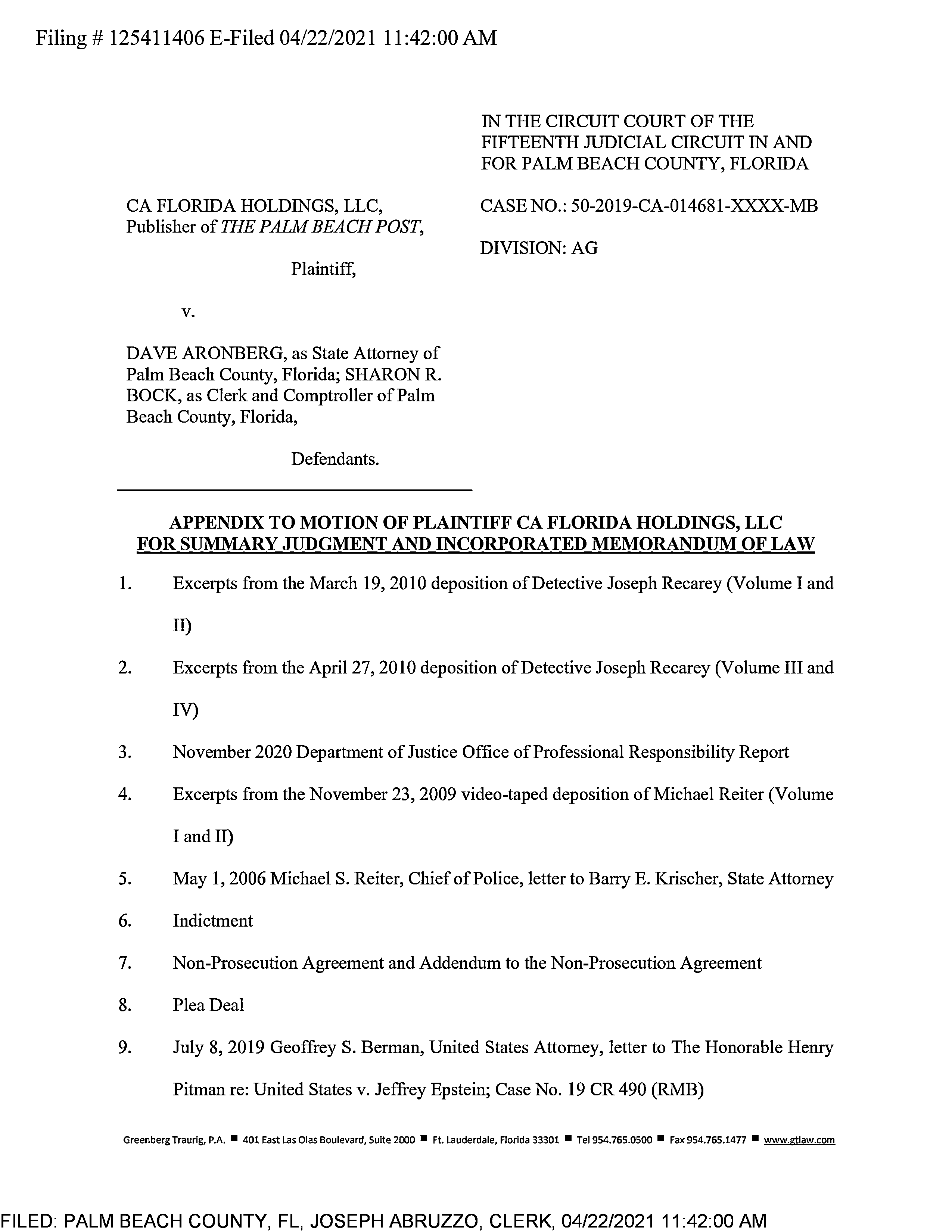
Page 1
document
2550 x 3300
Objects: Page, Text | Text: Filing # 12541 1406 E-Filed 04/22/2021 11:42:00 AM | IN THE CIRCUIT COUR

Page 2
document
2550 x 3300
Objects: Page, Text | Text: 10. | July 8, 2019 Department of Justice U.S. Attorney's Office for the
Page 3
document
2550 x 3300
Objects: Page, Text, Letter | Text: By: /s/ Nina D. Boyajian | NINA D. BOYAJIAN | (Admitted Pro Нас
Page 4
document
2550 x 3300
Objects: Text, Page | Text: Appendix 1
Page 5
document
2550 x 3300
Objects: Page, Text, Document, Invoice | Text: Page 1 | UNITED STATES DISTRICT COURT | SOUTHERN DIST
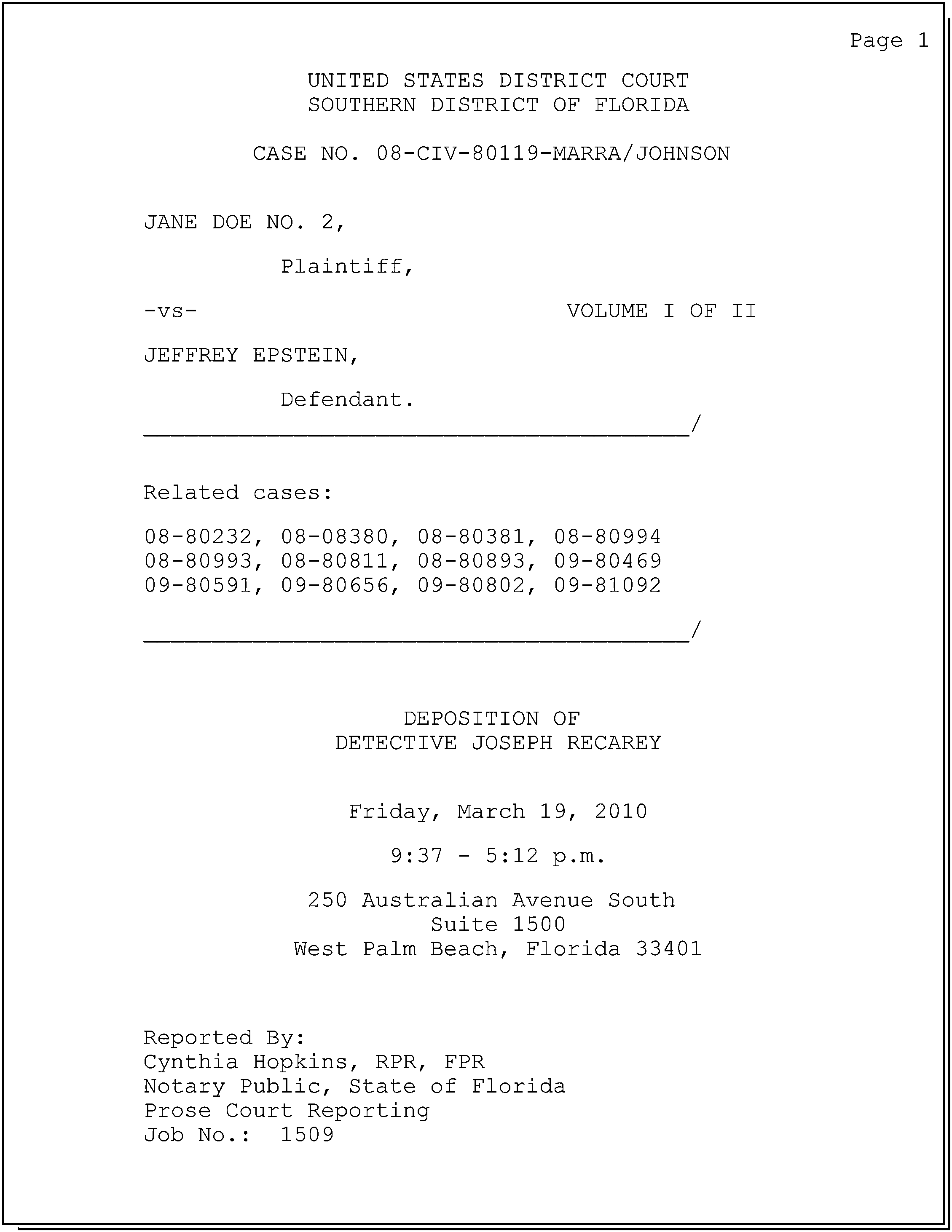
Page 5
document
2259 x 2924
Objects: Page, Text | Text: Page 1 | UNITED STATES DISTRICT COURT | SOUTHERN DISTRICT OF FLORIDA | C
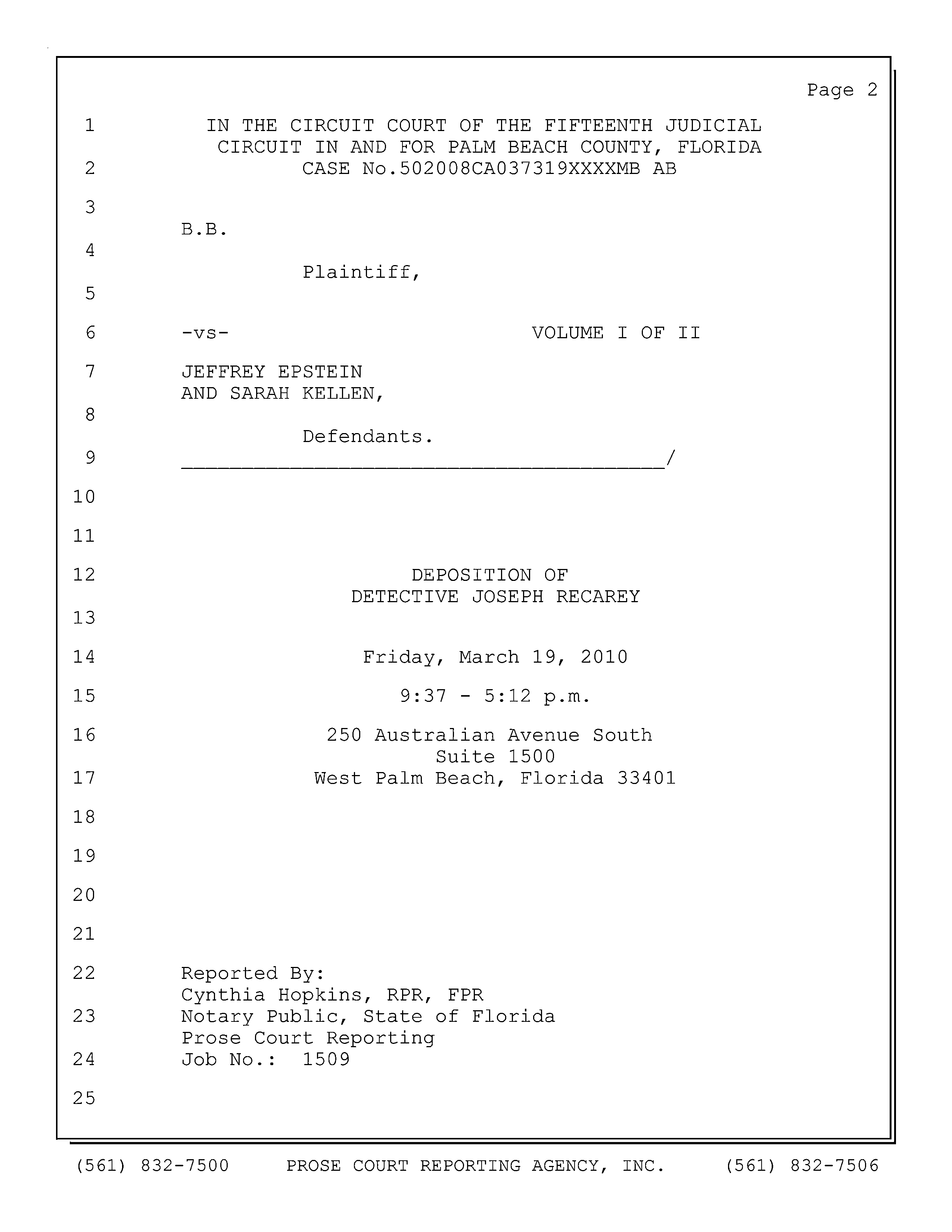
Page 6
document
2550 x 3300
Objects: Page, Text | Text: Page 2 | 1 | IN THE CIRCUIT COURT OF THE FIFTEENTH JUDICIAL | CIRCUIT IN
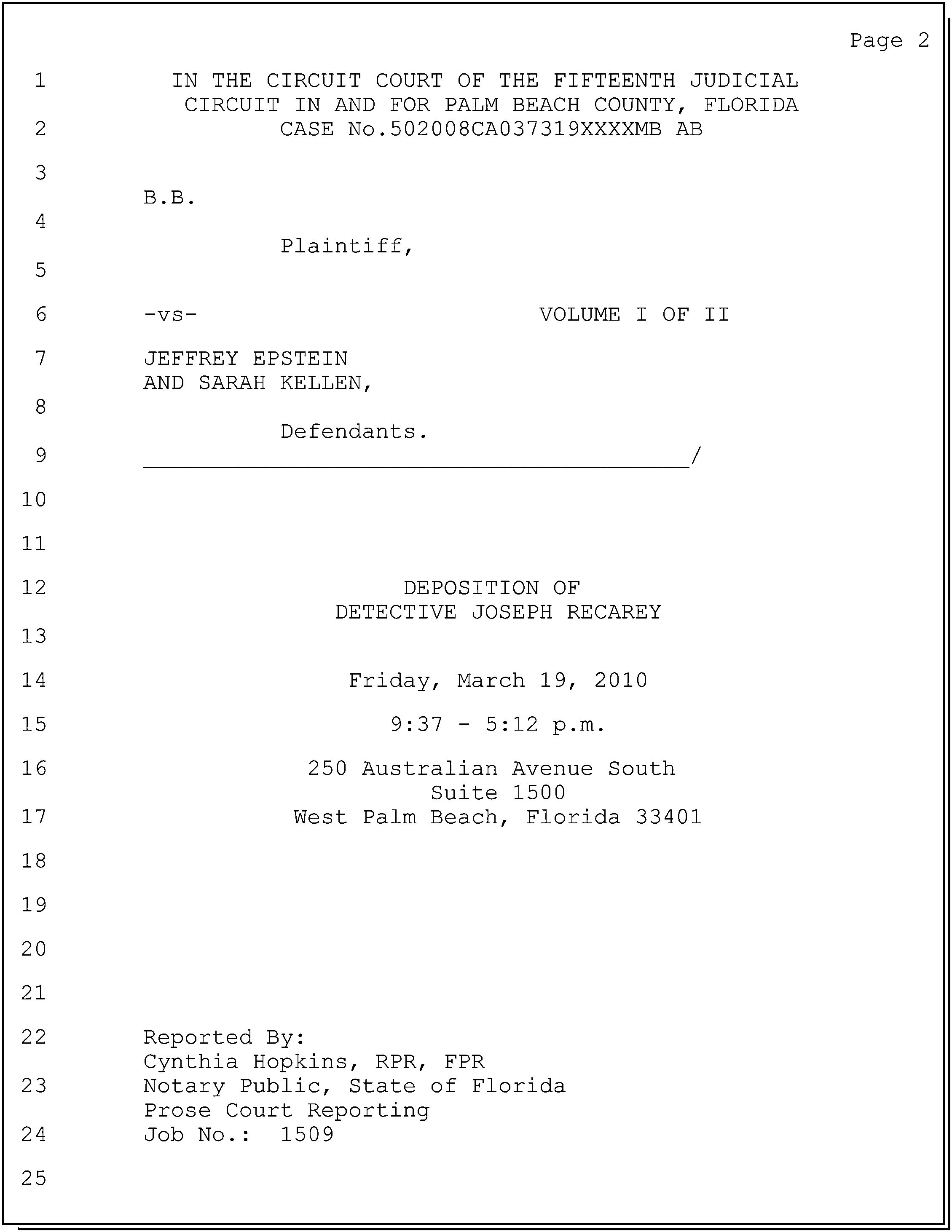
Page 6
document
2259 x 2924
Objects: Page, Text | Text: Page 2 | 1 | IN THE CIRCUIT COURT OF THE FIFTEENTH JUDICIAL | CIRCUIT IN
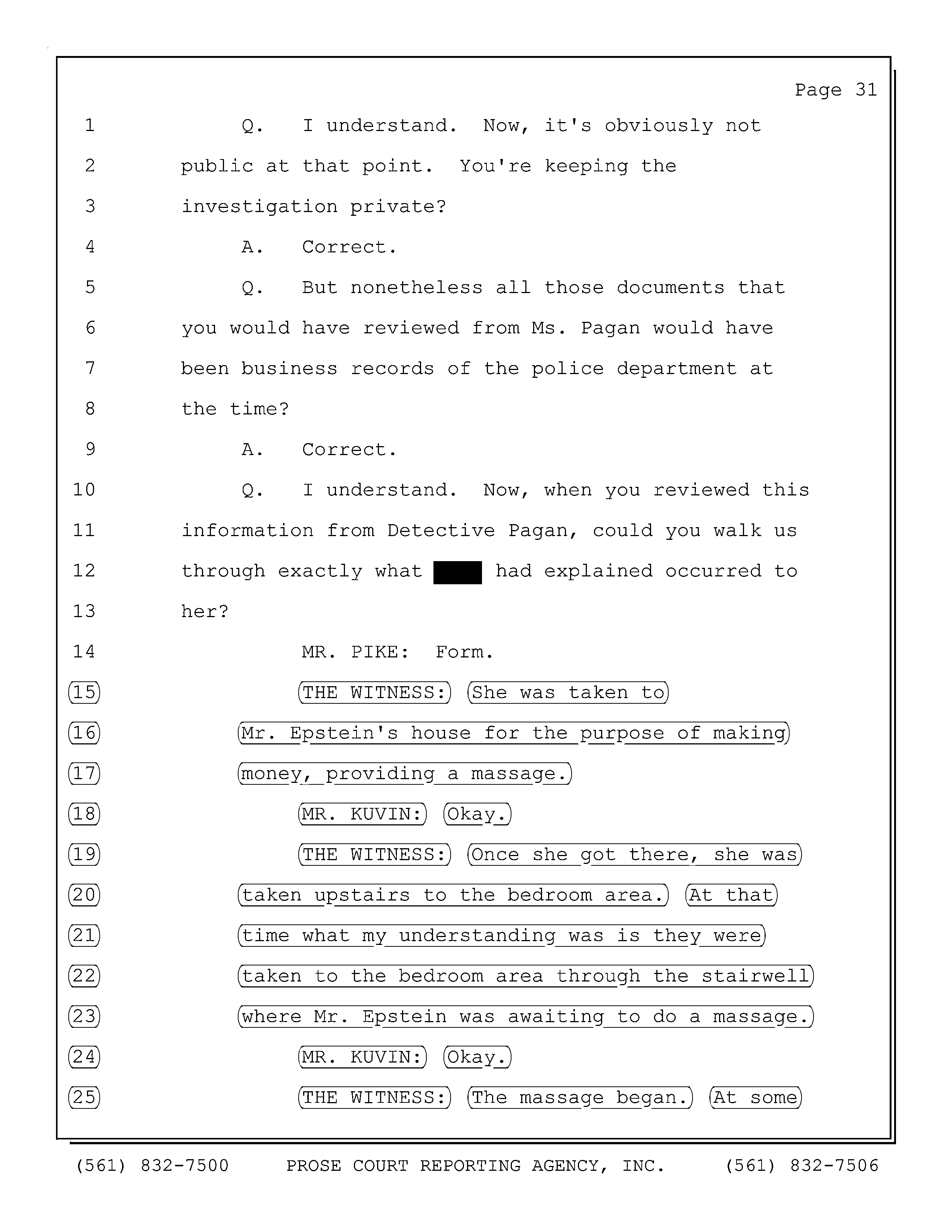
Page 7
document
2550 x 3300
Objects: Page, Text | Text: Page 31 | 1 | Q. | I understand. Now, it's obviously not | 2
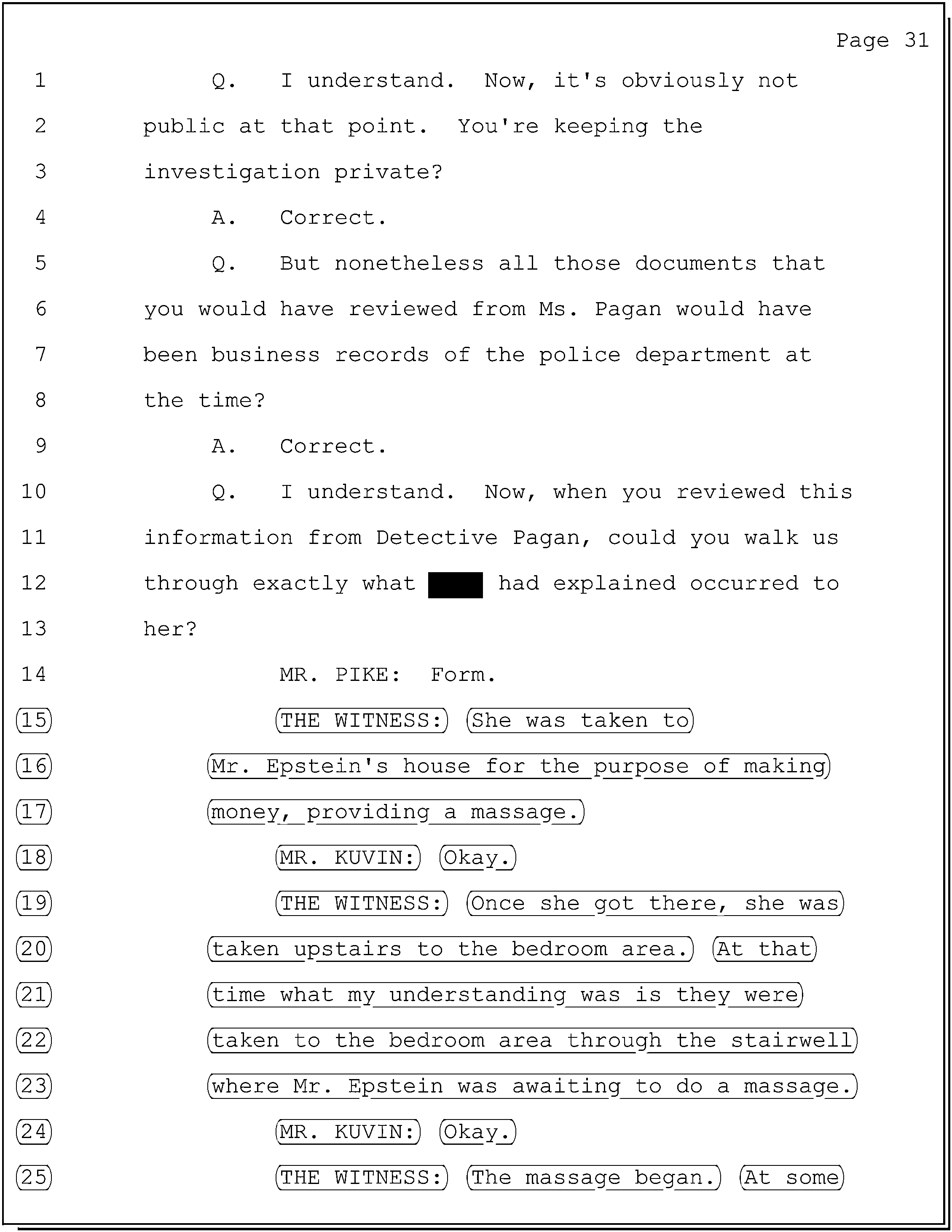
Page 7
document
2259 x 2924
Objects: Page, Text | Text: Page 31 | 1 | Q. | I understand. | Now, it's obviously not
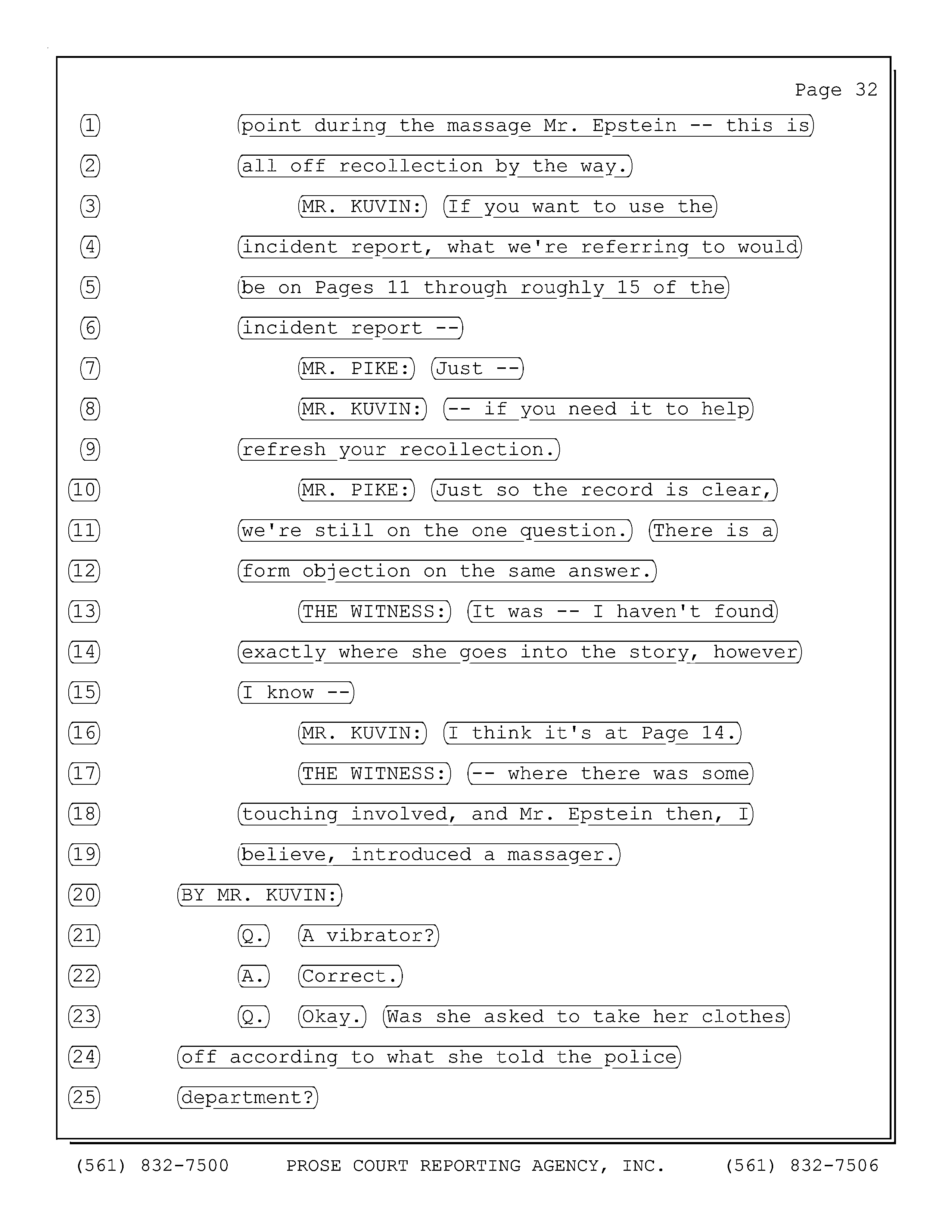
Page 8
document
2550 x 3300
Objects: Page, Text | Text: Page 32 | 1 | (point during the massage Mr. Epstein - - this is | 2 | al
Page 8
document
2259 x 2924
Objects: Page, Text | Text: Page 32 | 1 | (point during the massage Mr. Epstein -- this is | 2 | all
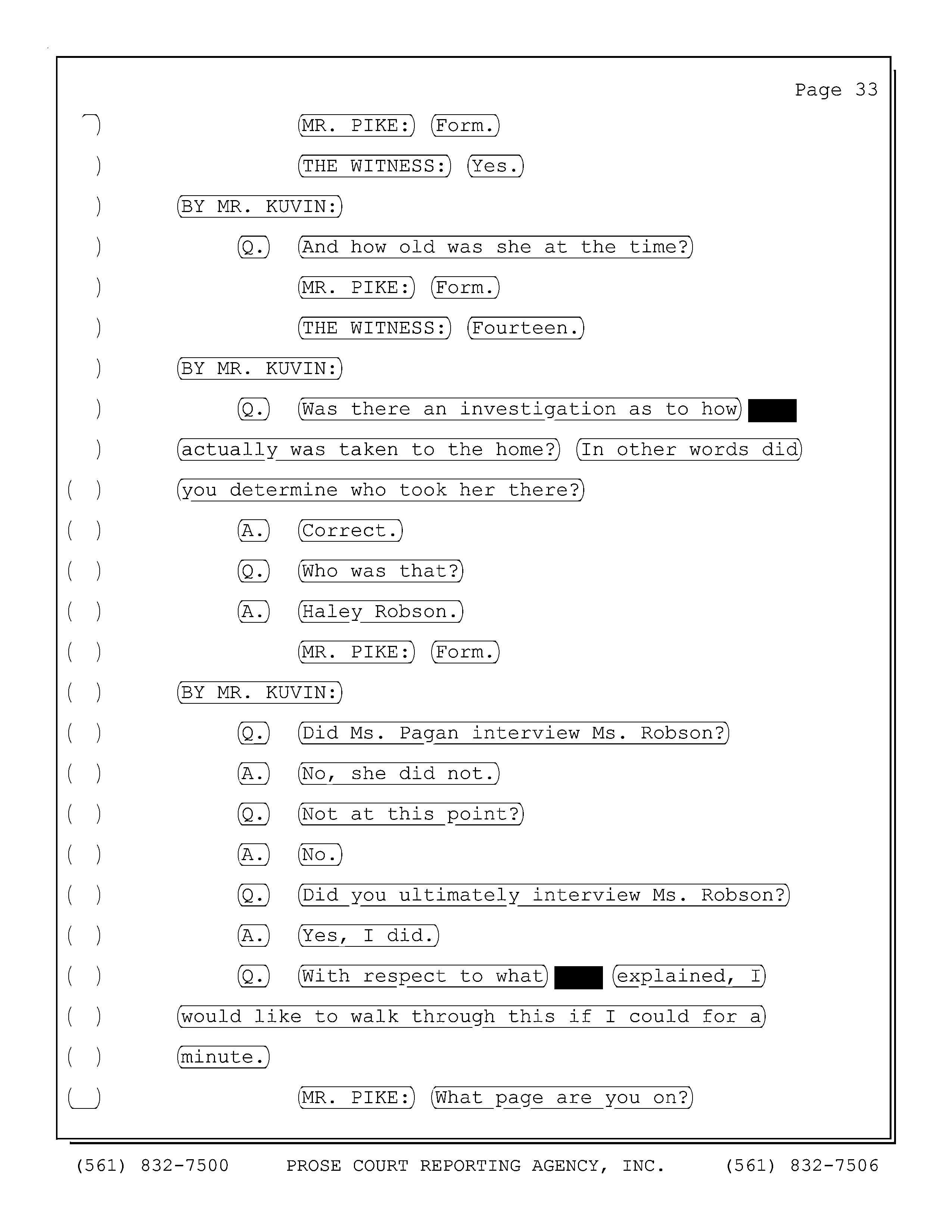
Page 9
document
2550 x 3300
Objects: Page, Text | Text: Page 33 | MR. PIKE: | Form. | THE WITNESS: | Yes.
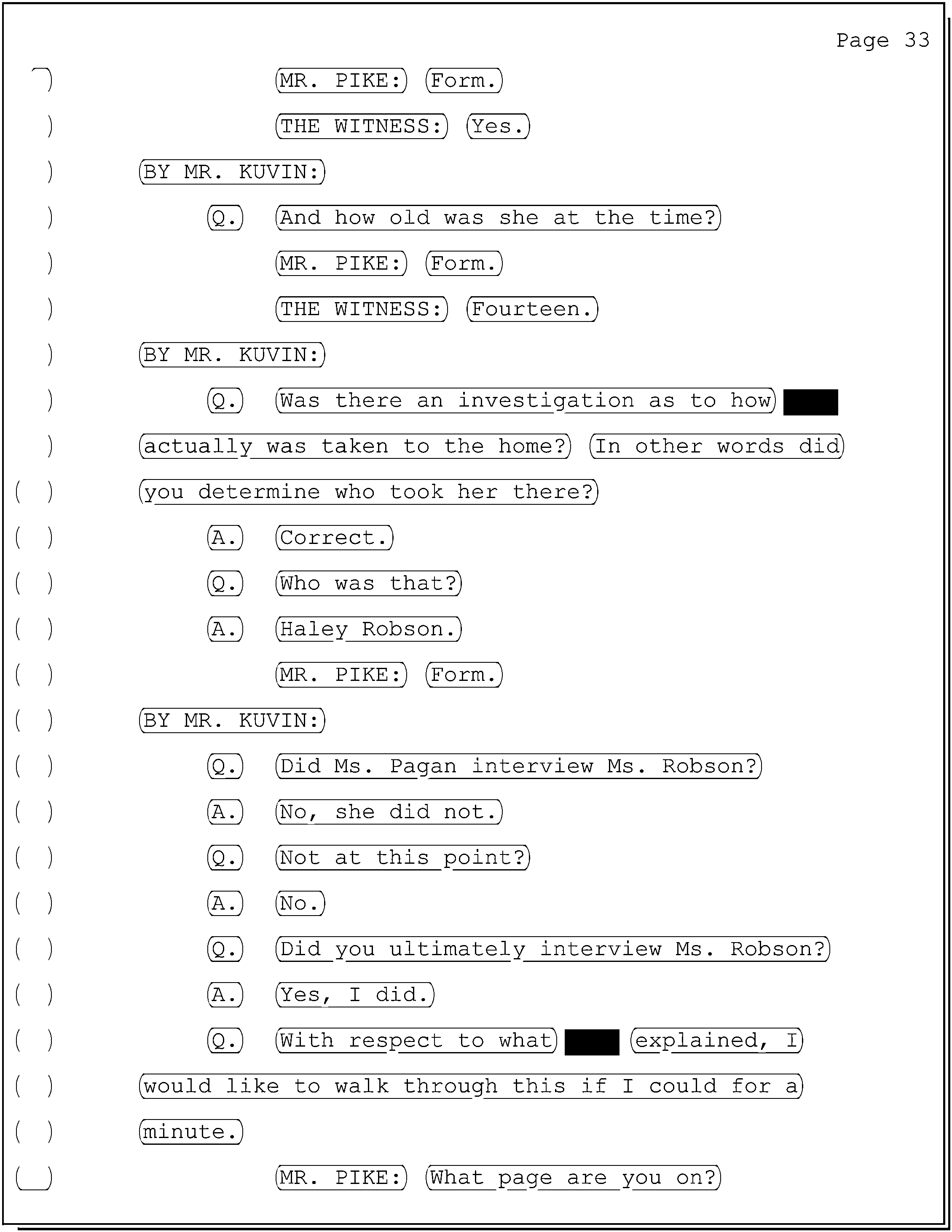
Page 9
document
2259 x 2924
Objects: Page, Text, Document | Text: Page 33 | MR. PIKE: | Form. | THE WITNESS: | Yes.

Page 9
document
85 x 2664
Objects: Spiral, Coil, Page, Text | Text: 1 | 2 | 3 | 4 | 5
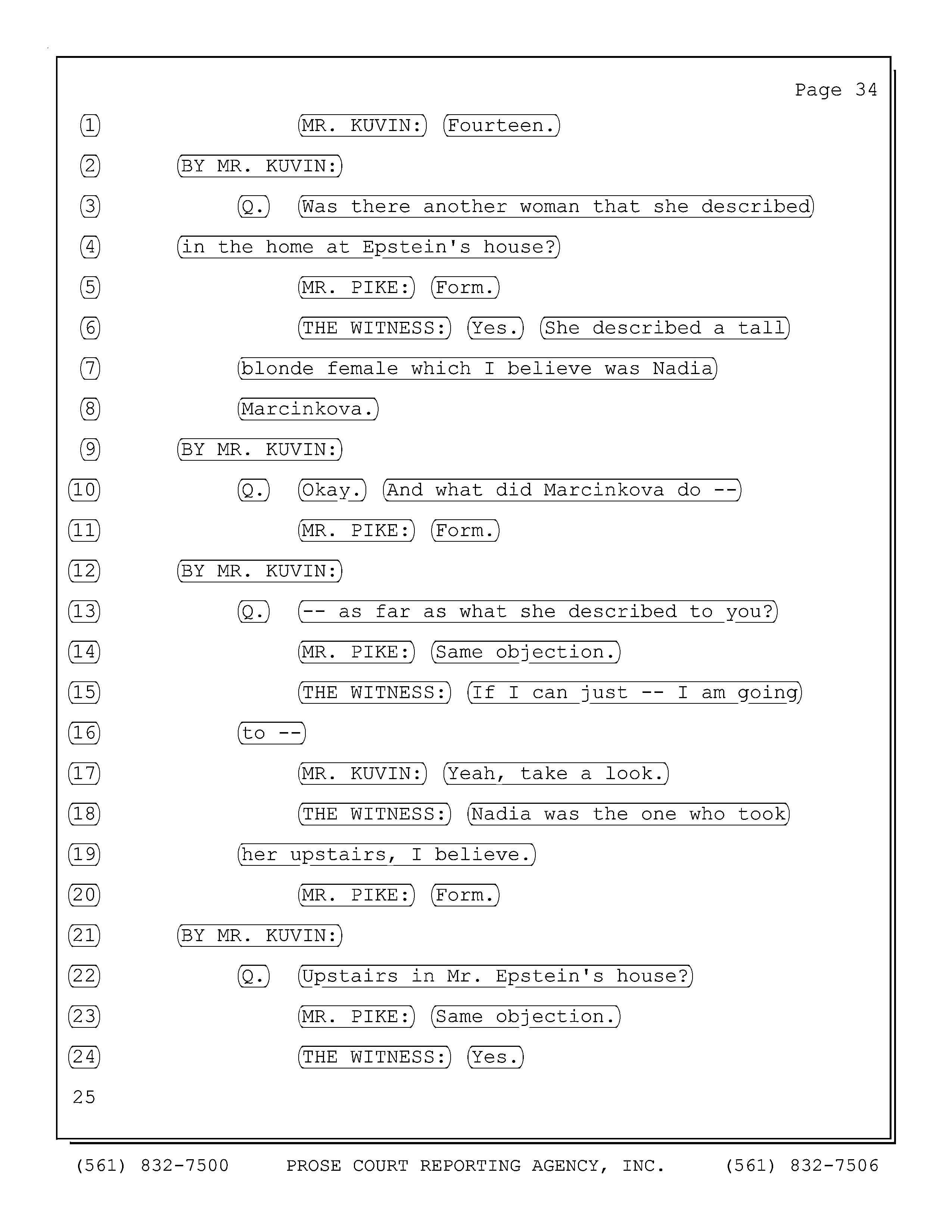
Page 10
document
2550 x 3300
Objects: Page, Text | Text: Page 34 | MR. KUVIN: | 1 | Fourteen. | 2
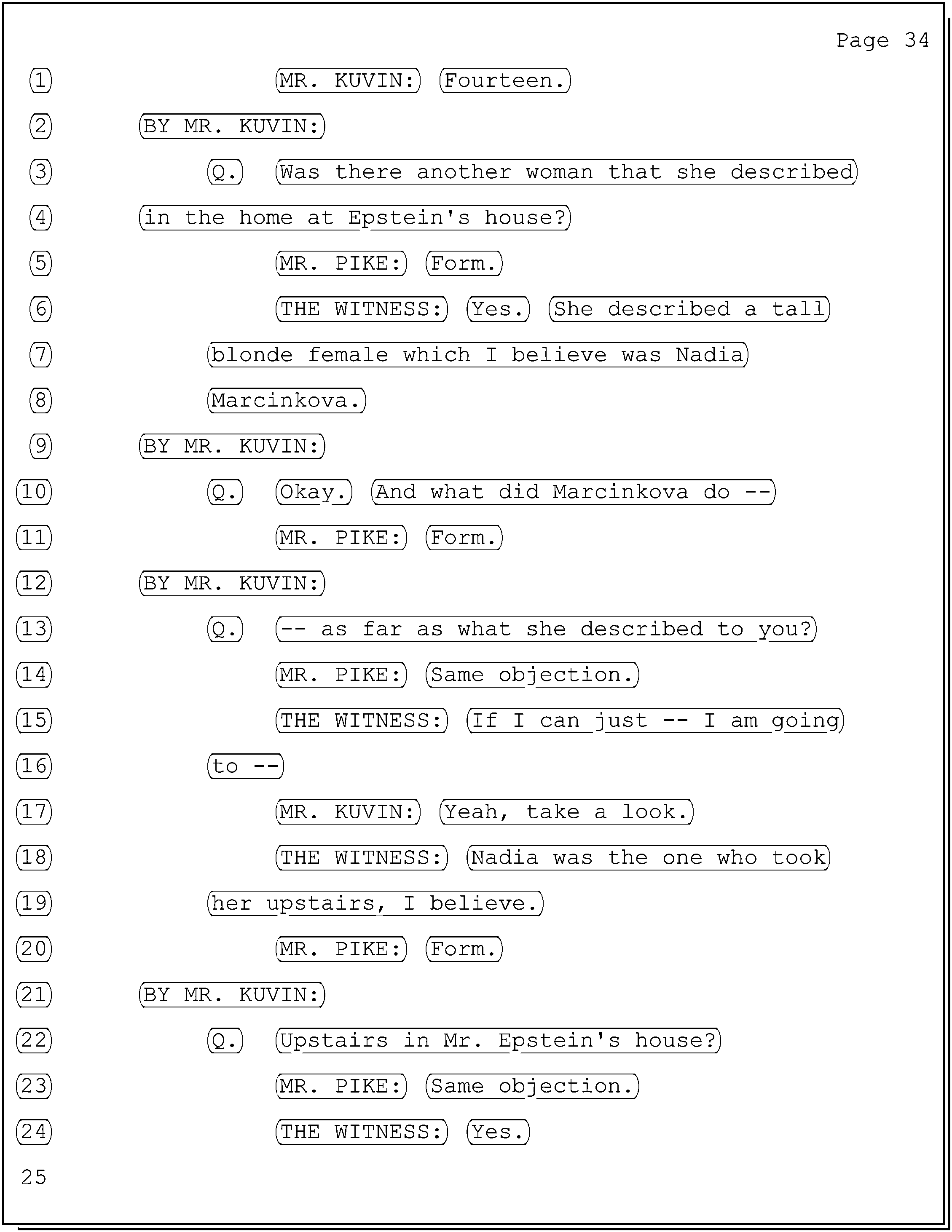
Page 10
document
2259 x 2924
Objects: Page, Text | Text: Page 34 | 1 | MR. KUVIN: | Fourteen. | 2
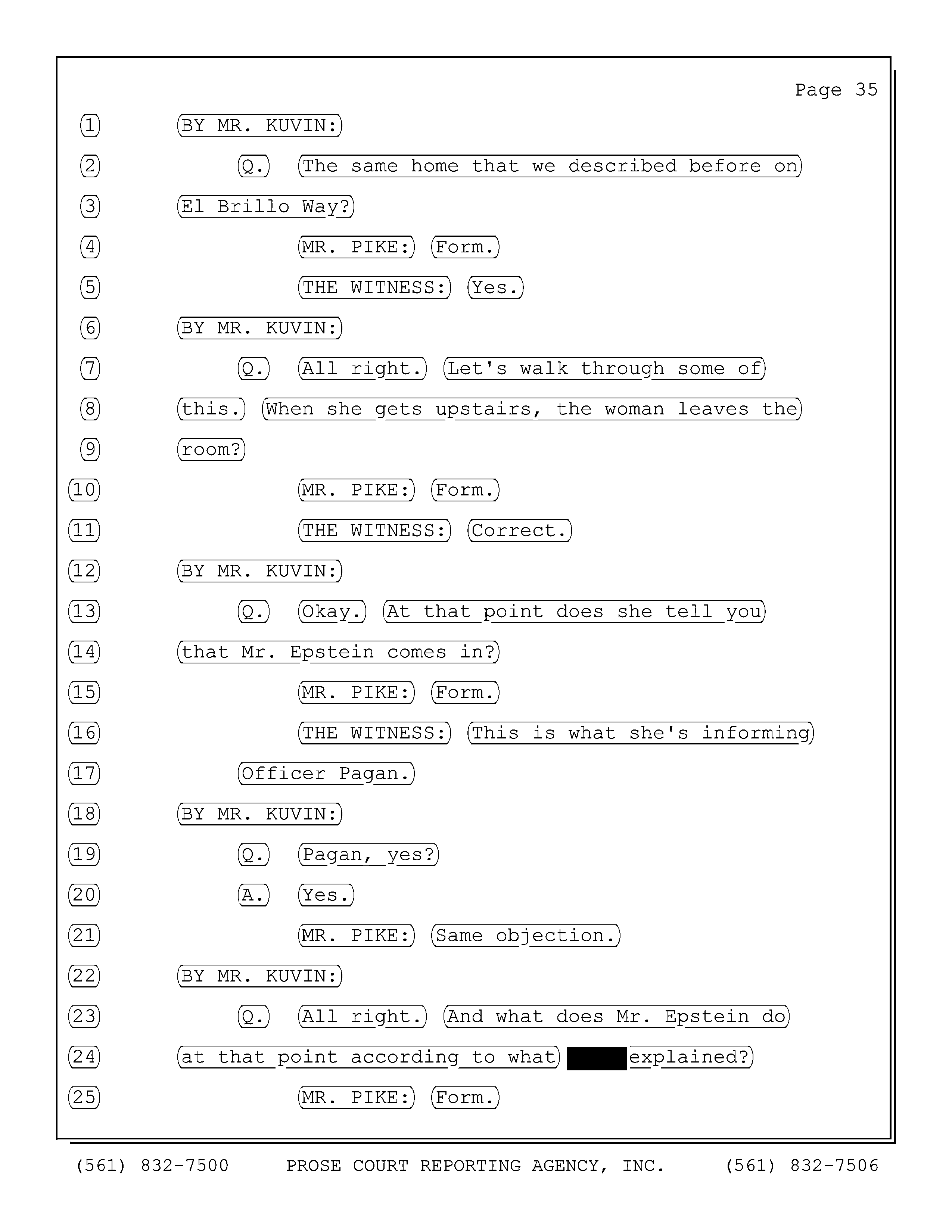
Page 11
document
2550 x 3300
Objects: Page, Text | Text: Page 35 | 1 | BY MR. KUVIN: | 2 | The same home that we described before
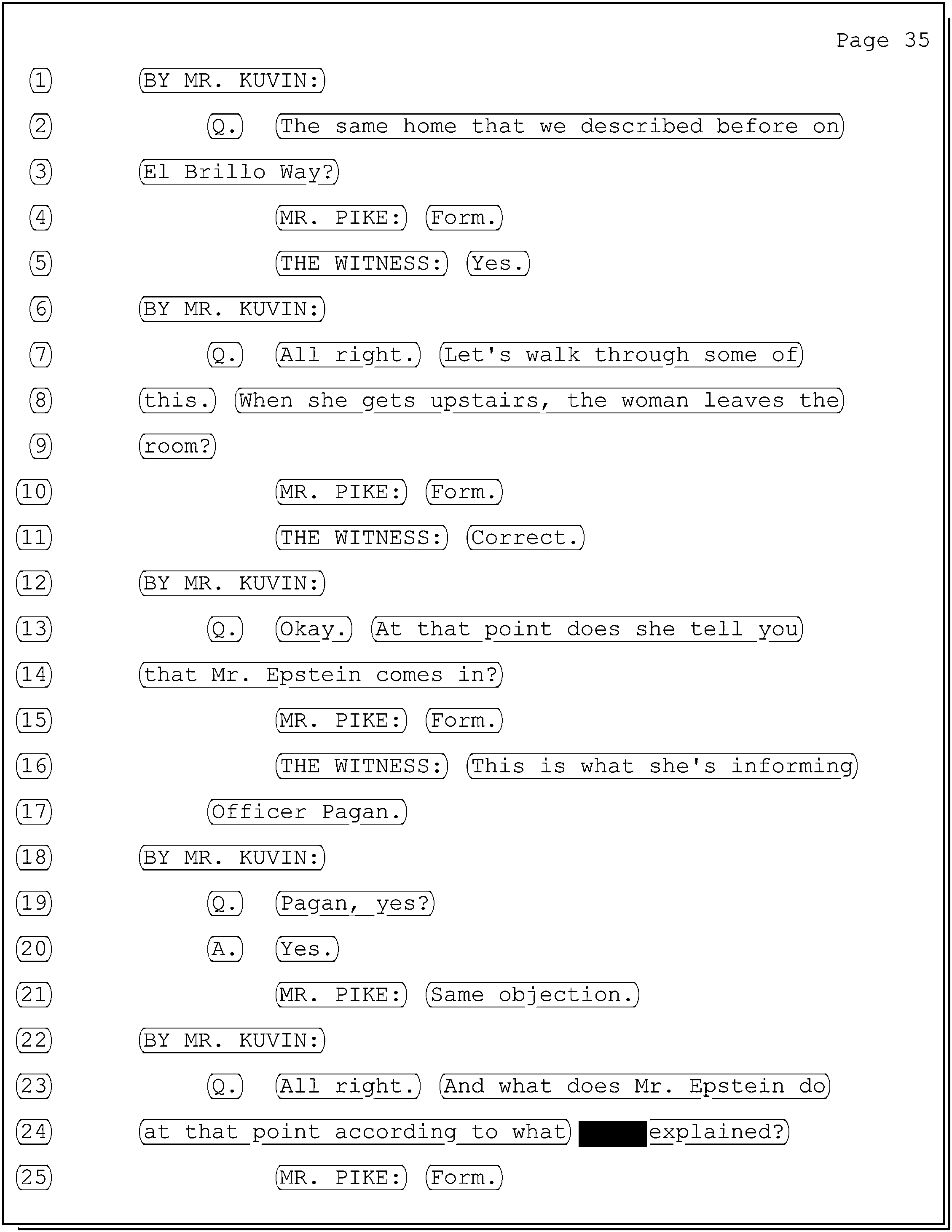
Page 11
document
2259 x 2924
Objects: Page, Text, Document | Text: Page 35 | 1 | BY MR. KUVIN: | 2 | The same home that we descri
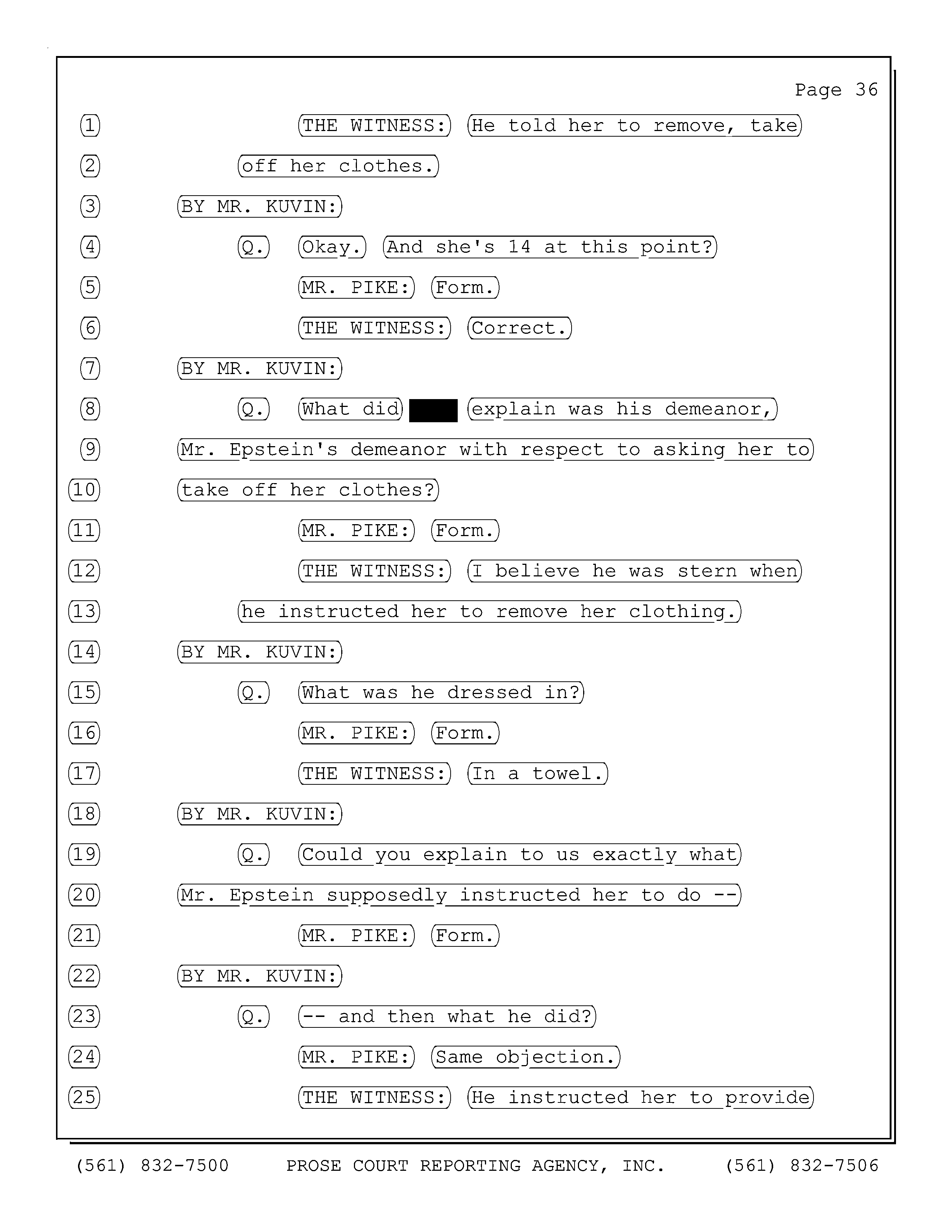
Page 12
document
2550 x 3300
Objects: Page, Text | Text: Page 36 | 1 | THE WITNESS: | Не told her to remove, take | 2
Page 12
document
2259 x 2924
Objects: Page, Text | Text: Page 36 | 1 | THE WITNESS: | He told her to remove, take | 2
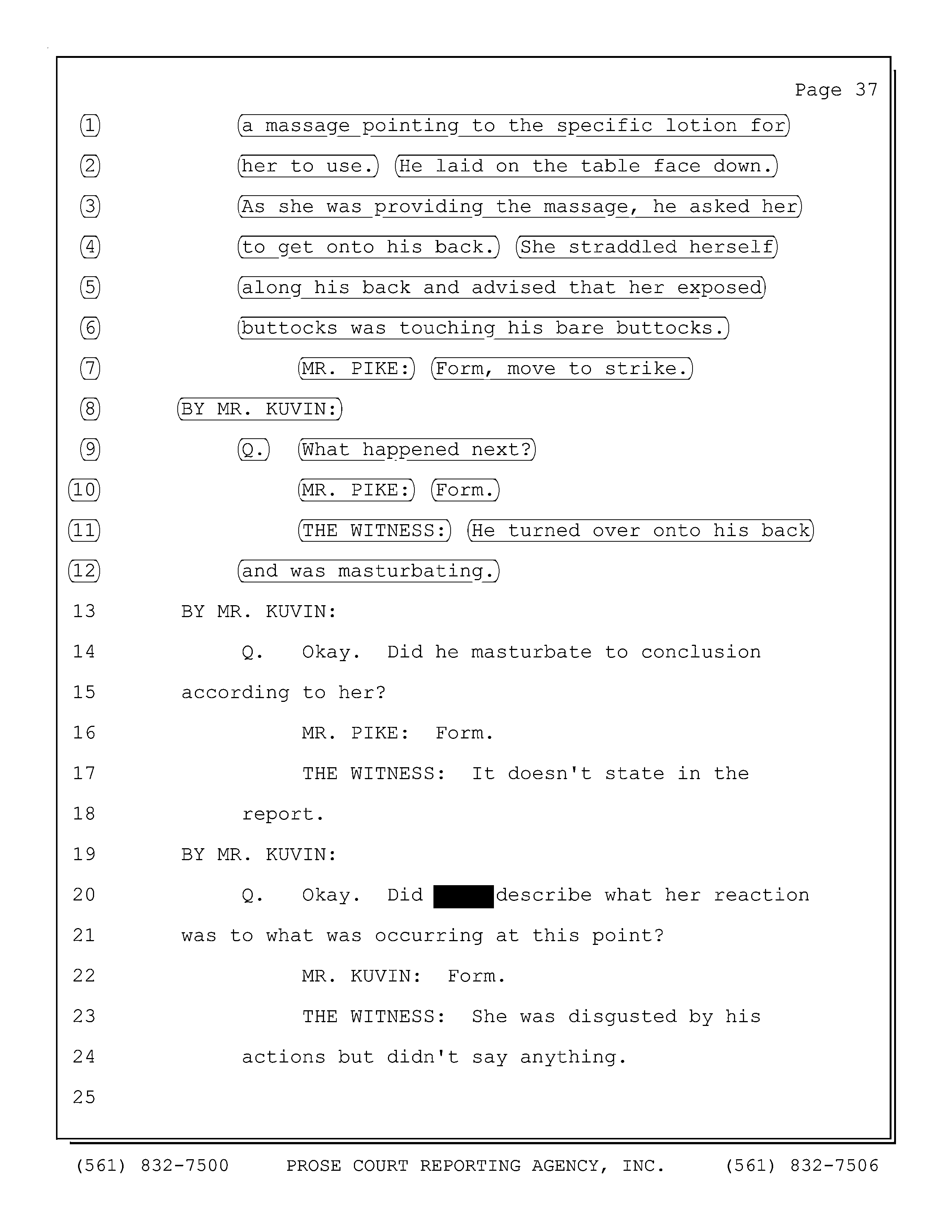
Page 13
document
2550 x 3300
Objects: Page, Text | Text: Page 37 | 1 | a massage pointing to the specific lotion for | 2 | He lai
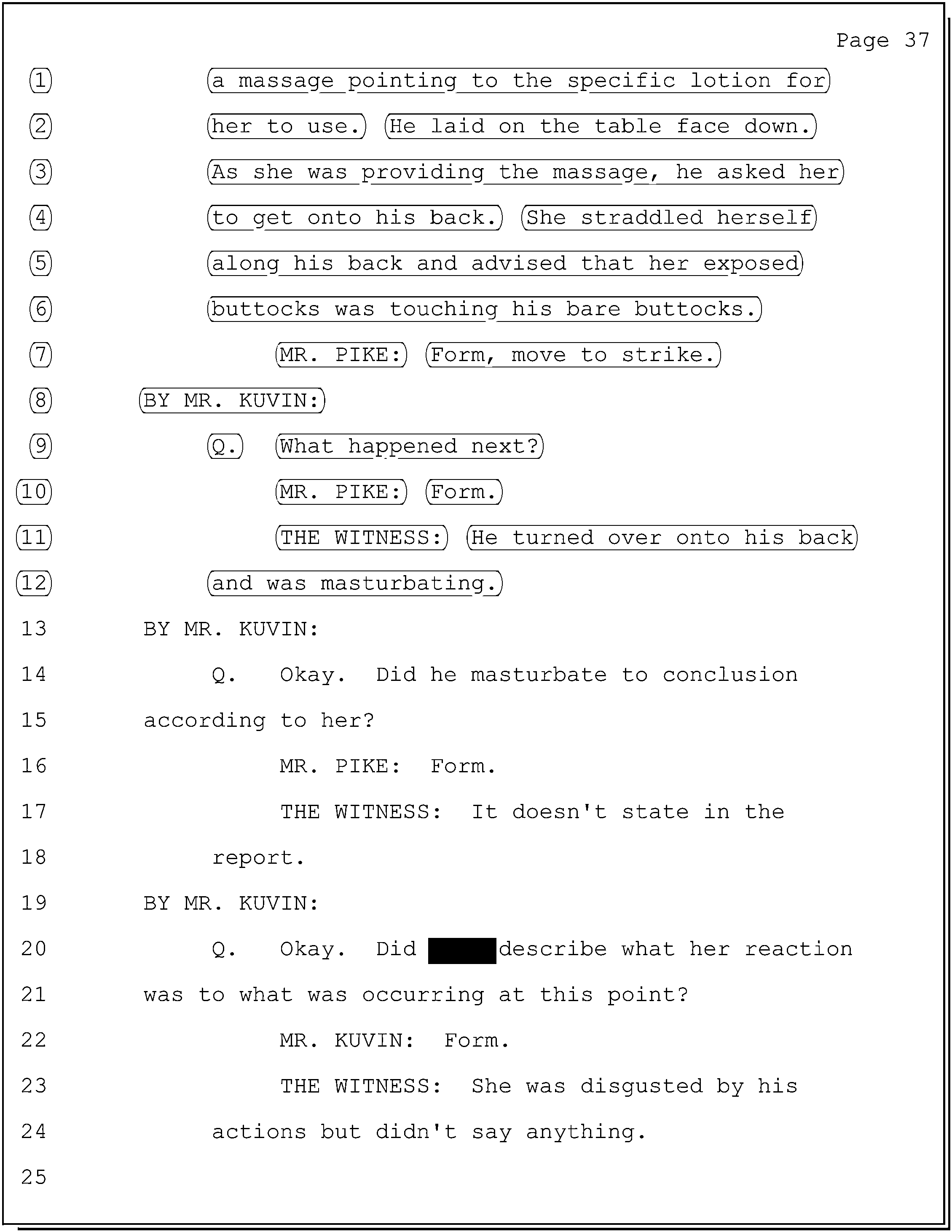
Page 13
document
2259 x 2924
Objects: Page, Text | Text: Page 37 | 1 | a massage pointing to the specific lotion for | 2 | her to
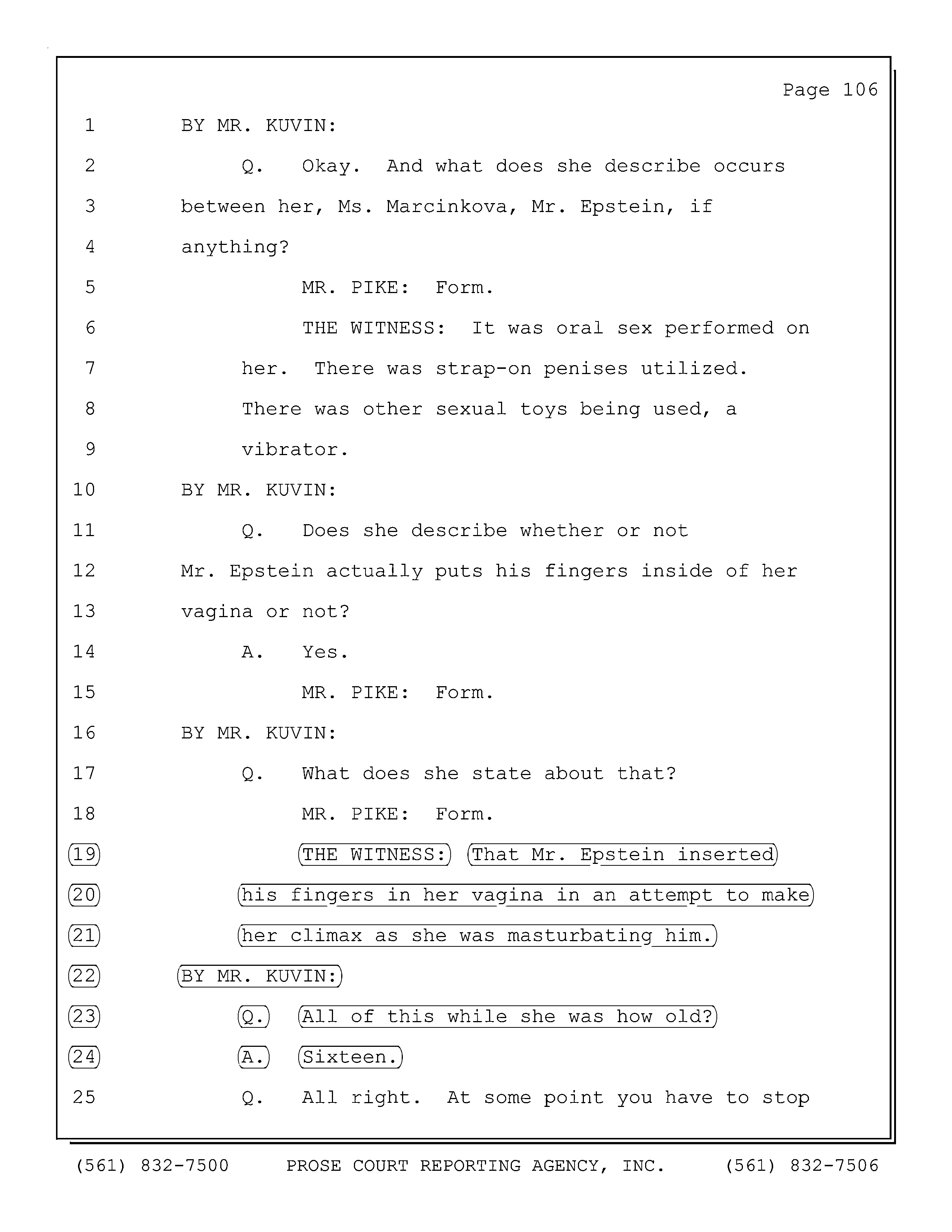
Page 14
document
2550 x 3300
Objects: Page, Text | Text: Page 106 | 1 | BY MR. KUVIN: | 2 | Okay.
Page 14
document
2259 x 2924
Objects: Page, Text | Text: Page 106 | 1 | BY MR. KUVIN: | 2 | And what does she describe occurs
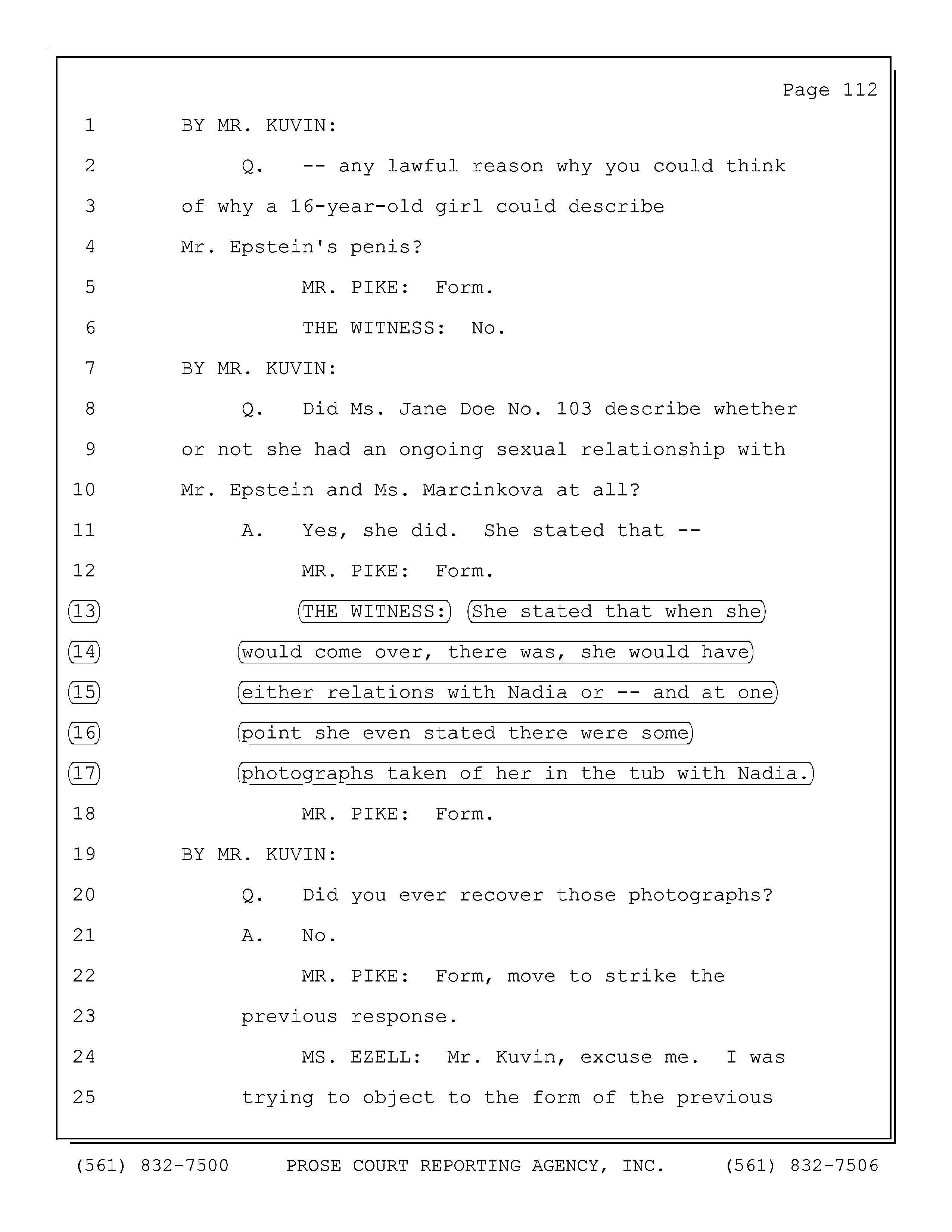
Page 15
document
2550 x 3300
Objects: Page, Text, Chart, Plot | Text: Page 112 | 1 | BY MR. KUVIN: | 2 | Q.
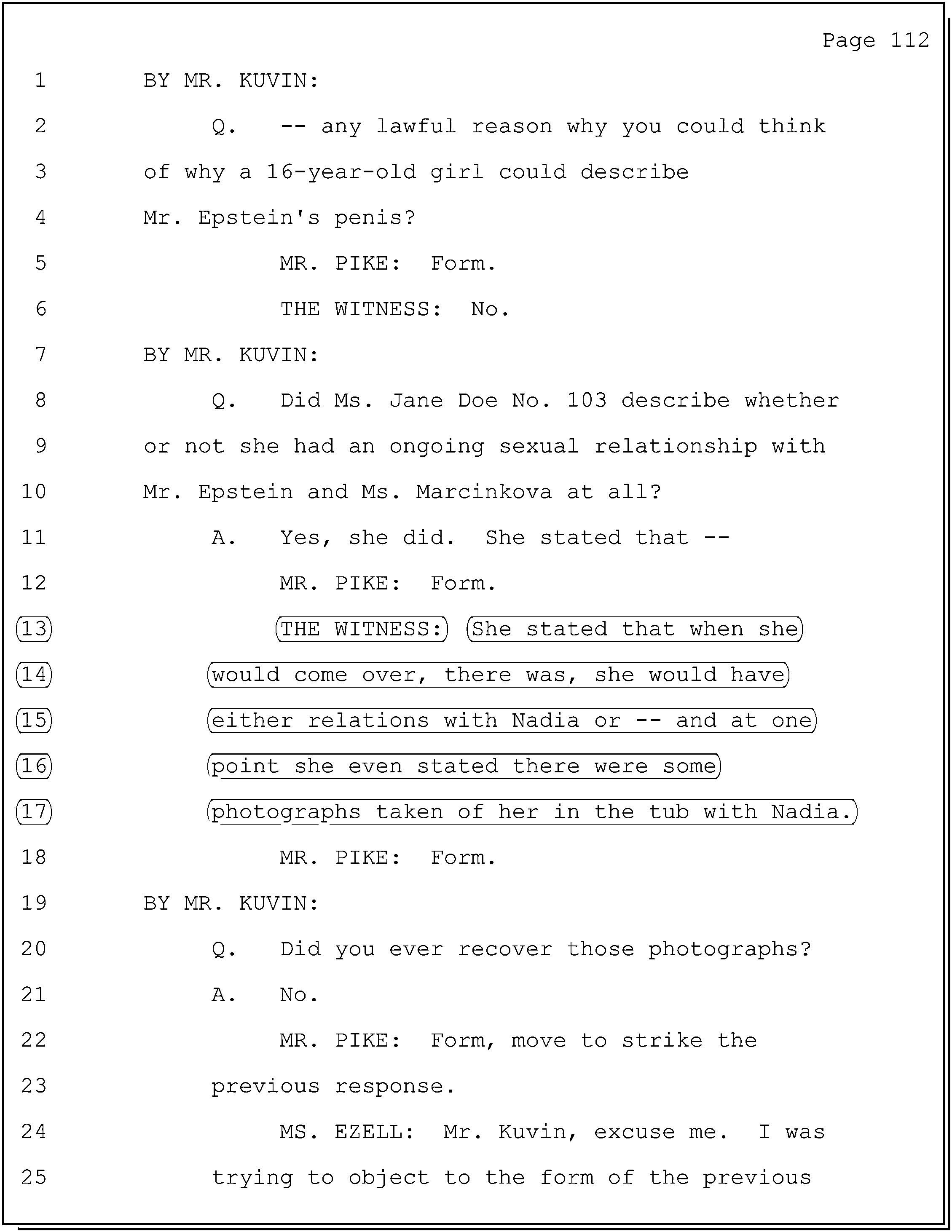
Page 15
document
2259 x 2924
Objects: Page, Text | Text: Page 112 | 1 | BY MR. KUVIN: | 2 | Q.
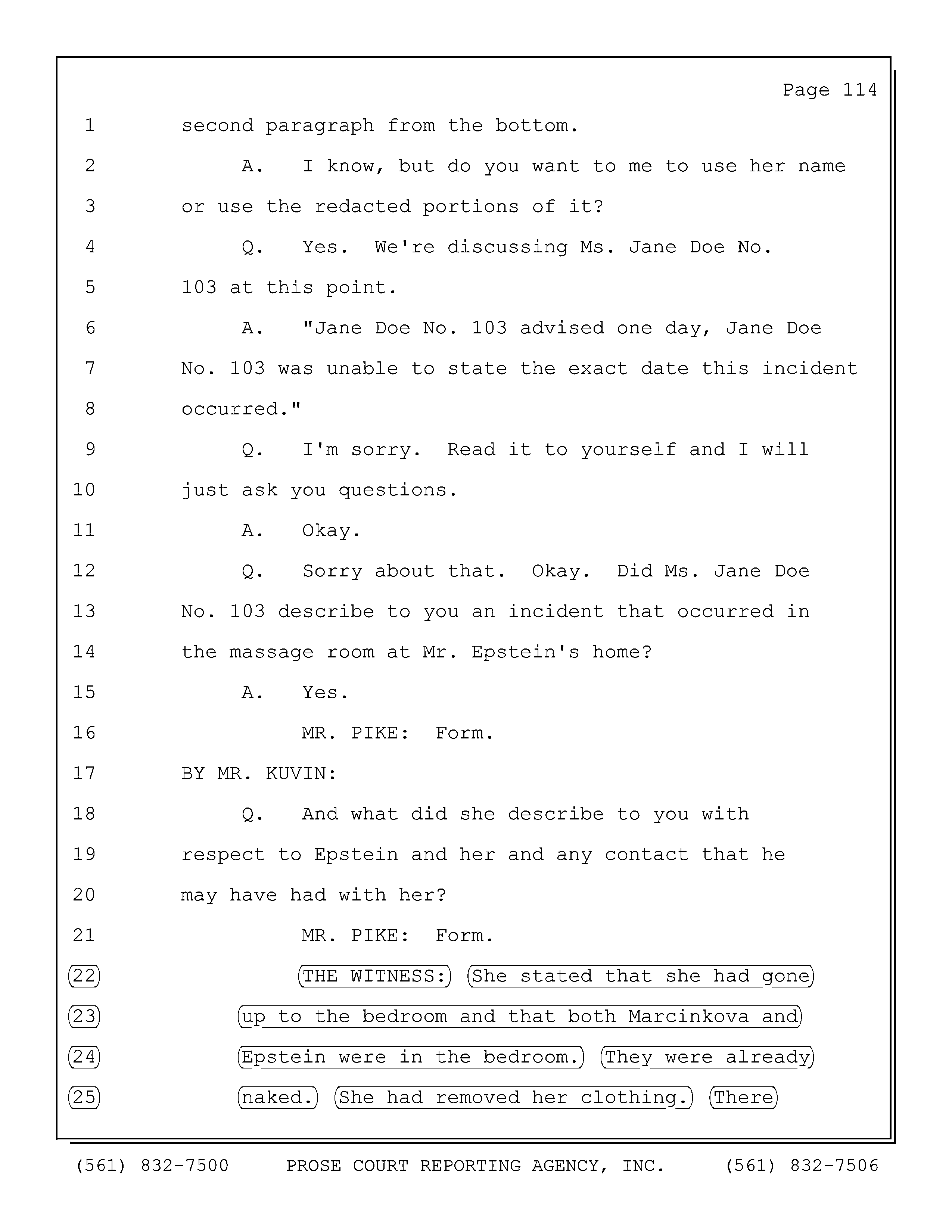
Page 16
document
2550 x 3300
Objects: Page, Text, Chart, Plot | Text: Page 114 | 1 | second paragraph from the bottom. | 2 | A.
Page 16
document
2259 x 2924
Objects: Page, Text | Text: Page 114 | 1 | second paragraph from the bottom. | 2 | A.
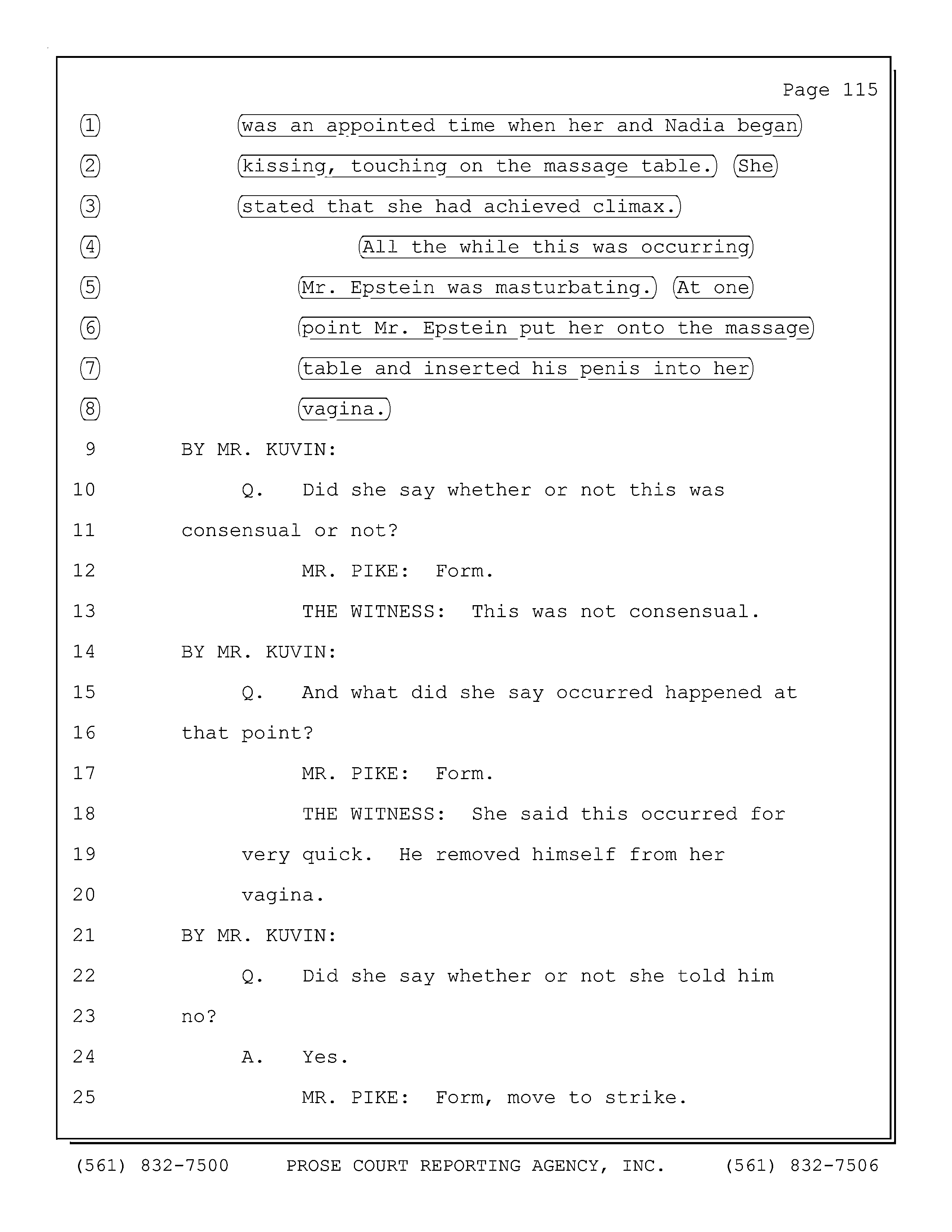
Page 17
document
2550 x 3300
Objects: Page, Text | Text: Page 115 | 1 | was an appointed time when her and Nadia began | 2 | kiss
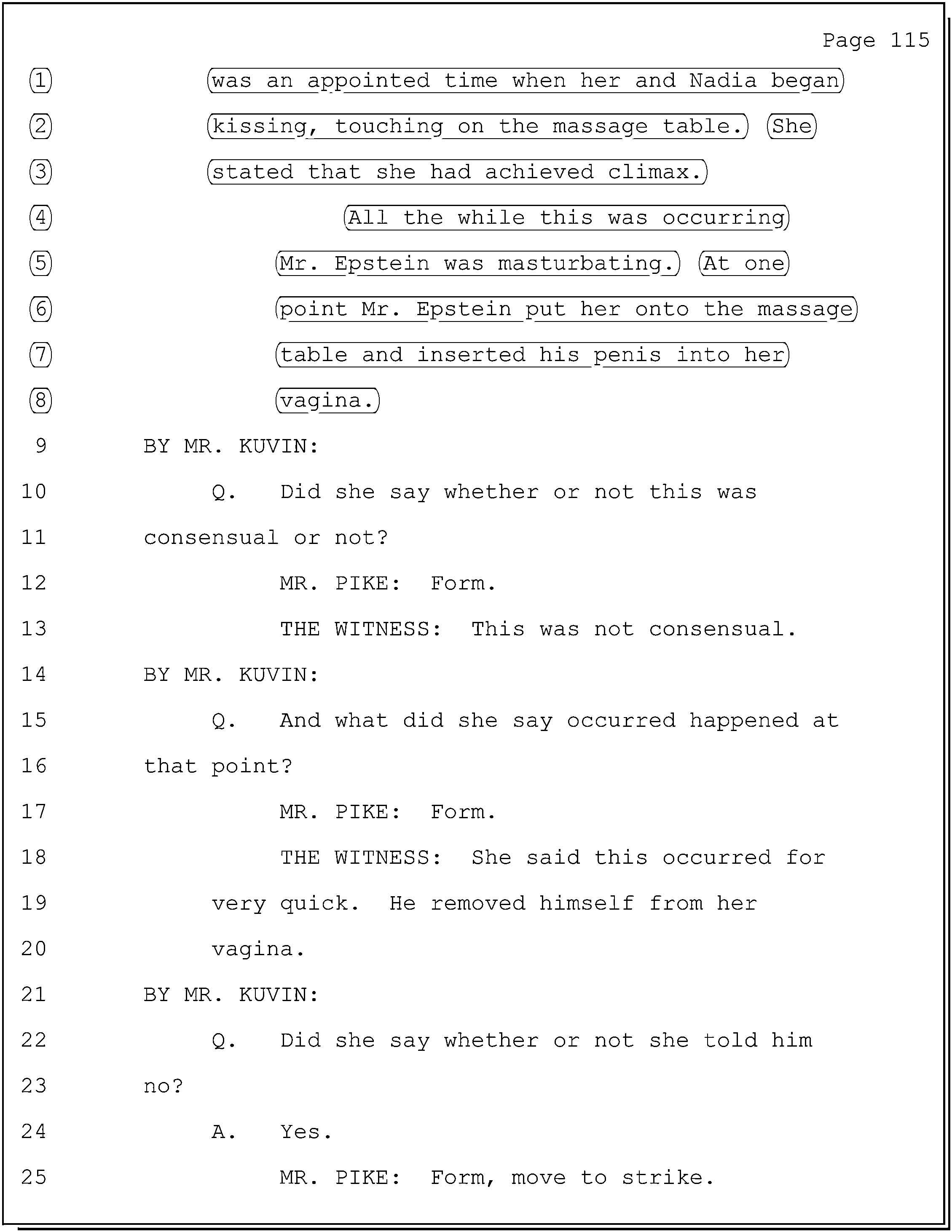
Page 17
document
2259 x 2924
Objects: Page, Text | Text: Page 115 | 1 | was an appointed time when her and Nadia began | 2 | kiss
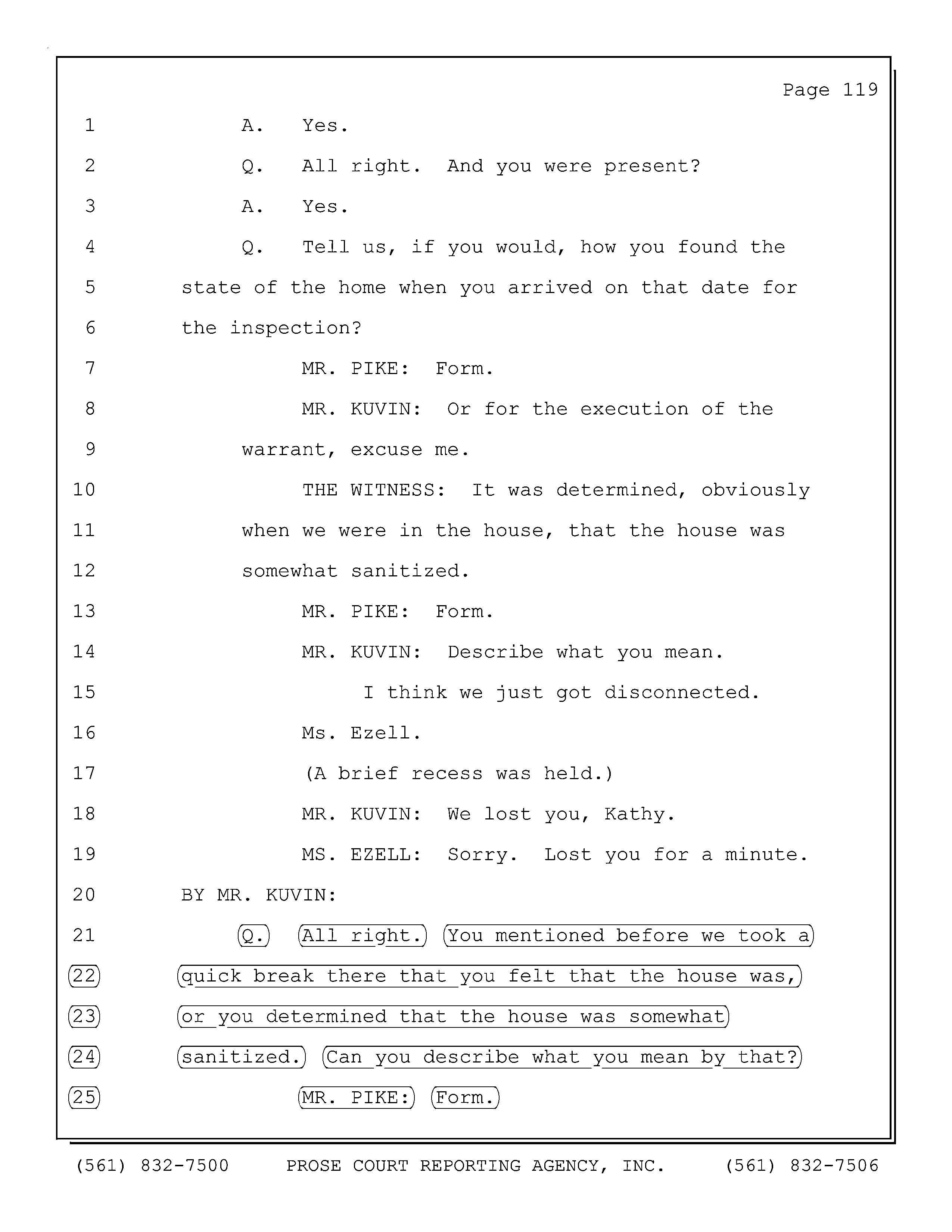
Page 18
document
2550 x 3300
Objects: Page, Text, Chart, Plot | Text: Page 119 | 1 | Yes. | 2 | Q.
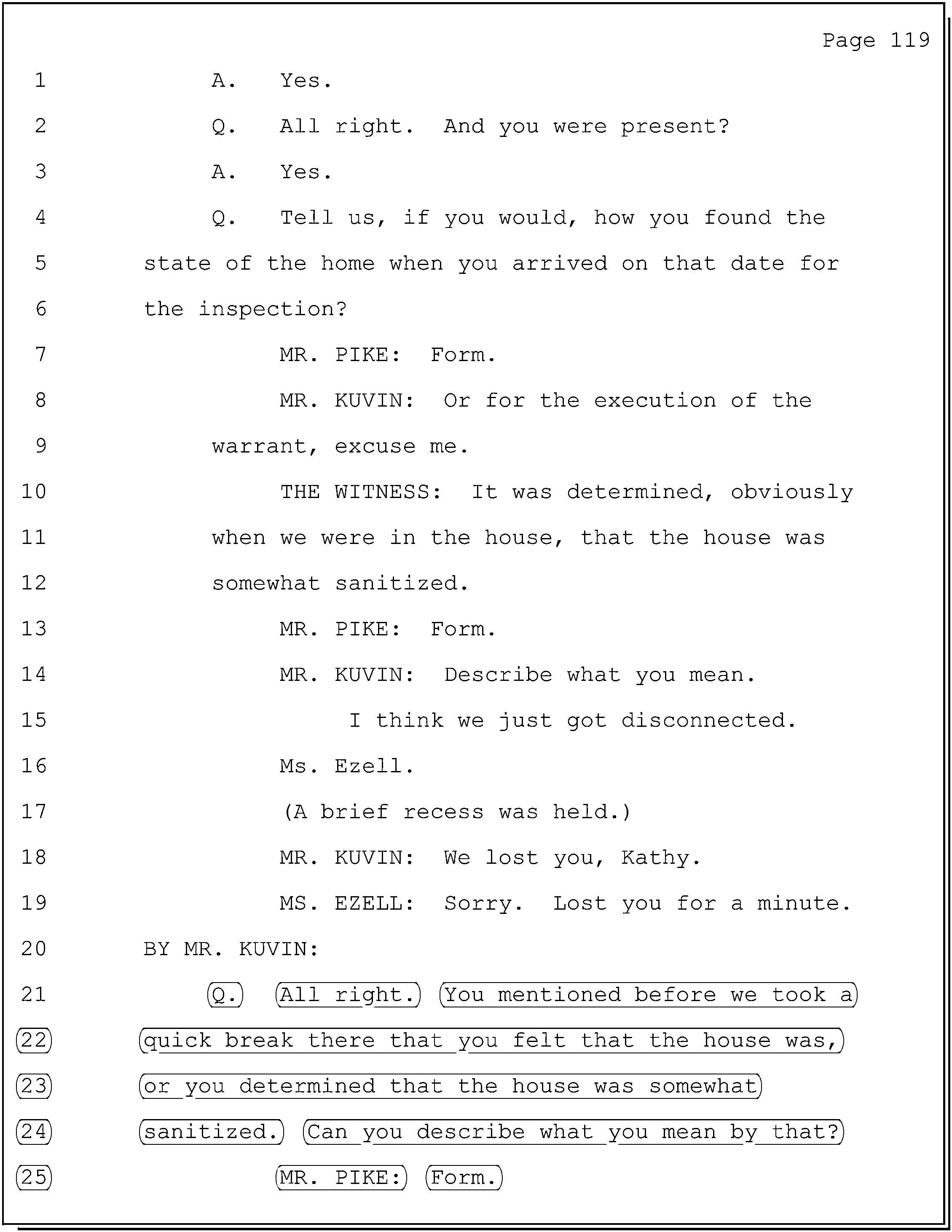
Page 18
document
2259 x 2924
Objects: Page, Text, Chart, Plot | Text: Page 119 | 1 | A. | Yes. | 2
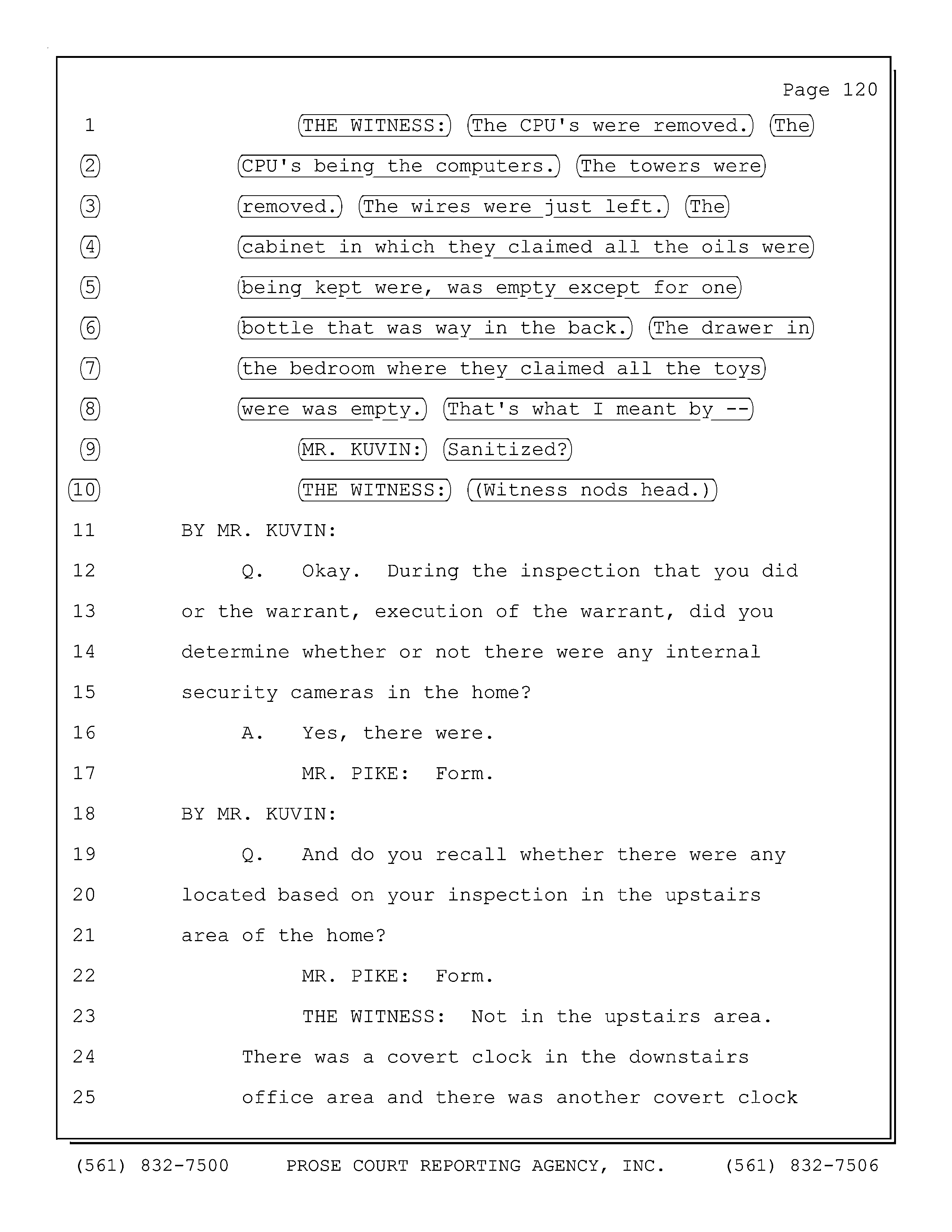
Page 19
document
2550 x 3300
Objects: Page, Text | Text: Page 120 | 1 | THE WITNESS: | The CPU's were removed. | The
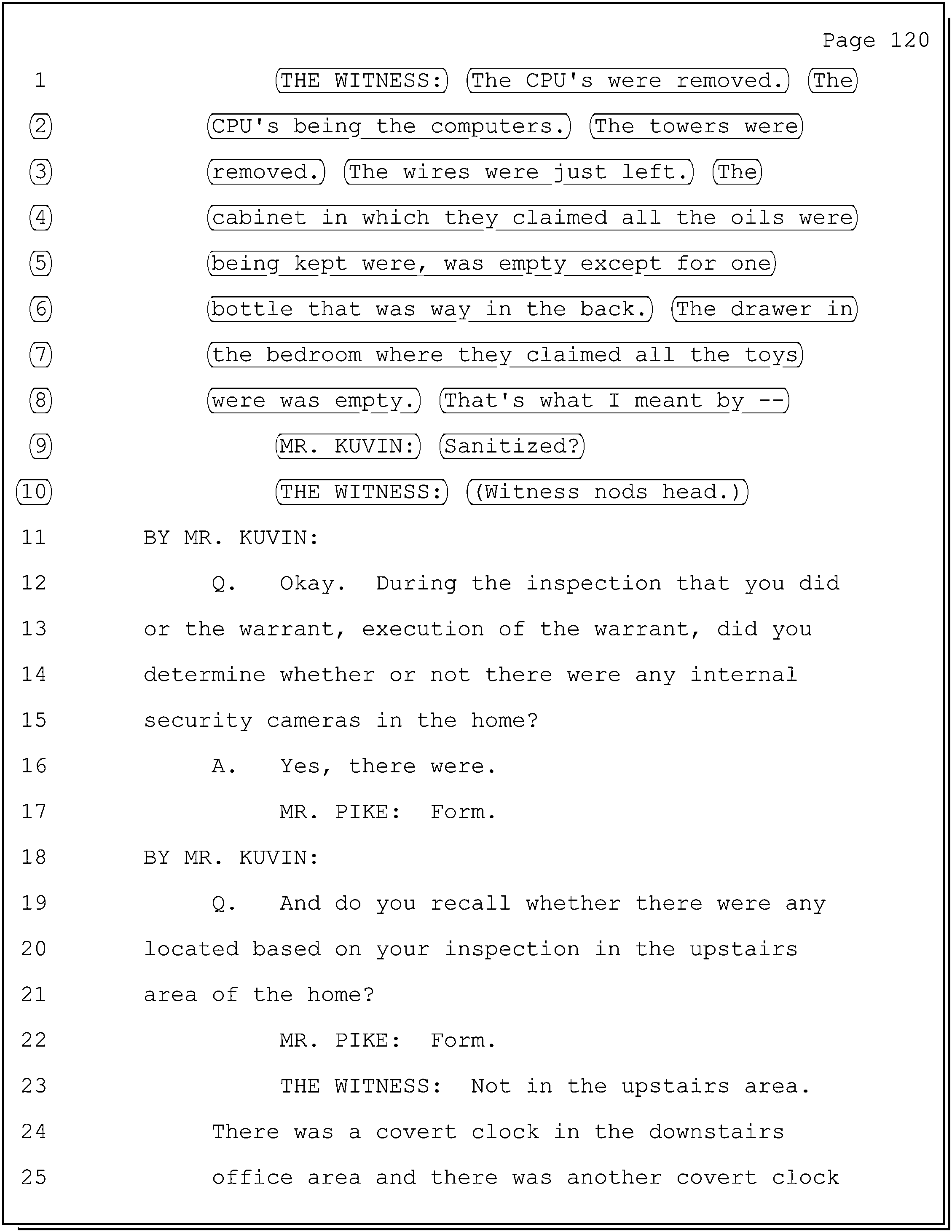
Page 19
document
2259 x 2924
Objects: Page, Text | Text: Page 120 | 1 | The | THE WITNESS: | The CPU's were removed.
Page 20
document
2550 x 3300
Objects: Page, Text, Document, Receipt, Invoice | Text: Page 130 | UNITED STATES DISTRICT COURT | SO
Page 21
document
2550 x 3300
Objects: Page, Text | Text: Page 131 | 1 | IN THE CIRCUIT COURT OF THE FIFTEENTH JUDICIAL | CIRCUIT
Page 22
document
2550 x 3300
Objects: Page, Text | Text: Page 132 | 1 | UNITED STATES DISTRICT COURT | 2 | SOUTHERN DISTRICT OF F
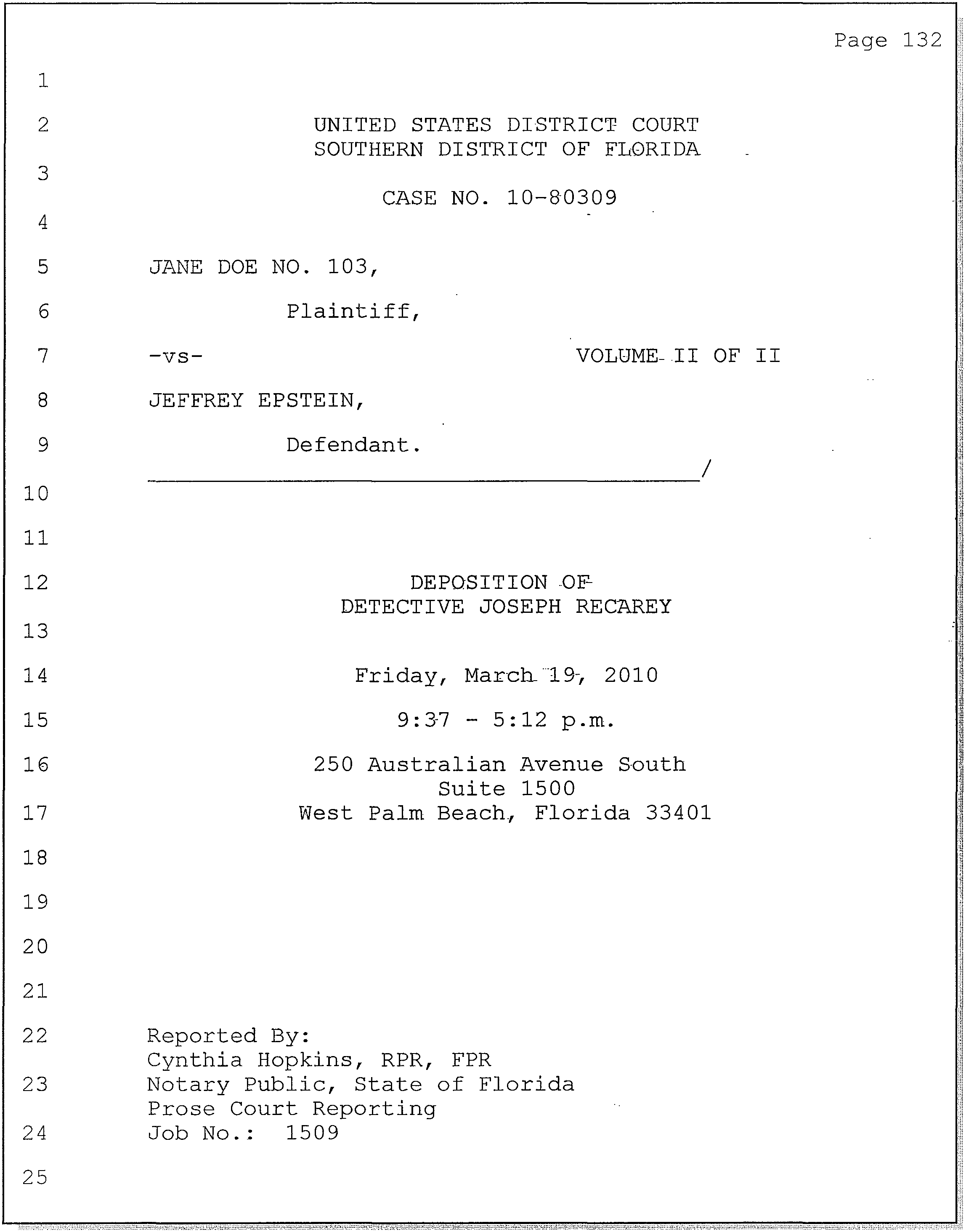
Page 22
document
2296 x 2927
Objects: Page, Text, Document, Invoice | Text: Page 132 | 1 | 2 | UNITED STATES DISTRICT COURT | SOU
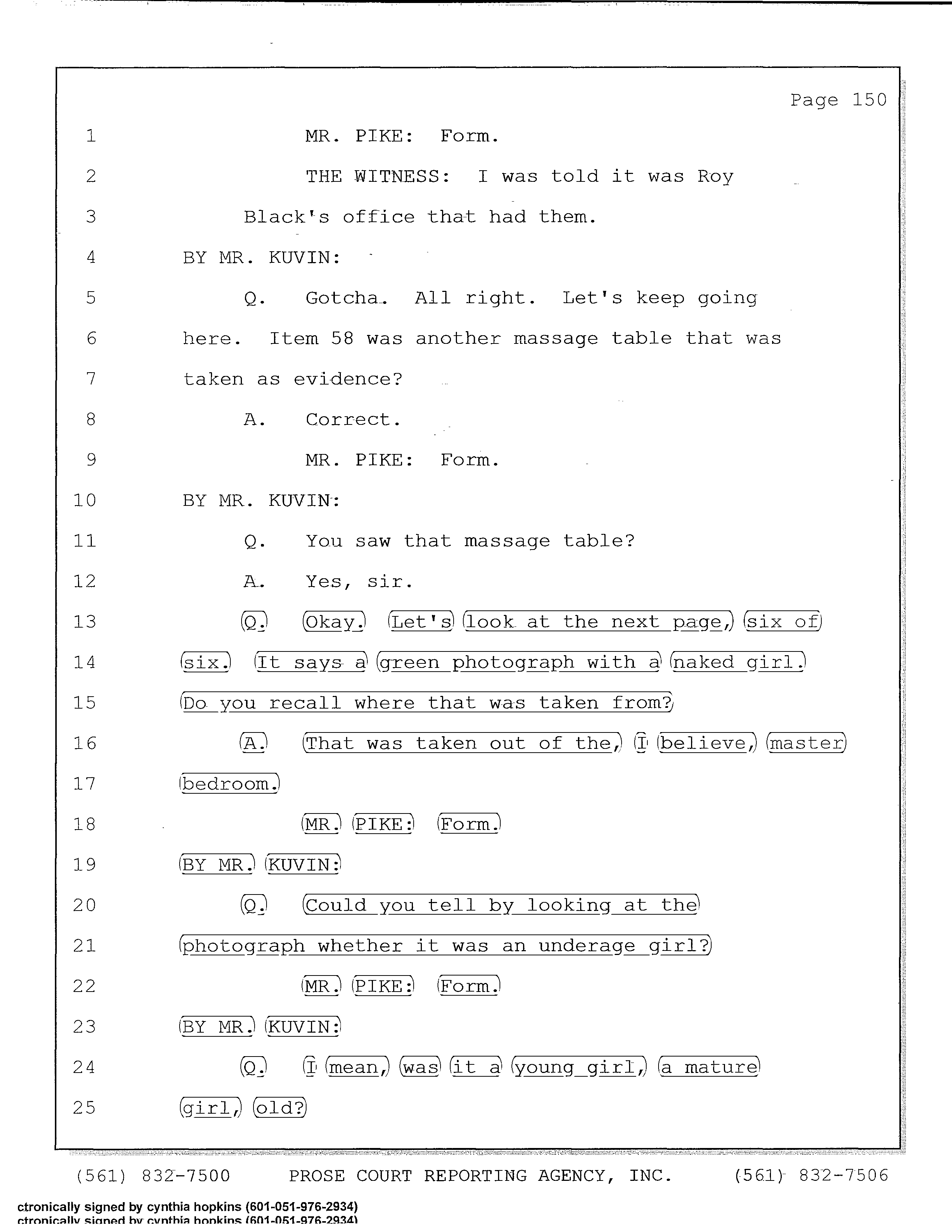
Page 23
document
2550 x 3300
Objects: Page, Text | Text: Page 150 | 1 | MR. PIKE: Form. | THE WITNESS: | 2
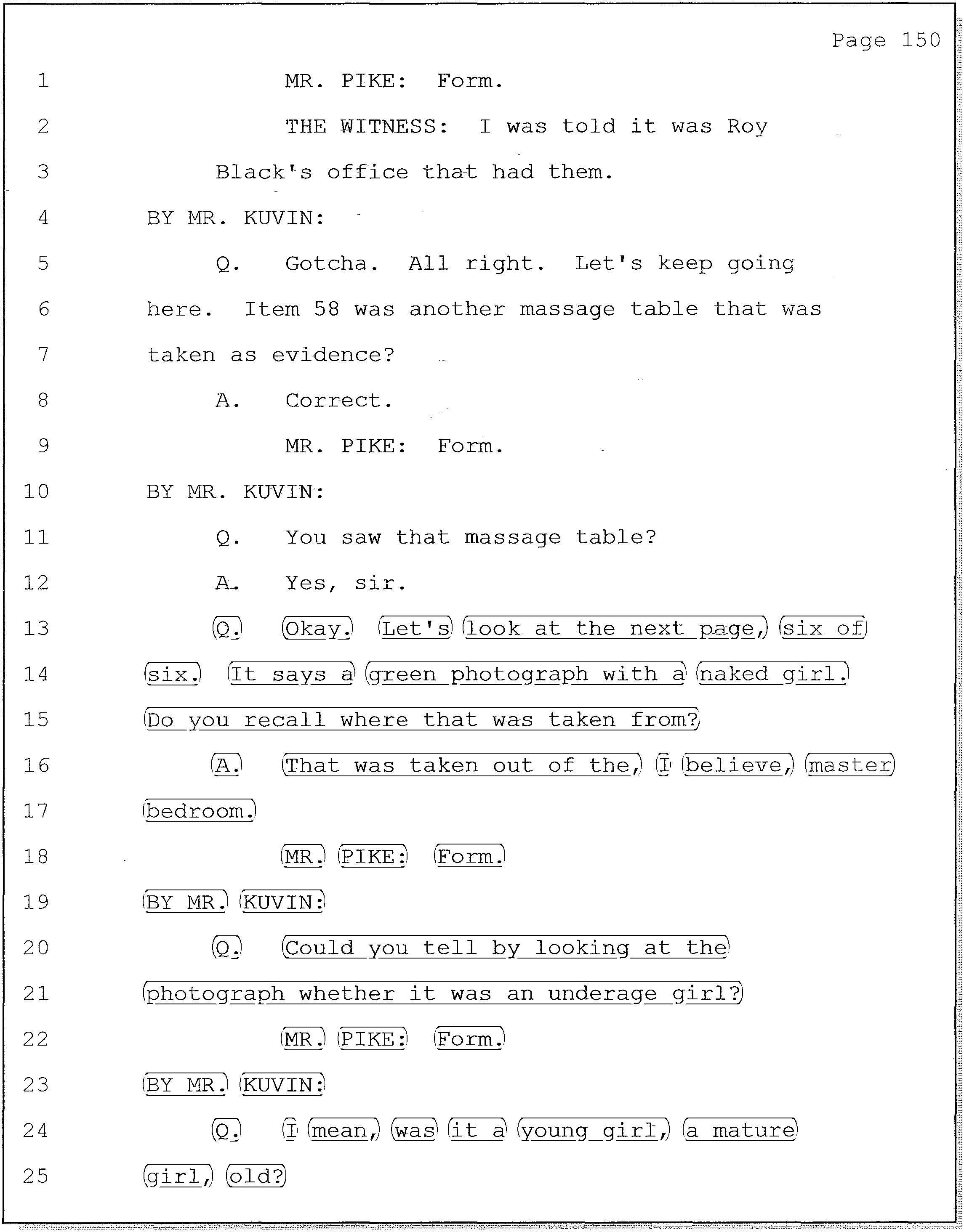
Page 23
document
2290 x 2928
Objects: Page, Text | Text: Page 150 | 1 | MR. PIKE: | Form. | 2
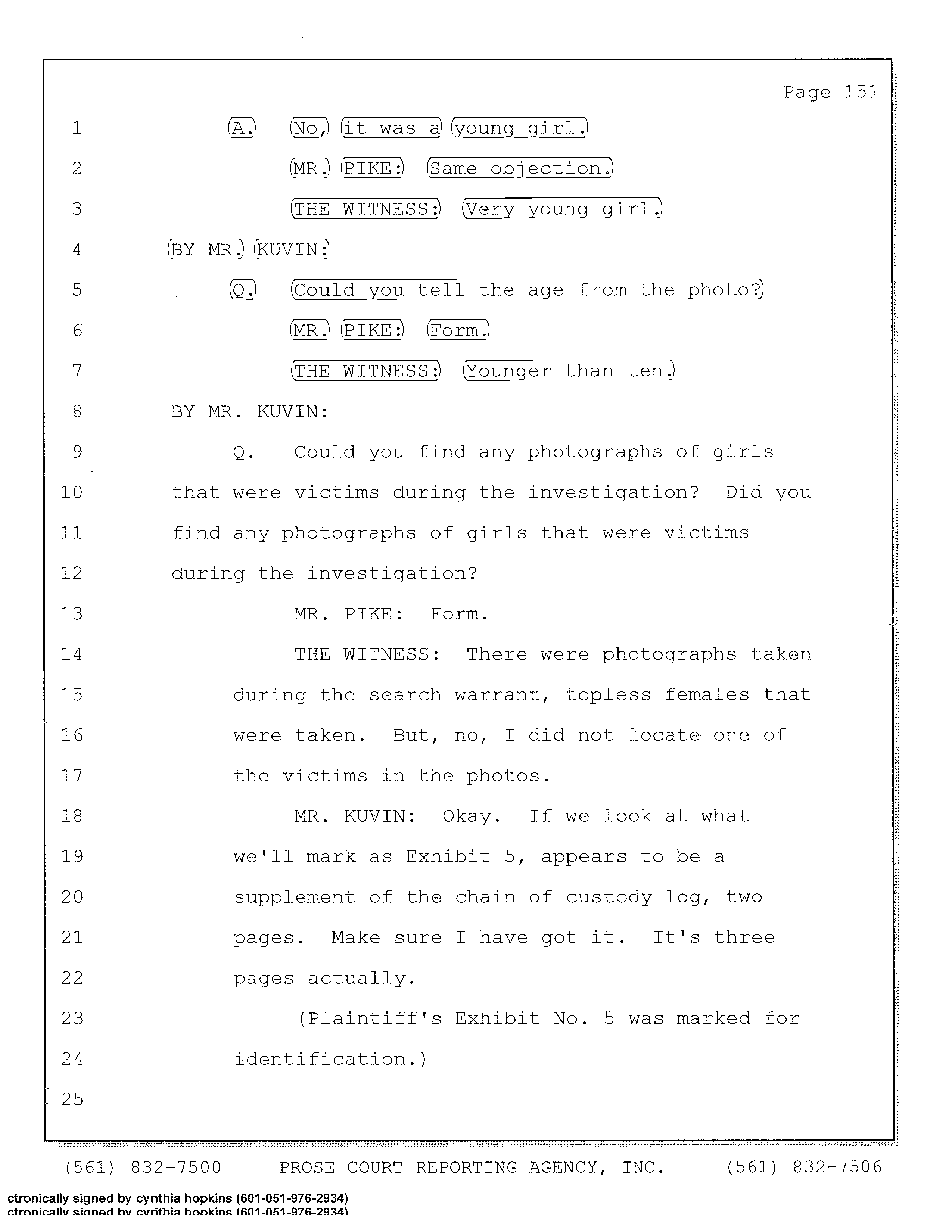
Page 24
document
2550 x 3300
Objects: Page, Text | Text: Page 151 | 1 | A | it was a lyoung_girl. | 2
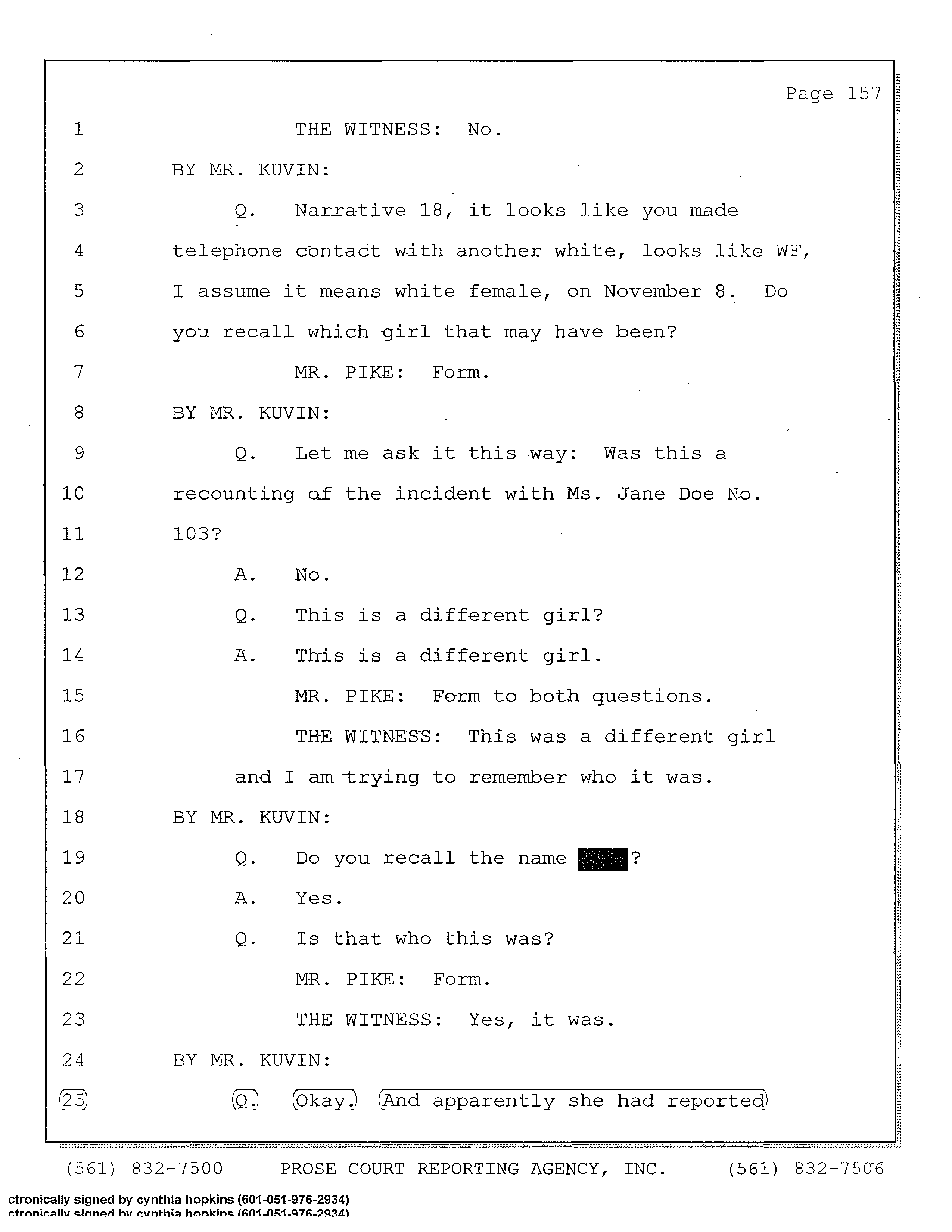
Page 25
document
2550 x 3300
Objects: Page, Text | Text: Page 157 | 1 | THE WITNESS: | No. | 2
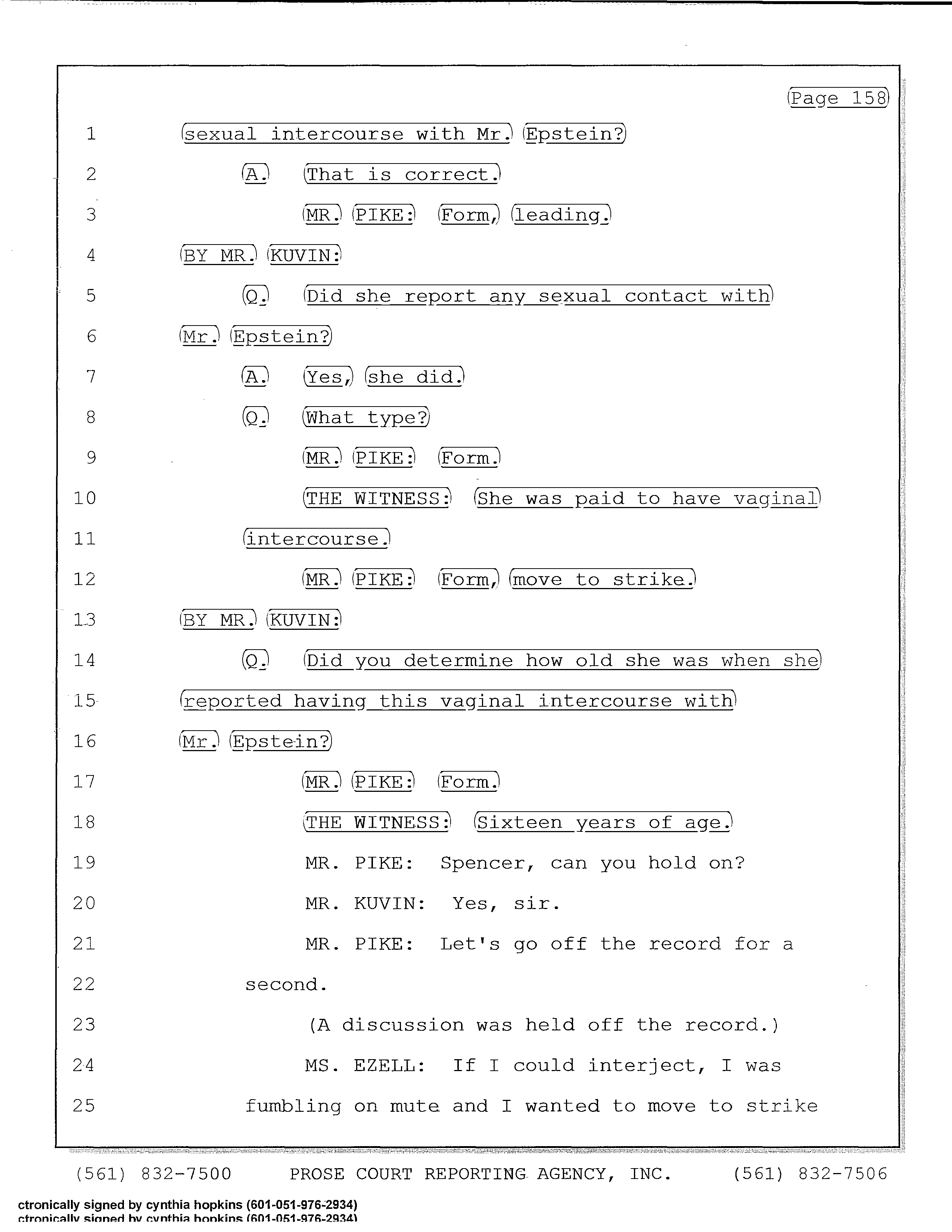
Page 26
document
2550 x 3300
Objects: Page, Text | Text: (Page 158 | 1 | sexual intercourse with Mr. (Epstein? | 2 | A.
Page 26
document
2294 x 2926
Objects: Page, Text | Text: Page 158 | 1 | sexual intercourse with Mr. (Epstein? | 2 | A
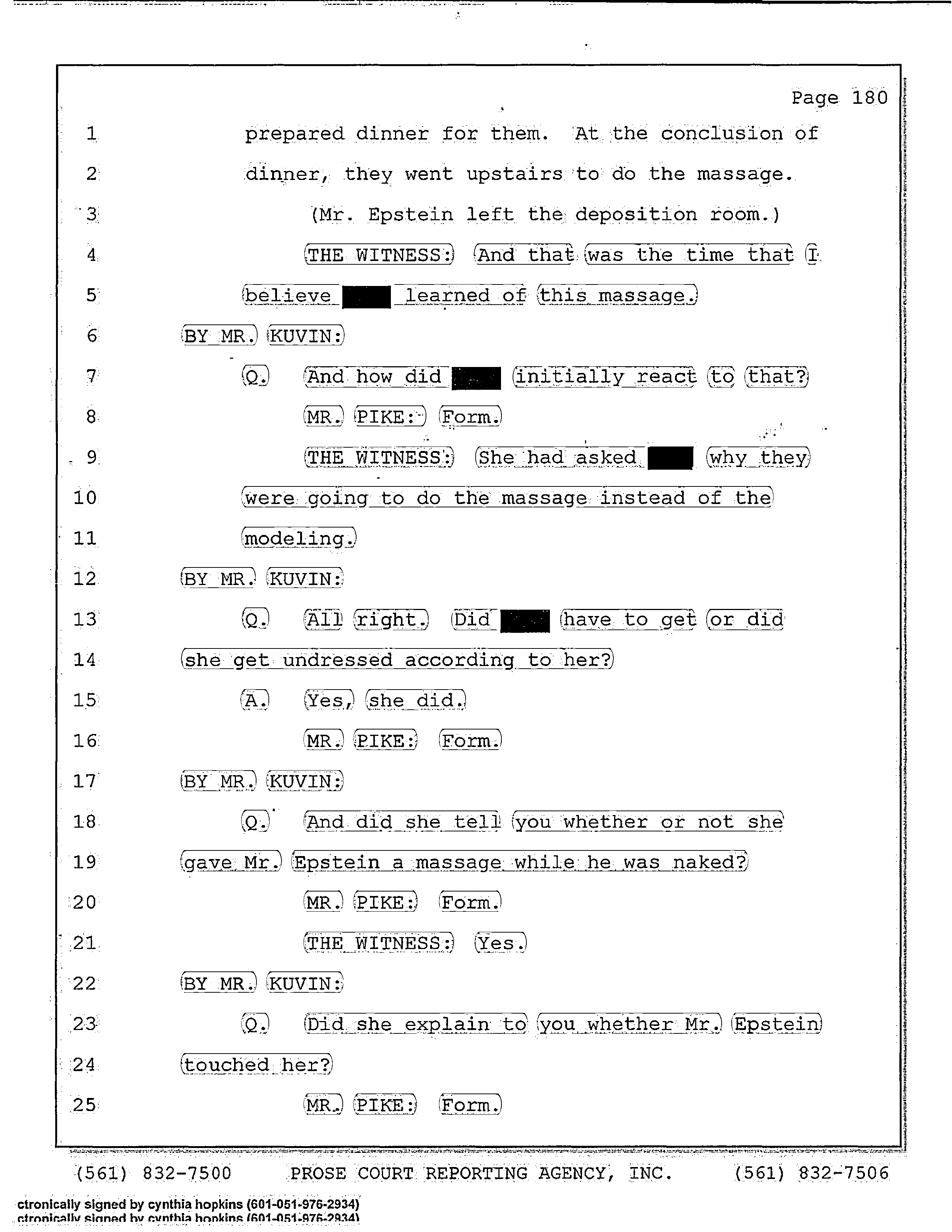
Page 27
document
2550 x 3300
Objects: Page, Text | Text: Page 180 | 1 | prepared dinner for them. At the conclusion of | 2 | dinn
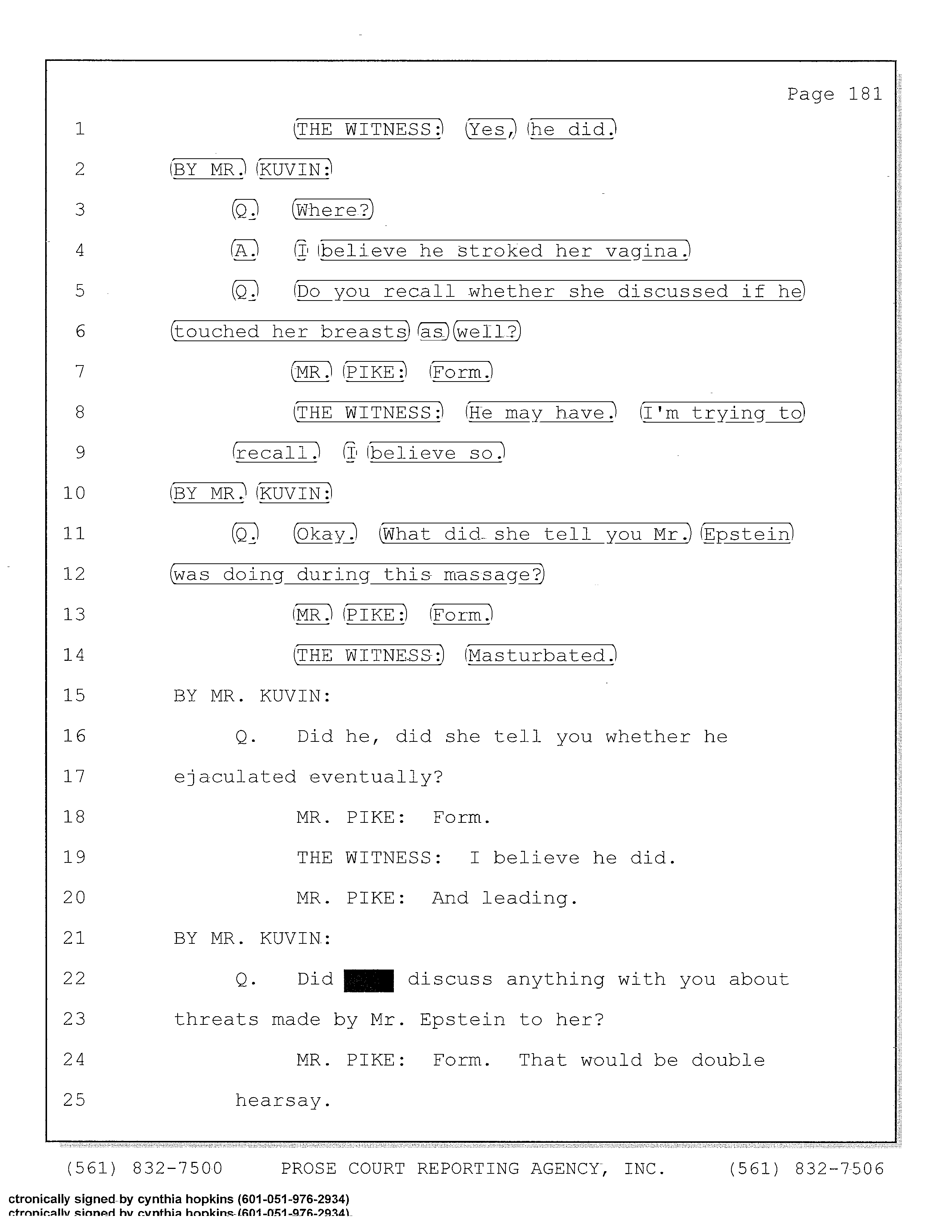
Page 28
document
2550 x 3300
Objects: Page, Text | Text: Page 181 | (he did. | 1 | THE WITNESS: | 2
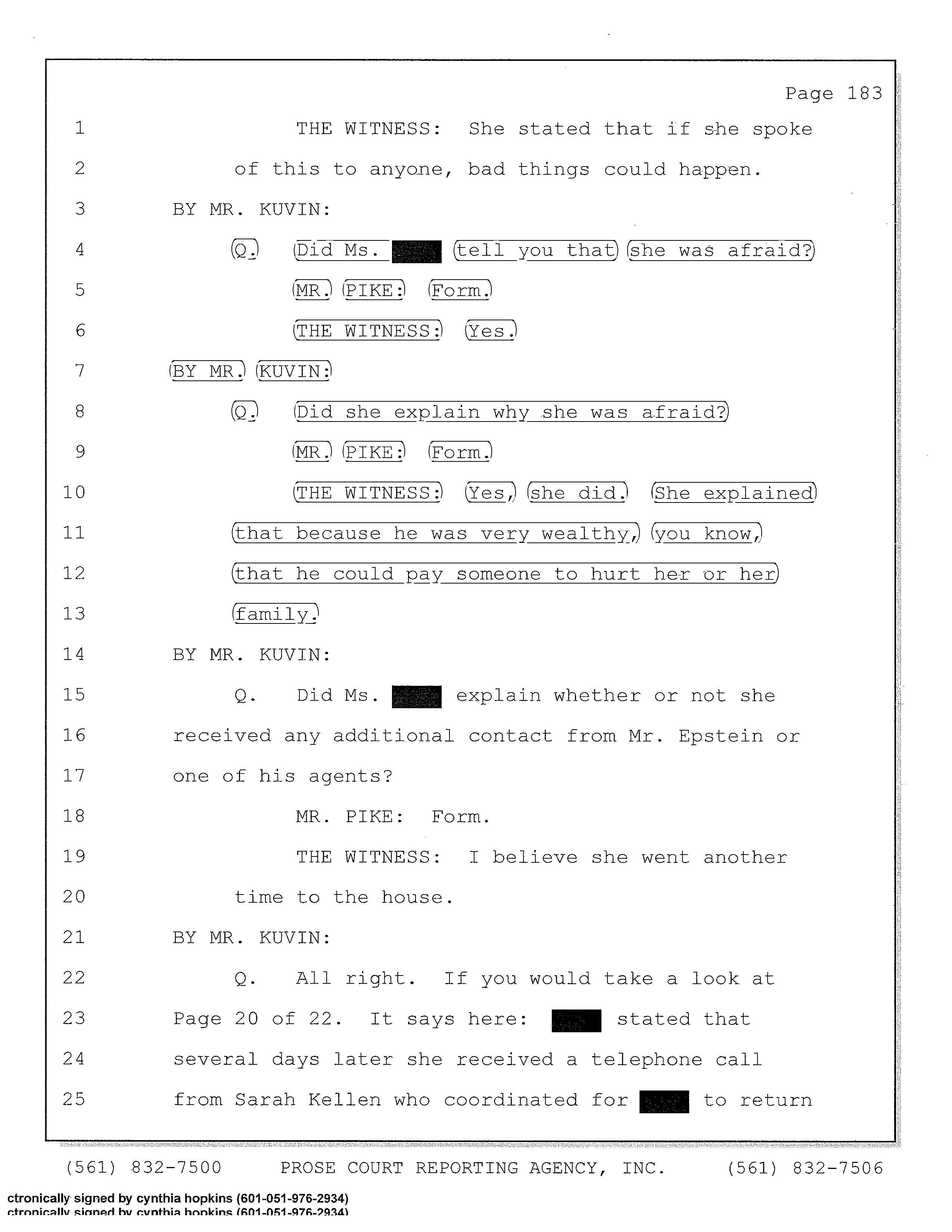
Page 29
document
2550 x 3300
Objects: Page, Text | Text: Page 183 | She stated that if she spoke | 1 | THE WITNESS: | 2
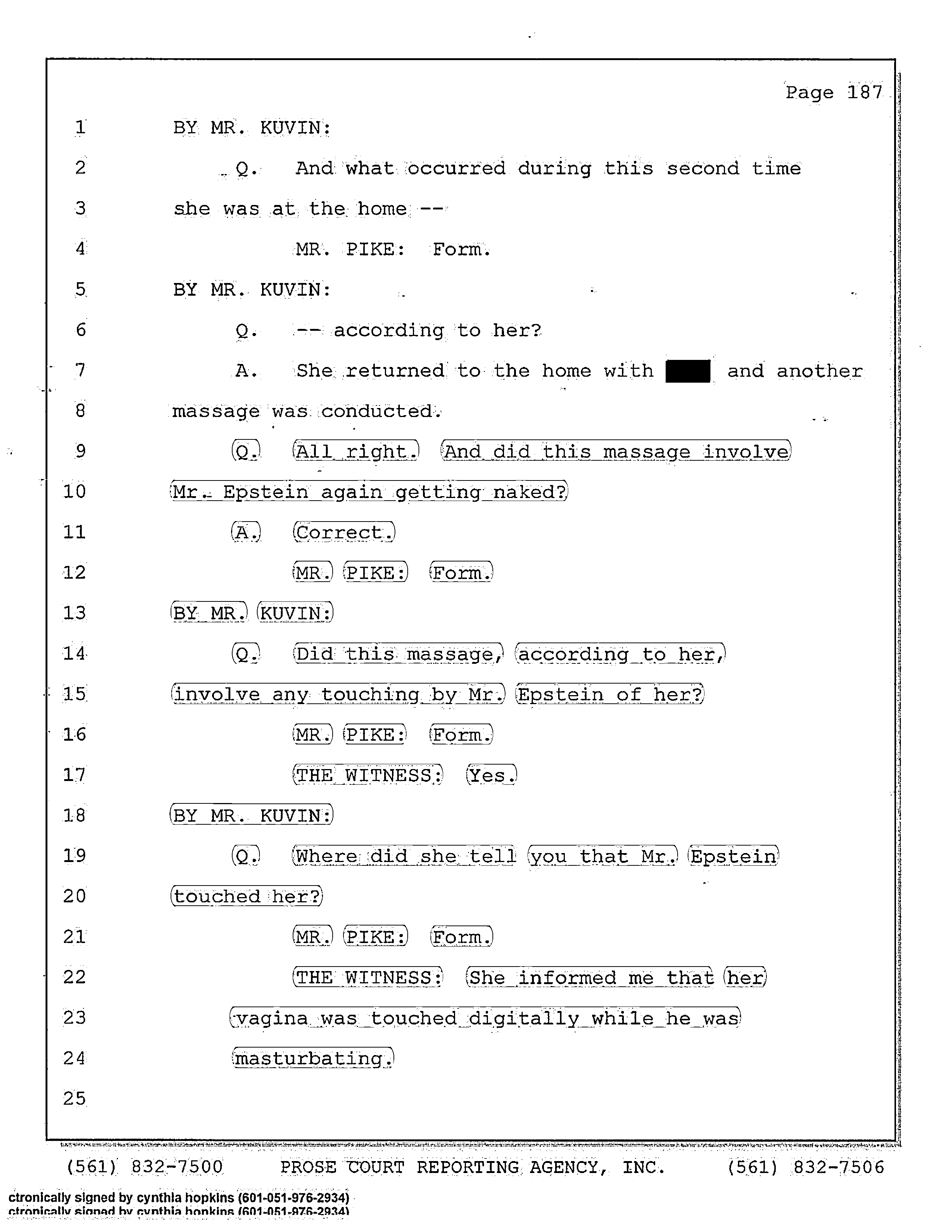
Page 30
document
2550 x 3300
Objects: Page, Text | Text: Page 187 | 1 | BY MR. KUVIN: | 2 | And what occurred during this second
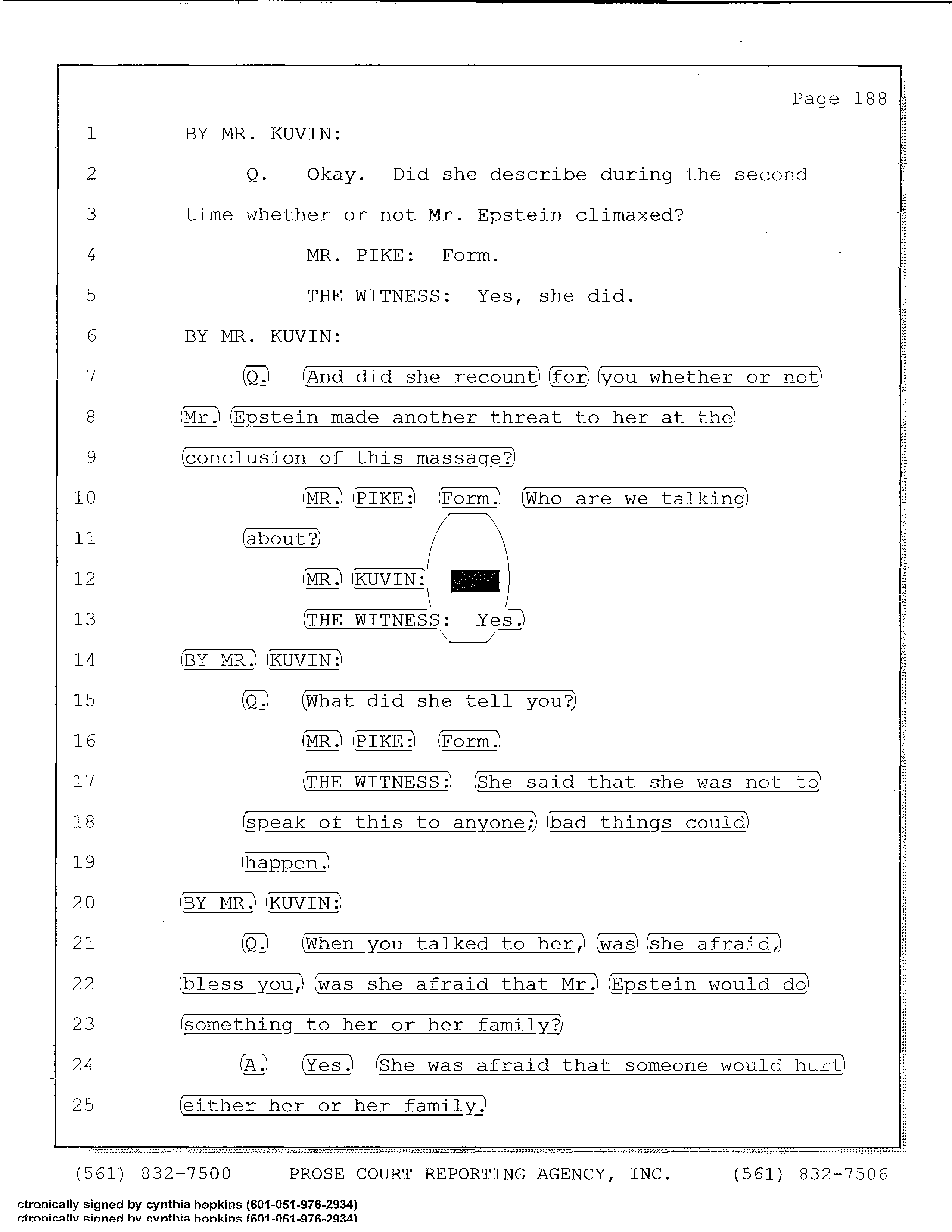
Page 31
document
2550 x 3300
Objects: Page, Text, Document, Receipt | Text: Page 188 | 1 | BY MR. KUVIN: | 2 | Q.
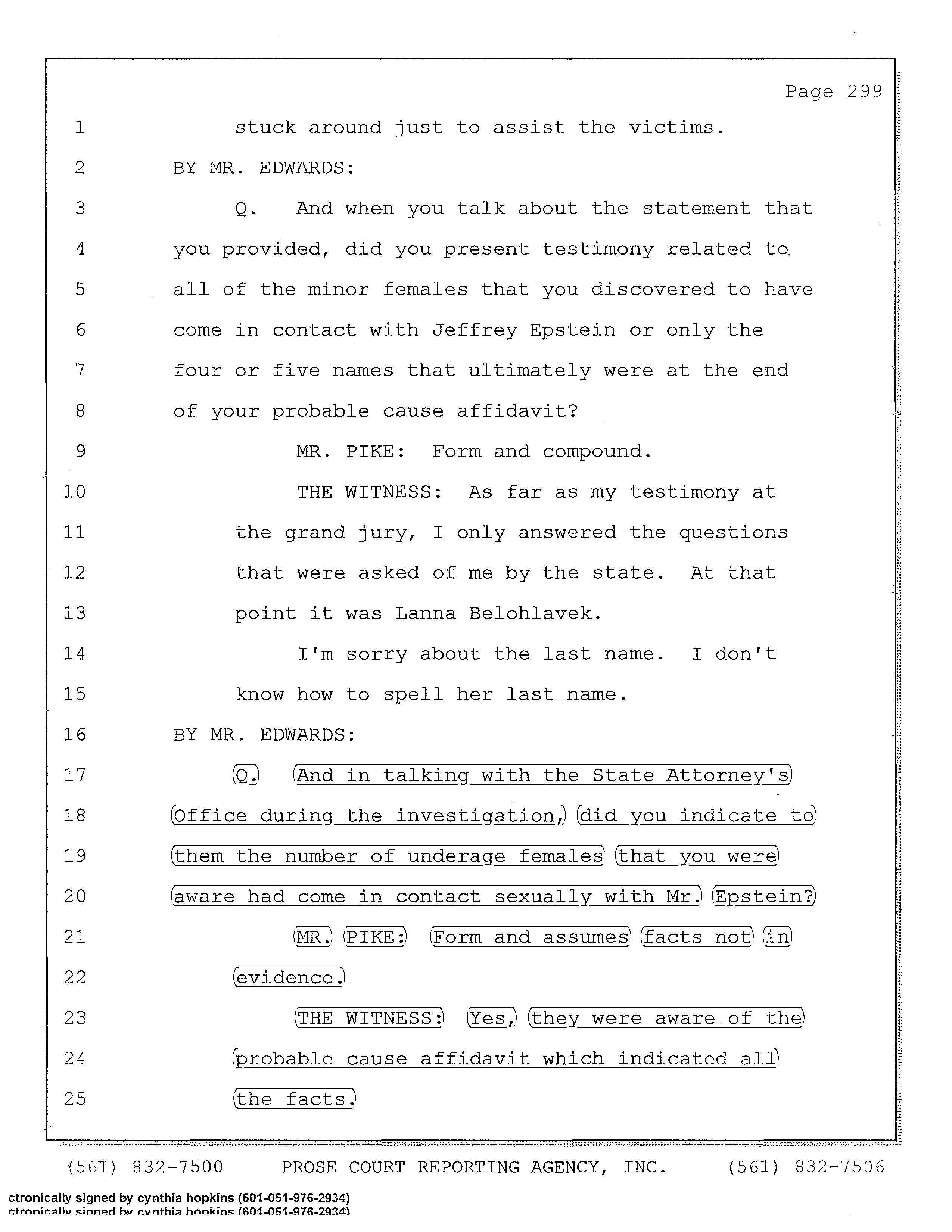
Page 32
document
2550 x 3300
Objects: Page, Text | Text: Page 299 | 1 | stuck around just to assist the victims. | 2 | BY MR. EDW
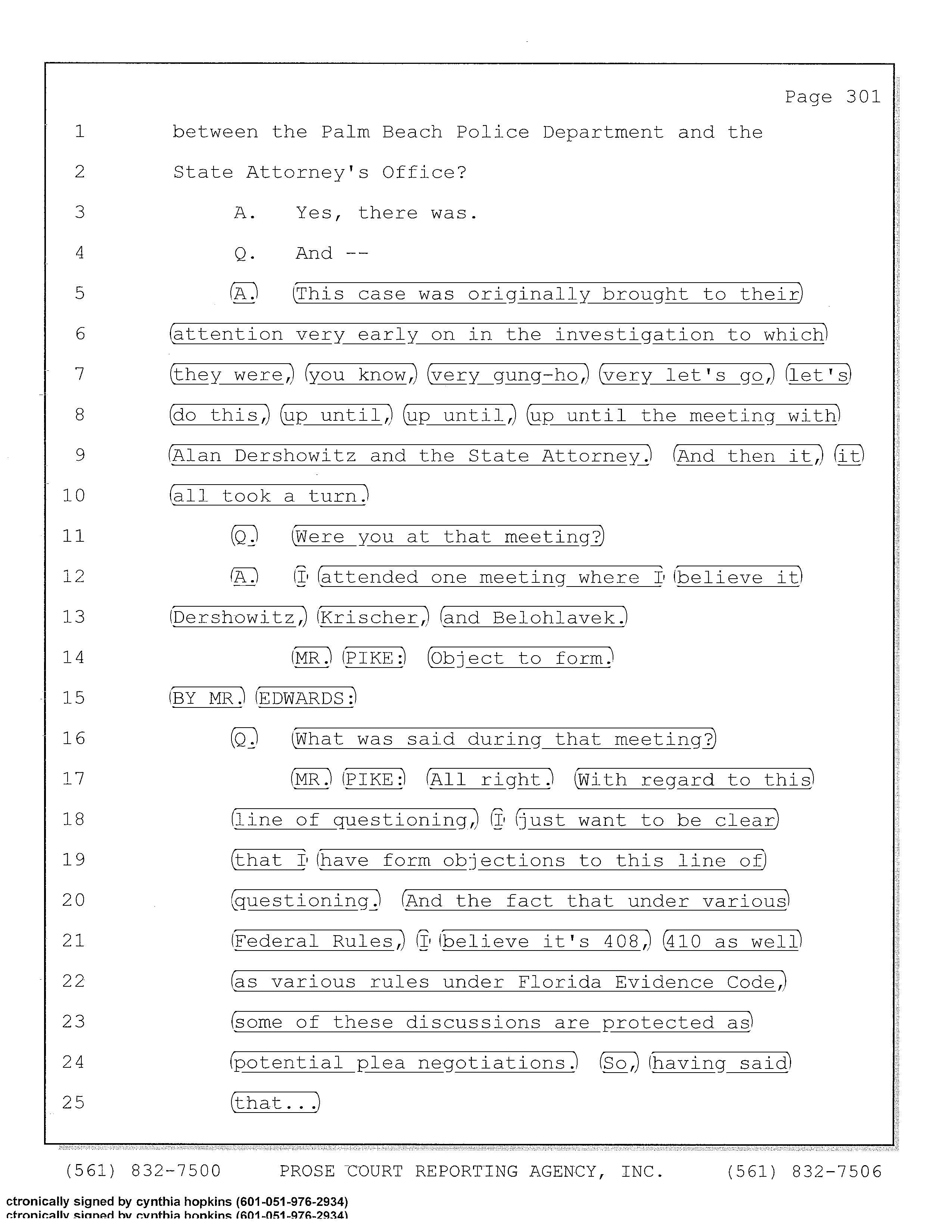
Page 33
document
2550 x 3300
Objects: Page, Text | Text: Page 301 | 1 | between the Palm Beach Police Department and the | 2 | St
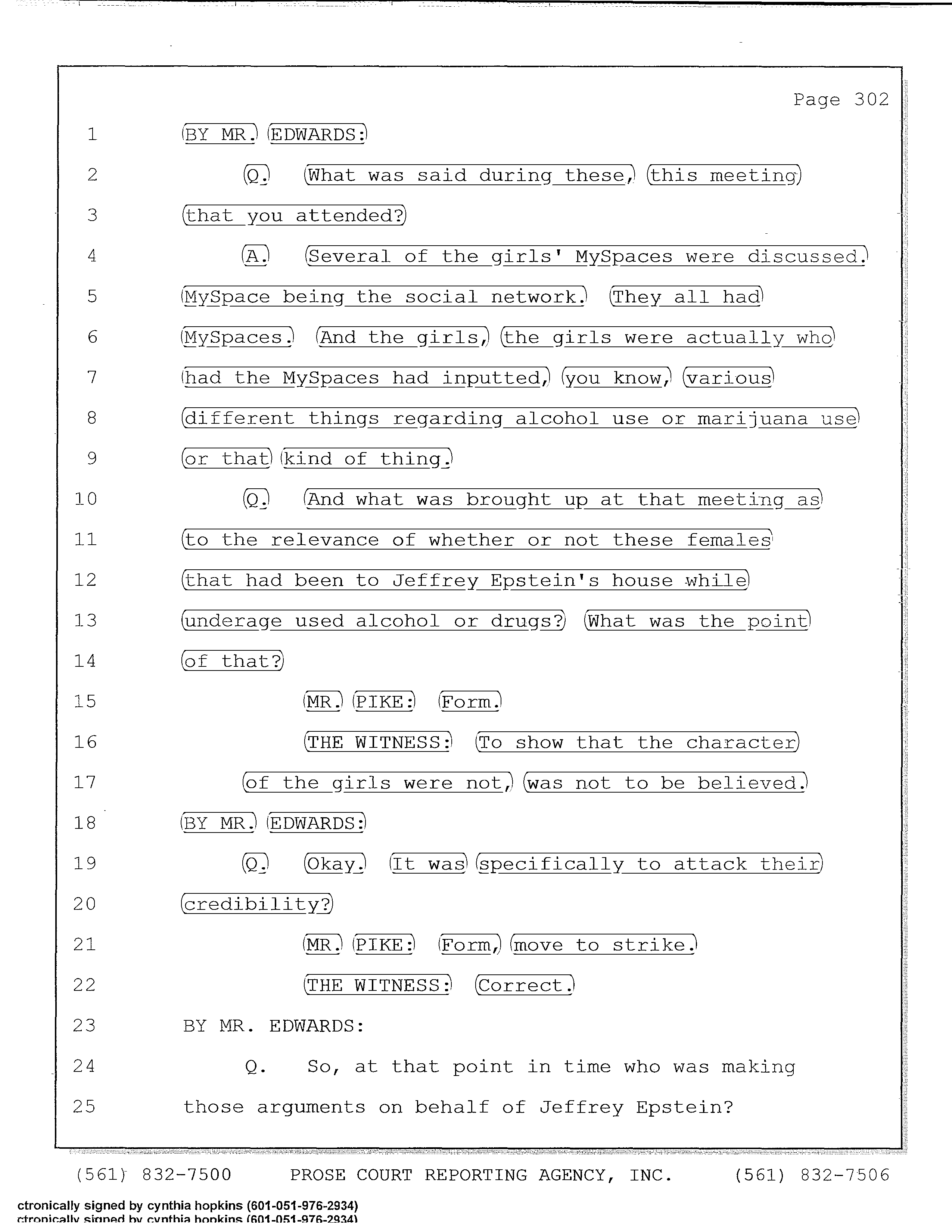
Page 34
document
2550 x 3300
Objects: Page, Text | Text: Page 302 | 1 | BY MR. | EDWARDS: | 2
Page 35
document
2550 x 3300
Objects: Text | Text: Appendix 2
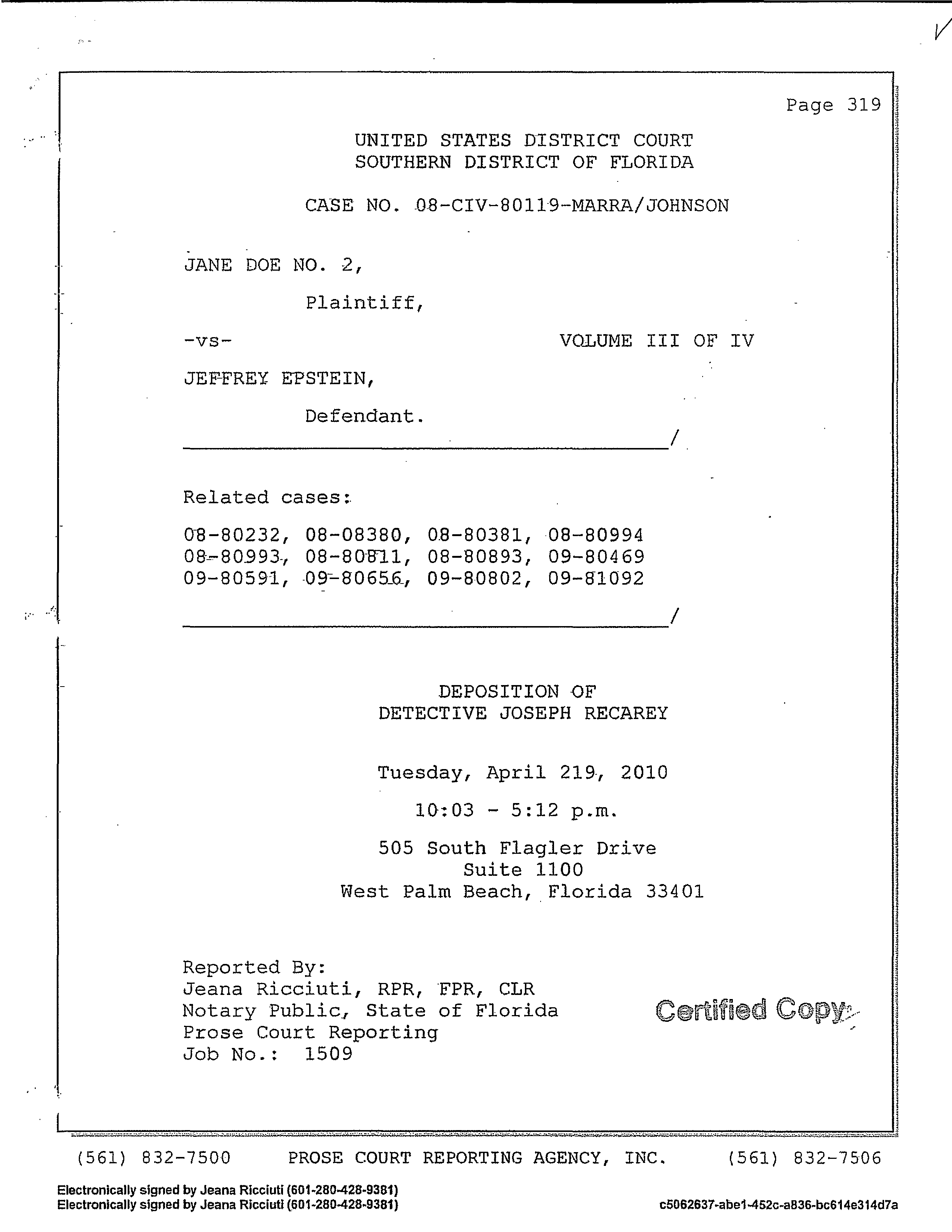
Page 36
document
2550 x 3300
Objects: Text, Page, Document, Receipt | Text: Page 319 | UNITED STATES DISTRICT COURT | SOUTHERN DI
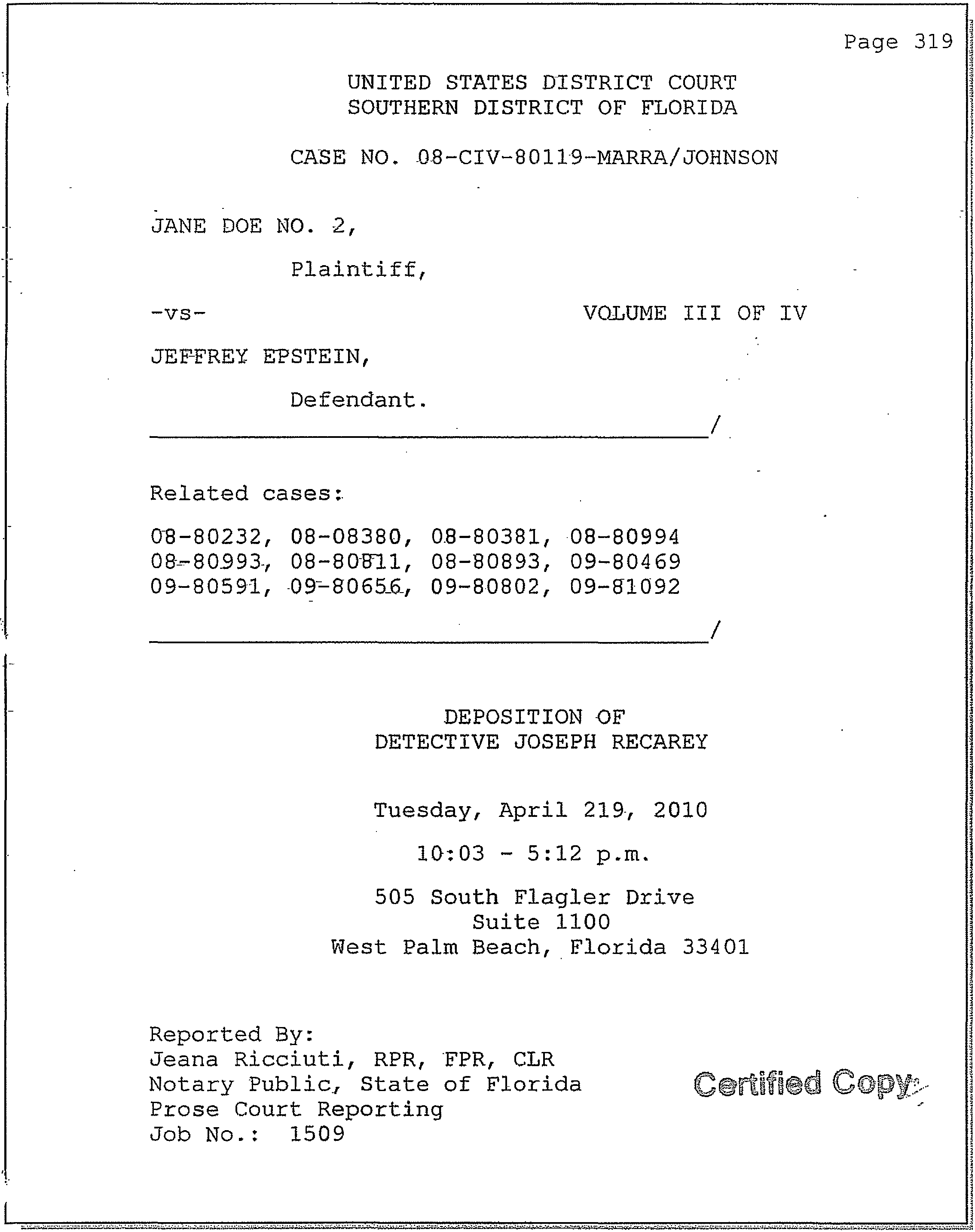
Page 36
document
2269 x 2867
Objects: Page, Text | Text: Page 319 | UNITED STATES DISTRICT COURT | SOUTHERN DISTRICT OF FLORIDA |
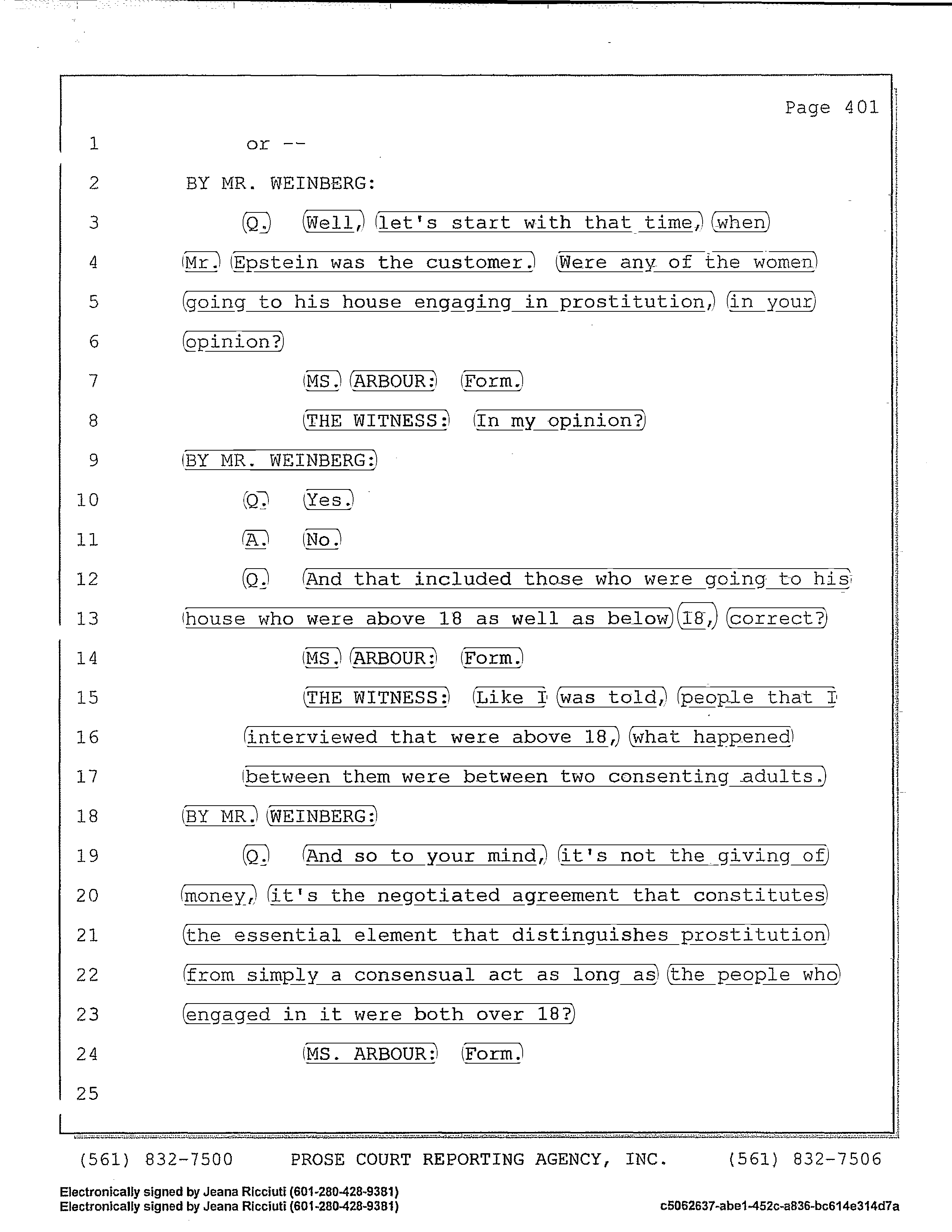
Page 37
document
2550 x 3300
Objects: Page, Text | Text: Page 401 | 1 | or | 2 | BY MR. WEINBERG:
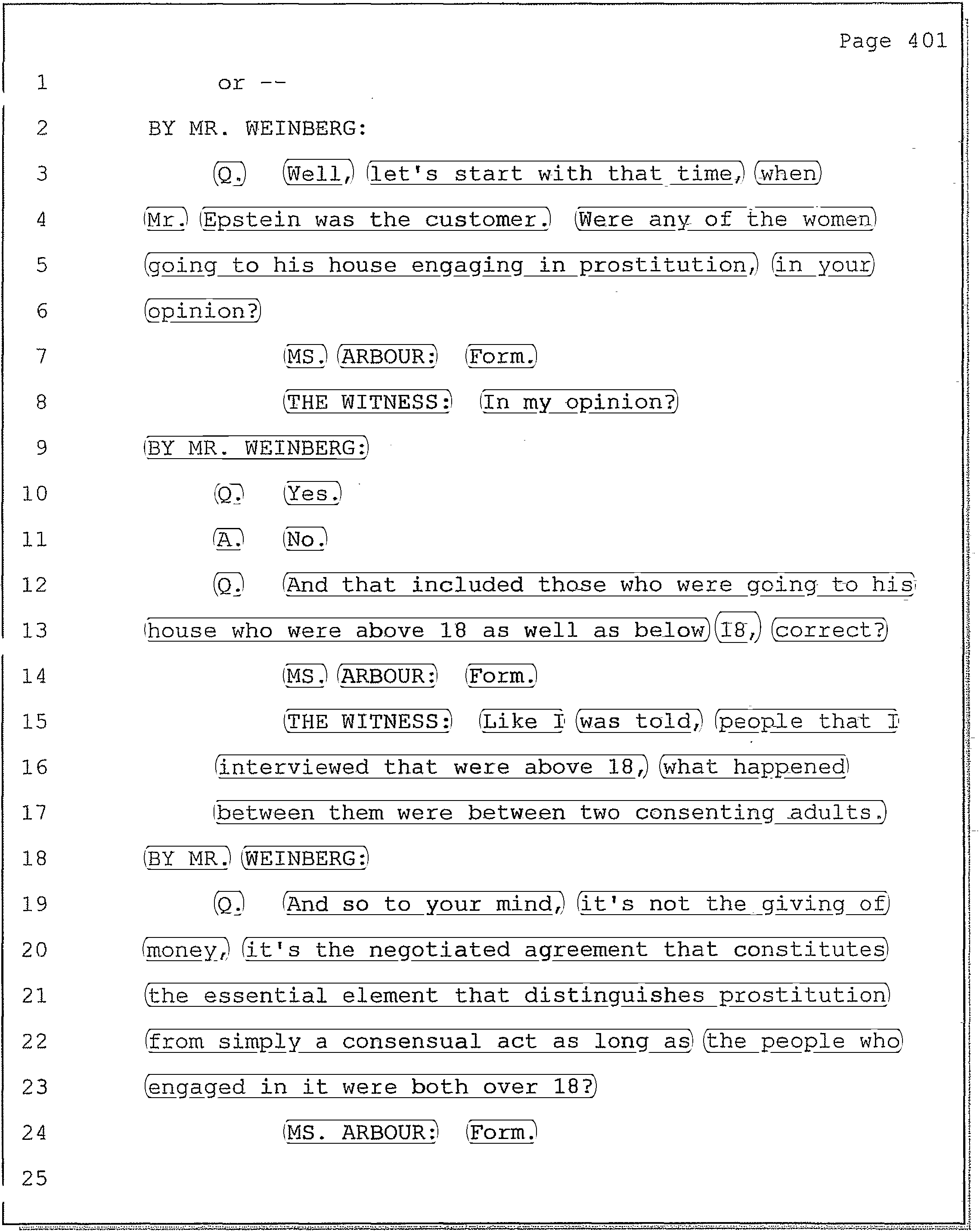
Page 37
document
2276 x 2861
Objects: Page, Text, Document | Text: Page 401 | 1 | or -- | 2 | BY MR. WEINBERG:
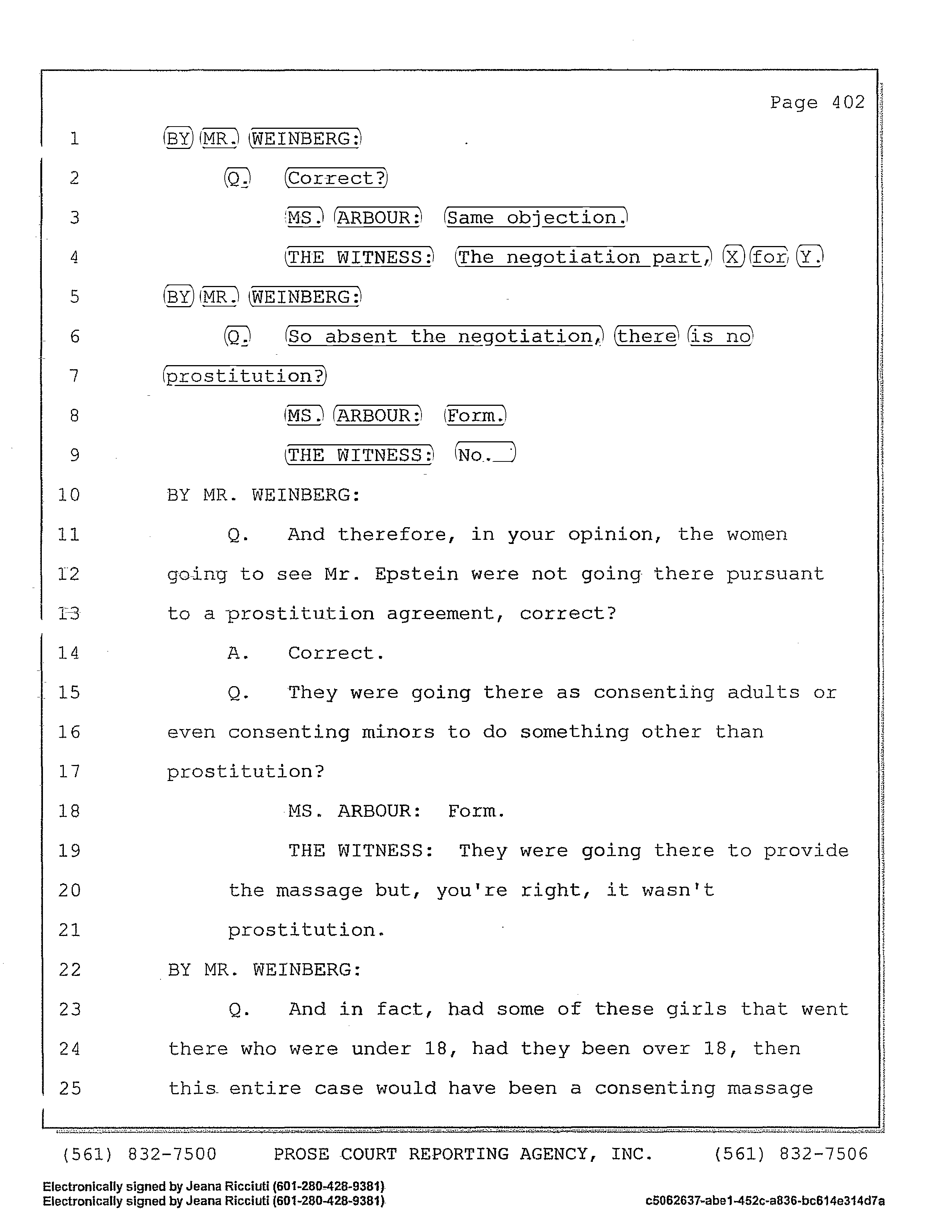
Page 38
document
2550 x 3300
Objects: Page, Text | Text: Page 402 | BY | 1 | WEINBERG: | 2
Page 38
document
2275 x 2862
Objects: Page, Text | Text: Page 402 | 1 | BY | MR | WEINBERG:
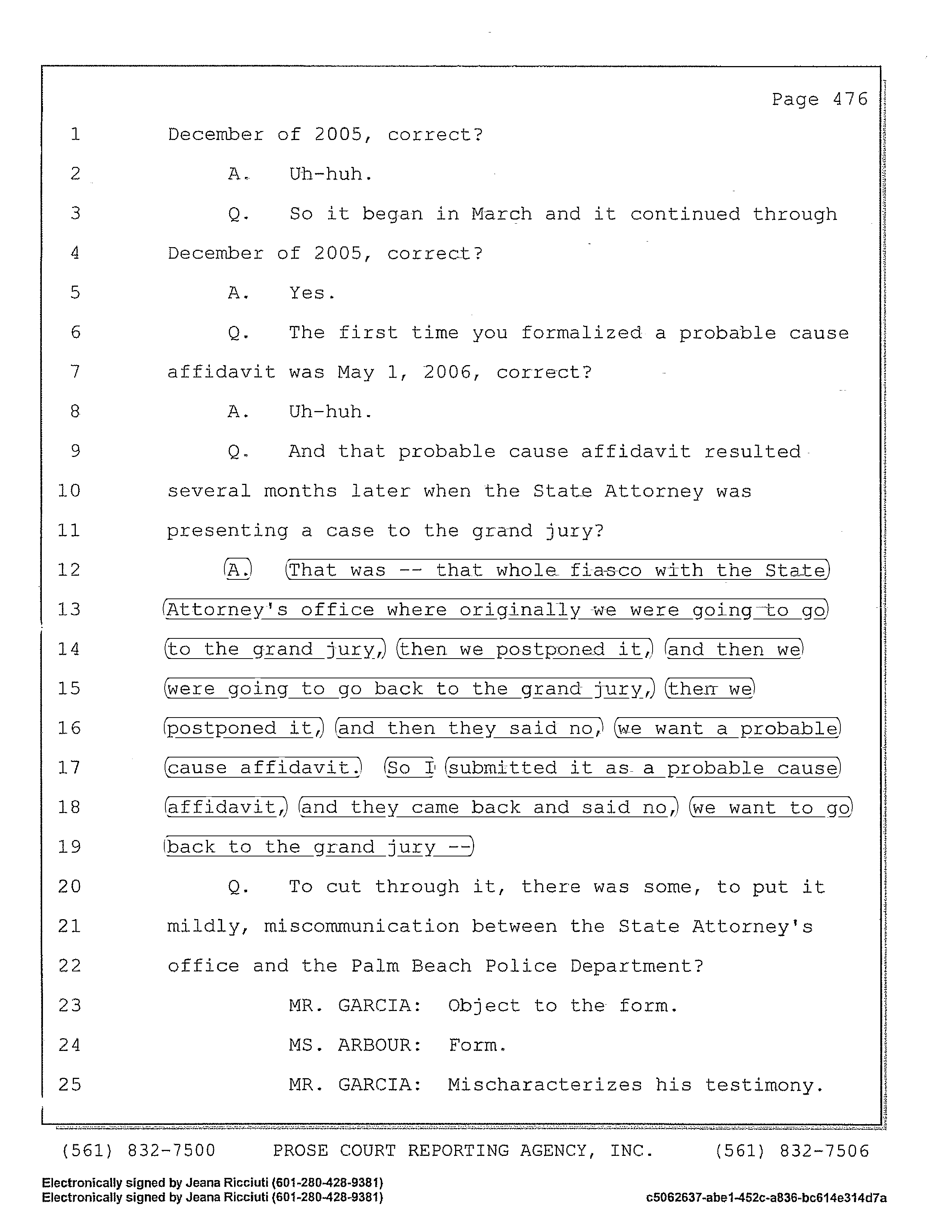
Page 39
document
2550 x 3300
Objects: Page, Text | Text: Page 476 | 1 | December of 2005, correct? | 2 | Uh-huh.
Page 39
document
2283 x 2863
Objects: Page, Text | Text: Page 476 | 1 | December of 2005, correct? | A. | Uh-huh.
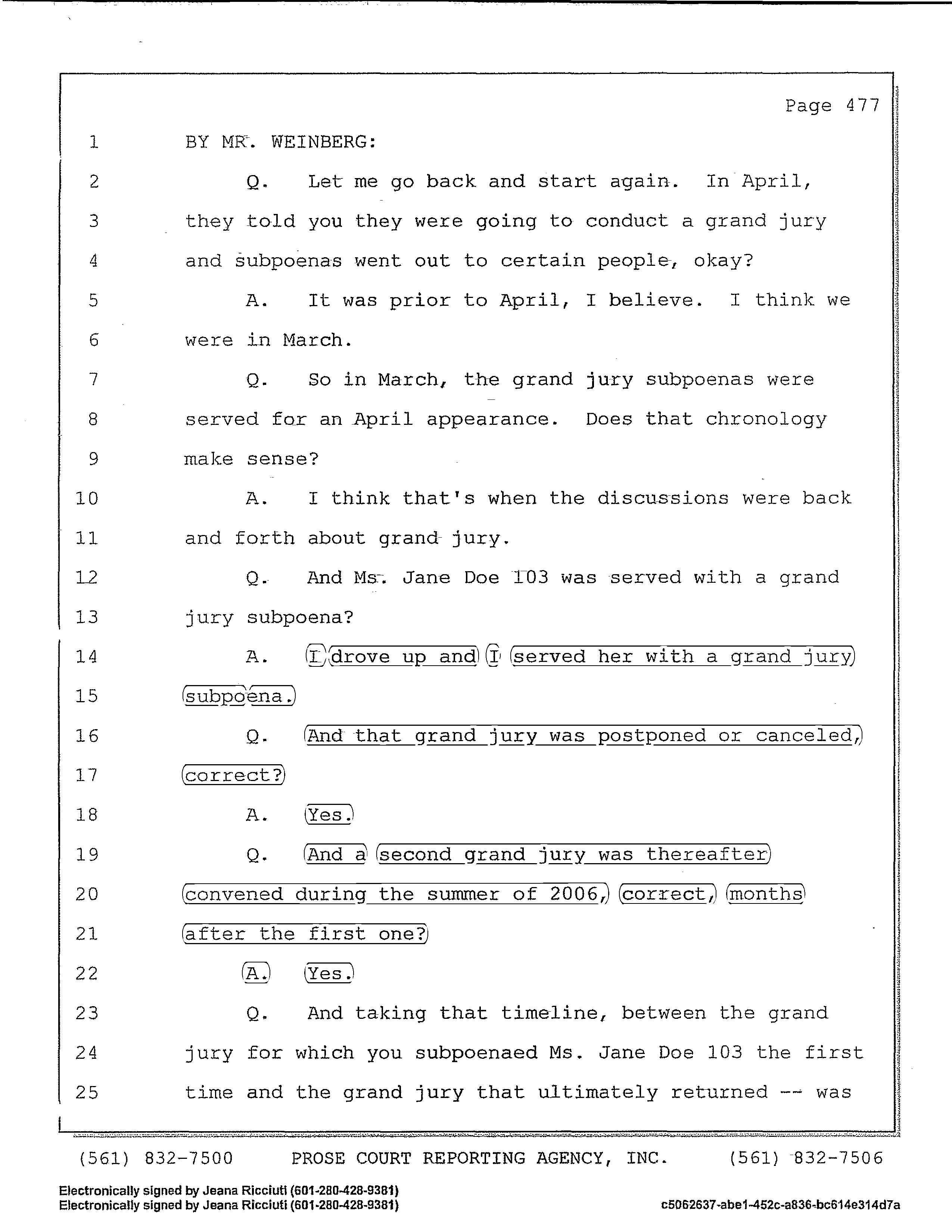
Page 40
document
2550 x 3300
Objects: Page, Text | Text: Page 477 | 1 | BY MR. WEINBERG: | 2 | Q.
Page 40
document
2270 x 2865
Objects: Page, Text | Text: Page 477 | 1 | BY MR. WEINBERG: | 2 | Q.
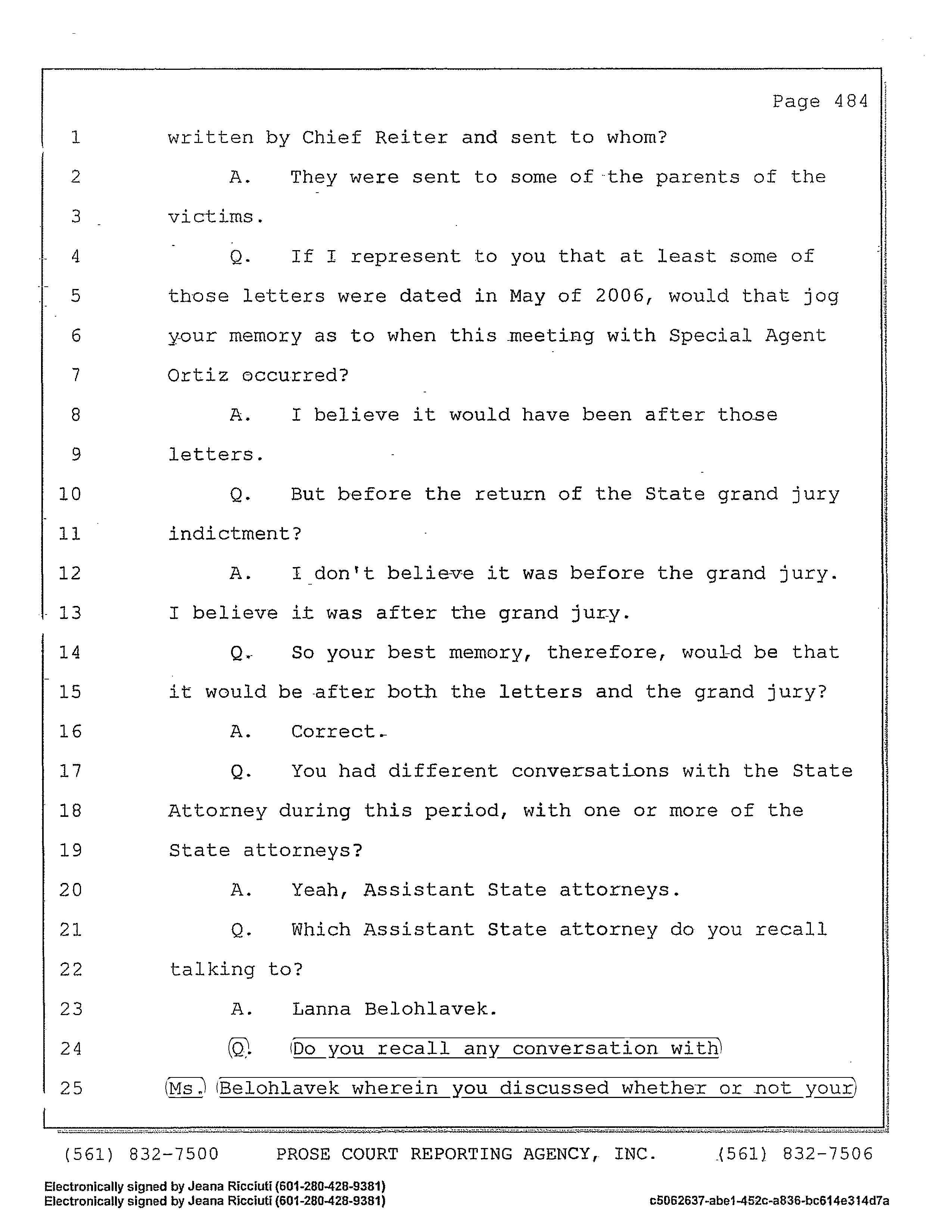
Page 41
document
2550 x 3300
Objects: Page, Text | Text: Page 484 | 1 | written by Chief Reiter and sent to whom? | 2 | A.
Page 41
document
2290 x 2864
Objects: Page, Text, Chart, Plot | Text: Page 484 | 1 | written by Chief Reiter and sent to whom? |
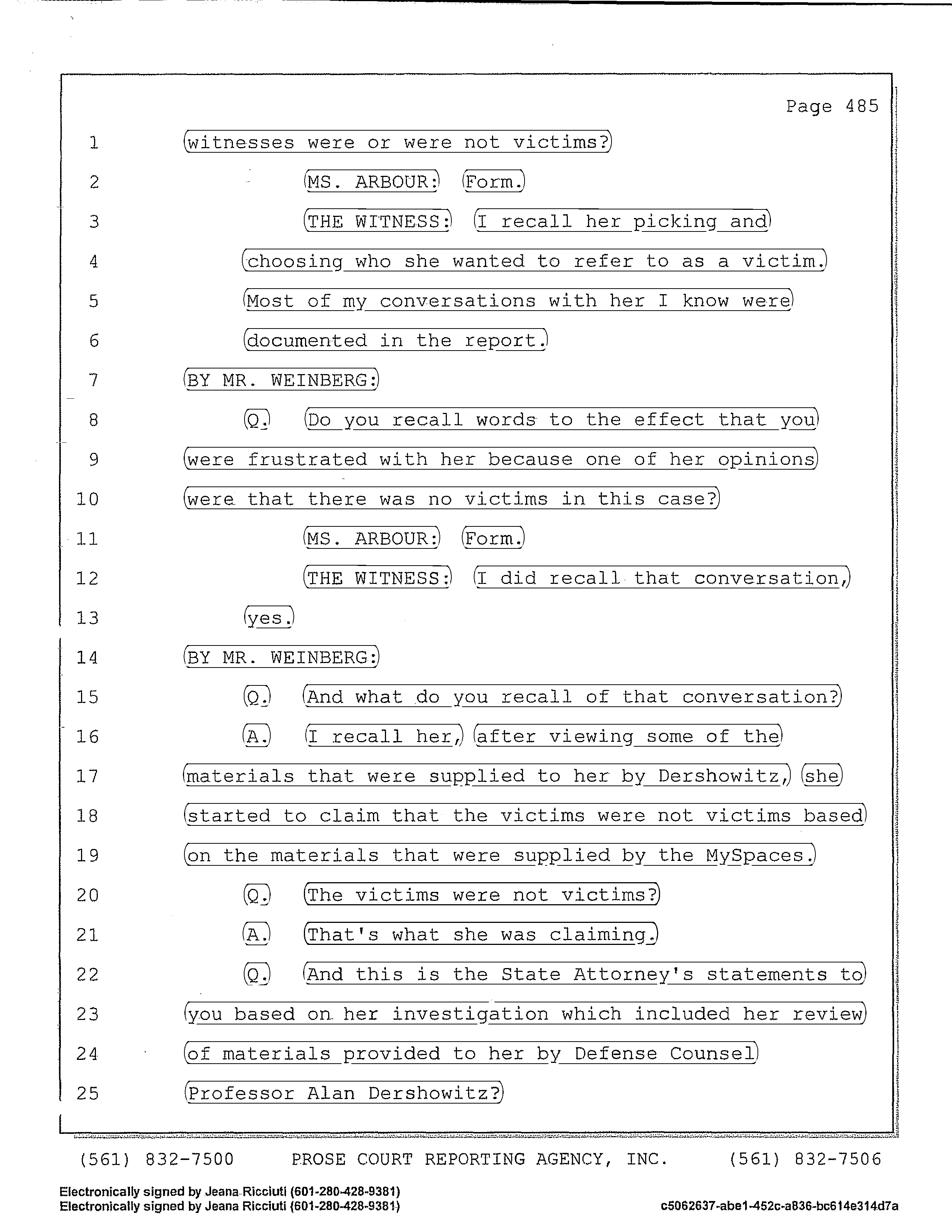
Page 42
document
2550 x 3300
Objects: Page, Text, Document | Text: Page 485 | 1 | witnesses were or were not victims? | MS. ARBOU
Page 42
document
2266 x 2864
Objects: Page, Text | Text: Page 485 | 1 | witnesses were or were not victims? | 2 | MS. ARBOUR:
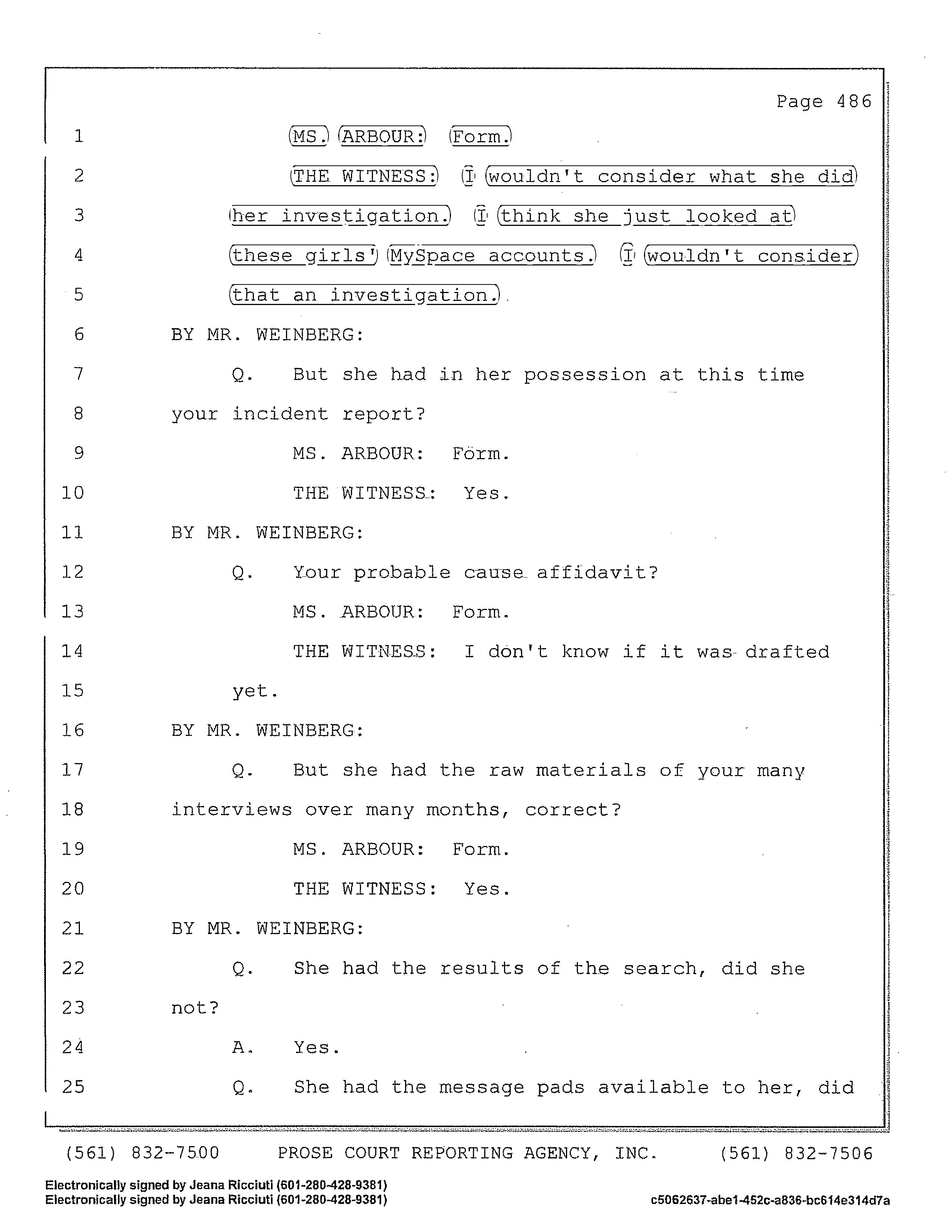
Page 43
document
2550 x 3300
Objects: Page, Text | Text: Page 486 | 1 | ARBOUR: | Form | 2
Page 43
document
2289 x 2865
Objects: Page, Text | Text: Page 486 | 1 | MS | ARBOUR: | Form.
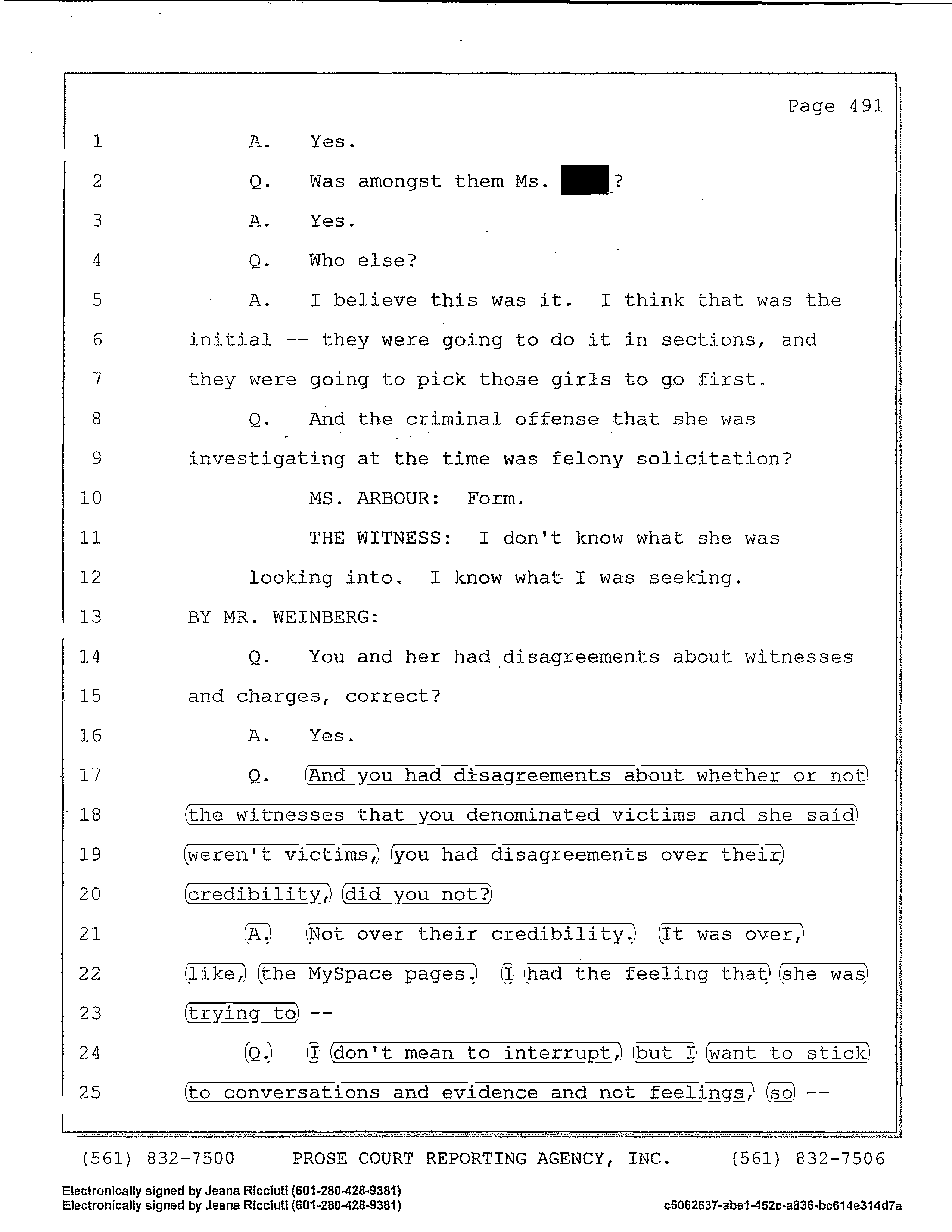
Page 44
document
2550 x 3300
Objects: Page, Text | Text: Page 491 | 1 | 2 | Q. | ?
Page 44
document
2262 x 2864
Objects: Page, Text | Text: Page 491 | 1 | A. | Yes. | 2
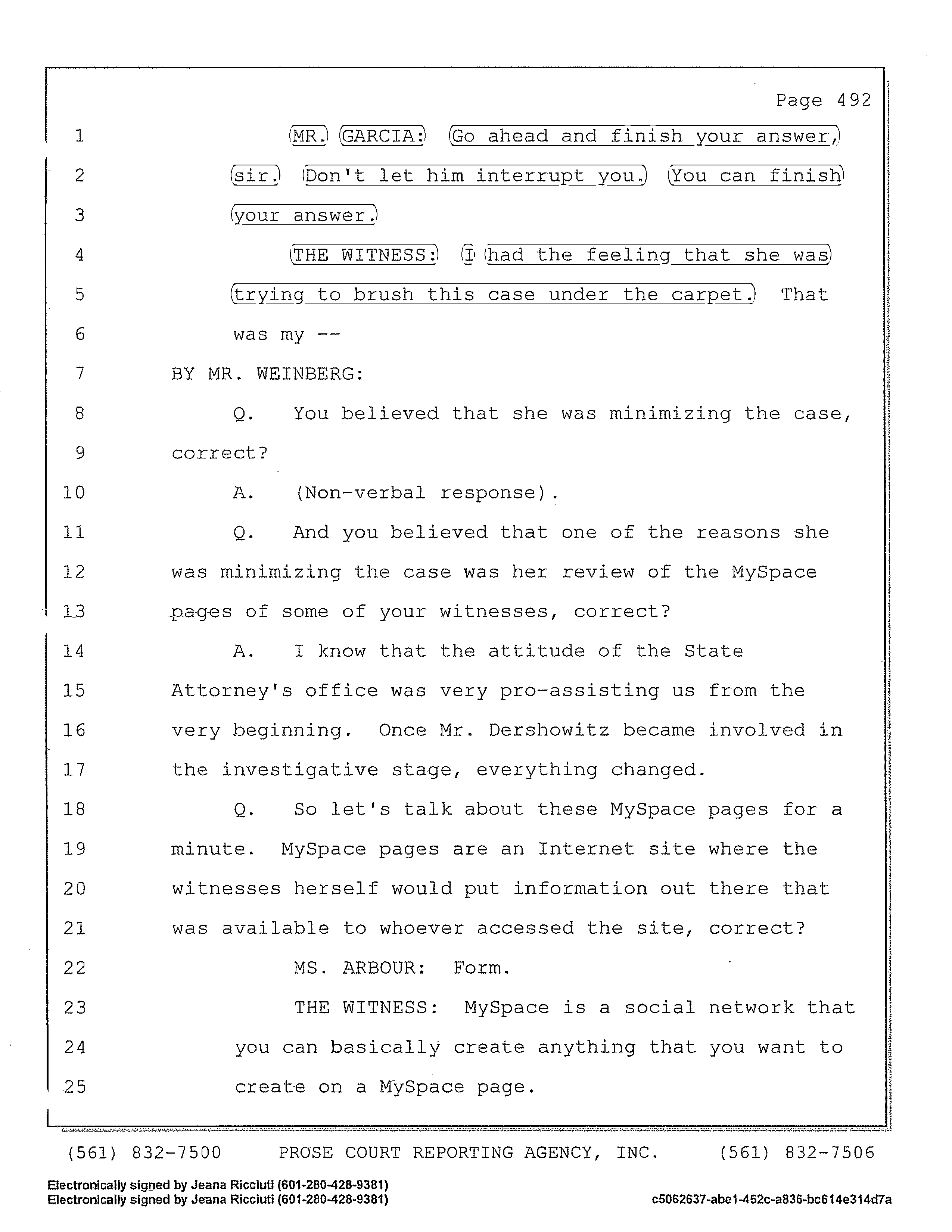
Page 45
document
2550 x 3300
Objects: Page, Text | Text: Page 492 | Go ahead and finish your answer | 1 | GARCIA: | 2
Page 45
document
2277 x 2863
Objects: Page, Text | Text: Page 492 | MR | Go ahead and finish your answer, | 1 | 2
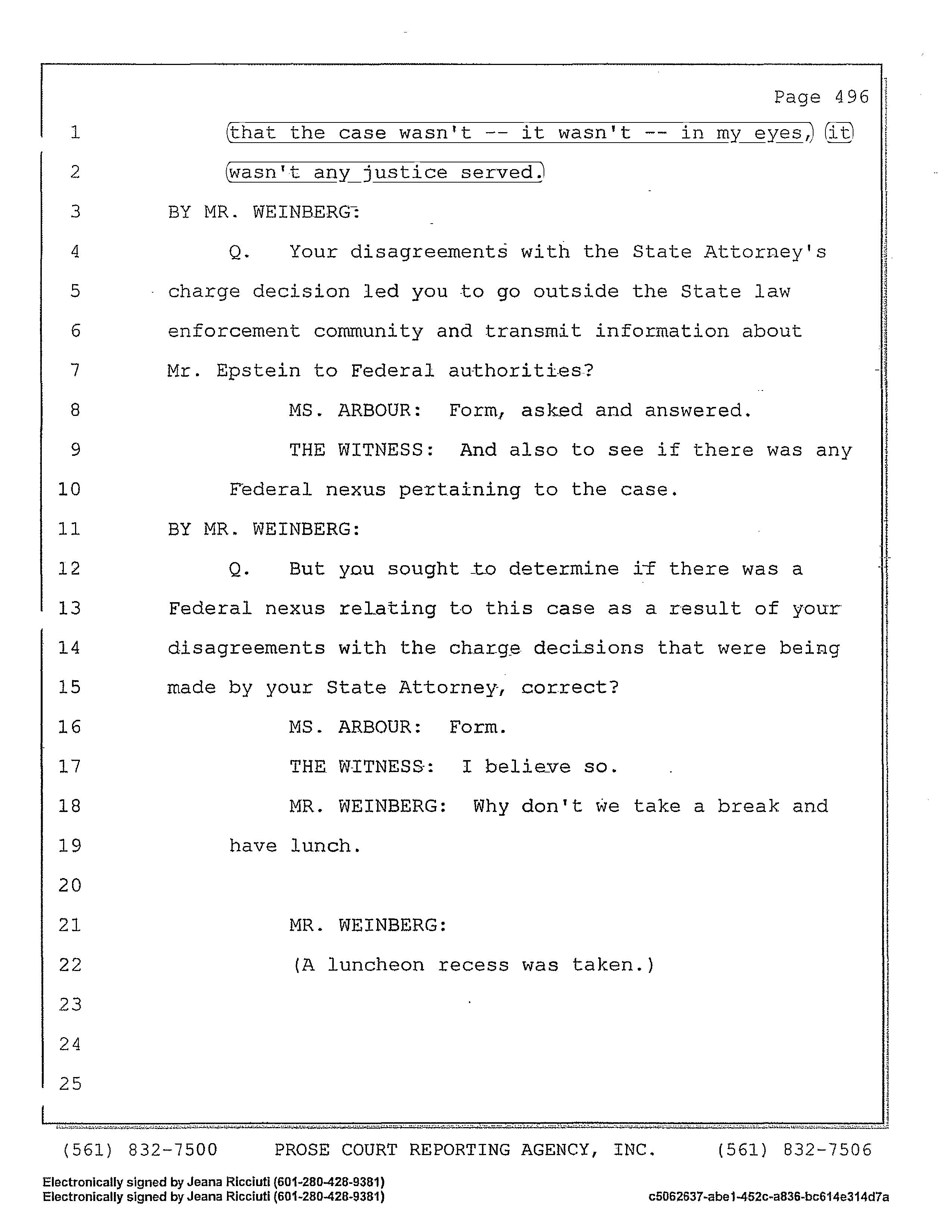
Page 46
document
2550 x 3300
Objects: Page, Text | Text: Page 496 | that the case wasn't -- it wasn't --- in my eyes, | it | 1 |
Page 46
document
2286 x 2865
Objects: Page, Text | Text: Page 496 | that the case wasn't -- it wasn't -- in my eyes, | 1 | it | 2
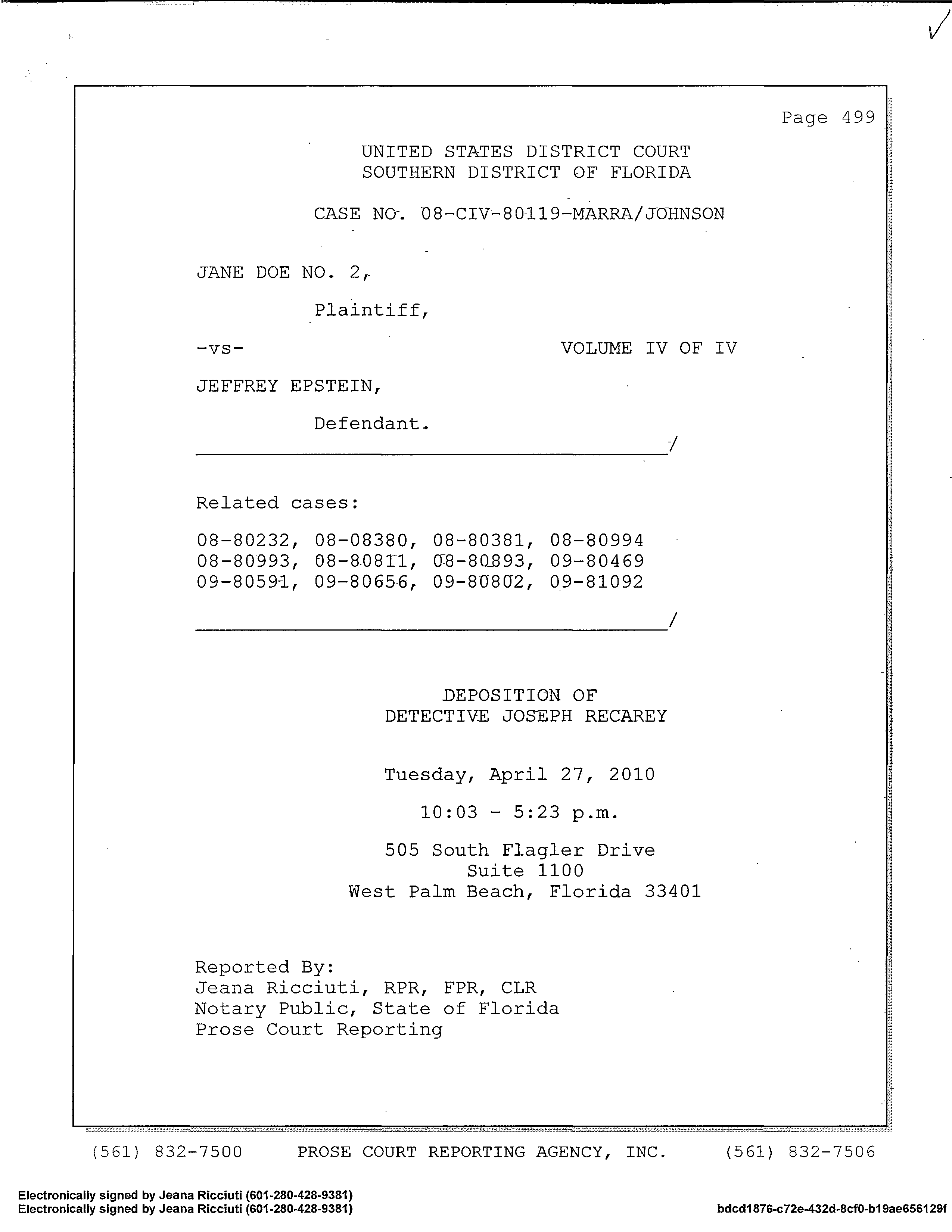
Page 47
document
2550 x 3300
Objects: Page, Text, Document, Invoice, Receipt | Text: Page 499 | UNITED STATES DISTRICT COURT | SO
Page 47
document
2209 x 2814
Objects: Page, Text | Text: Page 499 | UNITED STATES DISTRICT COURT | SOUTHERN DISTRICT OF FLORIDA |
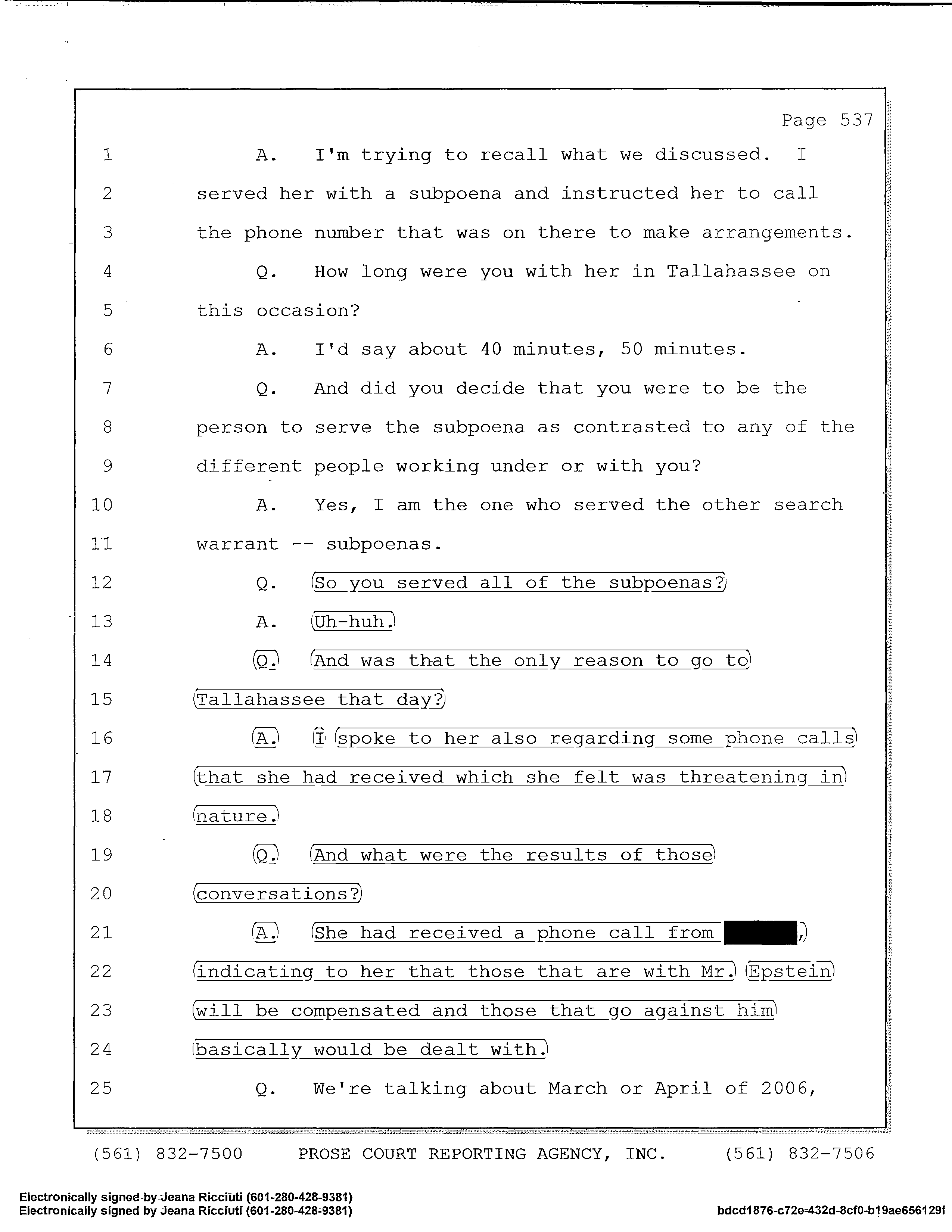
Page 48
document
2550 x 3300
Objects: Page, Text | Text: Page 537 | 1 | I'm trying to recall what we discussed. | I | A.
Page 48
document
2213 x 2813
Objects: Page, Text | Text: Page 537 | 1 | A. | I'm trying to recall what we discussed. | I
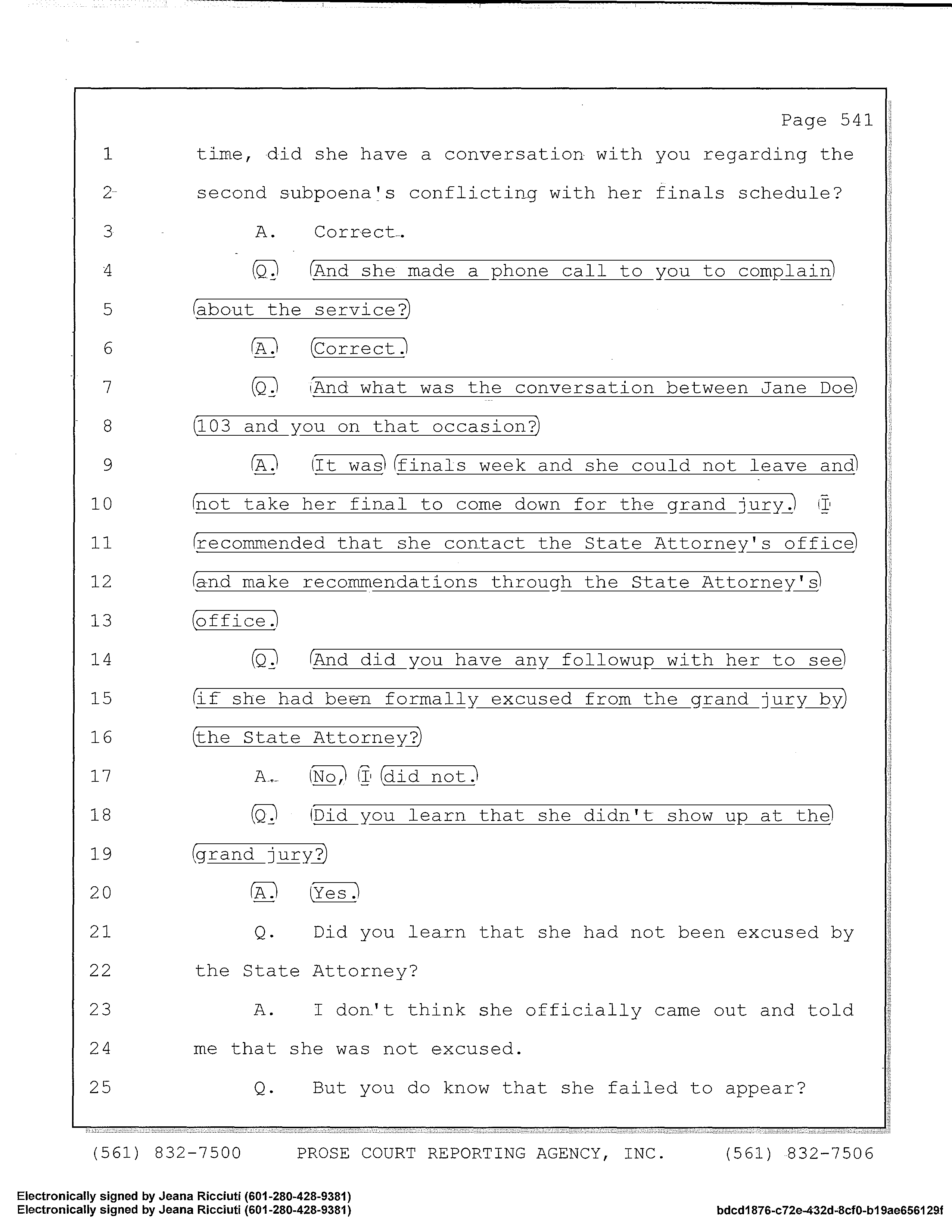
Page 49
document
2550 x 3300
Objects: Page, Text | Text: Page 541 | 1 | time, did she have a conversation with you regarding the
Page 49
document
2208 x 2812
Objects: Page, Text | Text: Page 541 | 1 | time, did she have a conversation with you regarding the
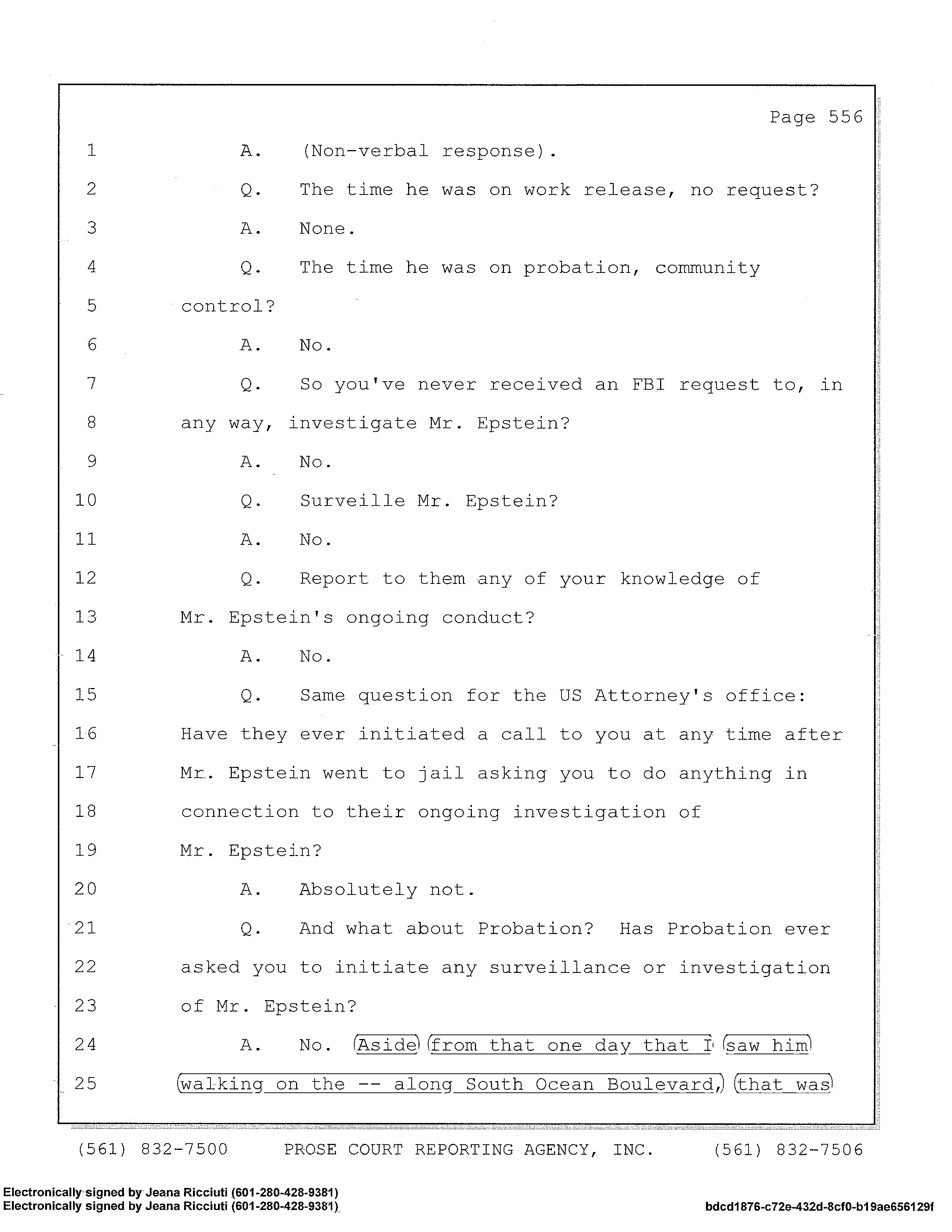
Page 50
document
2550 x 3300
Objects: Page, Text, Chart, Plot | Text: Page 556 | 1 | A. | (Non-verbal response) . | 2
Page 50
document
2226 x 2811
Objects: Page, Text, Chart, Plot | Text: Page 556 | 1 | A. | (Non-verbal response) . | 2
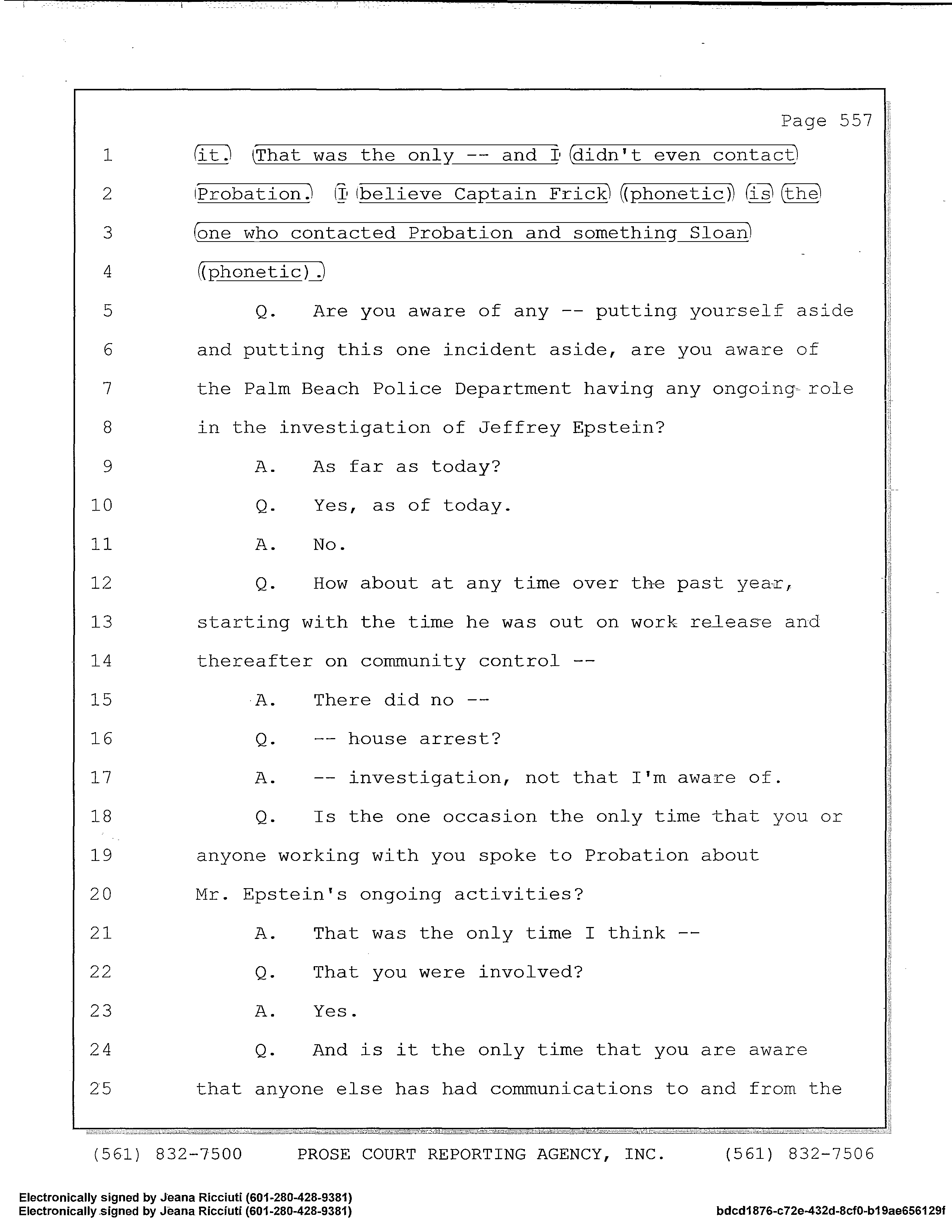
Page 51
document
2550 x 3300
Objects: Page, Text, Chart, Plot | Text: Page 557 | 1 | it | That was the only - a and I didn't even
Page 51
document
2228 x 2811
Objects: Page, Text, Chart, Plot | Text: Page 557 | 1 | it | That was the only -- and I didn't even
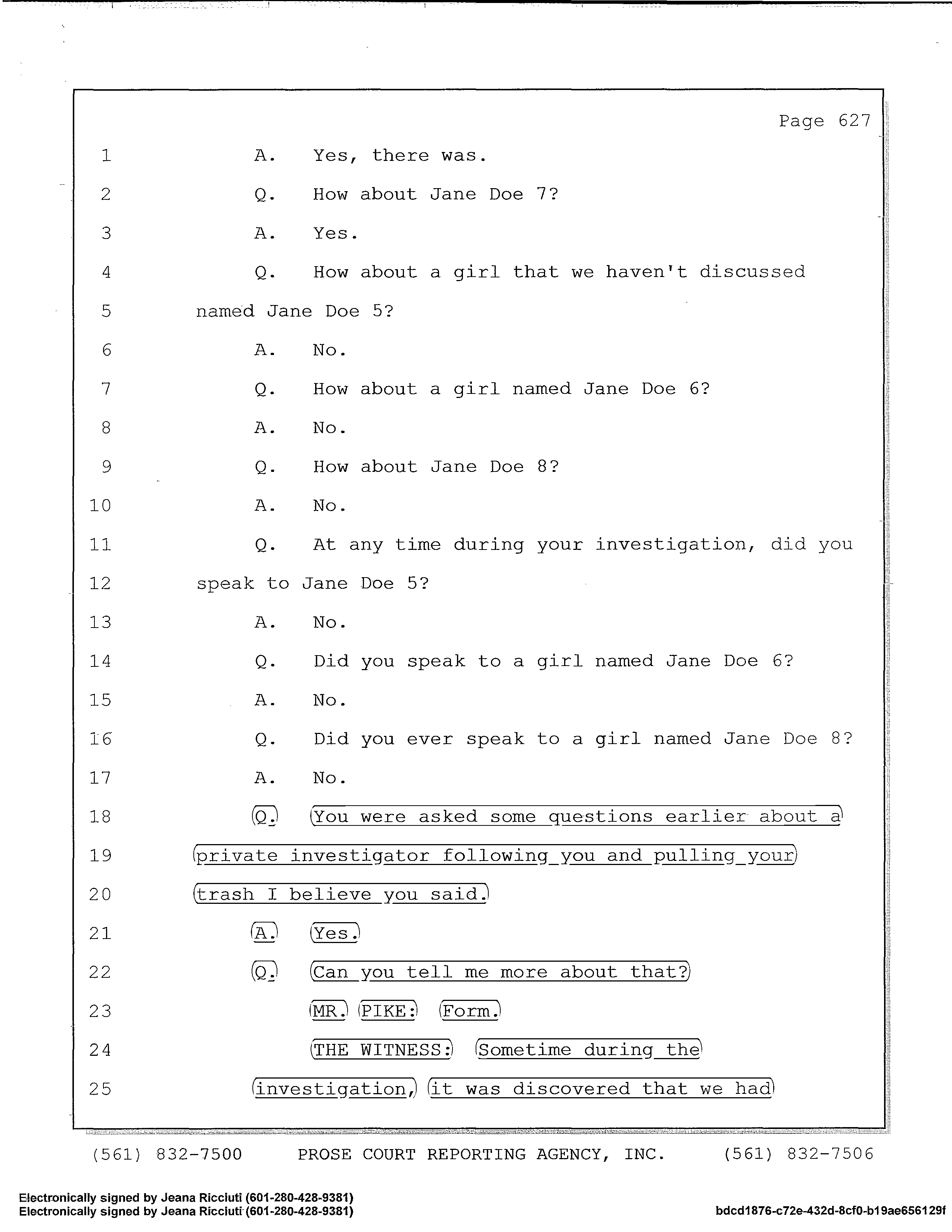
Page 52
document
2550 x 3300
Objects: Page, Text, Chart, Plot | Text: Page 627 | 1 | A. | Yes, there was. | How about Jane Doe 7?
Page 52
document
2218 x 2812
Objects: Page, Text, Chart, Plot | Text: Page 627 | 1 | A. | Yes, there was. | 2
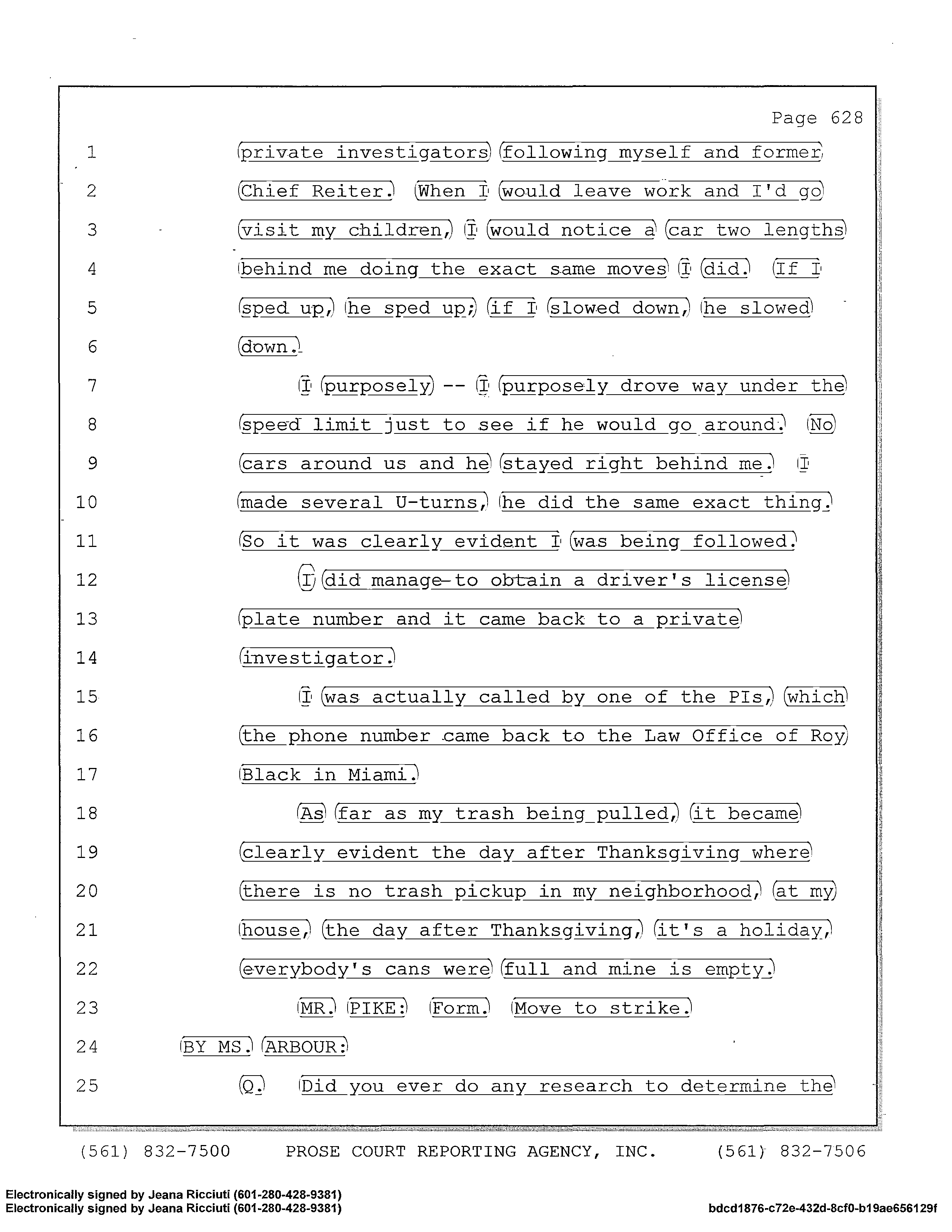
Page 53
document
2550 x 3300
Objects: Page, Text | Text: Page 628 | 1 | (private investigators following myself and former | Chie
Page 53
document
2226 x 2812
Objects: Page, Text | Text: Page 628 | 1 | (private investigators following myself and former | 2 |
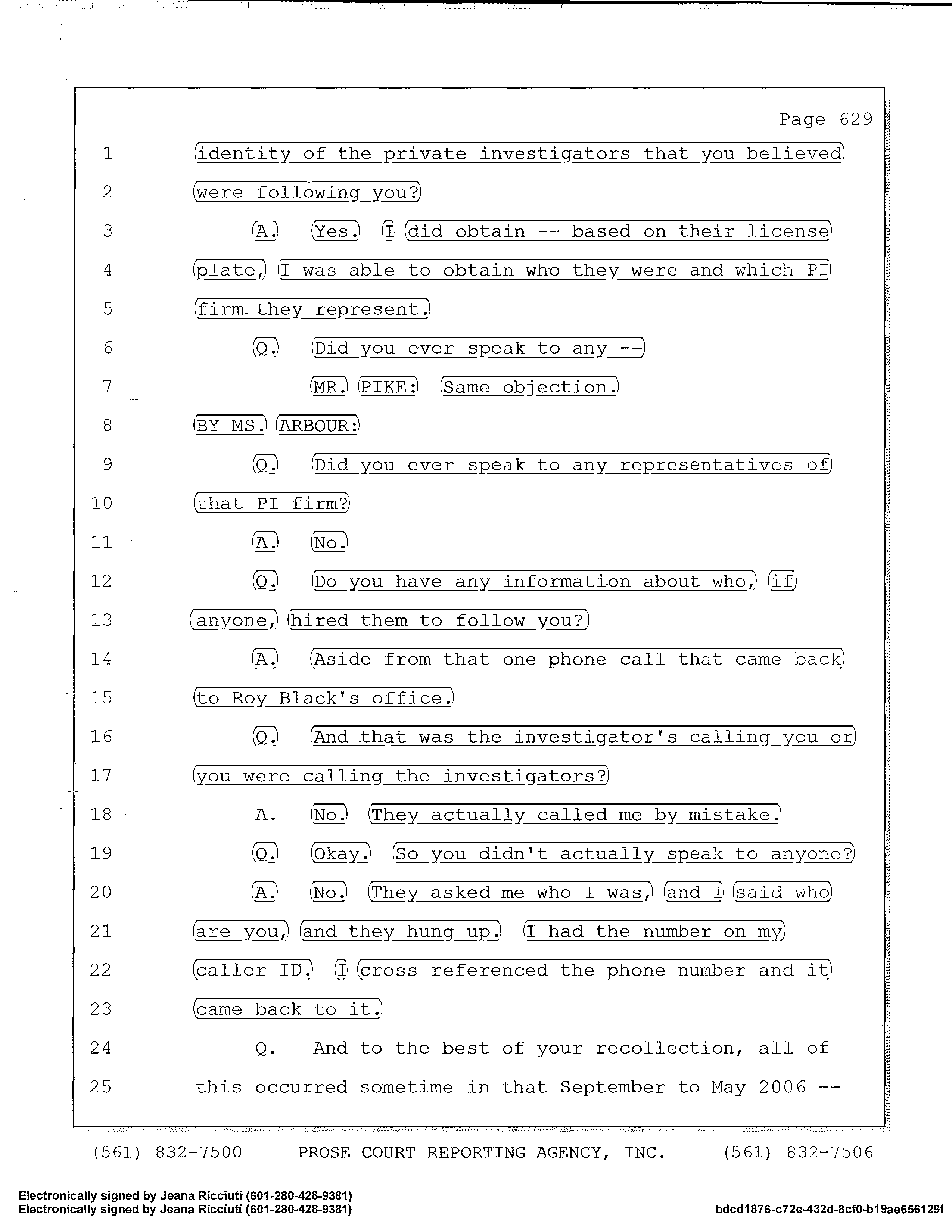
Page 54
document
2550 x 3300
Objects: Page, Text | Text: Page 629 | 1 | identity of the private investigators that you believed |
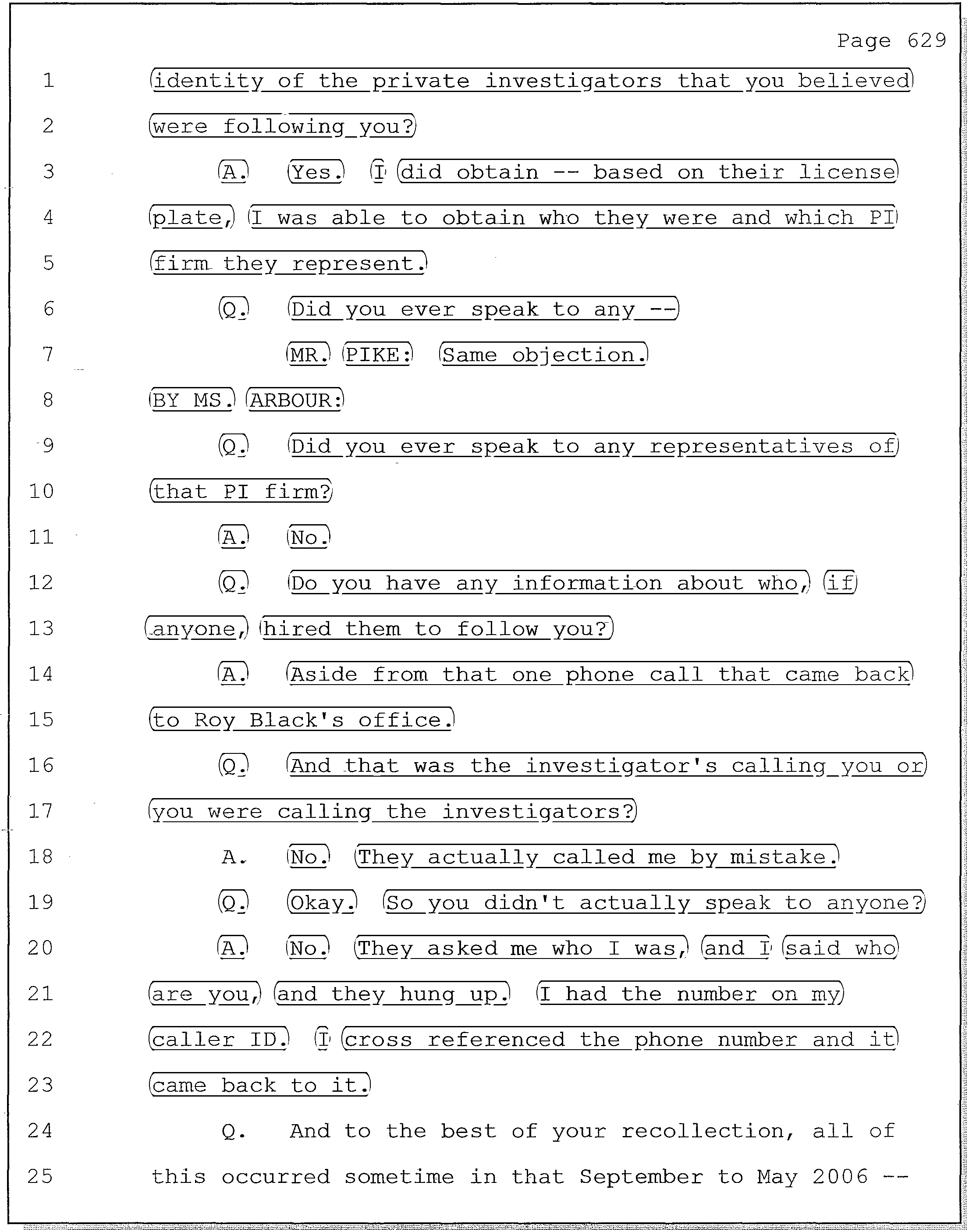
Page 54
document
2211 x 2811
Objects: Page, Text | Text: Page 629 | 1 | identity of the private investigators that you believed |
Page 55
document
2550 x 3300
Objects: Text | Text: Appendix 3
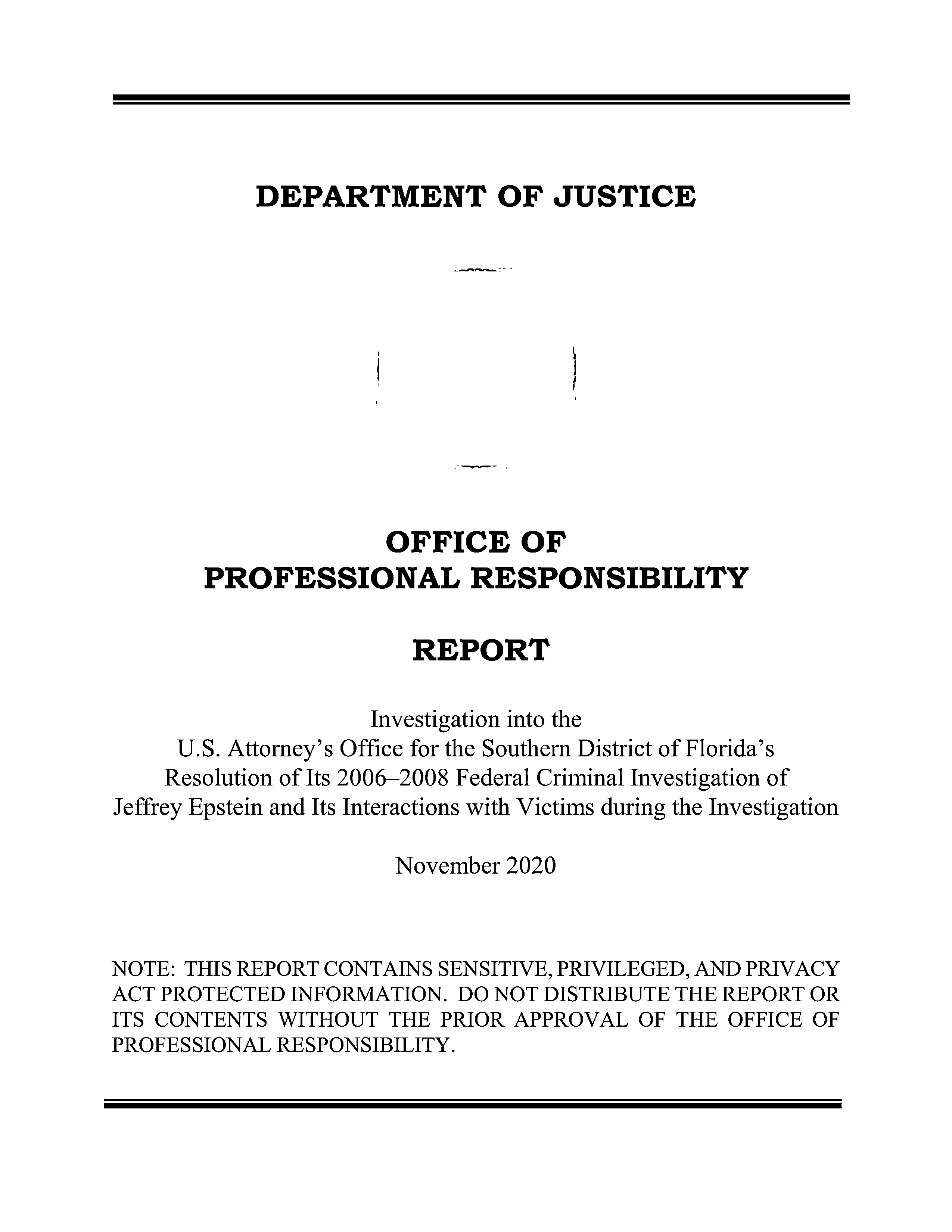
Page 56
document
2550 x 3300
Objects: Page, Text, Advertisement, Poster | Text: DEPARTMENT OF JUSTICE | OFFICE OF | PROFESSIONAL

Page 56
photo
536 x 536
Objects: Emblem, Symbol, Logo, Machine, Wheel, Face, Head, Person | Text: JUSTICE | OF | DEPARTMENT

Page 57
photo
2550 x 3300
Objects: Cutlery
Page 58
document
2550 x 3300
Objects: Page, Text, Letter | Text: EXECUTIVE SUMMARY | The Department of Justice (Department) Offic
Page 59
document
2550 x 3300
Objects: Letter, Text, Page | Text: NPA required Epstein to plead guilty in state court to the then-
Page 60
document
2550 x 3300
Objects: Letter, Text, Page | Text: Soon after he was incarcerated, Epstein applied for the Palm Bea
Page 61
document
2550 x 3300
Objects: Page, Text, Letter | Text: abuse of minors. | The Miami Herald report led to public outrage
Page 62
document
2550 x 3300
Objects: Letter, Text, Page | Text: Secretary of Labor. In a brief oral statement, Acosta explained
Page 63
document
2550 x 3300
Objects: Page, Text, Letter | Text: an investigation into the matter and would review the USAO's dec
Page 64
document
2550 x 3300
Objects: Page, Text, Letter | Text: carefully considered the comments and made changes, or noted com
Page 65
document
2550 x 3300
Objects: Page, Text, Letter | Text: investigate, litigate, or provide legal advice. | OPR also has j
Page 66
document
2550 x 3300
Objects: Page, Text, Letter | Text: of immunity, or (6) the deportation of criminal aliens. The pote
Page 67
document
2550 x 3300
Objects: Letter, Text, Page | Text: initiate a federal prosecution of Epstein was within the scope o
Page 68
document
2550 x 3300
Objects: Page, Text, Letter | Text: interactions with victims that ultimately led to public and cour
Page 69
document
2550 x 3300
Objects: Letter, Text, Page | Text: that the victims were not treated with the forthrightness and se
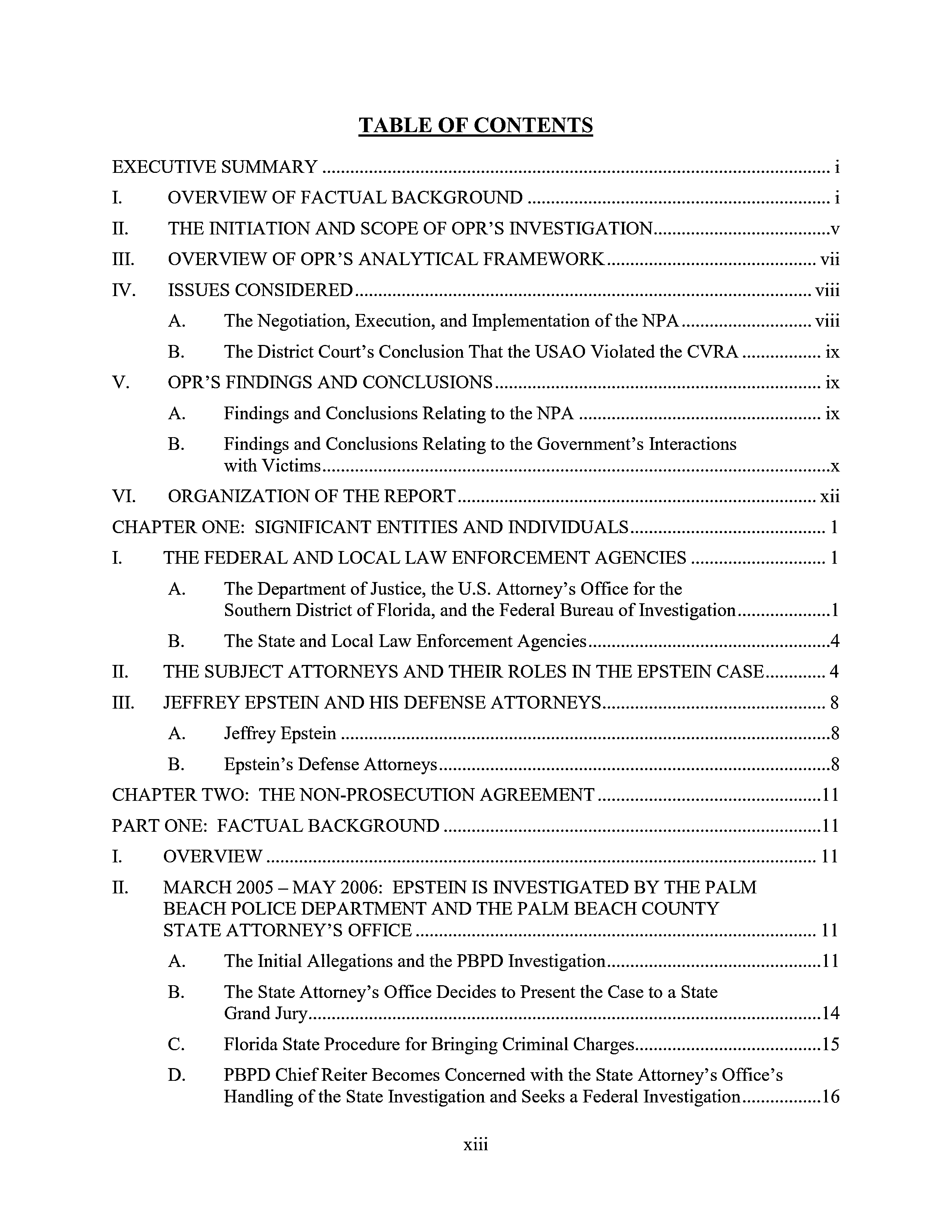
Page 70
document
2550 x 3300
Objects: Page, Text | Text: TABLE OF CONTENTS | EXECUTIVE SUMMARY | i | I. | OVERVIEW OF FACTUAL BAC
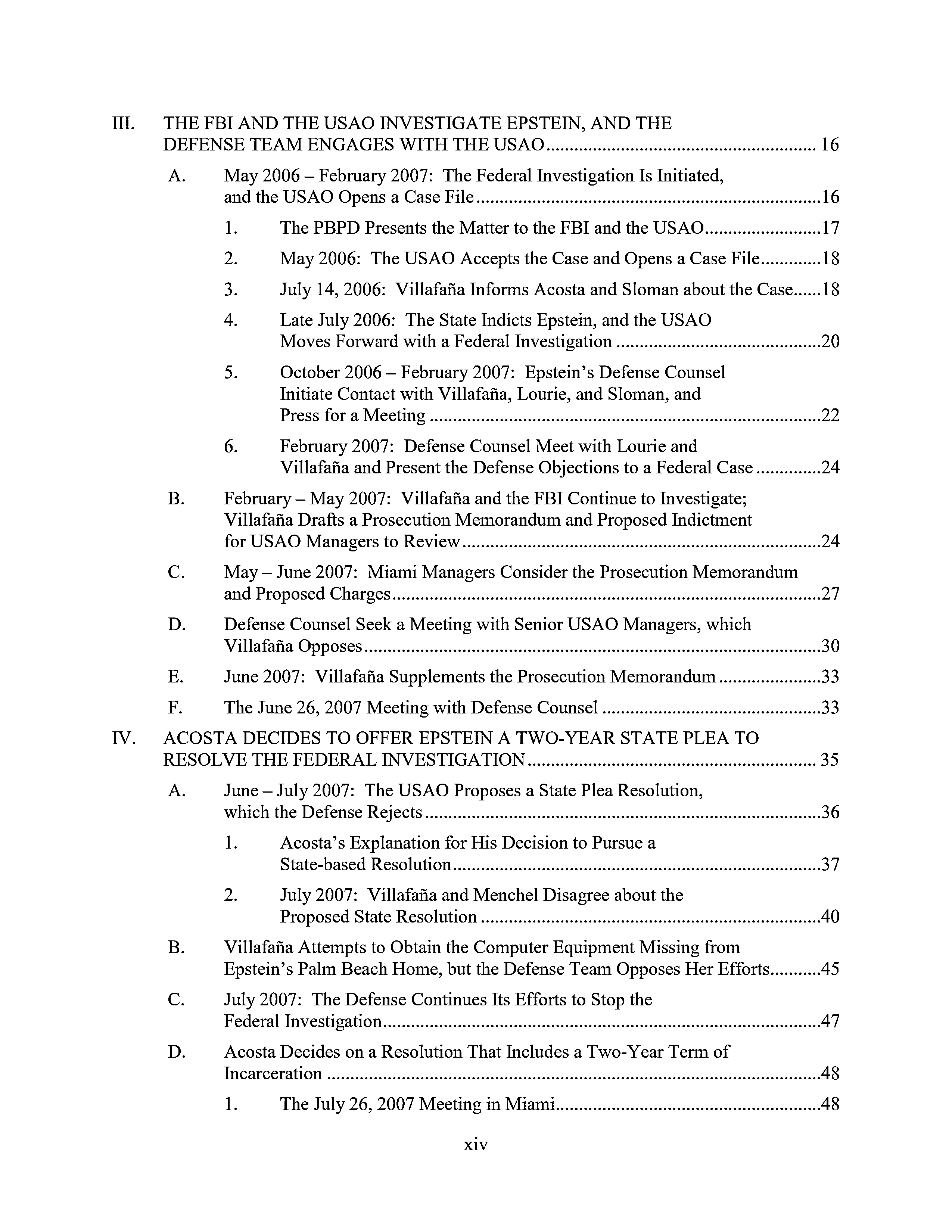
Page 71
document
2550 x 3300
Objects: Page, Text | Text: III. | THE FBI AND THE USAO INVESTIGATE EPSTEIN, AND THE | DEFENSE TEAM
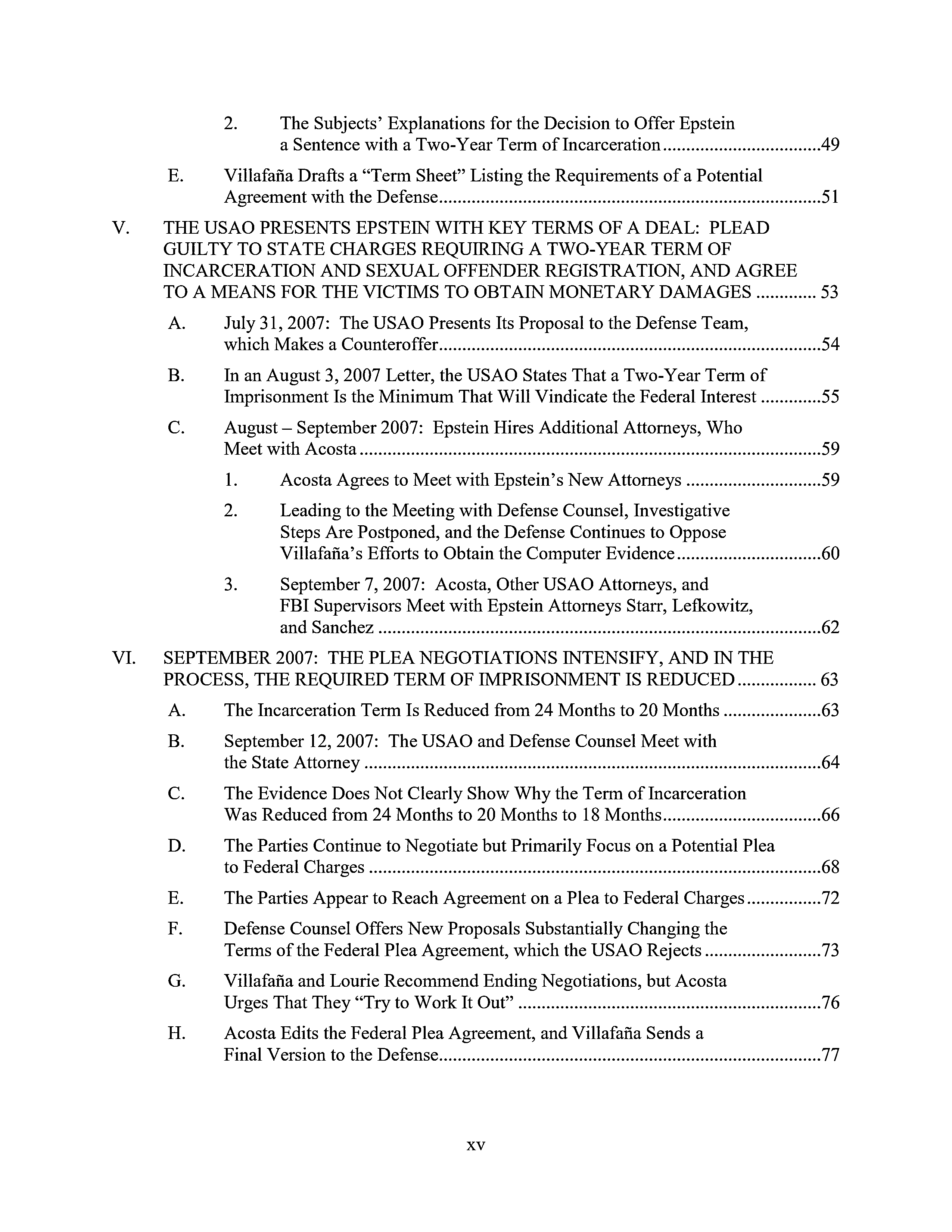
Page 72
document
2550 x 3300
Objects: Page, Text | Text: 2. | The Subjects' Explanations for the Decision to Offer Epstein | a Se
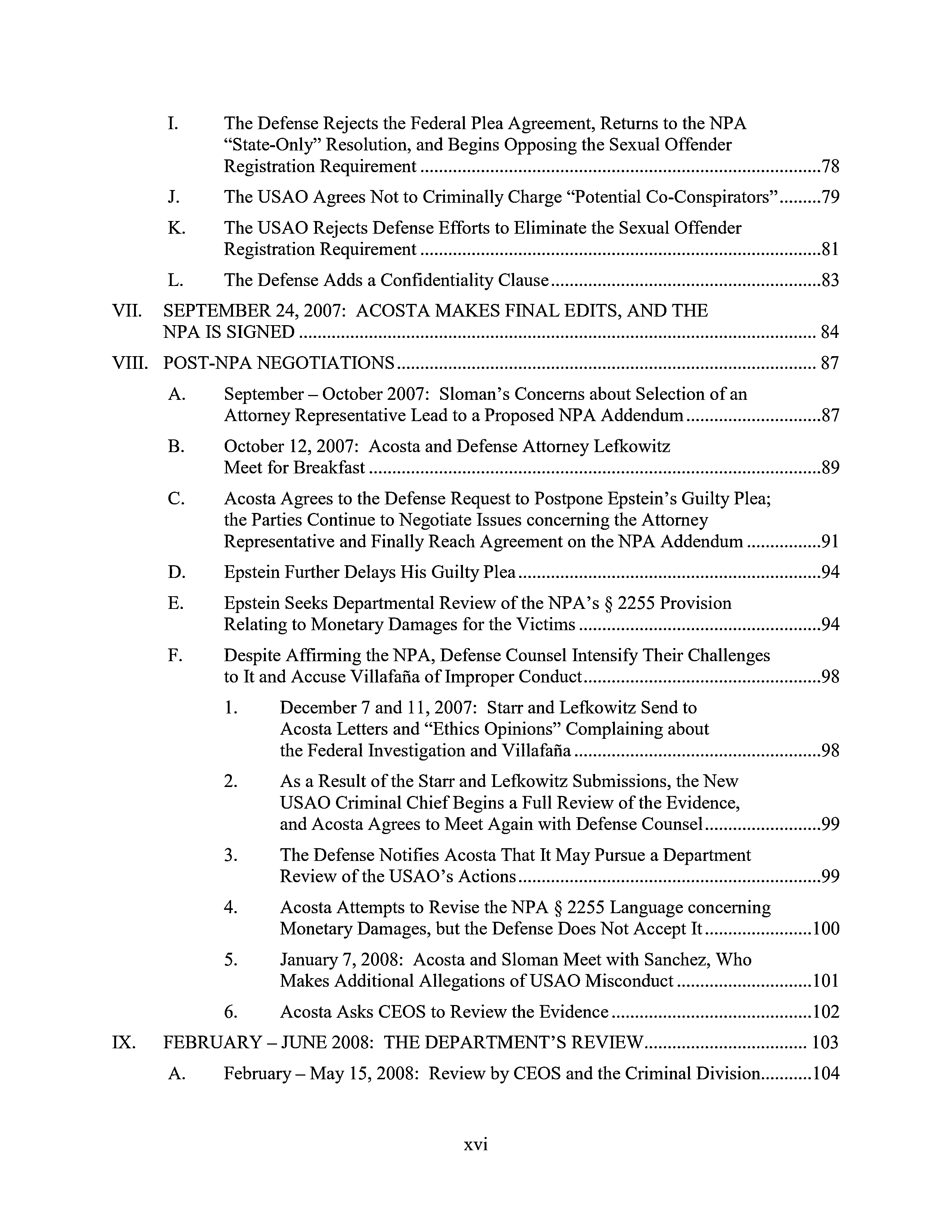
Page 73
document
2550 x 3300
Objects: Page, Text | Text: I. | The Defense Rejects the Federal Plea Agreement, Returns to the NPA
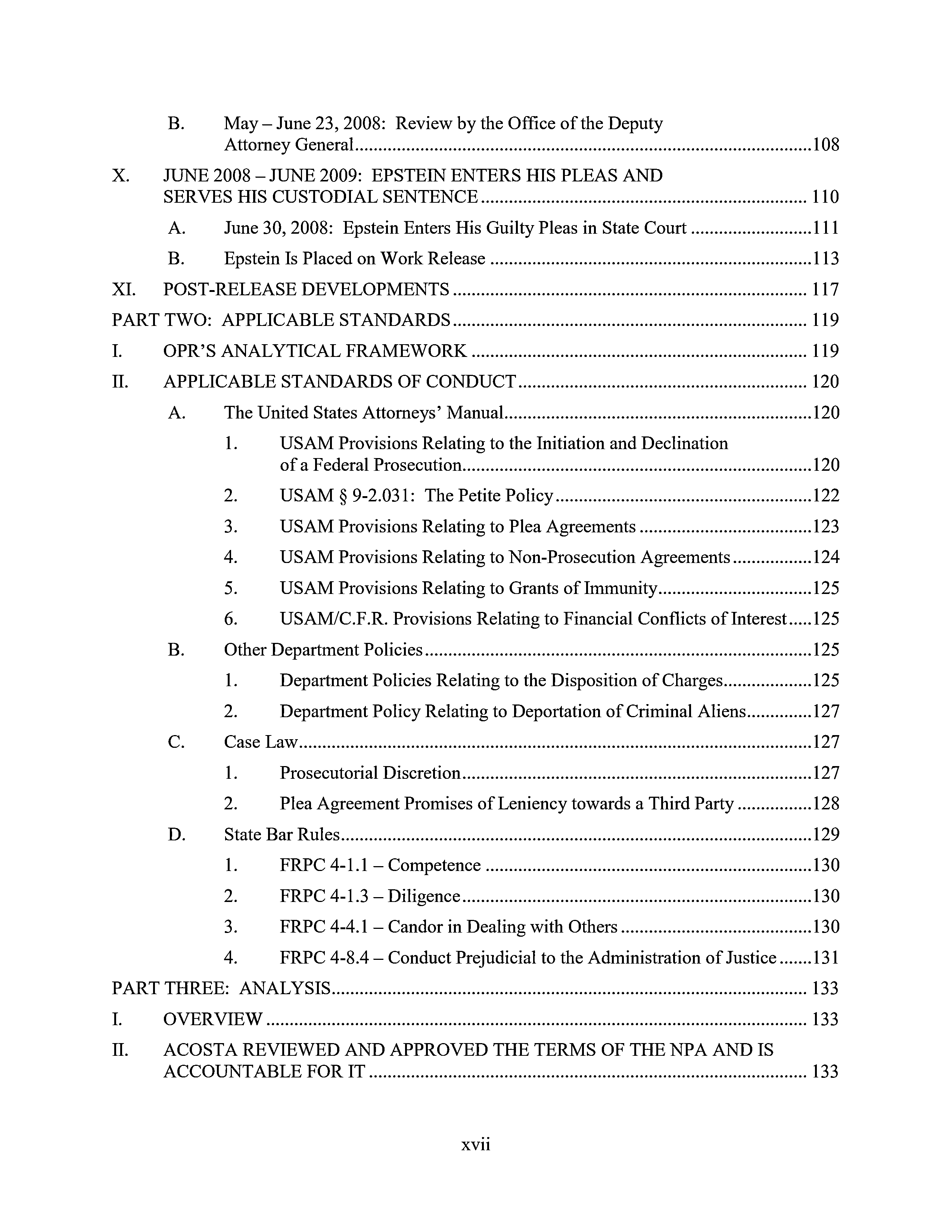
Page 74
document
2550 x 3300
Objects: Page, Text | Text: B. | May-June 23, 2008: Review by the Office of the Deputy | 108 | Attor
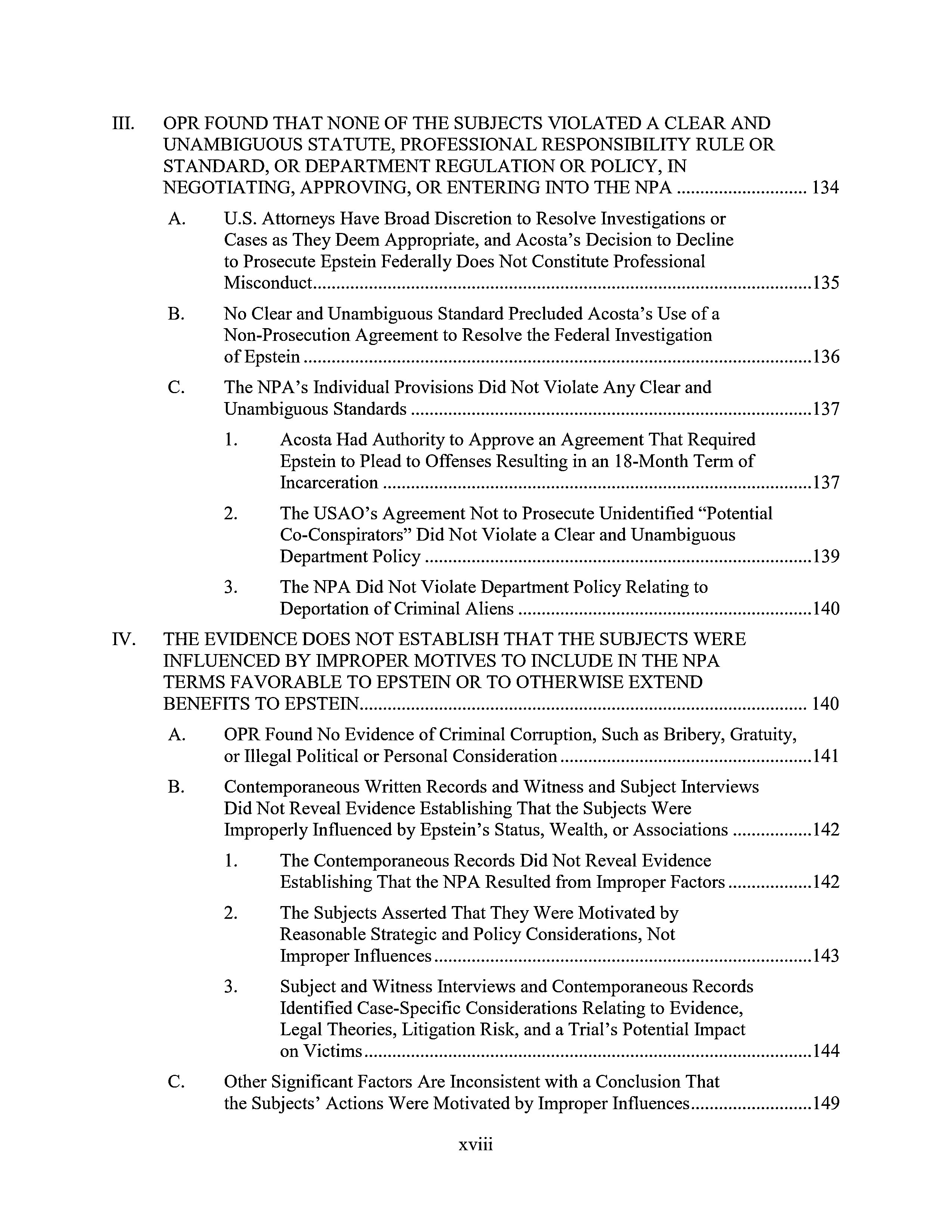
Page 75
document
2550 x 3300
Objects: Page, Text | Text: III. | OPR FOUND THAT NONE OF THE SUBJECTS VIOLATED A CLEAR AND | UNAMBI
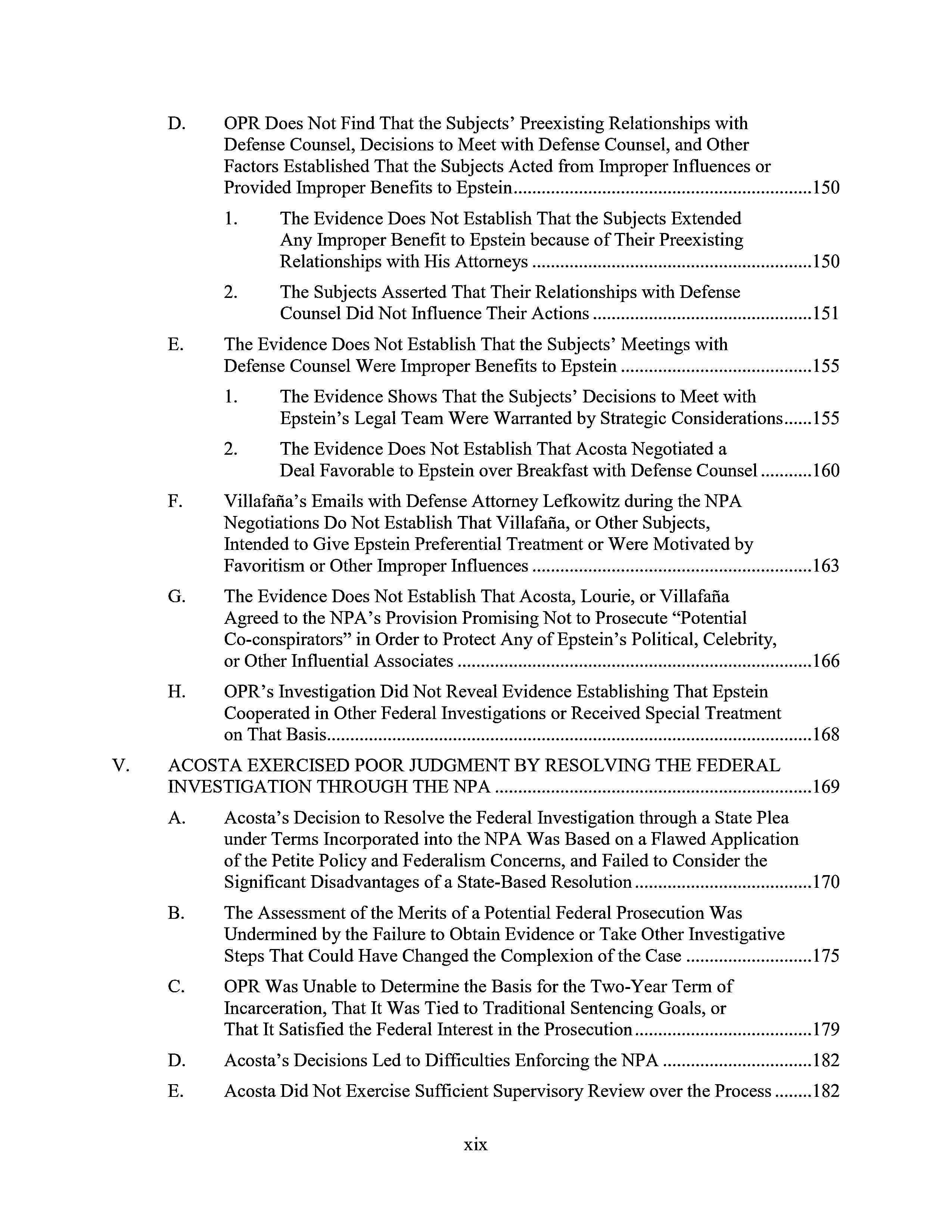
Page 76
document
2550 x 3300
Objects: Page, Text | Text: D. | OPR Does Not Find That the Subjects' Preexisting Relationships with
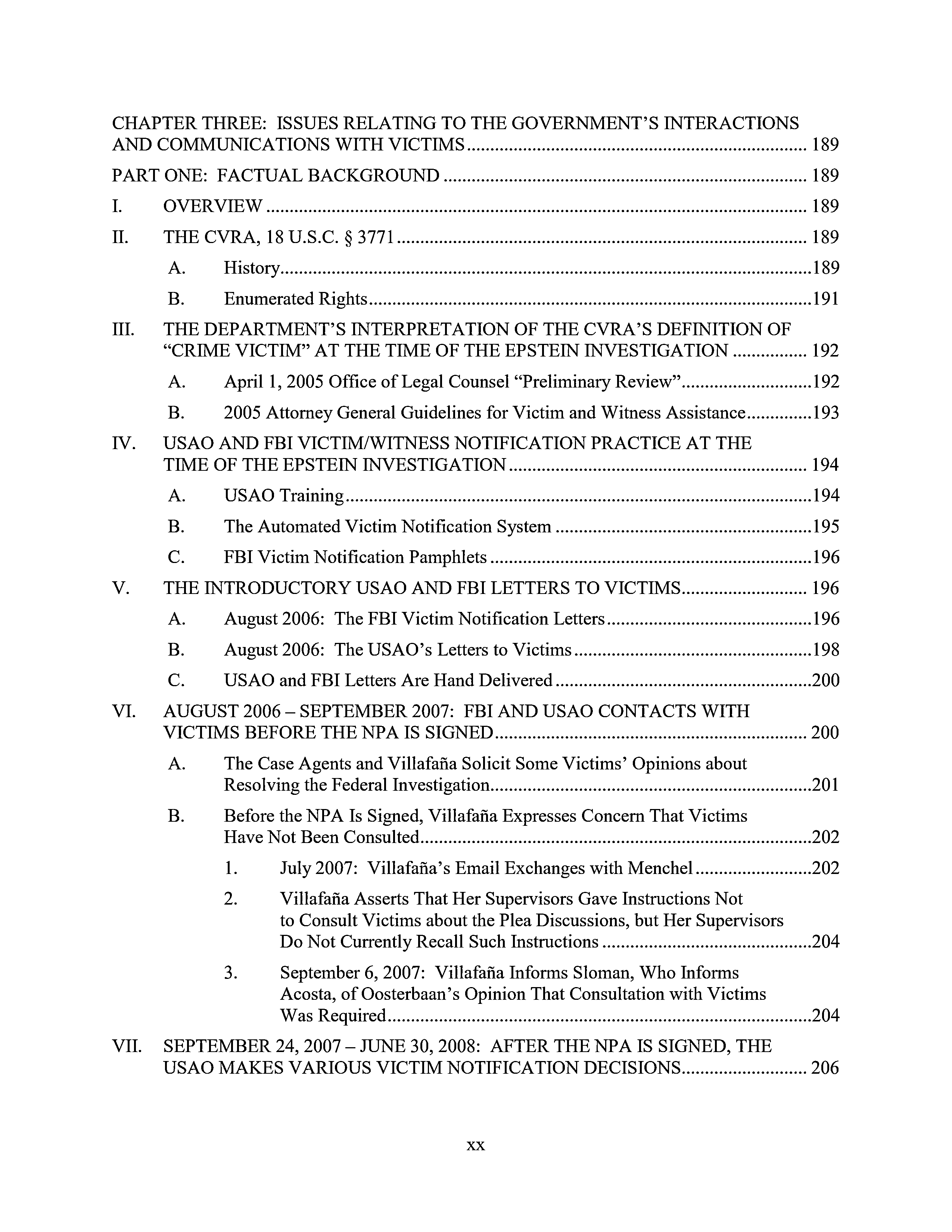
Page 77
document
2550 x 3300
Objects: Page, Text | Text: CHAPTER THREE: ISSUES RELATING TO THE GOVERNMENT'S INTERACTIONS | AND CO
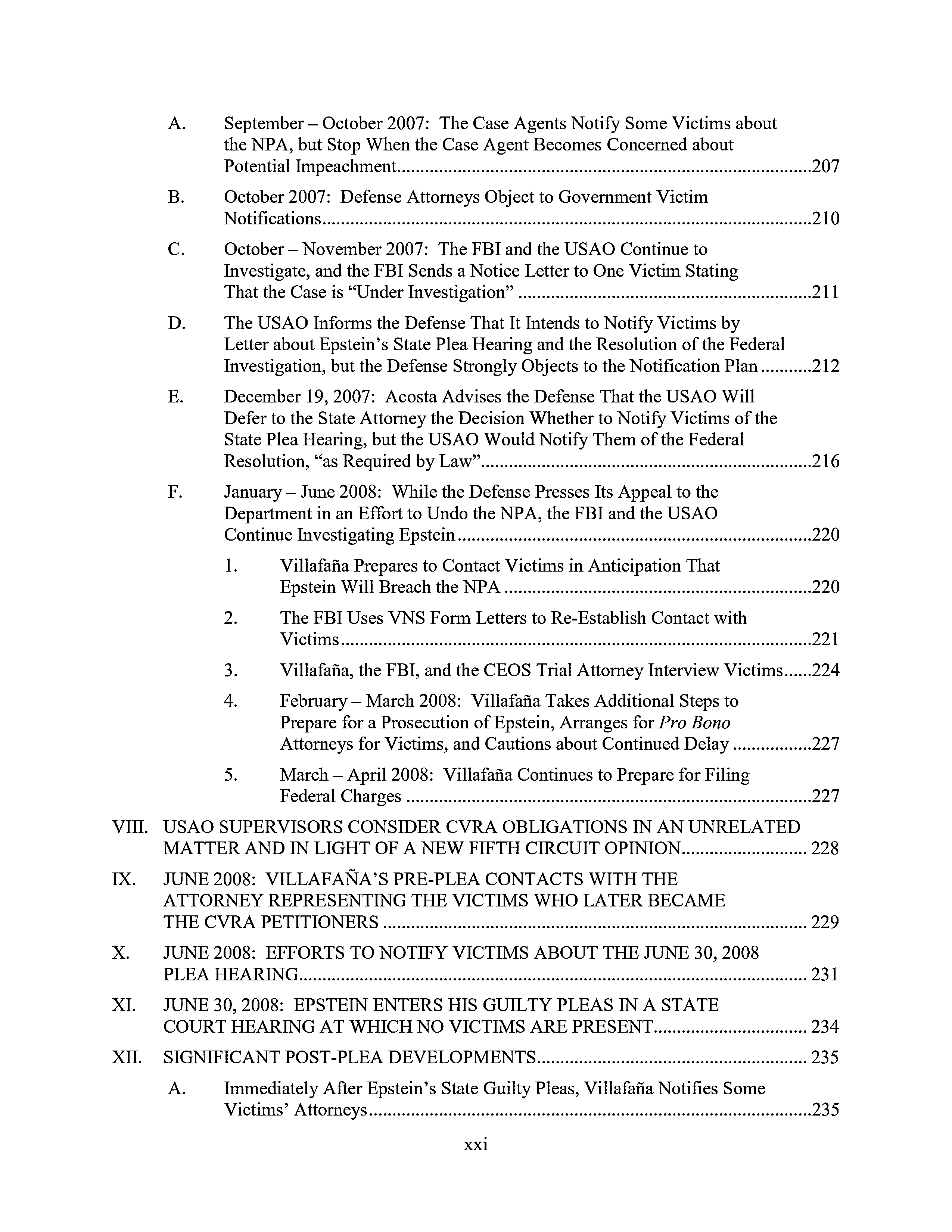
Page 78
document
2550 x 3300
Objects: Page, Text | Text: September-October 2007: The Case Agents Notify Some Victims about | the
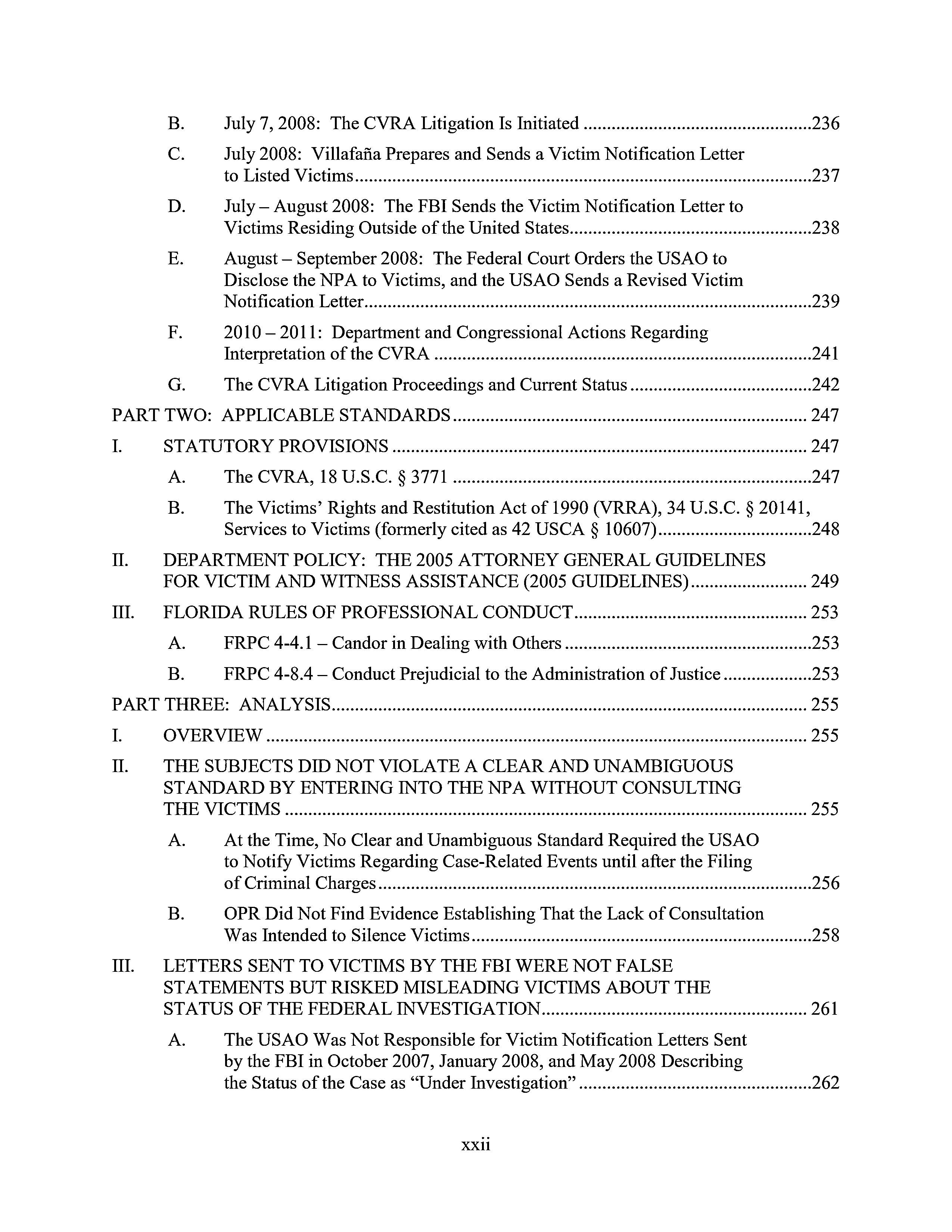
Page 79
document
2550 x 3300
Objects: Page, Text | Text: B. | July 7, 2008: The CVRA Litigation Is Initiated | C. | July 2008: Vi
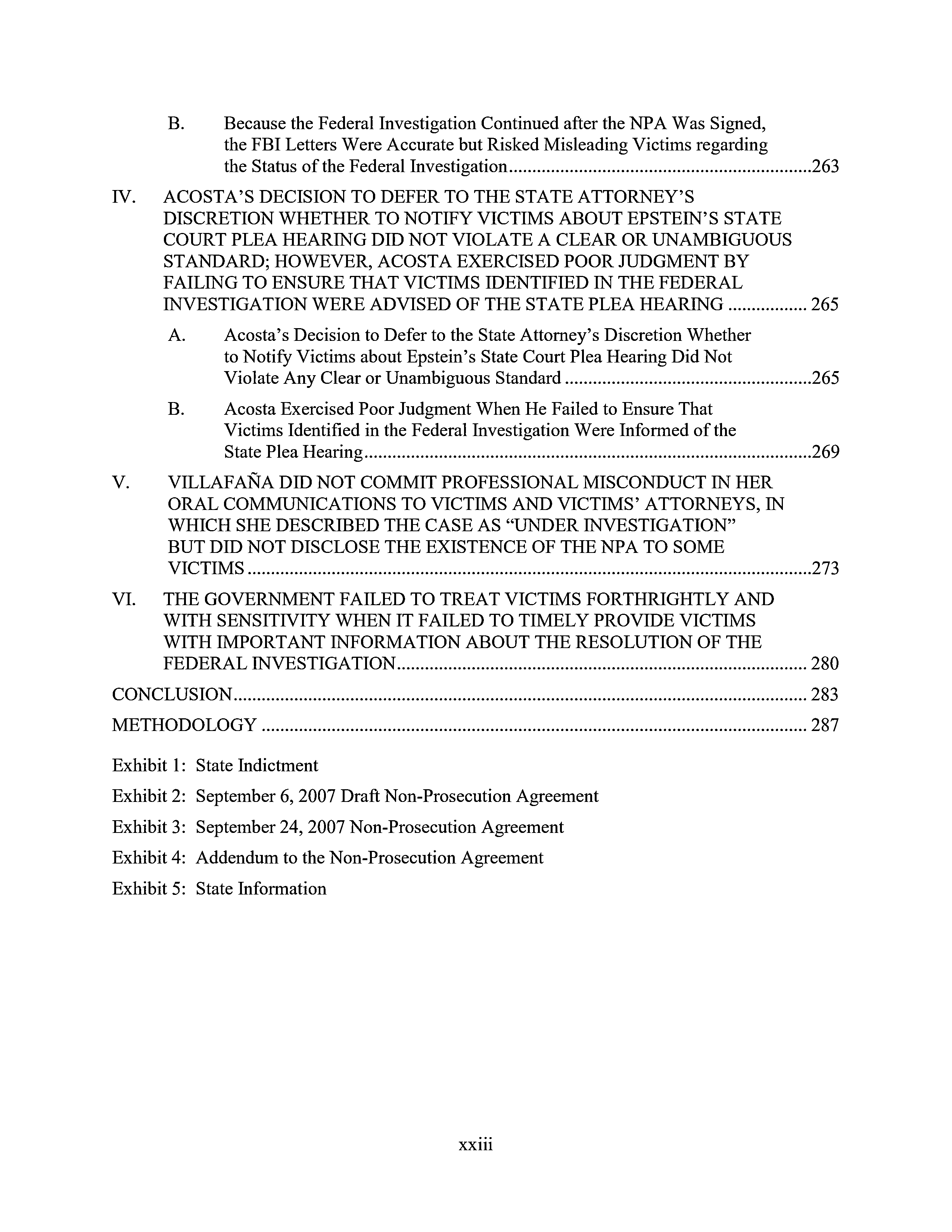
Page 80
document
2550 x 3300
Objects: Page, Text | Text: Because the Federal Investigation Continued after the NPA Was Signed, |

Page 81
document
2550 x 3300
Objects: Page, Text, Outdoors | Text: [Page Intentionally Left Blank] | xxiv
Page 82
document
2550 x 3300
Objects: Page, Text, Letter | Text: CHAPTER ONE | SIGNIFICANT ENTITIES AND INDIVIDUALS | I. | THE FE
Page 83
document
2550 x 3300
Objects: Letter, Text, Page | Text: or other divisions having responsibility for specific criminal e

Page 84
document
3300 x 2550
Objects: Page, Text, White Board | Text: 3
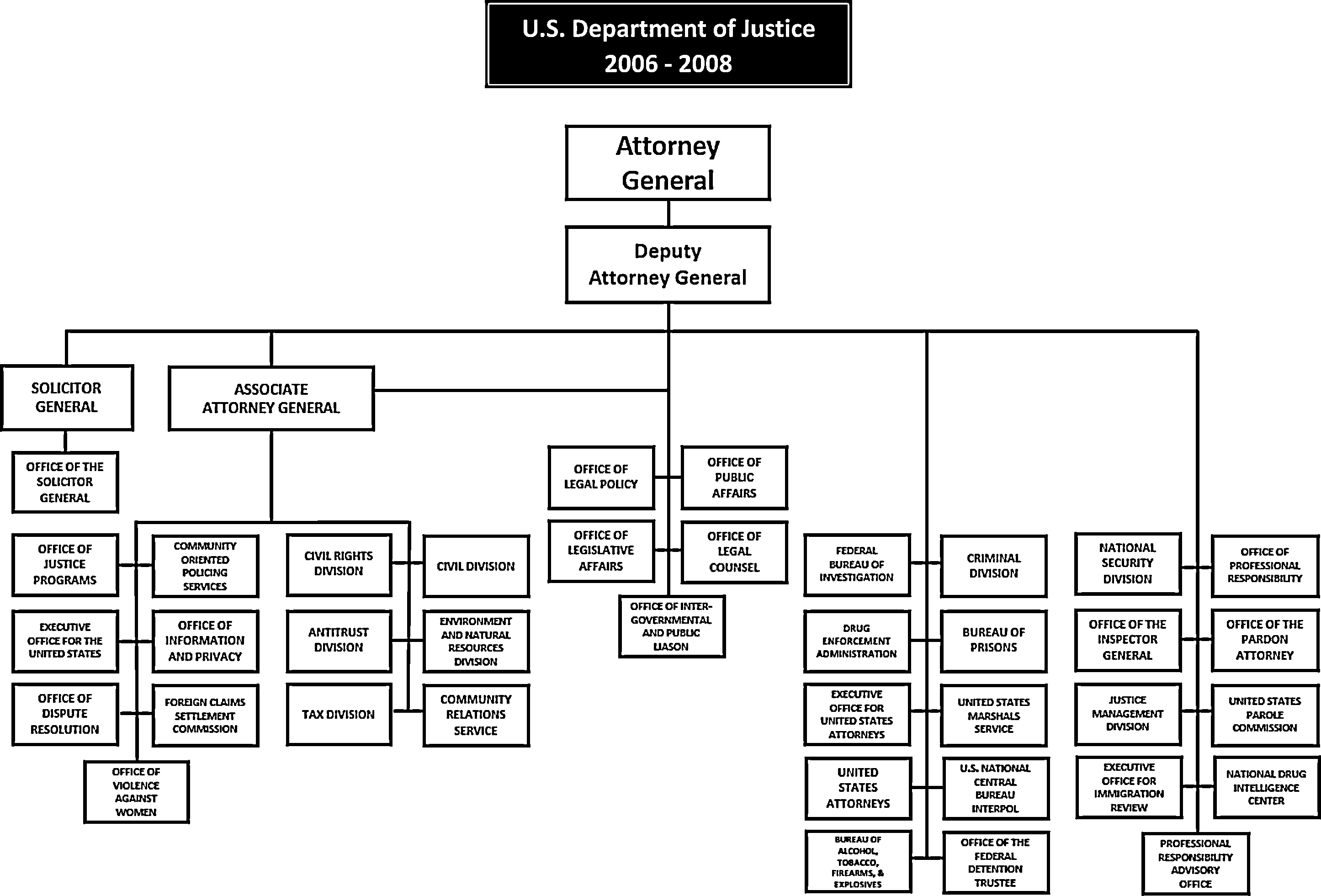
Page 84
diagram
2891 x 1961
Objects: Diagram, UML Diagram, QR Code | Text: U.S. Department of Justice | 2006 - 2008 | Attorney |
Page 85
document
2550 x 3300
Objects: Page, Text, Letter | Text: The State and Local Law Enforcement Agencies | Florida state cri
Page 86
document
2550 x 3300
Objects: Letter, Text, Page | Text: Kirkland & Ellis, which was representing Epstein, because Acosta
Page 87
document
2550 x 3300
Objects: Letter, Text, Page | Text: for the Department's Criminal Division, a position in which he s
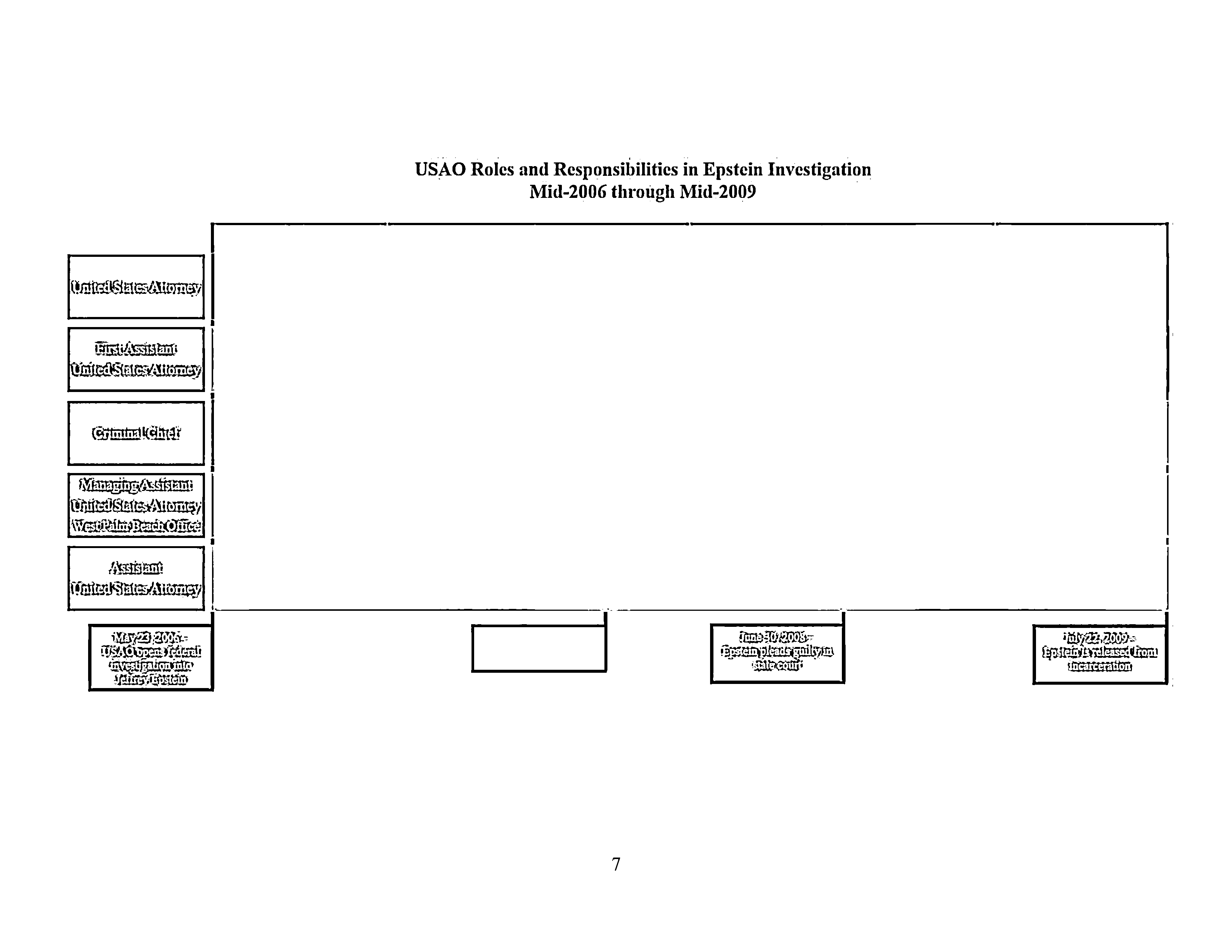
Page 88
document
3300 x 2550
Objects: Chart, Diagram, Plan, Plot, Page, Text, QR Code | Text: USAO Roles and Responsibilities in
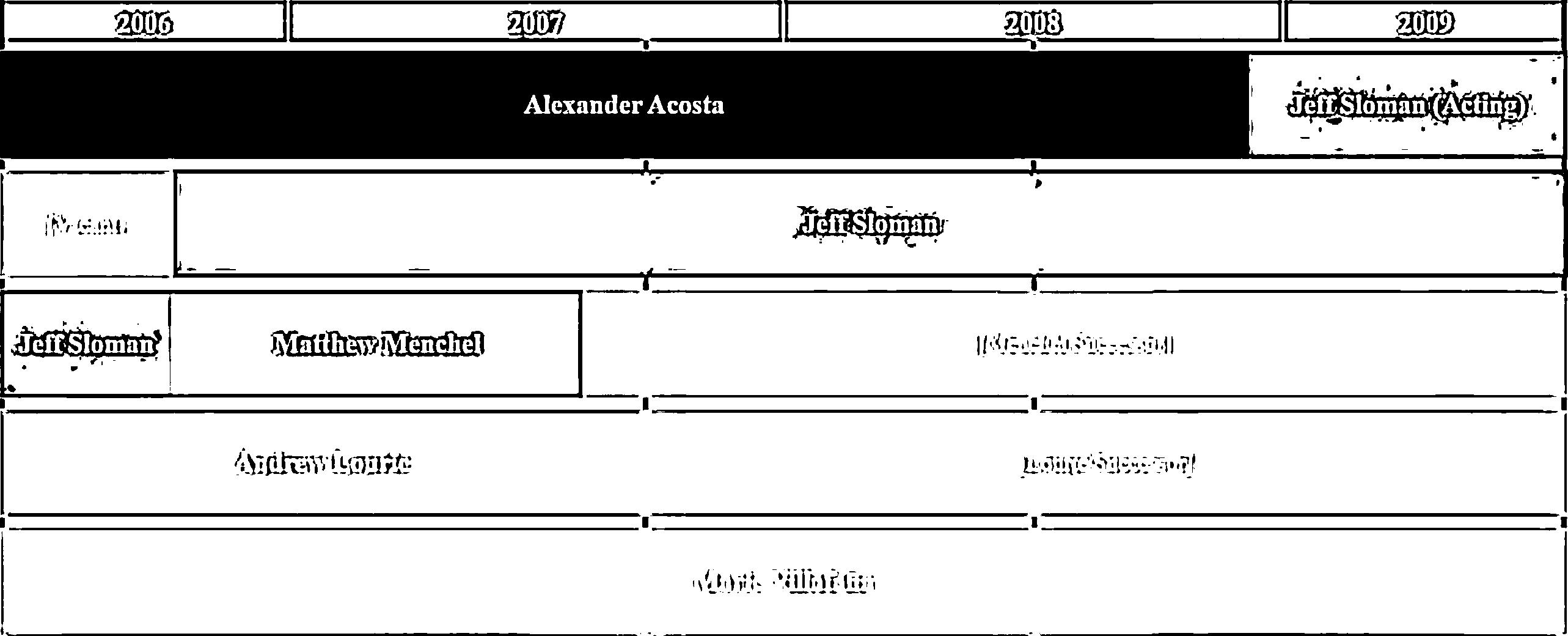
Page 88
document
2566 x 1040
Objects: Text, Chart, Plot, Page | Text: 2006 | 2007 | 2008 | 2009 | Alexander Acosta
Page 88
document
365 x 130
Objects: Text, QR Code, Handwriting
Page 89
document
2550 x 3300
Objects: Page, Text, Letter | Text: III. | JEFFREY EPSTEIN AND HIS DEFENSE ATTORNEYS | A. | Jeffrey
Page 90
document
2550 x 3300
Objects: Letter, Text, Page | Text: whose law firm website cites his "national reputation for the ag

Page 91
document
2550 x 3300
Objects: Page, Text, Outdoors | Text: [Page Intentionally Left Blank] | 10
Page 92
document
2550 x 3300
Objects: Page, Text, Letter | Text: CHAPTER TWO | THE NON-PROSECUTION AGREEMENT | PART ONE: FACTUAL
Page 93
document
3300 x 2550
Objects: Page, Text, Chart, Plot | Text: Timeline of Key Events for Federal Epstein Investigation-Ma
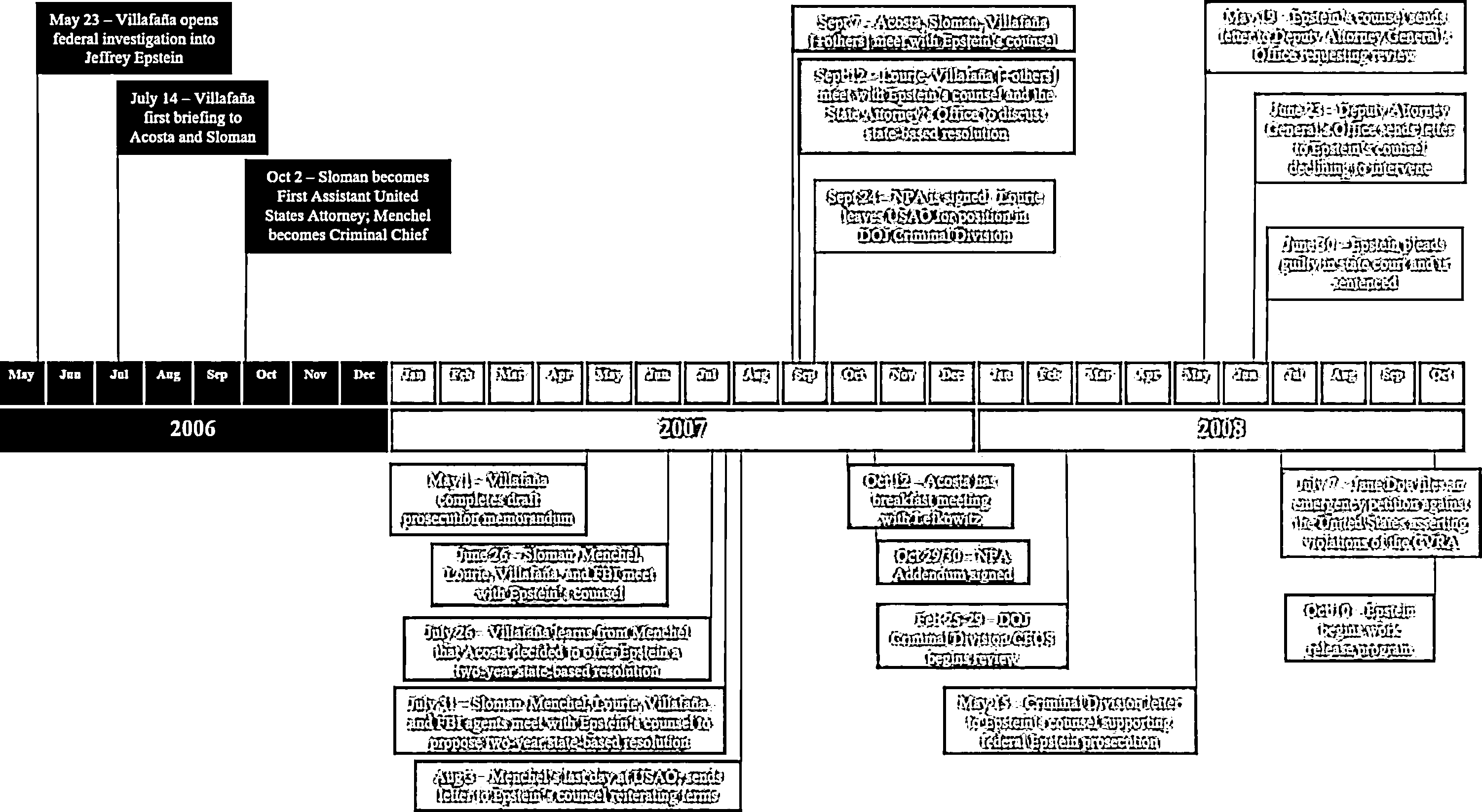
Page 93
diagram
3003 x 1646
Objects: Diagram, UML Diagram, Chart, Plan, Plot | Text: May 23 - Villafaña opens | federal investig
Page 94
document
2550 x 3300
Objects: Page, Text, Letter | Text: and some of the victims as well, regularly recruited local high-
Page 95
document
2550 x 3300
Objects: Letter, Text, Page | Text: they found computer monitors and keyboards in the home, as well
Page 96
document
2550 x 3300
Objects: Letter, Text, Page | Text: told OPR that Epstein' 's local counsel brought attorney Alan De
Page 97
document
2550 x 3300
Objects: Letter, Text, Page | Text: other things, prohibit anyone from being present while grand jur
Page 98
document
2550 x 3300
Objects: Letter, Text, Page | Text: charge. Villafaña suggested meeting with the PBPD, but the case
Page 99
document
2550 x 3300
Objects: Page, Text, Letter | Text: 2. | May 2006: The USAO Accepts the Case and Opens a Case File |
Page 100
document
2550 x 3300
Objects: Page, Text, Letter | Text: Epstein massages that were sexual in nature, and that Epstein ha
Page 101
document
2550 x 3300
Objects: Page, Text, Letter | Text: 4. | Late July 2006: The State Indicts Epstein, and the USAO Mov
Page 102
document
2550 x 3300
Objects: Page, Text, Letter | Text: On July 24, 2006, Villafaña alerted Sloman, who informed Acosta,
Page 103
document
2550 x 3300
Objects: Page, Text, Letter | Text: also informed Sloman and Lourie that the FBI was re-interviewing

Page 104
document
2550 x 3300
Objects: Letter, Text, Page | Text: "'anything' she wanted" without the necessity oflegal process. L
Page 105
document
2550 x 3300
Objects: Page, Text, Letter | Text: disagreed with her position. Villafaña and a West Palm Beach AUS
Page 106
document
2550 x 3300
Objects: Letter, Text, Page | Text: of the state' 's victim interviews and partial transcripts provi
Page 107
document
2550 x 3300
Objects: Page, Text, Letter | Text: forward with charges in this case. Lourie forwarded a copy of th
Page 108
document
2550 x 3300
Objects: Letter, Text, Page | Text: recalled generally having conversations with Sloman and Menchel
Page 109
document
2550 x 3300
Objects: Letter, Text, Page | Text: the FBI squad supervisor on May 9, 2007, to explain that charges
Page 110
document
2550 x 3300
Objects: Letter, Text, Page | Text: Lourie followed up his email to Villafaña with one to Menchel, i
Page 111
document
2550 x 3300
Objects: Page, Text, Letter | Text: he is comfortable before proceeding." Menchel told Villafaña he
Page 112
document
2550 x 3300
Objects: Letter, Text, Page | Text: we are contemplating SO Dershowitz can tell us why they don't ap
Page 113
document
2550 x 3300
Objects: Letter, Text, Page | Text: opposition to these meetings, but we are simply looking at this
Page 114
document
2550 x 3300
Objects: Letter, Text, Page | Text: for meetings was to cause delay, but "the people in my office ei
Page 115
document
2550 x 3300
Objects: Page, Text, Letter | Text: On that same day, Villafaña emailed Lourie, Menchel, Sloman, and
Page 116
document
2550 x 3300
Objects: Letter, Text, Page | Text: Lourie opined that the government could argue "that over time [E
Page 117
document
2550 x 3300
Objects: Page, Text, Letter | Text: damages. 55 During a two-month period, the subject attorneys wer
Page 118
document
2550 x 3300
Objects: Page, Text, Letter | Text: include concurrent time." The email primarily concerned other is
Page 119
document
2550 x 3300
Objects: Letter, Text, Page | Text: [The prosecution] was going forward on the part of the state, an
Page 120
document
2550 x 3300
Objects: Letter, Text, Page | Text: I do think it's important to look back on this, and try to be in
Page 121
document
2550 x 3300
Objects: Page, Text, Letter | Text: Menchel could not recall who initially suggested a state plea, b
Page 122
document
2550 x 3300
Objects: Letter, Text, Page | Text: In light of these concerns, Villafaña emailed Menchel, expressin

Page 123
document
2550 x 3300
Objects: Page, Text, Letter | Text: Menchel's reply email began with a rebuke: | Both the tone and s
Page 124
document
2550 x 3300
Objects: Letter, Text, Page | Text: on the defense team believes that the federal investigation in t
Page 125
document
2550 x 3300
Objects: Page, Text, Letter | Text: e-mail that I would like to address, and I also would like to ad
Page 126
document
2550 x 3300
Objects: Letter, Text, Page | Text: proof beyond a reasonable doubt of Epstein's criminal culpabilit
Page 127
document
2550 x 3300
Objects: Letter, Text, Page | Text: Early in the federal investigation, Villafaña recognized the pot
Page 128
document
2550 x 3300
Objects: Letter, Text, Page | Text: equipment. 74 After further communications on this issue involvi
Page 129
document
2550 x 3300
Objects: Page, Text, Letter | Text: D. | Acosta Decides on a Resolution That Includes a Two-Year Ter
Page 130
document
2550 x 3300
Objects: Letter, Text, Page | Text: Villafaña, Menchel left the meeting after almost no discussion,
Page 131
document
2550 x 3300
Objects: Letter, Text, Page | Text: Sloman also told OPR that he did not know how the decision to of
Page 132
document
2550 x 3300
Objects: Letter, Text, Page | Text: understood that the PBPD would not have asked the FBI to investi
Page 133
document
2550 x 3300
Objects: Letter, Text, Page | Text: as a "non-prosecution agreement" came from Acosta, although Menc
Page 134
document
2550 x 3300
Objects: Page, Text, Letter, Advertisement, Poster | Text: CONFIDENTIAL PLEA NEGOTIATIONS | TERMS OF
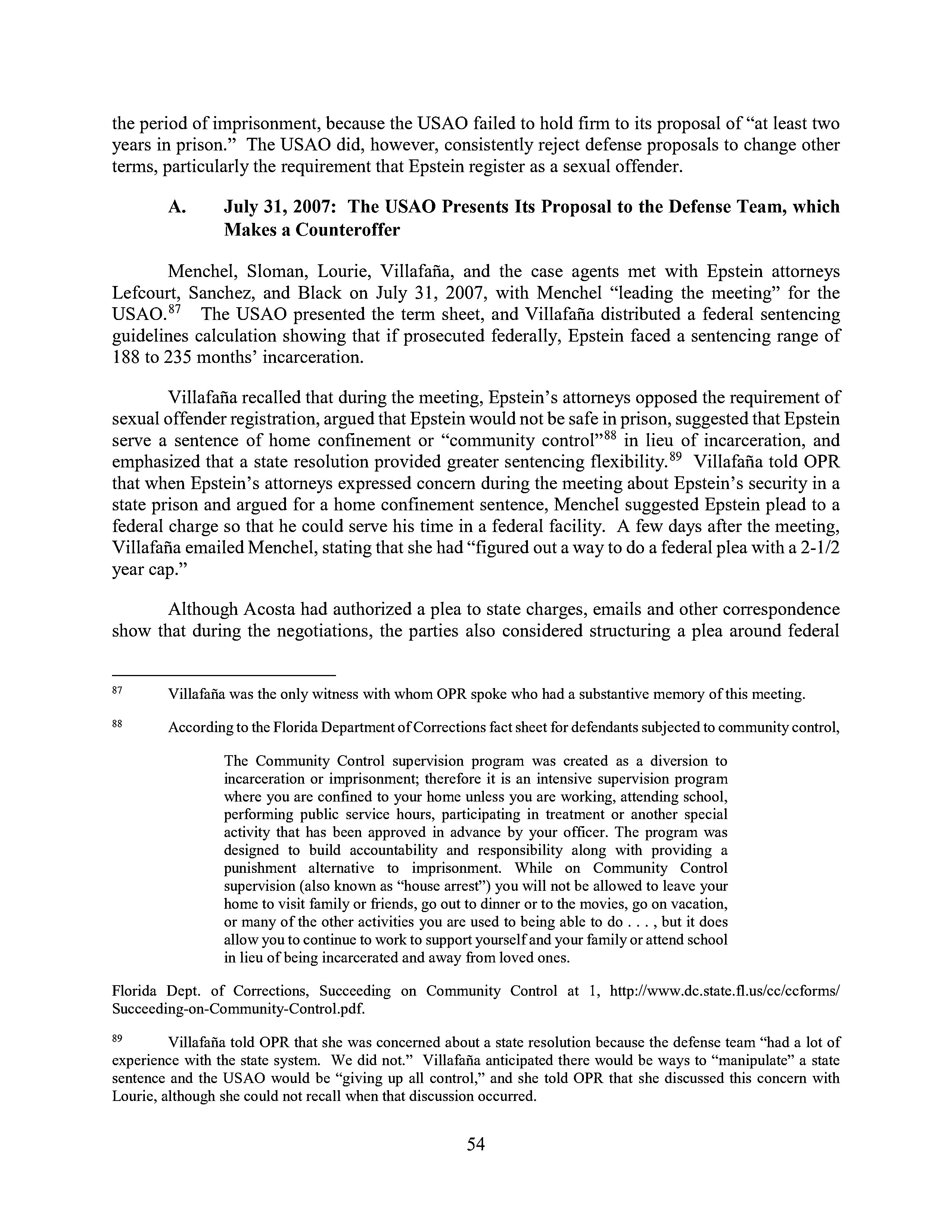
Page 135
document
2550 x 3300
Objects: Page, Text, Letter | Text: the period of imprisonment, because the USAO failed to hold firm
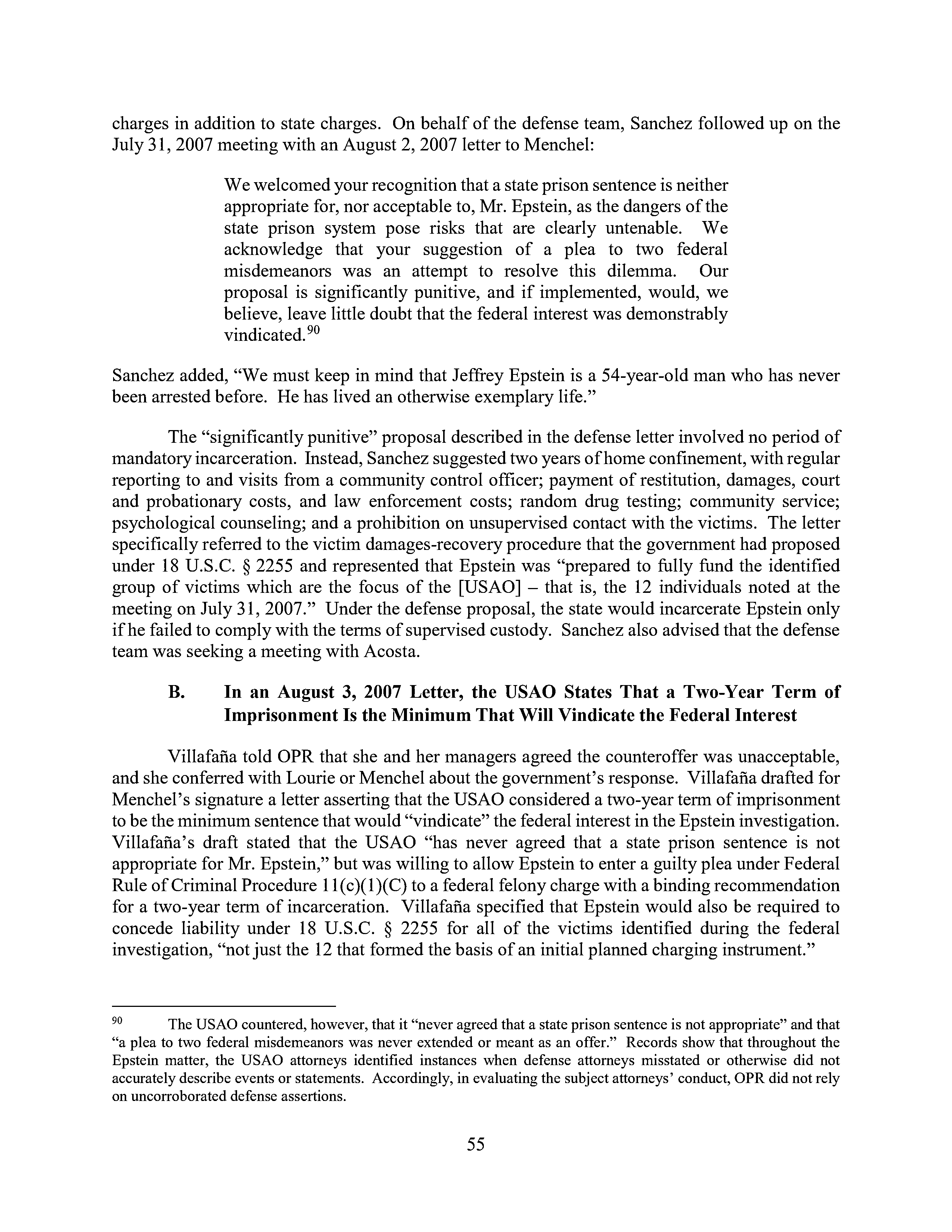
Page 136
document
2550 x 3300
Objects: Page, Text, Letter | Text: charges in addition to state charges. On behalf of the defense t
Page 137
document
2550 x 3300
Objects: Letter, Text, Page | Text: Menchel made several substantive changes to Villafaña' 's draft
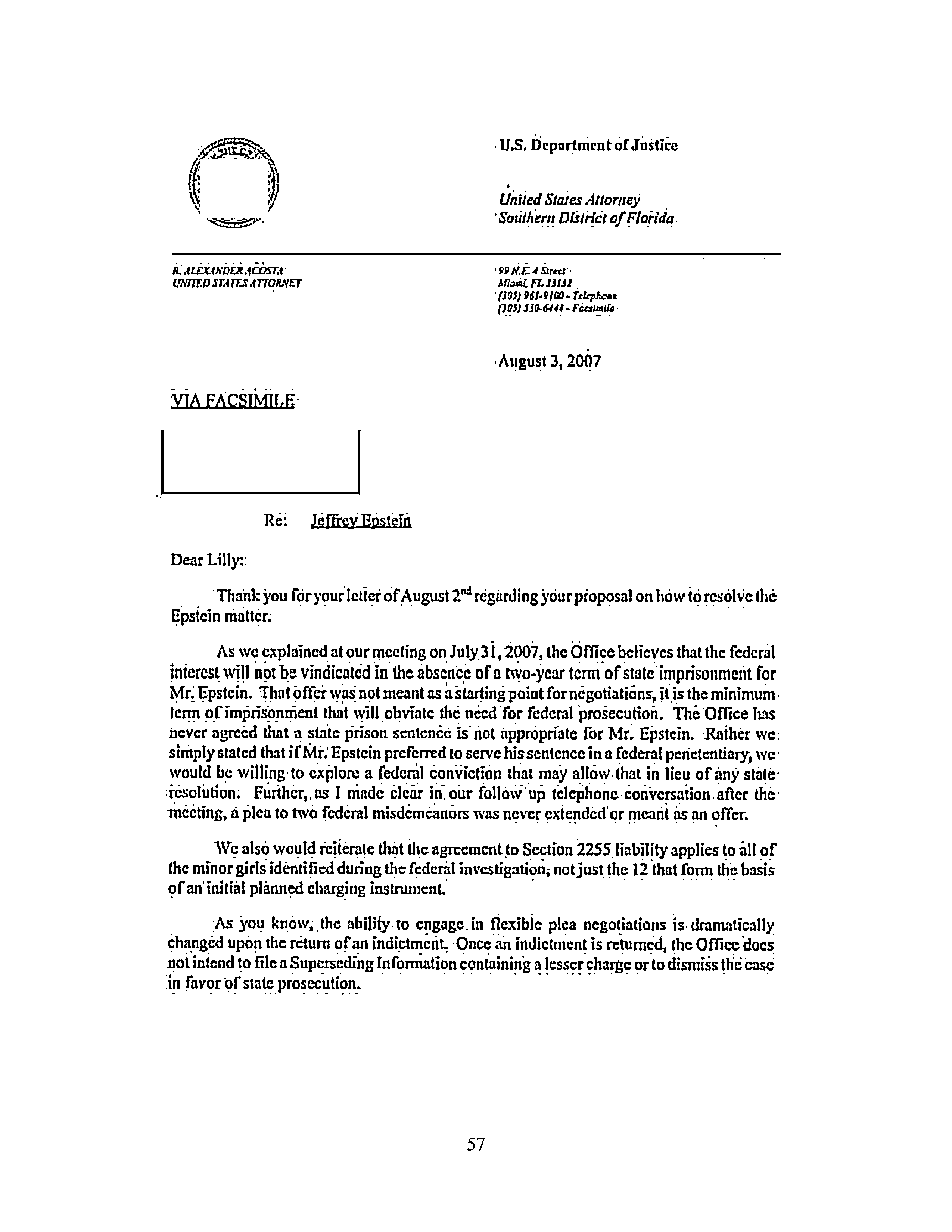
Page 138
document
2550 x 3300
Objects: Page, Text | Text: U.S. Department of Justice | United States Attorney | Southern District
Page 138
document
621 x 263
Objects: Text, Letter | Text: est will not be vindicated in the ab | Epstein. That offer was not mea

Page 138
photo
197 x 174
Objects: Emblem, Symbol, Chess, Game
Page 138
document
536 x 237
Objects: Text, Blackboard, Book, Publication | Text: Lilly Ann Sanchiz, Esq..
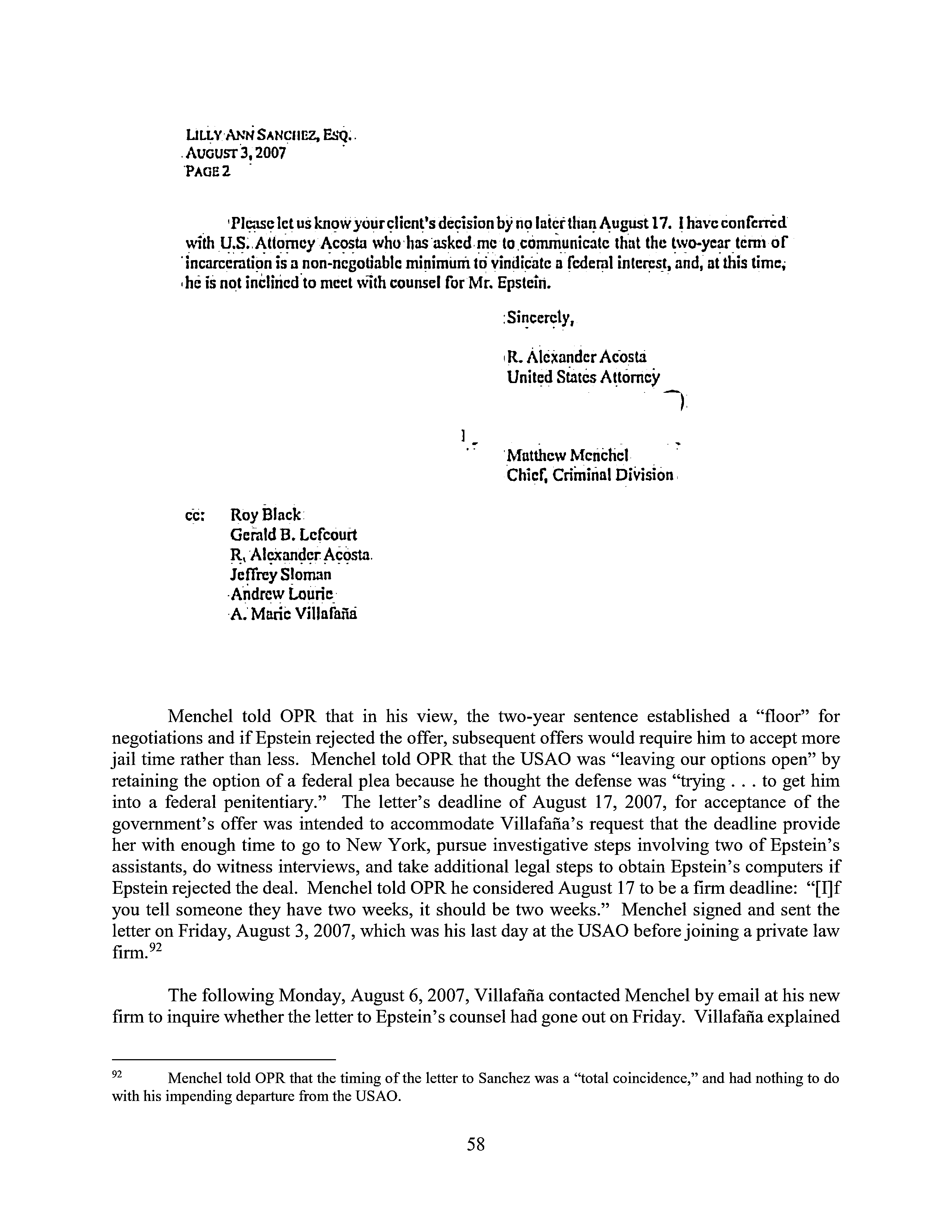
Page 139
document
2550 x 3300
Objects: Letter, Text, Page | Text: LILLY ANN SANCHEZ, ESQ. | AUGUST 3, 2007 | PAGE 2 | Please let u

Page 139
document
596 x 149
Objects: Handwriting, Text, Signature, Head, Person, Face | Text: By:
Page 140
document
2550 x 3300
Objects: Letter, Text, Page | Text: to OPR that she "wanted to know whether this letter went out. Be
Page 141
document
2550 x 3300
Objects: Page, Text, Letter | Text: jurisdiction), while making clear that we are not talking about
Page 142
document
2550 x 3300
Objects: Letter, Text, Page | Text: She believed that access to the computer evidence would strength
Page 143
document
2550 x 3300
Objects: Letter, Text, Page | Text: Villafaña added that the PBPD Chief had alerted the FBI that an
Page 144
document
2550 x 3300
Objects: Page, Text, Letter | Text: forward, that either there is this pre-indictment resolution, or
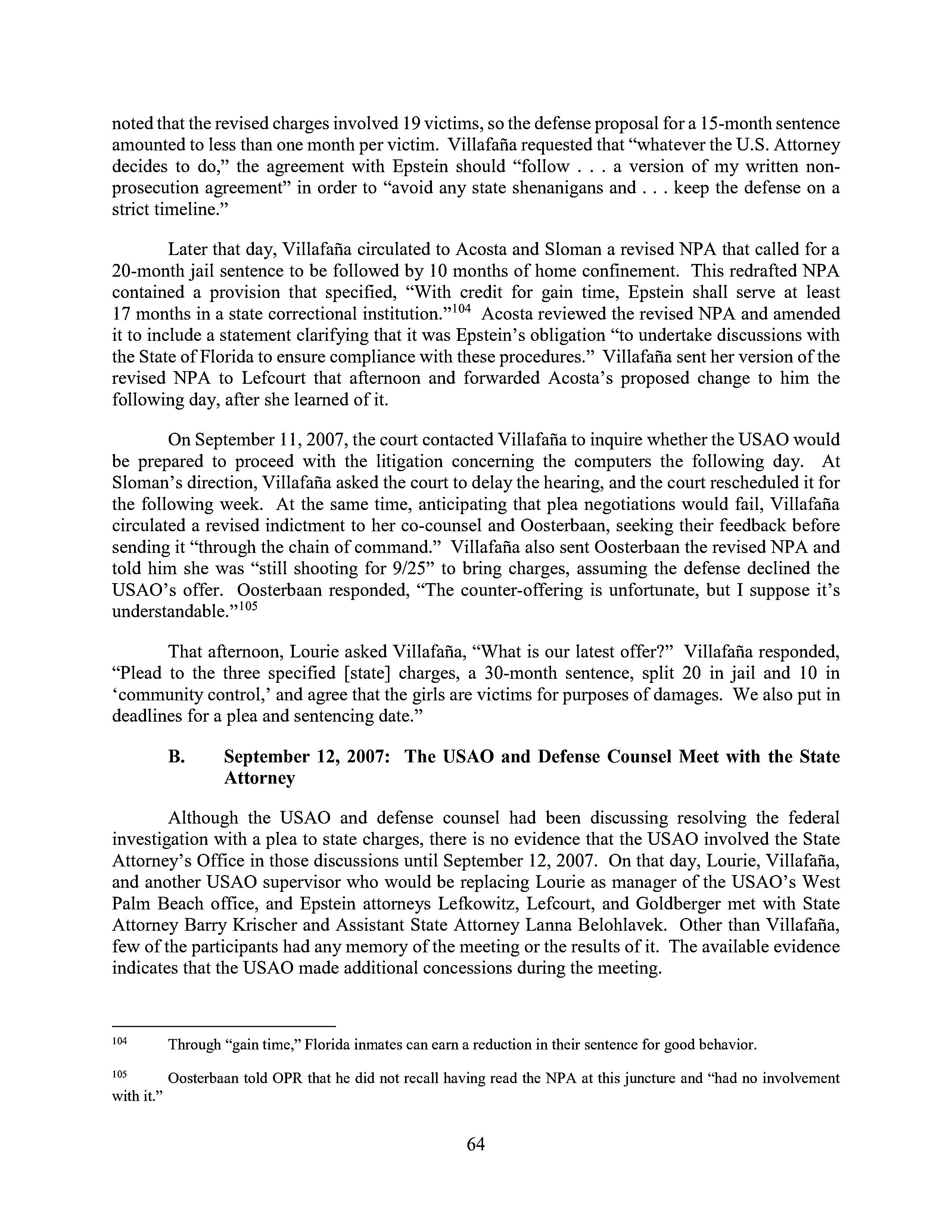
Page 145
document
2550 x 3300
Objects: Letter, Text, Page | Text: noted that the revised charges involved 19 victims, so the defen
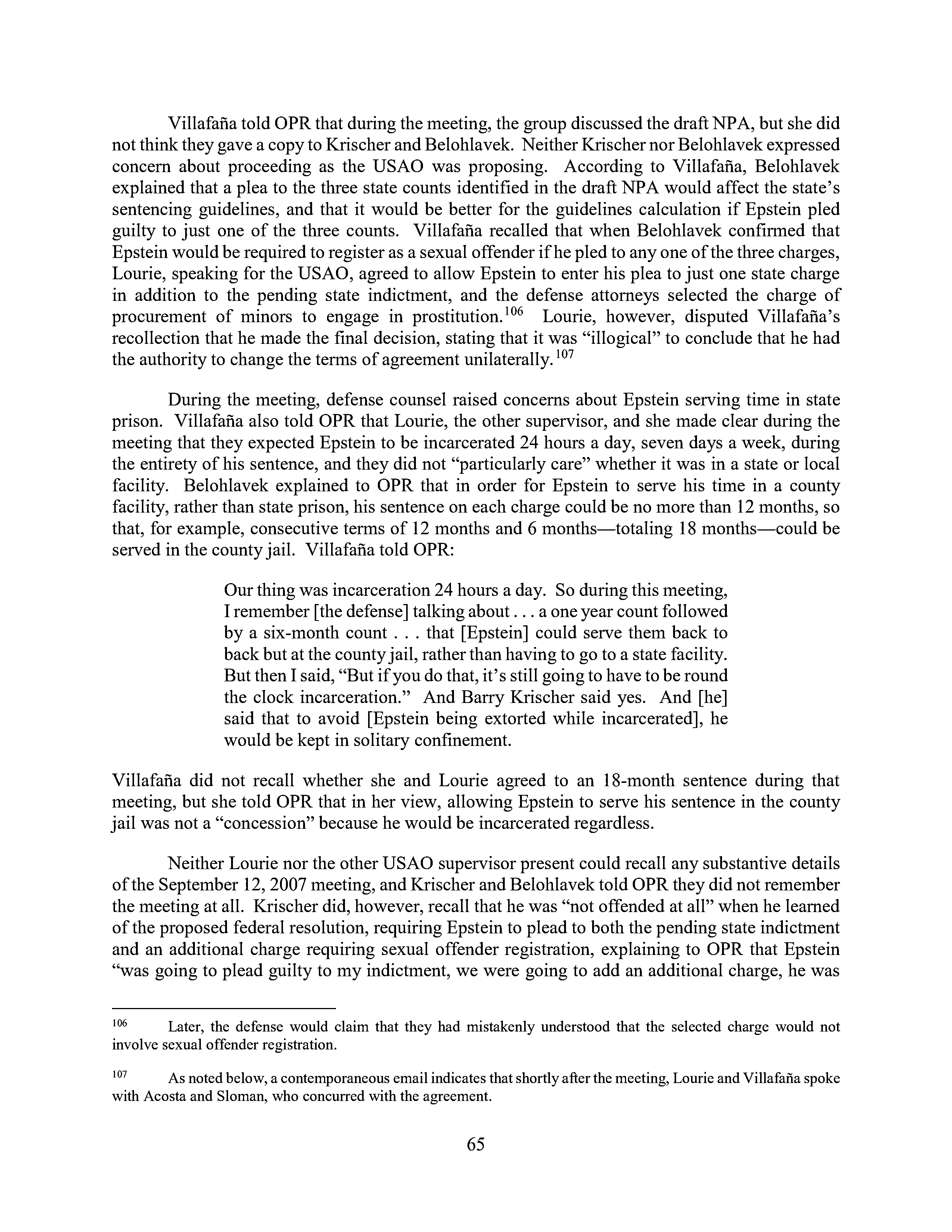
Page 146
document
2550 x 3300
Objects: Page, Text, Letter | Text: Villafaña told OPR that during the meeting, the group discussed
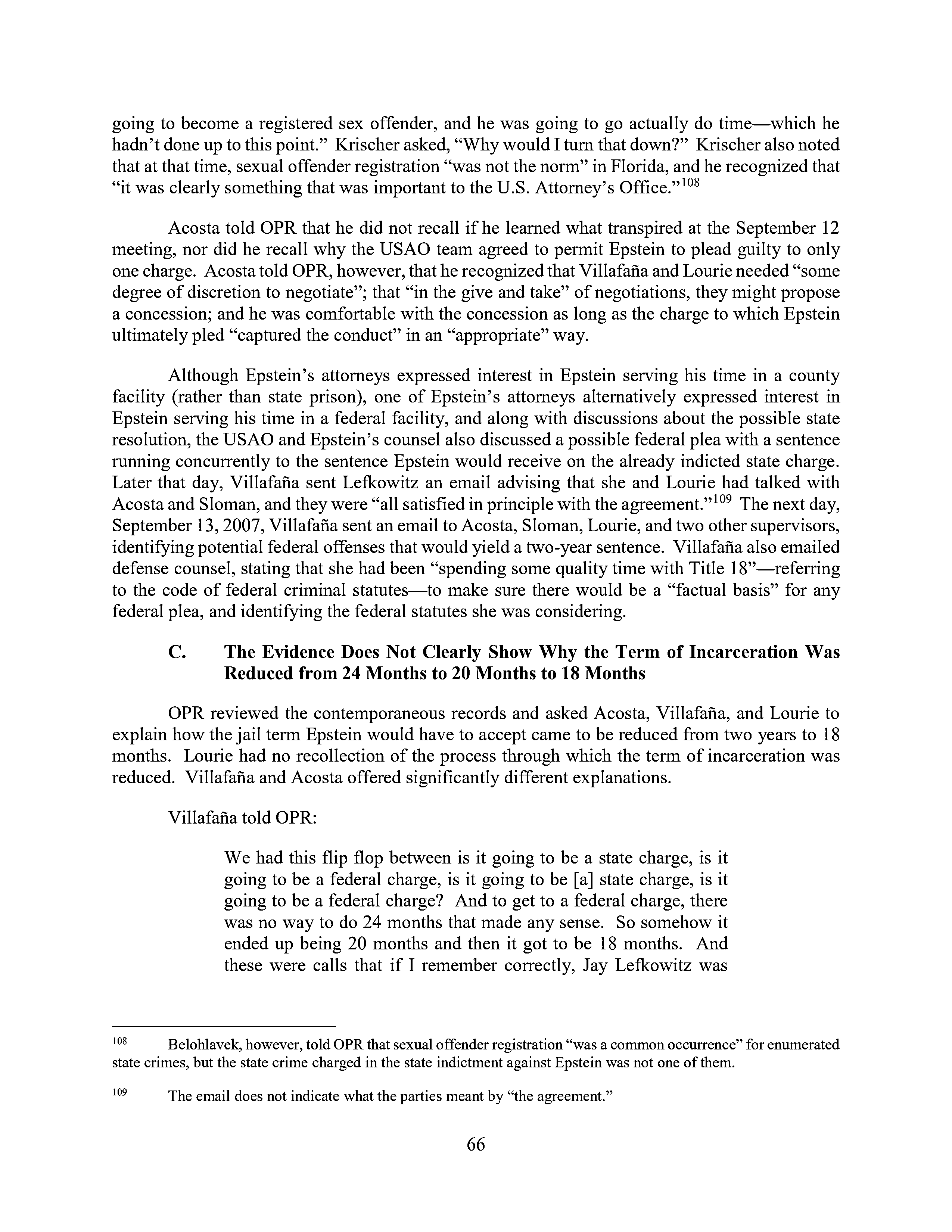
Page 147
document
2550 x 3300
Objects: Letter, Text, Page | Text: going to become a registered sex offender, and he was going to g
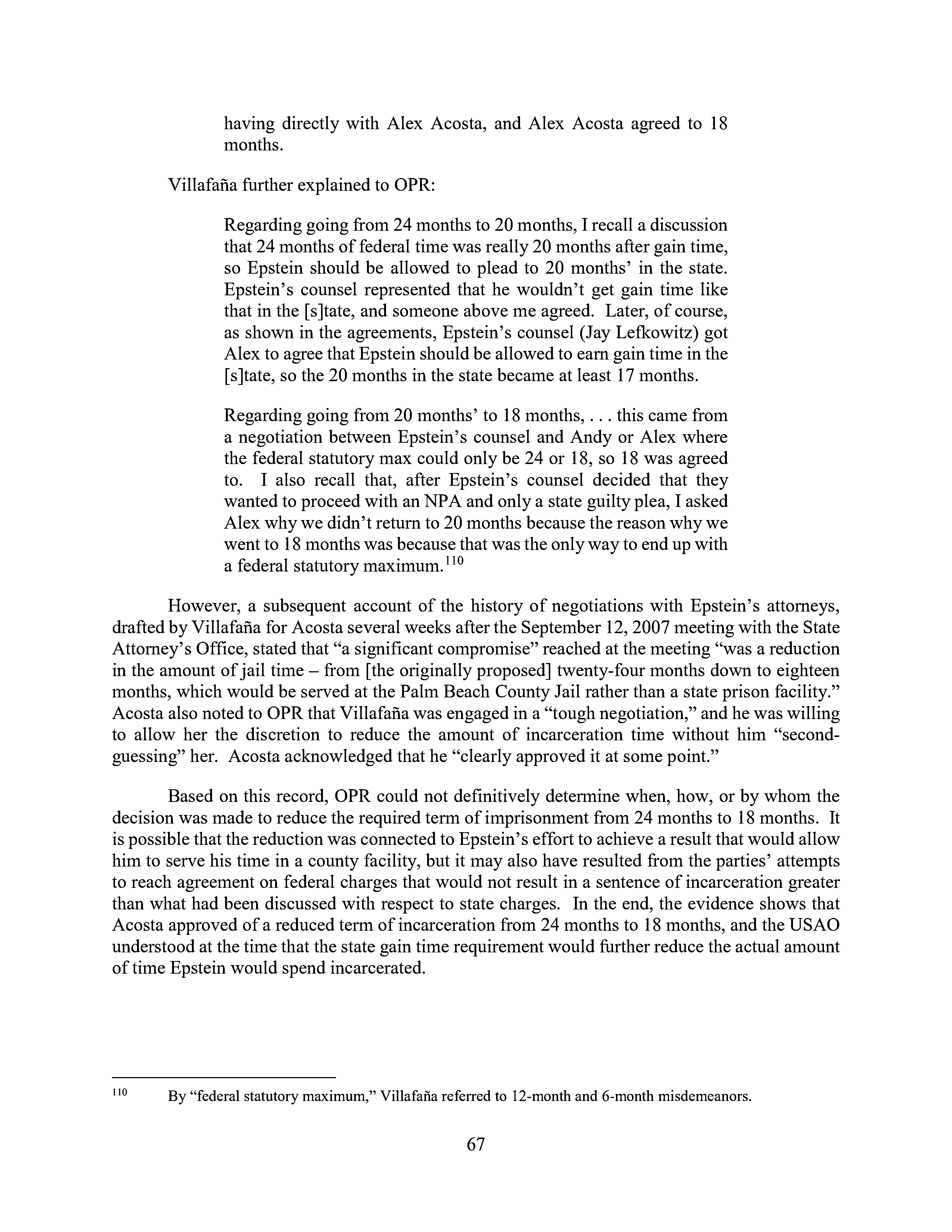
Page 148
document
2550 x 3300
Objects: Letter, Text, Page | Text: having directly with Alex Acosta, and Alex Acosta agreed to 18 |
Page 149
document
2550 x 3300
Objects: Page, Text, Letter | Text: D. | The Parties Continue to Negotiate but Primarily Focus on a
Page 150
document
2550 x 3300
Objects: Page, Text, Letter | Text: to the assault charge" and suggesting a different factual scenar
Page 151
document
2550 x 3300
Objects: Letter, Text, Page | Text: evidence of a violation of the agreement. Epstein and his counse
Page 152
document
2550 x 3300
Objects: Letter, Text, Page | Text: for them to be deported. "114 As to whether the foreign national
Page 153
document
2550 x 3300
Objects: Letter, Text, Page | Text: we go that route, would you intend to make the deferred [sic] pr
Page 154
document
2550 x 3300
Objects: Letter, Text, Page | Text: twelve months, with six served in home confinement, to run | con
Page 155
document
2550 x 3300
Objects: Letter, Text, Page | Text: and had added language waiving the preparation of a presentence
Page 156
document
2550 x 3300
Objects: Letter, Text, Page | Text: message, "That is fine. [The West Palm Beach manager] and I will
Page 157
document
2550 x 3300
Objects: Letter, Text, Page | Text: G. | Villafaña and Lourie Recommend Ending Negotiations, but Aco
Page 158
document
2550 x 3300
Objects: Letter, Text, Page | Text: everything, but I really do not think that Mr. Epstein is going
Page 159
document
2550 x 3300
Objects: Letter, Text, Page | Text: I. | The Defense Rejects the Federal Plea Agreement, Returns to
Page 160
document
2550 x 3300
Objects: Letter, Text, Page | Text: I think Jay [Lefkowitz] will try to talk you out of a registrabl
Page 161
document
2550 x 3300
Objects: Page, Text, Letter | Text: precluding the government from requesting, initiating, or recomm
Page 162
document
2550 x 3300
Objects: Letter, Text, Page | Text: federal court. Sloman similarly said that he had the impression
Page 163
document
2550 x 3300
Objects: Letter, Text, Page | Text: At some point that day, Acosta spoke with Lefkowitz by phone reg
Page 164
document
2550 x 3300
Objects: Letter, Text, Page | Text: Lefkowitz set forth arguments similar to those Sanchez had prese
Page 165
document
2550 x 3300
Objects: Letter, Text, Page | Text: The parties anticipate that this agreement will not be made part
Page 166
document
2550 x 3300
Objects: Letter, Text, Page | Text: agreement. I know that Andy promised ChiefReiter an update when
Page 167
document
2550 x 3300
Objects: Page, Text, Letter | Text: it had identified as victims. 131 The USAO, with the good faith
Page 168
document
2550 x 3300
Objects: Page, Text, Letter | Text: this matter." Lourie responded with an assurance that the Reiter
Page 169
document
2550 x 3300
Objects: Letter, Text, Page | Text: a proposal regarding the special master' 's responsibilities, al
Page 170
document
2550 x 3300
Objects: Letter, Text, Page | Text: that Epstein pay the victims' legal fees incurred from contested
Page 171
document
2550 x 3300
Objects: Letter, Text, Page | Text: However, as with Villafaña 's publicly released emails to Lefkow
Page 172
document
2550 x 3300
Objects: Page, Text, Letter | Text: Lefkowitz's description of their breakfast meeting discussion, A
Page 173
document
2550 x 3300
Objects: Letter, Text, Page | Text: On October 22, 2007, Sloman responded to the issues Lefkowitz ha
Page 174
document
2550 x 3300
Objects: Letter, Text, Page | Text: Why don't we agree to mutual recission [sic] and indict him? | A
Page 175
document
2550 x 3300
Objects: Page, Text, Letter | Text: D. | Epstein Further Delays His Guilty Plea | The addendum did n
Page 176
document
2550 x 3300
Objects: Letter, Text, Page | Text: not recall for OPR the substance of his conversation with Starr,
Page 177
document
2550 x 3300
Objects: Letter, Text, Page | Text: [S]ince the signing of the September 24th agreement, more than t
Page 178
document
2550 x 3300
Objects: Page, Text, Letter | Text: provision, recounted the history of NPA negotiations, and descri
Page 179
document
2550 x 3300
Objects: Letter, Text, Page | Text: the defense "[f]irst and foremost" reaffirmed the NPA and that E
Page 180
document
2550 x 3300
Objects: Letter, Text, Page | Text: Notwithstanding these voluminous submissions, Lefkowitz added th
Page 181
document
2550 x 3300
Objects: Page, Text, Letter | Text: 4. | Acosta Attempts to Revise the NPA § 2255 Language concernin
Page 182
document
2550 x 3300
Objects: Letter, Text, Page | Text: scheduled January 4, 2008 plea hearing. As soon became apparent,
Page 183
document
2550 x 3300
Objects: Letter, Text, Page | Text: that it was to establish whether, if the plea fell apart, he, as
Page 184
document
2550 x 3300
Objects: Letter, Text, Page | Text: these victim issues as insurmountable but, based on these alone,
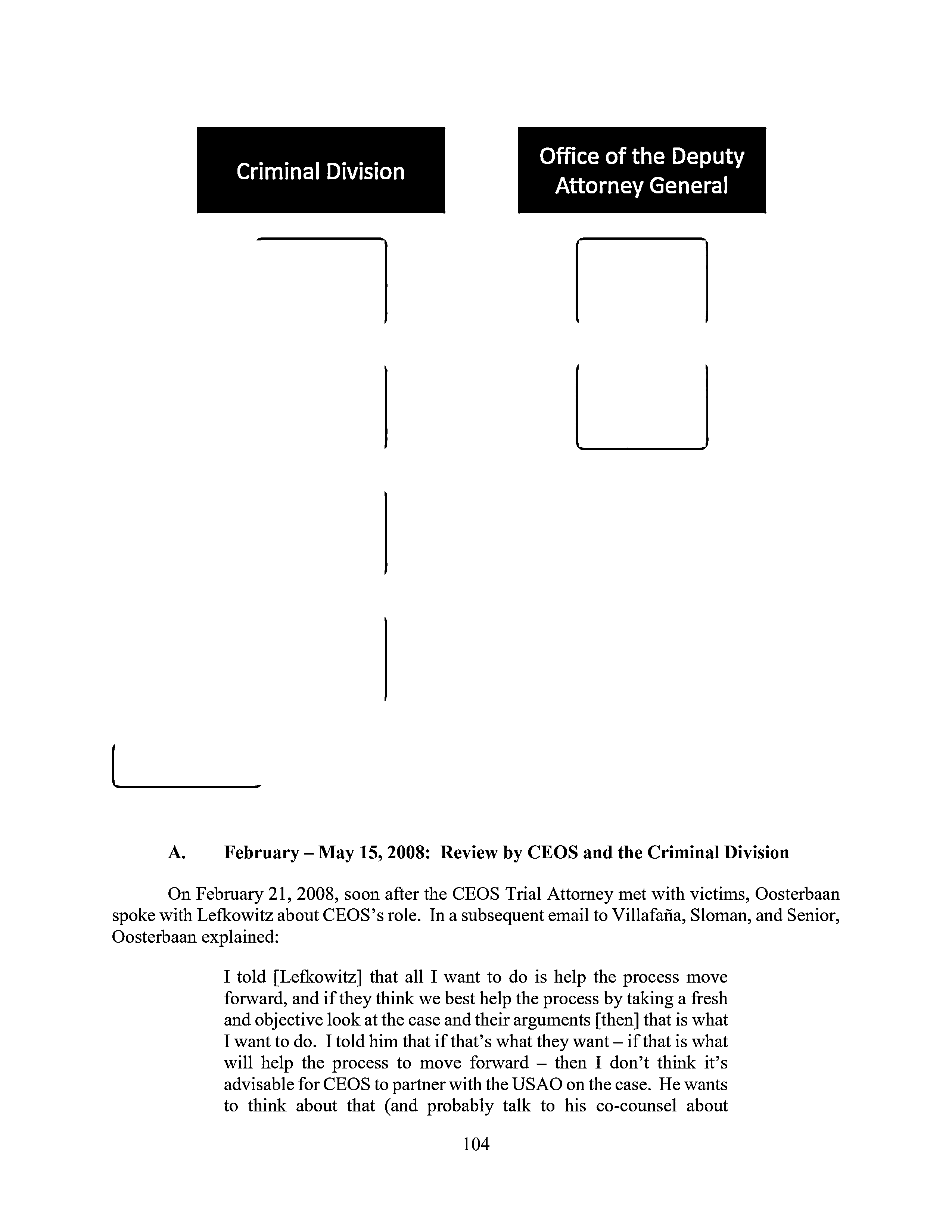
Page 185
document
2550 x 3300
Objects: Page, Text, Chart, Plot | Text: Office of the Deputy | Criminal Division | Attorney General

Page 185
document
365 x 238
Objects: White Board, Page, Text

Page 185
document
364 x 239
Objects: White Board, Page, Text
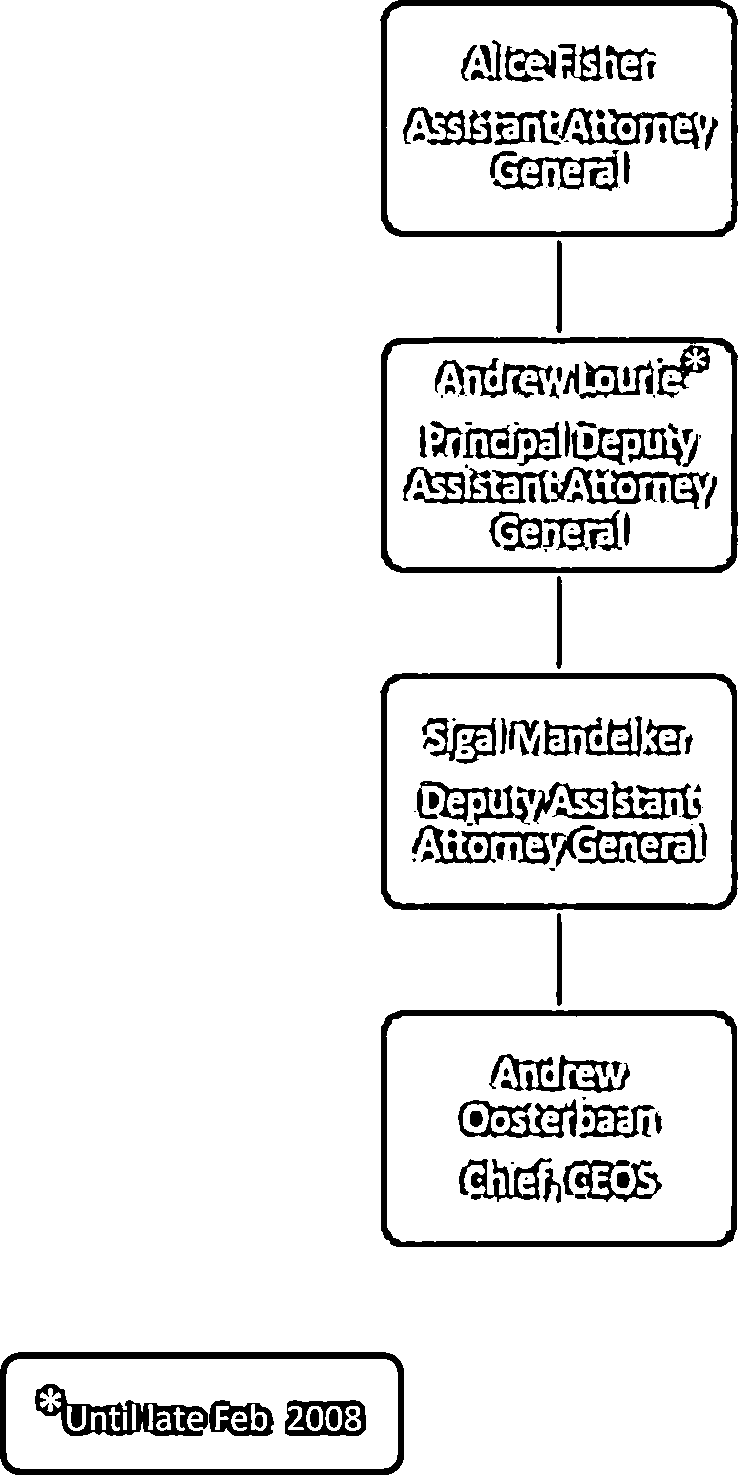
Page 185
document
738 x 1475
Objects: Text, Diagram, UML Diagram | Text: Assistant/Attorney | General | General | SigallMandelker

Page 185
document
359 x 240
Objects: White Board, Page, Text
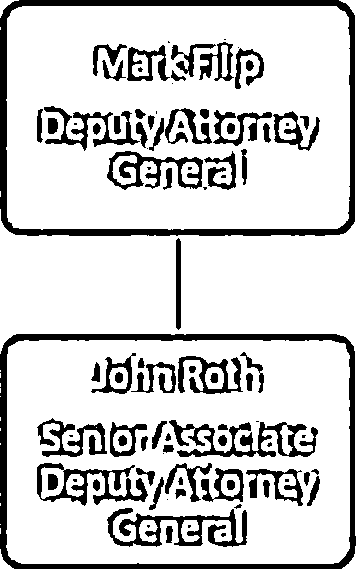
Page 185
document
356 x 569
Objects: Text, QR Code, Book, Comics, Publication | Text: General | DeputyAttorney | General
Page 186
document
2550 x 3300
Objects: Letter, Text, Page | Text: whether it is better to have us partnered in the case or just se
Page 187
document
2550 x 3300
Objects: Letter, Text, Page | Text: appeal an adverse determination by him within the DOJ. Ken [Star
Page 188
document
2550 x 3300
Objects: Letter, Text, Page | Text: In another letter, Starr renewed the defense accusation that the
Page 189
document
2550 x 3300
Objects: Letter, Text, Page | Text: federal prosecution is not appropriate in this case. ,168 Lefkow
Page 190
document
2550 x 3300
Objects: Letter, Text, Page | Text: Division forwarded to Roth the prior defense submissions, descri
Page 191
document
2550 x 3300
Objects: Letter, Text, Page | Text: On Monday, June 23, 2008, Roth sent a brief letter to Starr and
Page 192
document
2550 x 3300
Objects: Letter, Text, Page | Text: The next day, Villafaña asked Goldberger to change the plea agre
Page 193
document
2550 x 3300
Objects: Letter, Text, Page | Text: The Court: | Are all the victims in both these cases in | agreem
Page 194
document
2550 x 3300
Objects: Letter, Text, Page | Text: Dershowitz, Lefkowitz and Starr.''177 In that same later public
Page 195
document
2550 x 3300
Objects: Page, Text, Letter | Text: until after Epstein completed his sentence, but that Krischer wo
Page 196
document
2550 x 3300
Objects: Letter, Text, Page | Text: for up to 12 hours per day, six days per week, to work at the "F
Page 197
document
2550 x 3300
Objects: Letter, Text, Page | Text: Florida law treated work release as part of confinement; and the
Page 198
document
2550 x 3300
Objects: Letter, Text, Page | Text: the Sheriff's Office that Epstein's duties required him to work
Page 199
document
2550 x 3300
Objects: Letter, Text, Page | Text: cooperation. 186 | When Villafaña spoke with attorneys in the Ea
Page 200
document
2550 x 3300
Objects: Page, Text, Letter | Text: CHAPTER TWO | PART TWO: APPLICABLE STANDARDS | I. | OPR'S ANALYT
Page 201
document
2550 x 3300
Objects: Letter, Text, Page | Text: affirmative steps the attorney reasonably believed were required
Page 202
document
2550 x 3300
Objects: Letter, Text, Page | Text: him/her by an agency unless a statute provides otherwise." Whene
Page 203
document
2550 x 3300
Objects: Letter, Text, Page | Text: Some offenses, even though in violation of Federal law, are of |
Page 204
document
2550 x 3300
Objects: Page, Text, Letter | Text: that come within the national investigation and prosecution prio
Page 205
document
2550 x 3300
Objects: Page, Text, Letter | Text: defendant's criminal conduct, has an adequate factual basis, mak
Page 206
document
2550 x 3300
Objects: Letter, Text, Page | Text: cooperation as part of a plea agreement, or compelling cooperati
Page 207
document
2550 x 3300
Objects: Page, Text, Letter | Text: prosecutors adhere to the principles and objectives" of the Sent
Page 208
document
2550 x 3300
Objects: Letter, Text, Page | Text: flexibility to decline to bring a particular charge based on a "
Page 209
document
2550 x 3300
Objects: Letter, Text, Page | Text: the prosecutor indicted him on more serious charges. Hayes was t
Page 210
document
2550 x 3300
Objects: Letter, Text, Page | Text: when prosecutors have used third parties as leverage in plea neg
Page 211
document
2550 x 3300
Objects: Letter, Text, Page | Text: is subject to all rules of the court. 199 | Attorney Admission R
Page 212
document
2550 x 3300
Objects: Letter, Text, Page | Text: 4. | FRPC 4-8.4 - Conduct Prejudicial to the Administration of J

Page 213
document
2550 x 3300
Objects: Page, Text, Outdoors | Text: [Page Intentionally Left Blank] | 132
Page 214
document
2550 x 3300
Objects: Letter, Text, Page | Text: CHAPTER TWO | PART THREE: ANALYSIS | I. | OVERVIEW | Following t
Page 215
document
2550 x 3300
Objects: Letter, Text, Page | Text: different points in time, and regarding different decisions. Men
Page 216
document
2550 x 3300
Objects: Page, Text, Letter | Text: unambiguous standard or engaged in professional misconduct in de
Page 217
document
2550 x 3300
Objects: Page, Text, Letter | Text: As the U.S. Attorney, and in the absence of evidence establishin
Page 218
document
2550 x 3300
Objects: Page, Text, Letter | Text: agreement that did not require Epstein' 's cooperation nor did t
Page 219
document
2550 x 3300
Objects: Letter, Text, Page | Text: Longstanding Department policy directs prosecutors to require th
Page 220
document
2550 x 3300
Objects: Letter, Text, Page | Text: authority to deviate from the Ashcroft Memo's "most serious read
Page 221
document
2550 x 3300
Objects: Page, Text, Letter | Text: 3. | The NPA Did Not Violate Department Policy Relating to Depor
Page 222
document
2550 x 3300
Objects: Page, Text, Letter | Text: to prosecute all of Epstein's co-conspirators. | These factors a
Page 223
document
2550 x 3300
Objects: Page, Text, Letter | Text: OPR was attentive to any evidence that any of the subjects was m
Page 224
document
2550 x 3300
Objects: Letter, Text, Page | Text: narrative of Epstein 's philanthropic activities, rather than pr
Page 225
document
2550 x 3300
Objects: Letter, Text, Page | Text: considered that the USAO's most pivotal decisions--to resolve th
Page 226
document
2550 x 3300
Objects: Letter, Text, Page | Text: and guaranteed sexual offender registration by Epstein were | am
Page 227
document
2550 x 3300
Objects: Letter, Text, Page | Text: record, no restitution, no sex offender status, publication at a
Page 228
document
2550 x 3300
Objects: Letter, Text, Page | Text: d[id]n't want to have to relive what happened to them. "217 The
Page 229
document
2550 x 3300
Objects: Letter, Text, Page | Text: The USAO might have been able to surmount the evidentiary, legal
Page 230
document
2550 x 3300
Objects: Letter, Text, Page | Text: been concerned about policy and federalism issues. 221 Sloman to
Page 231
document
2550 x 3300
Objects: Page, Text, Letter | Text: reconsider the provision. Acosta could certainly have modified o
Page 232
document
2550 x 3300
Objects: Letter, Text, Page | Text: [O]ne of the issues in the case was the defense's ability to | d
Page 233
document
2550 x 3300
Objects: Letter, Text, Page | Text: friendships or associations with any of Epstein 's attorneys. In
Page 234
document
2550 x 3300
Objects: Letter, Text, Page | Text: In its review of the documentary record, OPR examined an email w
Page 235
document
2550 x 3300
Objects: Page, Text, Letter | Text: Menchel told OPR that when he and Sanchez were in the USAO, they
Page 236
document
2550 x 3300
Objects: Letter, Text, Page | Text: accept the two-year proposal when it was made, but instead conti
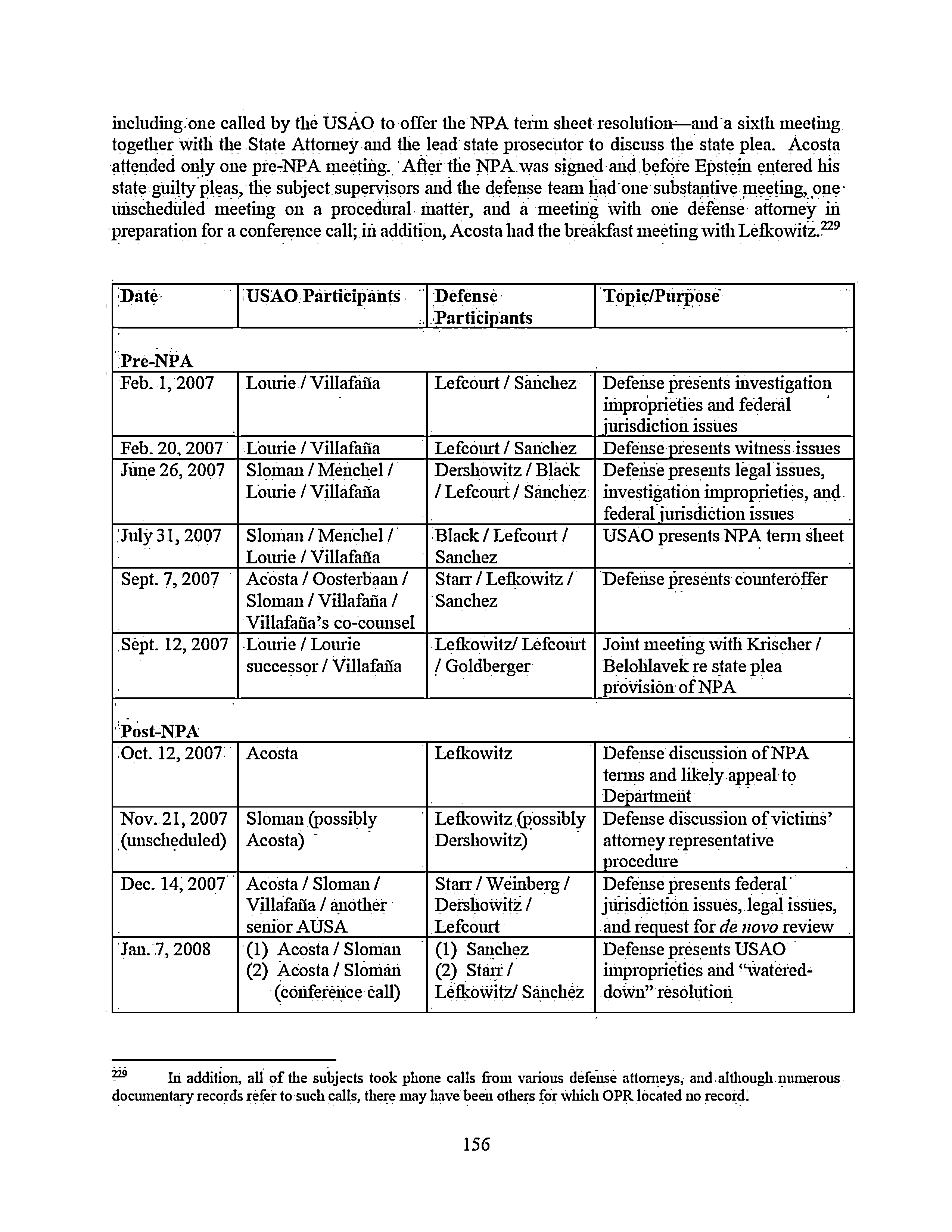
Page 237
document
2550 x 3300
Objects: Page, Text, Chart, Diagram, Plan, Plot | Text: including.one called by the USAO to offer th
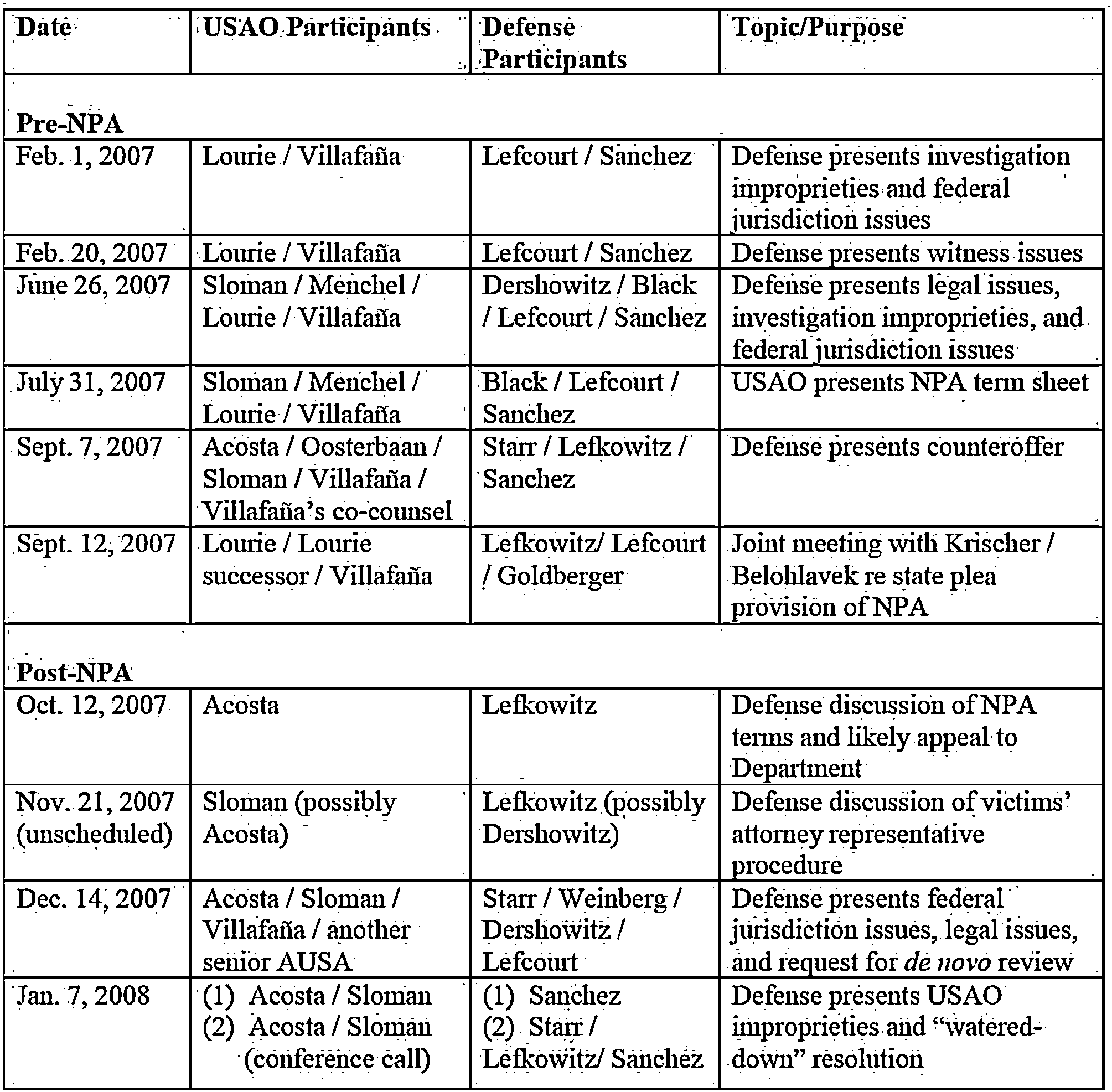
Page 237
document
2009 x 1973
Objects: Chart, Plot, Page, Text | Text: Defense | Date | USAO Participants | Participants | Pre-NPA
Page 238
document
2550 x 3300
Objects: Letter, Text, Page | Text: OPR explored the subject supervisors' reasoning for accommodatin
Page 239
document
2550 x 3300
Objects: Page, Text, Letter | Text: preparing a "short" charging document "with only 'clean' victims
Page 240
document
2550 x 3300
Objects: Letter, Text, Page | Text: The meeting of USAO representatives and Epstein's defense attorn
Page 241
document
2550 x 3300
Objects: Page, Text, Letter | Text: 2. | The Evidence Does Not Establish That Acosta Negotiated a De
Page 242
document
2550 x 3300
Objects: Letter, Text, Page | Text: proof that this led to the breakfast meeting, email exchanges be
Page 243
document
2550 x 3300
Objects: Letter, Text, Page | Text: promise equates to the imposition of a gag order. Our Office can
Page 244
document
2550 x 3300
Objects: Letter, Text, Page | Text: sentence of incarceration, and the USAO would consider a plea th
Page 245
document
2550 x 3300
Objects: Letter, Text, Page | Text: OPR asked Villafaña about these emails and about the tenor of he
Page 246
document
2550 x 3300
Objects: Letter, Text, Page | Text: With regard to her comment about "avoid[ing] the press," Villafa
Page 247
document
2550 x 3300
Objects: Page, Text, Letter | Text: entitled to significant weight, and OPR credits them. OPR finds,
Page 248
document
2550 x 3300
Objects: Page, Text, Letter | Text: Villafaña had raised (defense counsel's attempt to insert an imm
Page 249
document
2550 x 3300
Objects: Letter, Text, Page | Text: Lourie described the promise not to prosecute "potential co-cons
Page 250
document
2550 x 3300
Objects: Page, Text, Letter | Text: investigation. 243 | Media reports in mid-2009 suggested Epstein
Page 251
document
2550 x 3300
Objects: Letter, Text, Page | Text: successful federal prosecution, Acosta prematurely decided to re
Page 252
document
2550 x 3300
Objects: Page, Text, Letter | Text: Notably, in the early 2000s, the Department had begun pursuing s
Page 253
document
2550 x 3300
Objects: Letter, Text, Page | Text: [The prosecution] was going forward on the part of the state, an
Page 254
document
2550 x 3300
Objects: Letter, Text, Page | Text: depart from the Ashcroft Memo. He told OPR, however, that he did
Page 255
document
2550 x 3300
Objects: Page, Text, Letter | Text: The sexual offender registration provision is yet another exampl
Page 256
document
2550 x 3300
Objects: Page, Text, Letter | Text: Epstein's state guilty plea. 250 As U.S. Attorney, Acosta had th
Page 257
document
2550 x 3300
Objects: Letter, Text, Page | Text: search warrant was executed on that property, the computer equip
Page 258
document
2550 x 3300
Objects: Letter, Text, Page | Text: the federal investigation in exchange for a plea in state court
Page 259
document
2550 x 3300
Objects: Letter, Text, Page | Text: with one of Epstein's defense attorneys about it. Sloman told OP
Page 260
document
2550 x 3300
Objects: Letter, Text, Page | Text: To be clear, OPR is not suggesting that prosecutors must obtain
Page 261
document
2550 x 3300
Objects: Letter, Text, Page | Text: "I'm reconstructing memories of... 12 years ago. I can speculate
Page 262
document
2550 x 3300
Objects: Letter, Text, Page | Text: indictment. Given Epstein's continued insistence that federal ch
Page 263
document
2550 x 3300
Objects: Page, Text, Letter | Text: D. | Acosta's Decisions Led to Difficulties Enforcing the NPA |
Page 264
document
2550 x 3300
Objects: Letter, Text, Page | Text: the defendant faced decades in prison for sexual crimes against
Page 265
document
2550 x 3300
Objects: Page, Text, Letter | Text: which Villafaña and Lourie believed that the state had intention
Page 266
document
2550 x 3300
Objects: Page, Text, Letter | Text: managers required more effort than in other offices, where a lin
Page 267
document
2550 x 3300
Objects: Letter, Text, Page | Text: The rush to reach a resolution should not have led the USAO to a
Page 268
document
2550 x 3300
Objects: Letter, Text, Page | Text: from Villafaña and others, but given the highly unusual procedur

Page 269
document
2550 x 3300
Objects: Page, Text | Text: [Page Intentionally Left Blank] | 188
Page 270
document
2550 x 3300
Objects: Letter, Text, Page | Text: CHAPTER THREE | ISSUES RELATING TO THE GOVERNMENT'S INTERACTIONS
Page 271
diagram
3300 x 2550
Objects: Chart, Diagram, Plan, Plot, UML Diagram, QR Code | Text: Timeline of Key Events for Crime V
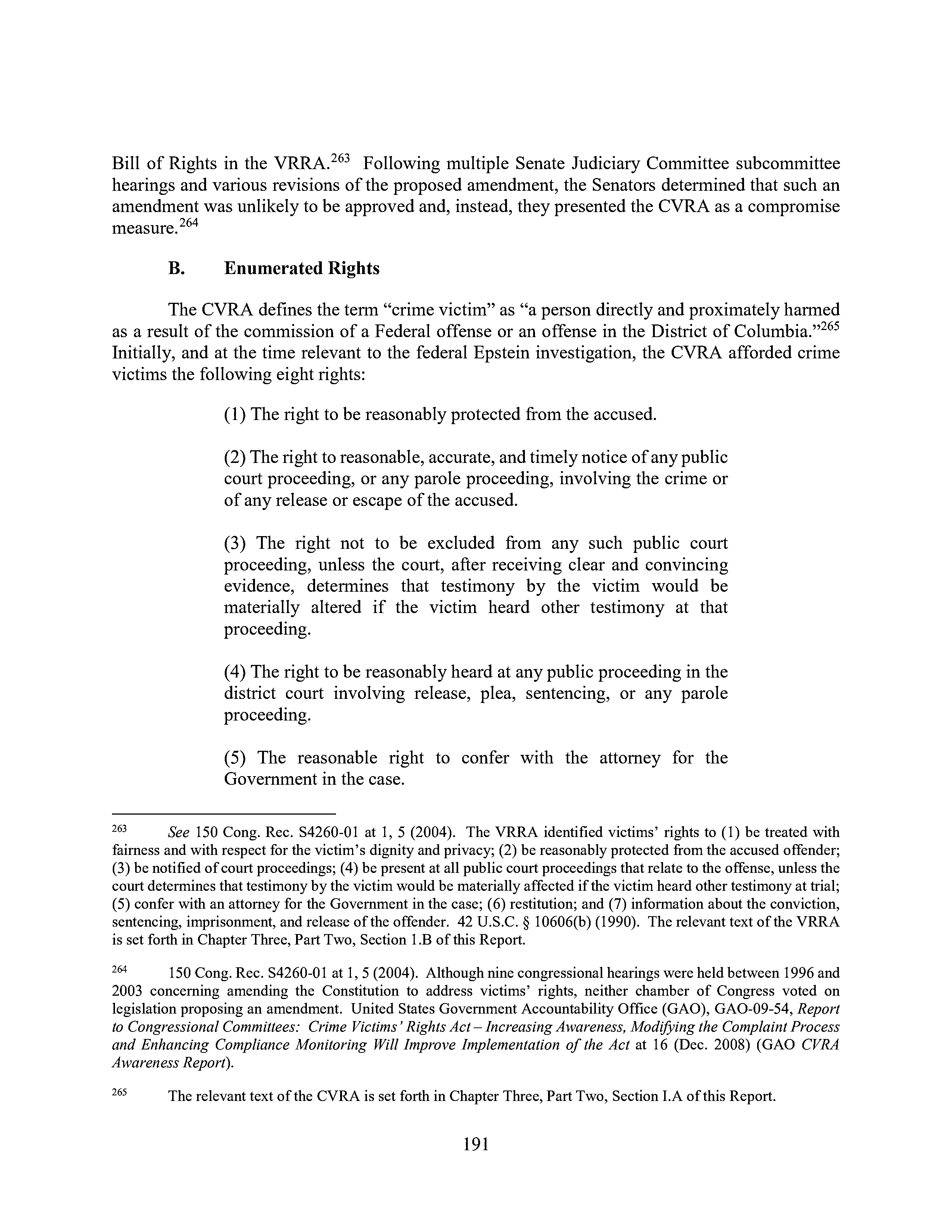
Page 272
document
2550 x 3300
Objects: Letter, Text, Page | Text: Bill of Rights in the VRRA.263 Following multiple Senate Judicia
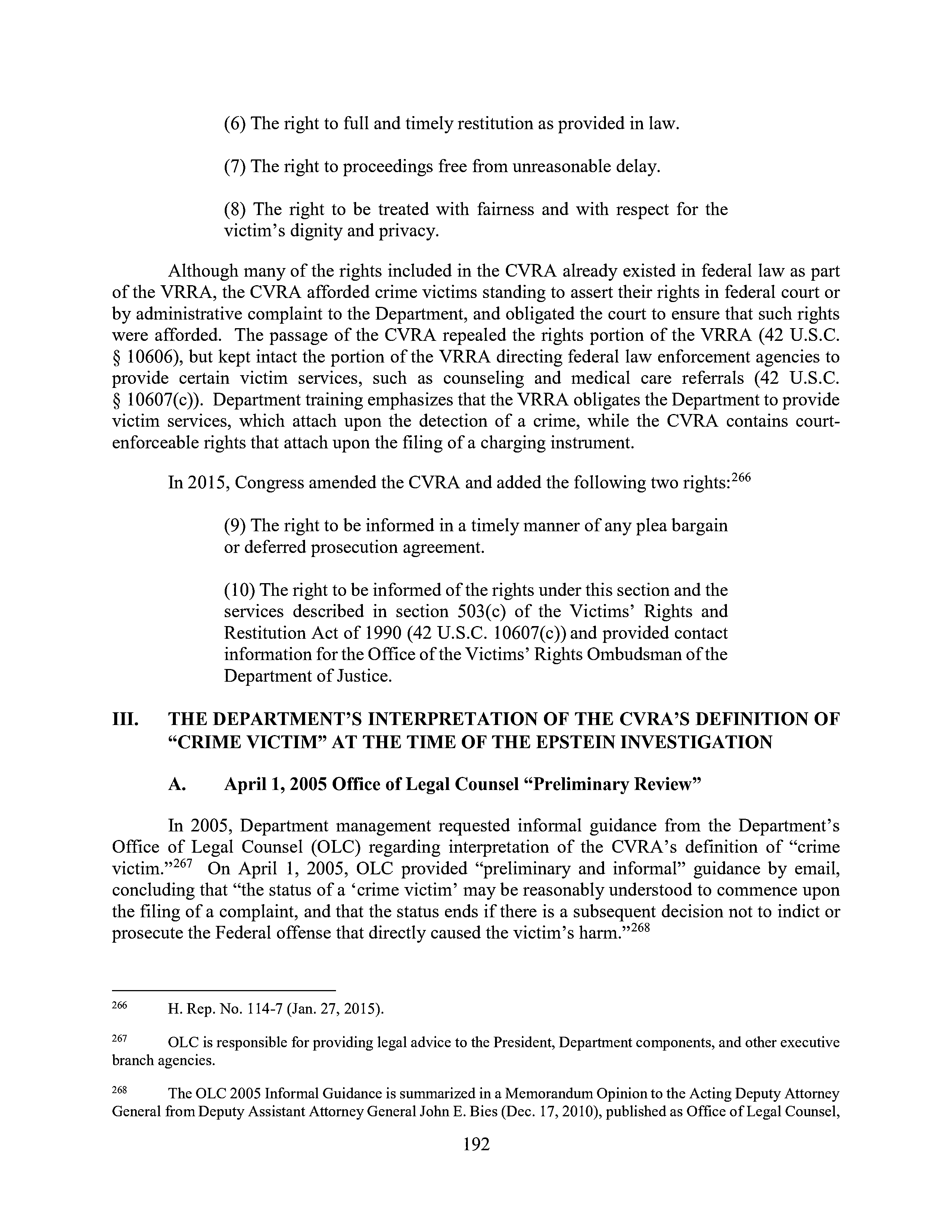
Page 273
document
2550 x 3300
Objects: Letter, Text, Page | Text: (6) The right to full and timely restitution as provided in law.
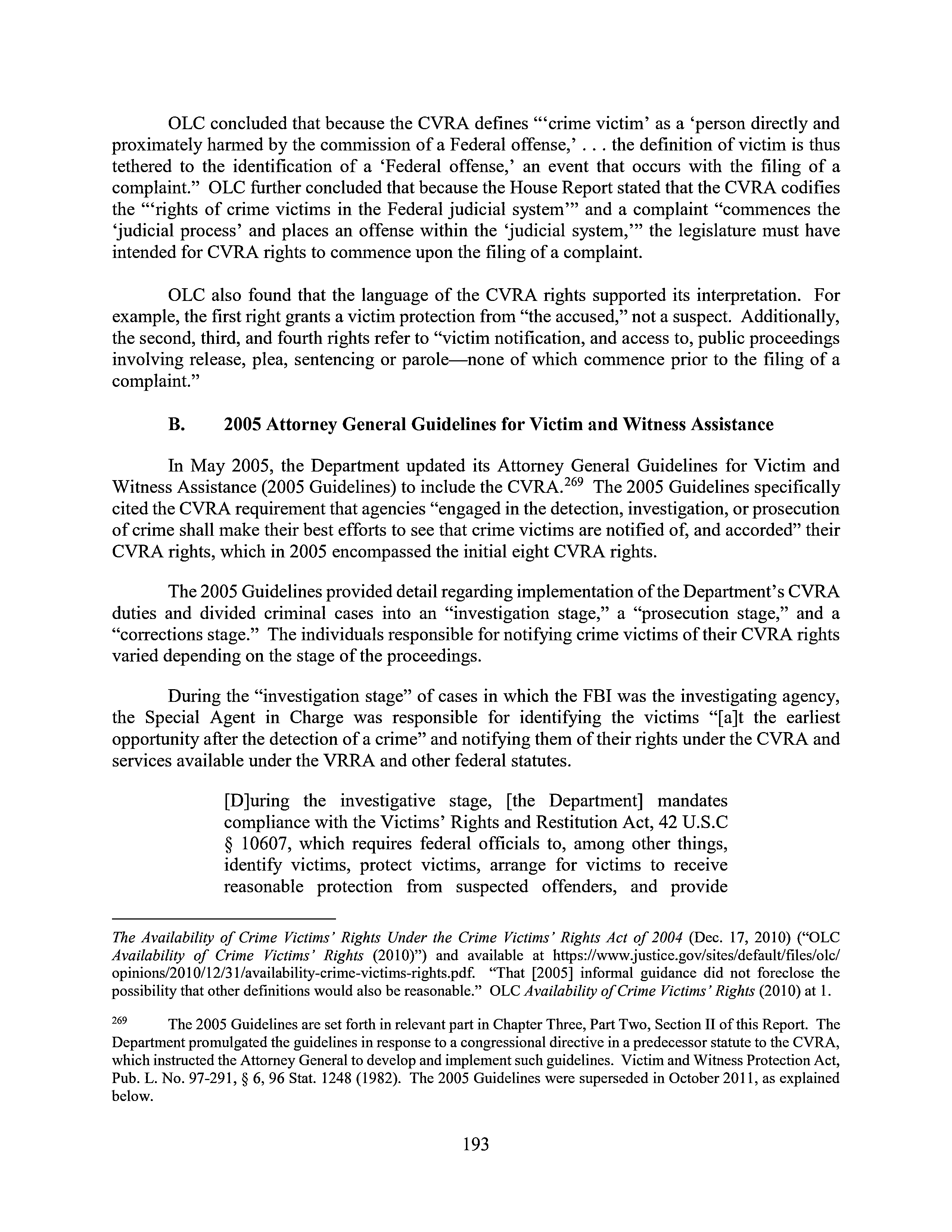
Page 274
document
2550 x 3300
Objects: Letter, Text, Page | Text: OLC concluded that because the CVRA defines "crime victim' as a
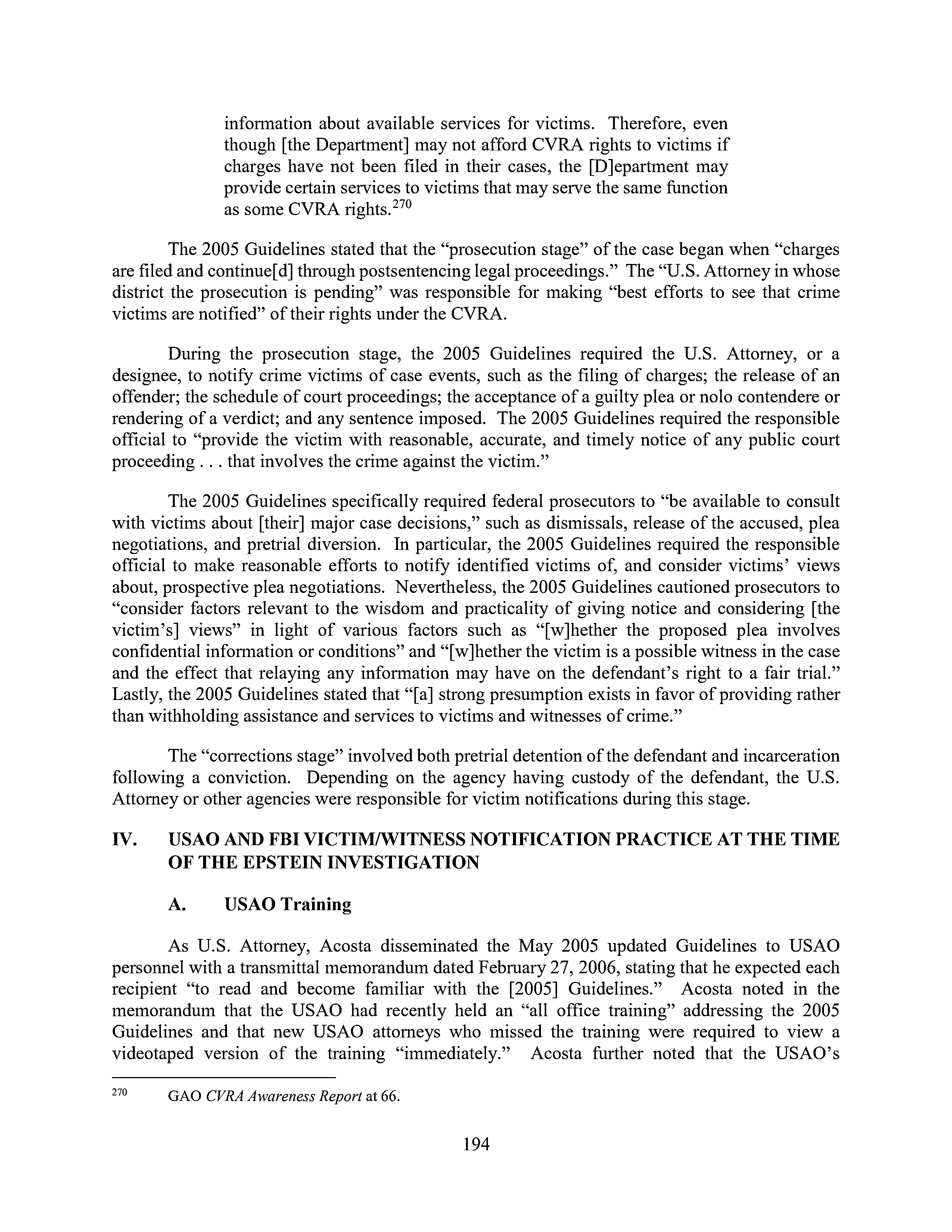
Page 275
document
2550 x 3300
Objects: Letter, Text, Page | Text: information about available services for victims. Therefore, eve
Page 276
document
2550 x 3300
Objects: Letter, Text, Page | Text: victim/witness staff were "ready to assist you with the details
Page 277
document
2550 x 3300
Objects: Page, Text, Letter | Text: C. | FBI Victim Notification Pamphlets | The 2005 Guidelines rec
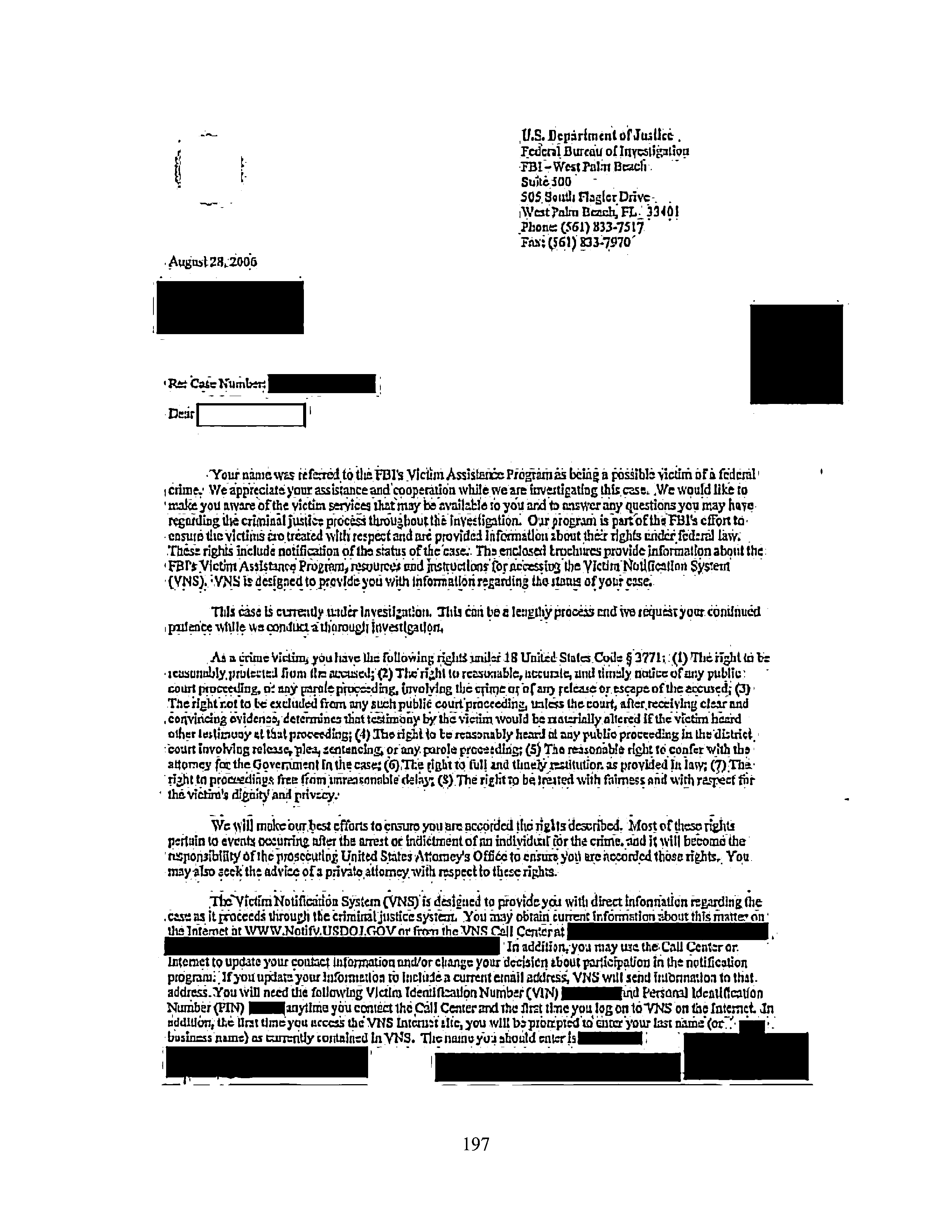
Page 278
document
2550 x 3300
Objects: Text, Page, Letter | Text: U.S. Department of Justice | Federal Bureau of Investigation | _
Page 278
document
466 x 348
Objects: Text, Handwriting, QR Code, Letter | Text: Federal Bureau of Investigation | WestPalm Beach

Page 278
photo
178 x 194
Objects: QR Code, Symbol

Page 278
document
295 x 69
Objects: Firearm, Gun, Rifle, Weapon, Text
Page 279
document
2550 x 3300
Objects: Letter, Text, Page | Text: the notificatiça part of this program 1s voluntary; In only in c

Page 279
document
582 x 233
Objects: Text
Page 280
document
2550 x 3300
Objects: Page, Text, Letter | Text: questions," she wanted to "make sure that they ... feel like the
Page 281
document
2550 x 3300
Objects: Letter, Text, Page | Text: [A]s Chief of the Criminal Division of the USAO, I did not consi
Page 282
document
2550 x 3300
Objects: Letter, Text, Page | Text: government informed any victim about the potential for resolving
Page 283
document
2550 x 3300
Objects: Letter, Text, Page | Text: for some victims, learning of the Epstein investigation and poss
Page 284
document
2550 x 3300
Objects: Letter, Text, Page | Text: various iterations of the victims' rights legislation. ,,285 Vil
Page 285
document
2550 x 3300
Objects: Page, Text, Letter | Text: 2. | Villafaña Asserts That Her Supervisors Gave Instructions No
Page 286
document
2550 x 3300
Objects: Letter, Text, Page | Text: Chief wanted to know if the victims had been consulted about the
Page 287
document
2550 x 3300
Objects: Letter, Text, Page | Text: disagreement" regarding the CVRA 's requirements. 295 Oosterbaan
Page 288
document
2550 x 3300
Objects: Page, Text, Letter | Text: A. | September-October 2007: The Case Agents Notify Some Victims
Page 289
document
2550 x 3300
Objects: Page, Text, Letter | Text: involved in such notifications. According to Villafaña, Sloman t
Page 290
document
2550 x 3300
Objects: Letter, Text, Page | Text: During this meeting, the Agents did not explain that an agreemen
Page 291
document
2550 x 3300
Objects: Letter, Text, Page | Text: for [victims] to enhance their stories" and that the defense wou
Page 292
document
2550 x 3300
Objects: Letter, Text, Page | Text: and thanking Acosta for agreeing on October 12, 2007, not to "co
Page 293
document
2550 x 3300
Objects: Letter, Text, Page | Text: NPA. 310 The FBI reports of the victim interviews do not mention
Page 294
document
2550 x 3300
Objects: Letter, Text, Page | Text: she would inform victims of the terms of the resolution of the f
Page 295
document
2550 x 3300
Objects: Letter, Text, Page | Text: the USAO's interpretation of the agreement and "the use of Secti
Page 296
document
2550 x 3300
Objects: Letter, Text, Page | Text: in Courtroom 11F at the Palm Beach County Courthouse, 205 North
Page 297
document
2550 x 3300
Objects: Letter, Text, Page | Text: her a victim for purposes of the federal charges, and continued
Page 298
document
2550 x 3300
Objects: Page, Text, Letter | Text: informed victims "of their right to collect damages prior to a t
Page 299
document
2550 x 3300
Objects: Letter, Text, Page | Text: review the appropriateness of the potential federal charges and
Page 300
document
2550 x 3300
Objects: Letter, Text, Page | Text: have "notified [the victims] that that was an all-encompassing p
Page 301
document
2550 x 3300
Objects: Letter, Text, Page | Text: decision as to who can be heard at a state sentencing is, amongs
Page 302
document
2550 x 3300
Objects: Page, Text, Letter | Text: "federal authorities are expected to drop their probe into wheth
Page 303
document
2550 x 3300
Objects: Letter, Text, Page | Text: We will make our best efforts to ensure you are accorded the rig
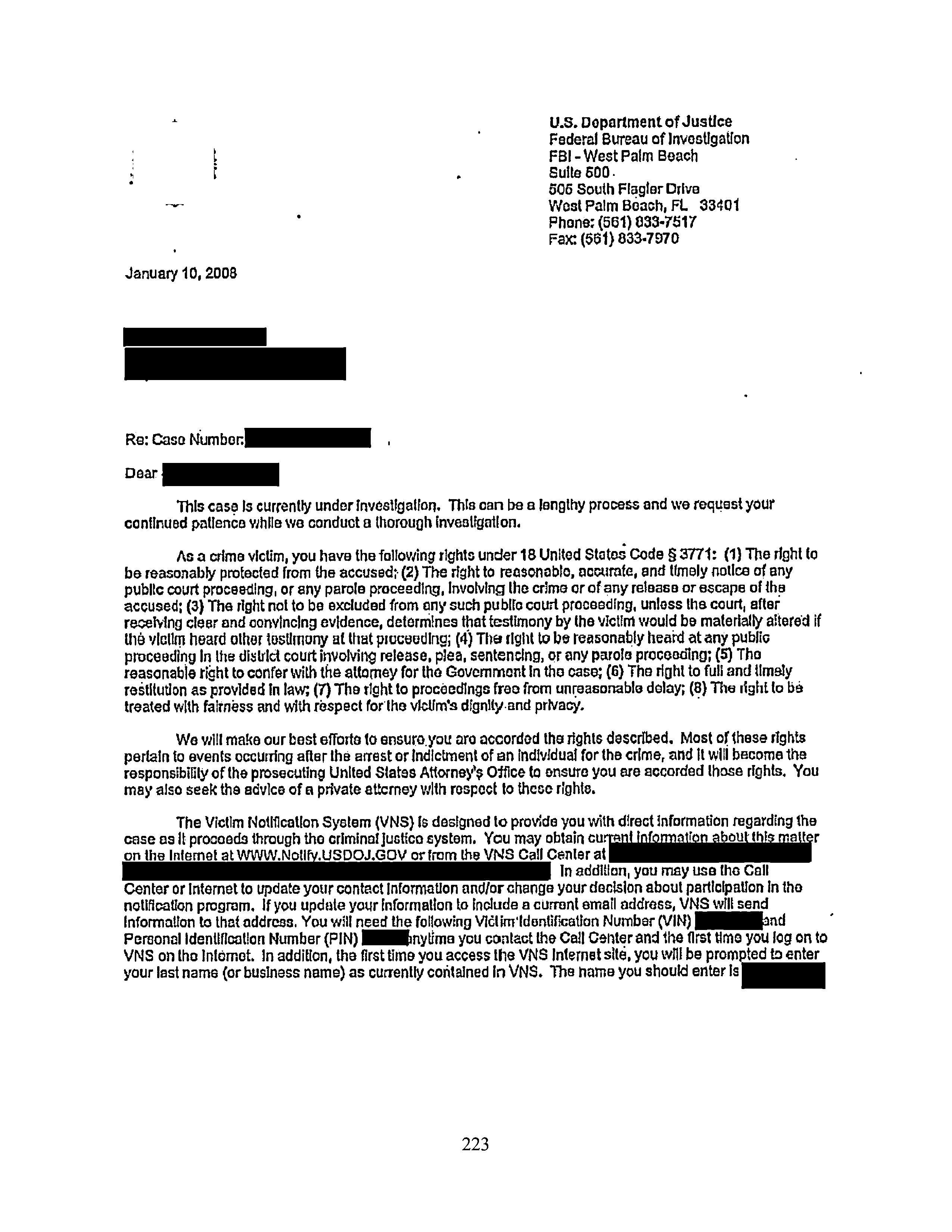
Page 304
document
2550 x 3300
Objects: Letter, Text, Page | Text: U.S. Department of Justice | Federal Bureau of Investigation | F
Page 304
document
740 x 300
Objects: Letter, Text, QR Code | Text: a your decision about participation in the | rent email addre
Page 304
document
388 x 220
Objects: Text, Scoreboard | Text: g. unless the court, after | m would be materially a | bly heard a

Page 304
photo
232 x 236
Objects: Pattern, QR Code, Home Decor, Symbol
Page 305
document
2550 x 3300
Objects: Page, Text, Letter | Text: If you have additional questions which Involve this matter, plea

Page 305
photo
672 x 283
Objects: Electronics, Screen, White Board, Projection Screen | Text: Victim Specialist.

Page 305
photo
663 x 235
Objects: Gray, Lighting
Page 306
document
2550 x 3300
Objects: Letter, Text, Page | Text: in FBI interviews of Wild and other victims, Villafaña informed
Page 307
document
2550 x 3300
Objects: Letter, Text, Page | Text: for him, as U.S. Attorney, to attend witness interviews, and fur
Page 308
document
2550 x 3300
Objects: Page, Text, Letter | Text: prosecutors and did not recall learning any information about Ep
Page 309
document
2550 x 3300
Objects: Letter, Text, Page | Text: camera memory cards seized by the PBPD in order to have them for
Page 310
document
2550 x 3300
Objects: Page, Text, Letter | Text: CVRA rights attach prior to the filing of criminal charges. 344
Page 311
document
2550 x 3300
Objects: Letter, Text, Page | Text: an instance in which Wild "asked a question that wasn 't answere
Page 312
document
2550 x 3300
Objects: Letter, Text, Page | Text: about the NPA because it was "confidential" and because the case
Page 313
document
2550 x 3300
Objects: Letter, Text, Page | Text: Villafaña told OPR that before the state plea hearing, she sent
Page 314
document
2550 x 3300
Objects: Letter, Text, Page | Text: [M]y expectation of what was going [to] happen at the plea was t
Page 315
document
2550 x 3300
Objects: Letter, Text, Page | Text: When asked why the USAO did not simply notify the victims of the
Page 316
document
2550 x 3300
Objects: Letter, Text, Page | Text: yes." The court also asked Belohlavek if the juvenile victim 's
Page 317
document
2550 x 3300
Objects: Letter, Text, Page | Text: civil suits that were pending against Epstein. 366 | Villafaña a
Page 318
document
2550 x 3300
Objects: Page, Text, Letter | Text: no federal charges filed against Epstein as a result of the gove
Page 319
document
2550 x 3300
Objects: Letter, Text, Page | Text: 18 U.S.C. § 2255 and again listing the 32 "individuals whom the
Page 320
document
2550 x 3300
Objects: Letter, Text, Page | Text: letter was substantially identical to the previous FBI victim no
Page 321
document
2550 x 3300
Objects: Letter, Text, Page | Text: obligated to amend her prior letter to victims to correct the re
Page 322
document
2550 x 3300
Objects: Page, Text, Letter | Text: F. | 2010 0 - 2011: | Department and Congressional Actions Regar
Page 323
document
2550 x 3300
Objects: Letter, Text, Page | Text: Department had made its "best efforts in thousands of federal an
Page 324
document
2550 x 3300
Objects: Letter, Text, Page | Text: letters to victims sent after the NPA was signed were not mislea
Page 325
document
2550 x 3300
Objects: Page, Text, Letter | Text: the 2005 Guidelines was inconsistent with positions the USAO had
Page 326
document
2550 x 3300
Objects: Letter, Text, Page | Text: victims deserve to be treated with fairness and respect, and to

Page 327
document
2550 x 3300
Objects: Page, Text, Outdoors | Text: [Page Intentionally Left Blank] | 246
Page 328
document
2550 x 3300
Objects: Page, Text, Letter | Text: CHAPTER THREE | PART TWO: APPLICABLE STANDARDS | I. | STATUTORY
Page 329
document
2550 x 3300
Objects: Page, Text, Letter | Text: The Victims' Rights and Restitution Act of 1990 (VRRA), 34 U.S.C
Page 330
document
2550 x 3300
Objects: Page, Text, Letter | Text: (4) During court proceedings, a responsible official shall ensur
Page 331
document
2550 x 3300
Objects: Page, Text, Letter | Text: service providers, and lists the names and telephone numbers of
Page 332
document
2550 x 3300
Objects: Letter, Text, Page | Text: 1. Responsible Officials. For cases in which charges have been i
Page 333
document
2550 x 3300
Objects: Letter, Text, Page | Text: (e) If the offender is convicted, the sentence and conditions of
Page 334
document
2550 x 3300
Objects: Letter, Text, Page | Text: (d) Whether the proposed plea involves confidential information

Page 335
document
2550 x 3300
Objects: Page, Text, Outdoors | Text: [Page Left Intentionally Blank] | 254
Page 336
document
2550 x 3300
Objects: Page, Text, Letter | Text: CHAPTER THREE | PART THREE: ANALYSIS | I. | OVERVIEW | In additi
Page 337
document
2550 x 3300
Objects: Letter, Text, Page | Text: As discussed below, OPR concludes that none of the subject attor
Page 338
document
2550 x 3300
Objects: Page, Text, Letter | Text: and consider victims' views about, prospective plea negotiations
Page 339
document
2550 x 3300
Objects: Letter, Text, Page | Text: In Wild, the Eleventh Circuit panel compared the language of the
Page 340
document
2550 x 3300
Objects: Letter, Text, Page | Text: did not find evidence showing that the subjects intended to sile
Page 341
document
2550 x 3300
Objects: Letter, Text, Page | Text: Acosta told OPR that there was no requirement to notify the vict
Page 342
document
2550 x 3300
Objects: Page, Text, Letter | Text: require victim approval of the prosecutors plans, but it allows
Page 343
document
2550 x 3300
Objects: Page, Text, Letter | Text: breach, however, Epstein would enter his state guilty plea and t
Page 344
document
2550 x 3300
Objects: Page, Text, Letter | Text: Because the Federal Investigation Continued after the NPA Was Si
Page 345
document
2550 x 3300
Objects: Letter, Text, Page | Text: continuing." The co-case agent also told OPR that, as of the tim
Page 346
document
2550 x 3300
Objects: Letter, Text, Page | Text: IV. | ACOSTA'S DECISION TO DEFER TO THE STATE ATTORNEY'S | DISCR
Page 347
document
2550 x 3300
Objects: Letter, Text, Page | Text: strongly objected to the government's plan to notify victims of
Page 348
document
2550 x 3300
Objects: Letter, Text, Page | Text: Thereafter, in his December 19, 2007 letter to defense counsel m
Page 349
document
2550 x 3300
Objects: Letter, Text, Page | Text: particular charges and victims at issue. Once the hearing was sc
Page 350
document
2550 x 3300
Objects: Page, Text, Letter | Text: Acosta Exercised Poor Judgment When Не Failed to Ensure That Vic
Page 351
document
2550 x 3300
Objects: Page, Text, Letter | Text: the PBPD during its investigation into Epstein's conduct. Absent
Page 352
document
2550 x 3300
Objects: Letter, Text, Page | Text: investigation. Because the state indictment and information appe
Page 353
document
2550 x 3300
Objects: Page, Text, Letter | Text: argued that Acosta should have been able to rely on his staff to
Page 354
document
2550 x 3300
Objects: Letter, Text, Page | Text: resolution of the case to ensure Epstein's victims were given an
Page 355
document
2550 x 3300
Objects: Page, Text, Letter | Text: agent and Villafaña consulted with the USAO's Professional Respo
Page 356
document
2550 x 3300
Objects: Letter, Text, Page | Text: the federal investigation I was cooperating in. If I had been to
Page 357
document
2550 x 3300
Objects: Letter, Text, Page | Text: not plead guilty in October 2007 as the USAO expected, it was a
Page 358
document
2550 x 3300
Objects: Letter, Text, Page | Text: attend the hearing. In his affidavit, Edwards asserted, "[T]here
Page 359
document
2550 x 3300
Objects: Letter, Text, Page | Text: previously noted, there is some contemporaneous evidence support
Page 360
document
2550 x 3300
Objects: Letter, Text, Page | Text: and they often cannot fully reveal either the facts or the statu
Page 361
document
2550 x 3300
Objects: Page, Text, Letter | Text: intentionally concealing information from them and was part of a
Page 362
document
2550 x 3300
Objects: Letter, Text, Page | Text: Villafaña informed Edwards about the state plea, but did not men
Page 363
document
2550 x 3300
Objects: Letter, Text, Page | Text: to be paid to the FBI's communications to ensure that the victim
Page 364
document
2550 x 3300
Objects: Page, Text, Letter | Text: CONCLUSION | In November 2018, the Miami Herald published an ext
Page 365
document
2550 x 3300
Objects: Letter, Text, Page | Text: OPR evaluated the conduct of each subject based on his or her in
Page 366
document
2550 x 3300
Objects: Page, Text, Letter | Text: principles was too expansive, his view of the federal interest i
Page 367
document
2550 x 3300
Objects: Letter, Text, Page | Text: OPR concludes that the decision to postpone notifying victims ab
Page 368
document
2550 x 3300
Objects: Letter, Text, Page | Text: METHODOLOGY | Document Review | As referenced in the Executive S
Page 369
document
2550 x 3300
Objects: Letter, Text, Page | Text: Attorney's Offices was migrated to EOUSA's centralized system to
Page 370
document
2550 x 3300
Objects: Letter, Text, Page | Text: 6. | U.S. Attorney's Office for the Middle District of Florida R

Page 371
document
2550 x 3300
Objects: Page, Text, Letter | Text: the victims to provide OPR with information regarding their cont
Page 372
document
2550 x 3300
Objects: Page, Text | Text: EXHIBIT 1 | State Indictment

Page 373
document
2550 x 3300
Objects: Page, Text | Text: [Page Intentionally Left Blank]
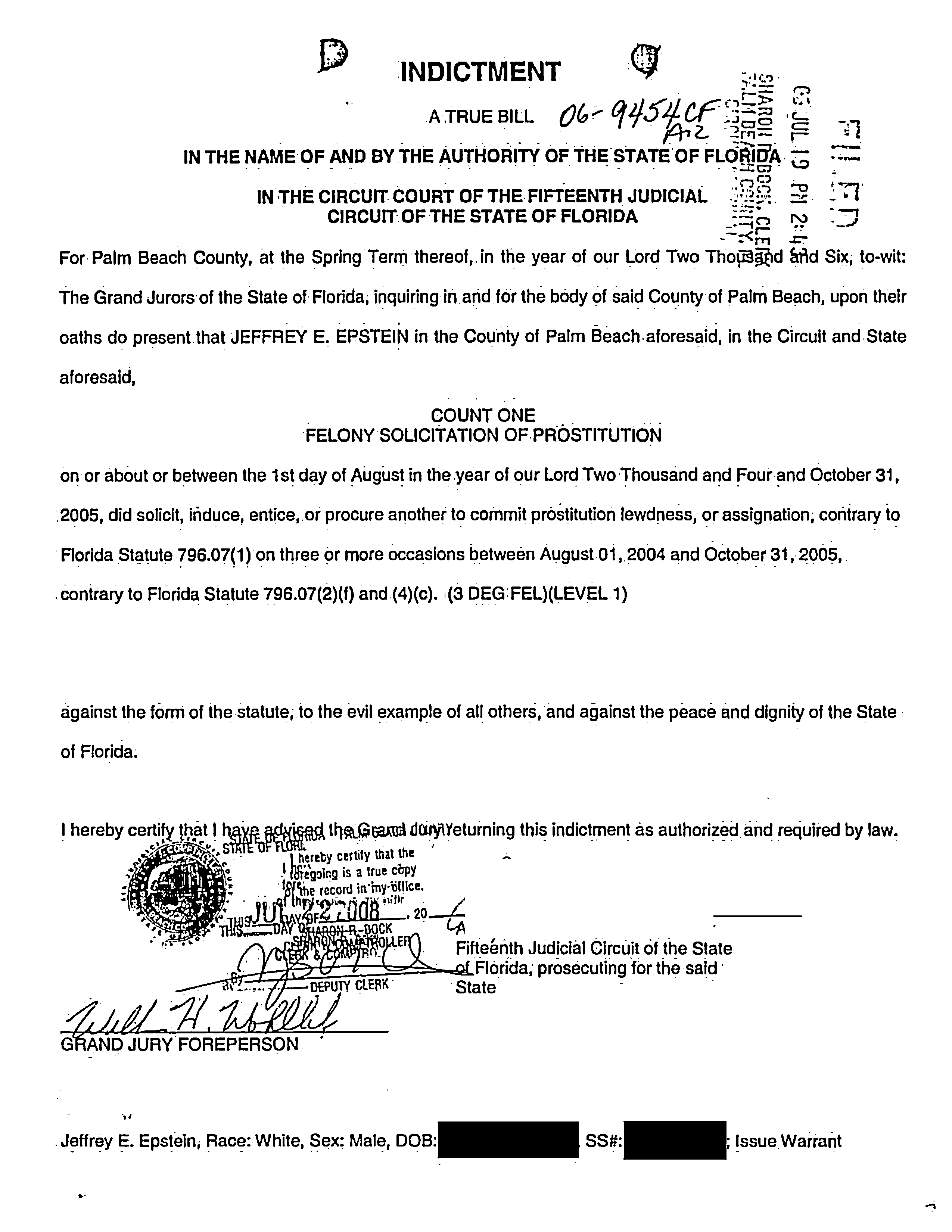
Page 374
document
2550 x 3300
Objects: Text, Page, Document | Text: INDICTMENT | FALM DE/ | A TRUE BILL | 06- 9454CF | IN THE NAME
Page 374
document
1277 x 634
Objects: Text, Handwriting, Machine, Spoke, Document | Text: ! hereby certify is a true that copy |
Page 374
document
217 x 534
Objects: Text, Stencil | Text: FLO | CLE | Thousand
Page 374
document
681 x 228
Objects: Handwriting, Text, Signature | Text: Assistant State Attorney

Page 374
document
892 x 166
Objects: Handwriting, Text, Signature | Text: DATE

Page 375
document
2550 x 3300
Objects: Text, Page | Text: [Page Intentionally Left Blank]
Page 376
document
2550 x 3300
Objects: Page, Text | Text: EXHIBIT 2 | September 6, 2007 | Draft Non-Prosecution | Agreement

Page 377
document
2550 x 3300
Objects: Text, Page | Text: [Page Intentionally Left Blank]
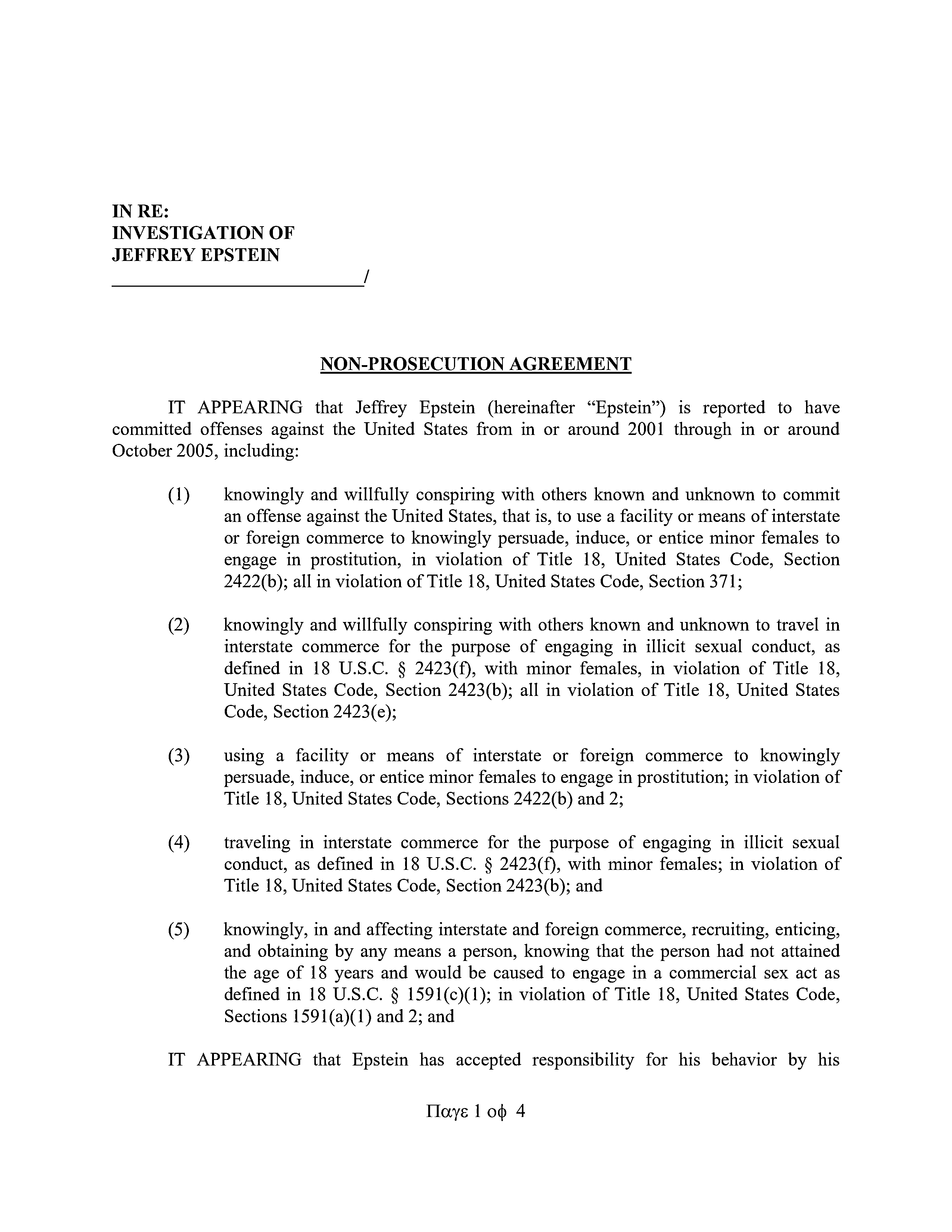
Page 378
document
2550 x 3300
Objects: Page, Text, Letter | Text: IN RE: | INVESTIGATION OF | JEFFREY EPSTEIN | NON-PROSECUTION AG
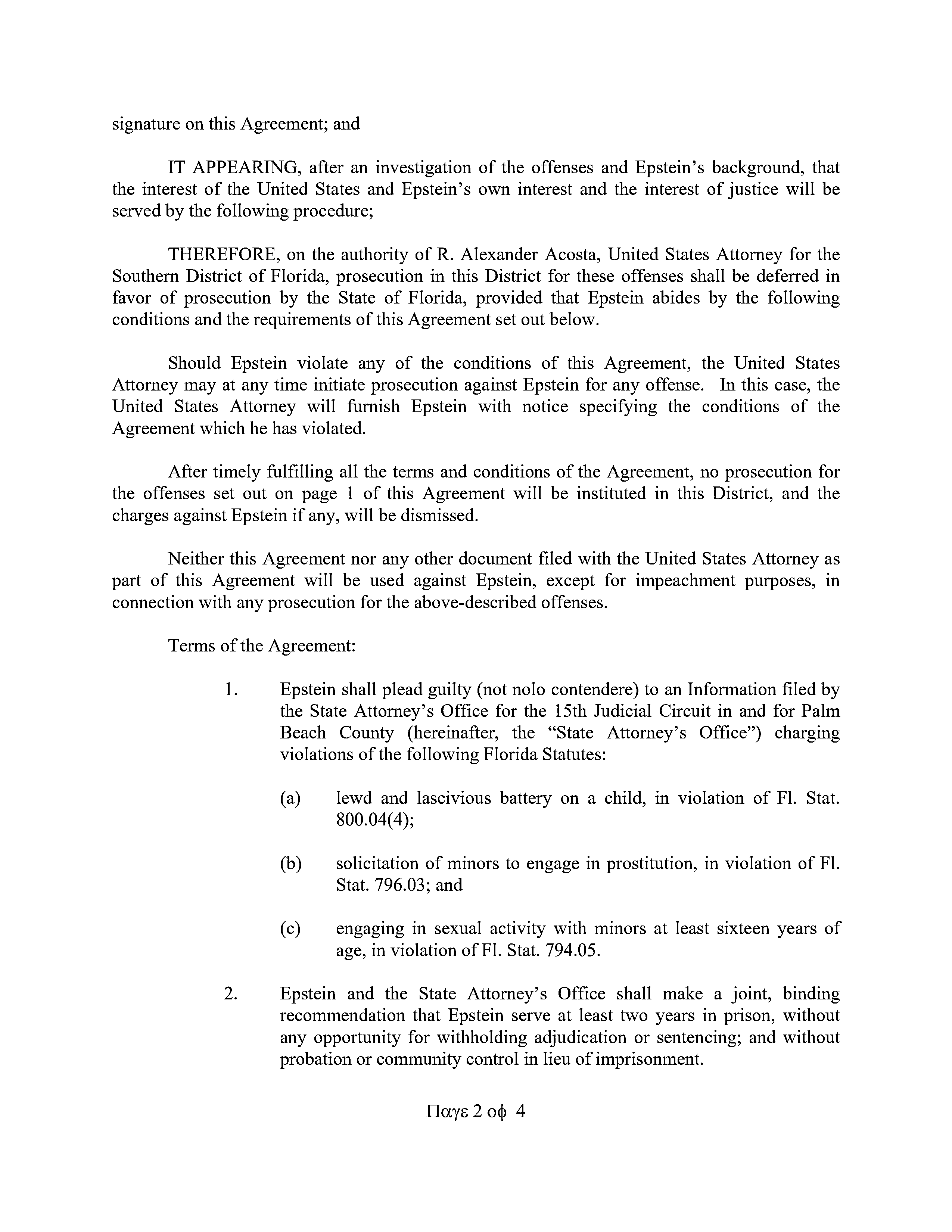
Page 379
document
2550 x 3300
Objects: Page, Text, Letter | Text: signature on this Agreement; and | IT APPEARING, after an invest
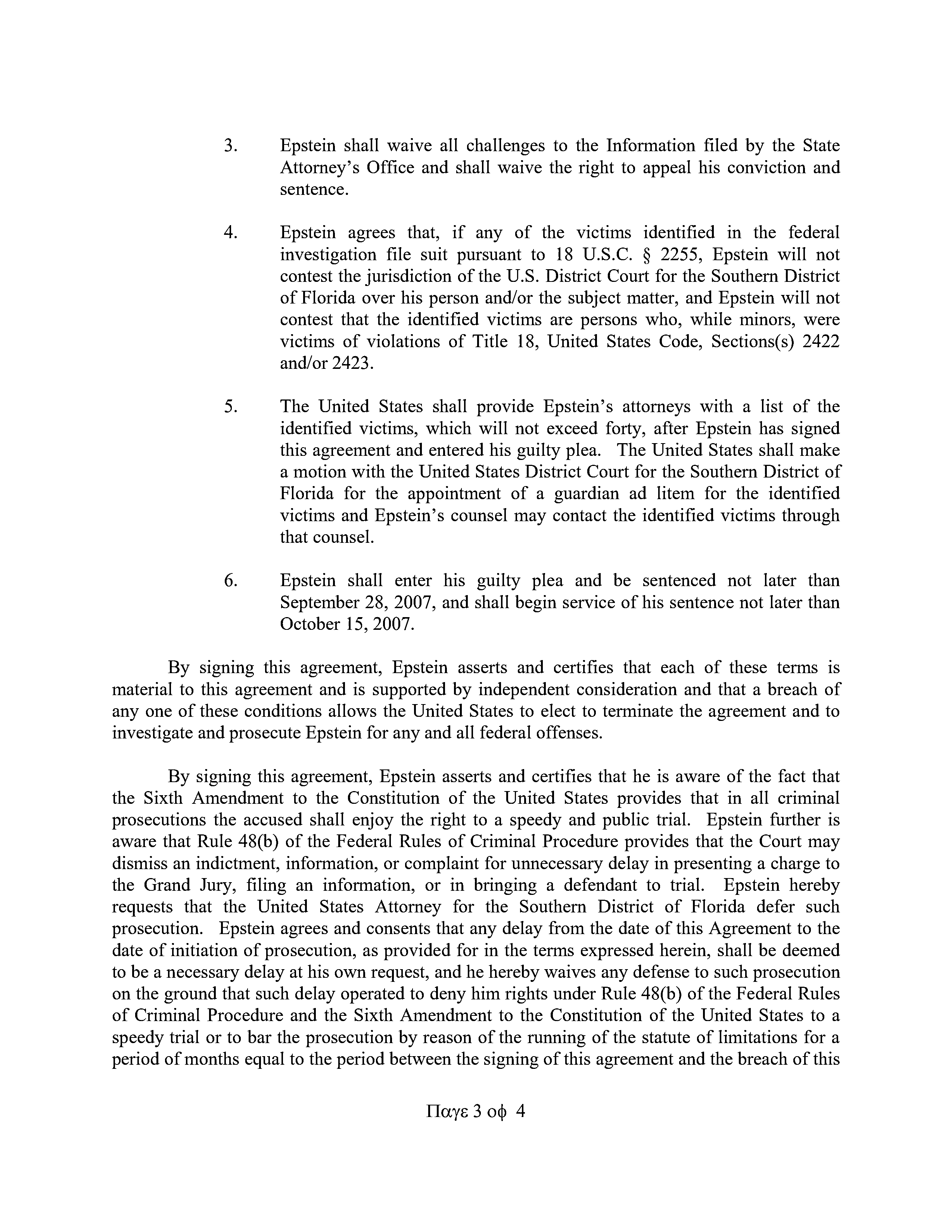
Page 380
document
2550 x 3300
Objects: Page, Text, Letter | Text: 3. | Epstein shall waive all challenges to the Information filed
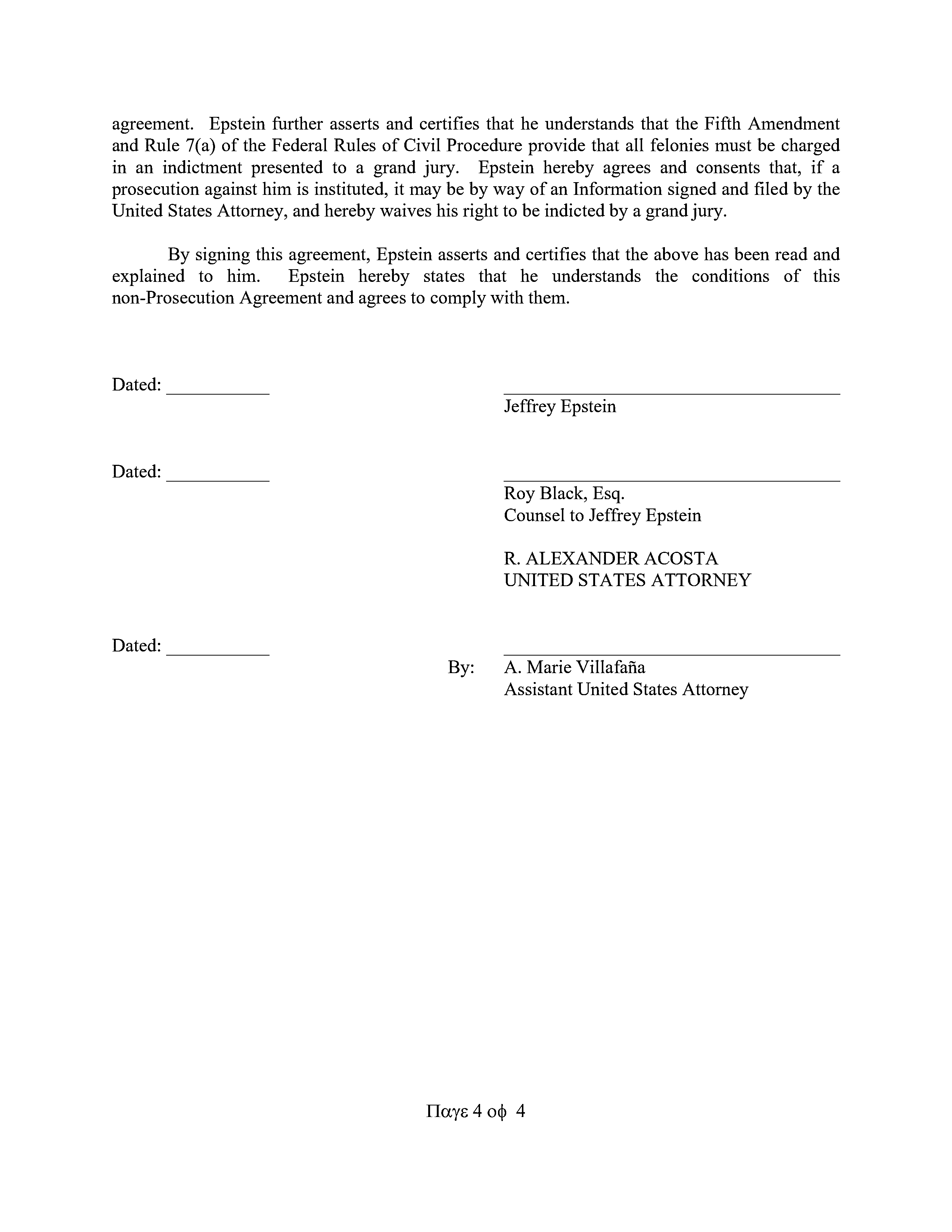
Page 381
document
2550 x 3300
Objects: Page, Text | Text: agreement. Epstein further asserts and certifies that he understands tha
Page 382
document
2550 x 3300
Objects: Page, Text | Text: EXHIBIT 3 | September 24, 2007 | Non-Prosecution | Agreement

Page 383
document
2550 x 3300
Objects: Text, Page | Text: [Page Intentionally Left Blank]
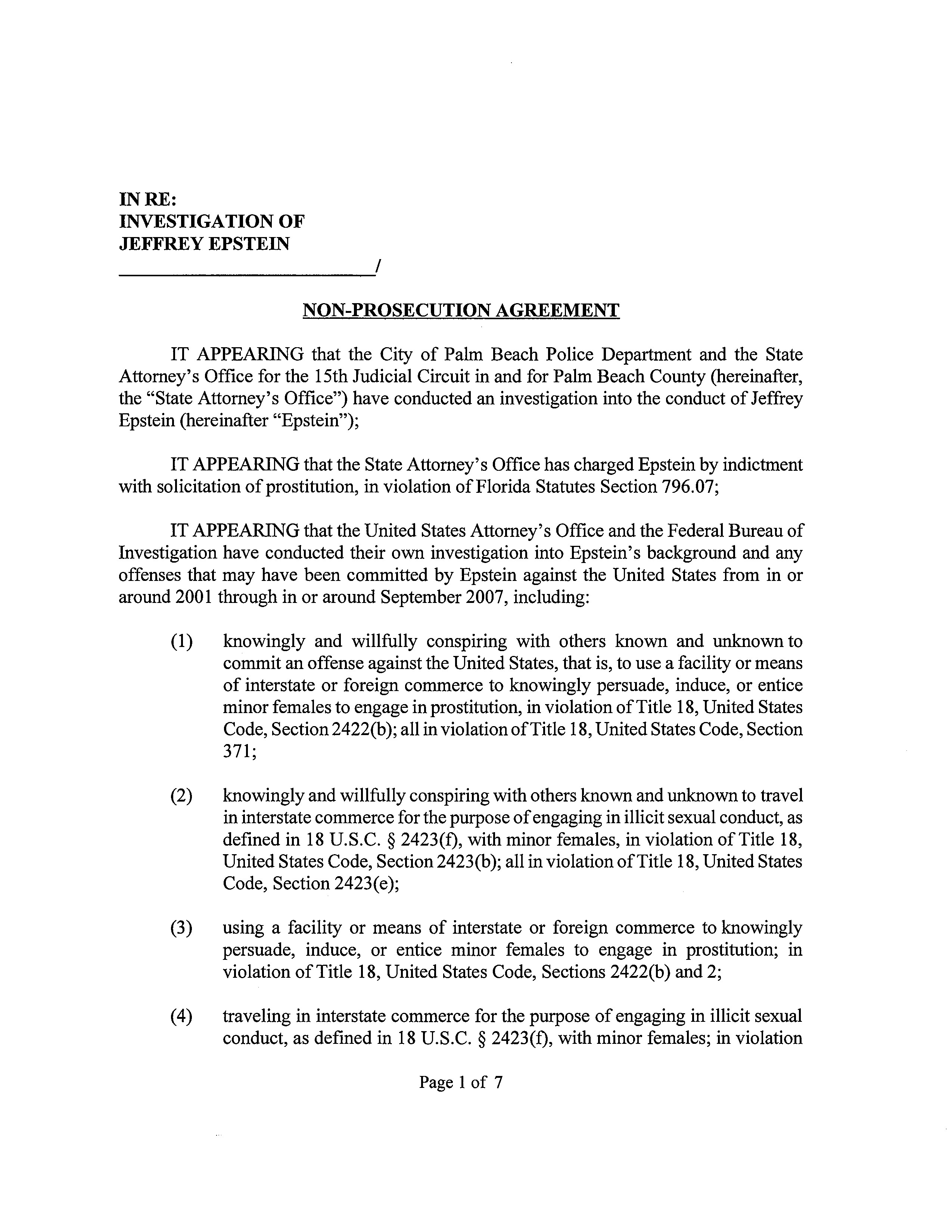
Page 384
document
2550 x 3300
Objects: Page, Text, Letter | Text: IN RE: | INVESTIGATION OF | JEFFREY EPSTEIN | NON-PROSECUTION AG
Page 385
document
2550 x 3300
Objects: Letter, Text, Page | Text: of Title 18, United States Code, Section 2423(b); and | (5) | kn
Page 386
document
2550 x 3300
Objects: Page, Text, Letter | Text: Terms of the Agreement: | 1. | Epstein shall plead guilty (not n
Page 387
document
2550 x 3300
Objects: Page, Text, Letter | Text: proposed agreements with the State Attorney's Office prior to en
Page 388
document
2550 x 3300
Objects: Letter, Text, Page | Text: sentenced not later than October 26, 2007. The United States has
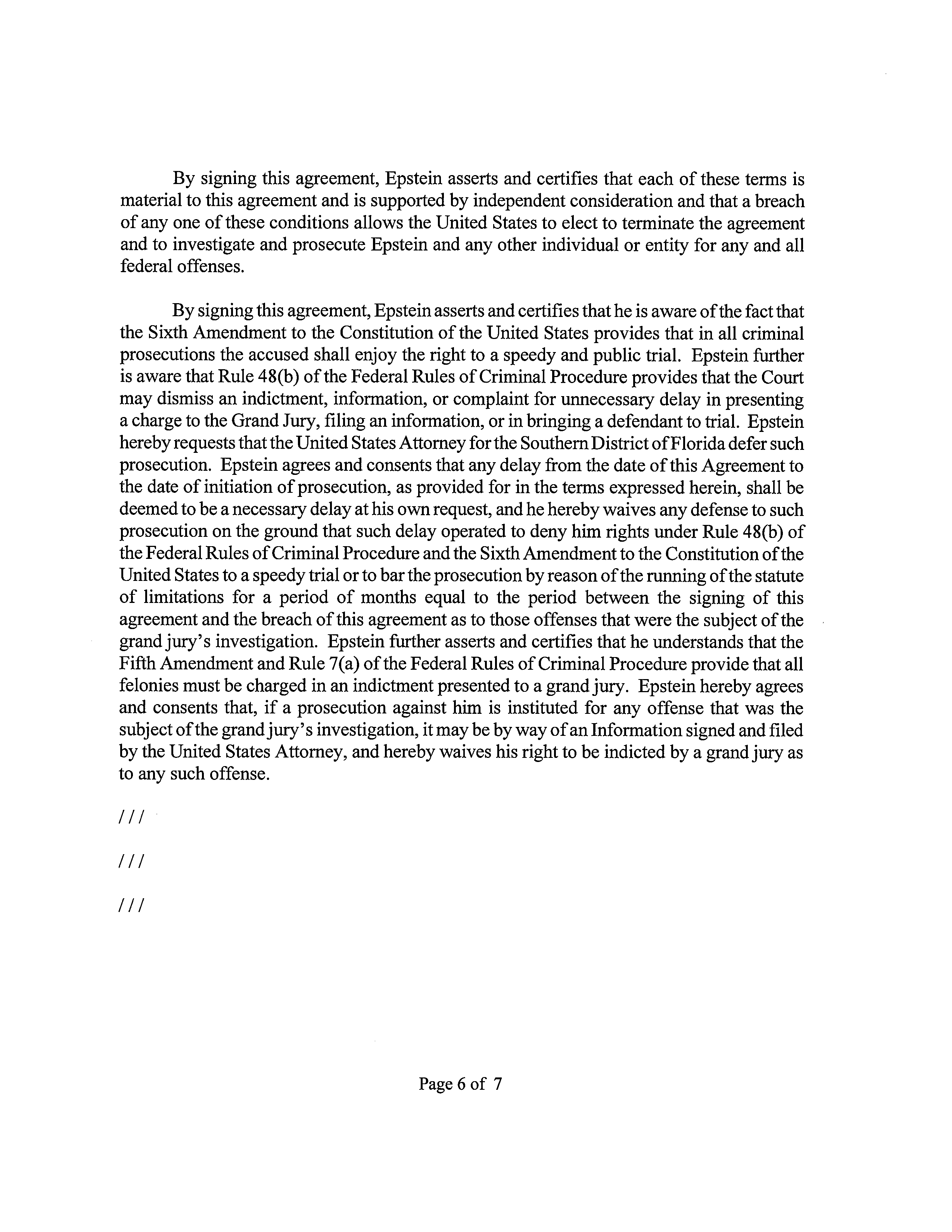
Page 389
document
2550 x 3300
Objects: Letter, Text, Page | Text: By signing this agreement, Epstein asserts and certifies that ea
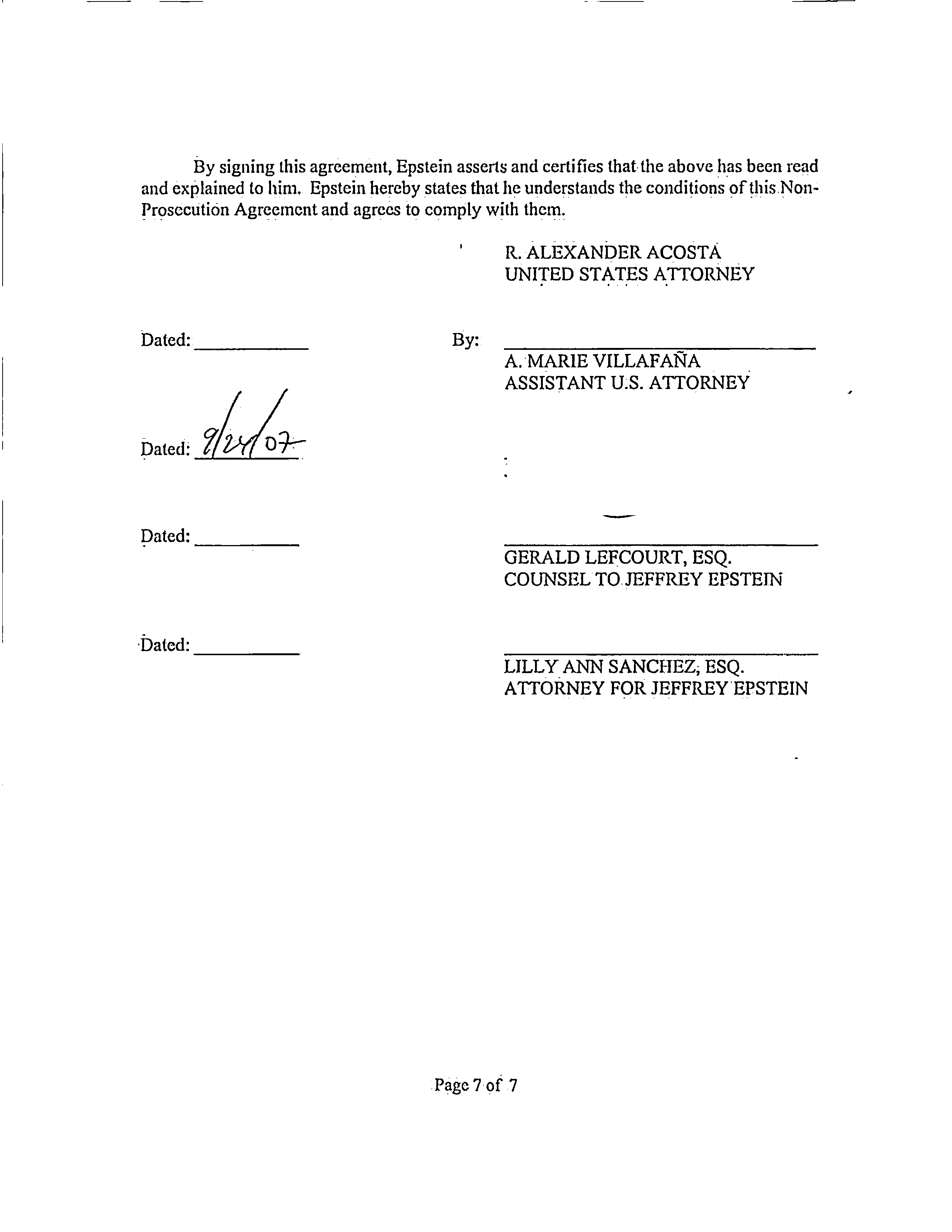
Page 390
document
2550 x 3300
Objects: Page, Text, Document | Text: By signing this agreement, Epstein asserts and certifies that
Page 390
document
932 x 342
Objects: Clothing, Hat, Text, Handwriting, Bow, Weapon | Text: JEFFREY EPSTEIN
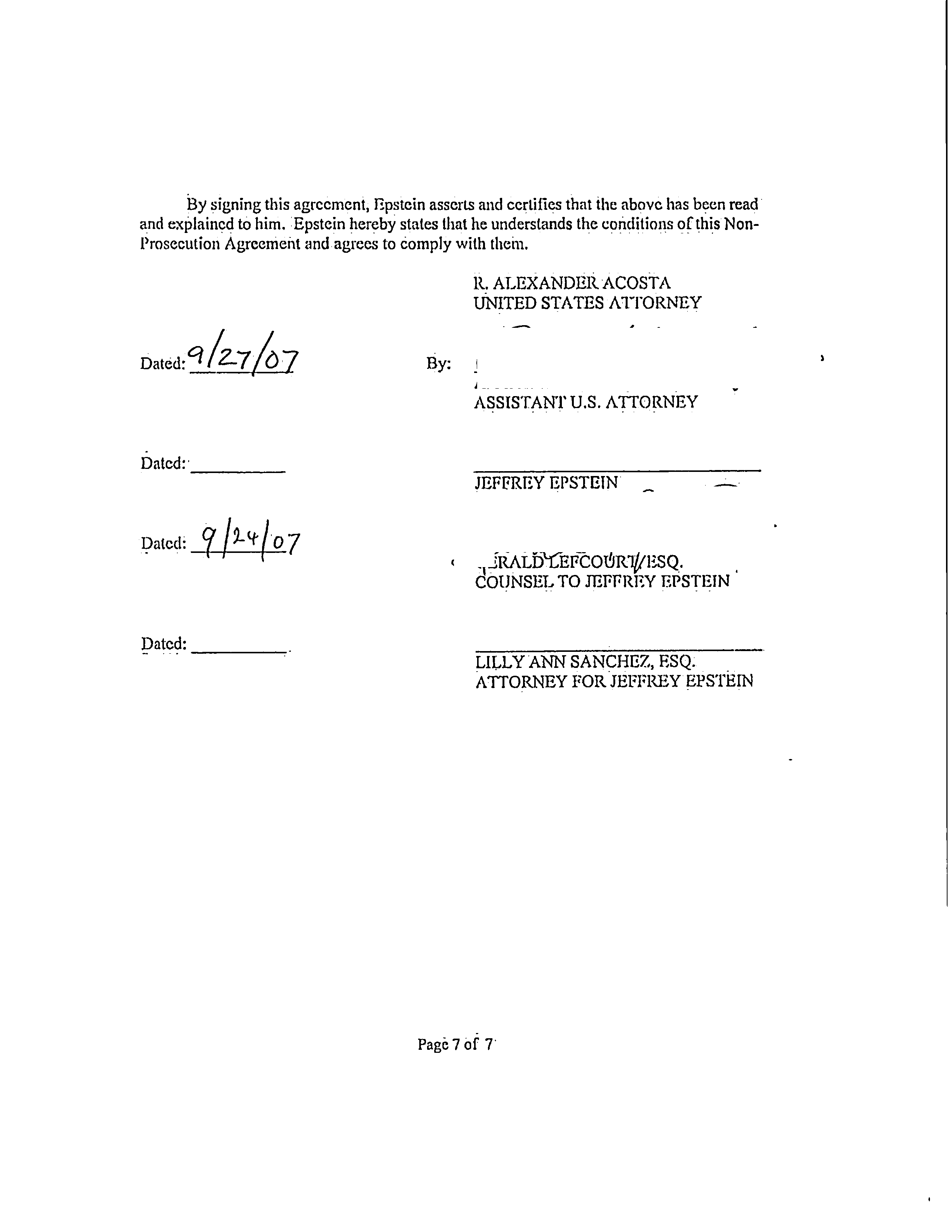
Page 391
document
2550 x 3300
Objects: Page, Text | Text: By signing this agreement, Epstein asserts and certifies that the above

Page 391
document
937 x 178
Objects: Handwriting, Text, Signature | Text: ILLAFAÑA | A. MARIE
Page 391
document
874 x 248
Objects: Handwriting, Text, Signature
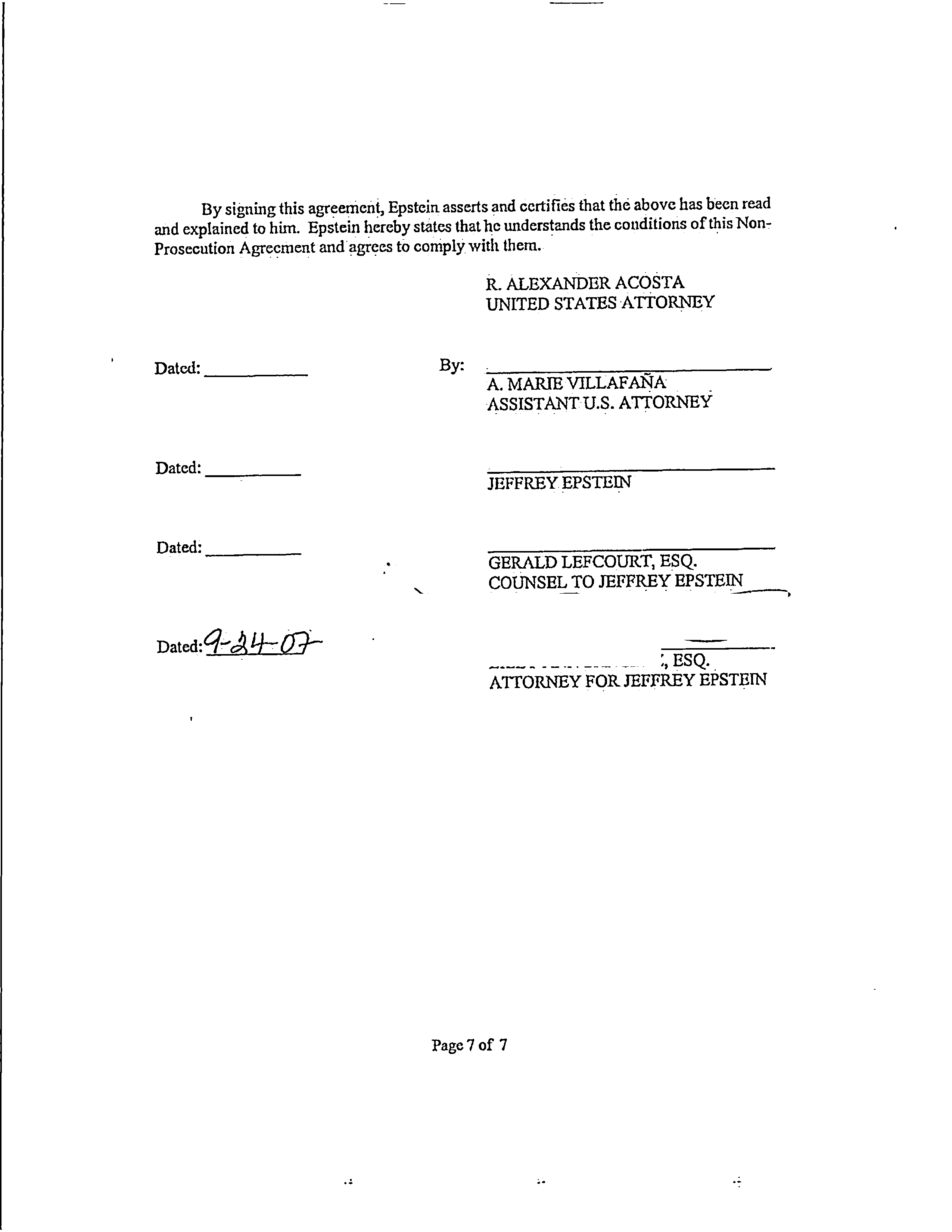
Page 392
document
2550 x 3300
Objects: Page, Text | Text: By signing this agreement, Epstein asserts and certifies that the above
Page 392
document
1084 x 287
Objects: Handwriting, Text, Signature | Text: LILLY ANN SANCHEZ,

Page 393
document
2550 x 3300
Objects: Text, Page | Text: [Page Intentionally Left Blank]
Page 394
document
2550 x 3300
Objects: Page, Text | Text: EXHIBIT 4 | Addendum to the | Non-Prosecution Agreement

Page 395
document
2550 x 3300
Objects: Text, Page | Text: [Page Intentionally Left Blank]
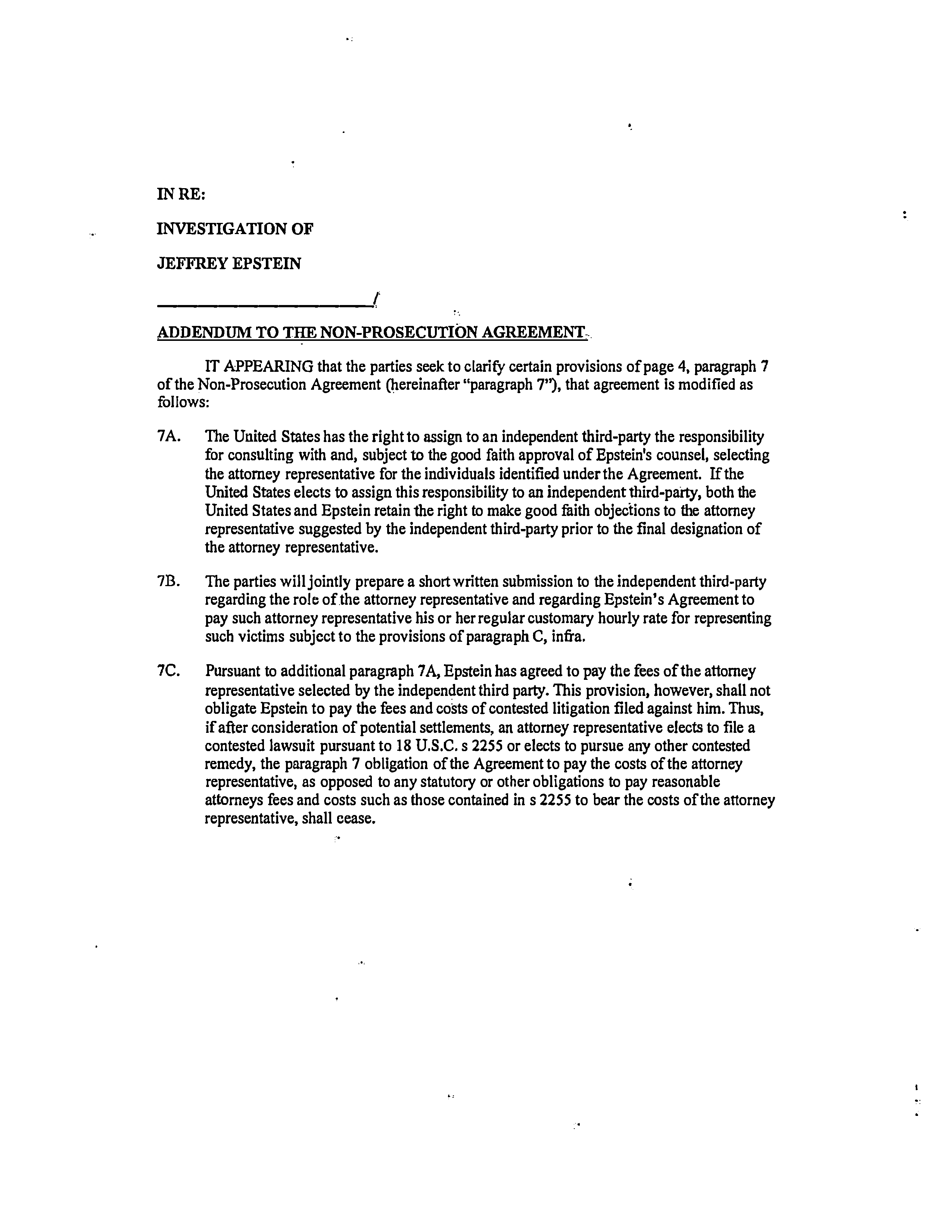
Page 396
document
2550 x 3300
Objects: Page, Text, Letter | Text: IN RE: | INVESTIGATION OF | JEFFREY EPSTEIN | ADDENDUM TO THE NO
Page 397
document
2550 x 3300
Objects: Text, Page | Text: By signing this Addendum, Epstein asserts and certifies that the above h
Page 397
document
376 x 178
Objects: Text, Boat, Sailboat, Transportation, Vehicle, Person, Number, Symbol, White Board | Text:
Page 397
document
820 x 267
Objects: Text, Nature, Outdoors, Handwriting
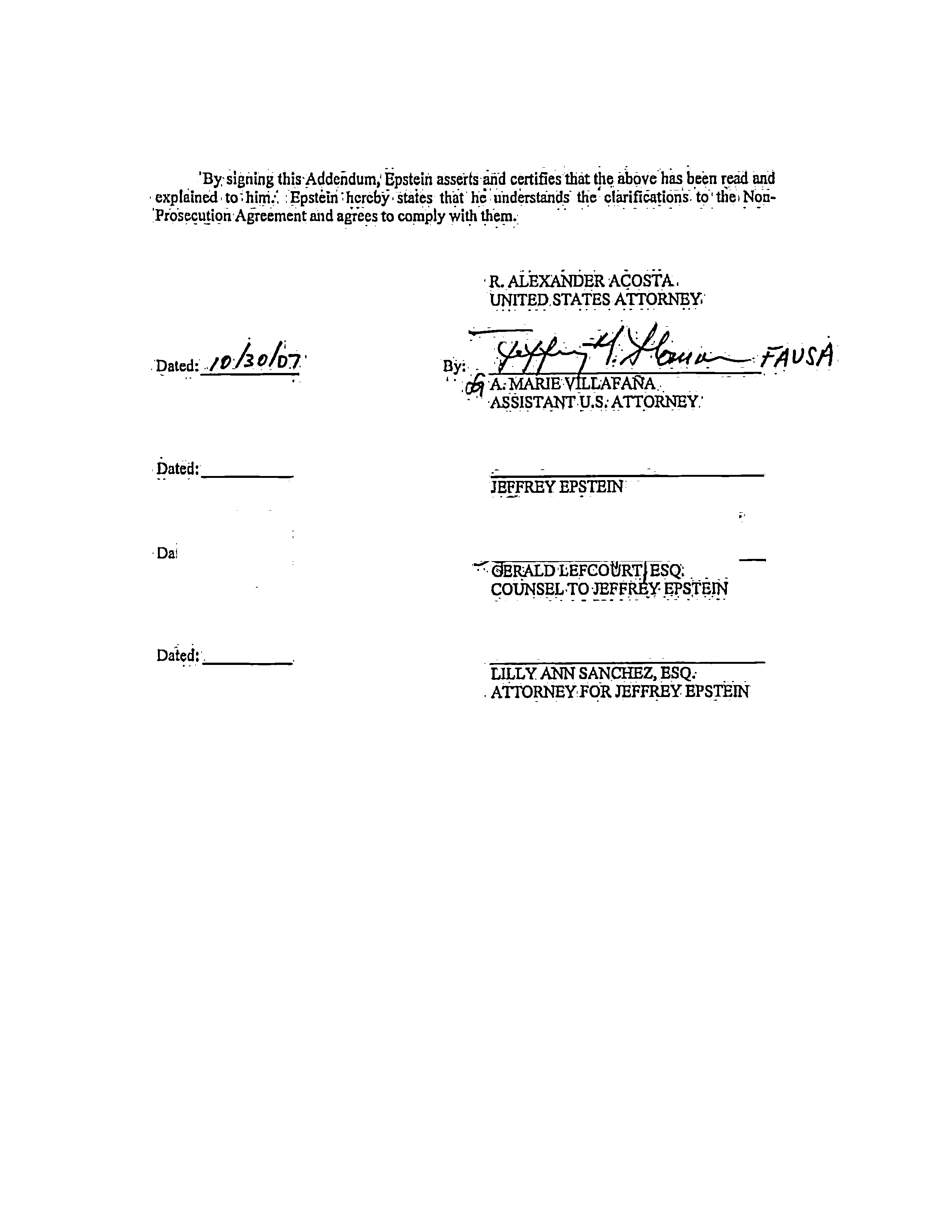
Page 398
document
2550 x 3300
Objects: Text, Page, Document | Text: 'By: signing this Addendum, Epstein asserts and certifies that
Page 398
document
326 x 220
Objects: Text, Handwriting, Bow, Weapon, Number, Symbol | Text: 10 | ted:
Page 398
document
720 x 270
Objects: Handwriting, Text, Signature
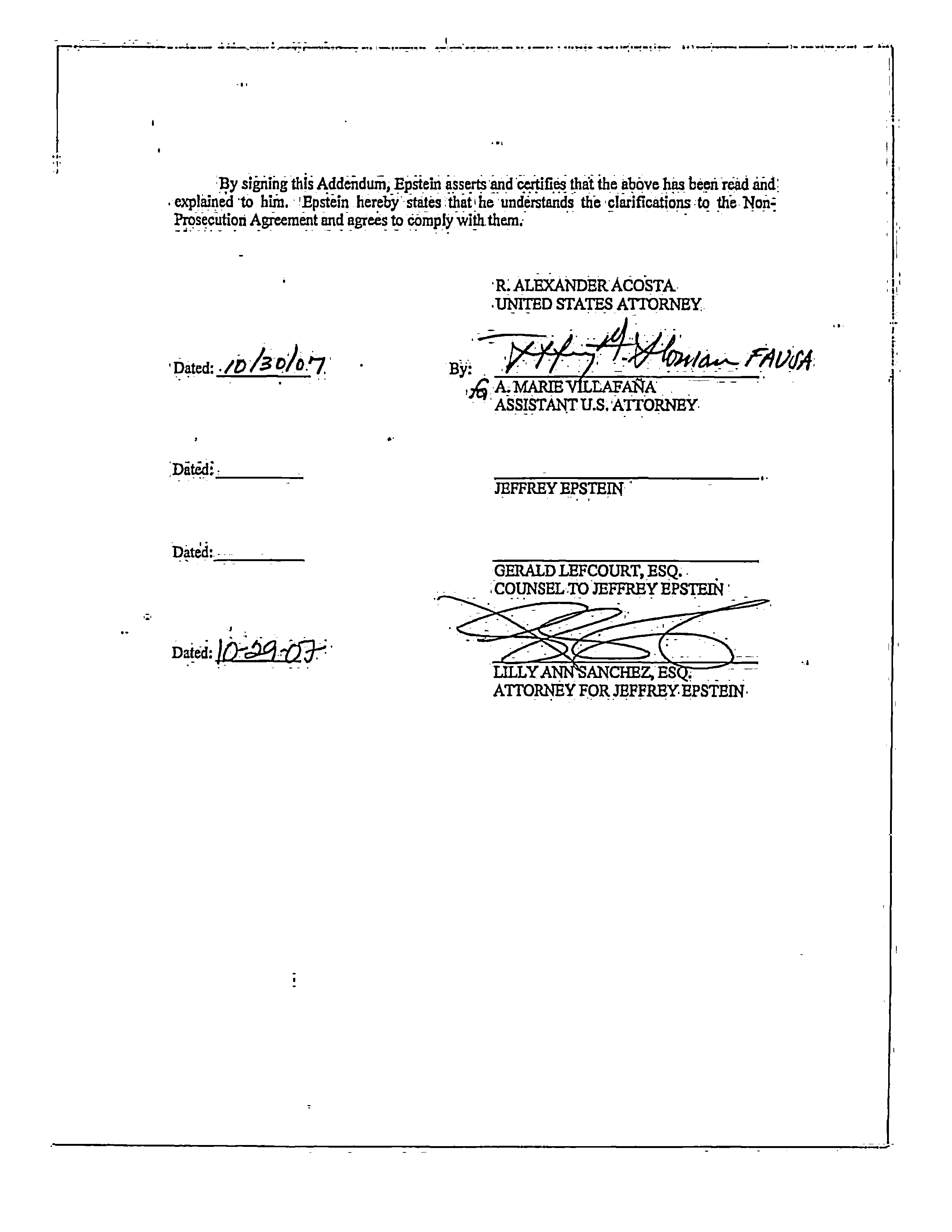
Page 399
document
2550 x 3300
Objects: Text, Page | Text: ... | By signing this Addendum, Epstein asserts and certifies that the a
Page 399
document
913 x 387
Objects: Handwriting, Text, Signature, Animal, Fish, Sea Life, Shark | Text: GERALD LEFCOURT, ESQ. |

Page 399
photo
437 x 368
Objects: White Board, Person
Page 400
document
2550 x 3300
Objects: Page, Text | Text: EXHIBIT 5 | State Information

Page 401
document
2550 x 3300
Objects: Text, Page | Text: [Page Intentionally Left Blank]
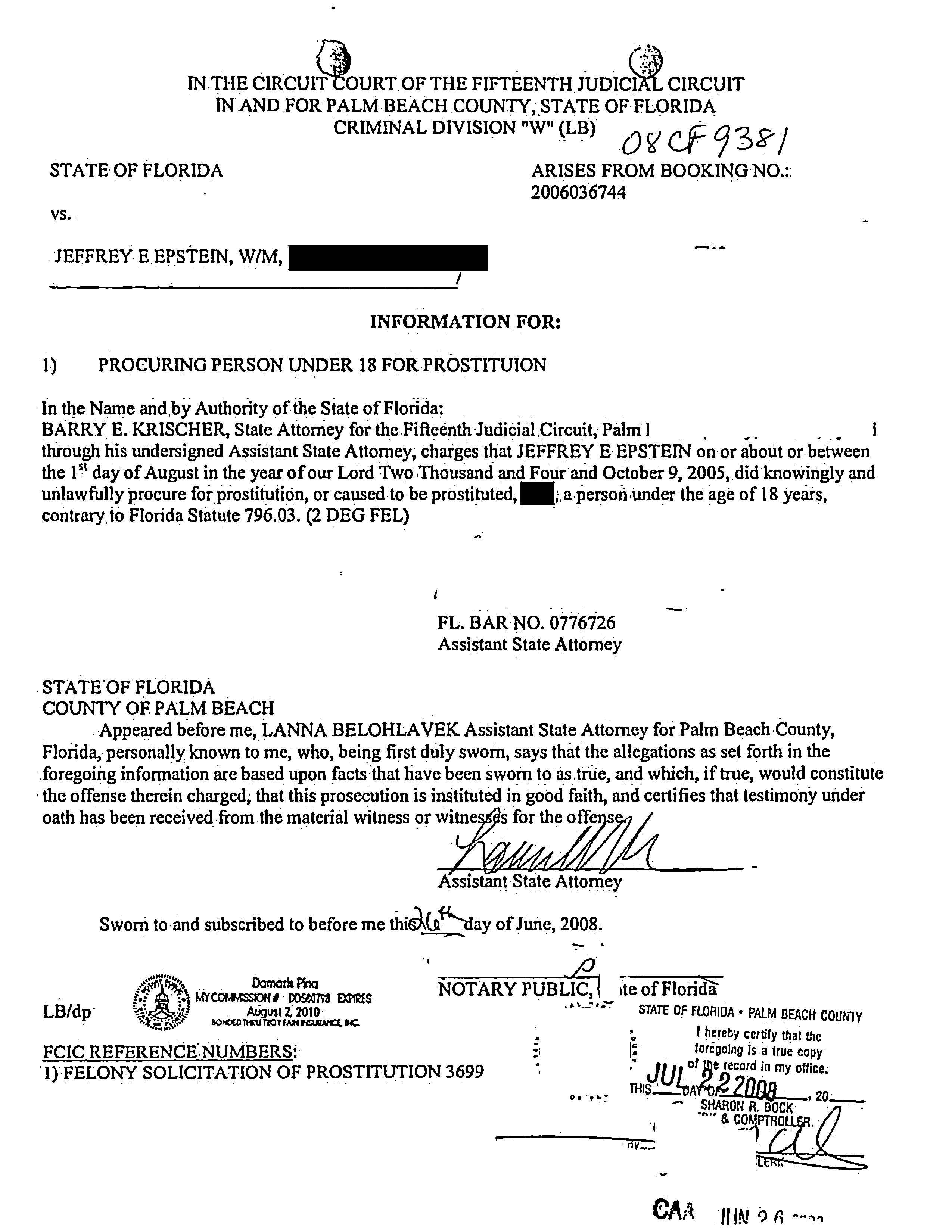
Page 402
document
2550 x 3300
Objects: Text, Letter, Document | Text: IN THE CIRCUIT COURT OF THE FIFTEENTH JUDICIAL CIRCUIT | IN
Page 402
document
646 x 316
Objects: Handwriting, Text, Signature | Text: of the record in my office. | JUL | THIS | 2 2008 | 20
Page 402
document
616 x 521
Objects: Text, Number, Symbol, Face, Head, Person, Alphabet | Text: FILED | 03 JUII ?G PH 3: 30 Flor
Page 402
document
778 x 204
Objects: Handwriting, Text, Signature | Text: A | BE | VEK
Page 402
document
376 x 124
Objects: Handwriting, Text, Signature, Animal, Kangaroo, Mammal | Text: -
Page 402
document
278 x 164
Objects: Handwriting, Text, Signature, Smoke Pipe | Text: Stat

Page 402
photo
257 x 250
Objects: Logo, Emblem, Symbol, Chess, Game, Coin, Money, QR Code | Text: F
Page 402
document
287 x 201
Objects: Handwriting, Text, Signature, Bow, Weapon

Page 403
document
2550 x 3300
Objects: Text, Page | Text: [Page Intentionally Left Blank]
Page 404
document
2550 x 3300
Objects: Text | Text: Appendix 4
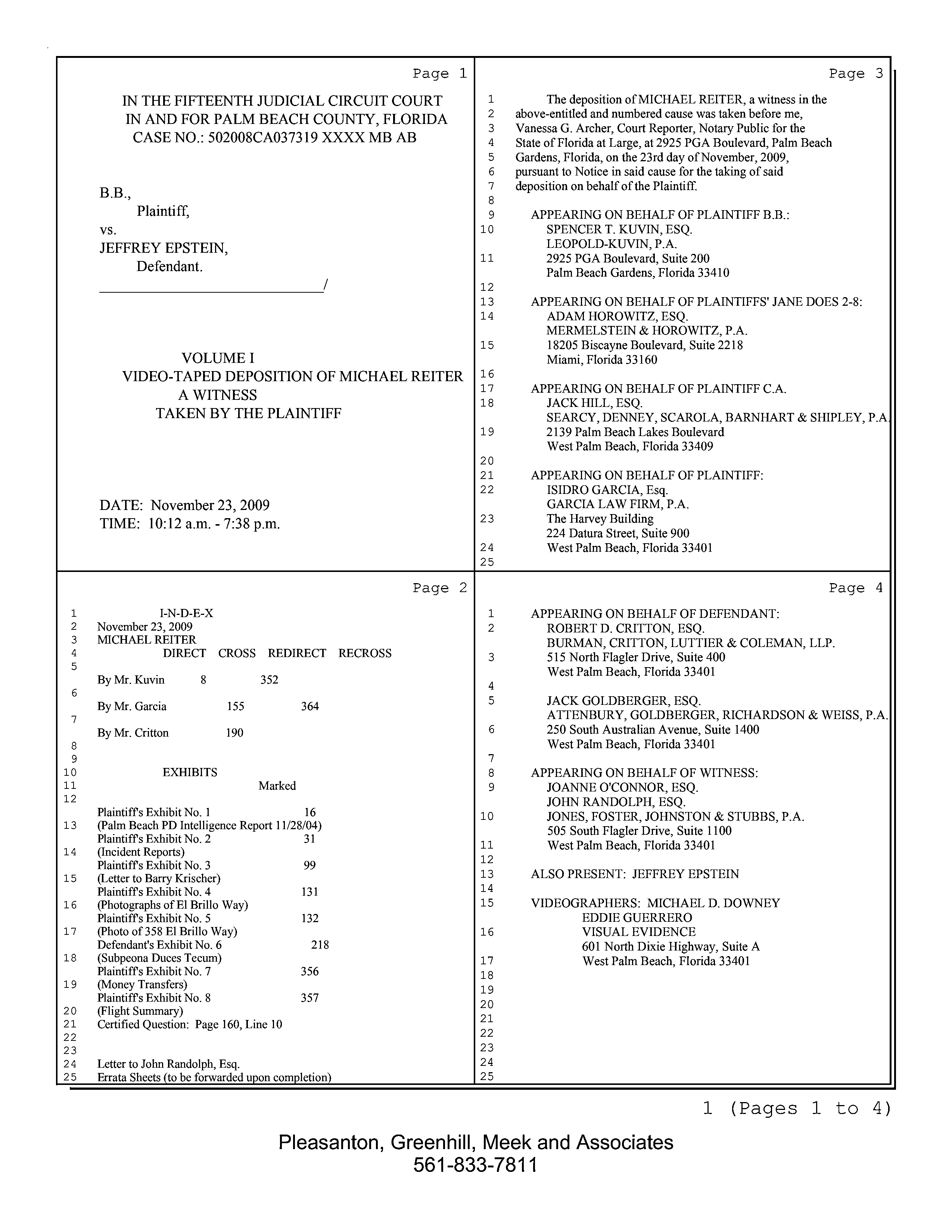
Page 405
document
2550 x 3300
Objects: Page, Text, Menu | Text: Page 1 | Page 3 | The deposition of MICHAEL REITER, a witness in t
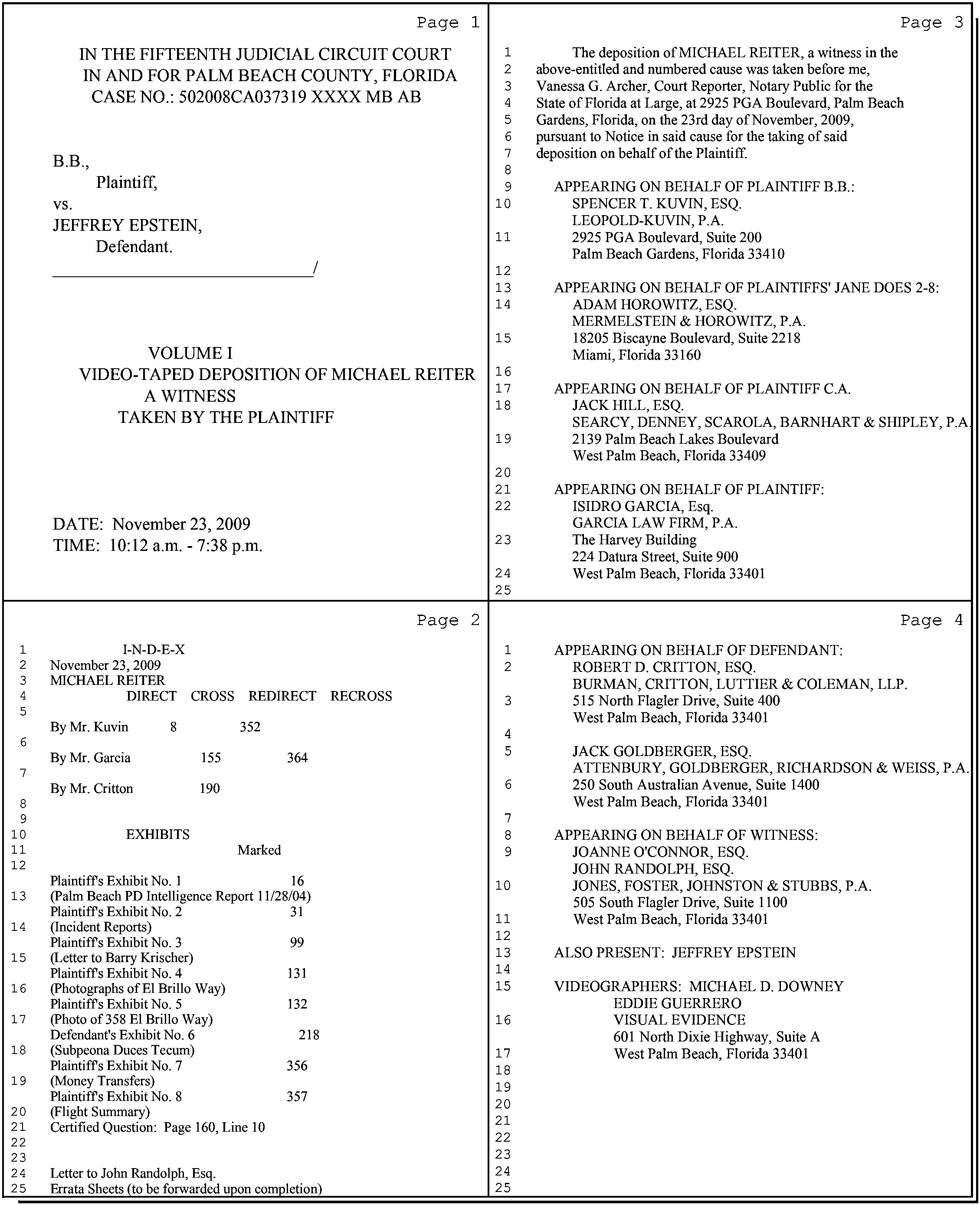
Page 405
document
2259 x 2778
Objects: Page, Text, Menu | Text: Page 1 | Page 3 | The deposition of MICHAEL REITER, a witness in t
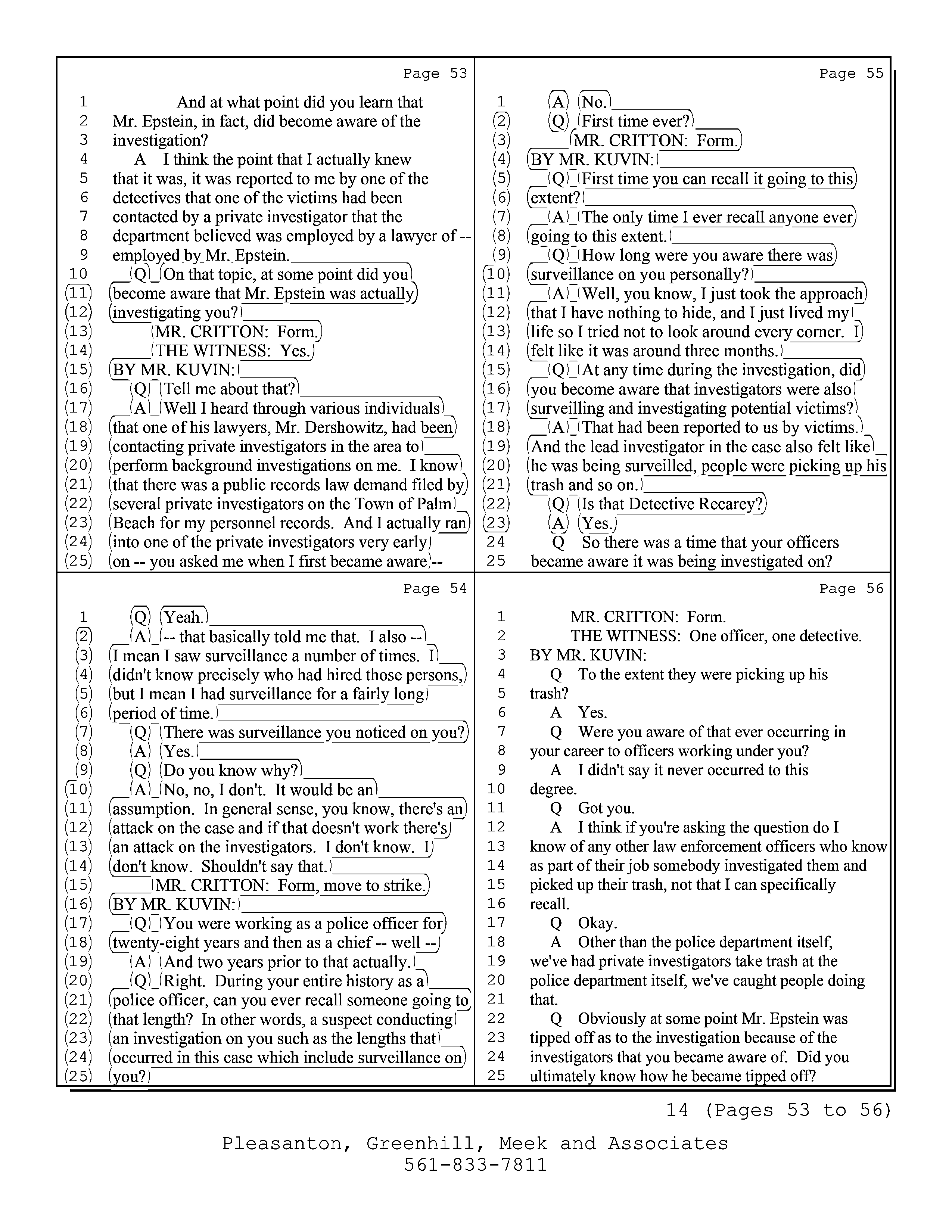
Page 406
document
2550 x 3300
Objects: Page, Text, Menu | Text: Page 53 | Page 55 | And at what point did you learn that | 4 1 5 2
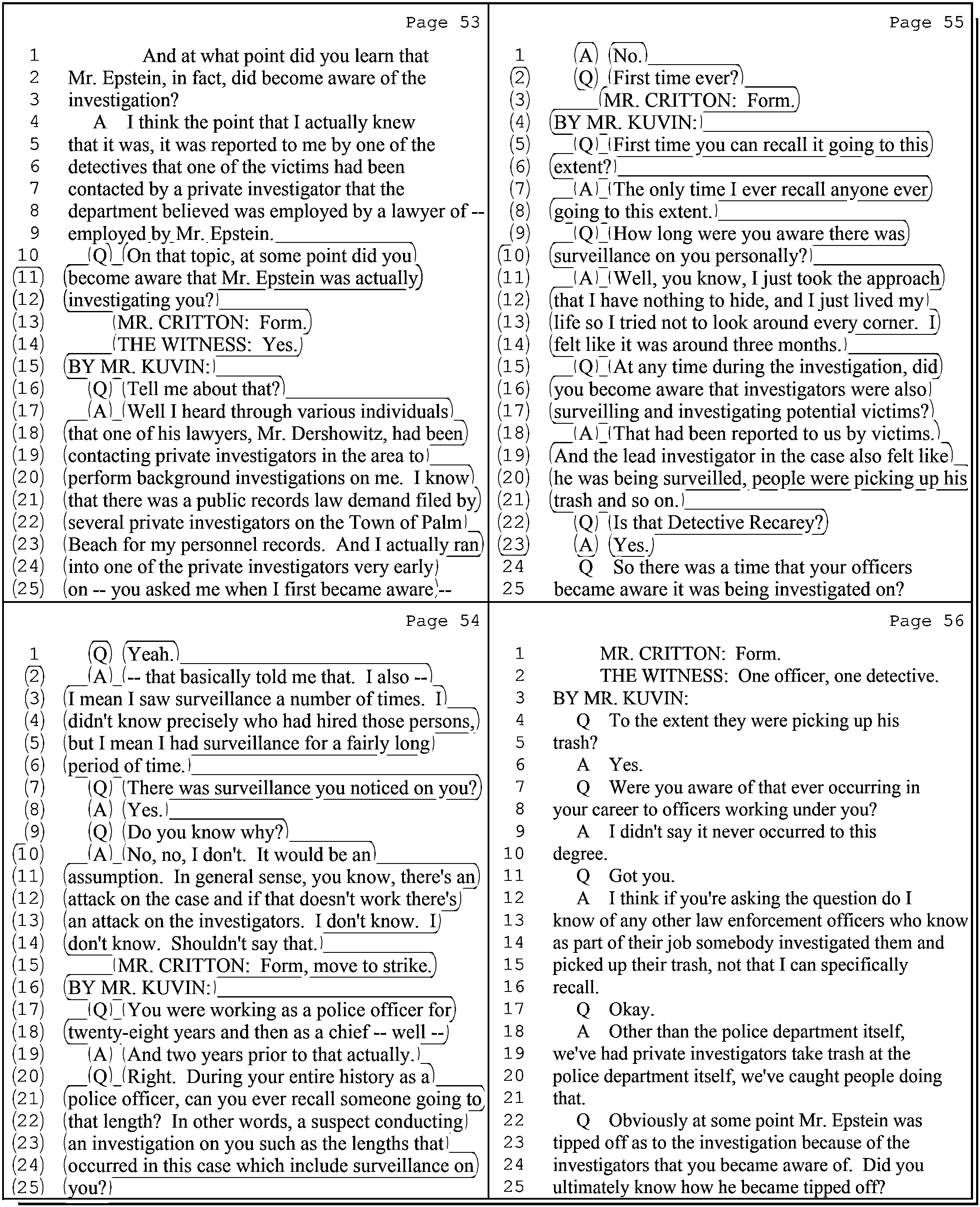
Page 406
document
2259 x 2783
Objects: Page, Text, Menu | Text: Page 53 | Page 55 | And at what point did you learn that | 1 | A
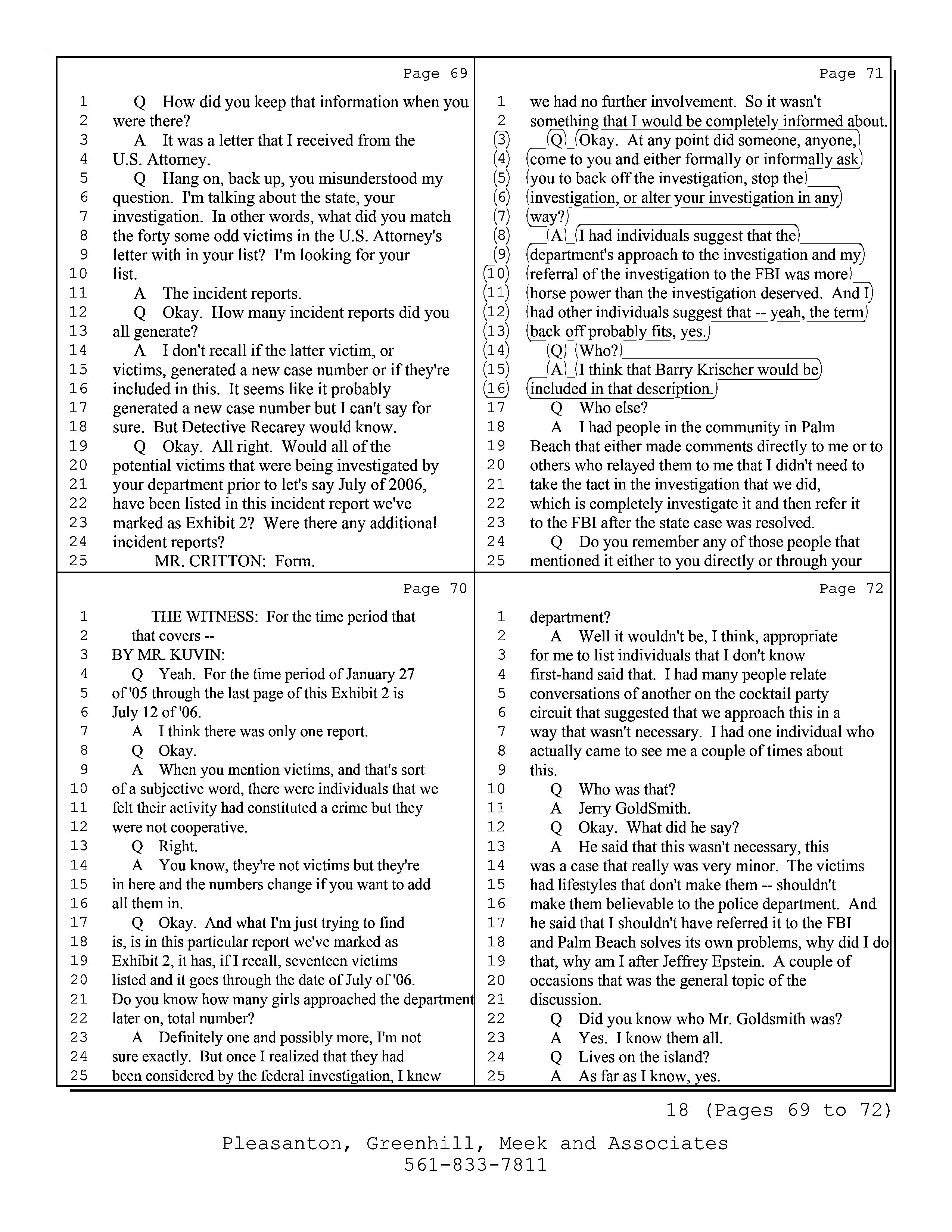
Page 407
document
2550 x 3300
Objects: Page, Text, Menu | Text: Page 69 | Page 71 | How did you keep that information when you | w
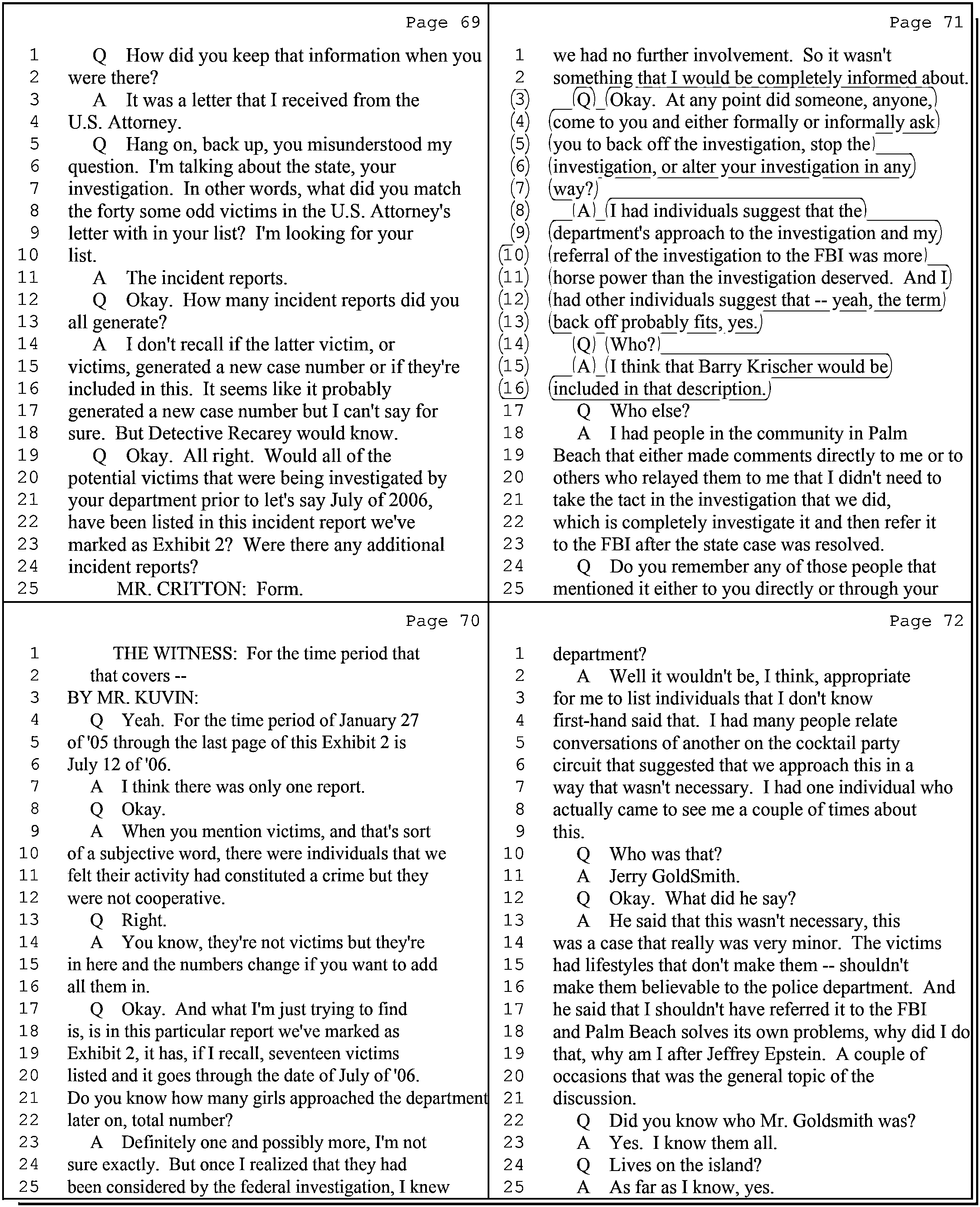
Page 407
document
2259 x 2783
Objects: Page, Text, Menu, Advertisement | Text: Page 69 | Page 71 | 7 8 9 4 5 6 | Q How did you kee
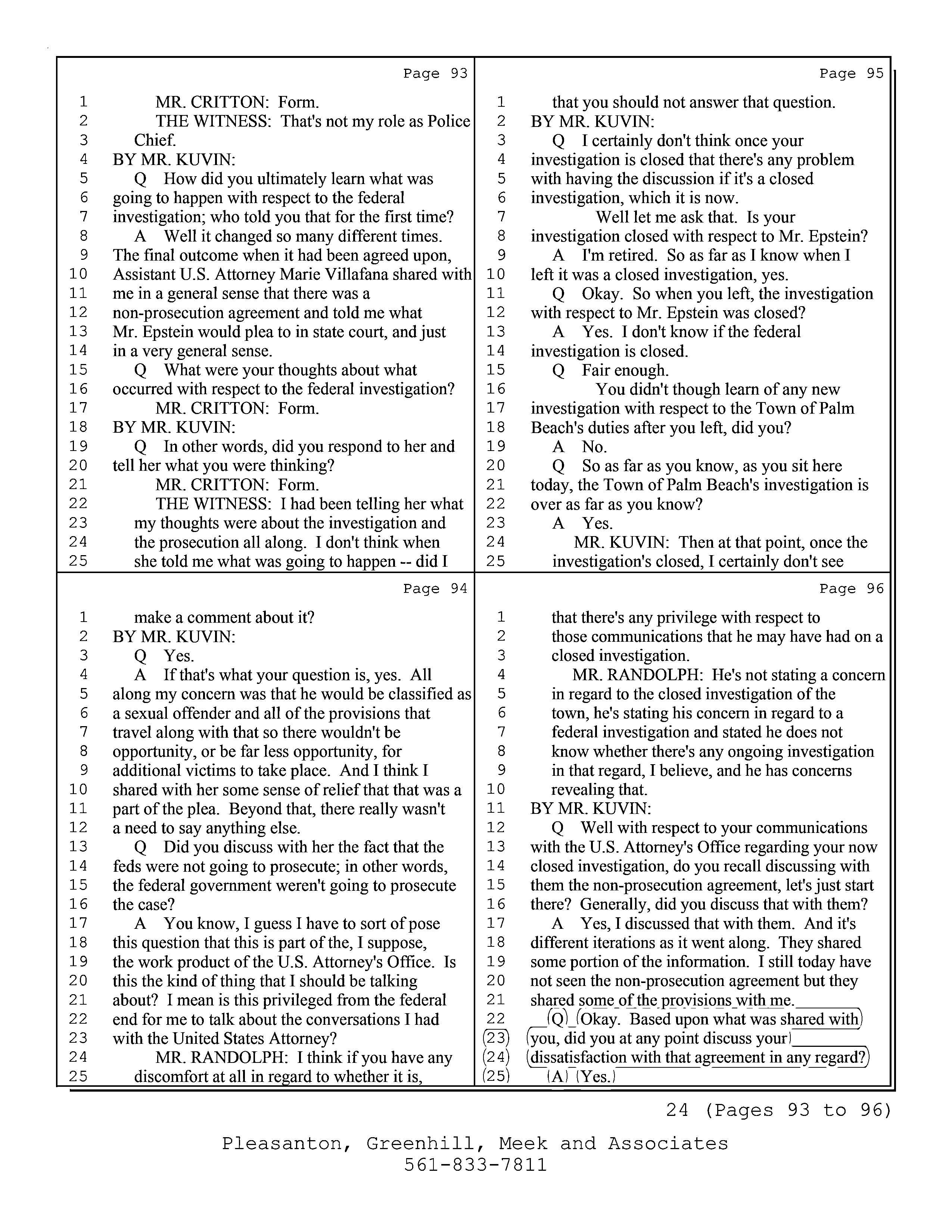
Page 408
document
2550 x 3300
Objects: Page, Text, Menu | Text: Page 93 | Page 95 | MR. CRITTON: Form. | that you should not answe
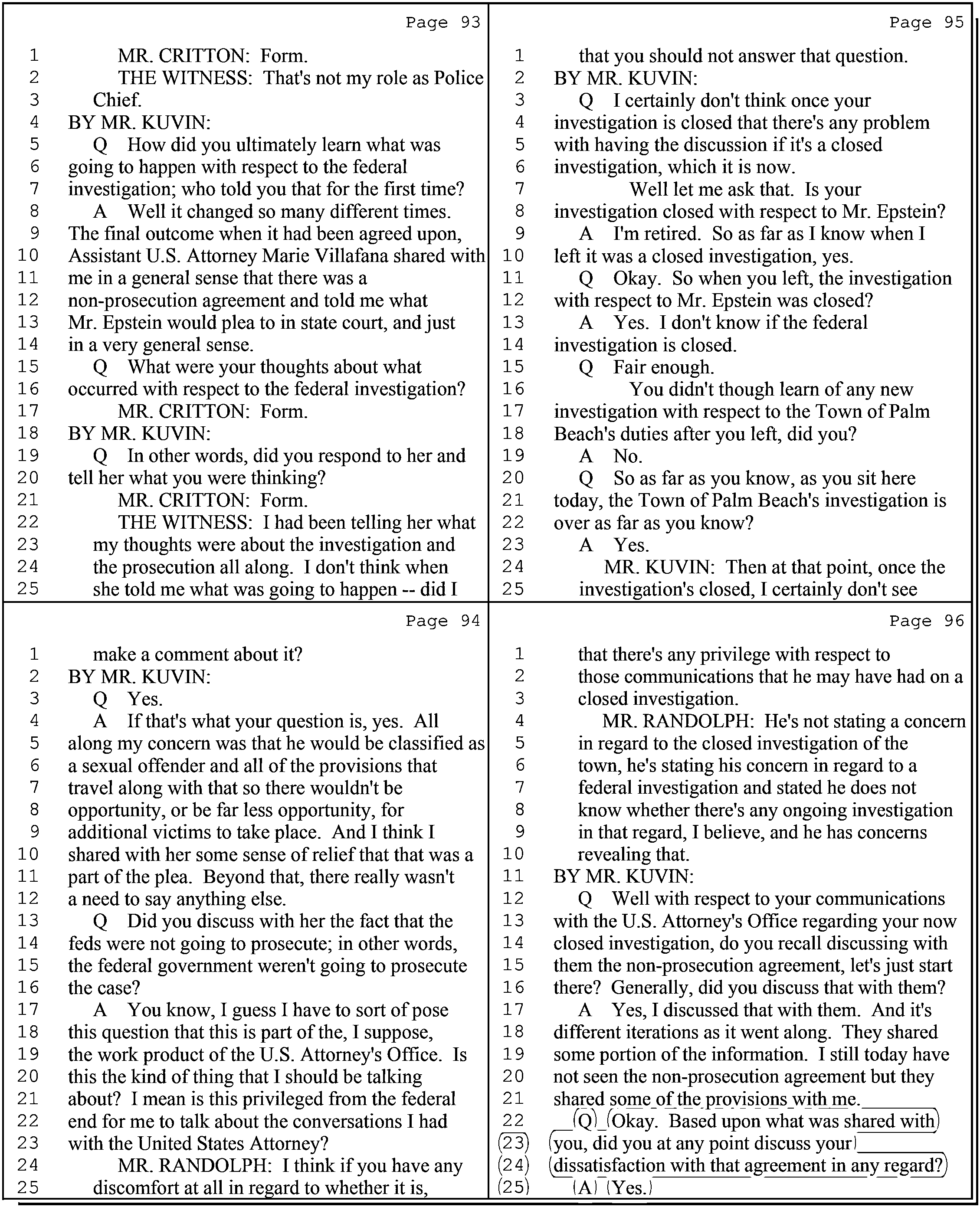
Page 408
document
2259 x 2783
Objects: Page, Text | Text: Page 93 | Page 95 | MR. CRITTON: Form. | 7 8 9 4 5 6 | that you should n
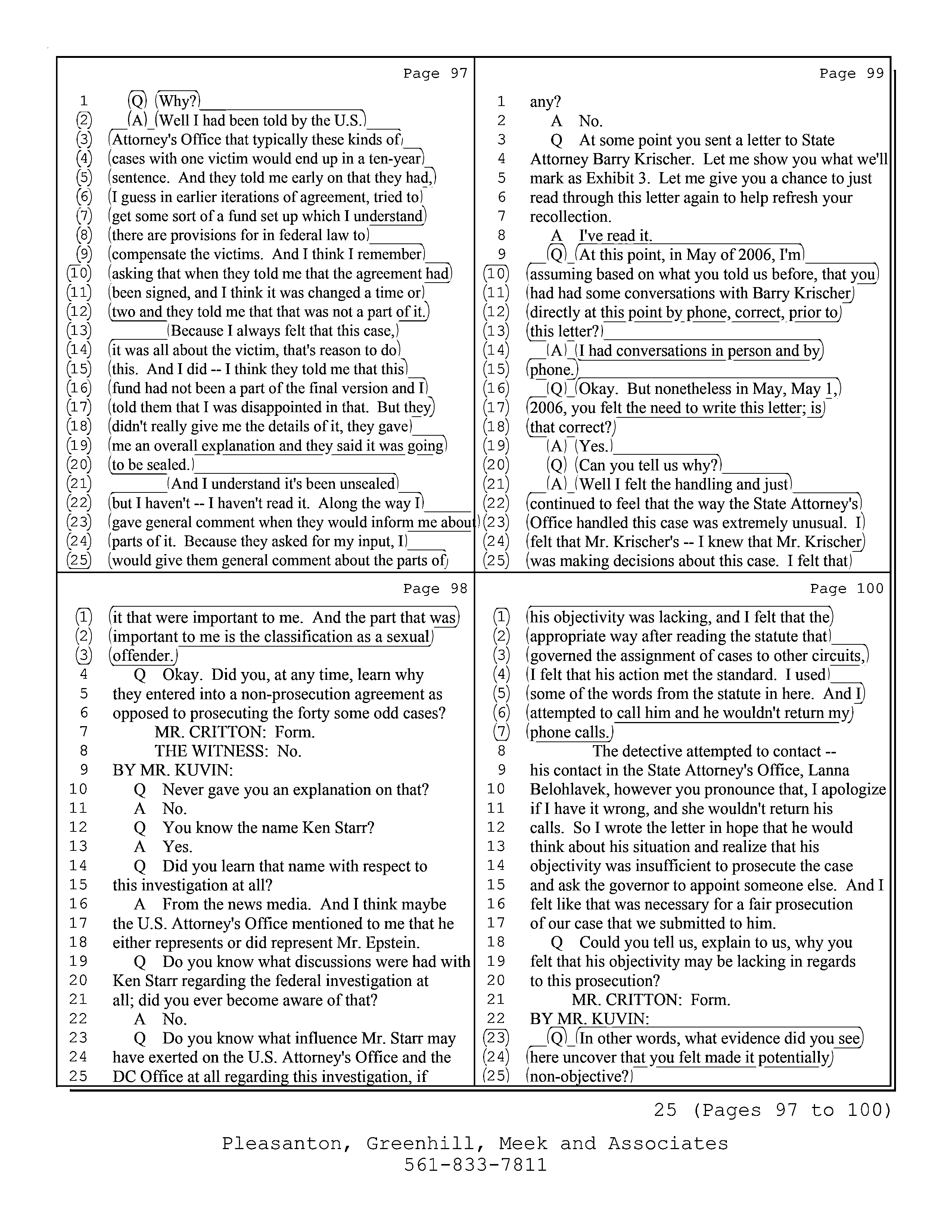
Page 409
document
2550 x 3300
Objects: Page, Text, Menu | Text: Page 97 | Page 99 | 1 | Why? | any?
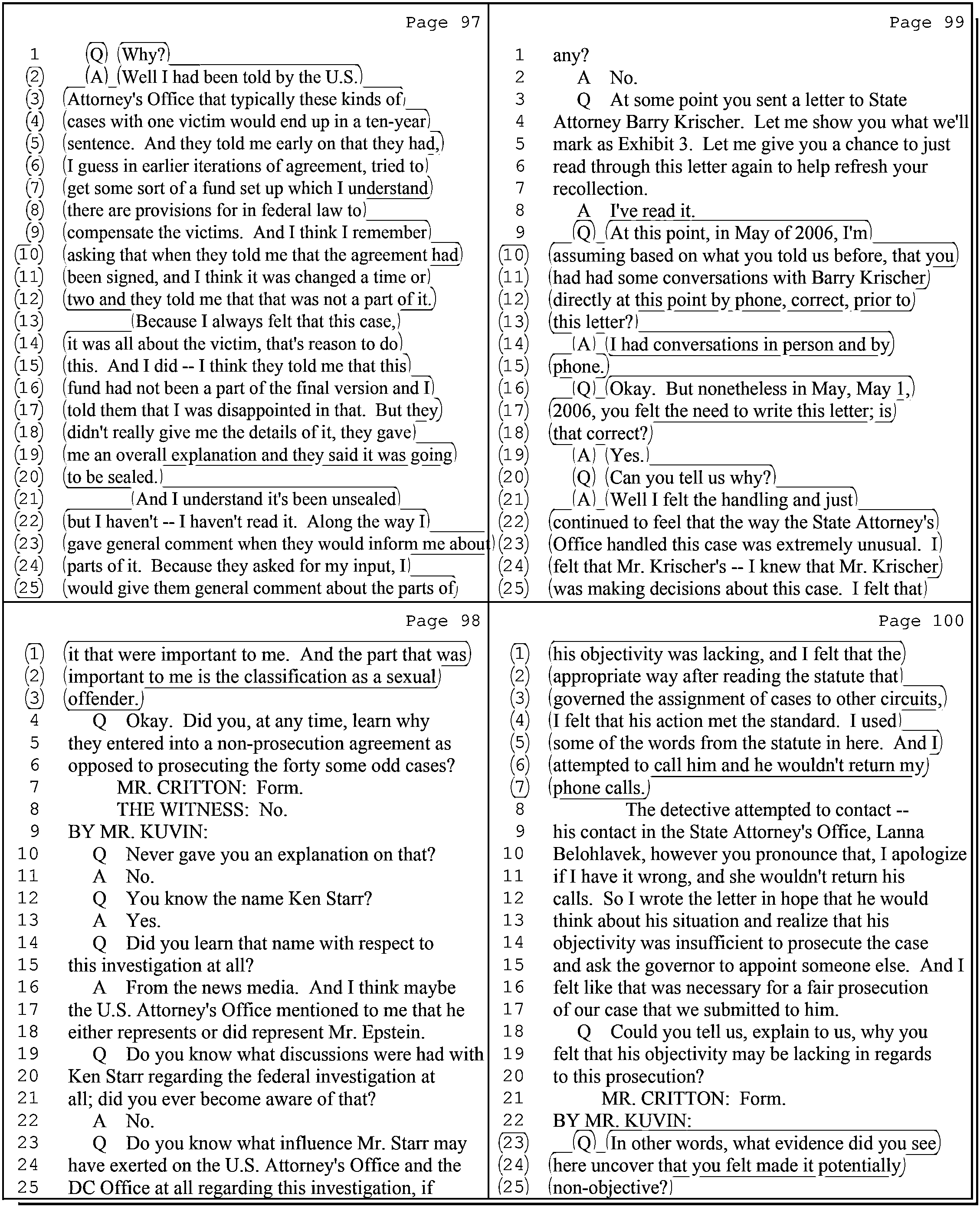
Page 409
document
2259 x 2783
Objects: Page, Text | Text: Page 97 | Page 99 | 1 | Why? | any?
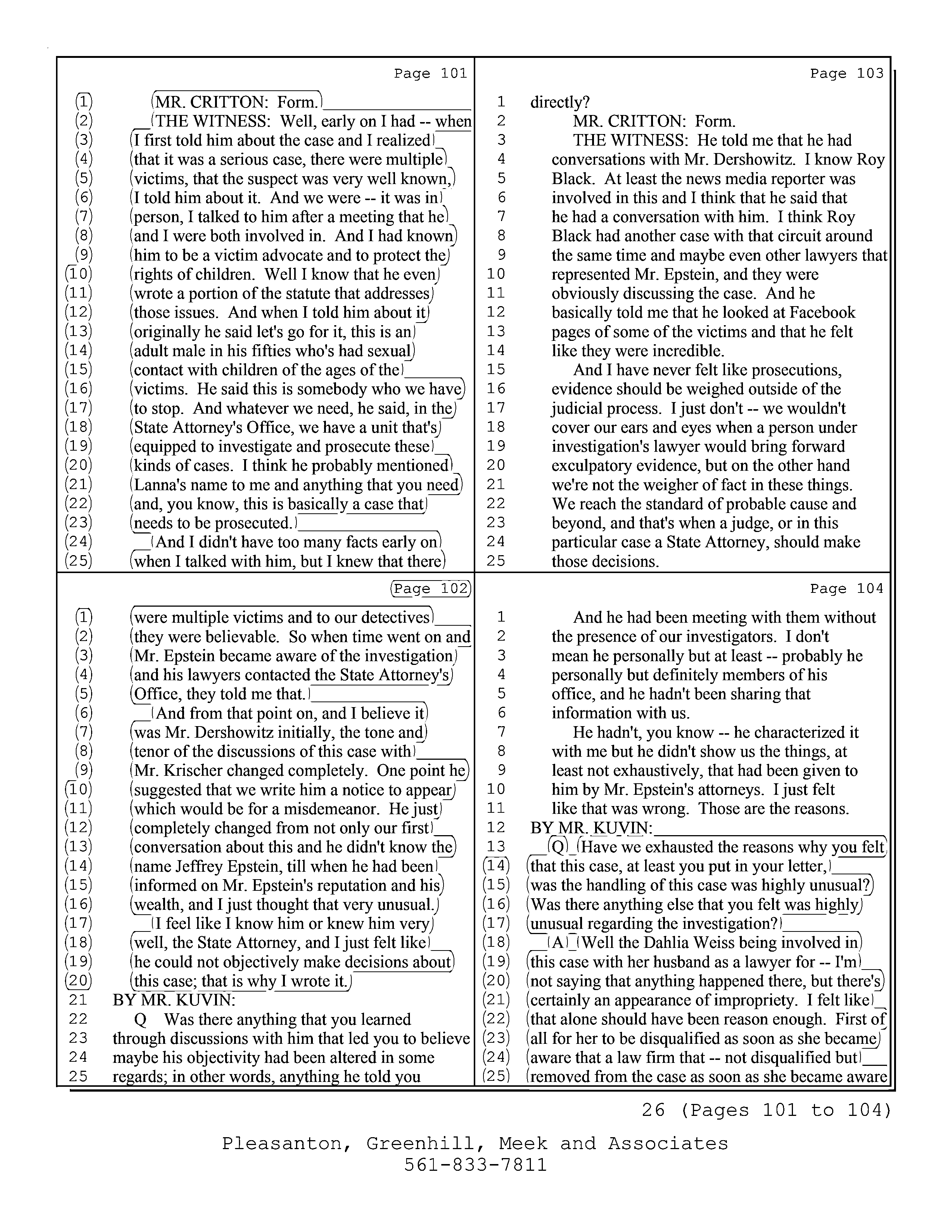
Page 410
document
2550 x 3300
Objects: Page, Text | Text: Page 101 | Page 103 | MR. CRITTON: Form. | directly? | (THE WITNESS: Wel
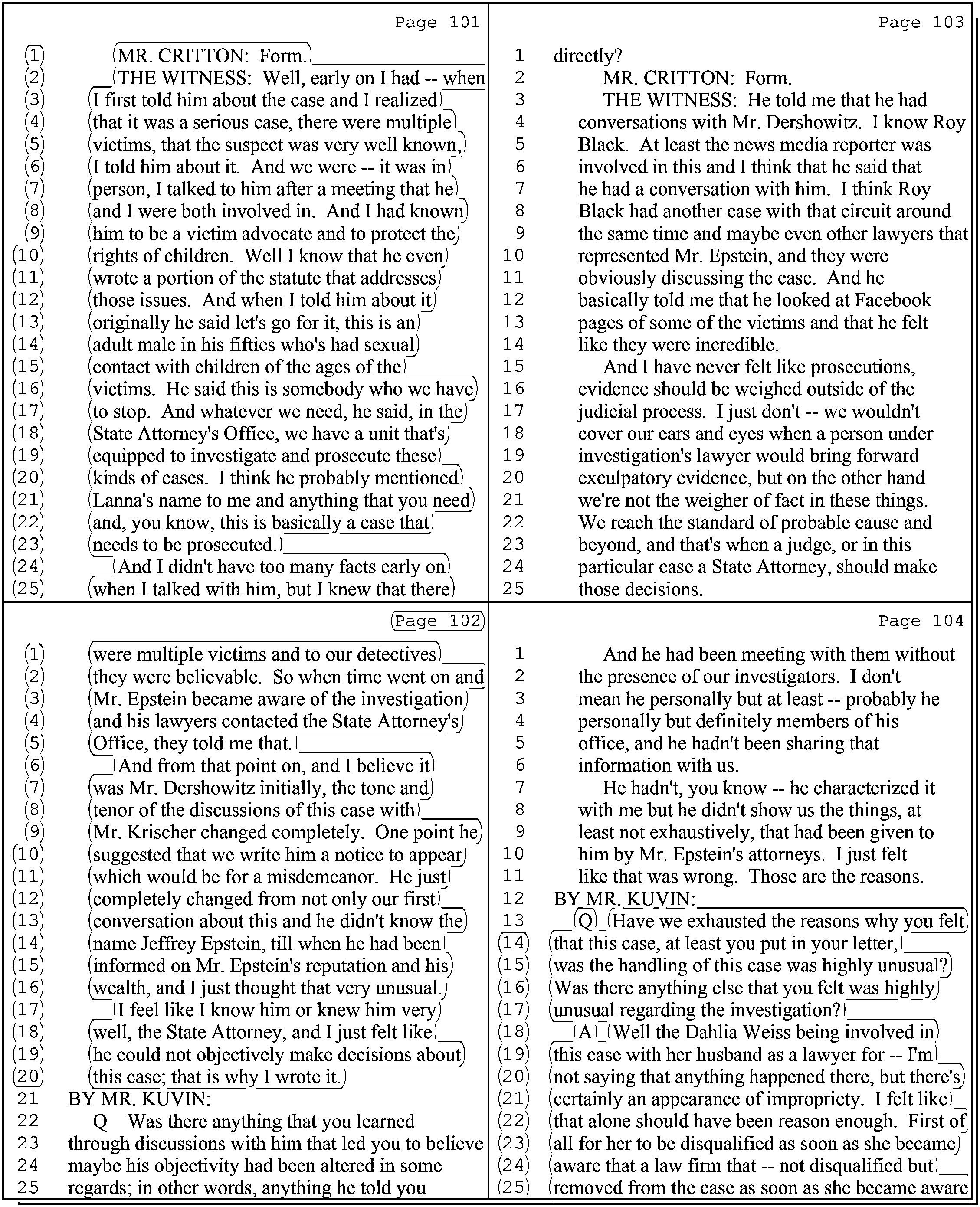
Page 410
document
2259 x 2783
Objects: Page, Text | Text: Page 101 | Page 103 | MR. CRITTON: Form. | directly? | (2 3 1 4
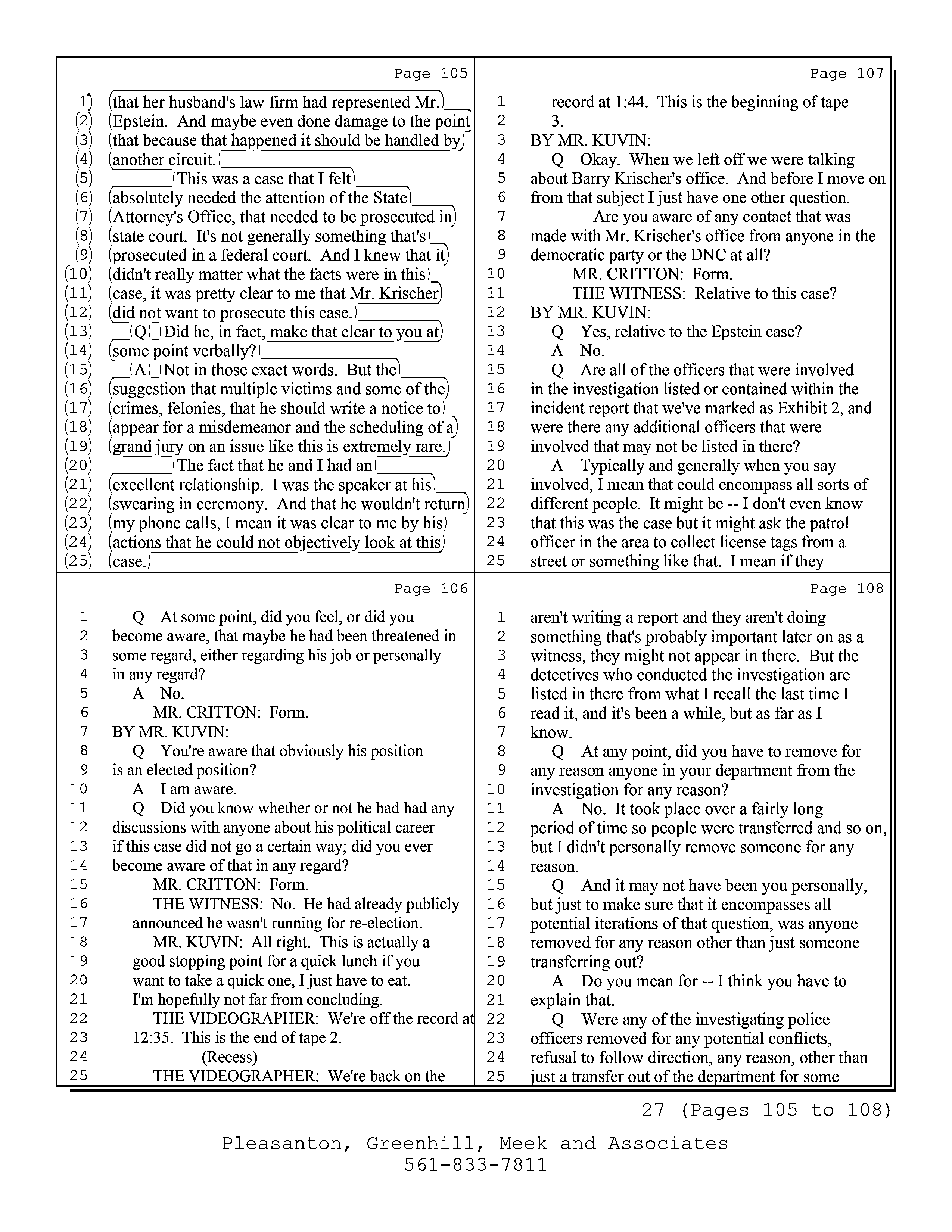
Page 411
document
2550 x 3300
Objects: Page, Text, Menu | Text: Page 105 | Page 107 | 1 | record at 1:44. This is the beginning of
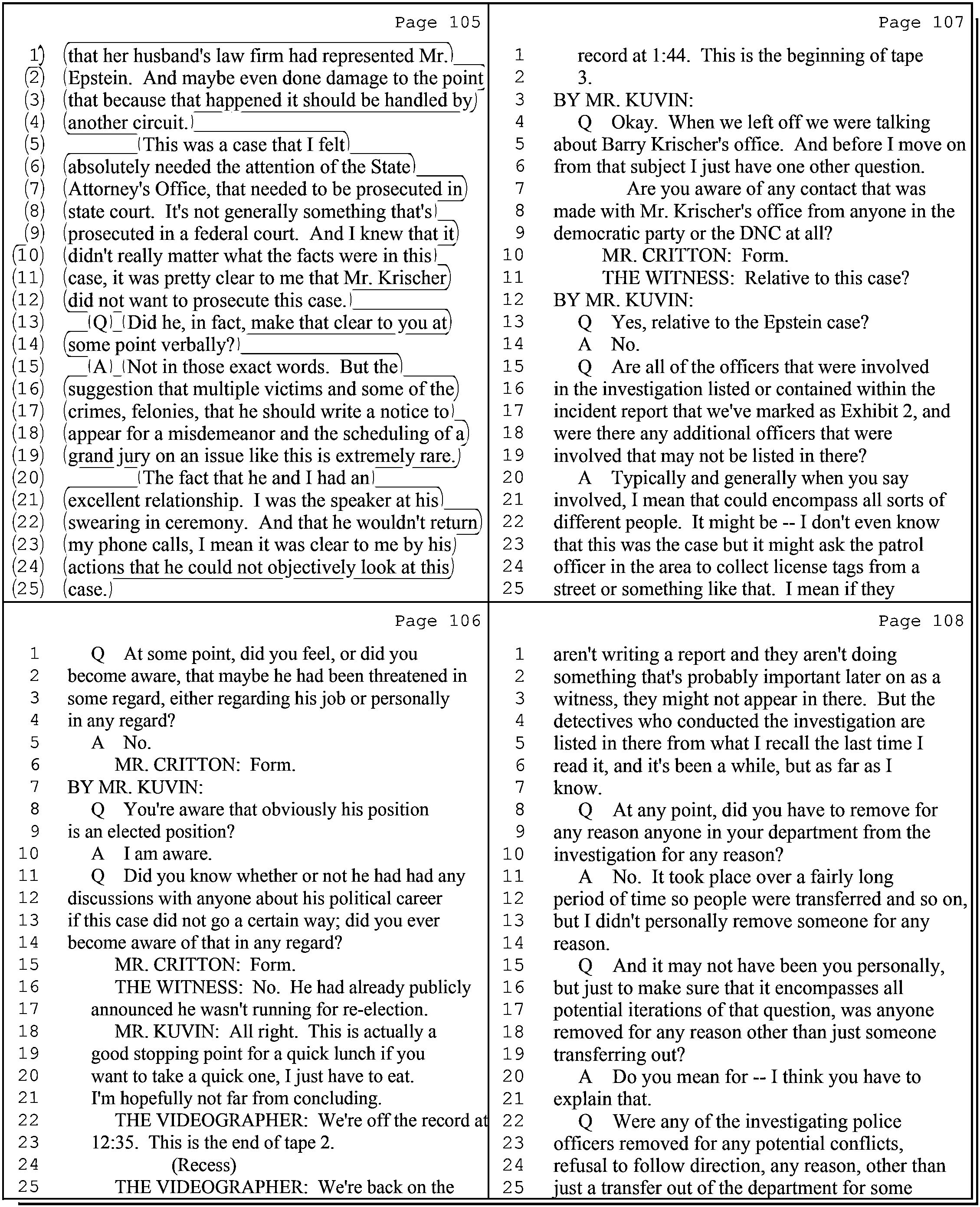
Page 411
document
2259 x 2783
Objects: Page, Text | Text: Page 105 | Page 107 | record at 1:44. This is the beginning of tape | th
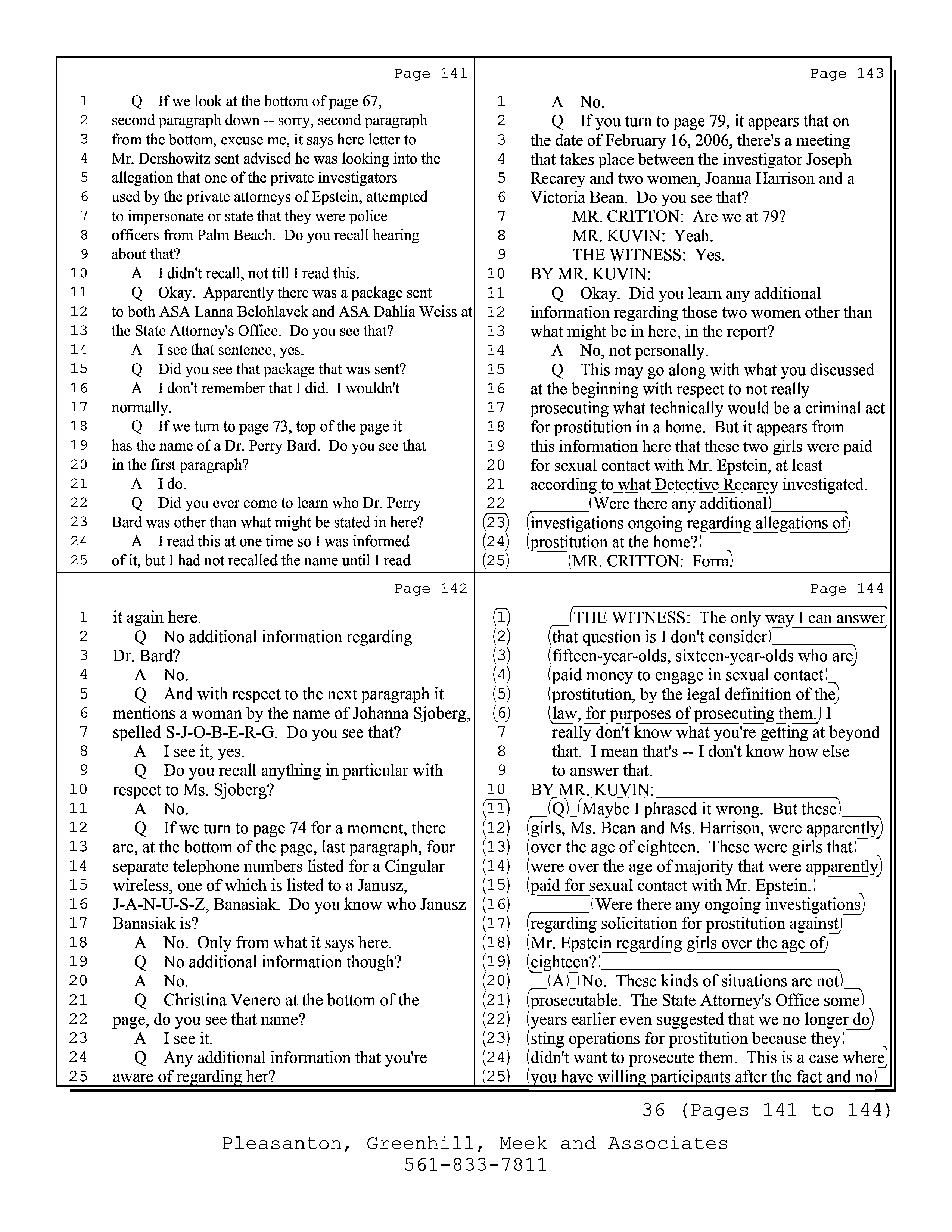
Page 412
document
2550 x 3300
Objects: Page, Text, Menu | Text: Page 141 | Page 143 | Q | If we look at the bottom of page 67, | A
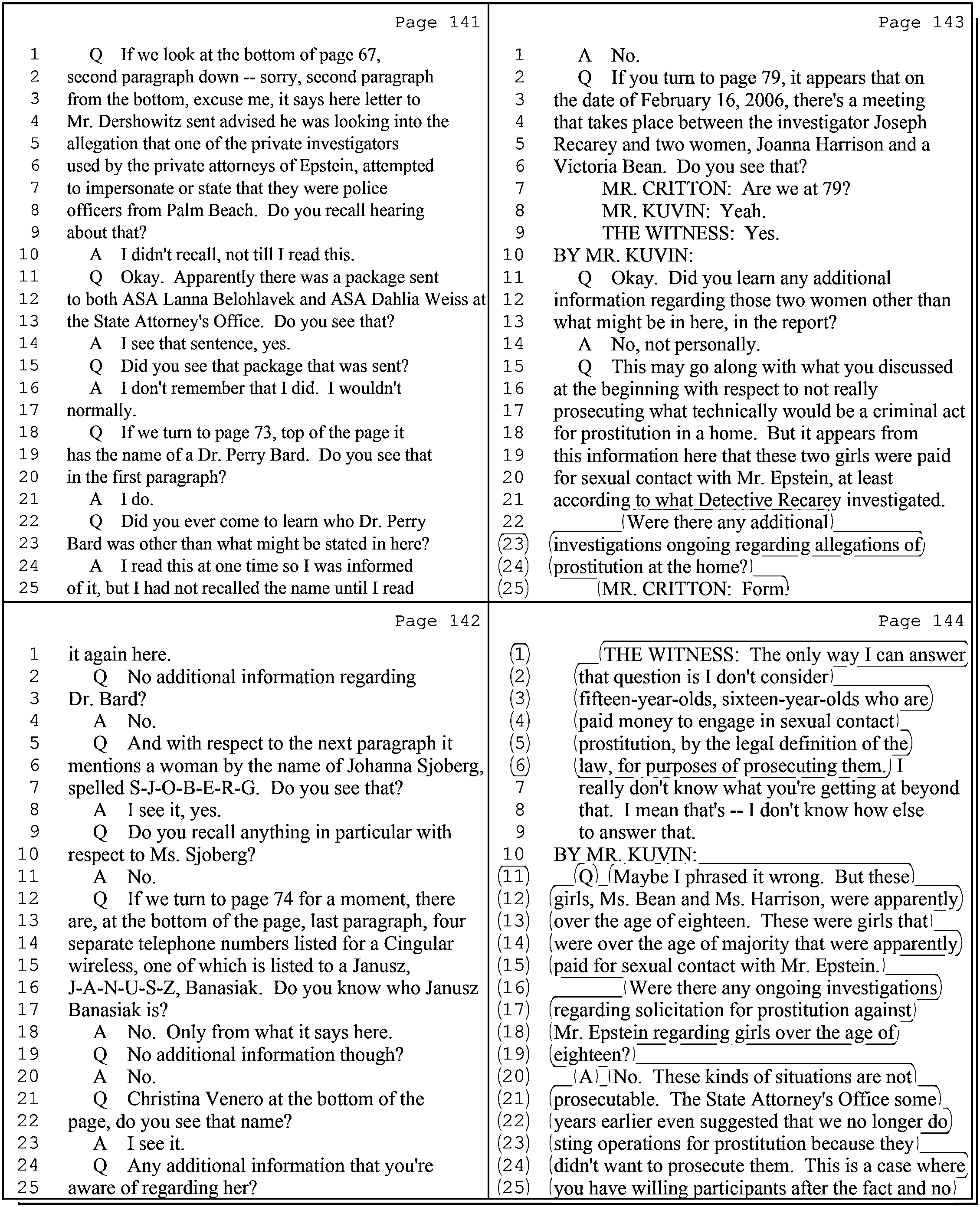
Page 412
document
2259 x 2783
Objects: Page, Text, Menu | Text: Page 141 | Page 143 | If we look at the bottom of page 67, | No. |
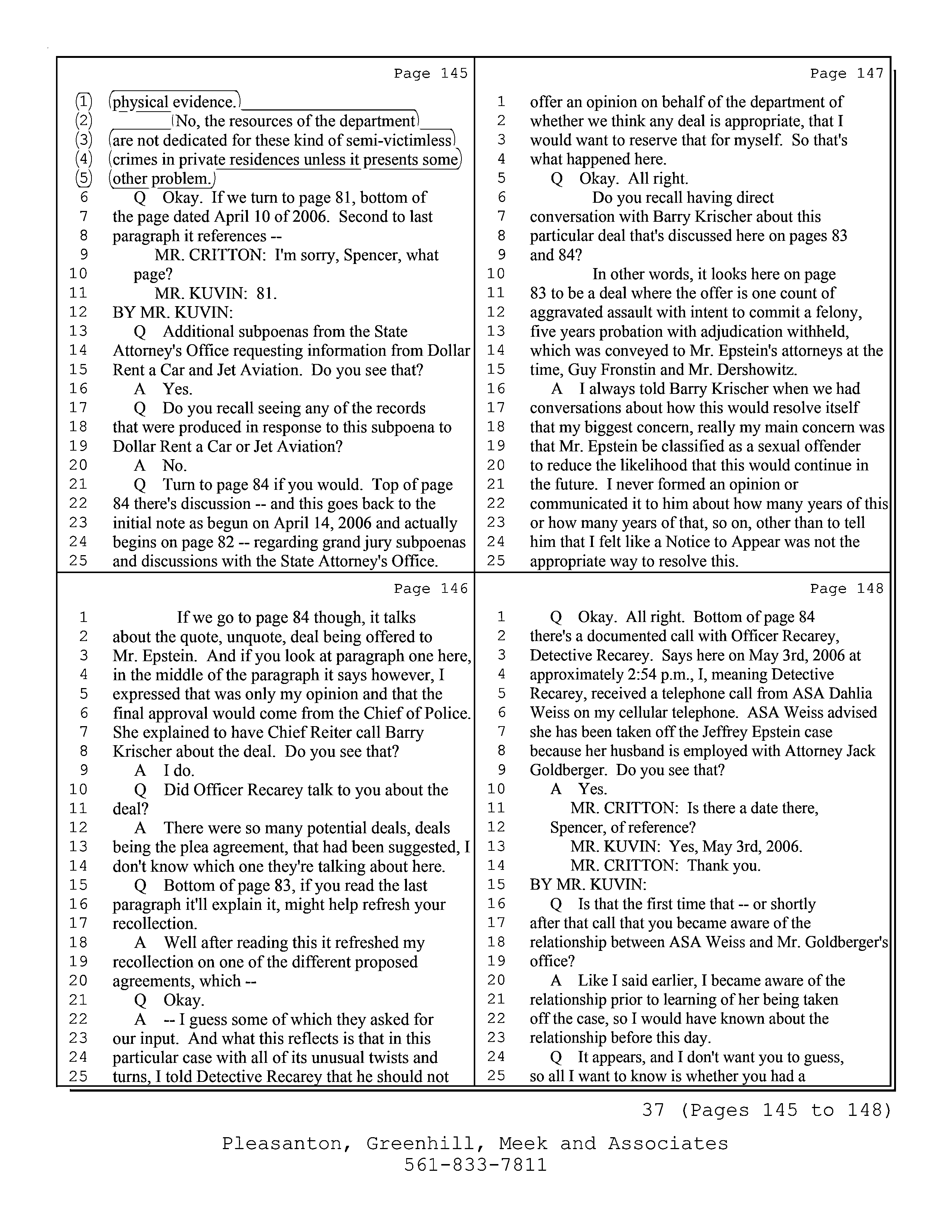
Page 413
document
2550 x 3300
Objects: Page, Text, Menu | Text: Page 145 | Page 147 | 4 5 | physical evidence. | offer an opinion
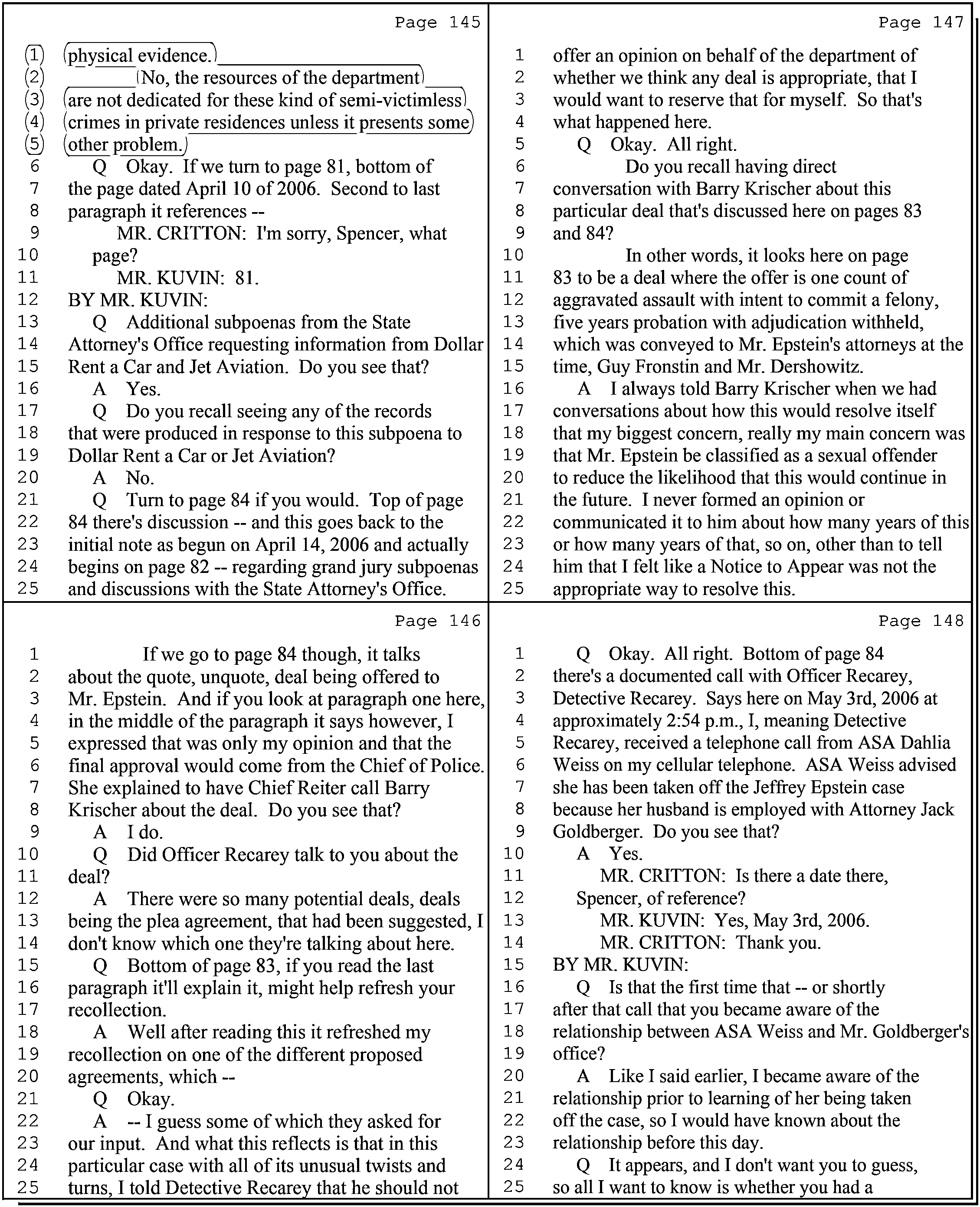
Page 413
document
2259 x 2783
Objects: Page, Text, Menu | Text: Page 145 | Page 147 | 6 | 123 4 5 7 8 6 | offer an opinion on beha
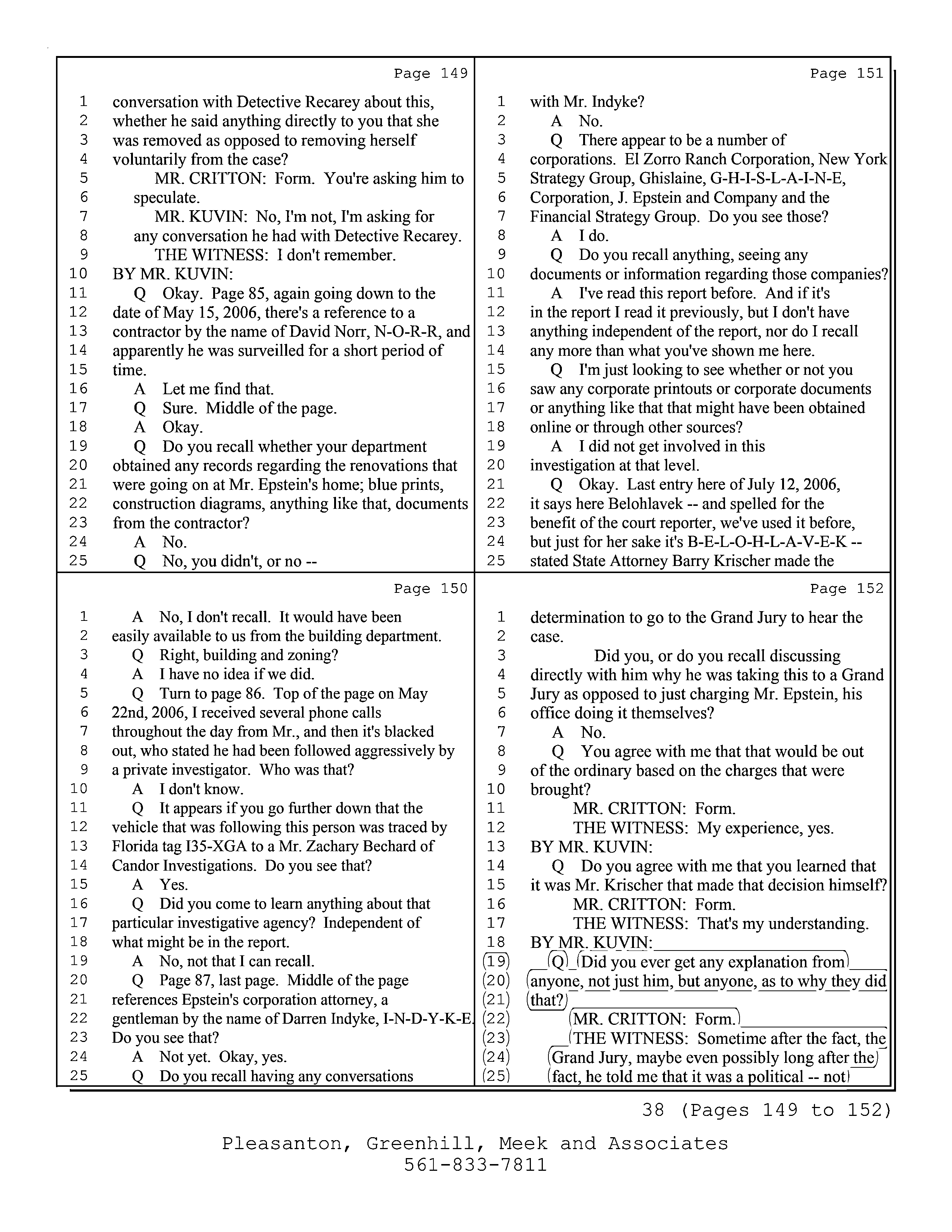
Page 414
document
2550 x 3300
Objects: Page, Text, Menu | Text: Page 149 | Page 151 | conversation with Detective Recarey about th
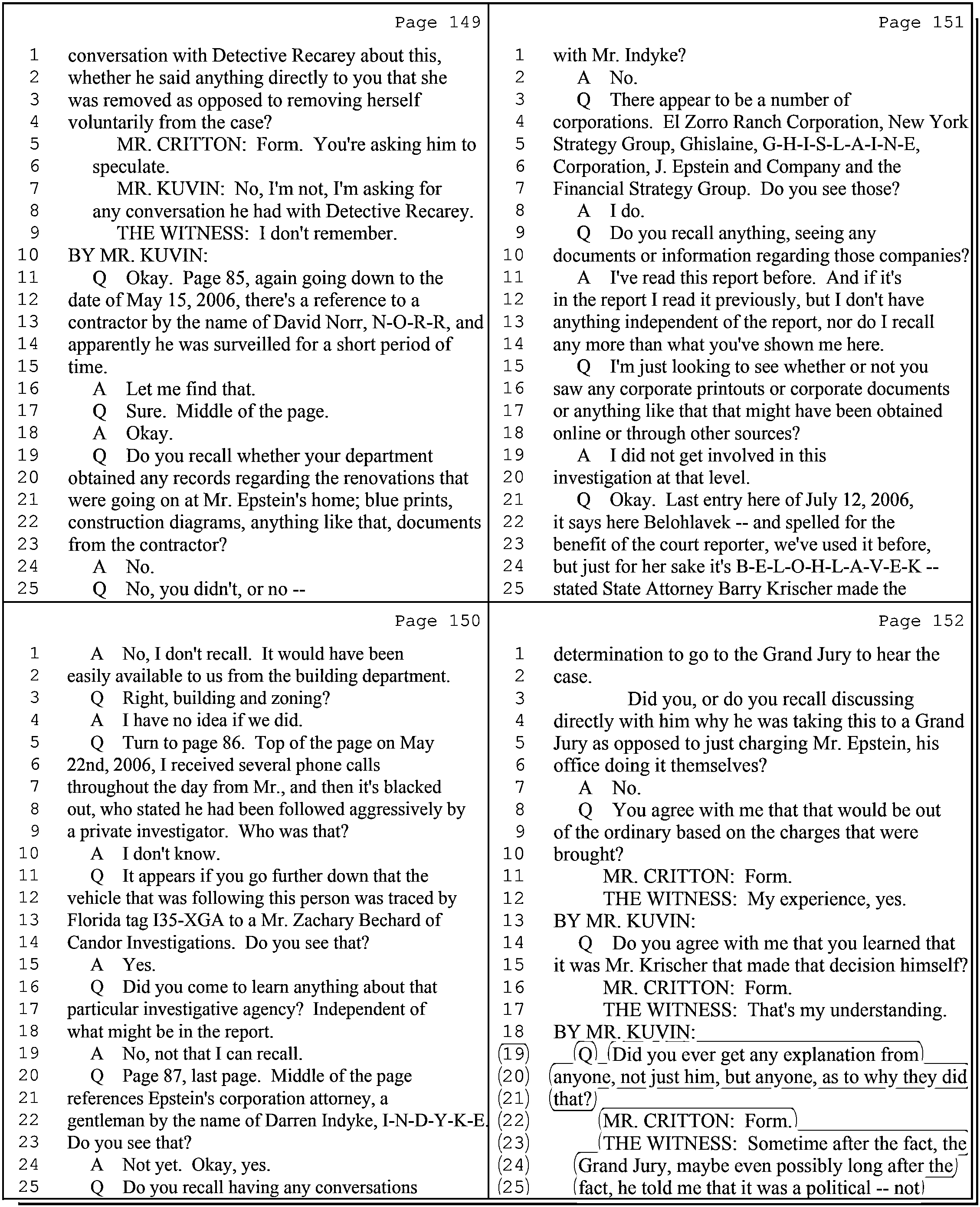
Page 414
document
2259 x 2783
Objects: Page, Text, Menu | Text: Page 149 | Page 151 | conversation with Detective Recarey about th
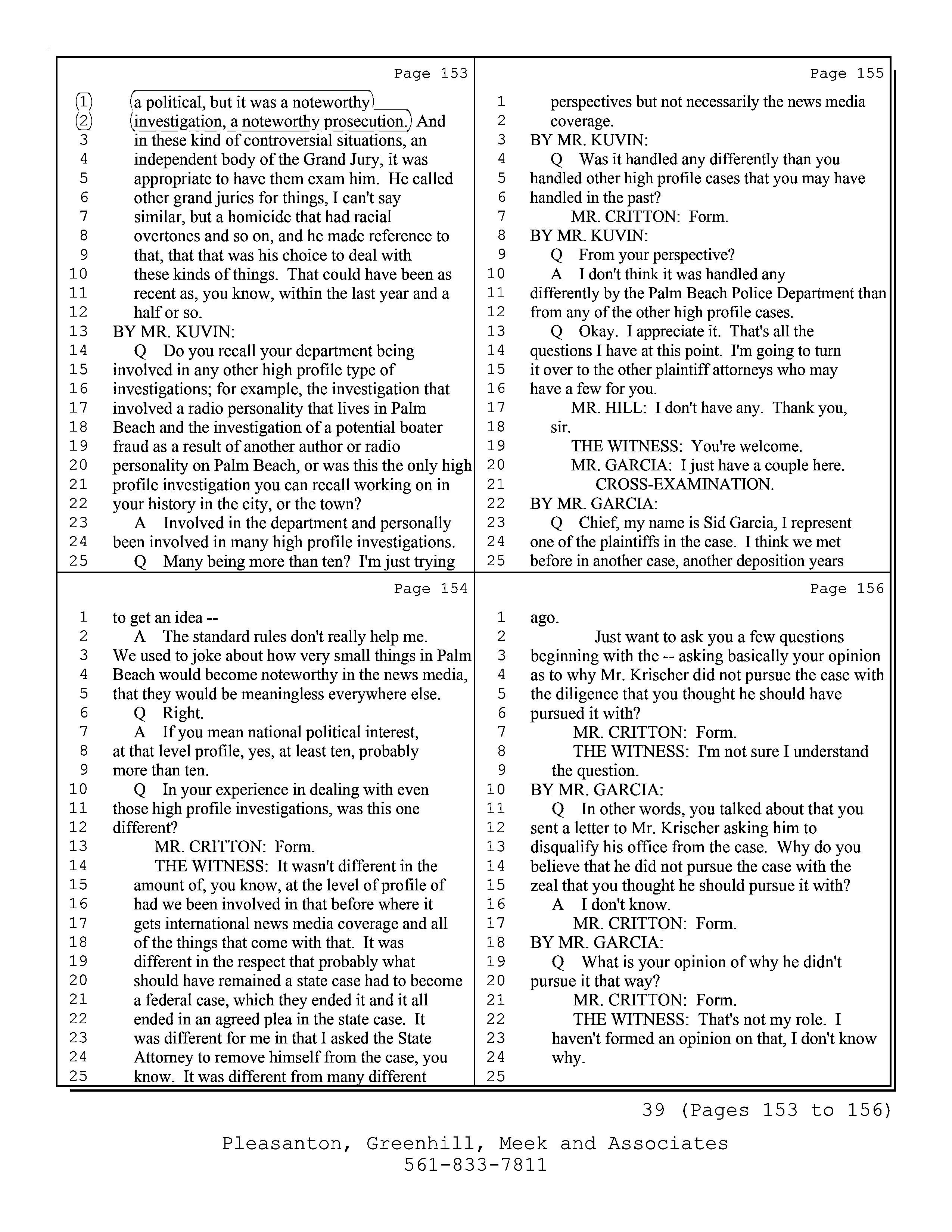
Page 415
document
2550 x 3300
Objects: Page, Text, Menu | Text: Page 153 | Page 155 | 1 | a political, but it was a noteworthy | p
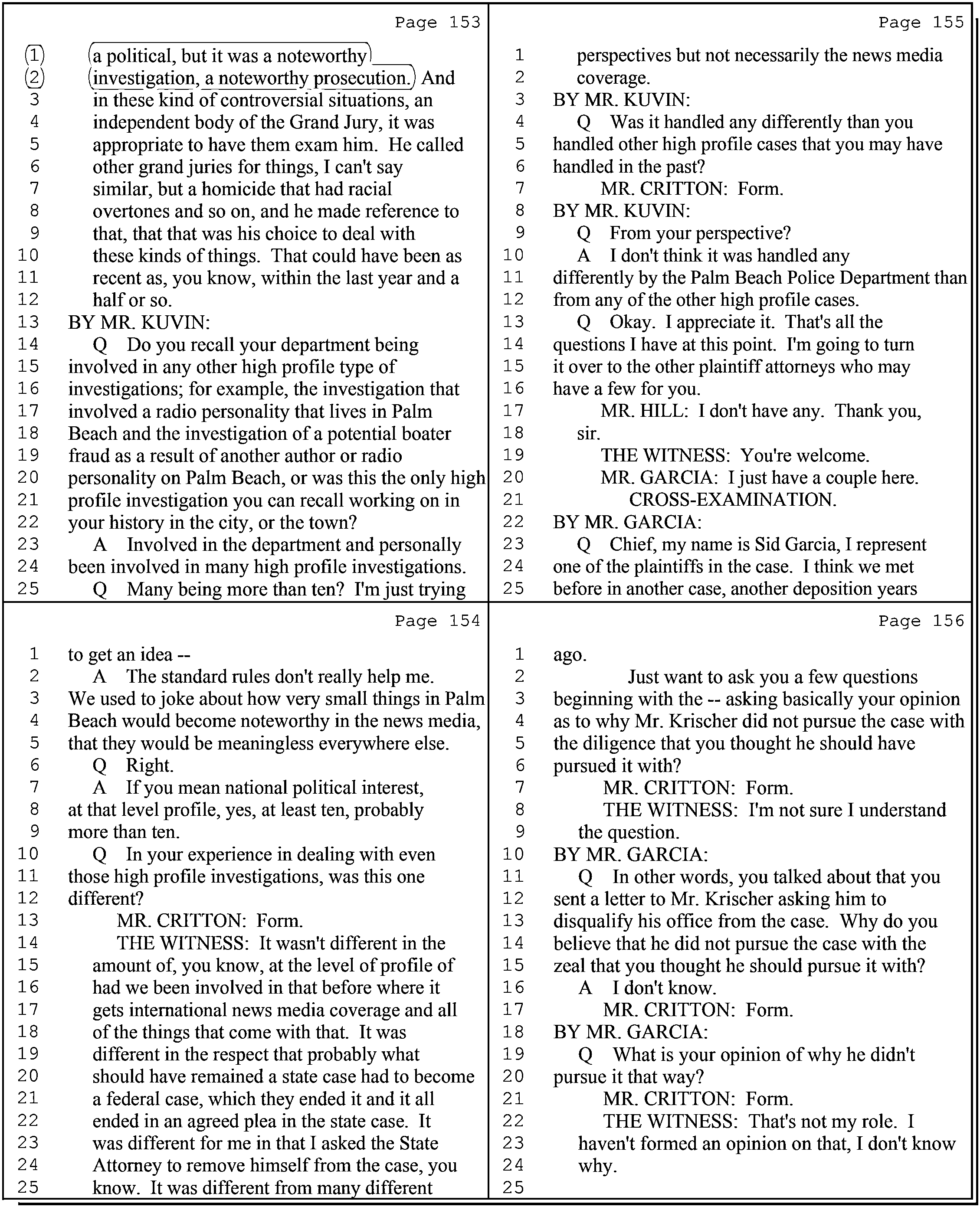
Page 415
document
2259 x 2783
Objects: Page, Text, Menu | Text: Page 153 | Page 155 | 1 | a political, but it was a noteworthy | p
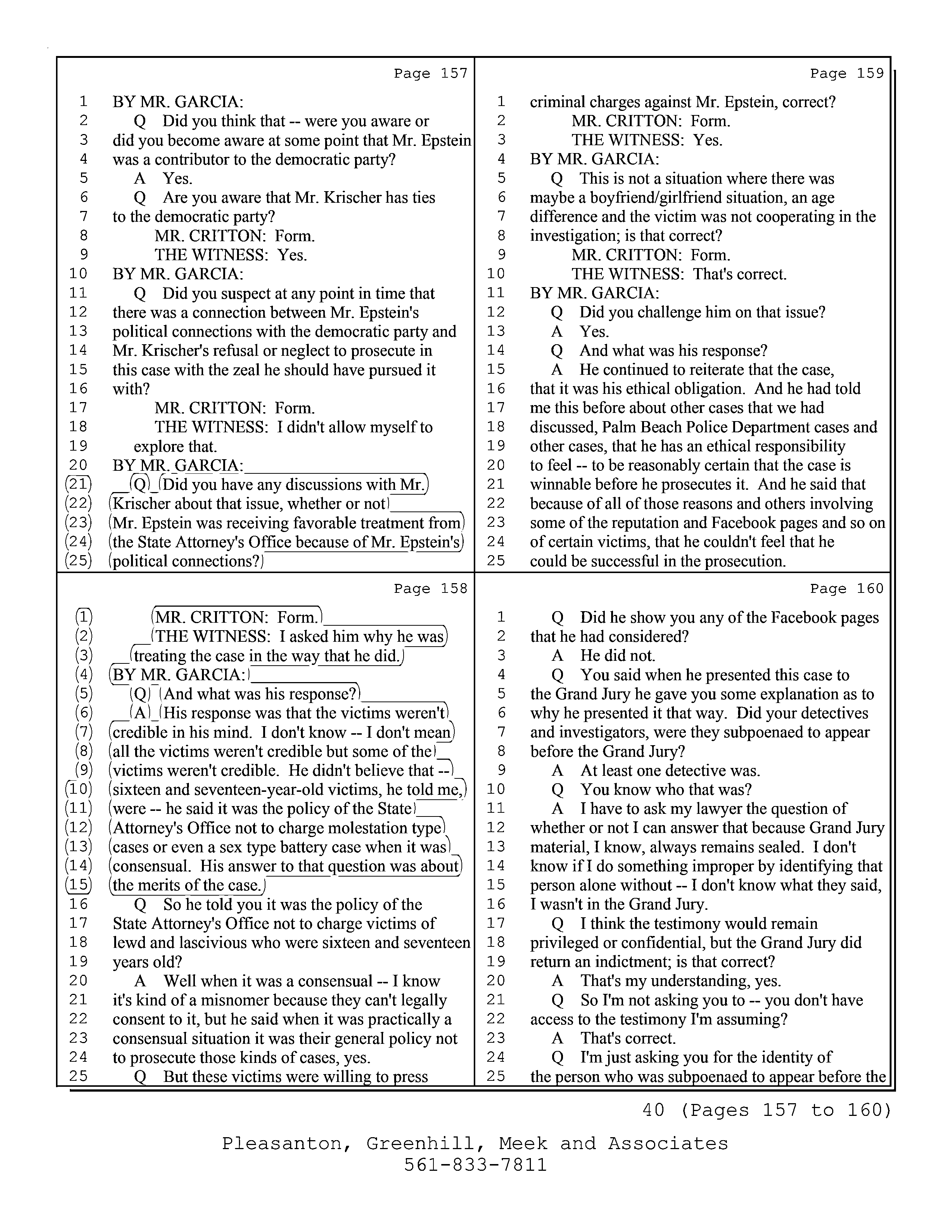
Page 416
document
2550 x 3300
Objects: Page, Text, Menu | Text: Page 157 | Page 159 | BY MR. GARCIA: | criminal charges against Mr
Page 416
document
2259 x 2783
Objects: Page, Text, Menu | Text: Page 157 | Page 159 | BY MR. GARCIA: | 7 8 9 4 5 6 | criminal char
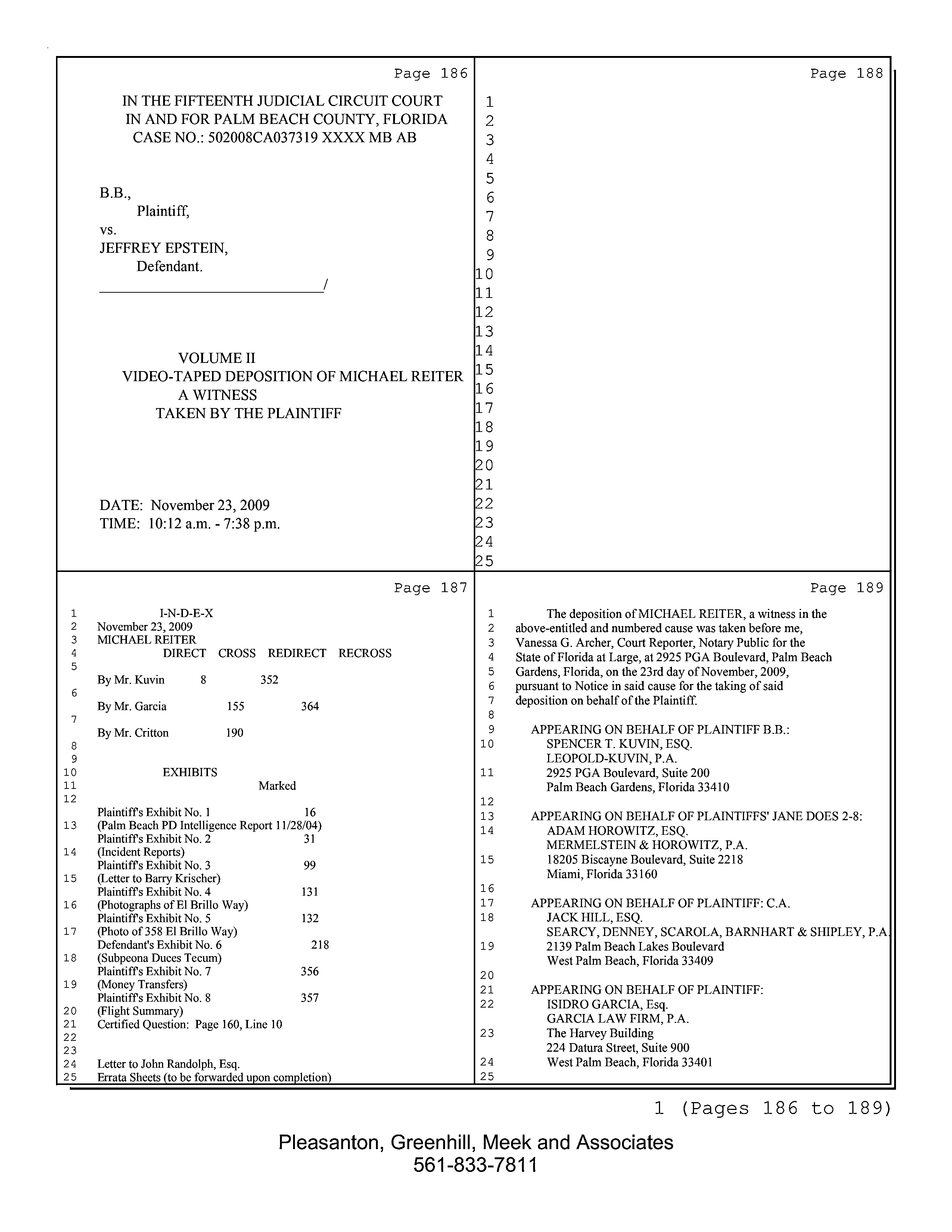
Page 417
document
2550 x 3300
Objects: Page, Text, Menu | Text: Page 186 | Page 188 | IN THE FIFTEENTH JUDICIAL CIRCUIT COURT | IN
Page 417
document
2259 x 2778
Objects: Page, Text, Menu | Text: Page 186 | Page 188 | IN THE FIFTEENTH JUDICIAL CIRCUIT COURT | IN
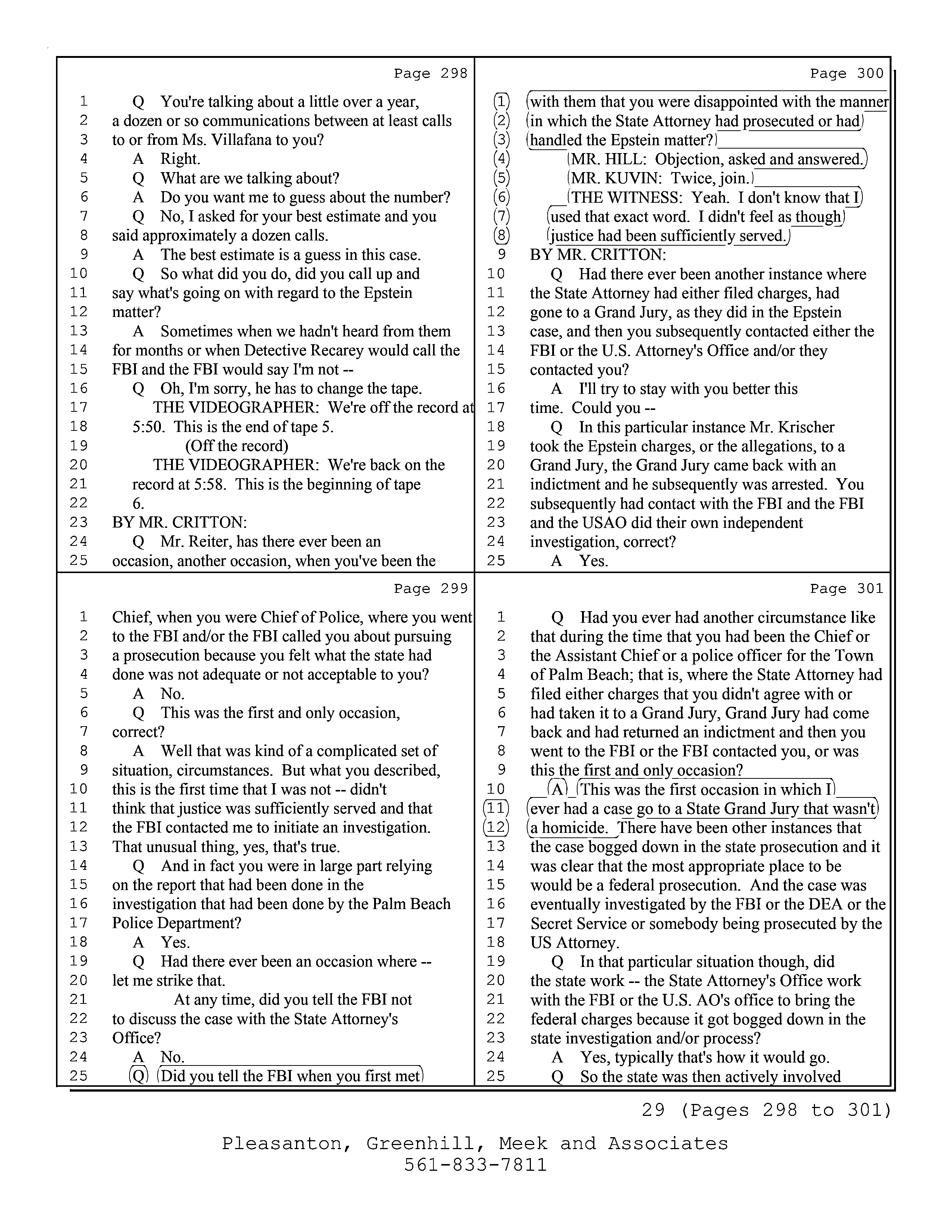
Page 418
document
2550 x 3300
Objects: Page, Text, Menu | Text: Page 298 | Page 300 | Q | You're talking about a little over a yea
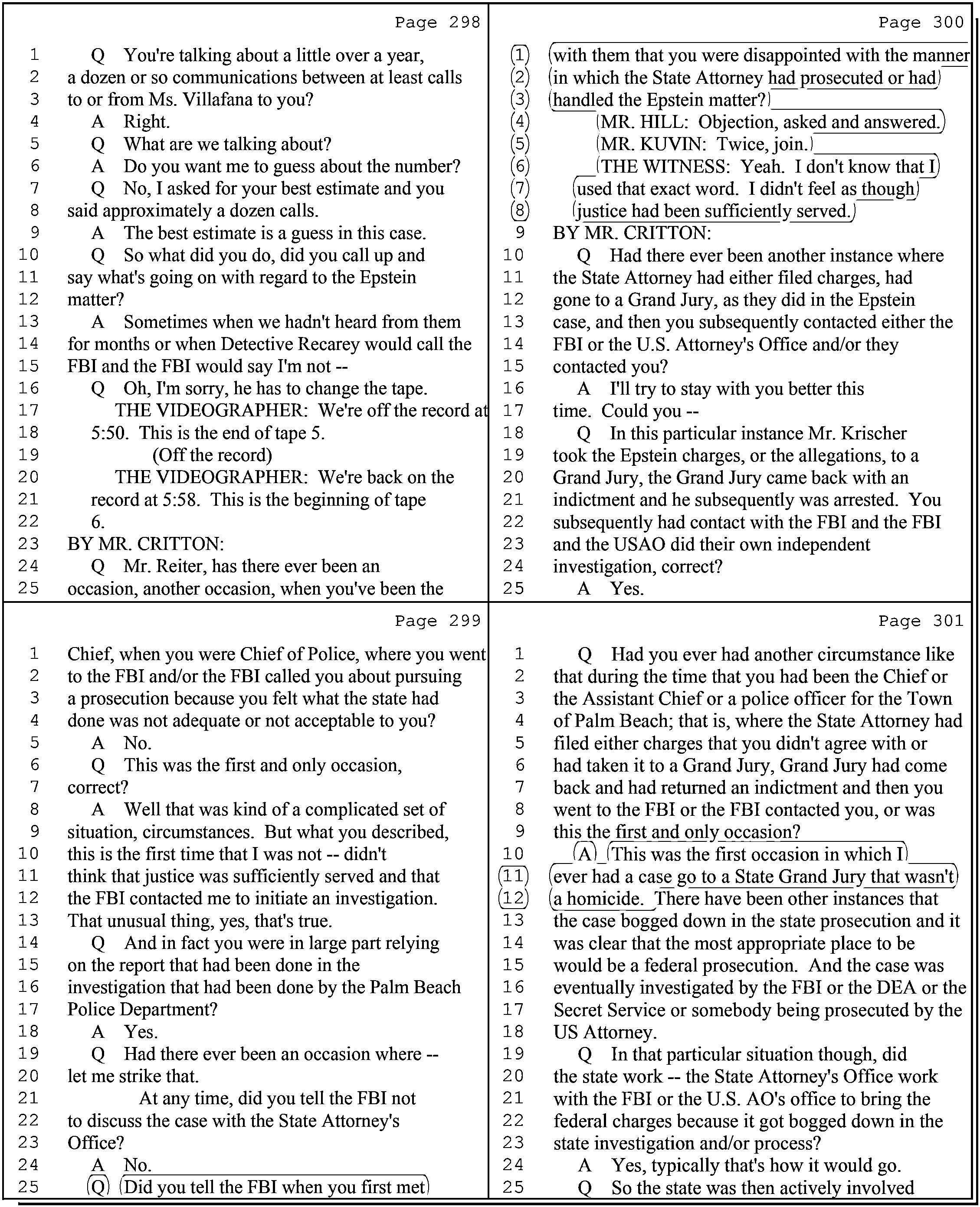
Page 418
document
2259 x 2783
Objects: Page, Text, Menu, Advertisement | Text: Page 298 | Page 300 | Q You're talking about a litt
Page 419
document
2550 x 3300
Objects: Text | Text: Appendix 5
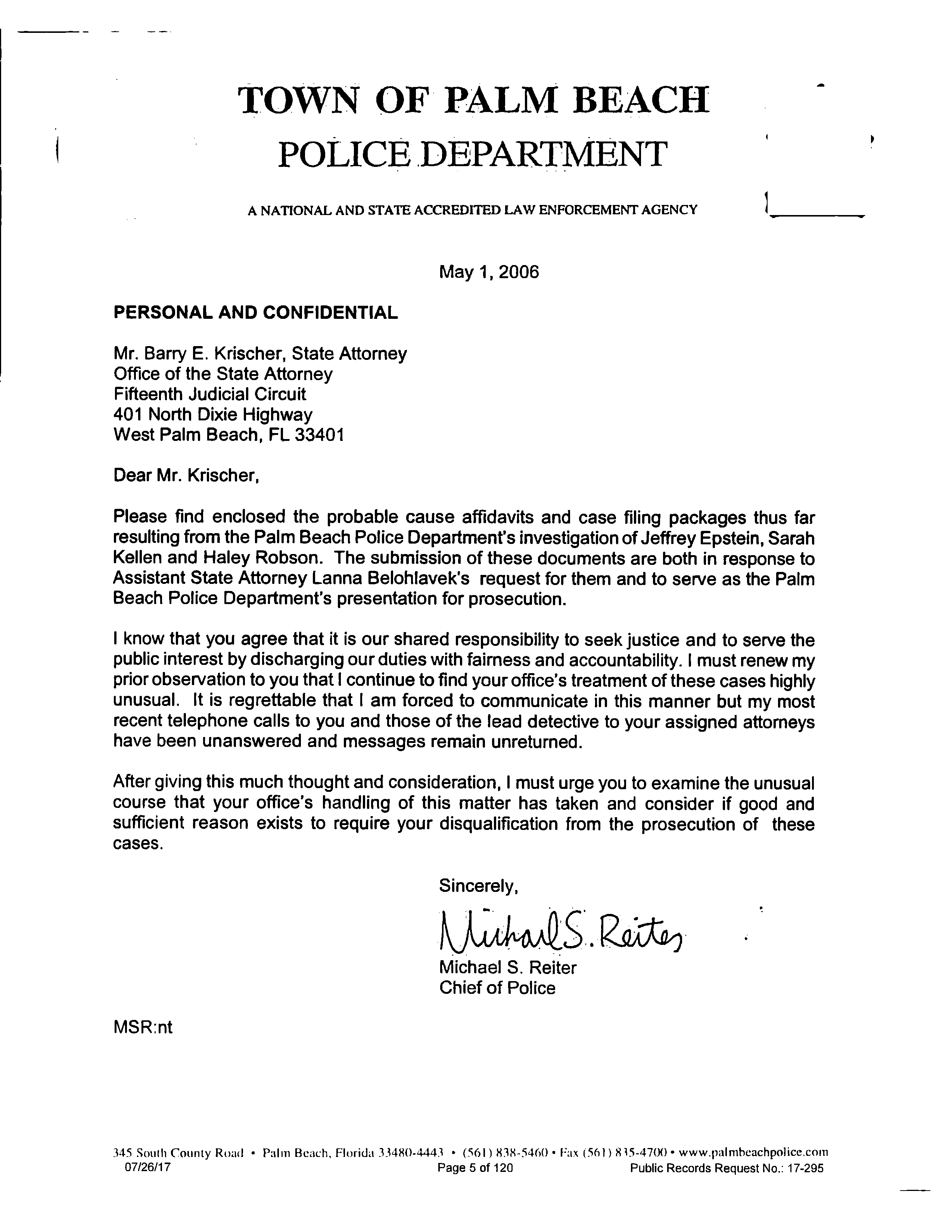
Page 420
document
2550 x 3300
Objects: Page, Text, Letter | Text: TOWN OF PALM BEACH | POLICE DEPARTMENT | A NATIONAL AND STATE AC

Page 420
photo
378 x 377
Objects: Logo, Emblem, Symbol, Face, Head, Person | Text: PALM | BEACH | UF | 17. | FLORIDA

Page 420
photo
293 x 360
Objects: Badge, Logo, Symbol, Emblem, Face, Head, Person | Text: TOWN OF | PALM | BEACH | POLICE
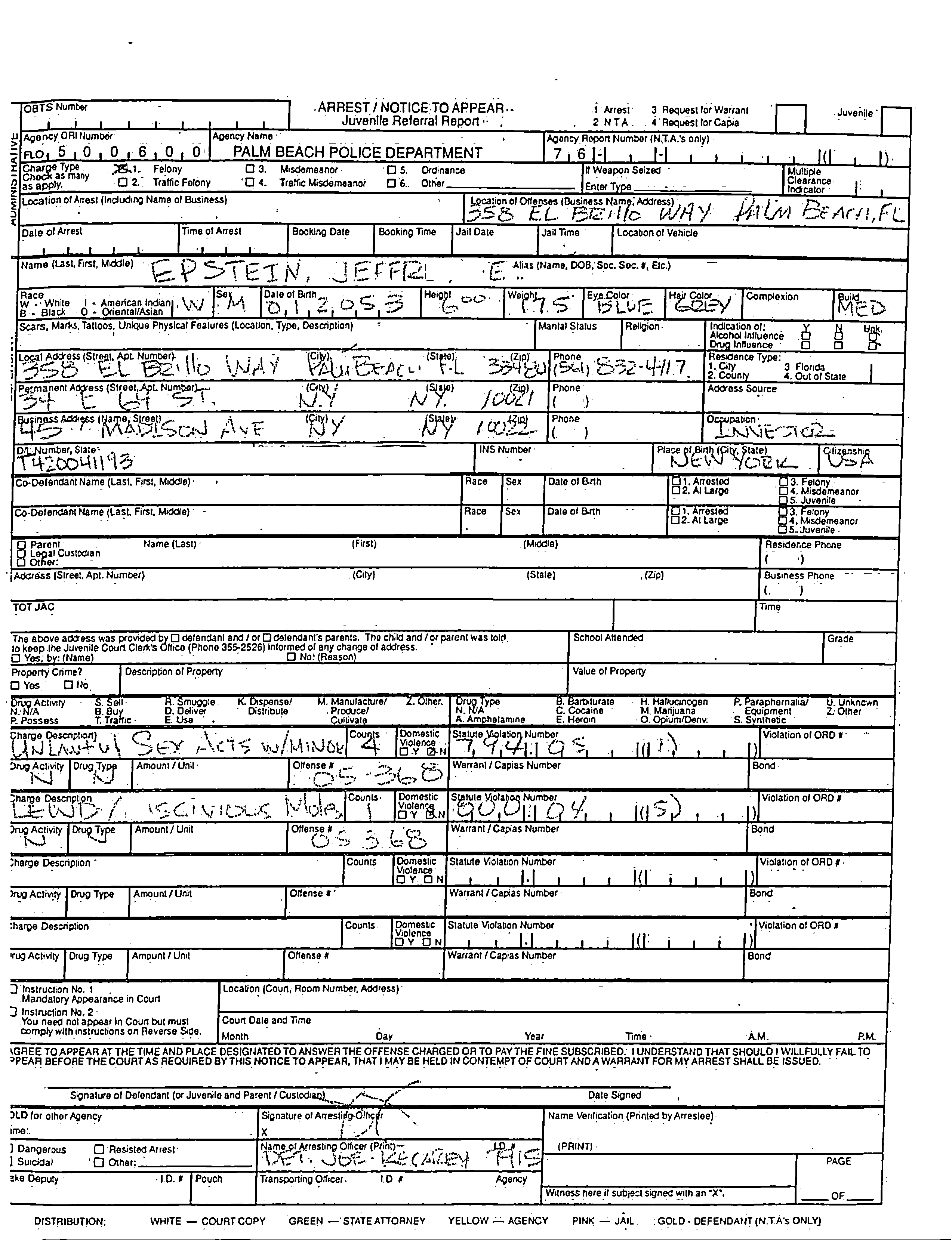
Page 421
document
2547 x 3321
Objects: Chart, Diagram, Plan, Plot, Text | Text: .ARREST/NOTICE: TO APPEAR.. | OBTS Number | 3 Requ
Page 421
photo
113 x 71
Objects: Stencil, Body Part, Hand, Person, Smoke Pipe

Page 421
document
1165 x 87
Objects: Stencil, Text, Handwriting

Page 421
document
79 x 68
Objects: Stencil, Triangle, Smoke Pipe, Text

Page 421
document
88 x 84
Objects: Stencil, Symbol, Sign, Text

Page 421
document
86 x 86
Objects: White Board, Text
Page 421
document
390 x 93
Objects: White Board, Electronics, Screen, Text | Text: Date
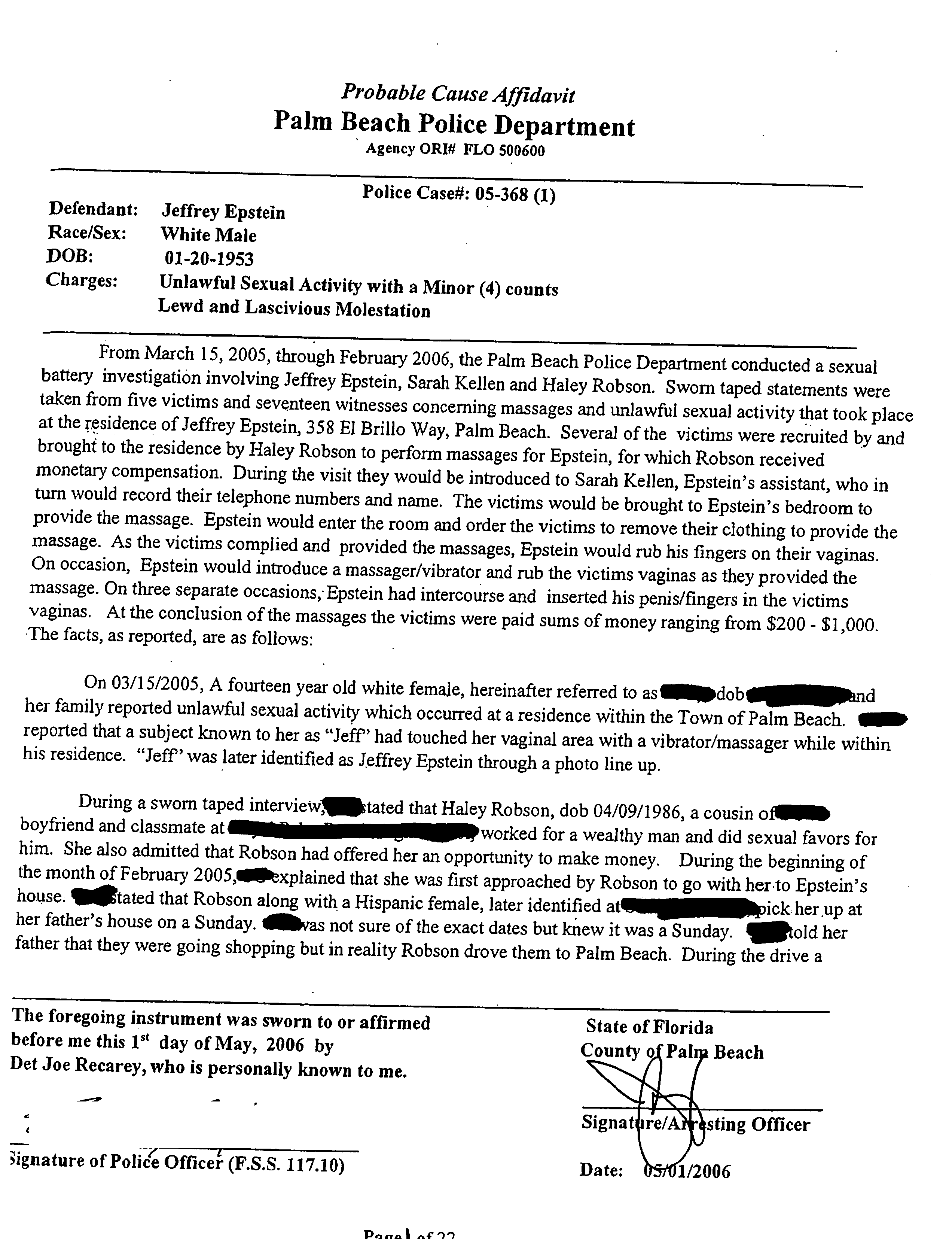
Page 422
document
2544 x 3312
Objects: Page, Text, Letter | Text: Probable Cause Affidavit | Palm Beach Police Department | Agency

Page 422
document
657 x 371
Objects: Handwriting, Text, Signature, Bow, Weapon | Text: County of Palm Beach | Date: | 05/01/2006
Page 422
document
619 x 141
Objects: Handwriting, Text, Signature
Page 423
document
2550 x 3312
Objects: Page, Text, Letter | Text: Probable Cause Affidavit | Palm Beach Police Department | Agency

Page 423
document
655 x 364
Objects: Handwriting, Text, Signature | Text: County ofPalm Beach | Date: | 05/01/2006
Page 423
document
606 x 158
Objects: Handwriting, Text, Signature
Page 424
document
2547 x 3309
Objects: Letter, Text, Page | Text: Probable Cause Affidavit | Palm Beach Police Department | Agency

Page 424
document
655 x 337
Objects: Handwriting, Text, Signature, Bow, Weapon | Text: Signa | Date: | 05/01/2006

Page 424
document
949 x 154
Objects: Handwriting, Text, Signature
Page 425
document
2544 x 3309
Objects: Letter, Text, Page | Text: Probable Cause Affidavit | Palm Beach Police Department | Agency

Page 425
document
657 x 375
Objects: Handwriting, Text, Signature | Text: County of Palm Beach | Signatur | Arresting Officer |
Page 425
document
263 x 109
Objects: Handwriting, Text, Signature, Bow, Weapon
Page 426
document
2547 x 3312
Objects: Letter, Text, Page | Text: Probable Cause Affidavit | Palm Beach Police Department | Agency
Page 426
document
659 x 443
Objects: Handwriting, Text, Signature | Text: State of Florida | County of Palm Beach | Signature/Ar
Page 426
document
689 x 182
Objects: Handwriting, Text, Signature | Text: gnature of Police Officer (F.S.S.
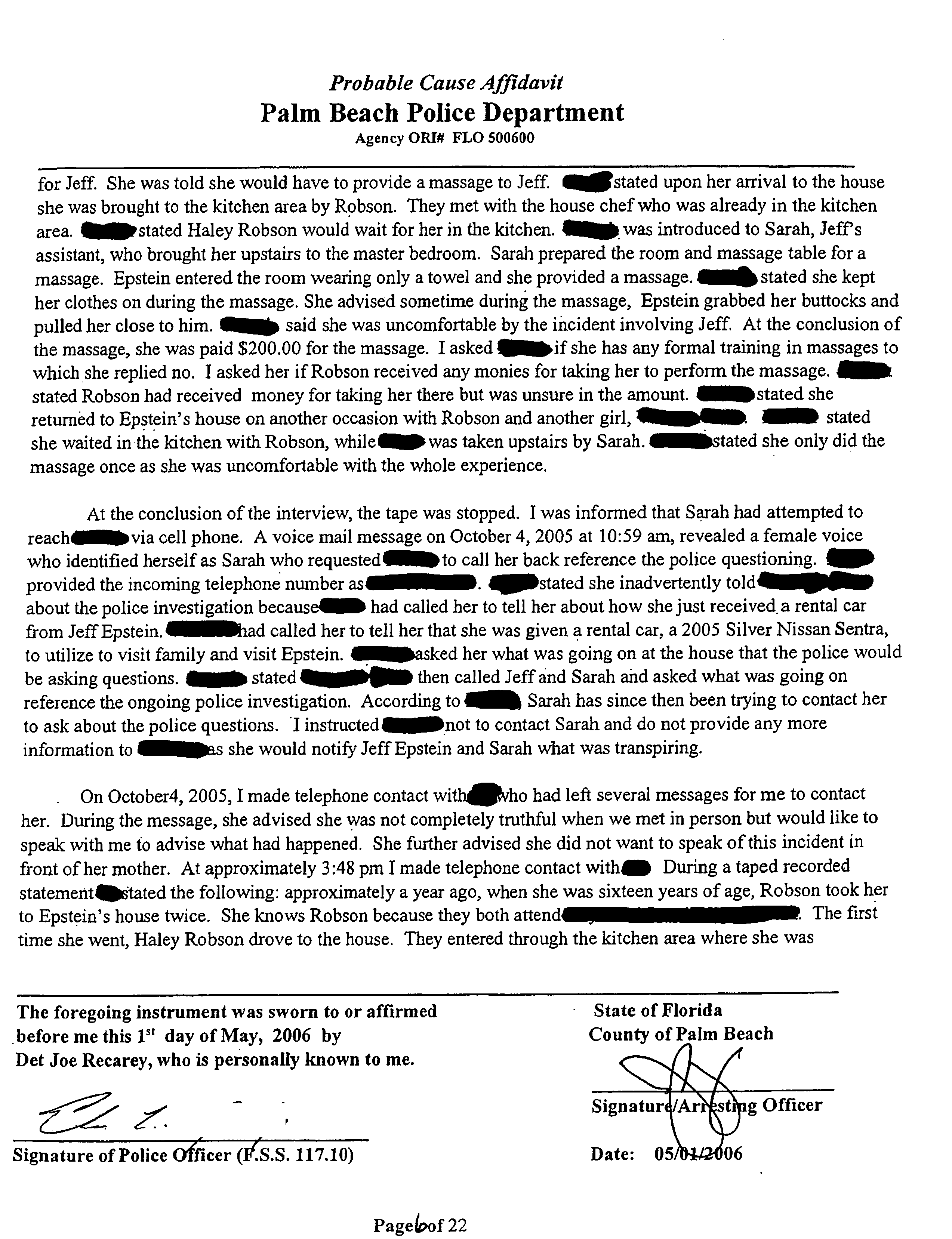
Page 427
document
2547 x 3315
Objects: Letter, Text, Page | Text: Probable Cause Affidavit | Palm Beach Police Department | Agency

Page 427
document
659 x 367
Objects: Handwriting, Text, Signature, Bow, Weapon | Text: County of Palm Beach | Signature/Arrestin
Page 427
document
334 x 107
Objects: Handwriting, Text, Signature, Bow, Weapon
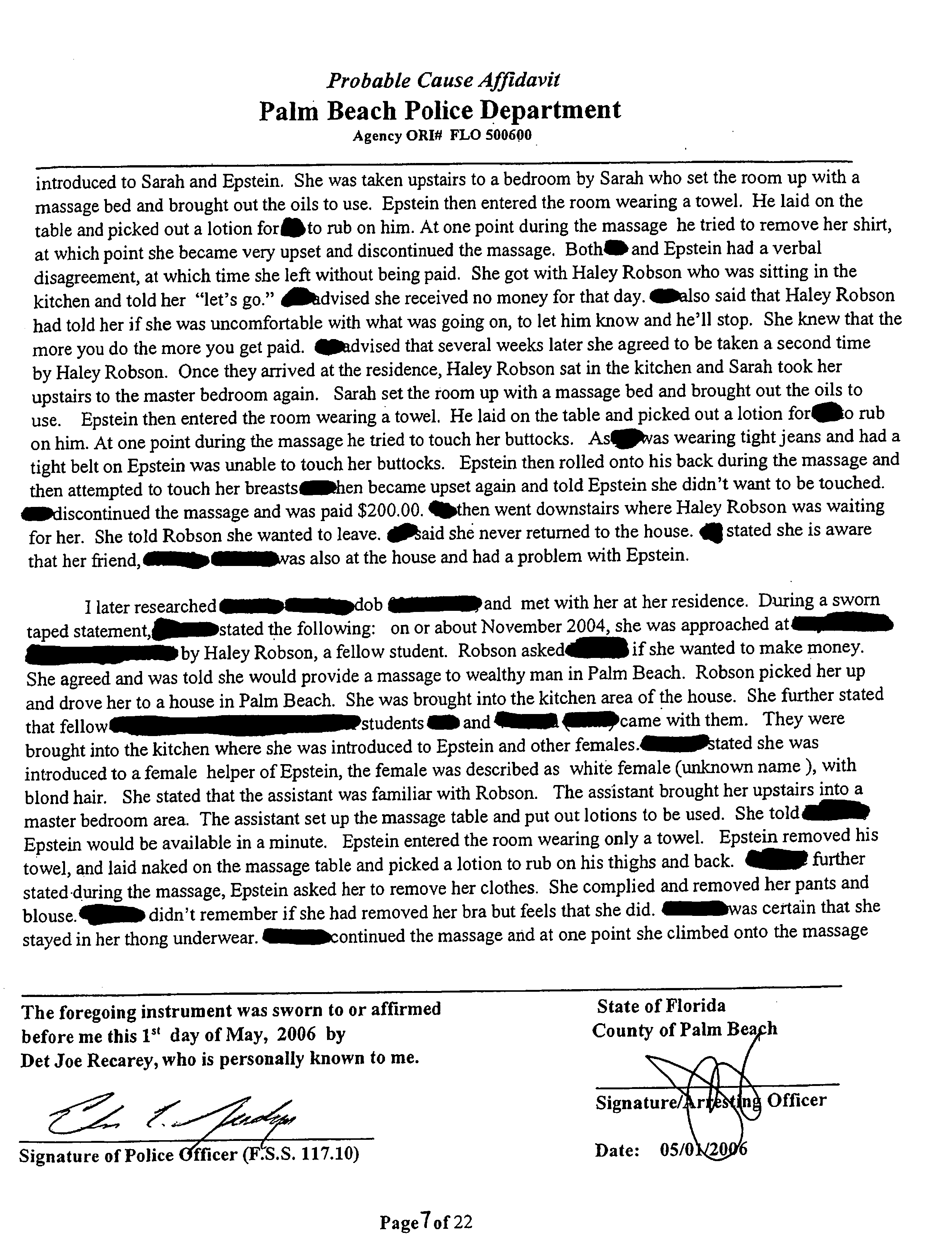
Page 428
document
2547 x 3309
Objects: Letter, Text, Page | Text: Probable Cause Affidavit | Palm Beach Police Department | Agency

Page 428
document
662 x 384
Objects: Handwriting, Text, Signature | Text: County of Palm Beach | Officer | Date: | 05/01/2006
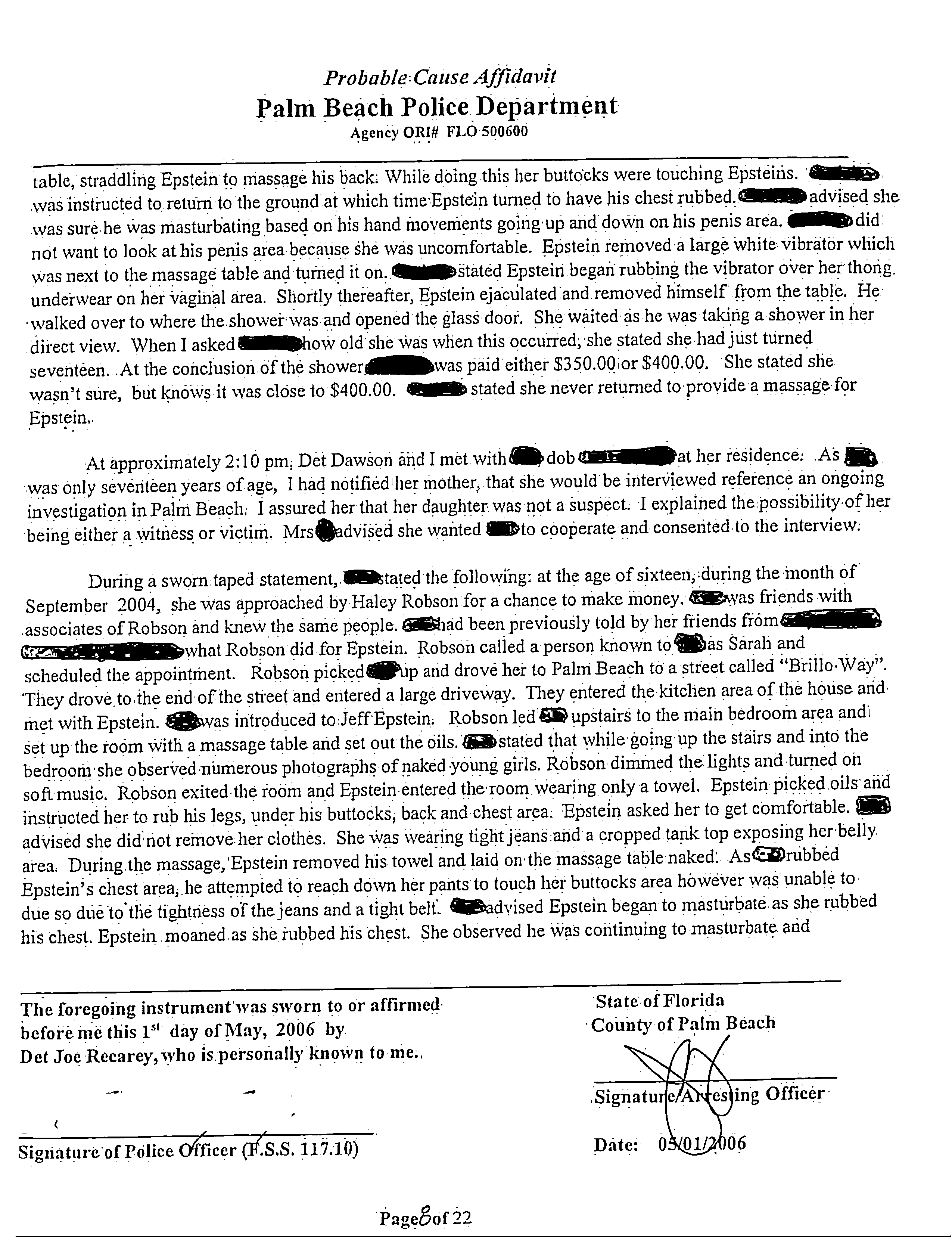
Page 429
document
2550 x 3312
Objects: Letter, Text, Page | Text: Probable:Cause Affidavit | Palm Beach Police Department | Agency

Page 429
document
668 x 333
Objects: Handwriting, Text, Signature, Face, Head, Person | Text: Date: 05/01/2006
Page 429
document
470 x 192
Objects: Text | Text: stein ejaculated and ren | glass door. She waited

Page 429
document
643 x 117
Objects: Handwriting, Text, Signature
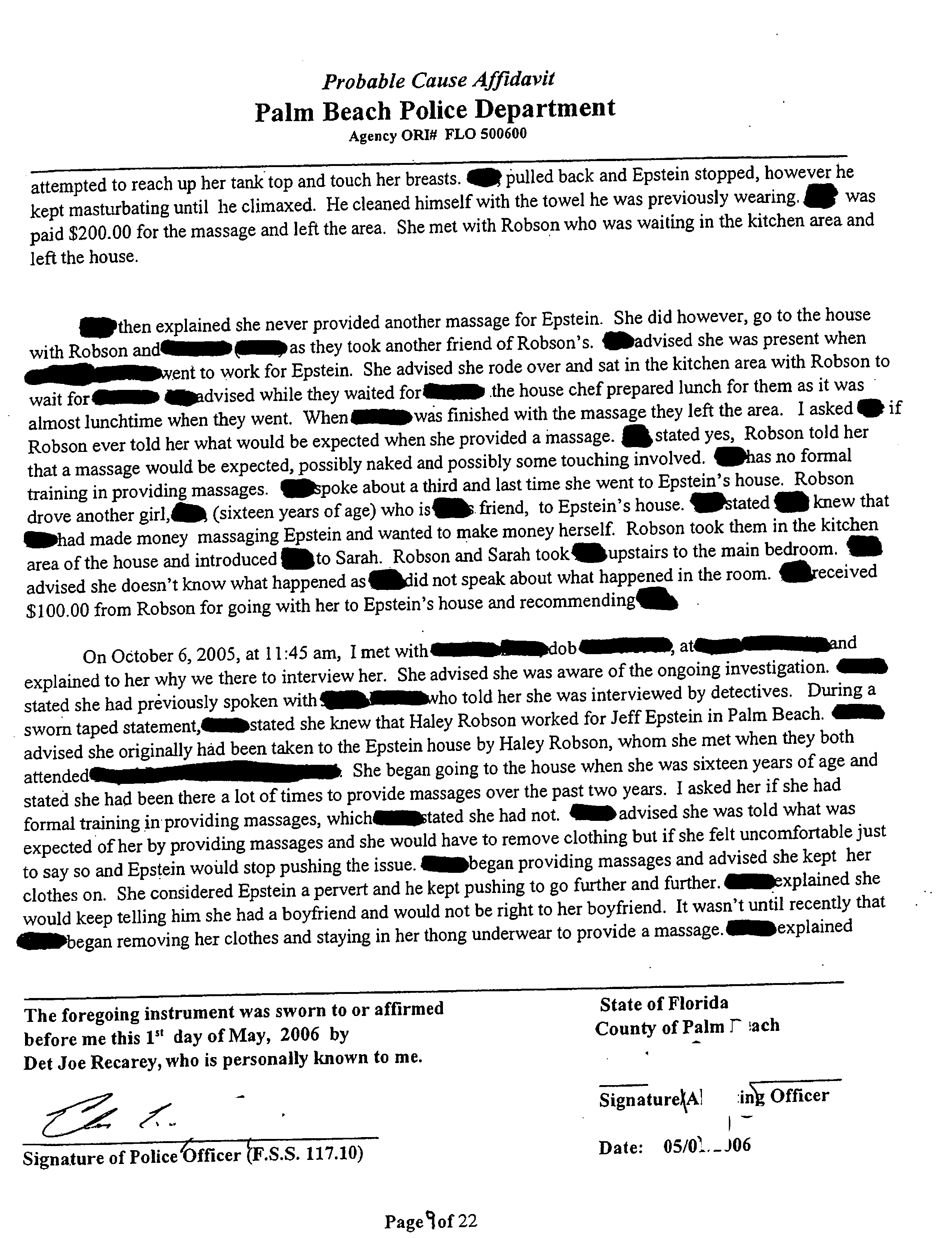
Page 430
document
2547 x 3312
Objects: Page, Text, Letter | Text: Probable Cause Affidavit | Palm Beach Police Department | Agency
Page 430
document
301 x 123
Objects: Handwriting, Text, Signature, Bow, Weapon
Page 430
document
321 x 360
Objects: Handwriting, Text, Signature
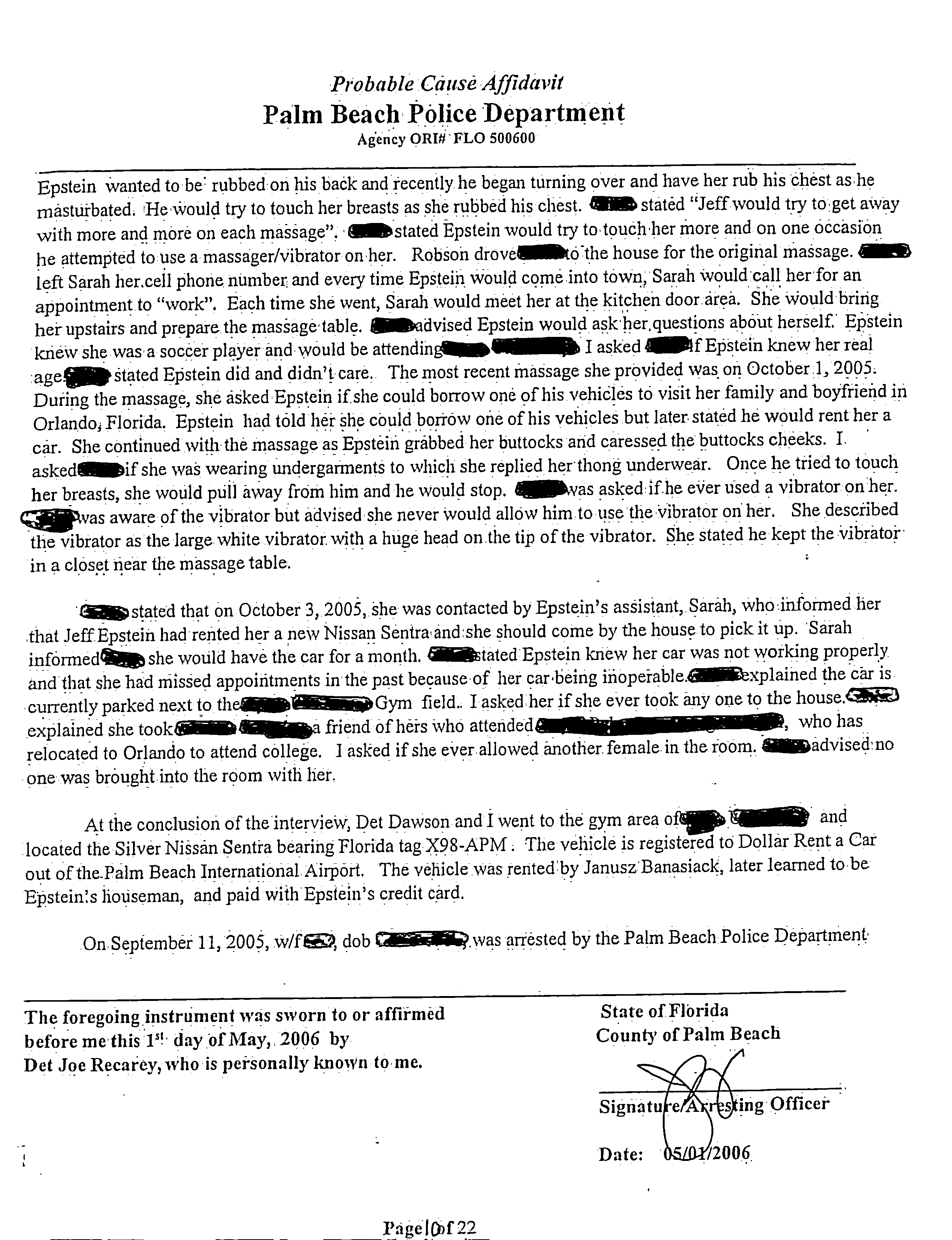
Page 431
document
2541 x 3309
Objects: Letter, Text, Page | Text: Probable Cause Affidavit | Palm Beach Police Department | Agency

Page 431
document
668 x 317
Objects: Handwriting, Text, Signature, Ammunition, Grenade, Weapon | Text: Date: | 05/01/2006
Page 431
document
953 x 215
Objects: Handwriting, Text, Signature | Text: Signature of Police Officer (F.S.S. 117.10)
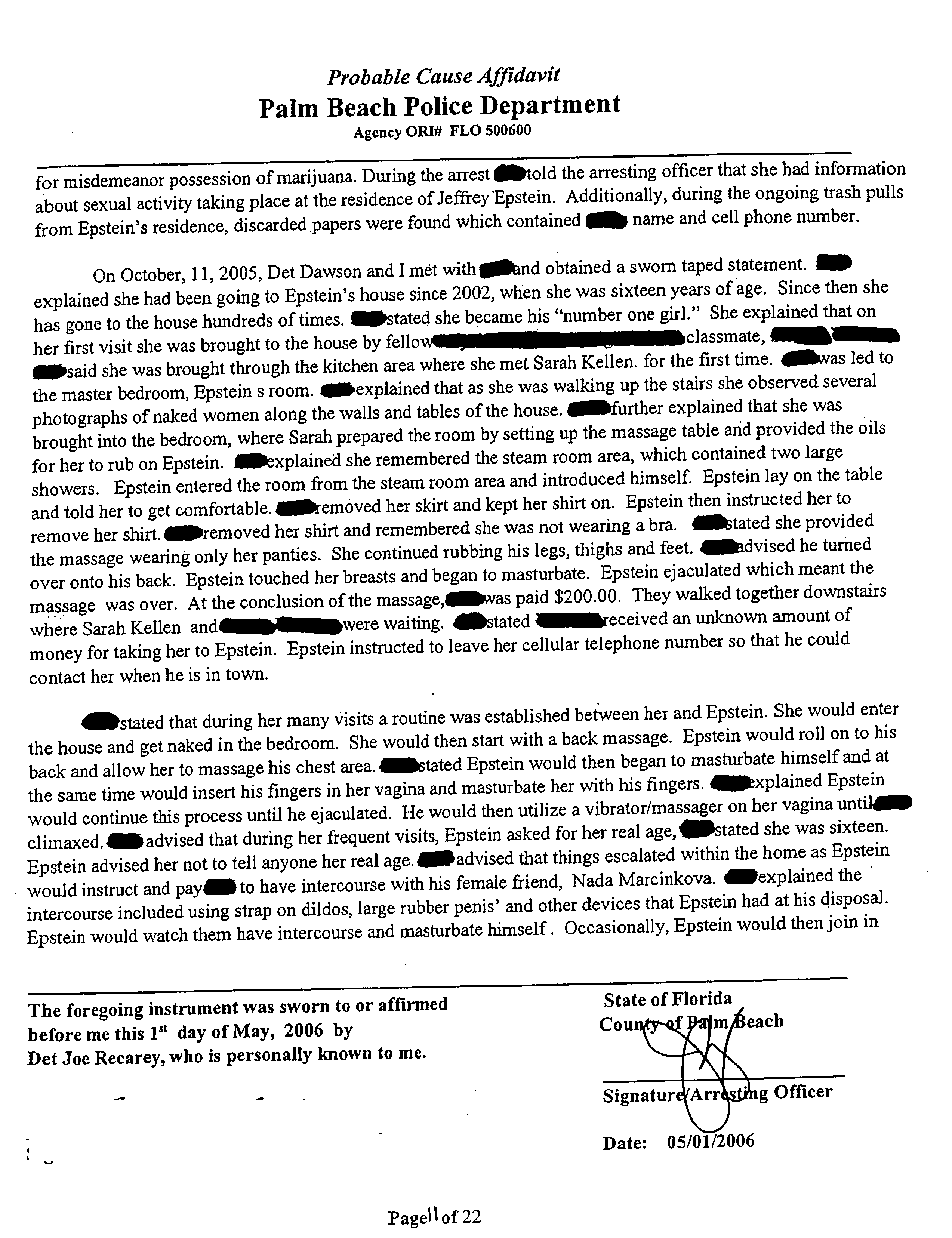
Page 432
document
2547 x 3312
Objects: Letter, Text, Page | Text: Probable Cause Affidavit | Palm Beach Police Department | Agency

Page 432
document
666 x 389
Objects: Handwriting, Text, Signature, Smoke Pipe | Text: County of Palm Beach | Signature/Arresting

Page 432
document
953 x 181
Objects: Handwriting, Text, Signature | Text: Signature of Police Officer (F.S.S. 117.10)
Page 433
document
2547 x 3315
Objects: Letter, Text, Page | Text: Probable Cause Affidavit | Palm Beach Police Department | Agency

Page 433
document
670 x 396
Objects: Handwriting, Text, Signature, Face, Head, Person | Text: County of Palm Beach | Date: | 05/
Page 433
document
431 x 122
Objects: Handwriting, Text, Signature, Bow, Weapon
Page 434
document
2547 x 3309
Objects: Letter, Text, Page | Text: Probable Cause Affidavit | Palm Beach Police Department | Agency
Page 434
document
383 x 149
Objects: Handwriting, Text, Signature, Bow, Weapon
Page 434
document
381 x 311
Objects: Handwriting, Text, Signature, Bow, Weapon, Smoke Pipe
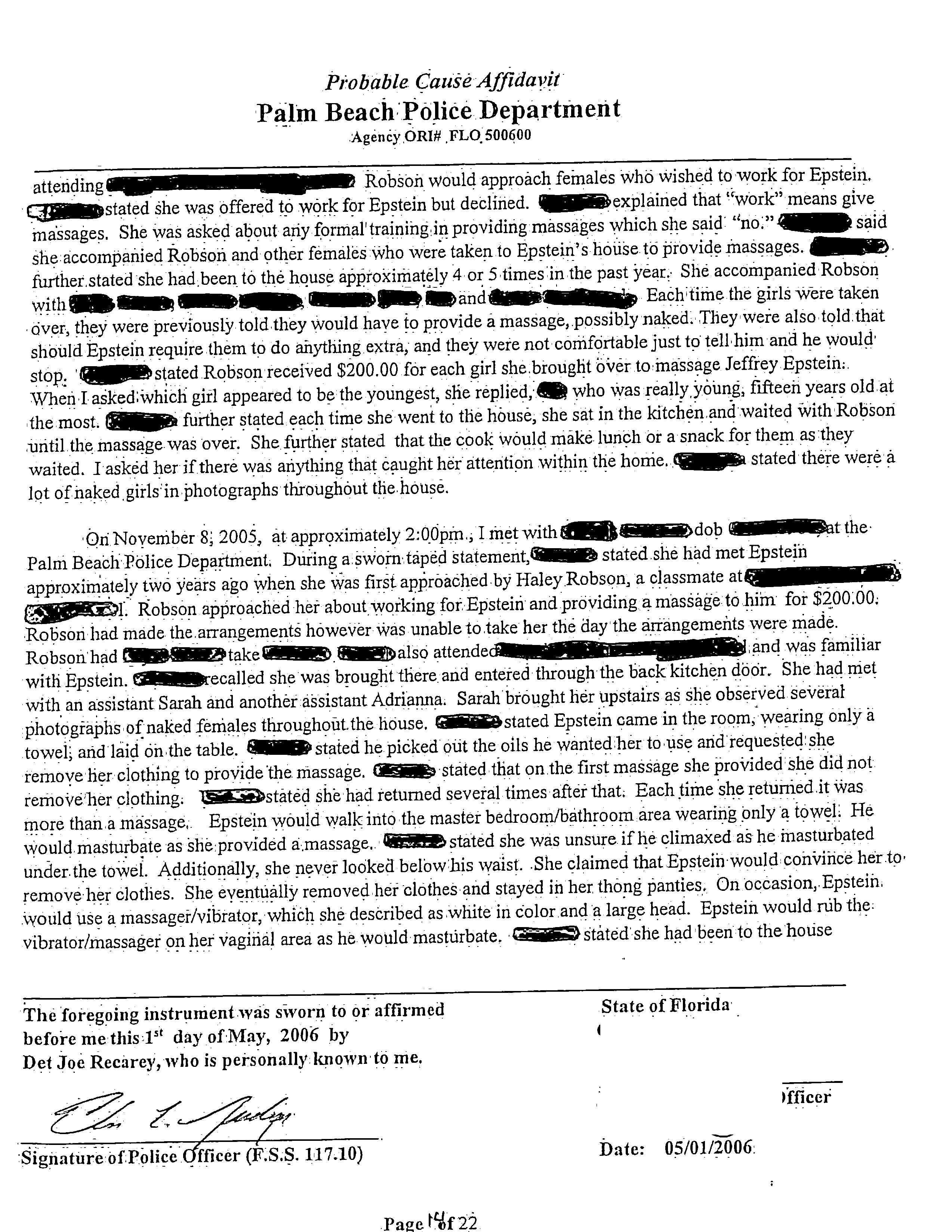
Page 435
document
2547 x 3297
Objects: Letter, Text, Page | Text: Probable Cause Affidavit | Palm Beach Police Department | Agency
Page 435
document
503 x 327
Objects: Handwriting, Text, Signature, Ammunition, Grenade, Weapon | Text: County of Palm Beach
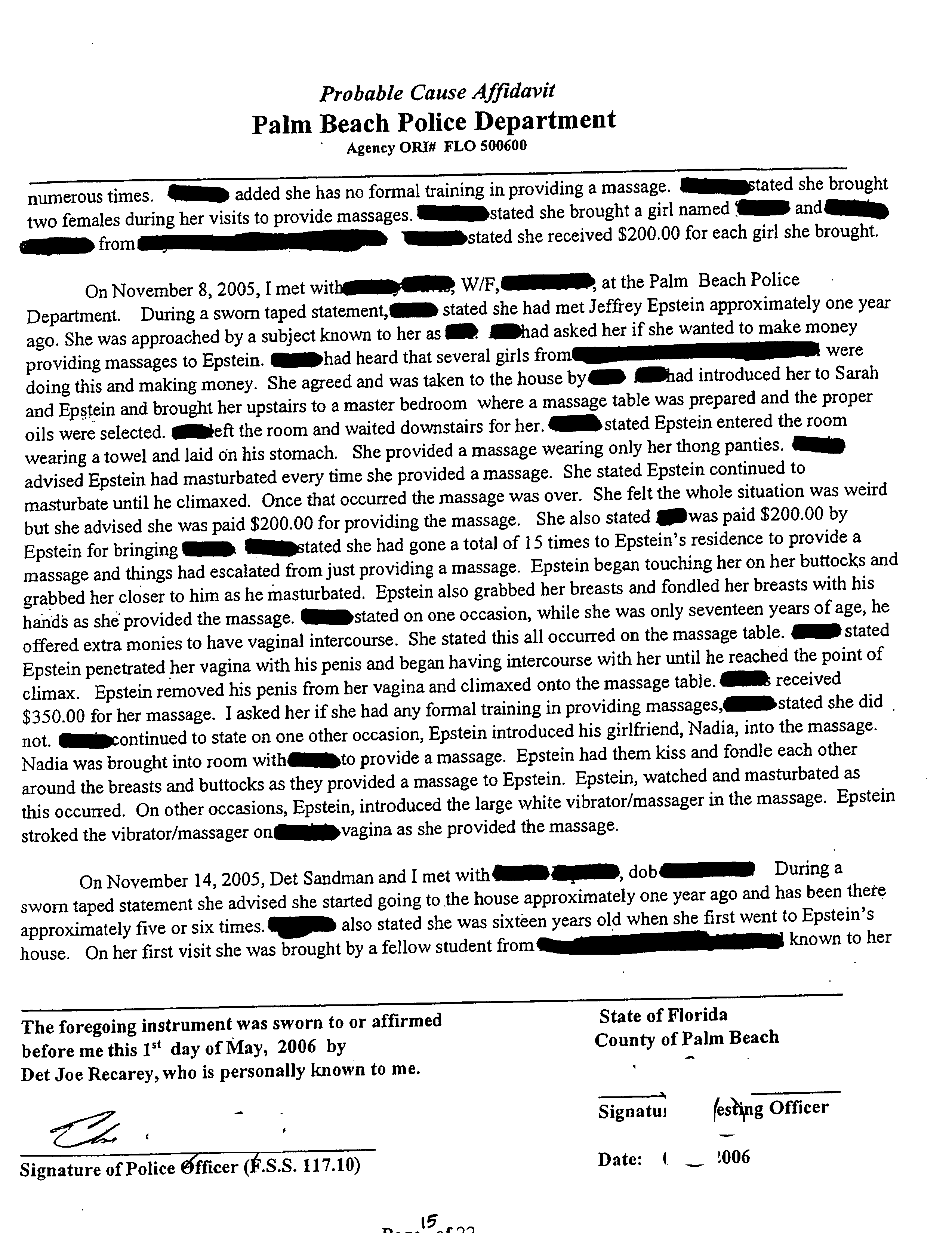
Page 436
document
2547 x 3300
Objects: Letter, Text, Page | Text: Probable Cause Affidavit | Palm Beach Police Department | Agency
Page 436
document
376 x 117
Objects: Handwriting, Text, Signature, Bow, Weapon
Page 436
document
325 x 299
Objects: Handwriting, Text, Bow, Weapon, Signature | Text: 05/01/20
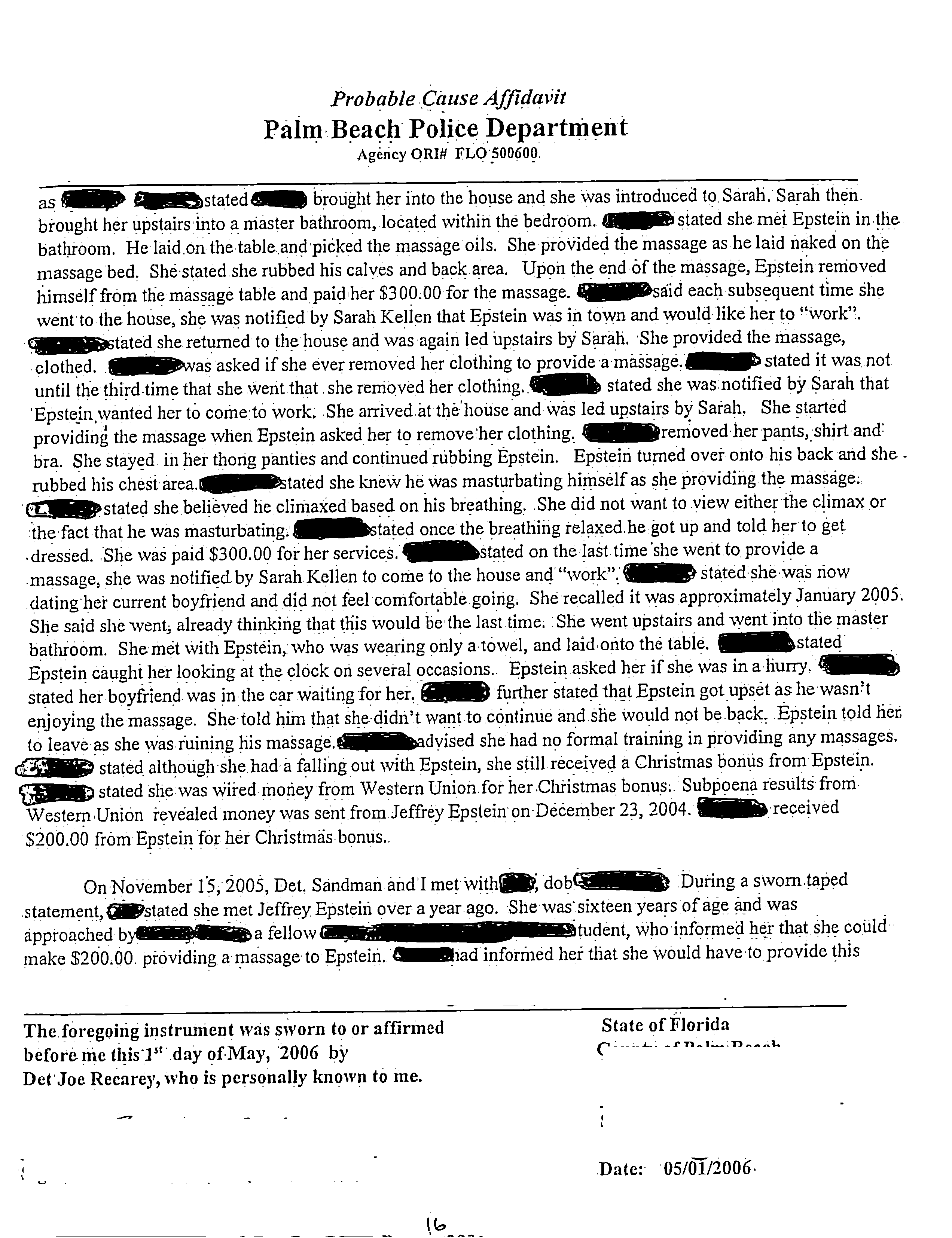
Page 437
document
2544 x 3309
Objects: Letter, Text, Page | Text: Probable Cause Affidavit | Palm Beach Police Department | Agency
Page 437
document
351 x 242
Objects: Text, Car, Transportation, Vehicle, Footprint | Text: to leave as she | stated | stated

Page 437
document
952 x 183
Objects: Handwriting, Text, Signature | Text: Signature of Police Officer (F.S.S. 117.10)
Page 437
document
651 x 311
Objects: Handwriting, Text, Signature | Text: Officer
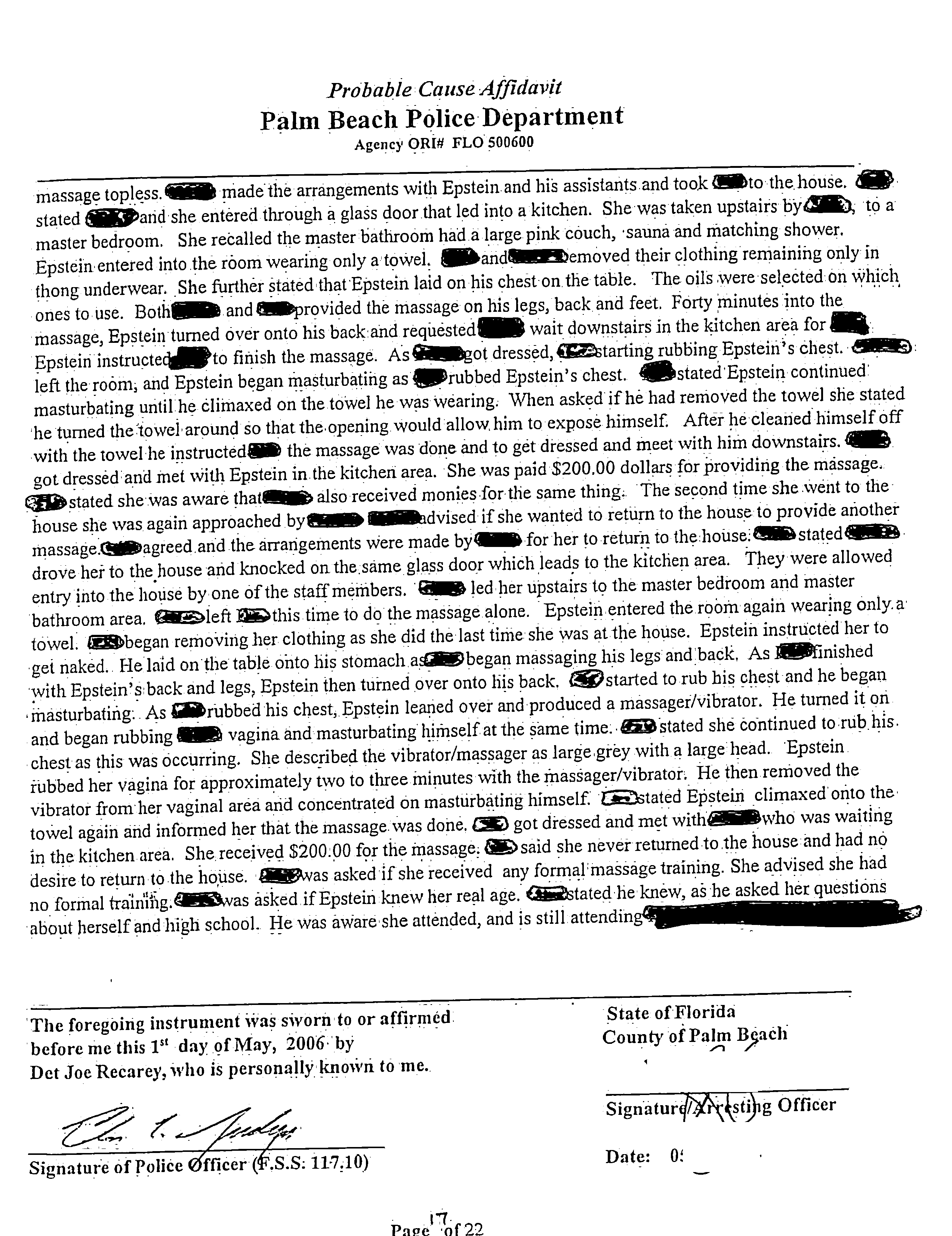
Page 438
document
2547 x 3306
Objects: Letter, Text, Page | Text: Probable Cause Affidavit | Palm Beach Police Department | Agency
Page 438
document
313 x 125
Objects: Handwriting, Text, Bow, Weapon, Signature
Page 438
document
217 x 150
Objects: Text, Handwriting, Smoke Pipe | Text: /01/2006
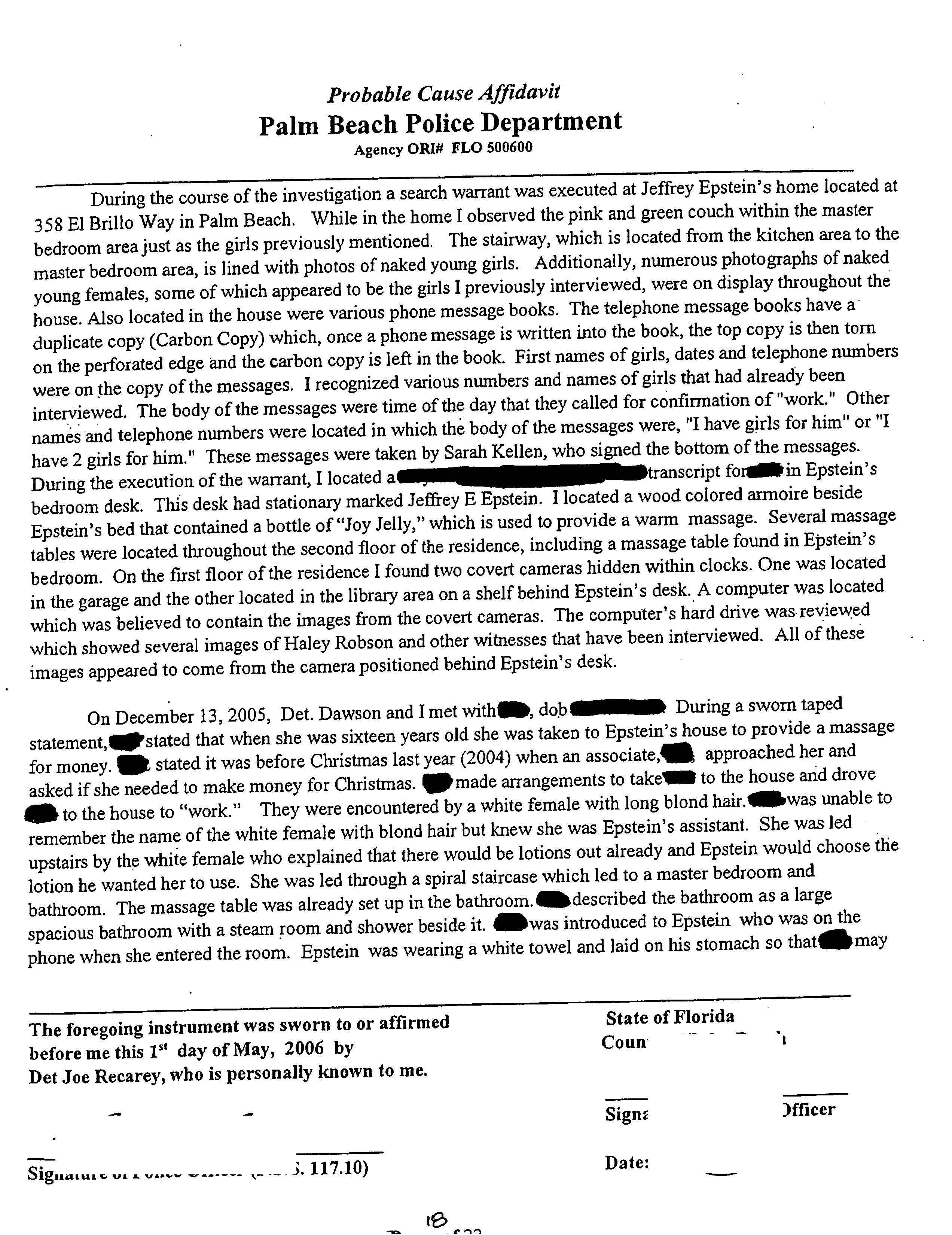
Page 439
document
2544 x 3300
Objects: Page, Text, Letter | Text: Probable Cause Affidavit | Palm Beach Police Department | Agency
Page 439
document
377 x 388
Objects: Handwriting, Text, Signature, Bow, Weapon | Text: ty of Palm Beach | Q1/200
Page 439
document
660 x 173
Objects: Handwriting, Text, Signature | Text: nature of Police Officer (F.S.S
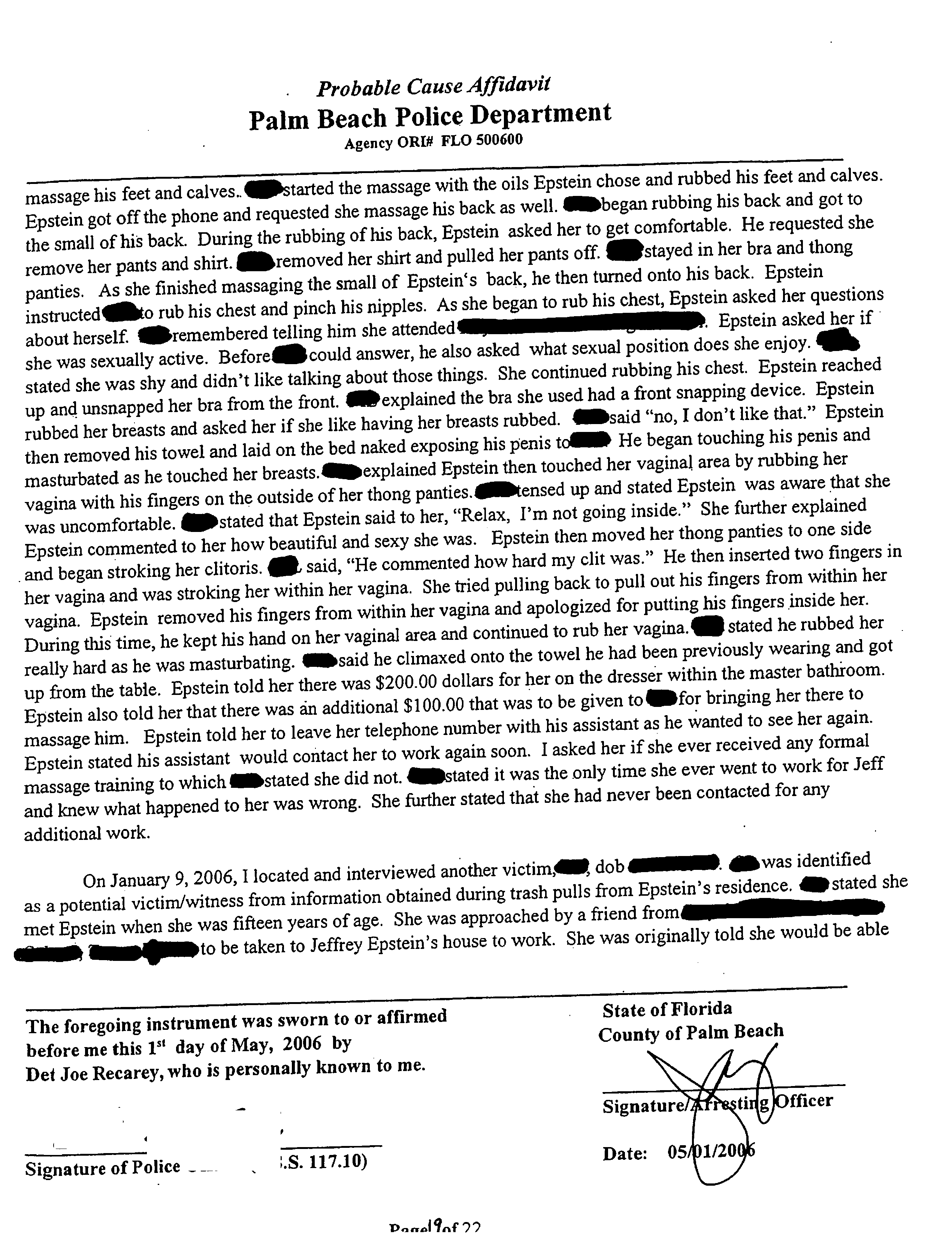
Page 440
document
2541 x 3294
Objects: Letter, Text, Page | Text: Probable Cause Affidavit | Palm Beach Police Department | Agency

Page 440
document
657 x 391
Objects: Handwriting, Text, Signature, Bow, Weapon | Text: Signature/ Officer | Date: | 05/01/2006
Page 440
document
200 x 125
Objects: Handwriting, Text, Signature, Bow, Weapon
Page 440
document
373 x 177
Objects: Handwriting, Text, Signature, Bow, Weapon | Text: Officer F.S
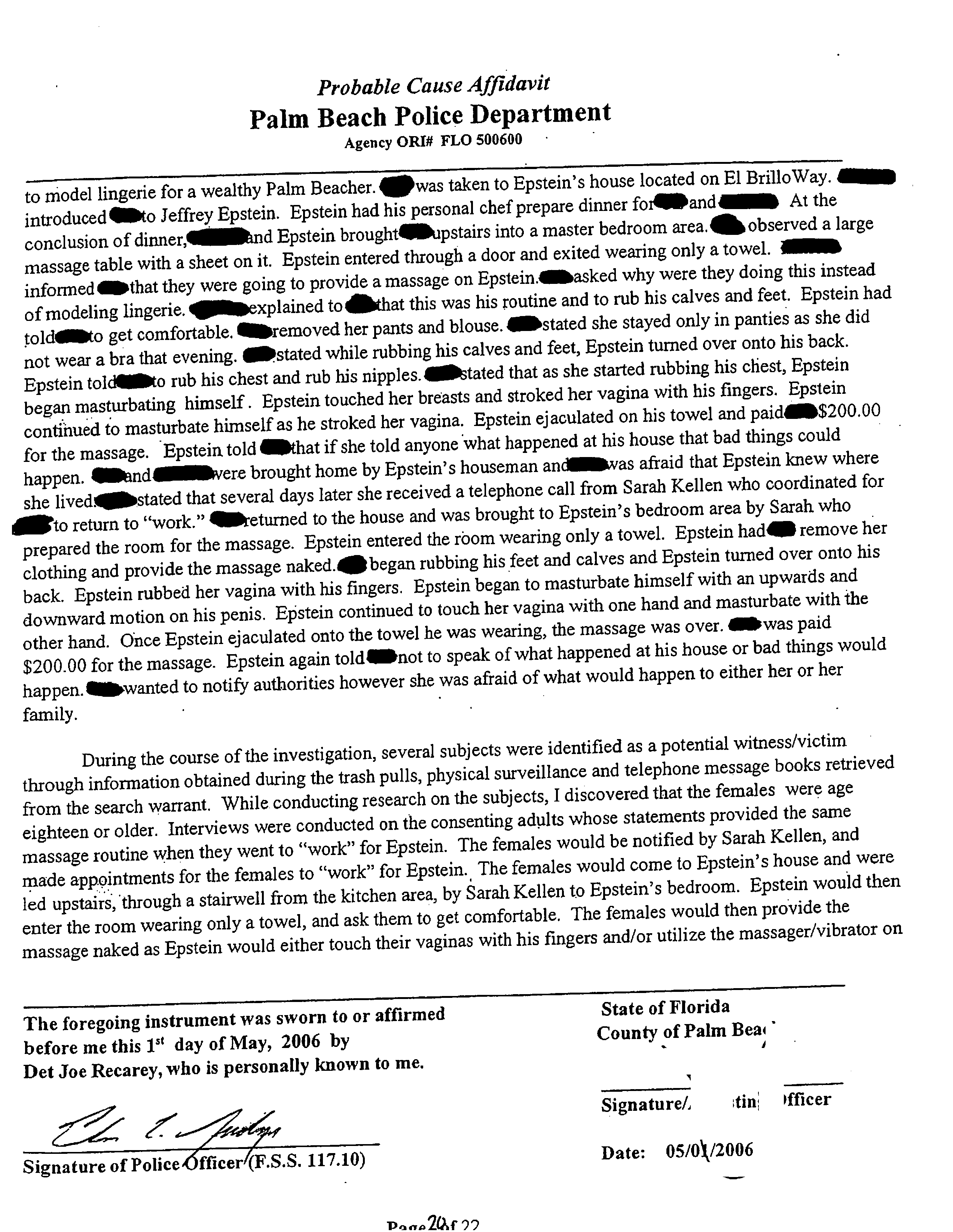
Page 441
document
2547 x 3294
Objects: Letter, Text, Page | Text: Probable Cause Affidavit | Palm Beach Police Department | Agency
Page 441
document
336 x 425
Objects: Handwriting, Text, Signature, Bow, Weapon | Text: Alt
Page 442
document
2547 x 3294
Objects: Page, Text, Letter | Text: Probable Cause Affidavit | Palm Beach Police Department | Agency
Page 442
document
281 x 121
Objects: Handwriting, Text, Signature, Bow, Weapon
Page 442
document
309 x 398
Objects: Handwriting, Text, Signature, Face, Head, Person, Baby

Page 442
photo
309 x 8
No significant content detected
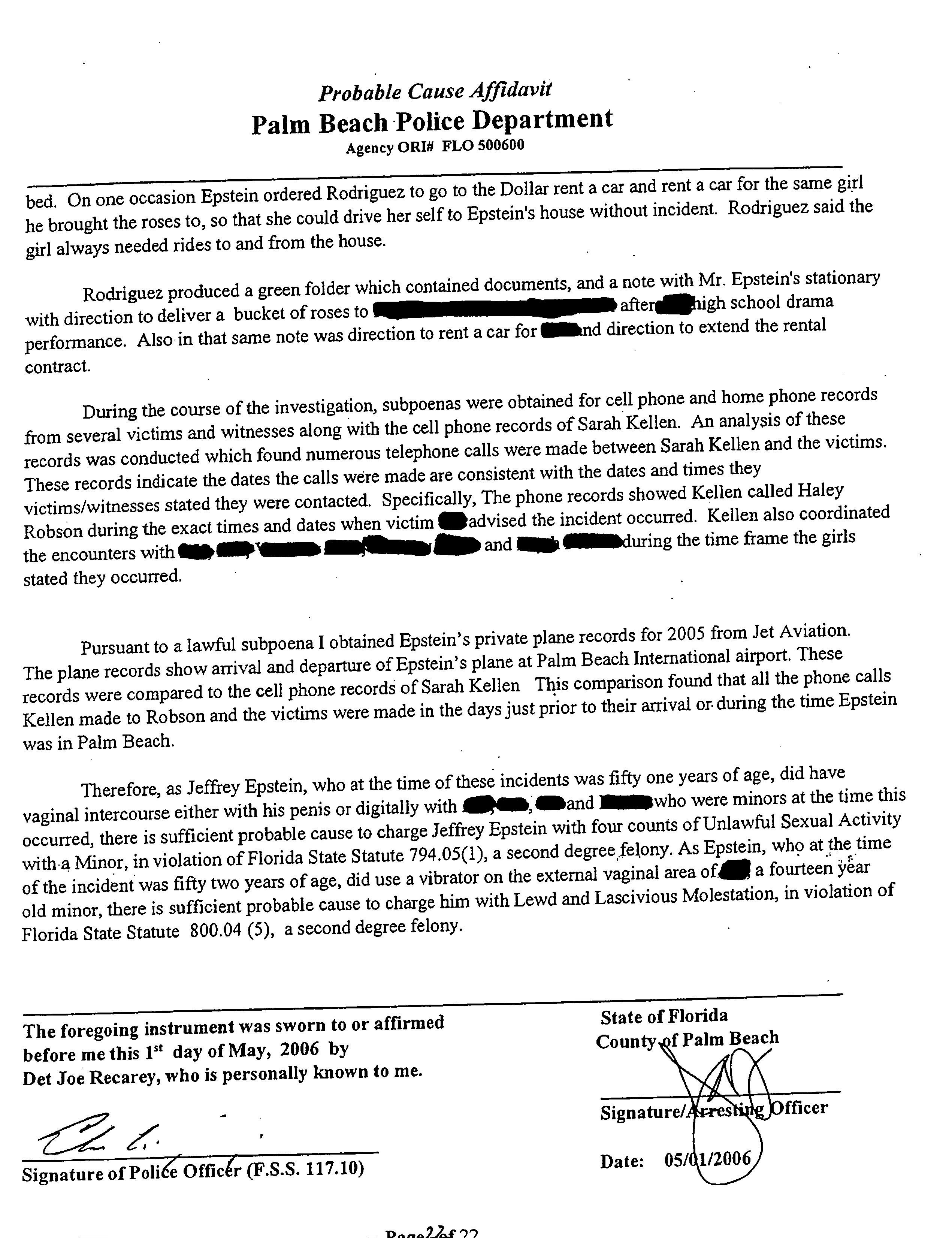
Page 443
document
2541 x 3309
Objects: Text, Page | Text: Probable Cause Affidavit | Palm Beach Police Department | Agency ORI# FL

Page 443
document
661 x 424
Objects: Handwriting, Text, Signature | Text: County of Palm Beach | Officer | Date: | 05/01/2006
Page 443
document
287 x 114
Objects: Handwriting, Text, Signature, Animal, Fish, Sea Life, Shark
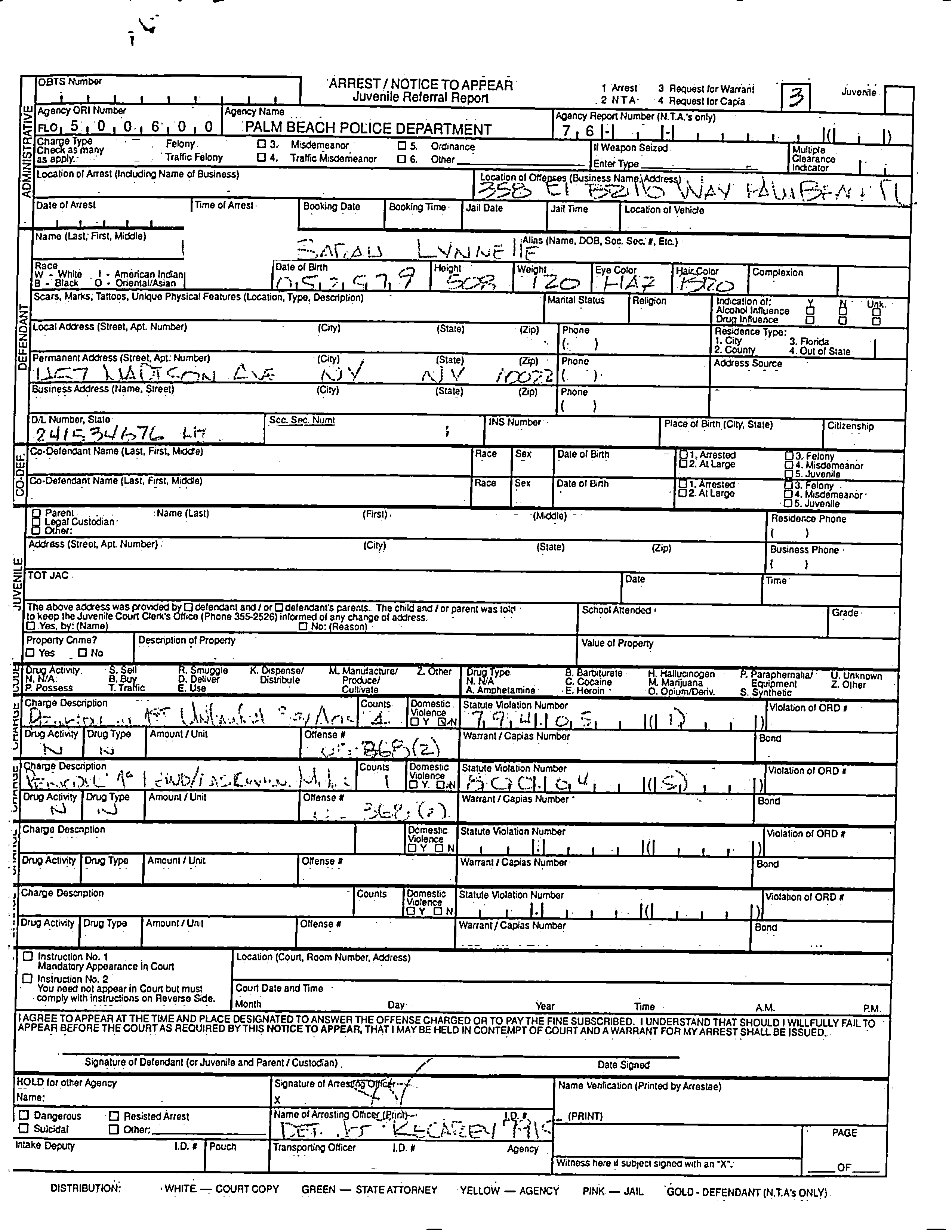
Page 444
document
2547 x 3297
Objects: Text, Document, Form | Text: OBTS Number | ARREST/NOTICE TO APPEAR | 3 Request for Warrant

Page 444
photo
85 x 72
Objects: Stencil, Robot

Page 444
document
525 x 87
Objects: Handwriting, Text | Text: Occupation

Page 444
document
501 x 88
Objects: Stencil, Text, Book, Publication | Text: Sec. Sec. Number

Page 444
document
84 x 84
Objects: White Board, Text
Page 444
document
319 x 252
Objects: Handwriting, Text | Text: Sex
Page 444
document
190 x 83
Objects: Stencil, Text, Handwriting, Blackboard | Text: Build | -
Page 444
document
143 x 87
Objects: White Board, Text, Blackboard | Text: Counts | -

Page 444
document
667 x 91
Objects: White Board, Electronics, Screen, Text

Page 445
document
2547 x 3309
Objects: Page, Text, White Board

Page 445
document
498 x 69
Objects: Text, Stencil
Page 445
photo
376 x 117
Objects: People, Person, Stencil, Stain, Water, Art
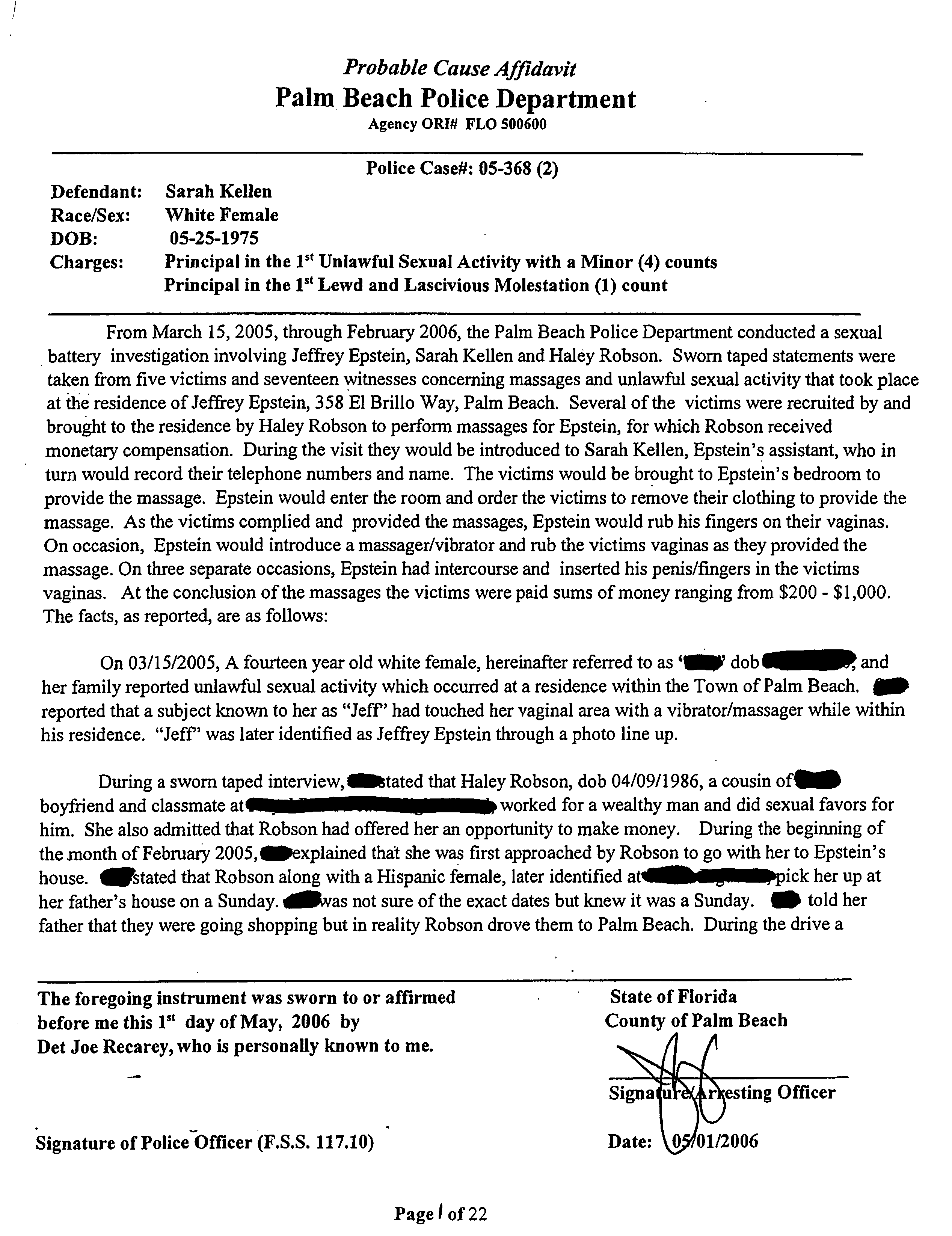
Page 446
document
2535 x 3291
Objects: Letter, Text, Page | Text: Probable Cause Affidavit | Palm Beach Police Department | Agency

Page 446
document
648 x 336
Objects: Handwriting, Text, Signature, Bow, Weapon | Text: Signa | Date: | 05/01/2006

Page 446
document
942 x 154
Objects: Handwriting, Text, Signature
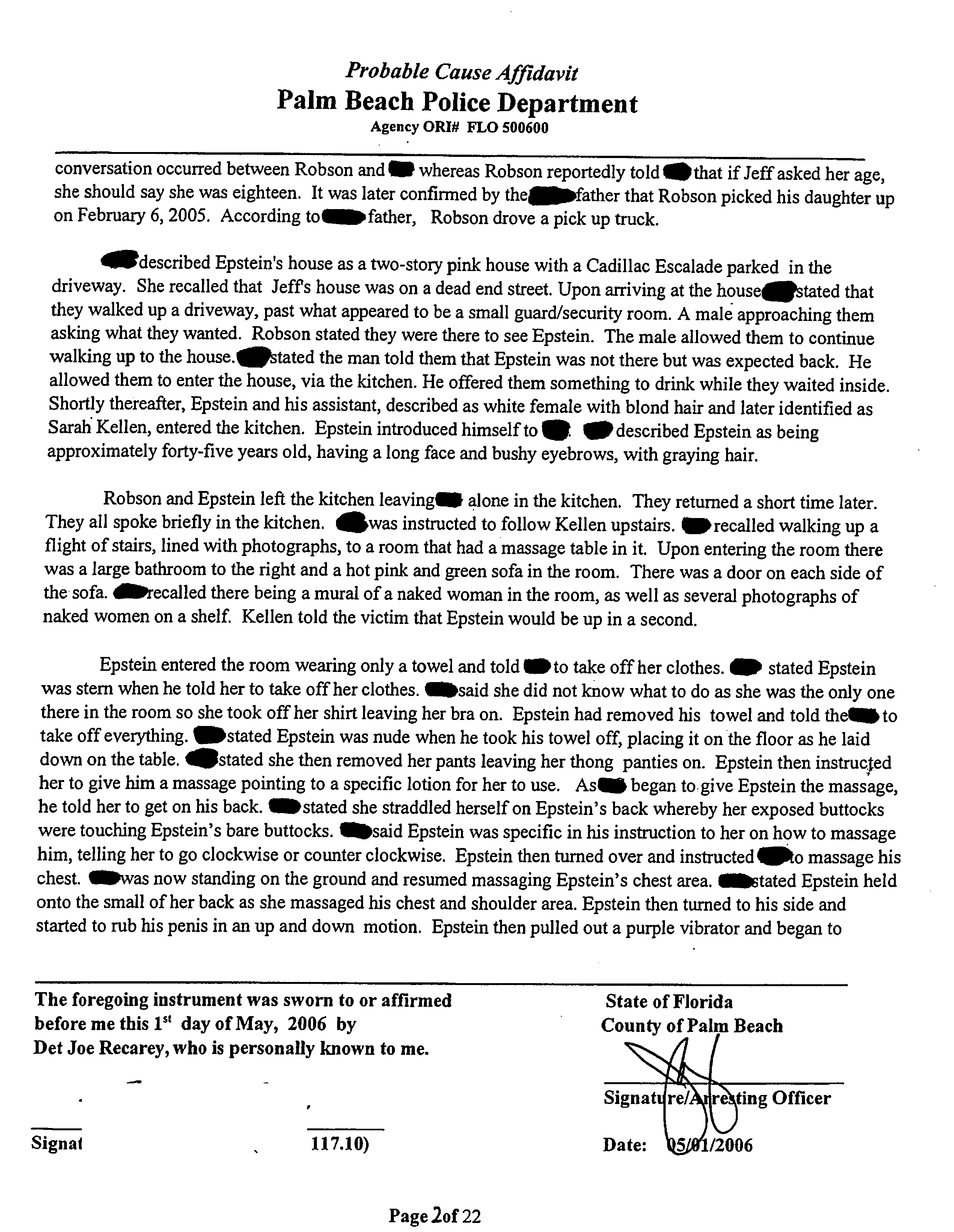
Page 447
document
2541 x 3282
Objects: Letter, Text, Page | Text: Probable Cause Affidavit | Palm Beach Police Department | Agency

Page 447
document
649 x 375
Objects: Handwriting, Text, Signature, Bow, Weapon | Text: County of Palm Beach | Signature/Aprestin
Page 447
document
616 x 194
Objects: Handwriting, Text, Signature | Text: ture of Police Officer (F.S.S.
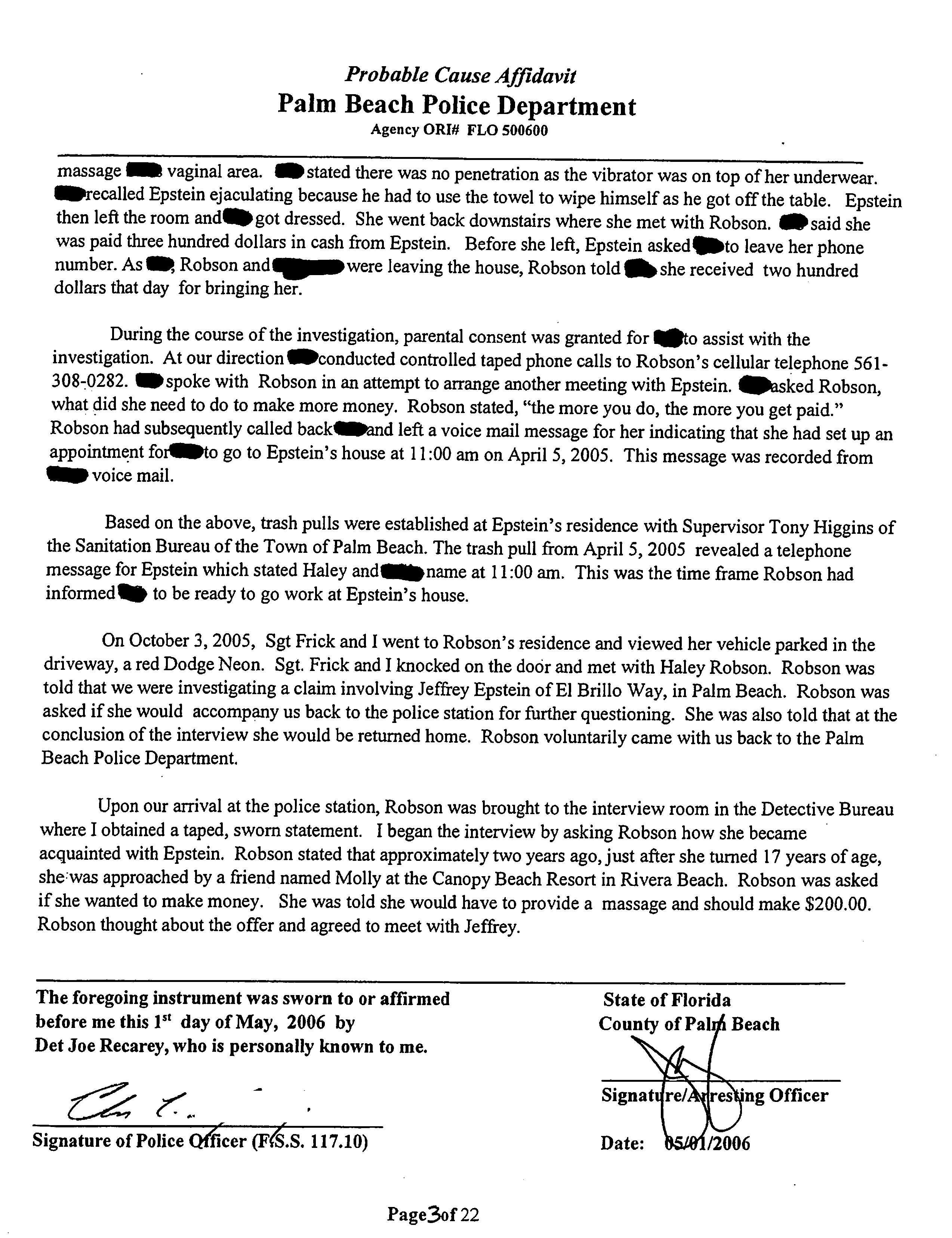
Page 448
document
2547 x 3312
Objects: Letter, Text, Page | Text: Probable Cause Affidavit | Palm Beach Police Department | Agency

Page 448
document
650 x 374
Objects: Handwriting, Text, Signature | Text: County of Palm Beach | Date: | 05/01/2006
Page 448
document
318 x 101
Objects: Handwriting, Text, Signature
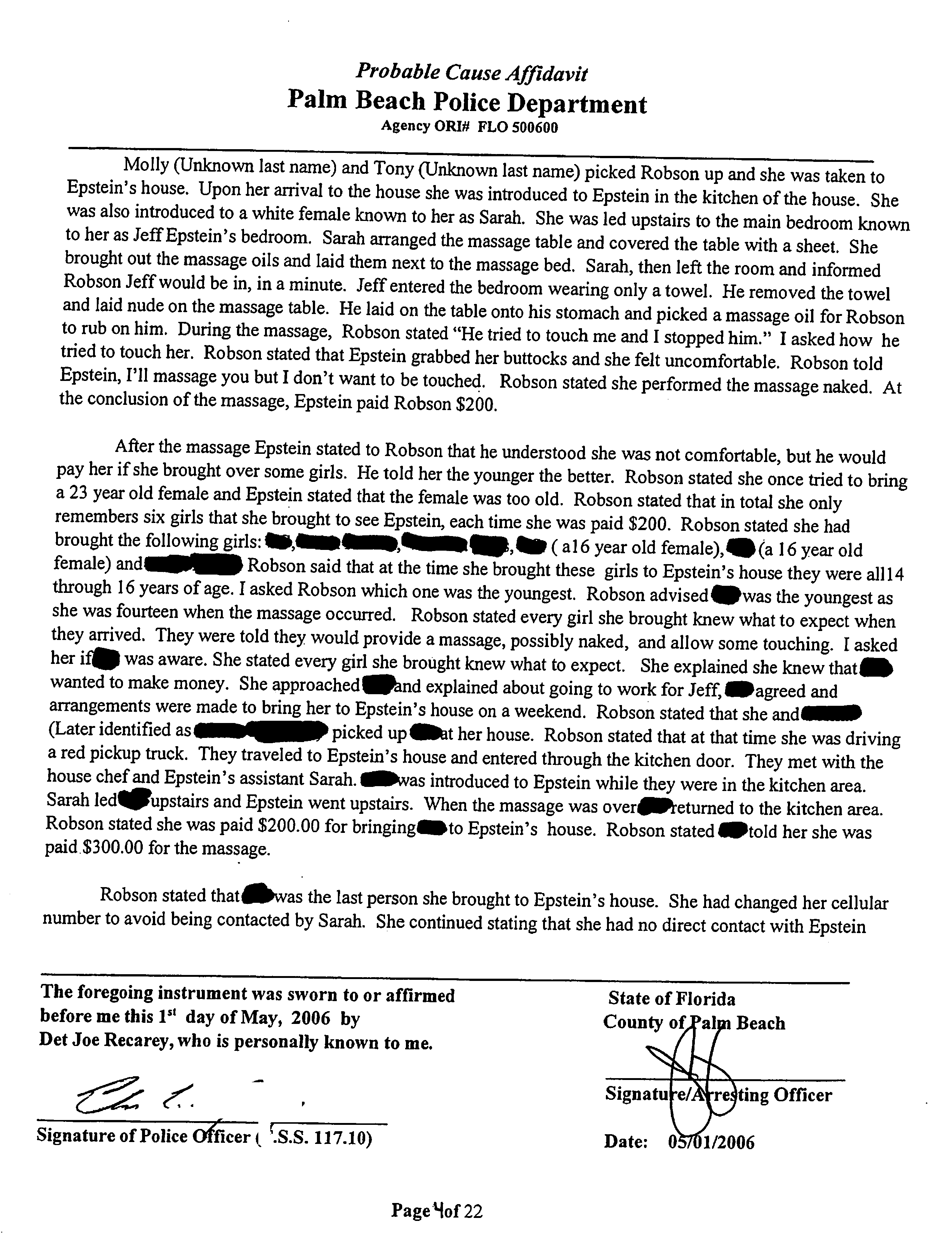
Page 449
document
2547 x 3309
Objects: Letter, Text, Page | Text: Probable Cause Affidavit | Palm Beach Police Department | Agency

Page 449
document
651 x 367
Objects: Handwriting, Text, Signature | Text: County of Palm Beach | Signature/Afresting Officer | D
Page 449
document
307 x 183
Objects: Handwriting, Text, Signature, Bow, Weapon
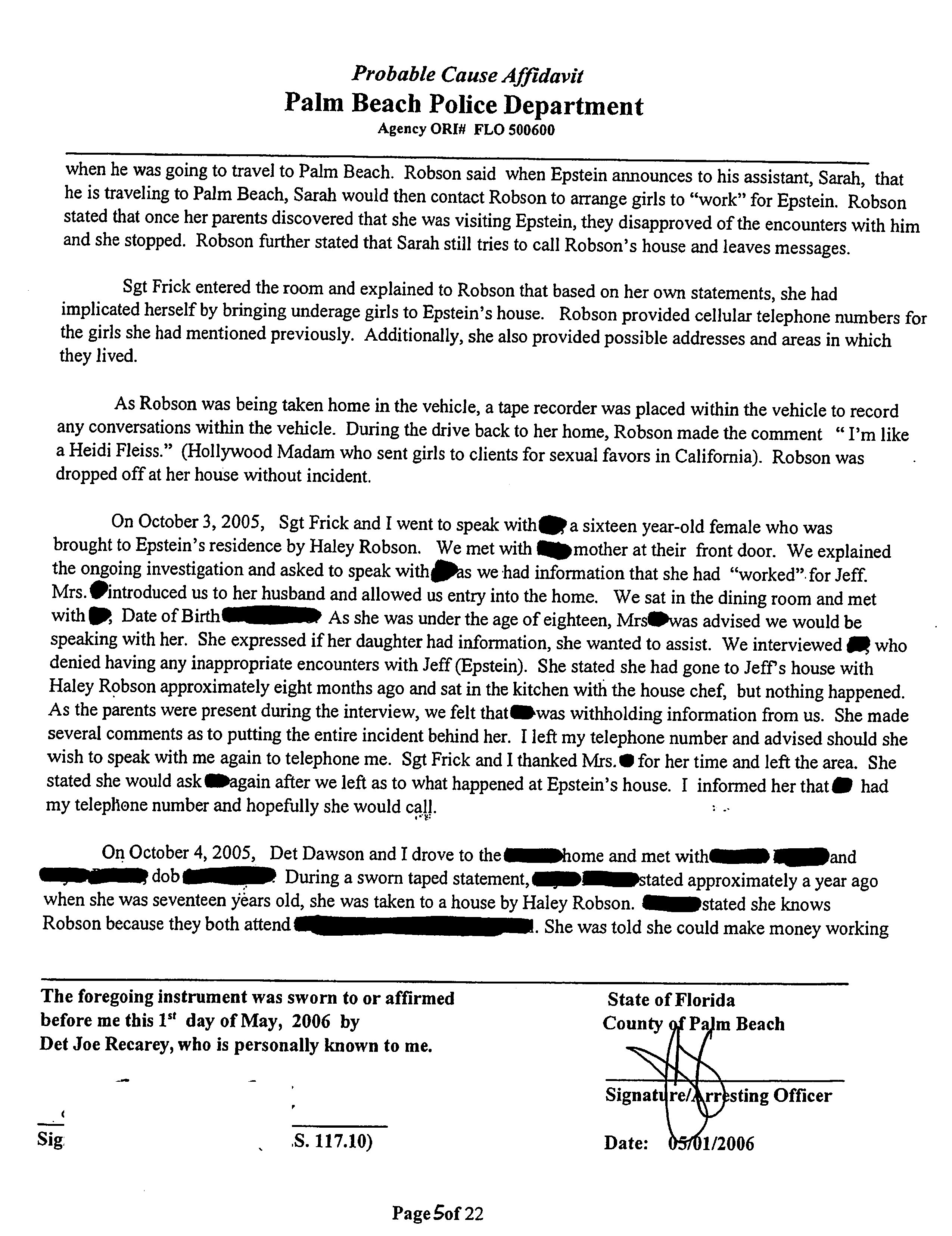
Page 450
document
2550 x 3309
Objects: Letter, Text, Page | Text: Probable Cause Affidavit | Palm Beach Police Department | Agency

Page 450
document
650 x 368
Objects: Handwriting, Text, Signature | Text: County of Palm Beach | Signature/Arresting Officer | D
Page 450
document
626 x 193
Objects: Handwriting, Text, Signature | Text: nature of Police Officer (F.S.
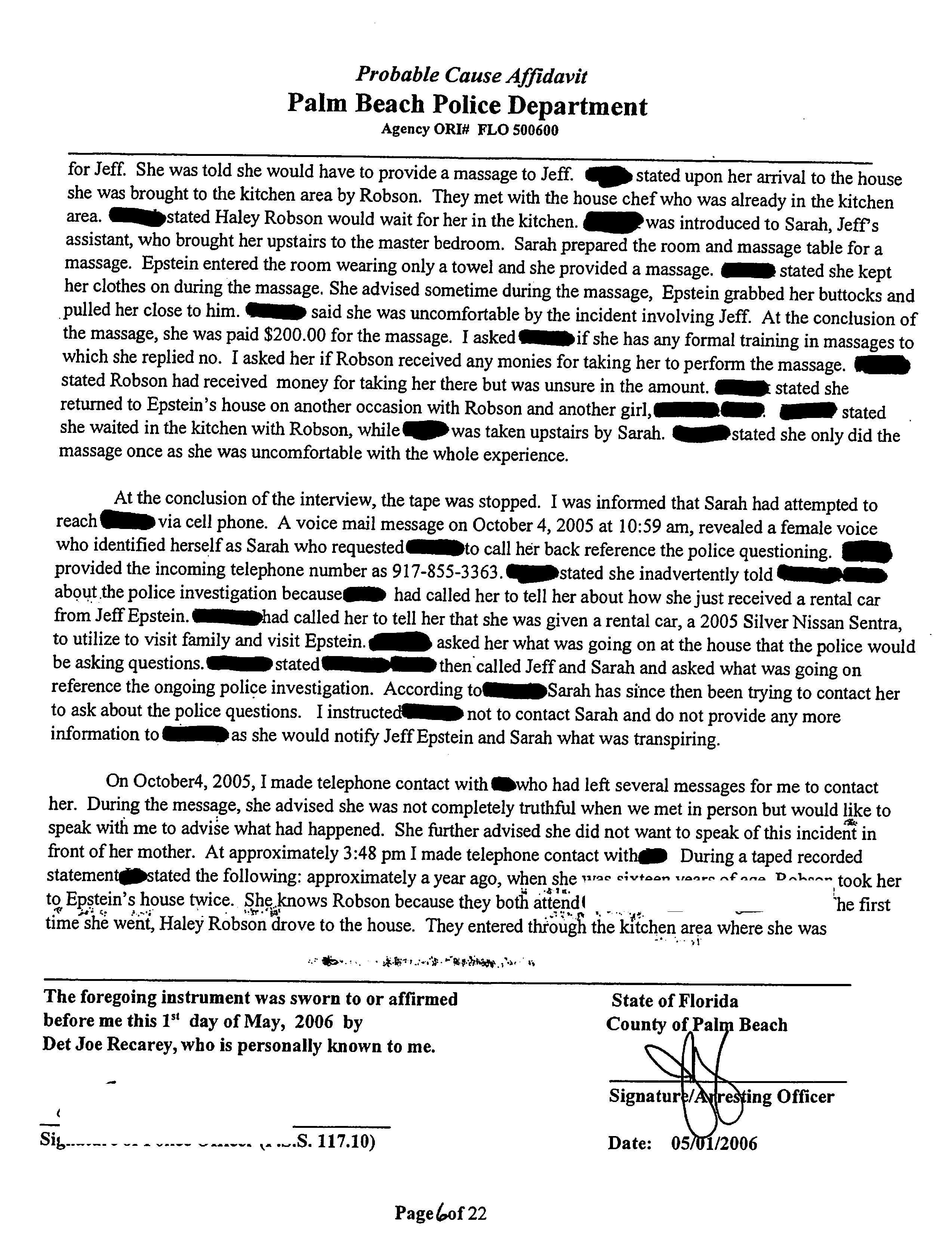
Page 451
document
2547 x 3309
Objects: Letter, Text, Page | Text: Probable Cause Affidavit | Palm Beach Police Department | Agency

Page 451
document
646 x 365
Objects: Handwriting, Text, Signature, Smoke Pipe | Text: County of Palm Beach | Signature/Apresting

Page 451
document
681 x 99
Objects: Text, Stencil, Silhouette | Text: was sixteen years OI age, Robson
Page 451
document
639 x 177
Objects: Handwriting, Text, Signature
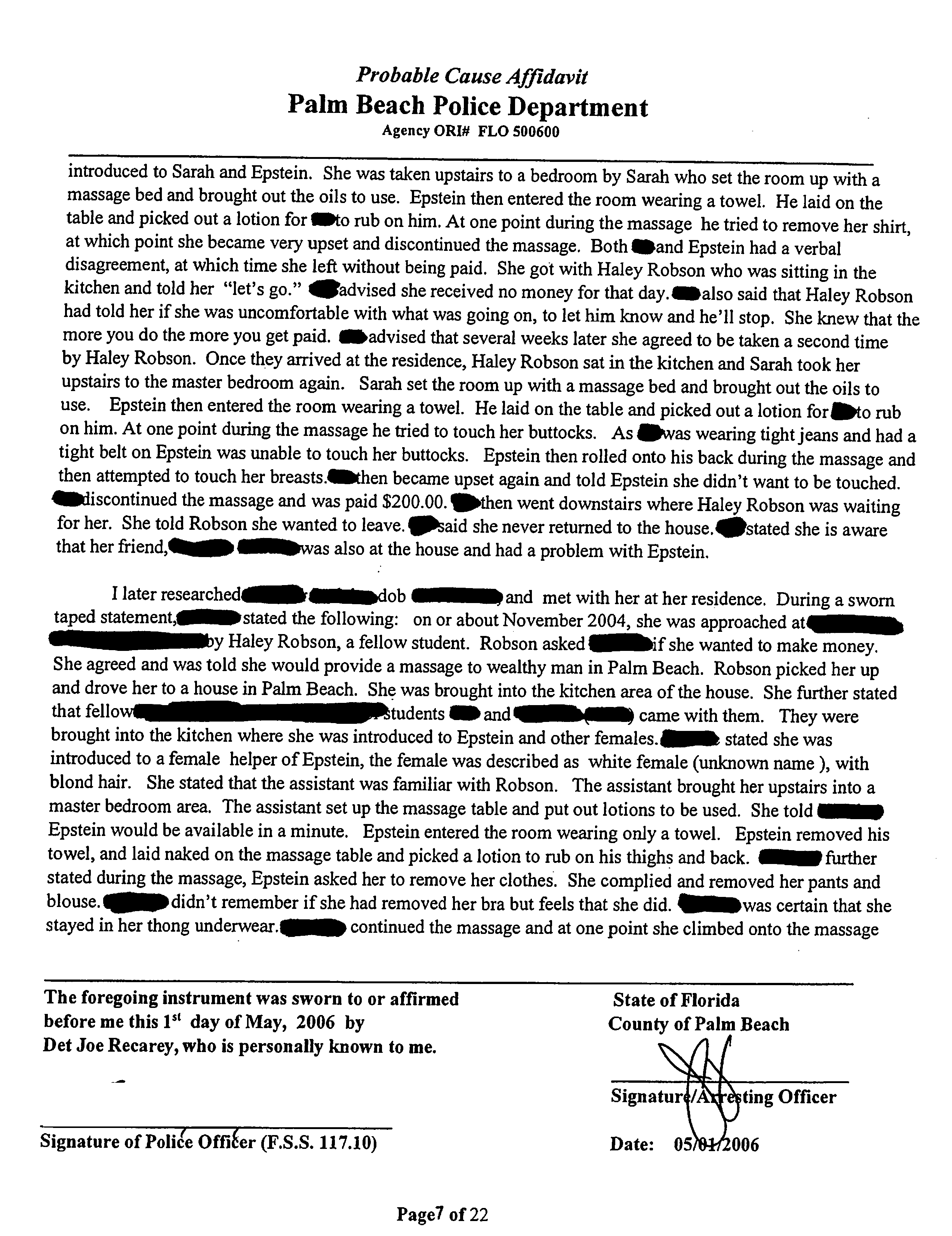
Page 452
document
2547 x 3306
Objects: Letter, Text, Page | Text: Probable Cause Affidavit | Palm Beach Police Department | Agency

Page 452
document
646 x 322
Objects: Handwriting, Text, Bow, Weapon, Signature | Text: Date: | 05/01/2006

Page 452
document
943 x 133
Objects: Handwriting, Text, Signature
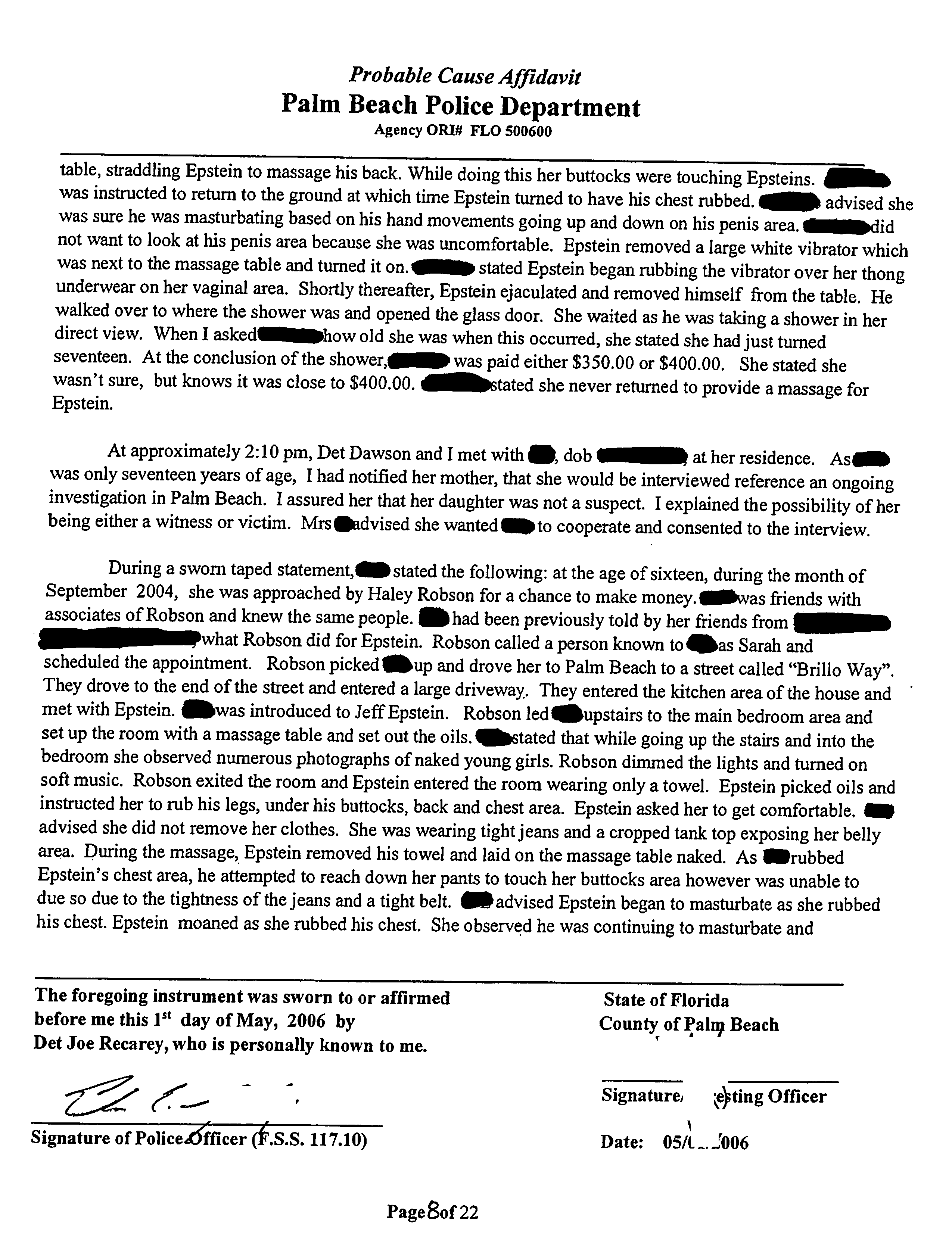
Page 453
document
2550 x 3306
Objects: Letter, Text, Page | Text: Probable Cause Affidavit | Palm Beach Police Department | Agency
Page 453
document
250 x 110
Objects: Handwriting, Text, Signature, Bow, Weapon
Page 453
document
203 x 310
Objects: Handwriting, Text, Bow, Weapon, Signature
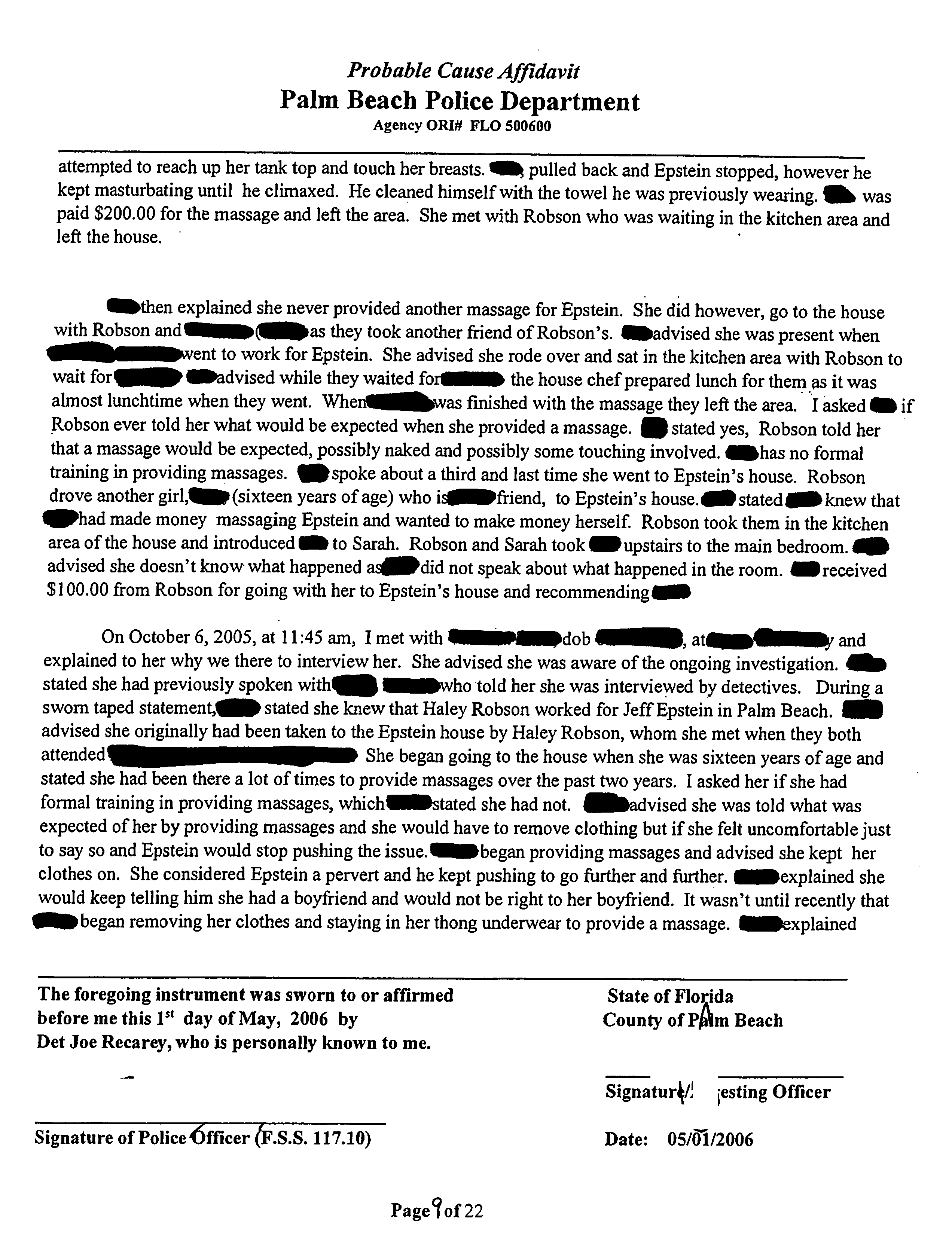
Page 454
document
2544 x 3309
Objects: Letter, Text, Page | Text: Probable Cause Affidavit | Palm Beach Police Department | Agency

Page 454
document
939 x 132
Objects: Handwriting, Text, Signature
Page 454
document
196 x 282
Objects: Handwriting, Text, Smoke Pipe, Signature
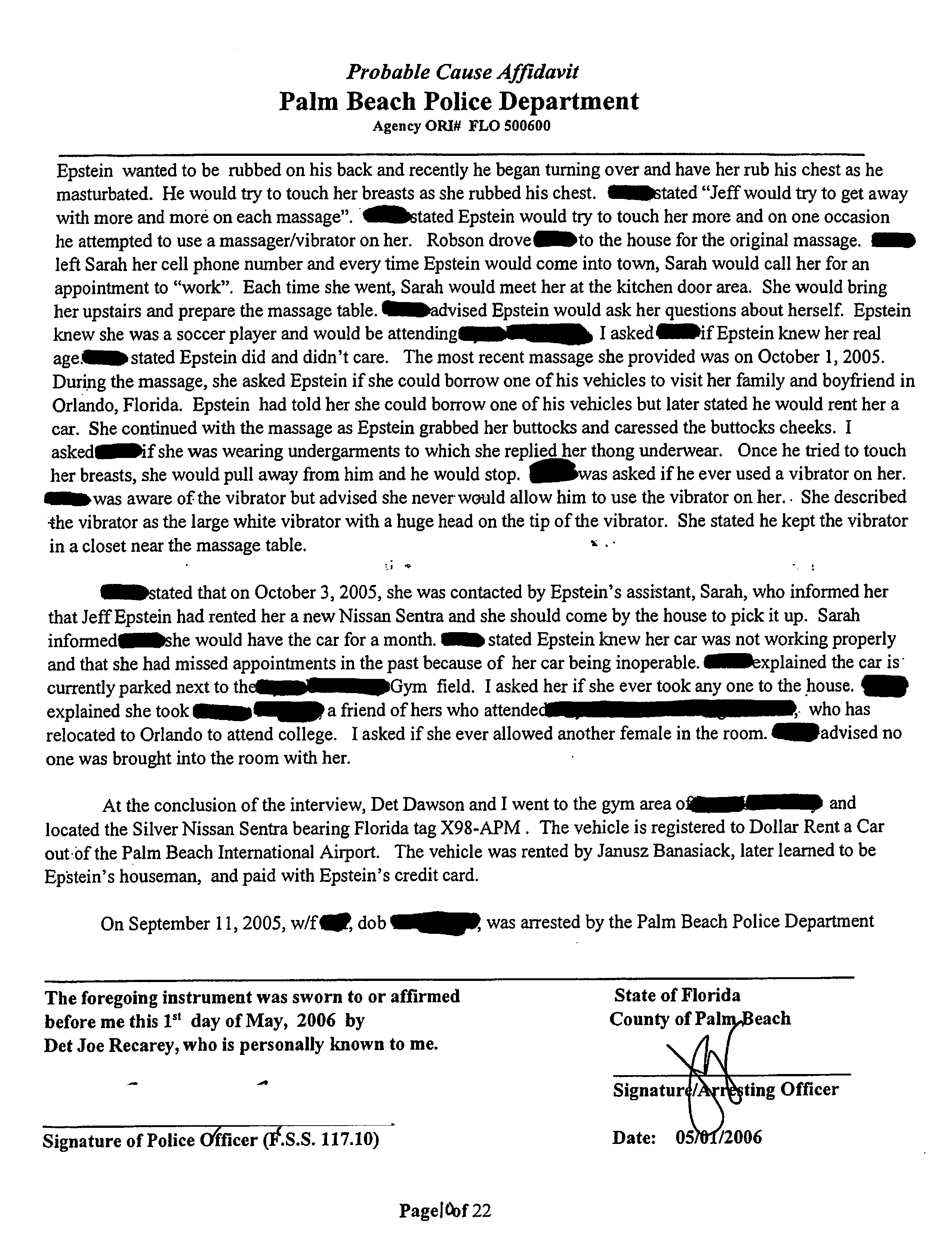
Page 455
document
2547 x 3309
Objects: Letter, Text, Page | Text: Probable Cause Affidavit | Palm Beach Police Department | Agency

Page 455
document
646 x 365
Objects: Handwriting, Text, Signature, Smoke Pipe | Text: County of Palm Beach | Signature/ /Arresti

Page 455
document
941 x 124
Objects: Handwriting, Text, Signature
Page 456
document
2550 x 3306
Objects: Letter, Text, Page | Text: Probable Cause Affidavit | Palm Beach Police Department | Agency
Page 456
document
574 x 173
Objects: Handwriting, Text, Signature
Page 456
document
230 x 424
Objects: Handwriting, Text, Bow, Weapon | Text: f Florida | of Palm B | est | 05/01/2006
Page 457
document
2550 x 3309
Objects: Letter, Text, Page | Text: Probable Cause Affidavit | Palm Beach Police Department | Agency

Page 457
document
650 x 363
Objects: Handwriting, Text, Signature | Text: County of Palm Beach | Signature/Arresting Officer | D
Page 457
document
303 x 133
Objects: Handwriting, Text, Signature, Bow, Weapon

Page 458
document
2544 x 3306
Objects: Letter, Text, Page, Face, Head, Person | Text: Probable Cause Affidavit | Palm Beach Police

Page 458
document
646 x 367
Objects: Handwriting, Text, Signature | Text: County of Palm Beach | Date: | 05/01/2006
Page 458
document
292 x 182
Objects: Handwriting, Text, Signature, Bow, Weapon

Page 459
document
2550 x 3309
Objects: Letter, Text, Page, Face, Head, Person | Text: Probable Cause Affidavit | Palm Beach Police
Page 459
document
219 x 254
Objects: Handwriting, Text, Bow, Weapon, Signature

Page 459
photo
219 x 3
Objects: Cutlery, Lighting, Fork | Content flags: Explicit, Exposed Female Nipple, Explicit Nudity
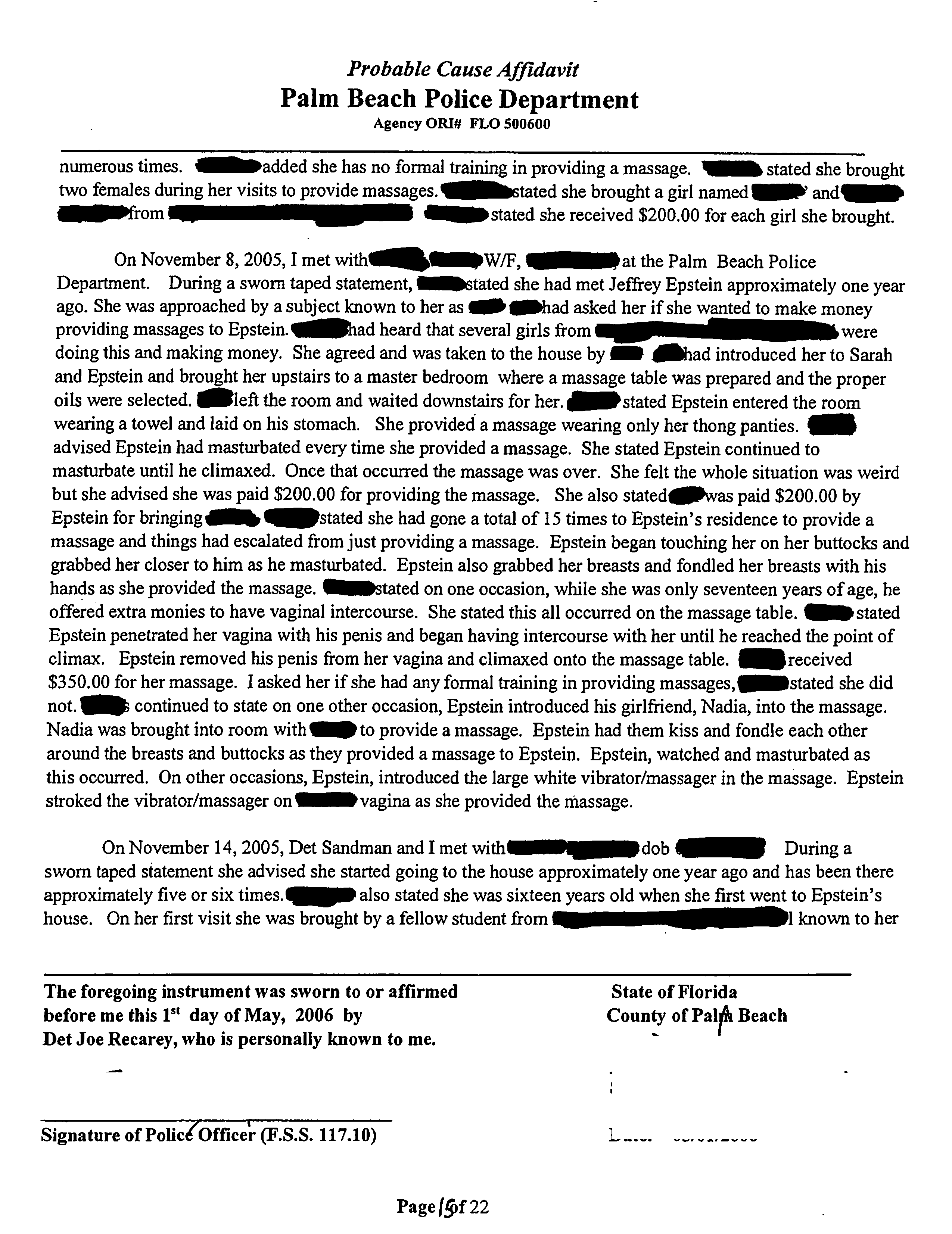
Page 460
document
2550 x 3306
Objects: Page, Text, Letter | Text: Probable Cause Affidavit | Palm Beach Police Department | Agency

Page 460
document
941 x 141
Objects: Handwriting, Text, Signature
Page 460
document
638 x 292
Objects: Handwriting, Text, Signature, Face, Head, Person | Text: Signature | ting Officer | 05/01/2

Page 461
document
2547 x 3309
Objects: Letter, Text, Page, Face, Head, Person | Text: Probable Cause Affidavit | Palm Beach Police

Page 461
document
648 x 364
Objects: Handwriting, Text, Signature, Bow, Weapon | Text: County of Palm Beach | Date: | 05/01/2006
Page 461
document
939 x 190
Objects: Handwriting, Text, Signature | Text: Signature of Police Officer (F.S.S. 117.10)
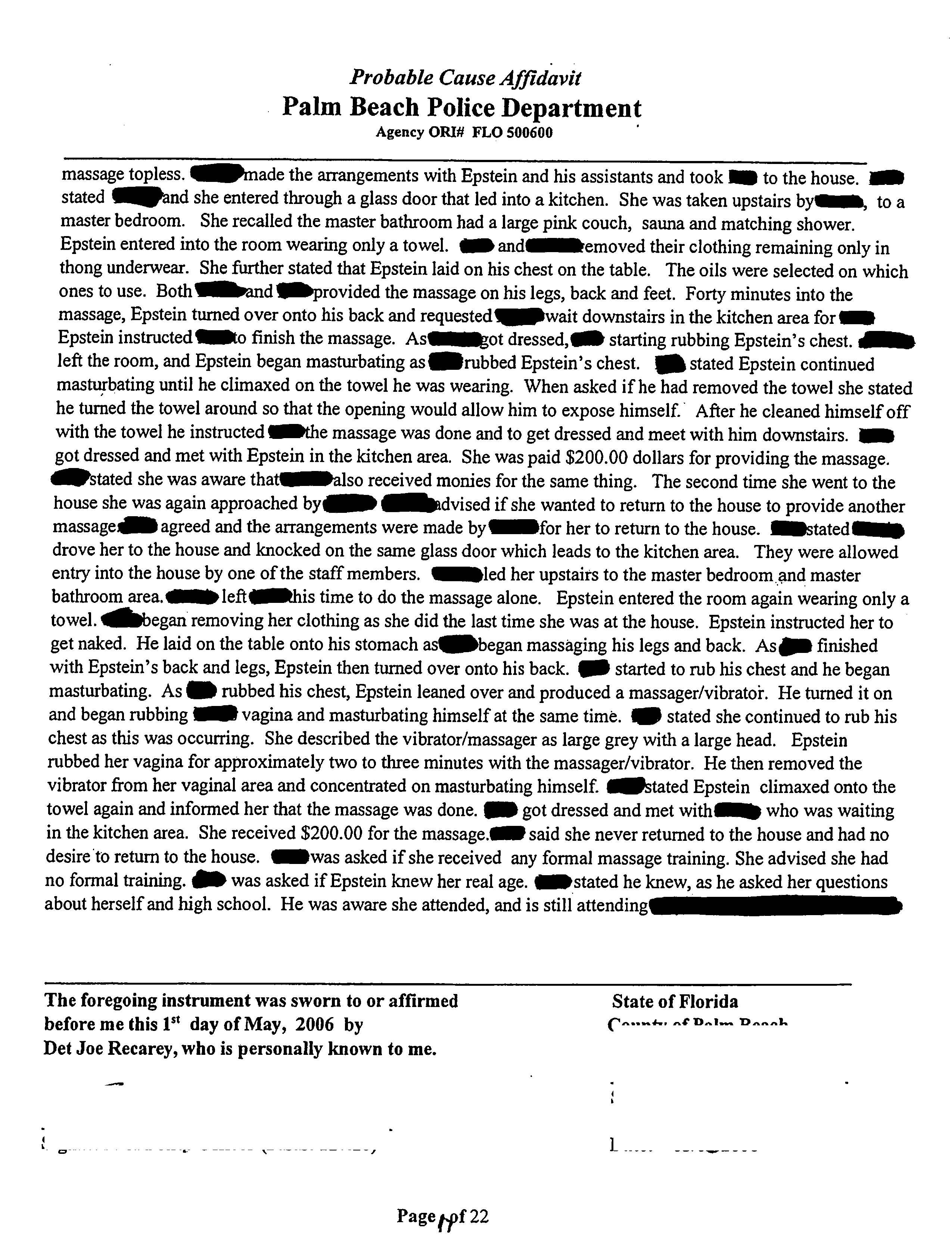
Page 462
document
2550 x 3309
Objects: Page, Text, Letter | Text: Probable Cause Affidavit | Palm Beach Police Department | Agency
Page 462
document
940 x 188
Objects: Handwriting, Text, Signature | Text: Signature of Police | Officer (F.S.S. 117.10
Page 462
document
637 x 351
Objects: Handwriting, Text, Signature | Text: County OI Palm Beach | Date: | 05/01/2006
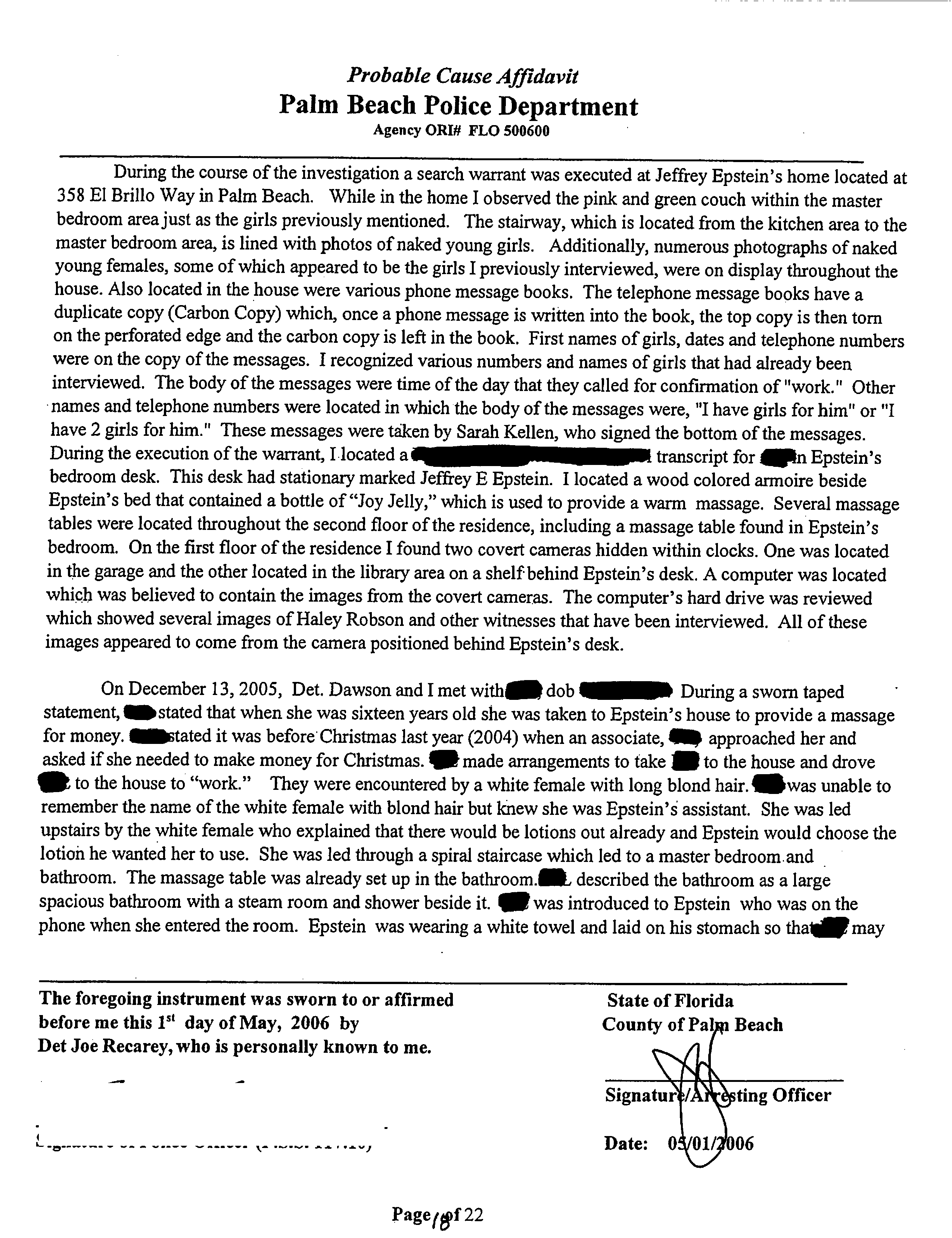
Page 463
document
2550 x 3315
Objects: Letter, Text, Page | Text: Probable Cause Affidavit | Palm Beach Police Department | Agency

Page 463
document
648 x 413
Objects: Handwriting, Text, Signature | Text: County of Palm Beach | Date: | 05/01/2006

Page 463
document
942 x 184
Objects: Handwriting, Text, Signature | Text: Signature of Police Officer (F.S.S. 117.10)
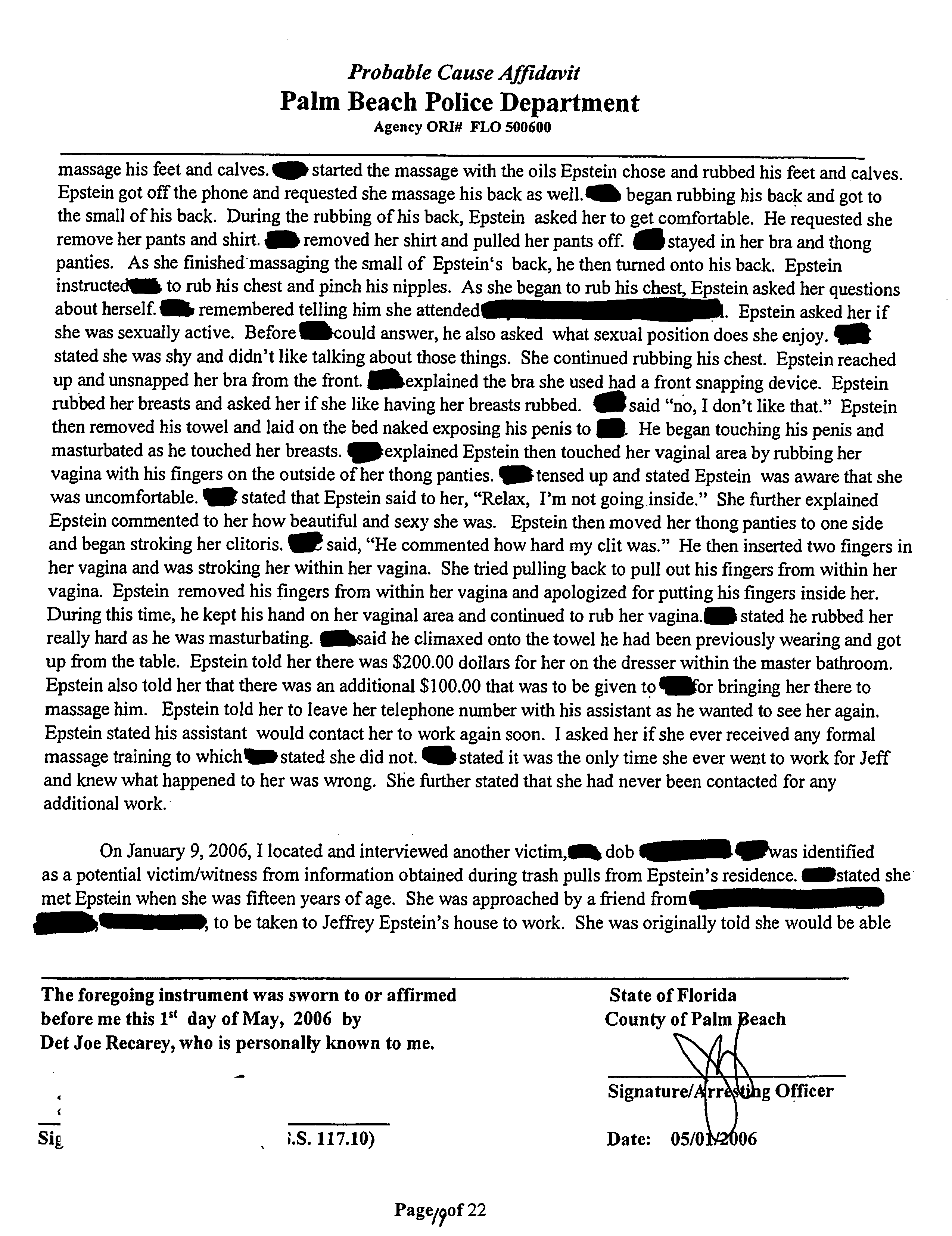
Page 464
document
2550 x 3309
Objects: Letter, Text, Page | Text: Probable Cause Affidavit | Palm Beach Police Department | Agency

Page 464
document
647 x 367
Objects: Handwriting, Text, Signature | Text: County of Palm Beach | Date: | 05/01/2006
Page 464
document
625 x 199
Objects: Handwriting, Text, Signature | Text: gnature of Police Officer (F.S
Page 465
document
2550 x 3303
Objects: Page, Text, Letter | Text: Probable Cause Affidavit | Palm Beach Police Department | Agency

Page 465
document
941 x 127
Objects: Handwriting, Text, Signature
Page 465
document
269 x 192
Objects: Handwriting, Text, Bow, Weapon, Signature
Page 465
document
269 x 132
Objects: Text, Smoke Pipe, Device, Grass, Lawn, Lawn Mower, Plant, Tool
Page 466
document
2550 x 3306
Objects: Letter, Text, Page | Text: Probable Cause Affidavit | Palm Beach Police Department | Agency

Page 466
document
648 x 365
Objects: Handwriting, Text, Signature, Bow, Weapon | Text: County of Palm Beach | 2006 | Date:
Page 466
document
941 x 200
Objects: Handwriting, Text, Signature | Text: Signature of Police Officer (F.S.S. 117.10)
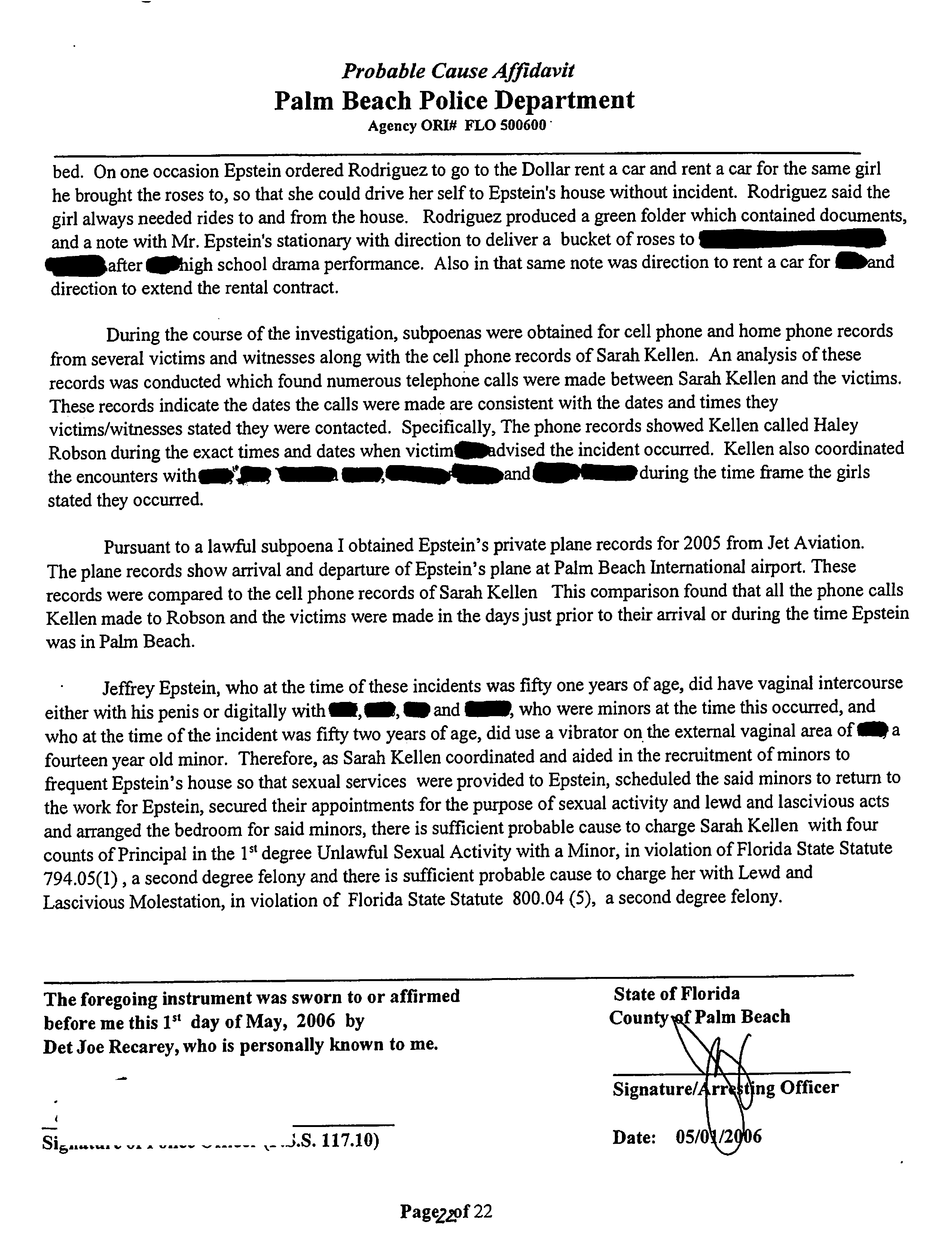
Page 467
document
2544 x 3306
Objects: Letter, Text, Page | Text: Probable Cause Affidavit | Palm Beach Police Department | Agency

Page 467
document
654 x 399
Objects: Handwriting, Text, Signature | Text: County of Palm Beach | Signature/Arresting Officer | D
Page 467
document
645 x 191
Objects: Handwriting, Text, Signature | Text: ignature of Police Officer (F.S
Page 468
document
2550 x 3300
Objects: Text | Text: Appendix 6
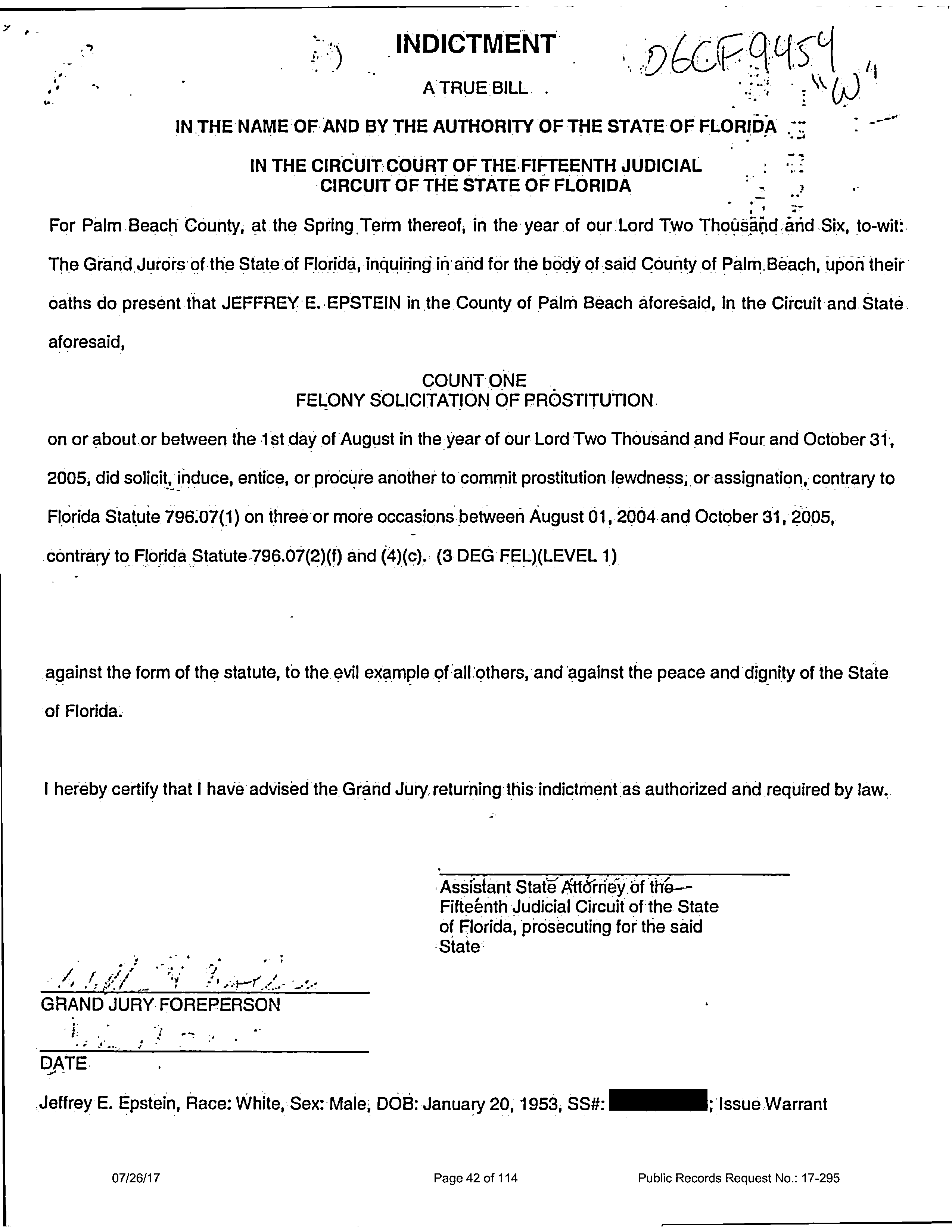
Page 469
document
2550 x 3300
Objects: Text, Page, Letter | Text: INDICTMENT | A TRUE BILL | IN THE NAME OF AND BY THE AUTHORITY O

Page 469
photo
159 x 98
Objects: Stencil, Smoke Pipe

Page 469
document
943 x 166
Objects: Handwriting, Text
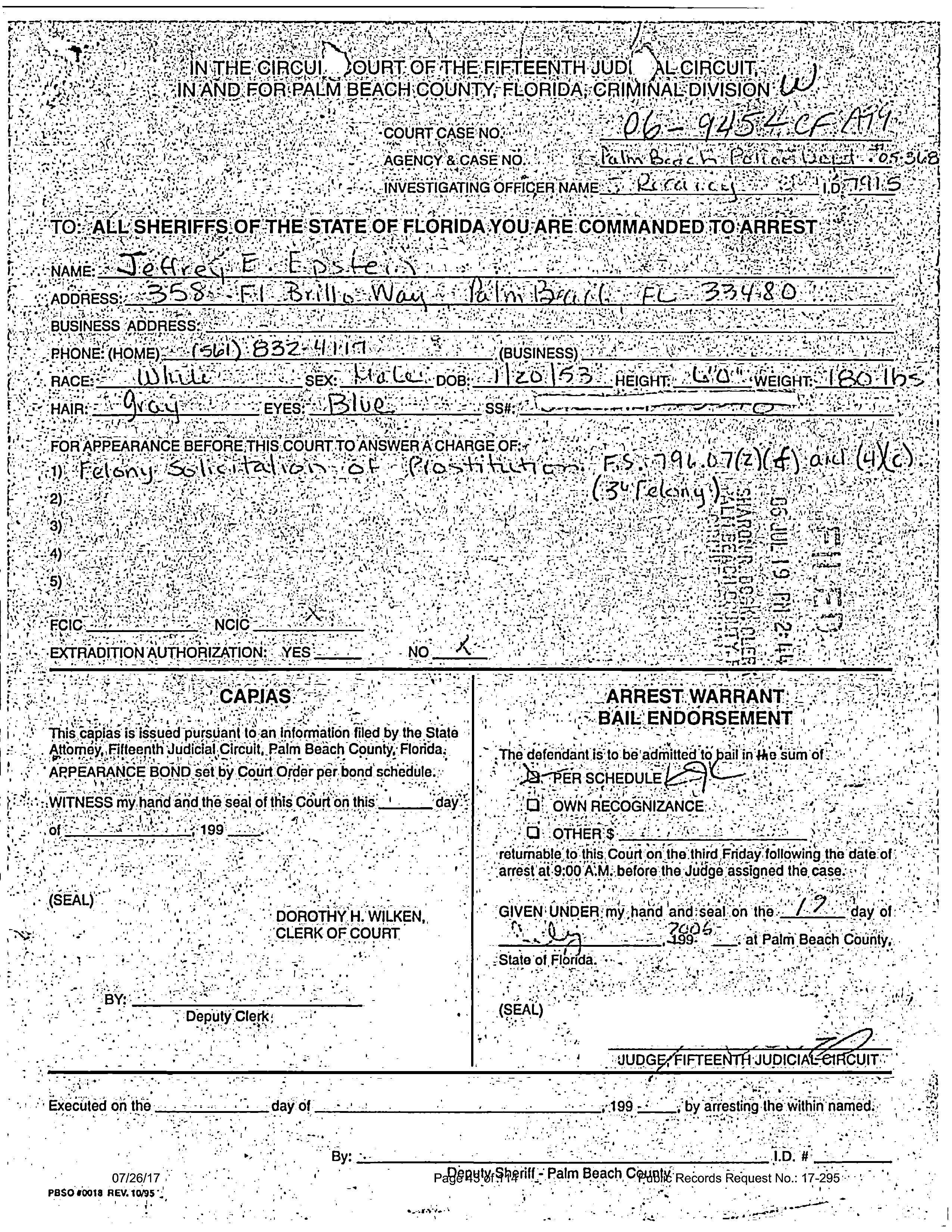
Page 470
document
2550 x 3300
Objects: Chart, Diagram, Plan, Plot, Page, Text | Text: OURT OF THE FIFTEENTH JUDI | AL CIRCUIT | IN
Page 470
document
649 x 194
Objects: Handwriting, Text, Signature
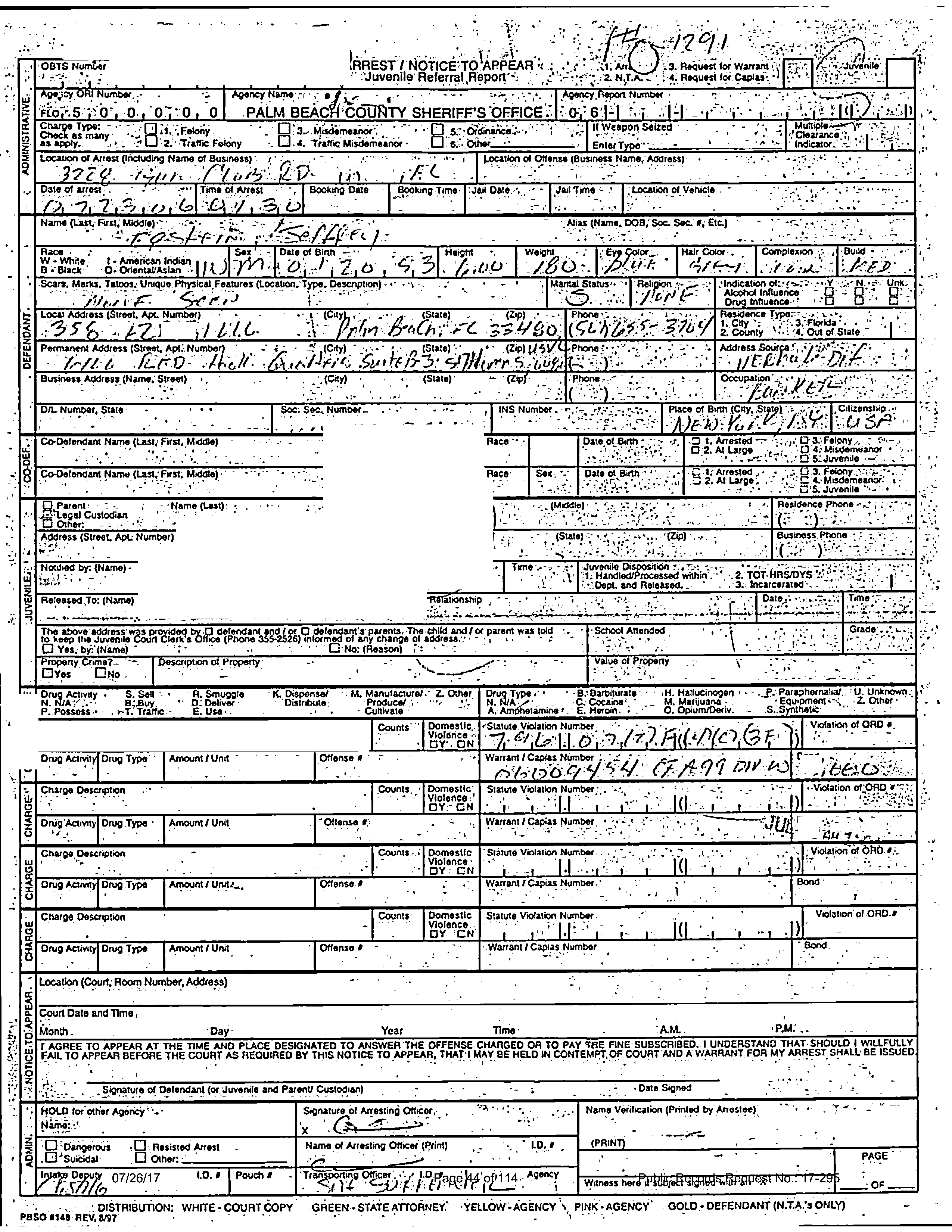
Page 471
document
2550 x 3300
Objects: Chart, Diagram, Plan, Plot, Text, Page | Text: OBTS Number | 3. Request for Warrant | Juven

Page 471
document
783 x 177
Objects: Handwriting, Text, Person

Page 471
document
90 x 72
Objects: Handwriting, Text, Stencil, Ammunition, Grenade, Weapon, Signature | Text: FB
Page 471
document
110 x 61
Objects: Text, Stencil, Handwriting, Ammunition, Grenade, Weapon
Page 471
document
966 x 536
Objects: Sphere, Text | Text: (First) | (City) | Date

Page 471
document
75 x 65
Objects: Stencil, Text | Text: Bond

Page 471
document
74 x 74
Objects: Stencil, Text, Dynamite, Weapon, People, Person | Text: Bond | 23

Page 471
photo
82 x 85
Objects: Stencil, White Board
Page 471
document
139 x 93
Objects: Stencil, White Board, Text, Blackboard | Text: Sex
Page 471
document
976 x 218
Objects: Text, Handwriting | Text: Charge Description
Page 472
document
2550 x 3300
Objects: Text | Text: Appendix 7
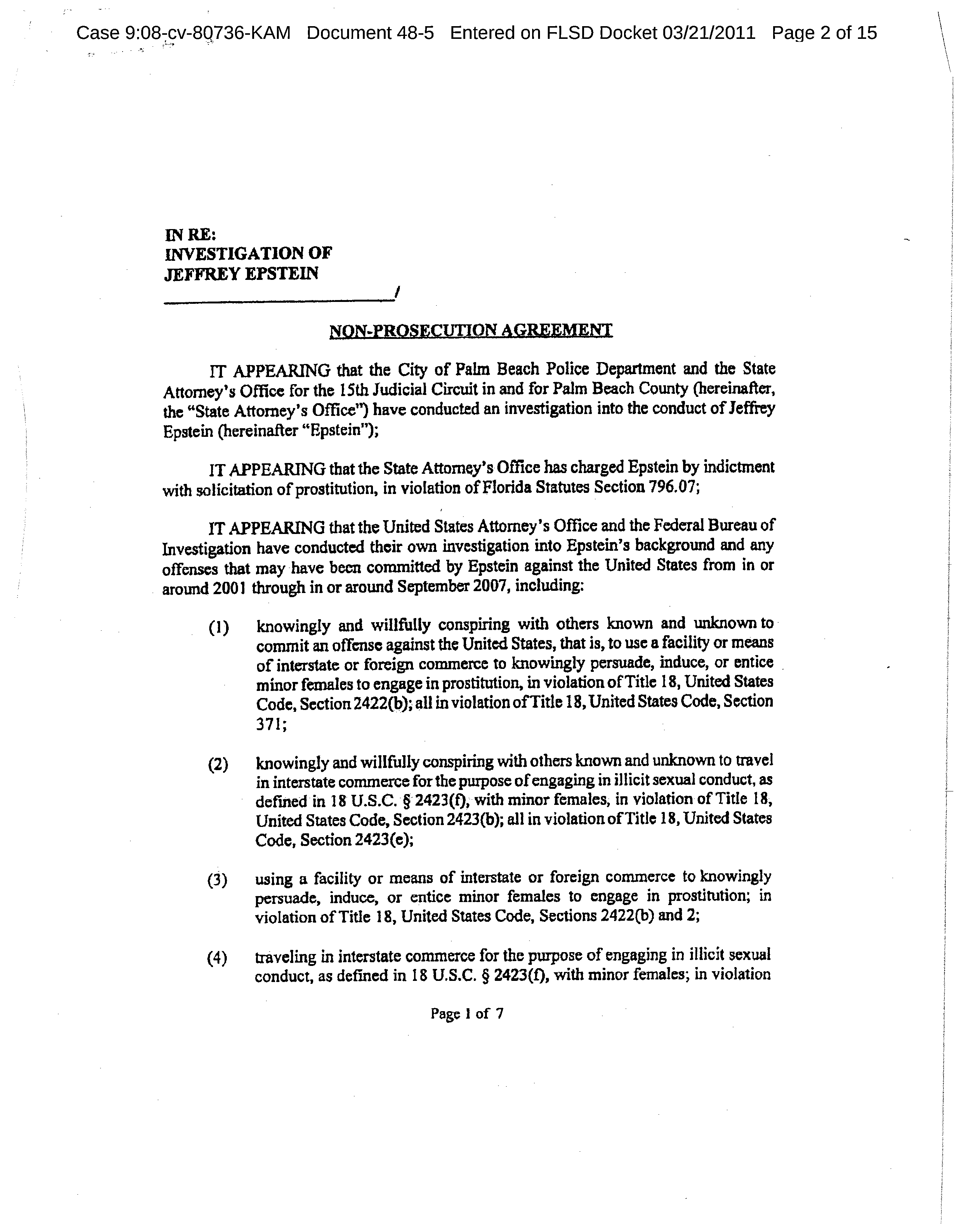
Page 473
document
2553 x 3297
Objects: Page, Text, Letter | Text: Case 9:08-CV-80736-KAM Document 48-5 Entered on FLSD Docket 03/2
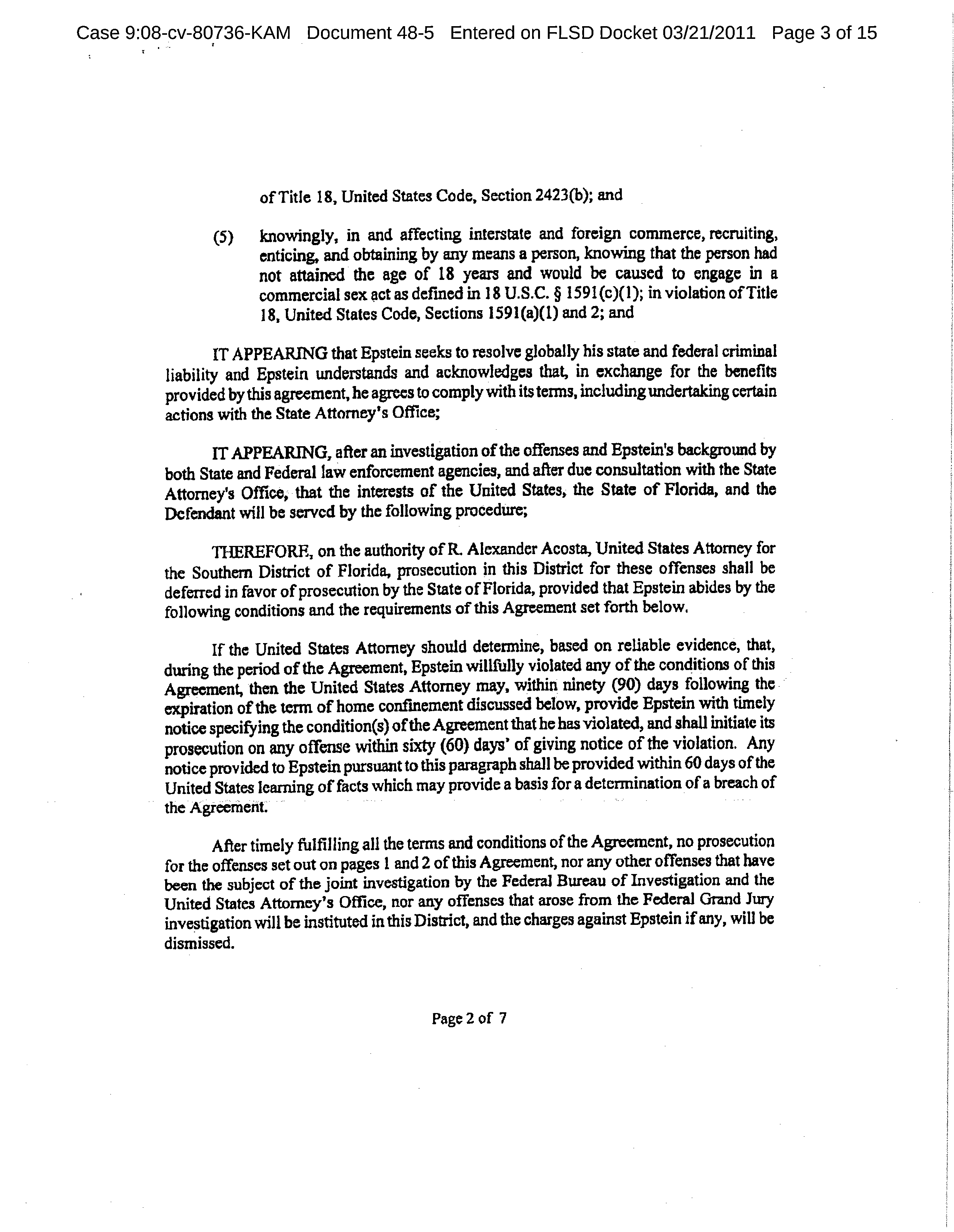
Page 474
document
2553 x 3297
Objects: Page, Text, Letter | Text: Case 9:08-cv-80736-KAM Document 48-5 Entered on FLSD Docket 03/2
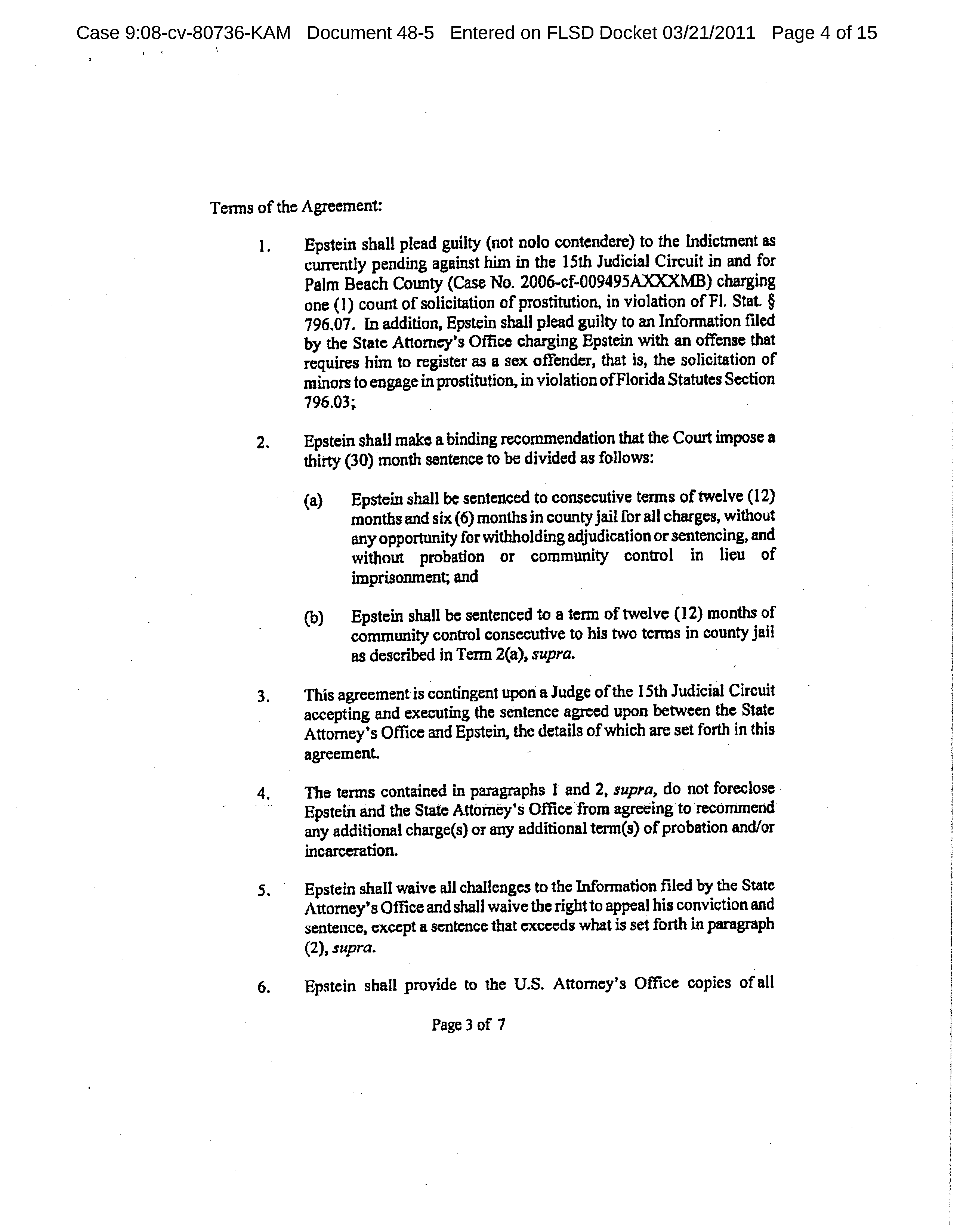
Page 475
document
2553 x 3297
Objects: Page, Text, Letter | Text: Case 9:08-cv-80736-KAM Document 48-5 Entered on FLSD Docket 03/2
Page 476
document
2553 x 3297
Objects: Page, Text, Letter | Text: Case 9:08-CV-80736-KAM Document 48-5 Entered on FLSD Docket 03/2
Page 477
document
2553 x 3297
Objects: Page, Text, Letter | Text: Case 9:08-cv-80736-KAM Document 48-5 Entered on FLSD Docket 03/2
Page 478
document
2553 x 3297
Objects: Page, Text, Letter | Text: Case 9:08-cv-80736-KAM Document 48-5 Entered on FLSD Docket 03/2
Page 479
document
2553 x 3297
Objects: Page, Text | Text: Case 9:08-cv-80736-KAM Document 48-5 Entered on FLSD Docket 03/21/2011 P
Page 479
document
865 x 354
Objects: Clothing, Hat, Handwriting, Text, Bow, Weapon, Signature | Text: ASSISTANT U.S. ATTORNEY |
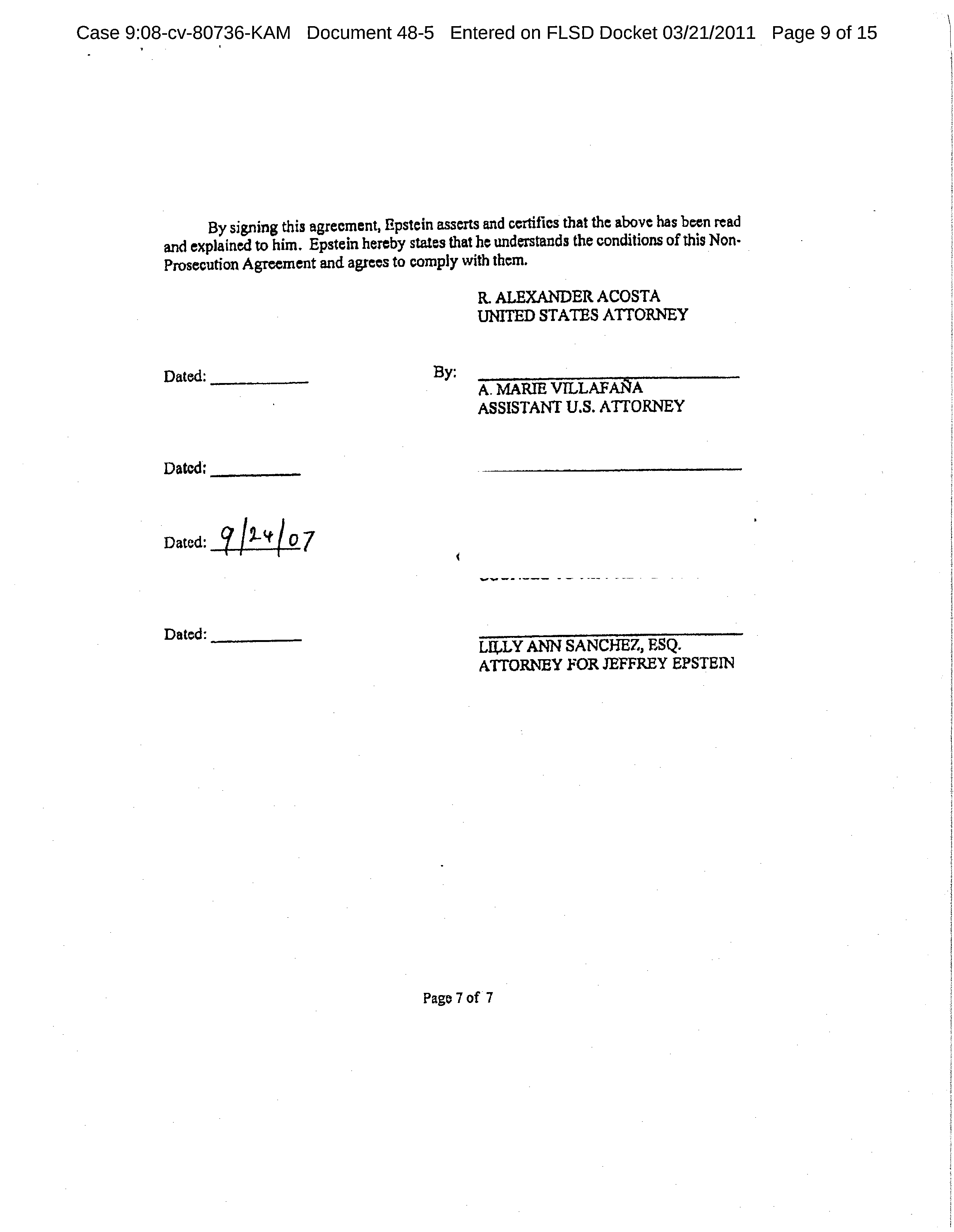
Page 480
document
2553 x 3297
Objects: Page, Text | Text: Case 9:08-cv-80736-KAM Document 48-5 Entered on FLSD Docket 03/21/2011 P
Page 480
document
806 x 301
Objects: Handwriting, Text, Signature, Face, Head, Person | Text: JEFFREY EPSTEIN | COUNSEL TO JEFFR
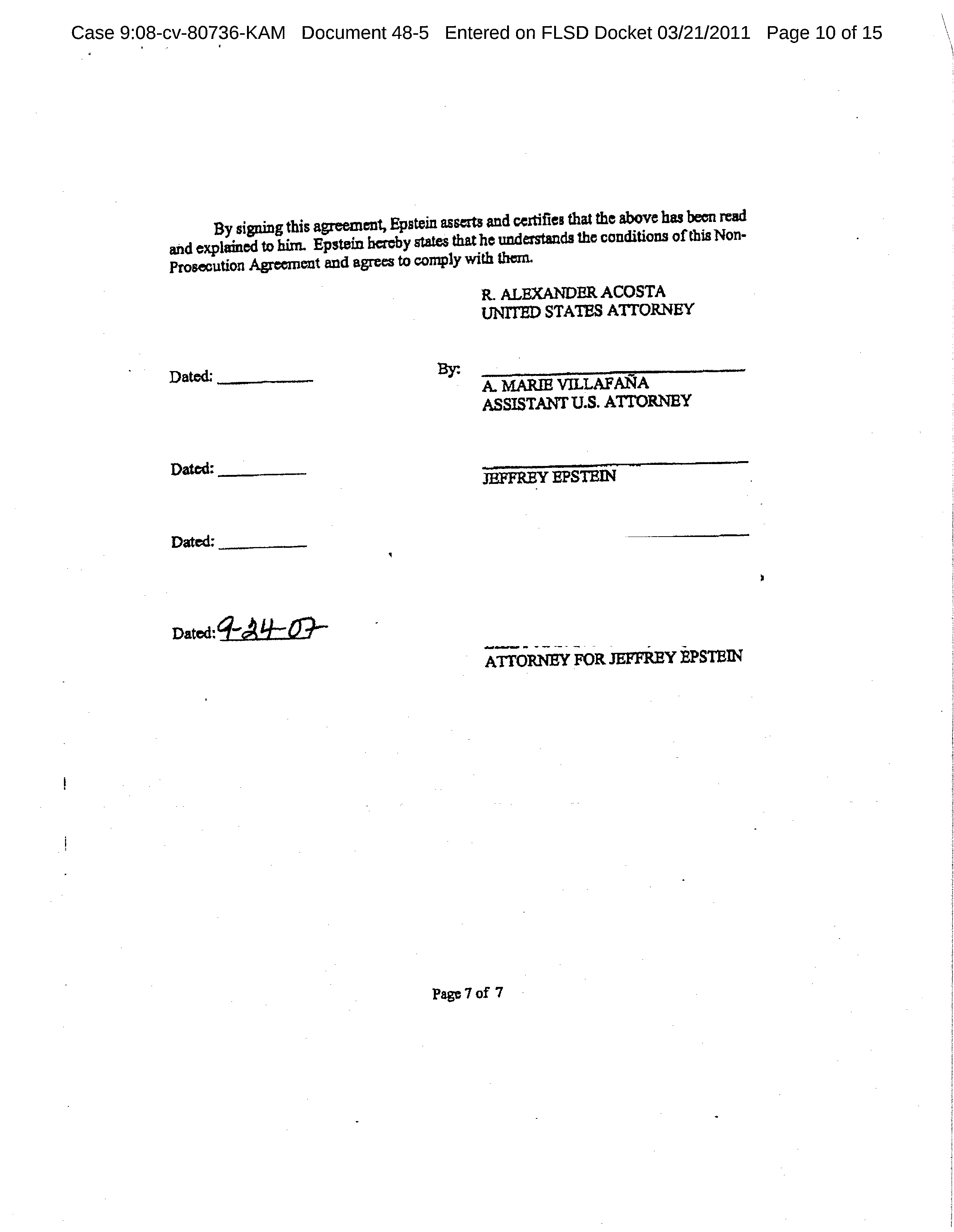
Page 481
document
2553 x 3297
Objects: Page, Text | Text: Case 9:08-cv-80736-KAM Document 48-5 Entered on FLSD Docket 03/21/2011 P
Page 481
document
1004 x 308
Objects: Handwriting, Text, Signature | Text: GERALD LEFCOURT, ESQ. | COUNSEL TO JEFFREY EPSTEIN
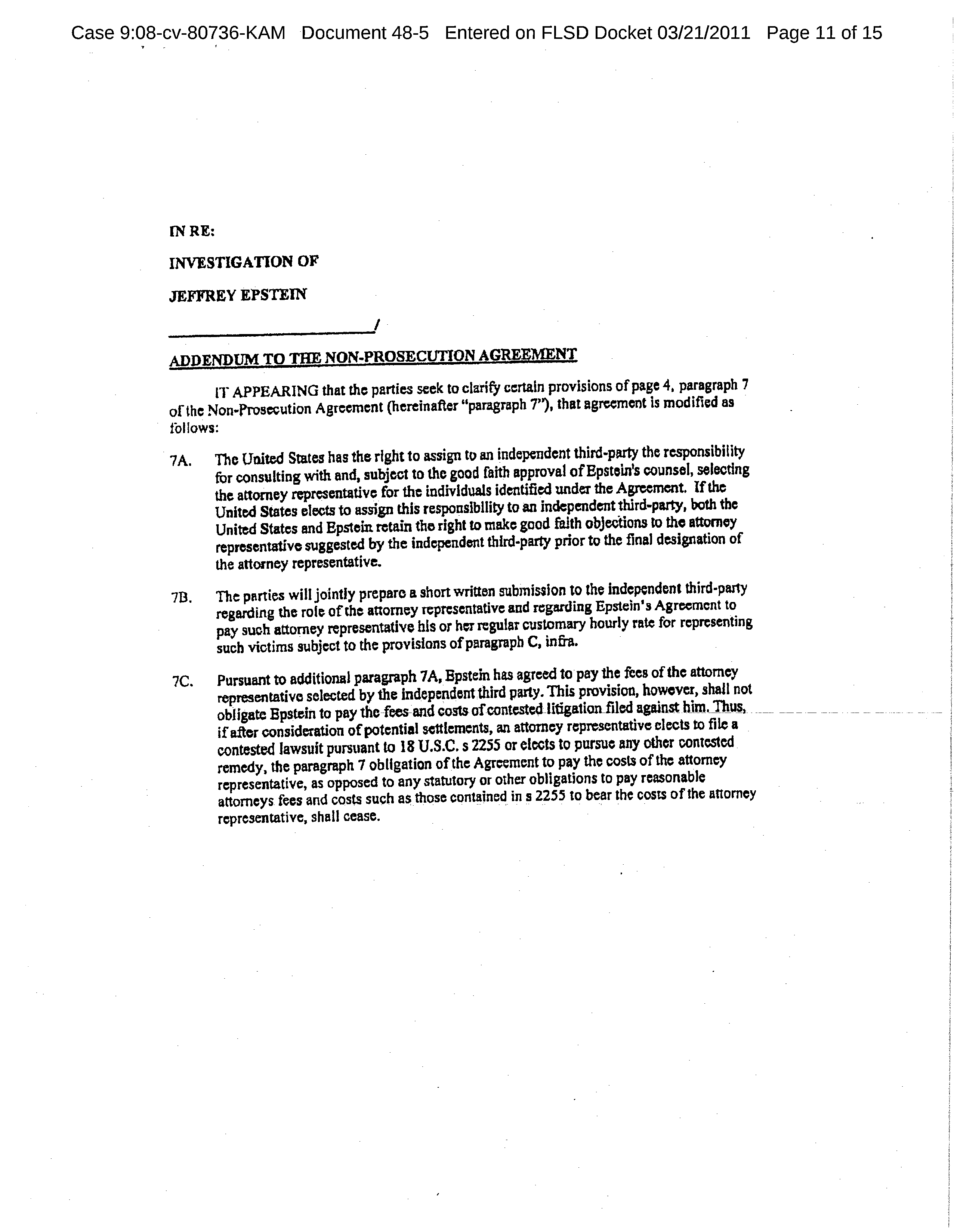
Page 482
document
2553 x 3297
Objects: Page, Text, Letter | Text: Case 9:08-cv-80736-KAM Document 48-5 Entered on FLSD Docket 03/2
Page 482
document
520 x 231
Objects: Text, QR Code, Letter | Text: independent third-party the resp | ith approval of Epstein's
Page 483
document
2553 x 3297
Objects: Page, Text | Text: Case 9:08-cv-80736-KAM Document 48-5 Entered on FLSD Docket 03/21/2011 P
Page 483
document
357 x 159
Objects: Handwriting, Text, Chess, Game, Signature | Text: Dated:
Page 483
document
773 x 277
Objects: Text, Nature, Outdoors | Text: JEFFREY EPSTEIN
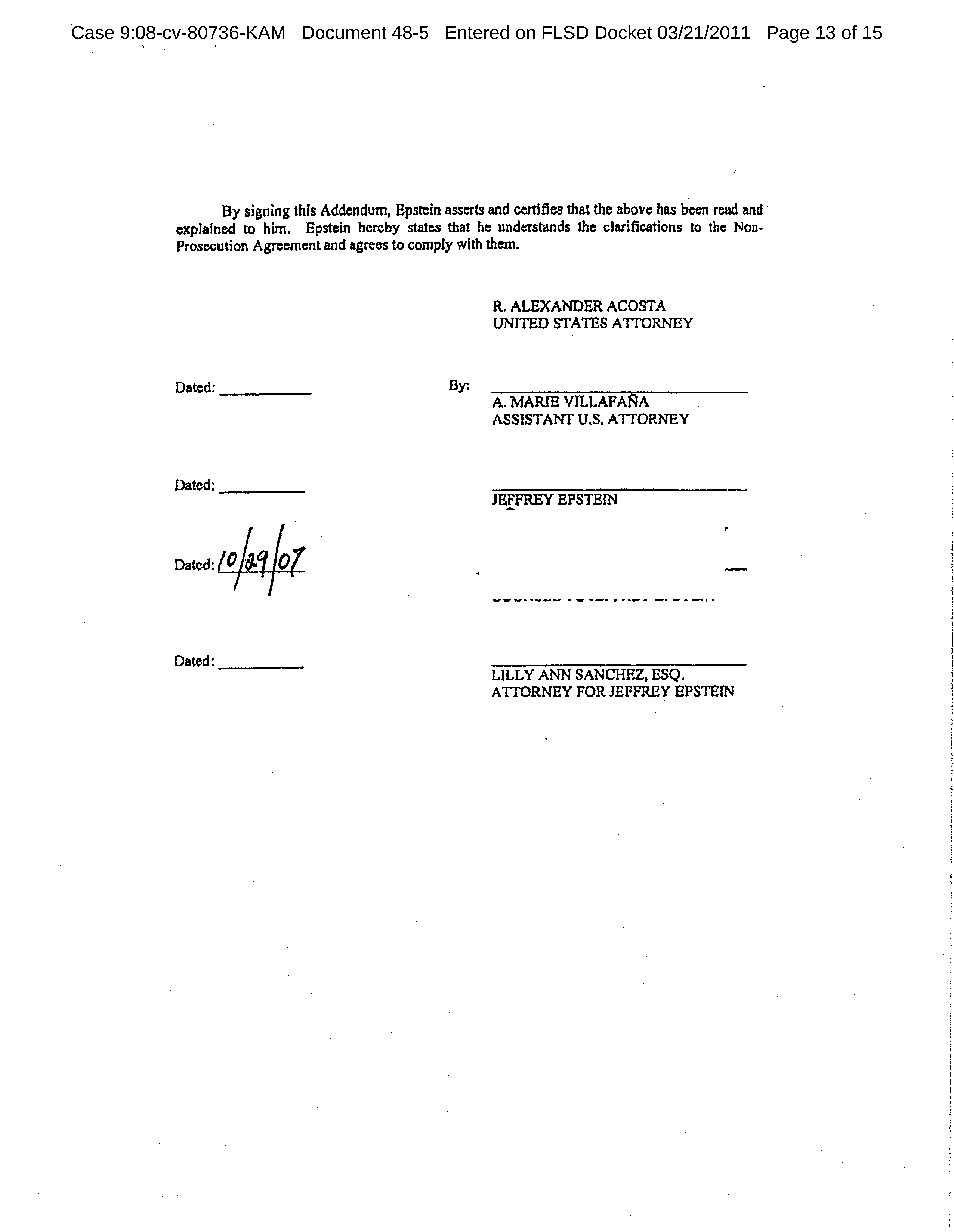
Page 484
document
2553 x 3297
Objects: Page, Text | Text: Case 9:08-cv-80736-KAM Document 48-5 Entered on FLSD Docket 03/21/2011 P
Page 484
document
675 x 252
Objects: Handwriting, Text, Signature | Text: GERALD LEFCOURT | ESQ. | COUNSEL TO JEFFREY EPSTEIN
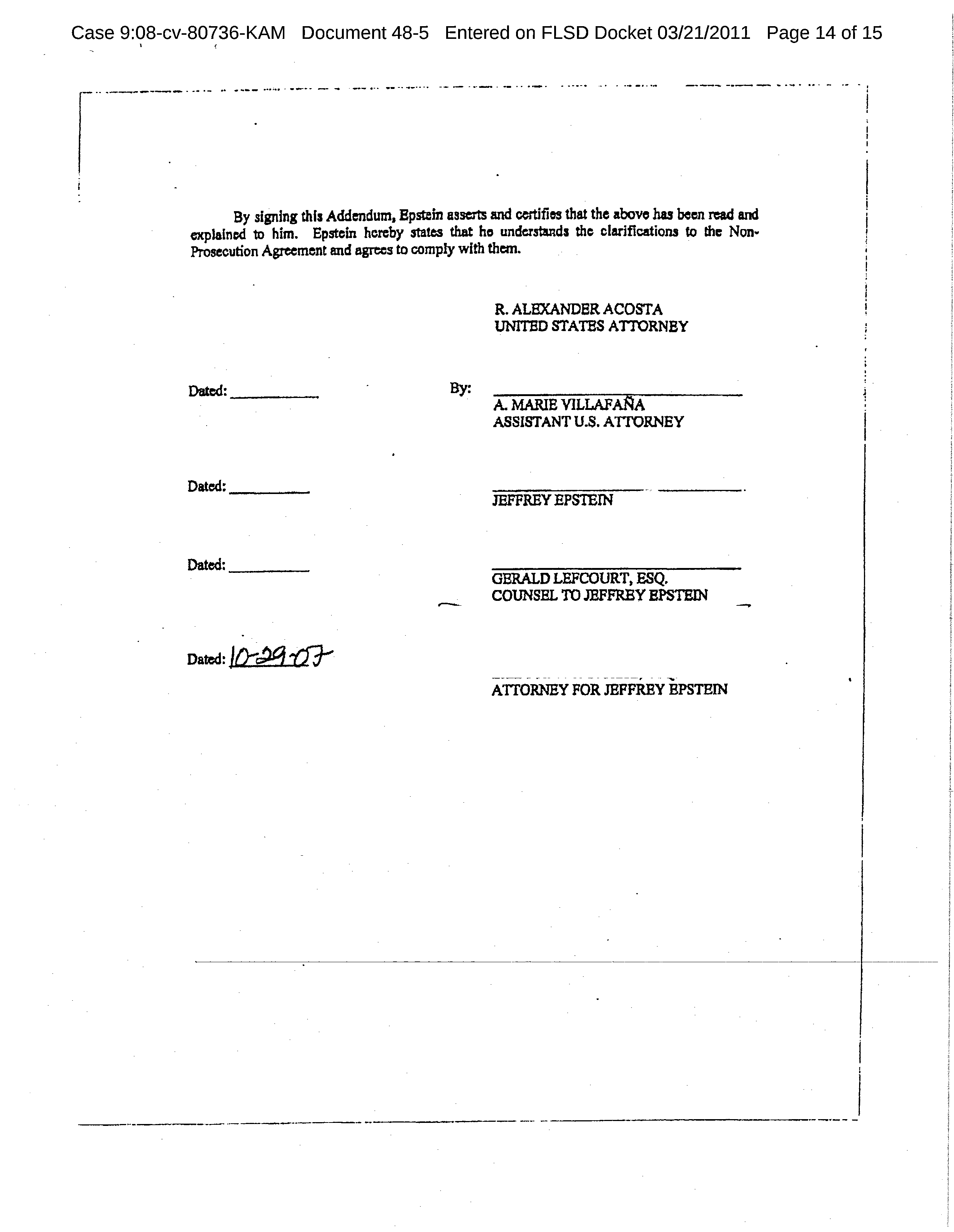
Page 485
document
2553 x 3297
Objects: Page, Text | Text: Case 9:08-cv-80736-KAM Document 48-5 Entered on FLSD Docket 03/21/2011 P
Page 485
document
1996 x 1818
Objects: Page, Text | Text: Dated: | By: | A. MARIE VILLAFANA | ASSISTANT U.S. ATTORNEY | Dated:
Page 485
document
838 x 209
Objects: Handwriting, Text, Signature | Text: LILLY ANN'SANCHEZ, ESQ
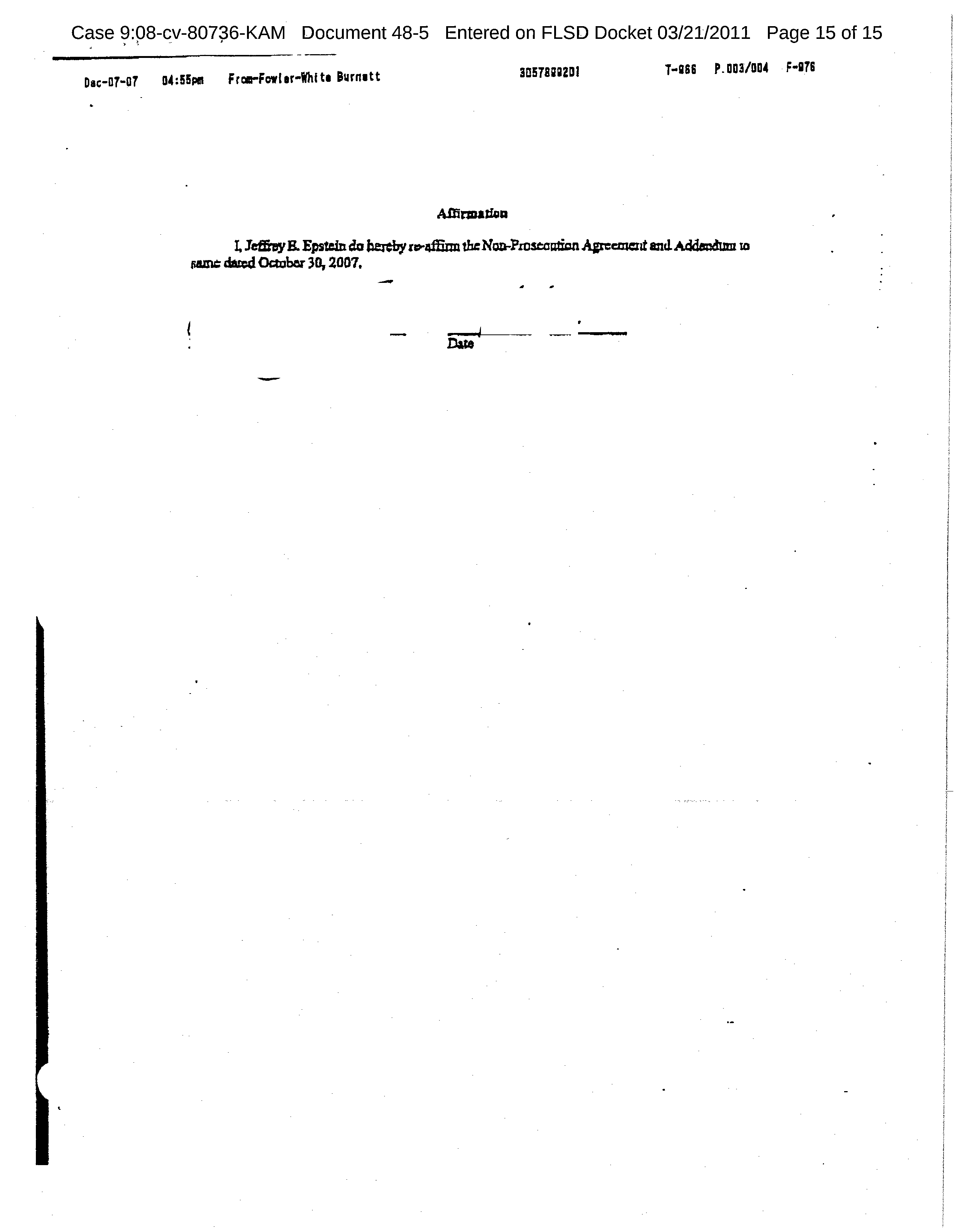
Page 486
document
2553 x 3297
Objects: Page, Text | Text: Case 9:08-cv-80736-KAM Document 48-5 Entered on FLSD Docket 03/21/2011 P
Page 486
document
551 x 270
Objects: Handwriting, Text, Signature, Bow, Weapon, Smoke Pipe
Page 486
document
276 x 140
Objects: Handwriting, Text, Signature, Smoke Pipe, Bow, Weapon
Page 487
document
2550 x 3300
Objects: Text | Text: Appendix 8
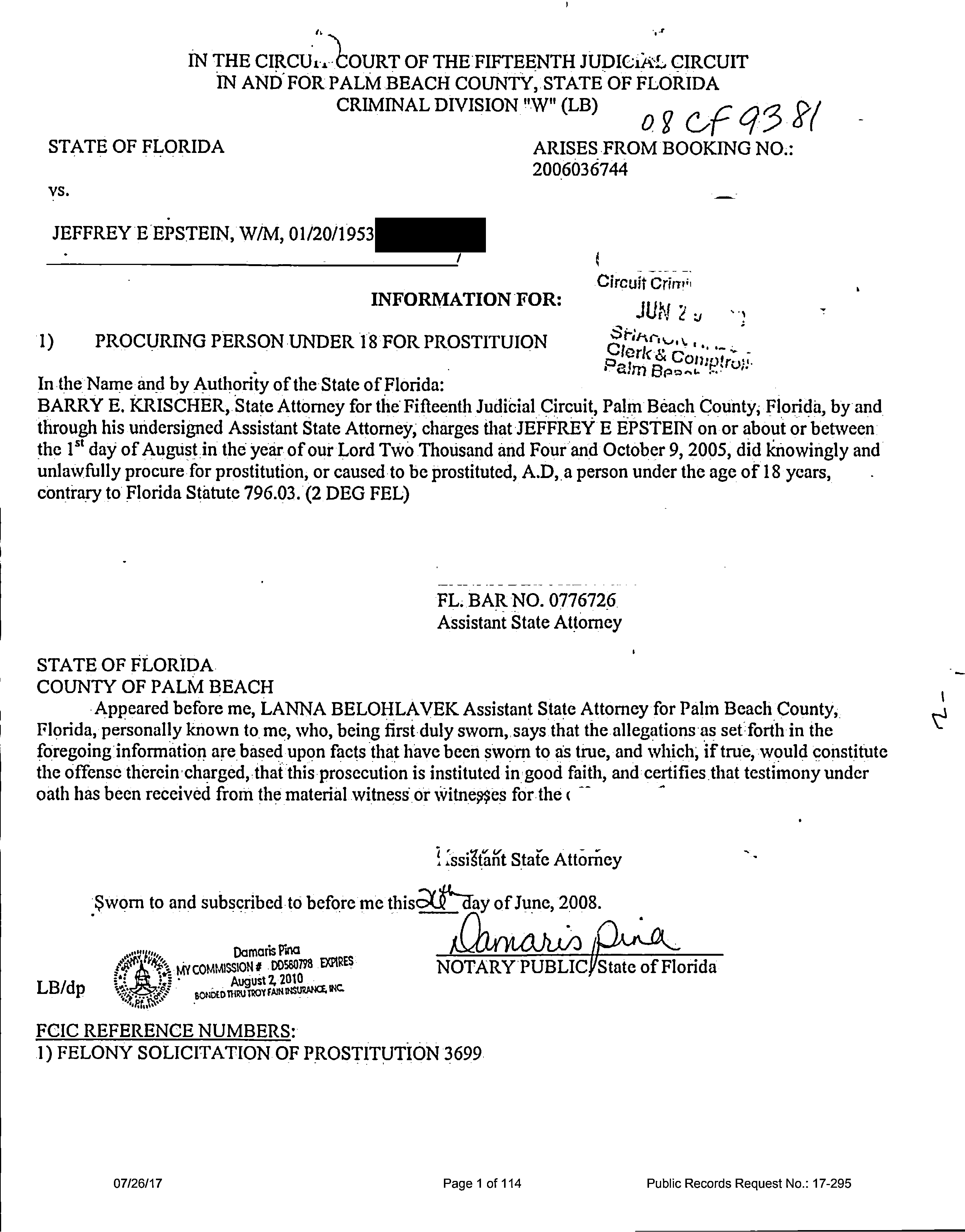
Page 488
document
2550 x 3255
Objects: Text, Page, Letter, Document | Text: IN THE CIRCU COURT OF THE FIFTEENTH JUDICIAL CIRCUIT |

Page 488
document
698 x 306
Objects: Text, Logo, Smoke Pipe | Text: ORI | INAL
Page 488
document
775 x 217
Objects: Handwriting, Text, Signature | Text: LANNA BELOHLAVEK
Page 488
document
827 x 217
Objects: Handwriting, Text, Signature | Text: offense.
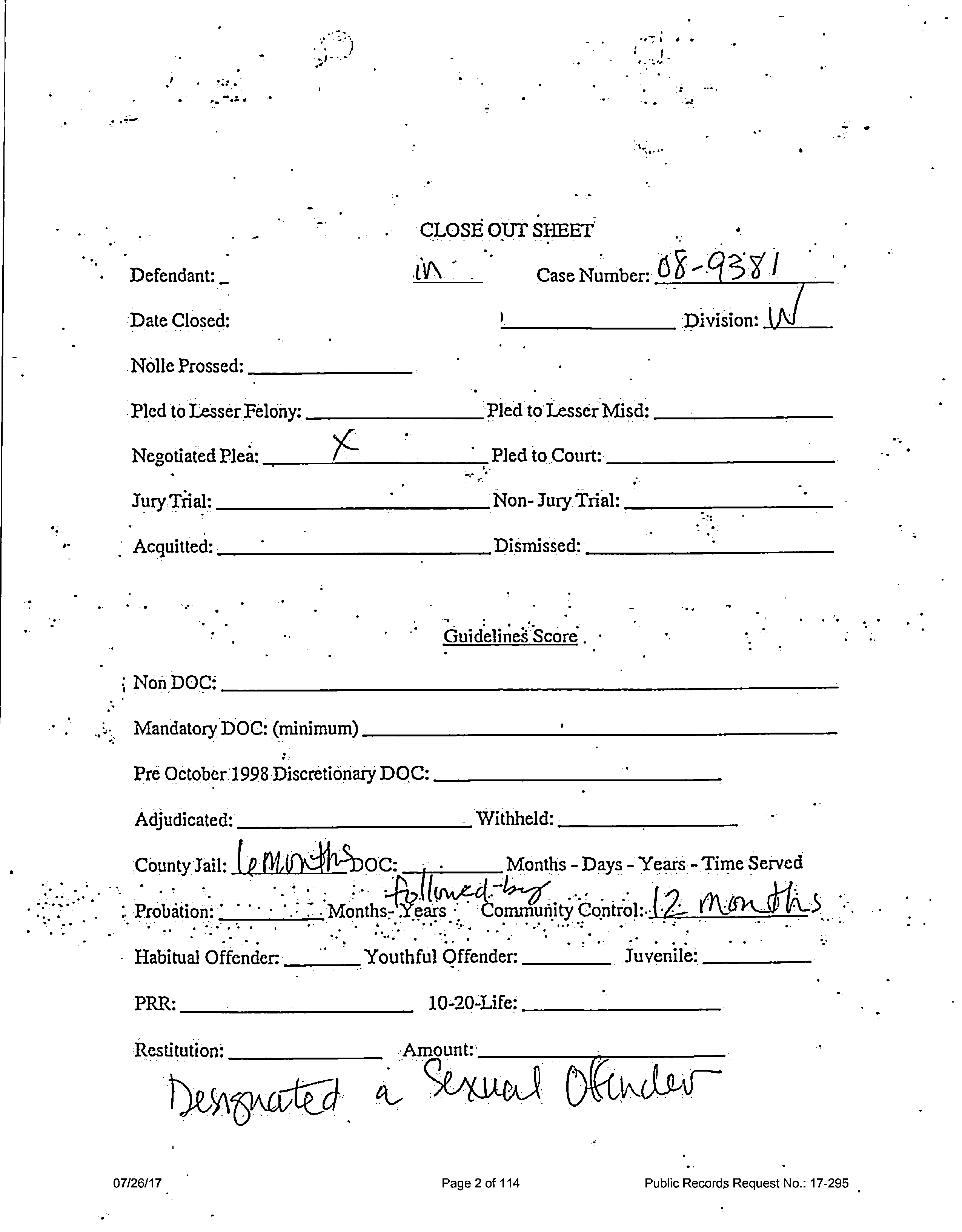
Page 489
document
2550 x 3264
Objects: Text, Page, Document | Text: CLOSE OUT SHEET | in | Case Number: | 08-9381 | Date Closed:

Page 489
document
485 x 225
Objects: Handwriting, Text, Face, Head, Person | Text: 9381 | Division:
Page 489
document
737 x 281
Objects: Text, Handwriting | Text: ASA
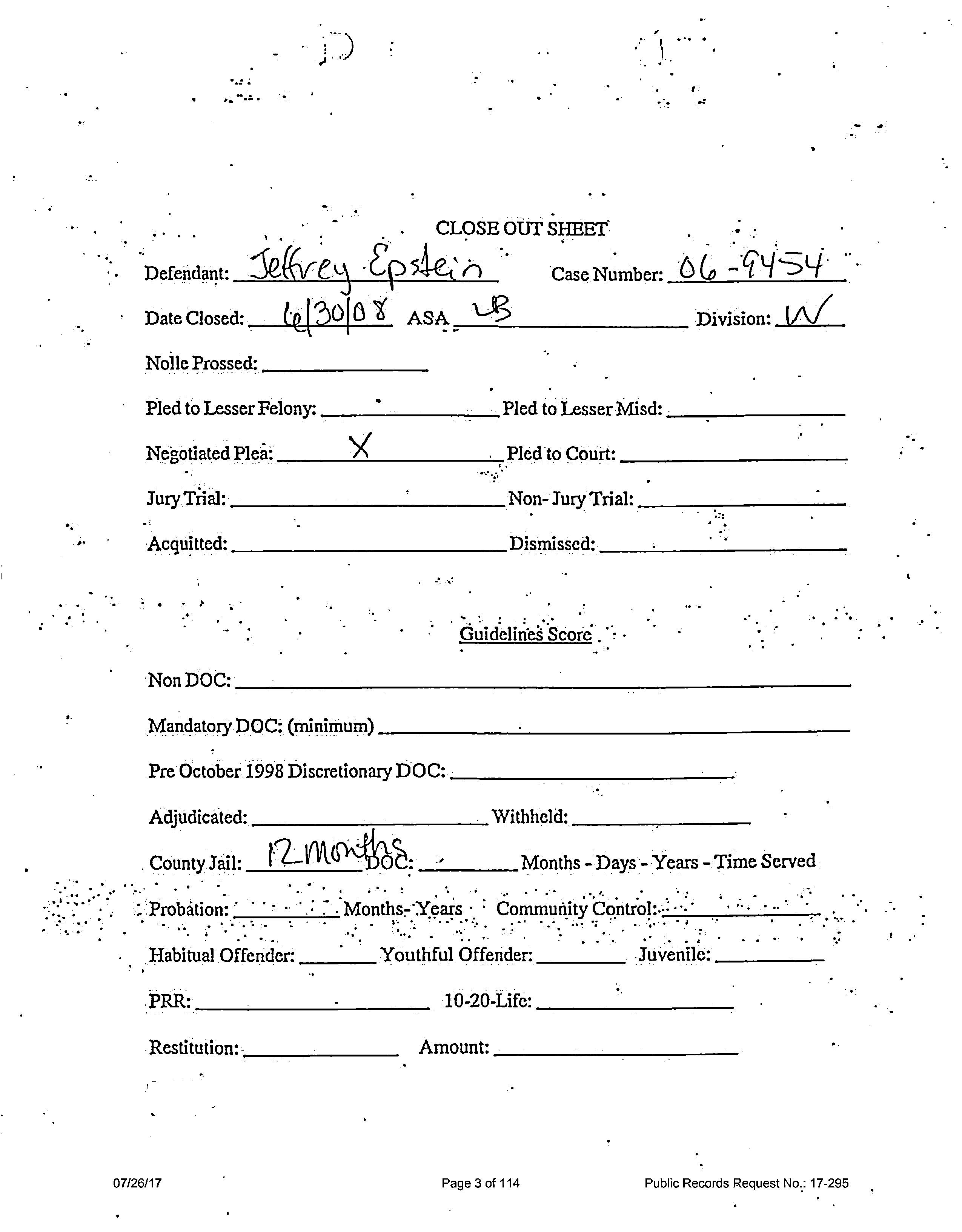
Page 490
document
2550 x 3264
Objects: Page, Text | Text: CLOSE OUT SHEET | Defendant: | Case Number: 06-9454 | Date Closed: 6/30/
Page 490
document
185 x 98
Objects: Accessories, Glasses, Stencil, Text, Animal, Kangaroo, Mammal, Smoke Pipe
Page 491
document
2550 x 3264
Objects: Page, Text, Letter, Chart, Diagram, Plan, Plot | Text: 948,101 Terms and conditions of comm
Page 491
document
311 x 204
Objects: Handwriting, Text, Person, Face, Head, Signature
Page 492
document
2550 x 3264
Objects: Letter, Text, Page, Chart, Diagram, Plan, Plot | Text: 1943.0435 Sexual offenders required
Page 492
document
462 x 271
Objects: Paper, Text, Confetti, Person | Text: whore the court finds
Page 493
document
2550 x 3264
Objects: Page, Text, Letter, Chart, Diagram, Plan, Plot | Text: (IV) Soction 800.01(5)(d) where the

Page 493
document
378 x 250
Objects: Paper, Text, Confetti, Person | Text: 17-295

Page 493
document
379 x 238
Objects: Paper, Confetti, Person
Page 493
document
359 x 180
Objects: Handwriting, Text, Clothing, Hat, Face, Head, Person, Signature
Page 494
document
2550 x 3264
Objects: Letter, Text, Page, Chart, Diagram, Plan, Plot, Advertisement | Text: control of, or undor
Page 494
document
428 x 277
Objects: Text, Baby, Person, Face, Head | Text: t No.: 17-295
Page 495
document
2550 x 3264
Objects: Letter, Text, Page, Chart, Diagram, Plan, Plot, Advertisement | Text: (b) Pay the costs ass
Page 495
photo
556 x 312
Objects: Clothing, Hat, Cowboy Hat

Page 495
document
282 x 430
Objects: Paper, Confetti

Page 496
document
2550 x 3264
Objects: Page, Text, Letter, Chart, Diagram, Plan, Plot, Advertisement | Text: (7) A sexual offender

Page 496
document
338 x 130
Objects: Leaf, Plant, Text, Face, Head, Person
Page 497
document
2550 x 3264
Objects: Letter, Text, Page, Chart, Diagram, Plan, Plot, Advertisement, Poster | Text: Justice, the
Page 498
document
2550 x 3267
Objects: Chart, Diagram, Plan, Plot, Letter, Text, Page | Text: (b) As definod in sub-subparagraph (
Page 499
document
2550 x 3264
Objects: Page, Text, Letter, Chart, Diagram, Plan, Plot | Text: 2. Soction 794.011, excluding s. 794
Page 499
document
496 x 374
Objects: Text, Handwriting, Paper | Text: est No.: 17-295
Page 500
document
2550 x 3267
Objects: Chart, Diagram, Plan, Plot, Page, Text | Text: instant message names, commits a felony of t
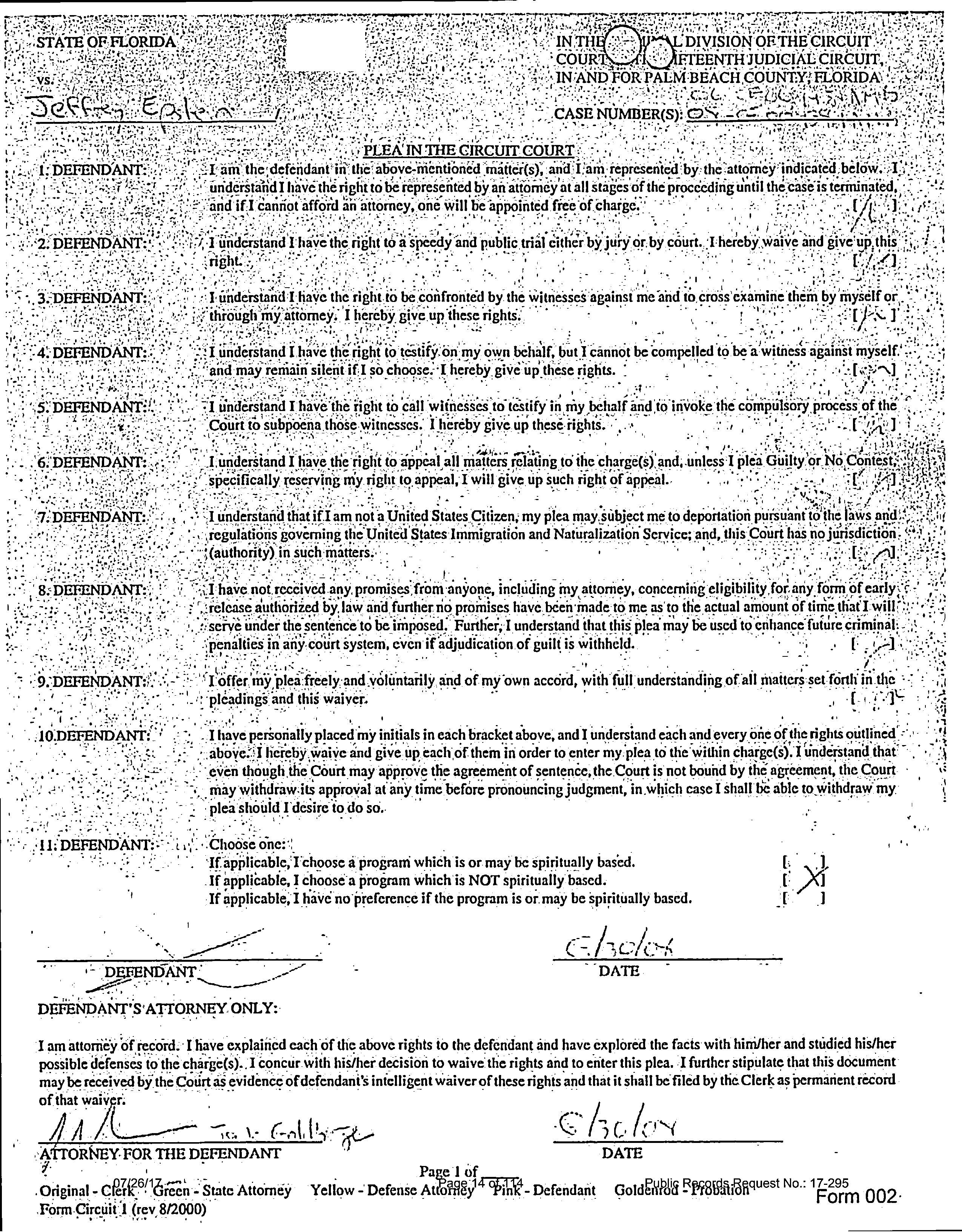
Page 501
document
2550 x 3264
Objects: Page, Text, Letter | Text: STATE OF FLORIDA | IN THE | L DIVISION OF THE CIRCUIT | COURT |
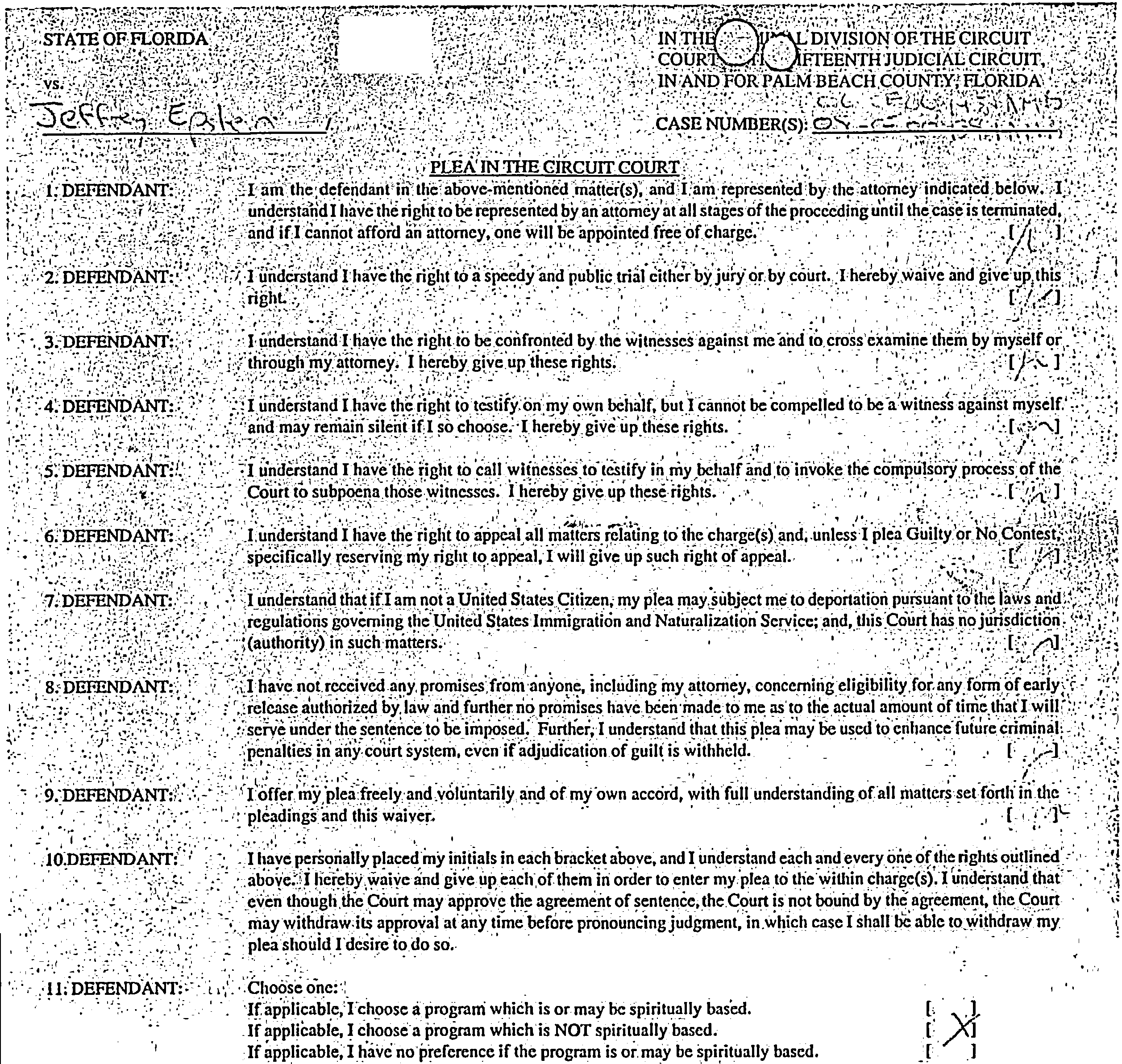
Page 501
document
2514 x 2384
Objects: Page, Text, Chart, Diagram, Plan, Plot, Letter | Text: STATE OF FLORIDA | IN THE | COURT |

Page 501
photo
224 x 145
Objects: Face, Head, Person, Analog Clock, Clock, QR Code, Gauge
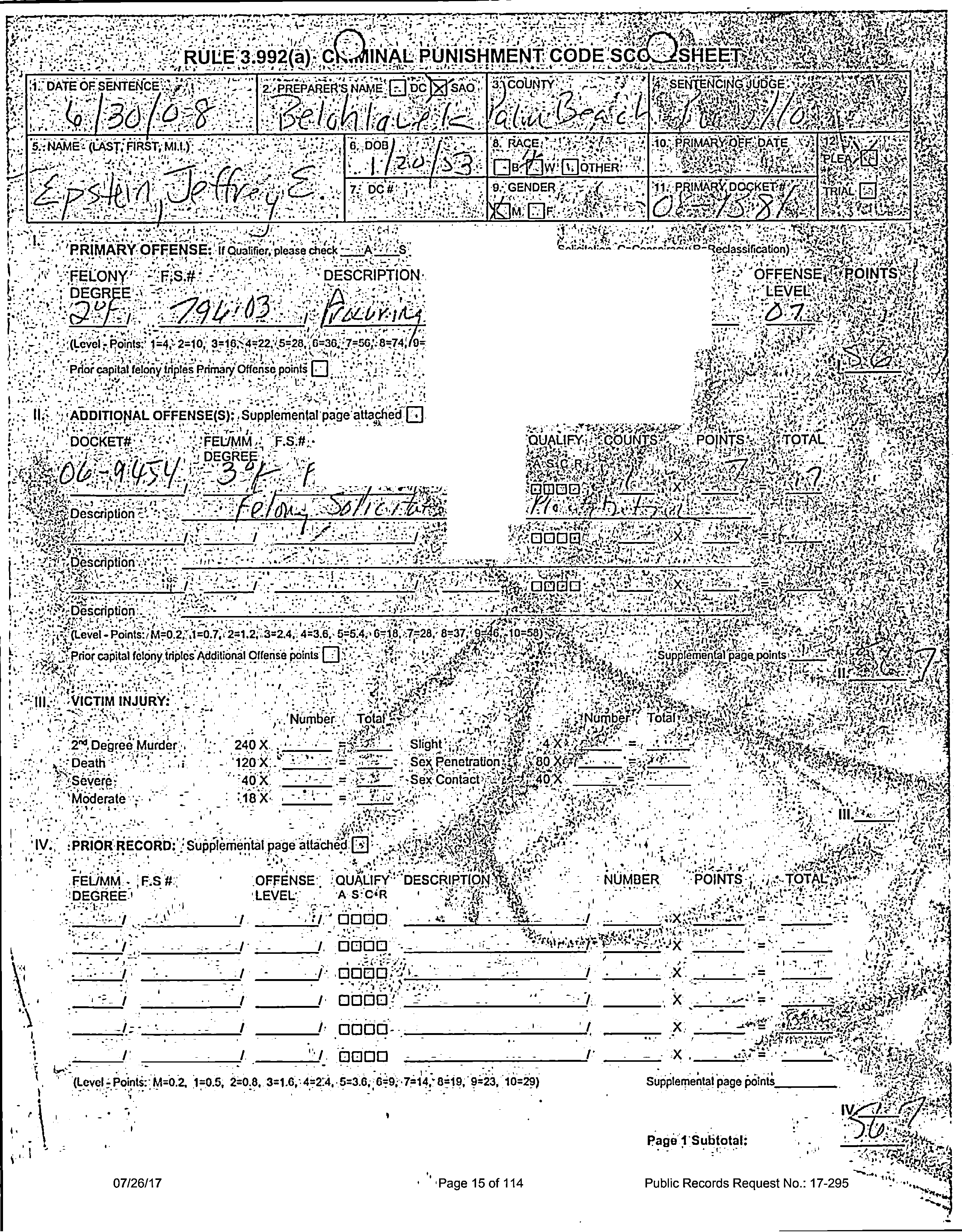
Page 502
document
2550 x 3264
Objects: Chart, Diagram, Plan, Plot, Text | Text: RULE 3.992(a) | PUNISHMENT CODE SCO | SHEET | 31CO
Page 502
document
476 x 197
Objects: Brick, Text, Number, Symbol
Page 502
document
1069 x 898
Objects: Text, Handwriting | Text: Person | for
Page 503
document
2550 x 3267
Objects: Chart, Diagram, Plan, Plot, Text | Text: V | Community, Sanction violation.before the *cour
Page 503
document
658 x 395
Objects: Text, Handwriting, Chart, Plot, QR Code, Number, Symbol | Text: violent offender, .
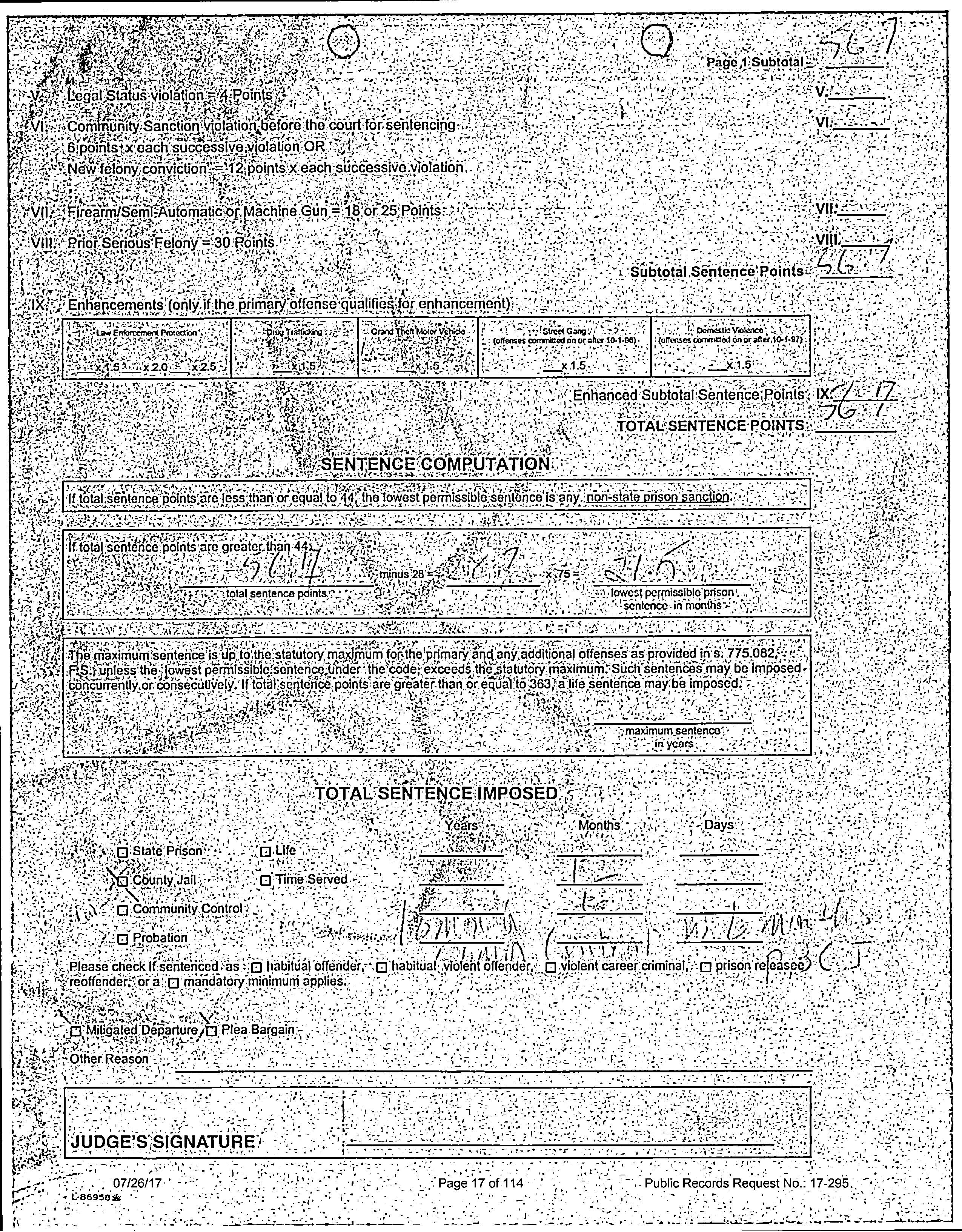
Page 504
document
2550 x 3264
Objects: Chart, Diagram, Plan, Plot, Text | Text: V: | VI. | VI | Community Sanction violation befor
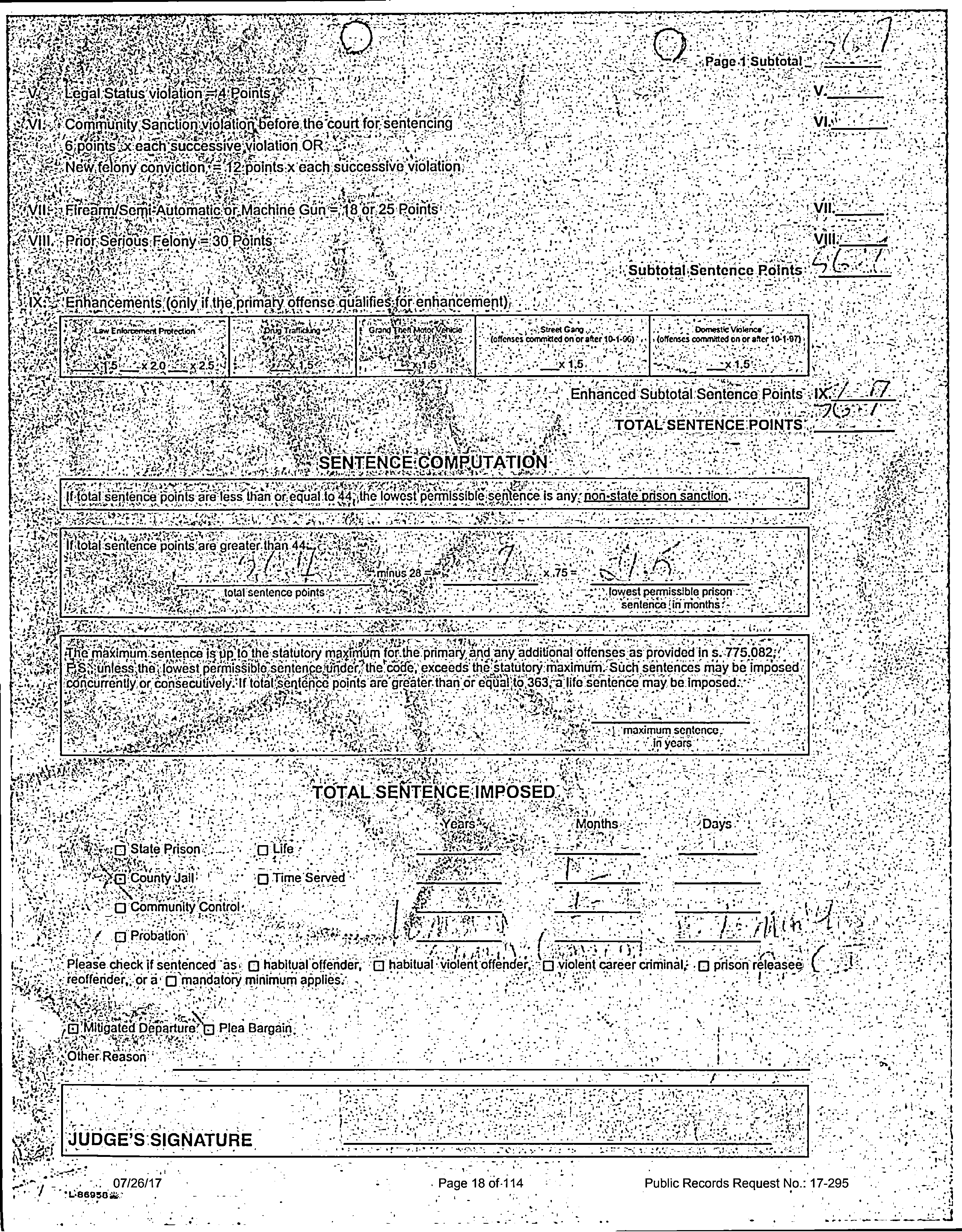
Page 505
document
2550 x 3264
Objects: Chart, Diagram, Plan, Plot, Text | Text: VI. | Community Sanction violation before the "cou
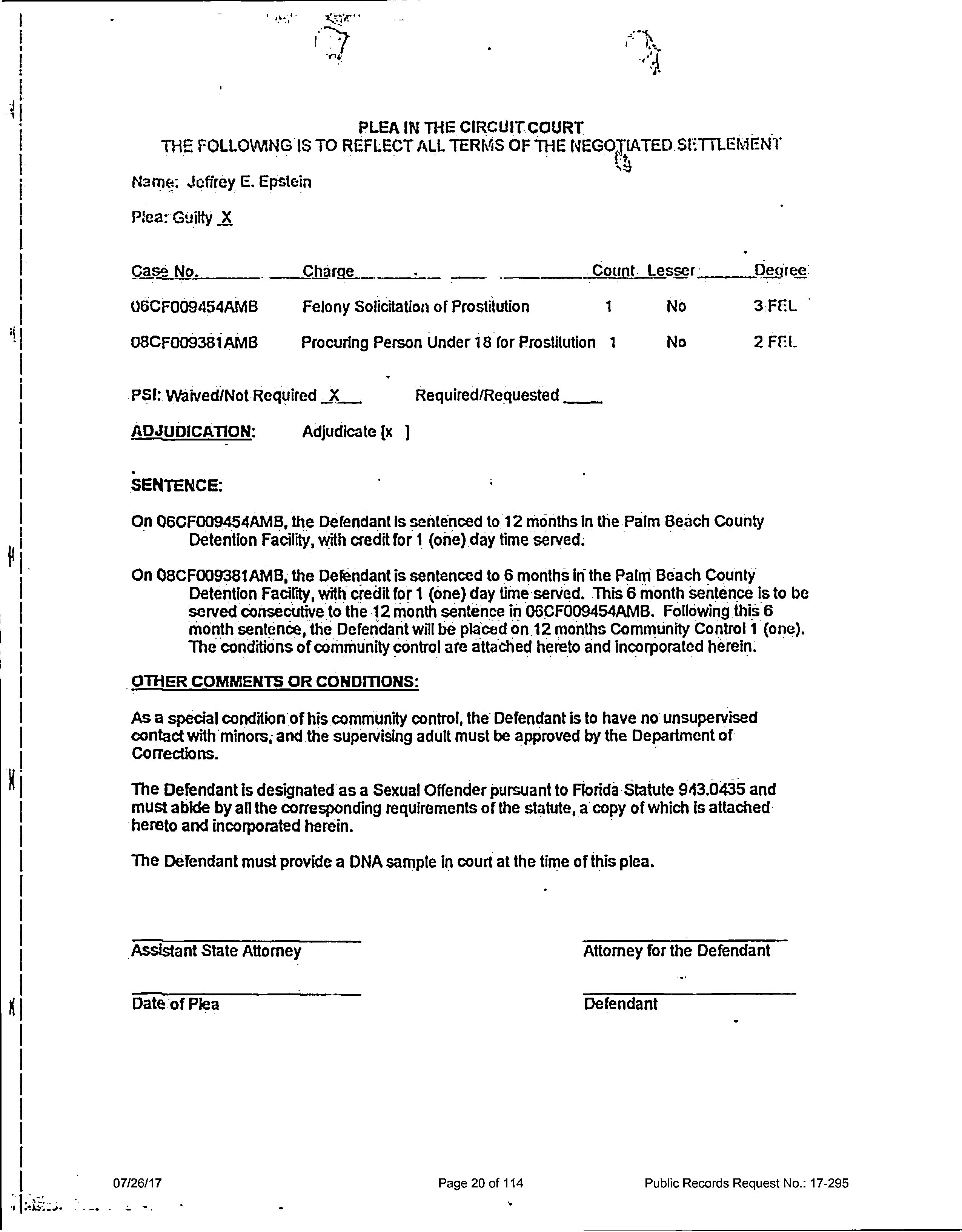
Page 506
document
2550 x 3264
Objects: Page, Text | Text: PLEA IN THE CIRCUIT COURT | THE FOLLOWING IS TO REFLECT ALL TERMS OF THE
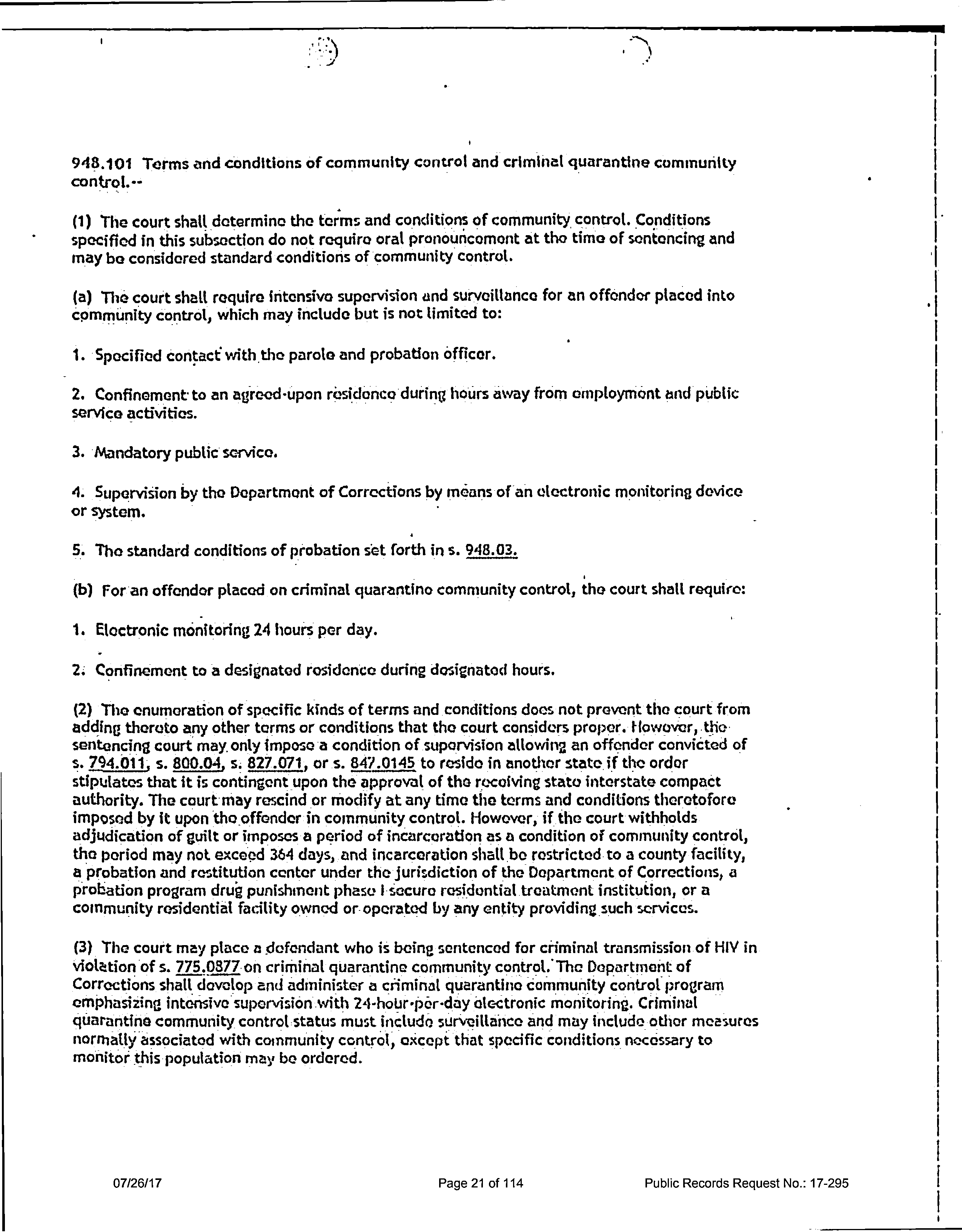
Page 507
document
2550 x 3264
Objects: Page, Text, Letter | Text: 948.101 Terms and conditions of community control and criminal q
Page 507
document
549 x 245
Objects: Text, Letter | Text: or, if the court withholds | condition of community cont | c restricte
Page 507
document
248 x 577
Objects: Text, QR Code, Alphabet | Text: (2) The enur | adding there | sentencing C | stipulates th
Page 507
document
543 x 288
Objects: Text, Scoreboard | Text: enumeration of specific kin | thereto any other tarms or C | cing
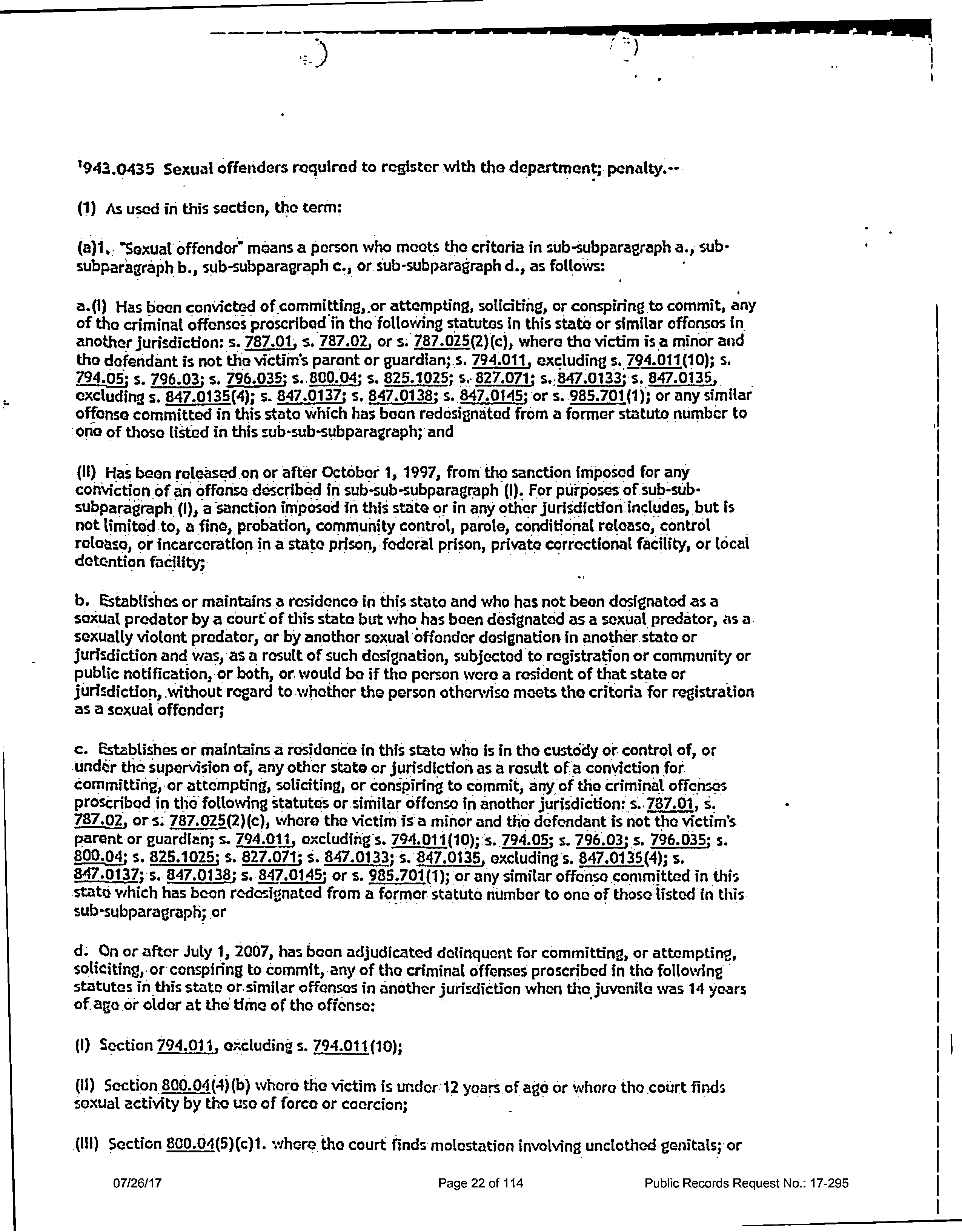
Page 508
document
2550 x 3264
Objects: Page, Text, Letter | Text: 1943.0435 Sexual offenders required to register with the departm
Page 508
document
455 x 190
Objects: Text, Scoreboard | Text: d. On or after July 1, 2 | soliciting, or conspiring | statutes in
Page 508
document
612 x 437
Objects: Text, Letter, QR Code | Text: 1 the custody or control of, or | result of a conviction for
Page 508
document
497 x 288
Objects: Text, Scoreboard, Letter | Text: soxual predator by a cour: | sexually violont prodator, |

Page 508
document
460 x 284
Objects: Text, Face, Head, Person | Text: not been designated as a | od as a sexual predator, | on i
Page 508
document
492 x 240
Objects: Text, Scoreboard, Letter | Text: r October 1, 1997, from th | d in sub-sub-subparagraph | s
Page 508
document
579 x 241
Objects: Text, Scoreboard | Text: here the victim is a minor and | excluding S. 794.011(10); S. | or
Page 508
document
409 x 333
Objects: Text, Scoreboard, Handwriting | Text: of the criminal offen | another jurisdiction: | the d
Page 508
document
530 x 336
Objects: Text, Scoreboard, Number, Symbol | Text: gg.or attempting, soliciting, | the following stat
Page 508
document
782 x 389
Objects: Text, QR Code | Text: as been convicted of committing,or atten | riminal offenses proscribe
Page 509
document
2550 x 3264
Objects: Page, Text | Text: (iV) Section 800.01(5)(d) where the court finds the uso of forco or cocr
Page 509
document
1029 x 438
Objects: Text, Letter, QR Code | Text: (b) "Convictod" means that there has been a determin | cntry
Page 509
document
608 x 336
Objects: Text, Letter, QR Code | Text: of a qualifying offenso listed in 1 | tho ago of tho victim a
Page 510
document
2550 x 3258
Objects: Page, Text, Letter | Text: control of, or undor the supervision of, the Department of Corre
Page 510
document
477 x 198
Objects: Text, Person, Head | Text: forward the photographs | on provided by the sexual | he informa
Page 510
document
485 x 197
Objects: Text, Scoreboard | Text: nrollment or employment | Il bc reported in person at | shoriff sh
Page 510
document
430 x 241
Objects: Text, Scoreboard, Face, Head, Person | Text: vocation at an instituti | ide to the departme
Page 510
document
488 x 196
Objects: Text, Handwriting | Text: naptor. 327, the sexual | IL identification number; | vessel, or
Page 510
document
468 x 243
Objects: Text | Text: temporary residence, wi | ost offico box, any electr | ed pursuant to paragrap
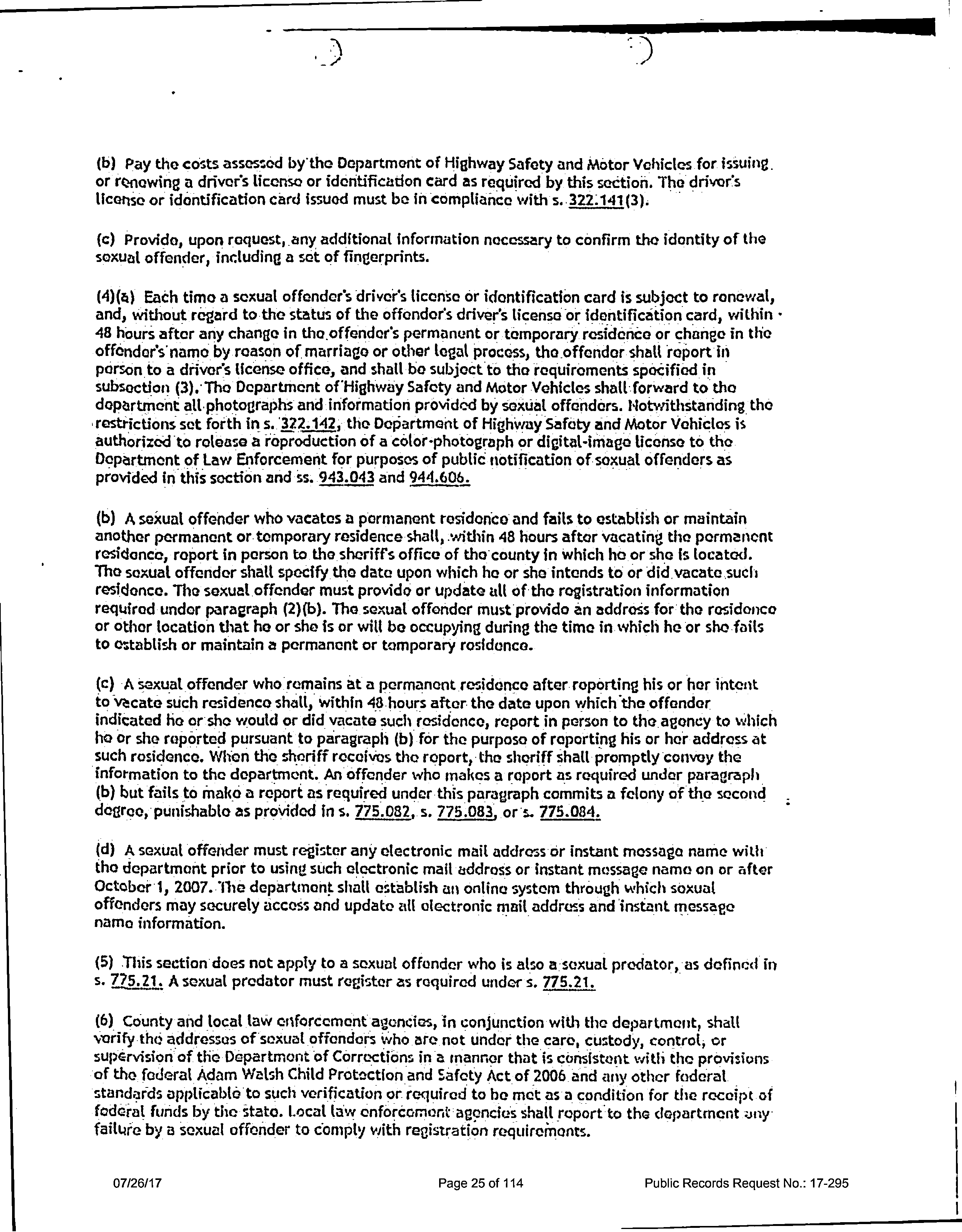
Page 511
document
2550 x 3264
Objects: Page, Text | Text: (b) Pay the costs assessed by'the Department of Highway Safety and Motor
Page 511
document
458 x 343
Objects: Text, Handwriting, QR Code | Text: (6) County and local la | varify the addressos of | supe
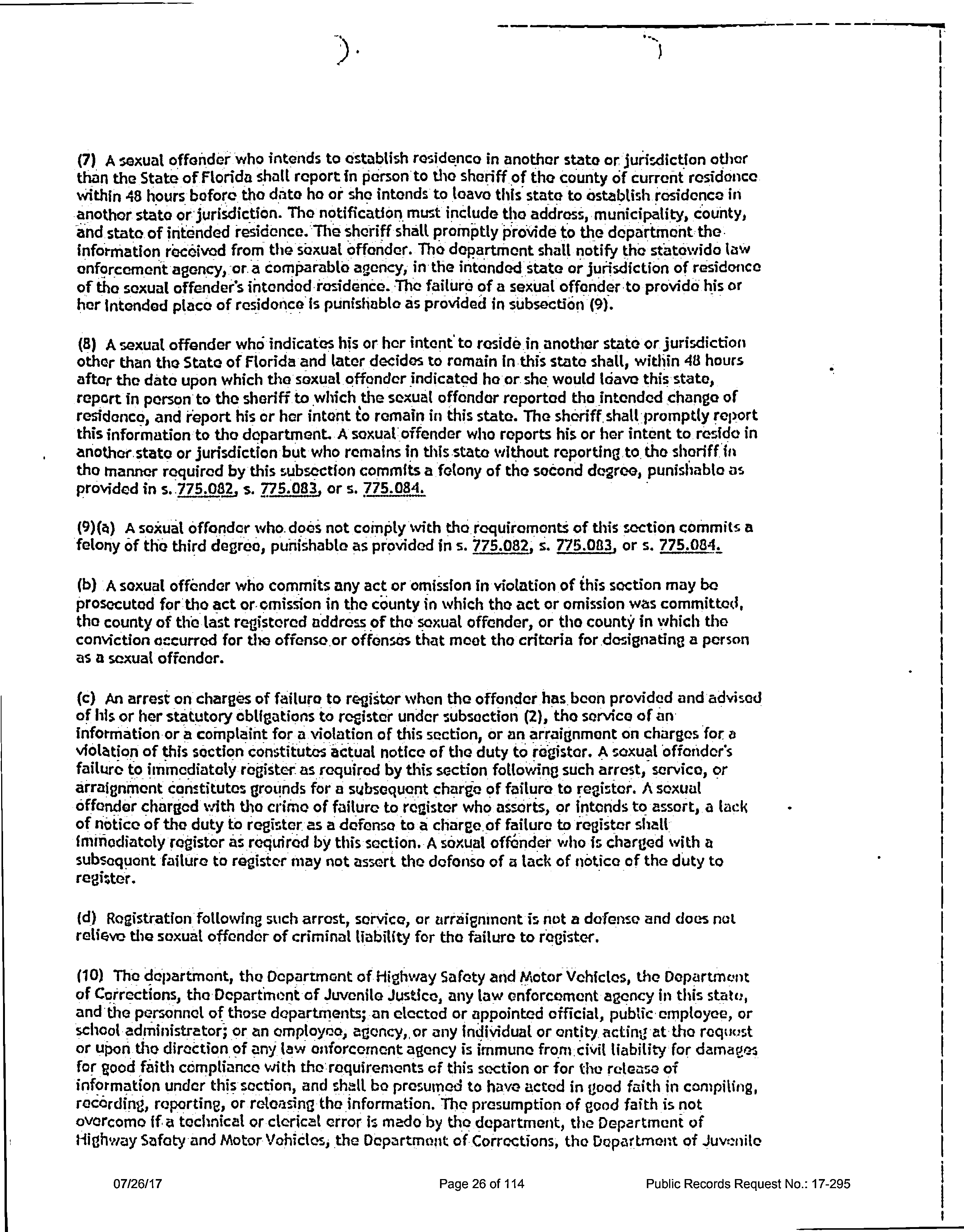
Page 512
document
2550 x 3258
Objects: Page, Text, Letter | Text: (7) A sexual offender who intends to establish residenco in anot
Page 512
document
482 x 243
Objects: Text, Scoreboard | Text: direction of any law enfo | th compliance with there | under this
Page 512
document
429 x 392
Objects: Text, QR Code, Letter | Text: (10) The department, | of Corrections, the Do | and the perso
Page 512
document
467 x 385
Objects: Text, Letter, QR Code | Text: violation of this soction | failure to immediately | arraignm
Page 512
document
511 x 291
Objects: Text | Text: cr subsection (2), the servi | section, or an arraignment | of the duty to reg
Page 512
document
397 x 433
Objects: Text, Handwriting, QR Code | Text: TO to register when th | s to register under su | violat
Page 512
document
485 x 200
Objects: Text | Text: Florida and later decides | ich the soxual offender in | sheriff to which the
Page 512
document
1027 x 435
Objects: Text, Letter, QR Code | Text: (8) A sexual offender who indicates his or her intent t | oth
Page 512
document
545 x 331
Objects: Text, Handwriting, Scoreboard, Letter | Text: nother state or jurisdiction | state shall, w
Page 512
document
492 x 198
Objects: Text, Blackboard | Text: information received from | of the sexual offender's in | her inte
Page 512
document
519 x 295
Objects: Text, Letter, QR Code | Text: liction. The notification mu | residence. The sheriff shall |
Page 513
document
2550 x 3264
Objects: Page, Text, Letter | Text: Justice, the personnel of those departments, or any individual o
Page 513
document
392 x 242
Objects: Text, Scoreboard | Text: demonstratos to the | requested relief CO | 4 and Safoty Act of 20
Page 513
document
416 x 202
Objects: Text, Letter, Scoreboard | Text: any individual or entit | s in compiling or prov | soxual
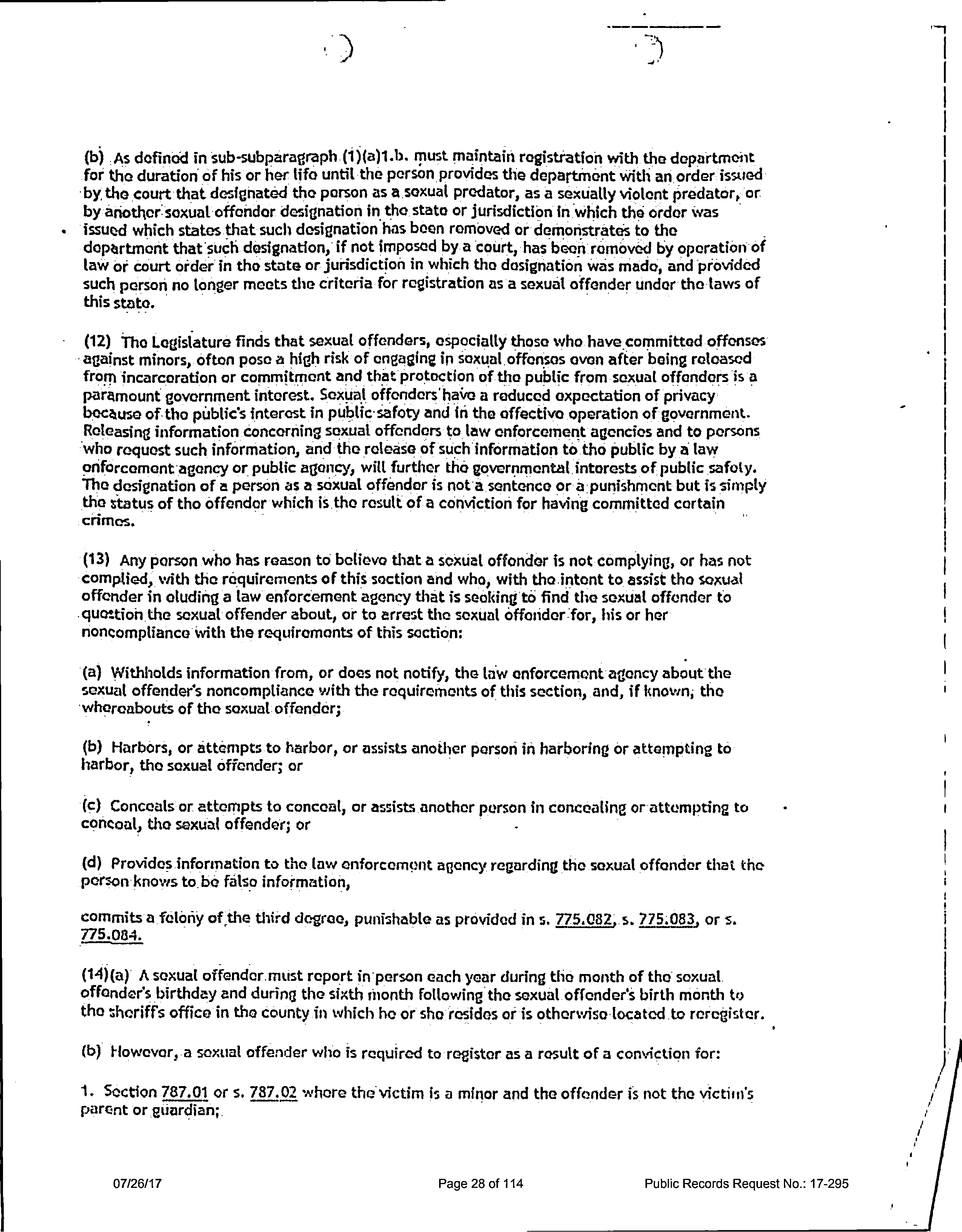
Page 514
document
2550 x 3267
Objects: Page, Text | Text: (b) As definod in sub-subparagraph (1)(a)1.b. must maintain rogistration
Page 514
document
1159 x 517
Objects: Page, Text, Chart, Plot, Outdoors | Text: a rosult of a conviction for: | d the offender is
Page 514
document
576 x 296
Objects: Text, Letter | Text: who have committed offenses | QS oven after being reloased | lic from
Page 514
document
430 x 336
Objects: Text, Letter, Scoreboard | Text: (12) The Legislature | against minors, ofton | from incarc
Page 515
document
2550 x 3267
Objects: Page, Text | Text: 2. Section 794.011, excluding 5. 794.011(10); | 3. Section 800.04(4)(b)
Page 515
document
771 x 385
Objects: Text, Letter, QR Code | Text: is a motor vehicle, trailer, mobilo home, | 0, the soxual off
Page 516
document
2550 x 3267
Objects: Page, Text | Text: instant message names, commits a felony of the third dogree, punishable
Page 517
document
2550 x 3300
Objects: Text | Text: Appendix 9
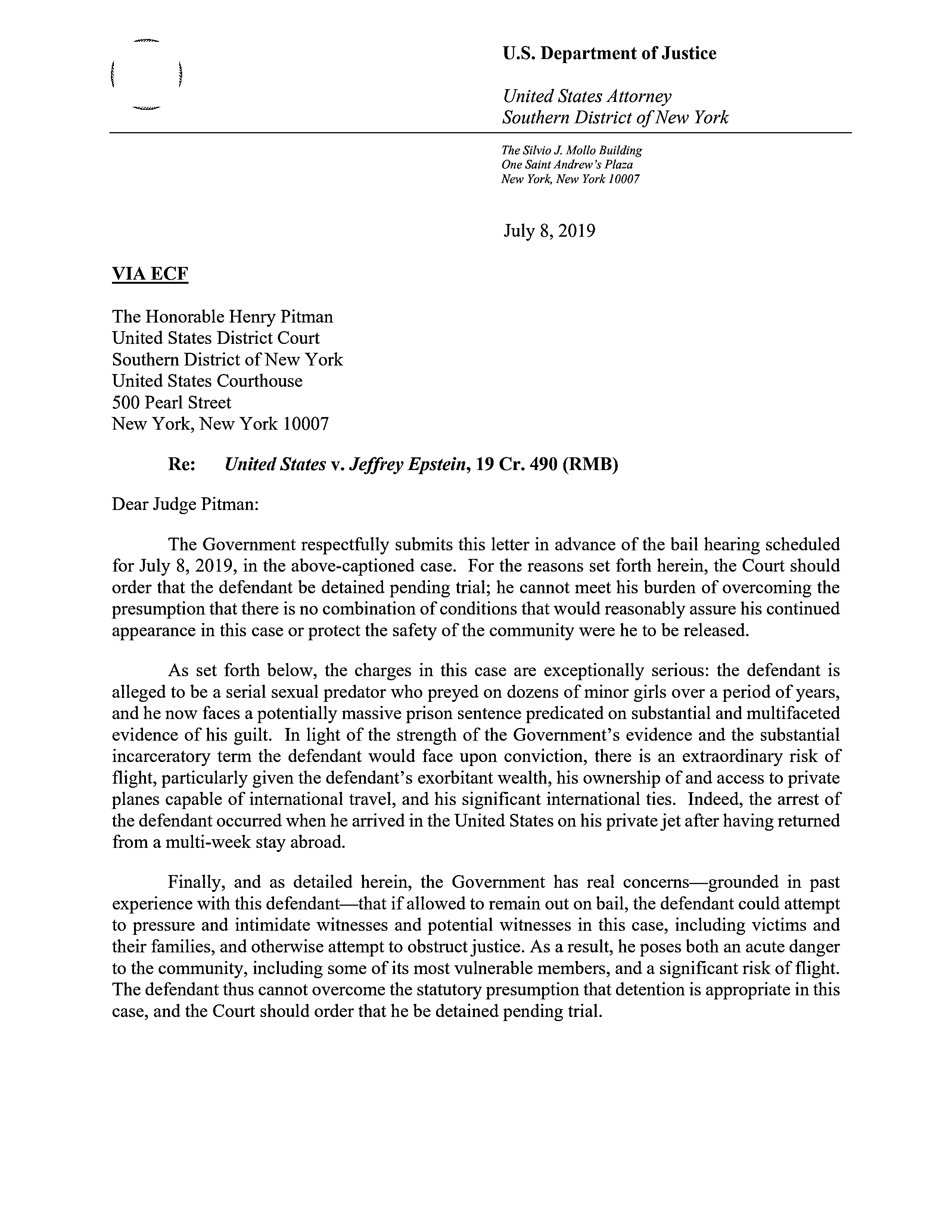
Page 518
document
2550 x 3300
Objects: Page, Text, Letter | Text: U.S. Department of Justice | United States Attorney | Southern D

Page 518
photo
191 x 190
Objects: Emblem, Symbol, QR Code, Logo
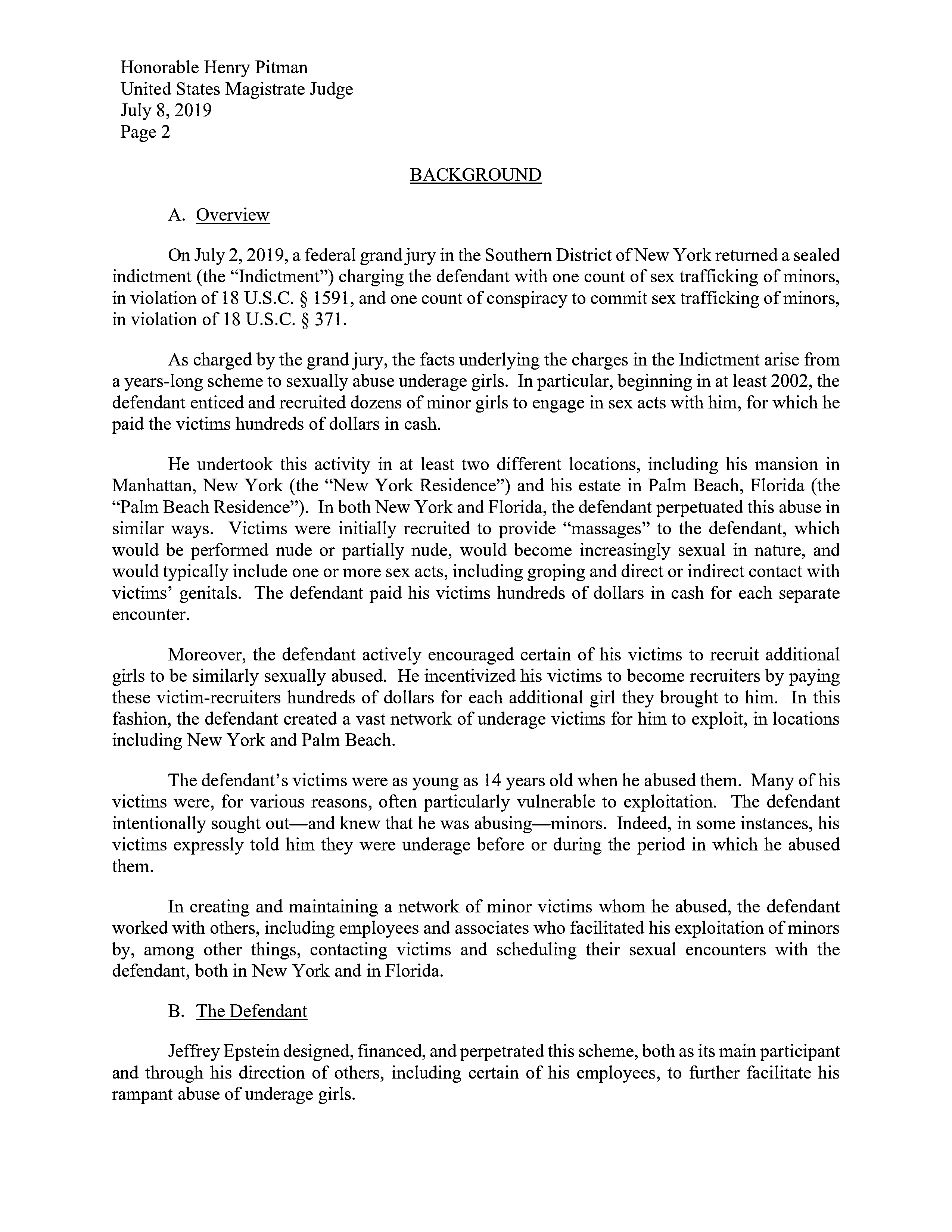
Page 519
document
2550 x 3300
Objects: Letter, Text, Page | Text: Honorable Henry Pitman | United States Magistrate Judge | July 8
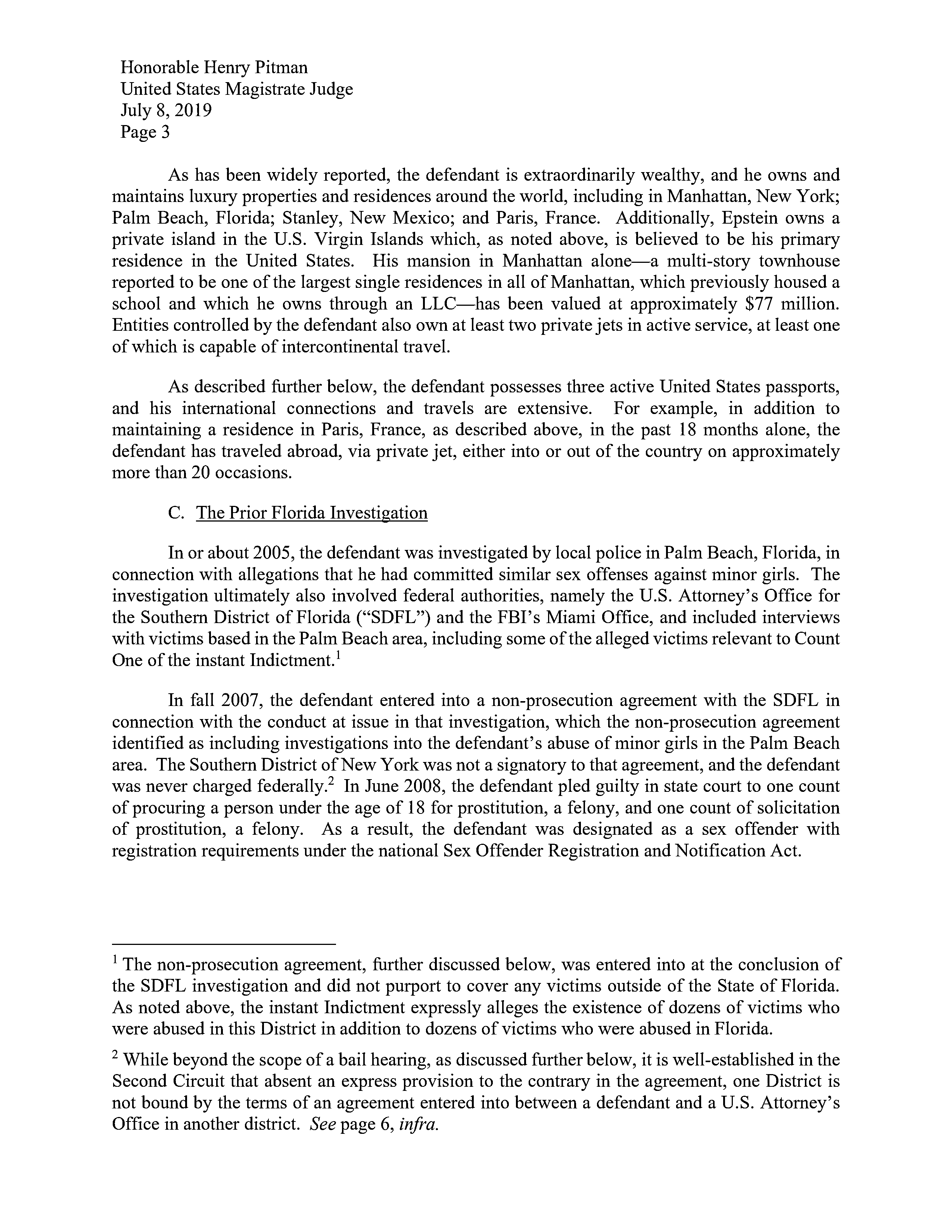
Page 520
document
2550 x 3300
Objects: Letter, Text, Page | Text: Honorable Henry Pitman | United States Magistrate Judge | July 8
Page 521
document
2550 x 3300
Objects: Letter, Text, Page | Text: Honorable Henry Pitman | United States Magistrate Judge | July 8
Page 522
document
2550 x 3300
Objects: Letter, Text, Page | Text: Honorable Henry Pitman | United States Magistrate Judge | July 8
Page 523
document
2550 x 3300
Objects: Letter, Text, Page | Text: Honorable Henry Pitman | United States Magistrate Judge | July 8
Page 524
document
2550 x 3300
Objects: Letter, Text, Page | Text: Honorable Henry Pitman | United States Magistrate Judge | July 8
Page 525
document
2550 x 3300
Objects: Letter, Text, Page | Text: Honorable Henry Pitman | United States Magistrate Judge | July 8
Page 526
document
2550 x 3300
Objects: Letter, Text, Page | Text: Honorable Henry Pitman | United States Magistrate Judge | July 8
Page 527
document
2550 x 3300
Objects: Letter, Text, Page | Text: Honorable Henry Pitman | United States Magistrate Judge | July 8

Page 528
document
2550 x 3300
Objects: Text | Text: Appendix 10
Page 529
document
2550 x 3300
Objects: Page, Text, Letter | Text: United States Department ofJastice | THE UNITED STATES ATTORNEY'
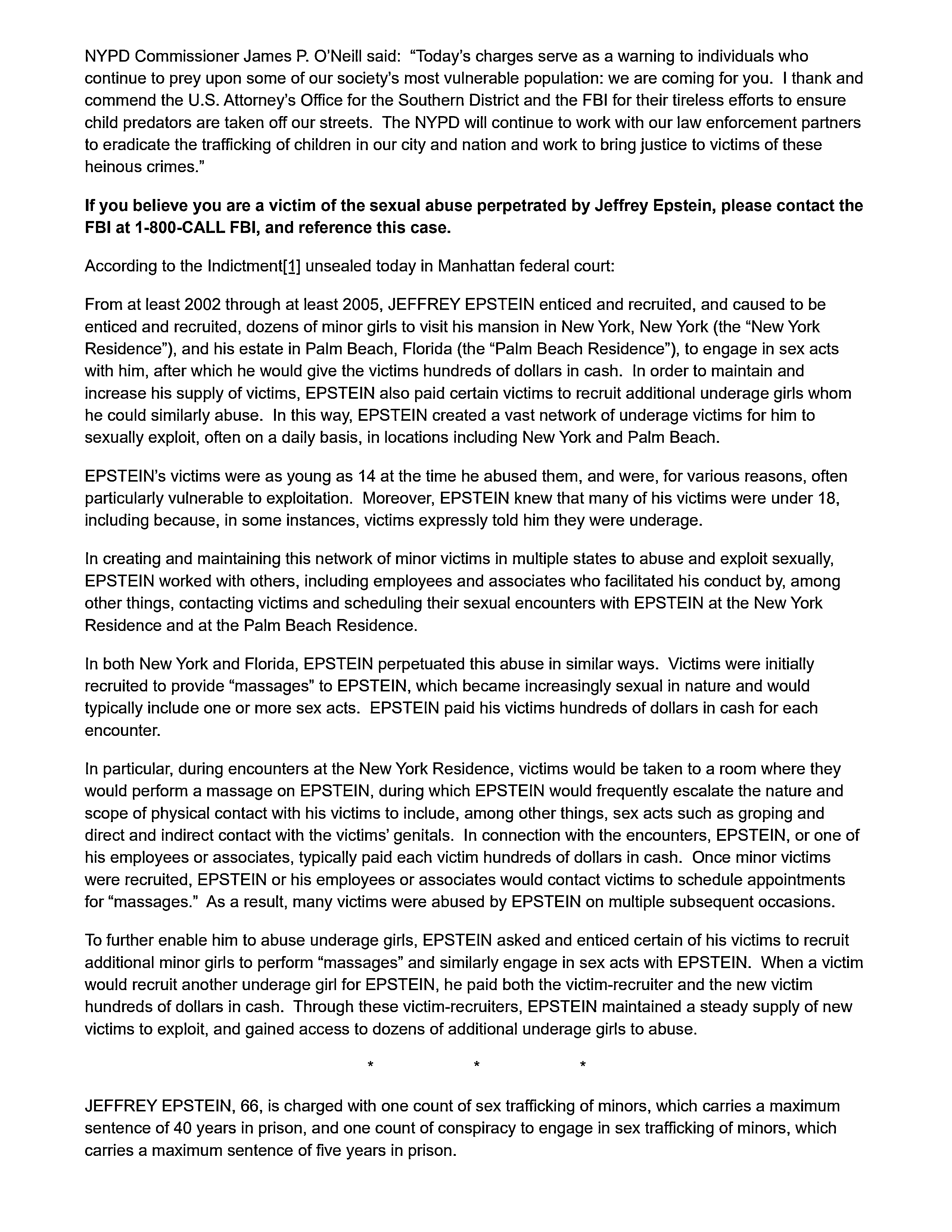
Page 530
document
2550 x 3300
Objects: Letter, Text, Page | Text: NYPD Commissioner James P. O'Neill said: "Today's charges serve
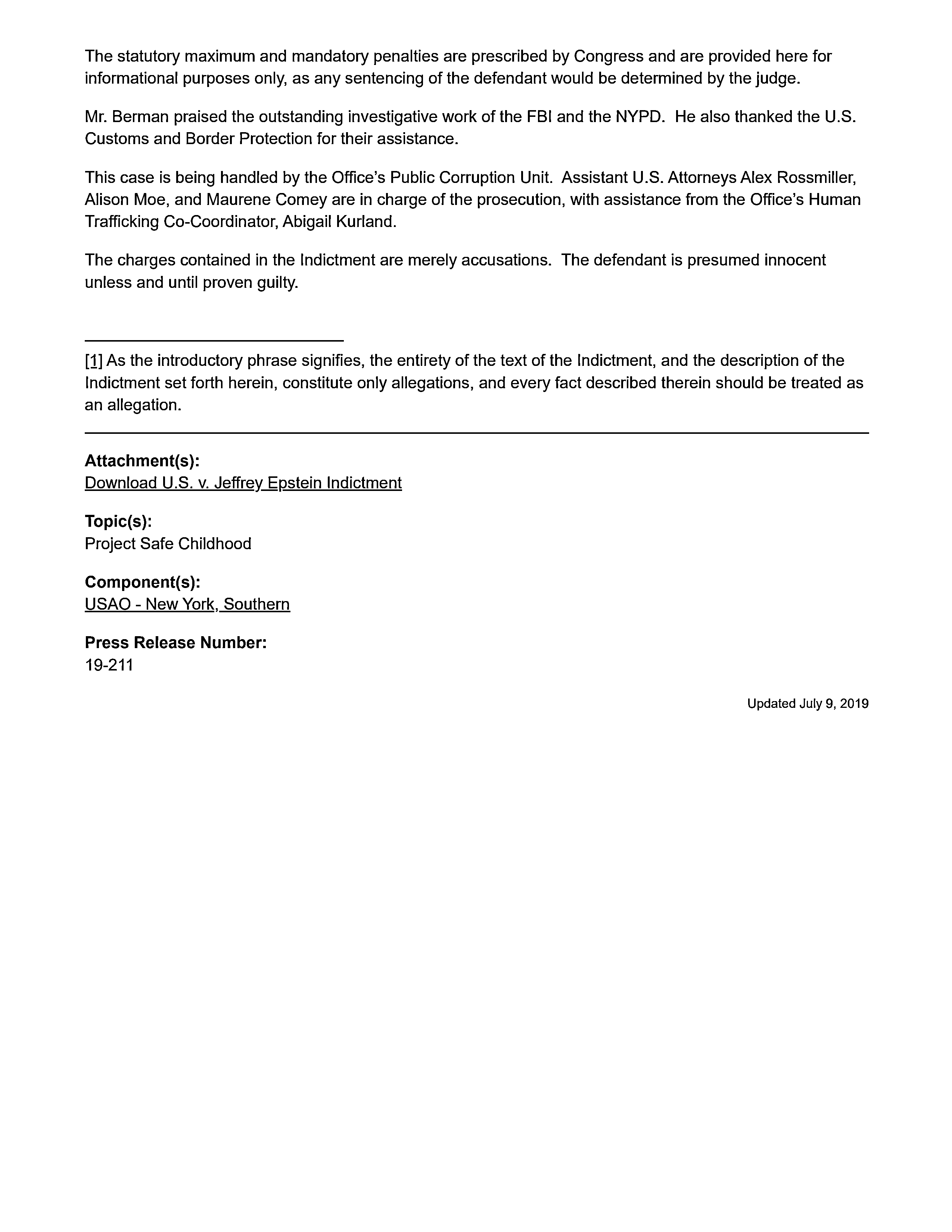
Page 531
document
2550 x 3300
Objects: Page, Text, Letter | Text: The statutory maximum and mandatory penalties are prescribed by
Page 532
document
2550 x 3300
Objects: Text | Text: Appendix 11
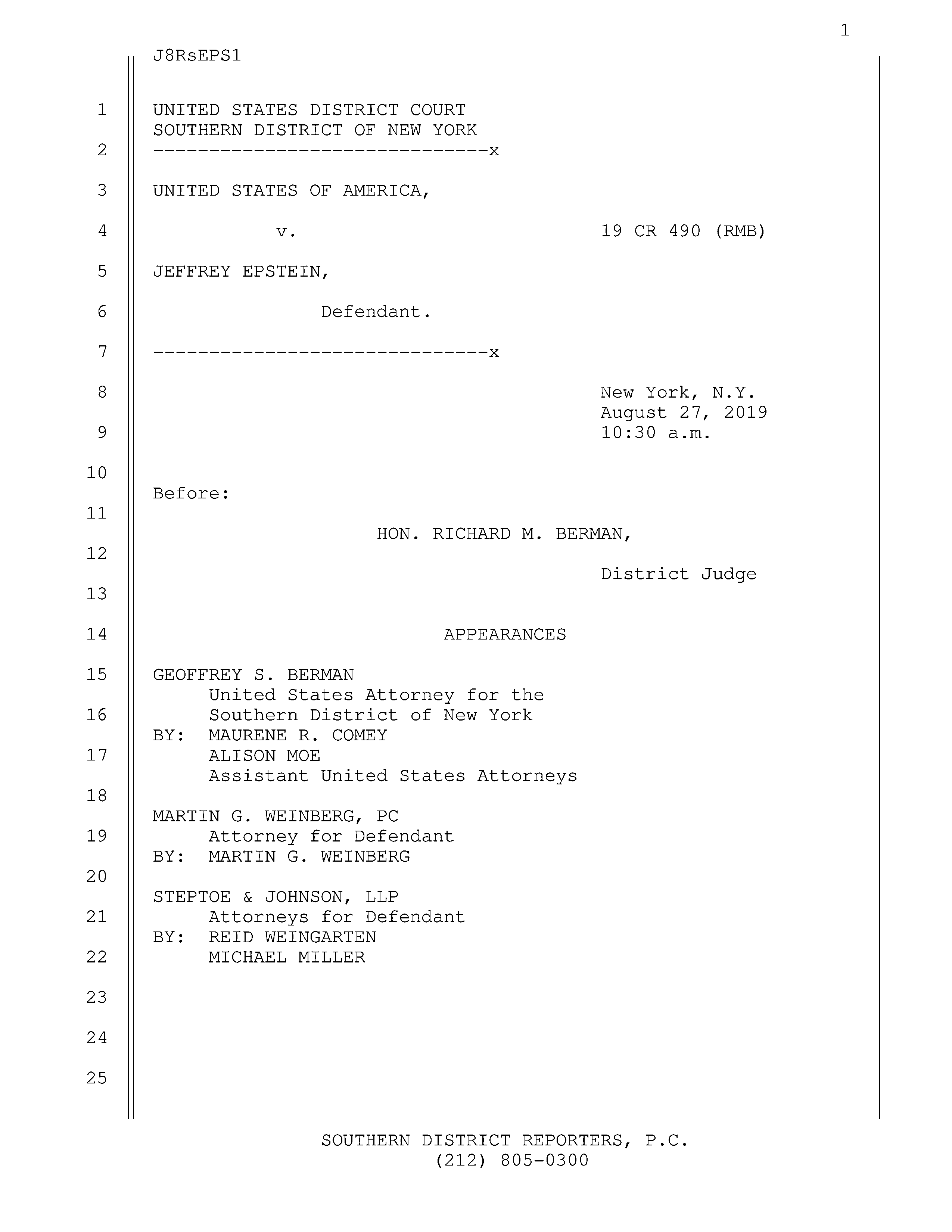
Page 533
document
2550 x 3300
Objects: Page, Text, Document, Invoice | Text: 1 | J8RsEPS1 | 1 | UNITED STATES DISTRICT COURT | SOU
Page 534
document
2550 x 3300
Objects: Page, Text | Text: 2 | J8RsEPS1 | 1 | (Case called) | 2
Page 535
document
2550 x 3300
Objects: Page, Text | Text: 3 | J8RsEPS1 | 1 | defendant. | 2
Page 536
document
2550 x 3300
Objects: Page, Text | Text: 4 | J8RsEPS1 | 1 | (In my view, a public hearing) | relatively straightf
Page 537
document
2550 x 3300
Objects: Page, Text, Letter | Text: 5 | J8RsEPS1 | 1 | today, I don't think it would be very signifi
Page 538
document
2550 x 3300
Objects: Page, Text | Text: 6 | J8RsEPS1 | 1 | discontinuance by the prosecutor of all or of a part
Page 539
document
2550 x 3300
Objects: Page, Text, Letter | Text: 7 | J8RsEPS1 | 1 | court must still make its own independent det
Page 540
document
2550 x 3300
Objects: Page, Text | Text: 8 | J8RsEPS1 | 1 | the court's responsibility, and manifestly within its
Page 541
document
2550 x 3300
Objects: Page, Text | Text: 9 | J8RsEPS1 | 1 | This latter application of the rule of abatement | 2
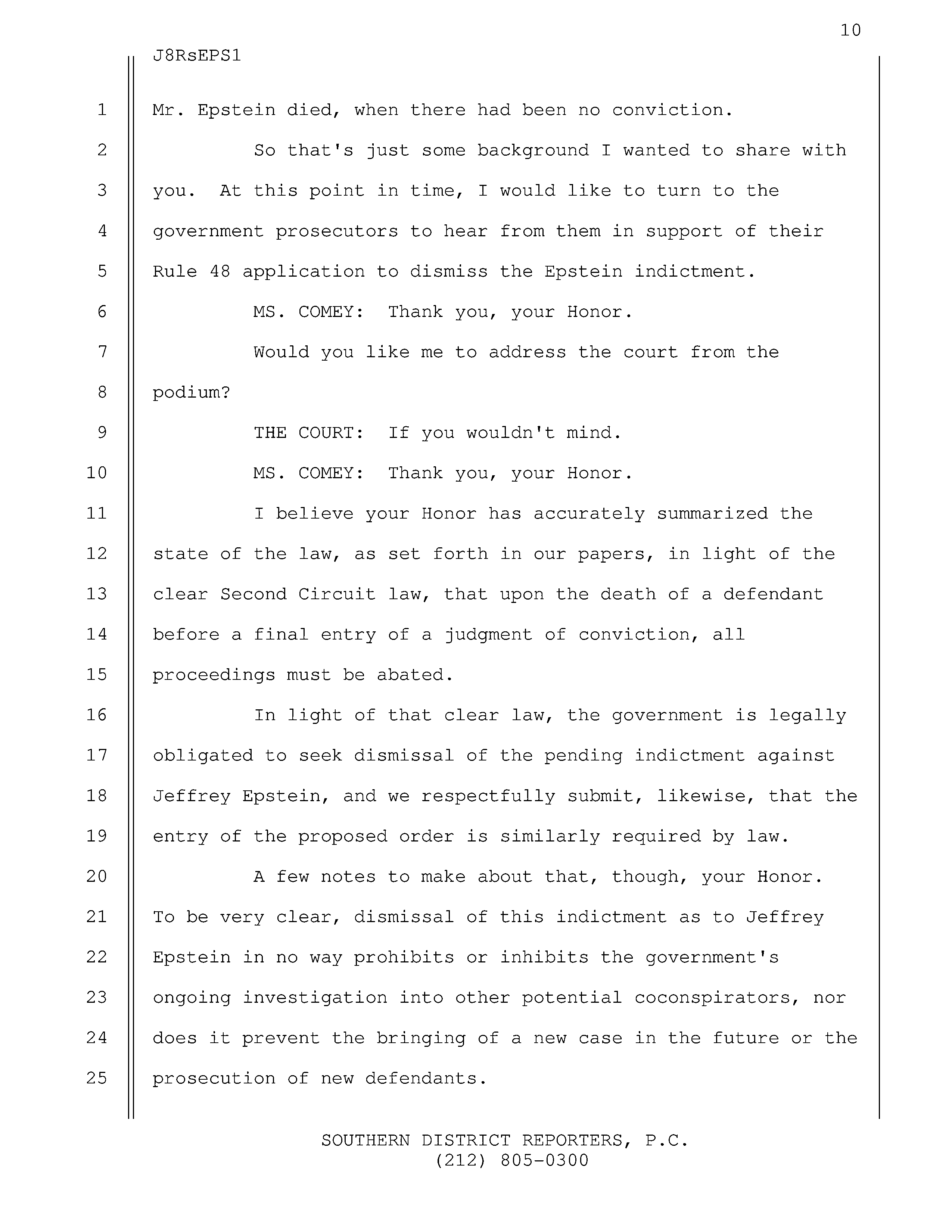
Page 542
document
2550 x 3300
Objects: Page, Text, Letter | Text: 10 | J8RsEPS1 | 1 | Mr. Epstein died, when there had been no con
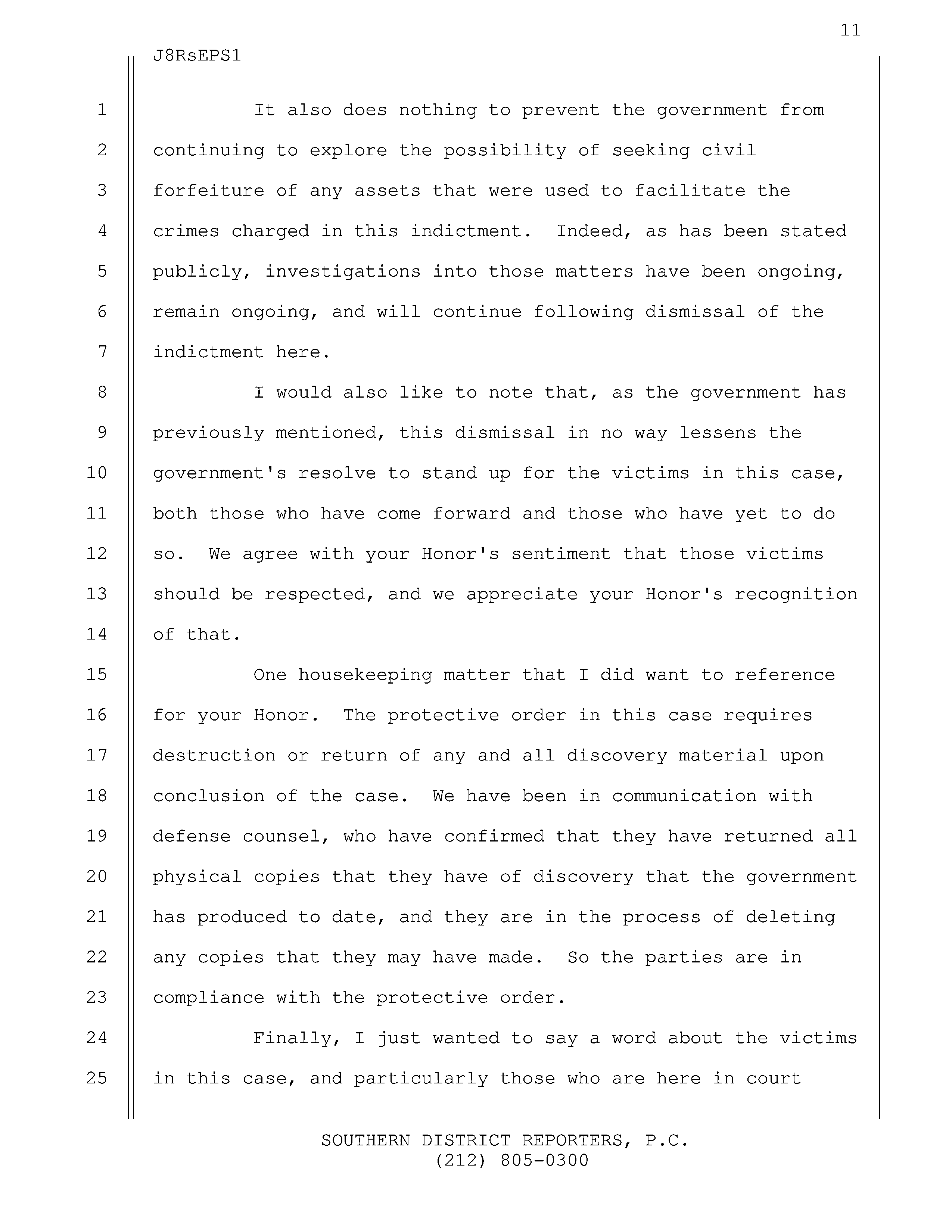
Page 543
document
2550 x 3300
Objects: Page, Text | Text: 11 | J8RsEPS1 | 1 | It also does nothing to prevent the government from
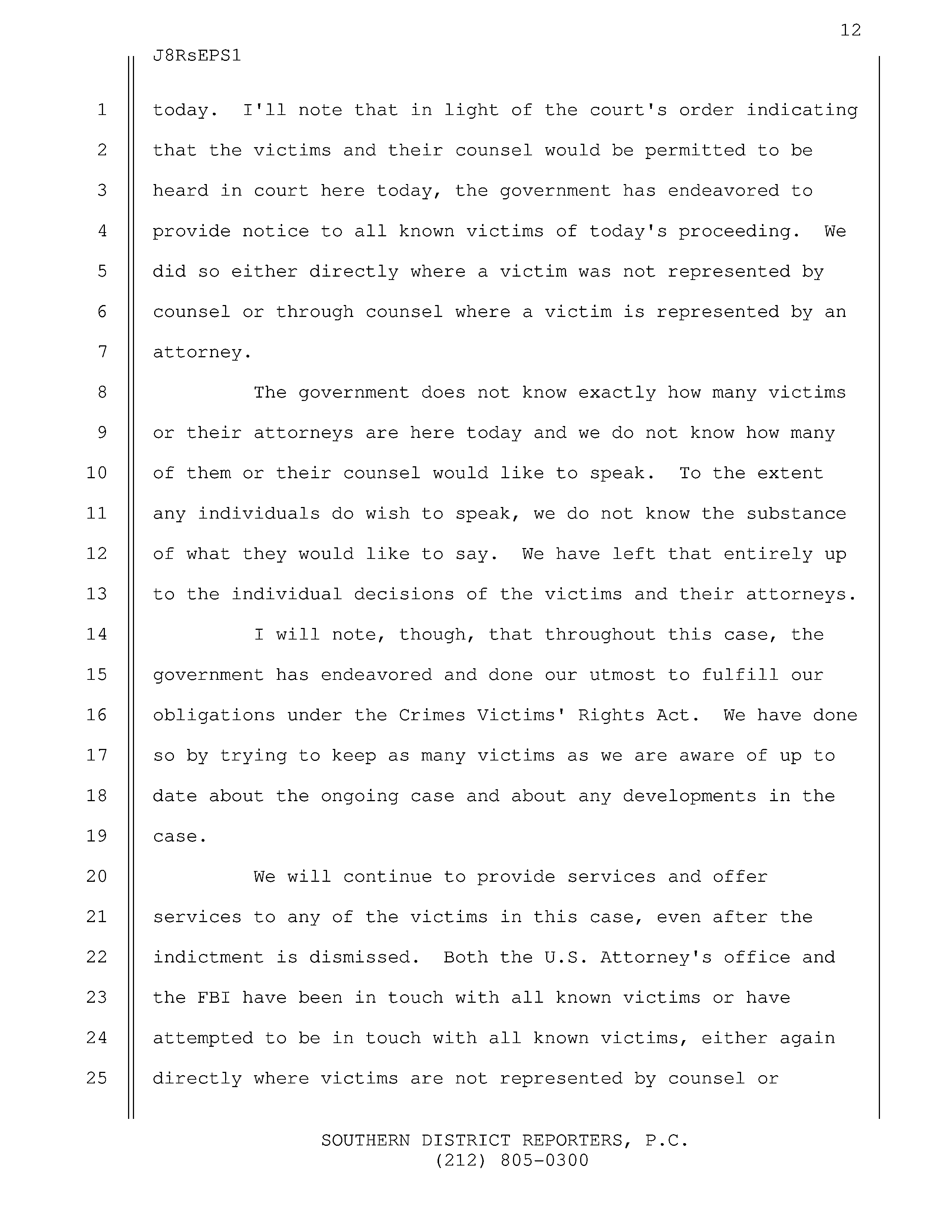
Page 544
document
2550 x 3300
Objects: Page, Text | Text: 12 | J8RsEPS1 | 1 | today. | I'll note that in light of the court's orde
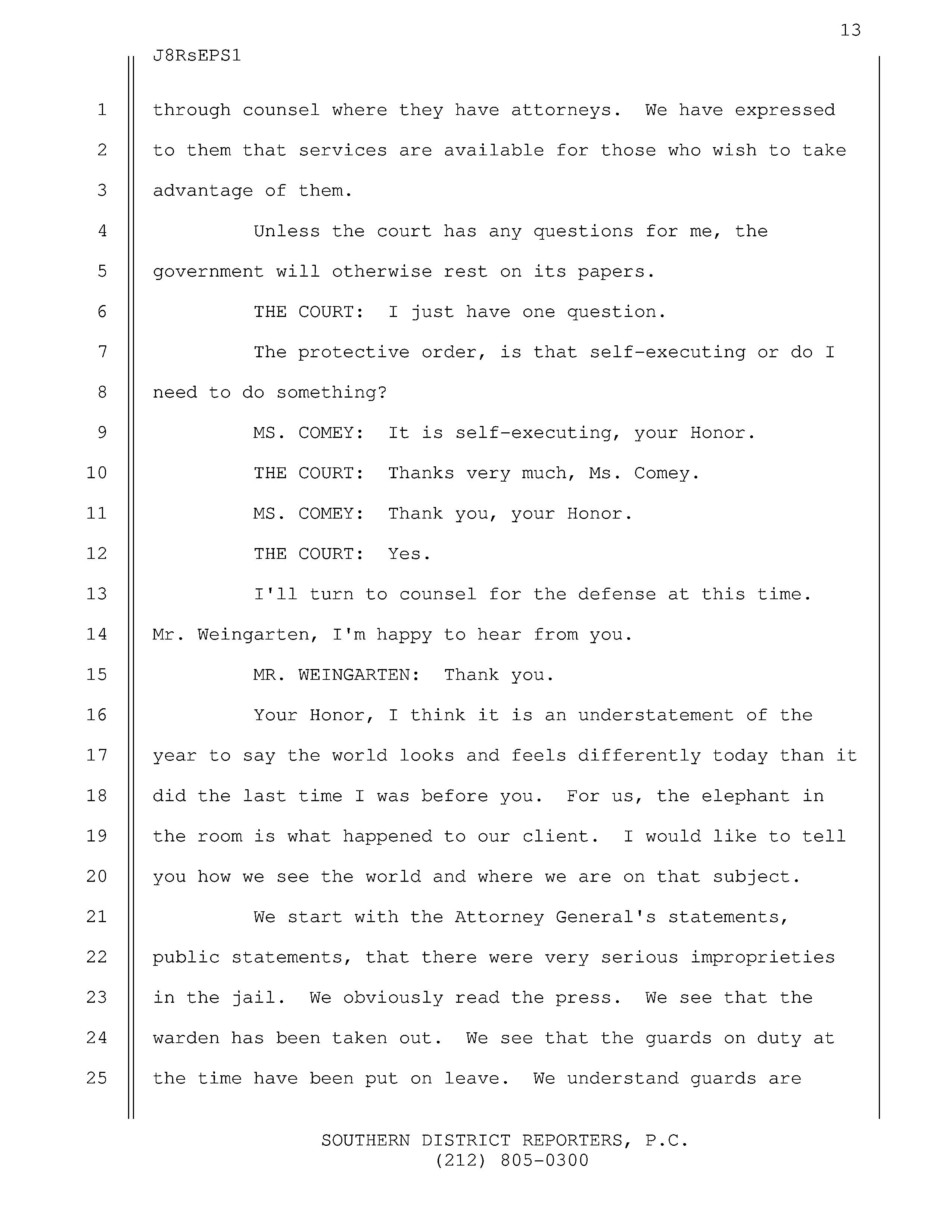
Page 545
document
2550 x 3300
Objects: Page, Text | Text: 13 | J8RsEPS1 | 1 | through counsel where they have attorneys. | We have
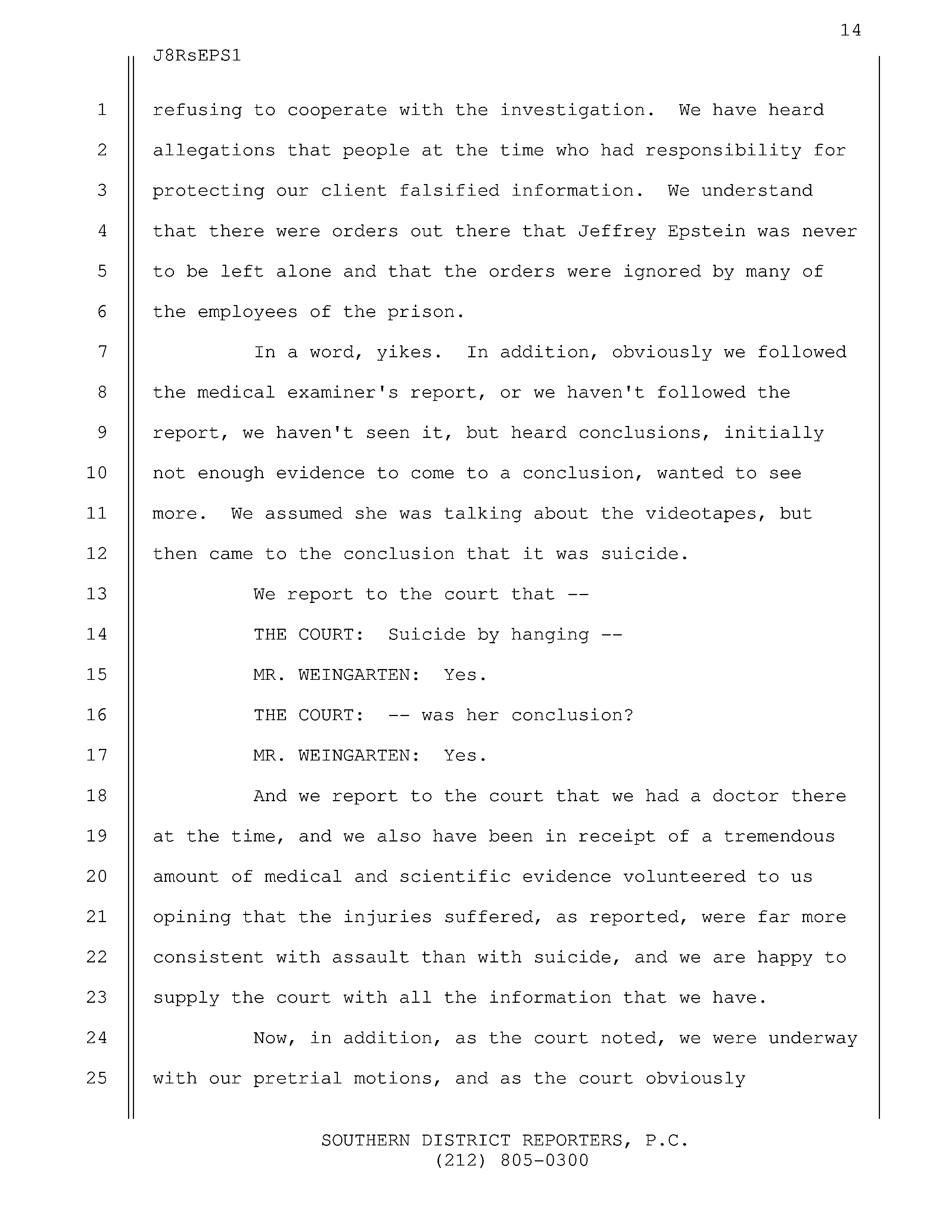
Page 546
document
2550 x 3300
Objects: Page, Text | Text: 14 | J8RsEPS1 | refusing to cooperate with the investigation. | We have
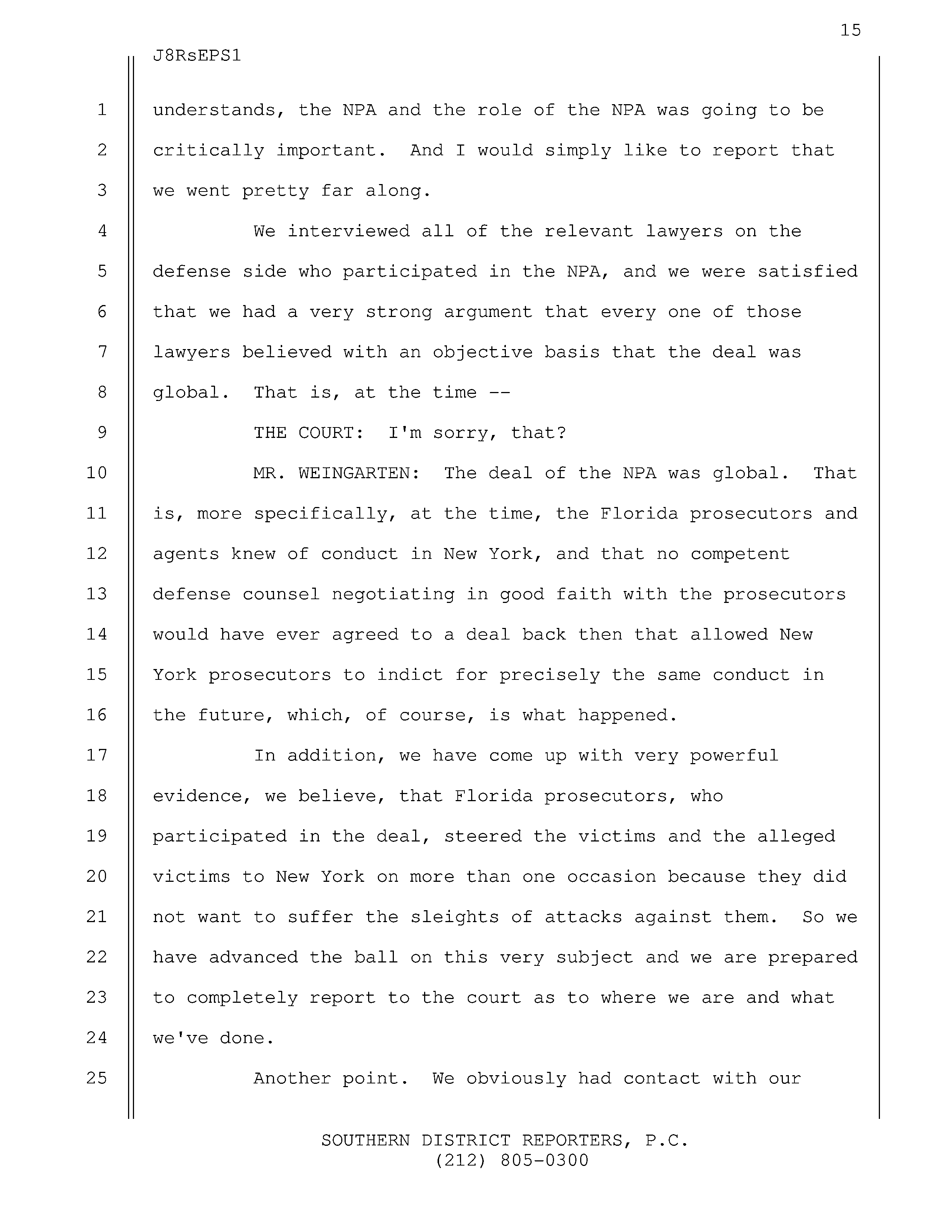
Page 547
document
2550 x 3300
Objects: Page, Text | Text: 15 | J8RsEPS1 | 1 | understands, the NPA and the role of the NPA was goi
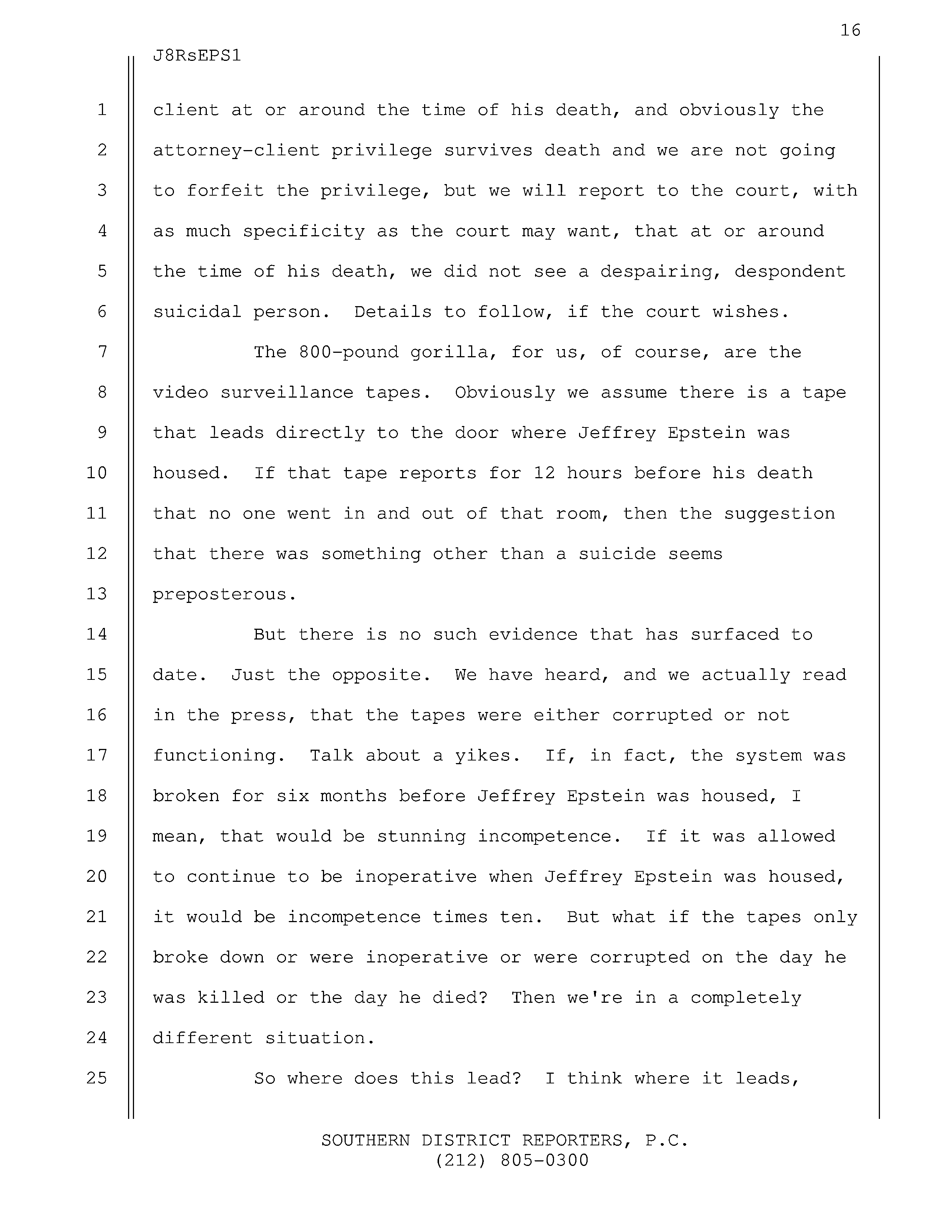
Page 548
document
2550 x 3300
Objects: Page, Text | Text: 16 | J8RsEPS1 | 1 | client at or around the time of his death, and obvio
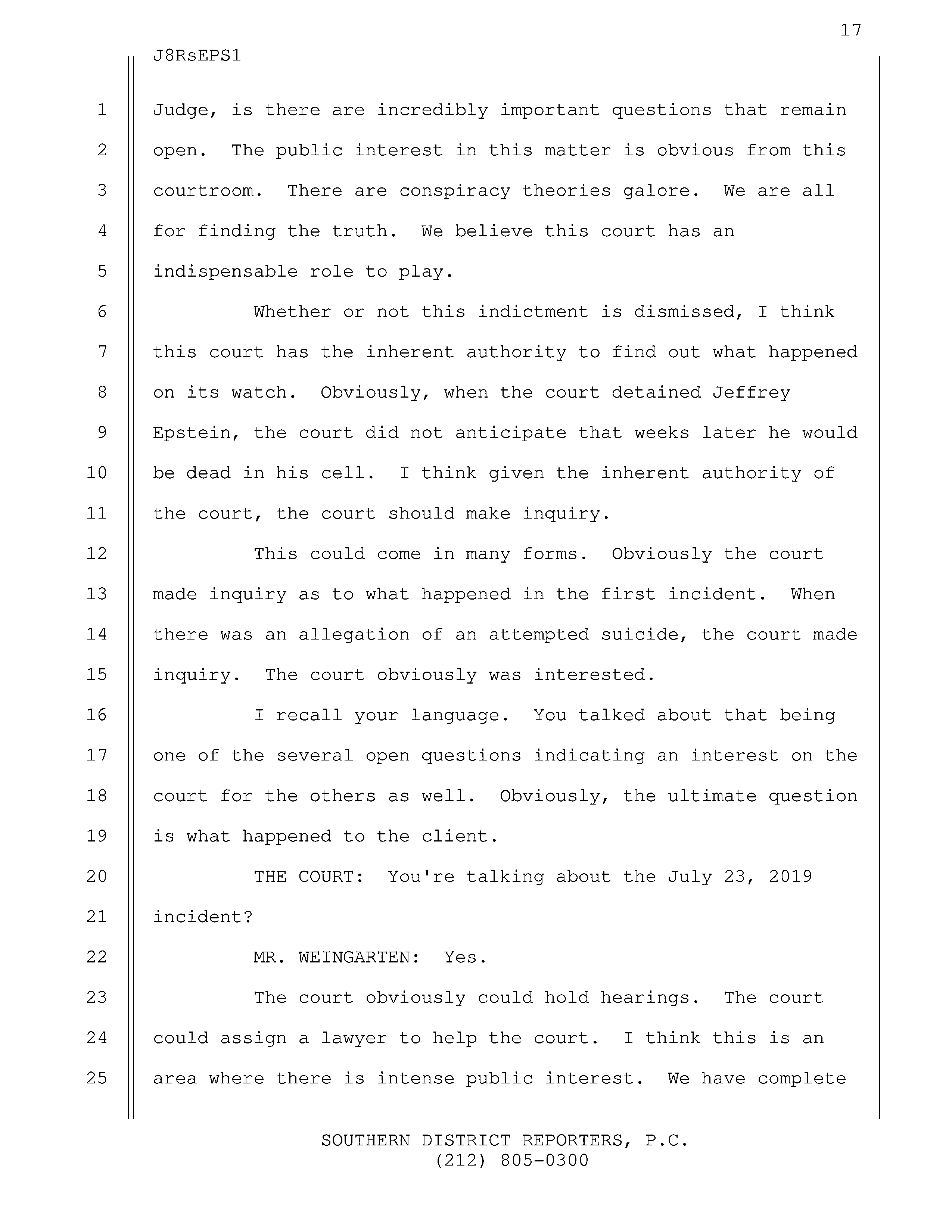
Page 549
document
2550 x 3300
Objects: Page, Text | Text: 17 | J8RsEPS1 | 1 | Judge, is there are incredibly important questions t
Page 550
document
2550 x 3300
Objects: Page, Text | Text: 18 | J8RsEPS1 | 1 | confidence in the prosecutors in the Southern Distri
Page 551
document
2550 x 3300
Objects: Page, Text | Text: 19 | J8RsEPS1 | 1 | (that most people have confidence in in these very t
Page 552
document
2550 x 3300
Objects: Page, Text | Text: 20 | J8RsEPS1 | 1 | MR. WEINBERG: | Judge, if I can just supplement?
Page 553
document
2550 x 3300
Objects: Page, Text | Text: 21 | J8RsEPS1 | 1 | reasons, your Honor. | 2
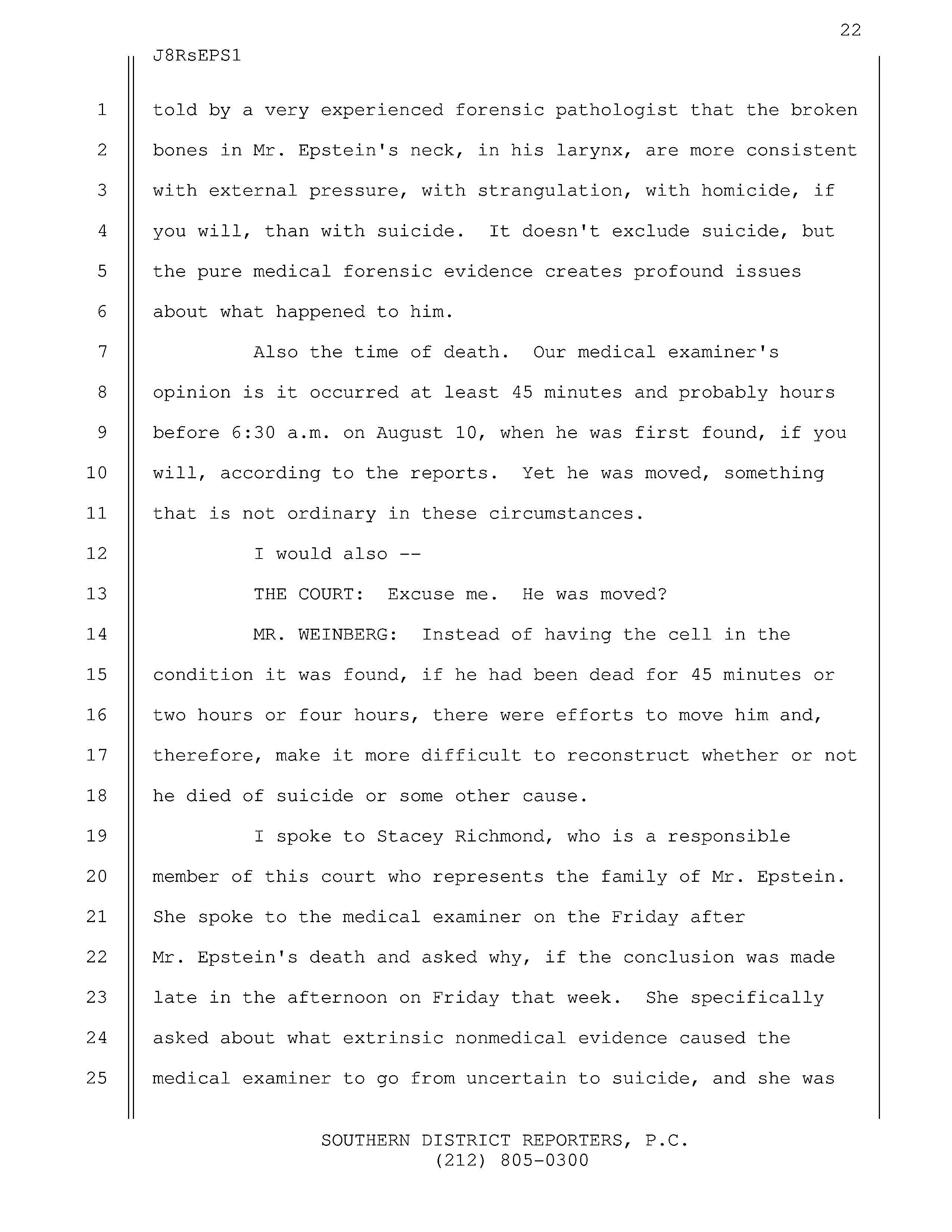
Page 554
document
2550 x 3300
Objects: Page, Text | Text: 22 | J8RsEPS1 | 1 | told by a very experienced forensic pathologist that
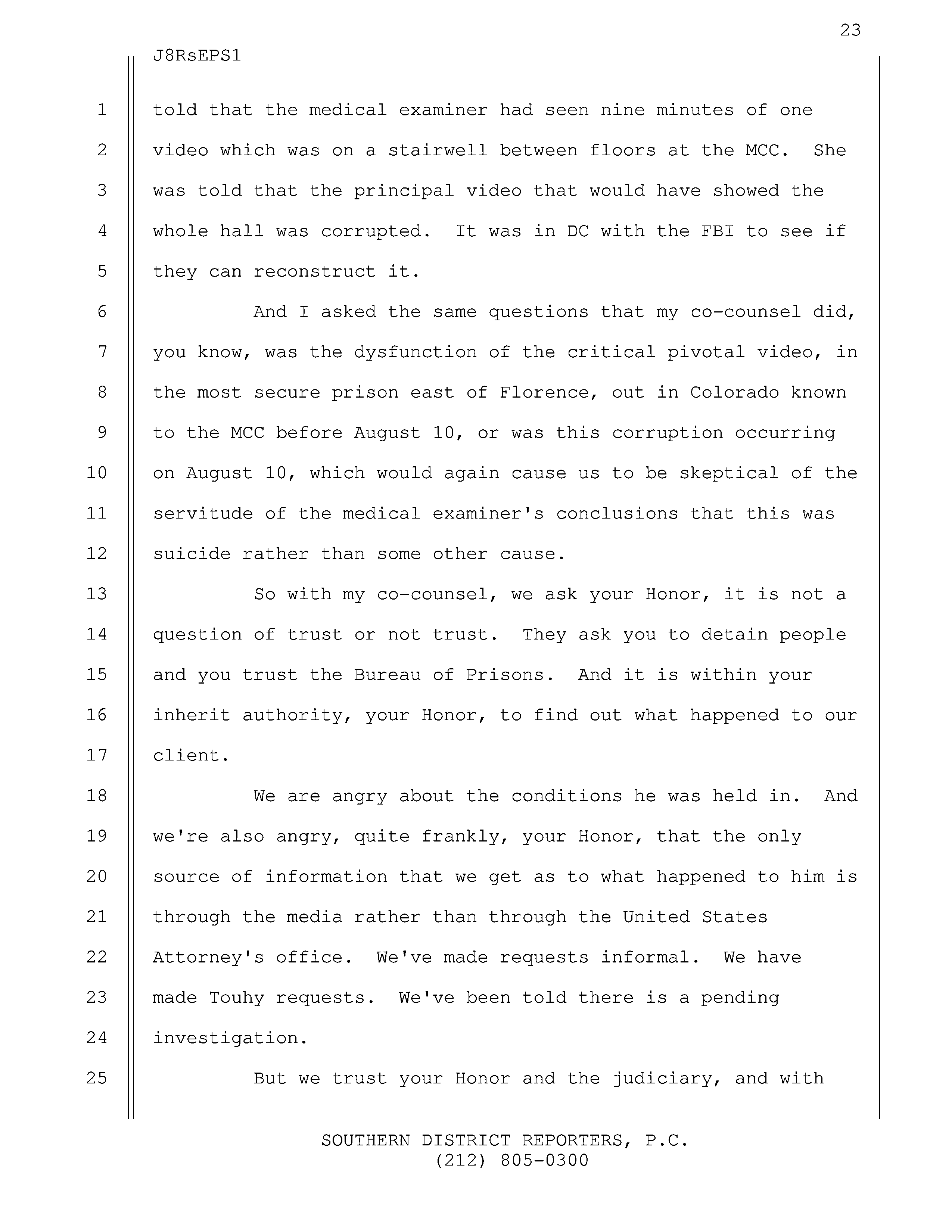
Page 555
document
2550 x 3300
Objects: Page, Text | Text: 23 | J8RsEPS1 | told that the medical examiner had seen nine minutes of
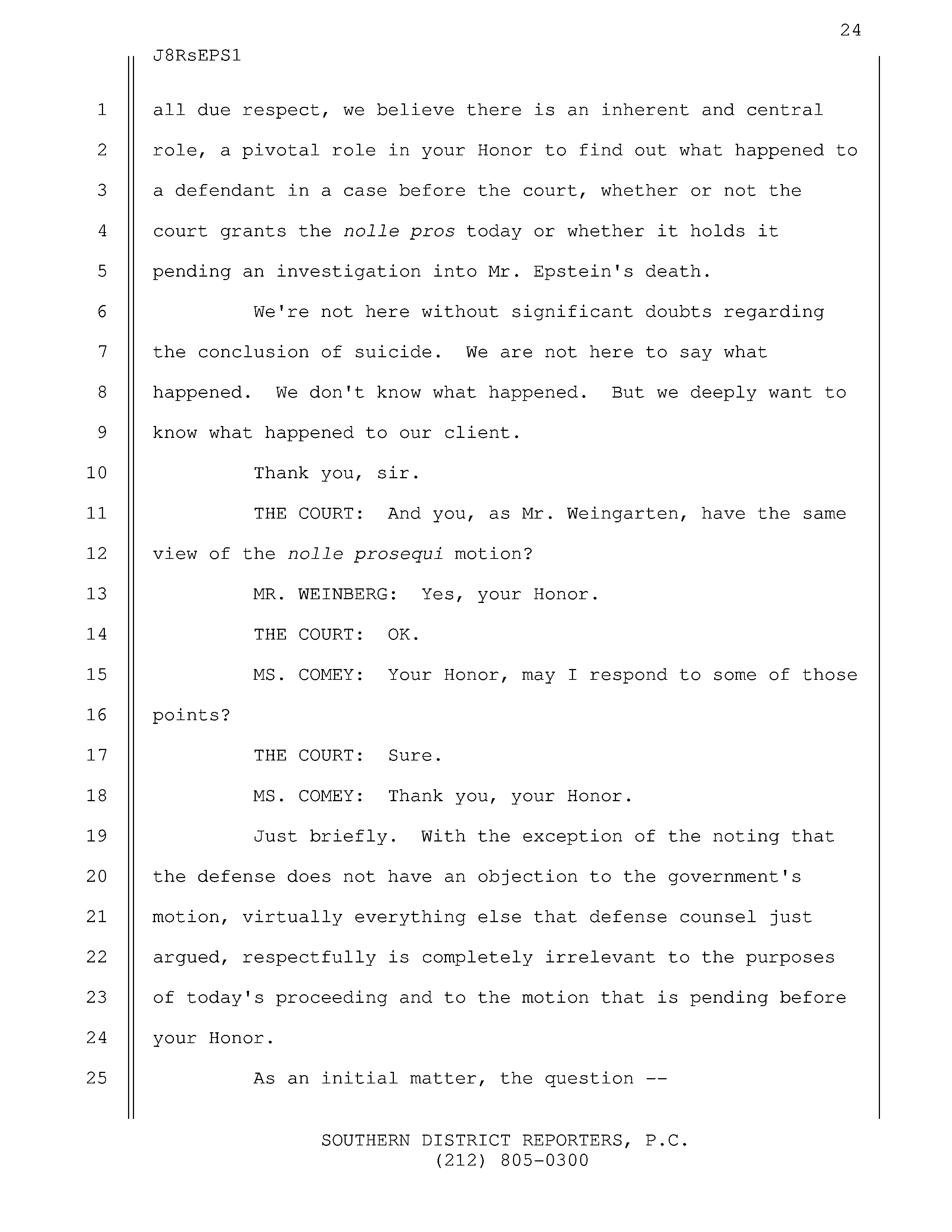
Page 556
document
2550 x 3300
Objects: Page, Text | Text: 24 | J8RsEPS1 | 1 | all due respect, we believe there is an inherent and
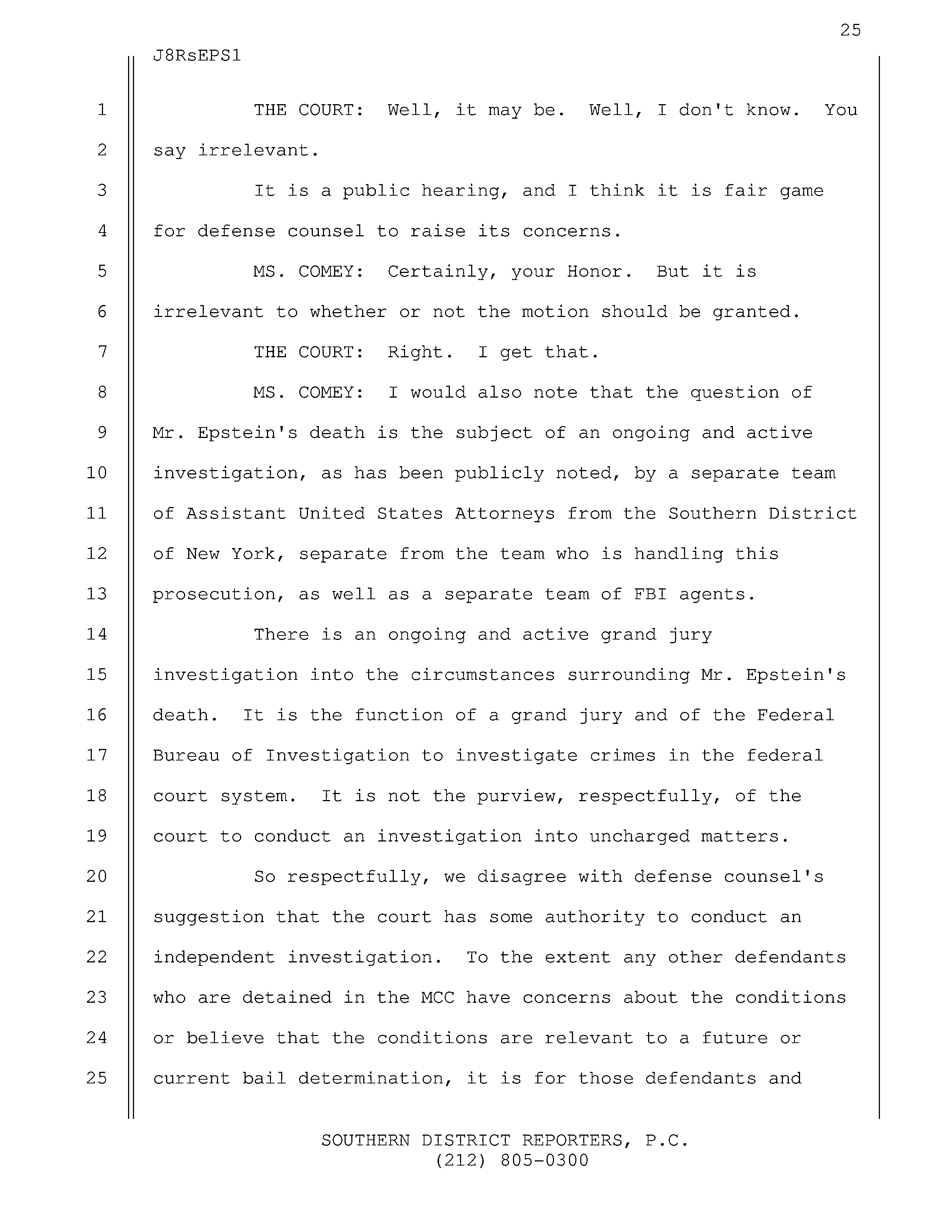
Page 557
document
2550 x 3300
Objects: Page, Text | Text: 25 | J8RsEPS1 | 1 | THE COURT: Well, it may be. | Well, I don't know.
Page 558
document
2550 x 3300
Objects: Page, Text | Text: 26 | J8RsEPS1 | 1 | their counsel to raise those arguments and for the j
Page 559
document
2550 x 3300
Objects: Page, Text | Text: 27 | J8RsEPS1 | 1 | he was deeply troubled by the alleged Brady violatio
Page 560
document
2550 x 3300
Objects: Page, Text | Text: 28 | J8RsEPS1 | MR. WEINBERG: | 1 | Yes, your Honor.
Page 561
document
2550 x 3300
Objects: Page, Text | Text: 29 | J8RsEPS1 | 1 | (It would be helpful if, in doing that, if counsel |
Page 562
document
2550 x 3300
Objects: Page, Text | Text: 30 | J8RsEPS1 | 1 | (bring full justice, and they decided it was best fo
Page 563
document
2550 x 3300
Objects: Page, Text | Text: 31 | J8RsEPS1 | 1 | Mr. Epstein that goes to the estate, , certainly the
Page 564
document
2550 x 3300
Objects: Page, Text | Text: 32 | J8RsEPS1 | 1 | (came to me not asking to file a lawsuit against Jef
Page 565
document
2550 x 3300
Objects: Page, Text | Text: 33 | J8RsEPS1 | 1 | prosecutors who have worked this investigation and t
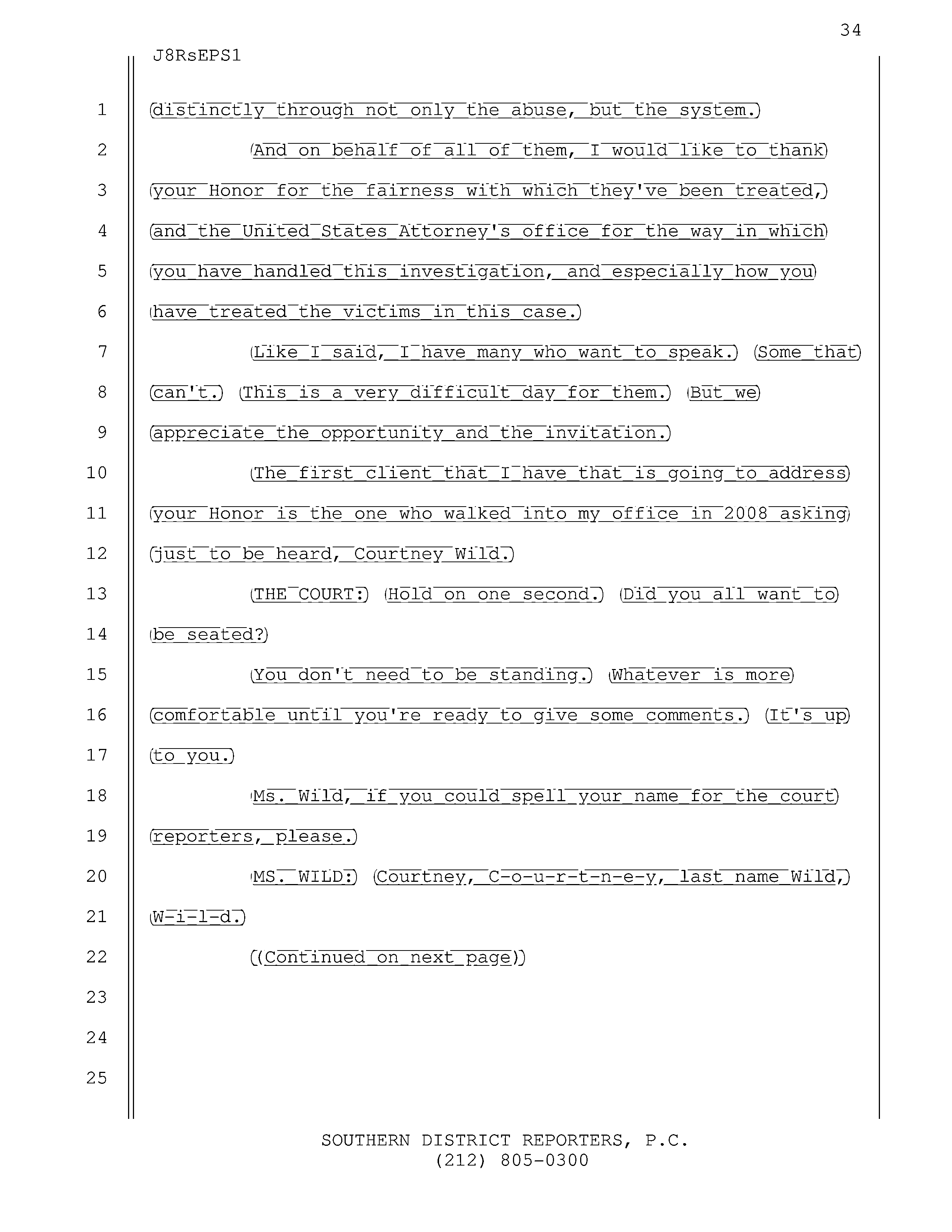
Page 566
document
2550 x 3300
Objects: Page, Text | Text: 34 | J8RsEPS1 | 1 | distinctly through not only the abuse, but the syste
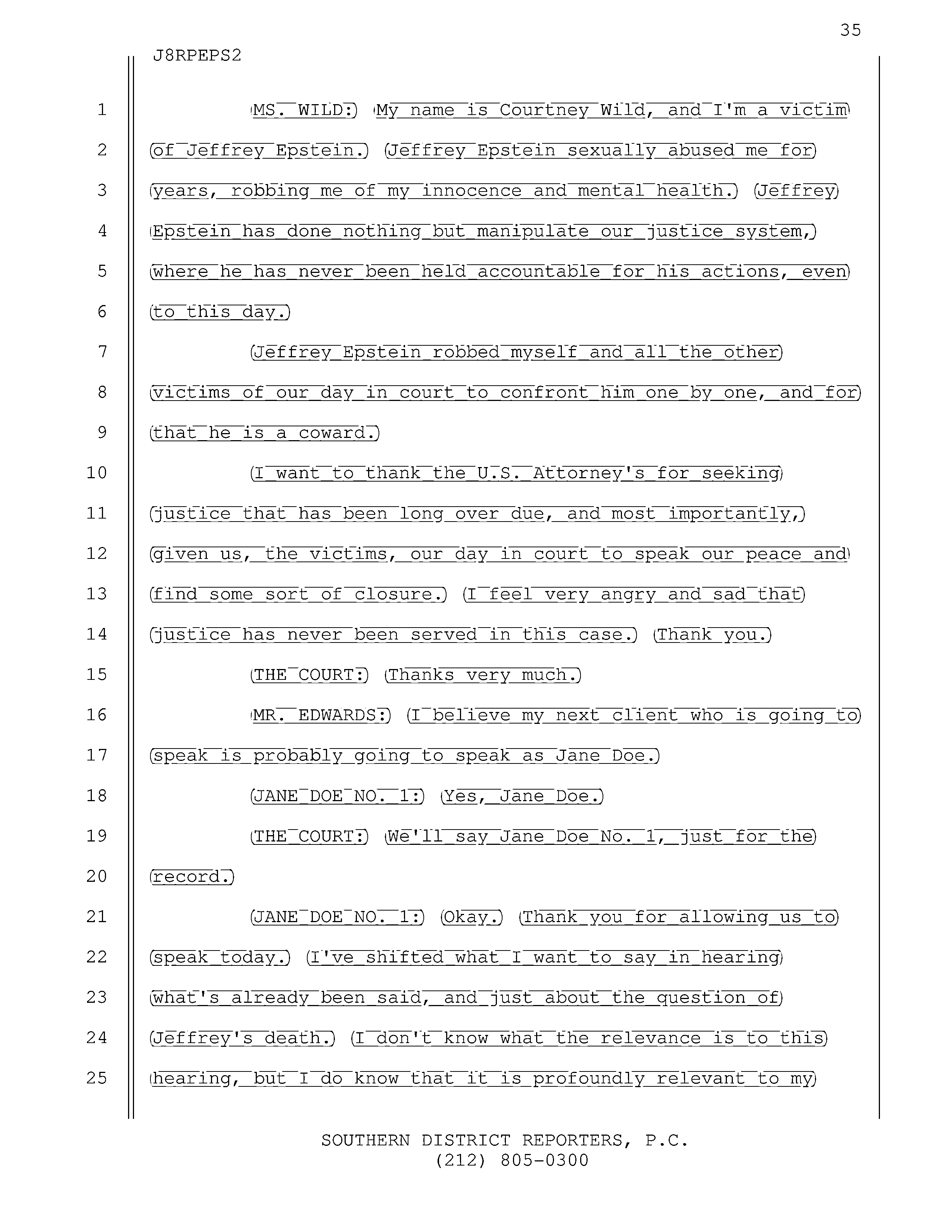
Page 567
document
2550 x 3300
Objects: Page, Text | Text: 35 | J8RPEPS2 | 1 | MS. WILD: My name is Courtney Wild, the and I'm a vi
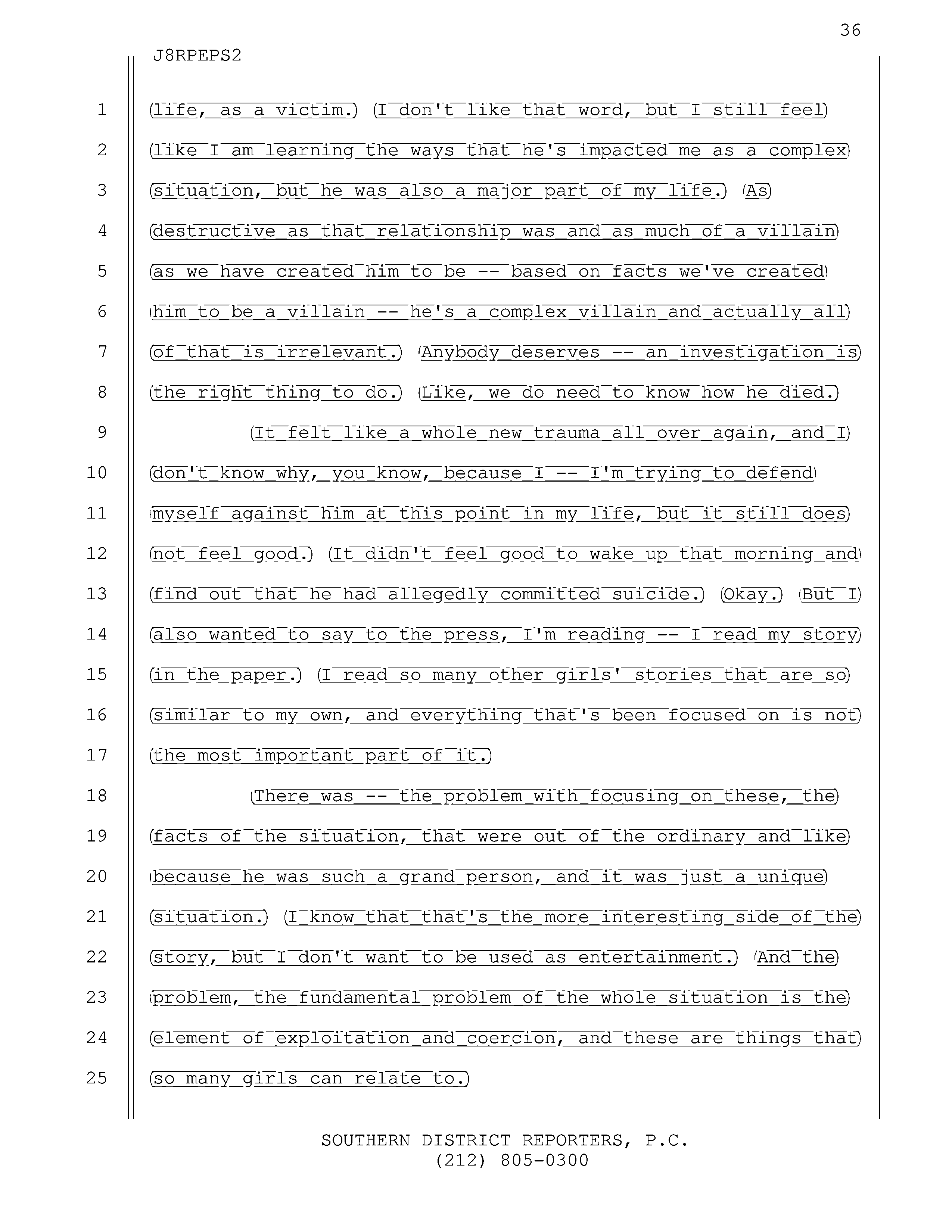
Page 568
document
2550 x 3300
Objects: Page, Text | Text: 36 | J8RPEPS2 | 1 | (life, as a victim. (I don't like that word, but I s
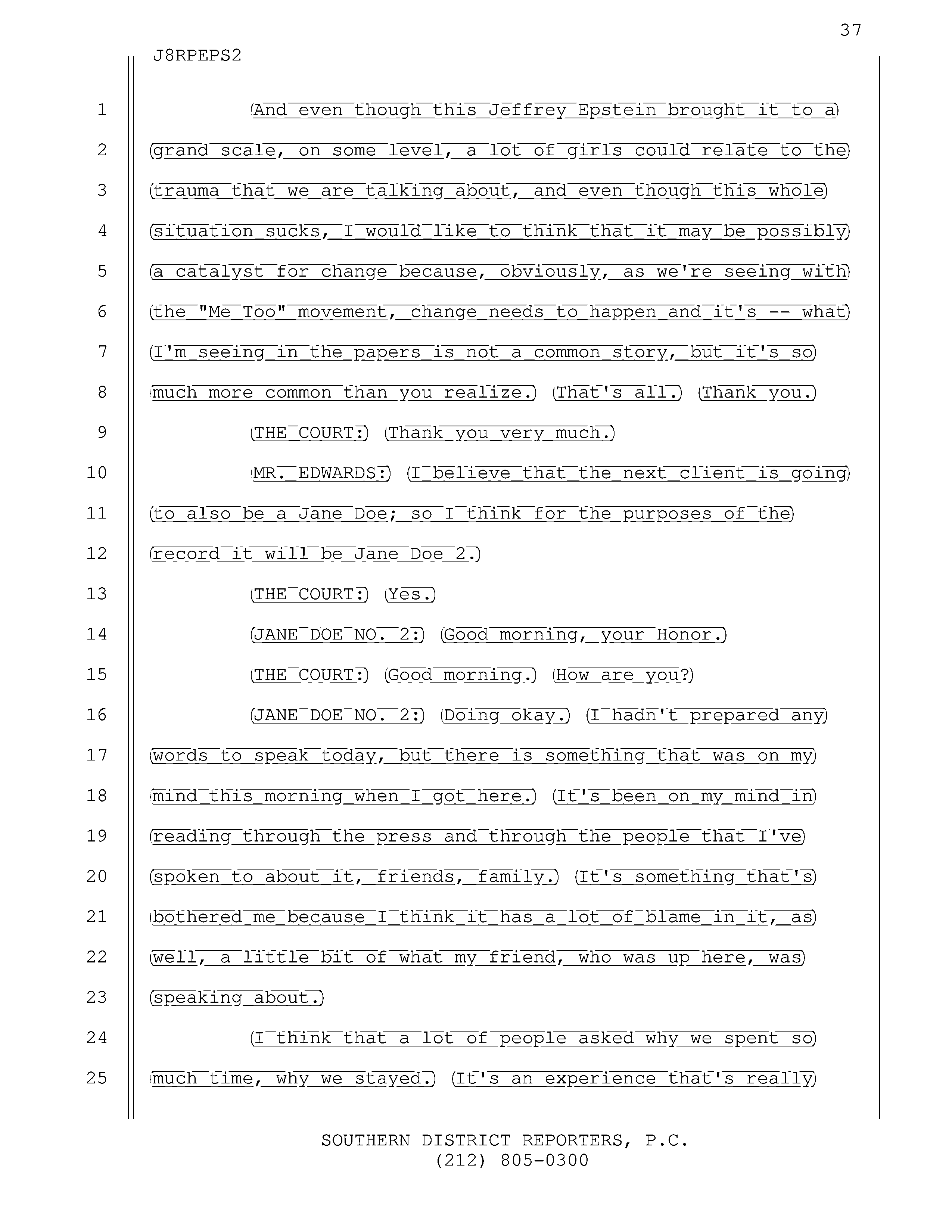
Page 569
document
2550 x 3300
Objects: Page, Text | Text: 37 | J8RPEPS2 | 1 | (And even though this Jeffrey Epstein brought It to
Page 570
document
2550 x 3300
Objects: Page, Text | Text: 38 | J8RPEPS2 | 1 | (hard to explain to people who haven 't gone through
Page 571
document
2550 x 3300
Objects: Page, Text | Text: 39 | J8RPEPS2 | 1 | (even know I was a victim until I spoke with my lawy
Page 572
document
2550 x 3300
Objects: Page, Text | Text: 40 | J8RPEPS2 | 1 | (I - left his home, after he threw me, | sexually as
Page 573
document
2550 x 3300
Objects: Page, Text | Text: 41 | J8RPEPS2 | 1 | wanted to express that we, the victims, we will alwa
Page 574
document
2550 x 3300
Objects: Page, Text | Text: 42 | J8RPEPS2 | 1 | (agreement was or why the specialtreatment_gotaprove
Page 575
document
2550 x 3300
Objects: Page, Text | Text: 43 | J8RPEPS2 | 1 | I will continue with writing my) | 2
Page 576
document
2550 x 3300
Objects: Page, Text | Text: 44 | J8RPEPS2 | 1 | (had only dreamt of and made me feel as | 2
Page 577
document
2550 x 3300
Objects: Page, Text | Text: 45 | J8RPEPS2 | 1 | (to continue because I had been taken advantage of m
Page 578
document
2550 x 3300
Objects: Page, Text | Text: 46 | J8RPEPS2 | (His death has robbed me of that justice. | 1 | (to hear
Page 579
document
2550 x 3300
Objects: Page, Text | Text: 47 | J8RPEPS2 | 1 | (together, those that are present and those that are
Page 580
document
2550 x 3300
Objects: Page, Text | Text: 48 | J8RPEPS2 | 1 | (held responsible, without any explanation and witho
Page 581
document
2550 x 3300
Objects: Page, Text | Text: 49 | J8RPEPS2 | 1 | is a model for how victims should be treated in a cr
Page 582
document
2550 x 3300
Objects: Page, Text | Text: 50 | J8RPEPS2 | 1 | this_particular issue, even though it's more than a
Page 583
document
2550 x 3300
Objects: Page, Text | Text: 51 | J8RPEPS2 | 1 | (the [leading expert formerly of the Districtcourt o
Page 584
document
2550 x 3300
Objects: Page, Text | Text: 52 | J8RPEPS2 | 1 | (brought against Mr. Dershowitz, but I would have ex
Page 585
document
2550 x 3300
Objects: Page, Text | Text: 53 | J8RPEPS2 | 1 | applicable law in this circuit, the Court has no alt
Page 586
document
2550 x 3300
Objects: Page, Text | Text: 54 | J8RPEPS2 | 1 | well | 2
Page 587
document
2550 x 3300
Objects: Page, Text | Text: 55 | J8RPEPS2 | 1 | (experience for the last 17 years has been a dark co
Page 588
document
2550 x 3300
Objects: Page, Text | Text: 56 | J8RPEPS2 | 1 | (Good morning, your Honor. | 2
Page 589
document
2550 x 3300
Objects: Page, Text | Text: 57 | J8RPEPS2 | 1 | 2 | Thank you, your Honor .
Page 590
document
2550 x 3300
Objects: Page, Text | Text: 58 | J8RPEPS2 | 1 | speaking this morning is Annie Farmer. | 2
Page 591
document
2550 x 3300
Objects: Page, Text | Text: 59 | J8RPEPS2 | 1 | (I believe that we have a real problem in this count
Page 592
document
2550 x 3300
Objects: Page, Text | Text: 60 | J8RPEPS2 | 1 | our age and liked to do the same things we did at_th
Page 593
document
2550 x 3300
Objects: Page, Text | Text: 61 | J8RPEPS2 | 1 | MR. BOIES: | (Your Honor, just very briefly.
Page 594
document
2550 x 3300
Objects: Page, Text | Text: 62 | J8RPEPS2 | 1 | (individual | (However, he was also a thief.
Page 595
document
2550 x 3300
Objects: Page, Text | Text: 63 | J8RPEPS2 | 1 | The fact that he felt entitled to take away my) | 2
Page 596
document
2550 x 3300
Objects: Page, Text | Text: 64 | J8RPEPS2 | 1 | (deplorable human being, because even though this we
Page 597
document
2550 x 3300
Objects: Page, Text | Text: 65 | J8RPEPS2 | 1 | (Statement of Jane Doe 7. | To the Honorable Richard
Page 598
document
2550 x 3300
Objects: Page, Text | Text: 66 | J8RPEPS2 | 1 | 2 | Furthermore, because I couldn't tell anyone, out
Page 599
document
2550 x 3300
Objects: Page, Text, Chart, Plot | Text: 67 | J8RPEPS2 | 1 | (experiences every day and move on to b
Page 600
document
2550 x 3300
Objects: Page, Text | Text: 68 | J8RsEPS3 | 1 | Thanks very much. | 2
Page 601
document
2550 x 3300
Objects: Page, Text | Text: 69 | J8RsEPS3 | 1 | I ask that you very seriously consider the final) |
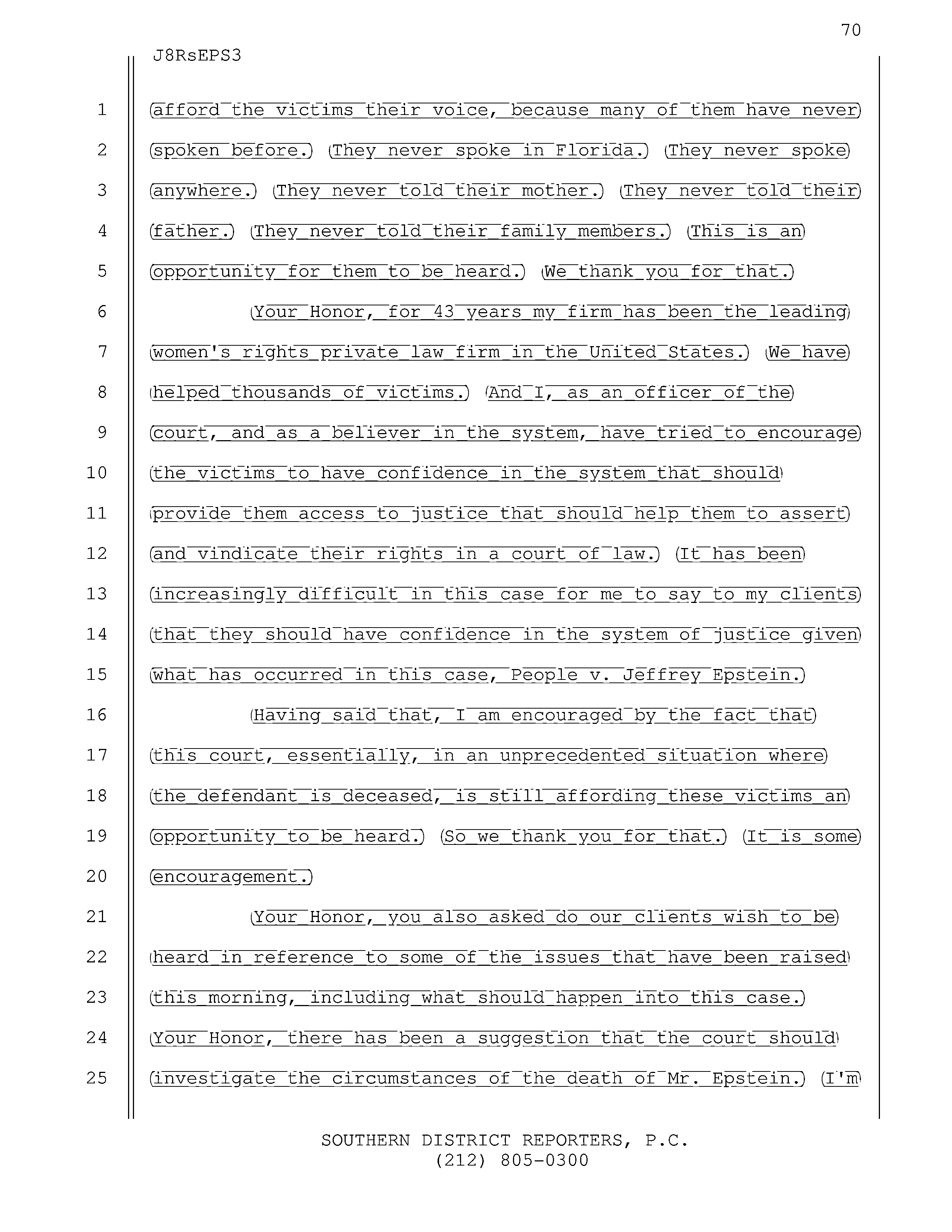
Page 602
document
2550 x 3300
Objects: Page, Text | Text: 70 | J8RsEPS3 | 1 | afford the victims their voice, because many of them
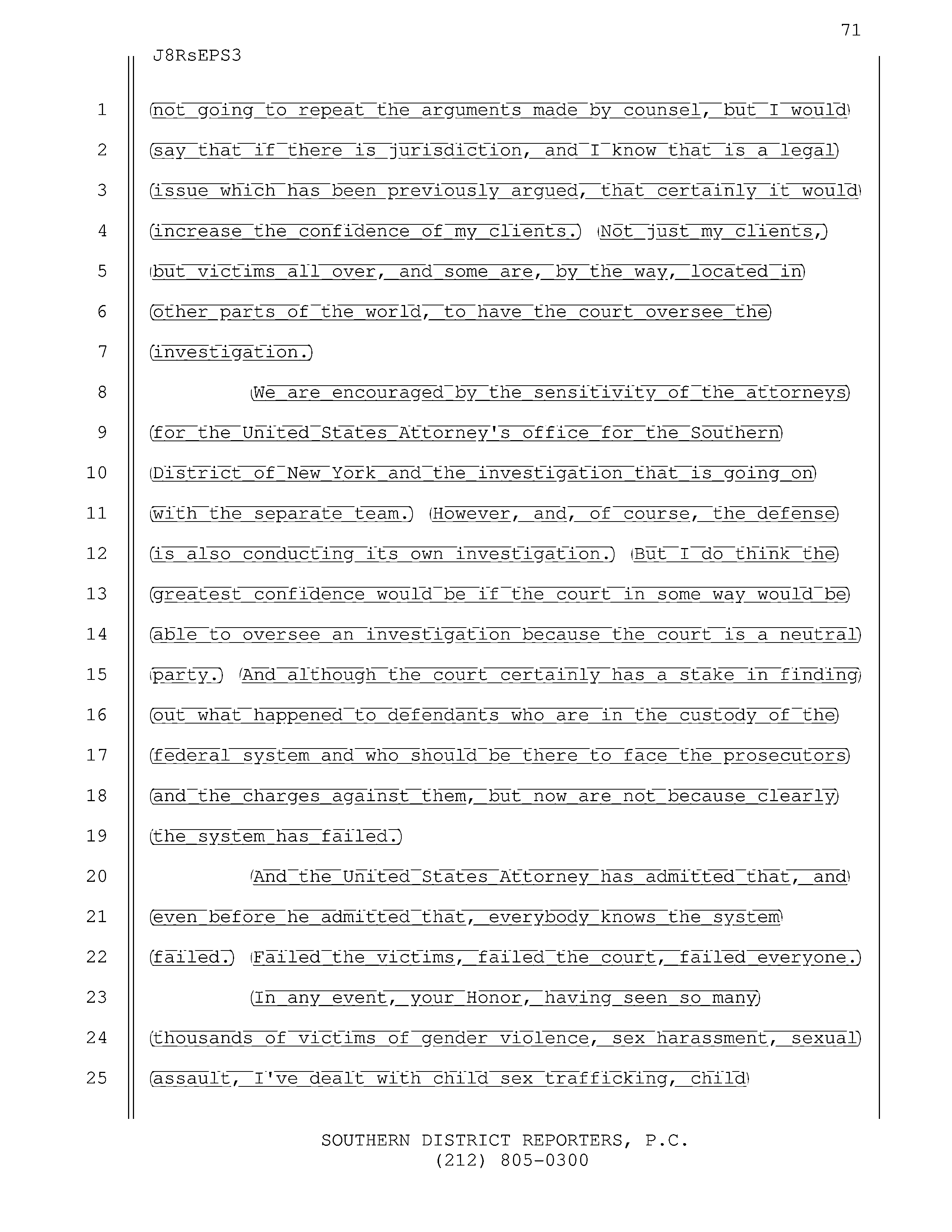
Page 603
document
2550 x 3300
Objects: Page, Text | Text: 71 | J8RsEPS3 | 1 | not_going to repeat the arguments made by counsel, b
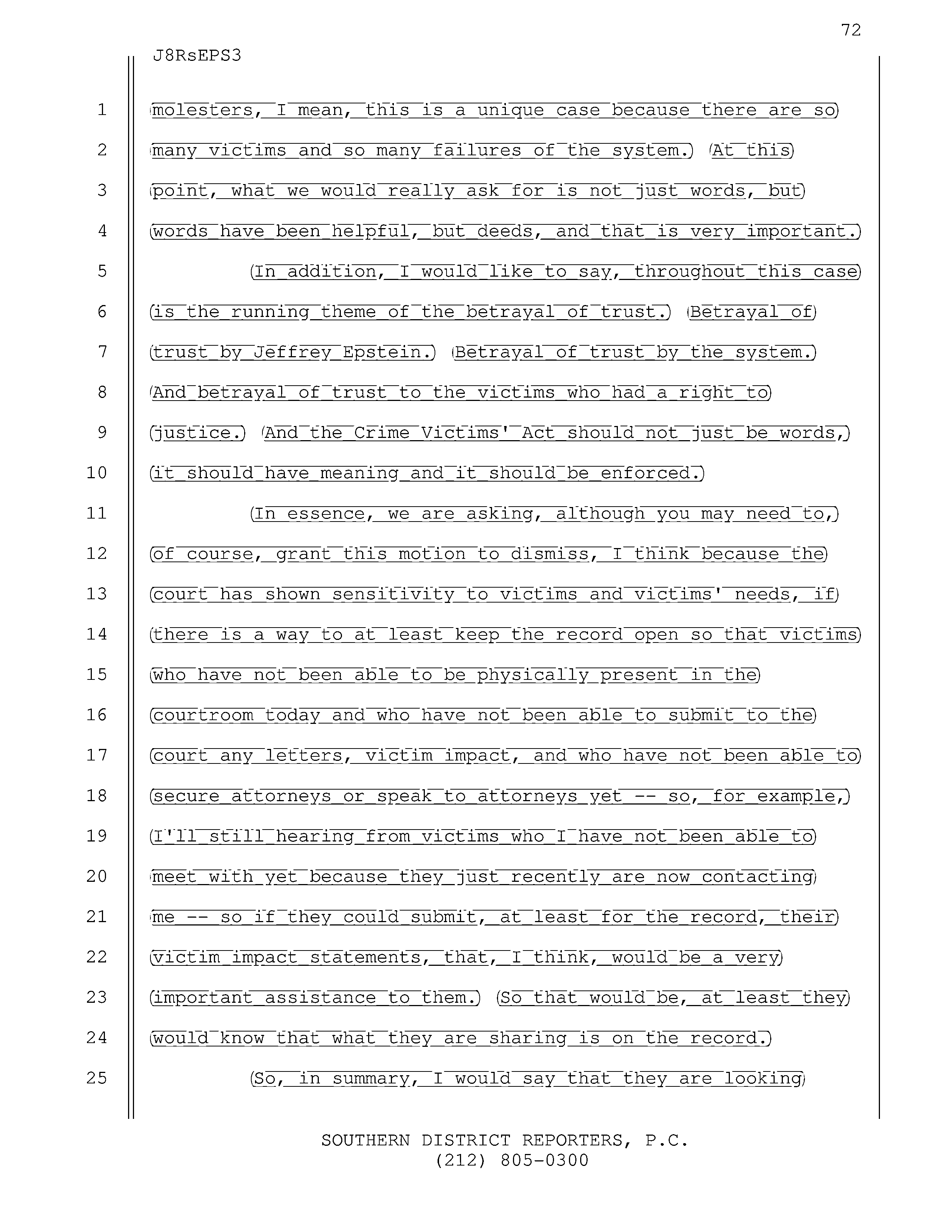
Page 604
document
2550 x 3300
Objects: Page, Text | Text: 72 | J8RsEPS3 | 1 | molesters, I mean, this is a unique case because the
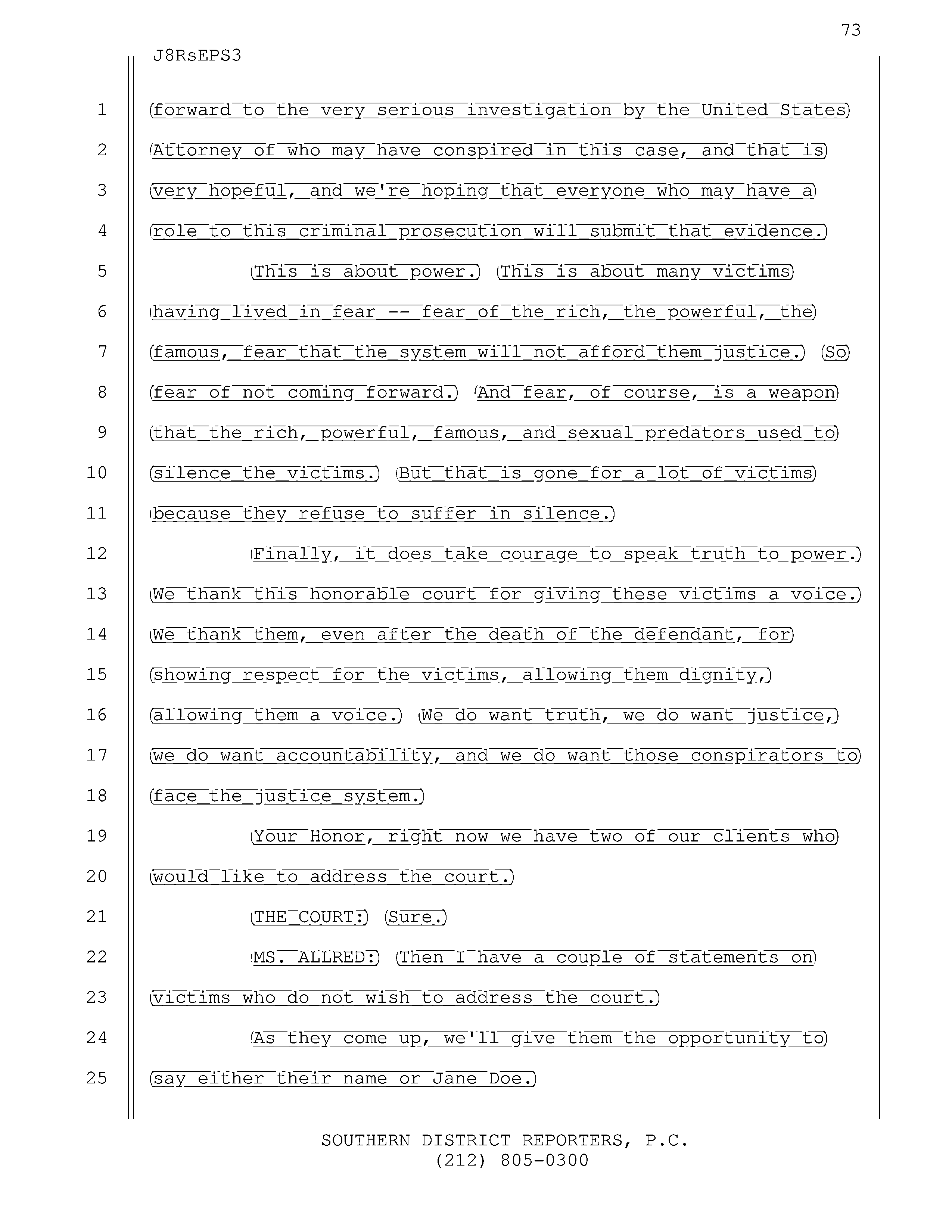
Page 605
document
2550 x 3300
Objects: Page, Text | Text: 73 | J8RsEPS3 | 1 | (forward to the very serious investigation by the Un
Page 606
document
2550 x 3300
Objects: Page, Text | Text: 74 | J8RsEPS3 | 1 | (By the way, thank you, your Honor, for allowing som
Page 607
document
2550 x 3300
Objects: Page, Text | Text: 75 | J8RsEPS3 | 1 | cannot eat at the thought of Jeffrey Epstein not ser
Page 608
document
2550 x 3300
Objects: Page, Text | Text: 76 | J8RsEPS3 | 1 | (As unjust as what happened to me was, I believe tha
Page 609
document
2550 x 3300
Objects: Page, Text | Text: 77 | J8RsEPS3 | 1 | opportunity he had. | 2
Page 610
document
2550 x 3300
Objects: Page, Text | Text: 78 | J8RsEPS3 | 1 | (to me that I stopped going to see him. (I had docum
Page 611
document
2550 x 3300
Objects: Page, Text | Text: 79 | J8RsEPS3 | 1 | (part of. (I was so impressedthatthis_great man woul
Page 612
document
2550 x 3300
Objects: Page, Text | Text: 80 | J8RsEPS3 | 1 | (details, which I'll share, should ignite fire inste
Page 613
document
2550 x 3300
Objects: Page, Text | Text: 81 | J8RsEPS3 | (Не forcefully_penetrated me. | (There was | (I was numb
Page 614
document
2550 x 3300
Objects: Page, Text | Text: 82 | J8RsEPS3 | 1 | (One day I walked out of his residence and passed a

Page 615
document
2550 x 3300
Objects: Page, Text | Text: 83 | J8RsEPS3 | 1 | was my desire to succeed on my own terms. | (I emers
Page 616
document
2550 x 3300
Objects: Page, Text | Text: 84 | J8RsEPS3 | 1 | resolution and justice for all of his underaged vict
Page 617
document
2550 x 3300
Objects: Page, Text | Text: 85 | J8RsEPS3 | 1 | (I-took it and threw it at him. | 2
Page 618
document
2550 x 3300
Objects: Page, Text, Chart, Plot | Text: 86 | J8RsEPS3 | 1 | as well, both for the government and th
Page 619
document
2550 x 3300
Objects: Text | Text: Appendix 12
Page 620
document
2550 x 3300
Objects: Page, Text, Advertisement, Poster, Menu | Text: The Palm Beach Post | REAL NEWS STARTS HERE
Page 621
document
2550 x 3300
Objects: Page, Text, Letter | Text: >>NEW: Jeffrey Epstein: Lawyer said financier had sex with woman
Page 622
document
2550 x 3300
Objects: Page, Text, Letter | Text: In 1976, Epstein left Dalton for a job at Bear Stearns. By the e
Page 623
document
2550 x 3300
Objects: Page, Text, Letter | Text: And yet he managed for decades to maintain a low profile. Не avo
Page 624
document
2550 x 3300
Objects: Page, Text, Letter | Text: "It's a bad memory. I would rather not have ever met Jeffrey Eps
Page 625
document
2550 x 3300
Objects: Page, Text, Letter | Text: Palm Beach police and the state attorney's office have declined
Page 626
document
2550 x 3300
Objects: Page, Text, Letter | Text: One employee told detectives he was told to send a dozen roses t
Page 627
document
2550 x 3300
Objects: Page, Text, Letter | Text: In the following weeks, police received complaints that two of t
Page 628
document
2550 x 3300
Objects: Page, Text, Letter | Text: It is not known how many of the girls testified before the grand

Page 629
document
2550 x 3300
Objects: Page, Text | Text: @AMarraPBPost | LEARN MORE
Page 630
document
2550 x 3300
Objects: Page, Text, Letter | Text: 273 / 278 - Tuesday, November 16, 2004 | Edition: FINAL | Sectio
Page 631
document
2550 x 3300
Objects: Page, Text, Letter | Text: But Friedman allowed the offer to stand, and Pulte and Trump wen
Page 632
document
2550 x 3300
Objects: Page, Text, Letter | Text: The trustee alleged during a weeklong trial in May that Gosman f
Page 633
document
2550 x 3300
Objects: Page, Text, Advertisement, Poster | Text: 11/11/2019 | Indictment: Billionaire Solicited 3
Page 634
document
2550 x 3300
Objects: Page, Text, Letter | Text: 11/11/2019 | Indictment: Billionaire Solicited 3 Times - News -
Page 635
document
2550 x 3300
Objects: Page, Text, Advertisement, Poster | Text: 11/11/2019 | After long probe, billionaire faces
Page 636
document
2550 x 3300
Objects: Page, Text, Letter | Text: 11/11/2019 | After long probe, billionaire faces solicitation ch
Page 637
document
2550 x 3300
Objects: Letter, Text, Page | Text: 11/11/2019 | After long probe, billionaire faces solicitation ch
Page 638
document
2550 x 3300
Objects: Page, Text, Letter | Text: 11/11/2019 | After long probe, billionaire faces solicitation ch
Page 639
document
2550 x 3300
Objects: Page, Text, Letter | Text: 11/11/2019 | After long probe, billionaire faces solicitation ch
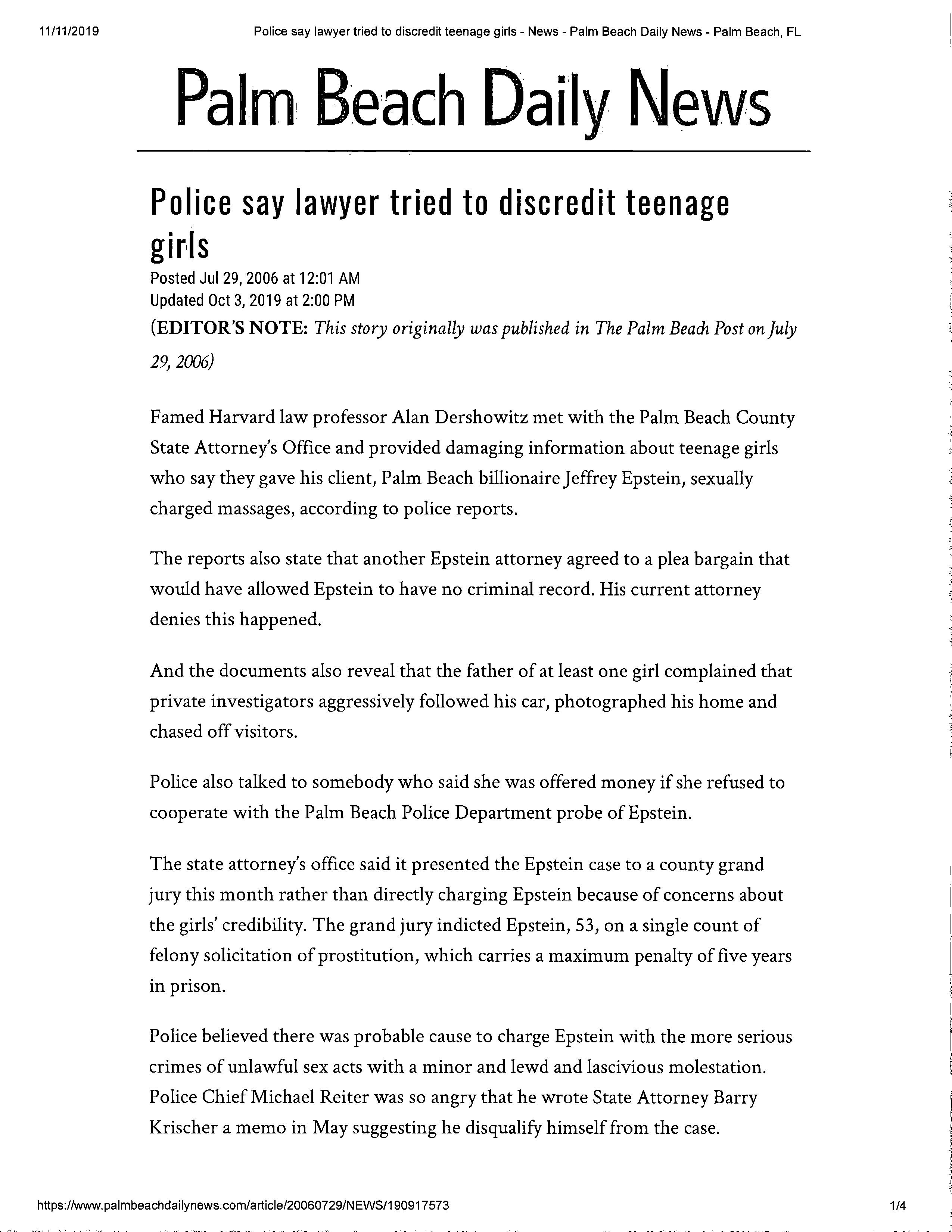
Page 640
document
2550 x 3300
Objects: Page, Text, Advertisement, Poster | Text: 11/11/2019 | Police say lawyer tried to discredit
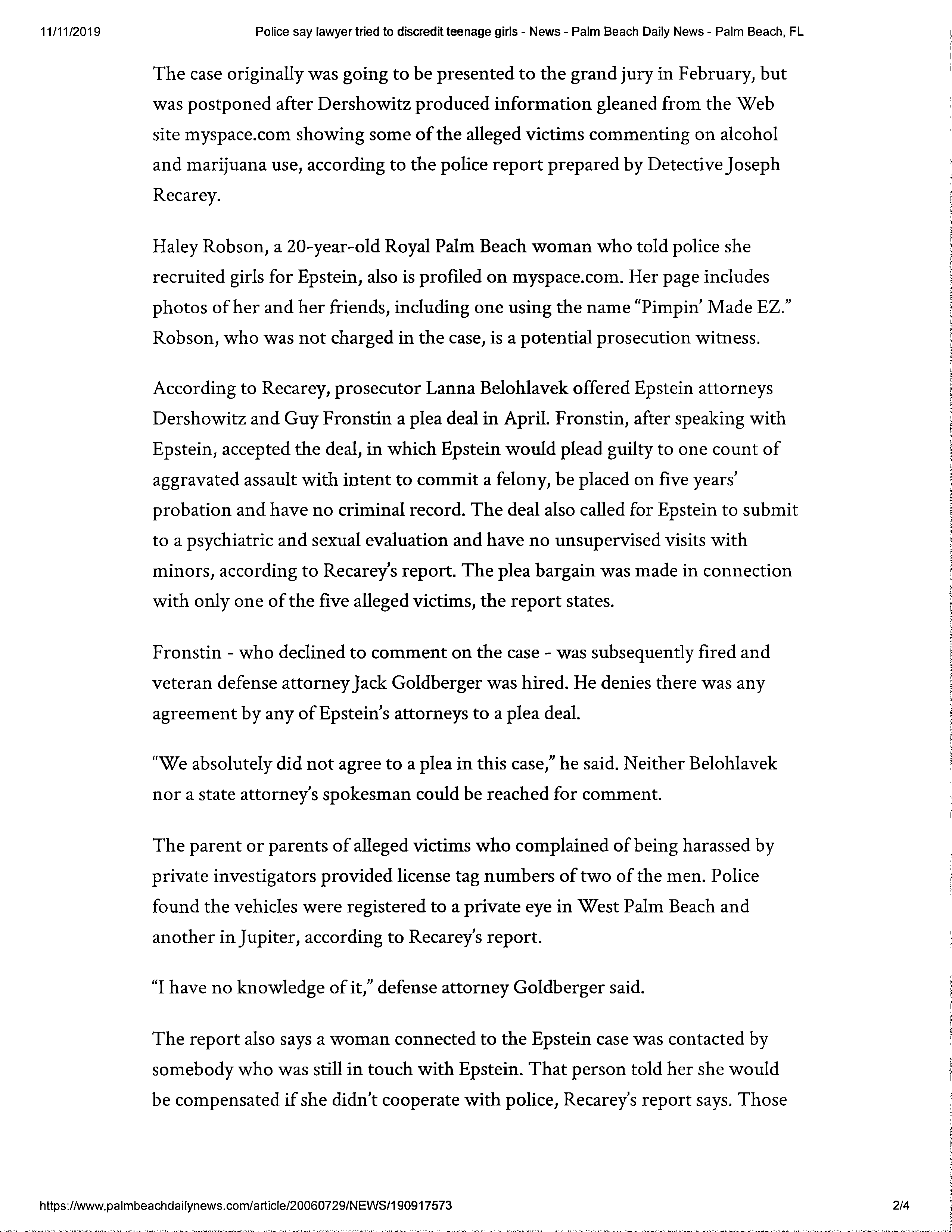
Page 641
document
2550 x 3300
Objects: Page, Text, Letter | Text: 11/11/2019 | Police say lawyer tried to discredit teenage girls
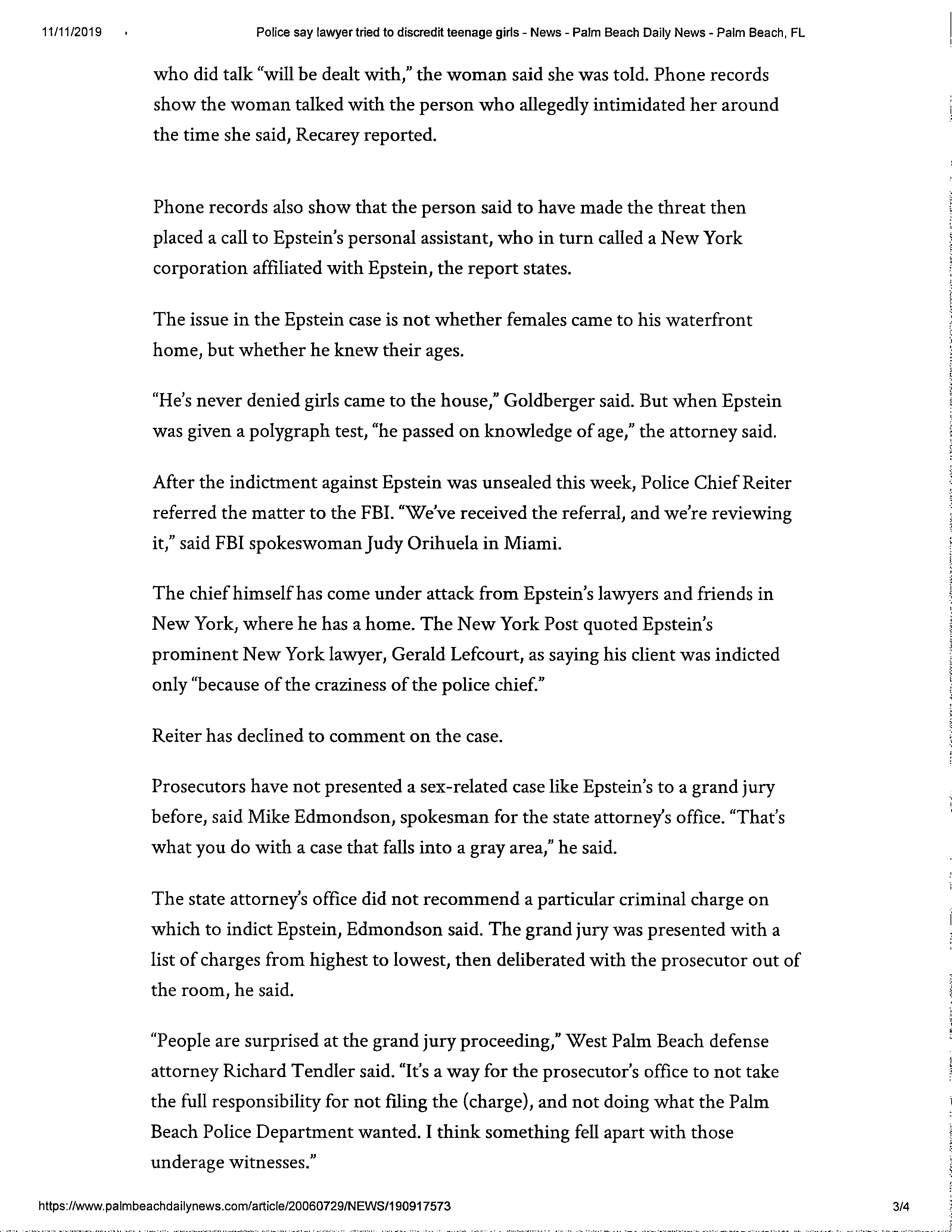
Page 642
document
2550 x 3300
Objects: Page, Text, Letter | Text: 11/11/2019 | Police say lawyer tried to discredit teenage girls
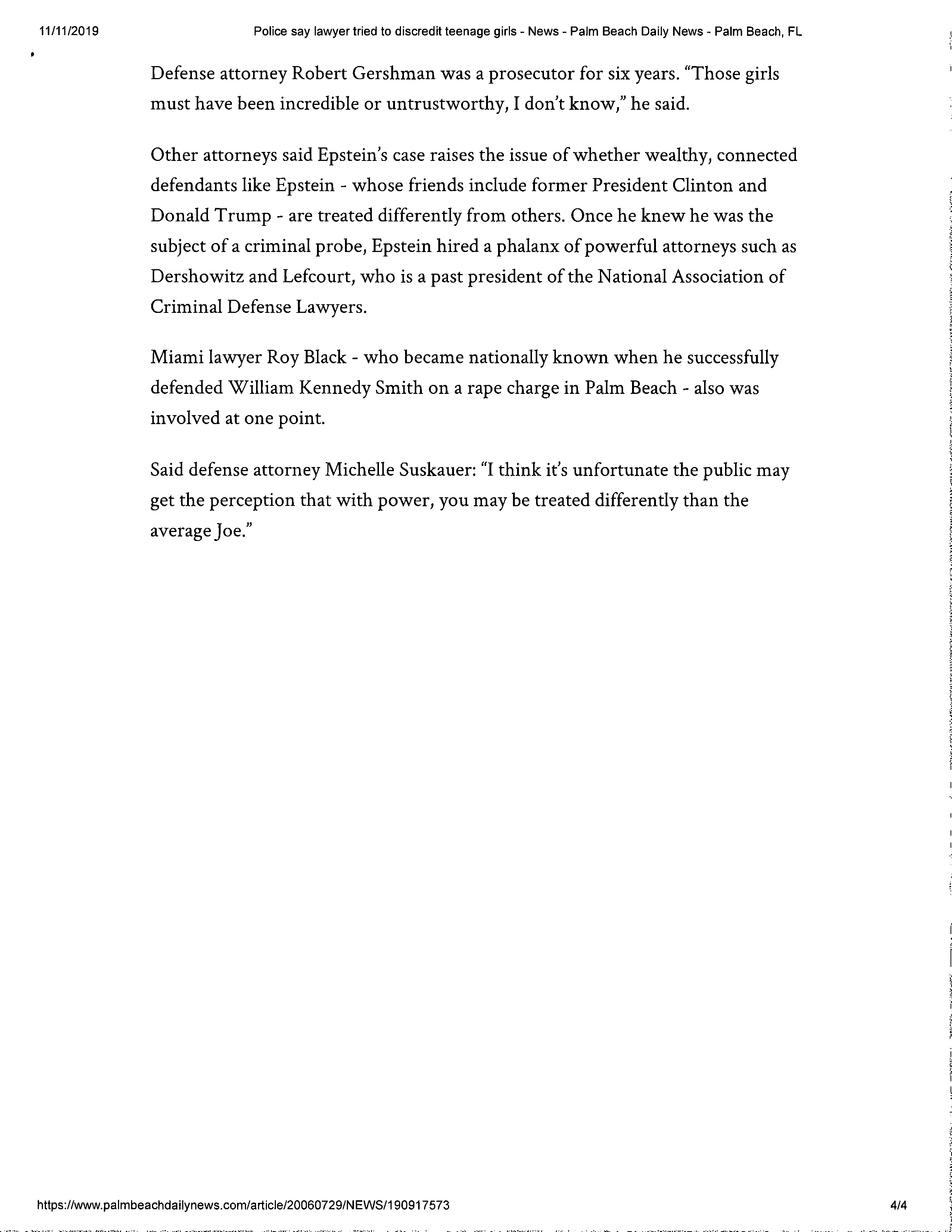
Page 643
document
2550 x 3300
Objects: Page, Text, Letter | Text: 11/11/2019 | Police say lawyer tried to discredit teenage girls
Page 644
document
2550 x 3300
Objects: Page, Text, Advertisement, Poster | Text: The Palm Beach Post | REAL NEWS STARTS HERE | Exp
Page 645
document
2550 x 3300
Objects: Page, Text, Letter | Text: his current job, has returned $10,000 to him because of the | Pa
Page 646
document
2550 x 3300
Objects: Page, Text, Letter | Text: "A prosecutor has to look at it in a much broader fashion," a |
Page 646
document
1288 x 488
Objects: Text, Paper | Text: LEARN MDRE
Page 647
document
2550 x 3300
Objects: Page, Text, Letter | Text: Still there is a "universal constant" in prosecuting these | cas
Page 648
document
2550 x 3300
Objects: Page, Text, Advertisement, Poster | Text: The Palm Beach Post | REAL NEWS STARTS HERE | Eps
Page 649
document
2550 x 3300
Objects: Page, Text, Letter | Text: Epstein on the less serious charge, Police Chief Michael | Reite
Page 650
document
2550 x 3300
Objects: Page, Text, Letter | Text: The Palm Beach Police Department was "happy and | ecstatic" that
Page 651
document
2550 x 3300
Objects: Page, Text, Chart, Diagram, Plan, Plot, Person, Newspaper | Text: The Palm Beach Post (West
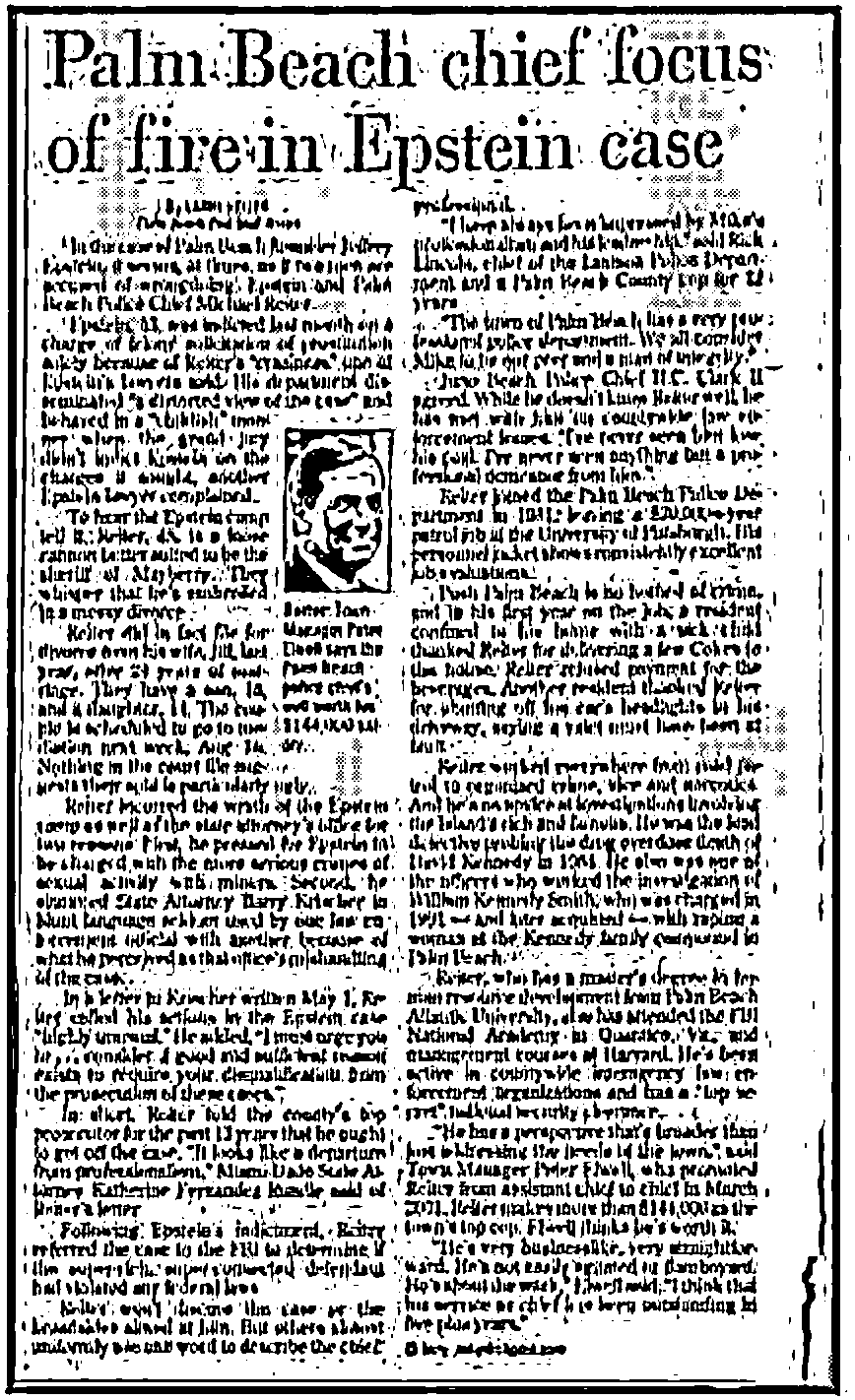
Page 651
document
868 x 1422
Objects: Newspaper, Text, Page, Baby, Person, Face, Head | Text: Palm Beach chief focus | of firein

Page 651
photo
100 x 113
Objects: Stencil, Ammunition, Grenade, Weapon, Smoke Pipe, Head, Person
Page 652
document
2550 x 3300
Objects: Page, Text, Advertisement, Poster | Text: The Palm Beach Post | REAL NEWS STARTS HERE | Del
Page 653
document
2550 x 3300
Objects: Page, Text, Letter | Text: "Highly unusual" is how Palm Beach Police Chief Michael | Reiter
Page 654
document
2550 x 3300
Objects: Page, Text, Letter | Text: Epstein's attorney Jack Goldberger did not return phone | messag
Page 655
document
2550 x 3300
Objects: Page, Text, Letter | Text: Edmondson, spokesman for State Attorney Krischer, said | there i
Page 656
document
2550 x 3300
Objects: Page, Text, Letter | Text: 252 / 278 - Thursday, October 18, 2007 | Edition: FINAL | Sectio
Page 657
document
2550 x 3300
Objects: Page, Text, Advertisement, Poster | Text: The Palm Beach Post | REAL NEWS STARTS HERE | Pal
Page 658
document
2550 x 3300
Objects: Page, Text, Letter | Text: The indictment charged Epstein only with felony | solicitation o
Page 659
document
2550 x 3300
Objects: Page, Text, Letter | Text: When he is released from jail, there is a chance that Epstein |
Page 660
document
2550 x 3300
Objects: Page, Text, Letter | Text: The state attorney's office said questions about the girls' | cr
Page 661
document
2550 x 3300
Objects: Page, Text | Text: The Palm Beach Post | REAL NEWS STARTS HERE | Jeffrey Epstein: Scientist
Page 662
document
2550 x 3300
Objects: Page, Text, Letter | Text: girls $200 to $300 in 2004 and 2005 for massages in his | home t
Page 663
document
2550 x 3300
Objects: Page, Text, Letter | Text: Epstein has financed a number of scientists over the years, | in
Page 664
document
2550 x 3300
Objects: Page, Text, Advertisement, Poster | Text: Palm Beach Daily News | Billionaire sex offender
Page 665
document
2550 x 3300
Objects: Page, Text, Letter | Text: arrangement is not unusual. | "He goes to work every single day
Page 666
document
2550 x 3300
Objects: Page, Text | Text: The Palm Beach Post | REAL NEWS STARTS HERE | Women want Epstein sex ple
Page 667
document
2550 x 3300
Objects: Page, Text, Letter, Book, Publication | Text: Epstein's own attorneys, in federal filings,
Page 668
document
2550 x 3300
Objects: Page, Text, Letter | Text: During a Palm Beach Police Department investigation, five | vict
Page 669
document
2550 x 3300
Objects: Page, Text, Advertisement, Poster | Text: The Palm Beach Post | REAL NEWS STARTS HERE | Eps
Page 670
document
2550 x 3300
Objects: Page, Text, Letter | Text: Mark Johnson of Stuart, a former federal prosecutor, | described
Page 671
document
2550 x 3300
Objects: Page, Text, Letter | Text: other young women to lure them to his Palm Beach | mansion. They
Page 672
document
2550 x 3300
Objects: Page, Text, Letter | Text: The investigation triggered tensions between police and | prosec
Page 673
document
2550 x 3300
Objects: Letter, Page, Text | Text: 187/278-Wednesday, January 27, 2010 | Edition: FINAL | Section:
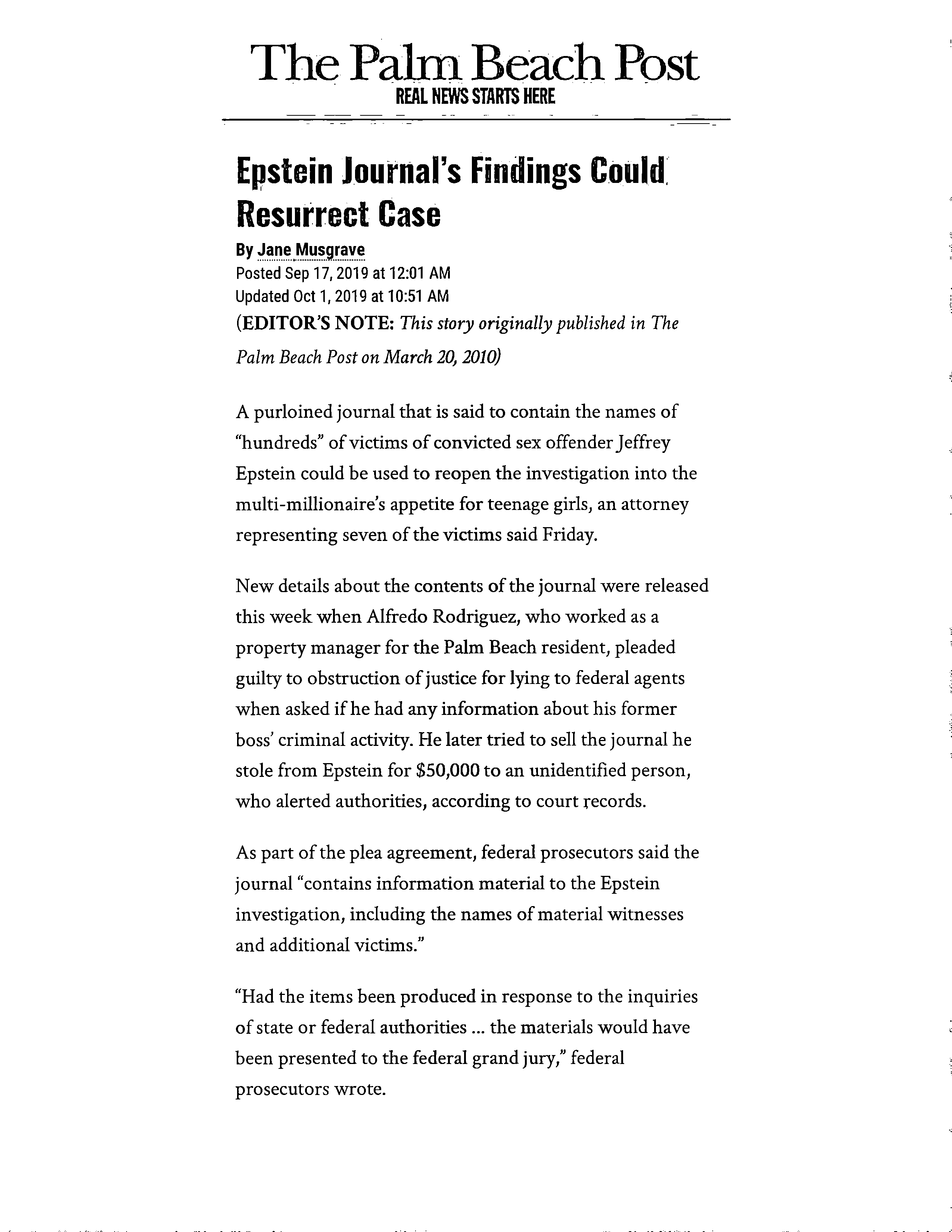
Page 674
document
2550 x 3300
Objects: Page, Text, Advertisement, Poster | Text: The Palm Beach Post | REAL NEWS STARTS HERE | Eps
Page 675
document
2550 x 3300
Objects: Page, Text, Letter | Text: Instead, prosecutors short-circuited the grand jury | investigat
Page 676
document
2550 x 3300
Objects: Page, Text, Letter | Text: represent any of the victims on the list who wanted to | pursue
Page 677
document
2550 x 3300
Objects: Page, Text, Advertisement, Poster | Text: The Palm Beach Post | REAL NEWS STARTS HERE | Eps
Page 678
document
2550 x 3300
Objects: Page, Text, Letter | Text: The revelations of the settlements came as part of an ongoing la
Page 679
document
2550 x 3300
Objects: Page, Text, Letter, Book, Publication | Text: Pointing out Epstein's enormous wealth and hi
Page 680
document
2550 x 3300
Objects: Page, Text, Advertisement, Poster | Text: Palm Beach Daily News | Judge rules feds' agreeme
Page 681
document
2550 x 3300
Objects: Page, Text, Letter | Text: Prosecutors' failure to alert the young women about the | deal v
Page 682
document
2550 x 3300
Objects: Page, Text, Letter | Text: "I don't see the government conceding to that remedy," | Scarola
Page 683
document
2550 x 3300
Objects: Page, Text, Letter | Text: Even if Marra agrees to toss out the non-prosecution | agreement
Page 684
document
2550 x 3300
Objects: Page, Text, Letter | Text: In his ruling, Marra detailed what appeared to be a cozy | relat
Page 685
document
2550 x 3300
Objects: Page, Text, Letter | Text: Such cooperation between prosecutors and defense | attorneys is
Page 686
document
2550 x 3300
Objects: Page, Text, Letter | Text: 76 / 278 - Tuesday, July 9, 2019 | Edition: Final | Section: A S
Page 687
document
2550 x 3300
Objects: Page, Text, Letter | Text: "We think he's a significant flight risk," Berman said of the ma
Page 688
document
2550 x 3300
Objects: Page, Text, Letter | Text: U.S. District Judge Kenenth Marra has already ruled that Acosta
Page 689
document
2550 x 3300
Objects: Page, Text, Letter | Text: "If you believe you are a victim of this man, Jeffrey Epstein, w
Page 690
document
2550 x 3300
Objects: Text | Text: Appendix 13
Page 691
document
2550 x 3300
Objects: Page, Text, Document, Invoice | Text: HEARING | June 03, 2020 | CA FLORIDA HOLDINGS vs DAVE

Page 691
document
1924 x 2883
Objects: Page, Text | Text: IN THE CIRCUIT COURT | IN AND FOR PALM BEACH COUNTY, FLORIDA | CASE NO.
Page 692
document
2550 x 3300
Objects: Page, Text | Text: HEARING | June 03, 2020 | CA FLORIDA HOLDINGS vs DAVE ARONBERG | 2 | 1

Page 692
document
1924 x 2883
Objects: Page, Text | Text: On behalf of the Plaintiff/Petitioner: | GREENBERG TRAURIG, P.A. | 1840
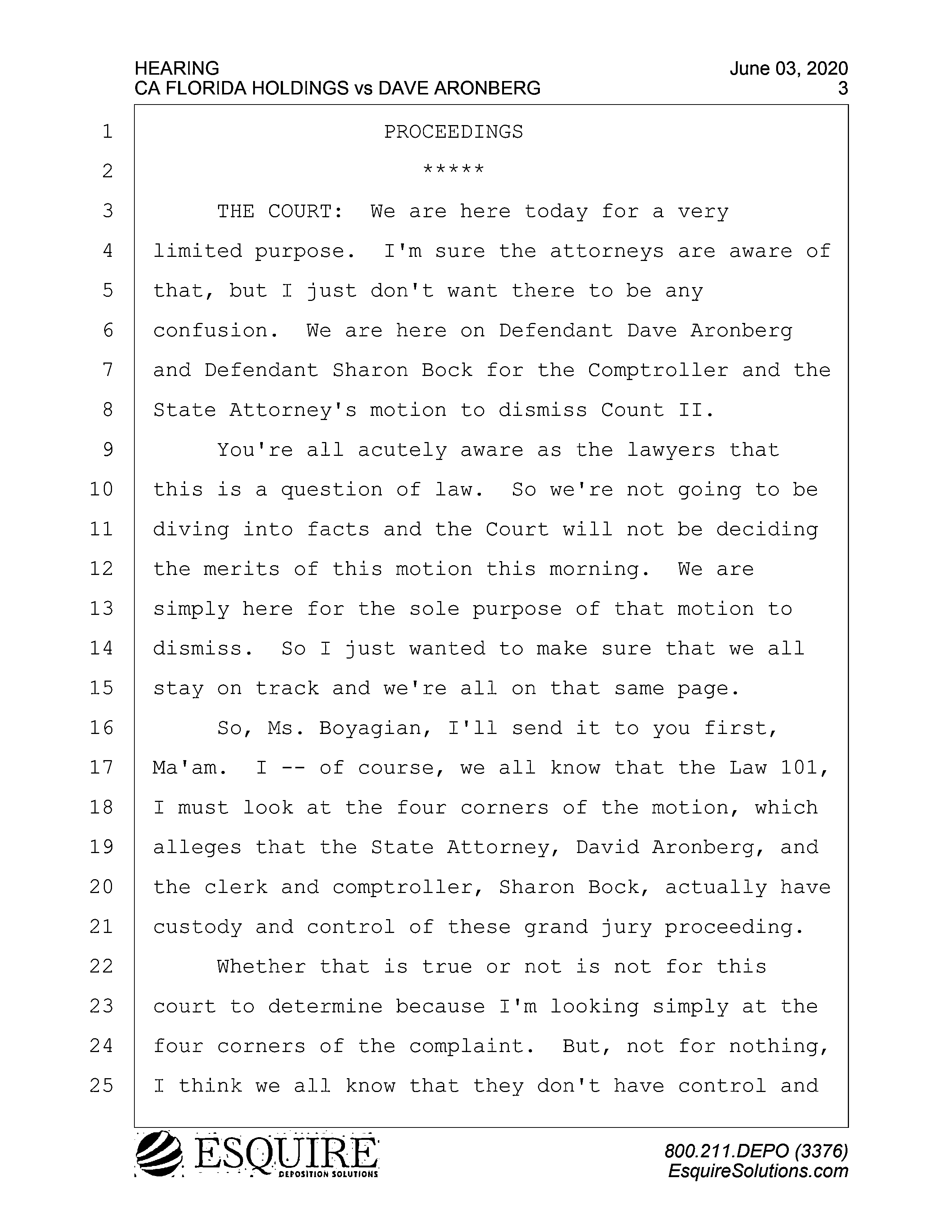
Page 693
document
2550 x 3300
Objects: Page, Text | Text: HEARING | June 03, 2020 | CA FLORIDA HOLDINGS vs DAVE ARONBERG | 3 | PRO

Page 693
document
1924 x 2883
Objects: Page, Text, Letter | Text: PROCEEDINGS | ***** | THE COURT : We are here today for a very |
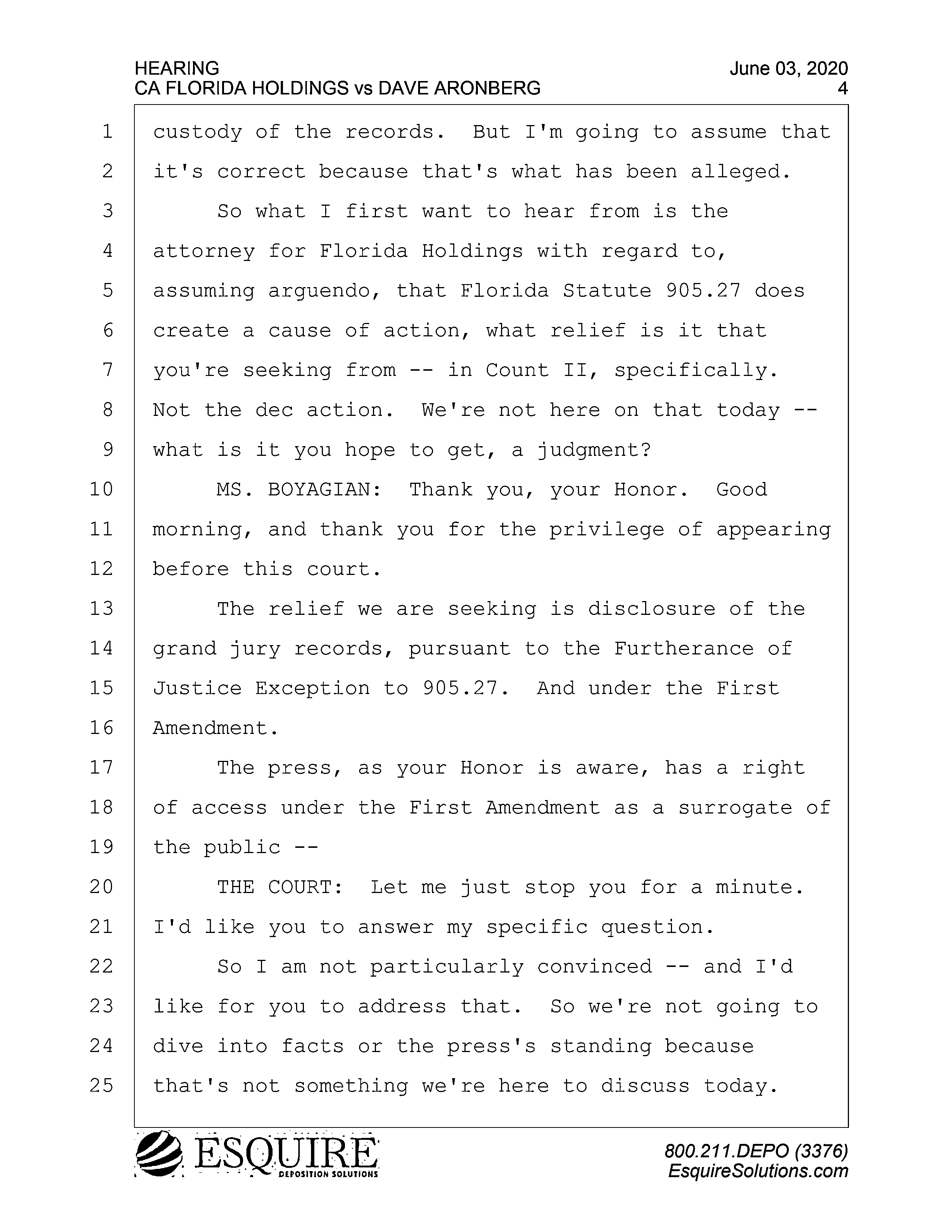
Page 694
document
2550 x 3300
Objects: Page, Text | Text: HEARING | June 03, 2020 | CA FLORIDA HOLDINGS vs DAVE ARONBERG | 4 | 1

Page 694
document
1924 x 2883
Objects: Page, Text, Letter, Advertisement | Text: custody of the records. But I'm going to assume t
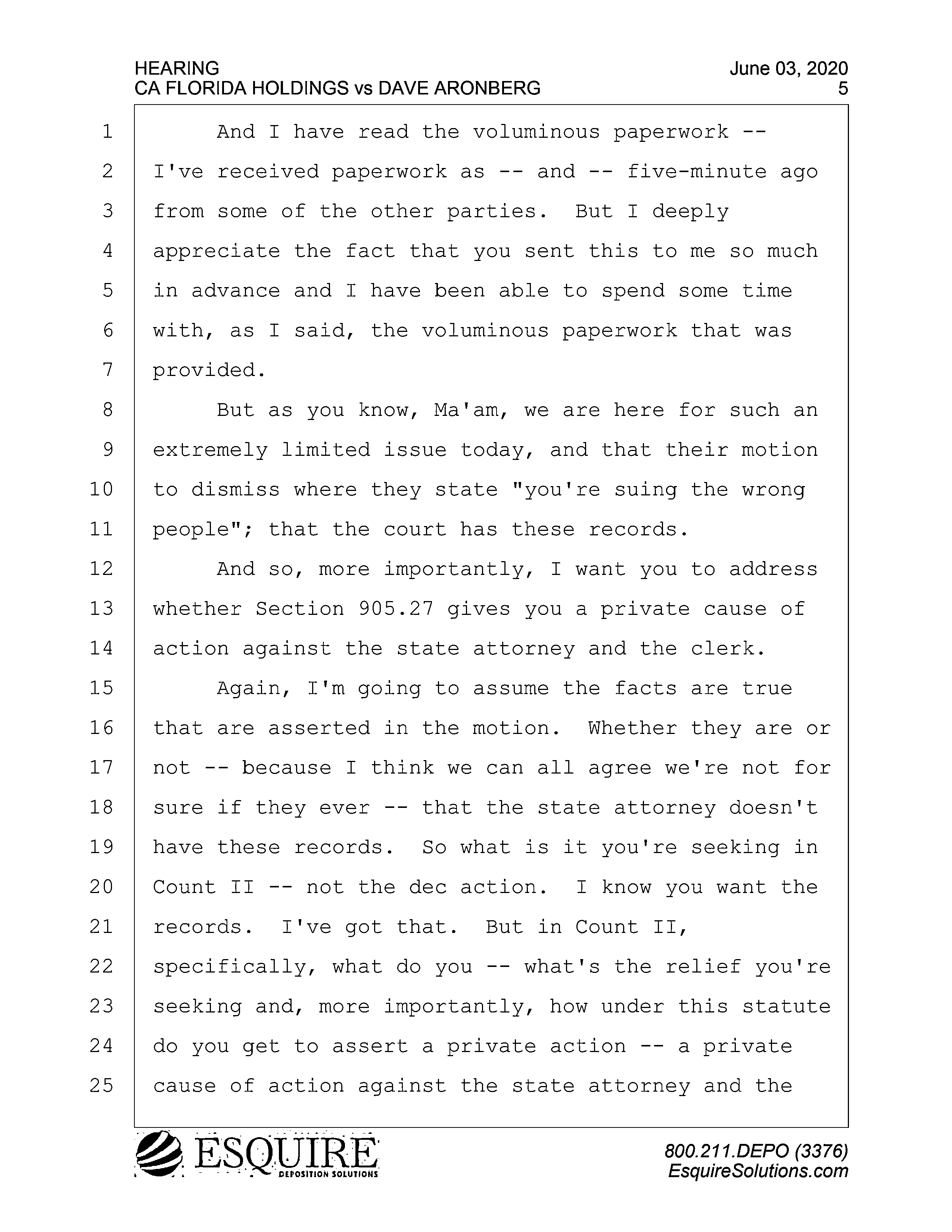
Page 695
document
2550 x 3300
Objects: Page, Text | Text: HEARING | June 03, 2020 | CA FLORIDA HOLDINGS vs DAVE ARONBERG | 5 | 1

Page 695
document
1924 x 2883
Objects: Page, Text, Letter | Text: And I have read the voluminous paperwork -- | I've received pape
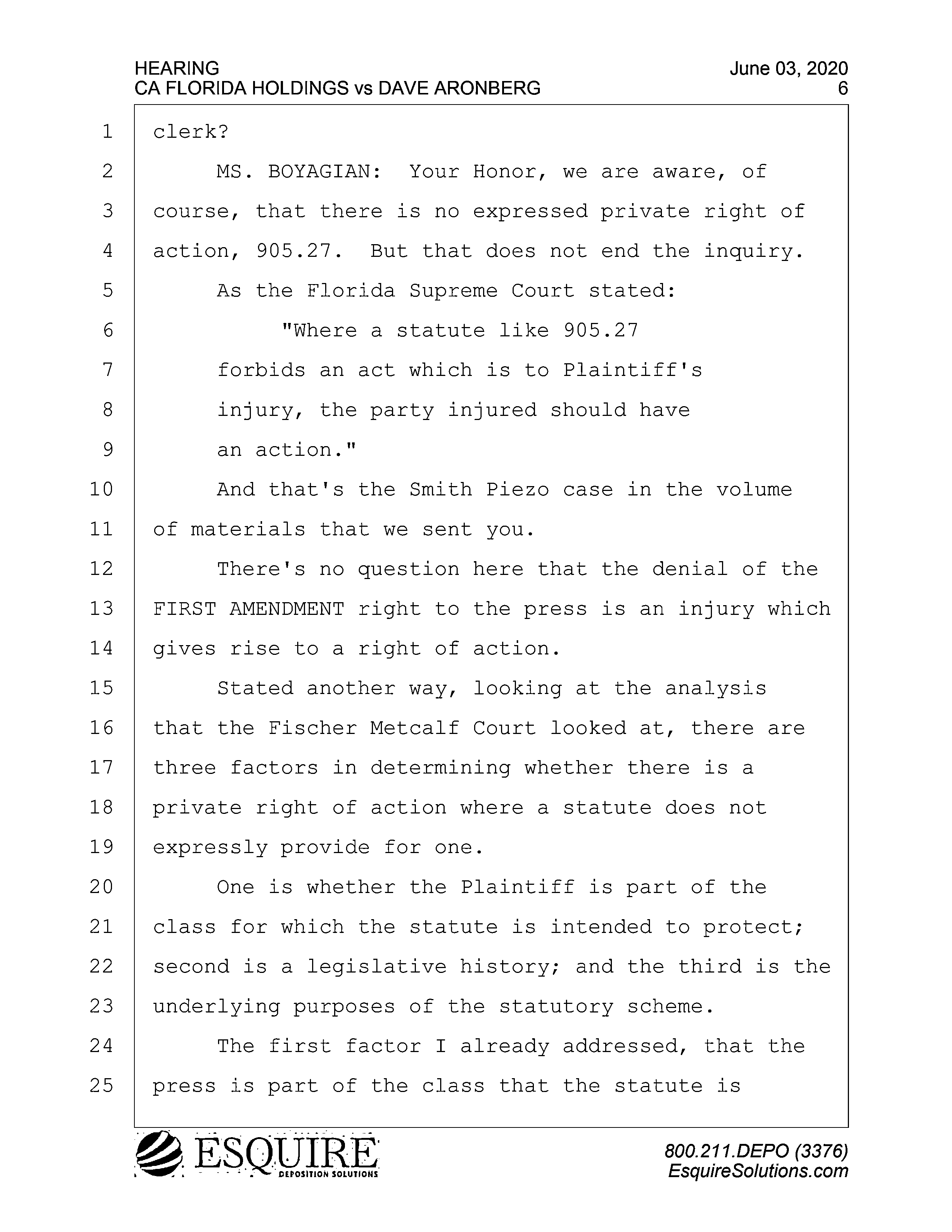
Page 696
document
2550 x 3300
Objects: Page, Text | Text: HEARING | June 03, 2020 | CA FLORIDA HOLDINGS vs DAVE ARONBERG | 6 | cle

Page 696
document
1924 x 2883
Objects: Page, Text, Letter, Advertisement | Text: clerk? | MS. BOYAGIAN: | Your Honor, we are aware
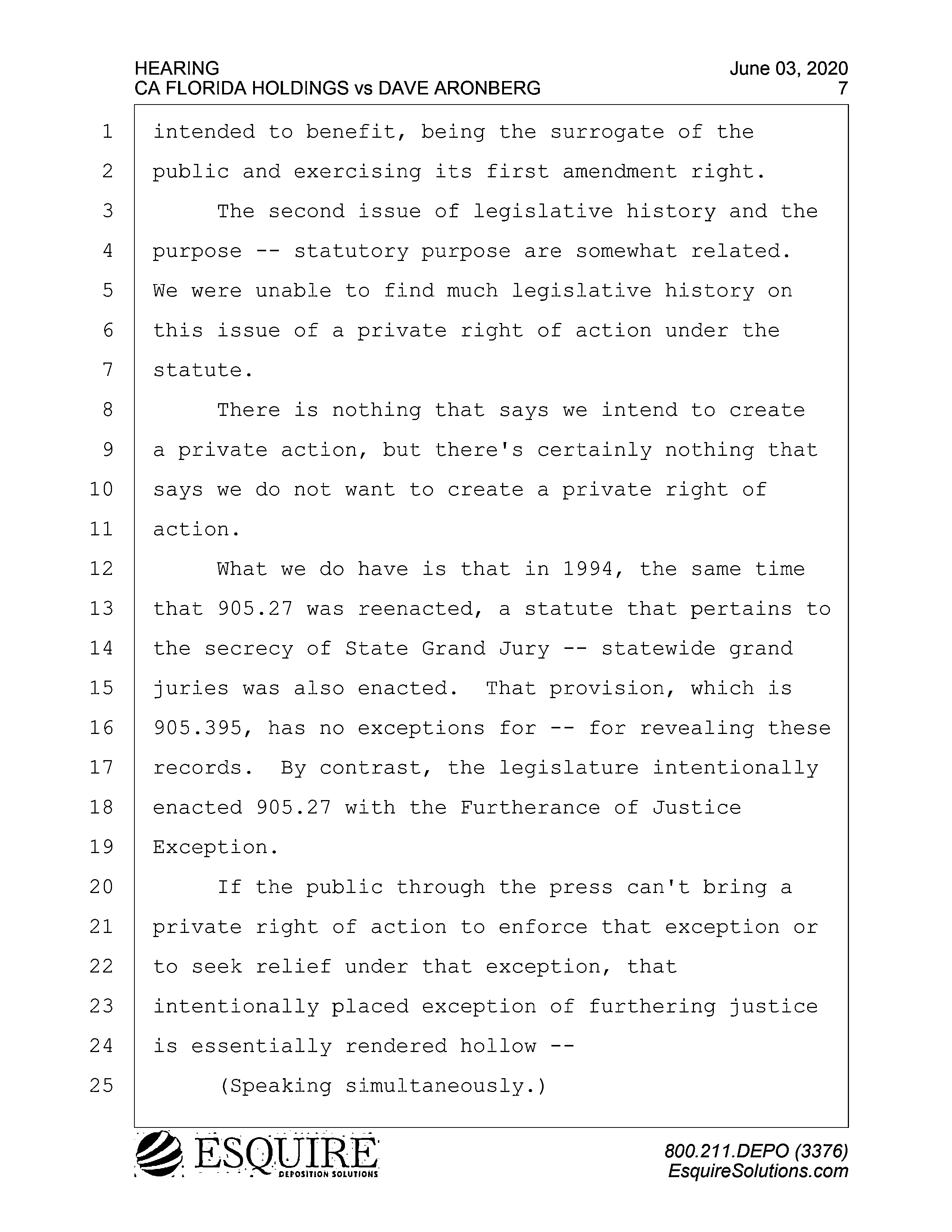
Page 697
document
2550 x 3300
Objects: Page, Text | Text: HEARING | June 03, 2020 | CA FLORIDA HOLDINGS vs DAVE ARONBERG | 7 | 1

Page 697
document
1924 x 2883
Objects: Page, Text, Letter | Text: intended to benefit, being the surrogate of the | public and exe
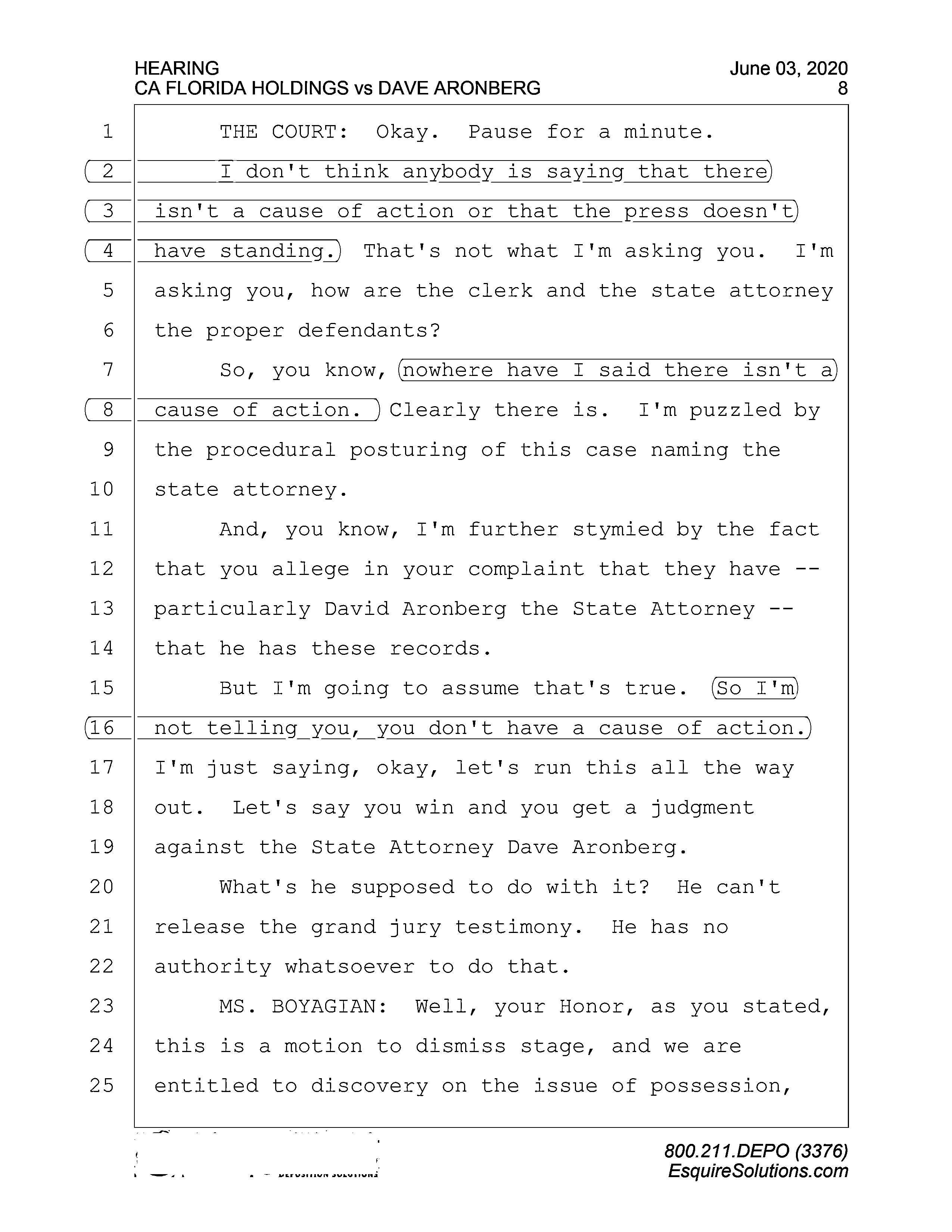
Page 698
document
2550 x 3300
Objects: Page, Text | Text: HEARING | June 03, 2020 | CA FLORIDA HOLDINGS vs DAVE ARONBERG | 8 | 1

Page 698
document
2056 x 2766
Objects: Page, Text, Chart, Plot | Text: 1 | THE COURT : | Okay. | Pause for a minute. | 2

Page 698
document
656 x 126
Objects: Logo, Text, Face, Head, Person | Text: UIRE | DEPOSITION SOLUTIONS
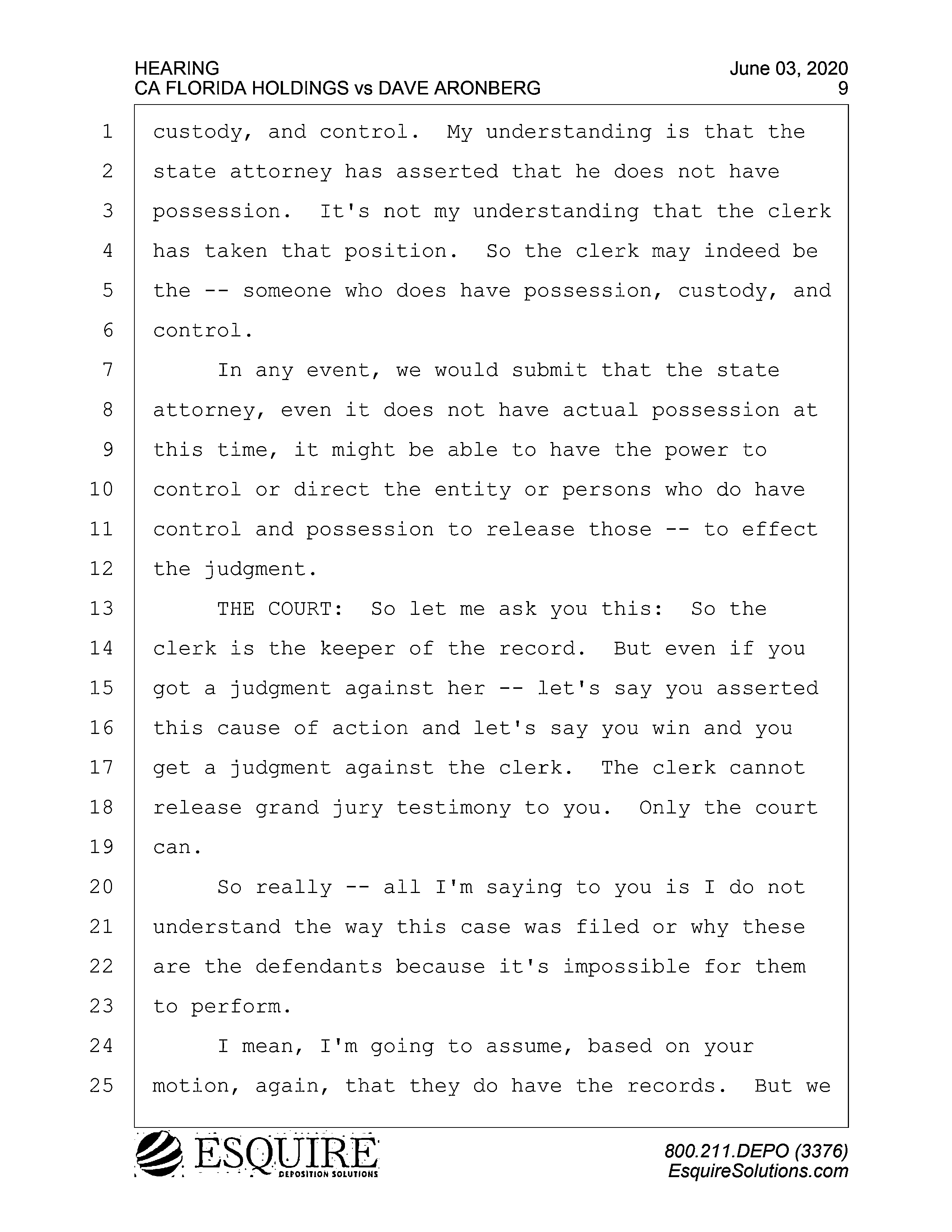
Page 699
document
2550 x 3300
Objects: Page, Text | Text: HEARING | June 03, 2020 | CA FLORIDA HOLDINGS vs DAVE ARONBERG | 9 | 1

Page 699
document
1924 x 2883
Objects: Page, Text, Letter | Text: custody, and control. My understanding is that the | state attor
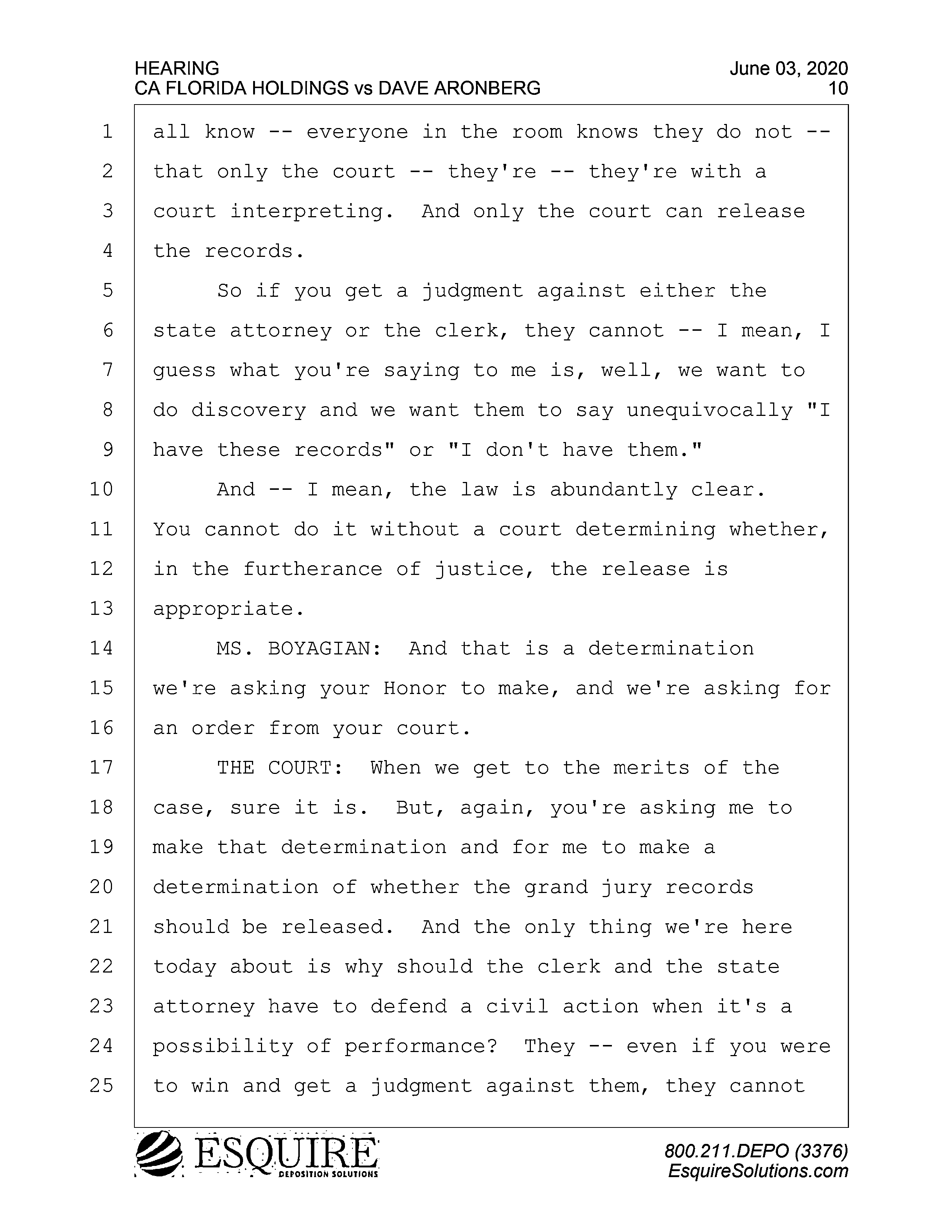
Page 700
document
2550 x 3300
Objects: Page, Text | Text: HEARING | June 03, 2020 | CA FLORIDA HOLDINGS vs DAVE ARONBERG | 10 | 1

Page 700
document
1924 x 2883
Objects: Page, Text, Letter | Text: all know -- - everyone in the room knows they do not - - - | tha
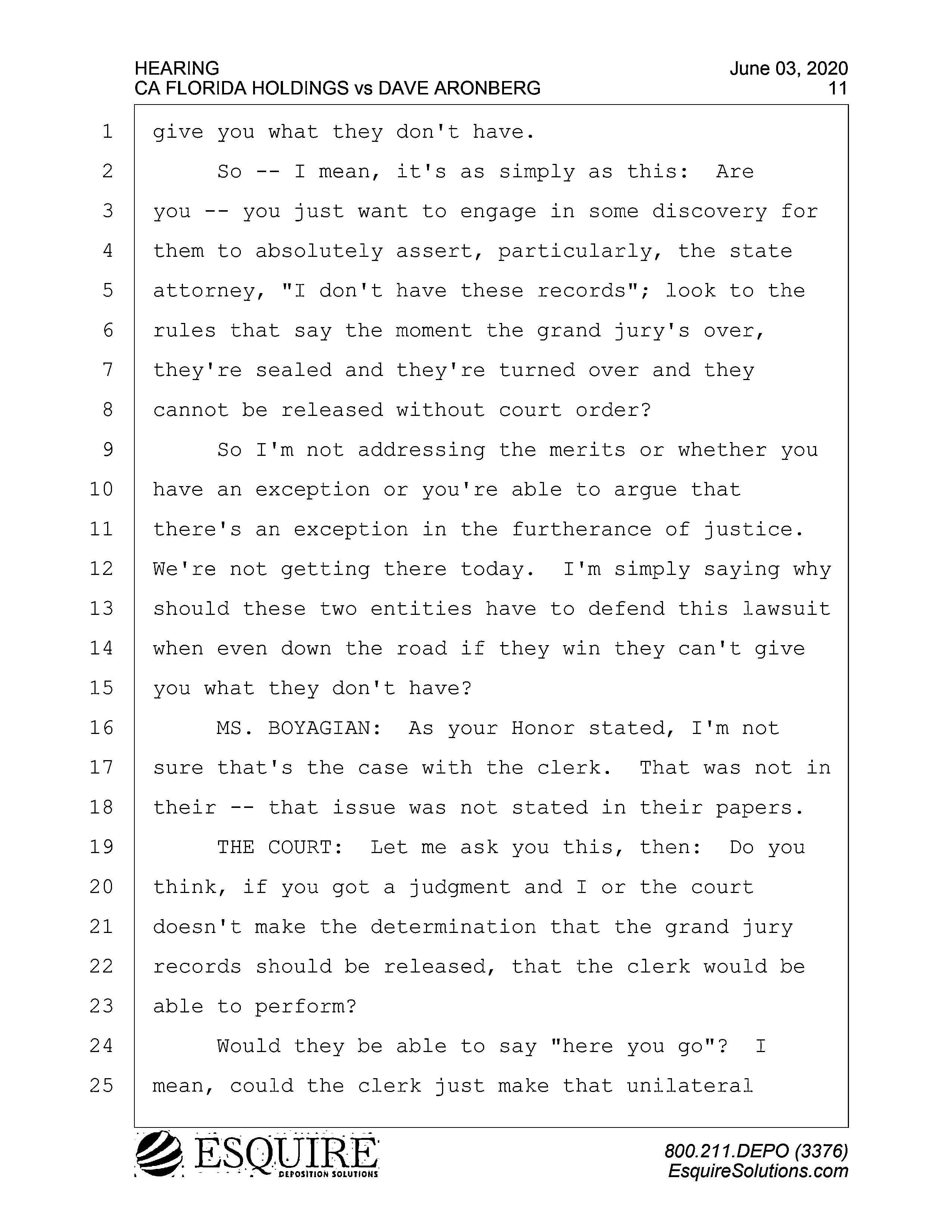
Page 701
document
2550 x 3300
Objects: Page, Text | Text: HEARING | June 03, 2020 | CA FLORIDA HOLDINGS vs DAVE ARONBERG | 11 | 1

Page 701
document
1924 x 2883
Objects: Page, Text, Letter | Text: give you what they don't have. | So - - I mean, it's as simply a
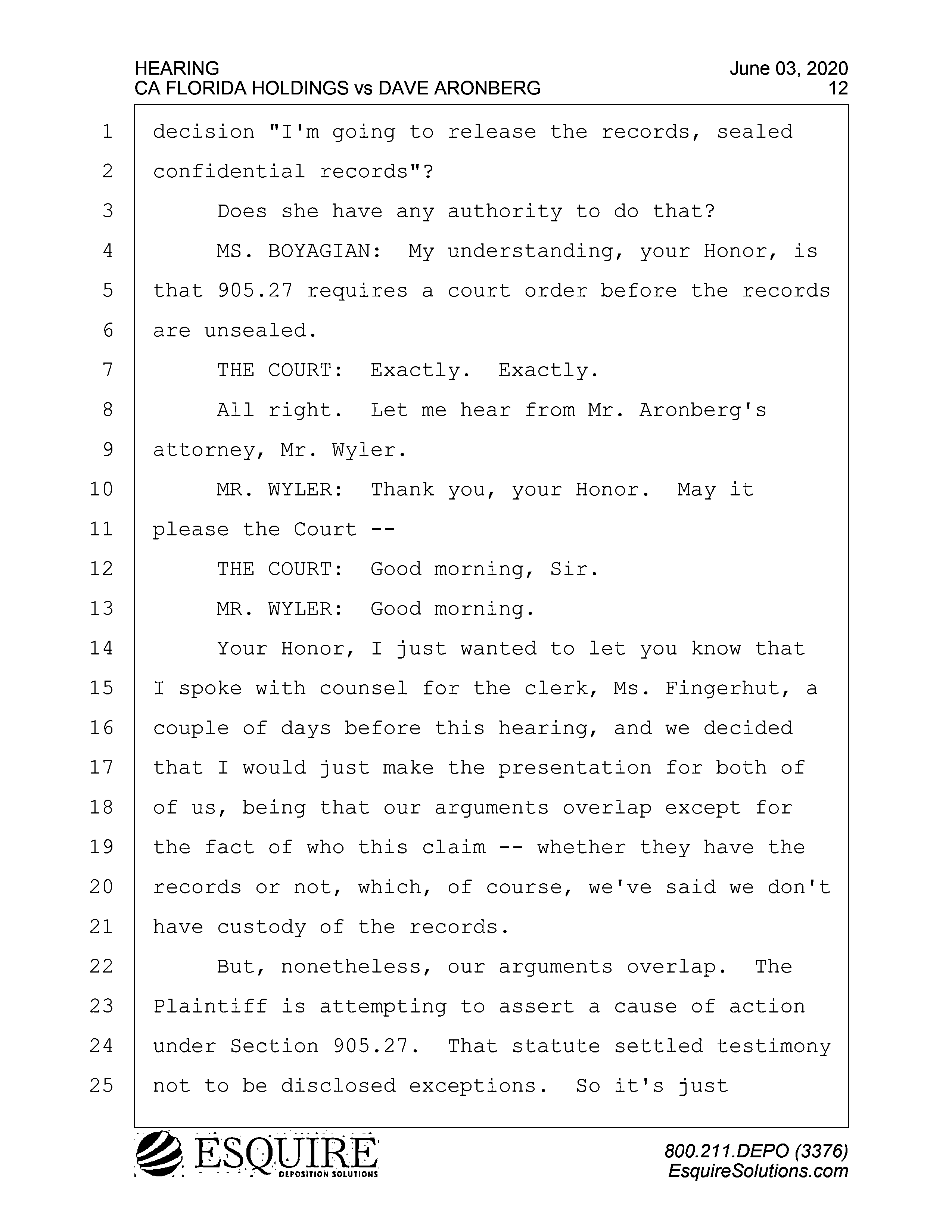
Page 702
document
2550 x 3300
Objects: Page, Text | Text: HEARING | June 03, 2020 | CA FLORIDA HOLDINGS vs DAVE ARONBERG | 12 | 1

Page 702
document
1924 x 2883
Objects: Page, Text, Letter | Text: decision "I'm going to release the records, sealed | confidentia
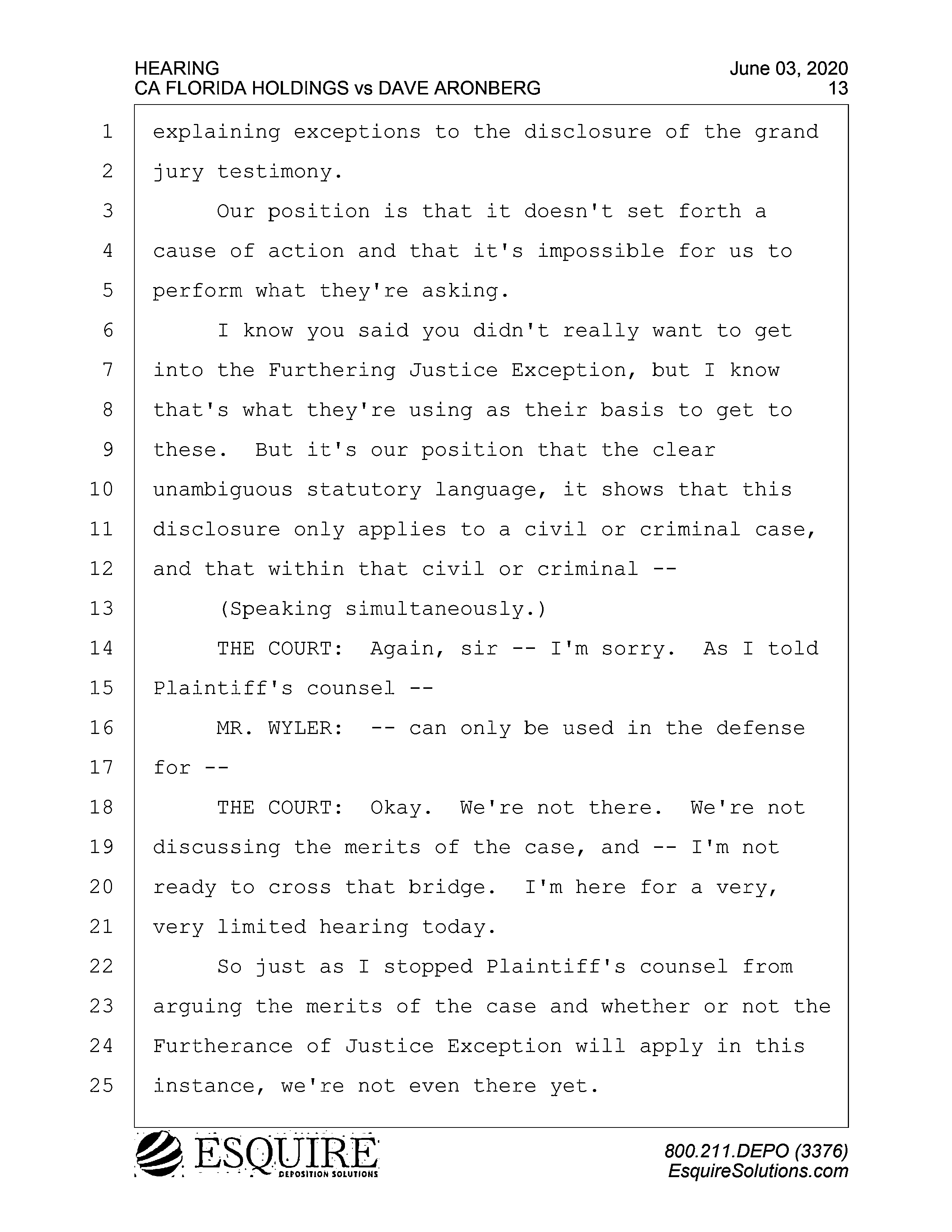
Page 703
document
2550 x 3300
Objects: Page, Text | Text: HEARING | June 03, 2020 | CA FLORIDA HOLDINGS vs DAVE ARONBERG | 13 | 1

Page 703
document
1924 x 2883
Objects: Page, Text, Letter | Text: explaining exceptions to the disclosure of the grand | jury test
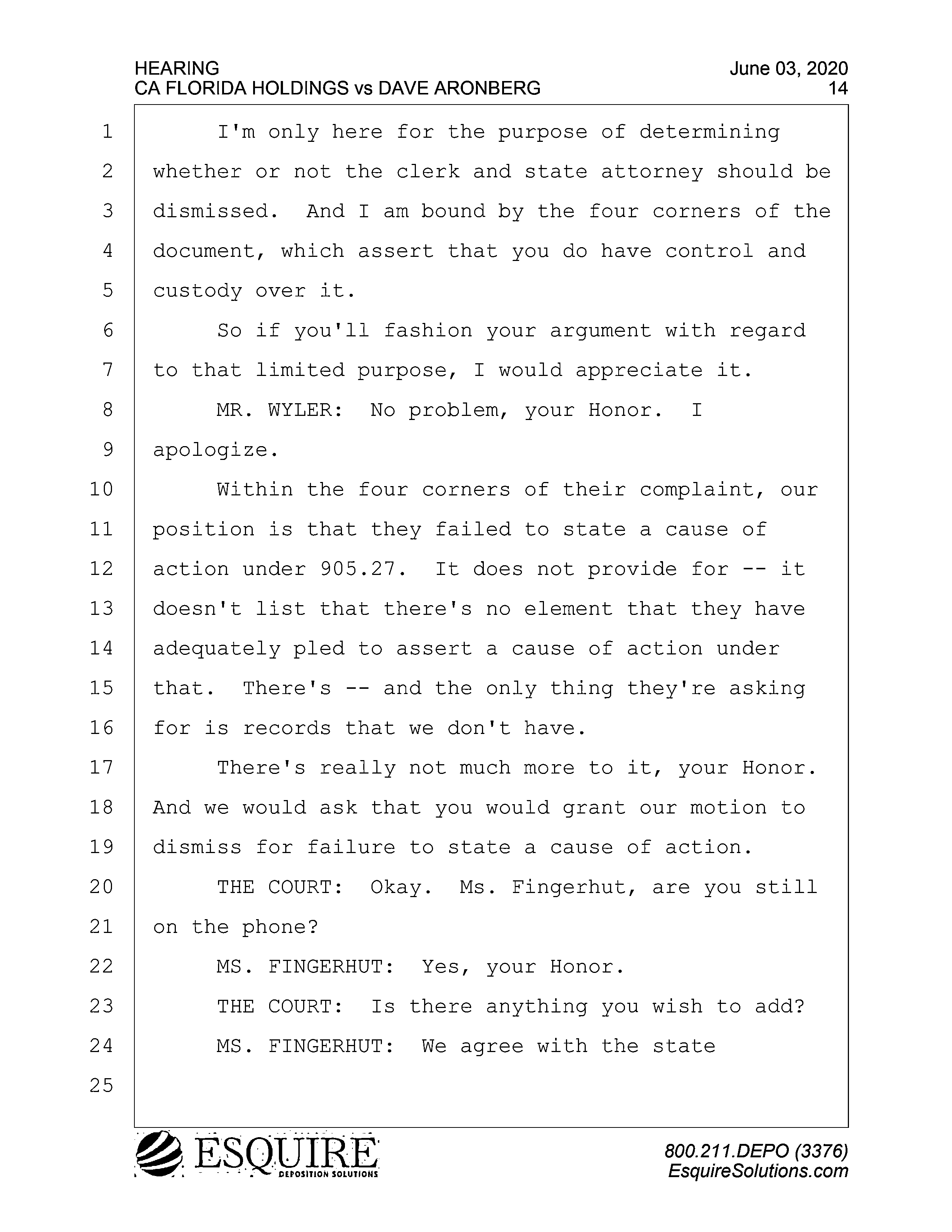
Page 704
document
2550 x 3300
Objects: Page, Text | Text: HEARING | June 03, 2020 | CA FLORIDA HOLDINGS vs DAVE ARONBERG | 14 | 1

Page 704
document
1924 x 2883
Objects: Page, Text, Letter | Text: I'm only here for the purpose of determining | whether or not th
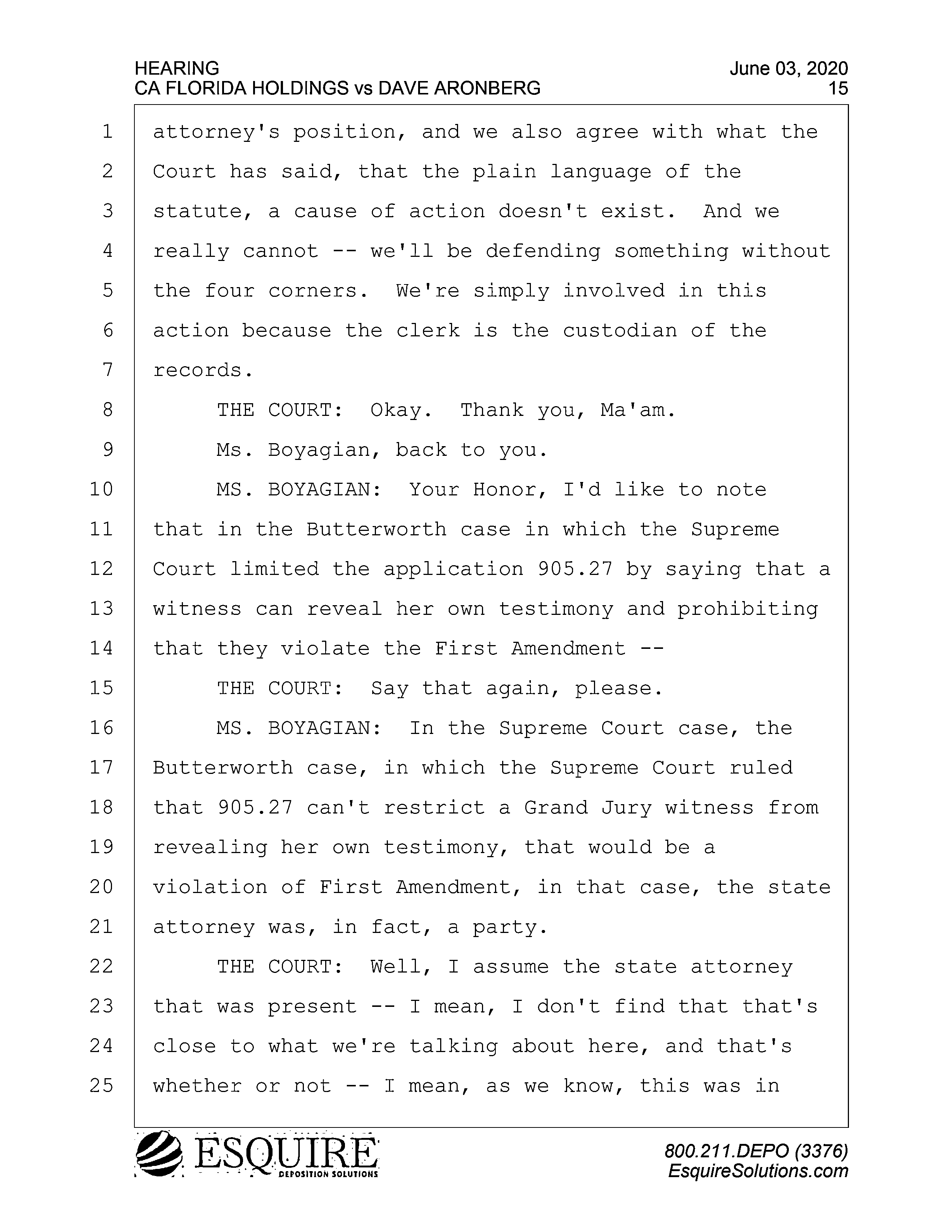
Page 705
document
2550 x 3300
Objects: Page, Text | Text: HEARING | June 03, 2020 | CA FLORIDA HOLDINGS vs DAVE ARONBERG | 15 | 1

Page 705
document
1924 x 2883
Objects: Page, Text, Letter | Text: attorney's position, and we also agree with what the | Court has
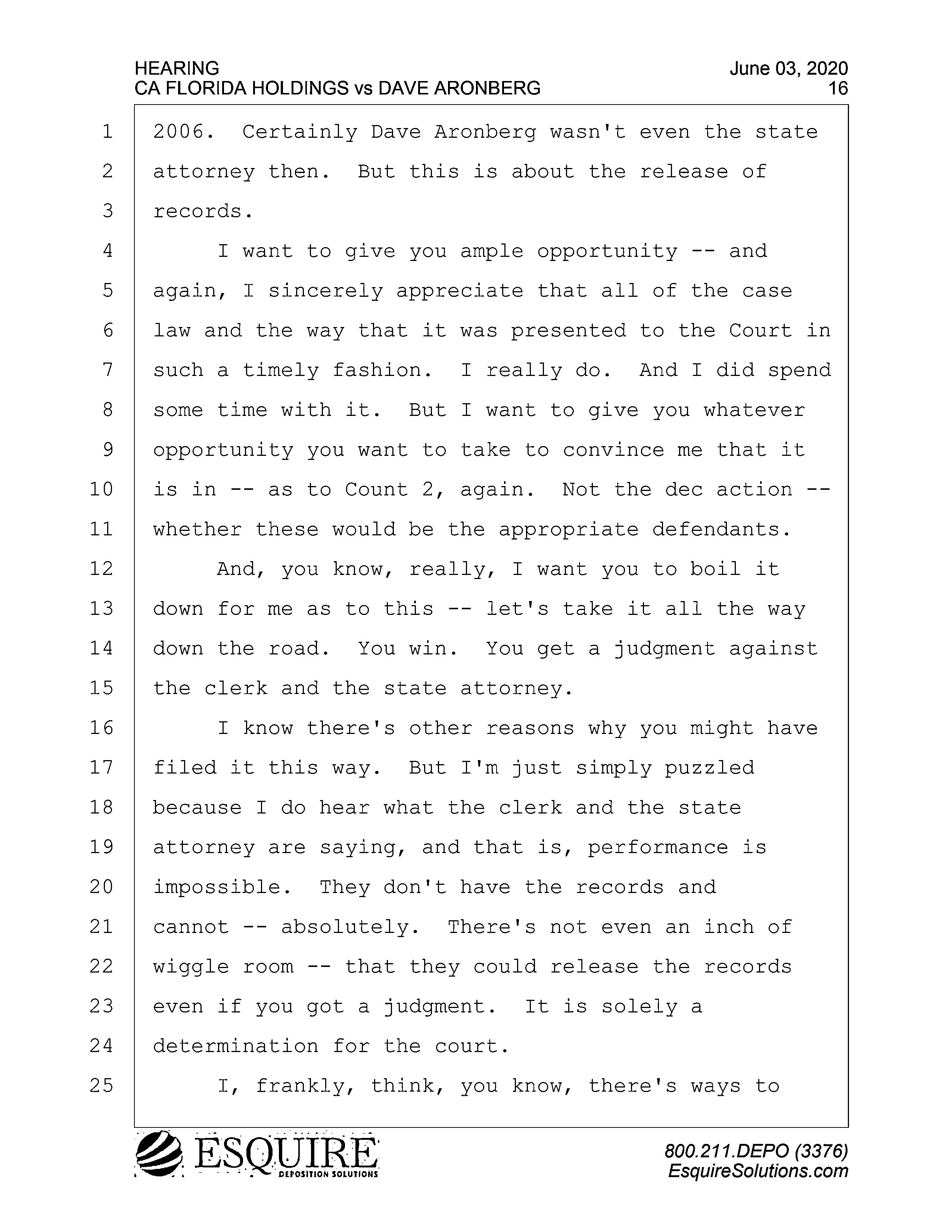
Page 706
document
2550 x 3300
Objects: Page, Text | Text: HEARING | June 03, 2020 | CA FLORIDA HOLDINGS vs DAVE ARONBERG | 16 | 1

Page 706
document
1924 x 2883
Objects: Page, Text, Letter | Text: 2006. Certainly Dave Aronberg wasn't even the state | But this i
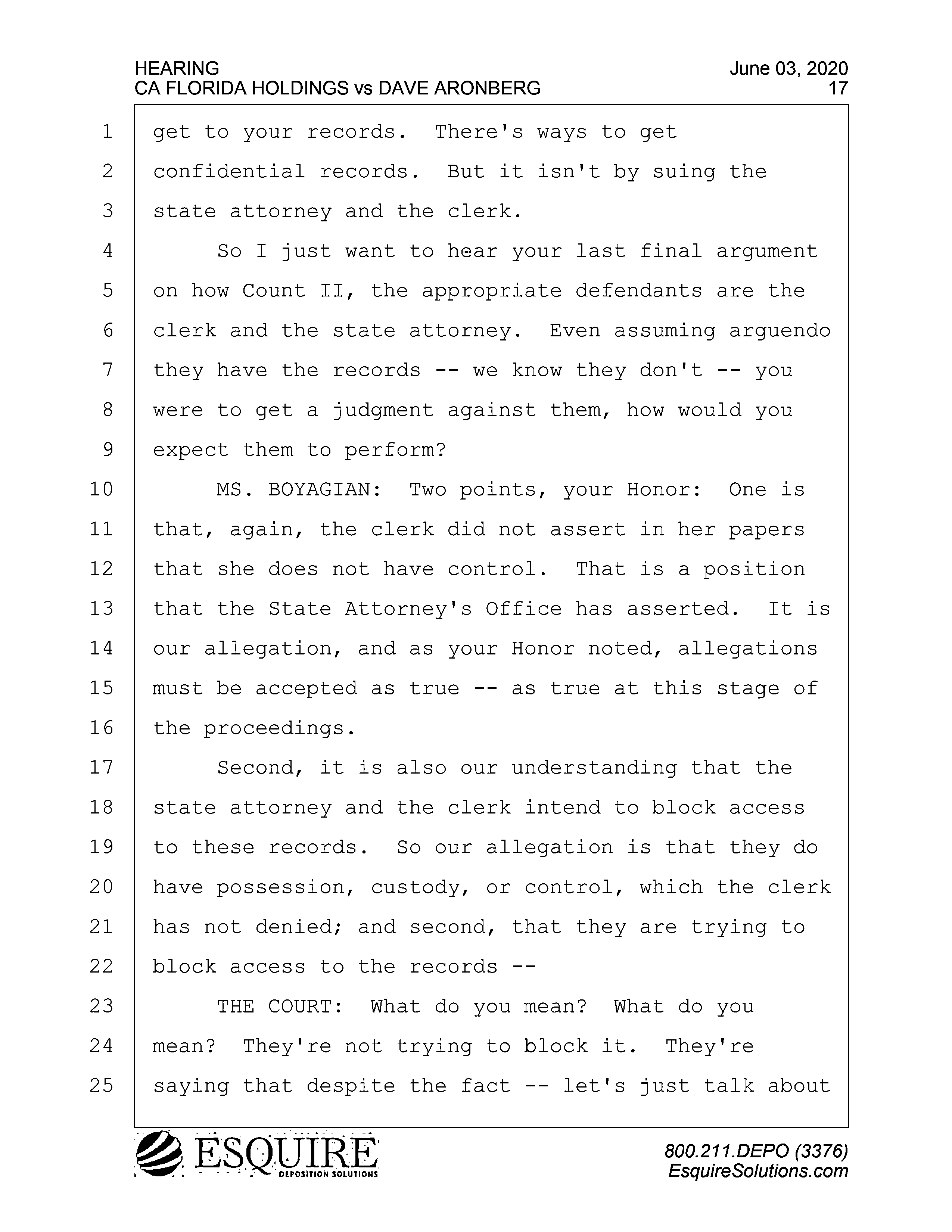
Page 707
document
2550 x 3300
Objects: Page, Text | Text: HEARING | June 03, 2020 | CA FLORIDA HOLDINGS vs DAVE ARONBERG | 17 | 1

Page 707
document
1924 x 2883
Objects: Page, Text, Letter | Text: There's ways to get | get to your records. | confidential record
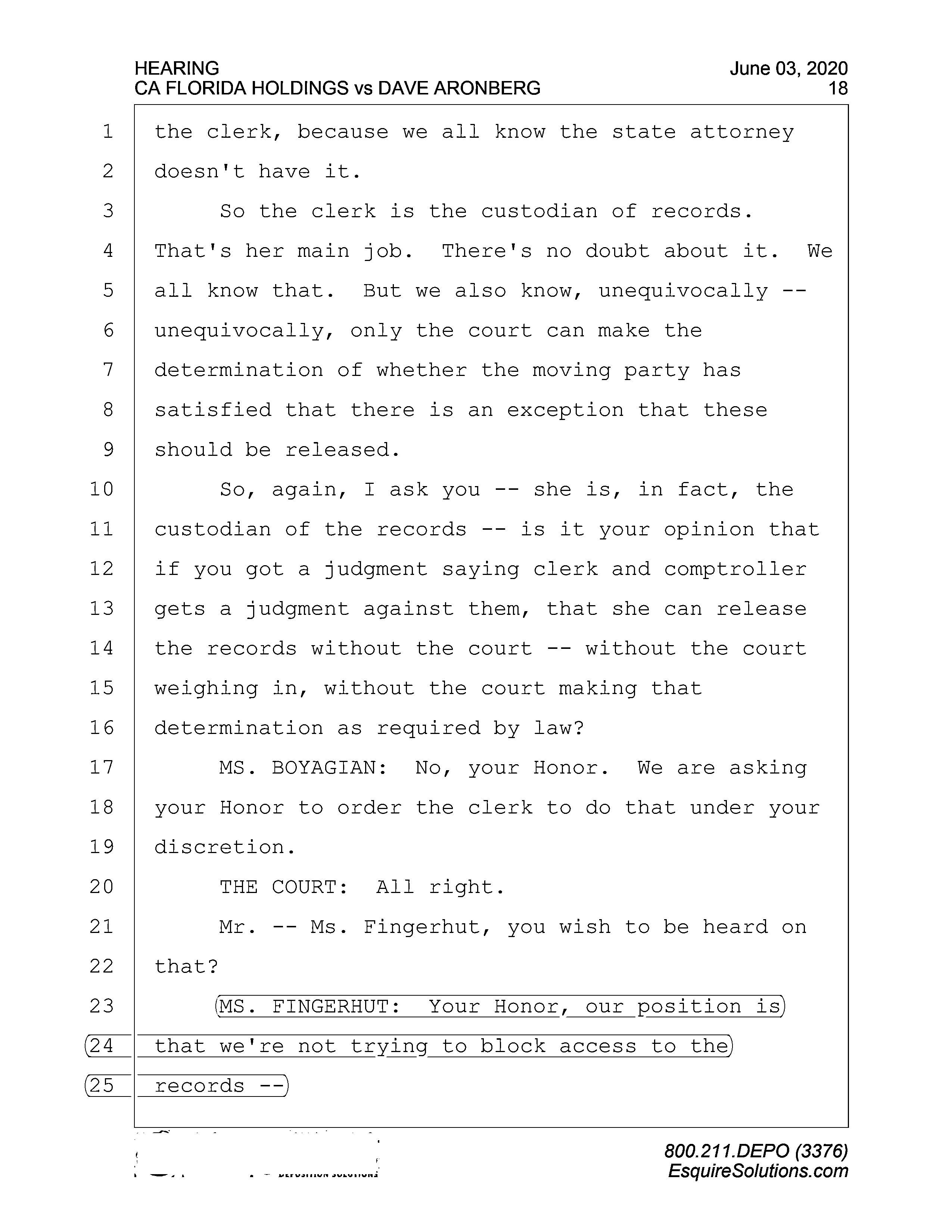
Page 708
document
2550 x 3300
Objects: Page, Text | Text: HEARING | June 03, 2020 | CA FLORIDA HOLDINGS vs DAVE ARONBERG | 18 | 1

Page 708
document
2056 x 2766
Objects: Page, Text, Chart, Plot | Text: 1 | the clerk, because we all know the state attorney | 2 |

Page 708
document
656 x 126
Objects: Logo, Text, Face, Head, Person | Text: UIRE | DEPOSITION SOLUTIONS
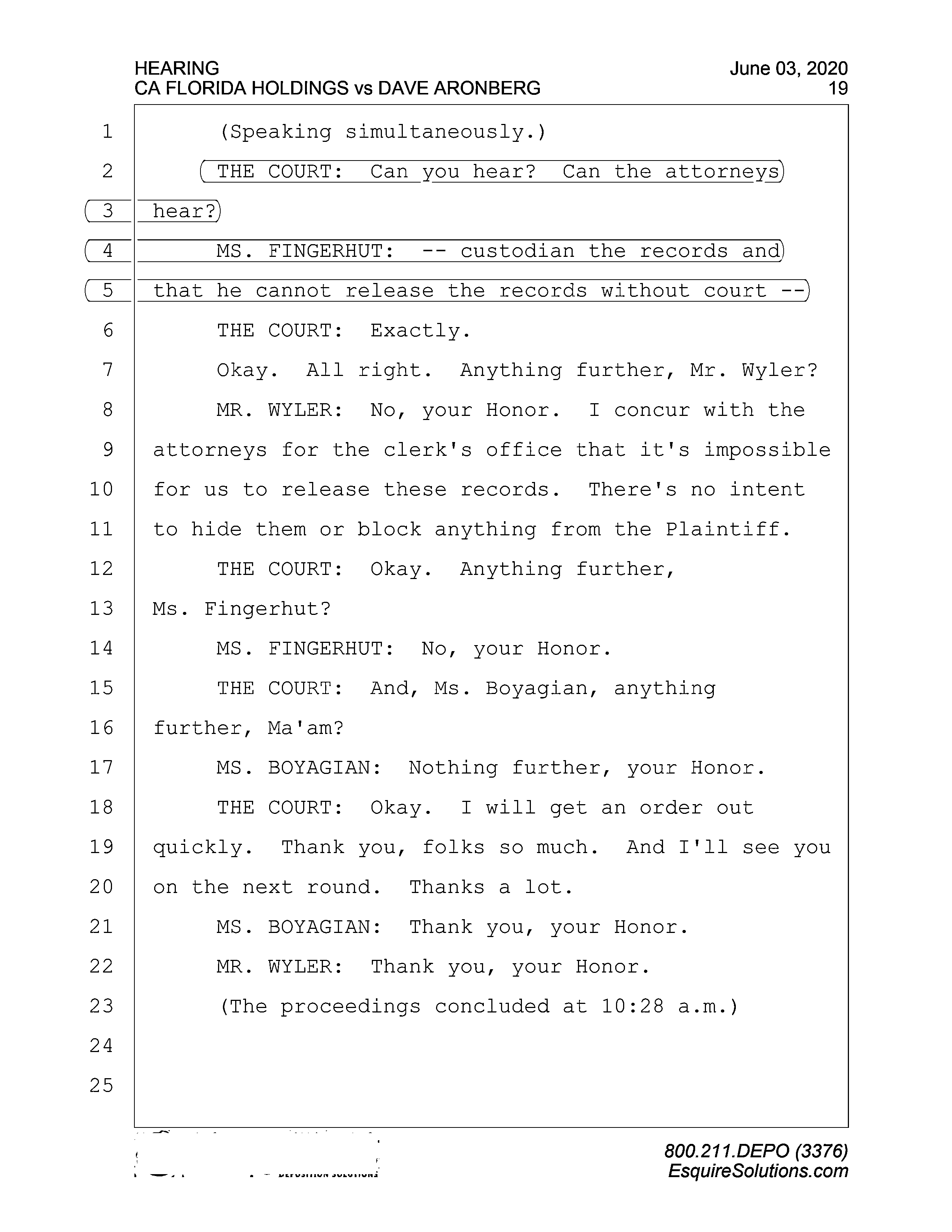
Page 709
document
2550 x 3300
Objects: Page, Text, Chart, Plot | Text: HEARING | June 03, 2020 | CA FLORIDA HOLDINGS vs DAVE ARONB

Page 709
document
2056 x 2766
Objects: Page, Text, Chart, Plot | Text: 1 | (Speaking simultaneously.) | 2 | THE COURT : | Can you

Page 709
document
656 x 126
Objects: Logo, Text, Face, Head, Person | Text: UIRE | DEPOSITION SOLUTIONS
Page 710
document
2550 x 3300
Objects: Page, Text, Document, Invoice | Text: HEARING | June 03, 2020 | CA FLORIDA HOLDINGS vs DAVE

Page 710
document
1924 x 2883
Objects: Page, Text, Document, Invoice | Text: CERTIFICATE OF REPORTER | I, Sonja M. Reed, Court Rep
Page 710
document
914 x 216
Objects: Handwriting, Text, Signature
- Abe Gosman (p.630) 95%
- Abe Gosman (p.631) 95%
- Abigail Kurland (p.531) 95%
- Accuse Villafana (p.73) 50%
- Accuse Villafana (p.179) 50%
- Aclivily Drug (p.421) 5%
- Acosta Advises (p.78) 5%
- Acosta Advises (p.297) 5%
- Acosta Agrees (p.73) 5%
- Acosta Agrees (p.140) 5%
- Acosta Agrees (p.172) 5%
- Acosta Agrees (p.180) 5%
- Acosta Agrees (p.72) 5%
- Acosta Asks (p.73) 5%
- Acosta Asks (p.183) 5%
- Acosta Attempts (p.73) 95%
- Acosta Attempts (p.181) 95%
- Acosta Decides (p.71) 95%
- Acosta Decides (p.129) 95%
- Acosta Edits (p.72) 5%
- ...and 2618 more
- 127 The St (p.162) address
- 158 After St (p.181) address
- 18 United St (p.304) address
- 18205 Biscayne Boulevard (p.405) address
- 18205 Biscayne Boulevard (p.417) address
- 19 Ken St (p.409) address
- 2139 Palm Beach Lakes Boulevard (p.405) address
- 2139 Palm Beach Lakes Boulevard (p.417) address
- 224 Datura Street (p.405) address
- 224 Datura Street (p.417) address
- 250 Australian Avenue (p.5) address
- 250 Australian Avenue (p.6) address
- 250 Australian Avenue (p.20) address
- 250 Australian Avenue (p.21) address
- 250 Australian Avenue (p.22) address
- 250 South Australian Avenue (p.405) address
- 345 South County Road (p.420) address
- 345 United St (p.310) address
- 357 Assistant St (p.314) address
- 358 El Brillo Way (p.405) property
- ...and 1333 more
- File Path
- additional_files/059.pdf
- File Size
- 18,633 KB
- Processed
- 2025-12-20 18:40
- Status
- completed
-
2020.11 DOJ Office of Professional Responsibility Report.pdf
Unknown - 348 pages
653 shared people 231 shared places -
074.pdf
Unknown - 338 pages
250 shared people 67 shared places -
171.pdf
Unknown - 175 pages
245 shared people 71 shared places -
166.pdf
Unknown - 160 pages
234 shared people 63 shared places -
146.pdf
Unknown - 92 pages
233 shared people 58 shared places -
153.pdf
Unknown - 94 pages
227 shared people 56 shared places -
205.pdf
Unknown - 91 pages
223 shared people 55 shared places -
Epstein Part 17 (Redacted).pdf
Unknown - 151 pages
91 shared people 40 shared places -
795 (1).pdf
Unknown - 338 pages
71 shared people 38 shared places -
795.pdf
Unknown - 338 pages
71 shared people 38 shared places -
745.pdf
Unknown - 154 pages
42 shared people 22 shared places -
1319.pdf
Unknown - 294 pages
49 shared people 11 shared places -
1417.pdf
Unknown - 258 pages
45 shared people 11 shared places -
787-01.pdf
Unknown - 73 pages
32 shared people 21 shared places -
1338.pdf
Unknown - 84 pages
38 shared people 14 shared places